Archives for category: Students

Teachers College Press released this description of recent research on school choice.

Does School Choice Mean Parents or Schools Do the Choosing?

Dr. Barbara Ferguson
Research on Reforms, Inc.


In their book on school choice, the authors ponder the question: “Does School Choice Mean Parents or Schools Do the Choosing?”

The book is published by Teachers College Press at Columbia University* and its authors, Wagma Mommandi and Kevin Welner, begin by citing the driving force behind school choice, which is to remove the “government monopoly on schools and let families choose the school for their children.”

But, through their decades of research, the authors conclude that “charter schools often play an outsize role in shaping enrollment.” They cite an assortment of practices that charter schools have implemented to deter the enrollment of certain groups of students. And they conclude, “even when parents are able to enroll their child in their preferred school of choice, academic requirements and disciplinary policies may prevent enrollment in subsequent years.”

These same conclusions were reached by Dr. Barbara Ferguson and published in her book: “Outcomes of the State Takeover of the New Orleans Schools” (2018). Dr. Ferguson uses the term “selective admission” for charter schools with enrollment practices that deter the enrollment of certain groups of students. The term “selective retention” is used for charter schools that have policies that prevent continued enrollment.

Charter schools are public schools, and they are supposed to be distinguished from the traditional public schools only by the governance structure. Charter schools are governed by private boards and traditional schools are governed by public boards. Yet, in New Orleans, the charter schools are allowed to enact admission and retention rules like those enacted by private schools..

“Selective Admission” allows charter schools to select the best and the brightest, and the wealthiest. Lycée Français charter school, in 2011-12, had a paid preschool program with a tuition of $4,570 and those preschool students gained automatic entry into the elementary charter school. They bypassed the lottery, which is required by federal law to be used when there are more applicants than spaces available in the school.

Benjamin Franklin, Lusher and Warren Easton were three successful magnet high schools that became charter schools and were allowed to keep their selective criteria for admission.“Selective Retention” allows charter schools to selectively remove underachieving and disruptive students:
• To continue their enrollment at Franklin and Lusher, students had to earn an overall 2.0 grade point average, and at Warren Easton an overall 1.5.

• At Hynes charter school: “Students with chronic attendance/tardy issues or with three or more suspensions will be ineligible to re-register.”

• At Mays charter school: “A student who misses ten or more consecutive days of school without notifying Mays Prep …is subject to being unenrolled at Mays Prep.”

• At Priestley charter school: “Students must maintain a 2.5 grade point average during the school year. Failure to do so will result in academic probation…and/or an invitation not to return the following year.”


• At Lake Forest Elementary charter school: “Failure to complete volunteer hours or participate in the mandatory fund raisers may result in loss of placement for your child.”This list can go on and on. The above information is taken from each school’s handbook and cited in Dr. Ferguson’s book.Perhaps the most egregious “Selective Retention” charter school scheme is expelling students for offenses for which they previously could not be expelled. Charter schools are allowed to develop their own rules for expulsion.


• At Miller-McCoy charter school, students can be expelled for “not attending tutoring, homework center…, misbehaving on the school bus, disrupting class….”


• At Arise Academy charter school, students can be expelled for “offenses, such as, disrespect, out of uniform, chewing gum…”


• At New Orleans College Prep charter school, students can be expelled “for repeated and fundamental disregard of school policies and procedures.”


• At Lafayette Academy charter school, students can be expelled for “unexcused or excessive absenteeism; cheating; failure to report to detention.”The list can go on and on. The above information is taken from each school’s handbook and cited in Dr. Ferguson’s book.

Charter schools not only developed their own rules for expulsion, but they could expel directly from the site level. Thus, a more tragic outcome was the aftermath of the expulsion. Previously, schools had to make a recommendation for expulsion to the district level. If the district office expelled the student, the district was then required to reassign the expelled student to another school. But charter schools were allowed to expel directly from the site level with no obligation to ensure that the student was re-enrolled in another school. Thus, the parents of the expelled student had to find another school which was almost impossible since charter schools can cap enrollment.

Constitutionally, each state has an obligation to educate all students to a given age which is established by the state. But that obligation is circumvented when no entity has the responsibility to ensure that a student expelled from a charter school is re-enrolled into another school. When the New Orleans School Board regained some control of the charter schools, they reversed the charter school site-level expulsion mandate, now requiring charter schools to recommend students for expulsion to the district office. If expelled, the district office then places the student into another school. However, two New Orleans high schools still retain language in their handbooks which state that they expel from the site level.

“Does school choice mean parents or schools do the choosing?” The Louisiana charter school law was intended for parents, especially parents of “at-risk” children and youth, to remove their students from “failing” schools and to choose a school with a higher rating. But the written law has not become the implemented law. New Orleans “at-risk” children and youth remain in the poorest performing schools.


________________________________Endnote:


*School’s Choice: How Charter Schools Control Access and Shape Their Enrollment (Teachers College Press, 2021) Authors: Wagma Mommandi and Kevin Welner.

Comments to bferguson@researchonreforms.orgResearch On Reforms Website

Steve Nelson is a retired educator. In this post, he contrasts the demands of the fake “parental rights” folk with a genuine agenda for the rights of parents and children:

As is true in many aspects of current American politics, the right wing conservatives dominate the discourse on education. As is also true in other aspects of current American politics, it seems not to matter that they are wrong – terribly wrong – and are gradually unraveling the critically important institution of public education.

The assault is on two broad fronts:

*The persistent efforts to privatize education through charter and voucher schemes, accompanied by defunding traditional public schools and diverting support to all manner of incompetent opportunists.

*An overlapping campaign to bring more Christianity into publicly-funded education and remove any and all references to race, gender, sexuality and normal functions of the human body.

In service of these goals they have successfully captured the PR realm, with groups like the attractively named Moms for Liberty. Who wouldn’t love moms or liberty?

The most damage is being done with legislation at the local and state level. Right-wingers have taken control of school boards and many gerrymandered state legislatures. Once again, these zealots have seized the PR reins by using the inarguably appealing mantra of “parental rights.” What parents want their rights taken away? So, the significant body of laws and policies that already protect the rights of parents is being absurdly enhanced with laws and policies that give parents the “right” to dictate what books children can read, what bathrooms children can use, and what public health measures can be exercised. They also claim the right to micromanage curricula, thereby ensuring that a white, Eurocentric, Christian, heteronormative experience is enjoyed by all. Ozzie and Harriet are applauding from the grave.

We liberals and progressives have done a piss poor job of responding in kind. Lots of folks (like me!) opine passionately to minuscule effect, given that our readers are in the hundreds or, rarely, thousands. There are politicians and pundits who argue against the nefarious work of this loud, conservative minority, but we are seldom, if ever, on the offensive.

We too need slogans and initiatives with catchy names that capture the imagination.

Perhaps:

*Moms for Keeping Crazy Moms Out of Our Schools and Libraries.

*Parents for the Rights of Teachers to Teach Without Nut-bag Interference

*Citizens for Keeping God Safe in Our Churches and Out of Our Politics

*Parents of Black and LGBTQ Students Who Won’t Take This Shit Anymore

Nelson then lists an educational bill of rights that the overwhelming majority of parents and teachers would likely endorse:

Then, if and when we can get the crazies under control, the parents in the majority can address the actual needs of children. What might happen if a grassroots effort gathered momentum and demanded that schools and school systems adopt this Bill of Rights?

Bill of Educational Rights

The undersigned insist that our school(s) and all teachers:

Open the link to read Steve Nelson’s Bill of Educational Rights.

Would you endorse these principles?

Carol Hillman was a teacher for many years in Pennsylvania, and she ran a consulting service that encouraged rural youth to attend college. When she and her husband Arnold retired (he is also an educator), they moved to South Carolina. They must have expected to lead a quiet life, but they immediately became involved with rural high schools, where the students are Black and impoverished. They worked tirelessly to help students set their sights on going to college.

Carol wanted to share some of her life’s lessons with other teachers.

She wrote:

To teachers everywhere……..

Regardless of what subject we teach we share the responsibility to help our students prepare for their futures. Middle school students need to begin to think about, and high school students must further explore, the ways in which they shape their futures through their own actions.

Each of these prompts provide a topic you might invite your students to consider. Students will appreciate the opportunity to share their own opinions and need to learn to consider the opinions of their peers. In examining these ideas students will be using abstract thinking and higher orders of thinking.

You can limit discussion to a set day and/or time or invite students to address concepts in a journal you are willing to read.

If you have a school newspaper or yearbook you might include student comments on different topics.

Do they agree that a particular idea is valuable? If so, why or why not?

Class discussion will help students give examples of how the concepts apply to real life.

•Enjoy change because it’s the only thing we can predict.

•Have the courage to face new challenges.

•Accept that you can control your own behavior.

•Surround yourself with people who value you.

•Embrace diversity so you can enjoy other people, places and things.

•Understand that the world needs good followers and good leaders.

•Define and redefine your personal goals.

•Know when to accept help and when to say, “I can do this myself.”

•Show that you value others so you can keep old friends and make new ones.

•Know the joy of celebrating small accomplishments as they are the building blocks of a good life.

•Welcome new experiences to expand your knowledge and interests.

•Cooperate so you can become a constructive member of your community.

•Keep your promises so people can trust you.

•Understand that successful people know when to quit and move on.

•Take pride in your accomplishments.

•Accept that while you can’t always control what happens to you, you can control how you react to it.

•Understand that the best motivation comes from within.

•Recognize that you can make the world a better place.

If you have questions about these prompts and how to present them, feel to contact me at carol@scorsweb.org

Thank you,

Carol Hillman

Since Ron DeSantis pushed through the “Don’t Say Gay” law (“Parental Rights in Education”), library books about anything related to gay subjects have been removed from school libraries. This week, the authors of the children’s book “Tango” sued the Lake County district in Florida for banning their book; they were joined by several students in the district.

“Tango” is a true story written for young students about two male penguins in a zoo who adopted an egg and raised the baby as their own. There is nothing remotely sexual about the story. It’s a sweet and touching story.

The New York Times reported:

A group of students and the authors of a children’s book about a penguin family with two fathers sued the Lake County school district and the board of education Tuesday, saying that restricting access to the book in school libraries was unconstitutional.


The suit argues that the picture book, “And Tango Makes Three,” was targeted on ideological grounds, as a result of new legislation that has led to a spike in book removals. The state law, known by its opponents as “Don’t Say Gay,” bans instruction on gender identity and sexual orientation.


In an attempt to follow the statute, the school district, Lake County, restricted access to 40 titles, the vast majority of them books that deal with LGBTQ issues and themes.


The lawsuit by the authors of the book seeks to make it available again and to have the law found unconstitutional.

“Our book has been banned because Tango has two dads,” said Justin Richardson, who wrote the book with his husband, Peter Parnell.


The book is based on the true story of a pair of male penguins at the Central Park Zoo, Roy and Silo, who incubated and hatched a baby chick. Zookeepers named the chick Tango.


The picture book, aimed at 4- to 8-year-olds, has won multiple awards. It has also been banned or restricted in many districts around the United States after parents and residents objected to the book’s depiction of a family with same-sex parents.

The complaint, filed in the U.S. District Court for the Middle District of Florida, said the Lake had “cited no legitimate pedagogical reason for its decision.”

No doubt, DeFascist will say that the book was not banned. It was removed from circulation.

Military man Mike Miles has launched his overhaul of Houston’s public schools, and parents and teachers are alarmed. Miles previously failed in Dallas, but that has not dimmed his authoritarian style. Trained for school leadership by the Broad Academy, which admires authoritarian style, Miles was imposed on Houston as part of a state takeover.

The state education department is led by non-educator Mike Morath but controlled by Governor Greg Abbott. Abbott hates Houston, because its a Democratic city. The takeover was triggered by the “failure” of one high school, Wheatley, which enrolls higher proportions of students with disabilities than other high schools. Miles, however, has far exceeded his mandate by firing the staff at 29 schools—not just Wheatley—and telling staff to re-apply for their jobs. Miles now sees himself as an education expert and has declared his grandiose ambition to create a “New Education System” (NES), to show the nation how it’s done.

Parents, teachers, and students at the schools that Miles is disrupting are outraged.

The Houston Chronicle reports:

Elmore Elementary School was never perfect, but Kourtney Revels felt prospects were improving for the northeast Houston campus. A new principal, Tanya Webb, had taken the helm in December, and while Revels didn’t approve of every move she made, she admired the newcomer’s initiative.

Revels and other parents had long been frustrated, for example, that the school bus would often arrive late in the afternoon because kids would act up on board. So the principal took matters into her own hands — she, or another staff member, began riding the bus home with students, to make sure their behavior stayed in line. Now, Revels’ third grader, Judith, arrives home faster from school.

“Going that one extra mile took a burden off of parents who were waiting an hour, two hours, three hours for their kid to come from down the street,” Revels said.

It remains to be seen if Elmore parents can count on the practice to continue. Webb, along with the majority of staff members at 28 other schools in northeast Houston, has to reapply for her job as part of a major shakeupannounced by new Superintendent Mike Miles on his first day in office. 

“I do see a little bit of turnaround since she came in this year but she’s only been here since December,” Revels said. “And now she has to reapply for her job.”

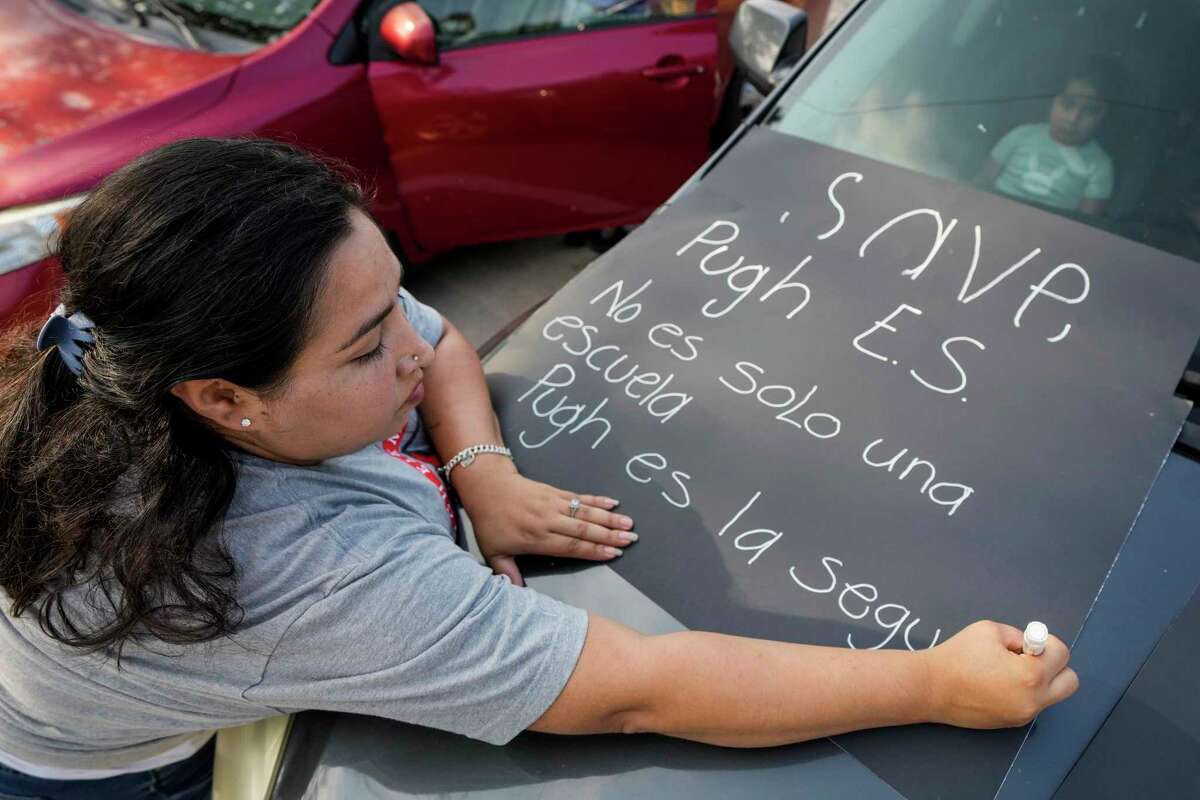
Parents, students and community activists gather near Pugh Elementary School to protest the potential replacement of their children’s teachers by HISD on Thursday, June 15, 2023 in Houston.
Nallely Garza make a sign as she joins parents, students and community activists near Pugh Elementary School to protest the potential replacement of their children’s teachers by HISD on Thursday, June 15, 2023 in Houston.

Radical changes

The 29 schools in the New Education System program that Miles announced on June 1 will likely look radically different when doors open to students on Aug. 28. For starters, kids might be greeted by an entirely new roster of teachers, administrators and support staff; all employees besides custodians, cafeteria workers, bus drivers and nurses have to reapply for their jobs.

Miles has already said that librarians will likely be removed from NES schools, though he promised that they, along with all other teachers, principals, assistant principals and counselors who are already under contract, will be guaranteed similar jobs with the same salary at other schools if they are not brought back. Other staff members have received no such guarantees.

Teachers who do return will make over $90,000 after factoring in various stipends offered for teaching at high-need schools, and be supported by teaching apprentices and learning coaches who will handle much of the supplementary work such as grading and classroom preparation.

The application process is already underway for principals and teachers. NES principals will be selected by June 23, and teachers by July 3.

But staffing changes are just part of the transformation coming to NES schools. Curriculum will be standardized across campuses and lesson plans prepared for teachers in advance. Classes will be recorded via webcam, and students who are pulled from class for disruptive behavior will be sent to another room to watch the streamed class. Magnet offerings such as STEM and dual language programs “will be evaluated on a case-by-case basis” and may be cut.

Emails shared with the Houston Chronicle from principals to their staff suggest school leaders will be observing teachers every day, and that schools will be open from 6:30 a.m. to 5 p.m. each day for free childcare before and after school, with teachers serving four supervisory shifts per month. Miles is also bringing the Dyad program that he had introduced at his charter school network, Third Future Schools, to the NES schools, in which community members will teach students in extra-curriculars, such as sports or arts twice a week, according to emails shared with the Chronicle.

Miles says the changes put students’ most fundamental needs at the forefront by allowing teachers to focus purely on instruction.

“We will be aligning our resources—especially our most effective teachers and principals—to better serve students in underserved communities,” Miles said. “For students who need to catch up and in schools that have failed for years, we will be offering more instructional time.”

Miles has repeatedly stated that he understands the concerns emanating from many in the HISD community, but that he hopes improvements at the schools will eventually win their trust.

“Change brings some anxiety, and there will be some anxiety most of the summer, probably, but we will keep putting information out there so that we can turn that anxiety into hope,” Miles said during his first week in office.

‘Pugh es nuestra familia’

Several parents at Pugh, Martinez and other northeast Houston elementary schools gathered Thursday morning with their children at the Denver Harbor Multi-Service Center to protest the potential removal of teachers from their A-rated schools, before traveling to HISD headquarters to bring their complaints to the district. Children held signs with their teachers’ names — Ms. Rodriguez, Ms. Arguelles, Mr. Infante — and pleas to keep them in place. “Pugh es nuestra familia,” one sign read.

“Every morning, everyone from the principal to the office staff, custodians and cafeteria workers, they greet our children with a smile. I think the kids forget the problems they have at home when they go to school. We don’t want new teachers, we want the same teachers because they’ve been our second family at Pugh,” said Nancy Coronado, a parent volunteer at Pugh for 13 years, in Spanish.

Her son, Ricardo Delgado, graduated from fifth grade at Pugh this year. He discussed his favorite teacher, Ms. Lopez, and how she was a warm, familiar presence to him even before he’d ever taken her class. Now set to start at the Baylor College of Medicine Academy at Ryan Middle School in the fall, Delgado credits Ms. Lopez with teaching him the reading skills he’ll need in middle school.

“If other teachers come, it wouldn’t be the same because she’s been there since I was 6 years old,” Delgado said.

The plan to have teachers reapply for their job has left other Houston parents with mixed feelings. Karmell Johnson, a Fifth Ward mother of three students at NES schools, said there are “pros and cons” to the situation. She welcomes the opportunity to remove under-performing teachers, but worries that some effective teachers, who understand the community they’re serving in and may have formed bonds with students, may be caught up in the mix.

“It’s an emotional roller coaster. Once a bond is established and they rip that out, the kids have to get used to their teachers, the teachers have to get used to the schools, and it’s going to take some time. It’s going to be uncomfortable for everybody,” Johnson said.

Uncertain future for teachers, staff

At many NES schools, however, teacher and principal turnover has already become a fact of life. It was only 10 years ago that North Forest High School was completely reconstituted when the Texas Education Agency ordered North Forest ISD to be absorbed into Houston ISD, and after a brief upswing, it has failed 80 percent of its TEA evaluations since (it passed this year with a C). Wheatley High School replaced a significant portion of their teachers just last year.

Ainhoa Donat, a bilingual fourth grade teacher at Paige Elementary, said she worked with a different fourth-grade colleague in each of her six years at the Eastex/Jensen school.

Donat said she was told by her principal that the school would no longer offer a bilingual program, and that she was welcome to apply for a standard teaching position at the school (the district, in a statement, said that NES schools “will now have a dedicated English Language Arts block for English language development,” which “includes bilingual support for emerging English speakers based on their proficiency level”).

With 16 years of experience at HISD under her belt, the extra money being offered wasn’t enough for Donat to overcome the indignity of being blamed for the school’s low performance. She’s currently in the process of applying for a bilingual job at another HISD campus.

“I have a lot of experience and I work super hard, so when I went to that meeting and the superintendent (basically) said ‘you didn’t do your job,’ I felt really humiliated,” Donat said.

One longtime teacher at Martinez Elementary School, who asked to remain anonymous out of fear of retribution, said she worries that the financial incentives may “entice the wrong people.”

“I would give it back to stay at Martinez,” she said. “There are some teachers who are all about the money… but not at our school.”

The fear is even more acute for support staff, who aren’t guaranteed positions.

One administrative assistant, who has worked for over 20 years at an NES elementary school and also asked to remain anonymous, said she may be forced to retire early if she isn’t rehired. The assistant has spent almost her entire career with HISD and doesn’t know what else she could do.

She wonders who will manage the payroll, procure supplies for teachers, plan field trips and do all the other unseen tasks that keep a school running if support staff are eliminated.

“All I’ve ever known is HISD, getting up and going to work at these schools. We’re not here for the money, we’re here for the children,” she said. “You talk about the children but what are you doing for them? You’re taking their teachers away, and its very upsetting.”Parents, students and community activists gather near Pugh Elementary to protest the potential replacement of their children’s teachers by HISD on Thursday, June 15, 2023 in Houston.Brett Coomer/Houston Chronicle

Photo of Sam González Kelly

Written By 

Sam González Kelly is a reporter for the Houston Chronicle.

You can reach Sam at sam.kelly@chron.comVIEW COMMENTS

If you read one article today, make it this one.

Kathryn Joyce is an outstanding journalist who has written several excellent articles about the far-right conspiracy to destroy public education. In this important article, published by both the Hechinger Report and Vanity Fair, she examines the rightwing takeover of public schools in Sarasota, Florida, by the extremist Moms for Liberty and their hero Governor DeSantis.

Joyce begins:

SARASOTA COUNTY, Fla. — On a Sunday afternoon in late May 2022, Zander Moricz, then class president of Sarasota County’s Pine View School, spent the moments before his graduation speech sitting outside the auditorium, on the phone with his lawyers. Over the previous month, the question of what he’d say when he stepped to the podium had become national news. That March, Florida Governor Ron DeSantis had signed the Parental Rights in Education Act, quickly dubbed the “Don’t Say Gay” law for its ban on all mention of gender identity and sexuality in K–3 classrooms and restriction of those discussions in higher grades as well. Moricz, a student LGBTQ+ activist, had led several protests against the act that spring and joined a high-profile lawsuit against the state. In early May, he charged on Twitter that Pine View’s administration had warned that if he mentioned his activism or the lawsuit at graduation, his microphone would be cut. (In a statement released last year, the school district confirmed that students are told not to express political views in their speeches.)

In the tumultuous weeks leading up to the ceremony, Pine View — Sarasota’s “gifted” magnet institution, consistently ranked one of the top 25 public high schools in the country — was besieged with angry calls and news coverage. Moricz stayed home for three weeks, he said, thanks to the rvolume of death threats he received, and people showed up at his parents’ work. When a rumor started that Pine View’s principal would have to wear a bulletproof vest to graduation, he recalled, “the entire campus lost their minds,” thinking “everyone’s going to die” and warning relatives not to come. His parents worried he’d be killed.

But after all the controversy, graduation day was a success. Moricz, now 19, delivered a pointedly coded speech about the travails of being born with curly hair in Florida’s humid climate: how he worried about the “thousands of curly-haired kids who are going to be forced to speak like this” — like he was, in code — “for their entire lives as students.” Videos of the speech went viral. Donations poured into Moricz’s youth-led nonprofit. That summer, he left to study government at Harvard.

Half-a-year later though, when Moricz came home, Sarasota felt darker.

“I’m wearing this hat for a reason,” he said when we met for coffee in a strip mall near his alma mater in early March. “Two years ago, if I was bullied due to my queerness, the school would have rallied around me and shut it down. If it happened today, I believe everyone would act like it wasn’t happening.”

These days, he said, queer kids sit in the back of class and don’t tell teachers they’re being harassed. A student at Pine View was told, Moricz said, that he couldn’t finish his senior thesis researching other states’ copycat “Don’t Say Gay” laws. (The school did not respond to a request for comment through a district spokesperson.) When Moricz’s nonprofit found a building to house a new youth LGBTQ+ center — since schools were emphatically no longer safe spaces — they budgeted for bulletproof glass.

“The culture of fear that’s being created is doing exactly what it’s supposed to do,” he said. And much of it was thanks to the Sarasota County School Board.

Over the last two years, education culture wars have become the engine of Republican politics nationwide, with DeSantis’s Florida serving as the vanguard of the movement. But within the state, Sarasota is more central still.

Its school board chair, Bridget Ziegler, cofounded the conservative activist group Moms for Liberty and helped lay the groundwork for “Don’t Say Gay.” After a uniquely ugly school board race last summer, conservatives flipped the board and promptly forced out the district’s popular superintendent. In early January, when DeSantis appointed a series of right-wing activists to transform Florida’s progressive New College into a “Hillsdale of the South” — emulating the private Christian college in Michigan that has become a trendsetting force on the right — that was in Sarasota too. In February, DeSantis sat alongside Ziegler’s husband and Moms for Liberty’s other cofounders to announce a list of 14 school board members he intends to help oust in 2024—Sarasota’s sole remaining Democrat and LGBTQ+ board member, Tom Edwards, among them. The next month, Ziegler proposed that the board hire a newly created education consultancy group with ties to Hillsdale College for what she later called a “‘WOKE’ Audit.” (Ziegler did not respond to interview requests for this article.)

The dizzying number of attacks has led to staffing and hiring challenges, the cancelation of a class, a budding exodus of liberals from the county, and fears that destroying public education is the ultimate endgame. In January, Ziegler’s husband, Christian — who chairs the Florida Republican Party — tweeted a celebratory declaration: “SARASOTA IS GROUND ZERO FOR CONSERVATIVE EDUCATION.”

It wasn’t hyperbole, said Moricz. “We say that Sarasota is Florida’s underground lab, and we’re its non-consenting lab rats.”

For as long as Florida has been grading schools and school districts — a late 1990s innovation that helped spark the “school reform” movement — Sarasota, with its 62 schools and nearly 43,000 students, has enjoyed an “A” rating. Perched on the Gulf Coast just south of Tampa, the county’s mix of powder-soft beaches and high-culture amenities — including an opera house, ballet and museums — have made it a destination for vacationers and retirees. And that influx has made Sarasota one of the richest counties in the state.

Since many of those retirees, dating back to the 1950s, have been white Midwestern transplants, it’s also made Sarasota a Republican stronghold and top fundraising destination for would-be presidential candidates. Both the last and current chairs of the state GOP — first State Senator Joe Gruters and now Christian Ziegler — live in the county. Sarasota arguably launched Donald Trump’s first presidential campaign, thanks to Gruters’s early support. These days, though, Sarasota isn’t just conservative, but at the leading edge of Florida’s turn to the hard right.

Partly that’s thanks to the Zieglers, who have become one of Florida’s premier power couples, with close ties to both Trump world and the DeSantis administration and a trio of daughters enrolled in local private schools. As founder of the digital marketing company Microtargeted Media, Christian did hundreds of thousands of dollars of work for pro-Trump PACs in 2021, the Sarasota Herald-Tribune reported. After being elected state GOP chair this February, he announced his goal was “to crush these leftist in-state Democrats” so thoroughly that “no Democrat considers running for office.” Although Bridget stepped down from Moms for Liberty shortly after its founding, she subsequently helped draftFlorida’s Parents’ Bill of Rights, which helped pave the way for DeSantis’s 2021 ban on mask mandates and ultimately last year’s “Don’t Say Gay” law. In 2022, the right-wing Leadership Institute hired her as director of school board programs, and built a 6,000-square-foot headquarters in Sarasota to serve as a national hub for conservative education activism. This winter, DeSantis also appointed her to a new board designed to punish the Disney Company for criticizing his anti-LGBTQ laws….

Last year, when Ziegler was up for reelection and two other board members were terming out, she ran as a unified slate with former school resource officer Tim Enos and retired district employee Robyn Marinelli. The candidates drew support from both DeSantis’s administration — which unprecedentedly endorseddozens of school board candidates across the state — and local members of the far-right. A PAC partially funded by The Hollow’s owner campaigned for the “ZEM” slate (a shorthand for the candidates’ surnames) by driving a mobile billboard around the county, calling one of their opponents a “LIAR” and “BABY KILLER” because she’d once worked for Planned Parenthood. Proud Boys hoisted ZEM signs on county streets and a mailer was sent out, castigating the liberal candidates as “BLM/PSL [Party of Socialism and Liberation]/ANTIFA RIOTERS, PLANNED PARENTHOOD BABY KILLERS, [who] WANT GROOMING AND PORNOGRAPHY IN OUR SCHOOLS.” (Enos and Marinelli did not respond to requests for comment for this article.)

Open the link and read all of the article. It is a devastating article about the takeover of the school board by hateful extremists whose tools are fear and divisiveness.

The New York Times reported on the annual competition for admission to New York City’s most selective high schools, where about 26,000 eighth-grade students competed for some 4,000 openings. Admission is based on a single standardized test, offered only once. Although two-thirds of the city’s students are Black or Latino, about 10% of offers went to students from these groups. More than half the acceptance offers (53%) went to Asian-American students.

Latino students were 26% of the test-takers and received 6.7% of the offers. White students were 17% of the students who took the test and received 27% of the offers. Asian-American students were 32% of test-takers and received 53% of the offers. Black students were 19% of the test-takers and received 3% of the offers.

Admission to the selective high schools is considered a ticket to the best colleges (but students have to work hard in high school to earn that ticket).

It should be noted that New York City has dozens of excellent high schools that do not require students to take the Specialized High School Admissions Test that is required by the elite high schools.

Former Mayor Bill de Blasio tried to change the admissions criteria to increase the proportion of Black and Latino students to 40%, but any change in the testing requirement must be approved by the State Legislature. That body includes graduates of the elite schools, who protect the status quo. Also, Asian-Americans fiercely oppose any change in the admissions process. All proposals for change have failed.

At Stuyvesant High School in Manhattan, the most selective of the city’s so-called specialized schools, seven of the 762 offers made went to Black students, down from 11 last year and eight in 2021. Twenty Latino students were offered spots at Stuyvesant, as were 489 Asian students and 158 white students. The rest went to multiracial students and students whose race was unknown.

Gaps at many of the other schools were also stark: Out of 287 offers made at Staten Island Technical High School, for example, two Black students were accepted — up from zero last year — along with seven Latino students….

The schools also represent perhaps the highest-profile symbol of segregation across the system, where over the last decade, Black and Latino students have never received more than 12 percent of offers.

Decades ago, the specialized schools tended to serve much larger proportions of Black and Latino students. And a handful of elite schools, like the Brooklyn Latin School — where 73 Black and Latino teenagers were accepted in a class of 388 this year — are somewhat more reflective of the city’s demographics….

The Adams administration has not made school integration a top priority, quieting the public and political attention on the issue after years of intense fights.

The system’s chancellor, David C. Banks, has argued that many Black and Latino families care more about school quality than who their children’s classmates are.

He has aimed to overhaul how students are taught to read, and supported increasing seats in the city’s selective gifted and talented program for elementary students, reversing Mr. de Blasio’s plan to eliminate it.

I served on the governing board of the National Assessment of Educational Progress (NAEP) for seven years. I was appointed by President Clinton. I learned quite a lot about standardized testing during that time. I enjoyed reading test questions and finding a few that had two right answers. Two subjects where I felt confident as a reviewer, in addition to reading, were history and civics.

I was momentarily dismayed, but not surprised, to learn that the NAEP scores in history and civics had declined, as they had in reading and math, after the disruptions and closings caused by the pandemic. This is not surprising, because fewer days of instruction translates into less learning.

So we know for sure that instructional time matters. You can’t learn what you weren’t taught.

But on second thought, I realized that in these days it is almost impossible to test history and civics and get a meaningful result.

Many states, all Republican-dominated, have censored history teaching. The legislatures don’t want students to learn “divisive concepts.” They don’t want anything taught that will make students “uncomfortable.” They don’t want “critical race theory” to be taught. These ideas have been spun out at length with other vague descriptions of what teachers are NOT allowed to teach.

The people who write test questions for NAEP history are not bound by these restrictions. They are most likely writing questions about “divisive concepts” and “uncomfortable” topics. They might even ask questions that legislators might think are tinged or saturated by critical race theory.

Given the number of states that ban the teaching of accurate, factual history, it’s seems to me impossible to expect students to be prepared to take an American history test.

Even more complicated is civics. A good civics exam might ask questions about the importance of the right to vote. It might ask questions written on the assumption that vote suppression and gerrymandering are undemocratic practices that were long ago banned by the courts. Yet courts are now allowing these baleful practices to stand. How can a student understand that a discredited practice is now openly endorsed in various state laws and have not been discredited by the courts?

Civics classes typically teach that one of the great strengths of American democracy is the peaceful transition of power from one President to another. How can they teach that idea when Trump partisans insist that he won the last election and was ousted in a coup? How can teachers explain the election process when Trump says it’s rigged (he said it before the 2016 election as well)? How can students answer questions about elections and the Electoral College when Trumpers believe they were corrupted in 2020?

How can teachers teach civics when almost every GOP leader asserts that the election was stolen?

How can civics be taught when public officials defy public opinion to allow any individual to buy guns without a background check or a permit. Having bought a gun, they may wear it openly in some states and carry it concealed in some other states. Students have been practicing in case an armed killer walks into their school during the day. They need only google to learn that a majority of the public favors gun control of varying kinds. Why, they might ask their teacher, doesn’t the legislature and Congress act to protect the lives of children?

Is it worse to teach lies or to teach the truth?

A reader shared a link to an important study of the damaging effects of student mobility. The more students changed schools, the more negative effects on them.

Too bad Margaret Spellings and Arne Duncan didn’t know about this research when they decided that the best way to help low-scoring students was to close their schools. Too bad Rahm Emanuel didn’t know about it when he closed 50 public schools in a single day.

School mobility has been shown to increase the risk of poor achievement, behavior problems, grade retention, and high school drop-out. Using data over 25 years from the Chicago Longitudinal Study, we investigated the unique risk of school moves on a variety of young adult outcomes including educational attainment, occupational prestige, depression symptoms, and criminal arrests. We also investigated how the timing of school mobility, whether earlier or later in the academic career, may differentially predict these outcomes over and above associated risks. Results indicate that students who experience more school changes between kindergarten and twelfth grade are less likely to complete high school on time, complete fewer years of school, attain lower levels of occupational prestige, are more likely to experience symptoms of depression, and are more likely to be arrested as adults. Furthermore, the number of school moves predicted above and beyond associated risks such as residential mobility and family poverty. When timing of school mobility was examined, results indicated more negative outcomes associated with moves later in the grade school career, particularly between fourth and eighth grade.

Doesn’t this seem like common sense? Your child is in a school where he or she makes friends and has a good relationship with teachers. You take the child out, and he or she has some trouble readjusting. Maybe the family moved, and it was necessary. But why would the government inflict it on children, call it “reform,” and celebrate the harm to the children?

Here’s a sign of hopeful change. The federal government has used standardized tests as valid measures of school quality for the past decade. The Chicago Board of Education has decided to discontinue the practice. Accountability experts have cautioned against rating schools by test scores for years. The test scores are highly correlated with family income. Schools in affluent districts getvhigh ratings, while schools enrolling the poorest kids get low ratings and are likely to be punished instead of helped.

Sarah Macaraeg of the Chicago Tribune wrote:


The Chicago Board of Education has voted to adopt a more “effective and fair” approach to assessing the performance of schools, replacing the district’s School Quality Rating Policy with a framework shaped by input from more than 20,000 members of school communities.

The previous method, relying largely on standardized test results to judge schools’ performance, penalized schools serving predominantly disadvantaged students, district officials and research partners said.

“Part of what started this was our communities being very clear about the harm that they felt from a ranking and ratings system that didn’t just make them feel like it was something about their schools, but something deficient with them as people, as communities, as parents,” board member Elizabeth Todd-Breland said of schools issued low ratings under the prior system, which was in effect from 2013-20.

Shifting toward a model of shared responsibility, district CEO Pedro Martinez said the new policy will be more responsive to the needs of school communities.

Doing away with summative ratings, the “Continuous Improvement and Data Transparency” policy will instead measure a range of “indicators of success.” Those include not only academic progress but also student well-being, quality of daily learning experiences, school inclusivity and the capacity of staff to collaborate in teacher learning.

“We are really focusing on what matters most: what’s happening in our schools and filling out the gaps to ensure that our educators have the resources and the support that they need, so that we can get the student outcomes that we all want for our babies in Chicago,” Chief Portfolio Officer and CPS parent Alfonso Carmona said at Wednesday’s school board meeting, where the vote to do away with the SQRP system was taken.

How the policy was developed also matters, in fulfilling the district’s stated commitment to equity, said Natalie Neris, chief of community engagement for the nonprofit Kids First Chicago, which partnered with CPS in engaging parents, students, experts, the Chicago Principals and Administrators Association, the Chicago Teachers Union and others in the school accountability redesign.

“We can’t continue to say that we want to create systems that are fair and then not include the people who are part of those systems in co-creating and co-producing the policy that they’re impacted by,” she said.