Archives for category: Religion

Jeff Tiedrich is a graphic artist who writes a popular blog called “Everyone Is Entitled to My Own Opinion.” He is irreverent, profane, outrageous, and very funny.

He wrote recently about MAGA’s reaction to the new Pope.

The College of Cardinals must have been conclaving the shit out of their search for a new pope, ’cause it only took those honchos two days find their boy.

meet Robert Prevost. he’s an American, born in Chicago. he roots for the White Sox. he’s 69 years old, and he’ll be popin’ up a storm as Leo XIV.

oh wait, I almost left out the best part: he’s a WOKE MARXIST POPE.

it only took about five minutes for someone to find the new pope’s not-twitter feed — and MAGA is throwing a shit-fit because it turns out that Robert Prevost/Leo XIV is their worst nightmare: a religious leader who actually follows the teachings of Jesus.

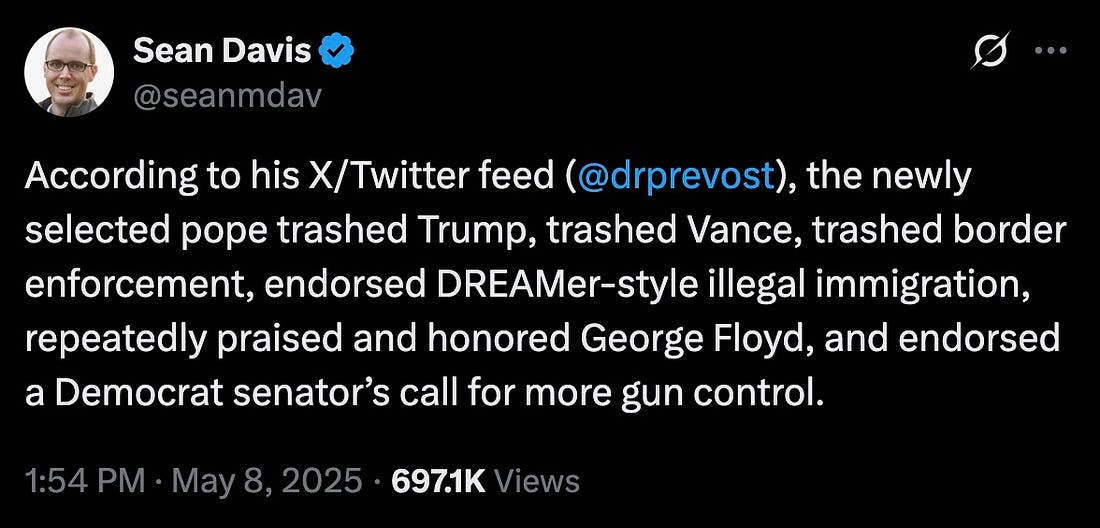
“According to his X/Twitter feed (@drprevost), the newly selected pope trashed Trump, trashed Vance, trashed border enforcement, endorsed DREAMer-style illegal immigration, repeatedly praised and honored George Floyd, and endorsed a Democrat senator’s call for more gun control.”

the horror.

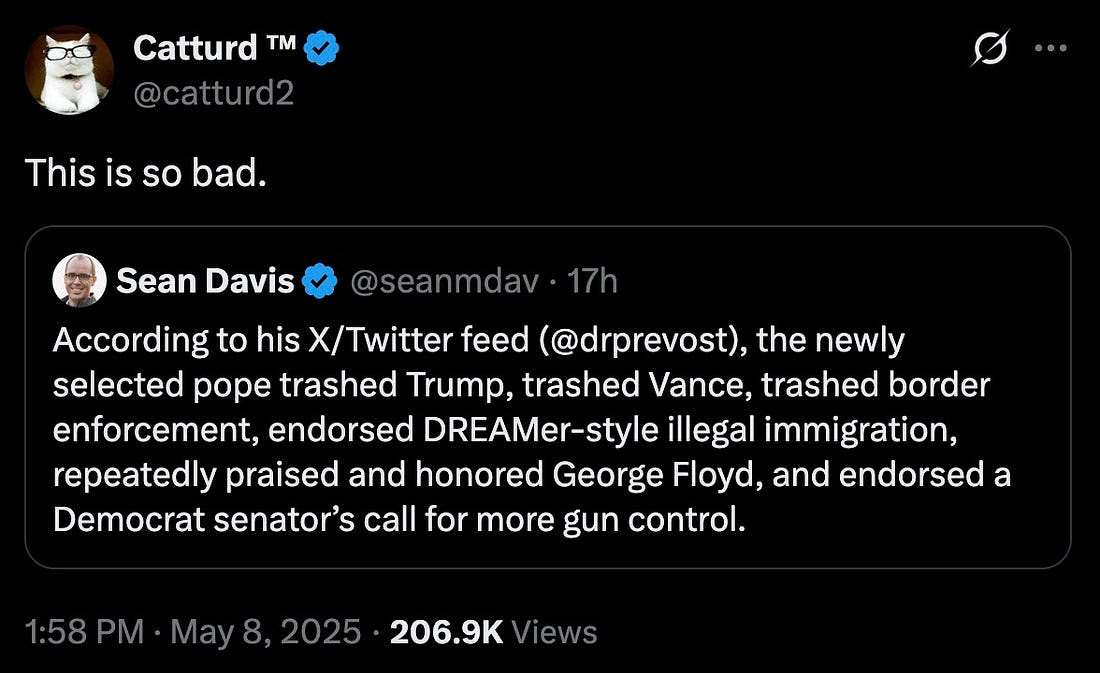
pour one out for the internet oddity who calls himself Catturd. he’s going through some things right now.

too bad, so sad.

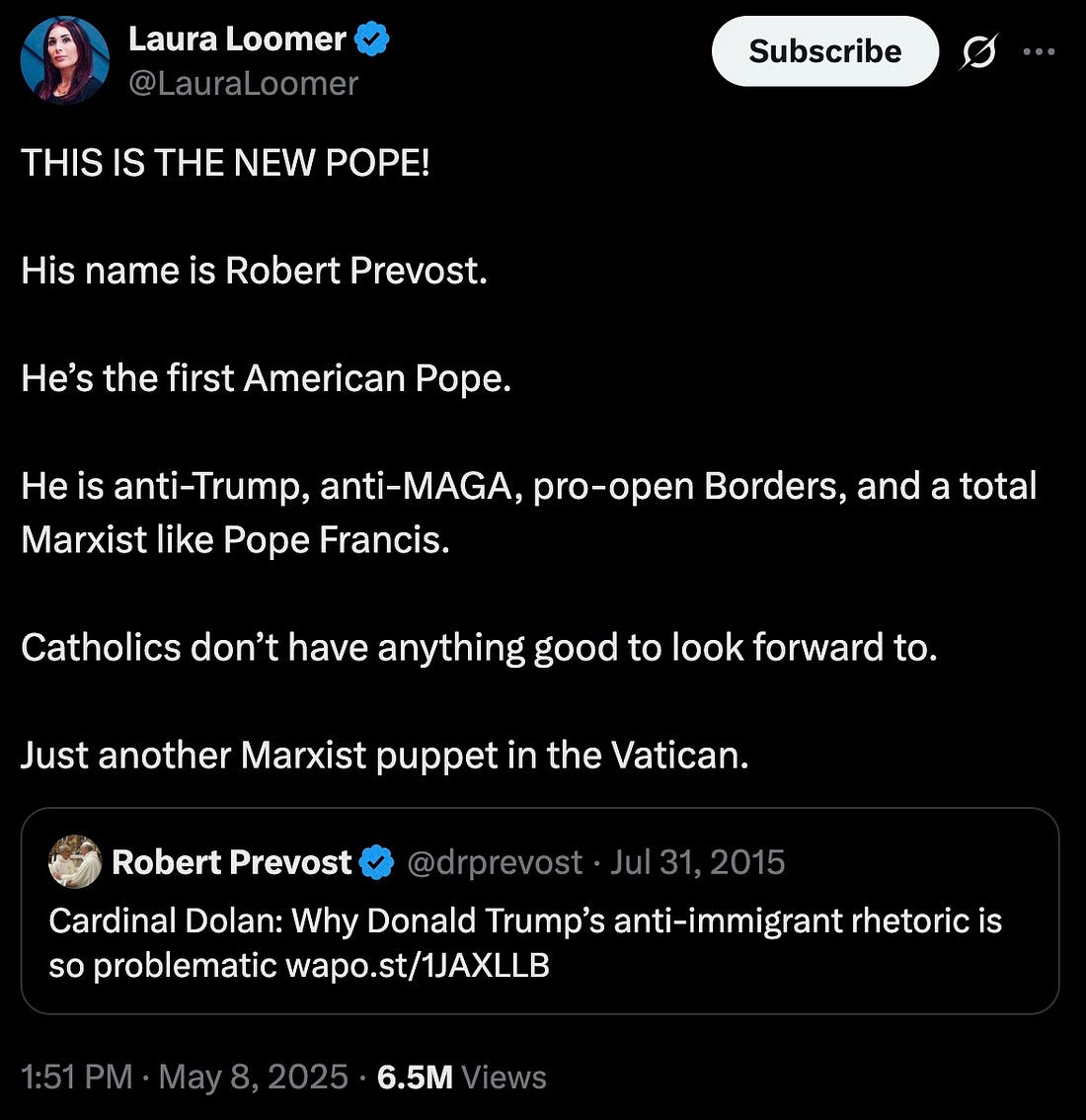
here’s Donny Convict’s side-piece Laura Loopy, back with another hot take.

the diaper-fillers are not entirely wrong — the current top-most thing on Robert/Leo’s not-twitter feed is a retweet taking Donny Convict to task for disappearing Venezuelan migrants off the streets and fuckity-byeing them into a Salvadoran slave-labor gulag.

furniture molester/eyeliner model JD Vance now has the distinction of being called out for shithead behavior by two consecutive popes— which I believe is a world record.

To finish reading, subscribe.

Ooops! State Commissioner Betty Rosa Did NOT write this great statement. It was written by a top deputy in her office named Jim Baldwin. She called to let me know after it was posted.

She sent the letter to me, and I assumed that she wrote it because she did not mention anyone else. I asked for her permission to post it, and she said yes. It never occurred to me that she was not the author. She does endorse the point of view!

Here is the original post:

Dr. Betty Rosa has a long career in education as a teacher, principal, District Supervisor, Chair of the New State Regents and now the New York Commissioner of Education, selected by the Regents. She believes strongly that all schools should meet state standards, including the politically powerful yeshivas run by ultra-Orthodox Jews. They are politically powerful because they vote as a bloc. Presently they are loyal to Trump because of his commitment to giving taxpayer dollars to religious schools. At the state level, the yeshivas want to be free of the state requirement that they teach their students in English.

The Hasidic community was eager to persuade legislators to lower the standards for their schools. The State Education Department demanded that they comply with state law and provide a “substantially equivalent” education to their students. They prefer to teach in Hebrew or Yiddish or both. Yesterday the New York Times reported that Hochul was going along with the Hasidim. Terrible! She wants to run again, and she wants their support in 2026.

Jim Baldwin, who is a deputy to State Commissioner of Education Dr. Betty Rosa, wrote the following letter to Governor Hochul:

Governor Hochul – you and legislative leaders have sold out children attending private schools in a most cynical manner- to curry favor with religious sects for purely political reasons.

The deficiencies in these schools are well documented by the State Education Department and in the media – most notably the New York Times. I know you are well aware of those findings.

As a former superintendent of schools and college president I encountered the deficiencies in yeshiva education first hand as we sought to help orthodox students achieve college degrees following “education” at a variety of yeshivas and seminaries. The yeshiva graduates were often illiterate, and could not demonstrate basic knowledge and skills let alone do college level studies. How could you allow this to continue?

Your failure to protect these children demonstrates lack of leadership and unwillingness to defend the basic rights of children to standards based educational opportunities that prepare them for life.

And then you have the audacity to pretend what you’ve done is just another option when it is a sham that will allow educational neglect to continue.

I have a long history of public service and educational leadership that put the interests of students first.

As a lifelong activist Democrat I am disgusted that you would not demonstrate principled leadership to stop this travesty.

Your attempt to appease the religious leaders who threaten your electoral success will almost certainly fail – and in the process you have alienated a significant number of us who would otherwise have voted for you once again.

Shame on you Governor.

Bravo, Dr. Rosa!

Heather Cox Richardson recounts the important exchanges between the new Pope, Leo XIV, and JD Vance, on the subject of immigrants. Vance, a convert to Catholicism, described Catholic doctrine and was quickly rebuffed at the time both by Pope Francis and by the future Pope. So, JD Vance has the dubious distinction of being rebuffed by two Popes!

She writes:

Today, on the second day of the papal conclave, the cardinal electors—133 members of the College of Cardinals who were under the age of 80 when Pope Francis died on April 21—elected a new pope. They chose 69-year-old Cardinal Robert Prevost, who was born in Chicago, thus making him the first pope chosen from the United States. But he spent much of his ministry in Peru and became a citizen of Peru in 2015, making him the first pope from Peru, as well.

New popes choose a papal name to signify the direction of their papacy, and Prevost has chosen to be known as Pope Leo XIV. This is an important nod to Pope Leo XIII, who led the church from 1878 to 1903 and was the father of modern Catholic social teaching. He called for the church to address social and economic issues, and emphasized the dignity of individuals, the common good, community, and taking care of marginalized individuals.

In the midst of the Gilded Age, Leo XIII defended the rights of workers and said that the church had not just the duty to speak about justice and fairness, but also the responsibility to make sure that such equities were accomplished. In his famous 1891 encyclical Rerum Novarum, translated as “Of New Things,” Leo XIII rejected both socialism and unregulated capitalism, and called for the state to protect the rights of individuals.

Prevost’s choice of the name Leo invokes the principles of both Leo XIII and his predecessor, Pope Francis. In his own lifetime he has aligned himself with many of Francis’s social reforms, and his election appears to be a rejection of hard-line right-wing Catholics in the U.S. and elsewhere who have used their religion to support far-right politics.

In the U.S., Vice-President J.D. Vance is one of those hard-line right-wing Catholics. Shortly after taking office in January, Vance began to talk of the concept of ordo amoris, or “order of love,” articulated by Catholic St. Augustine, claiming it justified the MAGA emphasis on family and tribalism and suggesting it justified the mass expulsion of migrants.

Vance told Sean Hannity of the Fox News Channel, “[Y]ou love your family, and then you love your neighbor, and then you love your community, and then you love your fellow citizens in your own country, and then, after that, you can focus and prioritize the rest of the world. A lot of the far left has completely inverted that.” When right-wing influencer Jack Posobiec, who is Catholic, posted Vance’s interview approvingly, Vance added: “Just google ‘ordo amoris.’ Aside from that, the idea that there isn’t a hierarchy of obligations violates basic common sense.”

On February 10, Pope Francis responded in a letter to American bishops. He corrected Vance’s assertion as a false interpretation of Catholic theology. “Christians know very well that it is only by affirming the infinite dignity of all that our own identity as persons and as communities reaches its maturity,” he wrote. “Christian love is not a concentric expansion of interests that little by little extend to other persons and groups…. The true ordo amoristhat must be promoted is that which we discover by…meditating on the love that builds a fraternity open to all, without exception.”

“[W]orrying about personal, community or national identity, apart from these considerations, easily introduces an ideological criterion that distorts social life and imposes the will of the strongest as the criterion of truth,” Pope Francis wrote. He acknowledged “the right of a nation to defend itself and keep communities safe from those who have committed violent or serious crimes while in the country or prior to arrival,” but defended the fundamental dignity of every human being and the fundamental rights of migrants, noting that the “rightly formed conscience” would disagree with any program that “identifies the illegal status of some migrants with criminality.” He continued: “I exhort all the faithful of the Catholic Church, and all men and women of good will, not to give in to narratives that discriminate against and cause unnecessary suffering to our migrant and refugee brothers and sisters.”

The next day, Trump’s border czar, Tom Homan, who said he was “a lifelong Catholic,” told reporters at the White House, “I’ve got harsh words for the Pope…. He ought to fix the Catholic Church and concentrate on his work and leave border enforcement to us.”

Cardinal Prevost was close to Pope Francis, and during this controversy he posted on X after Vance’s assertion but before Pope Francis’s answer: “JD Vance is wrong: Jesus doesn’t ask us to rank our love for others.” After the pope published his letter, Prevost reposted it with the comment: “Pope Francis’ letter, JD Vance’s ‘ordo amoris’ and what the Gospel asks of all of us on immigration.”

On April 14, Prevost reposted: “As Trump & [Salvadoran president Nayib] Bukele use Oval to [laugh at] Feds’ illicit deportation of a US resident [Kilmar Abrego Garcia], once an undoc[ument]ed Salvadorean himself, [Bishop Evelio Menjivar] asks, ‘Do you not see the suffering? Is your conscience not disturbed? How can you stay quiet?’”

The new Pope Leo XIV greeted the world today in Italian and Spanish as he thanked Pope Francis and the other cardinals, and called for the church to “be a missionary Church, building bridges, dialogue, always open to receiving with open arms for everyone…, open to all, to all who need our charity, our presence, dialogue, love…, especially to those who are suffering.”

As an American-born pope in the model of Pope Francis, Pope Leo XIV might be able to appeal to American far-right Catholics and bring them back into the fold. But today, MAGAs responded to the new pope with fury. Right-wing influencer Laura Loomer, who is close to Trump, called Pope Leo “another Marxist puppet in the Vatican.” Influencer Charlie Kirk suggested he was an “[o]pen borders globalist installed to counter Trump.”

In the U.S., President Donald Trump, who said he would like to be pope and then posted a picture of himself dressed as a pope on May 2, prompting an angry backlash against those who thought it was disrespectful, posted on social media that the election of the first pope from the United States was “a Great Honor for our Country” and that he looks forward to meeting him. ‘It will be a very meaningful moment!” he added.

This is an amazing story about the new Pope. Not only is he the first American-born pope, not only is he the first Peruvian pope, but he is descended on his mother’s side from Afro-Caribbeans.

The New York Times published the story today:

Robert Francis Prevost, the Chicago-born cardinal selected on Thursday as the new pope, is descended from Creole people of color from New Orleans.

The pope’s maternal grandparents, both of whom are described as Black or mulatto in various historical records, lived in the city’s Seventh Ward, an area that is traditionally Catholic and a melting pot of people with African, Caribbean and European roots.

The grandparents, Joseph Martinez and Louise Baquié, eventually moved to Chicago in the early 20th century and had a daughter: Mildred Martinez, the pope’s mother.

The discovery means that Leo XIV, as the pope will be known, is not only breaking ground as the first U.S.-born pontiff. He also comes from a family that reflects the many threads that make up the complicated and rich fabric of the American story.

The link is a gift article so feel free to open it and read about the genealogical research.

One of the most determined opponents of vouchers in Texas was the Pastors for Texas Children. While some faith leaders celebrated the opportunity to get public money for their religious schools, the PTC stood firm for separation of church and state. They believe it is the state’s responsibility to provide good public schools, and it is the duty of religious groups to support their own faith.

They know the research. They know that most of the $1 billion in vouchers will be used to subsidize students already enrolled in private schools. They know that many private schools will raise their tuition in response to the state subsidy. They know that the public schools, which serve the vast majority of students, will continue to be underfunded.

PTC sent out the following message:

The Signing of HB 3

An old preacher once said that God’s Justice was figuring out what belongs to whom and giving it to them.

Universal education for ALL children is God’s Justice. A $1 billion voucher subsidy program for children already in private schools— mostly religious schools that use Caesar to support their religion— is not.

Texans know that. They have rejected voucher programs for 30 years.

Gov. Greg Abbott had to rely on a Philadelphia billionaire to give him over $12 million dollars to defeat conservative, rural Republican state representatives who opposed vouchers on deep conviction and moral principle.

We take no pleasure in calling out our governor’s lies and bullying against these decent public servants. God is not mocked by Gov. Abbott’s corruption.

The voucher bill was signed on Saturday. Also on Saturday Texans all over the state overwhelmingly approved public school bond programs and elected pro-public ed trustees as a direct response to Abbott’s voucher scam.

We will have another opportunity to express our will on public education and against the privatization of it:

The 2026 primary and general elections.

DONATE TO PTC

PO Box 471155, Fort Worth, Texas, 76147

***************************************

What Happened After Passage of HB 3.

A statewide rejection of extremism.

In the aftermath of the passage of the voucher bill, voters in several districts responded by ousting hard-line conservative school board members. Texan Michelle H. Davis described the devastating losses of MAGA school board members across the state.

It was a tough night for MAGA-aligned candidates in Texas. In the May 3, 2025, local elections, voters across the state decisively rejected far-right candidates, particularly in school board and city council races. From Tarrant County to Collin County, and from San Antonio to Dallas, communities chose leaders who prioritize public education, inclusivity, and pragmatic governance over culture wars and partisan agendas. This widespread shift signals a growing resistance to extremist politics at the local level. 

Last night, voters across Texas sent a message loud enough to rattle the far-right out of their echo chambers: we’re done with your culture wars, your book bans, and your crusade against public schools. Voters chose community over chaos, educators over agitators, and progress over extremism.

The local elections weren’t just a series of wins but a sweep. MAGA-backed candidates got absolutely trounced across the state. This was the result of deep organizing, years of work by local Democrats, and voters who are fed up with the far-right hijacking of school boards and city councils to push their agenda.

Texas isn’t turning blue overnight, but make no mistake: the MAGA movement had a very bad night, and the momentum is shifting.

Tarrant County. 

The Republican Party poured money, endorsements, and out-of-state personalities into these Tarrant County races, and they got wiped. Every single candidate backed by Patriot Mobile, the far-right Christian nationalist group trying to take over school boards, lost. That’s losses in Mansfield ISD, Keller ISD, and Grapevine-Colleyville ISD. A clean sweep.

The Tarrant County GOP went 0-for-11 in the county’s three largest cities: Fort Worth, Arlington, and Mansfield. Let that sink in. They didn’t just lose a few races. They got shut out entirely. In Mansfield, Republican Rep. David Cook’s backyard, where Allen West himself came out to rally the troops, the GOP lost all five races they backed.

Meanwhile, Democrats made real gains on the Fort Worth City Council. One of the biggest victories was Debrah Peoples’s victory in her race. A longtime activist and former Tarrant County Democratic Party Chair, Peoples gave progressive voters a reason to celebrate in a city that’s often overlooked on the statewide map.

Huge, huge shout out to the Tarrant County Young Democrats. They didn’t just show up, they organized, knocked on doors, made calls, and fought for every single school board seat they were targeting. And guess what? They swept them all. That’s the kind of ground game that wins elections. That’s the kind of energy we need to keep building.

Open the link to continue reading about the pushback in Texas against bookbanning rightwing MAGA culture warriors.

New York State law requires private and religious schools to offer an education that is substantially equivalent to what is offered at secular public schools. Some Orthodox Jewish schools refuse to comply. Repeated inspections have found that the recalcitrant Yeshivas do not teach English and do not teach math and science in English.

Dr. Betty Rosa, an experienced educator and New York State Commissioner of Education, has insisted that Yeshivas comply with the law. She fears that their students are graduating from high school without the language skills required for higher education and the workplace.

The Hasidim are a tight-knit group that often votes as a bloc to enhance their political power. They vote for whoever promises to support their interests. Both parties compete for their endorsement.

Eliza Shapiro and Benjamin Oreskes reported the story in the New York Times:

New York lawmakers are considering a measure that would dramatically weaken their oversight over religious schools, potentially a major victory for the state’s Hasidic Jewish community.

The proposal, which could become part of a state budget deal, has raised profound concern among education experts, including the state education commissioner, Betty Rosa, who said in an interview that such changes amount to a “travesty” for children who attend religious schools that do not offer a basic secular education.

“We would be truly compromising the future of these young people,” by weakening the law, Ms. Rosa said. “As the architect of education in this system, how could I possibly support that decision,” she added.

Gov. Kathy Hochul on Monday announced a $254 billion budget agreement but acknowledged many of the particulars are still being hashed out.

Behind the scenes, a major sticking point appears to be whether the governor and the Legislature will agree to the changes on private school oversight, according to several people with direct knowledge of the negotiations, which may include a delay in any potential consequences for private schools that receive enormous sums of taxpayer dollars but sometimes flout state education law by not offering basic education in English or math.

The state is also considering lowering the standards that a school would have to meet in order to demonstrate that it is following the law.

Though the potential changes in state education law would technically apply to all private schools, they are chiefly relevant to Hasidic schools, which largely conduct religious lessons in Yiddish and Hebrew in their all-boys schools, known as yeshivas.

The potential deal is the result of years of lobbying by Hasidic leaders and their political representatives…

The Hasidic community has long seen government oversight of their schools as an existential threat, and it has emerged as their top political issue in recent years.

It has taken on fresh urgency in recent months, as the state education department, led by Ms. Rosa, has moved for the first time to enforce the law, after years of deliberation and delay….

There is little dispute, even among Hasidic leaders, that many yeshivas across the lower Hudson Valley and parts of Brooklyn are failing to provide an adequate secular education. Some religious leaders have boasted about their refusal to comply with the law and have barred families from having English books in their homes.

Mayor Eric Adams’s administration, which has been closely aligned with the Hasidic community, found in 2023 that 18 Brooklyn yeshivas were not complying with state law, a finding that was backed up by state education officials.

A 2022 New York Times investigation found that scores of all-boys yeshivas collected about $1 billion in government funding over a four-year period but failed to provide a basic education, and that teachers in some of the schools used corporal punishment.

It is clear why Hasidic leaders, who are deeply skeptical of any government oversight, would want to weaken and delay consequences for the schools they help run.

It is less obvious why elected officials would concede to those demands during this particular budget season. There is widespread speculation in Albany that Ms. Hochul, facing what may be a tough re-election fight next year, is hoping to curry favor from Hasidic officials, who could improve her chances with an endorsement….

Hasidic voters are increasingly conservative and tend to favor Republicans in general election contests.

New York’s state education law related to private schools, which is known as the substantial equivalency law, has been on the books for more than a century.

It was an obscure, uncontroversial rule up until a few years ago, when graduates of Hasidic yeshivas who said they were denied a basic education filed a complaint with the state, claiming that their education left them unprepared to navigate the secular world and find decent jobs.


Governor Gregg Abbott signed his big voucher bill into law yesterday, repeating promises he has made that are most certainly false. He claimed that vouchers will put Texas on a path to being the number one school system in the nation. Several other states have large voucher programs–e.g., Florida, Arizona, and Ohio–and none of them is the number one rated school system in the nation.

If anything, vouchers and charter schools break up the common school system that states pledge in their constitutions to support. Public schools are one system, regulated by the state, subject to elected local school boards. Charter schools are another, lightly regulated by the state, some for-profit, some as corporate chains, managed by private boards. Voucher schools are a third system, almost entirely deregulated, not required to accept all students, as public schools are. Voucher schools are not required to have certified teachers, as public schools are. Voucher schools are exempt from state testing. Most voucher schools are religious schools, managed by their religious leader. Private and religious schools choose their students.

Vouchers have been a big issue since the early 1990s. The first voucher program was launched in Milwaukee in 1990. The second started in Cleveland in 1996, ostensibly to save poor kids from failing public schools. Neither Cleveland nor Milwaukee is a high-performing district.

What we have learned in the past 30-35 years about vouchers is this:

  1. Most students who use vouchers were already enrolled in nonpublic schools.
  2. The students who transfer from public to private schools are likely to fall behind their peers in public schools. Many return to public schools.
  3. The public does not want their taxes to be spent on religious schools or on the children of affluent families. In nearly two dozen state referenda, voters defeated vouchers every time.
  4. The academic performance of students who leave public schools to attend nonpublic schools is either the same or much worse than students in public schools.
  5. Vouchers drain funding from public schools, where the vast majority of students are enrolled. This, the majority of students will have larger classes and fewer electives to subsidize vouchers.
  6. Vouchers are expensive. Arizona is projecting a cost of $1 billion annually. Florida currently is paying $4 billion annually.

To learn more about the research, read Joshua Cowen’s book The Privateers: How Billionaires Created a Culture War and Sold School Vouchers (Harvard Educatuon Press).

Governor Abbott surely knows these facts, but he determined that vouchers were his highest priority. Certainly they make him the champion of parents who send their children to private and religious school. All will be eligible for a subsidy from the state. And Abbott delivered for the billionaires who funded his voucher campaign.

Edward McKinley of the Houston Chronicle wrote:

Gov. Greg Abbott signed a $1 billion school voucher program into law Saturday, cementing the biggest legislative victory of his decade in office before a huge crowd including families, legislators and GOP donors.

Abbott framed the ceremony as the climax of a multiyear effort by himself and advocates around the state, and touted the state’s new program as the largest to ever launch in the nation. 

“Today is the culmination of a movement that has swept across our state and across our country,” he said, using the speech to call out parents in the crowd who had already pulled their students from “low-performing” public schools to put them into private ones. “It’s time we put our children on a pathway to have the number one-ranked education system in the United States of America.”

He put pen to paper at a wooden desk in front of the Governor’s Mansion, as a gaggle of children stood around him wearing their private school colors and logos. Someone shouted, “Thank you, governor!” before the crowd of nearly 1,400 people erupted in applause. Abbott pumped his fist in the air. 

The ceremony marked a major moment for the third-term Republican, who threw his full political weight and millions of campaign dollars into a push for private school vouchers, overcoming a legislative blockade that had lasted for decades. The bill he signed into law will give Texas students roughly $10,000 a year that they can put toward private school tuition, tutoring, textbooks and other expenses…

Texas Education Agency Commissioner Mike Morath and Pennsylvania billionaire Jeff Yass mingled in the crowd. Yass contributed more than $12 million to Abbott’s campaign last cycle, as the governor sought to unseat anti-voucher Republicans in the 2024 primary election.

Abbott was joined on stage by U.S. Sen. John Cornyn, Lt. Gov. Dan Patrick, House Speaker Dustin Burrows and the House and Senate authors of the bill. Also in attendance were private school leaders, including Joel Enge, director of Kingdom Life Academy. 

After Abbott’s address, Enge told the crowd he founded his Christian school after working in public schools in a low-income area of Tyler and watching children fall behind. His speech had the feel of a sermon.

“Children who have been beaten down by the struggles in the academic system that did not fit the system will now be empowered as they begin to find the right school setting that’s going to support them and to allow them to grow in confidence in who God created them to be,” he yelled, to raucous cheers. “Amen!…”

Hours earlier, Democratic legislators, union leaders and public educators gathered in the parking lot of the AFL-CIO building across the street from the governor’s mansion, where they had a much different message. 

Echoing lines used throughout committee hearings and legislative debates for the past few years, they warned that vouchers would hurt already struggling neighborhood public schools by stripping away their funding. About two dozen people swayed under the direct sun, waving signs that said “public dollars belong in public schools” and “students over billionaires.” 

“Today, big money won and the students of Texas lost,” said state Rep. James Talarico, an Austin Democrat. “Remember this day next time a school closes in your neighborhood. Remember this day next time a beloved teacher quits because they can’t support their family on their salary.”

Several speakers pointed out that while Republicans fast-tracked the voucher bill, they have yet to agree on a package to increase funding to public schools and raise teacher pay.

State Rep. Gina Hinojosa, an Austin Democrat, said she hoped this defeat could sow the seeds of future victories. Abbott and most legislators are up for reelection next year.

“He may have won this battle, but the war is not over,” she said. “There will be a vote on vouchers and he can’t stop it, and it will be in November 2026.”

What’s in the bill

The new law stands to remake education in Texas, granting parents access to more than $10,000 in state funds to pay for private school tuition and expenses, or $2,000 for homeschoolers. The first year of operation will begin in 2027, and in the run-up, the state will choose nonprofits to run the program, develop the application process and pick which families will have access.

All students will be eligible, although families making more than 500% of the federal poverty line, about $160,750 in income for a family of four, cannot take up more than 20% of the funds. The funds will be tied roughly to the amount of money the students would have received in public schools, meaning students with disabilities will receive extra.

School vouchers have become a signature of Abbott’s three terms in office. 

After the COVID-19 pandemic, other Republican-controlled states such as Florida, Arizona, Iowa and Indiana created or expanded their own voucher programs. But school choice advocates repeatedly fell short in Texas thanks to an alliance between Democrats and rural Republicans. Bills passed the Senate but failed to gain traction in the House. 

Then, in May 2022, Abbott announced in a speech at San Antonio’s Southside that he’d be throwing his full weight behind the policy. Even as public schools struggled to keep teachers in the classroom and balance their budgets, the governor told lawmakers he wouldn’t approve extra funds until a voucher bill made it to his desk. When it didn’t happen, even in special sessions, he took to the campaign trail, spending millions to unseat about a dozen key GOP lawmakers who stood in his way.

This session, he enlisted President Donald Trump’s help at the last minute to rally Republican House members, some of whom said they felt forced to back the policy.

Critics warn the state’s voucher program lacks safeguards to ensure it reaches the children it was designed to help and say they expect many of the slots to go to students already in private schools, which can pick and choose who they educate. The majority of private schools in Texas are religiously affiliated, and the average tuition costs upwards of $10,900, according to Private School Review.

Though $1 billion is set aside for the program in the first biennium, the nonpartisan Legislative Budget Board projects it could grow exponentially in the next decade amid huge demand from students currently in private or home schools.

It remains to be seen how many private schools will accept the vouchers, but many advocated their passage, including Catholic, Jewish and Muslim schools.

Although Abbott has said repeatedly that the program won’t pull funds from public schools, because schools are funded based on attendance, the LBB analysis showed that the program would reduce state payments to public schools by more than $1 billion by 2030. 

Kevin Cullen of the Boston Globe asked why Trump and Melania are attending the funeral of Pope Francis, since the two men disagreed about almost everything. He thinks it is Trump’s way of consoling his Catholic base. The Pope and Trump exchanged harsh words. The Pope was a man of faith who called on the faithful to welcome immigrants. Trump hates immigrants. The Pope called for mercy and compassion. All Trump can give is hatred and vitriol.

Cullen writes:

There’s a great scene in “The Godfather,” when all the other Mafia bosses attend Don Corleone’s funeral.

Ostensibly, the Godfather’s rivals are there to show respect, but there’s the unmistakable reality they are not mourning a death so much as relishing an opportunity.

The image of Donald Trump sitting near the body of Pope Francis conjures the image of Don Barzini nodding to Corleone’s family as he calculates in his head how many of Corleone’s soldiers and contacts he can peel off now that the Godfather is dead.

Why, on God’s green earth, would Donald Trump deign to attend Pope Francis’ funeral? To show respect? To mingle with other world leaders? To get his mug on television?

Pope Francis was arguably Trump’s highest-profile critic, especially when it came to the Trump administration’s treatment of migrants.

In the aftermath of the pope’s death, Trump was uncharacteristically gracious, posting on social media that Pope Francis was “a very good man.”

Trump called that very good man “disgraceful” in 2016 after the pope dismissed Trump’s proposal to build a wall between the US and Mexico. The pope said that anyone who only thinks about building walls instead of bridges “is not Christian.”

Trump, whose base includes millions of evangelical Christians and conservative Catholics, hit back, saying, “For a religious leader to question a person’s faith is disgraceful.”

For all the kind words he showered on the pope in the immediate aftermath of the pope’s death, it’s hard to imagine Trump disagreed with the less than charitable assessment offered by Roger Stone, the Trump advisor who avoided 40 months in prison after Trump commuted his sentence for lying to Congress to protect Trump. 

Stone, displaying the compassion of a viper, said this of the pope: “His papacy was never legitimate and his teachings regularly violated both the Bible and church dogma. I rather think it’s warm where he is right now.”

So gracious.

But, give Stone this much: at least he was honest.

Trump’s platitudes ring hollow indeed. But the death of Pope Francis offers Trump and MAGA Catholics the prospect, however unlikely, of replacing a progressive voice in the Vatican with someone more ideologically in tune with the more conservative voices within the church in the US.

At the very least, Trump has to be hoping the next pope isn’t as withering a critic as Francis was.

Nearly 60 percent of US Catholics voted for Trump last November, according to exit polls.Another survey put the figure at 54 percent

Either way, Trump, who describes himself as a non-denominational Christian, won the Catholic vote, decisively. The pope’s criticism of Trump when it came to the environment, the poor and especially immigration doesn’t appear to have dissuaded the majority of American Catholics from voting for Trump.

Catholics comprise more than one third of Trump’s cabinet.

The 9-member US Supreme Court that has been deferential to Trump’s unprecedented claims and exercise of executive power is comprised of six Catholics, only one of whom, Sonia Sotomayor, is liberal and regularly rules against Trump. (You could argue there are six conservative “Catholics” justices, given that Justice Neil Gorsuch, now an Episcopalian, was raised and educated as a Catholic, and voted with the five other conservative Catholic justices to overturn Roe v. Wade.) 

Thomas Groome, a professor of theology at Boston College, acknowledges that conservative Catholics in the US have been a boon to Trump, and suspects Trump show of respect to Pope Francis and the institution is keeping with his transactional approach to pretty much everything: that the conclave of cardinals who will elect a new pope will reward Trump with someone who thinks more like him.

Highly unlikely, says Groome.

“Francis appointed about two-thirds of the cardinals who will select his successor,” Groome said. “Trump may be hoping he’ll get a reactionary, a right-wing pope. But I don’t think that will happen.”

Groome said he was more concerned about Trump’s reaction when the president realizes that, following Vatican protocol, he won’t get the best seat in the house at St. Peter’s Basilica.

“My understanding is he’s been assigned to sit in the third row,” Groome said. “He’s not going to like that.”

Still, gripped by Christian charity, and influenced by an enduring belief in redemption, Groome holds onto the remote, infinitesimal chance Donald Trump could, on the way to Rome, have a Road to Damascus conversion, that some of Pope Francis’ empathy could somehow rub off on him.

“St. Paul fell off his horse,” Groome said. “Maybe Donald Trump will, too.”

Carol Burris is the executive director of the Network for Public Education. She was a high school teacher and principal in New York State, where she was honored by the state principal’s association as principal of the year. She is a tireless advocate of public schools and an equally tireless opponent of privatization.

She writes:

On April 30, the U.S. Supreme Court will hear a pivotal case concerning whether a charter school can teach a religious curriculum. The Oklahoma Statewide Virtual Charter School Board v. Drummond addresses Oklahoma’s St. Isidore of Seville Catholic Virtual School’s attempt to become the nation’s first publicly funded religious charter school. 

This case was always intended to go to the Supreme Court, testing the limits of the separation of Church and State. What is surprising, however, is who has entered the fight against St. Isadore. The National Alliance for Public Charter Schools (NAPCS), which has never met a charter school it did not like, has filed an amicus brief against its existence. This is unexpected from an organization that has supported charter schools run by for-profit corporations, virtual schools with poor outcomes, and even micro-schools, claiming that different models provide needed choice and innovation. When public money is allocated to religious private schools via vouchers, the charter lobby is either supportive or silent in the name of “choice.”

The reason for their present opposition is self-interest. According to the National Alliance for Public Charter Schools, “a decision to allow religious charter schools will throw charter laws into chaos nationwide, resulting in significant financial and operational uncertainties.”  Nina Rees, the former long-time CEO of the organization, lamented that a ruling in favor of St. Isadore “could also jeopardize the myriad federal and state funding streams they [charters] currently qualify for—funding that the sector has fought hard to secure and continues to fight for on the premise that students attending public charter schools are entitled to the same funds they would receive in district schools.”

On what basis, then, will SCOTUS make its decision? At the heart of the case is whether charter schools are state actors or state contractors providing educational services. The Oklahoma State Virtual Charter Board argues that merely because the state legislature declares a charter school “public,” it does not transform it into a public school. Furthermore, even if charter schools are state actors for some functions, they might not be state actors for purposes of the First Amendment, specifically regarding curriculum matters.

There is precedent for their argument.

In 2010, both a federal court and the U.S. Court of Appeals for the 9th Circuit, in San Francisco, determined, in an employment case, that an Arizona charter school was not a “state actor” and thus a wrongful termination lawsuit could not be brought forth by a former teacher.  “This case presents the special situation of a private nonprofit corporation running a charter school that is defined as a ‘public school’ by state law,” the three-judge appeals court panel said in its unanimous Jan. 4 decision in Caviness v. Horizon Community Learning Center. The court concluded that the corporation running the charter school (private non-profit or for-profit corporations run most charter schools) was not a state actor but a contractor providing a service.

In some states, where districts are the only authorizers of charter schools, charter schools likely fully meet the “state actor” test. That was the original intent of the charter movement—schools within a district free of some restraints to try innovative practices. However, only a few states still embrace that model, thanks to the relentless pressure from organizations like NAPCS, which have provided St. Isadore with more than enough fodder for its arguments. Over the years, charter trade organizations have successfully lobbied for looser charter laws, expanded charter management organizations, and vigorously defended for-profit corporations like Academica and Charter Schools USA, which use nonprofit schools as a façade. In short, they have made charter schools as “private” and profitable as possible. 

Remember how charter schools could secure Paycheck Protection Program (PPP) funds during COVID-19 when public schools could not? Charter trade organizations, including NAPCS, encouraged charter schools to leverage their corporate status, resulting in the sector securing billions of dollars. Some even provided talking points for justification.

The truth is that charter schools have used their private status when it is in their interest, even as they secure an advantage from the public label. And that is why they have only themselves to blame if the chicken comes home to roost and the sector is thrown into chaos. If that results in a shake-up of the charter industry and a return to truly public charter schools in most states, that may not be a terrible outcome. 

It’s long been clear that Trump has relied on evangelical Christians as a significant part of his political base. It’s also long been clear that Trump himself is not religious. He seldom quotes the Bible, which he usually mangles, but he does sell a Trump Bible ($60). He is usually golfing every Sunday, seldom seen in any house of worship. He has had three wives and cheated on them all. He has operated fraudulent businesses (such as Trump University, which cheated war widows, veterans, and the elderly, and was ordered to pay $25 million to victims of his scam).

Despite having broken almost every one of the Ten Commandments, Trump is adored by evangelicals because he delivered what they wanted most: the repeal of Roe v. Wade. Now, following the agenda of Project 2025, he is wiping out the barriers between church and state and satisfying his religious base.

Ruth Graham covers religion for The New York Times. She wrote:

This week, the White House issued an extraordinary statement — a presidential Easter greeting that was more directly evangelistic than those in the past. Trump and the first lady said they were celebrating “the living Son of God who conquered death, freed us from sin, and unlocked the gates of Heaven for all of humanity.” (By contrast, the White House’s much shorter Ramadan statement last month sent “warmest greetings.”)

The White House spent much of this week celebrating, including at a live-streamed Easter prayer service and a dinner attended by the president. Trump told attendees he hoped it would be “one of the great Easters ever.”

Trump has significantly expanded the power and influence of conservative Christians in government, as my colleague Elizabeth Dias and I have been reporting on for years. This week is a visible demonstration of just how powerful people advancing conservative Christian causes have become inside this administration.

The language and rituals of the White House are changing. The first Cabinet meeting opened with prayer “in Jesus’ name.” Prayer sessions and even hymn-singing have broken out in the West Wing, in public and in private.

President George W. Bush established the first White House faith office in the early 2000s, and versions carried on under later administrations, often working to direct some federal money to faith-based groups providing social services. This term, Trump has given the office a higher stature and a broader mandate.

The new faith office is led by Trump’s longtime personal pastor, Paula White-Cain, and by Jennifer Korn, who worked in his first administration. They have promised a more ambitious agenda to end what they see as Christian persecution in America and to challenge the notion that church and state should be separate.

Ruth and her colleague Elizabeth Dias met the White House faith leaders in their much-coveted office in the West Wing.

White-Cain and Korn said they were focused on all forms of anti-religious bias, not just those affecting Christians. But if atheist groups and abortion rights groups have had a voice in government, “why shouldn’t pastors, priests and rabbis?” Korn told us. “We’re telling them the door’s open.”

In the new organizational structure, the faith office is now able to weigh in on any issue it deems appropriate. White-Cain said the office works closely not just with Trump and his chief of staff, Susie Wiles, but also with officials in intelligence, domestic policy and national security.

White-Cain and Korn have also hosted multiple briefings, listening sessions and other events with faith leaders over the last few months. One regular attendee at events hosted by the office, the Rev. Samuel Rodriguez, who has visited the White House in previous administrations, said the new structure meant “unprecedented access” for faith leaders. Evangelical Christians are by far the most prominent presence.

These events are also communicating a clear message across the country. Many of the pastors have returned home to their large congregations in states like Colorado and Pennsylvania and shared photos of them with Trump. They’ve also recounted praying with him. Clips of faith leaders singing and praying in the White House have gone viral in conservative Christian circles.

“Even the White House shall be called house of prayer,” a pastor from Alabama wrote online in February, sharing a video clip of Christian leaders singing an impromptu a cappella version of the hymn “How Great Thou Art” in the Roosevelt Room. He added, “Would you join me in praying for President Trump and our United States of America?”

While the influence of conservative Christians is visible in the White House, it’s also emerging in federal policy. Trump has already taken several actions that have delighted his conservative Christian supporters. He has signed executive orders that establish a task force, spearheaded by the Justice Department, to “eradicate anti-Christian bias” and that declare there are “two sexes,” male and female.

I wonder if atheists, Muslims, Universalist Unitarians, and gay rabbis are invited to join the multi-faith meetings?