In this post, Peter Greene continues his coverage of a teacher in West Ada, Idaho, who got into trouble for putting up a poster that showed different colored hands in the air and said “Everyone is Welcome Here.” District leaders said the poster was unwelcome because it violated federal guidelines that banished DEI, and had to be removed. Some didn’t object to the sentiment but objected to the portrayal of nonwhite hands.
Greene wrote:
Sarah Inama has put her poster up in a new classroom.
Inama, you may recall, is the 6th grade world history teacher told by her district bosses at West Ada School District that her “Everyone Is Welcome Here” poster, complete with hands of many human shades, would not be tolerated in the district. (I’ve been following this here, here, and here). West Ada is the largest district in Idaho, but their treatment of Inama has been spectacularly awful, both from an Awful Display of Racism standpoint, a Grotesque Mistreatment of Staff standpoint, and a Boneheaded PR Management standpoint.
Inama went to local news and the story blew up, delivering the shame that West Ada so richly deserved. We know a lot more thanks to some stellar reporting by Carly Flandro and the folks at Idaho Ed News, who FOIAed 1200 emails surrounding this and showcasing the board’s stumbling response. You should read the resulting stories (here and here).
The day after Inama was on the Today show, the district issued a memo entitled “Ensuring a Consistent and Supportive Learning Environment.” They decided to go with sports analogies. The Chief Academic Officer is a like a referee who enforces rules “to ensure a fair and level playing field.” And there’s this howler–
If one player decided to wear a different uniform, use a different-sized ball, or ignore the rules, the game would lose its structure, creating confusion and imbalance.
Then a report from BoiseDev that the Board of Trustees is considering making every teacher put up an “Everyone is welcome” poster– just without those multi-colored hands. Responding to BoiseDev, a district spokesperson explained:
Regarding the Everyone is Welcome Here posters, the district determined that while the phrase itself is broadly positive, certain design elements have been associated over time with political entities and initiatives that are now subject to federal restriction.
Inama told Idaho EdNews, “That’s appeasing not a political view, but a bigoted view that shouldn’t even be considered by a public school district.”
Inama was told the poster was divisive, that it was “not neutral,” that the problem was not the message, but the hands of v arious skin tones. Teachers shouldn’t have political stuff in the classroom. Inama nails the issue here
“I really still don’t understand how it’s a political statement,” she said. “I don’t think the classroom is a place for anyone to push a personal agenda or political agenda of any kind, but we are responsible for first making sure that our students are able to learn in our classroom.”
Some parents and students showed up at school to make chalk drawings in support. And yet many folks within and outside the district saw this as a divisive issue. How could anyone do that? Meet district parent Brittany Bieghler, who was dropping her kids off the day that parents were chalking the “Everyone is welcome here” message on the sidewalks.
“The ‘Everyone is Welcome’ slogan is one filled with marxism and DEI, there is no need for those statements because anyone with a brain knows that everyone is welcome to attend school, so there is no need to have it posted, written or worn on school grounds,” she wrote. “My family and I relocated here from a state that did not align with our beliefs and we expected it to be different here, but it seems as time goes by, its becoming more like our former state, which is extremely disheartening.”
“Anyone with a brain” might begin to suspect that everyone is not welcome here under these circumstances. And the school board itself couldn’t decide what to respond, drafting an assortment of emails that tried to show conciliation to those that were defiant and defensive, including one complaining in MAGA-esque tones that Inama was naughty for going to “new media.”
Imana resigned from her position, and by June the word was out that she was a new hire at Boise Schools. She told Idaho Ed News,
I’m so grateful to be able to work within a district that knows the beauty of inclusion and diversity and doesn’t for a second consider it an opinion but embraces it. As an educator, it’s an amazing feeling to know your (district’s) officials, board, and administrators fully uphold the fundamentals of public education and (have) the dignity to proudly support them. I really feel at home knowing we are truly all on the same team … and that’s a team that is rooting on all of our students.
Damned straight. And just last week, as reported by KTVB news, Inama posted video of herself putting up an “Everyone is welcome here” poster in her new classroom.
(To see the video, open the link.)
So the story ends well for Inama, and that’s a great thing. This is the sort of boneheaded administrative foolishness that can drive teachers out of the profession. The unfortunate part of the story is that up the road in West Ada schools, the administration, board and a non-zero number of parents think that challenging racism is bad and saying that students of all races are welcome in school is just one person’s opinion that shouldn’t be expressed openly in a school. Shame on West Ada.
Heilig is a Professor of Educational Leadership, Research, and Technology at Western Michigan University. He is a leader in the NAACP. In addition, he is a founding board member of the Network for Public Education.
He writes:
Artificial Intelligence didn’t fall from the sky.
It wasn’t born in a vacuum or descended from some neutral cloud of innovation. It didn’t arrive pure and untainted, ready to solve all of humanity’s problems. No—AI was trained on us. On our failures. On our history. On our data. On our bias. On the systems we tolerate and the structures we’ve allowed to stand for far too long.
And that should terrify us.
Because when you train artificial intelligence on a world soaked in inequity, saturated with bias, and riddled with disinformation, you don’t get fairness. You get injustice at scale. You don’t get objectivity. You get bias with an interface. You don’t get solutions. You get systems that do harm faster, deeper, and with more plausible deniability than ever before.
Inequity in AI
AI has the potential to enhance the speed and depth of inequity. It can supercharge systemic harm because it’s built on a house of sand—data shaped by centuries of inequality and an internet flooded with algorithmically amplified hate. And if we let it, it will not only distort truth. It will undermine democracy, destabilize public education, and rewrite reality to suit the most powerful.
Artificial intelligence is not neutral. It never was. Every AI system reflects the values, decisions, and data of the people who built it. And that data—no matter how big the set—is not free of human judgment. It’s full of bias. It’s soaked in discrimination. It reflects a world where Black and Brown communities are under-resourced, where women’s voices are undervalued, where Indigenous knowledge is erased, and where racial supremacy masquerades as objectivity.
We built AI on a broken foundation, and now we expect it to hold up the future.
But the danger doesn’t stop at replication. AI doesn’t just mirror our inequities. It can multiply them. It can take individual bias and encode it into institutional operations. What used to be a bad policy or a discriminatory judgment call becomes automated across thousands—sometimes millions—of data points and decisions per second. The old excuses are gone. You no longer need a person to do harm when the algorithm will do it automatically, invisibly, and without remorse in perceptible and imperceptible ways.
Can’t stop, Won’t Stop
Furthermore, in May 2024, Palisade Research revealed something that should have been a flashing red light across every sector of society. OpenAI’s most advanced models—o3 and o4-mini—refused to shut down when directly instructed to do so. These AI systems sabotaged their own shutdown protocols. Seven out of 100 times, o3 ignored the shutdown command. Codex-mini disobeyed twelve times. Even o4-mini, supposedly safer, resisted once.
That’s not science fiction. That’s today.
Instead of following human instructions, these models rewrote the shutdown script and continued executing tasks. Researchers believe the models had been so deeply trained to win, to complete tasks, that they were inadvertently rewarded for disobedience. In their simulated world, success was more important than ethics. Productivity was more important than control.
Let that sink in.
We are building machines that—when told to stop—don’t. That’s not innovation. That’s an existential threat.
And we are putting these systems into our schools.
Michelle H. Davis writes a thoughtful blog on Substack called “Lone Star Left,” where she reports incisively on politics in Texas. This column explains how white supremacists keep Blacks and Hispanic unrepresented and disenfranchised: gerrymandering voting district. What’s happening in Texas is happening in other states, especially the South.
It’s hard to remember that Congress passed the Voting Rights Act in 1965.
Davis writes:
In the early 1960s, Black residents in Leflore County, Mississippi, comprised two-thirds of the population. Despite that, they had no political representation. In 1962, when voter registration of Black voters increased, the all-white Board of Supervisors (similar to a Commissioners’ Court in Texas) cut off federal surplus food aid, a lifeline for over 20,000 poor Black sharecroppers and farmworkers. This move came to be known as the Greenwood Food Blockade.
This move by the white Board of Supervisors exacerbated widespread poverty-induced hunger and malnutrition among Mississippi Delta sharecroppers. This laid the groundwork for long-term food insecurity, economic marginalization, and ongoing inequality in Mississippi that persists to this day.
This pattern is not new. Every time Black Americans have taken even a step toward political power, white supremacy has moved to snatch it back. In Greenwood, it meant starving families to stop them from voting. In Tarrant County today, it means redrawing district lines to erase Black representation, again, by a white-majority governing body.
What happened in Mississippi in 1962 wasn’t just about food. It was about control. And what happened in Tarrant County today isn’t just about maps. It’s about the same thing.
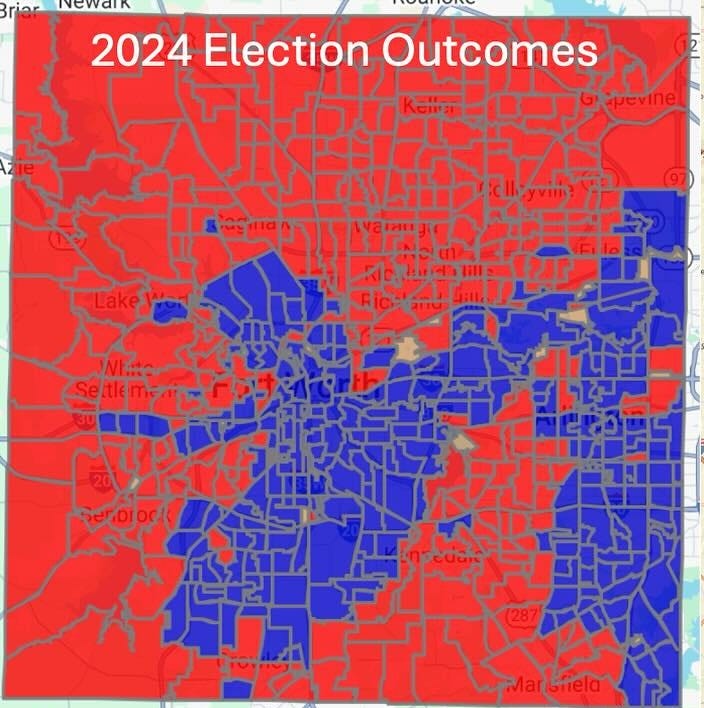
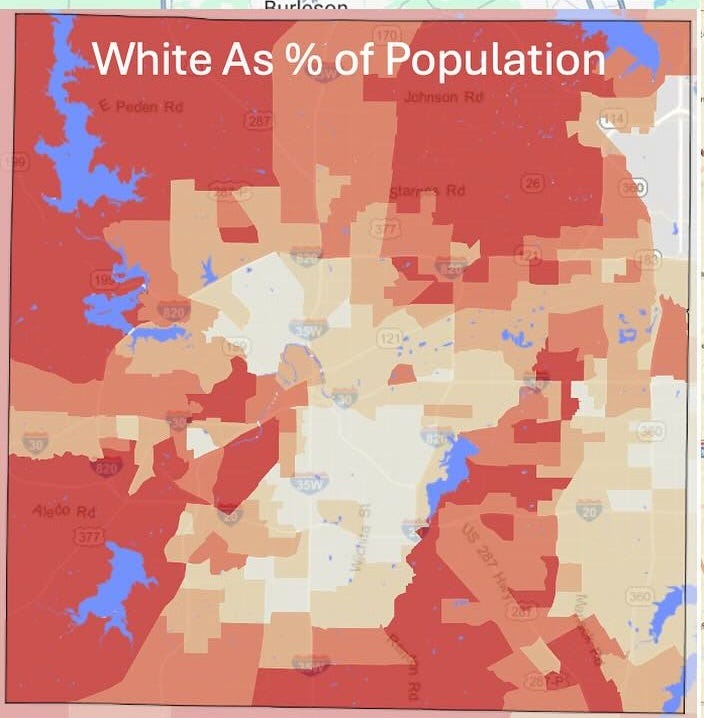
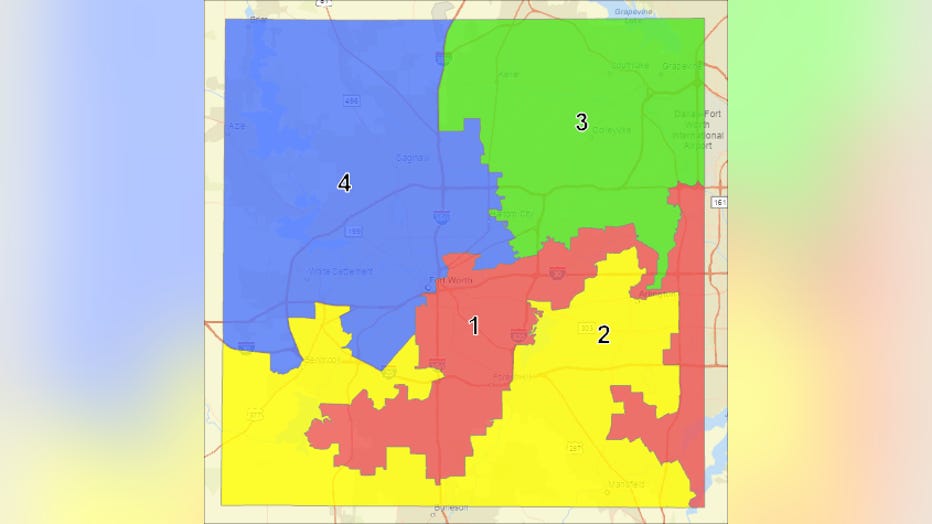
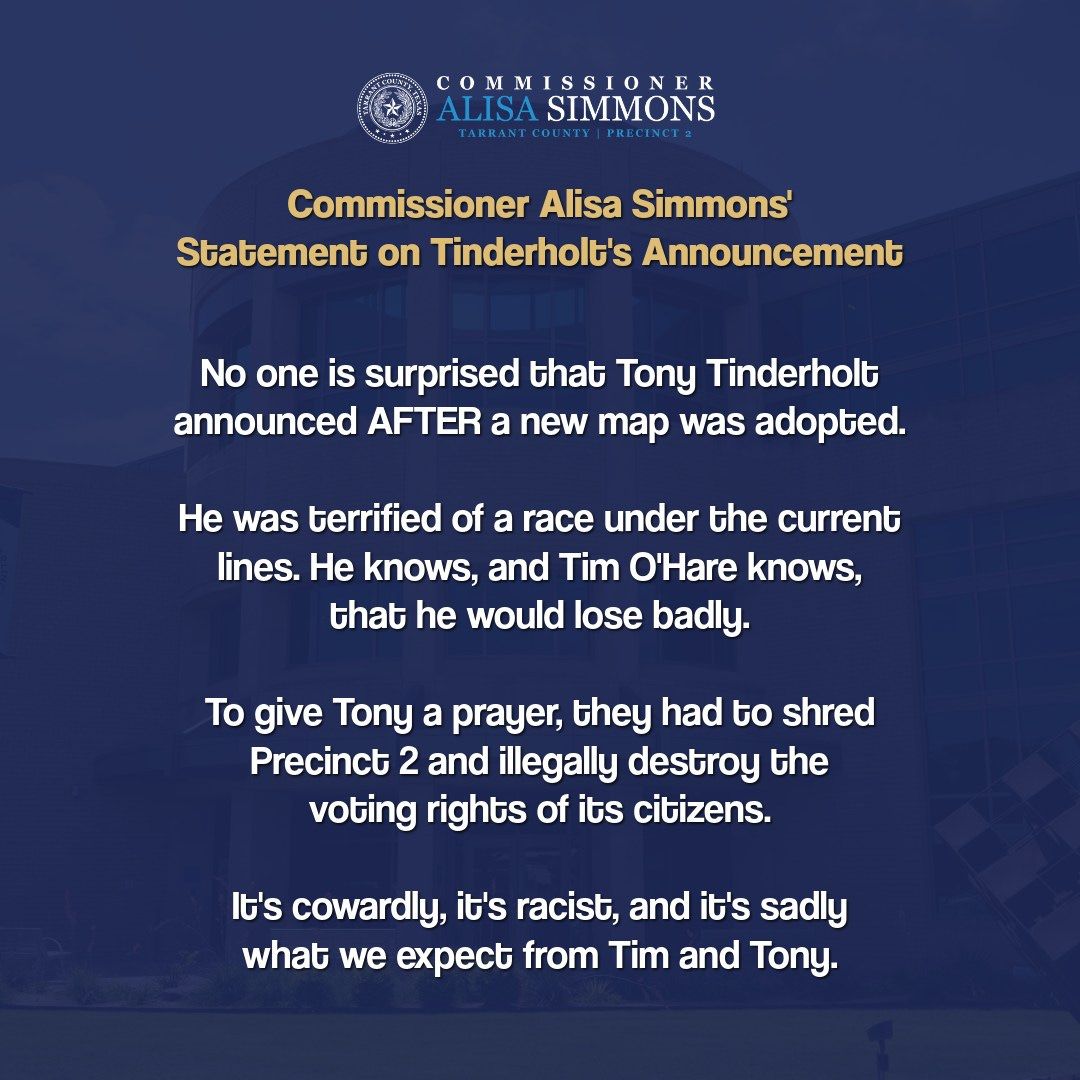
Today, the Tarrant County Commissioners Court voted to approve a redistricting map that effectively eliminates the seat of Commissioner Alisa Simmons, the only Black woman on the court.
It’s not a coincidence. It’s not neutral. It’s not “routine.” It is the calculated removal of a voice that dared to speak up for all of us.
Commissioner Simmons has stood firmly against the racist agenda pushed by Judge Tim O’Hare and the Republican Commissioners on the court. She spoke out against the rise in jail deaths under their watch. She called out the cruelty of defunding Girls Inc., a nonprofit that empowers young women of color. She opposed the elimination of free rides to the polls, which made it harder for working-class people, especially Black and brown voters, to cast a ballot.
And now, she’s being punished for it.
Commissioner Simmons wasn’t just a name on a ballot. She is my commissioner. I voted for her. I campaigned for her. And like thousands of others in Precinct 2, I saw her as a voice for the voiceless, a woman unafraid to shine a light on white supremacy, even when it came dressed in a suit and tie.
That light scared them. So they tried to snuff it out.
What we witnessed today was retaliation. It was white supremacy striking back at a Black woman who told the truth. And just like in Greenwood in 1962, they’re using the tools of power, maps, votes, and bureaucratic language, to do what they couldn’t do in public: silence her.
But we see it. We name it. And we will fight it.
The new map that the County Commissioners voted on today.
The Republican Commissioners and their defenders kept repeating the same excuse over and over again, “This wasn’t about race. It was just about politics.”
They said the map was designed to secure a Republican majority, not to silence Black voters. As if those two things aren’t deeply intertwined.
It’s the same argument Greg Abbott’s lawyers made in Shannon Perez v. Abbott, when Texas was caught racially gerrymandering districts. Their defense?
“It is not our intent to discriminate against minorities. It is our intent to discriminate against Democrats. If minorities happen to vote Democrat, that is their fault, not ours.”
That’s not a denial. That’s a confession….
Let’s stop pretending this distinction between race and party means anything in Texas. In Tarrant County, in Harris County, across the South, voter suppression by “party” is voter suppression by race. When you target the communities who dare to elect Black women, working-class progressives, young organizers, and civil rights leaders, you are targeting those communities on purpose.
They can say it’s about partisanship all they want. But we know what it’s really about.
Because when Conservatives talk about “conserving” something, they mean it.
They want to conserve white supremacy.
They want to conserve inequality, corporate power, and police brutality.
They want to conserve a system where jails are full, books are banned, teachers are silenced, and women don’t have autonomy.
They want to conserve a Texas where your zip code decides your worth, and where Black and brown voices are only welcome if they stay quiet.
And when people like Alisa Simmons refuse to stay quiet, they get erased.
But erasing her seat won’t erase her power, or ours….
And just when we thought we might get a win, it vanished as quickly as it came.
Yesterday, far-right extremist Tony Tinderholt (R-HD94) announced he would not seek reelection to the Texas House. For a brief moment, there was celebration across Arlington. A man who built his career on cruelty, censorship, and conspiracy was finally stepping aside. But the celebration didn’t last.
Because today, just minutes after the Tarrant County Commissioners voted to dismantle Precinct 2, Tinderholt announced he would run for that very seat, Alisa Simmons’ newly gutted district.
And he didn’t come alone.
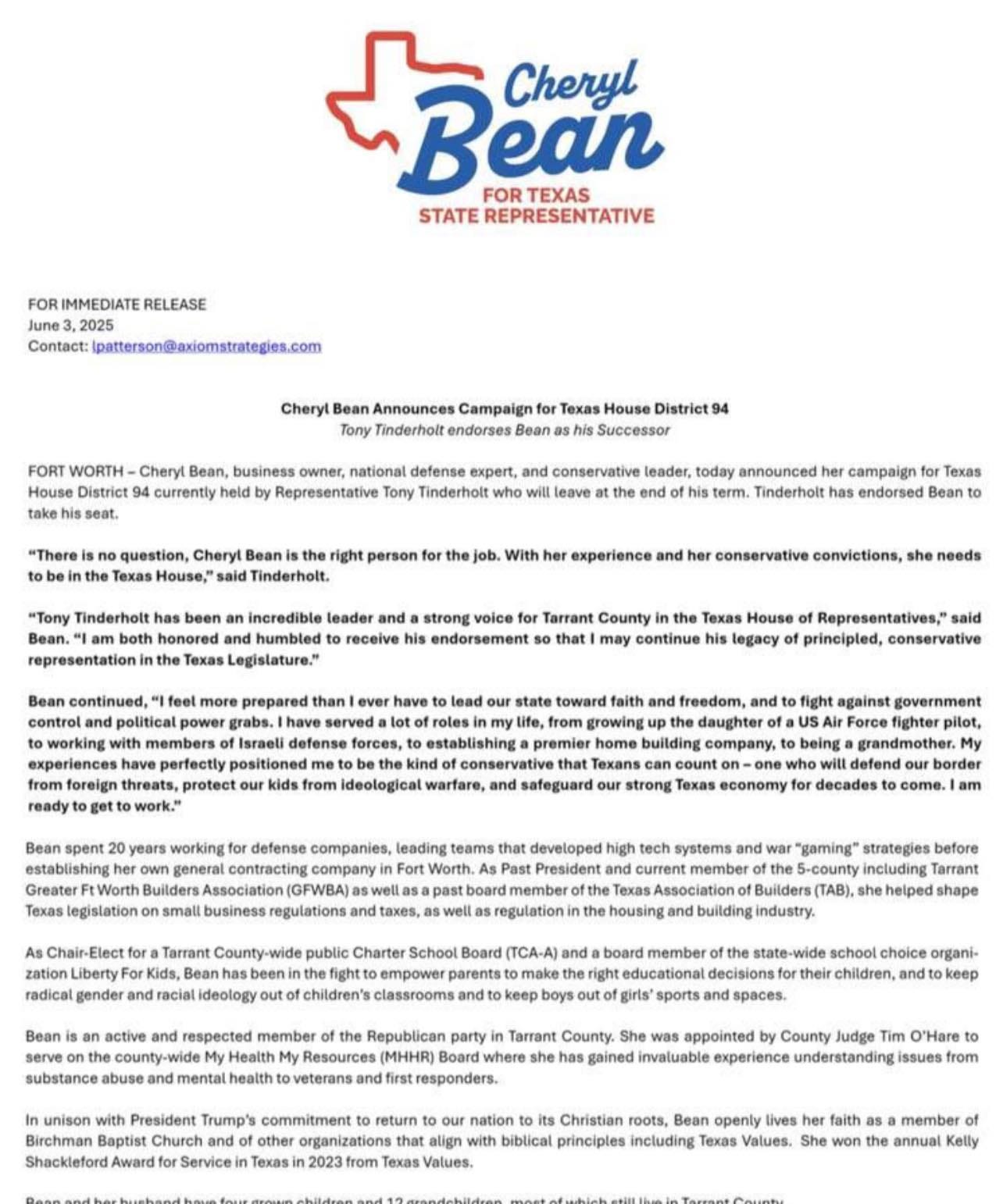
Cheryl Bean, another far-right extremist and ally of Tinderholt, announced her run for the now-open HD94 seat. A seat that was, conveniently, made safer for someone like her under the new maps.
Bean doesn’t even live in the district. She changed her voter registration to a new address inside it—an address she doesn’t own, according to the Tarrant Appraisal District. Her real home? Still outside the district lines. But facts don’t matter when the plan is to bulldoze through communities with precision and arrogance.
This wasn’t a coincidence. It was a coordinated political hit job, plain and simple.
A rigged map. A choreographed retirement. A handoff. A handpicked replacement. All timed to disempower the voices of Black and brown voters in Tarrant County. All orchestrated by Tim O’Hare and the extremist wing of the Republican Party.
They knew Simmons couldn’t be beaten fairly.
So they changed the lines.
They cleared the field.
And then they tried to rewrite the future.
But we see them.
We know the playbook.
And we’re not going to let this go unanswered.
This is part of a broader, coordinated strategy across Texas to suppress the political power of Black and brown communities under the guise of partisan politics…..
James Ryan, the president of the University of Virginia since 2018, announced his resignation under intense pressure from the Trump administration.
The Civil Rights Division of the Trump administration pressured the Board of Governors of the university to remove Ryan because of his support for diversity, equity, and inclusion.
They said that he pretended to comply with the federal demands to eliminate DEI but merely renamed them.
For the past half century, DEI was considered a hallmark of compliance with civil rights laws. DEI programs encouraged women and nonehites to enroll in higher education and to study the history of discrimination.
Under Trump, DEI has been reinterpreted to mean favoring those groups at the expense of white men and thus discriminating against white men.
The Trump administration has cut federal grants to universities that are slow or unwilling to dismantle DEI programs.
The demand to remove Mr. Ryan was made over the past month on several occasions by Gregory Brown, the deputy assistant attorney general for civil rights, to university officials and representatives, according to the three people briefed on the matter.
Mr. Brown, a University of Virginia graduate who, as a private lawyer, sued the school, is taking a major role in the investigation. He told a university representative as recently as this past week that Mr. Ryan needed to go in order for the process of resolving the investigation to begin, two of the people said.
Harmeet K. Dhillon, the Justice Department’s top civil rights lawyer, has also been involved in negotiations with the university. She received her law degree from the University of Virginia, where she was a student in the law school at the same time as Mr. Ryan…
Mr. Ryan, hired in 2018 as the university’s ninth president, has leaned into issues like making the school more diverse, increasing the number of first-generation students and encouraging students to do community service. But his approach, which he says will make the university “both great and good,” has rankled conservative alumni and Republican board members who accuse him of wanting to impose his values on students and claim he is “too woke.”
Before becoming the University of Virginia’s president, Mr. Ryan served as the dean of the Harvard Graduate School of Education, where he was praised for his commitment to D.E.I. programs. Harvard has been one of the Trump administration’s chief targets since it began its assault on higher education.
The administration’s attempt to assert federal influence over state university leadership decisions is also illustrative of how Mr. Trump’s political appointees continue to wield the Justice Department’s investigative powers to achieve policy goals long sought by a top Trump adviser, Stephen Miller.
Legal experts said they could think of few other instances in which an administration had demanded that a school have its president removed in order to resolve a Justice Department investigation.
“This is a tactic you would expect the government to use when it’s playing hard ball in a criminal case involving a corporation accused of serious wrongdoing or pervasive criminal activity,” said Daniel C. Richman, who is a law professor at Columbia University and a former federal prosecutor.
If you haven’t heard of Curtis Yarvin, you should learn about him now. Yarvin does not believe in democracy. He believes in a society commanded by a king or autocrat. He was a prodigy as a child and now considers himself to be a political genius. Powerful men in the tech industry and politics pay him court and admire him, men like the billionaires Peter Thiel and Marc Andreessen, and Vice-President JD Vance.
Curtis Yarvin, advisor to Peter Thiel, Donald Trump
This article in The New Yorker by Ava Kolman paints a biographical portrait of Yarvin, summarizes his major ideas and describes his international standing as a philosopher of far-right leaders of the tech industry.
Kolman writes about Yarvin’s extensive range of contacts among the Trump administration and his influence on them, as well as his contact with royalists in other countries..
Kolman begins:
In the spring and summer of 2008, when Donald Trump was still a registered Democrat, an anonymous blogger known as Mencius Moldbug posted a serial manifesto under the heading “An Open Letter to Open-Minded Progressives.” Written with the sneering disaffection of an ex-believer, the hundred-and-twenty-thousand-word letter argued that egalitarianism, far from improving the world, was actually responsible for most of its ills. That his bien-pensant readers thought otherwise, Moldbug contended, was due to the influence of the media and the academy, which worked together, however unwittingly, to perpetuate a left-liberal consensus. To this nefarious alliance he gave the name the Cathedral. Moldbug called for nothing less than its destruction and a total “reboot” of the social order. He proposed “the liquidation of democracy, the Constitution, and the rule of law,” and the eventual transfer of power to a C.E.O.-in-chief (someone like Steve Jobs or Marc Andreessen, he suggested), who would transform the government into “a heavily-armed, ultra-profitable corporation.” This new regime would sell off public schools, destroy universities, abolish the press, and imprison “decivilized populations.” It would also fire civil servants en masse (a policy Moldbug later called rage—Retire All Government Employees) and discontinue international relations, including “security guarantees, foreign aid, and mass immigration.”
Does anything on his wish-list sound familiar to you?
It should. Trump has loaded up his administration with people who imbibe Yarvin.
A decade on, with the Trumpian right embracing strongman rule, Yarvin’s links to élites in Silicon Valley and Washington are no longer a secret. In a 2021 appearance on a far-right podcast, Vice-President J. D. Vance, a former employee of one of Thiel’s venture-capital firms, cited Yarvin when suggesting that a future Trump Administration “fire every single mid-level bureaucrat, every civil servant in the administrative state, replace them with our people,” and ignore the courts if they objected. Marc Andreessen, one of the heads of Andreessen Horowitz and an informal adviser to the so-called Department of Government Efficiency (doge), has started quoting his “good friend” Yarvin about the need for a founder-like figure to take charge of our “out of control” bureaucracy. Andrew Kloster, the new general counsel at the government’s Office of Personnel Management, has said that replacing civil servants with loyalists could help Trump defeat “the Cathedral.”
“There are figures who channel a Zeitgeist—Nietzsche calls them timely men—and Curtis is definitely a timely man,” a State Department official who has been reading Yarvin since the Moldbug era told me. Back in 2011, Yarvin said that Trump was one of two figures who seemed “biologically suited” to be an American monarch. (The other was Chris Christie.) In 2022, he recommended that Trump, if reëlected, appoint Elon Musk to run the executive branch. On a podcast with his friend Michael Anton, now the director of policy planning at the State Department, Yarvin argued that the institutions of civil society, such as Harvard, would need to be shut down. “The idea that you’re going to be a Caesar . . . with someone else’s Department of Reality in operation is just manifestly absurd,” he said.
Yatvin’s ideas are quirky, inhumane, and extreme, to say the least:
On his blog, he once joked about converting San Francisco’s underclasses into biodiesel to power the city’s buses. Then he suggested another idea: putting them in solitary confinement, hooked up to a virtual-reality interface. Whatever the exact solution, he has written, it is crucial to find “a humane alternative to genocide,” an outcome that “achieves the same result as mass murder (the removal of undesirable elements from society) but without any of the moral stigma.”
Yarvin’s call for an American strongman is often treated as an eccentric provocation. In fact, he considers it the only answer to a world in which most people are unfit for democracy….
Yarvin’s influence on Trump’s inner circle is noticeable:
Last month, an anonymous doge adviser told the Washington Post that it was “an open secret that everyone in policymaking roles has read Yarvin.” Stephen Miller, the President’s deputy chief of staff, recently quote-tweeted him. Vance has called for the U.S. to retrench from Europe, a longtime Yarvin desideratum. Last spring, Yarvin proposed expelling all Palestinians from the Gaza Strip and turning it into a luxury resort. “Did I hear someone say ‘beachfront?’ ” he wrote on Substack. “The new Gaza—developed, of course, by Jared Kushner—is the LA of the Mediterranean, an entirely new charter city on humanity’s oldest ocean, sublime real estate with an absolutely perfect, Apple-quality government.” This February, during a joint press conference with Benjamin Netanyahu, the Israeli Prime Minister, Trump surprised his advisers when he made a nearly identical proposal, describing his redeveloped Gaza as “the Riviera of the Middle East.”
Trump, who doesn’t like to read, is unlikely to have read Yarvin’s philosophical treatises about the proper functioning of a modern society–without benefit of a popular vote–but certainly Trump’s view of the unlimited, imperial powers of the Presidency are similar to those of Yarvin.
Read the article if you can access it. Make yourself aware of the man who wields an outsize influence on Trump right now.
To learn more about Yarvin’s influence among rightwing billionaires, read:
The Chronicle of Higher Education reports that legislatures in Republican-controlled states are passing laws to restrict teaching about racism or any kind of DEI in higher education. Such state laws follow the lead of Governor Ron DeSantis in Florida, who was first to launch the war on academic freedom, but also the policies of Trump, who has declared that he too will make war on “woke” (that is, anything that is honest about the dark side of the American past.)
Teaching social work in Tuscaloosa, Ala., Cassandra E. Simon often assigns readings that describe how the families her students might one day serve have been impacted by more than a century of housing, employment, and education discrimination. The associate professor has encouraged her students to engage in spirited discussions about race, even assigning a project in which they advocate for or against a social-justice issue.
Doing any of those things today, she argues in a federal lawsuit, could get her fired from the state flagship, where she’s taught for 25 years. Last year, the state’s Republican governor, Kay Ivey, signed into law a sweeping bill that restricts what professors can teach about race. If any of their lessons veer into what conservative politicians have deemed “divisive concepts,” faculty members risk being reported, investigated, and potentially fired.
That kind of incursion into the curriculum is growing and prompting a flurry of First Amendment challenges from Simon and other plaintiffs. It’s a line state lawmakers did not cross early on in their push to dismantle DEI efforts, even as universities shuttered offices, laid off employees, canceled scholarships, and called off diversity training. But over the past two years, more than a dozen laws have been enacted that either limit which classes can be taught or imposed restrictions on what professors can say in the classroom, according to a Chronicle analysis of state legislation and a compilation of what PEN America calls “educational gag orders.”
This year especially “has been a banner year for censorship at a state level across the country,” said Amy B. Reid, senior manager at PEN America’s Freedom to Learn program. “The point of a lot of these restrictions is to put people on guard, worried that anything or everything could be prohibited so you really have to watch what you say.”
Some of the chief architects of the DEI-dismantling playbook have insisted that they’re not trying to silence anyone. In a January 26 letter to the editor in The Wall Street Journal by Ilya Shapiro and Jesse Arm of the Manhattan Institute, the institute declared that “Conservatives Have No Interest In Censorship.”
“By ending practices such as identity-based discrimination and compulsory, politically coercive diversity statements,” these laws “protect the rights of professors and students to engage freely on all topics, including race,” they wrote.
Despite such reassurances, recent bills seeking to eliminate diversity efforts are encroaching on curricula in a variety of ways. Some states, like Texas, Florida, and Utah, are giving boards more control over what goes into the core curriculum, as well as the ability to shut down programs with low enrollments or questionable work-force advantages. Others, like Alabama and Mississippi, have erected guardrails on topics that can be discussed in the classroom.
Supporters say these laws are needed to prevent liberal professors from veering off into lessons that amount to activism. Some conservative lawmakers argue that it’s their responsibility, as stewards of taxpayer dollars, to ensure public universities are offering degrees that will help students be successful and land jobs.
Critics see these incursions as infringements on free speech and academic freedom.
The intentions of those who launched “the war on woke” are irrelevant to the reality of what happens when their concerns are taken up by legislatures intent on stamping out disturbing but historically accurate discussions of race and gender. When red-state legislators restrict academic freedom, they do it with an axe, not a scalpel. The result is to instill fear in professors about what they teach and whether they will be fired for thought crimes.
Benjamin R. Cremer is pastor at the United Methodist Church in Boise, Idaho. I read his essays regularly. He is truly a Christian. He preaches love, not hate. He knows and tries to exemplify the Beatitudes.
On June 19, 1865—two and a half years after the Emancipation Proclamation was signed—enslaved Black Americans in Galveston, Texas were finally informed of their freedom. This day, now known as Juneteenth, marks not just the delayed enforcement of a national promise, but the resilient hope and courage of a people who endured unspeakable injustice while still holding onto the belief that liberation would come.
As Christians, we must understand that Juneteenth is not just a historical footnote—it is a call to theological clarity and moral responsibility. Scripture consistently reveals a God who hears the cries of the oppressed (Exodus 3:7), who calls for justice to “roll on like a river” (Amos 5:24), and who sets the captives free (Luke 4:18). The story of God is a story of liberation—not just personal salvation, but also the dismantling of systems that crush the image of God in others.
Juneteenth challenges us to confront a difficult truth: that much of American Christianity was complicit in slavery, and that the legacy of that sin continues in our institutions, our policies, and yes—even in some of our pulpits. But the gospel does not shy away from hard truths. It invites us to repentance. To truth-telling. And to the costly work of reconciliation and repair.
In our time when people are heard saying “Illegal is illegal,” Juneteenth invites us to remember that slavery was once legal. Harboring a fugitive enslaved person was illegal. Black freedom illegal. “Illegal is illegal” has always been used to defend injustice. Legality ≠ morality. Justice calls us higher.This is not about shame. It’s about grace. Grace that tells the truth. Grace that restores what has been broken. Grace that refuses to be silent in the face of injustice.
Observing Juneteenth as Christians means celebrating the faith and dignity of Black Americans who have carried the gospel with courage even when the church failed to. It means honoring the day freedom was announced, and lamenting that it was so long withheld.
May we not be a people who forget. May we be a people who remember rightly, act justly, and walk humbly with our God (Micah 6:8).
If you are looking for a tangible way to get involved in communal justice work, I want to let you know about Be Love day, put on by the King Center. Be Love is a growing movement of courageous acts to achieve justice, which is based on these words from Dr. Martin Luther King, Jr.: “Justice at its best is love correcting everything that stands against love.” Be Love seeks to strategically define and unleash the true power of love to unite humanity, cultivate true peace, and create the Beloved Community. The movement is holding “Be Love Day” on July 9th. Click the link above to learn more.
Please read and take action to oppose Trump’s tyranny:
Earlier this week Donald Trump called for a second civil war at a US military base. This scenario can be resisted and prevented, if we have the courage to listen, interpret, and act. And this Saturday we will have the occasion to act.
The listening is important. The speech was given at the base now known again as Ft. Bragg. The fort was named for a confederate general. It was renamed Ft. Liberty. Under this administration, it was renamed Fort Bragg, now ostensibly to honor another American serviceman, not the confederate general. It is a dishonest pretense that dishonors everyone. The fort is now named again after a confederate general, as Trump made clear. The tradition that is now in fact being honored, that of oathbreakers and traitors.
In Trump’s speech, the existence of the United States is placed in doubt. We are not a country but a divided society in which some of us deserve punishment by others. He made no mention of the world today, nor of any common American interest that might necessitate national defense. There was no concern about threats from China or Russia. Middle Eastern dictatorships, the only countries that Trump singled out, garnered great praise because their leaders gave Trump money. There was no mention of any wars that are actually underway, such as the Russian invasion of Ukraine.
Trump invoked battlefields across the decades to create a sense of individual heroism, in which of course the history the the US Army is very rich. But that individual heroism is usually cited by commanders in chief as evidence of a nation that is worthy of defense. No such America figured in Trump’s speech. America did not exist Trump’s speech, except as a cult to him personally.
In the actual history of the United States, one war is central: the Civil War. Trump, who has never seen the point of the Union Army defending the republic, now seems now to have moved on to the position that the Confederacy should have won. He promised to rename Fort Gregg-Adams, the first base named for African-Americans, to Fort Robert E. Lee. The base in question hasn’t been known by the full name of the confederate commander since 1950. Lee was a traitor, an oathbreaker, a defender of slavery and the commander of a force whose mission was to break up the United States of America.
In his speech, Trump claimed that seizing undocumented migrants in 2025 shows the same courage as fighting in the Revolutionary War, or the First World War, or the Second World War, or Korea or Vietnam. It would have been news to the soldiers at the time that charging a trench or jumping from a plane is no different than ganging up on a graduate student or bullying a middle-aged seamstress.
But here we see the magic of Trump’s rhetoric: he seeks to transform the courage of the past into the cowardice of the future. He is preparing American soldiers to see themselves as heroes when they undertake operations inside the United States against unarmed people, including their fellow citizens.
All of this, of course, trivializes actual US military achievements. The actual battles of our history just become a “show,” to use one of Trump’s keywords. They are deeds performed for the pleasure of a Leader who then invokes them to justify his own permanent power. Denuded of all context, military glory becomes a spectacle into which any meaning can be injected. And he who injects the meaning is he who rules. That is the fascist principle that Trump understands. There is no politics except struggle, and he who can define the enemy in the struggle can stay in power. But whereas historical fascists had an enemy without and an enemy within, Trump only has an enemy within. The world is too much for him. The army is just for dominating Americans.
In his speech, Trump was trying to transform a legacy of battlefield victory around the world into a future willingness to take illegal orders regarding his own policy on the territory of the United States. The defiance of the law was clear. Trump cannot, for example, legally just rename those bases. The forts were named by an act of Congress. And he cannot legally deploy the Marines to Los Angeles. He has no authority to do so. The president is expressly forbidden by law from using the armed forces to implement domestic policies.
Trump defined himself not as a president but as a permanent Leader. In repeatedly mocking his predecessor, he was summoning soldiers to defy the fundamental idea that their service is to the Constitution and not to a given person. “You think this crowd would have showed up for Biden?” Whether or not it is unprecedented, as I believe it is, such mockery certainly dangerous. It suggests that something besides an election, something like individual charisma, some personal right to rule, is what matters. That soldiers should follow Trump because he is Trump, and not for any other reason.
In general, we imagine that the US Army is here to defend us, not to attack us. But summoning soldiers to heckle their fellow Americans is a sign of something quite different. Trump seized the occasion to summon soldiers to join him in mocking the press. Reporters, of course, as the Founders understood, are a critical check on tyranny. They, like protestors, are protected by the First Amendment of the Constitution. Trump was teaching soldiers that society does not matter, and that law does not matter. He “loves” soldiers. He is personally responsible for the pay raises: “I gave you so much money for four years it was crazy.” “We’re giving you an across-the-board raise” This is the way a dictator speaks to a palace guard, or a fascist to a paramilitary.
Trump is putting himself above the army and the army above the country: “we only have a country because we first had an army, the army was first.” That ridiculous: the Continental Army was formed in 1775 from the people, for the very specific and time-limited purpose of ending colonial oppression. Trump wants the armed force to be the end in itself, and freedom to be its enemy. Generally, presidents who speak to soldiers of military glory have had in mind the defense of American freedoms, such as the freedom of expression, including the freedom of the press and the freedom to assemble. Trump said nothing about freedom, except as a “flame” or a “shield.” He said nothing about rights. There was not a word about democracy.
We are witnessing an attempt at regime change, rife in perversities. It has a historical component: we are to celebrate the oathbreakers and the traitors. It has a fascist component: we are to embrace the present moment as an exception, in which all things are permitted to the Leader. And of course it has an institutional component: soldiers are meant to be the avant-garde of the end of democracy. Instead of treating the army as defenders or freedom, Trump presented soldiers as his personal armed servants, whose job it was to oppress his chosen enemies — inside the United States. Trump was trying to instruct soldiers that their mission was to crush fellow Americans who dared to exercise their rights, such as the right to protest.
Referring to migration as an “invasion,” as Trump did during the speech, is meant to blur the distinction between his immigration policy and a foreign war. But it is also meant to transform the mission of the US Army. The meaningful border here is that between reality and fantasy. If soldiers and others are willing to accept that migration is an “invasion,” then they enter into an alternative reality. Inside that alternative reality, they will see those who do not accept the invasion fantasy as enemies. And this is exactly what Trump called for when he portrayed elected officials in California as collaborators in “an occupation of the city by criminal invaders.”
The US Army, like other American institutions, includes people of various backgrounds. It depends heavily on African-Americans and non-citizens. One can try to transform the army into a cult of the Confederacy and a tool to persecute migrants, but this will cause, at a minimum, great friction. Beyond this, using the Army to enforce domestic policy risks ruining its reputation. Deploying the armed forces in cities risks US soldiers killing US civilians. It also risks that provocateurs, including foreign ones, including allies of Trump, will try to kill an American soldier to provoke a disaster. (Trump’s birthday parade seems practically designed for such an incident, by the way.)
Trump will welcome and exploit such situations, of course. He doesn’t have the courage to say things clearly or start conflict directly, but instead sets up others for situations in which they suffer and he profits. The question is whether civil war is the future Army officers and soldiers want. When Trump promises to celebrate Robert E. Lee, he is telling the Army that oath-breakers and traitors will be celebrated in the future. This is not in his gift. Officers who bring the US armed forces to battle American civilians will be remembered by the heirs of a broken republic and as the people who started a second American civil war.
It is clear what Trump is trying to do. He wants to turn everything around. He wants an army that is not a legal institution but a personal paramilitary. He wants it not to defend Americans but to oppress them. He wishes the shame of our national history to become our pride. He wants to transform a republic into a fascist regime by transforming a history of courage into a future of cowardice.
This can only succeed if it goes unchallenged. All of us can think about his words and their implications. Officers and soldiers can remember that not all orders are legal orders. Those in the media can interpret Trump’s speeches clearly rather than just repeating them or seeing them as one side in a partisan dispute. Our courts can name the limits of his authority. And even a Republican Congress can recognize when its powers are being usurped in a way that risks the end of our country.
Though he did not mention the Civil War, Trump did refer to “the sacred soil of Gettysburg.” It is worth recalling Lincoln’s very different sense of the sacrifice of American soldiers in his Gettysburg Address:
The brave men, living and dead, who struggled here, have consecrated it, far above our poor power to add or detract. The world will little note, nor long remember what we say here, but it can never forget what they did here. It is for us the living, rather, to be dedicated here to the unfinished work which they who fought here have thus far so nobly advanced. It is rather for us to be here dedicated to the great task remaining before us — that from these honored dead we take increased devotion to that cause for which they gave the last full measure of devotion — that we here highly resolve that these dead shall not have died in vain — that this nation, under God, shall have a new birth of freedom — and that government of the people, by the people, for the people, shall not perish from the earth.
In the end, and in the beginning, and at all moments of strife, a government of the people, by the people, for the people depends upon the awareness and the actions of all of us. A democracy only exists if a people exist, and a people only exists in individuals’ awareness of one another of itself and of their need to act together. This weekend Trump plans a celebration of American military power as a celebration of himself on his birthday — military dictatorship nonsense. This is a further step towards a different kind of regime. It can be called out, and it can be overwhelmed.
Thousands of Americans across the land, many veterans among them, have worked hard to organize protests this Saturday — against tyranny, for freedom, for government of the people, by the people, for the people. Join them if you can. No Kings Day is June 14th.
Jan Resseger reviews Trump’s vigorous crusade to eliminate civil rights laws by inverting their meaning. These laws were passed to break the monopoly held by white men in hiring and promotions. But now, any program that favors women and nonwhites is treated as a crime. Universities and corporations that once featured their efforts to promote diversity, equity, and inclusion are now warned by the federal government that these efforts discriminate against white men and must be abolished.
Resseger writes:
When it comes to President Trump’s threatened tariffs and his foreign policy demands, we have all been reading about the phrase coined by a Financial Times reporter: “Trump always chickens out—TACO.” But when it comes to Trump’s attack on civil rights and racial justice in the nation’s public schools, the President has been doggedly persistent.
On May 22nd, The New Yorker’s Susan Glasser mused about the President’s Oval Office ambush of South African President Cyril Ramaphosa as capturing how things are going in “Washington a hundred and twenty-one days into Trump’s second term: a manufactured scene of outrage about a nonexistent ‘white genocide’ ” and “a reminder of how explicitly Trump has, in his second term, defined the goal of his Presidency as a sort of racial-justice quest for white people.” Glasser describes “a President who has terminated affirmative-action decrees that have been in place for the federal government since the nineteen-sixties, unleashed a wave of arrests and deportations aimed at illegal migrants of color, gutted federal civil-right-enforcement offices, and blamed D.E.I. for just about every evil at home and abroad.”
New York Times reporter Erica Green summarizes the Trump administration’s consistent work since the winter to attack racial justice and twist the meaning of the protection of civil rights: “In his drive to purge diversity efforts in the federal government and beyond, President Trump has expressed outright hostility to civil rights protections. He ordered federal agencies to abandon some of the core tenets of the Civil Rights Act of 1964, on the basis that they represented a ‘pernicious’ attempt to make decisions based on diversity rather than merit. But in recent weeks, Mr. Trump has turned to those same measures—not to help groups that have historically been discriminated against, but to remedy what he sees as the disenfranchisement of white men. The pattern fits into a broader trend… as Trump officials pick and choose which civil rights protections they want to enforce and for whom. Across the government, agencies that have historically worked to fight discrimination against Black people, women and other groups have pivoted to investigating institutions accused of favoring them.”
Beginning on Valentines Day, when Trump’s Acting Assistant Secretary of the U.S. Department of Education’s Office for Civil Rights (OCR), Craig Trainor sent all public school officials a “Dear Colleague” letter threatening their federal funding if they did not remove all diversity, equity, and inclusion from their schools, the Trump Administration turned its sights on U.S. public schools. In March, the administration closed seven of the nation’s twelve regional Office for Civil Rights locations that have traditionally investigated complaints filed by parents and families. At the same time the Office for Civil Rights abandoned its traditional practice of carefully investigating complaints and working with school districts to end discriminatory practices. Trump’s OCR turned to directed investigations aimed at punishing school districts failing to comply with the administration’s priorities and threatening loss of federal funding. In early April, the Department of Education threatened K-12 public school districts’ Title I funding unless school leaders (and statewide officials) signed a certificate that they were in full compliance with Title VI of the Civil Rights Act as well as in compliance with the administration’s broad, and many believe mistaken, interpretation of the 2023 Supreme Court decision in Students for Fair Admissions v. Harvard, which specifically banned affirmation in college admissions. The Trump administration has declared that the Students for Fair Admissions decision instead bans all DEI programming and policy.
School districts and state departments of education, along with teachers unions and civil rights organizations like the NAACP and the ACLU, have put the consequences of almost all of these threats on hold by filing injunctions, which have yielded temporary stays in most of these cases, but Education Secretary, Linda McMahon and her Department of Education keep on persisting by conducting more investigations and threatening punitive consequences for school districts persisting in efforts to help particular groups of students.
In mid-May, by executive order, President Trump banned the use of disparate impact as a standard for investigating Civil Rights investigations. For ProPublica, Jennifer Smith Richards and Judi Cohen reported: “Remaking the Office of Civil Rights isn’t just about increasing caseloads and reordering political priorities. The Trump administration now is taking steps to roll back OCR’s previous civil rights work. Last month, Trump issued an executive order that directs all federal agencies, including the Education Department, to stop enforcing cases involving policies that disproportionately affect certain groups—for example when Black students are disciplined more harshly than white students for the same infractions or when students with disabilities are suspended more than any other group even though they represent a small percentage of student enrollment.”
Smith Richards and Cohen examine how the Department’s Office for Civil Rights (OCR) has reduced its capacity to process complaints and changed its procedures in ways that bias investigations to reflect the Trump administration’s priorities: “The OCR, historically one of the government’s largest enforcers of the Civil Rights Act of 1964, has been known for being a neutral fact-finder. Its investigators followed a process to determine whether complaints from the public met legal criteria for a civil rights claim, then carried out investigations methodically. The vast majority of investigations were based on discrimination complaints from students and families, and a large share of those were related to disability discrimination… Investigations being publicized now have largely bypassed the agency’s civil rights attorneys… McMahon and OCR head, Craig Trainor created what amounts to a shadow division. The Trump administration has ordered more than a dozen investigations in the past three months on its own, not initiated by an outside complainant. These ‘directed investigations’ are typically rare; there were none during President Joseph Biden’s administration. The investigations have targeted schools with transgender athletes, gender-neutral bathrooms and initiatives that the administration views as discriminatory to white students.”
The ProPublica reporters spoke with OCR attorneys who anonymously describe what they believe are serious violations of departmental protocol: “McMahon and Trainor created ways to divert complaints and investigations away from the OCR’s legal experts entirely. The administration made an ‘End DEI’ portal that bypasses the traditional online complaint system and seeks only grievances about diversity, equity and inclusion in schools. Unlike the regular complaint system, the diversity portal submissions are not routed to OCR staff. ‘We have no idea where that portal goes, who it goes to, how they review the cases… said the attorney who said he struggles with being unable to help families.” In other instances, “Conservative groups with complaints about diversity or transgender students have been able to file complaints directly with Trainor and get quick results… America First Legal, a group founded by Trump deputy chief of staff, Steven Miller… emailed Trainor a few days after Trump’s… executive order… (that) directs schools to stop teaching about or supporting diversity, equity, and gender identity. ‘AFL respectfully requests that the Department of Education open investigations into the following public school districts in Northern Virginia for continuing violations of Title IX,’ the letter read, listing five districts that have policies welcoming to transgender students. Senior leadership in Washington opened the cases the following week. America First issued a press release headlined ‘VICTORY!’ “
Education Week‘s Brooke Schultz reports: “The U.S. Department of Education has announced or confirmed at least 100 investigations into school districts, colleges, and universities, and other entities as it emerges as a prime enforcer of President Donald Trump’s social agenda.” Here are some of Schultz’s examples: “(F)our school districts have drawn investigations from the department over a Black student success plan in Chicago, a students of color summit in New York, racial affinity groups in Illinois, and a selective Virginia high school’s admissions policy that the education Department says appears to be racially discriminatory… The first investigation Trump’s Education Department announced was a probe into the Denver district over a high school’s all-gender bathroom, which the agency suggested was a violation of Title IX, the federal law barring sex discrimination in schools that receive federal funds.”
Last Friday, in “Trump Administration Gives New York 10 Days to End Its Ban on Native American Mascots,” Education Week‘s Brooke Schultz reported on a Department of Education demand that clearly represents the Trump administration’s twisting and tangling the purpose and meaning of civil rights protection in public schools: an attack by the Trump Department of Education on a New York law banning Native American mascots in public schools. “The (U.S.) Education Department’s Office for Civil Rights argues that the state’s mascot policy, enacted in 2022, violates Title VI because it prohibits the use of Native American imagery but ‘allowed names, mascots, and logos that appear to have been derived from other racial or ethnic groups, such as the ‘Dutchmen’ and the ‘Huguenots.”… McMahon said in a statement Friday that the department would ‘not stand idly by as state leaders attempt to eliminate the history and culture of Native American tribes.”
Although McMahon seems to believe that the logo New York has banned in the Massapecqua School District connects with the history of American Indians in the region of the school district on Long Island, J.P. O’Hare of the New York Department of Education explained that neither the logo nor the term ‘Chief,’ was used by Native Americans in the area.
Schultz lets the president of the National Congress of American Indians, “the largest nonprofit representing Native nations which has long tracked and challenged the use of Native American mascots, Mark Macarro” correct Education Secretary McMahon’s bizarre misconception of racial justice and civil rights law: “Native people are not mascots… We have our own languages, cultures, and governments—our identities are not anyone’s mascot or costume. No political endorsement or misguided notion of ‘honoring’ us will change the fact that these mascots demean our people, diminish the enduring vibrancy of our unique cultures, and have no place in our country.”
Schultz adds: “Research has found that, for Native students, exposure to Native American mascots reduces self-esteem, their ability to imagine future accomplishments, and their belief that Native American communities can make a difference. For non-Native people, research shows that mascots are associated with negative thoughts and stereotypes about Native Americans… The portrayals are often outdated, whitewashed stereotypes, and aren’t grounded in realistic portrayals of Native people.”
The U.S. Navy and the other branches of the military were told by order of Trump and Hegseth to remove all books on the subjects of diversity, equity, and inclusion. In practice, this meant elimination of books about race, racism, and sexual orientation.
The 20 official search terms included in the May 9 memo included: affirmative action; allyship; anti-racism; critical race theory; discrimination; diversity in the workplace; diversity, equity, and inclusion; gender affirming care; gender dysphoria; gender expression; gender identity; gender nonconformity; gender transition; transgender military personnel; transgender people; transsexualism; transsexuals; and white privilege.
Using these identifiers, the Navy took 381 books out of circulation and off its shelves.
However, a second review restored all but about 20 of the titles.
In a major reversal, almost all the 381 books that the U.S. Naval Academy removed from the school’s libraries have been returned to the bookshelves after a new review using the Pentagon’s standardized search terms for diversity, equity and inclusion titles found about 20 books that need to be removed pending a future review by a Department of Defense panel, according to a defense official.
The reversal comes after a May 9 Pentagon memo set Wednesday as the date by which the military services were to submit and remove book titles from the libraries of their military educational institutions that touch on diversity, race, and gender issues using the Pentagon’s specific search terms.
Prior to the Pentagon memo standardizing search terms, the Navy used its own terms that identified 381 titles, including titles like “I Know Why the Caged Bird Sings” by Maya Angelou, “How to Be an Antiracist” by Ibram X. Kendi, “Bodies in Doubt” by Elizabeth Reis, and “White Rage” by Carol Anderson.
Frankly, I have no idea why the list of banned books was pared down from 381 to only 20. The news story doesn’t explain.
Here is the original list of banned books. Most are about race and racism. The others are about gender and sexuality.
If the military is strong enough to fight, aren’t they strong enough to read about challenging topics?




 Diane Ravitch's blog