Jamelle Bouie, columnist for The New York Times, wrote several columns (see here) about the decision by the U.S. Supreme Court to eviscerate the Voting Rights Act in its Callais decision. This one is titled “The Law They Hate Was a High Point of Our History.” The high court majority, six hard-right Republicans, decided that partisan redistricting is just fine, but redistricting that takes account of race is not. Thus, a state legislature dominated by one party can justly produce a voting map that gives every seat to its own party, but it may not permit districts created to encourage representation of racial minorities.
In the wake of the Callais decision, some states of the Confederacy quickly carved up districts to eliminate seats held by Democrats and by Blacks. Some of these states will have only white Republicans in Congress.
Bouie wrote:
The Voting Rights Act of 1965 wasn’t the top-down dictate of a rogue, liberal Supreme Court — if such a thing has ever existed.
It wasn’t the brainchild of out-of-touch bureaucrats in Washington, nor was it some kind of martial settlement imposed on the states of the former Confederacy.
It was, instead, an achievement of the most effective social movement of the postwar United States. The Voting Rights Act revitalized American democracy and stands as one of its great achievements.
This, somehow, has been lost in the discourse around the Supreme Court’s decision in Louisiana v. Callais. The court’s clear hostility to the law, as well as the glee with which conservative Republicans have dismantled the South’s majority-minority congressional districts in its wake, makes it seem as if the V.R.A. was a handcuff placed on American politics by some outside force.
The truth is that the Voting Rights Act was conceived, crafted and passed in order to further realize American democracy. And it was, itself, the product of an explosion of democratic energy.
The V.R.A. was forced onto the national agenda by the tireless work of the grass roots activists in the Civil Rights Movement, who struggled, bled and put their lives on the line in a fierce fight to secure their fundamental rights as Americans. It was signed into law by a president who had won election in one of the largest landslides in American history. It was subsequently reauthorized by Congress, after Congress, after Congress, after Congress.
The most recent reauthorization in 2006 was nearly unanimous, and there was broad support from the public — so much that to justify the Supreme Court’s attack on the law in Shelby County v. Holder, Chief Justice John Roberts had to fabricate a constitutional doctrine about the “equal sovereignty” of states, and Justice Antonin Scalia had to characterize the reauthorization as an unfair “racial entitlement” that politicians would never remove for fear of backlash.
If there is any single law that you could plausibly say represents the general will of the American people, it might be one that was reaffirmed nearly every decade for 40 years by the people’s representatives.
This isn’t just a historical point or a piece of idle trivia. It is essential. And it gets to what is so egregious about the court’s campaign against the law.
The Voting Rights Act was an attempt by the people of the United States, affirmed across two generations of voters and lawmakers, to make good the 15th Amendment to the Constitution — itself the hard fought product of war and reconstruction. It was an attempt to wield the authority of the federal government to secure the fundamental right to vote as well as the fundamental right to representation. It stood for substantive equal protection — the chance to make democracy real.
The V.R.A. was not, contra John Roberts and the rest, an expression of colorblindness, indifferent to the social realities of the United States. It did not pretend to treat supposed neutrality as truly neutral, nor did it place racial inequality outside the remit of the Constitution. And it was not, as this court would have it, the bland expression of a bloodless commitment to anti-discrimination. In fact, it was the most significant attempt in this country’s history to realize the promise of political equality.
The Voting Rights Act has more — much more — democratic legitimacy than this Supreme Court has ever enjoyed. After all, most of this court’s conservative majority was appointed by presidents who entered office as winners of the Electoral College but not the popular vote.
It is that relative difference in democratic legitimacy that makes this court’s voting rights jurisprudence so offensive.
Those voting rights rulings, from Shelby County v. Holder in 2013 to Callais in 2026, come from a court that has placed itself above the people at large. It is a court that will, according to its whims, ignore the clear commands, directions and intent of Congress. It is a court that treats voters and legislators as errant children to be corralled and disciplined by wise jurists. It is a court that doesn’t answer hard constitutional questions as they arise as much as it imposes constitutional meaning based on its narrow interests and ideological preoccupations.
It is a court that is trying to shape the political system to its liking, despite the claims of the chief justice, with no limits other than its partisan preferences. It is a court, in other words, that is wielding a cramped and parochial vision of the Constitution against American democracy, rather than treating the Constitution as a tool for realizing our democratic aspirations.
There have been many frustrating decisions from this Supreme Court. Louisiana v. Callais may not even be its worst decision — that prize might still go to Trump v. United States, where the chief justice conjured, out of thin air, an anti-constitutional doctrine of criminal immunity for the president.
Callais, however, might be the most emblematic of this court’s decisions: a flashing warning that our democracy is being crushed underneath the imperial authority of an arrogant and reactionary juristocracy. We can either discipline that court — and put it in its place — or accept our fate as its subjects.
Dan Froomkin writes “Press Watch,” a blog that covers the media. In this post, he criticizes the mainstream media for treating the U.S. Supreme Court’s Callais decision as a partisan issue. It is that, but it is at bottom a decision that destroys Black political power. It allows states to divvy up districts in ways that eliminates Black representation. And former Confederate states wasted no time in breaking up districts that elect Blacks to Congress.
He writes:
States across the South are redrawing election maps to eliminate majority-Black congressional districts.
Much of the major-media coverage is casting this in purely political terms – as just another part of the partisan battle for the House in November.
The remaking of the U.S. political map accelerated this week in courts and legislatures, all of it in this round expected to boost Republicans in their attempt to keep control of Congress in November’s elections.
Gov. Brian Kemp of Georgia on Wednesday called lawmakers back to the capital next month to redraw the state’s legislative districts for the 2028 election cycle, and to work on changes to the state’s voting system.
The call for a special session, which will begin on June 17, comes as Southern lawmakers have been rushing to reconfigure congressional maps to be more favorable to Republicans for this year’s midterms in response to the recent Supreme Court decision that weakened the Voting Rights Act of 1965.
But in the South, the significance of redistricting goes far beyond any partisan issue.
So let me rewrite that for you:
In a stunning display of racism, white Republican leaders throughout the South are stripping Black people of their franchise in order to retain political power.
The catalyst was a 6-3 Supreme Court decision on April 29 that gutted the Voting Rights Act of 1965, landmark legislation that gave Black people the opportunity to elect candidates of their choice.
Six right-wing justices insisted that intentional voting discrimination is a thing of the past. Southern legislators immediately responded by redrawing election boundaries to dilute the Black vote, in many cases making it virtually impossible for Black people to be elected to Congress.
What has happened in a matter of days amounts to a wrenching reversal of 60 years of racial progress — a revival of the Jim Crow era when Black people had no political power, no matter their number.
On a personal level, Black voters in the South are struggling with the repercussions of having one of their essential rights being brutally ripped away from them.
In states like Georgia, Louisiana, and Mississippi, where they make up more than 30 percent of the population, Black Americans will have little to no say in who is elected to Congress. And as the effects of the court decision trickle down to the local level, they may get shut out of some of those elections as well.
Meanwhile, the leaders of the white nationalist movement known as MAGA are celebrating. In some cases, their racism is expressed openly. “For too long, Tennessee politics has been dominated by cosmopolitan communists and race hustlers imposing their corrupt will on a deeply rural and conservative state,” Representative Andy Ogles of Tennessee posted on social media.
For the authoritarian leaders of MAGA, the dilution and nullification of Black votes is a crucial step in their quest to remain in power — even as most voters have turned against them.
MAGA’s future depends on suppressing the votes of groups that don’t support its white-male dominated Christian nationalist ideology. Reducing minority representation, to them, is essential to destroying majority rule. Destroying Majority rule is how they win.
Gerrymandering that leads to Southern states being almost entirely represented by white, right-wing elected officials dramatically improves MAGA’s political calculus. In the short run, it improves the odds of retaining Congress in November. MAGA’ strategy to keep the White House in 2028 includes yet more Black disenfranchisement, through voter intimidation, deception and disruption.
So far, MAGA’s plan is working, raising the prospect that Trump and his successors may remain in power for the foreseeable future.
But another way to characterize the current drive to disenfranchise Black voters is that it is the desperate – and maybe final — act of a white nationalist party that is being rejected by increasing number of voters.
For American journalists, this ought to be epic, tectonic stuff, worth aggressive and ongoing coverage.
And keep in mind that in the mid- to late-20th century, the struggle for civil rights was the dominant story in American politics, the subject of vast amount of journalism, some of it heroic. Ultimately it was journalism that brought the civil rights marchers into the American public’s breakfast nooks and living rooms, forcing the country to reckon with a brutal and sordid history of racism, and, eventually, try to move beyond it.
But today, as in the early days of the civil rights movement, too much of the media is averting its eyes from the experience of Black people. Too much coverage treats this extraordinary and consequential display of racism and societal regression as if it were just an ordinary political battle.
Some Reporters Get It
Some mainstream journalists have recognized the racial element of redistricting, and their work provides models of better, more appropriate coverage.
As evidence that you can address both the racial and political nature of the Republican moves in a news article, consider Emily Cochrane’s reporting in the Times about a new Tennessee map “that slices up Memphis to scatter Black voters into neighboring districts, a move intended to eliminate the state’s last Democratic House seat.” After several paragraphs of partisan framing, she wrote:
Democrats, noting that about two-thirds of Memphis voters are Black, said it was a blatant attack on hard-won gains for fair representation in a state shaped by slavery, segregation and the civil rights movement.
She described the scene in the state capitol in Nashville during the special session to pass the new map:
Black lawmakers delivered emotional speeches about family members, friends and colleagues who endured segregation or struggled with barriers to voting in the 1960s. State Senator Charlane Oliver of Nashville, a Democrat, stood on her desk right before the vote, holding a banner reading “No Jim Crow 2.”
And she quoted an attendee:
“My race is who I am and it informs my politics,” said Danyelle Norment, 30, who woke up early to drive in from Memphis. “It’s not something that’s separate or can be left behind.”
She added, “it’s really, really important to have folks who can understand our lived experience.”
In the Washington Post, Justin Jouvenal profiled Press Robinson, an 88-year-old civil rights pioneer. “That law passed in 1965 was the bedrock of improvement of life in America for people of color,” Robinson told Jouvenal.
Now, Robinson fears a wipeout of Black political power, much like the one that occurred after Reconstruction.
“History is now repeating itself,” he said.
On PBS Newshour, Liz Landers covered the story as part of the network’s “Race Matters” series, bringing us the voice of Leona Tate, a civil rights activist:
So now we move backwards with the Supreme Court decision that will go down as one of the most racist rulings in our nation’s history.
Tate was 6 years old when she became one of the first students to desegregate a New Orleans school, Landers noted. Then Tate continued:
I had no idea what racism was at that time, but I knew by third grade that it was the color of my skin that made a difference. I just can’t believe that it’s still happening 66 years later. It’s cheating, to me. That’s how I feel. It’s really cheating. And it’s really illegal.
It does bring back that feeling from a long time ago, and it’s not a good feeling.
Read the Black Press
As in the 1950s and 60s, the Black press is revealing what the white press is slow to acknowledge.
Brandon Tensley, writing for Capital B, explained “How One Supreme Court Ruling Is Rewriting 60 Years of Voting Protections.” “Most Black Americans reside in the South,” he wrote. Lawmakers in former slaveholding states dismantling majority-Black districts “could change the balance of power and the complexion of leadership in this country.”
Gerren Keith Gaynor, writing for TheGrio, headlined the fact that “Black legislators lead the resistance as Republicans rush to redraw maps after gutting of Voting Rights Act.” “It’s disturbing and disgusting to see how this administration and the white leadership here are trying to codify white supremacy and dilute Black political voting power because that’s what’s happening,” Tennessee State Rep. Justin J. Pearson told Gaynor. “I think none of us should make any mistake about what is going on. The attempt to remove Black representation and our ability to elect representatives of our choice is one of the most significant attacks on Black voter participation and Black voter representation since the end of Reconstruction.”
TheRoot published a viral video of Louisiana resident Marshan Camese delivering a powerful speech at a state Senate hearing over redistricting. “I believe the country as a whole is rebuking your party. Y’all are in a death spiral,” he said. “That’s why y’all have to redistrict. That’s why y’all have to cheat.” MAGA, he said, “is the last breath of the Confederacy.”
Civil rights leaders are headed to Alabama tomorrow for a rally they’re calling “All Roads Lead to the South.” As I wrote in my Heads Up News newsletter this week, this could be the birth of a movement that combines the battle for voting rights with the battle for democracy.
“Black folks from across the country are gonna be busing in, flying in, to show up and to really begin organizing to turn out in the November election,” Wisdom Cole, the Senior National Director of Advocacy for the NAACP, told TheRoot. “This is such an important moment to activate all of us.”
Note: the rally in Alabama was held last Saturday.
Heather Cox Richardson sums up the struggle for equal rights since the Brown decision of May 17, 1954. The struggle has continued in the years since then, aided especially by the Voting Rights Act of 1965.
The VRA enabled Black Americans to have a voice, representation, and genuine political power. The U.S. Supreme Court decided on April 29, 2026, in Louisiana v. Callais that there is no longer any need for federal protection of voting rights for Black Americans, and they made a decision that is certain to lead to the loss of meaningful representation for Blacks, who–the Court majority decided–no longer needed federal protection. The former Confederacy proceeded to enact redistricting that will wipe out many Black-held seats in Congress. Racism is alive.
Seventy-two years ago tomorrow, on May 17, 1954, the Supreme Court unanimously decided Brown v. Board of Education of Topeka, Kansas. That landmark decision declared racial segregation in public schools unconstitutional because segregated schools denied Black children “the equal protection of the laws guaranteed by the Fourteenth Amendment.”
Three years after the Brown v. Board decision, in the face of massive resistance to desegregation in the South, President Dwight D. Eisenhower proposed the Civil Rights Act of 1957 to protect the right of Black Americans to vote, using the federal government to overrule the state laws that limited voter registration and kept Black voters from the polls. To prevent the passage of the first federal civil rights legislation since 1875, South Carolina senator Strom Thurmond launched the longest filibuster in U.S. history, speaking for 24 hours and 18 minutes.
(Senator Cory Booker (D-NJ) broke Thurmond’s record on March 31 through April 1, 2025, speaking for 25 hours, 5 minutes, and 59 seconds, but his speech was not a filibuster.)
Southern Democrats known as “Dixiecrats” managed to weaken the measure, but Senate majority leader Lyndon B. Johnson (D-TX) managed to wrestle the Civil Rights Act of 1957 through Congress, and Black Americans and their white allies began trying to register Black Americans to vote.
But the law proved too weak to force white registrars to allow Black voters onto the rolls, and by 1961, activists with the Student Nonviolent Coordinating Committee (SNCC, pronounced “snick”) were at work in Mississippi to promote voter registration. In 1964 they launched the “Freedom Summer,” bringing college students from northern schools to work together with Black people from Mississippi to educate and register Black voters.
Just as the project was getting underway, three organizers—James Chaney, from Mississippi, and Andrew Goodman and Michael Schwerner from New York—disappeared outside Philadelphia, Mississippi. Lyndon Johnson, president by then, used the popular rage over the three missing voting rights workers to pressure Congress into passing the Civil Rights Act of 1964, designed to try to hold back the white supremacists and to make it possible for Black Americans to register to vote. The measure passed, and on July 2, Johnson signed it into law.
On August 4, investigators found the bodies of the three missing men. Ku Klux Klan members working with local law enforcement officers had murdered them and then buried the bodies in an earthen dam that was under construction.
And still, white officials refused to accept the idea of Black voting. In Selma, Alabama, where the city’s voting rolls were 99% white even though Black Americans outnumbered white Americans among the 29,500 people who lived there, local Black organizers had launched a voter registration drive in 1963, but a judge stopped voter registration meetings by prohibiting public gatherings of more than two people.
Selma voting rights activist Amelia Boynton invited the Reverend Dr. Martin Luther King Jr. to the city to draw national attention to its struggle, and he and other prominent Black leaders arrived in January 1965. For seven weeks, Black residents made a new push to register to vote. County sheriff James Clark arrested almost 2,000 of them on a variety of charges, including contempt of court and parading without a permit. A federal court ordered Clark not to interfere with orderly registration, so he forced Black applicants to stand in line for hours before taking a “literacy” test. Not a single person passed.
Then, on February 18, white police officers, including local police, sheriff’s deputies, and Alabama state troopers, beat and shot an unarmed man, 26-year-old Jimmie Lee Jackson, who was marching for voting rights at a demonstration in his hometown of Marion, Alabama, about 25 miles northwest of Selma. Jackson died eight days later, on February 26. Black leaders in Selma decided to defuse the community’s anger by planning a long march—54 miles—from Selma to the state capitol at Montgomery to draw attention to the murder and voter suppression.
On March 7, 1965, the marchers set out. As they crossed the Edmund Pettus Bridge, state troopers and other law enforcement officers met the unarmed marchers with billy clubs, bullwhips, and tear gas. They fractured the skull of young activist John Lewis and beat Amelia Boynton unconscious. A newspaper photograph of the 54-year-old Boynton, seemingly dead in the arms of another marcher, illustrated the depravity of those determined to stop Black voting.
On March 15, President Johnson addressed a nationally televised joint session of Congress to ask for the passage of a national voting rights act. “Their cause must be our cause too,” he said. “[A]ll of us…must overcome the crippling legacy of bigotry and injustice. And we shall overcome.” Two days later, he submitted to Congress proposed voting rights legislation.
Under the protection of federal troops, the Selma marchers completed their trip to Montgomery on March 25. Their ranks had grown as they walked until they numbered about 25,000 people. That night, Viola Liuzzo, a 39-year-old mother of five who had arrived from Michigan to help after Bloody Sunday, was murdered by four Ku Klux Klan members who tailed her as she ferried demonstrators out of the city.
A bipartisan majority of Congress passed the Voting Rights Act by a vote of 77–19 in the Senate and 333–85 in the House. Dr. King and Mrs. Boynton were guests of honor as President Johnson signed the Voting Rights Act of 1965 on August 6. Recalling “the outrage of Selma,” Johnson said: “This right to vote is the basic right without which all others are meaningless. It gives people, people as individuals, control over their own destinies.”
And yet, on April 29, 2026, the Supreme Court gutted the protections for the Black-majority districts Congress provided for in the Voting Rights Act after years of weakening the law in other ways. In its wake, Republican-dominated southern state legislatures are rushing to redraw their district lines to dilute the votes of Black Democrats.
Today, thousands of Americans, including eighteen members of Congress, traveled to Selma and Mongomery to call Americans to action to protect voting rights. Pastor Kenneth Sharpton Glasgow told Joseph D. Bryant of Alabama news site AL, “This moment is bigger than Democrats or Republicans. This is about democracy itself. This is about whether Black communities, poor communities, rural communities, formerly incarcerated people, and marginalized voices will continue to have representation and political power in America.”
Speakers united around the theme that those trying to gerrymander their way into control of Congress in defiance of voters had reawakened a movement. “They think they can draw us out of power,” Representative Alexandria Ocasio-Cortez (D-NY) told an audience in Montgomery.
“They do not know the sleeping giant that they just awakened. Because it is not a coincidence, and our whole country must understand, that it was not until voting rights were ratified in this country that we got the Great Society. Because when Black Americans have the right to vote and that vote is protected, our schools get funded. When voted rights are protected, healthcare gets expanded. When voted rights are protected, our country moves forward. And Montgomery, that’s what they’re actually afraid of. They’re afraid of us coming together. They’re afraid of us protecting one another.”
The U.S. Supreme Court’s recent decision eviserated the Voting Rights Act of 1965. The far-right 6-member majority struck down Section 2 of the Act, which required states to provide Black voters opportunity to represented. In effect, the ruling rejected Louisiana’s redistricting, which would have created two majority-Black districts.
Most black voters live in urban districts. It does not require a gerrymander to produce a Black-majority district.
To eliminate districts that are not likely to elect a Black candidate does require a gerrymander. The compact urban district must be sliced like a pizza, so that most Black voters are in districts where they are a minority.
That’s what’s happening now in Tennessee and other states that to reduce districts that are currently held by a Democrat, usually a man or woman of color.
Tennessee Republicans wasted no time slicing up Memphis in the expectation that the new districts would never elect a Black candidate.
Tennessee Republicans on Wednesday proposed a congressional map aimed at diluting the state’s lone majority-Black district, a swift response to last week’s Supreme Court ruling that weakened a landmark voting rights law.
The new map slices Memphis, a majority-Black city, and Shelby County into three districts and likely will give Republicans the ability to flip Tennessee’s lone remaining Democratic seat, which includes the city.
Democratic lawmakers, whose opposition means little under a Republican supermajority in the state’s General Assembly, and Black leaders across Tennessee have compared the effort to carve up the Ninth Congressional District to Jim Crow-era voter suppression tactics. They have accused conservatives of a power grab that undermines Black voters in Memphis, who have long favored Democrats.
Republicans, cheered on by President Trump, have rejected those claims. Instead, they have said, they are responding to the Supreme Court ruling, which raised the bar for what constitutes a racial gerrymander under the Voting Rights Act of 1965.
Under the map, Shelby County — which includes Memphis — is split into three districts. One district now runs along the state’s western border before extending down to include part of Williamson County, a suburban county just outside Nashville. Two other districts now share part of Shelby County and more rural, conservative communities in Tennessee.
“The Supreme Court has opined that redistricting, like the judicial system, should be colorblind — the decision indicated states like Tennessee can redistrict based on partisan politics,” Speaker Cameron Sexton said in a statement. “Tennessee’s redistricting will reduce the risk of future legal challenges while promoting sound and strategic conservatism.”
The General Assembly is expected to vote as soon as Thursday.
The Supreme Court struck down a Louisiana congressional map that included two majority-Black districts, arguing that it violated the Constitution by using race as the primary factor in redistricting. The ruling has set off a scramble across Southern states with Republican leadership, all of which have at least one majority-Black district, before the 2026 midterms.
I first met Vivian Connell in 2012 at a conference for legislators in Raleigh, North Carolina. She was part of a panel of North Carolina teachers who spoke about the challenges and needs of their classrooms. She was brilliant and articulate. I later learned that she was both a lawyer and a teacher. I was impressed by her candor, her insight, her passion, and her deep connection to her students.
That happened to be the same year that the Network for Public Education was founded.
Four years later, the Network decided to hold its annual conference in North Carolina. The decision was controversial because the state legislature (the General Assembly) had just passed a bathroom bill requiring that everyone must use the bathroom aligned with their assigned gender at birth. HB2 was known as Hate Bill 2. Some thought we should avoid North Carolina, others said we should show up.
We decided to stay in North Carolina (had we canceled at the last minute, we would have gone bankrupt), and our decision was reinforced when our dear friends in the state were able to persuade the Reverend William Barber to be our keynote speaker.
Rev. Barber was indeed eloquent, and we were glad we decided to stand by our original decision to meet in Raleigh. Funnily enough, the major hotel we stayed in had three kinds of bathrooms: women’s, men’s, and gender neutral. I wondered if the General Assembly knew. Had it occurred to them that HB 2 was unenforceable unless they had an inspector at every public bathroom to visually inspect either birth certificates or genitalia.
One prominent North Carolinian was missing from our conference: Vivian Connell.
Vivian lived about an hour away but she couldn’t travel. She had ALS, Lou Gehrig’s disease, which causes physical degeneration and has no cure.
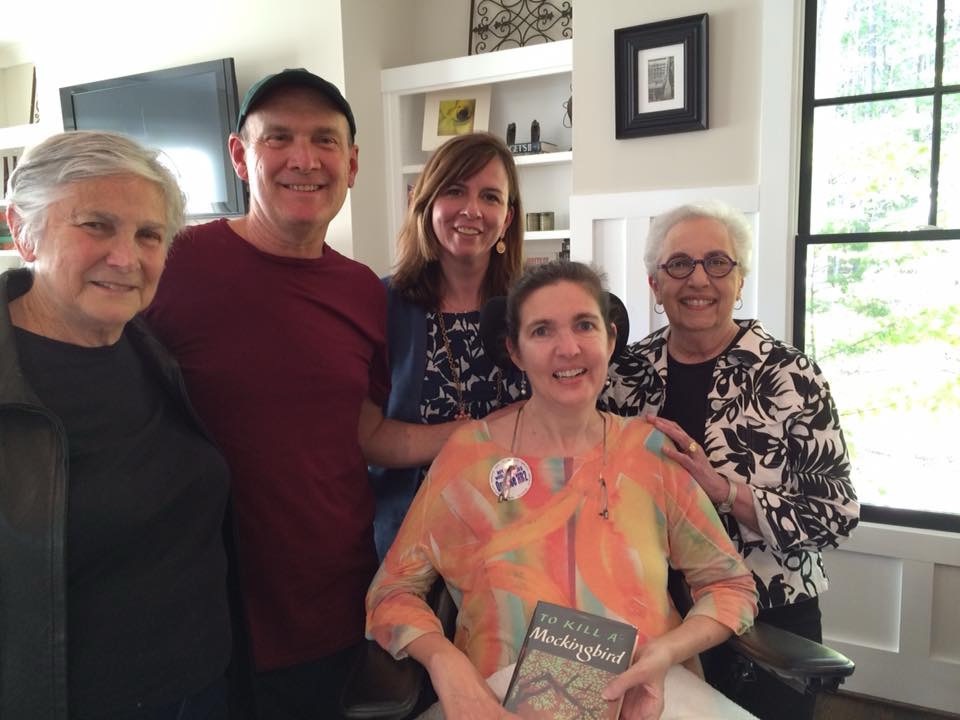
At the end of the last session, on April 17, 2016, several of us joined Bertis Downs to pay a visit to Vivian. Bertis is from Georgia; Colleen Wood is from Florida; Phyllis Bush, now deceased from cancer, was from Indiana; and I am from New York.
Surrounding Vivian at her home, Mr, Bertis Downs, Colleen Wood and Phylis Bush. Vivian, in her wheelchair, holds a first edition of one of her favorite books.
When we arrived at Vivian’s home, we met her husband Paul, her children Hadley and Hagan, and her aide. Vivian was in a wheelchair. She had no physical mobility and could not speak. She was able to communicate via an amazing device. She “typed” by looking at letters on a computer screen, which then expressed words. A member of our group gave her a first edition of To Kill a Mockingbird, one of her favorite books. Her husband announced that he was taking the kids to see Hamilton, their favorite show (they had memorized the lyrics.)
Soon after she received her diagnosis of ALS, she began writing a blog called “finALS.” When she began, she was still fully mobile. She documented her activities, checking off the items on her bucket list, and describing her deteriorating condition.
What follows is her final blog, which she wrote after we visited. We know that every word was laboriously written in a transfer from her eyes to the machine.
I hope you read it. You wil get a sense of her beautiful soul, which could conquer any obstacle but ALS.
One Last Time
[Prelude: It is June 24th, and I have at last finished my final post for finALS. It is not the masterpiece I dreamed of writing, but I am not a writer, and it is from my heart. This Monday, my medical team, husband and I will explore palliative sedation to manage the terrible choking and gagging that now dominate my waking hours. Some people adapt; some never wake up.
Before I go, I must spotlight my husband, Paul Connell, who has, from the beginning, eschewed any limelight. Never has a spouse been more constant or devoted. And though we each have big personalities that clash, he has never wavered in his devotion or care.
I dedicate all I have accomplished in law school and after my diagnosis to Paul, without whose selflessness, I could have done little.
VRC]
Well, I am back at last.
My doctor has called in hospice and used the phrase “last few months.”
And I have been paralyzed by the composition of this post.
You should all thank my writer friend David Klein that you are not reading my original idea. It involved stories of seeing Ken Burns speak in 2008–a version replete with quotations and commentary, I assure you–of how I wove segments from my beloved TV favorite, Aaron Sorkin’s West Wing, into my teaching (again, with no shortage of inspirational anecdotes) and of how I discovered that the author and star of Hamilton, Lin-Manuel Miranda, shares my love for the show.
But this is not to be an artful feature delineating again the ideals that inspired my teaching or the late-life leap to law school that validated my life’s work and filled the 27 months since I was diagnosed with ALS with wonder and opportunity. And I would love to regale you with the story of my Network for Public Education friends and colleagues visiting my home with both a signed first edition of To Kill a Mockingbird ( I know, right?) and my education policy hero, Diane Ravitch. I want to describe the tears of joy I cried when they left and the tears of joy my family enjoyed when we were gifted tickets to Hamilton! My husband wept because I couldn’t go. I bawled like a baby because they could.
And I want to tell you how my daughter ended up with an older script of Hamilton that Miranda had given to a journalist!
But this is not another post about serendipitous meetings and virtually miraculous joy that have so fully packed my life since I was diagnosed with this heinous, degenerative, and terminal disease.
I have covered my blessings pretty well.
These are to be my final words. Not a lesson from a dying teacher. Not an argument from a dying lawyer.
But one last time to attempt candor and artless honestly about my passions, my regrets, and wishing that this cup could be taken from me.
A LAST LITERARY LESSON
It feels important as well that I not leave anyone thinking too highly of me.
I was blessed to accomplish much I am proud of, mainly because I genuinely bought in to the best ideals of those before me and found the courage to follow my callings–to strive always to do more and do better.
Deepest thanks to my teachers and heroes.
I would be terribly remiss, however, if I failed to share at least a few of my representative fears and failings.
I’ve thought often of Hawthorne’s exhortation in The Scarlet Letter:
“Be true! Be true! Be true! Show freely to the world, if not your worst, yet some trait whereby the worst may be inferred!”
While I will not spend this post mimicking the poor guilty minister’s self-flagellation (you’re welcome), I will be sharing some of my less admirable choices. In retrospect, in fact, I am certain that my shame and regret–my failures–motivated me to keep striving to do better.
A loud conscience is a benefit, I think. At long as it brings about striving to do better rather than paralysis via self-loathing.
I diverge from many of my progressive parent friends because I take to heart that a reasonable and loving authority figure is healthy and character building.
I have no regrets about that aspect of my parenting: I think my kids knew that we rode them because we love them.
And I think this model is more effective when I ride myself equally.
And I encourage you not to procrastinate or ignore an urge to change or do better. Following these feelings brought all the most rewarding experiences of my life. And though I am far from done–though I have more public ( political) and private ( personal) battles to wage and improvements to make, I am out of time. And terribly sad about it.
So emulate the best of the heroes in Hamilton, our flawed founding fathers–yes, many of whom were paternalistic slave owners, but–who genuinely wanted to do better. The tireless work of Diane Ravitch, who once embraced the errant ideology of the failed Bush education mandate, No Child Left Behind (newsflash: many of our most vulnerable populations were “left behind”) but who now is standard-bearer for Valerie Strauss of The Washington Post, hundreds of leading education researchers, and hundreds of thousands of teachers and parents who are committed to the civic imperative of excellence and equity in public education.
And maybe even me: a self-absorbed, working-class only child who grew up oblivious to her privilege, pursuing only middle-class self-interest, but who learned through education and experience to change…
… To strive to be better, and in so doing, lived an adult life that makes it much less difficult to face death.
ON FAITH
I know my redeemer lives.
I did not embrace this belief until I was 28. And it is and has been the greatest gift of my life. I thank G-d for making him/herself real to me.
Every worthwhile accomplishment of my life–especially my love for my students and my passion for justice and tolerance–came from my faith.
My worst failings–especially my impatience, a hardness on others to live up to my (unjustified) expectations, and my intolerance for the intolerant–come from my failures to live out my faith.
I am grateful for forgiving friends and a forgiving G-d.
Regrets: Though I raised my children in church and strove to find churches that reflected the love of Jesus of Nazareth rather than the rules of so much organized religion, I never really prioritized participation in my church communities.
We moved several times when my kids were small, and I never fought hard enough to find the right church–a place that worked for social justice and where I could be confident that any person I invited would feel welcomed and loved for who they were.
For a couple of years, I asked my husband for us to tithe on our net, but I worried too much about birthday parties, vacations, activities, and home lifestyle to put giving first.
No Regrets: I did keep trying though, and about a year before leaving Charlotte, I bit the bullet and began shlepping my family to Warehouse 242, a place where I once saw one of my gay/trans high school students visit, and knew I had made the right decision! And when we moved to Chapel Hill, I at last found United Church of Chapel Hill, an open and affirming church community that focuses on serving “the least of these,” is active in the North Carolina Moral Monday movement for social justice, and actively promotes racial equity.
Despite my failures to live out my faith as I would have hoped, I was gifted lifelong friendship with several teens I led in a small group at a church in Charlotte that was much too legalistic for my comfort. I think I won these friendships because I never lied to the girls. I acknowledged the dissonance they perceived between the Jesus they knew or wanted to know and the legalism of our church and /or the politics of their parents.
Somehow I always respectfully challenged those I believe misrepresented the G-d who made himself real to me.
And for that, no regrets.
I do apologize to those with whom I disagreed, but failed to always love or respect. For example, the three arrogant social conservatives who poisoned my law school class: I held my ground against you in public, but I’m afraid I also referred to you surreptitiously as the unholy trinity.
And Andrew Brown, if you wonder why you practically had to rewrite your Law Review piece in which you demonized homosexuals and their rights as adoptive parents, well, that was me spending over twenty hours to eviscerate your pseudo-academic arguments and discredit your sources.
Oh, and Andrew, if you were my student and had used brackets to skew a quote to dishonestly promote your argument, I would have disciplined you to the outer boundaries of academic protocol.
Did you see what I did there?
I showed you that I enjoy kicking over the moneylenders’ tables in the temple a bit too much.
I think I was called to be a fighter, but I don’t think I always fought with love and humility.
May we all seek truth and justice while simultaneously striving to love our enemies as they are loved.
G-d help us all. S/he loves when we try and shows us unlimited forgiveness. This I know, and for this I am grateful.
ON RACE
It’s been a major issue in my life. And one I hate to leave on the table. Along with money in politics, corporate personhood, and the future of public education.
And so I find myself thinking of Greensboro.
The legendary lunch counter sit-ins.
This North Carolina city is now home to the Racial Equity Institute. My principal at Phoenix Academy, the alternative high school, sagely invested in each of his employees by sending us to the two-day introductory seminar of REI. The main reaction of attendees is “life-changing.” No guilting or emotional manipulation in sight, but two days of systematic realities steeped in history and taught by a diverse and largely dispassionate team. They are not crusading, but if you are interested in the statistics–the outcomes for people of color in health care, financial services, law enforcement, education, and other social structures, then they have the facts.
If you are ready and willing to face the not-so-just realities.
And Greensboro is also the home of my former law school classmate and honors writing scholar, Jessica. She married an African-American man, and they have three of the most beautiful biracial children I have ever seen. And though she has been busy with three children under five, she has come to Chapel Hill and fed me and my family on multiple occasions, and today she drove round-trip from Greensboro so that I could meet her two-month-old daughter before she had to pick up her toddler boys … or be charged a dollar a minute.
When I see the videos of those bad apples in law enforcement dragging black teenage girls in swimsuits to the ground or toppling one out of her school desk, or arresting Sandra Bland, I think of Jessica’s daughter. When I see the statistics and remember the stories of everything from violence to injustice to mere humiliation endured by my former students and my friends, I think of all our citizens of color and the ugly truth of Americans who must raise their children in fear.
And I hurt for white America, too many of whom deny the reality of our country’s latent and simmering injustice to so many people of color.
A child of the Deep South born in 1964 to parents raised on farms and in rental shacks around Vidalia, Georgia, I was lucky.
My parents taught me the right words:
Don’t judge people by skin color.
Everyone should be treated equally.
Don’t use the N-word.
But there were no black kids in my Mississippi elementary school and no black families in my neighborhoods… ever.
And the bulk of my south Georgia relatives never got the N-word memo.
By high school, I was passively non-racist but had never had a non-white friend.
Regrets : My worst memories…
When I was a high school sophomore, some popular girls I longed to befriend me asked me to go out after the football game. We got sundaes at the McDonald’s, and one had a hair in it. And so we circled round to request a replacement. Four privileged white girls in nice clothes carrying their generous allowances and riding in a parent’s new sedan. When we returned to the drive-thru, my new friend spoke into the speaker to the African-American girl at the window: “We need another sundae, and this time, hold the ni–er hair.”
I alone didn’t laugh, but I also didn’t speak up or get out of the car. And I still burn with shame at the memory.
No regrets: Junior year University, I brought my roommate home for Thanksgiving. I did not even think to tell my parents she was black. But when my poor mother said that she was afraid of what the neighbors would think, I stood up.
Dr. Anne Sharp, Dr. Albert Somers, Dr. Zach Kelehear and the wonderful English and Education professors unmasked the systematic racism of our education systems and even our very linguistics.
Never in my teaching career could I say “with liberty and justice for all” without adding “someday, if we all work for it.”
I am proud to have passed these lessons to my students and to reap the harvest of watching them work for a more just society. And of course, the root of the problem is not race alone, but the evil human propensity to divide ourselves by skin color, religion, gender, sexual orientation, social class, and myriad other traits. We declare our own group best or righteous, then marginalize and scapegoat “the other.” And in doing so, we undermine the promises of equality in both our Declaration and Constitution. We also fail to love our brothers as ourselves. As shared before, here is the story of my finest hour. Which I pray will counter the all-too-prevalent voices of evil flourishing in our political, and even religious arenas.
I have celebrated the election of our first biracial president only to witness a stunning political backlash and obstruction. I have witnessed racial attacks on President Obama and even his family. I witnessed the police attacks on black men and women, and the overtly racist slaughter in a Charleston church.
And now I have seen the most openly racist candidate become the GOP nominee for the upcoming presidential election. Ken Burns shares my concerns.
But:
I go with hope.
My children mirror my generational progress. My professors at UNC Law and the leaders in my church are standing up… and long have been. And oh, my amazing law school classmates, at so many centers and organizations, working for true equality for all.
I am so grateful to know them all. And to see Ta-Nehisi Coates win a genius grant. And to see Hamilton become the greatest Broadway sensation with a predominantly non-white cast portraying our crusty white founding fathers.
My hope is that America’s majority culture can admit that it is harder to be a person of color here and that this reality does not comport with our ideals.
For soon after that tipping point, this ugly reality will cease to be part of our identity.
“Someday… If we all work for it.”
ON LAW & POLITICS
I am failing fast: my abilities to swallow and breathe are plummeting. I will therefore need to be succinct and, hopefully compelling in this potentially off-putting yet crucial section.
REGRETS:
In 1981 I told my A.P. English teacher that I was apolitical. Though I doubt I knew that term. I’m sure my arrogance was less articulate.
I believe I made this claim because she asked me a question about politics, and I was far too self-involved to watch even the evening news, and so I could not give a knowledgeable answer to her question.
But I remember her upbraiding, partly because she was right, and partly because this truth haunted me and grew in me for decades.
She called bullshit like only a legendary, scholarly, and terrifying old English teacher who has been setting entitled little snots straight for decades can.
She looked me in the eyes and told me not delude myself. For we are all political. She described how almost all of our choices–where we shop, what we buy, where we live, where we educate our children–are all political actions. The only question, she assured me, was whether these choices would be informed decisions or whether I would be too lazy to become informed.
I am loath to admit how slow I was on this curve.
No regrets: During college, life abroad, graduate school, and almost two decades of teaching, I never forgot the clarion truth of Ms. Braswell’s words. I only wish that I had been more informed and much more civically active sooner.
Two tough truths I learned along the way:
“Washing one’s hands of the conflict between the powerful and the powerless means to side with the powerful, not to be neutral.” ― Paulo Freire
“Allowing the ratio of time we spend enjoying our freedom, wealth, and justice to materially surpass the time we spend preserving those blessings virtually guarantees they will diminish, or even be lost while we are not looking.” – Vivian Connell
When I came to UNC Law in 2010, North Carolina was a moderate state, considered progressive for the South. The Triangle of Raleigh-Durham-Chapel Hill topped lists of best places to live in America.
But then moderates and progressives busy enjoying this status looked away, and paid a disastrous price when dark money flipped our General Assembly to the radical right. It hadn’t happened in a century, but it happened the moment citizens disengaged from civic attentiveness. We have seen national model education programs dismantled, and our voter suppression laws, gerrymandering, and, most recently HB2,”the Bathroom Bill,” have pitted us against federal authorities and made us a national laughingstock.
Of course, these developments are no joke to the poor without health care, to minorities facing all kinds of discrimination, or to public school teachers and advocates who have seen their resources and rankings plummet.
Here are a few of the fights that must be fought when citizens in a democracy cannot be bothered with the work of politics:
It is really this simple: you are political whether you knowingly control the influence you wield or whether you cede your power to others through superficial participation or non-participation.
Informed participation, though. How the hell does one manage it?
Where can one find the truth untainted by special interests?
Obviously, by reading and viewing a variety of sources, some of which do not rely upon special interests for funding.
And if you become frustrated by how “they” have made terrible laws or skewed public policy in a way in which you disapprove, you might want to become one of “them.” I did, and I sought to get to the heart of the democratic process by attending law school.
Now would be a good time to be succinct.
The gravamen of almost every issue demands that we prioritize either our ideals or our economy. And while we need to maintain our economy, there are two essential ways that we have prioritized money to an extent that it is undermining our democracy.
money in politics
quarterly capitalism
Money in politics
Because of a Supreme Court decision called Citizens United–often named along with Dred Scott, Plessy, and Bush v. Gore as the potentially worst Court decision ever–uber-wealthy entities can buy elections.
We must support campaign finance reform so that ideas determine victors. We must find, recruit, and elect representatives who will govern for the greater good. We must recognize and reject empty rhetoric in superficial, soundbite ads.
When one of our most conservative representatives challenged Democratic senator Kay Hagan in 2014, I agreed to act as spokesperson in a $3 million ad buy for the NEA. I loathed the simplistic script because I knew Thom Tillis’s record on education and would have vastly preferred an hour-long, fact-based debate on a website that would not have cost the educators I represented a penny.
But the National Rifle Association outspent the teachers, and Tillis won by roughly a percentage point. I wrote about it for Salon.
I pray that with Citizens United‘s author, Justice Antonin Scalia, deceased and the legion of young Sanders supporters, the coming years will see true campaign finance reform. The reality of special interests and corporations disproportionately deciding ought to horrify anyone who loves this country and the truly democratic ideals for which it stands.
Or consider the words of the inimitable Andy Borowitz.
Quarterly capitalism
My Business Associations class–a course called Corporations at some law schools– enlightened me as to the core legal atrocity that undermines the ability of American companies to contribute to not only our economy but also to the greater good of our society.
Do you wonder why so few corporate officers or companies ever pay for their bad, or virtually fraudulent choices? It’s because our laws protect them from virtually any risk they take. If they can concoct any rationale that their risk was a potential money maker for share holders, then they are protected.
Worst, this singular focus on immediate profit means that corporate leaders face not only disincentive but potential lawsuits should they wish to take a longer and broader view of corporate citizenship. The law prevents them from investing in worker training, more research and development, community betterment, education enhancement, programs to reward and protect their consumer base, or other forward-looking ideas that would enrich all of the corporation’s constituents.
Please listen to this indictment of this system, in which corporate officers decline to consider actions for the long-term benefit of their companies and their constituents–investors, workers, clients, neighbors, and their habitat–if doing so might mean dropping even one penny off their stock price for the quarter.
Thus, we have codified greed and outlawed wisdom.
Our companies should make more than money. They should enrich their communities, workers, business, and society.
Even our Judeo-Christian tradition tells us of a year of jubilee in which debts were forgiven and indentured servants freed. And while I suggest nothing so radical, I insist that we must reform our corporate law AND adhere to financial reforms in Dodd-Frank if we are to retain a robust middle class and remain a society in which business serves people, and not vice versa.
It is funny–not “ha-ha” funny, of course–that I wanted this to be the richest section, a big finale, but it is likely to be the most truncated. I am sleeping more each day and struggling to swallow and breathe during the hours I am awake. And as much as I might write about various policy initiatives, like charter schools, vouchers, merit pay, and especially the insidious philosophy of market-based reform (that would have us apply profit-making principles to the complex, subtle, and sacred art of educating our populace), I want to get to the core.
REGRETS:
I have spent over three hours this morning working with my hospice nurse, my saint of a caregiver husband, my tireless and loyal assistant, to clear my secretions and stop this horrific gagging and choking, so I regret leaving this section for last!
But seriously, folks…
I regret failing to integrate the promotion of civic engagement during the early years of my teaching. It certainly distinguished the final years of my career, and I am grateful to have lived to see so many of my students become teachers, lawyers and activists.
No Regrets:
The hundred-plus emails and messages from students, the tens of visits ( most from Charlotte to Chapel Hill) made by students and even a couple of parents who helped unpack from my move (Jodi Brown) and even execute a plethora of retirement and insurance documents to assure our children’s trust would be the beneficiary (Hallie Hawkins) are major blessings. A couple of weeks ago, two young women visited– including one who feels a profound connection with my daughter, for which I am so delighted – – and when we had a nurse cancel, they cared for me like I was their own mother.
I hope this means that they know I really loved them.
Even when overworked, underpaid, underappreciated, and demeaned by many who genuinely believe that “those who can’t, teach, ” I regret not even one day I spent in the classroom.
Closing comments about education policy:
First, in lieu of embarking upon a treatise on education policy, I’ll let a passionate young history teacher who just marched to Raleigh to practice civil disobedience tell the story in a much more engaging manner.
And if You wish to remain informed about public education and align yourself with one of the most important social movements of the age, follow Diane Ravitch and support The Network for Public Education. They will be on the right side of history.
I am most concerned with all schemes to create “for-profit” charters for K-12 education. A quick Google search of charter school and fraud yields over 1 million results. Which makes sense: as you will remember from our discussion of quarterly capitalism, businesses exist to serve their owners. (If anyone wants to read my rather prescient Law Review note eviscerating corruption in for-profit higher education.
Can any first-rate, moral country exist and thrive without providing its citizenry with quality education?
I want my final commentary to address the purpose of education, a topic which ought be at the heart of every education debate yet which too often parents, businessmen, and the general populace presume to be settled.
But is the goal of education to produce a workforce or enlightenment? Should it indoctrinate children to sustain and succeed within the status quo or to challenge what is and strive ever for progress, even if change is painful?
As a country born of revolution and the Enlightenment, our answer must be the latter. Every educated citizen should have a working understanding of our government, as well as a belief that their civic engagement is essential to maintaining our democracy and that they can make a profound difference in their worlds.
Children in our best schools already come away with this understanding. Unfortunately, many of today’s education reformers are powerful business entities and politicians who would defund the liberal arts.
North Carolina governor Pat McCrory made the following telling remark: Liberal arts Programs, he said, ought to continue, but not receive government subsidies.
Let me translate: If you are wealthy enough to attend a prestigious private university, then you may study whatever you like: anthropology, minority Literature, developing political systems, gender studies, dance. But if not, you ought to be required to study subjects that promote the economic interests of those in power–business, technology, and skill majors. The goal of the education haves can be enrichment; the education have-nots will be herded into a compliant labor force.
Governor McCrory did not mention that his undergraduate degree from a private school is in philosophy.
Or that the majority of U.S. senators majored in the liberal arts. So did the majority of lawyers.
The study of history, Literature and the arts inspires and empowers, and it must remain accessible to all. And all of our public schools must equitably prepare every child to pursue his or her calling, whatever it may be.
And as long as there exist schools in our communities that are not considered good enough for some children, yet which remain the only option for other kids, we must acknowledge that the playing field of the American dream is not level.
And that until it is, we continue to fall short of justice for all.
Finally, most of you will have heard of “the achievement gap”–the disparity in educational outcomes between the predominantly successful students and those who fail to thrive or become functional members of society. Researchers have long (and largely accurately) identified poverty as the key demographic of “failing schools.”
But about a year ago, a Gallup poll found a more specific predictor of academic success: hope. And the miracle of Tangelo Park has born out the truth of this finding.
These poor minority students–kids many middle-class and affluent parents don’t want their kids to have to go to school with–suddenly began graduating at over 95 percent, one of the best in the country. Why?
Because they knew that if they got into college, they could go. It would be paid for. They were given the power to win in a system stacked against them.
They were given hope.
And none of us should rest until every American child has that hope.
GOODBYE
I have arrived at the end time of this disease, and it is horrific as they say. As I struggle not to choke and gag, I do wish that I had fewer regrets. Of course, these wishes that I had been a better wife, mother, and friend are tempered by all the love and mercy with which I have been blessed.
I want to thank the many amazing and generous people who have helped us in too many ways to innumerate. And thank the thousands of you who have read and shared my blog ; I am deeply honored that anyone has found value, comfort, or inspiration in my words.
May G-d bless and keep you all.
As I often told my students, few of us will be a Mother Teresa or a Hitler, but we will each make the world a little better or worse.
May we all strive to make it better. May we engage responsibly in the miraculous gift of our democracy and support public-interest lawyers and entities working for social justice. It feels so much better than following thoughtlessly in consumerism and self-interest.
History has its eyes on us all.
And as for death, I will quote Grandpa Blakeslee from Olive AnnBurns’s novel, Cold Sassy Tree: “Hit’s what you get for living.”
And though ALS is one of the worst demises imaginable, I’ll take the trade.
Love,
Vivian
P. S. I will be listening to the beautiful Gilead, the Harry Potter audio books as well as all my favorite playlists. (As Dumbledore says, “Ah music. A magic beyond all we do.”) My whole family will be listening to Hamilton–and how lucky I was to be alive right now. And I made it through The West Wing and The Newsroom again. Bless all of you who listened and watched with me, especially my patient and loving husband and my wonderful and Sorkin-savvy children! Thanks also kids for sharing Doctor Who. I would not have missed it for the world.
This is bad news indeed. The Trump administration, in its ongoing campaign to harass institutions of higher education in the U.S., demanded a list of Jews from the University of Pennsylvania. The university, as well as Jewish groups, objected.
The Trump regime says it is combatting anti-Semitism on campus and wants to collect evidence. The university believes this is an intrusion into private and personal information.
What reason is there to trust the good faith efforts of the Civil Rights Division of the Department of Justice? Under current leadership, it has tossed aside all efforts to defend the rights of historically marginalized groups. It fights DEI and any programs that are intended to help Blacks, Hispanics, women and LGBT individuals. The leader of the Civil Rights Division, Harmeet Dhillon, has devoted her career to fighting civil rights law.
Frankly, their sudden obsession with anti-Semitism is likely to cause an explosion of anti-Semitism. Maybe that’s their goal.
As a Jew, I say to the Trump regime, “No, thank you.” I don’t want my grandchildren in your census. It stinks.
The Trump administration was within its rights to demand that the University of Pennsylvania turn over information about Jews on campus as part of a federal investigation into discrimination at the school, a federal judge decided Tuesday.
The government’s investigation had united Penn leaders with Jewish students and faculty members as they opposed the Equal Employment Opportunity Commission’s subpoena. Many on campus drew parallels between the government’s approach and methods deployed in Nazi Germany.
But the Trump administration has said that its request was typical for discrimination investigations to seek potential victims and witnesses, and Judge Gerald J. Pappert of Philadelphia’s Federal District Court agreed on Tuesday. He gave Penn until May 1 to comply with the administration’s subpoena, though the ruling appeared unlikely to quell the debates around how the administration has pressured top American universities.
In his ruling, Judge Gerald J. Pappert of Philadelphia’s Federal District Court said Penn “relies on two federal-court opinions which hurt, not help, its position.”
Judge Pappert, an appointee of former President Barack Obama, appeared to hint at the discomfort that the government’s subpoena had prompted and at the accusations that the E.E.O.C. had gone too far with its tactics, especially a demand for information tied to groups “related to the Jewish religion.”
The Trump administration began in its earliest days to try to erase what it calls DEI (diversity, equity, and inclusion), which, in practice, means eliminating federal grants that acknowledge the existence of race, ethnicity, or gender, except for straight white men. Straight white women are usually okay, but recognizing the history, struggles and achievements of others is unacceptable in the Age of Trump.
Trump’s concept of “Make America Great Again” apparently means erasing those who deviate from his white straight ideal of the best days of America (think John Wayne).
An Underground Railroad museum in upstate New York alleged in a lawsuit Friday that the Trump administration unlawfully terminated its federal grant on the basis of race, pointing to President Donald Trump’s efforts to dismantle diversity-focused initiatives.
The Underground Railroad Education Center in Albany, New York, alleges that the National Endowment for the Humanities’cancelation of a $250,000 grant amounted to viewpoint and racial discrimination, violating the First and Fifth Amendments, respectively.
The lawsuit, filed in the U.S. District Court for the Northern District of New York, calls for the funds to be reinstated.
The suit cited Trump’s January 2025 executive orderthat required federal agencies to eliminate any operations supporting diversity, equity and inclusion (DEI) initiatives within 60 days. The 40-page brief outlined 1,400 grants that were terminated in early April 2025 “for their conflict with President Trump’s EOs and the new agency priorities adopted in their wake.”
Nina Loewenstein, a lawyer for the museum, told NBC News that there is “just no legitimate basis” for the grant’s cancellation, adding that it is “just explicitly erasing things associated with the Black race.”
Loewenstein and the team of lawyers volunteering on the case through Lawyers for Good Government, an organization that provides free legal services for civil and human rights cases, argued that the Underground Railroad Education Center is just one of thousands of organizations that have been unlawfully targeted by the Trump administration.
In March 2025, Trump issued an executive order titled “Restoring Truth and Sanity to American History.” In reality, the order directed federal sites not to “restore truth and sanity,” but to replace them with lies and pablum. Park officials were told to remove signs and exhibits that “denigrated” American history and prominent Americans. Anything that cast events and people in U.S. history in a negative light was to be removed, even if the events depicted were factual and true.
What followed, of course, were efforts to scrub federal museums, parks, and historic sites of accurate information.
At the Emmett Till and Mamie Till-Mobley National Monument in Mississippi, staff members asked the Trump administration to review an entire exhibit on the Black teen’s brutal 1955 killing by White men and his mother’s decision to publicize it — though the park’s staff warned that its removal would leave the site “completely devoid of interpretation.”
At Arches National Park in Utah, park managers wondered whether a sign about the damage that graffiti and invasive species leave on the iconic red rock landscape violates a Trump directive to focus solely on America’s natural beauty.
And at Harpers Ferry National Historical Park in West Virginia, staff members have asked federal officials to decide whether a document that describes an abolitionist’s murder by a mob might “denigrate the murderers.”
These displays and materials are among several hundred that managers have flagged at hundreds of national park locations since last summer in response to administration orders to scrub sites of “partisan ideology,” descriptions that “disparage” Americans, or materials that stray from a focus on the nation’s “beauty, abundance, or grandeur.” The submissions were compiled in an internal government database and reviewed by The Washington Post, which confirmed its authenticity with current federal employees.
The database does not make clear which of the plaques, maps, films and books ultimately will be removed or recast by the Interior Department, though some have already been axed. But the submissions provide a sweeping portrait of the scope of President Donald Trump’s bid to reconsider how national park sites address the historic legacy of racism and sexism, LGBTQ+ rights, climate change, and pollution — or whether to acknowledge them at all.
A group describing itself as “civil servants on the front lines” posted the database on two public websites Monday, saying in an attached note that it did so to show Americans how the administration is “trying to use your public lands to erase history and undermine science.”
Asked for comment, the Interior Department issued a statement Monday saying that the “draft, deliberative internal documents” in the database “are not a representation of final action taken.” The statement, from spokesperson Charlotte Taylor, asserted that the documents were “edited before being inappropriately and illegally released to the media in ways that misrepresented the status of this effort.”
The department did not respond to questions about the status or process for the reviews, nor about specific examples in the submissions.
The tone and content of the materials described and submitted to Interior by park managers vary widely, reflecting a mix of careful attempts to obey administration orders, confusion about what might violate them and, at times, apparent skepticism about the entire endeavor.
Staff members identified a brochure at Cape Hatteras National Seashore, in North Carolina, for “possible disparaging of a prominent American” because it mentions that aviator and onetime Smithsonian Institution secretary Samuel Langley failed to achieve flight. A park staffer at Glen Canyon National Recreation Area in Arizona asks for clarification about whether displays on California condors’ return from the brink of extinction disparage hunters “or tell a success ??
Several submissions ask for reviews of book covers, book chapters and entire books on sale at gift shops, including “Incidents in the Life of a Slave Girl,” an autobiography by abolitionist Harriet Jacobs.
“They are mostly on slavery and the black experience in Washington DC as well as a few on Lincoln’s assassination,” wrote a park official at Ford’s Theatre National Historic Site. “Not sure they all disparage historical figures, but they do cover dark periods in American history.”
Another inquiry came from the Thomas Jefferson Memorial in Washington, where employees shared a list of books on the third president. “I am not sure if they really disparage Thomas Jefferson, but they do aknowledge [sic] that he had children with Sally Hemings,” the inquiry notes.
Bill Wade , executive director of the Association of National Park Rangers, said the breadth of the submissions revealed the many hours of work that Trump’s order imposed on already overextended park employees, who “probably should’ve been doing other things most of us believe would be more important.”
The exercise, Wade added, runs counter to the reasons many National Park Service employees gravitated toward their work in the first place. “Park rangers everywhere, and all park employees for that matter, have been passionate about telling true stories about history, and about science,” said Wade, a former superintendent of Shenandoah National Park in Virginia. “It’s a real affront to the values that rangers have.”
Others have embraced Trump’s effort, including Sen. Jim Banks (R-Indiana), who last summer wrote to top officials at Interior and the Park Service over concerns about “woke” projects he said appeared to violate the president’s order.
“The President’s executive order rightfully opposes a decades-long effort by our institutions to usurp American history with an ideology-based narrative that casts America’s founding and history in a negative light,” Banks wrote at the time.
In nearly a year since Trump’s order, National Park sites have responded by removing exhibits that address slavery and the challenges overcome by minority and marginalized groups, as well as signs about the science of climate change.
But there also has been sustained pushback. Last month, a federal judge in Pennsylvania ordered the Trump administration to restore displays that discussed slavery at a site in Philadelphia where George Washington lived as president.
U.S. District Judge Cynthia M. Rufe of the Eastern District of Pennsylvania compared the displays’ removal earlier this year to the mind control employed by the government in George Orwell’s novel “1984.”
Rufe’s ruling — issued on Presidents’ Day — granted an immediate injunction, requiring the reinstallation of 34 educational panels removed in January by the Park Service from a site at Independence National Historical Park in Philadelphia.
Two weeks ago, a coalition of scientific, preservation and historical groups sued the Trump administration over changes that already have been made, arguing that the removal of information about civil rights, climate change and other topics at multiple national parks amounts to illegal censorship.
That lawsuit, filed in a federal court in Massachusetts, argues that Interior officials ignored well-established principles and legal requirements when seeking to overhaul information presented at national parks.
Democratic members of Congress have also sharply criticized the effort, which they describe as a bid to whitewash the American story. “It is absurd that any president would go down this road of trying to retrofit history and culture in their own image instead of getting actual historians to tell us these stories,” said Rep. Jared Huffman of California, the ranking Democrat on the House Natural Resources Committee.
The hundreds of submissions reviewed by The Post run the gamut, from signs and exhibits about slavery and the civil rights movement, to how the effects of climate change already are altering American landscapes, to how the nation remembers Indigenous people who inhabited lands long before there was a United States…
At Cape Hatteras, staff members asked whether information on the effect of light pollution on turtles might be “disparaging against park users.” The park also pointed out a Junior Ranger booklet’s mention of female pirates in the 17th and 18th centuries dressing like men to hide among ship crews. “Please review for appropriateness,” the park’s staff asked. At the Belmont-Paul Women’s Equality National Monument in Washington, staff members who surveyed bookshop items submitted pins, magnets and mugs that read: “Well-behaved women seldom make history.”
But many of the submissions involve even weightier topics in the nation’s history. At Cane River Creole National Historical Park in Louisiana, park staff members flagged a planned exhibit about the history of the train depot that is used as the site’s visitor center. The depot was still segregated when it ended rail service in 1965, and the exhibit relied on extensive consultation and oral history collection with Black community members, according to a former park employee who worked on the project.
“For the community, it means for the first time having that story being told in an honest way — and actually just being told,” said the former employee, who was laid off from the Park Service last year.
It is now unclear whether the exhibit will be installed
At Harpers Ferry, site of abolitionist John Brown’s raid in 1859, an employee singled out a document that describes how a “mob murders” an abolitionist. “Does this denigrate the murderers?” the employee wrote. “We can reword to: ‘Abolitionist editor Elijah Lovejoy is murdered for his views.’”
A Civil War battlefield driving tour map was also flagged for its inclusion of direct quotes about the cause of the war from secession documents and Alexander Stephens, vice president of the Confederacy. The quotes cite slavery as the cause.
“True, but is this considered cherry picking and denigrating southerners?” the park’s staff wrote. Those quotes were used to provide context and avoid downplaying the role of slavery in the Confederate rebellion, according to a former Harpers Ferry media specialist who inserted them.
Changing the documents and the map would amount to “pulling us back into a position of supporting White supremacy and supporting the ‘Lost Cause’ narrative and erasing the importance of African American history,” said the specialist, who retired last year and spoke on the condition of anonymity for fear of retaliation.
Along the Selma to Montgomery National Historic Trail, staffers highlighted signs and literature that discuss segregation in the South and how “non-violent civil rights demonstrators” crossing the Edmund Pettus Bridge on “Bloody Sunday” in 1965 “were attacked” by armed officers.
“While these statements are historically accurate and supported by firsthand accounts,” staffers noted in the submissions, “they may be perceived as disparaging by individuals who are less familiar with the history of the Civil Rights Movement.”
Amid the numerous materials submitted for review at Arlington House, the Robert E. Lee Memorial, just across the Potomac River from the District, was a line in a Junior Ranger book that reads, “In 1829, Robert E. Lee promised to serve in the Army and protect the United States. In 1861, he broke his promise and fought for slavery.”
Staffers at Arches National Park raised questions about a sign devoted to the effects of human-caused climate change already visible in the park. “The park seeks guidance on whether this entire panel is within the scope of Secretary’s Order 3431 and should be covered or removed,” the submission reads.
In other places, it appears that park officials are wrestling with whether entire exhibits — or even entire sites — somehow conflict with Trump’s order to “focus on the greatness of the achievements and progress of the American people.
At the Mississippi site commemorating Till, the very place deals with one of the grimmest examples of racial violence in the United States. Without this exhibit to share the difficult Till story, the new NPS site would be almost completely devoid of interpretation,” an employee notes in an inquiry shared with The Post. “The exhibit emphasizes ‘progress of the American people’ toward a better future.”
Wade said he was encouraged by the ruling that ordered the Trump administration to restore displays that discussed slavery at the site in Philadelphia. Wade’s group was also among the plaintiffs in the recently filed lawsuit seeking to halt the administration’s changes and deletions at national parks, saying they amount to censorship.
But if such legal avenues ultimately fail, Wade said, he suspects the push to alter the telling of history at many sites will continue.
“The impact is that the visitors are just not going to get true, accurate stories,” he said. “I just think the public ought to be really concerned about that.”
In some places, such as the preserved home of civil rights activist Medgar Evers or the Manzanar National Historic Site in California, where the U.S. government once incarcerated Japanese Americans during World War II, the entire site exists to commemorate painful moments in the nation’s history.
“If you take away the stories, you take away the purpose of the park itself,” Wade said.
The Trump administration never ceases to amaze with its far-rightwing policies and its uncontrolled militarism. Trump ran as an anti-war candidate, yet here we are in another war in the Middle East. Trump said no one has done more for Black peoples than himself, yet Jan Resseger shows that he is reversing civil rights policies in every arena. To no one’s surprise, Trump appointed Harmeet K. Dhillon, a lawyer who has litigated against civil rights policies, to lead the Justice Department’s Office for Civil Rights.
Resseger writes:
At the Brookings Institution’s Brown Center on Education Policy, Rachel Perera disdains the Trump administration’s, “unprecedented effort to repurpose federal anti-discrimination law to reverse longstanding efforts to promote equality in public life… Federal laws prohibiting racial and sex-based discrimination are being used to withhold federal funding from schools and colleges without even the facade of an investigation… (C)olleges that didn’t crack down on student protests against the war in Gaza are being punished for ‘antisemitism’; school districts with transgender-inclusive policies are being denounced for sex-based discrimination against girls; and schools and colleges pursuing racial equity… are being accused of racial discrimination against white and Asian students. All the while, legitimate complaints of discrimination are piling up (at the Office for Civil Rights).”
Vague federal threats to scrub hiring practices and programming said to promote “diversity, equity, and inclusion” have produced a McCarthy-era level of fear that has undone academic freedom, undermined hiring practices, threatened the jobs of school teachers, college professors, and even university presidents, and resulted in significant cuts to federal dollars that we all count on to pay for essential programs in the nation’s public schools and colleges and universities.
Last week Laura Meckler and a team of Washington Post reporters surveyed the impact of Trump administration policies on university hiring practices: “When President Donald Trump took office last year, America’s research universities were in the midst of an aggressive quest to hire more Black and Latino professors. All but three of the 187 most prominent schools had made public commitments…. Now most of these efforts are on ice or abandoned…. Of the 184 universities that made faculty pledges at least 108 have fully or partially rolled them back…. In 2020, the University of Virginia vowed to double the number of underrepresented faculty… ‘We must be a community that is diverse, inclusive, and equitable,’ Jim Ryan, then-president of U-Va., wrote at the time. ‘Diverse because talent exists all around the globe and within every demographic, and because the very best ideas emerge from the consideration of diverse viewpoints and perspectives.’ Under pressure from the Trump administration and the state, U-VA. ended its DEI programs last year…. Ryan resigned.”
Meckler and her colleagues describe how slowly racial and ethnic diversity has increased among the faculty at American universities: “Before the concentrated push began, the share of Black and Hispanic professors at top research universities barely moved—inching up 1.7 percentage points between 2005 and 2015. There was slightly more growth after the wave of university commitments. Between 2015 and 2024, the most recent year for which data is available, the share of Black and Hispanic professors increased by 3.1 percentage points. Absent focused diversity effort, faculties will remain overwhelmingly white, said Freeman Hrabowski, president emeritus of the University of Maryland at Baltimore County and a national leader on faculty recruitment. ‘People tend to choose people who look just like themselves,’ he said. ‘That’s just nature.’ “
While most job openings at the nation’s colleges and universities continue to be filled by white candidates, in a lawsuit that would have been unheard of a year ago, a white biologist, with legal representation from the America First Policy Institute (where Education Secretary Linda McMahon was formerly president of the board), recently sued Cornell University for violating the Civil Rights Act by favoring candidates of color and discriminating against him for being white. Meckler reports: “Colin Wright, the plaintiff, was a postdoctoral researcher… at the time. He said he was seeking an academic job and was well qualified for the tenure-track position that Cornell allegedly filled without ever posting the job publicly, as was required by university policy. Attorneys for the America First Policy Institute… contend that internal documents classified a list of candidates by race, ethnicity, disability status, and sexual orientation.”
The impact of the Trump administration’s rollback of civil rights protections is not limited to faculty hiring. In late January, the NY Times‘ Sarah Mervosh tracked a lawsuit filed by “the 1776 Foundation, a group that opposes racial preferences in education,” against the Los Angeles City School District: “A decades-old policy meant to combat the harms of school segregation in Los Angeles was challenged in federal court by a conservative group that says the policy discriminates against white students. The policy dates back to the 1970s, when the Los Angeles school district… was under a court order to desegregate and improve conditions for students of color… The plaintiffs argue that students at schools with more white students receive ‘inferior treatment and calculated disadvantages’… A 2023 Supreme Court decision outlawing race-based affirmative action in college admissions has galvanized conservative groups and the Trump administration, which has pushed to apply the ruling beyond college admissions.”
Finally, there is the Trump administration’s fight with the nation’s universities and especially with Harvard, which has refused to capitulate to the President’s demands. For refusing to cave in, Harvard University has reaped the Trump whirlwind. The conflict began as the Trump administration attempted to punish the university for failing to contain demonstrations during the war between Israel and Palestine. The Department of Education subsequently launched an attempt to force a number of universities to comply with the Trump administration’s redefinition of the meaning of the 2023 Supreme Court decision in Students for Fair Admissions v. Harvard by insisting that it ban not just affirmative action in student admissions but also now eliminate all programs that promote ‘diversity, equity and inclusion.’ Several universities and a mass of public school districts have submitted to the President’s demands, but Harvard, so far, has stood firm.
The NY Times‘ Alan Blinder summarizes the Trump administration’s year-long attack on Harvard: “The Trump administration’s biggest target has been Harvard…. The dispute erupted after Harvard rejected Trump administration proposals, including one for the use of an outsider to audit ‘programs and departments that most fuel antisemitic harassment or reflect ideological capture.’ The government also wanted Harvard to curb the power of its faculty and report international students who commit misconduct. The Trump administration almost immediately began cutting off billions in funds… Harvard sued the administration over the cuts. In September, a federal judge in Boston broadly ruled in Harvard’s favor, and research money is largely flowing again. The administration filed a notice of appeal in December. But the administration’s onslaught goes beyond research funding… Mr. Trump has also threatened Harvard’s tax-exempt status. His administration has also tried repeatedly to bar the university from enrolling international students. A federal judge in Boston has blocked those efforts. In June, Harvard and the White House began discussing the possibility of a settlement… Harvard told the government that it is willing to spend $500 million… to go toward work force programs. But the Trump administration shifted its demands… demanding that $200 million be paid directly to the government.”
Last week in a pair of reports, here and here, a team of NY Times reporters covered the latest developments in the President’s attack on Harvard. The Times reporters described what appeared perhaps to be Trump’s willingness to backtrack “on a major point in negotiations with Harvard, dropping his administration’s demand for a $200 million payment to the government in hopes of finally resolving the administration’s conflicts with the university.” The reporters added: “The White House’s concession comes amid sagging approval ratings for Mr. Trump, and as he faces outrage over immigration enforcement tactics and the shooting deaths of two Americans by federal agents in Minnesota.” The president responded with outrage on Truth Social: “Strongly Antisemitic Harvard University has been feeding a lot of ‘nonsense’ to The Failing New York Times… We are now seeking One Billion Dollars in damages, and want nothing further to do, into the future, with Harvard University.”
No one believes the Trump administration is permanently backing off its attack on Harvard University and the Trump administration’s attack more broadly on equity, diversity, and academic freedom. However, Harvard’s dogged refusal to capitulate to the Trump administration has proven a model for other university leaders who are realizing that conceding to the Trump administration’s demands erodes academic freedom, undermines their autonomy, undermines the rights of their faculty, and threatens programs that protect equity and inclusion among their students.
In late January the American Council on Education (ACE) joined 22 other national higher education associations to file “an amicus brief with the U.S. Court of Appeals for the First Circuit supporting Harvard University in its lawsuit challenging a Trump administration effort to bar international students from attending.” The American Council on Education explains why it is urgently important to support Harvard University in this case:
“ACE and the other higher education associations focus on the extraordinary implications of the case for colleges and universities nationwide, not just Harvard. The brief argues that the First Amendment protects the autonomy of educational institutions to govern themselves free from unwarranted federal intrusion, and that this autonomy is essential to the nation’s academic, scientific, and civic interests… The (presidential) proclamation reflects an effort to punish a single institution for perceived viewpoints by leveraging immigration policy in a manner that would chill speech and academic decision-making across higher education… International students would remain eligible to enter the United states to study at any institution other than Harvard—underscoring, the associations argue, that the measure is punitive rather than regulatory in character… ACE and its co-signatories warn that allowing the proclamation to stand would have consequences far beyond this single case, creating a chilling effect on institutional governance, campus expression, and the free exchange of ideas. Colleges and universities, they argue, could face pressure to alter academic programs, research priorities, or campus policies to avoid becoming targets of similar executive action.”
President Trump claims to be deeply concerned about anti-Semitism and discrimination against whites, both here and abroad. But he is persistently indifferent to racism directed towards people of color. He is keen to aid whites who suffer because of government programs intended to help people of color (DEI), but blind to historic and persistent racism directed at people who are Black and brown.
Trump’s racism showed when he nominated a man named Jeffrey Carl to be assistant secretary of state for international organization affairs, Carl had served as a deputy assistant secretary of the interior in the first Trump administration. He has sterling academic credentials. But even some Republicans are unnerved by his views about race.
Carl is committed to the importance of protecting white identity. At his senate confirmation hearings, he explained his concerns about “white erasure.”
The New York Times reported, “After nervously rambling about white food and Black food, white music and Black music and white worship styles, Mr. Carl told the Senate Foreign Relations Committee that a loss of a dominant white culture is weakening the country. That notion has become an intellectual framework animating much of what has been described as the New Right.“
Carl is “a proponent of ‘national conservatism,’ a movement that holds that American society lost its moorings when it drifted from a core power structure centered on the Christian white men who founded the nation and instead embraced diversity, multiculturalism and feminism…”
Mr. Carl has argued that white people should organize as a group to protect their rights.
“White Americans are increasingly second-class citizens in a country their ancestors founded and in which, until recently, they were the overwhelming majority of the population,” he writes in his 2024 book, “The Unprotected Class: How Anti-White Racism Is Tearing America Apart…”
Mr. Carl has also espoused the Great Replacement Theory, the notion that Western elites, sometimes manipulated by Jews, want to “replace” white Americans with nonwhite immigrants.
Carl openly espouses views that are far out of the mainstream, although his confirmation might redefine the “mainstream.”
Civil rights organizations oppose Carl’s nomination. At the close of the Senate hearings, Republican Senator John Curtis of Utah said that he would not support Carl’s nomination.
We will keep an eye on this nomination to gauge the Republican party’s stance on the issues that Carl raises.