Archives for category: History

Like many other states, New Hampshire passed a law forbidding the teaching of “divisive concepts” or anything that might make students “uncomfortable.” Such laws ban teaching truthfully and direct teachers to engage in self-censorship. Teachers who dare to violate these ridiculous laws risk being fired and losing their teaching license. Such laws are, in fact, shameful and an insult to freedom of inquiry, the freedom to teach and the freedom to learn. Petty tyrants suppress knowledge.

This article was written by Gary Rayno, InDepthNH.org’s State House Bureau Chief.

History is a funny thing.

For example, two communities claim to be the birthplace of the Republican Party, Exeter, New Hampshire and Ripon, Wisconsin.

Around here Exeter is thought to be the holy place, but almost everywhere else in the country — including Wikipedia — believe it was Wisconsin.

No one disagrees its founding was in opposition to slavery, but where it started, well even Jackson, Michigan was thought to be the birthplace for a long time. So, it is anyone’s guess just where the Grand Old Party first emerged.

And the founding place for Aerosmith, which is about to begin its final tour, is also contested.

The Boston Globe and all things Boston, claim the band was formed in the city’s Allston neighborhood.

But a case can be made that the band really formed at the Barn in Georges Mills, a section of Sunapee, and not in Boston.

Two bands played the Barn in the summers of 1968 and 69 and various other places around the Lake Sunapee region, the Jam Band and Just in Time.

Tom Hamilton and Joe Perry were in the Jam Band and Steve Tyler, Joey Kramer and Ray Tabano were in the other band.

They all moved to Boston in 1970 with the idea of making it big with Tabano being replaced by Brad Whitcomb.

But they all played together here and there in Sunapee before moving to Boston.

While the origins may be contested, people in Exeter, Ripon, Sunapee or Boston still feel pride about their place in history.

But some people may not feel pride, they may be embarrassed by the notoriety.

Aerosmith may be one of the greatest American bands selling millions of records and selling out stadiums around the world.

But their lifestyle may not be what you would want your child to experience as some of the members spent considerable time in rehab.

The same could be said about the Republican Party today as it is not the party of 50 years ago and has changed considerably since its founding as an anti-slavery organization.

Several state agencies work together to put up historical markers touting some bit of the state’s history or recognizing state residents who went on to do great things.

I don’t believe there are any historical markers for Aerosmith, but there is a historical marker in Exeter in front of what once was the tavern thought to be the birthplace of the Grand Old Party.

On Route 3A in Bow is a historical marker noting the birthplace of Mary Baker Eddy, an author and religious leader who founded the Church of Christ, Science in 1879, and the Christian Science Monitor and several other publications.

While Christian Science is a well-known religion, some find its teachings controversial.

But the marker remains near the home of her birth.

In Boscawen there is a historical marker and a monument to Hannah Dustin, a woman who was captured by Native Americans in Haverhill, Massachusetts and taken north to an island in the Merrimack River. At night she killed 10 Native Americans and scalped them and freed two others who were captive.

While there were few questions asked years ago about the monument, now it is considered controversial.

There are numerous other monuments to Native Americans and settlers’ interactions, often not for the best, around the state.

In Canaan there is a historical marker for Noyes Academy, the first co-ed academy for black students.

But it was not long before the outraged local citizens forced the black students to leave and dragged the academy building down Canaan Street to the middle of town.

However, a number of the students went on to be black leaders including Henry Highland Garnet, who was the first African American to preach in Congress.

A new historical marker installed in Concord will be removed because of concerns raised by two Executive Councilors, Joe Kenney of Wakefield and David Wheeler of Milford, and backed by Gov. Chris Sununu.

The marker honors Elizabeth Gurley Flynn, “The Rebel Girl,” who was born in Concord in 1890, and went on to be a noted union organizer, women’s rights activist and a founder of the American Civil Liberties Union.

What could be the problem with any of those three accomplishments?

Well, the issue that had councilors upset was she was a member of the Communist Party.

“Wonderful, we are recognizing and honoring someone who joined the Communist Party and died a Soviet,” Kenney wrote in an email to the council. “The same Soviets I fought against during the Cold War with patriotic Americans. This is Crap!”

At the council meeting last week, he called her “Unamerican” and a “Communist.”

During her heyday, many unionists were members of the Communist Party as the polar opposite of capitalism. Many artists and musicians were also members, but as folk singer Dave Van Ronk used to say “communist with a little ‘c.’”

Flynn was convicted in 1951 under the Smith Act which made it illegal to be a member of the Communist Party and jailed for 28 months.

Flynn went to the Soviet Union where she died and is buried.

“One thing I am doing right now is review who does have the final say, the authority when it comes to state markers on state lands and all of that. So we will review that whole process,” Sununu told reporters after the Executive Council meeting. “I don’t know whether it is the council that should have the final say or view or anything like that. It is something we can definitely talk about. But we are going to look at the process internally.”

So now deciding on which historical markers will be a political decision?

Flynn was a controversial figure but so was Mary Baker Eddy and the Noyes Academy certainly is not New Hampshire’s best foot forward.

History is not always comfortable, and really shouldn’t be.

Scalping Native Americans is not a comfortable notion, neither is intimidating young black students, nor is the work Flynn spent her life doing to uplift, particularly textile workers in the mills of New England and around the country.

History should reflect what happened, not what we wished happened or what we want to hide from our children.

That is what is so troubling about the divisive concepts law passed two years ago and the rush to ban books someone doesn’t agree with for whatever reason.

If we cannot be honest about our history and what was and was not done, we cannot learn from it, and we will keep repeating it and repeating it.

History should not be Groundhog’s Day.

Garry Rayno may be reached at garry.rayno@yahoo.com.

Distant Dome by veteran journalist Garry Rayno explores a broader perspective on the State House and state happenings for InDepthNH.org. Over his three-decade career, Rayno covered the NH State House for the New Hampshire Union Leader and Foster’s Daily Democrat. During his career, his coverage spanned the news spectrum, from local planning, school and select boards, to national issues such as electric industry deregulation and Presidential primaries. Rayno lives with his wife Carolyn in New London.
Dr. Leslie Fenwick gave the Diane Silvers Ravitch Lecture at Wellesley College a few weeks ago. It was just posted online. Dr. Fenwick is the Dean Emeritus at Howard University. She began her career as a teacher. Among her current affiliations: the U.S. Military Academy at West Point, the National Museum of African American History at the Smithsonian, the American Association of Colleges of Teacher Education.

Dr. Fenwick spoke about the after-effects of the Brown decision on Black professionals. When Southern states were compelled to integrate, tens of thousands of Black teachers and principals were fired and replaced by white teachers and principals with lesser qualifications. She documents these events in her new book Jim Crow’s Pink Slip: The Untold Story of Black Principal and Teacher Leadership. It is really the “untold story of the disappearance of Black principals and teachers.”

Dr. Fenwick was the runner-up to Miguel Cardona in the Biden administration’s selection of Secretary of Education. She is a strong supporter of experienced teachers, experienced principals, and well-resourced public schools. She is critical of corporate reform. After watching this lecture, you should watch her dissect corporate reform in this one, “Looking Behind the Veil of School Reform.” It is the country’s loss not having her at the helm now, speaking out eloquently and forcefully against ignorance, bigotry and greed.

In a week or so, this lecture will be posted on the archive of online lectures at the college, including this lecture series, which has included internationally renowned scholars such as Pasi Sahlberg and Yong Zhao.

Tim Slekar, Director of the Educator Preparation Program at Muskingum University in Ohio comments here on the recent report that NAEP scores in history and civics dropped during the pandemic. The decline should surprise no one since neither subject has mattered for the past two decades. Far more worrisome, he says, is the erosion of democracy. How do you prepare students to participate in a society where voter suppression and gerrymandering are widespread and are approved by the courts? Where members of the Supreme Court see no harm in accepting valuable gifts from billionaires? Where one of the two national political parties insists the last presidential election was stolen without any evidence? Where nominees for the highest Court testify under oath that they believe in stare decisis, then promptly overturn Roe v. Wade? Where killers stalk schools and public places because of the power of the gun lobby? Where honest teaching about political events and history is considered divisive and may be criminalized?

Slekar writes:

“In the 1930s, George Counts dared the schools to “build a new social order” comprised of an active, critical citizenry, challenging industrial society’s inequities through boldly democratic education.  In 2016, a supposedly educated population of United States citizens elected Donald Trump as its next president, ushering in what surely will be a new social order.  For decades preceding that election, social studies educators, researchers, and leaders have rejected powerful and critical social studies learning efforts in favor of superficial standards-setting and accountability talk….My guess is that Counts would not be very happy with Trump’s construct of a new social order, and my point is that standards—particularly in social studies—have been useless as instruments intended to affect how the social order Counts envisioned might be built through public education.”


I wrote the above in 2018. 40 years of devotion towards the erosion of the civic mission of history and the social studies had resulted in the election of a narcissistic reality tv show host to the presidency of the United States. There were no headlines about the dismal state of teaching and learning American history and civics in 2018. The most obscene—in-your-face evidence of civic failure was ignored.

And now America is faced with a “crisis” because of an insignificant drop in 8th graders’ test scores in US History and American Civics NAEP tests. Really? This is our national concern? Really?

What about the fact that the 8th graders tested spent significantly less time in History class than 8th graders 10 – years ago?

What about the fact that 8th graders 10 years ago spent significantly less time in History class than 8th graders 20 years ago?

Thank you Race to the Top (Obama) and No Child Left Behind (Bush).

What about the current reality of state legislatures taking the insignificant time devoted to the teaching of History and whitewashing the content that can be taught through the mandated erasure of painful truths that make some “uncomfortable?”

What about legislating penalties on teachers that involve students in that horrible civic responsibility of engaging with their elected officials?

The evidence is clear. We have a crisis of democracy. We have a morality crisis that has been legislated since 1983. The mission of public schools was purposely killed and now we have a society of grievance snowflakes that openly believe intolerance, bullying, and racism are constitutional rights.

Test score drop? Fake news!

Last Sunday’s New York Times Magazine, the same publication that bravely published The 1619 Project, had a cover story about Randi Weingarten. It raised (and implied) the question of whether she is “the most dangerous person in the world.” The cover illustration had several placards, the most prominent saying “Stop Randi Weingarten.” My immediate thought, before reading the story, was that Randi’s life might be in danger, because the illustration and the title made her a target. This is no joke.

Randi has been a friend of mine for many years, and we don’t always agree. I have never persuaded her, and she has never persuaded me. We have had some strong arguments, but she’s still my friend. I believe passionately in the importance of unions, especially in a society with such deep economic inequality as ours. I wrote a letter to the editor about my objections to the article. I hope it gets published.

One important inaccuracy in the article: the author says that “only” 40% of American 8th graders are “proficient” in math, and only 32% are “proficient” in reading. This is a common error among journalists, critics, and pundits who misunderstand the achievement levels of the National Assessment of Educational Progress (NAEP). “Proficient” on NAEP is not grade level. “Proficient” on NAEP represents A level work, at worst an A-. Would you be upset to learn that “only” 40% of 8th graders are at A level in math and “only” 1/3 scored an A in reading?

Jan Resseger, in one of her most brilliant articles, wrote today:

Why Randi Weingarten Is Not a Symbol of What’s Dangerous in American Politics

I felt myself getting angry as I began skimming Jonathan Mahler’s New York Times Magazine article featuring Randi Weingarten. But as I read more carefully, I realized I had to give Mahler credit for recognizing Weingarten’s strong leadership on behalf of public schools and the school teachers she leads as president of the American Federation of Teachers—even in an article framing public school policy according to the standard Republican attack against the teachers unions:

“By now, Pompeo, Tim Scott, Marco Rubio, Ron DeSantis, Donald Trump and the rest of the Republican Party were busy elevating education to a central plank in its 2024 platform…. But Weingarten was building her own case. Public education was now itself a hyperpartisan issue, and she addressed it in hyperpartisan terms in a fiery speech at the National Press Club. Calling out by name some of the people who had demonized her since the pandemic, including Betsy DeVos, she described the ongoing effort to defund public schools as nothing less than a threat to ‘cornerstones of community, of our democracy, our economy and our nation.’ She pointed to studies that have shown that vouchers don’t improve student achievement, characterizing them as a back door into private and parochial schools that are not subject to the same federal civil rights laws as public institutions and can therefore promote discrimination. ‘Our public schools shouldn’t be pawns for politicians’ ambitions… They shouldn’t be destroyed by ideologues.'”

I have myself been delighted to see Randi Weingarten out there fighting for the educational rights of our children during the pandemic, pushing against the widespread blaming of teachers, and opposing the wave of culture war attacks on teachers and on honest and accurate curricula. She has been a far better defender of public schooling than Secretary of Education Miguel Cardona.

But there is a bias in Mahler’s piece that kept me extremely uncomfortable. While Mahler gives Weingarten some credit for defending her side of the debate, he presents his analysis primarily from the point of view of of Mike Pompeo, Tim Scott, Marco Rubio, Ron DeSantis, and Donald Trump.

We learn about “pandemic learning loss” as measured in National Assessment of Educational Progress (NAEP) scores, but we don’t learn that the drop in scores is likely temporary—a one time drop due to Covid disruption. We learn about teachers unions fighting for better protection during Covid—fighting for mask and vaccination mandates. It is implied that teachers unions were partly to blame for school closures, but we read nothing about the struggles of teachers to provide for students’ needs during remote learning, including some pretty difficult periods when many teachers were teaching kids remotely in the same classrooms where they were simultaneously working in-person with groups of kids whose families sent them to school.

Mahler implies that teachers unions are a monolith. He does not tell readers that teachers join their union locals, which operate independently from the national American Federation of Teachers and the National Education Association—the two large teachers unions.

The culture wars comprise a substantial part of Mahler’s profile. He explains that Tina Descovich in Brevard County, Florida and Tiffany Justice, of Indian River County spontaneously decided to join up and create their own parents’ rights group, Moms for Liberty, but he neglects some important background: Moms for Liberty, Parents Defending Education, and No Left Turn in Education are, in fact, Astroturf fronts for a national culture war campaign being mounted by groups like the Manhattan Institute and the Heritage Foundation, with funding from DonorsTrust dark money and Charles Koch. Additionally Mahler reports that the American Federation of Teachers supported Terry McAuliffe against Glenn Youngkin, who ran a culture war campaign against honest teaching about race in American history in the campaign for Governor of Virginia. It should not be a bit surprising that, as a labor union, the American Federation of Teachers can legally endorse and support candidates, and that the AFT endorsed the candidate who stood with the American Historical Association, the American Association of University Professors, and PEN America on the issue of the school curriculum.

Mahler devotes a significant part of his report to what he describes as the “AFT’s left-wing local, the Chicago Teachers Union (CTU).” He adds that “like-minded left-wing slates have since taken control of AFT locals in several other cities, too, including Los Angeles and Baltimore.” Many supporters of public education would embrace the cause of these big-city teachers without identifying themselves as left-wing. Here is how Mahler describes CTU’s agenda: “They see public schools’ ongoing struggles to educate their students as inseparable from the larger societal and economic issues facing their working-class members and the poor communities whose children dominate their classrooms.” Mahler quotes the Chicago Teachers’ Union’s recent past president, Jesse Sharkey: “We are trying to promote a brand of unionism that goes all out in its fight for educational justice and is brave about taking on conflicts.”

The problem with Mahler’s analysis is that today’s debates about public education policy are far more complex and nuanced than a fight between Randi Weingarten as a symbol of teacher unionism and Ron DeSantis and Glenn Youngkin. Those of us who have followed the history of education policy battles through the past two decades of No Child Left Behind and Race to the Top are now watching the far right and dark money campaigns driving culture war chaos across the state legislatures as a path to the expansion of school vouchers. Without any direct connection to teacher unions, many of us share the enlightened assessment that has been articulated by the Chicago Teachers Union.

Mahler mistakes the significance of the recent election of Brandon Johnson, who is a former teacher and more recently an organizer for the Chicago Teachers Union, as Chicago’s new mayor. Mahler sees Johnson’s victory as a symbol of the power of teachers unions: “When Johnson narrowly won, it was a stunning upset…. the teachers’ unions had effectively elected the mayor of America’s third-largest city, who was himself an avowedly progressive union organizer promising to raise taxes on the rich, reform the police and increase funding for the city’s schools…. It was those who had underestimated the political power of the unions who were mistaken.” In reality the meaning of Chicago’s mayoral election was more likely a rejection of nearly a quarter of a century of mayoral governance of Chicago’s public schools, of test-and-punish school accountability, of the explosive growth of charter schools in Chicago, and of Rahm Emanuel’s 2013 closure of 49 elementary schools in Chicago’s Black and Hispanic neighborhoods.

In our alarmingly unequal society, where too frequently our children reside far apart in pockets of concentrated poverty or in pockets of wealth, we will not be able to close children’s opportunity gaps merely by improving the public schools alone. In a new book, The Education Myth, Jon Shelton, a professor at the University of Wisconsin-Green Bay, identifies the No Child Left Behind Act as the embodiment of a deeply flawed plan to equalize school achievement: “At root, the very premise of the bill—that punishing schools for the scores of their students would improve the schools’ performance—was simply flawed, particularly when school districts did not have the ability to raise students out of poverty or alleviate the trauma of racism…. NCLB ignored the broader economic structures that might lead a student to succeed or fail in school as well as the relationship between where a student got an education and what job would actually be available to them.” (The Education Myth, p. 173)

I am grateful that, in the cities where their members teach, some teachers union locals are working actively to support efforts to ameliorate child poverty. That is not a left-wing cause; it is instead a goal for us all to embrace. As we publicly debate the needs of our children and our public schools, it is wrong to define the conversation as a mere battle between right-wing Republicans and the teachers unions


A reader who identifies as “Retired Teacher” sees the school choice juggernaut as a deliberate plan to destroy our common good: public schools. Thomas Jefferson proposed the first public schools. The Northwest Ordinances, written by the founding fathers, set aside a plot of land in every town for a public school.

The origin of the school choice movement was the backlash to the Brown Decision of 1954. Segregationists created publicly-funded academies (charters) for white flight and publicly-funded vouchers to escape desegregation.

What replaces public schools will not be better for students, and it will be far worse for our society.

So much reckless “choice” will make the public schools the schools of last resort for those that have nowhere else to go. Choice is a means to defund what should be our common good. How are the schools supposed to fund the neediest, most vulnerable and most expensive students when so much funding is transferred to private interests? How will public schools be able to pay to maintain the buildings, hire qualified teachers and pay for all the fixed costs like insurance, transportation and utilities?

The billionaires and religious groups behind so-called choice would like to see public schools collapse. Choice benefits the ultra-wealthy and segregationists. Choice empowers the schools that do the choosing, not the families trying to find a school for their child. If public schools become the bottom tier of choice, they will become like the insane asylums of the 19th century where the unfortunate were warehoused, ignored and abused. This dystopian outcome would be the opposite of what the founding fathers envisioned. Their vision was one of inclusion where all are welcome, a place serves the interests of the nation, communities and individuals with civil, social and individual benefits. A tiered system of schools is neither ‘thorough or efficient.’ It is a nightmare, and nothing any proponents of democracy should be supporting.

I am thrilled to announce that Dr. Leslie T. Fenwick will speak at Wellesley College in the annual lecture series that I endowed. Admission to the lecture is free and open to the public. If you live within driving distance, be there.

The lecture will be held in the auditorium of Jewett Arts Center. Be there!

For a real treat, watch Dr. Fenwick’s lecture “Looking Behind the Veil of Education Reform.”

The Diane Silvers Ravitch ’60 Lecture

Living with Histories That We Do Not Know with Leslie Fenwick

Tuesday, April 11, 4 p.m. ET
Dr. Fenwick will draw on her sustained contribution to education policy research and groundbreaking findings from her recently published award-winning and bestselling book, Jim Crow’s Pink Slip. Dr. Fenwick’s research upends what we know and understand about Brown vs. Board of Education and details why the newly excavated history she shares is important to the nation’s racial justice and educational equity goals.

Livestreamed at www.wellesley.edu/live.

Dr. Leslie T. Fenwick, PhD, is a nationally-known education policy and leadership studies scholar who served as Dean of the Howard University School of Education for nearly a decade. A former Visiting Scholar and Visiting Fellow at Harvard University, Fenwick holds an invited appointment as a MCLC Senior Fellow at the U.S. Military Academy at West Point where she occasionally lectures about character leadership and ethics. Additionally, Fenwick served as an appointed member of the National Academy of Sciences committee that produced the first study about mayoral control of Washington DC Public Schools. Fenwick (who is a former urban school teacher and adminstrator) is regularly called upon to testify about educational equity and college access to the U.S. Senate, National Conference of State Legislatures (NCSL), U.S. Conference of Mayors, National Urban League, Congressional Black Caucus (CBC), American Federation of Teachers (AFT), Education Writers Association (EWA), National Education Association (NEA), National Association for Equal Opportunity in Higher Education (NAFEO), Hispanic Association of Colleges and Universities (HACU), and the National Alliance of Black School Educators (NABSE). Additionally, she has been an invited speaker at the National Press Club, the Washington Lawyers’ Committee on Civil Rights and Urban Affairs and the Washington Policy Seminar.

Fred Klonsky is a retired teacher who blogs regularly about Chicago, Illinois, the nation, politics, and culture. In this post, he draws an interesting comparison between the recent expulsion of two Black legislators in Tennessee and events concurrent with the end of the Reconstruction era and the reign of Jim Crow. There is this difference: The two ousted members are very likely to be restored to their seats in the legislature by their local elected officials. The Tennessee Three are now national figures revealing the fascist hand in the iron glove of the Republican Party when it has the majority.

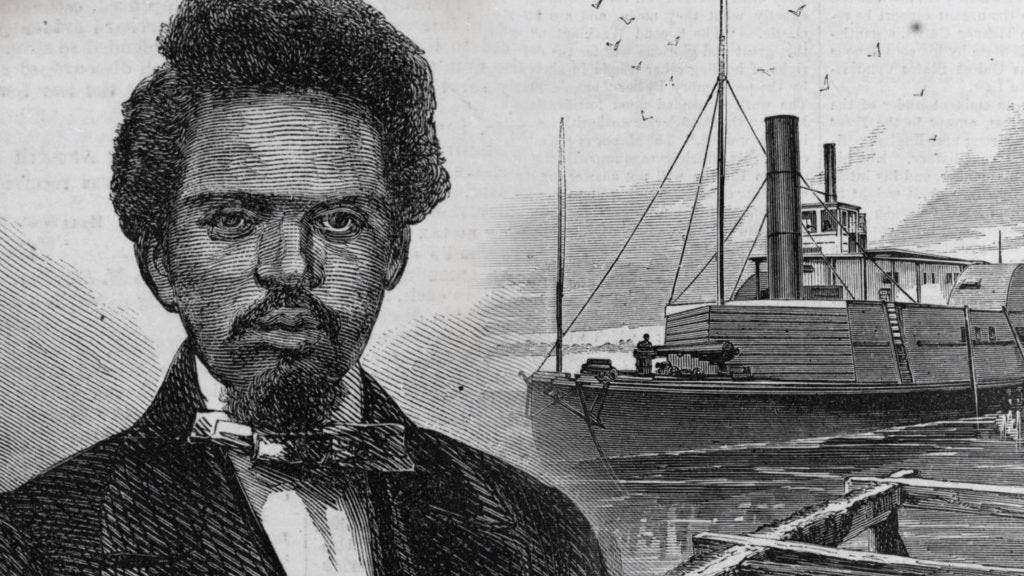
Robert Smalls, Congressman during Reconstruction.

The expulsion of Rep. Justin Jones and Rep. Justin Pearson from the Tennessee legislature has a direct historical link to the overthrow of real democracy and Reconstruction following the Civil War.

On May 13, 1862 an enslaved man named Robert Smalls, who labored on a Confederate steamer in South Carolina’s Charleston harbor, set into motion a daring plan.

As his great-great-grandson Michael Boulware Moore explained, “He saw that the Confederate crew had left, and he knew that oftentimes they left for the evening, not to come back until the next day.”

For Smalls and six other enslaved people and their families, the stakes couldn’t have been higher. “They knew that if they got caught, that they would be, not just killed, but probably tortured in a particularly egregious and public manner,” said Moore.

Disguising himself in the straw hat and long overcoat of the ship’s white captain, Smalls piloted the ship past Fort Sumter towards the Union blockade, and freedom.

After serving on a Union Naval vessel during the Civil War, Smalls returned home to Beaufort, S.C., and was elected to the U.S. House of Representatives – one of more than a dozen African Americans to serve in Congress during the period known as Reconstruction, when the formerly-rebel states were reabsorbed into the Union, and four million newly-freed African Americans were made citizens.

South Carolina, and throughout the former Confederacy, the era of Reconstruction saw the rise of Black political power and representation in both the U.S. Congress and Southern state legislatures.

During the 1870s, more than a dozen African American men, many of whom had been born into slavery, were elected to the U.S. Congress. 

It was a great democratic movement that ended all too quickly.

Former Southern insurrectionists, aided by the rise of the Ku Klux Klan, violently organized an anti-democratic counterrevolution.

Born in South Carolina, Aaron A. Bradley was a shoemaker in Augusta Georgia. Sometime around 1834 he ran away to the North, where he became a lawyer. 

In 1865 he returned to Georgia. He was the most outspoken member of the Black delegation to the constitutional convention. 

In 1868 he was elected state senator from the First District. Bradley rallied plantation workers around Savanah with his insistence that the formerly enslaved people be given land.

But Black political power and Reconstruction was short lived.

One quarter of the Black legislators in Georgia were killed, threatened, beaten, or jailed. In the December 1870 elections the Democrats won an overwhelming victory in overthrowing democracy and Reconstruction.

In 1906 W. H. Rogers from McIntosh County was the last Black legislator to be elected before Black voters were legally disenfranchised in 1908.

The actions by white Republican members of the Tennessee legislature to expel two elected Black members has all the stench of the overthrow of Reconstruction and the establishment of Jim Crow.

Donna Ladd wrote a compelling story about how white flight in Noxubee County, Mississippi, killed hopes for integration in the 1950s and 1960s. Ladd is the founder and editor of the Mississippi Free Press.

Whites had long controlled the county and its schools. They were determined not to permit any racial integration. Their response to the Brown decision of 1954 was to stall, stall, stall.

When whites realized that the federal courts were determined to integrate the schools, they had two strategies to defy court orders. One was to open “segregation academies,” like today’s charter schools. The other was to create voucher programs so that white children could participate at all-white private academies.

The story is fascinating. It’s not likely to be taught in public schools, because some people might think this honest retelling of what happened might make white students—more likely, their parents—uncomfortable.

We saw this coming. The GOP candidates for President have decided, for now, to focus their campaigns against “critical race theory,” Black history, the threat posed by transgender students, and any teaching about race, sex, and gender.

Juan Perez of Politico reports:

CULTURE CLASH — Once upon a time, back when people used fax machines, education policy — test scores, spending, school choice and the like — were a notable feature of Republican presidential campaigns.

Former President George W. Bush’s support for education spending and the transformative No Child Left Behind Act was enshrined in the party’s 2004 platform. Former Arkansas Gov. Mike Huckabee railed that a general lack of concern about education in the 2008 presidential field “frustrates the fire out of me.” Bush’s brother, Jeb, invoked Martin Luther King Jr.in 2016 when he proposed a detailed education platform before his campaign fizzled.

This year, education is re-emerging as a prominent issue for the budding 2024 GOP field. But America is poised to witness a presidential contest where the debate over school policy sounds dramatically different — with discussions over academic standards and the stunning, once-in-a-generation hitto test scores taking a back seat to issues with a more distinct culture war bent.

Former South Carolina Gov. Nikki Haley is salting a back-to-basics education mantra with brimstone, targeting school lessons on race and sexuality. Former Vice President Mike Pence has put a small Iowa school system’s gender identity policy in the national spotlight. And Former President Donald Trump is stirring up concerns about “pink-haired communists teaching our kids.”

Haley’s campaign launch last week offered a sign of the heightened role the education wars are about to play in the GOP primary.

“They’re talking about critical race theory, where if you send a five year old kindergartner into school — if she’s white, you’re telling her she’s bad, and if she’s brown or Black you’re telling her she’s never going to be good enough and she’s always going to be a victim,” Haley said of the academic practice to a New Hampshire crowd last week. “That’s abusive.”

She added that a Florida ban on sexual orientation and gender identity lessons for young students — championed by rival Republican Gov. Ron DeSantis and dubbed by critics as the “Don’t Say Gay” law — “didn’t go far enough.”

“When I was growing up, we didn’t have sex ed until seventh grade,” Haley said to applause in New Hampshire. “That’s the kind of stuff you do at home, you don’t do that at school. That’s the kind of thing parents do.”

For his part, Pence has focused attention on an Iowa dispute, in which the conservative Parents Defending Education organization is suing the Linn-Mar Community School District to stop it from enforcing a policy that directs educators to protect their students’ gender identities on campus.

The court case has garnered supportive briefs from the Pence-backed Advancing American Freedom organization plus a coalition of Christian groups and Republican state attorneys general. The legal battle is also the focus of a Pence political initiative— funded with an initial budget of $1 million — that will advocate for “parental rights” policies embraced by conservatives.

“We’re told that we must not only tolerate the left’s obsessions with race and sex and gender but we must earnestly and enthusiastically participate or face severe consequences,” Pence told supporters last week. “Nowhere is the problem more severe, or the need for leadership more urgent, than in our public school classrooms,” he said.

Trump’s education plan, unveiled last month, calls for cutting federal funding for any school or program that includes “critical race theory, gender ideology, or other inappropriate racial, sexual, or political content onto our children.”

Trump would also open civil rights investigations into any school district that has engaged in race-based discrimination, particularly against Asian American students. He also called to “keep men out of women’s sports,” make significant cuts to school administrative personnel, elect school principals and end teacher tenure.

“As the saying goes, personnel is policy and at the end of the day if we have pink-haired communists teaching our kids we have a major problem,” Trump said.

Sen. Tim Scott, who is testing the waters on a potential presidential bid, is taking a less combative approach. Speaking at a GOP Black History Month event in Charleston last week, the South Carolina senator said “the story of America is not defined by our original sin, the story of America is defined by our redemption” and urged Republicans to “be the party of parents.”

Scott and others are responding to the GOP grassroots energy surrounding issues at the intersection of race, gender, culture and education — which Virginia GOP Gov. Glenn Youngkin successfully harnessed in his 2021 blue-state victory.

The sharp-edged rhetoric might get sanded down for the general election. But for now, not getting outflanked on education controversies that currently animate the right appears to be the first order of business for the 2024 field.

Steven Singer, a teacher in Pennsylvania, cannot understand why the word “WOKE” has become a term of derision, when it means being aware of racial and social injustice. Who wants to erase our sense of right and wrong?

He explains:

“I advise everybody, be a little careful when they go along through there – best stay woke, keep their eyes open.”–Lead Belly“Scottsboro Boys”

How can you understand a problem if you are not allowed to name it?

How can you fight injustice if you are forbidden from learning its history and connection to the present moment?

These questions are at the heart of a well-financed war against a simple term – woke-ness.


Since the summer of 2020, oligarchs and their tools in the United States have been waging a disinformation campaign against that term – especially as it pertains to our schools.

Chiding, nagging, insinuating – you hear it constantly, usually with a sneer and wagging finger, but what does it really mean?

To hear certain governors, state legislators and TV pundits talk, you’d think it was the worst thing in the world. But it’s not that at all.

In its simplest form, being woke is just being alert to racial prejudice and discrimination.

That’s all – just knowing that these things exist and trying to recognize them when present.

I’m not sure what’s so controversial about that. If we all agree racism is bad, why is it undesirable to acknowledge it exists when it’s demonstrably there?

More specifically, being woke means focusing on intersectionality – how issues of race, class and gender overlap and interrelate with each other. It means practicing critical race theory – not the made up dog whistle conservatives use to describe anything they don’t like being taught in school, but the study of how racial bias is inherent in many Western social and legal systems. It means using the lens of Black feminism, queer theory and others to address structural inequality.

Again, why is that a bad thing? If we agree that prejudice is bad, we should want to avoid it in every way possible, and these are the primary tools that enable us to do so.

Our society is not new. We have history to show us how we got here and how these issues have most successfully been addressed in the past.

But these Regressives demand we ignore it all.

Shouldn’t we protect hard-fought advances in human rights? Shouldn’t we continue to strive for social justice and the ability of every citizen to freely participate in our democracy – especially in our public schools?…

As public school teachers, being woke is not a choice. It is a responsibility.

For we are the keepers of history, science and culture.

Who will teach the true history that for more than 400 years in excess of 15 million men, women and children were the victims of the transatlantic slave trade? Who will teach the true history of the fight against human bondage and the struggle for equal rights? Who will teach about women’s fight for suffrage, equal pay, and reproductive freedom? Who will teach about the struggle of the individual to affirm their own gender identity and sexual expression?

We, teachers, must help students understand what happened, what’s happening and why. And to do so we must protect concepts that emerged from decades of struggle against all forms of domination.

It must be us.

Please open the link and read the rest.

And stay WOKE.