Let us be thankful for the good things in our lives. Our families and friends. Health. Food. The blessings of freedom and democracy, which we must defend every day.
Let us think about those who do not enjoy the blessings of family, friends, good health, shelter, and food.
Do what you can to support those less fortunate than yourself. Lend a helping hand at a local community center or church or synagogue or mosque. Support groups that are helping immigrant families who are living in terror, fearful of being kidnapped by ICE.
Remember that it is not normal to have armed military patrolling the streets of our cities. It is not normal to see masked men pepper spraying fellow citizens in the streets. It is not normal to see armed men chasing people on farms, where they are picking the fruits and vegetables on our Thanksgiving table, tackling them, and whisking them away to unknown detention centers.
We don’t have a crisis of too many immigrants. We have a crisis of a do-nothing Congress that has been unable to pass legislation creating a process for honest, hard-working immigrants to have a legal path to citizenship.
We have a crisis of bigotry, of white nationalists who think they can restore a world of white supremacy that has disappeared. Nope, won’t happen. Twenty percent of our population is Hispanic. About 57-58% is Caucasian. Among children 17 and younger, about 49-50% is Caucasian.
Like it or not, our society is diverse. Banning the word “diversity” doesn’t change reality.
We must, all of us, practice kindness. Gratitude. Generosity of spirit.
I discovered Lisa Gonzalez’s blog on Substack recently. It is called “Eleanor’s Squad.” I read this post, which originally appeared on November 11, Memorial Day, as a tribute to members of her family and other people of Hispanic origin who served our country with their heart and soul.
The big surprise in reading her post was learning that about 20% of our population is Hispanic. Most have citizenship, some don’t. ICE is arresting people because they have brown skin. Many are citizens and must suffer days of detention before they are released. Very likely, some are unjustly deported. No way that Stephen Miller and Kristi Noem will deport 20%. Not to mention the many other Americans who do not have white skins,
“For those that will fight for it… freedom has a flavor the protected shall never know.” — Tim Craft, U.S. Marine Corps
I was born on the Fourth of July — fireworks overhead, and a tornado tearing through the edges of town. Maybe that’s why I carry the American spirit of both celebration and storm. And although I was born on the day this nation celebrates its freedom, my uncles and my cousin taught me what the word freedom really costs.
Four men—two Army soldiers, two Marines—each the sons or grandsons of a Puerto Rican foundry worker who came home every night with grease on his hands and pride in his posture. My grandfather never finished high school, but he was proud of his country and raised sons who served—earning medals, scars, and degrees without anyone handing them a thing. They served in Vietnam, in Germany, in Bosnia, in Iraq. They carried radios, rifles, and the weight of a flag that didn’t always claim them back.
One of them was shot up in the jungles of Vietnam and learned he had a newborn niece—me—from a telegram delivered as he was being flown to a hospital. He still carries the shrapnel, and the leukemia that came later from Agent Orange. The medals came too, but no medal will ever heal what he saw. They are proof that he bled when his country asked him to.
And yet, every one of them could be stopped for being brown or speaking Spanish and asked to prove their citizenship. That’s what it means to be a veteran of both war and bigotry: to have risked your life for a nation that still questions whether you belong in it.
And while their loyalty has never been in question on the battlefield, it’s still doubted in the streets and at the ballot box. That’s not only insulting—it’s mathematically absurd.
For the first time in American history, one in five people living in the United States identify as Latino. According to a 2024 study by the University of California, Los Angeles and California Lutheran University, our population has passed 68 million—two million more than just a year before. Latino labor now includes more than thirty-five million workers, growing more than seven times faster than the non-Latino labor force.
Together, our labor produces a $4.1 trillion GDP—large enough to rank as the world’s fifth-largest economy, larger than India’s. And yet, men like my uncles—who bled for this country—can still be told to “show their papers.”
What kind of nation demands proof from the very people who sustain it? What kind of nation questions the citizenship of those who keep it alive? What kind of patriotism forgets the hands that built the bridges fought its wars, and believed in its promise long after it stopped believing in them?
Economist Matthew Fienup, executive director of the Center for Economic Research and Forecasting at California Lutheran University, put it plainly: “Time and time again, we find that hard work, self-sufficiency, optimism, and perseverance are the characteristics that underlie the strength and resilience of U.S. Latinos.”
Because resilience is in our DNA.
What we have can’t be taught.
My family didn’t inherit America; they helped make it. And now the numbers finally tell the stories they always knew—and Stephen Miller wants you to forget: that Latino service, labor, and love of country are not exceptions—they are the backbone of the republic.
For at least three decades, the U.S. Census published the most popular surnames in America. The last list, released in 2010, showed us the truth they’re trying to bury: Garcia. Rodriguez. Martinez. Hernandez. Lopez. Gonzalez.
Thirty percent of the nation’s top twenty surnames trace back to families who crossed oceans, borders, and language lines to build this country. And that’s just from 2010—because, for some reason, they decided not to publish the most popular surnames from 2020. That’s how truth gets contained so the lies are easier to spread (see author’s note).
And that last surname—Gonzalez—is ours. It’s the name sewn onto uniforms and stitched into birth certificates; the name called out on roll calls and whispered in hospital rooms. It’s the name that’s been saluted, misspelled, profiled, and still carried with pride.
They’ve never needed to prove their loyalty. They’ve already lived the truth of a Marine’s words I once saw hanging on my uncle’s wall: “For those that will fight for it…freedom has a flavor the protected shall never know.”
That’s what my family understands—what so many Latino families understand—that freedom isn’t a speech; it’s a promise you keep even when the country doesn’t keep it for you.
They’ve paid for that promise in ways the record books don’t list. As boys, they learned what doors were for—sometimes to open, sometimes to close. White families smiled until the invitations reached their daughters; then the air shifted, polite and poisonous. They learned early that courtesy was armor, and excellence the stealthy weapon that left those who tried to thwart their progress in the dust.
Decades later, after wars and degrees and decorations, they have worked twice as hard to be called qualified. Men who have led troops into fire get reduced to talking points while those who cosplay as soldiers that never saw battle call themselves patriots and wrap themselves in excuses instead of service. They call veterans like my uncles DEI hires, as if discipline, intellect, and courage were diversity quotas. Their ignorance speaks volumes about who’s truly afraid of real merit.
And yet my family will keep showing up, still believing in a country that too often forgets them. Their endurance is not compliance; it’s faith in the possibility that the nation will one day live up to the flag they salute.
The uncle who came home from Vietnam carrying shrapnel and a telegram that said he had a niece was eventually blessed with a beautiful granddaughter—two firecrackers born decades apart who share the same birthday—they all share granddaughters joined by the same Spanish name, carrying the same pride and promise of what this country was meant to be.
They are proof that our story doesn’t end with propaganda, lies, or hatred. The promise lives on in the next generation—in children who instinctively understand that freedom and fairness mean the same thing. Now they carry our family name into classrooms and playgrounds where they will learn what it means to be both proud and careful. They may not know the weight of the history yet, but they feel its rhythm—the music of stubborn belonging that refuses to be silenced.
On Veterans Day, we hang flags and post photos, but the real observance happens in the quiet—in the lives still shaped by service and by the contradictions it exposes. It lives in the way my uncles still stand a little straighter when they hear the anthem, even as the country they defended still asks them to prove they belong. It lives in the children and grandchildren who bear their names and inherit both the pride and the vigilance that freedom demands.
Freedom isn’t fireworks; it’s endurance—the decision to keep showing up, to keep believing, to keep building the country that was promised. So on this Veterans Day, I honor them all: the men and women who valiantly served and fought the wars abroad, the children and grandchildren who carry their names forward, and the families who love this nation enough to tell the truth. Freedom’s flavor runs in our blood now—salt, sweat, and faith—and with every July Fourth candle we blow out, we’re still making good on the promise they fought to defend.
Author’s Note
On November 11, 2025, while finalizing this piece, I personally watched two official U.S. Census Bureau pages vanish in real time—the main genealogy index for the 2010 “Frequently Occurring Surnames” report and its linked sub-page, as well as those for 2000, and 1990. One moment they were live; but after refreshing, they both returned a 404 error. As of this writing, the surname dataset no longer appears in the Census archive, and the 2020 update has never been released.
Before the links went dark, I saved the files and screenshots that show what those pages contained: the 2010 table listing Garcia, Rodriguez, Martinez, Hernandez, Lopez, and Gonzalez among America’s twenty most common surnames—each more than 90 percent Hispanic in origin.
Below is my downloaded copy of that list, saved before the disappearance. Here is the link that used to list them:
Heather Cox Richardson draws together the seams of a story that is unfolding piece by piece. Trump’s popularity is plummeting; he is obsessed with his poll numbers. At the same time, he is assembling military forces to control Democratic-run cities where there are no riots, no disorders that can’t be handled by local police. Does he really believe that the nation’s cities are engulfed by a massive crime wave?
The only terrifying development that she did not include in her summary is Trump’s declaration that he intends to resume nuclear testing, a practice abandoned in 1992.
As I read her piece below, I was reminded that Trump said at a rally, “Vote for me now, and you will never have to vote again.” He often says the quiet part out loud.
House speaker Mike Johnson (R-LA) continues to try to pin the upcoming catastrophic lapse in Supplemental Nutrition Assistance Program (SNAP) funding on the Democrats. But with the U.S. Department of Agriculture sitting on $6 billion in funds Congress appropriated for just such an event, the Treasury finding $20 billion to prop up Trump ally Javier Milei in Argentina, Johnson refusing to bring the House into regular session to negotiate an end to the government shutdown, and President Donald J. Trump demanding $230 million in damages from the American taxpayer, bulldozing the East Wing of the White House to build a gold-plated ballroom that will dwarf the existing White House, and traveling to Asia, where South Korean leadership courted him by giving him a gold crown and serving him brownies topped with edible gold, blaming any funding shortfall on Democrats is a hard sell.
According to a Washington Post–ABC survey, more Americans blame Trump and congressional Republicans for the shutdown than blame Democrats by a margin of 45 to 33, and Trump’s approval rating continues to move downward, with the presidential approval average reported by Fifty Plus One at 41.3% approval and 55.1% disapproval, a –14 split. G. Elliott Morris of Strength in Numbers noted on October 24 that polls show Americans now trust Democrats more than Republicans to handle the economy well.
Trump ran in 2024 with a promise to bring down inflation, which was then close to the Federal Reserve’s target of 2.0%; now core inflation is at 3%, having gone up every month since April. Halloween candy—on people’s minds today—is at 9.8% inflation and costs 44% more than it did in 2019. Federal Reserve Board chair Jerome Powell sure sounded like he was describing stagflation—a condition when the economy stagnates despite inflation—when he said yesterday: “In the near term, risks to inflation are tilted to the upside, and risks to employment to the downside, a challenging situation.”
Treasury Secretary Scott Bessent said today that while the stock market has done well this year, a better economy is going to “start flowing through to working Americans next year.”
Meanwhile, on Tuesday, in a rambling and disjointed speech in Japan, Trump told U.S. military personnel that he is federalizing National Guard troops and sending them into Democratic-led cities “because we’re going to have safe cities.” In the same speech, Trump repeatedly attacked former president Joe Biden and insisted yet again that the 2020 presidential election was rigged. (It was not.)
When asked by a reporter later to clarify his remarks, Trump referred back to the Insurrection Act, saying that if he invoked it, “I’d be allowed to do whatever I want. But we haven’t chosen to do that because we’re…doing very well without it. But I’d be allowed to do that, you understand that. And the courts wouldn’t get involved. Nobody would get involved. And I could send the Army, Navy, Air Force, Marines. I can send anybody I wanted.”
In fact, a president can invoke the accurately named Insurrection Act only in times of insurrection or rebellion. Neither of those conditions exists.
But the administration is working hard to create the impression that they do. Drew Harwell and Joyce Sohyun Lee of the Washington Post reported yesterday that the videos the Department of Homeland Security has been publishing to demonstrate the administration’s triumph over crime in U.S. cities as its agents work “day and night to arrest, detain and deport vicious criminals” have been doctored. They do not represent current actions, but rather are a hash of video from different states and different times.
When the reporters asked the White House about the misleading footage, spokesperson Abigail Jackson told them that “the Trump administration will continue to highlight the many successes of the president’s agenda through engaging content and banger memes on social media.”
There are signs the administration is not just trying to give the impression that Americans are rioting, but is trying to push them to do so.
Aaron Glantz of The Guardian reported yesterday that on October 8, Major General Ronald Burkett, who directs the Pentagon’s National Guard bureau, ordered the National Guard in all the states, U.S. territories, and the District of Columbia to form “quick reaction forces” trained in “riot control.” Most states are required to train 500 National Guard personnel, for a total nationwide of 23,500. The forces are supposed to be in place by January 1, 2026.
In his order, Burkett relied on an executive order Trump signed on August 25, calling on the secretary of defense to “immediately begin ensuring that each State’s Army National Guard and Air National Guard are resourced, trained, organized, and available to assist Federal, State, and local law enforcement in quelling civil disturbances and ensuring the public safety and order,” and “ensure the availability of a standing National Guard quick reaction force that shall be resourced, trained, and available for rapid nationwide deployment.”
In August the administration planned for two groups of 300 troops to be stationed in Alabama and Arizona as a “Domestic Civil Disturbance Quick Reaction Force.” Now that number is 23,500, and the troops will be in every state and territory.
The establishment of a domestic quick reaction force to quell civil disturbances at a time when there are no civil disturbances that can’t be handled easily by existing law enforcement suggests the administration is expecting those conditions to change.
That expectation might have something to do with Monday’s story from Anna Giaritelli of the Washington Examiner that the White House is reassigning ICE field officers and replacing them with officers from Customs and Border Patrol (CBP). Greg Wehner and Bill Melugin of Fox News reported that the shift will affect at least eight cities, including Los Angeles, San Diego, Phoenix, Denver, Portland, Philadelphia, El Paso, and New Orleans.
White House officials, presumably led by White House deputy chief of staff Stephen Miller, who has said the administration intends to carry out “a minimum” of 3,000 arrests a day, are frustrated by the current pace of about 900 a day. So those officials, including Homeland Security Secretary Kristi Noem, special government employee and Noem advisor Corey Lewandowski, and Greg Bovino, a Border Patrol sector chief who has been overseeing the agency’s operations in Los Angeles and Chicago, have decided to ramp up those deportations by replacing ICE officials with far more aggressive CBP leaders.
Tripling arrests will likely bring pushback.
Michael Scherer, Missy Ryan, and Ashley Parker of The Atlantic reported today that political appointees Stephen Miller, Kristi Noem, Defense Secretary Pete Hegseth, and Secretary of State Marco Rubio have moved onto military bases.
The designs of the anti-immigrant leaders in the administration dovetail with Trump’s political designs. Trump has talked a lot about serving a third term in the presidency, most recently talking about it to reporters on Air Force One earlier this week. The Twenty-Second Amendment to the Constitution prohibits a third term, but Trump ally Stephen Bannon told The Economist last week that “Trump is going to be president in ‘28 and people just ought to get accommodated with that.” Bannon claimed, “There’s many different alternatives” to get around the Twenty-Second Amendment. Trump keeps “Trump 2028” campaign hats on bookshelves outside the Oval Office.
Janessa Goldbeck, the chief executive officer of the nonprofit Vet Voice Foundation, told Guardian reporter Glantz that Burkett’s recent order shows “an attempt by the president to normalize a national, militarized police force.” Such a force has not just military but also electoral power: it could be used in Democratic-led states to suppress voting. In a worst-case scenario, Goldbeck said, “the president could declare a state of emergency and say that elections are rigged and use allegations of voter fraud to seize the ballots of secure voting centers.”
Today, Buckingham Palace announced that King Charles has “initiated a formal process to remove the style, titles and honours of Prince Andrew” over his relationship with convicted sex offender Jeffrey Epstein and participation in activities surrounding Epstein. Andrew will be stripped even of his title of “prince” and will be forced to leave the home he has shared for more than 20 years with his ex-wife, Sarah Ferguson, at Royal Lodge, a 30-room mansion located in Windsor Great Park. The palace said: “These censures are deemed necessary, notwithstanding the fact that he continues to deny the allegations against him.”
Today Jim Acosta reported that survivors of Epstein’s sex trafficking enterprise have written a letter to Speaker Johnson demanding that Representative-elect Adelita Grijalva (D-AZ) be sworn into office. Voters elected Grijalva on September 23, but Johnson has steadfastly refused to swear her in. Grijalva has said she will provide the last signature necessary on a discharge petition to force a vote on the public release of the Epstein files, an outcome that threatens to expose how and why Trump was named in those files.
The survivors write that Johnson’s “continued refusal to seat her is an unacceptable breach of democratic norms and a disservice to the American people. Even more concerning to us as survivors, this delay appears to be a deliberate attempt to block her participation in the discharge petition that would force a vote to unseal the Epstein/Maxwell files. The American public has a right to transparency and accountability, and we, as survivors, deserve justice. Any attempt to obstruct a vote on this matter—by manipulating House procedure or denying elected members their seats—is a direct affront to that right and adds insult to our trauma.”
Despite Trump’s relentless demand to win the Nobel Peace Prize, he did not. He says he ended 6 or 8 wars in his few months in office. Just days ago, he brokered a ceasefire in Gaza.
But consider the criteria:
He united the opposition; check.
He resisted the militarization of his society. Fail.
He has promoted democracy. Fail.
They say there’s always next year. But if you fail to meet the criteria, no way.
Venezuelan opposition leader Maria Corina Machado was awarded the Nobel Peace Prize for 2025 for her efforts to promote democracy at a time when an increasing number of countries slide into authoritarianism.
She receives the prize worth 11 million Swedish kronor ($1.2 million) “for her tireless work promoting democratic rights for the people of Venezuela and for her struggle to achieve a just and peaceful transition from dictatorship to democracy,” the Oslo-based Norwegian Nobel Committee said in a statement Friday.
Machado, 58, “has led the struggle for democracy in the face of ever-expanding authoritarianism in Venezuela,” the Committee said. She leads the Vente Venezuela opposition party and has worked to unite pro-democracy forces in the country.
In her life before politics, she studied engineering and finance and had a short career in business before establishing a foundation that helps street children in Caracas.
Machado “meets all three criteria stated in Alfred Nobel’s will for the selection of a Peace Prize laureate,” the Committee said. “She has brought her country’s opposition together. She has never wavered in resisting the militarization of Venezuelan society. She has been steadfast in her support for a peaceful transition to democracy.”
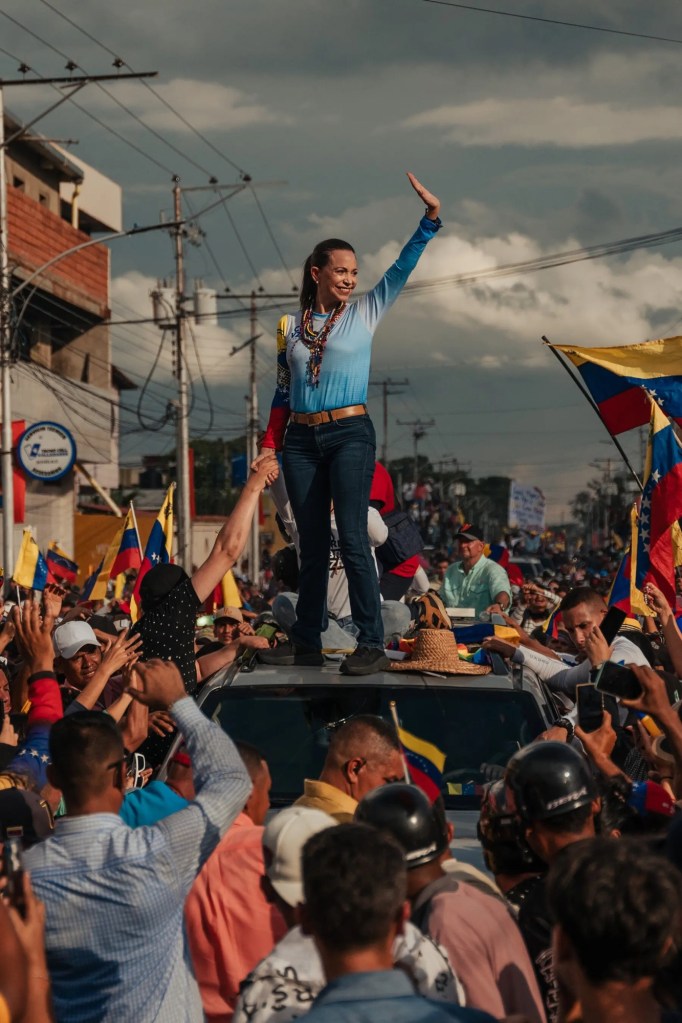
María Corina Machado at a rally in Guanare, Venezuela, in 2024.Credit…Adriana Loureiro Fernandez for The New York Times
In the post at 9 a.m. today, two scholars of racism and equity explained that Trump’s scrubbing of museums, national parks, and other federal facilities is an attempt to capture control of the culture and erase the place of Blacks, women, and anyone else who is not a straight white male.
But, as scholar Julian Vasquez Heilig writes here, Trump and his commissariat cannot control the popular culture. In time, we can hope, his mean-spirited efforts to revise history will become a bad joke, a cruel joke, a stupid joke. He and all those who carry out his orders will become a public laughing stock.
Vasquez Heilig writes on his blog Cloaking Inequity:
The Super Bowl has always been more than football. It is a ritual, a spectacle, a national performance. It’s where America tells the world who it thinks it is, and who it wants to be. Which is why the announcement that Bad Bunny will host the halftime show is far more significant than a musical lineup change. It’s a cultural earthquake.
I remember the first time I heard Bad Bunny. It was December 6, 2019, at La Concha Hotel in San Juan. In the downstairs lounge, the beat of reggaetón was shaking the walls, and I pulled out Shazam to figure out what it was. The song was Vete. The room was electric, filled with Puerto Ricans singing every word in Spanish, unapologetically themselves. That night, it hit me: Bad Bunny was not just making music in San Juan, he was celebrating culture. He wasn’t crossing over into the mainstream by adapting; he was dragging the mainstream toward him. He refused to translate, refused to dilute, and now he is everywhere—on playlists, on charts, SNL, in crowded places from San Juan to New York to Madrid.
That’s why his Super Bowl moment matters so much. It is not just a performance, it is the culmination of a global movement that began in places like that basement lounge in Puerto Rico. What felt local then is now universal. Bad Bunny’s rise shows how culture flows upward, from the margins to the center, from overlooked communities to the biggest stage in the world. For millions of us, this is affirmation. For the right wing, it is destabilization. Because when the halftime show belongs to Bad Bunny, it proves that America is no longer just what they imagine it to be. It is bigger, louder, and more diverse than great again nostalgia can contain.
Jay-Z, Kendrick Lamar, and the New Halftime Era
The NFL’s halftime choices haven’t shifted by accident. When the league came under fire for its treatment of Colin Kaepernick and broader criticisms about racial injustice, it needed credibility. Enter Jay-Z and Roc Nation. The NFL tapped him to advise and help curate halftime shows.
The results have been undeniable. Kendrick Lamar’s halftime performance last year was a watershed moment—unapologetically Black, politically charged, and culturally defining. That performance sparked widespread discussion, and even a blog post I wrote about it entitled “TV Off”: What Kendrick Lamar Was Really Saying at the Super Bowl drew more than 100,000 readers in just a few days. Clearly, the hunger to talk about representation and ownership of the halftime stage is real.
Now with Bad Bunny taking the baton, the NFL is making another cultural statement, whether it fully realizes it or not (I think it does). The league’s biggest platform is no longer reserved for the safe, predictable acts of yesterday. It’s becoming a stage where hip hop, reggaeton, and the voices of communities once marginalized are front and center.
Bad Bunny and the Right’s Panic
For decades, the halftime show was dominated by choices that reinforced a narrow image of America: classic rock icons, country stars, or pop acts who wouldn’t ruffle feathers but had wardrobe malfunctions. Bad Bunny shatters that mold. His performance won’t be a side act, it is the show. Spanish won’t be a novelty; it will be central.
This is exactly why the right wing panics. To them, football Sundays and Super Bowls have long been “their” cultural territory. They’ve wrapped the game in patriotic rituals, military flyovers, and moments of silence for conservative heroes. When someone like Bad Bunny steps into the spotlight, it disrupts their monopoly. It forces a new definition of America—one that is multilingual, multicultural, and undeniably Latino. That’s what makes his halftime role so radical: after focusing on the Black experience with Kendrick, this year signals that Latino identity is no longer peripheral. It’s woven into the fabric of America’s biggest stage.
Why ICE Wants to Loom Over the Moment
It might sound absurd that ICE wants to connect itself to the Super Bowl halftime show, but immigration enforcement has always thrived in the shadows of visibility. When Latino joy and success are celebrated so publicly, ICE apparently feels the need to remind America of its terrorizing power.
Bad Bunny performing at the Super Bowl is a triumph of belonging. But ICE’s assaults, raids, arrests, kangaroo courts, and deportations are constant reminders that belonging is conditional on politics. While millions watch a Puerto Rican superstar, ICE agents are throwing mothers and journalists to the ground, spraying pepper liquid into the eyes of Americans who dare to ask questions, arresting elected politicians at the behest of Washington politicians after turning off their body cameras, and authorized by the Supreme Court to detain people simply for looking Latino and poor.
The contradiction is sharp: on the world’s stage, Latino identity is being widely celebrated; on America’s streets, it’s criminalized. ICE doesn’t need to show up at the stadium—it already shows up in our daily life. Its existence ensures that even at moments of cultural triumph, there’s a purposeful shadow of fear and terroristic threats.
Danica Patrick’s Tone-Deaf Criticism
And then, inevitably, a silly critic emerges from the sidelines. This time it’s Danica Patrick, who dismissed Bad Bunny’s hosting role. Her comments were more than unhelpful, they were stupid.
Patrick should know better. She carved her own career by getting along in a male-dominated sport, where every step forward was a battle for representation. She knows the symbolic weight of breaking barriers. For her to turn around and mock or diminish Bad Bunny’s presence is hypocritical at best, willfully ignorant at worst.
Bad Bunny isn’t there to tick a diversity box, he’s there because he is one of the most influential artists alive— maybe THE most. The incredible success of his shows that he did for his most recent album this past summer ONLY in Puerto Rico is proof that the center of American culture is shifting. Criticizing that isn’t just a matter of taste. It’s a refusal to accept reality.
The Lions, Charlie Kirk, and Who Gets Tribute
The battle over cultural ownership in America doesn’t stop at the Super Bowl. It plays out every Sunday on the NFL field. When conservative commentator Charlie Kirk was assassinated, the league encouraged teams to hold moments of silence in his honor. Most complied. But the Detroit Lions, along with a few other teams, did not.
That decision matters. It was a quiet but deliberate act of boundary-setting, a refusal to let every NFL broadcast become a political ritual sanctifying right-wing political ideology. By declining the tribute, the Lions reminded us that not every form of patriotism must come prepackaged with conservative allegiance. It wasn’t loud or defiant. It was subtle and deeply symbolic. Sometimes resistance isn’t what you do, it’s what you decline to perform and participate.
The Lions’ restraint connects to the same cultural realignment symbolized by Bad Bunny’s Super Bowl performance. Both moments reject the idea that American culture belongs to a single tribe. They push back against the notion that sports, music, or patriotism must orbit one political pole. They insist, instead, that culture belongs to everyone, not just the loudest or the angriest voices claiming to defend it.
The Double Standard of Protest
Of course, this tension between culture, power, and dissent has long been visible in the NFL. When Colin Kaepernick knelt during the national anthem to protest police brutality, he was branded a traitor by many of the same voices now demanding “respect” for Charlie Kirk. His silent, dignified act of conscience was recast as an attack on America itself.
The outrage was never really about the flag. It was about control. It was about who is allowed to define what counts as “patriotic.” Kaepernick’s kneeling was an act of moral courage, but it exposed how fragile America’s cultural gatekeepers truly are when confronted with truth. They could not tolerate a protest that revealed their own comfort with injustice and brutality.
Meanwhile, state violence continues daily without the same moral outrage from the right-wing. ICE officers violently throw mothers and journalists to the ground without cause. They pepper-spray citizens in their eyeballs for daring to ask questions in a conversation. They arrest and detain American citizens in raids not for crimes but for looking poor, brown, or foreign. These acts have not provoked right-wing primetime outrage or public boycotts. Their hypocrisy is staggering.
A man kneeling quietly for justice was vilified. Agents brutalizing families are ignored. The problem has never been the method of protest, it has always been their morality. Silence in the face of injustice is acceptable; silence against injustice is not. The Lions’ quiet refusal and Kaepernick’s quiet protest share something profound: both disrupted the script of cultural obedience. Both reminded us that resistance isn’t always loud. Sometimes it’s the refusal to play along.
The Supreme Court’s Enabling Role
And looming behind all of this is the judiciary. Recent Supreme Court rulings have expanded law enforcement’s power, narrowing protections under the Fourth Amendment and giving politicians more leeway to persecute immigrants using federal data. Justice Brett Kavanaugh has been the lead in the right-wing judicial majorities that have handed law enforcement broad authority to stop, question, and detain anyone with minimal cause. Its new rulings have created the legal cover that now makes racial profiling essentially legal.
Racial profiling has happen illegally before and the new legal result empowered by the Supreme Court is the same: citizens living under suspicion, families living in fear, communities targeted not for what they’ve done but for how they look. The Supreme Court has enabled ICE brutality in the same way NFL owners enabled the blackballing of dissent, by creating structures that justify exclusion and violence while insisting neutrality.
The Bigger Picture: Who Owns the Stage?
So what do Bad Bunny, Kendrick Lamar, Jay-Z, Danica Patrick, ICE, the Lions, Charlie Kirk, and Brett Kavanaugh all have in common? They are all part of the “fight, fight, fight” (see new Trump $1 coin) over who gets to define American culture.
The right wing has long claimed the NFL as its territory: its rituals, its tributes, its symbols of patriotism. But culture evolves. It cannot be contained. From Detroit to San Juan to Los Angeles, new voices are shaping the narrative. Bad Bunny’s halftime show, Kendrick’s explosive performance, and even the Lions’ silent refusal all tell the same story: football does not belong exclusively to one political ideology. Neither does America.
The real question is whether we are willing to see that America’s identity is bigger than its old rituals. Are we willing to admit that inclusion is not a threat but a fact? Because culture doesn’t wait for permission. It claims the stage. And this year, that stage will belong to Bad Bunny.
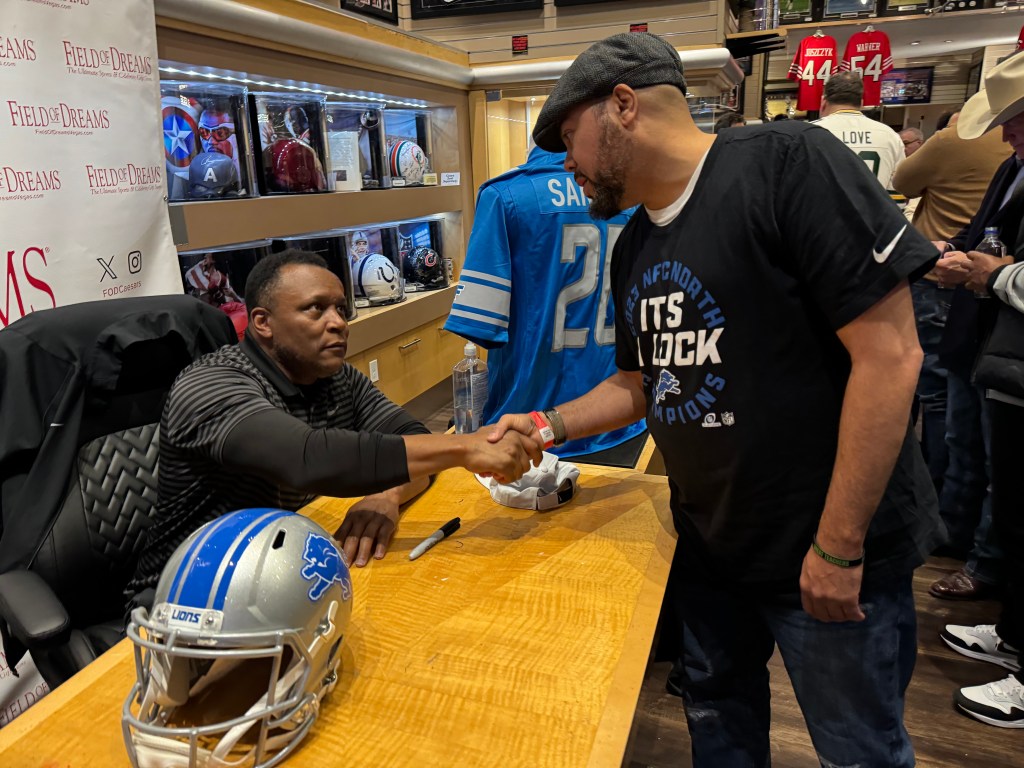
Julian Vasquez Heilig is a professor, writer, and a legit lifelong Detroit Lions fan since 1981. He attended the NFC Championship in San Jose two years ago to support his Cardiac Cats and last year’s playoff loss to the Washington Commanders at Ford Field. He was also at the official Lions partners party during the NFL Draft in Detroit, where he met Robert Porcher and Jason Hanson. Over the years he’s spotted Billy Sims in Times Square, endured the heartbreak of the Lions’ 0–16 season, and treasures his personally autographed Barry Sanders helmet. Beyond education and equity, Julian dabbles in writing about sports, culture, and society.
Two scholars–Kimberlé Crenshaw and Jason Stanley–explain why Trump is censoring exhibits at the Smithsonian. He has also imposed censorship of signage and exhibits at other federal sites, including national parks. He has enlisted the U.S. Department of Educatuon to organize rightwing groups to create a “patriotic” civics course.
Kimberlé Crenshaw is an American civil rights advocate and a scholar of critical race theory. She is a professor at the UCLA School of Law and Columbia Law School, where she specializes in race and gender issues
Jason Stanley is the Bissell-Heyd Chair in American Studies in the Munk School of Global Affairs & Public Policy at the University of Toronto and the author of Erasing History: How Fascists Rewrite the Past to Control the Future
Trump and his far-right cabal are l trying to revise history and memory. Unless he abolishes or rigs future elections, all this tinhorn fascist censorship will be swept away by his successors. He will rightly be judged, when that day comes, as the closest thing this country has ever seen to having a dictator. He will be portrayed in the Smithsonian and the textbooks as a buffoon and a tyrant.
In a letter sent to Smithsonian secretary, Lonnie G Bunch III, on 12 August, the Trump administration announced its plan to replace all Smithsonian exhibits deemed as “divisive” or “ideological” with descriptions deemed as “historical” and “constructive”. On 21 August, just nine days later, the White House published a list of said offending fixtures – the majority of which include exhibits, programming and artwork that highlight the Black, Latino and LGBTQ+ perspectives on the American project. Included in his bill of particulars was an exhibit that rightly depicts Benjamin Franklin as an enslaver, an art installation that acknowledges race as a social construct and a display that highlights racist voter suppression measures, among others.
The assault on the Smithsonian comes wrapped, as it were, as part of a broader attack on democracy, scenes of which we see playing out every day. The federal occupation of Washington DC, the crackdown on free speech on campus, the targeting of Trump’s political opponents, the gerrymandering of democracy – these are interwoven elements of the same structural assault. So with many fires burning across the nation, concerned citizens who are answering the call to fight the destruction of democracy may regard his attack on history and memory as a mere skirmish, a distraction from the herculean struggle against fascism unfolding in the US. But this is a mistake. Trump’s attack on American museums, education and memory, along with his weaponization of racialized resentment to package his authoritarian sympathies as mere patriotism, is a critical dimension of his fascist aims. The fight for democracy cannot avoid it, nor its racial conditions of possibility.
Fascism always has a central cultural component, because it relies on the construction of a mythic past. The mythic past is central to fascism because it enables and empowers a sense of grievance by a dominant racial or ethnic group whose consent is crucial to the sustainability of the project. In Maga world, the mythic past was pure, innocent and unsullied by women or Black leaders. In this kind of politics, the nation was once great, a byproduct of the great achievements of the men in the dominant racial group. In short, the assault on the Smithsonian and, more broadly, against truthful history and critical reflection is part of the broader fascist attack on democracy.
From this vantage point, racial equality is a threat to the story of the nation’s greatness because only the men of the dominant group can be great. To represent the nation’s founding figures as flawed, as any accurate history would do, is perceived, in this politics, as a kind of treason.
The success of the fascist dismantling of democracy is predicated on the widespread systematic failure to see the larger picture. The anti-woke assault that is a key pillar of Trumpism is part of that failure, partly due to the racial blinders and enduring ambivalence of too many in positions of leadership in the media and elsewhere. Those who sign on to the attack on “wokeness” but regard themselves as opponents of the other elements of the fascist assault are under the mistaken assumption that these projects can be disaggregated. In fact, the dismantling of democracy and of racial justice are symbiotically entangled. To support one is to give cover for the others.
It is no coincidence that this ‘proper’ ideology Trump exposes is constitutive of a more well-known strand of fascism – nazism
It is clear that the Trump administration understands this relationship and fully weaponizes racist appeals as a foundational piece of its fascist agenda. And if this was once the quiet part, it is now pronounced out loud in official government documents. In an executive order issued on 27 March 2025 titled “Restoring Truth and Sanity to American History”, Trump reveals that his mandate to ban “improper ideologies” targets core commitments repudiating a scientific racism that historically naturalized racial hierarchy thereby neutralizing resistance. According to Trump, the problem with the Smithsonian American Art Museum’s exhibit The Shape of Power: Stories of Race and American Sculpture was that it promoted the idea that “race is a human invention”.
The understanding that race is a social construct as opposed to a biological fact is perhaps the most fundamental advance in repudiating enslavement, genocide and segregation. Rejecting the idea that racial inequality is natural or pre-ordained – a claim that grounded enslavement and dispossession in America – forms the cornerstone of the modern commitment to a fully inclusive democracy. Trump’s declaration that this cornerstone is “improper” is an effort to turn the clock back, upending the entire American postwar project. It is no coincidence that this “proper” ideology Trump exposes is constitutive of a more well-known strand of fascism – nazism. How else can we understand why Maya Angelou was purged from the Naval Academy library while Adolf Hitler remains?
The fight against fascism in the US must be as robust in its embrace of racial equality as Trump’s embrace of outdated ideas about race and racism. The defense of memory, of truthful history, of telling the whole American story rather than ascribing agency in history to the deeds of “great men” is vital to the American democratic project. A pro-democratic education fosters the agency of its citizens by teaching about social movements that overturned entrenched hierarchies which blocked democratic equality and imposed racial tyranny. The story of how ordinary Americans lived and struggled and remade America is essential knowledge in developing and sustaining a multiracial democracy. The Smithsonian has been a vital institution in making this knowledge accessible to the masses. The National Museum of the American Latino and the National Museum of the American Indian, for example, provide artifacts and perspectives about the nation’s westward expansion that challenge the myth of unoccupied territory and manifest destiny. The National Museum of African American History and Culture brings forward the global scale of enslavement as well as its infusion across national institutions, culture and politics.
Someday, somehow, there will be another President of the United States, and his name won’t be Trump. That future President might well be a Democrat. That President might be in a position to exercise unchecked power, thanks to the acquiescence of the current Congress and Supreme Court, which are allowing Trump to exercise the powers of a dictator. The second and third branches of our government have willingly wiped out the separation of powers and ceded their authority to the President.
Congress has voted to give its power of the purse to King Donald. The Supreme Court (the Supine Court) has stood aside and approved of whatever the King wants, regardless of precedent. Justice Thomas said recently that precedent was irrelevant; he is no longer an originalist.
Now comes what might be considered the most important question. May the President send in troops–either the state’s National Guard, the National Guard of other states, or even the regular military–to cities that he believes need to be suppressed?
A Trump-appointed federal judge ruled that he could not. Justice Karin Immergut, appointed by Trump, ruled that Trump could not send troops to Portland, because it is not “war-ravaged,” as he claimed, or in a state of rebellion. In other words, you can’t just make sh-t up to do whatever you want, even if you are the President.
Constitutional lawyer Steve Vladeck, a scholar at the Georgetown University Law Center, noted that Trump’s advisors are claiming that the President doesn’t need approval of the courts before using the troops on American soil. He explains here why the President can’t ignore the judiciary.
Welcome back to “One First,” an (increasingly frequent) newsletter that aims to make the U.S. Supreme Court more accessible to all of us. If you’re not already a subscriber, I hope you’ll consider becoming one (and, if you already are, I hope you’ll consider upgrading to a paid subscription if your circumstances permit):
I wanted to put out a quick issue this morning in light of Judge Karin Immergut’s remarkable ruling yesterday, granting a temporary restraining order against President Trump’s federalization of members of the Oregon National Guard to quell the “violence” in “war-ravaged Portland.” That ruling has prompted a slew of claims this morning from the President’s advisers and outside supporters that federal courts, in general, lack the power to halt domestic deployments of the military.
Before this claim makes it too far, it seems worth helping to educate folks about a key early precedent that, in my view, cuts entirely in the other direction—and that provides powerful evidence, to those who care about such things, that the Founding-era understanding not only tolerated a robust judicial role in such cases, but, for a time, actually required one. That’s not to say Judge Immergut’s specific analysis in this case is correct (although I’m sympathetic); it’s to say that there is nothing categorically inappropriate about federal courts reviewing—and, where necessary, halting—domestic uses of the military while they are ongoing. Indeed, it would be striking if it were otherwise.
***
The modern-day Insurrection Act traces its lineage all the way back to a statute Congress enacted on May 2, 1792—which has often been referred to as the Calling Forth Act or First Militia Act. That statute was designed to carry into effect the Constitution’s grant of power to Congress, in Article I, Section 8, Clause 15, “[t]o provide for calling forth the Militia to execute the Laws of the Union, suppress Insurrections and repel Invasions.”
The idea was that Congress would identify the circumstances in which military power could be used domestically—and would thence delegate that power to the President. As Justice (Robert) Jackson would remind us in his concurring opinion in Youngstown, the Clause’s “limitation on the command power, written at a time when the militia rather than a standing army was contemplated as the military weapon of the Republic, underscores the Constitution’s policy that Congress, not the Executive, should control utilization of the war power as an instrument of domestic policy.”
But how, exactly, should that delegation work? This question was the subject of a rich debate in the Second Congress—one that culminated with the 1792 statute. I’ve summarized that debate elsewhere; for present purposes, the key point is that Congress’s principal concern was not with the last two circumstances in which it was to delegate power to the President (“to suppress Insurrections and repel Invasions”), but with the first circumstance (“to execute the Laws of the Union”). And the way Congress addressed its concerns was to delegate the authority to use the military, but with meaningful procedural checks.
Here’s the full text of section 2 of the act, image first; block quote second, with the key provisions highlighted:
[W]henever the laws of the United States shall be opposed, or the execution thereof obstructed, in any state, by combinations too powerful to be suppressed by the ordinary course of judicial proceedings, or by the powers vested in the marshals by this act, the same being notified to the President of the United States, by an associate justice or the district judge, it shall be lawful for the President of the United States to call forth the militia of such state to suppress such combinations, and to cause the laws to be duly executed. And if the militia of a state, where such combinations may happen, shall refuse, or be insufficient to suppress the same, it shall be lawful for the President, if the legislature of the United States be not in session, to call forth and employ such numbers of the militia of any other state or states most convenient thereto, as may be necessary, and the use of militia, so to be called forth, may be continued, if necessary, until the expiration of thirty days after the commencement of the ensuing session.
In other words, unlike section 1 (which dealt with insurrections and invasions), section 2 imposed two procedural requirements on domestic use of the military to carry out the laws of the union: a district judge or Supreme Court justice had to make the requisite factual findings before the President could do anything;¹ and, if out-of-state militia were used, there was a baked-in sunset.
The 1792 act was written as a temporary experiment. Congress decided to delegate comparable authority on a permanent basis in 1795—and, alas, removed the ex ante judicial review requirement. But there was no suggestion at the time, and I’m unaware of any since, that the provision was eliminated for constitutional reasons—as opposed to Congress’s broader (if, alas, myopic) view that the checks weren’t needed in light of how responsibly President Washington had behaved during the Whiskey Rebellion.
Thus, although there are later examples of courts issuing injunctions against domestic uses of the military (Youngstown itself stands out as a fairly prominent example), the relevant point for present purposes is that there was no Founding-era aversion to a robust judicial role in these cases. The first statute Congress ever enacted on the subject required such a role, and there was no contemporaneous suggestion that the Constitution forbade it.
I am, as regular readers of this newsletter likely know, no great fan of “originalism” as a conclusive methodological approach to constitutional interpretation. Thus, the way that I tend to think about these things, the existence of the judicial review provision in the Calling Forth Act of 1792 is useful evidence of how the Constitution was understood at the time, but nothing more. Rather, the argument for judicial review being available to halt, where necessary, unlawful domestic uses of the military rests on a lot more, in my view, than what some folks believed more than 230 years ago.
But for those who ascribe to the view that we are, today, bound by how the Constitution was understood then, I do not see how one can reconcile the 1792 precedent with any claim that prospective judicial review is categorically precluded when it comes to domestic use of the military. And given current and recent events, such review, if anything, seems more important than ever—whatever its outcome.
Larry Ellison, founder of Oracle, has recently been contending with Elon Musk for the title of world’s richest man. Both have wealth in the neighborhood of $350-400 billion. I mean, really, who cares? I can think of so many ways they could do something good for others with all that moola-boola, but no! They are on a power trip. Instead of feeding hungry children or endowing a hospital or funding wells in African villages, they buy self-aggrandizing toys.
Elon Musk wants to build a rocket to Mars and control the world’s satellite communications systems.
Larry Ellison bought CBS. He’s a friend of Donald Trump. CBS cancelled Stephen Colbert’s show. Colbert ridicules Trump. His show will be on the air until May so he has months in which to make jokes about Trump.
Larry Ellison is already a major stakeholder in CBS and Paramount. Now CNN, HBO and a major share of TikTok are in his sights. If all goes as anticipated, this tech billionaire, already one of the richest men in the world and a founder of Oracle, is poised, at 81, to become one of the most powerful media and entertainment moguls America has ever seen.
For the rest of us, the effect of Mr. Ellison’s gambit could be every bit as consequential, if not more so, than what happened a generation ago when Rupert Murdoch brought his brand of Down Under snark and cynicism to create what has become Fox News, intensifying our political polarization.
Mr. Ellison’s expected incursion into Hollywood and Big Media, if successful, could also go well beyond what other tech moguls like Jeff Bezos and Marc Benioff have attempted through their acquisitions of The Washington Post and Time magazine, respectively. For those men, the acquisitions were more like expensive hobbies.
Mr. Ellison is up to something very different: transforming himself into a media magnate. Along with his son, David, he could soon end up controlling a powerful social media platform, an iconic Hollywood movie studio and one of the largest content streaming services, as well as two of the country’s largest news organizations. Given Mr. Ellison’s friendship with, and affinity for, Donald Trump, an increasingly emboldened president could be getting an extraordinarily powerful media ally — in other words, the very last thing our country needs right now.
This consolidation of the news media is not good for democracy. What will freedom of the press mean if billionaires control the news?
Please watch. I am sorry this clip appears on Instagram. If anyone can find an independent link, please add. It is a powerful speech that reminds me what it’s like to have an intelligent, articulate national leader. That makes me sad.
The German data company Datapulse released a report showing the vast and growing power of billionaires in the U.S. The report confirms your and my suspicions about the rigging of our economy and our politics. Surely it’s no surprise that Trump’s Cabinet is packed with billionaires. Guess who they are looking out for? Not you.
They cheered on Elon Musk’s ignominious DOGS as they slashed vital government programs. They didn’t complain when Musk closed USAID, causing the ultimate deaths of millions of children and parents because of the halt in US food, medicine and health clinics.
They are thrilled to see Trump send in the troops to halt protests against ICE tactics.
A democracy is supposed to be of the people, for the people, by the people. We are rapidly devolving into an autocratic regime where the rich run the show.
The Myth of “Tax Flight”: Contrary to popular narratives, the mega-rich are not fleeing high-tax states. Our data shows that California and New York, states with progressive tax codes, are home to 40% of all U.S. billionaires.
Explosive Growth: The number of U.S. billionaires has nearly tripled since 2007, growing from 329 to 877 today. This trajectory is unique to America; China’s billionaire class, by comparison, is stalling.
The Rise of the Billionaire Political Class: In the post-Citizens United era, the top 10 political donors, all billionaires, contributed over $420 million in the 2024 cycle alone, directly translating wealth into political influence.
Policy for the Few: The study analyzes the direct impact of billionaire-backed policy, such as the House’s 2025 “Big Beautiful Bill,” which could see billionaires gain over $390,000 in annual after-tax income while households earning under $51,000 see their incomes shrink.
Concentrated Wealth: Tech and Finance now account for nearly half of all U.S. billionaires, with tech titans alone commanding 37% of total billionaire wealth.