Archives for category: Freedom to Read

Arkansas Governor Sarah Huckabee Sanders has wasted no time in pushing her evangelical, fundamentalist Christian views and diverting public money to religious schools that teach her views. Sanders, who was Trump’s press secretary, is the daughter of fundamentalist pastor Mike Huckabee, who also was governor of Arkansas.

Sanders pushed through a voucher law, and now the state will pay tuition for students at private and religious schools. As in other states, the overwhelming majority of vouchers were claimed by students already enrolled in nonpublic schools.

The state education department went a step beyond making vouchers available. It’s now using taxpayer money to advertise on behalf of a fundamentalist school that does not admit LGBT students, and is certainly not likely to enroll students who are Jewish, Muslim, Catholic, or modern Protestants.

David Ramsay of the Arkansas Times wrote:

Last week, we noted that the Arkansas Department of Education had released a video promoting Cornerstone Christian Academy, a K-12 private school in the southeast Arkansas town of Tillar.

It’s not unusual for a state agency to promote a new law or policy initiative, which this video does by highlighting the voucher program available under Arkansas LEARNS, the state’s new education overhaul. But what is unusual is for the state’s education department to use public resources to create such an explicit advertisement for a private school. As Josh Cowen, a professor at Michigan State University and a nationally prominent expert on education policy, told us: “[U]sually they pretend it’s about parental choice more broadly. What’s less common — what I’ve yet to see, in fact — is a state agency leaning this heavily into promotion of private education. And Christian education at that.”

The publicly funded promo for a private school is made even more awkward given the religious affiliation: Cornerstone uses a Bob Jones University curriculum known for teaching “young-Earth creationism,” the belief that the planet and universe are only a few thousand years old. It requires students to take a Christian studies class and attend chapel. The application asks parents about church affiliation and about their child’s “personal experience and faith in Jesus Christ.”

The application also asks about whether a student has ever been involved with “sexual immorality” and requires that parents agree to “maintain the basic principles of biblical morality in my home.”

I left a message with the school’s administrator to find out whether its admissions policies explicitly discriminated against LGBT students. I never heard back, but after a little further digging on their website, I found a student handbook that directly states LGBT students are not allowed to attend the school:

The significance the Bible places on the severity of sexual immorality, and our commitment to a “Christ-centered” environment demands certain standards for admittance to CCA. Therefore, students will NOT be permitted to attend CCA who professes any sort of sexually immoral lifestyle or an openly sinful lifestyle including but not limited to: promiscuity, homosexuality, transgenderism, etc.

This sort of policy is not uncommon at some Christian private schools, but it raises some thorny questions about the state’s voucher program. LEARNS vouchers are  funneling somewhere in the neighborhood of $419,000 in public funds to Cornerstone this school year, part of $32.5 million projected to be spent on private school vouchers across the state. It remains unclear whether the Cornerstone promo video was made directly or funded by the education department, which has not responded to questions.

The video sells vouchers as a vehicle of parental choice, but ultimately it’s the schools themselves that decide who can — or cannot — attend. The only obligation these schools face in terms of admission is that they cannot discriminate based on race, color or national origin, which would violate federal law. But unlike traditional public schools, they are under no obligation to take all comers. 

They are free to discriminate against LGBT students. They are free to impose religious requirements. They do not have to admit students who struggle academically or have behavior problems. They do not have to offer necessary services for disabled students. We have no way of knowing how many students might be rejected from applying to a school, or what the reasons were. There is no transparency and there are almost no rules. To receive a publicly funded voucher under Arkansas LEARNS, a student must gain admission to a private school — but the entire admission process is an unregulated Wild West. 

Kicking a student out of a private school likewise leaves wide latitude to the schools. To expel a voucher student, a private school must follow clear, pre-established disciplinary procedures. But so long as they don’t discriminate based on race, color or national origin, schools are free to follow their own policies.

Among the 94 private schools participating in the voucher program, many are Christian. It’s likely that a significant number, like Cornerstone, close their doors to LGBT students. That has been found to be the the case in voucher programs in Wisconsin and Indiana. The vouchers are publicly funded, but not all schools are open to the public: The vaunted principle of school choice is, in fact, the school’schoice, and some families may find themselves shut out.

The Washington Post published this story of a librarian in Florida who “couldn’t take it anymore.” The book bans and censorship imposed by Governor Ron DeSantis and his compliant Legislature violated her professional ethics. Her job became impossible.

Governor DeSantis insists that no book is banned in his state. Maybe he should interview a school librarian.

Florida is the state where freedom to read goes to die.

KISSIMMEE, Fla. — It was her last Monday morning in the library, and when Tania Galiñanes walked into her office and saw another box, she told herself that this would be the last one.

Inside were books. She didn’t know how many, or what they were, only that she would need to review each one by hand for age-appropriate material and sexual content as defined by Florida law, just as she’d been doing for months now with the 11,600 books on the shelves outside her door at Tohopekaliga High School.

Last box, and then after this week, she would no longer be a librarian at all.

She heard the first-period bell ring, 7:15 a.m. She’d wanted to get to the box right away, but now she saw one of the school administrators at her door, asking whether she’d heard about the latest education mandate in Florida.

“What’s the name of this thing?” he said. “Freedom Week?”

She exhaled loudly. “Freedom Week.”

“Oh, good,” he said. “You know about this.”

Yes, Tania knew about it. It was one more thing the state had asked of them, a mandatory recitation of parts of the Declaration of Independence “to reaffirm the American ideals of individual liberty,” along with something else she had heard from the district. “They asked us to please not celebrate Banned Books Week,” Tania said.

She was tired. Her husband was always reminding her: Tania, you have no sense of self-preservation. She had thought about pushing back against the district, had imagined putting up posters all over the walls from the American Library Association celebrating “freedom to read,” a final act before her last day on Friday. But even if she did put up the posters, who would be there to see them once she left? The library would be closed after this week, until they found someone to take her place.

Tania had planned to spend the rest of her career in the Osceola County School District. She was 51. She could have stayed for years at Tohopekaliga, a school she loved that had only just opened in 2018. The library was clean and new. The shelves were organized. The chairs had wheels that moved soundlessly across the carpet. The floor plan was open, designed by architects who had promised “the 21st century media center.”

That was before the school board meeting on April 5, 2022, when Tania watched parents read aloud from books they described as a danger to kids. It was before she received a phone call from the district, the day after that, instructing her to remove four books from her shelves. It was before a member of the conservative group Moms for Liberty told her on Facebook, a few days later, that she shouldn’t be allowed anywhere near students.

It had been 18 months since then. Nine months since she had taken Florida’s new training for librarians, a mandatory hour-long video, and heard the state say that books in the library must not contain sexual content that could be “harmful to minors” and that violating this statute would result in a third-degree felony. “A crime,” the training had said. “Districts should err on the side of caution.” It had been seven months since she began collecting Florida’s laws and statutes in a purple folder on her desk, highlighting the sections that made her mad, and also the ones that could get her fired. Six months since she broke out in hives, since eczema crept up the side of her face, since she started having trouble sleeping and got a prescription for an anti-anxiety medication. Five months since she stood in her house crying and her husband said it wasn’t worth it anymore. He could work two jobs if he had to. “You need to quit,” he’d told her. Six weeks since the start of another school year. Five weeks since she had given her notice.

And sometime in the middle of all that, as she showed up every weekday at 7 a.m. and tried to focus on the job she had signed up for, which was, she thought, to help students discover a book to love, Tania could feel something shifting inside her 21st-century media center. The relationships between students and books, and parents and libraries, and teachers and the books they taught, and librarians and the job they did — all of it was changing in a place she thought had been designed to stay the same.

A library was a room with shelves and books. A library was a place to read.

On her desk was a purple folder containing the laws and regulations imposed on librarians by the Legislature.

Inside, there were printouts of 79 pages of Florida law and statute that told her how to think about what students should and should not read. One law made it easier for people to challenge books they believed contained sexual conduct or age-inappropriate material. Another defined that term, “sexual conduct,” in layer upon layer of clinical specificity.

When she had decided to become a librarian almost 10 years ago, it was for a simple reason: She loved to read. Now she watched as the work she did at a high school in Central Florida became part of a national debate. There were fights going on over democracy and fascism. There were parents and school board members arguing on social media and in meetings. Florida Gov. Ron DeSantis (R) wasn’t just passing laws but using them to run for president. To Tania, the pure act of reading was becoming more and more political, and as a result, she had to spend much of her time reviewing the books on her shelves — not to suggest one to a student but to ask herself whether the content was too mature for the teenagers at her school. Then she had moved on to the books in each teacher’s classroom, because as of this year, the state considered those books to be part of the library, too.

All of this took time. The librarian’s job was expanding even as she felt it was shrinking to a series of rote tasks: She would copy a book’s ISBN number into a peer-review database. She would decide whether to mark it with the thumb-size red sticker, provided to her by the district, that read “M” for “mature.” If a book wasn’t listed in a database, she would review it by hand, and then she would start again with the next book. In those hours, the job became a series of keystrokes, and she began to feel more like a censor than a librarian.

It wasn’t just Tania doing this. It was more than 1,400 librarians in all of Florida’s 67 counties, each district interpreting the law in its own way. In the panhandle, Escambia County had instructed its schools to close parts of their libraries entirely until every book on every shelf had been reviewed for sexual content. In Charlotte County, near Fort Myers, schools were told to remove any books with LGBTQ characters from elementary and middle school libraries.

This reign of terror has spread from Florida to other red states. Students can see whatever they want on their cell phones. But what they read must be scrutinized and censored, and librarians must abandon their professional ethics.

PEN America has published a state-by-state study of gag orders in education.

Has your state passed gag orders banning books or topics? Check the PEN listing.

PEN wrote:

Over the past three years, state legislators have launched an onslaught of educational gag orders—state legislative and policy efforts to restrict teaching about topics such as race, gender, American history, and LGBTQ+ identities in educational settings.1 PEN America tracks these bills in our Index of Educational Gag Orders.

During the 2023 state legislative sessions, 110 bills that PEN America defines as educational gag orders were introduced, and 10 became law. Four more gag orders were imposed via executive order or state or system regulation: two in Florida, and one each in Arkansas and California. These developments bring the number of educational gag orders that have become law or policy to a total of 40 across 21 states as of November 1, 2023.

While it is difficult to guess the total number of educators affected by these laws and policies, a conservative estimate would put the number at approximately 1.3 million public school teachers and 100,000 public college and university faculty.2 The students who have been directly affected—through canceled classes, censored teachers, and decimated school library collections—likely number in the millions. The chilling effect on public education across the country is certainly much larger.

In this report, we analyze the educational gag orders introduced and passed in the 2023 legislative sessions, as well as the impact of laws passed in 2022 and 2021. We find the following trends:

  • In 2023, educational gag orders changed dramatically in their shape. Their supporters, who remain overwhelmingly politically conservative, have learned from past mistakes and have new and more insidious strategies for silencing America’s educators.
  • Backers of these laws in K–12 schools have shifted their emphasis to bills that restrict speech about LGBTQ+ topics and identities, including numerous copycats of last year’s HB 1557 in Florida, known to critics as the “Don’t Say Gay” law.
  • In higher education, legislators have introduced a new set of bills that attack the traditional support network that underpins academic freedom and free speech,including proposed restrictions on university governance, curricula, faculty tenure, DEI offices and initiatives, and accreditation agencies.
  • New surveys of K–12 and college teachers affected by educational gag orders show for the first time the extensive toll such laws are having on educators.
  • Fortunately, resistance to educational gag orders is rapidly growing. Increasing majorities of Americans have had enough, and organized opposition to educational censorship has increased across the country, with some notable successes.
  • In 2024, legislative efforts to censor educational institutions are likely to continue. Each of the past three legislative sessions has seen greater and more varied proposals to impose prohibitions on the freedom to learn and teach in schools, colleges, and universities. The 2024 general election is likely to contribute to ongoing escalation of this trend.

If you missed the 10th annual conference of the Network for Public Education, you missed some of the best presentations in our ten years of holding conferences.

You missed the brilliant Gloria Ladson-Billings, Professor Emerita and formerly the Kellner Family Distinguished Professor of Urban Education in the Department of Curriculum and Instruction at the University of Wisconsin-Madison.

Ladson-Billings gave an outstanding speech that brought an enthusiastic audience to its feet. She spoke about controversial topics with wit, charm, wisdom, and insight.

Fortunately, her presentation was videotaped. If you were there, you will enjoy watching it again. If you were not there, you have a treat in store.

Valerie Strauss reviews the local school board elections in several states, where the self-described “Moms for Liberty” were widely rejected. Despite their misleading name, most voters understood that they have an agenda to ban books, demonize teachers, and harass teachers and administrators with demands for censorship. Voters didn’t want more of the same.

Strauss writes:

In 2021, the right-wing “parents rights” Moms for Liberty claimed victory in 33 school board races in a single county in Pennsylvania — Bucks — saying that it had helped turn 8 of 13 school districts there with a majority of members who support their agenda.


Tuesday’s elections were a different story. In Bucks County, and many other districts across the country, voters rejected a majority of candidates aligned with the group’s agenda in what elections experts said could be a backlash to their priorities.
In Pennsylvania, Iowa, Virginia, Minnesota, New Jersey and other states, voters favored candidates who expressed interest in improving traditional public education systems over those who adopted the agenda of Moms for Liberty, which has been at the forefront of efforts to reject coronavirus pandemic health measures in schools, restrict certain books and curriculum and curb the rights of LGBTQ students, and other like-minded groups.

“‘Parental rights’ is an appealing term, but voters have caught on to the reality that it is fueling book bans, anti-LGBT efforts, pressure on teachers not to discuss race and gender, whitewashing history, and so on,” said political analyst Larry Sabato, a politics professor at the University of Virginia and founder and director of the Center for Politics. “Parents may want more input in the schools, but as a group they certainly aren’t as extreme as many in the Moms for Liberty.”


The school board results were part of a broader wave of support for moderate and liberal candidates in local and state elections who campaigned on support for traditional public education. An election analysis conducted by the American Federation of Teachers, the second-largest national teachers’ union, found that in 250 races across the country, candidates in different types of races backed by opponents of traditional public education lost about 80 percent of the time.

I read the many comments that followed Strauss’s article, and to my delight, every comment agreed that Moms for Liberty was phony and its program was to undermine freedom of students to learn and freedom of teachers to teach.

Here are a few:

Moms for Liberty is an antisemitic, racist, homophobic, transphobic, white nationalist, vaccine-ignorant, book-banning, child-endangering hate group. The sooner it lands on the ash heap of Trumpist history, the better.

Moms for Liberty really means Moms for facism and hate.

They overplayed their hand. ‘Tis the demise of so many movements. Plus, oh yeah, they are loud, obnoxious, overbearing, power-hungry, wrong-headed, and anti-American.

Sorry Youngkin..looks like your dragging on public school teachers and setting up Nazi Snitch hotlines to turn them in didn’t turn out to be your key to the WH.

Well, it seems book bans, anti-LGTBQ+ agendas, revisionist history and free speech restrictions on teachers are NOT the wave of the future.

Sod off, Klanned Karenhood. We’ve got your number.

Sounds like voters are catching on to the Minivan Taliban. Not before time.

If you want to raise your own offspring to be ignorant bigots, have at it, ladies. Can’t guarantee they will appreciate you ensuring they will never be able to compete in the real world. Meanwhile, leave the rest of us alone.

For the past few years, Virginia was a hotbed of dissension over “parental rights.” Governor Youngkin won office by attacking public schools, teachers, trans kids, and libraries. On Tuesday, Virginia’s parents took back most school boards from MAGA extremists.

Pundits cast Virginia’s Tuesday general elections as a referendum on abortion rights. It was more than that. Further down the ballot those votes also sent a strong message to those trying to disrupt public education: listen to parents. Parents who came out to vote in Fairfax, Loudoun and even Spotsylvania, the epicenters of vitriol and fantasy, voted with a resounding “no” to candidates who focused on anti-CRT, book bans and transphobia. Parents overwhelmingly voted for moderate candidates campaigning on safe schools, feeding hungry kids and supporting our teachers.

After almost four years of vile accusations of racism, pedophilia, incompetence and more, voters in Fairfax rejected the lies and returned Rachna Sizemore Heizer, Melanie Meren, Ricardy Anderson and Karl Frish to the School Board, along with a sweep of all pro-public education newcomers. Rachna Sizemore Heizer said “Today, Fairfax County resoundingly rejected the GOP’s divisive politics and relentless attacks on our schools, students and staff, and stood strong in support of public education. It has been a tough four years on the school board, but we’ve stood strong knowing the majority of Fairfax County shared our values of an excellent education in a welcoming and inclusive environment. Now on to work making our great schools even better for every child.”

Spotsylvania County, with one of the most “toxic” school boards in the Commonwealth, flipped from MAGA extremist to centrist, teacher-focused sanity. Carol Medowar, a newcomer to politics, and part of the wave that flipped the Spotsylvania school board, stated “I’m just so happy for the students, families, and educators who really get to breathe a sigh of relief for this race. It’s a huge flip on the Spotsy school board.”

In Loudoun County, the genesis of the politization of public education education, pro-public school supporters held their ground in a clear referendum on Youngkin’s plan to dismantle public schools, drive out teachers and humiliate trans-kids. The acrimony and chaos of the last four years drove every member of the prior school board out of the race. However, the new board, with all new members, will maintain a strong pro-public school majority, despite Youngkin’s concerted, last minute attempt to influence the race. According to Loudoun public school advocate Andrew Pihonek, “a brand new school board will be a breath of fresh air for many in Loudoun.”

Albermarle-Charlottesville followed the same trend as Loudoun, Fairfax and Spotsylvania, rejecting candidates who tried to re-write our history and ban books.

If Glenn Youngkin and his minions truly want to listen to parents, now is their chance. Parents across the Commonwealth, in their first opportunity since his election to send a clear message, have rejected fear-mongering, white-washing, transphobia, sabotage and lack of civility. The question is no longer will we listen to parents, but will he? As Carol Medowar, successful Spotsylvania candidate, pleaded a few weeks ago, “Let’s make school board meetings boring again.”

Peter Greene warns that the people who want to ban books will never be satisfied.

He writes:

At the heart of the raging controversy about reading restrictions, there are books about which reasonable adults can disagree, even books that the most ardent free speecher might not want their younger children to read. This is why one tactic of the reading restriction crowd is to shove the most extreme excerpts and pictures in front of audiences. If you aspire to being a reasonable person in these debates, you probably accept the premise that there are some books that do not belong in the middle school library.

But no matter how reasonable you want to be, you have to remember one thing.

The book banners, reading restrictors, censors, ultra-conservative crowd, whatever you want to call them–the people out in front of this drive– are never going to be satisfied.

Greene reviews the list of books that the censors want to purge in Collier County, Florida. It’s an astonishing list, because it contains books that have been taught for decades without incident. One must wonder how many students are actually reading the books that are considered offensive.

So what books did Collier County find as dangerous as guns and drugs? The list is long, but PEN America is sharing it; here are some highlights.

Some of the usuals are here– Steven King, Ellen Hopkins, Toni Morrison. But Ernest Hemmingway? Three are on the list, including The Sun Also Rises which I taught for years and while, yes, sex is obliquely (really obliquely) an idea in the book, digging out sexual content would be a hopeless quest.

Dune Chronicles? Steve Martin’s novel Shopgirl? One Flew Over The Cuckoo’s Nest? 2001: A Space Odyssey– I mean, seriously, Clarke is one of the most asexual authors in all of SF.

Many Waters??!! The Madeline L’Engle second sequel to Wrinkle in Time is, like the rest of the series, soaked hard in religious ideas, but Many Waters has for sexual content some heavy flirting. Flowers for Algernon, also regularly taught and unsexy. The Once and Future King, T. H. Whites four-book Arthurian doorstop that is the basis for both Disney’s Sword in the Stone and the musical Camelot and, again, not very sexy.

Man in the Iron Mask, the final of Dumas’s three Three Musketeers novels published in the mid-nineteenth century, when no literary characters ever had sex at all. This is one of several items on the list that lead me to suspect that, in the time honored tradition of non-readers, the compilers of the list skipped the book and watched a movie version instead.

And, believe it or not, both Atlas Shrugged and The Fountainhead, the two Ayn Rand cornerstones. Granted, I agree that nobody ever needs to read Atlas Shrugged ever, but if you feel so compelled, go ahead. Both books, other than presenting Rand’s bizarro notions about romance and some very ungraphic depictions of what appears to be angry sex, these are not ban-worthy books. I mean, I deeply dislike them for their blundering prose and teenaged sociopathic egoism promotion, but I wouldn’t ban them.

Do they want students to read anything?

As Greene notes, PEN America made the list of banned books available. It also pointed out that Collier County “responded to growing restrictions from the state by requiring parents to grant permission for their students to access school libraries. District administration also requires parental permission slips to use nicknames for students.”

Thomas Ultican of California has become a regular attendee at the annual meetings of the Network for Public Education. He attended every keynote and many panels, and he reports here on what he heard.

Ultican wrote:

NPE met at the Capitol Hilton for a weekend conference beginning on Friday, October 27. The old hotel seemed well maintained. That first evening, Diane Ravitch interviewed James Harvey who was a key contributor to “A Nation at Risk.”We gathered in a large conference room which caused Mr. Harvey to comment, “I remember being at a meeting in this room fifty years ago when we heard that Alexander Butterfield had just testified that there were tapes of the oval office.” With that historical reference, the conference was off to a wonderful start.

“A Nation at Risk” is seen as an unfair turning point that undermined public education. Mr. Harvey’s job was to synthesize the input from members of the National Commission on Excellence in Education, which was created by Secretary of Education Terrence Bell to produce the report. He shared with us that two famous academics on the panel, Nobel Prize winner Glen Seaborg and physicist Gerald Holton, were the driving forces for politicizing public education.

Diane Ravitch and James Harvey

That first night’s presentation was actually an added event for the benefit of us coming in on Friday afternoon. The conference had three keynote addresses, two panel discussions and seven breakout sessions. The difficult problem was choosing which of the six offerings in the breakout sessions to attend.

Pastors for Children

For session one, I attended “Mobilizing Faith Leaders as Public Education Allies.” The amazing founder of Pastors for Children, Charles Foster Johnson, and his two cohorts were well reasoned and did not proselytize us. Their movement really does seem to be about helping communities and not building their church. Among Johnson’s points were,

  • “Privatized religion teachers believe “God likes my tribe best.”
  • “We are the reason there is not a voucher program in Texas.”
  • “Conservatives and liberals come together over education.”
  • “Faith leaders have a different effect when lobbying politicians.”
  • “We are making social justice warriors out of fundamentalist Baptist preachers.”

Houston School Takeover

I have no intention of writing about each of the 7 sessions I attended, but the session on the Houston School District takeover needs mention.

Texas took-over Houston Independent School District (ISD) on June 1, 2023. It is the largest school district in the state and eighth largest in the country with more than 180,000 students attending 274 schools. The student demographics are 62% Hispanic, 22% African-American, 10% White and 4% Asian with 79% identified as economically disadvantaged.

In 2021, Millard House II was selected by a unanimous vote of the Houston ISD school board to be Superintendent. Under his leadership, Houston ISD was rated a B+ district and the school in one of Houston’s poorest neighborhoods that was used to excuse the takeover received a passing grade on Texas’s latest STAR testing. The take-over board replaced House with Mike Miles, a charter school operator from Colorado who previously only lasted 2 years of his five year contract to lead the Dallas ISD.

Ruth Kravetz talked at some length about the how angry Houstonians are and their effective grassroots organizing. Kravetz stated, “We want Mike Miles gone.” She noted that the local media started turning against the takeover when citizens were locked out of the first takeover board meetings. Kravetz intoned,

  • “Teachers no longer need a certificate or college degree to teach in Houston ISD.”
  • “Seven year-olds are not allowed to use restrooms during instructional times. They must wait.”
  • “People are being fired for ridiculous reasons. Five people were fired last week over a made up story.”
  • Expect more student action against the takeover.
  • “Rolling sickouts are coming.”

Jessica Campos is a mother in one of Houston’s poorest communities. She said her school is made up of 98% Mexicans with 68% of them being Spanish speakers. Jessica claims, “Our school community has been destroyed” and reported that all teachers were removed with many being replaced by uncertified teachers.

Daniel Santos (High School social studies teacher) said,

“It is all about dismantling our school district. We wear red-for-Ed every Wednesday and Mayor Turner lights up city hall in red.”

The Keynote Addresses

Gloria Ladson-Billings from the University of Wisconsin Madison delivered the first Keynote address on Saturday morning.

She mentioned that we were really dealing with 4 pandemics:

  1. Covid-19
  2. George Floyd murder
  3. “Economic Shesession” (Large numbers of women were forced to leave the workforce.)
  4. Climate catastrophe

Professor Ladson-Billings claims the larger agenda is the complete eradication of public education in what she sees as an evolving effort.

  • The evacuation of the public spaces which are being privatized.
  • Affordable, Reliable and Dependable (public space keys) is being undermined.
  • Public housing is closing.
  • The last domino is public education!

Ladson-Billings says, “choice is a synonym for privatization.” There is money in the public and wealthy elites do not think the public should have it.

She noted, “We are in the business of citizen making.” We do not want to go back to normal because it was not that great.

Ladson-Billings ended on a positive note about the attack on public education in Florida, “All is not lost – people on the ground in Florida are working hard to reverse it.”

History Professor Marvin Dunn from Florida was our lunch time keynote speaker. Professor Dunn has been working hard to educate the children of Florida about the states racist past including giving guided tours of the site of the 1923 Rosewood Massacre of an African American community.

He noted that “Racism is in our national DNA” and shared that George Washington owned 500+ slaves. When he was 11 years-old, Washington was given his first slave. Still, 500 black soldiers were with him at the crossing of the Delaware river.

Another American icon mentioned by Professor Dunn was Thomas Jefferson. The third president of the United States was 41 years-old when first having sexual relations with Sally Hemings; she was 14.

Julian Vasquez Heilig, Josh Cowen and Jon Hale held a public discussion late in the afternoon on Saturday. The moderator, Heilig, made the point that instead of funding one system, now many states are funding three systems with the same amount of dollars.

Josh Cowen, from Michigan State University, noted that using evidence based data, since 2013, vouchers have been catastrophic. If we were using evidence informed education policy, vouchers would have died 5 years ago. Test score losses from voucher students are greater than those experienced in either Katrina or Covid-19. He also noted that 20% – 30% of children give up their voucher each year.

Cowen added don’t believe a word coming out of Iowa Governor Kim Reynolds’ mouth. She has instituted vouchers, opposed abortion and supported child labor. Reynolds is pushing Christian nationalism.

Jon Hale, from the University of Illinois says white architects of choice have a 70 year history. He says it was never about improving schools. The white supremacist movement sprung up after Brown versus the Board of Education in 1954…

What I Found

Several participants showed up kind of down in the mouth. However, by the end of the conference they were heading back home with new energy and resolve. Billionaires are spending vast sums of money trying to end public school because if public education goes then all of the commons will follow. Their big problem is that vast wealth and spending is not a match for the grassroots organizing that is happening throughout America.

Diane Ravitch, Carol Burris and the members of NPE have become a bulwark for democracy and public education.

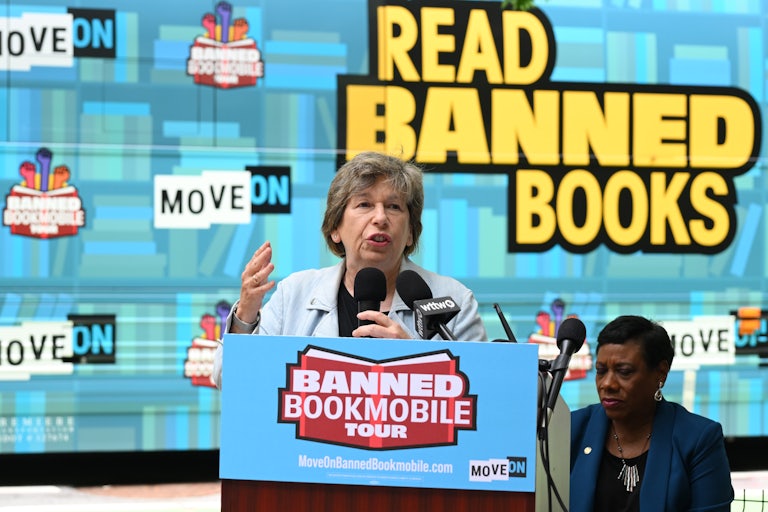
The New Republic convened a meeting to discuss Trump, book banning and the culture wars. Randi Weingarten described the attack on schools as a coordinated strategy to destroy public schools and promote vouchers. Edith Olmsted of The New Republic interviewed her. None of this is new to readers of this blog, but the American public needs to hear this message. Again and again.

Book Bans Are a Conservative Plot to Destroy Public Schools, Says Randi Weingarten, The teachers union head denounced the “extremist strategy,” which also includes voucher campaigns and manufactured outrage over critical race theory.

DANIEL BOCZARSKI/GETTY IMAGES FOR MOVEON

Teachers union head Randi Weingarten says that the campaign by conservatives to ban books isn’t about the books at all, but part of a broader strategy to destroy public schools—one that was supercharged by the pandemic.

“You take the agita and the anxiety that people had at Covid, that fear, and you combine it with a right wing who has wanted to kill public schools for years and take that money for vouchers, and you have the scenario we have,” Weingarten, the president of the American Federation of Teachers, said Wednesday at The New Republic’s Stop Trump Summit.

Vouchers, which use public education dollars to fund private and religious school attendance, are just one pillar of the conservative campaign to “undermine, destroy, and defund” public schools, she said. The other two are book banning and manufactured outrage over critical race theory.

Weingarten pointed to conservative activist Chris Rufo and a comment he made at Hillsdale College, a Christian nationalist school, in which he admitted that focusing on these issues was all part of a master plan to promote universal vouchers: “To get to universal school choice, you really need to operate from a premise of universal public school distrust.”

In an interview with TNR after the event, Weingarten explained the “extremist strategy” Rufo and other conservatives have used to defund public schools. “The hook was trust. If you really create as much distrust as possible in public schooling, then parents will look at privatization as an option,” she said.

That’s where critical race theory comes in.

“[Rufo] tried to make a term that nobody knows so toxic, so that you can weaponize it and make fear,” she said. “Conversations about hard subjects became weaponized as indoctrination. Which is patently ridiculous, and dangerous.”

Race, as well as gender, is the subject conservatives have focused on in their campaigns to ban books in public schools and libraries.

“What [Republican Governor Ron] DeSantis is doing in the so-called ‘war on woke,’ is exactly part of their playbook—to make people afraid of books, and afraid of what we do in school,” Weingarten said. According to Pen America, Florida passed 15 “educational intimidation” bills in the last two and a half years.

The “parents’ rights” movement is made up of a loud minority, Weingarten said, and actively undermines what most parents want. “What we see in Florida is that 60 percent of the book banning has been done by 11 people,” she said.

The AFT has partnered with The New Republic in fighting back against such bans. TNR’s Banned Books Tour has been delivering thousands of banned books across the country this month, most recently in Florida.

Jan Resseger writes brilliantly about the importance of education in a democracy. She reads widely in the work of authors who understand why education should not be privatized and turned into a consumer good. You will enjoy reading this essay.

She writes:

I find myself struggling these days to understand how those of us who prize our U.S. system of public education seem to have lost the narrative. As I listen to the rhetoric of today’s critics of public schooling—people who distrust or disdain the work of school teachers and who believe test scores are the only way to understand education, I worry about the seeming collapse of the values I grew up with as a child in a small Montana town whose citizens paid so much attention to the experiences its public schools offered for the community’s children. The schools in my hometown provided a solid core curriculum plus a strong school music program, ambitious high school drama and speech and debate programs, athletics, a school newspaper, and an American Field Service international student every single year at the high school. While many of us continue to support our public schools, what are the factors that have caused so many to abandon their confidence in public education?

It is in this context that I found myself reading “Education and the Challenges for Democracy,” the introductory essay in the current issue of Education Policy Analysis Archives. In his essay, Fernando M. Reimers, a professor in the graduate school of education at Harvard University, explores the interconnection of public education and democracy itself. Reimers explains, for example, that the expansion of our democracy to include more fully those who have previously been marginalized is likely to impact the public schools in many ways and that these changes in the schools will inspire their own political response:

“(T)he expansion of political rights to groups of the population previously denied rights (e.g. women, members of racial or religious minorities) may lead to increased access for these groups to educational institutions and a curriculum that prepares them for political participation. These changes, in turn, feed back into the political process, fostering increased demands for participation and new forms of representation as a result of the new skills and dispositions these groups gained by educational and political changes. But these increases in representation may activate political backlash from groups who seek to preserve the status quo. These forces may translate into efforts to constrain the manner in which schools prepare new groups for political participation. In this way, the relationship between democratic politics and democratic education is never static, but in perpetual, dynamic, dialectical motion that leads to new structures and processes. The acknowledgement of this relationship as one that requires resolution of tensions and contradictions, of course, does not imply an inevitable cycle of continuous democratic improvement, as there can be setbacks—both in democracy itself, and in education for democracy.”

Reimers continues: “Democracy—a social contract intended to balance freedom and justice—is not only fluid and imperfect but fragile. This fragility has become evident in recent years… In order to challenge the forces undermining democracy, schools and universities need to recognize these challenges and their systemic impact and reimagine what they must do to prepare students to address them.” While Reimers explains that the goal of his article is not only, “to examine how democratic setbacks can lead to setbacks in democratic education, but also how education can resist those challenges to democracy,” he presents no easy solutions. He does, however sort out the issues to which we should all be paying attention—naming five specific challenges for American democracy:

“The five traditional challenges to democracy are corruption, inequality, intolerance, polarization, and populism… The democratic social contract establishes that all persons are fundamentally equal, and therefore have the same right to participate in the political process and demand accountability. Democracy is challenged when those elected to govern abuse the public trust through corruption, or capturing public resources to advance private ends… Democracy is also challenged by social and economic inequality and by the political inequalitythey may engender… One result of political intolerance is political polarization… Political intolerance is augmented by Populism, an ideology which challenges the idea that the interests of ordinary people can be represented by political elites.” (emphasis in the original)

Reimers considers how these threats to democracy endanger our public schools: “The first order of effects of these forces undermining democracy is to constrain the ability of education institutions to educate for democracy. But a second order of effects results from the conflicts and tensions generated by these forces….” As the need for schools and educators to prepare students for democratic citizenship becomes ever more essential, political backlash may threaten schools’ capacity to help students challenge the threats to democracy.

In their 2017 book, These Schools Belong to You and Me, Deborah Meier and Emily Gasoi articulate in concrete terms what Reimers explains abstractly as one of the imperatives that public schools must accomplish today: “(W)e need a means of ensuring that we educate all future citizens, not only to be well versed in the three Rs, and other traditional school subjects, but also to be able to see from multiple perspectives and to be intellectually curious and incisive enough to see through and resist the lure of con artists and autocrats, whether in the voting booth, the marketplace, or in their social dealings.” (These Schools Belong to You and Me, p. 25) Schools imagined as preparing critical thinkers—schools that focus on more than basic drilling in language arts and math—are necessary to combat two of the threats Reimers lists: corruption and populism.

But what about Reimers’ other threats? How can schools, in our current polarized climate, push back against intolerance, inequality, and polarization? Isn’t today’s attack on “diversity, equity and inclusion” in some sense an expression of a widespread desire to give up on our principle of equality of opportunity—to merely accept segregation, inequality and exclusion? This is the old, old struggle Derek Black traces in Schoolhouse Burning—the effort during Reconstruction to develop state constitutions that protect the right to education for all children including the children of slaves—followed by Jim Crow segregation—followed by the Civil Rights Movement and Brown v. Board of Education—followed by myriad efforts since then to keep on segregating schools. Isn’t the attempt to discredit critical race theory really the old fight about whose cultures should be affirmed or hidden at school, and isn’t this fight reminiscent of the struggle to eliminate the American Indian boarding schools whose purpose was extinguishing American Indian children’s languages and cultures altogether? Isn’t the battle over inclusion the same conflict that excluded disabled children from public school services until Congress passed the Individuals with Disability Education Act in 1975? And what about the battle that ended in 1982, when, in Plyler v. Doe, the U.S. Supreme Court protected the right to a free, K-12 public education for children of undocumented immigrants? Our society has continued to struggle to accept the responsibility for protecting the right to equal opportunity. As Reimers explains, action to address inequality has inevitably spawned a reaction.

Educators and political philosophers, however, have persistently reminded us of our obligation to make real the promise of public schooling. In 1899, our most prominent philosopher of education, John Dewey, declared: “What the best and wisest parent wants for his own child, that must the community want for all of its children… Only by being true to the full growth of all the individuals who make it up, can society by any chance be true to itself.” (The School and Society, p. 1)

In 1992, political theorist Benjamin Barber advocated for the very kind of public schooling Reimers would like to see today: “(T)he true democratic premise encompasses… the acquired virtues and skills necessary to living freely, living democratically, and living well. It assumes that every human being, given half a chance, is capable of the self-government that is his or her natural right, and thus capable of acquiring the judgment, foresight, and knowledge that self-government demands.… The fundamental assumption of democratic life is not that we are all automatically capable of living both freely and responsibly, but that we are all potentially susceptible to education for freedom and responsibility. Democracy is less the enabler of education than education is the enabler of democracy.” (An Aristocracy of Everyone, pp. 13-14)

In a 1998 essay, Barber declared: “America is not a private club defined by one group’s historical hegemony. Consequently, multicultural education is not discretionary; it defines demographic and pedagogical necessity. If we want youngsters from Los Angeles whose families speak more than 160 languages to be ‘Americans,’ we must first acknowledge their diversity and honor their distinctiveness. English will thrive as the first language in America only when those for whom it is a second language feel safe enough in their own language and culture to venture into and participate in the dominant culture. For what we share in common is not some singular ethnic or religious or racial unity but precisely our respect for our differences: that is the secret to our strength as a nation, and is the key to democratic education.” (“Education for Democracy,” in A Passion for Democracy: American Essays, p. 231)

These same principles are prophetically restated by William Ayers in his final essay in the 2022 book, Public Education: Defending a Cornerstone of American Democracy: “In a free society education must focus on the production—not of things, but—of free people capable of developing minds of their own even as they recognize the importance of learning to live with others. It’s based, then, on a common faith in the incalculable value of every human being, constructed on the principle that the fullest development of all is the condition for the full development of each, and conversely, that the fullest development of each is the condition for the full development of all… Schools don’t exist outside of history or culture: they are, rather, at the heart of each. Schools serve societies; societies shape schools. Schools, then, are both mirror and window—they tell us who we are and who we want to become, and they show us what we value and what we ignore, what is precious and what is venal.” (Public Education: Defending a Cornerstone of American Democracy, p. 315)

Please open the link to complete the reading.