Archives for category: Extremism

We are living in a perilous that demonstrates the need for tenure and unions. With so many astroturf parent groups making spurious charges against public schools and their teachers, who will dare to stand up to bullies? In New Hampshire, it’s the president of the state AFTDeb Howes.

Contact:
Deb Howes
president@aft-nh.org
603-930-9248


AFT-NH Statement on Bill on ‘Obscene Materials’ in K-12 and Higher Education Classes, Public Libraries

CONCORD, N.H.—The following is a statement from AFT-New Hampshire President Deb Howes on HB 514, a bill to provide a procedure for people to complain about so-called obscene materials in K-12 and higher education classes and public libraries but that does not even clearly define what would be considered obscene:

“For all intents and purposes, this legislation about the dissemination of obscene materials is a book ban bill. Incredibly, the bill’s sponsors don’t even have the guts to clearly define what would be considered obscene, so it’s really meant to intimidate teachers and deprive students—both school-aged and adults—of books that one person who files a complaint deems objectionable. It practically begs parents or guardians to complain about a particular book to their local school board in the case of public schools, opening the way to a chaotic free-for-all. For public universities, public libraries and museums, it adds the Department of Education to the agencies that can initiate legal hearings to find material ‘obscene’ after receiving anonymous citizen complaints. Higher education faculty actually could be arrested, charged and indicted if they are found to be using a book that is judged to be obscene, whatever that means.

“This is disgusting and meant to censor students’ education and deprive them of quality books. Book bans have no place in New Hampshire K-12, public libraries or higher education classes. We will fight vigorously to ensure that our students have the books they need to receive a well-rounded, honest education. We also will stand firm for the right to access the whole world of ideas through public libraries and universities.”

# # #

Oklahoma State Superintendent Ryan Walters seems to have absorbed all his talking points from ALEC, the rightwing bill mill or he may just be trying to duplicate whatever Florida Governor Ron DeSantis is doing. All the talking points are there about critical race theory, “diversity, equity, and inclusion,” the “science of reading,” the fear of students turning transgender or being recognized as such, the readiness to censor anything that mentions sexuality or gender, and of course, vouchers for home schoolers and religious schools.

Superintendent Walters adds another item to his “reform” agenda: pay for performance, which has been tried for a century and never worked anywhere. It is hard to find an educational program that has been more thoroughly discredited, especially in the past dozen years. Performance these days equals test scores, and the teachers in the most affluent schools always come out in top, while those who teach the most vulnerable children are always on the bottom. No need to reinvent that broken wheel. Even Republican legislators know instinctively that “performance,” defined as test scores favors those in the whitest, most advantaged schools.

John Thompson, historian and former teacher, writes:

Last week, rightwing Oklahoma Secretary of Education Ryan Walters tried to “Shove ‘Choice’ Down the Throats of Unwilling Schools and Parents,” but he received serious pushback by influential Republicans for ignoring legislative norms in budget-making. This week, Walters’ revealed more of his plans to divide and conquer public schools, while ramping up the stakes for educators who don’t comply with ambiguous and weird mandates. The response by numerous Republicans, however, seems to indicate that a bipartisan effort against Walters’ and Gov. Kevin Stitt’s extremism is growing.

Walters started the Board of Education meeting, where his budget was presented with a prayer, which included a “reference to his school choice goals.” He then condemned “a loud and vocal crowd, a minority for sure, that say that all that is needed to fix the problems in education is to toss more money and to leave everything alone.” Walters then promised:

“There will be school choice. We will ensure that indoctrination and CRT (critical race theory) are eliminated in our state. We will also make sure that our kids are safe. There will be no boys in the girls bathrooms. There will be no pornography in our schools. We will make sure all of our vendors and the schools are focused on education and not diversity, equity and inclusion.”

Then, Walters met with rural superintendents in Atoka, the home of the Republican Speaker of the House Charles McCall, who has opposed voucher expansion. Walters explained that his “incentive pay plan that would reward a select few highly rated teachers in each school with up to $10,000 on top of their salaries.”

Walters then complained that:

“Tulsa has done so poor that if you took Tulsa Public Schools out of what we’re doing, we’re in the top half nationally. If you take Tulsa and OKC out, we’re in the top 15.”

So, the Tulsa World reported that Walters said:

“He would be open to pushing for Tulsa Public Schools to be broken up into smaller schools because of academic results there he says are dismal and parents who complain they are locked in because they can’t afford private school tuition and suburban schools bursting at the seams.”

At the same time, Walters’ allies are revealing more options for punishing educators who don’t comply with confusing mandates. While Walters seems to be backing off from his suggestion that all federal education funds be rejected, Sen. David Bullard filed a bill to “develop a ten-year plan to phase out the acceptance and use of federal funds for the support of K-12 education.” Sen. Shane Jett would “add seven more prohibited topics to House Bill 1775, which bans eight race and gender concepts from K-12 schools.” Jett and Rep. Terry O’Donnell seek to ban “teaching about sexual orientation and gender identity to elementary-age children,” And Jett “would outlaw any school policies that respect or promote ‘self-asserted sex-based identity narratives,’” as well as hosting “drag queen story time.”

Moreover, Sen. Cody Rogers “would prohibit school employees from calling students by names or pronouns that differ from the students’ birth certificates, unless having received written consent from the child’s parent.” Rep. Danny Williams would completely ban sex education from public schools.

Then, it was learned, Walters fired the Oklahoma State Department of Education’s Assistant general counsel Lori Murphy. The veteran attorney was “known for her support of transgender people and objections to the state’s rulemaking on classroom race and gender discussions.”

And the Tulsa World reported, the Oklahoma State Regents for Higher Education responded to Walters’ “urgent request” to audit spending on diversity, equity and inclusion, or DEI, programs. The Regents, “scrambled hundreds of employees to compile a 10-year review of its spending history on and current materials used for … DEI programs.” They found that DEI spending was “a third of 1%” of the budget.

But, on the eve of submitting his budget to the legislature, Walters, as well as his ally Gov. Stitt, faced more bad news. As the Oklahoman reports, Attorney General Gentner Drummond, who defeated Stitt’s appointee, John O’Conner, announced an “investigation into misspent education funds” which “hung over the state Capitol on Wednesday.” As an investigation by Oklahoma Watch and The Frontier found, Connors’ lawsuit led “some critics to question whether the lawsuit was an honest attempt to recoup the funds.” Consequently, The Oklahoman reported, “some high-ranking lawmakers appeared hesitant to heed funding requests from Oklahoma’s new state superintendent because of his alleged part in the controversy.” The reason was it was “a mix of Walters’s and Gov. Kevin Stitt’s staff, not a state agency [that] was overseeing the program.”

The Republican Chair of the House Appropriations and Budget subcommittee for Education, Mark McBride, said (and Speaker Charles McCall confirmed) he had been authorized to investigate the lawsuit, and was wrong in not doing so. But now, as Nondoc reports, A.G. Drummond said he “would pursue accountability for state officials, potentially including Walters owing to his prior role as director of an organization tasked with dispersing the funds.” (for what it’s worth McCall, a likely candidate for governor, attended the budget presentation.)

The Tulsa World added that Stitt had blamed the parent company of ClassWallet for the “unflattering audit of federal pandemic relief funds under Stitt’s control.” But, the audit was critical of how the Stitt administration spent $31 million to provide pandemic relief for students’ educational needs.”

Nondoc further explained that Walters’ presentation to the committee “took the opportunity with some of the lawmakers’ questions to expound on campaign rhetoric, including addressing questions regarding his ‘liberal indoctrination’ comments and past declarations to get federal funding out of Oklahoma public education.” And, his two-point plan, funding “science of reading” and pay-for-performance, drew plenty of criticism.

Republican Rhonda Baker, chair of the Common Education Committee, told Walters, “We have, as a legislative body, voted on the science of reading.” She added, “We’ve been very supportive of that, and we have made sure that there has been funding for that, so none of that is new. What is challenging, though, … is that we are not keeping teachers.”

Moreover, Democrat Rep. Andy Fugate said Walters performance pay plan would backfire by drawing teachers away from high-challenge schools and finding schools where “it’s easiest to teach.” Similarly, McBride said:

“Merit pay, I’m OK with it if you work in the oil field or some industry, but in education I just don’t see it working. … If you’ve got a classroom of troubled youth, how do you compare that to the classroom over here where the teacher’s got all the A and B students? It’s just almost impossible to me to evaluate that.”

I’ve heard mixed appraisals as to whether Walters really believes his own words. Regardless, as his ideology-driven claims become more extreme, it seems more likely that there will be more bipartisan pushback against Walters, Stitt, and MAGA true-believers. And, who knows, maybe it will open the door to Republican Adam Pugh’s bill, based on discussions with hundreds of superintendents and education leaders and over a thousand educators, that “would spend $241 million on teacher pay raises, guarantee 12 weeks of maternity leave for teachers and offer $15 million in scholarships to future educators who pledge to work in high-poverty schools,” while bestowing respect on teachers.
The Network for Public Education posted this article about the billionaires behind the voucher legislation that recently passed. None of the billionaires live in Idaho.

New post on Network for Public Education.

Kelcie Moseley-Morris: Records show powerful, wealthy funders outside Idaho back school choice campaign

Reporting for the Idaho Capital Sun, Kelcie Moseley-Morris explains how Idaho’s big voucher push is the product of carpetbagger astroturf. What has been presented as a grassroots movement is fueled by other players.

The national special interests groups who have poured millions of dollars into efforts to make education savings account programs a reality in states like Arizona, Utah, Wyoming, Wisconsin and New Hampshire are the same donors who spent hundreds of thousands of dollars during Idaho’s midterm election to ensure school choice-friendly legislators occupied as many seats as possible in the Idaho Legislature, records show.

The American Federation for Children and the State Policy Network are two of those groups that are coordinated and funded by millionaires and billionaires dedicated to conservative policy positions across the U.S. — and now in Idaho. Sen. Tammy Nichols, R-Middleton, introduced an education savings account bill Tuesday for parents to use per-pupil funding from state funds at the institution of their choice.

The Federation is focused on school choice, while State Policy Network’s affiliates also demonstrate opposition to unions, a reduction in public services, opposition to climate change efforts and advocate for school choice.

The State Policy Network’s donors are largely not known to the public, but investigations have determined donors include foundations run by David and Charles Koch and large corporations such as Microsoft, Verizon, GlaxoSmithKline and Kraft Foods.

[One of the players is one of the DeVos family’s favorite charities.]

During the 2022 primary election in Idaho, a group called the American Federation for Children Action Fund gave $200,100 to an entity called the Idaho Federation for Children. It gave the entity another $140,500 in contributions between September and Dec. 28.

It is unclear how much the entity is connected to Idaho. It is not registered as an entity with the Idaho Secretary of State, and campaign finance records do not indicate any Idaho individuals or companies have donated to the PAC. Records show the Idaho Federation for Children’s street address is the same as the American Federation for Children’s offices in Washington, D.C., although the “state” section of the address says “ID” rather than D.C.

The group’s chairman as listed on Idaho’s campaign finance portal is Tommy Schultz, CEO of the D.C.-based organization.

[The piece also quotes Charles Siler, a former conservative operative who became disenchanted with the anti-public school workings. He places this advocacy in a larger context.]

Siler said his job often involved meeting with legislators to persuade them to support a certain policy ideal, which included welfare reform, efforts to fight subsidies for public transportation and ballot access restrictions, along with education programs.

Siler said the policies are aimed at disrupting the political power of regular people.

“It’s all funded by people who have a world view that’s really in opposition to any kind of collective action to resolve inequities in our society,” Siler said. “It’s all about undermining and destroying collective power, because it’s the only opposition that wealthy people actually face.”

Read the full piece here. 

You can view the post at this link : https://networkforpubliceducation.org/blog-content/kelcie-moseley-morris-records-show-powerful-wealthy-funders-outside-idaho-back-school-choice-campaign/

Sara Stevenson was a librarian in an Austin, Texas, middle school. The following opinion piece was published in the Fort Worth Telegram.

When schools went remote at the beginning of the coronavirus era, parents were briefly in awe at teachers’ patience and skills.

As schools remained closed and parents grew angry, educators quickly fell from grace, and 370,000 have left the profession since the beginning of the pandemic.

Even at that, school librarians experienced the steepest fall.

During my 15 years as a public middle-school librarian, I frequently received affirmation for my vocation to encourage young people to read.

But ever since then-Rep. Matt Krause of Fort Worth published a list of 750 questionable books in fall 2021, Texas librarians have been put on the defensive.

School librarians fully support parents’ rights to monitor their children’s reading choices. In fact, some parents use the selection of library books as a way to facilitate conversations and even read books together.

Problems arise when particular parents try to usurp this role from the professionally trained librarians and decide which books belong or don’t belong in the library — not just for their kids but for all children.

School librarians in Texas are required to hold master’s degrees (or be working towards them) as well as teaching certificates and are charged with curating their library collections.

Each school population has different age levels, interests, needs and community standards, and the librarian’s duty is to choose suitable titles while making sure many points of view are represented.

A book’s inclusion in a library is not a librarian’s endorsement of the content. The book is there to provide access and choice.

Now, several Texas House members have introduced bills that would directly affect school libraries.

House Bill 338, filed by Republican Rep. Tom Oliverson of Cypress, would skip the role of the librarian altogether by putting the onus directly on the book publishers. Under this measure, publishers would have to rate every book for age appropriateness and display these ratings on their covers.

The labels wouldn’t just rate for sexual content; they would even warn if a book might be too scary for a child younger than 7.

How can anyone possibly decide this for all children? How would Maurice Sendak’s “Where the Wild Things Are” be rated? It has monsters, yes, but it’s also adorable.

The consequence for a publisher’s failure to include the rating would be that its books will not be available for school libraries to purchase.

This demand on private companies certainly seems like overreach, and it would significantly slow down the process of getting new books into the hands of eager readers.

And once again, we are faced with the question of who decides. Is it the publisher, who may be quite liberal or overly strict in standards? Will the publisher hire readers to count “dirty words” and “inappropriate” or “scary” scenes, or will the book be judged as a whole? Will every parent in every Texas community agree with these ratings? And why bypass the professional librarian in this process?

At the other end of the pendulum, we have House Bill 552 from Republican Rep. Ellen Troxclair of Austin. This law would remove the education protection clause, “repealing the affirmative defense to prosecution for the criminal offense of sale, distribution, or display of harmful material to a minor.”

This stems from the accusation that certain librarians are “groomers” for sexual deviancy.

This threat will affect the contents of libraries, causing librarians to self-censor and limit books with mature or controversial themes, LGBT characters or racial conflict.

Librarians cannot possibly read through every book acquired, so they will err on the side of safety and limit the choices of their students, especially when threatened with arrest.

During the last year and a half, I’ve watched clips of school board meetings that have been hijacked by Moms for Liberty and other organizations that ironically seek to curtail the liberty of students to select and parents to monitor their children’s reading choices.

When schools have to compete with Tik Tok and every new app that comes along to get children to read in the first place, this manufactured fight against libraries is not just misdirected but harmful.

If you want to protect kids from bad influences, take away their phones, not their library books.

Read more at: https://www.star-telegram.com/opinion/opn-columns-blogs/other-voices/article271647162.html#storylink=cpy

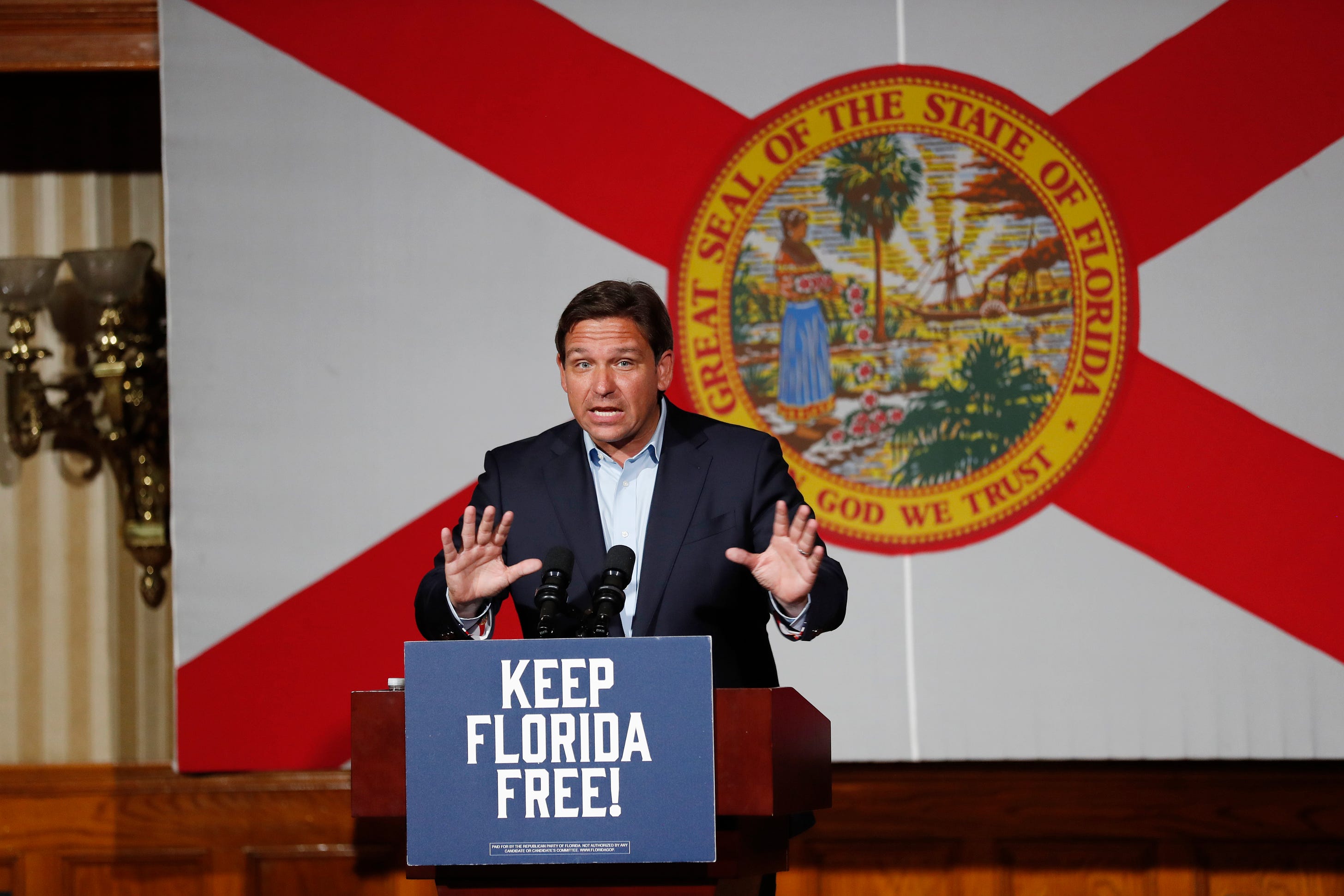
Florida has become a Petri dish for potential fascism. DeSantis has made war on African Americans, on gays, on transgender people, on drag queens, on public schools, on higher education, even on private corporations (Disney). He likes to stand behind signs that declare Florida is “free,” but no one is free to disagree with him. That’s not freedom.

Now DeSantis has proposed to create a military force that answers only to him. To call out the National Guard, he must get federal permission. That’s not good enough for him. He wants a Florida state guard. Some other states have them, but they are not in the hands of a would-be dictator whose vanity knows no limits.

CNN reports:

St, Petersburg, Florida (CNN) — Florida Gov. Ron DeSantis wants to reestablish a World War II-era civilian military force that he, not the Pentagon, would control.

DeSantis pitched the idea Thursday as a way to further support the Florida National Guard during emergencies, like hurricanes. The Florida National Guard has also played a vital role during the pandemic in administering Covid-19 tests and distributing vaccines.

But in a nod to the growing tension between Republican states and the Biden administration over the National Guard, DeSantis also said this unit, called the Florida State Guard, would be “not encumbered by the federal government.” He said this force would give him “the flexibility and the ability needed to respond to events in our state in the most effective way possible.” DeSantis is proposing bringing it back with a volunteer force of 200 civilians, and he is seeking $3.5 million from the state legislature in startup costs to train and equip them.

States have the power to create defense forces separate from the national guard, though not all of them use it. If Florida moves ahead with DeSantis’ plan to reestablish the civilian force, it would become the 23rd active state guard in the country, DeSantis’ office said in a press release, joining California, Texas and New York. These guards are little-known auxiliary forces with origins dating back to the advent of state militias in the 18th century. While states and the Department of Defense share control of the National Guard, state guards are solely in the power of a governor.

Will DeSantis use his state guard to break up peaceful demonstrations? Will he send it to drag shows to close them down? Will he it to harass teachers accused of being woke? The possibilities are frightening.

Dan Rather and Elliott Kirschner write a blog called Steady. Their voice is always thoughtful, reasonable, informed, and…steady. I think that they, like me, are old enough to remember when we believed that overt racism was ebbing and that white supremacy was dead. Our hopes have been shattered since 2016. It takes the use of critical race theory to understand why we were so naive. Here is their take on the big Education story of the day:

Photo credit: Octavio Jones

Editor’s note: this is an ironic banner in front of DeSantis. Florida is not free for those who don’t share his ideology. If you think racism exists today in Florida, you are not free to discuss it in school or college. You are free to agree with him.

Rather and Kirschner write:

Much of American history is entangled with racism and white supremacy. That is the reality of our beloved nation, no matter how much we wish it were not.

As we sit here nearly a quarter of the way through the 21st century, it is obvious that we need to have the maturity to look back to our past as well as ahead to the future. Can we do this with our eyes wide open? Will we study and learn from the lessons of history?

You can’t grapple with the truth if you hide it from view. Yes, our national narrative is an inspiring one — of freedom, rights, and new opportunities. But it is also a narrative of pain — of the bondage, rape, and murder of enslaved people. It is a story of mass death, broken treaties, and land stolen from Native people. And it is a story of persecution of the “other,” time and again.

The chasm between the noble promises of our founding documents and our historical realities continues to obstruct our national journey toward a more perfect union.

Yes, ours is a country that has facilitated exploration, innovation, and growth, but it is also one built upon families torn apart at the auction block, bodies whipped, and police dogs and fire hoses set against children.

Cities were redlined. Public schools were segregated. And despite our carefully cultivated national image as a meritocracy, throughout our history we have seen talent overlooked and our common humanity diminished on account of people’s race, religion, and sexual orientation.

The ripples of injustice continue to destabilize our society.

It shouldn’t be controversial to say any of this. But acknowledging these truths today is a political act, because it threatens the privileged narratives of those who seek to sugarcoat our past. These are men and women who serve their own ambitions by fortifying their cynical holds on power, delighting in division, feeding off fear, and applauding anger.

And that brings us to Florida’s Governor Ron DeSantis.

Listing all of his efforts to leverage the power of his office to attack equity, empathy, and justice would stretch this post immeasurably. But doing so would also jeopardize the central point: DeSantis is an opportunist. He is not weighing the merits of any one campaign. Rather, he wants headlines as a culture warrior standing up to “wokeness,” a term he has eagerly redefined to suit his own purposes. It allows him to sneer at and dismiss any attempt to reckon with American injustice.

DeSantis has focused his assaults on two of our society’s most traditionally marginalized groups: Black Americans and the LGBTQ community. While these populations have thus far felt the brunt of his targeting, we need to see clearly that his rhetoric is a threat to all who care about a democratic, peaceful, empathetic, and just America. Those of us with the greatest privilege should bear a special burden in rejecting this hate.

DeSantis’s pugilism has enabled him to consolidate power in Florida. Any opposition to his toxic initiatives must contend with the uncomfortable truth that voters validated his message and style via his landslide win in November. Now DeSantis thinks he can take his show on the road with a presidential bid. That remains to be seen. Florida has been trending Republican in recent years, and success there might not translate to the current battleground states, many of which saw big Democratic wins in the midterms.

All that being said, there is a great danger to framing this struggle primarily through the lens of electoral politics. This normalizes a discourse that should be rejected by society’s mainstream. Just as the outright bigotry of the past became socially unacceptable, so too should these latest attempts at divisiveness.

It should not surprise us that DeSantis is making schools — both K-12 and college — a central target. He wants to teach a distorted view of America. He wants to make dissenting speech not only suspect but even criminal. He wants to silence the voices of his critics and of critical thinking more generally. This is a playbook that has been followed by demagogues before to very dangerous ends.

It is essential that DeSantis not be covered by the press through a false equivalence paradigm. We can debate what we should teach and how to teach it. But we can’t replace the truth, as unsavory as it may be, with sanitized narratives that suit those already in power. This is a battle for the minds of the voters of the future. This is about what kind of nation we will become.

But DeSantis primarily cares about what kind of country we are now. He wants to appeal to fear because he thinks he can mine that fear for votes. That is his game plan. And he’s not hiding it. There can be no appeasement. DeSantis has already shown that he isn’t interested in deliberations or good faith compromise. Those would disrupt his approach of means to an end.

History illustrates that hatred can be taught, but so can empathy and justice. We are on a winding journey as a nation. And we have much farther to go. But we have made progress in the face of bigots and autocrats because people had the courage to forge the inequities of our past into a more equitable future.

This history, this truth, is what scares people like DeSantis the most. But it is one that can give us hope if we are determined not to look away.

When I first had a chance to read the College Board’s AP African American Studies syllabus, I predicted that the College Board was likely to beat a hasty retreat if its bottom line was jeopardized. I have not yet seen the revised edition, but the media is reporting that certain hot topics and prominent names were deleted to make the course palatable to Ron DeSantis and other conservative governors.

The New York Times reported:

After heavy criticism from Gov. Ron DeSantis, the College Board released on Wednesday an official curriculum for its new Advanced Placement course in African American Studies — stripped of much of the subject matter that had angered the governor and other conservatives.

The College Board purged the names of many Black writers and scholars associated with critical race theory, the queer experience and Black feminism. It ushered out some politically fraught topics, like Black Lives Matter, from the formal curriculum.

And it added something new: “Black conservatism” is now offered as an idea for a research project.

This last addition was a direct concession to criticism from the conservative National Review, which assailed the AP course as Neo-marxist indoctrination that left out the voices of African American conservative writers and scholars.

The Times’ story continues:

But the study of contemporary topics — including Black Lives Matter, incarceration, queer life and the debate over reparations — is downgraded. The subjects are no longer part of the exam, and are simply offered on a list of options for a required research project.

And even that list, in a nod to local laws, “can be refined by local states and districts.”

The expunged writers and scholars include Kimberlé W. Crenshaw, a law professor at Columbia, which touts her work as “foundational in critical race theory”; Roderick Ferguson, a Yale professor who has written about queer social movements; and Ta-Nehisi Coates, the author who has made the case for reparations for slavery. Gone, too, is bell hooks, the writer who shaped discussions about race, feminism and class.

After the curriculum was released, Professor Crenshaw said that even if her name and others had been taken out of the curriculum because secondary sources — theorists or analysts — were being eliminated in favor of facts and lived experience, the decision sent a troubling message. “I would have made a different choice,” she said. “Even the appearance of bowing to political pressure in the context of new knowledge and ideas is something that should not be done.”

But she said she was also disappointed because she had believed the course would capitalize on a hunger of young students to learn “ways of thinking about things like police brutality, mass incarceration and continuing inequalities.”

Instead, she said, “the very same set of circumstances that presented the need for the course also created the backlash against the content that people don’t like.”

David Blight, a professor of American history at Yale University, said Wednesday that he had written an endorsement of the new curriculum, at the College Board’s request, and that he believed it had much to offer not just about history but also about Black poetry, art and the origins of the blues, jazz and hip-hop. But he withdrew his endorsement on Wednesday, after learning that some sections had been cut.

“I withdrew it because I want to know when and how they made these decisions to excise these people, because that’s also an attack on their academic freedom,” Dr. Blight said.

PEN America, a free speech organization, echoed that concern. While the College Board had said the changes were not political, the board “risked sending the message that political threats against the teaching of particular types of content can succeed in silencing that content,” said Jeremy C. Young, senior manager of free expression and education at PEN America…

Dr. Gates, who was a consultant to the curriculum, said he was “sorry that the College Board’s policy is not to require secondary sources in its curricula.” He teaches Harvard’s introduction to African American studies, “and academic subjects such as ‘Intersectionality’ and critical race theory, the 1619 Project, reparations for slavery, Black homophobia and antisemitism are fair game, of course, for such a class,” he said in an email. The 1619 Project is an initiative by The New York Times.

The College Board insists it made its changes in December before DeSantis denounced the syllabus.

But the conservative attack on the syllabus began last September, when Stanley Kurtz received a leaked copy and wrote a scathing critique in The National Review called “Neo-Marxing the College Board with AP African American Studies.”

He wrote in September:

A new and sweeping effort to infuse leftist radicalism into America’s K–12 curriculum has begun. The College Board — the group that runs the SAT test and the Advanced Placement (AP) program — is pilot-testing an AP African American Studies course. While the College Board has withheld the course’s curriculum framework from the public, I have obtained a copy.

Although K–12 teachers and academic consultants working with the College Board have publicly denied that AP African American Studies (APAAS) either pushes an ideological agenda or teaches critical race theory, those denials are false. APAAS clearly proselytizes for a socialist transformation of the United States, although its socialism is heavily inflected by attention to race and ethnicity. Even if there were no laws barring such content, states and local school districts would have every right to block APAAS as antithetical to their educational goals. In any case, APAAS’s course content does run afoul of the new state laws barring CRT. To approve APAAS would be to gut those laws.

Kurtz followed with additional articles in The National Review lambasting the course as radical leftist indoctrination that violated state laws prohibiting the teaching of critical race theory. He applauded DeSantis’s attack on the course.

Although the College Board insisted that it’s revisions had nothing to do with the conservative pushback and was completely nonpolitical, Kurtz laughed:

Here’s the reality. The College Board is in a panic. Its repeated attempts to keep the APAAS curriculum secret have failed. That curriculum has now been widely published, and the teacher’s guide has been exposed here at NRO as well. My sources tell me that at least one other red state is seriously considering pulling out of the course. More red states are likely doing the same. The College Board knows that if it doesn’t stop the bleeding, the red states will be lost.

The College Board knew it had a problem months before DeSantis condemned the course. Could it take the risk of offering a course that would be rejected by red states that had already banned “critical race theory?”

The Times pointed out:

Acceptance for the new curriculum is important to the College Board, a nonprofit, because A.P. courses are a major source of revenue. The board took in more than $1 billion in program service revenue in 2019, of which more than $490 million came from “AP and Instruction,” according to its tax-exempt filing.

The College Board is a nonprofit but it pays hefty salaries. According ito Forbes, its Chief Executive Officer David Coleman (the architect of the Common Core standards) was paid $1.8 million in salary in 2018 (the last year that figures were available), and its president received more than $1 million. The company holds over $1 billion in assets.

Could they risk publishing a course that might be rejected by every red state? Maybe. But would they? Clearly, it was decided that it was easier to drop the controversial names and topics than to offend powerful conservative figures who might hurt their revenues.

Robert Hubbell writes a thoughtful, informative blog. I’m posting this as part of my personal project to understand the new face of white supremacy. White supremacy has always been there, simmering below the surface. Trump invited them to show their faces and step into the daylight. They did, and DeSantis is sending them signals that he wants to be their champion.

Florida Governor Ron DeSantis has set his anti-education sites on Florida’s state colleges. Through a series of political and legal maneuvers, he has ceded control over Florida’s state colleges to ultra-conservative culture warriors like Christopher Rufo. In short order, DeSantis has announced that he will rid Florida state colleges and universities of curricula not “rooted in Western tradition” or that “compels belief in critical race theory or related concepts such as intersectionality.”

Amid the torrent of reporting on Ron DeSantis’s attack on critical race theory and intersectionality, the quiet part is often left unsaid. So let me say it: DeSantis’s educational agenda is code for racism and white supremacy. (Other parts of his agenda seek to erase the dignity and humanity of LGBTQ people.) DeSantis’s invocation of “Western tradition” is meant to suppress knowledge regarding the people (and contributions) of Asia, Africa, South America, Oceania, and the Indigenous Peoples of the Americas. See Talking Points Memo, DeSantis Makes 2024 Ambitions Clear As He Pours Gasoline On His ‘Woke’ Education Fire.

Given DeSantis’s generalized ignorance, his call to focus on “Western tradition” is a slippery slope that will inevitably lead to the discussion of unpleasant truths about America. For example, the enslavement of Black people was a “tradition” in North America for 246 years—and the abolition of that evil practice is relatively recent (155 years ago). So, a college course that honestly addresses the Western “traditions” of North America should include an examination that the role of slavery played in the economic, social, and political development of America.

But DeSantis isn’t stopping at converting Florida’s colleges and universities into re-education camps in the worst traditions of the USSR. He is seeking to up-end centuries of “Western tradition” embodied in the Constitution and the English common law: the requirement of a unanimous jury to impose capital punishment. DeSantis has floated the idea that a less-than-unanimous jury verdict can impose a sentence of death—an unconstitutional proposal designed to inflict the death penalty on more Black and Latino Americans. See Vox, Ron DeSantis wants to make it much easier for the state to kill people.

DeSantis is willing to do all this because he wants to capture Trump’s loyal base—which is the only hope that DeSantis has of becoming a credible candidate. As Trump becomes mired in criminal prosecutions, DeSantis will become emboldened and radicalized beyond his already extremist views. Doing so ignores the lessons of the 2022 midterms: persuadable Americans are done with Trump and his MAGA extremism. Like all military generals, Ron DeSantis is fighting the last war (the presidential election of 2020) and has failed to heed the tectonic shift that occurred in the midterms.

Governor Ron DeSantis hates the fact that there is a progressive public college called New College that openly teaches diversity, equity, inclusion, feminist studies, ethnic studies, and gay studies. That’s WOKE, and he vowed to crush anything WOKE.

He named 6 conservatives to the 13-member board, and the board of the state university system added another, meaning that Rightwingers are in charge. A hard-right board needs a hard-right president, and they got one.

Their first meeting was this afternoon, and they are expected to appoint former State Commissioner of Education Richard Corcoran as the new president. From the following story, it appears that no one bothered to let the current president of the New College know that she was being shown the door.

DeSantis is showing how to stamp out ideas he doesn’t like, with power, not subtlety. Is he a fascist or is he pretending?

A new board of trustees at New College of Florida intends to name Richard Corcoran as its next President.

Corcoran, a former House Speaker, served as Gov. Ron DeSantis’ first Education Commissioner.

Carlos Trujillo, president and founder of Continental Strategy, revealed the plans in a letter to clients and colleges.

“We are beyond excited to announce that one of our Partners, former Department of Education Commissioner Richard Corcoran, will be returning to higher education to serve as the Interim — and hopeful permanent — President of the New College of Florida, in Sarasota,” Trujillo wrote.

“This move comes as part of Gov. DeSantis ongoing work to refocus the university on providing the most value to its students and their parents.”

Corcoran was a founding partner for the consulting firm.

The news comes hours before the first board meeting since DeSantis appointed six new trustees on the 13-member board. The State University System Board of Governors also appointed a new trustee with a similar conservative think tank background.

Of note, work of Corcoran’s apparent hire comes before any news of current President Patricia Okker’s future with the school. Eddie Speir, co-founder of Inspiration Academy, wrote a blog post this weekend promising to call for Okker to be renamed as interim President and to terminate all faculty and staff before deciding who still fit in the new vision for the college.

While Florida’s Sunshine Law requires all decisions by the board to be made in publicly noticed meetings, Trujillo treats the matter like a done deal.

“The selection of Richard distinguishes our firm as a leader in innovation and strategic solutions for the clients we serve. We look forward to finding new synergies that can better serve our current clients and ensure their goals are made a reality,” his letter reads.

John Thompson, a retired teacher and historian in Oklahoma, has written frequently about events in his state for this blog. Here, he describes the political coercion that determined right-wingers are promoting in Oklahoma and calling it “choice.” From his description, some Republican legislators are worried about “liberal indoctrination,” transgender students using the “wrong” bathroom, litter boxes for children who think they are cats (this seems to be a QAnon idea), and the danger of “social-emotional learning.” Apparently students in Oklahoma have no social or emotional issues.

Ryan Walters, Oklahoma’s newly elected, extreme rightwing Secretary of Education, first says that “the state should have the ‘most comprehensive school choice in the country.’” Secondly, Walters pushes the rightwing Michigan-based Hillsdale College curriculum; he doesn’t want to allow schools to choose to retain research-based curriculums that he identifies as “liberal indoctrination.” As Clark Frailey, executive director of Pastors for Oklahoma Kids, says, Walters seems to be pushing for “Christian Dominionism,” which is “based on the philosophy that Christianity is at the core of America’s foundation and all institutions need to align with that viewpoint. If people won’t convert, then a government religion must be forced upon them.”

Two voucher programs for private schools and homeschools have been filed. The most interesting one is Sen. Shane Jett’s Oklahoma Parent Empowerment Act for Kids (PEAK). Even extremely conservative Republicans legislators worry that vouchers would undermine the finances of their rural schools. Jett seems to be offering a carrot and a stick to those vulnerable constituencies. He would impose vouchers only in counties with a population of more than 10,000 people. But, vouchers would be offered in counties with fewer than 10,000 residents if they are served by a “trigger district.”

The Oklahoman then reports:

Jett defined a “trigger district” as a public school system that allows or tolerates House Bill 1775 violations, use of school bathrooms according to gender identity, anthropomorphic behavior known as “furries,” disparagement of the oil and gas industry, lesson plans promoting social-emotional learning and animal rights activism, among other topics.

In other words, the bill would coerce schools into “choosing” to comply with the entire extremist agenda. But that begs the question about how educators would choose to deal with today’s threats to public education. Republican Sen. Adam Pugh’s newly revealed plan for school improvement was based on meetings with 200 public school superintendents; every college president in Oklahoma; and “hundreds, if not thousands” teachers and parents and advocacy groups.  Based on these listening sessions, Pugh did not propose vouchers.

Pugh’s plan would raise teacher pay so the minimum starting salary was $40,000, “with graduated raises to the minimum salary schedule based on longevity.” The estimated cost would be $241 million, which is less than the cost of Sen. Julie Daniels’ voucher bill ($275 million). They would  also create an “Oklahoma Teacher Corps” and a teacher mentoring system;  provide certain teachers at least 12 weeks of maternity leave; update the school funding formula, and pass Pugh’s seven other constructive reforms. 

As Pugh explained, “I hope this plan will demonstrate to teachers that we’re serious about the work that you do, and we appreciate how you pour your heart and your soul into educating kids, as we need you to stay in the classroom, and we need more of you.”

But, the Stillwater News Press offers an equally important response:

While that offers us a bit of a sigh of relief, Oklahomans should be aware that the push [to] move taxpayer money into private schools isn’t going anywhere. It’s a well-funded campaign and the state’s administrators and board members have been handpicked to make that a top priority.

I’m afraid I agree with the Stillwater News. Pugh’s bills raise hope. But Oklahoma Republicans will continue to coerce schools into compliance with their extremist privatization and Christian Dominionism ideologies – and call it “choice.”

On the other hand, more Republicans sound like they are getting fed up by Walters and his minions. This week, the Secretary of Education was supposed to present a budget to a legislative subcommittee for planning purposes, but a letter obtained by the Tulsa World shows that Walters seems to be prioritizing “ridding public education of ‘liberal indoctrination.’” Walters’ “spokesman” said he “has requested additional information on diversity, equity, inclusion programs (DEI) to fully understand the extent of indoctrination happening in higher education.”

The letter said:

Please provide a full outline and review of every dollar that has been spent over the last 10 years on diversity, equity, inclusion. Additionally, I want an overview of your staffing and the colleges underneath your oversight as the Chancellor of Oklahoma Higher Regents within every DEI program … and expenditures,” Walters wrote on letterhead of the Office of the Secretary of Education. “Lastly, please provide a copy of the materials that are being used in any of these programs.”

Neither has Walters followed legislative norms for presenting a public education budget. As Nondoc reported, Walters said he instituted a hiring freeze and a spending freeze for the State Department of Education when he took office and all related decisions require his approval. And, in addition to demanding vouchers, he has insisted on any teacher pay raise being performance-based. Above all, Walters said he would be bringing a completely different budget than the one his predecessor drafted. 

Republican Toni Hasenbeck (R-Elgin) responded saying, “district superintendents had expressed concern for ‘the next four years’” because of Walters’ campaign comments. Rep. Dell Kerbs, (R-Shawnee) commented, “I don’t need elevator speeches. I need details.” Subcommittee Chairman Mark McBride (R-Moore) understood the argument that performance pay could be a part of teacher pay, but he said that Walters’ plan went too far. And then he tried to get Walters back to the normative procedures which the subcommittee follows for helping craft funding priorities.

McBride “interrupted Walters,” and asked, “Are you saying the budget will totally change — you’re presenting a budget that’s not going to be the same budget, and you’re going to totally change it?”

Nondoc reported that “McBride seemed confused and paused for a moment.” When Walters tried to change the subject, [McBride] interrupted him and asked why Walters was presenting a budget that would not exist in a week. Walters again changed the subject and, as Nondoc reported, “McBride interrupted him again, asking him to stay on topic presenting monetary figures rather than discussing policy and slipping into “campaign rhetoric.” McBride said, “With all due respect, I need the performance review for last year. That’s what you’re here to present.” Then, after that interruption, Walters stopped his presentation.

 After the meeting, Matt Langston, Walters’s “spokesman” (a paid GOP consultant based in Texas) said, “Not one person in Oklahoma is surprised that Democrats are unhappy with the political theater that was orchestrated today.” According to Langston:

They do not want transparency, accountability or even basic reform because they are used to playing in the shadows. Union bosses, whining and liberal tears will not stop education reform, and the superintendent is looking forward to next week’s actual budget hearing.

Stay tuned! When Walters reveals his budget, chaos and vitriol will increase, and we’ll see whether Walters really believes he can implement his promise or “suggestion,” that “received some pushback from lawmakers in 2022,” a ten-year plan to reject all federal spending on education …