Archives for category: Education Industry

On August 20, the New York Times published a story about how Ron DeSantis joined the “ruling class” but now campaigns against it. His story is shot through with hypocrisy. He paints himself as the public school kid from middle-class Dunedin, Florida, surrounded by snobs from private schools who looked down on him. Yet now as governor, he treats public schools and their teachers with contempt and expanded vouchers to pay billions of taxpayer dollars for kids to go to private schools, including high-income families.

Why is he, the public school kid, subsidizing private and religious schools? Why is he so hostile to public schools? He complains that public schools indoctrinate their students yet he’s willing to send kids to religious schools whose purpose is indoctrination. Why does he subsidize the tuition of rich kids who go to private schools? Aren’t those the kind of kids who treated him with condescension?

Early last year, Gov. Ron DeSantis nestled into his chair onstage in Naples, Fla., to explain to an audience of the would-be conservative elite his journey through the reigning liberal one they hoped to destroy. His host was Larry P. Arnn, the president of Hillsdale College, a small Christian school in southern Michigan that has become an academic hub of the Trump-era right. His subject was Yale University, where Mr. DeSantis was educated and where, as he tells it, he first met the enemy.

The story begins:

“I’m a public school kid,” Mr. DeSantis told the audience, unspooling a story that he has shared in recent years with aides, friendly interviewers, donors, voters and readers of his memoir, “The Courage to Be Free.” “My mom was a nurse, my dad worked for a TV ratings company, installing the metering devices back then. And I show up in jean shorts and a T-shirt.” The outfit “did not go over well with the Andover and Groton kids” — sometimes it is Andover and Groton, sometimes it is Andover and Exeter, sometimes all three — who mocked his lack of polish.

Worse than Yale’s snobbery was its politics: College was “the first time that I saw unadulterated leftism,” he told the Republican Jewish Coalition this March. “We’re basically being told the Soviet Union was the victim in the Cold War.” Teachers and students alike “rejected God, and they hated our country,” he assured the audience in Naples. “When I get people that submit résumés,” he said, “quite frankly, if I got one from Yale I would be negatively disposed.”

Then there are the parts of the story he doesn’t tell: How his new baseball teammates at Yale — mostly fellow athletic recruits from the South and West who likewise viewed themselves as Yale outsiders — were among those who teased him about his clothes, and how he would nevertheless adopt their insular culture as his own. How he joined one of Yale’s storied “secret societies,” those breeding grounds of future senators and presidents, but left other members with the impression that he would have preferred to be tapped by a more prestigious one. How he shared with friends his dream of going to Harvard Law School — not law school, Harvard Law School — and successfully applied there, stacking one elite credential neatly onto another, and co-founded a tutoring firm that touted “the only LSAT prep courses designed exclusively by Harvard Law School graduates.” How his Yale connections helped him out-raise rivals as a first-time candidate for Congress, and how he featured his Ivy credentials — “a political scarlet letter as far as a G.O.P. primary went,” Mr. DeSantis likes to say — on his campaign websites, sometimes down to the precise degree of honors earned. And how that C.V. helped sell him to an Ivy-obsessed President Donald J. Trump, whose 2018 endorsement helped propel Mr. DeSantis to the governor’s office in Florida, where his Yale baseball jersey is displayed prominently on the wall next to his desk…

For Mr. DeSantis and his allies, the culture wars are the central struggle of American public life, and schools are the most important battleground where they will be fought. “Education is our sword,” Mr. DeSantis’s then education commissioner, Richard Corcoran, explained to a Hillsdale audience in 2021. And Mr. DeSantis is the man to wield it — a self-made striver who was “given nothing,” as he told the audience attending his campaign kickoff in Iowa in May. “These elites are not enacting an agenda to represent us. They’re imposing their agenda on us, via the federal government, via corporate America and via our own education system.”

DeSantis has aggressively taken political control of Florida’s schools and universities, passing laws that limit or eliminate what may be taught about gender and race. He has encouraged parent vigilantes to scour classrooms and libraries for books on controversial topics and ban them. His ally, radical conservative Chris Rufo, is quoted in the article:

“The goal of the university is not free inquiry,” Christopher Rufo, a conservative activist and one of the new trustees [of New College], said during a recent appearance in California. Instead, he argued, conservatives need to deploy state power to retake public institutions wherever they can.

“The universities are not overly politicized. The universities are overly ideologized and insufficiently politicized,” Mr. Rufo said. “We should repoliticize the universities and understand that education is at heart a political question.”

At Yale, DeSantis joined Delta Kappa Epsilon (Dekes), which was known for its vicious hazing of pledges. As an upper-class member, DeSantis was known for bullying pledges and forcing them to engage in pranks like dropping their pants and exposing their genitals, while the older members mocked their private parts.

The story says that DeSantis took a course on the Cold War taught by the esteemed scholar John Lewis Gaddis, who was an outspoken critic of the Soviet Union. In other words, DeSantis lied about being exposed to pro-Soviet views of the Cold War.

DeSantis portrayed Harvard Law School, where he studied, as a bastion of left wing thought. But the Dean of the law school when DeSantis arrived belonged to the conservative Federalist Society. And he was not the only member of that group on the faculty.

A 2005 survey of The Harvard Law Review, published in the Federalist Society’s flagship publication, The Harvard Journal of Law & Public Policy, found that staff members “identifying themselves as left-of-center did not comprise even a majority.”

DeSantis neglects to mention that he was an active member of the Harvard Law School’s Federalist Society. He prefers to play the victim.

When he ran for Congress and then for governor, he tapped his Yale and Harvard networks to raise money.

But then he discovered there was even more political advantage for him if he played the role of the enemy of the ruling class.

How better to attack the ruling class than to destroy the public schools that enabled him to enter Yale? If this makes no sense, neither does DeSantis’ fable about being victimized at Yale and Harvard.

Tom Ultican writes about the Delaware disaster. Delaware went all in for neoliberal school reform, being one of the first winners of a Race to the Top award, and has seen its academic performance decline. It’s time to switch gears, he says, and let teachers teach without threats and fear. He writes that the Delaware story should be a lesson for the nation on the failure of No Child Left Behind and Race to the Top ideology —both representative of neoliberal school reform. This is one of Tom’s very best posts. Open the link and read it all!

He begins:

An unholy alliance between neoliberal Democrats and education reform oligarchs is harming Delaware public education. This is a lesson for the rest of the nation.

A new charter school law introduced to reduce principal professionalism is the latest example. Data clearly shows for almost two decades, top-down education reform has been ineffective and seriously damaged a once exemplary system.

In March, the Delaware Professional Standards Board recommended charter school certification requirements match public school rules. Kendall Massett, executive director of the Delaware Charter Schools Network, immediately responded, “All Delaware charter schools are led by highly qualified administrators.” She said charter school principals have a different role than public school leaders and need to be excellent marketeers to raise funds and drive enrollment.

Did she mean charter school principals don’t need to be professional educators?

For the Standards Board recommendation to take effect, adoption by the State Board of Education is required. Before they acted, Senate President Pro Tem David P. Sokola introduced senate bill 163 to relax certification rules for charter school principals.

The heart of Democrat Sokola’s legislation says:

“The bill creates new subsections in Section 507(c) of Title 14 of the Delaware Code to define the licensure and certification requirements more clearly within Chapter 5 of Title 14. Finally, the bill requires the Secretary of Education to work with the Delaware Charter Schools Network to create a qualified alternative licensure and certification pathway for charter school administrators engaged in the instruction of students (Instructional Administrators).”

Teachers’ union leader, Mike Matthews, wrote to the Senate Executive Committee:

“I was disheartened to see that SB 163 — a bill that will actually deprofessionalize the education profession — was introduced by Senator Sokola. I was even more disappointed — and concerned — to see it filed in the Senate Executive Committee instead of the Senate Education Committee where it belongs. Why was that?”

The Bill was passed by the State Senate and is currently awaiting action in the House Administration Committee. The House Education Committee, like its counterpart in the Senate, is not involved.

Neoliberal Education Reform

A Delaware Live headline howls, School test scores dismal again despite new math, reading plans.” Two decades of 4th and 8th grade reading and math data on the National Assessment of Education Progress (NAEP) support the headline. NAEP is often referred to as the nation’s education report card. The above graphs beg the question,“what happened in 2010?”

Long-term NAEP data showed that from 1971 until 2002, there was steady growth in math and reading. The steady growth ended concurrent with the adoption of the bipartisan Kennedy-Bush education reform called No Child Left Behind. The graphs illustrate this phenomenon.

Why did Delaware’s scores start falling?

In 2010 educator and blogger, Susan Ohanian, reported,

“Delaware and Tennessee came out on top in round one of RTTT: Delaware got $100 million (about $800 per student), and Tennessee $500 million (about $500 per student). Since these states radically changed their education strategies to receive what amounts to 7 percent of their total expenditures on elementary and secondary education, the feds are getting a lot of bang for the buck.”

The $4.5 billion dollar Obama-era Race To The Top (RTTT) program was administered by Education Secretary Arne Duncan. Grants were given to states that complied with three key elements: (1) Evaluate teachers based on student test scores (2) Close and turn into charter schools public schools that continue to get low test scores (3) In low-test score schools, the principal and half of the staff are to be fired and replaced. In addition, states were encouraged to create more privately-managed charter schools.

Education historian and former Assistant US Secretary of Education Diane Ravitch predicted the program’s utter failure when it was announced:

“All of these elements are problematic. Evaluating teachers in relation to student test scores will have many adverse consequences. It will make the current standardized tests of basic skills more important than ever, and even more time and resources will be devoted to raising scores on these tests. The curriculum will be narrowed even more than under George W. Bush’s No Child Left Behind, because of the link between wages and scores. There will be even less time available for the arts, science, history, civics, foreign language, even physical education. Teachers will teach to the test. There will be more cheating, more gaming the system.”

For more than a century, brilliant educators have been skeptical of top-down coerced education reform like those from Duncan, Obama, Bush and Kennedy. Alfred North Whitehead published his essay, “The Aims of Education” in 1917, stating:

“I suggest that no system of external tests which aims primarily at examining individual scholars can result in anything but educational waste.” (Page 13)

“But the first requisite for educational reform is the school as a unit, with its approved curriculum based on its own needs, and evolved by its own staff. If we fail to secure that, we simply fall from one formalism into another, from one dung-hill of inert ideas into another.” (Page 13)

Former McKinsey Consultant and Democrat with neoliberal inclinations, Jack Markell, was elected Delaware Governor in 2009. His first major victory was winning the RTTT grant. He said:

“What’s really important today is where we go from here; whether we have the will to put our children first and move forward with reforms to improve our schools so that Delaware children can successfully compete for the best jobs in an increasingly competitive global economy. That won’t be easy, but we have proven in these past few months that it can be done.  I would like to thank all those who worked with us in support of our application and look forward to moving ahead to improve our schools.”

Markell praised then Senate Education Committee Chair, David Sokola, for his work on the RTTT grant proposal, the same Senator who just introduced legislation to soften certification requirements for charter school principals.

Since the RTTT announcement, Delaware has gone from consistently scoring above the national average on all NAEP testing to dropping well below.

Please open the link and keep reading.

Oklahoman John Thompson writes about the conflict enveloping the Tulsa public schools: Ryan Walters, the extremist Secretary of Education, wants to take over Tulsa’s public schools. Opposition to Walters’ plans by Tulsa’s parents and political leaders is growing. State takeovers if school districts have historically failed but Walters doesn’t appear to know it.

Thompson writes:

Oklahoma Secretary of Education Ryan Walters has a history of threatening the accreditation of the Tulsa Public schools, promising to fire its superintendent, Deborah Gist, and driving “Diversity, Equity, and Inclusion” (DEI) out of the classes, as well as mandating his ideology-driven curriculums. Walters’ attacks grew dramatically as he responded to the news in June that he might be in danger because his department’s “administration of federal GEER funds is being investigated by FBI agents and the Oklahoma Attorney General’s Office, according to people with direct knowledge of the inquiry.”

For instance, Walters said at a Moms for Liberty event, “Tulsa Public Schools is getting money from the Chinese communist government,” He said, “They funneled it through a nonprofit — I mean, money-laundered it through a nonprofit in Texas.”

But then Walters said he “had been in regular communication with Houston [HISD] about their school takeover.” According to HTUL news, he has said “there’s currently a standards team and textbook committee to gather information on possible vendors like Hillsdale College and PragerU.”

Immediately afterwards, journalists, educators, and public school supporters studied the history of Broad Foundation takeovers in Dallas and the HISD. Even better, they spoke out in ways I had never seen in Oklahoma’s edu-politics. For example, TPS board member, Jennettie Marshall, “said during the board’s 90-minute discussion of the district’s accreditation status. ‘We are under attack. If you’re not keeping up with Houston, … if we continue the course we’re on, that’s where we’re headed. That shouldn’t be.’”

Just as important, the Tulsa World balanced its excellent reporting with editorials and publishing letters to the editors. The following 13 headlines were cited in just one day, August 18, 2023, of the paper’s E-Edition:

Letter: Many good things, successes happening in Tulsa Public Schools

Letter: State School Board needs to show support for Tulsa community, stop antics of top official

Letter: Tulsa Mayor G.T. Bynum must be more forceful defending Tulsa schools

Letter: Tulsa Superintendent Deborah Gist deserves credit for leading through times of crisis

Letter: State Education Department ought to help improve schools, not tear down

Letter: State superintendent has no specific plans for Tulsa schools, only insults


Letter: State superintendent’s attack on Tulsa schools harms students across the state

Letter: Tulsa clergy leaders urge state to build bridges with TPS, not hurl rocks

Letter: Oklahoma education crisis comes from state superintendent pushing a personal agenda

Editorial: Silence is no way to improve schools or defend representative democracy

Editorial: Losing control of Tulsa schools to state bureaucrats bad for city and students

Ginnie Graham: Manufactured crisis in schools takes time away for big-picture discussions

Opinion: Set aside political rhetoric, provide Tulsa schools help to keep good teachers

The first thing that stands out stands out about the World’s coverage is its excellent journalism, and its fact-checking of Walters. The first thing that stands out from the World’s opinion pieces and letters to the editor is the strong wording when opposing Walters’ threat to the Tulsa Public Schools. The letters opposed Walters’ “antics;” his “personal agenda;” his “political rhetoric;” how he “has no specific plans for Tulsa schools, only insults;” and how he “harms students across the state; as well as how he should “help improve schools, not tear down;” and how the mayor “must be more forceful defending Tulsa schools.”

The editorials criticize the “silence” of political leaders, who belatedly pushed back against Walters, saying the “TPS needs partners, champions and advocates to improve — not political firebombs and quiet bystanders.” Another argued that Walters’ “political rhetoric” hurts the retention of good teachers; and that it hurts the city. Ginnie Graham described the chaos that she witnessed when enrolling her child in school, and explained:

The TPS administrators are completely overwhelmed by the firehose of misinformation, distortions and lies coming at them. Their time is monopolized by people seemingly hell-bent on tearing down the district, rather than offering a helping hand or even sitting down for an informative discussion.

And TPS School Board Chair Stacey Woolley closes her editorial with:

Your TPS Board of Education has a plan. Walters does, too, but not one that works on behalf of Tulsans.

I didn’t sign up for this takeover and neither did you. As a community, we must stop it: www.protecttps.com

Moreover, the World reported on powerful philanthropists, like the Schusterman and the Kaiser foundations, who have publicly opposed Walters takeover threats. Then, Mayor G.T. Bynum came out against the takeover. The resistance has even reached the point where the World editorialized, “conservative lawmakers must speak up.” And now, Gov. Kevin Stitt has distanced himself from the extremist (Walters) who he appointed and then repeatedly supported. The World reported, Stitt said he “believes the State Board of Education will not overreact when considering accreditation for Tulsa Public Schools.” Stitt now says, “I don’t know what takeover is, what they are talking about. I believe in local control. I think the local board needs to address that.”

When I first learned about Walters’ new threats, I worried, “If we don’t recognize the extent of the threats of a HISD-style takeover, he might unite the worst of the corporate reform privatizers, with his Moms for Liberty extremism, and impose irreparable damage on the TPS and other school systems.” But, “If we unite, the damage that Walters is promising to inflict on the TPS, and the Tulsa metropolitan area as a whole, could undermine his extremist campaigns.”

It looks to me, that Tulsans and other Oklahomans are pushing back, making it more likely that Walters will lose this fight

Dan Rather and Elliot Kirschner wrote in their blog Steady about the importance of saving public education from the forces trying to destroy and privatize it. They remind us and the general public that public schools unite us; privatization is inherently divisive. It is ironic that the red states are implementing voucher plans as the evidence about the failure of vouchers and the null effects of charter schools grows stronger. (The boldfacing of passages in their essay was added by me).

It is back to school. Students of all ages flock to campuses and classrooms. Fleeting memories of summer are quickly replaced by tests and textbooks.


Getting into the swing of a new semester has always included an adjustment period, but this is a particularly difficult time for many of our nation’s students and their parents, guardians, teachers, and others entrusted with the education of young minds.


The pandemic wreaked havoc with the emotional, intellectual, and social development of America’s youth. Dismal test scores provide depressing data of yawning learning deficits. Talk to anyone in or around schools and you hear stories of setbacks and struggle — heaps of qualitative data suggesting a staggering scale of generational loss.
As usual, those who were already the most marginalized have paid the heaviest price. The pandemic exacerbated existing disruptions and placed greater strain on finances and time, particularly in large urban districts and small rural ones tasked with educating children from families struggling economically.


We like to tell ourselves that the United States is a great meritocracy, but wealth and levels of family education continue to play outsized roles in dictating a child’s likelihood of academic success long before she learns her ABCs. The simple truth is that kids come to school from widely different circumstances, and these influence their ability to thrive, independent of whatever innate intelligence or drive they may possess. The pandemic made these differences more acute.


The United States does possess a system (or more accurately, a collection of thousands of systems) that, if nurtured and respected, could foster greater equality of opportunity. And it is exactly the institution that is now struggling the most: public education. America’s public schools were once the envy of the world as engines of opportunity and upward mobility. If the nation had the will, they could return to that status once again.


Our public schools certainly weren’t perfect in the past, especially during legal racial segregation, when the lie of “separate but equal” (separate is never equal) helped enshrine white supremacy. The segregated schools of the Jim Crow Deep South were a shameful injustice and a stain on our national identity. They were inconsistent with our founding documents, which spoke eloquently about equality among people. Of course there was (and remains, to some extent) de facto segregation throughout America based on who lives in what neighborhoods. Well-financed suburban schools were often part of the draw of “white flight” from urban districts.


The very ethos of public education should be one of inclusion for America’s diverse population. It should be a place where children of different backgrounds come together to learn both from teachers and from each other. Our schools should be places that allow students to wrestle with what it means to be part of this great country, including understanding America’s uneven and often bloody road to greater equality.


Sadly, in recent years, we have seen a grave regression from these noble goals. Our schools and school districts have become fiercely contested frontlines in an era of stepped-up culture wars. As reactionary political forces target what we teach our children, it is no accident that truth, empathy, and our democratic values have become casualties.

A chief concern is how and what we teach about our history, particularly the Black experience, and race and ethnicity more generally. We have written here before about the shameful whitewashing of racial violence and injustice, including slavery, by Florida Governor Ron DeSantis. But this effort is not limited to him or that state. There is a national movement to not tell the full — and unfortunately tragic — reality of race in American history and how it continues to shape the nation.


Another serious concern is the othering of LGBTQ+ students and teachers. After years of progress, we see a wave of intolerance spread across America, including in our schools.


Few institutions in American life are as essential to the continuation of our democracy as the public schools. In a time of ascendent autocracy, attacks on our schools — how they are run, what they teach, what books they have in their libraries — are among the most pernicious, pathetic, and painful assaults on the health of our nation.

Several months back, Texas Monthly ran a striking piece of journalism with the headline, “The Campaign to Sabotage Texas’s Public Schools.” It tells a story that extends beyond the raucous school board meetings and book banning campaigns that have gotten the most attention. There is a movement afoot, and not just in Texas, to destroy public schools more generally, to privatize education through vouchers and other means.


In this context, the various culture fights become battles in a larger war over the very future and viability of public education:

Taken individually, any of these incidents may seem like a grassroots skirmish. But they are, more often than not, part of a well-organized and well-funded campaign executed by out-of-town political operatives and funded by billionaires in Texas and elsewhere. “In various parts of Texas right now, there are meetings taking place in small and large communities led by individuals who are literally providing tutorials—here’s what you say, here’s what you do,” said H. D. Chambers, the recently retired superintendent of Alief ISD, in southwest Harris County. “This divisiveness has been created that is basically telling parents they can’t trust public schools. It’s a systematic erosion of the confidence that people have in their schools.

The ideal of quality, integrated public schools for all children in the United States epitomizes the promise of our country’s founding as a place of equality and opportunity for all. It thus makes sense that would-be autocrats and protectors of privilege would seek to undermine our public schools by whatever means necessary. We must see this as what it is: as much a threat to the nation as was the violent storming of our Capitol.

The future of the United States depends on an educated and empathetic citizenry. It requires us to share a sense of common purpose and recognize our common humanity. It requires an environment that allows every child to thrive and see themselves included in the American story. It requires quality public education. Full stop.

A historic battle to save this institution and the very idea of good public schools has been underway for some time. It is now intensifying. Attention must be paid.

Steven Singer considers the trajectory of Teach for America and concludes that it failed. Enrollment in the program is down. No one believes any more that TFA newcomers are “better” than experienced teachers. What’s the point of hiring a newby instead of someone who wants to make teaching their career?

Steven Singer writes:

Teach for America (TFA) was a solution to a problem it helped create.

Educators have been leaving the profession for decades due to poor salary, poor working conditions, heavy expectations and lack of tools or respect.

So Wendy Kopp, when in Princeton, created a program to fast track non-education majors into the classroom where they would teach for a few years and then enter the private sector as “experts” to drive public policy.

These college graduates would take a five week crash course in education and commit to at least two years in the classroom thereby filling any vacant teaching positions.

Surprise! It didn’t work.

In fact, it made things worse. Apparently deprofessionalizing education isn’t an incentive to dive into the field.

That isn’t to say everyone who went through the program became a bad teacher. But the few good and committed educators that did come through the program could have done so even more successfully by graduating with a degree in education.

Now the organization created in 1990 is expecting its lowest enrollment in 15 years. TFA anticipates placing slightly less than 2,000 teachers in schools across the country this fall. That’s two-thirds of the number of first-year teachers TFA placed in schools in fall 2019, and just one-third of the number it sent into the field at its height in 2013.

Apparently fewer people than ever don’t want to train for four to five years to become lifelong teachers – and neither do they want to be lightly trained for a few years as TFA recruits, either – even if that means they can pass themselves off as education experts afterwards and get high paying policy positions at think tanks and government.

On the one hand, this is good news.

Watering down what it means to be a teacher is even less popular than actually being an educator.

On the other hand, we have a major crisis that few people are prepared to handle.

The US is losing teachers at an alarming rate.

After decades of neglect only made worse by the Covid-19 pandemic, we’re missing almost a million teachers.

Nationwide, we only have about 3.2 million teachers left!

According to the Bureau of Labor Statistics, there are 567,000 fewer educators in our public schools today than there were before the pandemic. And that’s on top of already losing 250,000 school employees during the recession of 2008-09 most of whom were never replaced. All while enrollment increased by 800,000 students.

Meanwhile, finding replacements has been difficult. Across the country, an average of one educator is hired for every two jobs available.

Not only are teachers paid 20% less than other college-educated workers with similar experience, but a 2020 survey found that 67% of teachers have or had a second job to make ends meet.

It’s no wonder then that few college students want to enter the profession.

Over the past decade, there’s been a major decline in enrollment in bachelor’s degree programs in education.

Beginning in 2011, enrollment in such programs and new education certifications in Pennsylvania — my home state— started to decline. Today, only about a third as many students are enrolled in teacher prep programs in the Commonwealth as there were 10 years ago. And state records show new certifications are down by two-thirds over that period.

To put that more concretely, a decade ago roughly 20,000 new teachers entered the workforce each year in the Commonwealth, while last year only 6,000 did so, according to the state Department of Education (PDE).

But don’t look to most of the so-called experts to solve the problem. A great deal of them are former TFA recruits!

Through programs like TFA’s Capitol Hill Fellows Program, alumni are placed in full-time, paid staff positions with legislators so they can “gain insights into the legislative process by working in a Congressional office” and work “on projects that impact education and opportunities for youth.”


Why do so many lawmakers hire them? Because they don’t cost anything.

Their salaries are paid in full by TFA through a fund established by Arthur Rock, a California tech billionaire who hands the organization bags of cash to pay these educational aides’ salaries. From 2006 to 2008, alone, Rock – who also sits on TFA’s board – contributed $16.5 million for this purpose.


This isn’t about helping lawmakers understand the issues. It’s about framing the issues to meet the policy initiatives of the elite and wealthy donors.


It’s about selling school privatization, high stakes testing and ed-tech solutions.

Please open the link and keep reading.

A reader who uses the sobriquet “Retired Teacher” posted the following succinct summary of the harm caused by vouchers.

Vouchers represent anti-democratic education policy. Instead of serving the interests of society, vouchers turn unaccountable public dollars over to unaccountable schools and parents that can often do as they wish with the money. Vouchers are also a form of taxation without representation. When vouchers are used to supplement tuition for affluent children, which is often the case, they represent a massive transfer of wealth from working class to the affluent. They undermine community stability and force austerity on the public schools that serve the most students. They do not save poor students from failing schools. They create an economic reality that legitimizes the defunding of public education.

New Hampshire’s State Board of Education deliberated whether to adopt the infamous PragerU videos for a required financial literacy course. PragerU creates curriculum materials that are intended to indoctrinate children to rightwing views.

Gary Rayno of inDepthNH wrote:

CONCORD — The State Board of Education Thursday tabled an application by PragerU Kids to offer an on-line course on financial literacy until additional information is provided.

Board Chair Drew Cline said he was not comfortable approving the application until he could see the “whole package” including a company proposal to establish a stand-alone website for the course for New Hampshire students.

One of the many criticisms raised at the board’s meeting about the controversial, conservative non-profit organization is students taking the financial literacy course would have easy access to other Prager videos that some organizations classify as misleading on climate change, slavery and racism, immigration, history of fascism and its anti-LGBTQ bent.

The organization’s opponents told the board approving the financial literacy contract pushed by Education Commissioner Frank Edelblut would open the door to other material that did not belong in New Hampshire schools.

The non-profit organization is not an academic institution, does not confer degrees and is not accredited, and has had some of its videos removed from YouTube and Google because of their “hateful content.”

On its website, PragerU Kids says it teaches “American Values” while “Woke agendas are infiltrating classrooms, culture and social media.”
Several speakers at Thursday’s meeting said the organization’s website could lead students taking financial literacy to other videos with messages that would not be appropriate.

Emmett Soldati of Somersworth, said he is proud of the state’s tradition of local government, and shares the belief that PragerU is not right for New Hampshire.

While approving the application would appear to be tacit approval of PragerU, he said, it is more than that because throughout the financial literacy videos and its other videos is its brand and logo.

He said that branding would have to be removed from the financial literacy videos if the board did not want to have the association of other concerns with the organization.

Brandon Ewing of PragerU said the company is planning a stand-alone website for the state’s financial literacy course so students would not have access to other material on its website, which he acknowledged would be hard to navigate for students looking for the literacy course.

That would allow students with their parents to work through the 15 videos and worksheets to the final assessment without having to use the Prager website or with a log in to gather student information, he said.

“We’re a media company and we love the Learn Everywhere Program, and the state’s school choice program,” Ewing said….

But some speakers believed the program was not up to the state standards for graduation requirements.

Kearsarge Regional School District Assistant Superintendent Michael Bessette said using PragerU instead of a locally developed curriculum, is like going to McDonalds and claiming you are going to a four-star restaurant.

He had concerns particularly around competencies as did several members of the board saying five-minute videos with 36 multiple choice questions do not replace a full semester of hands-on teaching.

This is a quick hit replacing quality, Bessette said. “It may be convenient, but you are replacing something of high quality with something of low quality. You are doing a disservice to my children and all children.”
Bessette and other speakers took issue with a report on the application that said department officials had reached out to educators and the extended learning opportunity network to review the videos but did not have anyone respond.

Bessette said he was not aware of any outreach and others said the request went out on July 3 with a July 7 deadline, during a vacation week when many teachers were with their families.

Deb Howes, president of the American Federation of Teachers, called the statement an insult, noting teachers work hard all school year and during vacation time they do like to spend time with their families.

The non-profit PragerU Kids program would help fulfill a state requirement students learn financial literacy to graduate and would be available under the Department of Education’s Learn Everywhere Program.

The program was founded by conservative talk radio host Dennis Prager and uses conservative pundits and activists along with Republican National Committee members to tout its conservative philosophy in its videos it offers free to schools. So far Prager is working with Florida, Texas and Montana on programs, Ewing said.

Several board members pressed some of those opposing the application if the financial literacy videos were biased or contained good content.

Mark Maclean, director of the School Administrators Association said he did watch the videos and they were well produced and the content was good but questioned if it would be enough as a stand alone course to satisfy the minimum standards for financial literacy.

He said you have to understand what a competency-based approach is. There has to be more than one way to determine what a student knows and answering 40 multiple choice questions is not that.

Maclean said some instructional support needs to go along with the video and more robust learning experiences for the students.

He said he watched the video without considering the propaganda the brand uses, but as a piece of information.

“It is engaging, and I like the five-minute (concept), but my concern is the platform this is coming from.”

Louise Spencer of Concord, said she is concerned about the financial literacy video as it had face after face of young people looking with horror when the issue of taxes is raised.

“Oh no terrible you have to pay taxes,” she quoted from the video saying “they figure out taxes are inherently bad and that is indoctrination,” said Spencer. She said she believes taxes are what you contribute to live in a community.

“PragerU is a media company,” Spencer said. “They understand the media is the message.”

A conversation with different viewpoints is best for education, she said, noting the students need a wider range of opportunities.

Rep. David Luneau, D-Hopkinton, accused the board of trying to slip the controversial application through with little notice, when people are not paying attention and with little to no transparency.

Cline asked Luneau if he had concerns about the literacy program and Luneau said he had concerns about Prager.

The producer of this material has a well known reputation for producing extremist propaganda, Luneau said.

“People received a four-day notice to approve material submitted by an organization considered by many people to be a racist propaganda mill,” Luneau said.

The decision about adopting the PragerU videos will be made at the state board’s meeting on a September 14.

Journalist Gary Rayno expects that the state board, packed with school choice partisans, will vote to import PragerU videos, but he explains why this outfit is wrong for New Hampshire. It peddles right-wing propaganda.

At the urging of Governor DeSantis, Florida’s legislature rubber stamped his proposal to expand vouchers to all students in the state without income restrictions. As Leslie Postal reported in The Orlando Sentinel, demand for vouchers in the state surged by 44%. Many of the applicants are already enrolled in private and religious schools. In other states where vouchers were made universal, most of the vouchers were claimed by students who never attended public schools. Thus, instead of “saving poor kids from failing public schools,” vouchers have become a subsidy for affluent families.

Postal writes:

The number of Florida students awarded school vouchers jumped by more than 117,500 this year, mostly due to a new state law that made all students eligible for scholarship programs once targeted to low-income children.

By Aug. 11, more than 382,000 students had received vouchers for the 2023-24 school year, giving them access to money for private school tuition, homeschooling services or therapies for children with disabilities, according to Step Up For Students, the private group that administers most of Florida’s scholarship programs.

That represents a 44% increase from a year ago when about 264,400 scholarships were awarded by the same date….

The scholarships are worth an average of about $7,800 a year, though actual amounts vary by student’s grade level and by county. The voucher programs are still required to prioritize giving awards to children whose families earn no more than 185% of the federal poverty limit, or a family of four earning $55,000 a year or less. But everyone, whether middle class or very rich, is now eligible to apply….

The hike in scholarships was expected after Gov. Ron DeSantis in March signed the new law, which he called a “major game changer” that would boost educational options for families. The law was celebrated by GOP leaders, school choice advocates and parents already paying for private school who are now eligible for state assistance.

They argued families who never opted for free public schools still pay school taxes and so it makes sense to provide them school vouchers to help offset private school costs.

This week, the Archdiocese of Miami credited the new law with boosting enrollment at its Catholic schools and creating waitlists at some campuses. “Step Up Blew Up,” it wrote on its website, like many, using Step Up as shorthand for Florida’s school scholarship programs.

The archdiocese noted that at one Catholic school in Coral Gables, with about 900 students, the number of families receiving state scholarships leapt from 160 last year to more than 560 this year.

But the new law also faces fierce critics. They worry its price tag — one estimate says it will cost the state $4 billion in its first years — will devastate public school budgets and dislike that private schools that take vouchers face little regulation from the state.

“The public dollars that they have given to private schools, those are our public school dollars that they are now giving to people to go to a private school,” Castor Dentel said. “Those are public school dollars they are now handling over to unaccountable private schools where you don’t have to have a qualified teacher.”

Private schools that take state vouchers are mostly religious schools, and they make their own decisions as far as teacher qualifications, curriculum and facilities. Some have hired teachers without college degrees and employees with criminal convictions, set up in rundown buildings and offered curriculum outside mainstream academics, the Orlando Sentinel has reported.

Providing scholarships to families whose children already were in private school or were being homeschooled “is absolutely taking away from public school dollars,” said Norin Dollard, a senior policy analyst with the Florida Policy Institute, a progressive think tank that warned back in February that the new law would cost the state billions of dollars.

Dollard said the state earmarked about $3.3 billion for all its scholarship programs this school year and likely will run through that by the end of October, given the number of awards announced so far.

If you thought Betsy DeVos was bad, wait ‘til you meet Erika Donalds! She is adored by both Ron DeSantis and Donald Trump. She hates public schools and spreads lies about them. Sadly for DeSantis, she has cast her lot with Trump.

Kiera Butler wrote about the rise of Erika Donalds in Mother Jones. She begins:

On a hot afternoon in June, some 700 seated attendees of the annual summit of the conservative parents’ rights group Moms for Liberty bowed their heads in prayer. The Moms had waited in a security line that spanned two floors of the Philadelphia Marriott to get here, and even during this somber moment, the giddiness in the ballroom was palpable as they geared up for the highlight of the conference: a speech by former President Donald Trump.

Up at the dais, wearing a shiny green satin T-shirt that stood out against a row of American flags, Moms for Liberty advisory board member and wife of Rep. Byron Donalds (R-Fla.) Erika Donalds offered an invocation. “Lord, you have elevated this organization to do your good work in this country,” she said. “We’re grateful that the truth is being exposed, that parents are being able to see what’s really going on in education in our country.”

Presumably, Donalds was referring to the litany of complaints about public schools that had emerged in the conference breakout sessions: how they were corrupting children with lessons about institutional racism, gender diversity, and sex ed. Trump, when he finally took the stage, put a finer point on these forces of corruption, decrying the “radical left, the Marxists and communists” who had supposedly taken over American education. Then, he thanked Donalds by referring to her as “Byron’s wonderful wife.” He went on, “Where is she? I hope she’s here somewhere because she is an incredible person!”DeSantis helped position Donalds as an educational power player in the state. In return, Donalds has had an outsize influence on Florida’s educational policy.

Trump’s hour-and-a-half speech was a meandering affair, but the Moms were rapt: They booed when he accused President Joe Biden of arranging his indictment, and whooped when he complained about “the 87 different genders that the left says are out there.” But possibly the loudest applause of all came when he returned to the topic of education. “By the way I want to move our education system back to the states,” he said. The audience exploded. “You hear that, Erika?”

That Donalds received two separate Trump shout-outs was noteworthy because, well, she’s not all that famous, at least not outside of her home state. A former school board member from Collier County, Florida, she now runs a local network of charter schools—you’re more likely to have heard of her congressman husband, a Black archconservative who has been touted as a potential Trump running mate in 2024. Trump’s praise of Donalds was even more striking given that she was, until recently, a golden child of one of Trump’s Republican opponents. Over the last decade, Florida Gov. Ron DeSantis helped position Erika Donalds as an educational power player in the state, elevating her work and appointing her to key committees. In return, Donalds has had an outsize influence on Florida’s educational policy, says Sue Legg, a retired University of Florida professor of education who has followed Florida’s move toward conservatism in education.

But in recent months, as DeSantis’ political fortunes shifted, Donalds appears to have dropped the governor and instead hitched her star to Trump’s wagon. Legg believes it’s possible that Donalds may be on the list of possible Trump picks for the next secretary of education, the role previously filled by charter-school crusader Betsy DeVos. In addition to her school-choice advocacy, DeVos threateneddesegregation efforts, rolled back Obama-era protection for transgender students, and has openly called for the dismantling of the Department of Education. “Betsy DeVos was a disaster,” says Legg. “I think Erika Donalds could be worse.”

A fourth-generation Floridian born in 1980, Donalds grew up middle class in Tampa. Her current passion for education wasn’t on display in her early life; in a 2015 interview with the News-Press, she recalled being a mediocre high school student, buckling down only after she learned she would be thrown off the basketball team if she couldn’t get her grades up. With the help of her churchgoing grandparents, she raised her GPA and narrowly qualified for admission to Florida State University, where she excelled, graduating magna cum laude in 2002 with a degree in accounting. It was at Florida State that she met her husband, Byron, who became a Christian after attending Erika’s evangelical church. The pair got married shortly after graduation and moved to the affluent town of Naples in Southwest Florida’s Collier County. Erika went on to earn a master’s degree in accounting from Florida Atlantic University, then to work her way up in an investment firm, an experience that would later serve her well when she became a charter-school entrepreneur.

In 2013, when the second of Erika and Byron’s three sons was in elementary school, the couple began to question the public school that their children attended. During his speech at this year’s Moms for Liberty summit, Byron Donalds recalled his son struggling with math homework that followed the instructional method endorsed by the federal Common Core education program under Obama, which many conservatives see as an example of federal government overreach. “I remember it like it was yesterday,” said Byron. “He’s sitting at the kitchen table. He’s got tears in his eyes crying. ‘This is how they’re teaching me.’ And I said, ‘Son, I don’t know what they’re teaching you. But I promise you this. In the real world, you get fired over doing math like that.’” The Donaldses promptly pulled their son out of their neighborhood public school and enrolled him in private school.

That experience seems to have made a strong impression on Erika Donalds; she soon began advocating for school choice, an educational policy movement that champions charter schools and private school tuition vouchers as alternatives to public schools. In 2013, she helped found a group called Parents’ Rights of Choice for Kids (Parents ROCK), whose members, foreshadowing the current parents’ rights movement, railed against what they saw as government intrusion into the sacred relationship between parents and children. In a July 2013 Facebook post, the group wrote, “We are fighting so hard for all of these parents, and many more who are still unaware that their parental rights have been snatched away by an overreaching school district, hungry for more money and control.”

There is speculation that Erika Donalds might be Trump’s choice for Secretary of Education. Assuming, that is, that he is not incarcerated.

John Thompson, historian and retired teacher, believes that Ryan Walters, the state superintendent, may take control of Tulsa Public Schools, despite the fact that he has no idea how to improve them and that state takeovers have seldom (if ever) improved any schools. It’s ironic that Walters is eager to fire Tulsa superintendent Deborah Gist, since Gist received national plaudits for threatening to seize control of the impoverished Central Falls school district in 2010 when she was state superintendent in Rhode Island.

Thompson writes:

We’ve known that State Superintendent Ryan Walters was rapidly ramping up his attacks on public education, especially the Tulsa Public Schools (TPS), but the intensity of his assaults keeps growing at a frightening rate. Even though I’ve been worrying that Walters would combine the destructive rightwing extremists’ venom with the worst of the discredited neo-liberal corporate privatization reforms, it sounds like on August 24, he may do it in the worse possible way. Rather than remove the TPS’s accreditation and/or its superintendent, Walters may order a rushed takeover of the district patterned after the recent takeover of Houston’s schools.

As Nondoc reported on Tuesday, on Saturday Walters said at a Moms for Liberty event, “Tulsa Public Schools is getting money from the Chinese communist government,” He said, “They funneled it through a nonprofit — I mean, money-laundered it through a nonprofit in Texas.” On Monday, “Walters appeared at the Tulsa County Republican Party headquarters to discuss the district,” saying that it must “Reorient finances to serve students, increase reading proficiency scores to the state average, and lift its schools off of the state F-list.” “Now,” Nondoc reports, “state board members could choose to place TPS on full probation.” Moreover, Walters has “also declined to rule out a non-accreditation vote on TPS, though it is unclear how that action would play out for a district of 33,000 students after the school year has already started.”

Clearly, the removal of Superintendent Deborah Gist is a major priority. Ironically, Walters is challenging the honesty of TPS administrators as his “administration of federal GEER funds is being investigated by FBI agents and the Oklahoma Attorney General’s Office, according to people with direct knowledge of the inquiry.”

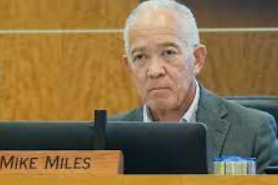
Even worse, Walters says he is regularly consulting with the Texas education commissioner, Mike Morath, about “strategies Texas used in its takeover of HISD.” The new Houston superintendent, Mike Miles, has long relied on mass exiting of teachers, and he’s already ordered educators at 28 schools to reapply for their jobs, and ordered the closures of many  “reformed” schools’ libraries. So, it is no surprise that the President of the Tulsa Classroom Teachers Association, Shawna Mott-Wright, says that “the uncertainty over the district’s future already has some teachers stepping away from their jobs.”

In response, TPS board member, Jennettie Marshall, “said during the board’s 90-minute discussion of the district’s accreditation status. ‘We are under attack. If you’re not keeping up with Houston, … if we continue the course we’re on, that’s where we’re headed. That shouldn’t be.’” She warned, “We can’t afford to lose our educators, support groups and people who provide wraparound services. We can’t afford for this district to lose its accreditation.”

To understand why Walters’ new attack could be an existential threat to public education in Tulsa, one should listen to Nancy Bailey’s analysis of such takeovers:

State takeovers aren’t new. Nor are they known for innovation, but for creating school voids, cutting services, and firing key staff, promising to close learning gaps. Takeovers usually only weaken schools, breaking them up and leaving communities with fewer and poorer schools.

Moreover, the Hechinger Report cited a study by Brown University and the University of Virginia which “looked at all 35 state takeovers between 2011 and 2016. ‘On average, we find no evidence that takeover generates academic benefits.’” But the Hechinger Report added, “Race, meanwhile, plays a role in the likelihood of a district being taken over.”

The HIDC takeover campaign sped up in 2018 when “four of Houston’s 274 schools, all of them in the city’s economically distressed north and east sides, hadn’t met the standards for four years running.” By the time the takeover was ordered, “all but one of the district’s four failing schools was meeting state standards” but a rule change caused Phillis Wheatley High School to “narrowly” miss the mark. By 2021-22, Phyllis Wheatley had already improved from an F to a high C grade. Persisting in the takeover thus added support to researchers who concluded, “Now red-state governors increasingly use the takeovers to undermine the political power of cities, particularly those governed by Black and Hispanic leaders.”

We must also remember the history of the disastrous reigns of non-educator Mike Miles, a Broad Foundation corporate reform trainee, who Texas commissioner Morath placed in charge of Houston. When Miles was selected, apparently nobody asked about “the 26% drop in high school enrollment during the 6 years he was superintendent over Harrison School District Two in Colorado.” In Dallas, Miles set a target of “at least 75 percent of the schools are ‘partially proficient’ in four areas that focus on classroom instruction.” One of many reasons why that goal was impossible was “the loss of 6000 teachers in just three years.” His dictatorial mindset was illustrated by Miles ordering the removal by the police of a board member visiting a middle school where he had “replaced the principal, two assistant principals and 10 teachers.”

Dallas student outcomes had been increasing before Miles took over but student performance largely stagnated during his administration. As the Dallas Morning News reported, his tenure was marked by “disruptions, scandals, clashes.”

Now, Houston is facing the same situation where “sweeping changes include longer instructional days, lessons scripted by planners, not teachers, and new evaluations for educators that tie pay to academic performance.” The focus will be on math and reading. Cameras will be placed in each classroom to monitor behavior. Not surprisingly, Nancy Bailey notes that as the “HISD is losing qualified teachers, school libraries, and librarians,” it is “advertising for 350 long-term substitutes who don’t require a college degree.” She presciently concludes, “Watch as these kinds of reforms become prevalent in other school districts if they haven’t already.”

I have long had serious problems with Superintendent Gist, but I would have never called her “Woke Barbie” as her opponents have. To me, this is similar to the situation when Democrats joined with former Rep. Liz Cheney in defending our democracy. And, if we unite, the damage that Walters is promising to inflict on the TPS, and the Tulsa metropolitan area as a whole, could undermine his extremist campaigns. On the other hand, if we don’t recognize the extent of the threats of a HISD-style takeover, he might unite the worst of the corporate reform privatizers, with his Moms for Liberty extremism, and impose irreparable damage on the TPS and other school systems.