Archives for category: DeSantis

Scott Maxwell, opinion columnist for The Orlando Sentinel, wrote about the unusual public protest against the Legislature’s plan to cut funding for AP classes in public schools. For years, Republicans who run the state have inflicted blow after blow on the public schools, preferring to divert billions of public dollars to private and religious schools. But not this time. This time, the public organized fought back and blocked the latest effort to inflict damage on the state’s public schools.

Maxwell writes:

Chalk one up for the Floridians who are willing to stand up and make themselves heard.
Tallahassee politicians were forced last week to abandon their plans to gut funding for AP classes in public schools after they ran into something they rarely encounter in this state — a wall of public opposition.

GOP lawmakers have been pulling the rug out from under public education for the better part of two decades, driving away teachers, injecting political wars into classrooms and diverting public money to private schools. But their plan to cut funding to AP, IB and dual enrollment programs was a bridge too far.

Why? Because this plan to sabotage public schools would’ve impacted a population beyond the marginalized families that these insulated politicians are usually happy to short-change. Legislators were trying to undercut the college prospects of kids who go to high school in Windermere and Winter Park — the children of parents who normally write campaign checks.

And everyone banded together to object.
“I was getting emails from people asking: ‘What do I do? How do I help? Who do I email?’” said Orange County School Board member Stephanie Vanos. “And before long, we started hearing legislators saying: ‘Please make the parents stop emailing us. Please, just make it stop.’”

My thanks to those of you who did not relent, because this idea was as bone-headed as it was backwards.

Basically, Republican lawmakers in both chambers wanted to cut funding allocated for AP (Advanced Placement), IB (International Baccalaureate), AICE (Advanced International Certificate of Education) and even dual enrollment programs at places like Valencia College for students who want to get ahead.

One of the most nonsensical parts about this attack was that it targeted a program that awarded funding based on students who passed these courses. In other words, one that only paid for successful results.

The politicians were also targeting one of the few things Florida really does well in public schools. While Florida’s scores for the SAT and other tests have plummeted in recent years, Florida’s AP test scores have historically been quite good. The College Board ranked Florida in the Top 5 for passage rate in 2021, largely because of this successful and aggressive funding model.

So Republican lawmakers were attacking something that was both successful and popular, affecting more than 110,000 students.
There was no valid reason for this funding cut, other than trying to make public schools less attractive.

See, AP classes are one of the advantages public schools have over many private schools, especially the fly-by-night voucher ones that hire uncertified teachers and can’t even think about offering classes like AP calculus, Chinese and 3-D art and design.

“These are the programs that are among the most popular in our high schools,” Vanos said. “Families come back to our high schools specifically for these programs.”

So parents and supporters of public education banded together and spoke up.

I sensed a revolt brewing as soon as I published a column on the topic a few weeks ago entitled: “Cutting AP classes would dumb down Florida schools.”

House Republicans had just advanced their defunding plan by a vote of 22-6 in a subcommittee, and I urged anyone who thought this was a rotten idea to let their lawmakers know. Boy, did they.

One reader said she and her sister, a retired teacher, were gathering as many others as possible to get “riled up to action.”

Another said she sent Gov. Ron DeSantis an email that asked him a simple question: “Are you TRYING to drive us out of the Republican Party?”
Conservatives objected alongside liberals.

Seniors alongside teens. I heard from everyone from fired-up retirees in Osceola County to a genuinely perplexed Eagle Scout in Maitland.
Even Florida TV stations that usually pay more attention to car crashes than legislative subcommittees carried stories about Floridians who were up in arms.

Local elected officials noticed the widespread discontent and decided to weigh in as well. Jacksonville’s large and heavily Republican city council voted 16-1 to tell GOP lawmakers to back off their plan to sabotage AP classes.

The pressure ultimately worked. When leaders from both chambers went behind closed doors last week to hash out their final budget proposal, they ditched this latest attack on public schools in quiet, unceremonial fashion.

Imagine for a moment if Floridians used their voices more often.

Not just to protect public education, but to support other issues that the vast majority of Floridians on both sides of the aisle support.
We might not live in a state where more than 20,000 families grappling with special needs are stuck on a years-long waiting list for services.

Or a state that has allowed so much pollution to kill so many manatees that two rounds of federal judges had to step in to tell the state it had to stop allowing the slaughter of the state’s official marine mammal.

It’s often said that we get the government we deserve. But we also get the government we demand.

In this case, Floridians demanded that the politicians take their stinkin’ hands off a successful educational program that has helped countless students get a head start in college, careers and life.

Imagine if we all did that more often.
“Advocacy works,” Vanos said. “It’s all about people power.”

DeSantis has prided himself on being a leader of the War on Woke. He passed a bill to ban any mention of diversity, equity and inclusion (DEI), which was known as the “Don’t Say Gay” law.

In line with his principle of refusing to recognize those who are not straight white men, he issued a proclamation today in honor of the 49 victims of the Pulse nightclub, but failed to mention that most were LGBT or Hispanic or both. The Pulse was a gay nightclub that welcomed everyone.

Gov. Ron DeSantis’ annual statement on the Pulse shooting anniversary released Thursday makes no mention of the LGBTQ and Hispanic communities — the two groups most devastated by the massacre that left 49 dead.


DeSantis mentioned those communities last year and in other previous statements recognizing the shooting on June 12, 2016. Those anniversary statements called it a “a horrific act of terrorism against the LGBTQ and Hispanic communities.” In his first year in office, however, the two-term governor faced blowback when an initial statement also failed to note who was most impacted by the shooting.


The deletion this year seems in line with efforts by both the DeSantis and Trump administrations to purge what it calls “diversity, equity and inclusion” from the government, which has included similar deletions that reference sexual orientation and race from the National Park Service website and others.


“Gov. DeSantis’ erasure of the LGBTQ+ and Latino communities today may say a lot about what kind of person he is, but it doesn’t change the fact that those were the communities most directly impacted at Pulse,” said Brandon Wolf, a Pulse survivor from Orlando who serves as spokesman for the Human Rights Campaign.

Scott Maxwell is an opinion columnist for The Orlando Sentinel. He tells the truth about the state’s sordid politics and backs it up with facts. Learn here how the state chooses college and university presidents.

He writes:

You probably know that Florida’s GOP politicians have taken a wrecking ball to the state’s university system. And the narrative is that they’re on a noble crusade to exorcise evil, “woke” ideology from college campuses.

But if you believe that’s the only goal here, you’ve been duped. This isn’t about politicians going after liberal doctrines nearly as much as it’s about them going after tax dollars.

They’ve turned the university system into a political spoils system where politicians with no higher-ed experience can score lucrative higher-ed jobs for themselves.

It’s been going on for a while now, but the grift was fully exposed this past week. That’s when it was revealed that one of the political has-beens fuming about diversity — as a supposed reason to deny the University of Florida presidency to a qualified applicant — had secretly made a play to try to get the $3 million-a-year job for himself.

See, you have to separate the theater from the grift. The theater was a bunch of privileged guys griping about the concept of diversity and inclusion. The grift was one of those same guys making a secretive play for the very job he was griping about.

More about that in a moment, but first, let’s remember where this all started — at New College of Florida with Richard Corcoran. Two years ago, the former House Speaker craved a fat, higher-ed paycheck. The problem was that Corcoran had as much higher-ed experience as my dead cat, Furball.

So to distract from his lack of qualifications, Corcoran fumed — about DEI, CRT and other scary-sounding acronyms. It was red meat for the trolls. And Corcoran laughed all the way to the bank. He got a $1 million deal to run a tiny college with 698 students. Elementary school principals oversee more pupils.

Then Corcoran and Co. invited other political has-beens to feed at the New College trough. They gave a former Senate president a $500-an-hour legal contract, the governor’s former spokesman a $15,000-a-month PR contract and the wife of the former Republican Party of Florida chairman $175,000 to run the school’s foundation.

With the chow bell rung, the politicians came running. Former U.S. Sen. Ben Sasse of Nebraska scored a $10 million deal for a short-lived and disastrous tenure at UF where the student newspaper discovered he’d quickly blown through $17 million in public money, including $38,000 he spent on a sushi bar.

Lieutenant Gov. Jeanette Nunez snagged the top spot at Florida International University. A cable-company lobbyist friendly with the administration is in line to lead FAMU.
At one college, they had to actually remove the requirement that the president have an advanced degree so that they could give the job to Fred Hawkins, a GOP legislator who lacked one.

But then this past week, the scheme was fully exposed in cringe-worthy fashion.

The scene was the Board of Governors meeting in Orlando where appointees of Gov. Ron DeSantis were once again fuming about the alleged evils of diversity and inclusion. Their reason this time was to try to deny the UF presidency to former University of Michigan President Santa J. Ono.

Somehow, a qualified candidate had actually advanced through the secretive application process — and that would not be tolerated.

So the political appointees accused Ono of all kinds of terrible things like embracing equality and believing in science. Former House Speaker Paul Renner led the anti-woke war.

But then one board member who’d apparently heard enough posturing went off-script.
Eric Silagy, the former CEO of Florida Power and Light, asked if any of his fellow board members — the ones savaging Ono for being too woke — had applied for the very job Ono was seeking.
Yes, responded board chairman Mori Hosseini. “Paul Renner.”

It turned out the very guy claiming Florida needed an anti-woke warrior in this $3 million-a-year position had been salivating over the post.
Renner became visibly enraged when exposed. He indignantly responded that he’d only inquired about the job because other people suggested he do so and that he’d since decided not to accept the high-paying job even if it was offered to him. Sure, Mr. Speaker. Your nobility is noted.

Most of the time, qualified candidates like Ono don’t even get a shot. But occasionally, well-intentioned leaders at individual schools try to give them one — as trustees at Florida Atlantic University did two years ago when they nominated Vice Admiral Sean Buck, the superintendent of the United States Naval Academy, to be FAU’s president.

That’s how these folks treat these positions.

DeSantis would later admit in a moment of surprising candor that he only supported Fine because other GOP legislators disliked Fine and wanted him gone. “They wanted to get him out of the Legislature,” DeSantis said. “So they asked me to put him up for Florida Atlantic president, and I did.”

But Buck didn’t stand a chance in this environment. DeSantis allies savaged the respected admiral’s reputation so that yet another GOP legislator, Randy Fine, could have a shot at the job.

Fine and DeSantis later had a falling out, and Fine didn’t get the gig. But the rules of the game were clear: Qualified applicants need not apply.
An irony is that former politicians actually can become impressive university leaders. Florida State University President John Thrasher, a former GOP house speaker, was one of them. I respected him. So did many others.

But Thrasher, who sadly passed away last week, was a different kind of man than the Florida politicians of today. He was a statesman — not someone willing to savage others’ reputation simply to enrich himself.

Governor Ron DeSantis has done everything possible to destroy education in Florida. He apparently hates public schools. He pushed through an expansion of vouchers that provides a subsidy to every student in the state, no matter if the family is rich or poor. Of course, most of those using the voucher never attended public schools. Most vouchers go to students in religious schools. Florida currently spends $4 billion annually on vouchers, a sum sure to increase.

Bad as public K-12 education is, the state’s public higher education system is in worse shape. DeSantis has placed political cronies in charge of every state university. He took charge of tiny New College (700 students) because he was offended that Florida had one progressive institution of higher education where students were encouraged not to conform. DeSantis replaced the board with conservatives who put a political extremist in President. What was once a haven for free-thinking students was transformed into a school for jocks and business majors.

The editorial board of the Sun-Sentinel summarized DeSantis’s record of using higher education as patronage for political cronies:

When Gov. Ron DeSantis won his landslide re-election in 2022, a half-fawning and half-fearful Florida Legislature gave him whatever he wanted.

The Harvard graduate could have used that power to burnish Florida’s celebrated universities. He could have chosen the best and brightest to lead schools already among the nation’s best. He could have been the education governor.

That — not a bellyflopping bid for the White House — could have cemented his legacy.

Instead, DeSantis has earned a doctorate in cronyism. He’ll be remembered as the governor who did everything in his power to erode higher education and independent thought. He puts politics above merit and qualifications, with sham “searches” and secret deals.

College and university campuses are now soft-landing patronage pads for Republican allies, at sky-high salaries.

Former House Speaker Richard Corcoran was installed as president of New College in Sarasota. Another politician, former House Majority Leader Adam Hasner, was handed the FAU presidency. A run-of-the-mill former legislator, Fred Hawkins, won the presidency of a state college in Avon Park despite lacking academic qualifications.

Former Lt. Gov. Jeanette Nuñez is now president of Florida International University. Former U.S. Sen. Ben Sasse of Nebraska was given the prestigious UF presidency, then flamed out amid reports of over-the-top spending.

It’s no surprise, then, that Education Commissioner Manny Diaz, a former Republican legislator from Hialeah who oversees state colleges and K-12 education, will slide into the presidency of the University of West Florida in Pensacola.

For DeSantis and Diaz, no university is too big and no kindergarten picture book is too small to escape being recast in the governor’s philosophy.

Step 1: Stack the board

First, DeSantis stacked UWF’s board of trustees. Then, newly appointed trustee Zach Smith quickly made clear that UWF president Martha Saunders was unwelcome.

Smith, a Heritage Foundation fellow, had to reach back to six years ago to find even a speck of mud to throw: Two student-organized drag shows in 2019; social media messaging about a Black Lives Matter co-founder and a book, “How to be an Antiracist,” once recommended by university librarians.

It’s true that best-seller is full of provocative opinions. But so is Smith’s book, “Rogue Prosecutors,” which pushes dark conspiracies about prosecutors corrupted by a wealthy Jew.

That did not stop his nomination to the UWF board by DeSantis, who only last year declared war on campus antisemitism amid great fanfare.

The widely popular Saunders saw the writing on the wall, and she resigned.

A farcical scene

That board meeting was an ambush, said trustee Alonzie Scott. The next one was a farce.

Without a job posting or a search, Diaz’s name alone surfaced as a replacement. Just as quickly, a special meeting was called by UWF trustees. There would be no search for a temporary president and no effort to pick an interim leader from the university.

There was only a perfunctory vote to install Diaz. Then, farce upon farce, the board voted with a straight face to begin looking for a permanent replacement for Diaz.

Barring a political earthquake, that will be Diaz. As former Pensacola mayor and UWF alum Jerry Maygarden said at the meeting, what serious candidate would apply for a job that smacks of a done deal?

Even Diaz’s roots defy all logic.

UWF’s strength is its strong community support among residents and businesses, including Republican leaders. Diaz’s Miami-Dade home is a 10-hour drive, 700 miles and culturally worlds apart from Escambia County in “Lower Alabama.”

None of this is about rescuing students who feel intimidated and indoctrinated.

After all, a state-mandated 2022 Intellectual Freedom and Viewpoint Diversity report found that a majority of UWF students surveyed felt the school provided them the freedom to express their own opinions. Half said they had no idea if their professors were liberal or conservative.

New College 2.0

Never mind. In April, DeSantis told UWF to “buckle up,” announcing he would do for them what he did for New College.

It’s hard to see the success story in New College since the governor declared war on it. DeSantis’ hostile takeover of the tiny liberal arts college has devolved into a money pit: The state’s cost for each New College student shot to more than $90,000. Other state universities average roughly $8,000.

Last month, New College and the University of South Florida were found to be secretly working on a deal to “transfer” USF’s Sarasota-Manatee campus to New College. It’s dead for the moment. Community leaders, kept in the dark as usual, demand answers.

Meanwhile, USF has become the latest fertile field for DeSantis to reward his friends. USF’s president said she will resign, creating yet another job opportunity for a like-minded crony.

The Sun Sentinel Editorial Board consists of Opinion Editor Steve Bousquet, Deputy Opinion Editor Dan Sweeney, editorial writers Pat Beall and Martin Dyckman, and Executive Editor Gretchen Day-Bryant. To contact us, email at letters@sun-sentinel.com.

Anyone who has ever seen a drag show knows that they are performances. I remember seeing “Dame Edna” on Broadway, and she was hilarious. There was nothing sexual about her show. And by the way, Dame Edna was played by a straight man who created an original character. Last year, I went to play “Drag Bingo” at a local restaurant, and the performers were funny. Their goal was to entertain.

Florida Governor Ron DeSantis, America’s number one prude, decided that drag shows had to be banned because they “sexualized” children. In addition to drag shows performed in bistros, there are also Drag Queen Story Hours at local libraries, where drag queens read children’s books out loud. Parents bring their children to these events; the little ones do not come alone.

To heck with parental rights, DeSantis wanted to close down all the drag shows.

Hamburger Mary’s, one of the leading venues for drag queens, sued.

They won.

Scott Maxwell of the Orlando Sebtinel tells the story:

In recent years, Florida Republicans have been on a crusade to censor books, speech, theatrical performances and even thoughts expressed in private workplaces.

Their actions have been repeatedly ruled unconstitutional — often by conservative judges who have more respect for the Constitution than these petty politicians with their phony patriotism.

Still, it takes courage to stand up to political bullies willing to spend unlimited amounts of tax dollars, paying lawyers as much as $725 an hour, even when they know they’ll lose.

That’s why John Paonessa and Mike Rogier deserve credit.

The Clermont couple and Hamburger Mary’s franchise owners are the victors in the latest court fight against Gov. Ron DeSantis and GOP lawmakers’ attempts to silence speech they dislike.

This time it was Florida’s war on drag queens, which was pretty clearly unconstitutional from the day it debuted, mainly because it was so poorly written.

Authors of the so-called “Protection of Children” act claimed to want to protect kids from “shameful” and “lewd” performances, but couldn’t even explain what that meant.

When bill sponsor Randy Fine was asked on the House floor to define “shameful” — so that venue owners could know what kind of performances would be illegal — he responded:

“Um … um … [eight seconds of silence] … I think that it … again, that is things that are … I dunno … I mean, again, you can look these things up in the dictionary.”

Quite the legislative brain trust.

The reality is that Florida already has laws on the books that protect children from sexually explicit performances. Did you know that? A lot of these tinpot politicians sure hoped you didn’t. But two rounds of federal judges did. And they concluded that this law wasn’t written to target obscenity in general, but rather drag in particular. That’s selective censorship. And if you’re a fan of government doing it, you might prefer living in Russia.

Patriotic Americans don’t support government censorship of speech. Dictators in North Korea do.

So after Paonessa and Rogier saw lawmakers repeatedly target drag performers — and even nonprofit organizations like the Orlando Philharmonic rented out their venues for such shows — Paonessa said the two men decided: “If we just let them do this, what is next?”

Both a federal judge in Orlando and appellate judges in Atlanta ruled they were right to do so.

The 81-page appellate ruling from the majority made several key points: One was that the state already has laws to protect minors and that out-of-court comments from guys like Fine and DeSantis made it clear that the politicians were trying to specifically — and unconstitutionally — target drag.

Another was that the state’s own inability to define the kind of behavior it was trying to outlaw proved it was overly broad. “The Constitution demands specificity when the state restricts speech” to shield citizens “from the whims of government censors,” the ruling stated.

The case also laid bare a lie: These chest-thumping politicians don’t actually believe in “parental rights” or “freedom.” Because this law attempted to make it illegal for teens to attend certain performances even when accompanied by their parents.

Keep in mind: These politicians are fine with parents taking their kids to see R-rated movies with hard-core sex and graphic violence. They kept that legal. It was only when drag queens got on stage that these politicians lost their minds.

Drag queens? Evil. Cinematic depictions of bestiality? That’s OK. Those are some strange family values.

I can’t recall ever taking my own kids to a drag performance. But that was my choice — not the government’s. And Paonessa said many of his restaurant’s offerings, including the Sunday drag brunch, were family-friendly affairs that some teens enjoyed so much, they would return with their own kids when they were older.

Of course some drag performances are vulgar — just like some movies are. But trying to use a snippet of one sexed-up drag show to represent all drag performances is about as honest and accurate as using a movie like “Eyes Wide Shut” or the “The Texas Chainsaw Massacre” to represent all movies. It’s a tactic of misrepresentation known as “tyranny of the anecdote” that’s particularly effective with the intellectually incurious

For the record, a dissent was authored by a 95-year-old judge appointed by Gerald Ford who invoked states’-rights-themed arguments and said censorship laws needn’t be that specific.

While the judges who shot down the drag law last week were appointed by Democratic presidents, the judges who shot down DeSantis’ other unconstitutional attempts to silence speech have been hard-core, Federalist Society conservatives.

Like the ones who blocked the “Stop Woke Act” that tried to ban private businesses from holding employee-training sessions on topics like sexism and racism that GOP lawmakers found too “woke.”

And the Trump-appointed judge who invalidated the GOP law that called for arresting citizens who donated more than $3,000 to citizen-led campaigns for constitutional amendments.

If you think government should be able to imprison citizens for donating to campaigns that politicians dislike or silence private speech within the walls of private companies, don’t you dare call yourself a constitutionalist. Or even a patriot.

In response to the latest judicial smackdown, a DeSantis spokesman whined about judicial “overreach” and said: “No one has a constitutional right to perform sexual routines in front of little kids.”

Once again, he was banking on your ignorance, hoping you don’t know Florida already has laws that protect minors — just not ones created specifically to target drag.

The appellate judges referred the case back to Orlando Judge Gregory Presnell, who issued the original injunction in a ruling that was maybe even more damning in effectively detailing the law’s many flaws. But there’s certainly a chance the state will continue trying to litigate the case, since it has unlimited access to your money.

Frankly, Paonessa and Rogier, who shut down their Hamburger Mary’s location in downtown Orlando last year in the middle of this court battle and are currently looking for a new home, probably couldn’t have afforded to fight back in this two-year court battle if they hadn’t had pro bono help. It came from a Tennessee attorney, Melissa J. Stewart, who fought a similarly unconstitutional attack on drag in that state.

But Paonessa said they decided to fight for their rights — and yours — because they concluded: “If not us, then who?”

smaxwell@orlandosentinel.com

Jason Garcia is an investigative reporter in Florida who has had plenty to investigate during the regime of Ron DeSantis. His blog is called “Seeking Rents.” This is a post you should not miss.

The governor acts like a dictator, and the Republican-dominated legislature doesn’t stop him. Remember the takeover of New College? It was the only innovative, free-thinking public institution of higher education in the state. It was tiny, only 700 students. But DeSantis took control of the college’s board, hired a new president (a crony) and set about destroying everything that made it unique. He issued one executive order after another for the entire state to crush DEI and assure the only permissible thought mirrored his own. He attacked drag queens and threatened to punish bars and hotels that allowed them to perform. He created a private army, subject only to his control. He selected politicians to run major universities. He imposed thought control on the state. Fascism thrives in Florida.

Thus far, he has gotten away with his gambits. But Garcia doesn’t think he will get away with this one.

He writes:

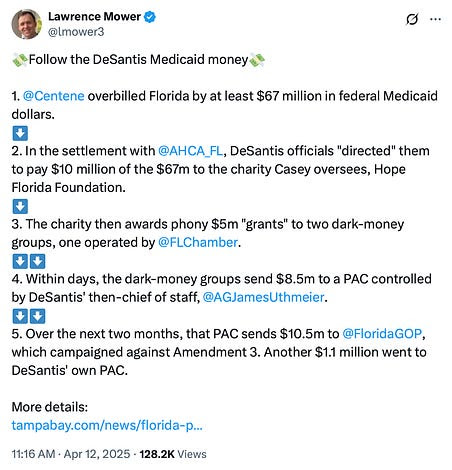
A simmering scandal erupted Friday afternoon when the Tampa Bay TimesMiami Herald and Politico Florida revealed that the administration of Gov. Ron DeSantis orchestrated a $10 million payment last fall to a charity founded by the governor’s wife — which then turned around and gave the money to groups that helped finance the governor’s campaign against a proposed constitutional amendment to legalize marijuana in Florida.

In a nutshell: The DeSantis administration pressured a major state contractor to make a $10 million donation to the Hope Florida Foundation, the controversial charity spearheaded by First Lady Casey DeSantis. It was part of a settlement negotiated with Centene Corp., after the state’s largest Medicaid contractor overbilled the state by at least $67 million.

Days later, Hope Florida transferred that $10 million to a pair of dark-money nonprofits. The state-backed charity gave $5 million each to “Save Our Society From Drugs,” an anti-marijuana group founded by a late Republican megadonor, and “Secure Florida’s Future,” a political vehicle controlled by executives at the Florida Chamber of Commerce, the Big Business lobbying group.

And days after that, Save Our Society From Drugs and Secure Florida’s Future gave a combined $8.5 million to “Keep Florida Clean,” a political committee — chaired by Ron DeSantis’ then-chief of staff — created to oppose Amendment 3, the amendment on last year’s ballot that would have allowed Floridians to use marijuana recreationally rather than solely for medicinal reasons.

It’s a daisy chain that may have transformed $10 million of public money — money meant to pay for health insurance for poor, elderly and disabled Floridians — into funding for anti-marijuana campaign ads.

DeSantis, of course, has repeatedly insisted that he did nothing wrong while also lashing out in increasingly vitriolic ways at everyone from the Republican speaker of the state House to the newspaper reporters digging into the story.

But at least one prominent GOP lawmaker — Rep. Alex Andrade, a Pensacola Republican who has been presiding over hearings into Hope Florida — told the Times and Herald that the transaction chain “looks like criminal fraud by some of those involved.”

Clearly, this looks very bad. But it is also by no means an isolated incident. 

In fact, this is part of a larger pattern of potential abuses that Ron DeSantis committed last fall when he chose to turn the power of state government against two citizen-led constitutional amendments that appeared on the November ballot: Amendment 3 and Amendment 4, which would have ended Florida’s statewide abortion ban.

Consider what we already know about how DeSantis financed his campaigns against the two amendments using public money taken from taxpayers — and private money taken from donors who got public favors from the governor.

  • Five state agencies directly funded television commercials meant to weaken support for the marijuana and abortion-rights ballot measures. We still don’t know the full extent of their spending, although Seeking Rents has estimated the total taxpayer tab at nearly $20 million. We also know that the DeSantis administration commandeered money for anti-marijuana advertising from Florida’s share of a nationwide legal settlement with the opioid industry — money that was supposed to be spent combatting the opioid addiction crisis.
  • At the same time, another nonprofit funded by Florida taxpayers poured at least $5 million into television ads attempting to soften Florida’s image on women’s healthcare at a time when Florida’s near-total abortion was under intense attack. It was the Florida Pregnancy Care Networks’ first-ever TV ad campaign. And its commercials, which were overseen by DeSantis administration staffers, complemented the state agency ads against the abortion-rights amendment — right down to using the same slogan.
  • Last June, after DeSantis vetoed legislation that would have strictly regulated the state’s hemp industry, CBS News Miami revealedthat industry executives and lobbyists promised to raise $5 million in exchange for the veto for the governor to spend on his campaign against Amendment 3. “Our lobby team made promises to rally some serious funding to stand with him on this,” a hemp industry representative wrote in one message that included a bank routing number for the Republican Party of Florida. “We have to pay $5 million to keep our end of the veto,” a hemp executive wrote in another message.
  • In the closing weeks of the campaign, records show that the Big Tobacco giant Philip Morris International gave $500,000 to DeSantis’ personal political committee — which was also chaired by the governor’s then-chief of staff and which DeSantis was using to campaign against both Amendment 3 and Amendment 4. Shortly after the election, the DeSantis administration handed Philip Morris a lucrative tax break, ruling that the company could sell a new line of electronically heated tobacco sticks free of state tobacco taxes.

There were other abuses of power, too. DeSantis and his team threatened to criminally prosecute television stations that aired ads supporting Amendment 4. They sent state police to the homes of Florida voters who signed Amendment 4 petitions. And they hijacked the ballot-writing process for Amendment 4.

There’s a reason why the DeSantis administration made sure to extract a promise of legal immunityfrom the organization that sponsored Amendment 4 as part of a legal settlement negotiated after the election.

DeSantis’ tactics worked. Though Amendments 3 and 4 each won majority support from Florida voters — 55.9 percent for recreational marijuana, 57.2 percent for abortion rights — both fell short of the 60 percent support needed to amend the state constitution.

But, suddenly, it looks like this may not be over — at least not for Ron DeSantis.

House Republicans are seeking troves of records from the DeSantis administration, including text messages and emails related to Hope Florida. The chamber has also scheduled another hearing on the Casey DeSantis charity next week.

What’s more, the House also unveiled a sweeping ethics reform package last week that would, among other things, explicitly expose senior government officials to criminal penalties if they interfere with elections.

That particular legislation would also prohibit state employees from soliciting money for political campaigns — an idea that emerged after DeSantis aides got caught squeezing lobbyistsfor more donations to their boss’ political committee ahead of a possible Casey DeSantis campaign for governor….

Ron DeSantis bet his political future on beating the marijuana and abortion-rights amendments. And he won both of those battles.

But it may turn out that he ultimately lost the war.

Wishful thinking? I hope not.

To give you an idea of how far/right the legislature is, Garcia lists some of the bills that are currently moving through the legislative process:

  • House Bill 549: Requires all new public school textbooks to refer to the Gulf of Mexico as the “Gulf of America.” Passed the Senate by a 28-9 vote. (See votes) Previously passed the House of Representatives by a 78-29 vote. (See votes) Goes to the governor.
  • House Bill 575: Replaces Gulf of Mexico with “Gulf of America” in state law. Passed the Senate by a 28-9 vote. (See votes) Previously passed the House of Representatives by a 78-27 vote. (See votes) Goes to the governor….
  • House Bill 1517: Allows someone to file a wrongful death lawsuit seeking lost wages on behalf of an embryo or fetus. Passed the House of Representatives by a 79-32 vote. (See votes)…
  • House Bill 7031: Cuts the state sales tax rate from 6 percent to 5.25 percent. Passed the House of Representatives by a 112-0 vote. (See votes)
  • House Bill 123: Allows a traditional public school to be converted into a charter school without the consent of the teachers who work at the school. Passed the House Education & Employment Committee by an 11-4 vote. (See votes)

Jennifer Berkshire has been writing about the politics of education for many years. She has written two books with education historian Jack Schneider, A Wolf at the Schoolhouse Door and The Education Wars. This is the second installment in her excellent series called “Connecting the Dots.” Her Substack blog is called “The Education Wars.”

She writes:

BAs are out, babies are in

The Trump world’s obsession with the declining birthrate doesn’t quite rank with rooting out “DEI,” tariff-ing, or expelling immigrants but it’s up there. In a recent interview, Elon Musk confessed that a fear of the shrinking number of babies keeps him up at night. What does this have to do with education? Everything. Last year, two of the big education ‘thinkers’ at Heritage released a guide to how changes in education policy could increase “the married birthrate”:

Expensive and misguided government interventions in education are, whether intended or not, pushing young people away from getting married and starting families—to the long-term detriment of American society.

What are those government interventions? Things like subsidizing student loans, thereby encouraging young women to go to college. Or requiring teachers, who are mostly women, to have bachelor degrees, thereby encouraging young women to go to college. Of course there is a voucher angle—there always is with these folks. But the key here is that a chorus of influential Trump thinkers like this guy keep telling us that there are too many women on campus, and that policy shifts could get them back into the home where they belong. 

If the administration succeeds in privatizing the government-run Student Loan Program, college will become much more expensive, significantly shrinkign the number of kids who’ll be able to attend. And that seems to be the point, as conservative activist Chris Rufo explained in an interview a few weeks ago.

By spinning off, privatizing and then reforming the student loan programs, I think that you could put the university sector as a whole into a significant recession. And I think that would be a very salutary thing.

So when you hear the rising chorus coming from Trump world that there are too many of the wrong people on the nation’s campuses, recall that an awful lot of these self-styled ‘nationalists’ believe this: “If we want a great nation, we should be preparing young women to become mothers.”

Some people are more equal than others 

I’ve been making the case that both the Department of Education and public education more broadly are especially vulnerable because of the equalizing roles that they play. Of course, education is not our only equalizer. Indeed, all of the institutions and policy mechanisms intended to smooth out the vast chasms between rich and poor are on the chopping block right now. While you were clicking on another bad news story, Trump eviscerated collective bargaining rights for thousands of federal workers. While teachers weren’t affected, a number of red states have been rushing to remedy that, including Utah which just banned collective bargaining for public employees. 

Writer John Ganz describes the unifying thread that connects so much of Trump world as ‘bosses on top,’ the belief that “the authority and power of certain people is the natural order, unquestionable, good.” We got a vivid demonstration of what this looks like in Florida this week as legislators debated whether to roll back (more) child labor protections, allowing kids as young as 14 to work over night. 

Governor Ron DeSantis is busily spinning the bill as about parents rights, but what it’s really about is expanding the power of the boss. The ‘right’ to work overnight while still in school is actually the boss’ right to demand that young employees keep working. Nor is it hard to imagine the long-term consequences of this policy change. Teen workers who labor through the night end up dropping out of school, their futures constrained in every possible way. Here’s how Marilynn Robinson described the rollback of child labor laws in her adopted home state of Iowa: “If these worker-children do not manage to finish high school, they will always be poorer for it in income and status and mobility of every kind.”

Go back one hundred years when the country was in the midst of a fierce debate over child labor, and you’ll hear the same arguments for ‘bosses on top’ that are shaping policy today. At a time when public education was becoming compulsory, conservative industry groups like the National Association of Manufacturers cast their opposition to both child labor laws and universal public education in explicitly bossist terms, as Naomi Oreskes and Erik Conway recount in The Big Myth: How American Business Taught Us to Loathe Government and Love the Free Market:

“They believed that men were inherently unequal: it was right and just for workers to be paid far less than managers and managers far less than owners. They also believed that in a free society some children would naturally enter the workforce. Child labor laws wer (to their minds) socialistic because they enforced erroneous assumptions of equality—for example, that all children should go to school—rather than accepting that some children should work in factories.”

Back to the states

Did you hear the one about how we’re returning education to the states? Back-to-the-states has become a mantra for the Trump Administration on all kinds of favored policy issues, as the New York Times recently pointed out. Of course, education is already a state ‘thing,’ which means that we can look at the states Trump keeps pointing to as models and see how they’re faring. So how are they faring? Not so well, as the education reform group EdTrust lays out here, reviewing both NAEP scores and the track records of these states in supporting low-income students and students of color.

But there are plenty of warning signs beyond test scores. Ohio seems poised to slash funding for public education, even as the state’s voucher program balloons. (And let’s not even get into the just-enacted Senate Bill 1, which limits class discussions of any ‘controversial’ topic and goes hard at campus unions.) But for a glimpse of the future that awaits us, pay attention to another state in my beloved Heartland, and which Trump has repeatedly showered with praise: Indiana.

Now, Indiana happens to be home to one of my favorite economists, Ball State’s Michael Hicks, who has been warning relentlessly that the state’s decision to essentially stop investing in K-12 and public higher education has been an economic disaster. Hoosiers, he pointed out recently, earn less than the typical Californian or New Yorker did in 2005. As the number of kids going to college in Indiana has plummeted, the state now spends more and more money trying to lure bad employers to the state. Here’s how Hicks describes the economic and education policies that Indiana has embraced:

“If a diabolical Bond villain were to craft a set of policies that ensured long-term economic decline in a developed country, it would come in two parts. First, spend enormous sums of money on business incentives that offer a false narrative of economic vibrancy, then cut education spending.”

As for Indiana’s 25-year-long school choice experiment, Hicks concludes that it has been a failure. Why? Because the expansion of school vouchers and charter schools was used to justify spending less on public schools—precisely the policy course that we’re hurtling towards now. Today, Indiana spend less money per student on both K-12 and public higher education than it did in 2008.

GOP-run states have already begun to petition what’s left of the Department of Education for ‘funding flexibility’—the ability to spend Title 1 dollars, which now go to public schools serving low-income and rural students, on private religious education. We shouldn’t be surprised. This is precisely the vision laid out in Project 2025. (Fun fact: the same Heritage thinker who penned the education section of Project 2025 also co-authored the above referenced guide to getting young married ladies to have more babies.)

And just like in Indiana, school privatization will be used to justify reducing the investment in K-12 public education. So when an economist tells us that school choice “risks being Indiana’s single most damaging economic policy of the 21st century,” we should probably listen.

It was entirely predictable that Florida Governor Ron DeSantis would create a labor shortage by driving immigrants away. Whether documented or not, immigrants are the backbone of the tourist industry and agriculture, two of the basic elements in the state’s economy. Once they were gone, who would replace them? Children. DeSantis is now promoting a reduction in child labor laws to replace the immigrant labor he criminalized. Orlando Sentinel columnist Scott Maxwell describes the new Florida economy, balanced on the backs of children. Not the rich kids, but the poor kids.

Maxwell writes:

The Newsweek headline looked like satire: “Florida May Replace Immigrant Workers With Child Labor.”

Savvy Floridians know, though, that you can’t fictionalize stories more absurd than this state’s reality. And Florida lawmakers are, in fact, trying to roll back the state’s child-labor laws.

Basically, if employers in this state can’t exploit immigrants, the governor and Legislature want them to be able to legally exploit your children.

The latest proposal would allow teens to work longer hours, without breaks and even overnight shifts on school nights. Take that, Myanmar.

Up next, maybe we can emulate Burkina Faso where more than half the kids are in the labor force, some as young as 7. Now there’s a country with values.

What you’re witnessing is a real-life version of the dog that chased cars without thinking about what he’d do if he actually caught one. In this case, Gov. Ron DeSantis and the state’s GOP legislators have fumed for years about undocumented workers without having the slightest clue about how they’d respond if those workers actually walked off Florida job sites.

So now they’re panicking and want your kids to fill the bill.

Normally, in a free-market economy, if an employer can’t find workers, it would just raise wages until people start applying. That’s how supply and demand works.

But Florida’s GOP politicians don’t want to ask their campaign donors to raise wages. They’d rather flood the market with another class of exploitable workers — teenagers.

Maybe you used to dream of your teen becoming an engineer or architect. Well, forget that Ivy League, ivory-tower fiddle-faddle. Florida’s economy needs them harvesting tomatoes and cleaning motel rooms.

In some ways, it makes sense to put our kids to work. We’re sure not educating them. Florida’s SAT scores have dropped to 47th in America. And our state’s eighth-graders just posted the lowest math and reading scores in 20 years.

So, if we’re not preparing them for higher education or high-paying jobs, we might as well get them primed for the low-wage tourism and agriculture jobs that make this state hum.

Senate Bill 918, would eliminate restrictions on how many hours 16- and 17-year-olds can work. It would end guaranteed meal breaks and also lift restrictions for kids as young as 14 who are home schooled or enrolled in virtual school. (So if you want your rugrat pulling down a paycheck, just yank ’em out of traditional school.)

The Florida Policy Institute summarized the bill by saying it would allow Florida to work teens “for unlimited hours, any time day or night, seven days per week and without breaks.”Welcome to childhood in Florida.

Not all Republicans think this is a boffo idea. Sen. Joe Gruters, a former chairman of the Republican Party of Florida, joined Democrats in opposing the bill, saying: “I think we need to let kids be kids.”

Gruters chose his words carefully: “Let kids be kids” is a line DeSantis uses a lot, usually when he’s pushing censorship laws.

Apparently, in DeSantis’ worldview, teens aren’t mature enough to see certain drag performers, even alongside their parents — but are mature enough to work right through the night until school starts at 7 am. That’s just kids being kids.

As I’ve said before, I’m a fan of teens having jobs. I had a paper route in middle school and landed my first real job at a drugstore when I was 14 — old enough to legally sell condoms and tampons, but still immature enough to giggle about it. (Basically, if you ever entered a Revco in the 1980s,  nervous about making a purchase, I was your worst nightmare.)

But here’s the thing: I believe teens should get jobs when they and their parents want them to get jobs — not because we need to plug labor holes in our low-wage economy.

Keep in mind: DeSantis didn’t promote his roll-back-child-labor-laws ideas at a panel discussion on building teen character. He did it at panel discussion on immigration. After noting that undocumented workers provided “dirt cheap labor,” DeSantis asked: “Why do we say why we need to import foreigners, even import them illegally, when you know teenagers used to work at these resorts?”

This is just about swapping one exploitable labor class for another … in a state that already turns a blind eye to companies that break labor laws.

Remember Florida’s “mandatory” E-Verify law? It explicitly said that the state couldn’t even fine companies caught breaking the law until they’re caught three times. And that law-breaking employers must be given 30 days to stop breaking the law before they’re punished. What other laws work like that?

This is a state that gives companies a pass on labor-law violations and now wants to give them a younger workforce. What a dangerous combo. Even moreso when you consider GOP lawmakers also want to let businesses subvert minimum wage laws for some workers “younger than 18 years of age.”

Kids in Florida who say they have financial “hardships” can surrender even more workplace protections. Basically, the poorer you are, the more you can be exploited. So it ain’t gonna be the private, prep-school kids working farm fields and cleaning motel rooms at 3 in the morning.

DeSantis seemed particularly interested in using kids to fill the theme parks’ job needs. But the proposed rollbacks would also allow teens to work longer hours waxing floors, painting houses, stocking shelves, doing landscaping and working in fast food. Kids would still be banned from doing particularly dangerous jobs like mining or tarring roofs higher than six feet.

So teens could be asked to work overnight shifts right up until the start of a school day. That’s just “kids being kids.” But we’d draw the line at putting kids in boiler rooms and phosphate mines. A state has to have standards, after all.

smaxwell@orlandosentinel.com

Peter Green explores one of the strangest paradoxes of our time: how can people be “pro-life” and also oppose any gun control? Guns kill people. Guns kill thousands of people every year. Consistency would demand that a person who is pro-life would also want to regulate the sale of guns.

But no. Among the most zealous pro-life governors is Ron DeSantis of Florida. He doesn’t want any woman to get an abortion, regardless of the peril to her life or the fetus. But when it comes to guns, DeSantis wants everyone to have at least one.

Green writes:

This week in his State of the State speech, Ron DeSantis announced that it was time to get over the Marjorie Stoneman Douglas High School shooting–that would be the one in Parkland in which a 19-year-old killed 17 and injured 17 others in the deadliest mass shooting at a high school in US history. 

After that shooting, the state put in place a piddly excuse for an attempt to make such horrors less likely, but even that is too much for DeSantis, who specifically wants to get rid of language raising the age to purchase a shotgun or rifle from 18 to 21 and also the red flag law that lets family members or law enforcement petition the court to remove someone’s firearms id they are risk to themselves of others. You know– like maybe a 19 year old with a long history of racism and fascination with mass shootings. “We need to be a strong Second Amendment state. I know many of you agree, so let’s get some positive reform done for the people in this state of Florida,” DeSantis was quoted by the Florida Phoenix

Also, he’d like to have open carry in the state.

Because nothing is more important than an American’s God-given right to shoot other people. Because we should go to any length to “protect” a fetus, but once it’s a live child, its life is less important than someone’s right to fire off a couple of rounds at anyone that bugs them. Because this is one more way politicians can show that for all their talk, they don’t particular care about young humans. 

On the right column of the blogspot version of this blog, I have had one image parked for years. It’s not complicated

I would say that it’s the least we could do, but of course the least we can do is nothing, and Ron DeSantis would like us to get back to doing that. 

The only bright spot here is that the legislature doesn’t seem to have his back on this. Good. DeSantis should be ashamed that he can’t even produce a bad argument for his favored policies other than complaining that Florida has “lagged on this issue.” What a bummer– imagine all the people who are going to some other state because it’s easier to shoot people there. 

Annie Martin and Leslie Postal of the Orlando Sentinel have repeatedly exposed the fraud baked into Florida’s voucher program. It began in 1999 with the modest ambition of offering choice to low-income students in “failing schools.” It expanded to provide vouchers for students with disabilities. In past articles, they surveyed voucher schools and identified academic deficiencies, such as uncertified teachers and principals, and Bible-based textbooks. Now, they report on what happened after the state removed all income limits in 2023. Florida now offers money for all students, regardless of family income.

Most of the students getting the voucher money are not low-income, do not have disabilities, and are not escaping bad public schools.

The students getting vouchers are already enrolled in private schools. They don’t need the extra money but they are happy to take it.

They write:

A block from Winter Park’s tony Park Avenue sits St. Margaret Mary Catholic School, where tuition can top $14,000 a year for a K-8 education.

But at this school in the heart of one of Central Florida’s wealthiest communities, about 98 percent of students used taxpayer-funded scholarships worth roughly $8,000 to help pay tuition last year.

Only three percent of St. Margaret Mary’s students got that state financial aid just one year earlier.

The change – repeated at schools around the state – is one powerful measure of how a 2023 Florida law has supercharged a school voucher initiative that was already the nation’s largest.

Once reserved for low-income students and those with disabilities, state scholarships, often called vouchers, are now available to all – and they’re fueling an unprecedented pipeline of public money, estimated at $3.4 billion this year, into private, mostly religious schools across the Sunshine State.

All that money is doing more than just expanding Florida’s voucher program. The new rules are transforming it.

Since their emergence as a conservative educational talking point four decades ago, vouchers have been pitched as a way to provide “school choice” – the opportunity for families who couldn’t otherwise afford private education to escape a substandard neighborhood public school.

But when lawmakers dropped the income limits on Florida’s programs, the key element of the 2023 law, the system became something else:

Choice for lower-income families plus a wide-open taxpayer subsidy for the better off.
More than 122,000 new students started using vouchers for the first time in the 2023-24 school year, and nearly 70 percent were already in private school, many in some of Florida’s priciest institutions, according to data from Step Up For Students, the nonprofit that administers most of the state’s scholarships. About 40 percent came from families too wealthy to have qualified previously.

So in many cases the new law did not expand these new families’ options. Instead, it provided state subsidies for the choices they had previously made and were able to afford on their own.

The implications of that shift are vast, an Orlando Sentinel analysis has found.

• Voucher use has jumped by 67% since the new law was approved.
• Individual private schools are seeing even bigger surges, creating new reliance on taxpayer funding. The Sentinel found nearly 250 schools where the number of students using vouchers jumped by at least 100 children in the first year after the law changed. At St. Margaret Mary, the growth pushed total annual voucher funding from $65,000 to $3.5 million – in just one example of the multi-million dollar windfalls.
• A significant amount of the money is flowing to Florida’s most expensive private schools, many of which served few voucher students in the past: Campuses that advertise annual tuition of $15,000 or more added more than 30,000 voucher students last year.
• The proportion of private school students with state scholarships has topped 70% this school year. Ten years ago it was less than a third.
• More Florida students use vouchers — a total of 352,860 — to attend private campuses than are enrolled in public schools in Osceola, Orange and Seminole counties combined.

Program critics say Florida is now spending an inordinate amount of its education resources on the wrong people – rather than focusing on system improvements that would be good for all students.


“This is just a subsidy for wealthier people — people who already have the advantage,” said state Rep. Kelly Skidmore, a Democrat from Boca Raton who voted against the expansion.


Skidmore is among those who fear the impact of the voucher explosion on public schools – which are losing money as students shift to private education – and the implications of handing millions in taxpayer dollars to private schools over which the state has little control.


These schools are free, as the Sentinel has reported previously, to hire teachers without college degrees, teach history and science lessons outside mainstream academics and discriminate against LGBTQ students and staff. They do not face the same accountability requirements as their public counterparts, whose students’ test scores and graduation rates are publicly reported. Without such numbers for private schools, it’s difficult to assess the impact of Florida’s voucher program on the quality of education students receive.

Nevertheless, the voucher push shows no signs of abating, with more than 10% of all K-12 students in Florida now receiving the subsidy.

On Jan. 10, Gov. Ron DeSantis celebrated Florida’s “choice revolution” at Trinity Christian Academy in Jacksonville, which now enrolls more than 1,200 voucher students.

“The debate about school choice I think is over. Clearly you’re better offering choice than not offering choice,” DeSantis said.

An Orlando mother of four sent them to The First Academy, affiliated with First Baptist Church of Orlando, where high school tuition is more than $24,000 a year. Nearly 90% of the students use vouchers now, up from about 20% two years ago. She paid the full cost for her two oldest, who graduated, and can afford to pay for her two youngest, but is delighted to take the state subsidy.

Florida is spending $3.4 billion annually to subsidize the state’s most affluent families.

Is it surprising that Florida’s NAEP scores fell to their lowest point in 20 years? The state is not investing in its public schools, which enroll the overwhelming majority of its students.