Archives for category: DeSantis

Anyone who has ever seen a drag show knows that they are performances. I remember seeing “Dame Edna” on Broadway, and she was hilarious. There was nothing sexual about her show. And by the way, Dame Edna was played by a straight man who created an original character. Last year, I went to play “Drag Bingo” at a local restaurant, and the performers were funny. Their goal was to entertain.

Florida Governor Ron DeSantis, America’s number one prude, decided that drag shows had to be banned because they “sexualized” children. In addition to drag shows performed in bistros, there are also Drag Queen Story Hours at local libraries, where drag queens read children’s books out loud. Parents bring their children to these events; the little ones do not come alone.

To heck with parental rights, DeSantis wanted to close down all the drag shows.

Hamburger Mary’s, one of the leading venues for drag queens, sued.

They won.

Scott Maxwell of the Orlando Sebtinel tells the story:

In recent years, Florida Republicans have been on a crusade to censor books, speech, theatrical performances and even thoughts expressed in private workplaces.

Their actions have been repeatedly ruled unconstitutional — often by conservative judges who have more respect for the Constitution than these petty politicians with their phony patriotism.

Still, it takes courage to stand up to political bullies willing to spend unlimited amounts of tax dollars, paying lawyers as much as $725 an hour, even when they know they’ll lose.

That’s why John Paonessa and Mike Rogier deserve credit.

The Clermont couple and Hamburger Mary’s franchise owners are the victors in the latest court fight against Gov. Ron DeSantis and GOP lawmakers’ attempts to silence speech they dislike.

This time it was Florida’s war on drag queens, which was pretty clearly unconstitutional from the day it debuted, mainly because it was so poorly written.

Authors of the so-called “Protection of Children” act claimed to want to protect kids from “shameful” and “lewd” performances, but couldn’t even explain what that meant.

When bill sponsor Randy Fine was asked on the House floor to define “shameful” — so that venue owners could know what kind of performances would be illegal — he responded:

“Um … um … [eight seconds of silence] … I think that it … again, that is things that are … I dunno … I mean, again, you can look these things up in the dictionary.”

Quite the legislative brain trust.

The reality is that Florida already has laws on the books that protect children from sexually explicit performances. Did you know that? A lot of these tinpot politicians sure hoped you didn’t. But two rounds of federal judges did. And they concluded that this law wasn’t written to target obscenity in general, but rather drag in particular. That’s selective censorship. And if you’re a fan of government doing it, you might prefer living in Russia.

Patriotic Americans don’t support government censorship of speech. Dictators in North Korea do.

So after Paonessa and Rogier saw lawmakers repeatedly target drag performers — and even nonprofit organizations like the Orlando Philharmonic rented out their venues for such shows — Paonessa said the two men decided: “If we just let them do this, what is next?”

Both a federal judge in Orlando and appellate judges in Atlanta ruled they were right to do so.

The 81-page appellate ruling from the majority made several key points: One was that the state already has laws to protect minors and that out-of-court comments from guys like Fine and DeSantis made it clear that the politicians were trying to specifically — and unconstitutionally — target drag.

Another was that the state’s own inability to define the kind of behavior it was trying to outlaw proved it was overly broad. “The Constitution demands specificity when the state restricts speech” to shield citizens “from the whims of government censors,” the ruling stated.

The case also laid bare a lie: These chest-thumping politicians don’t actually believe in “parental rights” or “freedom.” Because this law attempted to make it illegal for teens to attend certain performances even when accompanied by their parents.

Keep in mind: These politicians are fine with parents taking their kids to see R-rated movies with hard-core sex and graphic violence. They kept that legal. It was only when drag queens got on stage that these politicians lost their minds.

Drag queens? Evil. Cinematic depictions of bestiality? That’s OK. Those are some strange family values.

I can’t recall ever taking my own kids to a drag performance. But that was my choice — not the government’s. And Paonessa said many of his restaurant’s offerings, including the Sunday drag brunch, were family-friendly affairs that some teens enjoyed so much, they would return with their own kids when they were older.

Of course some drag performances are vulgar — just like some movies are. But trying to use a snippet of one sexed-up drag show to represent all drag performances is about as honest and accurate as using a movie like “Eyes Wide Shut” or the “The Texas Chainsaw Massacre” to represent all movies. It’s a tactic of misrepresentation known as “tyranny of the anecdote” that’s particularly effective with the intellectually incurious

For the record, a dissent was authored by a 95-year-old judge appointed by Gerald Ford who invoked states’-rights-themed arguments and said censorship laws needn’t be that specific.

While the judges who shot down the drag law last week were appointed by Democratic presidents, the judges who shot down DeSantis’ other unconstitutional attempts to silence speech have been hard-core, Federalist Society conservatives.

Like the ones who blocked the “Stop Woke Act” that tried to ban private businesses from holding employee-training sessions on topics like sexism and racism that GOP lawmakers found too “woke.”

And the Trump-appointed judge who invalidated the GOP law that called for arresting citizens who donated more than $3,000 to citizen-led campaigns for constitutional amendments.

If you think government should be able to imprison citizens for donating to campaigns that politicians dislike or silence private speech within the walls of private companies, don’t you dare call yourself a constitutionalist. Or even a patriot.

In response to the latest judicial smackdown, a DeSantis spokesman whined about judicial “overreach” and said: “No one has a constitutional right to perform sexual routines in front of little kids.”

Once again, he was banking on your ignorance, hoping you don’t know Florida already has laws that protect minors — just not ones created specifically to target drag.

The appellate judges referred the case back to Orlando Judge Gregory Presnell, who issued the original injunction in a ruling that was maybe even more damning in effectively detailing the law’s many flaws. But there’s certainly a chance the state will continue trying to litigate the case, since it has unlimited access to your money.

Frankly, Paonessa and Rogier, who shut down their Hamburger Mary’s location in downtown Orlando last year in the middle of this court battle and are currently looking for a new home, probably couldn’t have afforded to fight back in this two-year court battle if they hadn’t had pro bono help. It came from a Tennessee attorney, Melissa J. Stewart, who fought a similarly unconstitutional attack on drag in that state.

But Paonessa said they decided to fight for their rights — and yours — because they concluded: “If not us, then who?”

smaxwell@orlandosentinel.com

Jason Garcia is an investigative reporter in Florida who has had plenty to investigate during the regime of Ron DeSantis. His blog is called “Seeking Rents.” This is a post you should not miss.

The governor acts like a dictator, and the Republican-dominated legislature doesn’t stop him. Remember the takeover of New College? It was the only innovative, free-thinking public institution of higher education in the state. It was tiny, only 700 students. But DeSantis took control of the college’s board, hired a new president (a crony) and set about destroying everything that made it unique. He issued one executive order after another for the entire state to crush DEI and assure the only permissible thought mirrored his own. He attacked drag queens and threatened to punish bars and hotels that allowed them to perform. He created a private army, subject only to his control. He selected politicians to run major universities. He imposed thought control on the state. Fascism thrives in Florida.

Thus far, he has gotten away with his gambits. But Garcia doesn’t think he will get away with this one.

He writes:

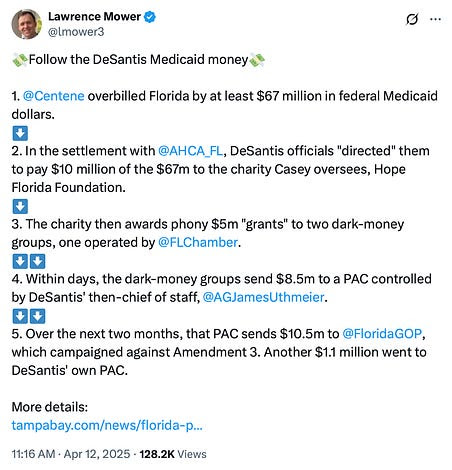
A simmering scandal erupted Friday afternoon when the Tampa Bay TimesMiami Herald and Politico Florida revealed that the administration of Gov. Ron DeSantis orchestrated a $10 million payment last fall to a charity founded by the governor’s wife — which then turned around and gave the money to groups that helped finance the governor’s campaign against a proposed constitutional amendment to legalize marijuana in Florida.

In a nutshell: The DeSantis administration pressured a major state contractor to make a $10 million donation to the Hope Florida Foundation, the controversial charity spearheaded by First Lady Casey DeSantis. It was part of a settlement negotiated with Centene Corp., after the state’s largest Medicaid contractor overbilled the state by at least $67 million.

Days later, Hope Florida transferred that $10 million to a pair of dark-money nonprofits. The state-backed charity gave $5 million each to “Save Our Society From Drugs,” an anti-marijuana group founded by a late Republican megadonor, and “Secure Florida’s Future,” a political vehicle controlled by executives at the Florida Chamber of Commerce, the Big Business lobbying group.

And days after that, Save Our Society From Drugs and Secure Florida’s Future gave a combined $8.5 million to “Keep Florida Clean,” a political committee — chaired by Ron DeSantis’ then-chief of staff — created to oppose Amendment 3, the amendment on last year’s ballot that would have allowed Floridians to use marijuana recreationally rather than solely for medicinal reasons.

It’s a daisy chain that may have transformed $10 million of public money — money meant to pay for health insurance for poor, elderly and disabled Floridians — into funding for anti-marijuana campaign ads.

DeSantis, of course, has repeatedly insisted that he did nothing wrong while also lashing out in increasingly vitriolic ways at everyone from the Republican speaker of the state House to the newspaper reporters digging into the story.

But at least one prominent GOP lawmaker — Rep. Alex Andrade, a Pensacola Republican who has been presiding over hearings into Hope Florida — told the Times and Herald that the transaction chain “looks like criminal fraud by some of those involved.”

Clearly, this looks very bad. But it is also by no means an isolated incident. 

In fact, this is part of a larger pattern of potential abuses that Ron DeSantis committed last fall when he chose to turn the power of state government against two citizen-led constitutional amendments that appeared on the November ballot: Amendment 3 and Amendment 4, which would have ended Florida’s statewide abortion ban.

Consider what we already know about how DeSantis financed his campaigns against the two amendments using public money taken from taxpayers — and private money taken from donors who got public favors from the governor.

  • Five state agencies directly funded television commercials meant to weaken support for the marijuana and abortion-rights ballot measures. We still don’t know the full extent of their spending, although Seeking Rents has estimated the total taxpayer tab at nearly $20 million. We also know that the DeSantis administration commandeered money for anti-marijuana advertising from Florida’s share of a nationwide legal settlement with the opioid industry — money that was supposed to be spent combatting the opioid addiction crisis.
  • At the same time, another nonprofit funded by Florida taxpayers poured at least $5 million into television ads attempting to soften Florida’s image on women’s healthcare at a time when Florida’s near-total abortion was under intense attack. It was the Florida Pregnancy Care Networks’ first-ever TV ad campaign. And its commercials, which were overseen by DeSantis administration staffers, complemented the state agency ads against the abortion-rights amendment — right down to using the same slogan.
  • Last June, after DeSantis vetoed legislation that would have strictly regulated the state’s hemp industry, CBS News Miami revealedthat industry executives and lobbyists promised to raise $5 million in exchange for the veto for the governor to spend on his campaign against Amendment 3. “Our lobby team made promises to rally some serious funding to stand with him on this,” a hemp industry representative wrote in one message that included a bank routing number for the Republican Party of Florida. “We have to pay $5 million to keep our end of the veto,” a hemp executive wrote in another message.
  • In the closing weeks of the campaign, records show that the Big Tobacco giant Philip Morris International gave $500,000 to DeSantis’ personal political committee — which was also chaired by the governor’s then-chief of staff and which DeSantis was using to campaign against both Amendment 3 and Amendment 4. Shortly after the election, the DeSantis administration handed Philip Morris a lucrative tax break, ruling that the company could sell a new line of electronically heated tobacco sticks free of state tobacco taxes.

There were other abuses of power, too. DeSantis and his team threatened to criminally prosecute television stations that aired ads supporting Amendment 4. They sent state police to the homes of Florida voters who signed Amendment 4 petitions. And they hijacked the ballot-writing process for Amendment 4.

There’s a reason why the DeSantis administration made sure to extract a promise of legal immunityfrom the organization that sponsored Amendment 4 as part of a legal settlement negotiated after the election.

DeSantis’ tactics worked. Though Amendments 3 and 4 each won majority support from Florida voters — 55.9 percent for recreational marijuana, 57.2 percent for abortion rights — both fell short of the 60 percent support needed to amend the state constitution.

But, suddenly, it looks like this may not be over — at least not for Ron DeSantis.

House Republicans are seeking troves of records from the DeSantis administration, including text messages and emails related to Hope Florida. The chamber has also scheduled another hearing on the Casey DeSantis charity next week.

What’s more, the House also unveiled a sweeping ethics reform package last week that would, among other things, explicitly expose senior government officials to criminal penalties if they interfere with elections.

That particular legislation would also prohibit state employees from soliciting money for political campaigns — an idea that emerged after DeSantis aides got caught squeezing lobbyistsfor more donations to their boss’ political committee ahead of a possible Casey DeSantis campaign for governor….

Ron DeSantis bet his political future on beating the marijuana and abortion-rights amendments. And he won both of those battles.

But it may turn out that he ultimately lost the war.

Wishful thinking? I hope not.

To give you an idea of how far/right the legislature is, Garcia lists some of the bills that are currently moving through the legislative process:

  • House Bill 549: Requires all new public school textbooks to refer to the Gulf of Mexico as the “Gulf of America.” Passed the Senate by a 28-9 vote. (See votes) Previously passed the House of Representatives by a 78-29 vote. (See votes) Goes to the governor.
  • House Bill 575: Replaces Gulf of Mexico with “Gulf of America” in state law. Passed the Senate by a 28-9 vote. (See votes) Previously passed the House of Representatives by a 78-27 vote. (See votes) Goes to the governor….
  • House Bill 1517: Allows someone to file a wrongful death lawsuit seeking lost wages on behalf of an embryo or fetus. Passed the House of Representatives by a 79-32 vote. (See votes)…
  • House Bill 7031: Cuts the state sales tax rate from 6 percent to 5.25 percent. Passed the House of Representatives by a 112-0 vote. (See votes)
  • House Bill 123: Allows a traditional public school to be converted into a charter school without the consent of the teachers who work at the school. Passed the House Education & Employment Committee by an 11-4 vote. (See votes)

Jennifer Berkshire has been writing about the politics of education for many years. She has written two books with education historian Jack Schneider, A Wolf at the Schoolhouse Door and The Education Wars. This is the second installment in her excellent series called “Connecting the Dots.” Her Substack blog is called “The Education Wars.”

She writes:

BAs are out, babies are in

The Trump world’s obsession with the declining birthrate doesn’t quite rank with rooting out “DEI,” tariff-ing, or expelling immigrants but it’s up there. In a recent interview, Elon Musk confessed that a fear of the shrinking number of babies keeps him up at night. What does this have to do with education? Everything. Last year, two of the big education ‘thinkers’ at Heritage released a guide to how changes in education policy could increase “the married birthrate”:

Expensive and misguided government interventions in education are, whether intended or not, pushing young people away from getting married and starting families—to the long-term detriment of American society.

What are those government interventions? Things like subsidizing student loans, thereby encouraging young women to go to college. Or requiring teachers, who are mostly women, to have bachelor degrees, thereby encouraging young women to go to college. Of course there is a voucher angle—there always is with these folks. But the key here is that a chorus of influential Trump thinkers like this guy keep telling us that there are too many women on campus, and that policy shifts could get them back into the home where they belong. 

If the administration succeeds in privatizing the government-run Student Loan Program, college will become much more expensive, significantly shrinkign the number of kids who’ll be able to attend. And that seems to be the point, as conservative activist Chris Rufo explained in an interview a few weeks ago.

By spinning off, privatizing and then reforming the student loan programs, I think that you could put the university sector as a whole into a significant recession. And I think that would be a very salutary thing.

So when you hear the rising chorus coming from Trump world that there are too many of the wrong people on the nation’s campuses, recall that an awful lot of these self-styled ‘nationalists’ believe this: “If we want a great nation, we should be preparing young women to become mothers.”

Some people are more equal than others 

I’ve been making the case that both the Department of Education and public education more broadly are especially vulnerable because of the equalizing roles that they play. Of course, education is not our only equalizer. Indeed, all of the institutions and policy mechanisms intended to smooth out the vast chasms between rich and poor are on the chopping block right now. While you were clicking on another bad news story, Trump eviscerated collective bargaining rights for thousands of federal workers. While teachers weren’t affected, a number of red states have been rushing to remedy that, including Utah which just banned collective bargaining for public employees. 

Writer John Ganz describes the unifying thread that connects so much of Trump world as ‘bosses on top,’ the belief that “the authority and power of certain people is the natural order, unquestionable, good.” We got a vivid demonstration of what this looks like in Florida this week as legislators debated whether to roll back (more) child labor protections, allowing kids as young as 14 to work over night. 

Governor Ron DeSantis is busily spinning the bill as about parents rights, but what it’s really about is expanding the power of the boss. The ‘right’ to work overnight while still in school is actually the boss’ right to demand that young employees keep working. Nor is it hard to imagine the long-term consequences of this policy change. Teen workers who labor through the night end up dropping out of school, their futures constrained in every possible way. Here’s how Marilynn Robinson described the rollback of child labor laws in her adopted home state of Iowa: “If these worker-children do not manage to finish high school, they will always be poorer for it in income and status and mobility of every kind.”

Go back one hundred years when the country was in the midst of a fierce debate over child labor, and you’ll hear the same arguments for ‘bosses on top’ that are shaping policy today. At a time when public education was becoming compulsory, conservative industry groups like the National Association of Manufacturers cast their opposition to both child labor laws and universal public education in explicitly bossist terms, as Naomi Oreskes and Erik Conway recount in The Big Myth: How American Business Taught Us to Loathe Government and Love the Free Market:

“They believed that men were inherently unequal: it was right and just for workers to be paid far less than managers and managers far less than owners. They also believed that in a free society some children would naturally enter the workforce. Child labor laws wer (to their minds) socialistic because they enforced erroneous assumptions of equality—for example, that all children should go to school—rather than accepting that some children should work in factories.”

Back to the states

Did you hear the one about how we’re returning education to the states? Back-to-the-states has become a mantra for the Trump Administration on all kinds of favored policy issues, as the New York Times recently pointed out. Of course, education is already a state ‘thing,’ which means that we can look at the states Trump keeps pointing to as models and see how they’re faring. So how are they faring? Not so well, as the education reform group EdTrust lays out here, reviewing both NAEP scores and the track records of these states in supporting low-income students and students of color.

But there are plenty of warning signs beyond test scores. Ohio seems poised to slash funding for public education, even as the state’s voucher program balloons. (And let’s not even get into the just-enacted Senate Bill 1, which limits class discussions of any ‘controversial’ topic and goes hard at campus unions.) But for a glimpse of the future that awaits us, pay attention to another state in my beloved Heartland, and which Trump has repeatedly showered with praise: Indiana.

Now, Indiana happens to be home to one of my favorite economists, Ball State’s Michael Hicks, who has been warning relentlessly that the state’s decision to essentially stop investing in K-12 and public higher education has been an economic disaster. Hoosiers, he pointed out recently, earn less than the typical Californian or New Yorker did in 2005. As the number of kids going to college in Indiana has plummeted, the state now spends more and more money trying to lure bad employers to the state. Here’s how Hicks describes the economic and education policies that Indiana has embraced:

“If a diabolical Bond villain were to craft a set of policies that ensured long-term economic decline in a developed country, it would come in two parts. First, spend enormous sums of money on business incentives that offer a false narrative of economic vibrancy, then cut education spending.”

As for Indiana’s 25-year-long school choice experiment, Hicks concludes that it has been a failure. Why? Because the expansion of school vouchers and charter schools was used to justify spending less on public schools—precisely the policy course that we’re hurtling towards now. Today, Indiana spend less money per student on both K-12 and public higher education than it did in 2008.

GOP-run states have already begun to petition what’s left of the Department of Education for ‘funding flexibility’—the ability to spend Title 1 dollars, which now go to public schools serving low-income and rural students, on private religious education. We shouldn’t be surprised. This is precisely the vision laid out in Project 2025. (Fun fact: the same Heritage thinker who penned the education section of Project 2025 also co-authored the above referenced guide to getting young married ladies to have more babies.)

And just like in Indiana, school privatization will be used to justify reducing the investment in K-12 public education. So when an economist tells us that school choice “risks being Indiana’s single most damaging economic policy of the 21st century,” we should probably listen.

It was entirely predictable that Florida Governor Ron DeSantis would create a labor shortage by driving immigrants away. Whether documented or not, immigrants are the backbone of the tourist industry and agriculture, two of the basic elements in the state’s economy. Once they were gone, who would replace them? Children. DeSantis is now promoting a reduction in child labor laws to replace the immigrant labor he criminalized. Orlando Sentinel columnist Scott Maxwell describes the new Florida economy, balanced on the backs of children. Not the rich kids, but the poor kids.

Maxwell writes:

The Newsweek headline looked like satire: “Florida May Replace Immigrant Workers With Child Labor.”

Savvy Floridians know, though, that you can’t fictionalize stories more absurd than this state’s reality. And Florida lawmakers are, in fact, trying to roll back the state’s child-labor laws.

Basically, if employers in this state can’t exploit immigrants, the governor and Legislature want them to be able to legally exploit your children.

The latest proposal would allow teens to work longer hours, without breaks and even overnight shifts on school nights. Take that, Myanmar.

Up next, maybe we can emulate Burkina Faso where more than half the kids are in the labor force, some as young as 7. Now there’s a country with values.

What you’re witnessing is a real-life version of the dog that chased cars without thinking about what he’d do if he actually caught one. In this case, Gov. Ron DeSantis and the state’s GOP legislators have fumed for years about undocumented workers without having the slightest clue about how they’d respond if those workers actually walked off Florida job sites.

So now they’re panicking and want your kids to fill the bill.

Normally, in a free-market economy, if an employer can’t find workers, it would just raise wages until people start applying. That’s how supply and demand works.

But Florida’s GOP politicians don’t want to ask their campaign donors to raise wages. They’d rather flood the market with another class of exploitable workers — teenagers.

Maybe you used to dream of your teen becoming an engineer or architect. Well, forget that Ivy League, ivory-tower fiddle-faddle. Florida’s economy needs them harvesting tomatoes and cleaning motel rooms.

In some ways, it makes sense to put our kids to work. We’re sure not educating them. Florida’s SAT scores have dropped to 47th in America. And our state’s eighth-graders just posted the lowest math and reading scores in 20 years.

So, if we’re not preparing them for higher education or high-paying jobs, we might as well get them primed for the low-wage tourism and agriculture jobs that make this state hum.

Senate Bill 918, would eliminate restrictions on how many hours 16- and 17-year-olds can work. It would end guaranteed meal breaks and also lift restrictions for kids as young as 14 who are home schooled or enrolled in virtual school. (So if you want your rugrat pulling down a paycheck, just yank ’em out of traditional school.)

The Florida Policy Institute summarized the bill by saying it would allow Florida to work teens “for unlimited hours, any time day or night, seven days per week and without breaks.”Welcome to childhood in Florida.

Not all Republicans think this is a boffo idea. Sen. Joe Gruters, a former chairman of the Republican Party of Florida, joined Democrats in opposing the bill, saying: “I think we need to let kids be kids.”

Gruters chose his words carefully: “Let kids be kids” is a line DeSantis uses a lot, usually when he’s pushing censorship laws.

Apparently, in DeSantis’ worldview, teens aren’t mature enough to see certain drag performers, even alongside their parents — but are mature enough to work right through the night until school starts at 7 am. That’s just kids being kids.

As I’ve said before, I’m a fan of teens having jobs. I had a paper route in middle school and landed my first real job at a drugstore when I was 14 — old enough to legally sell condoms and tampons, but still immature enough to giggle about it. (Basically, if you ever entered a Revco in the 1980s,  nervous about making a purchase, I was your worst nightmare.)

But here’s the thing: I believe teens should get jobs when they and their parents want them to get jobs — not because we need to plug labor holes in our low-wage economy.

Keep in mind: DeSantis didn’t promote his roll-back-child-labor-laws ideas at a panel discussion on building teen character. He did it at panel discussion on immigration. After noting that undocumented workers provided “dirt cheap labor,” DeSantis asked: “Why do we say why we need to import foreigners, even import them illegally, when you know teenagers used to work at these resorts?”

This is just about swapping one exploitable labor class for another … in a state that already turns a blind eye to companies that break labor laws.

Remember Florida’s “mandatory” E-Verify law? It explicitly said that the state couldn’t even fine companies caught breaking the law until they’re caught three times. And that law-breaking employers must be given 30 days to stop breaking the law before they’re punished. What other laws work like that?

This is a state that gives companies a pass on labor-law violations and now wants to give them a younger workforce. What a dangerous combo. Even moreso when you consider GOP lawmakers also want to let businesses subvert minimum wage laws for some workers “younger than 18 years of age.”

Kids in Florida who say they have financial “hardships” can surrender even more workplace protections. Basically, the poorer you are, the more you can be exploited. So it ain’t gonna be the private, prep-school kids working farm fields and cleaning motel rooms at 3 in the morning.

DeSantis seemed particularly interested in using kids to fill the theme parks’ job needs. But the proposed rollbacks would also allow teens to work longer hours waxing floors, painting houses, stocking shelves, doing landscaping and working in fast food. Kids would still be banned from doing particularly dangerous jobs like mining or tarring roofs higher than six feet.

So teens could be asked to work overnight shifts right up until the start of a school day. That’s just “kids being kids.” But we’d draw the line at putting kids in boiler rooms and phosphate mines. A state has to have standards, after all.

smaxwell@orlandosentinel.com

Peter Green explores one of the strangest paradoxes of our time: how can people be “pro-life” and also oppose any gun control? Guns kill people. Guns kill thousands of people every year. Consistency would demand that a person who is pro-life would also want to regulate the sale of guns.

But no. Among the most zealous pro-life governors is Ron DeSantis of Florida. He doesn’t want any woman to get an abortion, regardless of the peril to her life or the fetus. But when it comes to guns, DeSantis wants everyone to have at least one.

Green writes:

This week in his State of the State speech, Ron DeSantis announced that it was time to get over the Marjorie Stoneman Douglas High School shooting–that would be the one in Parkland in which a 19-year-old killed 17 and injured 17 others in the deadliest mass shooting at a high school in US history. 

After that shooting, the state put in place a piddly excuse for an attempt to make such horrors less likely, but even that is too much for DeSantis, who specifically wants to get rid of language raising the age to purchase a shotgun or rifle from 18 to 21 and also the red flag law that lets family members or law enforcement petition the court to remove someone’s firearms id they are risk to themselves of others. You know– like maybe a 19 year old with a long history of racism and fascination with mass shootings. “We need to be a strong Second Amendment state. I know many of you agree, so let’s get some positive reform done for the people in this state of Florida,” DeSantis was quoted by the Florida Phoenix

Also, he’d like to have open carry in the state.

Because nothing is more important than an American’s God-given right to shoot other people. Because we should go to any length to “protect” a fetus, but once it’s a live child, its life is less important than someone’s right to fire off a couple of rounds at anyone that bugs them. Because this is one more way politicians can show that for all their talk, they don’t particular care about young humans. 

On the right column of the blogspot version of this blog, I have had one image parked for years. It’s not complicated

I would say that it’s the least we could do, but of course the least we can do is nothing, and Ron DeSantis would like us to get back to doing that. 

The only bright spot here is that the legislature doesn’t seem to have his back on this. Good. DeSantis should be ashamed that he can’t even produce a bad argument for his favored policies other than complaining that Florida has “lagged on this issue.” What a bummer– imagine all the people who are going to some other state because it’s easier to shoot people there. 

Annie Martin and Leslie Postal of the Orlando Sentinel have repeatedly exposed the fraud baked into Florida’s voucher program. It began in 1999 with the modest ambition of offering choice to low-income students in “failing schools.” It expanded to provide vouchers for students with disabilities. In past articles, they surveyed voucher schools and identified academic deficiencies, such as uncertified teachers and principals, and Bible-based textbooks. Now, they report on what happened after the state removed all income limits in 2023. Florida now offers money for all students, regardless of family income.

Most of the students getting the voucher money are not low-income, do not have disabilities, and are not escaping bad public schools.

The students getting vouchers are already enrolled in private schools. They don’t need the extra money but they are happy to take it.

They write:

A block from Winter Park’s tony Park Avenue sits St. Margaret Mary Catholic School, where tuition can top $14,000 a year for a K-8 education.

But at this school in the heart of one of Central Florida’s wealthiest communities, about 98 percent of students used taxpayer-funded scholarships worth roughly $8,000 to help pay tuition last year.

Only three percent of St. Margaret Mary’s students got that state financial aid just one year earlier.

The change – repeated at schools around the state – is one powerful measure of how a 2023 Florida law has supercharged a school voucher initiative that was already the nation’s largest.

Once reserved for low-income students and those with disabilities, state scholarships, often called vouchers, are now available to all – and they’re fueling an unprecedented pipeline of public money, estimated at $3.4 billion this year, into private, mostly religious schools across the Sunshine State.

All that money is doing more than just expanding Florida’s voucher program. The new rules are transforming it.

Since their emergence as a conservative educational talking point four decades ago, vouchers have been pitched as a way to provide “school choice” – the opportunity for families who couldn’t otherwise afford private education to escape a substandard neighborhood public school.

But when lawmakers dropped the income limits on Florida’s programs, the key element of the 2023 law, the system became something else:

Choice for lower-income families plus a wide-open taxpayer subsidy for the better off.
More than 122,000 new students started using vouchers for the first time in the 2023-24 school year, and nearly 70 percent were already in private school, many in some of Florida’s priciest institutions, according to data from Step Up For Students, the nonprofit that administers most of the state’s scholarships. About 40 percent came from families too wealthy to have qualified previously.

So in many cases the new law did not expand these new families’ options. Instead, it provided state subsidies for the choices they had previously made and were able to afford on their own.

The implications of that shift are vast, an Orlando Sentinel analysis has found.

• Voucher use has jumped by 67% since the new law was approved.
• Individual private schools are seeing even bigger surges, creating new reliance on taxpayer funding. The Sentinel found nearly 250 schools where the number of students using vouchers jumped by at least 100 children in the first year after the law changed. At St. Margaret Mary, the growth pushed total annual voucher funding from $65,000 to $3.5 million – in just one example of the multi-million dollar windfalls.
• A significant amount of the money is flowing to Florida’s most expensive private schools, many of which served few voucher students in the past: Campuses that advertise annual tuition of $15,000 or more added more than 30,000 voucher students last year.
• The proportion of private school students with state scholarships has topped 70% this school year. Ten years ago it was less than a third.
• More Florida students use vouchers — a total of 352,860 — to attend private campuses than are enrolled in public schools in Osceola, Orange and Seminole counties combined.

Program critics say Florida is now spending an inordinate amount of its education resources on the wrong people – rather than focusing on system improvements that would be good for all students.


“This is just a subsidy for wealthier people — people who already have the advantage,” said state Rep. Kelly Skidmore, a Democrat from Boca Raton who voted against the expansion.


Skidmore is among those who fear the impact of the voucher explosion on public schools – which are losing money as students shift to private education – and the implications of handing millions in taxpayer dollars to private schools over which the state has little control.


These schools are free, as the Sentinel has reported previously, to hire teachers without college degrees, teach history and science lessons outside mainstream academics and discriminate against LGBTQ students and staff. They do not face the same accountability requirements as their public counterparts, whose students’ test scores and graduation rates are publicly reported. Without such numbers for private schools, it’s difficult to assess the impact of Florida’s voucher program on the quality of education students receive.

Nevertheless, the voucher push shows no signs of abating, with more than 10% of all K-12 students in Florida now receiving the subsidy.

On Jan. 10, Gov. Ron DeSantis celebrated Florida’s “choice revolution” at Trinity Christian Academy in Jacksonville, which now enrolls more than 1,200 voucher students.

“The debate about school choice I think is over. Clearly you’re better offering choice than not offering choice,” DeSantis said.

An Orlando mother of four sent them to The First Academy, affiliated with First Baptist Church of Orlando, where high school tuition is more than $24,000 a year. Nearly 90% of the students use vouchers now, up from about 20% two years ago. She paid the full cost for her two oldest, who graduated, and can afford to pay for her two youngest, but is delighted to take the state subsidy.

Florida is spending $3.4 billion annually to subsidize the state’s most affluent families.

Is it surprising that Florida’s NAEP scores fell to their lowest point in 20 years? The state is not investing in its public schools, which enroll the overwhelming majority of its students.

A group of professors in Florida filed a federal lawsuit against the 2023 state law banning teaching about diversity, equity, and inclusion, claiming that it restricts freedom of speech.

The law was enacted as part of Governor Ron DeSantis’s war on “woke,” meaning any teaching about or practice related to DEI.

The Orlando Sentinel reported:

TALLAHASSEE — A group of Florida university professors on Thursday filed a federal lawsuit challenging a 2023 state law and related regulations that prevent colleges from spending money on diversity, equity and inclusion initiatives, saying the restrictions are “punishing educators and students for expressing differing and disfavored viewpoints.”


The lawsuit, filed by the American Civil Liberties Union of Florida and Gibson, Dunn & Crutcher LLP on behalf of six professors, alleges that the restrictions violate educators’ and students’ speech rights and is chilling expression in public universities. It targets the 2023 law (SB 266) and rules passed last year by the state university system’s Board of Governors.


“Continuing its effort to police the marketplace of ideas, the Florida Legislature again passed vague, viewpoint-discriminatory legislation that broadly restricts academic freedom and imposes the state’s favored viewpoints on public higher education, punishing educators and students for expressing differing and disfavored viewpoints,” the lawsuit said.


The restrictions ban funding for programs or campus activities that advocate for diversity, equity, or inclusion or that engage in “political or social activism.”

One of the rules defines DEI as “any program, campus activity, or policy that classifies individuals on the basis of race, color, sex, national origin, gender identity, or sexual orientation and promotes differential or preferential treatment of individuals on the basis of such classification.” Colleges and universities risk losing funding if they violate the restrictions.
The lawsuit alleged that the regulations’ definitions are “ambiguous, inconsistent, and far too broad to provide any real guidance other than indicating the Legislature’s and the BOG’s (Board of Governors’) intent to disfavor certain speech.”


The restrictions “have left instructors and students fearful for the future of not only education, but also free thought and democracy in Florida,” the professors’ lawyers wrote.
The rules have “stripped hundreds of university courses” from being designated as “general education” courses, according to the lawsuit. Universities also have denied scholarship and research money to faculty and students who have received it in the past.

The Miami Herald noted that Trump is considering dropping Pete Hegseth as his nominee for Secretary of Defense and selecting Florida Governor Ron DeSantis instead. So it published a story reviewing DeSantis’s statements about how he would deploy the military. Read and be informed.

The Miami Herald reports:

Florida Gov. Ron DeSantis repeatedly vowed during his presidential campaign to send troops to the U.S. southern border, authorize lethal force against migrants attempting to cross between ports of entry, and even consider firing missiles into Mexico — an extraordinary use of U.S. military power that has since been endorsed by President-elect Donald Trump. Now, DeSantis may have a chance to fulfill that promise, among other controversial proposals, should Trump ask him to lead the Pentagon. The Republican governor is said to be in discussions with Trump and his transition team about replacing Pete Hegseth, a Fox News television personality plagued by sex and drinking scandals, as his nominee for defense secretary….

At one of the GOP primary debates, DeSantis said he would declare a national emergency and send troops to the southern border to deploy lethal force against drug cartels attempting to smuggle drugs into the country. Throughout the campaign, DeSantis was repeatedly pressed to explain how the military would determine whether individuals crossing the border had any connection to the drug trade. “I am gonna declare a national emergency, I’m not gonna send troops to Ukraine but I am gonna send them to our southern border,” he said. “When these drug pushers are bringing fentanyl across the border, that’s gonna be the last thing they do. We’re gonna use force and we’re gonna leave them stone-cold dead….”

In another exchange during the primary, DeSantis told CBS that he would consider all available military options — including using force in Mexico itself — to combat the illegal drug trade. “The tactics can be debated,” he said, asked whether he would fire missiles into Mexico. “That would be dependent on the situation.” DeSantis has also spent millions of dollars in recent years supporting Texas in deterring migrants from entering the country through state-led border security initiatives. Florida aided in some of Texas’ efforts that have come under scrutiny, including reports that officers were ordered to push small children and nursing babies back into the Rio Grande.

DOMESTIC DEPLOYMENTS

DeSantis, as governor, has already demonstrated a willingness to deploy state troops under his control for unconventional purposes, often unrelated to the immediate needs of the state. He sent members of the Florida State Guard to aid Texas’ state efforts to police the border — despite questions over their coordination with federal border patrol — and, in 2020, sent 500 Florida National Guardsmen to Washington in response to protests following the death of George Floyd….

RECRUITMENT CHALLENGES

DeSantis also promised to purge the military of “woke” policies, such as highlighting diversity, equity and inclusion and allowing transgender personnel to serve as their preferred sex, claiming the policies were undermining military effectiveness and suppressing recruitment. “It is time to rip the woke out of the military and return it to its core mission,” DeSantis said during the campaign. “We must restore a sense of confidence, conviction, and patriotic duty to our institutions — and that begins with our military….”

On the campaign trail, DeSantis also frequently questioned the value of sending financial and military support to Ukraine to help it defend itself against Russia. He opposed its membership bid to NATO and questioned the mission of NATO itself during the primary, calling on the transatlantic alliance to focus on the growing threat from China.

A 2021 study commissioned by the Pentagon on recruitment strategies found that “wokeness” did not register among the top 10 reasons why Americans were enlisting at record low numbers.

“Our research shows that the top barriers to service are concerns about death or injury, PTSD, emotional issues, and leaving friends and family — not political issues,” a Pentagon official told McClatchy last year. “Concerns about vaccines and ‘wokeness’ are among the least to be raised as reasons not to join the military….”

On the campaign trail, DeSantis also frequently questioned the value of sending financial and military support to Ukraine to help it defend itself against Russia. He opposed its membership bid to NATO and questioned the mission of NATO itself during the primary, calling on the transatlantic alliance to focus on the growing threat from China.

“I think NATO was fine for the Cold War. It made sense,” he said. “Now we’re in a situation where a lot of those countries aren’t doing their fair share in terms of their defenses, and yet we’re supposed to provide blanket security for that, where our interests may diverge around the world.”

At one point, DeSantis called the war between Ukraine and Russia a “territorial dispute.” He quickly changed his message after facing criticism and said that Russia was wrong to invade Ukraine and Putin was a “war criminal.”

Ukraine, DeSantis added, has a “right to that territory.”

“If I could snap my fingers, I’d give it back to Ukraine 100%,” DeSantis told the New York Post’s Piers Morgan in March 2023. “But the reality is what is America’s involvement in terms of escalating with more weapons, and certainly ground troops I think would be a mistake. So, that was the point I was trying to make, but Russia was wrong to invade. They were wrong to take Crimea.”

Read more at: https://www.miamiherald.com/news/politics-government/article296548929.html#storylink=cpy

The DeSantis regime threatened to prosecute television stations that aired ads supporting Amendment 4, the one that repeals the state ban on abortion. The order was blocked by the courts. When the lawyer for the state Department of Health was directed to sign a second letter reiterating the threat, he resigned.

The Miami Herald reported:

Gov. Ron DeSantis’ top deputies directed a Florida Health Department lawyer to threaten Florida television stations with criminal prosecution for running political advertisements that support enshrining abortion rights in the state’s Constitution, according to new court records.

Florida Department of Health General Counsel John Wilson said he was given pre-written letters from one of DeSantis’ lawyers on Oct. 3 and told to send them under his own name, he wrote in a sworn affidavit Monday.

Although he had never participated in any discussions about the letters, Wilson sent them anyway, he wrote, setting off a firestorm that led to a federal judge last week granting a temporary restraining order against the state.

Wilson abruptly quit on Oct. 10, writing in his resignation letter that “A man is nothing without his conscience.” The letter, first reported by the Herald/Times, did not explicitly say he was resigning over the controversy.

But in his affidavit, Wilson said the decision was made to avoid sending out more letters. “I resigned from my position as general counsel in lieu of complying with directives from [DeSantis General Counsel Ryan] Newman and [Deputy General Counsel Jed] Doty to send out further correspondence to media outlets,” he wrote.

Read more at: https://www.miamiherald.com/news/politics-government/state-politics/article294143314.html#storylink=cpy

Some Republican leaders, including Trump, believe that climate change is a hoax. The Trump administration banned the use of the term by government agencies. Florida recently declared it would not adopt science textbooks that explain climate change. It’s not real.

Really? Read this story, which appeared in the Los Angeles Times.

Jack Dolan, staff writer, reports:

In late June, as a group of mountaineers descended a treacherous glacier high in the Peruvian Andes, they spotted a dark, out-of-place lump resting on the blinding white snow.

When they approached, they realized it wasn’t a rock, as they had initially assumed. 

It was a corpse. 

When they got a little closer, they could tell from the out-of-date clothes and the condition of the skin that the dead man had been there for a very long time. A miraculously well-preserved California driver’s license in the man’s pocket identified him as Bill Stampfl, a mountaineer from Chino who had been buried by an avalanche in 2002.

Avalanches begin as loose, flowing rivers of ice and snow that sweep their victims off their feet and wash them down the mountain. When the frozen debris stops, it quickly solidifies into something like a concrete tomb.
But in recent years, as the planet has warmed and ice has melted at an alarming rate, receding glaciers on the upper reaches of many of the world’s most celebrated and deadly peaks have begun surrendering the bodies of long-lost mountaineers.
It’s a blessing and a relief for grieving families who crave closure, but it creates a grim chore for public officials whose job it is to respectfully remove the remains.

Last year, on the heels of a heat wave that triggered the fastest loss of glacial ice in Swiss history, the boot of a German climber who disappeared in 1986 began poking out of a well-traveled glacier near the mountain town of Zermatt, not far from the Matterhorn.
In the Himalayas, where hundreds of adventurers have perished on the slopes of Mt. Everest since the 1920s, Nepali officials have been forced to launch risky, arduous expeditions to retrieve the recently revealed — and rapidly thawing — corpses.
“Because of global warming, the ice sheet and glaciers are fast melting and the dead bodies that remained buried all these years are now becoming exposed,” Ang Tshering Sherpa, former president of the Nepal Mountaineering Assn., told the BBC in 2019.
And now, a similarly gruesome scenario has played out on the slopes of 22,000-foot Huascaran, Peru’s highest mountain.

The warming planet is “definitely the reason we found Bill,” said Ryan Cooper, a personal trainer from Las Vegas who was among the group of climbers who discovered Stampfl’s body a few weeks ago.
When Stampfl and two climbing partners disappeared in 2002, rescuers went looking for them. They found one body, that of Steve Erskine, but Matthew Richardson and Stampfl could not be located.
“If Bill had been on top of the ice they would have found him, but he was buried back then,” Cooper said in an interview.

A lot has changed in 22 years.
Hauscaran is the highest point, and crown jewel, of the Cordillera Blanca, a region of breathtaking natural beauty that’s home to a dozen peaks higher than 20,000 feet and hundreds of alpine glaciers.
These ancient, frozen reservoirs supply irrigation and hydroelectric power to much of Peru. But, as with glaciers everywhere on the planet as temperatures have risen, those in the Cordillera Blanca have lost significant mass, as much as 27% in the last five decades, according to official estimates.

Cooper said he didn’t understand the extent and speed of the changes underway until days before his guided climb was supposed to begin. He and his brother, Wes Warne, were hanging out in the Peruvian mountain town of Huaraz, listening in as other climbers and guides compared notes.
They heard the glaciers were melting so fast that previously manageable crevasses — cracks caused by natural movement of the ice — had turned into deep, yawning chasms up to 60 feet wide that could swallow an entire team of climbers.
And they heard that many guides had begun steering their clients to more stable summits, because conditions on Huascaran had become so dicey.
Nevertheless, Cooper’s team decided to give their planned route a try.

The five days they spent on the glaciers were tense, Cooper said, an up-close look at the chaos warmer-than-expected temperatures can cause.
“You’re just hearing avalanches, you’re hearing rock fall, you’re hearing ice fall all around you,” Cooper said. “I’ve never been on a mountain that was so active.”
Eventually, the guides decided not to push for the summit, Cooper said. Instead, they led the group down an older, less traveled route that had been the standard track “back in the day,” he said, before shifting terrain prompted climbers to start taking a different approach.
That’s where they came upon Stampfl’s body, at about 17,000 feet, resting alone, undisturbed and almost completely exposed.
In other cases, when just part of a body is sticking out of the ice, excavation can be a grueling ordeal. Rescuers use shovels, axes, boiling water — anything to help coax and pry remains free.
As soon as they discovered Stampfl was American, Cooper said, he and his brother set aside their frustrations about not making the summit. They now had a much higher goal — getting Bill home.
Once they had climbed down far enough to have cellphone reception, a flurry of text messages began, and Cooper’s wife joined the search for Stampfl’s family.
Before long, Cooper found himself on the phone with Joseph Stampfl, Bill’s son.

Please open the link to finish the story.