Archives for category: Democracy

The Brown Decision was released by the U.S. Supreme Court on May 17, 1954, precisely sixty-nine years ago. It was a historic decision in many ways. It was the beginning of the end of de jure segregation in every aspect of American society. Of course, de facto segregation persists in schools, housing, and in many aspects of life. It would have been impossible to imagine in 1954 that the nation would elect a Black man as President in 2008 and again in 2012.

The decision was unanimous. America could not claim to be a nation of freedom, liberty, democracy, and equality when people of color were excluded from full participation in every aspect of public life and walled off from the mainstream of American society in their private lives. Segregation and discrimination were hallmarks of the American way. Black people were not only restricted in the right to vote, were not only underrepresented in legislatures and other decision-making bodies, but were excluded from restaurants, hotels, movie theaters, public transport, public beaches, and from all other places of public accommodation, as well as private commerce. Segregation was imposed by law in the South and some border states, and by custom in northern, western, and midwestern states.

The Brown Decision struck a blow against this cruel reign of prejudice and bigotry in American life. We are far, very far, from fulfilling the promise of the Brown Decision. To make progress, we must be willing to look deeply into the roots of systemic racism and dismantle the structures that condemn disproportionate numbers of Black families to live in poverty and in segregated neighborhoods. A number of Republican-led states have made such inquiries illegal.

The present movement for vouchers, which is strongest in Republican-dominated states, will not move us closer to the egalitarian goals of the Brown Decision. Vouchers are inherently a divisive concept. They encourage people to congregate with people just like themselves. Heightened segregation along lines of race, religion, social class, and ethnicity are a predictable result of vouchers.

The voucher movement began as a hostile response to the Brown decision, led by racist governors, members of Congress, legislatures, White Citizens Councils, parents who did not want their children to attend schools with Black children, and white supremacists who wanted to protect their “way of life.” They refused to comply with the Supreme Court decision. They called Earl Warren a Communist. They engaged in “massive resistance.” They quickly figured out that they could fund private academies for whites only, and some Southern states did. And they figured out that they could offer “vouchers” or “scholarships” to white students to attend white private and religious schools.

I recommend three books about the history of the ties between segregationists, the religious right, and vouchers. I reviewed all three in an article called “The Dark History of School Choice” in The New York Review of Books. Although it is behind a paywall, you can read one article for free or subscribe for a modest fee.

The Power Worshippers: Inside the Dangerous Rise of Religious Nationalism, by Katherine Stewart

Overturning Brown: The Segregationist Legacy of the Modern School Choice Movement, by Steve Suitts

Schoolhouse Burning: Public Education and the Assault on American Democracy, by Derek W. Black

In addition, I recommend Nancy MacLean’s superb Democracy in Chains: The Deep History of the Radical Right’s Stealth Plan for America. It links the voucher moment to the Koch brothers and other libertarians, including Milton Friedman. I reviewed it in the same journal. MacLean is the William H. Chafe Professor of History and Public Policy at Duke University.

Nancy MacLean wrote the following article for The Washington Post nearly two years ago. In the past two years, the voucher movement has gained even more ground in Republican-dominated states. If it is behind a paywall, you can read it here.

She wrote:

The year 2021 has proved a landmark for the “school choice” cause — a movement committed to the idea of providing public money for parents to use to pay for private schooling.

Republican control of a majority of state legislatures, combined with pandemic learning disruptions, set the stage for multiple victories. Seven states have created new school choice programs, and 11 others have expanded current programs through laws that offer taxpayer-funded vouchers for private schooling and authorize tax credits and educational savings accounts that incentivize parents moving their children out of public schools.

On its face, this new legislation may sound like a win for families seeking more school options. But the roots of the school choice movement are more sinister.

White Southerners first fought for “freedom of choice” in the mid-1950s as a means of defying the U.S. Supreme Court’s 1954 Brown v. Board of Education decision, which mandated the desegregation of public schools. Their goal was to create pathways for White families to remove their children from classrooms facing integration.

Prominent libertarians then took advantage of this idea, seeing it not only as a means of providing private options, but also as a tool in their crusade to dismantle public schools altogether. This history reveals that rather than giving families more school options, school choice became a tool intended to give most families far fewer in the end.

School choice had its roots in a crucial detail of the Brown decision: The ruling only applied to public schools. White Southerners viewed this as a loophole for evading desegregated schools.

In 1955 and 1956, conservative White leaders in Virginia devised a regionwide strategy of “massive resistance” to the high court’s desegregation mandate that hinged on state-funded school vouchers. The State Board of Education provided vouchers, then called tuition grants, of $250 ($2,514 in 2021 dollars) to parents who wanted to keep their children from attending integrated schools. The resistance leaders understood that most Southern White families could not afford private school tuition — and many who could afford it lacked the ideological commitment to segregation to justify the cost. The vouchers, combined with private donations to the new schools in counties facing desegregation mandates, would enable all but a handful of the poorest Whites to evade compliance.

Other Southern states soon adopted voucher programs like the one in Virginia to facilitate the creation of private schools called “segregation academies,” despite opposition from Black families and civil rights leaders. Oliver Hill, an NAACP attorney key to the Virginia case against “separate but equal” education that was folded into Brown, explained their position this way: “No one in a democratic society has a right to have his private prejudices financed at public expense.”

Despite such objections, key conservative and libertarian thinkers and foundations, including economists Milton Friedman and Friedrich Hayek, Human Events editor Felix Morley and publisher Henry Regnery, backed the White Southern cause. They recognized that White Southerners’ push for “freedom of choice” presented an opportunity to advance their goal of privatizing government services and resources, starting with primary and secondary education. They barely, if ever, addressed racism and segregation; instead, they spoke of freedom (implicitly, White freedom).

Friedman began promoting “educational freedom” in 1955, just as Southern states prepared to resist Brown. And he praised the Virginia voucher plan in his 1962 book, “Capitalism and Freedom,” holding it up as a model for school choice everywhere. “Whether the school is integrated or not,” he wrote, should have no bearing on eligibility for the vouchers. In other words, he knew the program was designed to fund segregation academies and saw it as no barrier to receiving state financing.

Friedman was far from alone. His fellow libertarians, including those on the staff of the William Volker Fund, a leading funder on the right, saw no problem with state governments providing tax subsidies to White families who chose segregation academies, even as these states disenfranchised Black voters, blocking them from having a say in these policies.

Libertarians understood that while abolishing the social safety net and other policies constructed during the Progressive era and the New Deal was wildly unpopular, even among White Southerners, school choice could win converts.

These conservative and libertarian thinkers offered up ostensibly race-neutral arguments in favor of the tax subsidies for private schooling sought by white supremacists. In doing so, they taught defenders of segregation a crucial new tactic — abandon overtly racist rationales and instead tout liberty, competition and market choice while embracing an anti-government stance. These race-neutral rationales for private school subsidies gave segregationists a justification that could survive court review — and did, for more than a decade before the Supreme Court ruled them unconstitutional.

When challenged, Friedman and his allies denied that they were motivated by racial bigotry. Yet, they had enough in common ideologically with the segregationists for the partnership to work. Both groups placed a premium on the liberty of those who had long profited from white-supremacist policies and sought to shield their freedom of action from the courts, liberal government policies and civil rights activists.

Crucially, freedom wasn’t the ultimate goal for either group of voucher supporters. White Southerners wielded colorblind language about freedom of choice to help preserve racial segregation and to keep Black children from schools with more resources.

Friedman, too, was interested in far more than school choice. He and his libertarian allies saw vouchers as a temporary first step on the path to school privatization. He didn’t intend for governments to subsidize private education forever. Rather, once the public schools were gone, Friedman envisioned parents eventually shouldering the full cost of private schooling without support from taxpayers. Only in some “charity” cases might governments still provide funding for tuition.

Friedman first articulated this outlook in his 1955 manifesto, but he clung to it for half a century, explaining in 2004, “In my ideal world, government would not be responsible for providing education any more than it is for providing food and clothing.” Four months before his death in 2006, when he spoke to a meeting of the conservative American Legislative Exchange Council (ALEC), he was especially frank. Addressing how to give parents control of their children’s education, Friedman said, “The ideal way would be to abolish the public school system and eliminate all the taxes that pay for it.”

Today, the ultrawealthy backers of school choice are cagey about this long-term goal, knowing that care is required to win the support of parents who want the best for their children. Indeed, in a sad irony, decades after helping to impede Brown’s implementation, school choice advocates on the right targeted families of color for what one libertarian legal strategist called “forging nontraditional alliances.” They won over some parents of color, who came to see vouchers and charter schools as a way to escape the racial and class inequalities that stemmed from White flight out of urban centers and the Supreme Court’s willingness to allow White Americans to avoid integrating schools.

But the history behind vouchers reveals that the rhetoric of “choice” and “freedom” stands in stark contrast to the real goals sought by conservative and libertarian advocates. The system they dream of would produce staggering inequalities, far more severe than the disparities that already exist today. Wealthy and upper-middle-class families would have their pick of schools, while those with far fewer resources — disproportionately families of color — might struggle to pay to educate their children, leaving them with far fewer options or dependent on private charity. Instead of offering an improvement over underfunded schools, school choice might lead to something far worse.

As Maya Angelou wisely counseled in another context, “When people show you who they are, believe them the first time.” If we fail to recognize the right’s true end game for public education, it could soon be too late to reverse course.

Update: According to Future-Ed, citing pro-voucher EdChoice (which used to be the Milton and Rose Friedman Foundation), “Currently, 32 states provide an estimated $4 billion in subsidies to some 690,000 students through tuition vouchers, education savings accounts, and tax-credit scholarships.” Several Republican-led states are considering or have already universal vouchers, which would subsidize the tuition of all students in private schools, including the children of wealthy families. Currently, most students who use vouchers were already enrolled in private and religious schools. In one state alone, Florida, the added cost of vouchers might be as much as $4 billion a year, just for the children already in private schools.
President Biden has said he would not compromise on raising the debt ceiling but lately he has sent mixed signals. If the debt ceiling is not raised, the United States would be forced to default on its bonds for the first time in history. Congress raised the debt ceiling three times during Trump’s term in office. Congressional Republicans passed a budget that allows increases for defense and border security but requires steep cuts in everything else. Trump, the titular leader of the Republican Party, said at his New Hampshire town hall, that the U.S. should default on its debt, even though most economists predict that a default would likely precipitate a deep recession, with global consequences. Trump once called himself “the king of debt,” so he has no fear of the consequences, which would hurt Biden in 2024.

Ryan Cooper of The American Prospect explains why the President should not compromise and what those cuts would mean:

For months, President Biden had a consistent line on the debt ceiling: He would accept only a clean increase, without conditions. This was the lesson from the Obama administration, it was thought, learned at great expense when President Obama tried to negotiate with Tea Party Republicans in 2011 to get a grand bargain to cut the deficit. The result was the budget “sequester,” which badly eroded the federal government and elongated the agonizingly slow economic recovery. That’s why Obama stood his ground in 2013, and Republicans—eventually—backed down, getting essentially nothing out of the eventual debt ceiling increase.

But now all that is out the window. With the June 1 X-date approaching, the Washington media clamoring for Biden to cave, and administration officials working themselves into an anxious fit over potential executive actions to nullify the ceiling, it seems President Dark Brandon is returning to be old Conciliatory Joe. The man himself telegraphed this in a speech in New York last week that was designed to hammer Republicans over the debt ceiling, saying “we should be cutting spending and lowering the deficit without a needless crisis, in a responsible way.”

Reuters and Politico report that the White House is preparing to offer concessions in the form of cutting discretionary spending to the level of fiscal year 2022, and then capping the rate of increase at 1 percent per year for an indeterminate period, maybe two years. There would be other parts to the compromise, including rescinding some COVID aid and some bargain on permitting reform, but as far as spending, the discretionary caps would be the major piece.

This is a disastrous move. Politically, it reinforces the precedent that Republicans can extract concessions through legislative terrorism, and by signaling weakness and timidity in the Democratic leadership, it will further enable GOP extremism. If Republicans control either chamber of Congress next time the ceiling is hit—a high likelihood given how bad the Senate map is in 2024—then they’re virtually certain to take the debt ceiling hostage again.

But the practical consequences will also be terrible. We don’t know the details yet, but returning to fiscal year 2022 budget levels would mean an immediate cut of about 13 percent to every government agency and program (thanks to an unusually large spending increase in 2023 to account for economic growth, high inflation, and a few additional programs). If defense and border cops are exempted, then the cut will be perhaps 22 percent.

Read all of our debt ceiling coverage here

Rep. Rosa DeLauro (D-CT), the ranking member on the House Appropriations Committee, solicited estimates from various government departments on what that 22 percent cut would mean. They told her that just for starters, 60,000 people would not be able to attend college; 200,000 children would get kicked off Head Start; 100,000 families would lose child care; and 1.2 million people would be removed from WIC nutrition assistance.

One hundred twenty-five air traffic control towers would be shut down, affecting one-third of airports, and no doubt worsening the chronic snarls in American air travel. Rail safety inspections would be cut back by 11,000 work days, meaning 30,000 miles of track going uninspected. (More dangerous chemical spills, here we come!) Some 640,000 families would lose rental assistance, and 430,000 more would be evicted from Section 8 housing. And even all that isn’t the whole list of carnage.

Now, Republicans have not suggested an across-the-board cut, and it’s certainly possible that some of the above priorities would be spared. But that would only make the cuts to the programs that don’t get such treatment worse, because appropriators would need to hit that overall cap number.

Incidentally, this illustrates well the utter stupidity of Republican budget politics. Instead of drawing up a list of priorities, calculating how to fund them, and then writing a budget plan to fit—they neither know nor care about any of that stuff—they just demand arbitrary and escalating cuts to everything that isn’t the troops or border police, because that’s what right-wing media says is the most conservative thing to do.

Needless to say, there’s no indication of any revenue increases being discussed to offset this pain. Anti-tax Republicans wouldn’t like that, and in this hostage situation, you mustn’t anger the guys (and it’s mostly guys) with the guns.

There may well be macroeconomic effects from this deal as well. These cuts would suck hundreds of billions of dollars out of an economy that is already plainly softening, thanks to high interest rates and instability in the banking system. A ton of austerity might just be the thing that tips America into a recession during an election year, with Biden, a willing negotiator in this process, on the ballot.

Finally, it’s not at all clear that House Republicans will actually accept this partial ransom. Speaker of the House Kevin McCarthy just barely managed to pass his current debt ceiling hostage note by giving the far right everything it asked for (and then only because two Democrats were absent from the chamber). Sure enough, several members told PoliticoFriday that they want the spending cap to last ten years instead of two, at a minimum. As I was writing this, others also told Politico they want harsh border controls as well.

From their perspective, this makes perfect sense. If Biden is too weak-willed to stare down Republicans like Obama did in 2013, and too chicken to mint the coin or invoke the 14th Amendment, why not demand more concessions while he’s on the ropes? Heck, why not demand the entire ransom, including work requirements for Medicaid and gutting the Inflation Reduction Act?

Two years of capped spending is bad enough. But it might end up being even worse.

The stories about payments and gifts from rightwing billionaire Harlan Crow to Supreme Court Justice Clarence Thomas continue to escalate. The revelations began with ProPublica’s report that Crow had given luxurious vacations to Thomas and his wife. Then ProPublica reported that Crow bought the house where Justice Thomas’ elderly mother lives, rent free. Crow paid the private school tuition of Thomas’s grandnephew. The stories of the billionaires’ beneficence to this one Justice continue to roll out. Justice Thomas’ wife, a rightwing political activist, also received large fees from other sources who have cases before the Court.

What have we learned? The Supreme Court is not subject to any explicit code of ethics. Chief Justice John Roberts (whose wife has been paid millions as a headhunter for law firms that appear before the High Court) has refused to appear before the Senate Judiciary Committee.

The Boston Globe noted that the Clarence Thomas affair is unprecedented in its scope, so much so that it has had a profound effect on public respect for the Court.

As Supreme Court Justice Clarence Thomas faces a growing number of revelations that have raised intense scrutiny over his ethical practices, legal experts say the high court has found itself in unprecedented territory, its credibility in the eyes of the public rapidly eroding.

The slew of disclosures about Thomas, the most recent of which came Thursday, demonstrate a need for institutional reform and the revision of ethics rules, experts said.

“The revelations showcase how both wealthy and narrow interests cultivate their own relationships with justices with life tenure with the capacity to entrench or undermine policies for generations,” Robert Tsai, a professor at Boston University School of Law, said in an e-mail….

As Supreme Court Justice Clarence Thomas faces a growing number of revelations that have raised intense scrutiny over his ethical practices, legal experts say the high court has found itself in unprecedented territory, its credibility in the eyes of the public rapidly eroding.

The slew of disclosures about Thomas, the most recent of which came Thursday, demonstrate a need for institutional reform and the revision of ethics rules, experts said.

“The revelations showcase how both wealthy and narrow interests cultivate their own relationships with justices with life tenure with the capacity to entrench or undermine policies for generations,” Robert Tsai, a professor at Boston University School of Law, said in an e-mail.

Democrats are outraged and want accountability and reform. Republican sensors have closed ranks and insist that it’s up to the Court to reform itself. Fat chance.

Mark Paoletta defended Thomas, a friend of his, in a statement Thursday, arguing that, while Thomas was helping a “child in need,” Thomas was not required to report the tuition because his grandnephew was not technically his “dependent.”

But Stephen Gillers, a legal ethics professor at New York University School of Law, said that defense was invalid and that the payments “certainly had to be recorded on his disclosure statements.”

“The gift was to Thomas himself because Thomas had legal responsibility for his nephew’s education,” Gillers said. “He didn’t adopt the great-nephew, but he did become a legal guardian of the nephew and took on the responsibility to support the nephew, including education. The money relieves Thomas of having to pay.”

The report about Leo also poses “serious concern,” Gillers said. “The idea that a person can turn on the spigot, generate substantial income to the spouse of a justice, should be troublesome to the court and to the country.”

As outrageous as the Thomas revelations are, there is no chance that the Supreme Court will reform itself—or that a closely divided Congress will act. That is, unless Chief Justice John Roberts decides that he doesn’t want “the Roberts Court” to go down in history as the Court without ethical standards, unwilling to reform itself, indifferent to the collapse of public respect for the Court. If he has any sense of honor or shame, he might act.

Even if the Justices agree to stop taking gifts and money from interested parties, the Court still has the problem that it can’t solve: it is packed with five rightwing ideologues, three chosen by the Federalist Society, who used Trump as their willing dummy. Their decision to overturn Roe v. Wade, after swearing under oath that they would not, will be a permanent scar on the Suprene Court.

Charlie Sykes is a lead writer for the Never Trumper website “The Bulwark.” He watched CNN’s “town hall” with Donald Trump and shared his reactions. He was disgusted. I did not watch. I gather he called E. Jean Carroll, the woman who won a civil case against Trump the day before the New Hampshire town hall, a “wack job.” I wonder if she will sue him again.

Sykes wrote:

Critics had worried that giving the indicted, twice-impeached, coup-plotting, chronically lying sexual predator an unedited, live television forum might turn out badly.

The reality, however, was far ghastlier: a sh*tshow for the ages, and a moment that captured the thorough degradation of both our politics and the media. “It was a f**king nightmare,” remarked one savvy observer, “and it was programmed to BE a f**king nightmare.” 

Trump was, of course, thrilled. 

For her part, Kaitlan Collins was poised, prepared, and determined, but she never stood a chance. She raised all of the key questions and tried (not always successfully) to ask followups. 

But Trump just rolled over her with a torrent of invective, jibes, and bullsh*t. The fact-checkers were reduced to asterisks. “He declared war on the truth,” CNN anchor Jake Tapper said afterward. “And I’m not sure that he didn’t win.”

Where to start?

  • Trump called a black law enforcement officer a “thug.”
  • He repeated baseless conspiracy theories about 2020.
  • He lied about losing the 2020 election. (CNN’s Oliver Darcy tweeted: “I’ve lost count of how many times Trump has lied about the election. Collins keeps fact-checking him, but he keeps lying.”)
  • He lied about calling for “terminating” the Constitution so he could be returned to power.
  • He lied about his role on January 6th.
  • He suggested that he would pardon many of the January 6th insurrectionists.
  • He insisted again that Mike Pence should have overturned the election.
  • He endorsed letting the country default on its debt, even if it would bring on an economic cataclysm.
  • He claimed that residents of the Chinatown neighborhood in Washington, D.C., “did not speak English as part of an allegation that Biden stored boxes there after his vice presidency because he had nefarious ties to Beijing.”
  • He refused to back Ukraine against Russia.
  • He lashed out at Collins as “nasty woman” — and the audience CHEERED.

But this was hardly the worst of it. Actually, not even close.

The day after a federal jury found that the ex-president had sexually abused and defamed E. Jean Carroll, Trump turned the episode into a joke, mocking and insulting his victim.

And the crowd laughed.

The former president then turned Collins’ other questions about Carroll into his version of a comedy routine, cracking up the audience CNN assembled of New Hampshire Republicans and effectively independent voters. At many points, Trump appeared to repeat the same rhetoric that led to Carroll’s suit in the first place…

Trump went on to suggest that Carroll, who vividly recounted her allegation on the witness stand, was overly promiscuous.

The CNN audience loved it. 

“What kind of a woman meets somebody and brings them up and within minutes you’re playing hanky panky in a dressing room? I don’t know if she was married then or not. I feel sorry for you John Johnson,” Trump said to a chorus of laughter.

It was a shocking moment, even for veterans of Trump-era politics.

But that was the moment we knew.

**

Even the folks at CNN seemed to recognize how bad it was. “It’s hard to see how America was served by the spectacle of lies that aired on CNN Wednesday evening,” Oliver Darcy, the network’s senior media reporter wrote in CNN’s Reliable Sources newsletter. “It felt like 2016 all over again. It was Trump’s unhinged social media feed brought to life on stage.”

But let’s be clear about this: last night was not Kaitlan Collins’s fault. The decision to amplify Trump’s firehose of disinformation on live television doomed the whole thing from start. As Mehdi Hasan writes today, the “ridiculous town hall format and an audience seemingly recruited ‘from the Mar-a-Lago parking lot’, put its own anchor in a position to fail.”

Her bosses at CNN should have known that, but they made it clear last night that they had learned nothing. Or simply didn’t care.

Increasingly, Chris Licht is to CNN what Elon Musk is to Twitter.

The network’s defenses for all of this are bullsh*t on the surface. Of course, CNN needs to “cover” and report on the frontrunning GOP candidate. He’s news. 

But this was not journalism we saw on CNN last night: this was entertainment programming, the kind of reality television show that did so much to foist Trump onto the body politic. He owned last night’s format.

In a different format, Collins could have performed a flagrant act of journalism. She could have done an in-depth taped interview with the former president, the sort that Jonathan Swan has done. She could have been given the chance to ask detailed follow-up questions, like Mehdi Hasan might do. CNN could have edited the responses, rather than simply air one lie after another. 

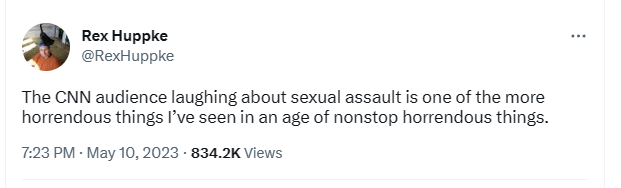
Instead, well, you saw it… (via Rex Hupke):

Sexual abuse, like the kind a jury just found Trump liable of? That’s a laugh line for these folks. Literally. They laughed during CNN’s town hall as Trump continued to likely defame E. Jean Carroll, the woman he was just found liable of defaming. 

The Jan. 6 domestic terrorist attack on the U.S. Capitol? Trump said he’ll swiftly pardon most of the now-imprisoned attackers, possibly even some of the Proud Boys who were convicted of seditious conspiracy, because they’re “great people.” And that brought applause from the crowd.

A rat-a-tat-tat string of lies about the “rigged election”? The crowd chuckled.

A lie about “finishing” the border wall he barely started? You know, the one Mexico didn’t pay for. The crowd applauded.

Lie, lie, lie, lie, lie. Laugh, applaud, chuckle, clap, cheer.

This was the moment we knew. 

We knew who Trump was of course. But last night showed us who we are and what’s about to happen. This is the GOP frontrunner. 

He is still the star who can do anything. And it will get worse.

“Listen,” wrote author Jared Yates Sexton, “if this town hall is any indication, and I think it is, the Trump Campaign of 2024 is going to be infinitely more disturbing and upsetting. I’ve spent a lot of time studying this man and his movement. I’m stunned by the depths here. This is . . . awful.”

**

More key reads:

Officer Michael Fanone:

Putting him onstage, having him answer questions like a normal candidate who didn’t get people killed in the process of trying to end the democracy he’s attempting to once again run, normalizes what Trump did. It sends a message that attempting a coup is just part of the process; that accepting election results is a choice; and that there are no consequences, in the media or in politics or anywhere else, for rejecting them.  

Tom Nichols in the Atlantic:

One might hope that Trump’s loss in New York would lead him to slink away in shame, but we now live in post-shame America. Instead, Trump will sit for a town hall on CNN tonight, where he will field questions as if he is a normal person running for office instead of a sexual abuser who incited sedition and violence against the government he is once again seeking to control.

Trump, of course, has the self-awareness of a traffic cone, and he is seemingly incapable of remorse. But CNN’s decision to move ahead with the event, as if nothing has happened, is disappointing. A more defensible position would have been to scrap the town-hall format and tell Trump that he is still invited to sit, one-on-one, with a CNN reporter. To present him to voters as just another candidate, however, is the very definition of normalizing his behavior.

Kara Swisher on Twitter:

A thread: As I said before, this was an impossible stage. But there were a few key moments where CNN could have taken back the con from Trump, even tho his cavalcade of lies made it very difficult and the audience was gamed in his favor. Here’s my quick thoughts as an interviewer.

In no particular order, you need to top Trump early and often, despite accusations of being unfair. For example, the obvious Nasty Woman retort would have been: “And a jury just yesterday unanimously called you a sexual predator. So here we are. Do you want to keep going here, because to quote Captain America, ‘I can do this all day.’” Make sure you can do it all day. (I can.)…

The Trump loving audience would jar anyone and it is easy to let it get to you. But it is also an opportunity to win some over, which is especially powerful if you are in someone’s home base. You only need one. 

So, when the crowd started snickering about E. Jean Carroll, for example, I would have stopped the interview cold, told Trump politely to sit still for a second, walked over to a man and a woman in the crowd who laughed and said: “Do you have a daughter? I do. She’s just three.”

Then, in the kindest tone possible, ask them if they said they did have a daughter or sister or wife, if they thought a man forcibly touching a woman’s genitals was actually funny, because I could not imagine they would since they did not look cruel. In any case, I would have interacted with the crowd a lot more, as most tend to fold when you pull individuals away from the mob. People don’t like to be found when they are acting badly and are usually embarrassed….

Amanda Carpenter in the Bulwark:

At times, it seemed like just another Trump rally. Even down to the moment where Trump turns the crowd against the press, as he did when he called Collins a “nasty person” to her face. (To her credit, she didn’t flinch.)

The event was a disaster for the reason that all of Trump’s live events are problematic: It’s much easier to spew lies on live television than it is for anyone to push back against them. Live coverage privileges the liar, no matter how nimble the interviewer.

But it all happened because CNN wanted a show. And they sure got one. No one should pretend it was some kind of public service.

The Daily Beast:

Throughout the 70-minute town hall, Trump refused to accept reality. When Collins tried to fact-check him, Trump just spoke over her and repeated his falsehoods. When she tried to correct Trump about his election lies, noting that Trump and his supporters lost more than 60 court cases, Trump simply kept lying.

“They found millions of votes on camera, on government cameras, where they were stuffing ballot boxes,” Trump falsely claimed.

Collins repeatedly tried to rectify the record, but Trump just kept forging ahead. When he said the “government cameras” showed “people going to 28 different voting booths”—something that never happened—Collins tried to correct him to no avail.

Halfway through the town hall, CNN staffers were acknowledging the event was a disaster for the truth.

“This is so bad,” one of CNN’s on-air personalities told The Daily Beast before the first commercial break. “I was cautiously optimistic despite the criticism… it is awful. It’s a Trump infomercial. We’re going to get crushed.”

“One of the worst hours I’ve ever seen on our air,” another CNN staffer told The Daily Beast.

Politico’s Playbook:

By the end of the night, the reviews were abysmal. The words “disaster” and “disgrace” were plastered all over Twitter….

Even network talent and talking heads participating on CNN panels following the event seemed shell-shocked. And sources inside the network confided their deep regrets.

“It was a complete disaster,” one CNN employee told Playbook, arguing that the format — specifically, stacking the audience with Trump supporters who cheered his lies — was a “strategic error.”

“It made it seem like CNN was endorsing that behavior,” the employee said. “Incredibly disappointing.”

Dan Rather has had an illustrious career as a journalist. He is now blogging at Steady. He was annoyed that CNN gave Donald Trump a platform to repeat his lies, to bulldoze the interviewer, and to play his usual demagogic role. After Trump was elected in 2016, CNN was widely criticized for giving Trump so much air time, more than any other network or cable station did. CNN sometimes covered his rallies live and at length, a courtesy not extended to other candidates. By some estimates, CNN gave Trump $2 billion of free on-air time.

He writes:

Donald Trump is a liar. He is a bigot, a misogynist, and a deadbeat. He has just been found by a jury to be a sexual abuser. He faces multiple other serious criminal investigations. He spurred a violent insurrection. He has repeatedly demonstrated complete disdain for the foundations of American democracy. The list of traits that makes this man unfit for the presidency fills pages.

And yet despite these debased qualities, or maybe (depressingly) because of them, he is immensely popular with many Americans. They cheer on his worst impulses. They bask in his hatred. They are fueled by the danger he poses to this nation. They have propelled him once again to be the favorite for the Republican presidential nomination.

And although many Americans don’t want to believe it, at this moment, he is a real threat to return to the presidency.

Among other things, Trump is and always has been a performer, and performers, no matter how vile their message, crave and thrive in the spotlight.

Last night, CNN gave Trump not only a spotlight, but a platform and a rabid crowd of cheering supporters. He made the most of it, as chiling and distressing as that might be.

Those who have made up their minds on Trump — those who love him and hate him — undoubtedly found plenty of justification for their opinions watching, ignoring, or doom scrolling his performance.

But what about the casual observer, the disaffected, the persuadable? Trump knows how to command a stage. He knows how to go on the attack. And the format CNN gift-wrapped for him allowed him to score a mark.

There is a school of thought that Trump is so toxic that the more America sees of him, the less they like him. And there were moments last night that could easily be plugged into effective attack ads against him. But what we should have learned from 2016 and the years that followed is that people as shameless as Trump do not measure their success by metrics of civility. It’s about demonstrating primal dominance, and that instinct delivered him the presidency once before. And even though he lost reelection, he remade American politics in ways with which we are still contending.

Trump played the part CNN surely knew he would play. What did they hope to get from normalizing this demeaning and dangerous demagogue? Ratings? Relevance? A tack to the mythic “middle” in line with new ownership and direction? Trying to become some new version of Fox News? Is any of this worth endangering the health and security of our country?

When CNN announced that they would give Donald Trump more than an hour of free prime time for a “town hall” (more like a town maul), it was clear what was going to happen.

Trump would lie, and bully, and insult, and lie, and lie, and lie some more. That is who he is. It is who he has always been.

There is no moderating a discussion with Trump. It is nearly impossible to engage in dialogue by asking probing follow-up questions. Because he will just ignore them. And lie and lie and lie. And this is especially true when he has an audience that seemed hand-picked to double as a campaign rally — hooting and hollering with approval the more he launched into his mendacious invective.

The press will have to figure out how to cover Trump as he stomps his way toward renomination. Liars should not be given open mics in formats where they can filibuster falsehoods unchallenged. Edit what he says with context. Do not sugarcoat how untrue many of his rantings are.

America rejected Trump in 2020. He is further weakened by the court cases he faces. But he remains a potent force. He will get his message out. Let us hope the press will analyze it, not amplify it.

The future of not only American journalism, but of America itself, will be shaped by how Trump is covered going forward.

Jim Hightower is a Texas populist who has observed the state’s hard rightward swing with dismay. In this post, he flays the profiteers who are attacking teachers and public schools. You should consider subscribing to his blog.

He writes here in honor of teachers:

I’m a child of privilege. Not the privilege of money (I come from a family of small-town working people). But it was my privilege to grow up in the public schools of Denison, Texas.

There I received the rich blessings of dedicated classroom teachers, a diverse student body, playground socialization, librarians, coaches, cafeteria and custodial workers, student politics, vocational training… and a deep appreciation for the unifying value of community and the Common Good.

That’s why I’m flabbergasted by today’s clique of corporate profiteers, theocratic zealots, and laissez-faire knuckleheads who’re lobbying furiously across the country to demonize, defund, and dismantle this invaluable social benefit. If ignorance is bliss, they must be ecstatic!

Public schools do have some real problems: Politicians constantly slashing education budgets, professional burnout created by understaffing and low pay, the devastating strain of a killer pandemic, and a new-normal of assault-rifle murders. But the profiteers, theocrats, and knuckleheads aren’t interested in those, instead focusing on what they say is the fatal flaw in public education: Teachers.

Yes, the claim is that diabolical educators are perverting innocent minds by teaching America’s actual history, showing students that the full diversity of humankind enriches our society, and presenting our Earth as something to be protected, not plundered. And worse – OMIGOSH – many classroom teachers are union members! So, teachers suddenly find themselves political pawns in the GOP’s culture war. “Our schools are a cesspool of Marxist indoctrination,” squawked Sen. Marco Rubio, and Donald Trump squealed that schools are run by “radical left maniacs” and “pink-haired communists.”

These right-wing Chicken Littles are demonizing America’s invaluable educators because they need someone for people to hate, providing cover for their unpopular plot to privatize education. But hate can easily backfire on hatemongers – and local teachers are a whole lot more popular than conniving politicos and profiteers.

Michael Hiltzik is a columnist for the LA Times. Although supposedly a business columnist, he writes about cultural topics that shape our world. In this column, he takes issue with media bias against older people. As a woman approaching her 85th birthday, I share his view. Fifty years ago, I was physically vigorous, not so much now. But I know so much more now than I did when I was 35. I dare say I’m less impetuous, less likely to be caught up in fads, less likely to be fooled. I would rather be led by a wise person than a relatively youthful fascist like DeSantis or an old liar like Trump. Age is of far less consequence than character and beliefs. (I was going to say “convictions,” but that word favors Trump, who is probably going to have at least one conviction by November 2024, an unenviable record.)

Hiltzik writes:

The cry is heard that America has become a “gerontocracy.” That’s supposed to be bad, it’s argued, because our superannuated political leadership is out of touch with the electorate and blocking younger and (theoretically) more vigorous and intellectually vibrant leaders from taking their hour upon the stage.

Earlier this year, CNN called President Biden’s age a “hot topic.” Leaving aside that news organizations such as CNN have helped make it a hot topic, the real question is whether it’s anything more than that. The answer is no….

The gerontocracy critique also threatens to deprive us of our most experienced leaders. Rather than remove poor performers from their sinecures, the current fixation on age could remove from our political and economic structures men and women who have spent decades learning about the world and offering the wisdom born of long professional experience.

The U.S. State Department, for example, requires its professional foreign service staff to retire at 65, “when they are at the height of their wisdom and knowledge,” publishing executive and author Michael Clinton observed recently, a rule he attributed to “toxic ageism.” Some corporations require their top officers to retire at 60 or 65, while most are still willing to make a professional contribution….

Claims that a political gerontocracy is somehow undermining American democracy — the theme of so much political navel-gazing— simply don’t hold water. They depend on the notion that as we grow older, our political outlooks coalesce into something at odds with the public interest. Where’s the evidence for that?

It’s widely noted that Biden and his likeliest presidential challenger, Donald Trump, would be the oldest president if either wins election in 2024. Biden would be 82 on inauguration day 2025 and Trump nearly 80. Does that tell us anything about how their administration would unfold? Obviously not.

Biden would almost certainly run on his record of creating remarkably inclusive and progressive White House policies and overseeing an economy of job growth and economic expansion in the wake of the pandemic; Trump, judging from his most recent speeches, would continue to flog personal grievances based on his groundless claims of fraud in his 2020 loss…

Some of our political leaders have notched their most outstanding achievement at an age decades later than when conventional wisdom holds that they should have retired.

The questions raised about the physical and mental capacity of Sen. Dianne Feinstein (D-Calif.), 89, didn’t apply to former House Speaker Nancy Pelosi (D-San Francisco), who compiled what might be the most successful record in House history by shepherding the Affordable Care Act through Congress in 2010 at 70 and Biden’s progressive policies to enactment after the age of 80….

As for whether older politicians are out of step with the younger members of the American electorate, Sen. Bernie Sanders (I-Vt.) didn’t seem to have much trouble connecting with youthful voters when he ran for president in the run-up to the 2016 election, at age 75.

Nor are there signs that the liberal Sen. Elizabeth Warren (D-Mass.) has lost the youth vote because of her age, 73. Senate Minority Leader Mitch McConnell (R-Ky.) and Sen. Charles E. Grassley (R-Iowa) seemed to have little trouble getting reelected in the last election, when they were, respectively, 80 and 89….

Quite plainly, the best guides to politicians’ adequacy are their words and actual performance in office. Few reach the highest echelons of American politics without leaving a record to be examined.

Republican presidential hopeful Nikki Haley, a former South Carolina governor, recently took a swipe at Biden’s age, remarking that he would be unlikely to live to the end of his next term.

Does that tell you anything about what she has to offer as an alternative? No; for that you’d have to delve into her positions on gun control (after a deadly school shooting in Nashville, she called for more metal detectors at schoolhouse doors but not more gun legislation) or abortion rights (she’s against them).

Who shows more mental acuity? Joe Biden, who occasionally stumbles over his words (apparently an artifact of his youthful stuttering)? Or Rep. Marjorie Taylor Greene (R-Ga.), who recently called for a “national divorce,” i.e., secession by red states, at the age of 48?

Does the age of Texas Republican Gov. Greg Abbott explain his boasting about signing a 2021 law allowing almost any Texan to carry a gun in public — “No license or training is needed,” he bragged in a tweet. Abbott was 63 at the time, a relative spring chicken. How has that worked out for his Texas constituents?

NBC News reported on the takeover of Woodland Park, Colorado, by rightwing extremists. Woodland Park is a mostly white district with 8,000 residents. Colorado is a bluish state. The governor is a Democrat, as are the two Senators. But the state, like other states, has deep red districts. The new board wasted no time in pushing their ideological agenda, which apparently concerns even some Republicans.

WOODLAND PARK, Colo. — When a conservative slate of candidates won control of the school board here 18 months ago, they began making big changes to reshape the district.

Woodland Park, a small mountain town that overlooks Pikes Peak, became the first — and, so far, only — district in the country to adopt the American Birthright social studies standard, created by a right-wing advocacy group that warns of the “steady whittling away of American liberty.” The new board hired a superintendent who was previously recalled from a nearby school board after pushing for a curriculum that would “promote positive aspects of the United States.” The board approved the community’s first charter school without public notice and gave the charter a third of the middle school building.

As teachers, students and parents began protesting these decisions, the administration barred employees from discussing the district on social media. At least two staff members who objected to the board’s decisions were later forced out of their jobs, while another was fired for allegedly encouraging protests.

These rapid and sweeping shifts weren’t coincidental — instead it was a plan ripped from the MAGA playbook designed to catch opponents off guard, according to a board member’s email released through an open records request.

“This is the flood the zone tactic, and the idea is if you advance on many fronts at the same time, then the enemy cannot fortify, defend, effectively counter-attack at any one front,” David Illingworth, one of the new conservative school board members, wrote to another on Dec. 9, 2021, weeks after they were elected. “Divide, scatter, conquer. Trump was great at this in his first 100 days.”

The leaders of the Woodland Park School District are enacting an experiment in conservative governance in the middle of a state controlled by Democrats, with little in the way so far to slow them down. The school board’s decisions have won some praise in heavily Republican Teller County, but opposition is growing, including from conservative Christians and lifelong GOP voters who say the board has made too many ill-advised decisions and lacks transparency.

“I think they look at us as this petri dish where they can really push all their agenda and theories,” said Joe Dohrn, a Woodland Park father who described himself as a staunch Republican and “very capitalistic.” “They clearly are willing to sacrifice the public school and to put students presently in the public school through years of disarray to drive home their ideological beliefs. It’s a travesty.”

Teachers grew particularly alarmed early this year when word spread that Ken Witt, the new superintendent, did not plan to reapply for grants that covered the salaries of counselors and social workers.

At Gateway Elementary School in March, Witt told staff members he prioritized academic achievement, not students’ emotions. “We are not the department of health and human services,” he said, as teachers angrily objected, according to two recordings of the meeting made by staff members and shared with NBC News.

Someone in the meeting asked if taxpayers would get a say in these changes, and Witt said that they already did — when they elected the school board.

Over the past two years, school districts nationwide have become the center of culture war battles over race and LGBTQ rights. Conservative groups have made a concerted effort to fill school boards with ideologically aligned members and notched dozens of wins last fall.

In Colorado, conservatives started making gains earlier because school board elections are held in off years. Woodland Park offers a preview of how quickly a new majority can move to reshape a district — and how those battles can ripple outward into the community. Some longtime residents say that the situation has grown so tense, they now look over their shoulder when discussing the school board in public to avoid confrontation or professional consequences.

David Rusterholtz, the board’s president, believes that chasm predates his election in November 2021.

“This division is much more than political — this is a clash of worldviews,” Rusterholtz said at a board meeting in January. He concluded his remarks with a prayer for the district: “May the Lord bless us and keep us, may His face shine upon us and be gracious to us…”

When asked to respond to criticism from school personnel and parents, Illingworth, the board’s vice president, replied in an email: “I wasn’t elected to please the teacher’s union and their psycho agenda against academic rigor, family values, and even capitalism itself. I was elected to bring a parent’s voice and a little common sense to the school district, and voters in Woodland Park can see I’ve kept my promises.”

As the school year winds down, many of the Woodland Park School District’s employees are heading for the exit, despite recently receiving an 8% raise. At least four of the district’s top administrators have quit because of the board’s policy changes, according to interviews and emails obtained through records requests. Nearly 40% of the high school’s professional staff have said they will not return next school year, according to an administrator in the district.

The board’s critics have pinned their hopes on the next election in November — when three of the five school board members are up for a vote — to claw back control of the community’s schools.

“This is an active case study on what will happen if we allow extremist policies to start to take over our public education system,” said David Graf, an English teacher who recently resigned after 17 years in the district. “And the scariest part about it, they knew that this community would bite on it.”

The new board approved the district’s first charter school without any public notice. The approval of Merit Academy was listed on the board agenda as “board housekeeping.”

The district’s teachers union complained in an email to middle school staff that the board’s action was “underhanded, and at worst illegal.” A parent sued, aiming to force the board to follow open meetings law. A trial court judge did not rule on the legality of the board’s actions but ordered the board to list agenda items “clearly, honestly and forthrightly.”

In response to the teachers’ complaints, Illingworth accused the union of attempting to organize a “coup,” and instructed then-Superintendent Mathew Neal to make “a list of positions in which a change in personnel would be beneficial to our kids” and “help the union see the wisdom in cooperation rather than conflict.”

Illingworth’s emails spread after parents obtained them through open records requests. Subsequent board meetings attracted boisterous crowds, as teachers accused board members of creating a hostile environment, while other community members spoke in favor of the board for supporting “school choice” and quoted Scripture. A handful of parents, including some lifelong Republicans, tried to organize a recall, but failed to get enough signatures to force a vote.

The district’s superintendent resigned and was replaced by Ken Witt, who had been active in conservative politics in Jefferson County, CO., schools.

A week before Witt was hired, on Dec. 13, students in a class called Sources of Strength, which is part of a national suicide prevention program, asked their teacher what should they know about him as the sole finalist for the superintendent job.

Sara Lee, a longtime teacher at Woodland Park High School, responded, “You should Google him.”

The students did, and they didn’t like what they learned.

They discovered that Witt, as president of the school board in neighboring Jefferson County, supported a plan in 2014 to ensure the district’s curricula would promote patriotism and not encourage “social strife.” Witt said students who protested the board policies at the time were “pawns” of the teachers union. After he and two other conservative members of the board were recalled, Witt became executive director of an organization that oversees charter, online and other schools and helped launch Merit Academy.

The teacher, Sara Lee, had taught high school for 25 years, 18 of them in the district. The board reassigned her to an elementary school to punish her for sharing information about Witt. She resigned and was promptly hired by another district.

Please open the link and keep reading. The story gets worse. Parents and teachers tried to persuade Witt to reapply for mental health funds to support counselors and social workers. He refused, insisting that such problems should be handled by parents, not schools. The district’s mental health supervisor, unable to persuade him to ask for the funds, submitted her resignation.

Hannah Natanson of the Washington Post reports that high schools are canceling productions of plays that might offend parents and members of the community. The “culture wars” have watered down which topics are permissible in 2023. Once again, we see how fear of offending anyone restricts freedom.

She writes:

The crew had built most of the set. Choreographers had blocked out almost all the dances. The students were halfway through rehearsals.


Then in late January, musical director Vanessa Allen called an emergency meeting. She told the cast and crew of 21 teens that their show — the musical “The 25th Annual Putnam County Spelling Bee” — was off.

Board members in Ohio’s Cardinal Local Schools disliked some features of “Spelling Bee,” Allen explained, including a song about erections, the appearance of Jesus Christ and the fact that one character has two fathers.


Sobs broke out across the room, said Riley Matchinga, 18, who was slated to play one of the leads: Logainne Schwartzandgrubenierre, the character whose fathers are gay. “Everyone’s faces just fell,” she said. “I could see everyone’s hearts melting, because we had worked so hard.”


Following a record-setting surge in efforts to change curriculums and ban books at schools nationwide, the education culture war has now reached the stage. The controversy in Cardinal is one of a number of recent instances in which school administrators have intervened to nix or alter school theatrical productions deemed objectionable — often because they feature LGBTQ characters or deal with issues of race and racism.

In Florida’s Duval County Public Schools this January, administrators stopped a production of the play “Indecent,” which details a love affair between two women, due to its “mature content.” In February, Indiana’s Northwest Allen County Schools pulled the plug on a production of the play “Marian” after adults raised the alarm over its depiction of a same-sex couple and a nonbinary character. And in March, Iowa’s South Tama County Community School District halted a performance of the play “August: Osage County” over fears that its treatment of suicide, addiction and racism was inappropriate for school-aged children.

Censorship of K-12 student productions has been happening for years, said Howard Sherman, managing director of the performing arts center at New York’s Baruch College. Since 2011, Sherman has tracked and fought efforts to end or edit school theater, assisting with roughly four dozen such cases, many of which never became public.


Still, this most recent wave of opposition seems more intense and organized than in past years, Sherman said, and more tightly focused on plays and musicals with LGBTQ content.


“Something that was being dealt with community by community has now, for some people, become a cause, ” he said. “You see politicians and officials enacting rules and laws which are incredibly onerous and designed to enforce a very narrow view of what students can see, read, learn or act on stage.”

The logic: if high school students see a play with gay characters, they might think being gay is normal, and they too might be gay. Counter-logic: the same students are far more likely to see movies, TV, and plays where people are not gay.

Robert Pondiscio of the American Enterprise Institute, a conservative think tank, defended censorship:

“You have to be mindful of local values,” Pondiscio said. “School has always existed to signal to children what is worth knowing and valuable, what we praise and condemn, and you have to apply that to musicals as well.”

In North Lebanon School District in Pennsylvania, the school board voted down a proposed performance of “The Addams Family,” which is the most frequently performed high school musical. The board thought it was too gloomy.

In Ohio, the students won a minor victory:

In Ohio’s Cardinal schools, Matchinga and her peers were determined to put on “Spelling Bee.” They bombarded the school board with emails questioning the cancellation.


Musical director Allen began revising the script to erase lines board members dubbed inappropriate — eliminating profanity, a line about “[beating] up” kids and replacing the phrase “fake mom” with “step mom,” according to school documents obtained by The Washington Post. She was assisted by Rachel Sheinkin, one of the writers of the 2005 Broadway musical. Ultimately, after requesting more than two dozen edits and receiving 12, the school board voted to let “Spelling Bee” proceed.

Alterations to Matchinga’s lines included replacing “and I’ve heard she is pro-choice/though still a virgin” with “but she will not make her choice/til she is certain.”


“I don’t think that really made a big effect on the story, and the show was still really funny and we got a ton of laughs,” Matchinga said. “Overall, I think it was okay.”

But in the future, the school board will have veto power on which plays may be staged.

Let’s see, “Mary Poppins” should pass muster. What else?

Jonathan Chait wrote an excellent article about the Republican plan to control, destroy, and censor American education. It is the cover story in this week’s New York magazine.

Chait and I have long disagreed about charter schools and will continue to do so. The article does not get into privatization, and the Republicans’ determination to divert public money to religious and private schools via vouchers. Nor does it touch on the growth and scandals of the charter industry. It’s hard to ignore privatization as a main line of attacking the public purpose of public schools, but Chait covers culture war issues only.

Chait says that, in the view of conservatives, left wing indoctrination occurs in religious schools, private schools, and charter schools, so choice will not solve the problem (the problem being the left wing capture of the culture). The answer, then, for the rightwing is to capture control of the institutions and replace left wing indoctrination with rightwing indoctrination.

The article digs into the Republican effort to destroy academic freedom, freedom to teach, freedom to learn, and to turn American schools and universities into purveyors of rightwing ideology. Two central figures in this conspiracy are Florida Governor Ron DeSantis and rightwing ideologue Chris Rufo.

Florida is indeed the model for the Republican attack on education. It is here that the Governor boasts about his Stop WOKE Act, which blocks teaching about topics that might cause discomfort (especially teaching factually accurate accounts of racist brutality in American politics); his Don’t Say Gay Act (which eliminates any instruction about homosexuality in K-3, recently amended to grades K-8); his successful capture of tiny progressive New College and to turn it into the Hillsdale of the South; his intention to take control of the state’s public colleges and universities, eliminate tenure, and purge progressive professors; and his encouragement of censorship of books about race, racism, and gender issues. Add to these DeSantis’ demonizing of the minuscule number of transgender students, as well as his bullying of drag queens, and you have a major state that has embraced fascism and scapegoating of powerless minorities. Florida is also notable for the billions it spends on lightly regulated charters and unregulated, unaccountable vouchers.

Readers of this blog are familiar with DeSantis’ war on public schools and higher education, and his control of curriculum and leadership. I can’t think of another state where the Governor has moved so aggressively to control every aspect of public education. Others have recognized the limits of their power. DeSantis does not.

We also know that Florida recently enacted universal vouchers, offering to subsidize the tuition of rich students. And that the wife of the Republican Speaker of the House, then state education commissioner, Richard Corcoran, now president of New College, started a charter. And that many legislators are financially tied to charters.

This article is about the culture wars, however, not privatization.

Chait writes:

Republicans have begun saying things about American schools that not long ago would have struck them as peculiar, even insane. Senator Marco Rubio of Florida has called schools “a cesspool of Marxist indoctrination.” Former secretary of State Mike Pompeo predicts that “teachers’ unions, and the filth that they’re teaching our kids,” will “take this republic down.” Against the backdrop of his party, Donald Trump, complaining about “pink-haired communists teaching our kids” and “Marxist maniacs and lunatics” running our universities, sounds practically calm.

More ominously, at every level of government, Republicans have begun to act on these beliefs. Over the past three years, legislators in 28 states have passed at least 71 bills controlling what teachers and students can say and do at school. A wave of library purges, subject-matter restrictions, and potential legal threats against educators has followed.

Education has become an obsession on the political right, which now sees it as the central battlefield upon which this country’s future will be settled. Schoolhouses are being conscripted into a cataclysmic war in which no compromise is possible — in which a child in a red state will be discouraged from asking questions about sexual identity, or a professor will be barred from exploring the ways in which white supremacy has shaped America today, or a trans athlete will be prohibited from playing sports…

While there have been political battles over the schools for many years, but this controversy is different. Republicans are going for the jugular. They believe that “the left” has taken over the nation’s educational institutions and is determined to indoctrinate the next generation to despise their own country. Nothing could be more ridiculous, but facts don’t get in the way of their culture war.

He writes:

The Republican Party emerged from the Trump era deeply embittered. A large share of the party believed that Democrats had stolen their way back into power. But this sentiment took another form that was not as absurd or, at least, not as clearly disprovable. The theory was that Republicans were subverted by a vast institutional conspiracy. Left-wing beliefs had taken hold among elite institutions: the media, the bureaucracy, corporations, and, especially, schools.

This theory maintains that this invisible progressive network makes successful Republican government impossible. Because the enemy permanently controls the cultural high ground, Republicans lose even when they win. Their only recourse is to seize back these nonelected institutions….

“Left-wing radicals have spent the past 50 years on a ‘long march through the institutions,’” claims Manhattan Institute fellow and conservative activist Chris Rufo, who is perhaps the school movement’s chief ideologist. “We are going to reverse that process, starting now.”

Many institutions figure in Republicans’ plans. They are developing proposals to cleanse the federal workforce of politically subversive elements, to pressure corporations to resist demands by their “woke employees,” and to freeze out the mainstream media. But their attention has centered on the schools. “It is the schools — where our children spend much of their waking hours — that have disproportionate influence over American society, seeding every other institution that has succumbed to left-wing ideological capture,” writes conservative commentator Benjamin Weingarten.

Republicans are afraid that the liberal bias of schools and colleges is turning their children into liberals, intent on advancing social justice. They feel a sense of urgency about gaining control of these agencies of indontrination.

DeSantis’ approach is straightforward: Taxpayers pay for schools. Why shouldn’t they control them? Why shouldn’t they tell them what to teach and what not to teach?

Chait errs in describing Florida’s efforts to restrict the accurate teaching of African American history. He writes:

It is possible for legislatures to restrict some of the pedagogical fads of recent years without preventing children from learning unvarnished historical truths about slavery, reconstruction, Jim Crow, and its aftermath. Reports have described bans on lessons that make students feel guilty, when they have merely restricted lessons that instruct them to feel guilty, a reasonable thing to ask. Commentators on the internet likewise depicted Florida as banning the teaching of African American history, when in fact the state merely objected to elements of the AP African American History curriculum, ultimately resulting in a revised version.

This is understating the active role that the DeSantis team played in squashing the brutal facts about African American history in Florida and the U.S. The Stop WOKE Act banned teaching “critical race theory,” which most people can’t define but assume that it refers to systemic racism. The DeSantis team has banned textbooks in math and social studies that showed any interest in “social justice.”

DeSantis and his education commissioner didn’t “merely object” to parts of the AP African American History course, they threatened to exclude the AP course and test from the state’s schools altogether, a move that would likely be followed by other deep red states. This hits the College Board where it hurts, in their revenues. DeSantis has objected not only to CRT, but to “social-emotional learning,” which he sees as indoctrination but which typically means exercises in perseverance, self-control, and other workaday approaches to collaboration and respect for others. Like what I learned in elementary school many decades ago.

Are there teachers who go too far in imposing their own beliefs (from both the left and the right)? Surely. But Chait observes:

A broader problem with the wave of conservative legislation is that it is responding to a wildly hyperbolic version of reality. In a very large country with a fragmented education system, there are going to be plenty of examples of outrageous or radical teaching in the schools on a daily basis without necessarily indicating anything about the system’s overall character. As conservatives grew alarmed about left-wing teachers, their favorite media sources started curating examples of it to stoke their outrage.

DeSantis projects Florida as a model for the nation, and he looks to Hungary as a model for Florida. Its leader Viktor Orban has tamed the universities by controlling them. Chris Rufo recently spent a month in Hungary, learning how Orban has silenced the left.

Orbán’s example has shown the government’s power over the academy can be absolute. DeSantis is simply the first Republican to appreciate the potential of this once-unimaginable use of state power to win the culture wars. Even before DeSantis’s plan has passed, Republicans in North Carolina, Texas, and North Dakota rushed out bills to eliminate tenure for professors.

I urge you to read the article in full. Aside from his leaving out privatization as the keystone of the Republican attack on public schools, the article fails to mention the big money behind the culture wars and privatization. DeVos, Walton, Koch, Yass. They are an important part of the story. And there are many more (I have a long list of billionaires, foundations, and corporations funding privatization in my book Slaying Goliath.)

Chait’s incisive analysis is a good primer for the elections of 2024. Implicit are the many reasons why Democrats must be prepared to defend teachers and professors, to protect both schools and universities from the takeovers planned by Republican legislators, to gear up for the fight against censorship, to resist incipient fascism, and to hold the line for our democratic principles.