Archives for category: Cruelty

If you read one article today, make it this one.

Kathryn Joyce is an outstanding journalist who has written several excellent articles about the far-right conspiracy to destroy public education. In this important article, published by both the Hechinger Report and Vanity Fair, she examines the rightwing takeover of public schools in Sarasota, Florida, by the extremist Moms for Liberty and their hero Governor DeSantis.

Joyce begins:

SARASOTA COUNTY, Fla. — On a Sunday afternoon in late May 2022, Zander Moricz, then class president of Sarasota County’s Pine View School, spent the moments before his graduation speech sitting outside the auditorium, on the phone with his lawyers. Over the previous month, the question of what he’d say when he stepped to the podium had become national news. That March, Florida Governor Ron DeSantis had signed the Parental Rights in Education Act, quickly dubbed the “Don’t Say Gay” law for its ban on all mention of gender identity and sexuality in K–3 classrooms and restriction of those discussions in higher grades as well. Moricz, a student LGBTQ+ activist, had led several protests against the act that spring and joined a high-profile lawsuit against the state. In early May, he charged on Twitter that Pine View’s administration had warned that if he mentioned his activism or the lawsuit at graduation, his microphone would be cut. (In a statement released last year, the school district confirmed that students are told not to express political views in their speeches.)

In the tumultuous weeks leading up to the ceremony, Pine View — Sarasota’s “gifted” magnet institution, consistently ranked one of the top 25 public high schools in the country — was besieged with angry calls and news coverage. Moricz stayed home for three weeks, he said, thanks to the rvolume of death threats he received, and people showed up at his parents’ work. When a rumor started that Pine View’s principal would have to wear a bulletproof vest to graduation, he recalled, “the entire campus lost their minds,” thinking “everyone’s going to die” and warning relatives not to come. His parents worried he’d be killed.

But after all the controversy, graduation day was a success. Moricz, now 19, delivered a pointedly coded speech about the travails of being born with curly hair in Florida’s humid climate: how he worried about the “thousands of curly-haired kids who are going to be forced to speak like this” — like he was, in code — “for their entire lives as students.” Videos of the speech went viral. Donations poured into Moricz’s youth-led nonprofit. That summer, he left to study government at Harvard.

Half-a-year later though, when Moricz came home, Sarasota felt darker.

“I’m wearing this hat for a reason,” he said when we met for coffee in a strip mall near his alma mater in early March. “Two years ago, if I was bullied due to my queerness, the school would have rallied around me and shut it down. If it happened today, I believe everyone would act like it wasn’t happening.”

These days, he said, queer kids sit in the back of class and don’t tell teachers they’re being harassed. A student at Pine View was told, Moricz said, that he couldn’t finish his senior thesis researching other states’ copycat “Don’t Say Gay” laws. (The school did not respond to a request for comment through a district spokesperson.) When Moricz’s nonprofit found a building to house a new youth LGBTQ+ center — since schools were emphatically no longer safe spaces — they budgeted for bulletproof glass.

“The culture of fear that’s being created is doing exactly what it’s supposed to do,” he said. And much of it was thanks to the Sarasota County School Board.

Over the last two years, education culture wars have become the engine of Republican politics nationwide, with DeSantis’s Florida serving as the vanguard of the movement. But within the state, Sarasota is more central still.

Its school board chair, Bridget Ziegler, cofounded the conservative activist group Moms for Liberty and helped lay the groundwork for “Don’t Say Gay.” After a uniquely ugly school board race last summer, conservatives flipped the board and promptly forced out the district’s popular superintendent. In early January, when DeSantis appointed a series of right-wing activists to transform Florida’s progressive New College into a “Hillsdale of the South” — emulating the private Christian college in Michigan that has become a trendsetting force on the right — that was in Sarasota too. In February, DeSantis sat alongside Ziegler’s husband and Moms for Liberty’s other cofounders to announce a list of 14 school board members he intends to help oust in 2024—Sarasota’s sole remaining Democrat and LGBTQ+ board member, Tom Edwards, among them. The next month, Ziegler proposed that the board hire a newly created education consultancy group with ties to Hillsdale College for what she later called a “‘WOKE’ Audit.” (Ziegler did not respond to interview requests for this article.)

The dizzying number of attacks has led to staffing and hiring challenges, the cancelation of a class, a budding exodus of liberals from the county, and fears that destroying public education is the ultimate endgame. In January, Ziegler’s husband, Christian — who chairs the Florida Republican Party — tweeted a celebratory declaration: “SARASOTA IS GROUND ZERO FOR CONSERVATIVE EDUCATION.”

It wasn’t hyperbole, said Moricz. “We say that Sarasota is Florida’s underground lab, and we’re its non-consenting lab rats.”

For as long as Florida has been grading schools and school districts — a late 1990s innovation that helped spark the “school reform” movement — Sarasota, with its 62 schools and nearly 43,000 students, has enjoyed an “A” rating. Perched on the Gulf Coast just south of Tampa, the county’s mix of powder-soft beaches and high-culture amenities — including an opera house, ballet and museums — have made it a destination for vacationers and retirees. And that influx has made Sarasota one of the richest counties in the state.

Since many of those retirees, dating back to the 1950s, have been white Midwestern transplants, it’s also made Sarasota a Republican stronghold and top fundraising destination for would-be presidential candidates. Both the last and current chairs of the state GOP — first State Senator Joe Gruters and now Christian Ziegler — live in the county. Sarasota arguably launched Donald Trump’s first presidential campaign, thanks to Gruters’s early support. These days, though, Sarasota isn’t just conservative, but at the leading edge of Florida’s turn to the hard right.

Partly that’s thanks to the Zieglers, who have become one of Florida’s premier power couples, with close ties to both Trump world and the DeSantis administration and a trio of daughters enrolled in local private schools. As founder of the digital marketing company Microtargeted Media, Christian did hundreds of thousands of dollars of work for pro-Trump PACs in 2021, the Sarasota Herald-Tribune reported. After being elected state GOP chair this February, he announced his goal was “to crush these leftist in-state Democrats” so thoroughly that “no Democrat considers running for office.” Although Bridget stepped down from Moms for Liberty shortly after its founding, she subsequently helped draftFlorida’s Parents’ Bill of Rights, which helped pave the way for DeSantis’s 2021 ban on mask mandates and ultimately last year’s “Don’t Say Gay” law. In 2022, the right-wing Leadership Institute hired her as director of school board programs, and built a 6,000-square-foot headquarters in Sarasota to serve as a national hub for conservative education activism. This winter, DeSantis also appointed her to a new board designed to punish the Disney Company for criticizing his anti-LGBTQ laws….

Last year, when Ziegler was up for reelection and two other board members were terming out, she ran as a unified slate with former school resource officer Tim Enos and retired district employee Robyn Marinelli. The candidates drew support from both DeSantis’s administration — which unprecedentedly endorseddozens of school board candidates across the state — and local members of the far-right. A PAC partially funded by The Hollow’s owner campaigned for the “ZEM” slate (a shorthand for the candidates’ surnames) by driving a mobile billboard around the county, calling one of their opponents a “LIAR” and “BABY KILLER” because she’d once worked for Planned Parenthood. Proud Boys hoisted ZEM signs on county streets and a mailer was sent out, castigating the liberal candidates as “BLM/PSL [Party of Socialism and Liberation]/ANTIFA RIOTERS, PLANNED PARENTHOOD BABY KILLERS, [who] WANT GROOMING AND PORNOGRAPHY IN OUR SCHOOLS.” (Enos and Marinelli did not respond to requests for comment for this article.)

Open the link and read all of the article. It is a devastating article about the takeover of the school board by hateful extremists whose tools are fear and divisiveness.

Jeff Bryant writes often about education. He lives in North Carolina. In this article, he tries to solve the mystery of why Democratic state legislator Tricia Cotham switched sides and joined the Republican Party, giving them a supermajority in both houses of the General Assembly?

Cotham was a Democrat who had campaigned in promises to oppose school vouchers; to defend LGBT rights; and support abortion rights.

Once she gave the Republicans the decisive vote in the lower house, the Republicans had a veto-proof majority and were in a position to override any veto by Democratic Governor Roy Cooper.

Cotham, the new Republican, reversed her vote on everything she campaigned for or against. She supported Republicans’ efforts to reduce abortion rights; she endorsed school vouchers; and she sided with Republicans in their attack on trans youth.

In other words, she betrayed the people who voted for her and cast her lot with the hard-right Republicans who have aligned themselves with anti-progressive, anti-liberal, anti-Democrat policies.

Why? She said the Democrats were mean to her. She said they ignored her. She said she didn’t get the committee assignments she wanted. Are these good reasons to join forces with a party that has sought to destroy public education, demoralize teachers, and gerrymander the state to protect its advantages?

None of this made sense. A person doesn’t change their fundamental values because of hurt feelings.

Jeff investigated and determined that her decision was transactional. What did she get in exchange for double-crossing her constituents and her colleagues? Read his article to find out.

If you read only one article today, read this one. It’s powerful and poignant. The article was written by Forrest Wilder and appears in the Texas Monthly, a terrific publication.

To understand why Republican legislators from rural districts helped to defeat vouchers in Texas, read this article about the schools of Fort Davis in Jeff Davis County in rural West Texas. The superintendent is a bedrock conservative who is dead set against vouchers. His schools are on the verge of bankruptcy due to the state’s Byzantine school-finance system. The state government doesn’t care. At the end, you will understand Governor Abbott’s long-term goal: to eliminate property taxes and completely privatize education.

Texas doesn’t have a mile-high city, but Fort Davis comes close at 4,892 feet. The tiny unincorporated town is nestled in the foothills of the Davis Mountains, where bears and mountain lions and elk stalk among pine-forested sky islands. Fort Davis is the seat of Jeff Davis County, whose population of 1,900 is spread among 2,265 square miles, 50 percent bigger than Rhode Island. The sparsely populated desert country of Mongolia has nearly seven times the population density of Jeff Davis County. Odessa, the nearest city to Fort Davis, is two and a half hours away. The state Capitol is six and a half.

For Graydon Hicks III, the far-flunged-ness of Fort Davis is part of its appeal. He likes the high and lonesome feel of his hometown—the “prettiest in Texas,” he says. But these days, it has never felt further from the state’s political center of gravity.

For years, Hicks, the superintendent of Fort Davis ISD, has been watching, helplessly, as a slow-motion disaster has unfolded, the result of a flawed and resource-starved public-school finance system. Over the last decade, funding for his little district, which serves just 184 K–12 students, has sagged even as costs, driven by inflation and ever-increasing state mandates, have soared. The math is stark. His austere budget has hovered around $3.1 million a year for the past six years. But the state’s notoriously complex school finance system only allows him to bring in about $2.5 million a year through property taxes.

Hicks has hacked away at all but the most essential elements of his budget. More than three-quarters of Fort Davis’s costs come in the form of payroll, and the starting salary for teachers is the state minimum, just $33,660 a year. There are no signing bonuses or stipends for additional teacher certifications. Fort Davis has no art teacher. No cafeteria. No librarian. No bus routes. The track team doesn’t have a track to train on.

But Hicks can’t cut his way out of this financial crisis. This school year, Fort Davis ISD has a $622,000 funding gap. To make up the difference, Hicks is tapping into savings. Doug Karr, a Lubbock school-finance consultant who reviewed the district’s finances, said Fort Davis ISD was “wore down to the nub and the nub’s all gone. And that pretty much describes small school districts.”

“I am squeezing every nickel and dime out of every budget item,” Hicks said. “I don’t have excess of anything.” When I joked that it sounded like he was holding things together with duct tape and baling wire, he didn’t laugh. He said: “I literally have baling wire holding some fences up, holding some doors up.”

The district’s crisis comes at a time when the state is flush with an unprecedented $33 billion budget surplus. Hicks is a self-described conservative, but he thinks the far right is trying to destroy public education. For years, the state has starved public schools of funding: Texas ranks forty-second in per-pupil spending. And yet Governor Greg Abbott is spending enormous political capital on promoting a school voucher plan, which would divert taxpayer funds to private schools. Public education, Abbott has repeatedly said, will remain “fully funded,” though public-education spending is lower now than when he took office in 2015, and the Legislature recently passed a $321.3 billion budget with no pay raise for teachers and very little new funding for schools. Unable to get his voucher plan through the regular legislative session, Abbott is threatening to call lawmakers back to Austin until he gets his way.

Lieutenant Governor Dan Patrick, long a champion of vouchers, is backing legislation that would attempt to appease rural Republican legislators—a bloc long wary of vouchers—by offering $10,000 to districts that lose students to private schools. Hicks can barely contain his anger when he hears such talk. He has been lobbying state leaders for years to fix the crippling financial shortages that plague districts like his. “Take your assurances and shove ’em up your ass,” he says, before softening a bit. “I’m so tired. I’m so frustrated. We have tried. I have fought and fought and fought.”

With each passing month, his rural district inches closer to financial ruin. If nothing changes by next summer or fall, Fort Davis will have depleted its savings. He doesn’t know the exact day that his school district will go broke, but he can see it coming.

It’s easy enough to grasp the basic problem in Fort Davis. But what’s going on beneath the surface is another story.

During my twenty years of reporting on Texas politics, I’ve often heard that only a handful of people in the state understand the school-finance system, with its complicated formulas, allotments, maximum compressed tax rates, guaranteed yields, and “golden pennies.” A former colleague of mine, who once spent months trying to make sense of the topic, warned me against writing about it. Karr, the school finance consultant, compares the process of making sense of our public education funding to encountering a fire at a roadside cotton gin on some lonely West Texas highway. “You drive off into that smoke and you might never drive out,” he said. “You might end up getting killed.”

A thorough explanation of the system is the stuff of graduate theses, but the broad strokes are straightforward enough. How a school district is funded begins with two key questions: How much money is the district eligible for? And who pays for it?

Here it’s helpful to use a venerable school finance analogy: buckets of water. The size of a school district’s bucket—how much money it’s entitled to—is largely determined by the number of students in attendance. Every district receives at least $6,160 per pupil, an amount known as the basic allotment, an arbitrary number dreamed up by the Legislature and changed according to lawmakers’ whims.

At this point in the article, Wilder goes into the intricacies of school finance in Texas. Very few people understand it. All you need to know is that some districts are lavishly funded while others, like Fort Davis, are barely scraping by and may go bankrupt.

Hicks is not alone in thinking the opaqueness is intentional. “They make it just as complicated as they can,” he said of state officials. “Because how do you explain something so complicated to the average voter?” In other words, if constituents can’t easily grasp the perplexing and unnecessarily knotty framework, it’s tougher to hold officials accountable for budget decisions.

Though the spreadsheets may be head-spinning, they tell a story. In a state where some wealthy suburban communities build $80 million high school football stadiums, Fort Davis ISD is one of many rural communities literally struggling to keep the lights on.

I first heard from Hicks in March 2021, when he emailed state officials and journalists with a dire message: “What, exactly, does the state expect us to do? What more can we do? What more do our children need to be deprived of? At what point does our community break?” Hicks has received few answers, even as his situation has grown more desperate.

When I visited him in April, we met in his office, where he keeps a book on Texas gun laws, a photo of his West Point 1986 graduating class (which included Donald Trump’s secretary of state Mike Pompeo), and a list of quotes from General George Patton (“Genius comes from the ability to pay attention to the smallest details”). Hicks, who’s stout and serious and talks in a sort of shout-twang because of partial hearing loss, wore a cross decorated in the colors of the American flag. He was eager to show me the fine line he walks between fiscal prudence and dilapidation. The first lesson came as he stood from his desk and I noticed the holstered handgun on his hip. The district, he explained, can’t afford to hire a school security officer, so he and eleven other district employees carry firearms.

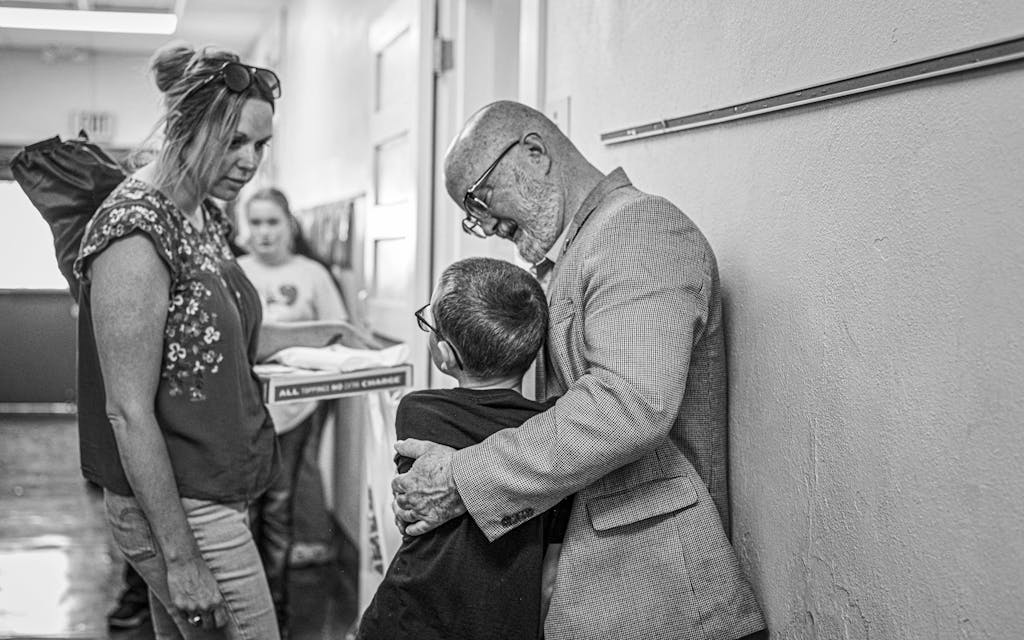
His family has been in the area since the 1870s, when federal soldiers still pursued Comanche and Apache from the town’s namesake garrison. His great uncle was one of the first superintendents of Fort Davis ISD. (At one point, Hicks showed me a copy of his great-uncle’s 1942 master’s thesis, “The Early Ranch Schools of the Fort Davis Area.”) Later, as we were walking around campus, Hicks’s ten-year-old grandson, a thin fourth-grader wearing blue-rimmed glasses and blue jeans tucked into a pair of cowboy boots, ran up to Hicks and gave him a hug.

Fort-Davis-Superintendent-Graydon-Hicks-grandson-Dirks-Anderson-Elementary-School-BW
Superintendent Hicks hugs his grandson in the hallway at Dirks-Anderson Elementary School in Fort Davis.Photograph by Maisie Crow

Both the elementary school and the high school—where Hicks graduated in 1982—were built in 1929, Hicks explained. Walking through their timeworn hallways is to step back in time. In places, the plaster is flaking off the original adobe walls. The elementary school gym floor is bubbling up because of a leak under the foundation. The wooden seats in the high school auditorium have never been replaced. The urinals in the elementary school are original too. The newest instructional facility, a science lab, was built in 1973. In the summer, Hicks mows the football field, the same one he played on five decades ago. “Every bit helps,” he said.

The funding challenges create all manner of ripple effects. Hicks has trouble recruiting and retaining teachers, and some students drift away from school without extracurriculars to hold their interest. “You lose teachers, then you start losing kids, and then your funding gets worse,” he said. “It’s a circle-the-drain kinda thing. And it’s really speeding up for Fort Davis.”

The first problem is the size of the district’s bucket. For the last decade, TEA has calculated that Fort Davis’s Tier I annual allotment is between $2 million and $2.5 million, well short of its already spartan $3.1 million budget.

And then there’s the matter of how that bucket is filled. In the 2011–2012 school year, the state covered two-thirds of Fort Davis’ entitlement, about $2.1 million. Today, it chips in about $150,000, a 93 percent decrease. How to explain that change?…

In June 2019, the Big Three figures in state government—Abbott, Patrick, and then–House Speaker Dennis Bonnen—gathered at an elementary school in Austin for an almost giddy bill-signing ceremony. As a bipartisan group of lawmakers watched, Abbott signed into law House Bill 3, an $11.6 billion package of property tax cuts and education funding that had received near-unanimous support in both the House and Senate, a rarity in the highly polarized Legislature. “This one law does more to advance education in the state of Texas than any law that I have seen in my adult lifetime,” said Abbott.

For almost a year, an appointed commission of experts had met to discuss how to overhaul the school-finance system, issuing a report in December 2018 that called on the Lege to “redesign the entirety of our state’s funding system to reflect the needs of the 21st century.” HB 3 was the by-product of that prompt. Lawmakers rejiggered many of the system’s outdated formulas, offered pay raises to teachers, fixed some of the most glaring inequities, and reduced the amount of money recaptured by the state from property-wealthy districts. Most important, HB 3 represented a much-needed infusion of cash for struggling schools. The basic allotment was raised from $5,140 to $6,120 per student.

But HB 3 also exacerbated disparities among property-wealthy and property-poor districts. Because of changes to the way Tier II enrichment funding works, some communities were able to cut tax rates and generate significant new revenues from their tax base. For others, a minority of districts, HB 3 actually created new problems. Around 10 percent of districts saw a decrease in formula funding. This year, Alpine has $220,000 less than it would have had under the old system, even as some of the richest districts in the state—tiny West Texas communities with lots of oil wealth—saw their funding explode. Rinehart contrasts Alpine, which has almost no mineral wealth, with Rankin ISD, 130 miles northeast in the Permian Basin oil patch. While Alpine’s funding went down 2 percent, Rankin’s went up 339 percent. Even though Rankin is projected to return close to $100 million in recapture payments to the state this year, the district is fabulously wealthy. “Alpine’s budget is $10 million,” Rinehart points out. “Rankin’s is $14 million. We educate a thousand kids and they educate three hundred kids. So they are a third of our size and have a budget 40 percent larger than ours.”

Rinehart doesn’t begrudge Rankin’s wealth—she recently served as assistant superintendent there—but uses the Alpine–Rankin comparison as a “wild” example of how HB 3 exacerbated inequities, making the rich richer and the poor poorer.

Hicks, too, has noticed. “Rankin just built a whole new school,” he told me. “They got a new fieldhouse, a new gym. Two new science labs. A turf practice field, a turf game field. A new track, a new stadium. And my buildings were built in 1929.” Rankin is planning to build ten new “teacherages”—district-funded housing for teachers, important to attracting and retaining talent in areas with scant or affordable residences.

Jeff Davis County, on the other hand, has no oil and gas and very little industry; any school debt would thus be borne by homeowners through bonds. Hicks’s district has never issued a bond, in part because it would be unlikely to pass; the voters wouldn’t support a tax increase. The school’s ag barn was built in 2019 with local donations. The band program, suspended for nine years as a cost-saving measure, was only revived in 2023 after a philanthropist left his estate to the school.

To be sure, Alpine and Fort Davis are outliers. Most districts saw an immediate boost to their finances from HB 3, and advocates celebrated a meaningful investment in public education after $5.4 billion in devastating cuts in 2013. But even for those districts, the sugar rush from HB 3 didn’t last long. According to Chandra Villanueva, the director of policy and advocacy at the progressive nonprofit Every Texan, the $1,000 increase in the basic allotment was “roughly enough to cover one year of inflation….”

The property tax system and the school finance system are inextricably linked, Rube Goldberg–style. Twist a dial here and a light will come on over there. Slip a gear here and spring a leak there. As state lawmakers have prioritized tax cuts over public education funding, the trade-offs have grown clearer. This year represents a potential turning point. But rather than trying to solve the problem using the $33 billion budget surplus—a generational bonanza—Abbott and Patrick have overwhelmingly focused their attention on property tax cuts and a school-voucher plan loathed by almost everyone in public education, in part because it would threaten to strip even more funding from school districts.

The just-completed regular session was a bloodbath. The 88th Legislature began in January with the governor and lieutenant governor promising to pass a transformative voucher program and a record-setting $17 billion in property-tax cuts. Funding for public education, often a banner issue, was scarcely discussed. Even the House, the friendlier chamber toward public education, only proposed raising the basic allotment by $140, from $6,160 to $6,300 per student—far less than the $1,500 increase needed to keep up with inflation since 2019, according to the Texas American Federation of Teachers. But in the end, teachers and public schools got virtually nothing.

Teachers and administrators were stunned. Zeph Capo, the president of Texas AFT, called it a “joke.” HD Chambers, the executive director of the Texas School Alliance, accused Patrick and Abbott of playing a “hostage game” with Texas’s teachers and public school students by tying education funding to vouchers. “It’s pretty simple. The governor and Senate says, ‘If you don’t give us the kind of vouchers we want, we’re not giving you any money.’” The House refused to budge, and the regular session concluded without a deal on property tax relief, vouchers, and other GOP priorities.

Now, the governor has promised to convene multiple special sessions to take up the unresolved issues. The first special session began three hours after the regular one ended, and effectively wrapped up less than 24 hours later, with the House rejecting the Senate property-tax plan, passing its own program consisting solely of property-tax compression, and then abruptly adjourning. Abbott threw his support behind the House plan. The message to the Senate was clear: take it or leave it. If the Senate yields, the House version would push some school districts down to as low as $0.60 per $100, with no new source of revenue to backfill for the reduced funding in case of a bad economy.

Abbott has said his goal is to completely eliminate the main school property tax. In such a scenario, Texas’s thousand-plus school districts would be at the mercy of the Legislature for funding—a troubling scenario, says Villanueva. She suspects vouchers would then become inevitable. “At that point, it’s like, ‘You know what, we don’t have the money to fund schools. Everyone take five thousand bucks, figure it out for yourselves.’”

That day, if it ever comes, may still be far off. But the education system is in crisis right now, and unlike previous hard times, the state is flush with cash. The pain, Chambers says, is being intentionally inflicted by Abbott and Patrick. “Because of this one pet project that the governor has”—vouchers—“they are purposely creating a financial environment where every school district in Texas is being set up to fail.”

The result is that Texas schools, already operating on “shoestring budgets,” will have a harder time attracting and retaining educators, said Josh Sanderson, the deputy executive director of the Equity Center, a nonprofit that represents six hundred Texas school districts. They will run up deficits. They may have to cut extracurriculars and athletic programs. Some, like Fort Davis, may become insolvent and be forced to consolidate with another district, an often painful process.

As we were sitting in his red pickup with the engine idling outside his office, Hicks told me that he’d given up on lobbying the Legislature. He mentioned again that Patrick and other GOP lawmakers are trying to destroy public education by using vouchers to privatize schools, and he said that most other politicians “don’t give a shit about West Texas.” But for the time being he was still fighting: writing op-eds, firing off plaintive missives, asking concerned citizens to contact their legislators.

Toward the end of our visit, I asked Hicks what’s going to happen to his schools. “I don’t know,” he said. “I’m not patient enough to spend time with assholes in Austin, and I’m not rich enough to buy any votes.” TEA has suggested consolidating with another district—most likely nearby Valentine ISD—but Hicks said this would harm both Fort Davis and the other district.

He seemed resigned to his role as a Cassandra warning of impending doom, destined to be ignored. He reminded me that his grandson goes to school here, and that the painful road ahead feels both personal and existential. “If you don’t have a school,” he said, “you don’t have a community.”

Two months later, Hicks called me with some news. He’d decided to resign this summer, joining the mass exodus of school leaders that have fled the profession in the past few years. To anyone who closely follows public education in Texas, his reasoning was tragically familiar: He said he was too tired to fight anymore.

Timothy Snyder is a historian at Yale Univerity who has written extensively on European history and threats to democracy. This essay is a fascinating history of Ukraine, which was published in The New Yorker.

He writes:

When Vladimir Putin denies the reality of the Ukrainian state, he is speaking the familiar language of empire. For five hundred years, European conquerors called the societies that they encountered “tribes,” treating them as incapable of governing themselves. As we see in the ruins of Ukrainian cities, and in the Russian practice of mass killing, rape, and deportation, the claim that a nation does not exist is the rhetorical preparation for destroying it.

Empire’s story divides subjects from objects. As the philosopher Frantz Fanon argued, colonizers see themselves as actors with purpose, and the colonized as instruments to realize the imperial vision. Putin took a pronounced colonial turn when returning to the Presidency a decade ago. In 2012, he described Russia as a “state-civilization,” which by its nature absorbed smaller cultures such as Ukraine’s. The next year, he claimed that Russians and Ukrainians were joined in “spiritual unity.” In a long essay on “historical unity,” published last July, he argued that Ukraine and Russia were a single country, bound by a shared origin. His vision is of a broken world that must be restored through violence. Russia becomes itself only by annihilating Ukraine.

As the objects of this rhetoric, and of the war of destruction that it sanctions, Ukrainians grasp all of this. Ukraine does have a history, of course, and Ukrainians do constitute a nation. But empire enforces objectification on the periphery and amnesia at the center. Thus modern Russian imperialism includes memory lawsthat forbid serious discussion of the Soviet past. It is illegal for Russians to apply the word “war” to the invasion of Ukraine. It is also illegal to say that Stalin began the Second World War as Hitler’s ally, and used much the same justification to attack Poland as Putin is using to attack Ukraine. When the invasion began, in February, Russian publishers were ordered to purge mentions of Ukraine from textbooks.

Faced with the Kremlin’s official mixture of fantasy and taboo, the temptation is to prove the opposite: that it is Ukraine rather than Russia that is eternal, that it is Ukrainians, not Russians, who are always right, and so on. Yet Ukrainian history gives us something more interesting than a mere counter-narrative to empire. We can find Ukrainian national feeling at a very early date. In contemporary Ukraine, though, the nation is not so much anti-colonial, a rejection of a particular imperial power, as post-colonial, the creation of something new.

Southern Ukraine, where Russian troops are now besieging cities and bombing hospitals, was well known to the ancients. In the founding myth of Athens, the goddess Athena gives the city the gift of the olive tree. In fact, the city could grow olives only because it imported grain from ports on the Black Sea coast. The Greeks knew the coast, but not the hinterland, where they imagined mythical creatures guarding fields of gold and ambrosia. Here already was a colonial view of Ukraine: a land of fantasy, where those who take have the right to dream.

The city of Kyiv did not exist in ancient times, but it is very old—about half a millennium older than Moscow. It was probably founded in the sixth or seventh century, north of any territory seen by Greeks or controlled by Romans. Islam was advancing, and Christianity was becoming European. The Western Roman Empire had fallen, leaving a form of Christianity subordinate to a pope. The Eastern (Byzantine) Empire remained, directing what we now call the Orthodox Church. As Rome and Constantinople competed for converts, peoples east of Kyiv converted to Islam. Kyivans spoke a Slavic language that had no writing system, and practiced a paganism without idols or temples.

Putin’s vision of “unity” relates to a baptism that took place in this setting. In the ninth century, a group of Vikings known as the Rus arrived in Kyiv. Seeking a southbound route for their slave trade, they found the Dnipro River, which runs through the city. Their chieftains then fought over a patchwork of territories in what is now Ukraine, Belarus, and the northeast of Russia—with Kyiv always as the prize. In the late tenth century, a Viking named Valdemar took the city, with the help of a Scandinavian army. He initially governed as a pagan. But, around 987, when the Byzantines faced an internal revolt, he sensed an opportunity. He came to the emperor’s aid, and received his sister’s hand in marriage. In the process, Valdemar converted to Christianity.

Putin claims that this messy sequence of events reveals the will of God to bind Russia and Ukraine forever. The will of God is easy to misunderstand; in any case, modern nations did not exist at the time, and the words “Russia” and “Ukraine” had no meaning. Valdemar was typical of the pagan Eastern European rulers of his day, considering multiple monotheistic options before choosing the one that made the most strategic sense. The word “Rus” no longer meant Viking slavers but a Christian polity. Its ruling family now intermarried with others, and the local people were treated as subjects to be taxed rather than as bodies to be sold.

Yet no rule defined who would take power after a Kyivan ruler’s death. Valdemar took a Byzantine princess as his wife, but he had a half a dozen others, not to mention a harem of hundreds of women. When he died in 1015, he had imprisoned one of his sons, Sviatopolk, and was making war upon another, Yaroslav. Sviatopolk was freed after his father’s death, and killed three of his brothers, but he was defeated on the battlefield by Yaroslav. Other sons entered the fray, and Yaroslav didn’t rule alone until 1036. The succession had taken twenty-one years. At least ten other sons of Valdemar had died in the meantime.

These events do not reveal a timeless empire, as Putin claims. But they do suggest the importance of a succession principle, a theme very important in Ukrainian-Russian relations today. The Ukrainian transliteration of “Valdemar” is “Volodymyr,” the name of Ukraine’s President. In Ukraine, power is transferred through democratic elections: when Volodymyr Zelensky won the 2019 Presidential election, the sitting President accepted defeat. The Russian transliteration of the same name is “Vladimir.” Russia is brittle: it has no succession principle, and it’s unclear what will happen when Vladimir Putin dies or is forced from power. The pressure of mortality confirms the imperial thinking. An aging tyrant, obsessed by his legacy, seizes upon a lofty illusion that seems to confer immortality: the “unity” of Russia and Ukraine.

In the Icelandic sagas, Yaroslav is remembered as the Lame; in Eastern Europe, he is the Wise, the giver of laws. Yet he did not solve the problem of succession. Following his reign, the lands around Kyiv fragmented again and again. In 1240, the city fell to the Mongols; later, most of old Rus was claimed by the Grand Duchy of Lithuania, then the largest state in Europe. Lithuania borrowed from Kyiv a grammar of politics, as well as a good deal of law. For a couple of centuries, its grand dukes also ruled Poland. But, in 1569, after the Lithuanian dynasty died out, a Polish-Lithuanian commonwealth was formalized, and the territories of Ukraine were placed under Polish jurisdiction.

This was a crucial change. After 1569, Kyiv was no longer a source of law but an object of it—the archetypal colonial situation. It was colonization that set off Ukraine from the former territories of Rus, and its manner generated qualities still visible today: suspicion of the central state, organization in crisis, and the notion of freedom as self-expression, despite a powerful neighbor.

During the sixteenth and seventeenth centuries, all the forces of Europe’s globalization seemed to bear down on Ukraine. Polish colonization resembled and in some measure enabled the European colonization of the wider world. Polish nobles introduced land-management practices—along with land managers, most of whom were Jewish—that allowed the establishment of profitable plantations. Local Ukrainian warlords rushed to imitate the system, and adopted elements of Polish culture, including Western Christianity and the Polish language. In an age of discovery, enserfed peasants labored for a world market.

Ukraine’s colonization coincided with the Renaissance, and with a spectacular flowering of Polish culture. Like other Renaissance thinkers, Polish scholars in Ukraine resuscitated ancient knowledge, and sometimes overturned it. It was a Pole, Copernicus, who undid the legacy of Ptolemy’s “Almagest” and confirmed that the Earth orbits the sun. It was another Pole, Maciej of Miechów, who corrected Ptolemy’s “Geography,” clearing Ukrainian maps of gold and ambrosia. As in ancient times, however, the tilling of the black earth enabled tremendous wealth, raising the question of why those who labored and those who profited experienced such different fates.

The Renaissance considered questions of identity through language. Across Europe, there was a debate as to whether Latin, now revived, was sufficient for the culture, or whether vernacular spoken languages should be elevated for the task. In the early fourteenth century, Dante answered this question in favor of Italian; English, French, Spanish, and Polish writers created other literary languages by codifying local vernaculars. In Ukraine, literary Polish emerged victorious over the Ukrainian vernacular, becoming the language of the commercial and intellectual élite. In a way, this was typical: Polish was a modern language, like English or Italian. But it was not the local language in Ukraine. Ukraine’s answer to the language question was deeply colonial, whereas in the rest of Europe it could be seen as broadly democratic.

The Reformation brought a similar result: local élites converted to Protestantism and then to Roman Catholicism, alienating them further from an Orthodox population. The convergence of colonization, the Renaissance, and the Reformation was specific to Ukraine. By the sixteen-forties, the few large landholders generally spoke Polish and were Catholic, and those who worked for them spoke Ukrainian and were Orthodox. Globalization had generated differences and inequalities that pushed the people to rebellion.

Ukrainians on the battlefield today rely on no fantasy of the past to counter Putin’s. If there is a precursor that matters to them, it is the Cossacks, a group of free people who lived on the far reaches of the Ukrainian steppe, making their fortress on an island in the middle of the Dnipro. Having escaped the Polish system of landowners and peasants, they could choose to be “registered Cossacks,” paid for their service in the Polish Army. Still, they were not citizens, and more of them wished to be registered than the Polish-Lithuanian parliament would allow.

The rebellion began in 1648, when an influential Cossack, Bohdan Khmelnytsky, saw his lands seized and his son attacked by a Polish noble. Finding himself beyond the protection of the law, Khmelnytsky turned his fellow-Cossacks toward revolt against the Polish-speaking, Roman Catholic magnates who dominated Ukraine. The accumulated cultural, religious, and economic grievances of the people quickly transformed the revolt into something very much like an anti-colonial uprising, with violence directed not only against the private armies of the magnates but against Poles and Jews generally. The magnates carried out reprisals against peasants and Cossacks, impaling them on stakes. The Polish-Lithuanian cavalry fought what had been their own Cossack infantry. Each side knew the other very well.

In 1651, the Cossacks, realizing that they needed help, turned to an Eastern power, Muscovy, about which they knew little. When Kyivan Rus had collapsed, most of its lands had been absorbed by Lithuania, but some of its northeastern territories remained under the dominion of a Mongol successor state. There, in a new city called Moscow, leaders known as tsars had begun an extraordinary period of territorial expansion, extending their realm into northern Asia. In 1648, the year that the Cossack uprising began, a Muscovite explorer reached the Pacific Ocean.

The war in Ukraine allowed Muscovy to turn its attention to Europe. In 1654, the Cossacks signed an agreement with representatives of the tsar. The Muscovite armies invaded Poland-Lithuania from the east; soon after, Sweden invaded from the north, setting off the crisis that Polish history remembers as “the Deluge.” Peace was eventually made between Poland-Lithuania and Muscovy, in 1667, and Ukraine was divided more or less down the middle, along the Dnipro. After a thousand years of existence, Kyiv was politically connected to Moscow for the first time.

The Cossacks were something like an early national movement. The problem was that their struggle against one colonial power enabled another. In 1721, Muscovy was renamed the Russian Empire, in reference to old Rus. Poland-Lithuania never really recovered from the Deluge, and was partitioned out of existence between 1772 and 1795. Russia thereby claimed the rest of Ukraine—everything but a western district known as Galicia, which went to the Habsburgs. Around the same time, in 1775, the Cossacks lost their status. They did not gain the political rights they had wanted, nor did the peasants who supported them gain control of the black earth. Polish landowners remained in Ukraine, even as state power became Russian.

Whereas Putin’s story of Ukraine is about destiny, the Ukrainian recollection of the Cossacks is about unfulfilled aspirations. The country’s national anthem, written in 1862, speaks of a young people upon whom fate has yet to smile, but who will one day prove worthy of the “Cossack nation.”

The nineteenth century was the age of national revivals. When the Ukrainian movement began in imperial Russian Kharkov—today Kharkiv, and largely in ruins—the focus was on the Cossack legacy. The next move was to locate history in the people, as an account of continuous culture. At first, such efforts did not seem threatening to imperial rule. But, after the Russian defeat in the Crimean War, in 1856, and the insult of the Polish uprisingof 1863 and 1864, Ukrainian culture was declared not to exist. It was often deemed an invention of Polish élites—an idea that Putin endorsed in his essay on “historical unity.” Leading Ukrainian thinkers emigrated to Galicia, where they could speak freely.

The First World War brought the principle of self-determination, which promised a release from imperial rule. In practice, it was often used to rescue old empires, or to build new ones. A Ukrainian National Republic was established in 1917, as the Russian Empire collapsed into revolution. In 1918, in return for a promise of foodstuffs, the country was recognized by Austria and Germany. Woodrow Wilson championed self-determination, but his victorious entente ignored Ukraine, recognizing Polish claims instead. Vladimir Lenin invoked the principle as well, though he meant only that the exploitation of national questions could advance class revolution. Ukraine soon found itself at the center of the Russian civil war, in which the Red Army, led by the Bolsheviks, and the White Army, fighting for the defunct empire, both denied Ukraine’s right to sovereignty. In this dreadful conflict, which followed four years of war, millions of people died, among them tens of thousands of Jews.

Though the Red Army ultimately prevailed, Bolshevik leaders knew that the Ukrainian question had to be addressed. Putin claims that the Bolsheviks created Ukraine, but the truth is close to the opposite. The Bolsheviks destroyed the Ukrainian National Republic. Aware that Ukrainian identity was real and widespread, they designed their new state to account for it. It was largely thanks to Ukraine that the Soviet Union took the form it did, as a federation of units with national names.

The failure of self-determination in Ukraine was hardly unique. Almost all of the new states created after the First World War were destroyed, within about two decades, by Nazi Germany, the Soviet Union, or both. In the political imaginations of both regimes, Ukraine was the territory whose possession would allow them to break the postwar order, and to transform the world in their own image. As in the sixteenth century, it was as if all the forces of world history were concentrated on a single country.

Stalin spoke of an internal colonization, in which peasants would be exploited so that the Soviet economy could imitate—and then overtake—capitalism. His policy of collective agriculture, in which land was seized from farmers, was particularly unwelcome in Ukraine, where the revolution had finally got rid of the (still largely Polish) landholders. Yet the black earth of Ukraine was central to Stalin’s plans, and he moved to subdue it. In 1932 and 1933, he enforced a series of policies that led to around four million people dying of hunger or related disease. Soviet propaganda blamed the Ukrainians, claiming that they were killing themselves to discredit Soviet rule—a tactic echoed, today, by Putin. Europeans who tried to organize famine relief were dismissed as Nazis.

The actual Nazis saw Stalin’s famine as a sign that Ukrainian agriculture could be exploited for another imperial project: their own. Hitler wanted Soviet power overthrown, Soviet cities depopulated, and the whole western part of the country colonized. His vision of Ukrainians was intensely colonial: he imagined that he could deport and starve them by the millions, and exploit the labor of whoever remained. It was Hitler’s desire for Ukrainian land that brought millions of Jews under German control. In this sense, colonial logic about Ukraine was a necessary condition for the Holocaust.

Between 1933 and 1945, Soviet and Nazi colonialism made Ukraine the most dangerous place in the world. More civilians were killed in Ukraine, in acts of atrocity, than anywhere else. That reckoning doesn’t even include soldiers: more Ukrainians died fighting the Germans, in the Second World War, than French, American, and British troops combined.

The major conflict of the war in Europe was the German-Soviet struggle for Ukraine, which took place between 1941 and 1945. But, when the war began, in 1939, the Soviet Union and Germany were de-facto allies, and jointly invaded Poland. At the time, what is now western Ukraine was southeastern Poland. A small group of Ukrainian nationalists there joined the Germans, understanding that they would seek to destroy the U.S.S.R. When it became clear that the Germans would fail, the nationalists left their service, ethnically cleansed Poles in 1943 and 1944, and then resisted the Soviets. In Putin’s texts, they figure as timeless villains, responsible for Ukrainian difference generally. The irony, of course, is that they emerged thanks to Stalin’s much grander collaboration with Hitler. They were crushed by Soviet power, in a brutal counter-insurgency, and today Ukraine’s far right polls at one to two per cent. Meanwhile, the Poles, whose ancestors were the chief victims of Ukrainian nationalism, have admittednearly three million Ukrainian refugees, reminding us that there are other ways to handle history than stories of eternal victimhood.

After the war, western Ukraine was added to Soviet Ukraine, and the republic was placed under suspicion precisely because it had been under German occupation. New restrictions on Ukrainian culture were justified by a manufactured allocation of guilt. This circular logic—we punish you, therefore you must be guilty—informs Kremlin propaganda today. Russia’s foreign minister, Sergey Lavrov, has argued that Russia had to invade Ukraine because Ukraine might have started a war. Putin, who has said the same, is clearly drawing on Stalin’s rhetoric. We are to understand that the Soviet victory in the Second World War left Russians forever pure and Ukrainians eternally guilty. At the funerals of Russian soldiers, grieving parents are told that their sons were fighting Nazis.

The history of the colonization of Ukraine, like the history of troubling and divisive subjects in general, can help us get free of myths. The past delivers to Putin several strands of colonial rhetoric, which he has combined and intensified. It also leaves us vulnerable to a language of exploitation: whenever we speak of “the Ukraine” instead of “Ukraine,” or pronounce the capital city in the Russian style, or act as if Americans can tell Ukrainians when and how to make peace, we are continuing imperial rhetoric by partaking in it.

Ukrainian national rhetoric is less coherent than Putin’s imperialism, and, therefore, more credible, and more human. Independence arrived in 1991, when the U.S.S.R was dissolved. Since then, the country’s politics have been marked by corruption and inequality, but also by a democratic spirit that has grown in tandem with national self-awareness. In 2004, an attempt to rig an election was defeated by a mass movement. In 2014, millions of Ukrainians protested a President who retreated from the E.U. The protesters were massacred, the President fled, and Russia invaded Ukraine for the first time. Again and again, Ukrainians have elected Presidents who seek reconciliation with Russia; again and again, this has failed. Zelensky is an extreme case: he ran on a platform of peace, only to be greeted with an invasion.

Ukraine is a post-colonial country, one that does not define itself against exploitation so much as accept, and sometimes even celebrate, the complications of emerging from it. Its people are bilingual, and its soldiers speak the language of the invader as well as their own. The war is fought in a decentralized way, dependent on the solidarity of local communities. These communities are diverse, but together they defend the notion of Ukraine as a political nation. There is something heartening in this. The model of the nation as a mini-empire, replicating inequalities on a smaller scale, and aiming for a homogeneity that is confused with identity, has worn itself out. If we are going to have democratic states in the twenty-first century, they will have to accept some of the complexity that is taken for granted in Ukraine.

The contrast between an aging empire and a new kind of nation is captured by Zelensky, whose simple presence makes Kremlin ideology seem senseless. Born in 1978, he is a child of the U.S.S.R., and speaks Russian with his family. A Jew, he reminds us that democracy can be multicultural. He does not so much answer Russian imperialism as exist alongside it, as though hailing from some wiser dimension. He does not need to mirror Putin; he just needs to show up. Every day, he affirms his nation by what he says and what he does.

Ukrainians assert their nation’s existence through simple acts of solidarity. They are not resisting Russia because of some absence or some difference, because they are not Russians or opposed to Russians. What is to be resisted is elemental: the threat of national extinction represented by Russian colonialism, a war of destruction expressly designed to resolve “the Ukrainian question.” Ukrainians know that there is not a question to be answered, only a life to be lived and, if need be, to be risked. They resist because they know who they are. In one of his very first videos after the invasion, when Russian propaganda claimed that he had fled Kyiv, Zelensky pointed the camera at himself and said, “The President is here.” That is it. Ukraine is here.
Millions of Americans are saddled with debt due to the cost of their college education. I have met adults who were still paying for their college education years after they graduated. As a society, we send mixed messages to young people: we want you to get a college education, but you will have to spend years paying for it.

When I visited Finland a decade ago, I was amazed to learn that all higher education there is tuition-free. My guide explained the Finnish view: education is a human right, and it’s immoral to make people pay for a human right.

We as a nation know that investing in education is good for the nation’s future. We all benefit when more people are better educated and have more skills and knowledge. To the extent that young people are reluctant to assume the high cost of a college education, they will choose not to go to college. This is not good for them or for our society.

President Biden understands the dilemma and developed a plan to help college students pay down their college student loans. “Unveiled in August, Biden’s loan forgiveness plan would eliminate $10,000 of federal student debt for borrowers earning up to $125,000 annually, or $250,000 for married couples. Recipients of Pell Grants, a form of financial aid for low- and middle-income students, are eligible for an additional $10,000 in forgiveness.”

The GOP is unanimously opposed to helping relieve students of their debt. They reason that others have paid their debt, so no one should get relief. This is penurious and hard-hearted.

Aided by a few Democratic votes (three Senators— Manchin, Sinema, and Tester of Montana—and two members of the House), Republicans passed a bill to kill Biden’s plan for student debt relief. The President vetoed their bill.

The Supreme Court will soon rule on whether it’s constitutional to relieve students of their debt, and that’s another peril for Biden’s plan.

The stubborn opposition of the GOP to any student debt relief is another reason to vote Blue in 2024.

President Biden on Wednesday vetoed a Republican-led resolution that would have struck down his controversial plan to forgive more than $400 billion in student loans.

In a statement on Wednesday, the president said the resolution — which the Senate approved on a 52-46 vote Thursday under the Congressional Review Act, a week after the House passed the measure — would have kept millions of Americans from receiving “the essential relief they need as they recover from the economic strains associated with the COVID-19 pandemic.” The resolution called for a restart of loan payments for millions of borrowers that have been on pause since early in the coronavirus pandemic. It also would have prevented the Education Department from pursuing similar policies in the future.

In his statement, the president said it is “a shame for working families across the country that lawmakers continue to pursue this unprecedented attempt to deny critical relief to millions of their own constituents, even as several of these same lawmakers have had tens of thousands of dollars of their own business loans forgiven by the Federal Government.”

(It wasn’t the first time the White House has highlighted that lawmakers received financial relief from the government during the pandemic through the Payment Protection Program loans.)
The student loan forgiveness program has faced legal challenges, and the Supreme Court is set to issue a ruling on its legality before the end of June.

“I remain committed to continuing to make college affordable and providing this critical relief to borrowers as they work to recover from a once-in-a-century pandemic,” Biden said in his statement Wednesday.

Is it possible for us one day to be a nation that sees the importance of investing in the future and restoring a sense of common purpose? Could we begin to care for everyone’s children as if they were our own?

The respected Southern Poverty Law Center (SPLC) designated “Moms for Liberty” as an extremist group, along with a number of other astroturf anti-government organizations that popped up during the pandemic to protest masks and vaccines.

In its annual report on hate groups, SPLC named Moms for Liberty and 11 other “parent”groups as extremists who feed on racism, misogyny, homophobia, and bigotry:

Moms for Liberty joins the ranks of groups including the Oath Keepers, the Three Percenters and the United Constitutional Patriots, a self-styled militia that “patrols” the U.S.-Mexico border.

Other astroturf “parent” groups were identified as extremist by SPLC:

The 12 “parent’s rights” groups labeled by the SPLC as extremist groups: Moms for Liberty; Moms for America; Army of Parents; Courage is a Habit; Education First Alliance; Education Veritas; No Left Turn in Education; Parents Against CRT (PACT); Parents Defending Education; Parents Rights in Education; Purple for Parents Indiana and Parents Involved in Education.

Will Carless wrote in USA Today that Moms for Liberty “pitched itself as a potent grassroots movement of outraged parents, many of whom weren’t active in school politics until COVID-19 restrictions forced them to pay attention. It has sprouted local chapters in at least 40 states, claims more than 100,000 members and has the ear of the Republican establishment: Florida Gov. Ron DeSantis has championed their efforts to restrict teaching about race in schools and universities. Critics in Florida slam the group for turning schools into a political battlefield.”

Both DeSantis and Trump will address the annual conference of this two-year-old organization of hate-mongers.

Moms for Liberty and the other organizations are being designated as “anti-government extremist groups,” based on longstanding criteria, explained SPLC Intelligence Project Director Susan Corke. Corke said the grassroots conservative groups are part of a new front in the battle against inclusivity in schools, though they are drawing from ideas rooted in age-old white supremacy.

“[The movement] is primarily aimed at not wanting to include our hard history, topics of racism, and a very strong push against teaching anything having to do with LGBTQ topics in schools,” Corke said. ”We saw this as a very deliberate strategy to go to the local level…”

Despite the national profile, these organizations spread conspiracy theories and operate on the myth that educators are engaged in “Marxist indoctrination” of the nation’s children by imbuing them with dangerous ideas about equality and sexuality, the SPLC said.

While the movement may be reasonably new, it is founded on the same traditional racist, misogynist and homophobic views that brought people out to protest the desegregation of schools in the 1950s and ’60s, the SPLC argues.

Moms for Liberty does not report the names of its funders.

Lizette Alvarez, a journalist in Miami, wrote an opinion piece for The Washington Post, explaining the outrageousness of Florida’s universal voucher program.

What I find outrageous is that this story is not being covered by the Washington Post, the New York Times, or any of the other major media outlets. Nor is it reported as news by any of the network or cable stations.

Why are these stories not in the news every day?

CONSERVATIVE REPUBLICANS ARE WIPING OUT THE LONG-HONORED TRADITION OF SEPARATION OF CHURCH AND STATE!!

CONSERVATIVE REPUBLICANS IN EVERY RED STATE ARE DESTROYING THEIR PUBLIC SCHOOLS DESPITE PUBLIC OPPOSITION!!

Well, at least, the Washington Post printed an opinion piece telling of the greatest theft of the public good in our lifetimes:

Florida public schools are having an awful year. Record numbers of teachers have left their jobs, and those who remain face a minefield of ambiguous culture-war dictates about what they can say and how they teach.

And it’s about to get worse for Florida’s beleaguered public schools.

Florida Gov. Ron DeSantis (R) recently signed legislation that might radically undermine the state’s education system by making Florida’s already robust school voucher program the largest and most expensive in the country.

Beginning in July, the state will make it possible for every Florida K-12 student to receive a taxpayer-funded voucher or savings account worth $8,648. And for the first time in Florida, the vouchers will be available to children from wealthy families, even those who are home-schooled or who already attend private or religious schools. The money can go to tuition and educational expenses.

At least five other states have passed so-called universal choice programs — Arizona, Arkansas, Iowa, Utah and West Virginia — but Florida’s is, by far, the biggest. Other Republican-led states are considering similar bills.

The new policy is a revolutionary (and expensive) expansion. The original state voucher program, which began in 1999, was designed exclusively for a small number of children in F-rated, or failing, public schools and, later, special-needs students. The program grew to more than 177,000 students, from households earning up to $100,000.

About 2,300 private schools in Florida accept vouchers; 69 percent of them are unaccredited, 58 percent are religious and 30 percent are for-profit, according to the Hechinger Report.
In a state infamous as a magnet for schemers and grifters, there’s plenty of reason to worry as millions of dollars in new spending will soon pour into schools that have little accountability. When DeSantis celebrated passage of his vouchers-for-all gambit as a victory for school choice, he was no doubt being cheered on by those with no ideology other than diving into any trough freshly filled with public money.

But, as of July 1, even the child of a private-jet-flying tycoon will be eligible for a voucher. As state Rep. Marie Woodson (D) said, “This bill is an $8,000 gift card to the millionaires and billionaires who are being gifted with a state-sponsored coupon for something they can already afford.” The rich might not need it, but who passes up free money?

Estimates of the cost range from $209 million to $4 billion a year. About 2,300 private schools in Florida accept vouchers; 69 percent of them are unaccredited, 58 percent are religious and 30 percent are for-profit, according to the Hechinger Report….

In a state infamous as a magnet for schemers and grifters, there’s plenty of reason to worry as millions of dollars in new spending will soon pour into schools that have little accountability.

When DeSantis celebrated passage of his vouchers-for-all gambit as a victory for school choice, he was no doubt being cheered on by those with no ideology other than diving into any trough freshly filled with public money.

It’s not often that I have the opportunity to repost something written years ago. John Thompson, teacher and historian, summarized Mike Miles’s disastrous three years in Dallas. At the time I posted John’s analysis, I didn’t know how to embed links. His commentary starts in the second paragraph of the linked post.

Miles is a military veteran. He has no experience as a teacher or principal. Yet somehow he thinks he knows how to reform schools. That conceit is a hallmark of the Broad Academy.

Miles was recently selected by the Texas Commissioner of Education Mike Morath—also not an educator—to be the superintendent of schools in Houston, one of the nation’s largest school districts. The state took control of The Houston Independent School District because one school—Wheatley High School—received failing scores for several years in a row. This past year, its state score rose to a C, but the state didn’t care. These are Republicans who don’t believe in local control or democracy.

Mike Miles arrived in Dallas after a stint as superintendent of a tiny district in Colorado. He’s a know-it-all. He arrived with an attempt at a Broadway show performance in which he was the star (the video was deleted).

He quickly set numerical goals that everyone was expected to meet. He alienated teachers, who left DISD in record numbers. He had no appreciation for words like “trust,” “respect,” “collaboration,” “teamwork.” It was his way or the highway.

It was not surprising that Miles’s first action as superintendent in Houston under the state takeover was to fire every member of the staff at 29 schools and invite them to reapply for their jobs. So what if this creates instability for students? Miles doesn’t care. He also plans to evaluate teachers in part by test scores, a well-discredited method.

He is a razzle-dazzle guy who likes to take bold actions, no matter who he hurts or what chaos he creates for the students and the professionals.

One of Mike Miles’ worst actions in Dallas was the time he called the police to arrest a school board member who was visiting a school in her district. That tells you the kind of guy he is: arrogant, insensitive, tough, mean.

Soon after he arrived in Dallas, his family moved back to Colorado because Mike was such a toxic guy. Hopefully, this time they stayed in Colorado.

Education doesn’t need military leaders. It doesn’t need people who don’t give a hoot for the morale of the teachers.

Miles was booted out of Dallas after three years of failure.

The question now is why Mike Morath, who was on the Dallas school board when Miles wreaked his damage on the district, decided to install him in Houston. Was it to punish Houston? Houston public schools today are performing better than Dallas. Why didn’t Morath take control of Dallas and give Miles another chance to ruin that district?

Broadies have a very bad track record. They were taught to be top-down, decisive, arrogant, indifferent to others. This is not an approach that blends well with students, teachers, teaching and learning.

Great educational leaders have experience in the classroom. They attract dedicated teachers and protect them. They understand that every child is precious to someone, whatever their test scores. They care about education more than test scores. They listen.

Mike Miles is not that guy.

Here are a few other commentaries about Niles while he was in Dallas:

Miles arrives: https://dianeravitch.net/2012/05/20/enter-the-new-dallas-superintendent/

Teachers flee Dallas, and Miles urges other districts not to hire them: https://dianeravitch.net/2013/08/06/dallas-teachers-flee-superintendent-mike-miles-under-investigation-his-family-moves-back-to-colorado/

Miles calls police to arrest a school board member visiting a school in her district: https://dianeravitch.net/2014/10/13/breaking-news-dallas-superintendent-miles-calls-police-to-remove-school-board-member-from-school/

At the end of his stormy three years, Miles compares his time in Dallas to “Camelot”:https://dianeravitch.net/2015/06/24/mike-miles-compares-his-three-year-tenure-in-dallas-to-camelot-starring-him-as-king-arthur/

PS: I take this state invasion of HISD personally. I graduated from HISD in 1956.

The Lever is a site created by investigative journalist David Sirota. Sirota was a speech writer for Senator Bernie Sanders and co-writer of the award-winning film “Don’t Look Up.” In this post, he reveals the Dark Money behind state-level efforts to get rid of abortion rights. Based on what happened in Kansas, anti-abortion forces will try to block referenda in the future; letting voters decide defeats their cause, just as it does with vouchers, which never win state referenda. In Kansas, their deceptive tactic was to confuse voters about whether to vote yes or no. Most women do not want to abandon a right they had for almost fifty years.

The dark money network led by conservative Supreme Court architect Leonard Leo financed the nonprofit that bankrolled a misleading text message campaign pretending a Kansas ballot measure would “give women a choice,” when it actually would have eliminated state abortion protections.

New tax documents hint at how Leo’s network has been quietly working to influence abortion policy in the states utilizing his historic $1.6 billion dark money fund, in the wake of the Supreme Court decision last year overturning Roe v. Wade and ending federal protections for abortion rights. As President Donald Trump’s judicial adviser, Leo helped select three of the six justices making up the Supreme Court’s conservative supermajority.

Leo’s network donated $1.7 million to CatholicVote Civic Action, a conservative Catholic advocacy group, between July 2021 and June 2022, according to a new tax return obtained by The Lever.

The contribution was made around the time that CatholicVote Civic Action was funding a campaign supporting a Kansas ballot measure designed to eliminate protections for abortion rights in the state constitution. The ballot measure would have affirmed “there is no Kansas constitutional right to abortion” and given state lawmakers “the right to pass laws to regulate abortion.”

Do Right PAC, a political action committee funded by CatholicVote Civic Action, sent text messages to Kansas voters a day before the election last summer giving the false impression that a “yes” vote on the ballot measure would “give women a choice” and “protect women’s health,” when its passage would have ended state protections for abortion rights.

The PAC also paid for TV ads featuring Kansas City Chiefs kicker Harrison Butker, in which he claimed that the amendment would “let Kansas decide what we do on abortion, not judges and not D.C. politicians.”

A spokesperson for Leo did not respond to questions from The Lever.

Former Rep. Tim Huelskamp (R-Kan.), a senior political advisor to CatholicVote Civic Action, led Do Right PAC. CatholicVote Civic Action donated $500,000 of the $556,000 raised by the PAC last year.

Huelskamp did not respond to a request for comment.

Despite these efforts, the Kansas initiative failed decisively, 41 to 59 percent — offering an early preview of how anti-abortion efforts would flounder in the 2022 state elections. While Kansas Republicans recently overrodeDemocratic Gov. Laura Kelly’s vetoes of some anti-abortion measures, abortion remains legal in the state up to 22 weeks.

The Leo network’s donation to CatholicVote Civic Action came via the Concord Fund, the conservative advocacy group that spent tens of millions to confirm the three Supreme Court nominees whom Leo helped select as former Trump’s judicial adviser.

Tax records show the Concord Fund raised $29 million between July 2021 and June 2022. All of that money appears to have come from Leo’s Marble Freedom Trust. As The Lever and ProPublica reported last year, this trust was the recipient of an unprecedented $1.6 billion cash infusion courtesy of Chicago surge protector magnate Barre Seid.

The new tax documents show how Leo is using the Concord Fund to imprint his conservative vision on both politics and policy.

The disclosure shows the Concord Fund donated $3 million to One Nation, the Senate GOP’s dark money arm. One Nation, which supports Republican Senate candidates, aired ads supporting Supreme Court Justice Brett Kavanaugh’s confirmation in 2018.

The Concord Fund separately donated nearly $1 million to the Susan B. Anthony List, an anti-abortion advocacy group that pressed the Supreme Court to overturn Roe v. Wade. The organization has actively backed voter suppression laws passed by Republican lawmakers around the country.

Records show the Concord Fund also donated $500,000 to Advancing American Freedom, a dark money group chaired by former Vice President Mike Pence that is serving as his “campaign-in-waiting” in advance of a potential 2024 presidential bid, according to Politico.

In 2021, Advancing American Freedom filed an amicus brief, or friend-of-the-court filing, pressing the Supreme Court to overturn Roe v. Wade — warning that “unfettered access to abortion” has led to “declining formation of families with accompanying increases in family instability and single parent households (many living in poverty).”

This year, the organization filed a brief unsuccessfully urging the high court to approve a Texas district court ruling designed to ban a commonly-used abortion pill. The Supreme Court blocked the lower court’s decision in April, allowing an appeals court to consider the case first, though it’s widely expected that the case will eventually end up back at the high court.

The Concord Fund has long been the chief financier of the Republican Attorneys General Association, which elects GOP attorneys general, and donated $6.5 million to the group last election cycle, according to data compiled by CQ Roll Call’s Political Moneyline.

Those attorneys general regularly bring cases and file briefs urging the Supreme Court to issue precedent-shattering decisions. Mississippi Attorney General Lynn Fitch, for instance, led the Dobbs v. Jackson Women’s Health Organization case at the Supreme Court, by which justices overturned federal protections for abortion rights.

The Concord Fund additionally reported donating $750,000 to the lobbying arm of the Foundation for Government Accountability, which has led the fight to institute new and expanded work requirements for a range of social safety net programs.

President Joe Biden’s recent debt ceiling deal with House Republicans includes some of those expanded work requirements, at the urging of Speaker Kevin McCarthy (R-Calif.).

Yesterday I reviewed Nicholas Kristof’s enthusiastic endorsement of Mississippi’s reading program, which has raised test scores in fourth grade without reducing class size, spending more on education, or reducing child poverty. Kristof seems to believe that the so-called “science of reading,” allied with third grade retention and pre-school is the no-cost silver bullet to change American education. It should certainly appeal to those who don’t want to raise taxes or reduce economic inequality. The one study cited by Kristof in support of third grade retention was funded by Jeb Bush’s foundation; Florida enacted third grade retention and saw its fourth grade scores rise (but not scores in eighth grade).

Kristoff quoted a study that reached favorable conclusions about the efficacy of third-grade retention. He said that 9% of third-graders in Mississippi had been held back. I said that might be sufficient to explain the impressive fourth grade scores on NAEP: eliminate the lowest-scoring kids and scores go up.

Nancy Bailey, retired teacher, summarizes some of the research on third-grade retention: it’s bad.

She writes:

How can anyone who claims the Science of Reading is real think it’s OK to retain a third-grade child based on one test or for any reason?

If ever evidence or science existed involving education, understanding the rottenness of retention would be it. Yet some of the same people who believe using phonics (and more) is the one-size-fits-all scientific reading miracle seem fine with retention.

This is a crack in the glass for SoR science because it makes it look political. Retaining third graders because of a test may drive parents to leave public schools.

Children are devastated by retention. Once a child is retained, it changes their world. In Student Ratings of Stressful Experiences at Home and School, Anderson, Jimerson, and Whipple (2008) found that it rated high with various stressors.

Across grade levels, those events rated as most stressful by children were: losing a parent, academic retention, going blind, getting caught in theft, wetting in class, a poor report card, having an operation, parental fighting, and being sent to the principal.

When a child is kept back, they are more likely to be more physically developed in middle school than their peers. This certainly causes a child to rethink school and want to drop out.

In 2001, that’s right, 2001, Shane R. Jimerson’s Meta-analysis of Grade Retention Research: Implications for Practice in the 21st Century summarized studies of a previously published literature review about retention between 1990 and 1999, comparing this research with studies about retention done in the 1970s and 1980s.

Jimerson concludes:

In isolation, neither social promotion nor grade retention will solve our nation’s educational ills nor facilitate the academic success of children. Instead attention must be directed toward alternative remedial strategies. Researchers, educators, administrators, and legislators should commit to implement and investigate specific remedial intervention strategies designed to facilitate socioemotional adjustment and educational achievement of our nation’s youth.

Some SoR enthusiasts say if children had been given evidence-based instruction with phonics, no child would need to be retained. But even if this were true, why would they be on board for retention today when science is more confident of the problems with retention, especially third-grade retention based on one test, than the SoR?

It’s hard to believe Floridians ever permitted retention, since its researchers identified its harmfulness years ago. Many students have been retained in third grade throughout the years.

It’s perplexing to see legislators in other states endorsing it, like it’s a good thing, when the research about it is clear. It’s good that Michigan will no longer do it, but many other states continue to practice grade retention.

Furman professor Paul Thomas, who has written extensively about the SoR, describes retention here and presents a map showing the states currently subscribing to holding third graders back.

The same promoters of the SoR seem to love retention and are trying to connect it to Mississippi, where they appear to have higher test results in fourth grade.

The promoters of third-grade retention seem connected to former Governor Jeb Bush, who, for some strange reason, hitched his education star to third-grade retention based on a test. How sad that he didn’t promote lowering class sizes in K-3rd grade instead.