Archives for category: Civil Rights

The Florida legislature passed a universal voucher plan, meaning that the state will subsidize the tuition of every student, no matter their family income, Rich or poor. The state will hand out subsidies to rich families whose children go to elite private schools. All money deducted from public schools. Short-sighted and stupid, a giveaway to families who can afford private schools.

Currently, there are more than 400,000 students enrolled in private schools. About 80,000 may already have a voucher. Now, even those attending an exclusive school will be subsidized by the state. Homeschoolers will also be subsidized by the state, at least 20,000 in the fumigation year.

Most of the schools that take vouchers are religious and most are not accredited.

Likely new cost: 320,000 students already enrolled in private schools without a voucher plus 20,000 homeschooled kids x $7,800=$2.65 billion. And that’s without a single student now in public school asking for a voucher. A realistic estimate for the annual cost of Florida’s universal voucher would be at least $3 billion a year.

The Center for Budget and Policy Priotities notes that the Florida voucher funding is designed to reduce the funding of public schools, which currently enroll about 80-85% of the state’s children:

While voucher programs are often funded as line-item appropriations in state budgets or through private donations (which over time reduces the revenues available for education and other state priorities), this Florida voucher is actually designed to take money away from the state K-12 funding formula designated for public school districts.

Scott Maxwell of the Orlando Sentinel says that Florida’s universal voucher program is likely to blow a billion-dollar hole in the state budget. As I pointed out above, $1 billion is a low estimate. That hole in the budget will be closer to $3-4 billion, when you include the students whose parents can already afford to pay tuition.

He writes:

Florida lawmakers are about to take the biggest educational gamble in American history — financed with your tax dollars.

They want to offer every child in Florida the chance to use publicly funded vouchers at private schools that have virtually no regulation and offer no guarantee that the students will get educated.

Florida’s existing network of voucher schools is so infamously unchecked that the Orlando Sentinel has found schools employing teachers that don’t have high-school diplomas themselves. Some refuse to serve children with disabilities or gay parents. Others were such financial wrecks that they shut down in the middle of the school year, stranding students.

Flaw #1:

Voucher schools in Florida are unregulated. They can hire teachers who are not certified. They can hire teachers who never finished college. Voucher schools do not take state tests. They need not disclose their graduation rate or their curriculum. They are not overseen by state officials. Some voucher schools ignore safety codes, because they are not required to comply with them. The Orlando Sentinel conducted an investigation called “Schools Without Rules,” demonstrating that voucher schools take tax money without any oversight, transparency or accountability.

Flaw #2:

Voucher schools operate in secrecy. They are not required to report anything to the state.Not test scores, graduation rates, SAT scores, or anything else. Florida is operating on the principle of “Trust But Don’t Verify.” Public schools are held to tight accountability requirements. Voucher schools, none at all. If accountability is good for public schools, why is it unnecessary for voucher schools?

Flaw #3:

Voucher schools can discriminate against any group. Unlike public schools, voucher schools can discriminate on any grounds. They don’t have to accept students with disabilities, gay students, students who don’t speak English, or students from a religion they don’t like.

Flaw #4:

Legislators think that choice is the only accountability needed. If a parent is unhappy, make a different choice. The only choice that parents do not have is to stop paying their tax dollars to fund this sector.

There is another grievous flaw:

The Florida voucher program reduces funding for the schools that the overwhelming majority of students attend. Why does this make sense?

Maxwell says there are good voucher schools, and they should have no objection to accountability, transparency, and oversight. Maxwell recommends the following fixes for the state voucher program.

All voucher-eligible schools should be required to:

  1. Publish graduation rates and nationally accepted test scores.
  2. Hire teachers who are certified or at least have a college degree.
  3. Disclose all the curriculum being taught.
  4. Ban discrimination. (If discrimination is a key tenet of a religious organization’s belief system, they should fund that discrimination with their own money. Any group that receives public dollars should serve all the public.)

Maxwell does not address the two glaring defects of the voucher program:

1. 75-80% of the students who take vouchers already attend private schools. Why is it in the interest of Florida to pay their tuition?

2. About 60% of the students who switch from a public school to a voucher school will drop out within two years. The vast majority of voucher studies conclude that students lose ground academically when they take a voucher. Shouldn’t parents be warned of the risk that they are taking by accepting a voucher?

The statehouse in Nashville, Tennessee, was surrounded by parents and students demonstrating in favor of gun control and against the GOP-controlled legislature’s protection of guns. The protest follows the murder of three children and three staff members at the Coventry School in Nashville.

Three Democratic members of the legislature joined the protest, chanting with the protestors.

The GOP leadership threatened to expel the Democrats. The speaker of the House absurdly claimed that the three Democrats were encouraging an insurrection.

Parents and children held signs and shouted chants during a large protest at the Tennessee capitol last week following a deadly school shooting. And while no one was arrested or injured, Republican House Speaker Cameron Sexton is comparing the demonstration to the Jan. 6 insurrection.

During the House Floor session on Thursday — days after the Covenant School shooting — Reps. Gloria Johnson, D-Knox, Justin Pearson, D-Memphis, and Justin Jones, D-Nashville, stood up and chanted with protestors in the gallery.

Pearson and other Democrats attempted to acknowledge the large group of protesters during session, but were told to stick to the subject of the bill by Speaker Cameron.

“We listened to them and helped to elevate the issue that they are demanding justice for,” said Pearson.

House Speaker Cameron Sexton said their actions were more than a breach of decorum, comparing it to the January 6th insurrection in remarks to outlets.

“Two of the members; Representative Jones and Representative Johnson, have been very vocal about Jan. 6 and Washington, D.C., about what that was,” said Sexton. “What they did today was equivalent, at least equivalent, maybe worse depending on how you look at it, to doing an insurrection in the State Capitol.”

Sexton warned that there will likely be consequences for the trio.

“It could be removal of committees; it could be censorship; it could be expulsion from the General Assembly. Anywhere in between,” said Sexton.

Leaders in the Democratic caucus are defending their colleagues. Nashville Democrat John Ray Clemmons says he believes Speaker Sexton is exaggerating.

“You show me the broken windows, you show me anyone who went into the speaker’s office and put their chair up on his desk and trashed his office, you show me where a noose was hanging anywhere on the legislative plaza,” said Clemmons, citing damage committed during the Capitol riot, which resulted in five deaths before and after the event.

The three rebellious Democrats were stripped of their committee assignments. Their member badges were deactivated. Their telephones were disconnected.

In a press conference Monday, Jones says Sexton is more focused on politics than addressing last week’s mass shooting.

“We are members, who are standing in the well, telling our speakers and our colleagues that kids should not be murdered in school,” Jones said, “and rather than address that issue, the speaker has spent more time on Twitter this weekend talking about a fake insurrection than he did about the deaths of six people including 9-year-old children.”

It is not yet clear if the lawmakers will face expulsion. Sexton has not commented on whether they will face further discipline.

A tweet:

Three Tennessee Democrats have been stripped of their committee and subcommittee assignments by the Republican dominated legislature for speaking out against gun violence in the wake of the Nashville shooting that killed three children.

Democracy is dead in Tennessee.

@Sethaweitz

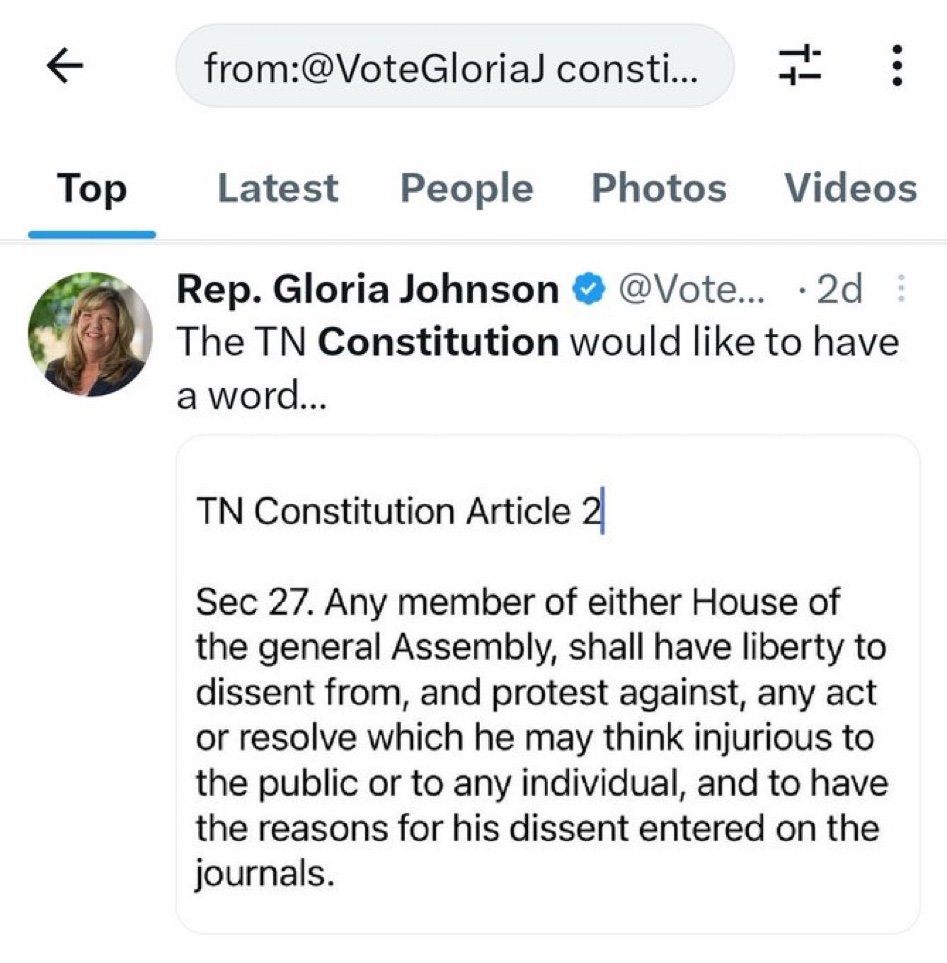
Rep. Gloria Johnson, one of the three Democrats, tweeted:

The New York Times published an article about a tenured professor at the University of Pennsylvania Law School, Amy Wax, who has frequently made statements that are racist, homophobic, sexist, xenophobic, the whole range of prejudices, not what you expect of someone who supposedly teaches students that everyone is equal in the eyes of the law.

Amy Wax, a law professor, has said publicly that “on average, Blacks have lower cognitive ability than whites,” that the country is “better off with fewer Asians” as long as they tend to vote for Democrats, and that non-Western people feel a “tremendous amount of resentment and shame.”

At the University of Pennsylvania, where she has tenure, she invited a white nationalist to speak to her class. And a Black law student who had attended UPenn and Yale said that the professor told her she “had only become a double Ivy ‘because of affirmative action,’” according to the administration.

Professor Wax has denied saying anything belittling or racist to students, and her supporters see her as a truth teller about affirmative action, immigration and race. They agree with her argument that she is the target of censorship and “wokeism” because of her conservative views.

All of which poses a conundrum for the University of Pennsylvania: Should it fire Amy Wax?

The university is now moving closer to answering just that question. After long resisting the call of students, the dean of the law school, Theodore W. Ruger, has taken a rare step: He has filed a complaint and requested a faculty hearing to consider imposing a “major sanction” on the professor…

For years, Mr. Ruger wrote in his 12-page complaint, Professor Wax has shown “callous and flagrant disregard” for students, faculty and staff, subjecting them to “intentional and incessant racist, sexist, xenophobic and homophobic actions and statements.”

The complaint said she has violated the university’s nondiscrimination policies and “standards of professional competence.”

The article goes on to cite the many times that Professor Wax has offended women, Blacks, gays, foreign students, or anyone else who does not agree with her idyllic view of the culture of the 1950s. Implicitly she means an era when Blacks were subservient, women were compliant wives, gays were in the closet, and foreigners were tourists.

What should the university do?

…many free speech groups, including the Academic Freedom Alliance, PEN America and the Foundation for Individual Rights and Expression, have criticized the dean and said that Professor Wax should not be fired because of her public statements.

My view: She should not be fired. Perhaps she should be admonished for behavior that is insulting to students, but her academic freedom and tenure protect her job.

Academic freedom protects not just the views that one likes, not just the views of the majority, but the views you hate. I might wish that Professor Wax were open-minded and wish that she had a keener sense of humanity, but I defend her right to be offensive, inconsiderate, and obnoxious. Students are not required to take her courses. Those who take her courses should challenge her views if they disagree.

But academic freedom must prevail.

Voltaire: “I may not agree with what you have to say, but I will defend to the death your right to say it.”

We saw this coming. The GOP candidates for President have decided, for now, to focus their campaigns against “critical race theory,” Black history, the threat posed by transgender students, and any teaching about race, sex, and gender.

Juan Perez of Politico reports:

CULTURE CLASH — Once upon a time, back when people used fax machines, education policy — test scores, spending, school choice and the like — were a notable feature of Republican presidential campaigns.

Former President George W. Bush’s support for education spending and the transformative No Child Left Behind Act was enshrined in the party’s 2004 platform. Former Arkansas Gov. Mike Huckabee railed that a general lack of concern about education in the 2008 presidential field “frustrates the fire out of me.” Bush’s brother, Jeb, invoked Martin Luther King Jr.in 2016 when he proposed a detailed education platform before his campaign fizzled.

This year, education is re-emerging as a prominent issue for the budding 2024 GOP field. But America is poised to witness a presidential contest where the debate over school policy sounds dramatically different — with discussions over academic standards and the stunning, once-in-a-generation hitto test scores taking a back seat to issues with a more distinct culture war bent.

Former South Carolina Gov. Nikki Haley is salting a back-to-basics education mantra with brimstone, targeting school lessons on race and sexuality. Former Vice President Mike Pence has put a small Iowa school system’s gender identity policy in the national spotlight. And Former President Donald Trump is stirring up concerns about “pink-haired communists teaching our kids.”

Haley’s campaign launch last week offered a sign of the heightened role the education wars are about to play in the GOP primary.

“They’re talking about critical race theory, where if you send a five year old kindergartner into school — if she’s white, you’re telling her she’s bad, and if she’s brown or Black you’re telling her she’s never going to be good enough and she’s always going to be a victim,” Haley said of the academic practice to a New Hampshire crowd last week. “That’s abusive.”

She added that a Florida ban on sexual orientation and gender identity lessons for young students — championed by rival Republican Gov. Ron DeSantis and dubbed by critics as the “Don’t Say Gay” law — “didn’t go far enough.”

“When I was growing up, we didn’t have sex ed until seventh grade,” Haley said to applause in New Hampshire. “That’s the kind of stuff you do at home, you don’t do that at school. That’s the kind of thing parents do.”

For his part, Pence has focused attention on an Iowa dispute, in which the conservative Parents Defending Education organization is suing the Linn-Mar Community School District to stop it from enforcing a policy that directs educators to protect their students’ gender identities on campus.

The court case has garnered supportive briefs from the Pence-backed Advancing American Freedom organization plus a coalition of Christian groups and Republican state attorneys general. The legal battle is also the focus of a Pence political initiative— funded with an initial budget of $1 million — that will advocate for “parental rights” policies embraced by conservatives.

“We’re told that we must not only tolerate the left’s obsessions with race and sex and gender but we must earnestly and enthusiastically participate or face severe consequences,” Pence told supporters last week. “Nowhere is the problem more severe, or the need for leadership more urgent, than in our public school classrooms,” he said.

Trump’s education plan, unveiled last month, calls for cutting federal funding for any school or program that includes “critical race theory, gender ideology, or other inappropriate racial, sexual, or political content onto our children.”

Trump would also open civil rights investigations into any school district that has engaged in race-based discrimination, particularly against Asian American students. He also called to “keep men out of women’s sports,” make significant cuts to school administrative personnel, elect school principals and end teacher tenure.

“As the saying goes, personnel is policy and at the end of the day if we have pink-haired communists teaching our kids we have a major problem,” Trump said.

Sen. Tim Scott, who is testing the waters on a potential presidential bid, is taking a less combative approach. Speaking at a GOP Black History Month event in Charleston last week, the South Carolina senator said “the story of America is not defined by our original sin, the story of America is defined by our redemption” and urged Republicans to “be the party of parents.”

Scott and others are responding to the GOP grassroots energy surrounding issues at the intersection of race, gender, culture and education — which Virginia GOP Gov. Glenn Youngkin successfully harnessed in his 2021 blue-state victory.

The sharp-edged rhetoric might get sanded down for the general election. But for now, not getting outflanked on education controversies that currently animate the right appears to be the first order of business for the 2024 field.

MEDIA ADVISORY:

Tomorrow, on Saturday, parents and community members from the Alliance to Reclaim Our Schools (AROS) and HEAL Together, alongside organizations from Florida and Pennslyvania, will hold a press conference opposing Governor Ron DeSantis’ harmful policies attacking our children’s freedom to learn. The press conference will take place opposite the site of DeSantis’ keynote speech at the Pennsylvania Leadership Conference. Florida advocates will speak at the press conference to warn that DeSantis’ policies are bringing chaos to Florida families.

The full media advisory is below. Feel free to reach out to the media contact: Moira Kaleida | 412-760-0030 | moira@reclaimourschools.org


FOR IMMEDIATE RELEASE: March 31, 2023


**MEDIA ADVISORY**PARENTS, COMMUNITY FROM PA & FL STAND UP AGAINST DESANTIS ATTACKS ON EDUCATION AND OUR COMMUNITIES— PRESS CONFERENCE AND ACTION


Harrisburg, PA – Saturday, April 1, 2023, parents and community members from the Alliance to Reclaim Our Schools (AROS) and HEAL Together, alongside Moms Rising, Red Wine & Blue, 412 Justice and Common Purpose (West Palm Beach, FL), and parents and community members from Florida to Pennsylvania will hold a press conference opposing Governor DeSantis’ harmful policies attacking our children’s freedom to learn.

The press conference will take place opposite the site of DeSantis’ keynote speech at the Pennsylvania Leadership Conference.

Concerned parents and community members will speak in response to the attacks on public education, including the passage of classroom censorship laws, the voucher bill which is a $5 billion giveaway to rich families, and the ban on life-saving education and healthcare for LGBTQIA+ youth.

Florida advocates will speak at the press conference to warn that these policies are bringing chaos to Florida families.


Education justice groups will be holding rallies also on April 1 in Miami, Orlando, Pinellas County and other sites throughout Florida to protest DeSantis’ anti-Black and anti-LGBTQ policies that have had a devastating impact on Florida’s children.

Pennsylvanians have voted against these policies in the past, and through solidarity with Floridians, Pennsylvanians have an opportunity to oppose DeSantis’ divisive tactics in order to ensure that all children have the freedom to learn and build a better future.

WHAT: Press conference with Pennsylvanians and Floridians to oppose Governor Ron DeSantis’ harmful policies attacking our children, our schools and our educational freedom after DeSantis’ keynote speech at the Pennsylvania Leadership Conference.


WHEN: April 1, 2023. Press Conference begins at 1 PM EST.


WHERE: In front of Harrisburg Academy (10 Erford Rd, Wormleysburg, PA 17043). The press conference location is across the street from Penn Harris Hotel (1150 Camp Hill Bypass, Camp Hill, PA 17011) where the Pennsylvania Leadership conference takes place.


WHO: Alliance to Reclaim Our Schools (AROS), with HEAL Together, Moms Rising, Red Wine & Blue, Common Purpose, 412 Justice, and parents, educators, and community members.


For on-site interviews, contact: Moira Kaleida | 412-760-0030 | moira@reclaimourschools.org

image.png
###

The Alliance to Reclaim Our Schools (AROS) is a coalition of parent, youth, community and labor organizations fighting to reclaim the promise of public education as our nation’s gateway to a strong democracy and racial and economic justice. AROS is uniting parents, youth, teachers and unions to drive the transformation of public education, shift the public debate and build a national movement for equity and opportunity for all.

HEAL (Honest Education Action & Leadership) Together is building a movement of students, educators, and parents in school districts across the United States who believe that an honest, accurate and fully funded public education is the foundation for a just, multiracial democracy.

Cassie Creswell and Diane Horwitz wrote the following article for Valerie Strauss’s blog “The Answer Sheet” at the Washington Post. Both residents of Chicago, they are fearful of what Paul Vallas will do to the Chicago Public Schools if he is elected Mayor. They urge Chicagoans to reject his candidacy. The latest poll shows the two candidates tied. Every vote matters.

Valerie Strauss wrote the introduction.

On April 4, Chicago voters will choose a new mayor — and the decision could have a profound effect on the future of the country’s third-largest public school district, which is under mayoral control. The two candidates in the runoff election are Paul Vallas and Brandon Johnson, Democrats who offer vastly different views of public education.

Vallas is a politician and a former education superintendent in Bridgeport, Conn.; at the Recovery School District of Louisiana (most of the schools were in New Orleans); and in Philadelphia and Chicago. Vallas became known as a “turnaround” specialist, meaning he moved into troubled districts and supposedly turned them around.

However, as education historian Larry Cuban wrote: “Whether, indeed, Vallas turned around Chicago, Philadelphia, and New Orleans is contested. Supporters point to more charter schools, fresh faces in the classroom, new buildings, and slowly rising test scores; critics point to abysmal graduation rates for Black and Latino students, enormous budget deficits, and implementation failures.”

Vallas has also unsuccessfully run for several offices, including mayor of Chicago in 2019 and lieutenant governor of Illinois in 2014.

Johnson was a public school teacher in high-poverty areas where school closures and gun violence affected the communities. He then became an organizer for the Chicago Teachers Union and fought to keep neighborhood schools open, expand state funding to district schools and reduce the use of high-stakes standardized tests. He has said he will not cut funding from Chicago public schools if he is elected mayor.In 2018, he was elected commissioner of the 1st District of Cook County, where he led a successful effort to ban housing discriminating against formerly incarcerated people.

The following was written by Cassie Creswell and Diane Horwitz, who are concerned about the privatization of public education. Creswell is a public school parent in Chicago and director of Illinois Families for Public Schools, a nonprofit advocacy group that lobbies for policies that support public education, which it sees as a public good. Horwitz is a graduate of Chicago public schools, a retired educator and a board member of Illinois Families for Public Schools. Both are writing as individuals and are not speaking for the organization.

By Cassie Creswell and Diane Horwitz


In just a week, the future direction of Chicago Public Schools will be decided by voters in a pivotal mayoral election. The two candidates, Paul Vallas, a former CEO of Chicago Public Schools, and Brandon Johnson, a former teacher and teachers union organizer, offer diametrically opposed visions for schools in Chicago, which will remain under mayoral control at least through January 2027.

We see the choice as stark. Will Chicago move in the direction of school privatization, a movement gaining ground in a number of states around the country with the growth of charter schools as well as school funding programs that use public money to fund private and religious education?

Or will there be a commitment to well-resourced neighborhood schools and increased funding that would be used to reduce class size, expand mental health services and bilingual education, and ensure that every school has a nurse and a librarian?
Will there be a recognition that the conditions in which many Chicago public school students live — in impoverished and segregated communities marked by violence and disinvestment — must be tackled as part of a broad education improvement agenda?

Johnson’s education platform emphasizes that families should not have to leave their communities or compete to secure a spot in a school that meets their needs and includes a library, music and art program, and small class sizes. He says that neighborhood schools contribute not only to the well-being of students but also to that of the communities in which they are located.

Saying that Chicago public schools are underfunded, he has called for more resources from the state that would be distributed based on the needs of a school’s student population and not solely on enrollment numbers. He has called for creating sustainable community schools with wraparound supports and his education plan integrates proposals for affordable housing, transportation and safety.

Vallas has criticized the operation of Chicago public schools and says he will make schools safer while creating new programs to bring back students who have left the system. He also said he would work to expand alternatives to public schools for families and would change the way schools are funded to “follow the student.”

Vallas has long supported initiatives that critics say are aimed at privatizing public education. He spelled out his vision for the future of Chicago’s school system in a little-noticed op-ed that he wrote for the Chicago Tribune in February 2022, months before declaring his candidacy — and that is what we focus on here. Here are some of his most revealing statements:

Expanding vouchers

Vallas supports expanding Illinois’ existing “Invest in Kids” voucher program, a tax credit scholarship program that offers a 75 percent income tax credit to individuals and businesses that contribute to organizations that pay for private and religious schools. A full 95 percent of participating schools are religious. More than 4,000 Chicago students were funded in this way in the last school year.

Vallas has also floated the idea of using tax increment financing (TIF) dollars to pay for K-12 school vouchers during the current campaign. TIF is a complex, and often misused, public financing initiative designed to fund development through investments and infrastructure in economically struggling communities.

The details of Vallas’ proposal in the Tribune highlight a fiscal initiative that we think is rash. He proposes applying TIF surplus dollars to cover teachers’ pension costs, and then using money that should be earmarked for pensions for vouchers. Vallas says this will allow these diversions of funds to be “legally accomplished.” One of the key concerning legacies of Vallas’ time as the chief executive officer of Chicago Public Schools was years of unpaid pension debt, generated by diverting funds that should have gone to teachers’ pensions into operating costs.

Religious charter schools

In Oklahoma, the Catholic Church recently asked the state to establish a virtual, openly religious charter school. In December 2022, Oklahoma’s outgoing attorney general issued a controversial legal opinion supporting the church’s application, saying that prohibiting religious charter schools violated the First Amendment. It was praised by Oklahoma’s Republican governor and state superintendent.

Ten months earlier, Paul Vallas’ op-ed called for religious contract schools, a type of charter school, to be established in Chicago. He wrote: “Longer term, the city can invite state-recognized parochial and private schools to become ‘contract schools’ in which the district contributes to or covers tuition for students who attend.”

Oklahoma’s new attorney general, a conservative Republican, took office in January and quickly rescinded his predecessor’s opinion, saying it “misuses the concept of religious liberty by employing it as a means to justify state-funded religion.”

Vallas also gave a nod of support to the 2022 Supreme Court Carson v. Makin decision, in which six ultraconservative justices ruled that the state of Maine could not exempt religious institutions from a school voucher program.

An unusual precedent

Vallas justified his vision for charter school expansion on “a long history of contracting out for private educational services. There is precedent.”

He then wrote:

“The Supreme Court’s landmark 1954 decision in Brown v. Board of Education grants the right to equitable educational opportunity. It is a right guaranteed by the Equal Protection Clause of the 14th Amendment. Those in power in Chicago have chosen to interpret this right as a mandate that all public financing of education be allocated exclusively to ‘public’ or government-run schools.”

Let it be noted that after Brown v. Board of Education, many communities in Southern states responded by spending public dollars on private schools using voucher schemes — private academies created for White students whose families refused to send them to public schools with Black children and were given public dollars to fund tuition.

It seems to us that Vallas is twisting the import of the Brown v. Board of Education ruling, using it to include the use of public dollars to fund children’s departure from public — or, as he called them, “government- run” — schools. His use of the phrase “government-run schools” mirrors the language used by former president Donald Trump and his education secretary, Betsy DeVos, who framed public education as a government institution essentially holding students hostage.

Private and religious schools that take public funds are not bound by the same anti-discrimination regulations as public schools, leaving them free to discriminate on the basis of disability, LGBTQ+ status, parenting and pregnancy status, English-language learner status and religion itself.

“Dollars follow students”


Vallas ended his op-ed by saying that he supports the “explicit endorsement of a reconstituted system in which parents get to direct the per-pupil public dollars to the school (or education model) of their choosing.”

This is exactly what DeVos has long advocated: “Fund students, not systems.”

DeVos is a leader in the national movement toward the privatization of our public schools, via vouchers, charter schools — which are publicly funded but privately operated — and other often poorly regulated funding programs. Those include education savings accounts and direct financial support for home schooling. The goal: discrediting and dismantling our public schools districts.
Vallas was clear about his plans, which would work toward that goal in Chicago. It’s up to the voters now.

Randi Weingarten, president of the American Federation of Teachers, delivered the following remarks today at the National Press Club in Washington, D.C. She vigorously defended public schools against current efforts to destroy them. She named names. She explained the purpose of public schools, which makes them a precious part of our democratic aspirations but also a target for those who hate democracy.

Randi said:

Today, we once again grieve for families shattered by senseless gun violence. Please join me in a moment of silence for the lives lost at the Covenant School in Nashville, and for all victims of gun violence.

Today we renew our call for commonsense gun safety legislation including a ban on assault weapons. This is an epidemic that our great nation must solve.

There’s a saying: You don’t have to love everything about someone to love them. I’m sure my wife doesn’t love everything about me, but she loves me. (I, on the other hand, love everything about her.) Nothing is perfect. Banks aren’t. Congress isn’t. And neither are our public schools—not even our most well-resourced and highest-performing schools. Those of us involved in public schools work hard to strengthen them to be the best they can be. But only public schools have as their mission providing opportunity for all students. And by virtually any measure—conversations, polls, studies and elections—parents and the public overwhelmingly like public schools, value them, need them, support them—and countless Americans love them.

Public schools are more than physical structures. They are the manifestation of our civic values and ideals: The ideal that education is so important for individuals and for society that a free education must be available to all. That all young people should have opportunities to prepare for life, college, career and citizenship. That, in a pluralistic society such as the United States, people with different beliefs and backgrounds must learn to bridge differences. And that, as the founders believed, an educated citizenry is essential to protect our democracy from demagogues.

Thomas Jefferson argued general education was necessary to “enable every man to judge for himself what will secure or endanger his freedom.” Franklin D. Roosevelt said: “The real safeguard of democracy … is education.” And Martin Luther King Jr., in accepting the United Federation of Teachers’ John Dewey Award, made clear, “Education is the road to equality and citizenship.”

When kids go to school together, they become part of a community; their families become part of a community. That community comes together at school concerts, basketball games and science fairs, and for shelter and comfort, when people are displaced by natural disasters or, far too often, at vigils for victims of gun violence. In good times and bad, public schools are cornerstones of community, of our democracy, our economy and our nation.

But some people want that cornerstone to crumble—and they’re wielding the sledgehammers.

II. ATTACKS ON PUBLIC EDUCATION AND DEMOCRACY

Attacks on public education are not new. The difference today is that the attacks are intended to destroy it. To make it a battlefield, a political cudgel. After former President Trump lost re-election, Steve Bannon, his key ally, declared that their fight goes through school boards. In a speech last year, culture war operative and Governor Ron DeSantis’ appointee Christopher Rufo put it bluntly, “To get to universal school choice, you really need to operate from a premise of universal public school distrust.” To this end, he says, his side has “to be ruthless and brutal.”

And, I would add, well-funded, which it is. The DeVos, Bradley, Koch, Uihlein and Walton family foundations and others have poured many millions of dollars into anti-public education, pro-privatization groups like the American Federation for Children and EdChoice.

The Betsy DeVos wing of the school privatization movement is methodically working its plan: Starve public schools of the funds they need to succeed. Criticize them for their shortcomings. Erode trust in public schools by stoking fear and division, including attempting to pit parents against teachers. Replace them with private, religious, online and home schools. All toward their end goal of destroying public education as we know it, atomizing and balkanizing education in America, bullying the most vulnerable among us and leaving the students with the greatest needs in public schools with the most meager resources.

It’s an extremist scheme by a very vocal minority of Americans.It’s hurting our efforts to do the work we need to do, which is educating the nearly 50 million kids who attend America’s public schools. And the urgent work of helping kids recover from learning loss, sadness, depression and other effects of the pandemic.

And it’s not what parents or the public want.

Let’s start with defunding: This year alone, 29 state legislatures are considering bills to either create or expand existing voucher programs. This is on top of the 72 voucher and tax credit programs in 33 states already subsidizing private and home schooling, costing billions every year. Voucher programs are proliferating even though research shows that, on average,vouchers negatively affect achievement—the declines are worse than pandemic learning loss. In fact, vouchers have caused “some of the largest academic drops ever measured in the research record.”

Proponents of vouchers used to argue that they were a way for low-income and minority families to transfer out of low-performing schools. No longer. Today most vouchers go to families who already send their kids to private schools. And private schools are not required to follow most federal civil rights laws protecting students, so they can—and many do—discriminate, especially against LGBTQ students and students with special needs.

The universal voucher program signed by Florida Gov. DeSantis yesterday will divert $4 billion from the state’s public schools. Florida ranks 44th in the nation in per pupil spending, and 48thin average teacher salaries. DeSantis is sending taxpayers’ dollars in the wrong direction.

And then there are the culture wars. What started as fights over pandemic-era safety measures has morphed into fearmongering: False claims that elementary and secondary schools are teaching critical race theory; disgusting, unfounded claims that teachers are grooming and indoctrinating students; and pronouncements that public schools push a “woke” agenda, even though they can’t or won’t define what they mean. Banning books and bullying vulnerable children. School board meetings descending into screaming matches. This is an organized and dangerous effort to undermine public schools.

Over the last three years, legislators in 45 states proposed hundreds of laws placing public schools at the center of culture wars: laws seeking to ban books from school libraries—even books about Ruby Bridges and Anne Frank and Roberto Clemente; laws restricting what teachers can teach and students can learn—particularly about about race, gender, LGBTQ issues, current events and American history; and laws attacking kids who are transgender. Students and staff should feel welcome, safe and respected in school—but the culture wars are fueling hostility and fear.

A torrent of enacted and proposed legislation targeting even the mention of “controversial” topics—sweeping and open-ended restrictions on what can be taught—has teachers teaching on eggshells. In Florida, the Department of Education has threatened teachers and librarians with felony prosecution if they provide students with books that the state later decides are inappropriate. If Florida lawmakers have their way, colleges will no longer have diversity, equity or inclusion policies; or tenure;or academic freedom. And AP courses and the mere utterance of LGBTQ will be banned in all K-12 schools. And forget about facts. Many laws and pending bills allow any individual to sue schools and teachers for perceived violations. The intent and effect are to create a climate of fear and intimidation.

This takes a toll on the quality of education teachers can provide our students, and on the trust and connection that are so important. Shouldn’t teachers be free to talk with students who are withdrawn or in distress, and to answer students’ questions? Don’t we want students to learn both our nation’s achievements that make us proud and the failings that make us strive to do better? Isn’t that our job?

Teachers should have the freedom to teach. And students should have the freedom to learn.

These same governors who are pushing vouchers and culture wars are also trying to defund and weaken teachers unions, so educators don’t have the wherewithal to fight back against censorship, attacks on their academic freedom, threats to their livelihoods and criminal prosecution.

These attacks aren’t about protecting kids. If they were, they would be working with us to address learning loss and the youth mental health crisis. They would be working with us to take on social media companies for contributing to that crisis.

If these attacks were about protecting kids, they would be working with us to fight against the leading cause of death for American children—gun violence.

If this were about protecting kids, instead of putting LGBTQ youth at risk and banning books about Black people and by Black authors, they would give a damn about these kids’ safety and well-being, including the youth suicide crisis.

Forty-five percent of LGBTQ youth seriously considered suicidein the last year. And the suicide rate among Black youth of all sexual orientations has been increasing as well.

This is literally a matter of life and death. These attacks on public education make it increasingly difficult to create the welcoming, safe environment that our students need and deserve.

School climate and culture

It is a fraught time in our country. The effects of COVID-19; the climate of conflict; drug abuse; gun violence; economic insecurity; and the youth mental health crisis have all taken a heavy toll. Hate crimes have surged against many Americans—Asian, Black, Latino, Jewish and Muslim Americans.

School staff report a rise in bullying, verbal altercations and physical violence among students, as well as this behavior directed at them.

I recall a teacher saying that when her students are disruptive, it’s not because they are bad; it’s because they’re sad.

So many students have experienced isolation and trauma. They need help. But there weren’t enough mental health specialists before the pandemic, and they are in critically short supply now.

The persistent demonization and disrespect of teachers—from screaming matches at school board meetings to the former secretary of state saying teachers teach “filth”—have contributed to a culture of disrespect that seeps into our schools.

I just got a report from Florida. In Flagler County, a 17-year-old student with special needs pushed a paraprofessional so hard she went airborne and was knocked unconscious. A teacher in Osceola County was monitoring students in the hallway when a student sucker-punched him. And there are others. The educators who were hurt all cited lack of staff in the schools and lack of mental health support for students as the main reasons leading to the attacks.

And this crisis will only get worse as Gov. DeSantis’ universal voucher bill kicks in. What will the loss of $4 billion do to safety in Florida’s public schools? What will that do to the quality of academics, to the condition of school buildings, to teacher pay, to staffing shortages?

III. CRISIS IN THE TEACHING PROFESSION

Even before the pandemic, there were steep declines in teachers’ satisfaction. The percent of teachers who were “very satisfied” fell from 62 percent in 2008 to just 12 percent in 2022.

The stresses of the COVID-19 era—plus the culture wars, attacks on teachers, inadequate pay, poor teaching and learning conditions, and the threat of school shootings—have made recent years the toughest in modern times for educators.

Despite it all, teachers have thrown themselves into the mission of helping students recover academically, socially and emotionally. You heard Tamara (Simpson). I witness these acts of teaching, of nation-building, every day. Yet, according to our critics, we’re responsible for all the woes of society.

Even before the pandemic, nearly 300,000 teachers were leaving the profession each year. Now, it’s closer to 400,000.

And the teacher pipeline has collapsed as college students and career-changers choose not to go into education. How are we going to recruit and retain the staff schools need in this climate?

Our teaching profession is in crisis.

It’s in crisis because of the poor teaching and learning conditions created by inadequate funding for public schools. It’s teacher pay, which has been falling relative to other college graduates’ pay for the last 40 years. It’s giving teachers all the blame and little authority. And it’s the de-professionalization of teaching that demoralizes an already beleaguered profession.

I hear it all the time—teachers just want to teach.


IV.Strategies for Powerful Education

So where do we go from here?

The American Rescue Plan, and the programs it spawned, particularly the tutoring programs, have really helped. And we are grateful to President Joe Biden, Education Secretary Miguel Cardona and the last Congress for the much-needed resources. Of course we will continue to fight this defunding of our public schools and this dividing of our communities. But we also must do better to address the learning loss and disconnection we are seeing in our young people. And we can. We can make every public school a school where parents want to send their kids, educators want to work and all students thrive.

Four strategies can help transform our schools to realize the promise and purpose of public education. Not just to overcome learning loss or get back to normal, but to truly help us prepare all children with the knowledge and skills they need for their lives, for college, for career and for citizenship. These strategiescan help us create safe and welcoming environments and bring joy back to learning. And in tandem, they have a catalytic effect. I have seen it work. But we need to do these strategies at scale—for every child and in every school. These four strategies are expanding community schools, scaling experiential learning, addressing staff shortages, and deepening the partnership between families and educators.

Community Schools

First and foremost, we need to make sure our kids are OK. That’s why we need community schools, which are hubs for neighborhoods, combining academics with extended learning opportunities, family and community events, and an infusion of medical, mental health and other social services. They are the best system I know to connect students and families to the support they need to learn, live and thrive.

A recent University of Calgary study found that youth suicide attempts increased 22 percent during the pandemic. According to the Centers for Disease Control and Prevention, nearly 1 in 3 teen girls seriously considered suicide in 2021—up nearly 60 percent from a decade ago. More than 42 percent of high school students reported persistent feelings of sadness or hopelessness.

What helps? The Calgary report found that “school connectedness, defined as feeling close to people at school, has a long-lasting, protective impact for adolescents well into adulthood.”

Our schools must be equipped to support and connect with students, and there is no better model for this than community schools. There is another tragic reality in the United States: Half the students in America’s public schools live in poverty. Community schools mitigate the effects of poverty by providing essential services right where students are and where families can be.

Once kids’ physical and emotional needs are met, they are ready to learn, and teachers can focus on their primary role—which is to teach.

A few weeks ago I went back to Wolfe Street Academy, a community school in Baltimore, to see how they were doing.

Ninety-six percent of the students there qualify for free- or reduced-price lunch. Since converting to a community school nearly 20 years ago, Wolfe Street has gone from the 77th-most successful elementary school in Baltimore (out of 80) to the second-most successful. And, like other community schools,when COVID-19 hit it was a matter of ramping up services, not having to start from scratch.

Students have access to medical checkups, clothing and mental health services. Families have food assistance, language support and legal aid.

And this school is fun! Wolfe Street offers a wide variety of after-school programs, including chess club, robotics club, Mexican folkloric dance, orchestra, a soccer league and more.

And, by the way, Wolfe Street is a unionized public charter school.

There are successful community schools in rural and suburban areas, as well.

The Rome (New York) Teachers Association started a community school with help from the AFT in 2016. Today itsConnected Model has spread to 14 school districts and provides everything from access to mental health services and dental care, to food packages for weekends and holidays, and prom dresses!

A recent Rand Corp. study of community schools in New York City found positive impacts on both attendance and graduation rates. In New Mexico, community schools in operation for five or more years have better-than-average student achievement growth and higher attendance rates, and employed more highly effective teachers. And Robeson High School in Philadelphia went from nearly closing to a 95 percent graduation rate after implementing the community school model.

AFT members have helped create 700 community schools across the country, and we see how they meet kids’ needs. From Kimball Elementary School in Washington, D.C., to the Oyler School in Cincinnati, to Roybal-Allard Elementary in Los Angeles. That’s why the AFT is calling for 25,000 community schools by 2025 and our call is gaining steam. California just approved another $45 million to make 1 in every 3 schools in the state a community school. And President Biden’s budget doubles federal community school investment. We need to make this happen everywhere.

Experiential Learning

Second, we can re-engage students through experiential learning, transforming their educational experiences. Why do kids skip school, or slump in the back of the classroom? They may feel unsafe or unseen. Or just uninterested. We must do better. And we can.

Of course, fundamental academic subjects are important. But so is how we teach them. Experiential learning engages students through problem-solving, critical-thinking, teamwork, and learning by doing. We need to help kids engage with the world, with ideas and with each other—not just with their devices.

Experiential learning embeds the things that make kids want to be in school: The excitement of learning that is deeply engaging, and the joy of being together, especially after the isolation of the last few years. The camaraderie and responsibility of working together on a team.

And in the age of AI and chatGPT, this type of learning is critical to being able to think and write, solve problems, apply knowledge and discern fact from fiction.

Experiential learning can be applied to any content area from math to computer science to social studies, and often weaves subjects together in powerful interdisciplinary instruction. It can be adapted to any grade level. It can take place in rural, urban and suburban schools. And it nurtures kids’ natural curiosity and creativity. That is what robotics and debate teachers do all the time. It’s what I did as an AP government teacher at Clara Barton High School. These opportunities need to be the norm not the exception.

This type of learning makes clear just how outmoded the standardized test-based accountability system is. Of course, the country needs data on how our kids are doing, but if we are talking about student success, research shows classroom grades, not tests, are the best predictor of that. And experiential learning takes the classroom to a new level.

Experiential learning is assessed by teachers in their classrooms and focuses on mastery of the skill. It can include capstone projects that allow students to research a topic they’re passionate about and present it to their teachers and peers. It can include nature-based pre-K, where youngsters learn by exploring natural surroundings while building social skills with other kids. It can include students working together to code and build robotics projects; service-learning projects to support community members; and summer learning on a farm caring for crops or animals; or reporting for and producing a neighborhood newsletter. And it can start with field trips, during and after school.

Experiential learning has long been embedded in career and technical education programs where students use their minds and their hands to learn everything from auto repair, to nursing, IT, graphic design, welding and culinary skills. CTE students learn skills that give them a head start when they go to college or start their careers. Shouldn’t every student have that opportunity?

It’s also a proven strategy. Ninety-four percent of young people who concentrate in CTE graduate from high school, and 72 percent of them go on to college.

Talk to any employer about the skills and knowledge they look for in a successful employee, be it a plumber, a nurse or a lawyer, and you’re bound to hear similarities—employees who are creative, self-starters, critical-thinkers, problem-solvers;have empathy; and can build relationships. This type of learning provides every student with more options to develop those skills and to find their passion, their purpose and their pathway to good jobs and fulfilling careers.

Carpentry students use math when they’re figuring out the right cuts to make and how the pieces will all fit together. They’re using their hands and their minds to construct something. They’re acquiring literacy, technology and writing skills in developing business plans or a website. They’re building self-confidence and public speaking skills when they explain plans and work with customers or their peers. They have a sense of pride in the finished product. When a project doesn’t turn out as expected, they have to problem-solve what went wrong and try a new approach.

On Governors Island in New York City, students attending the Harbor School pursue industry certification in specialties like marine science and oceanography. In Louisiana, the Teaching and Reaching initiative is a two-year dual enrollment program that gives high school juniors and seniors the opportunity to earn credits and get a head start on pursuing a degree in education. In Peoria, Ill., CTE programs are preparing students for green energy jobs. And the Rio Rancho, N.M., public schools partner with the local college to provide stackable microcredentials in robotics, coding and automotive technology.

President Biden’s remaking of the economy through the CHIPS and Science Act, the Bipartisan Infrastructure Law, and the climate provisions of the Inflation Reduction Act will create millions of new high-paying jobs in renewable energy, broadband, semiconductors, construction, cybersecurity, transportation, small business, entrepreneurship and so much more. Then there’s healthcare and education, which have huge staffing crises right now. There are so many incredible opportunities for our young people in the job markets of today and tomorrow. They need to be ready to seize them. This dynamic new economic vision requires a dynamic new workforce vision.

We are all in, but this requires more than educators. And doing this at scale will require new approaches. We need to start by high school. We need employers to partner with us, giving students internships and apprenticeships, including paid opportunities so students who need to work can afford to participate. That’s why the AFT donated stipends for high school kids in Newark, N.J.’s Red Hawks Rising teacher pathway program. Teachers need experiential learning, too, and more externship opportunities in industry.

The potential for all of this is in our grasp, but we all need to do better on the alignment of people, preparation and professions. And it means all of us making changes. That is why we are working with the AFL-CIO, Commerce Secretary Gina Raimondo, Education Secretary Miguel Cardona, Acting Labor Secretary Julie Su, and the Bloomberg Philanthropies on this work. We are reaching out to business groups large and small, as experiential learning can take place in the private sector, the public sector and nonprofits. The formula of starting by high school and identifying school-to-career pathways, including community colleges, partnering with employers, and ensuring the opportunities are paid, can be replicated everywhere.

Revive and Restore the Teaching Profession

Third, for us to meet the needs of the 50 million children in our public schools, we need to revive and restore the teaching profession. That starts with addressing the teacher and school staff shortage crisis. And taking care of the educators we still have.

We know how to solve this. At our 2022 convention, AFT members unanimously approved the report our Teacher and School Staff Shortage Task Force had been working on for seven months. That report is a blueprint with scalable solutions that every district and state in the nation can implement. But it boils down to treating educators like the professionals they are, with appropriate pay and time to prepare for classes, the chance to collaborate with colleagues, the opportunity to participate in meaningful professional development, and the authority to make day-to-day classroom decisions. And ensuring they have the conditions that help students learn like buildings in good repair, with safe ventilation and smaller class size.

The Kansas City Federation of Teachers recently negotiated a new contract, and they used the AFT staffing shortage report as their blueprint. Now, every first- and second-year teacher will be mentored by an exemplary teacher, who will be paid for serving as a mentor. The union secured the highest starting teacher salaries in the region and increases to keep teachers in the profession. They won paid family leave for any parent, making them the first district in the state having this essential family benefit. Where there’s a will, there’s a way. Thank you, Jason Roberts, the KCFT president, for being with us today.

I’m really worried about the well-being of teachers and school staff. We are working with groups like Educators Thriving on strategies that address well-being. Their program has helped teachers reduce emotional exhaustion, a leading indicator of burnout. And as a union, we are providing a trauma benefit to all our members and have worked hard to reduce student debt and make the bipartisan Public Service Loan Forgiveness program work. That’s been life-changing for those who qualify. But I am asking politicians to do their part as well.

A word to politicians—rather than using educators as cannon fodder, why not work with us? Like New Mexico Gov. Michelle Lujan Grisham, who enacted a $10,000 raise for teachers in that state. And Michigan Gov. Gretchen Whitmer, who signed a bipartisan education budget that will make the highest state investment in Michigan history, investing in school infrastructure, teacher recruitment, school safety and mental health resources. And Sen. Bernie Sanders and Florida Rep. Frederica Wilson, whose bills would raise teacher salaries. And New York Rep. Jamaal Bowman, who has introduced a bill to reduce federally mandated standardized tests.

Parents and Community as Partners

Fourth, the pandemic proved what we always knew: In-person learning is essential for kids, and public schools are centers of their communities.

It’s beyond obvious that the school-family connection, the parent-teacher connection, is vital to children’s success. But as others are trying to drive a wedge in that connection, we need to deepen it.

PTAs are remarkable organizations; so are so many parent groups and parent-teacher groups like Red Wine and Blue, Parents Together, MomsRising and the Campaign for Our Shared Future. And we are honored to work with them and others. But we know we need to create this muscle of working together everywhere.

That’s why the AFT created the Powerful Partnerships Institute, which supports family and community engagement. In our inaugural year, the institute has given out 27 grants to AFT locals across the country. Montana is engaging thousands of public education-supporting families and educators across the state. New Haven is working with educators, families and students on fair school funding. And you just heard a little about our partnership in Houston.

Let’s be role models for how we deal with conflicts and disagreement. During the pandemic, we met via Zoom with parent groups that often disagreed with us on COVID-19 safety measures and school closures. We heard each other out and talked things through. We need more of that in America.

Two years ago, the AFT increased our legal defense fund, so we could help if a member was put in jeopardy for teaching honest history or answering a student’s question. But in too many places, there are no unions, or educational associations, or parent groups. People feel alone and isolated. Teachers. Parents. Children.

That’s why, in conjunction with the Campaign for Our Shared Future, we are launching a new Freedom to Teach and Learn hotline for teachers, parents or students to use if they need support. It’s a place to call if you’ve been told to remove a book from the curriculum or from the library, or that there are topics that can’t be discussed in your classes, or that you cannot teach honestly and appropriately, or if politicians in your district or state are targeting vulnerable student groups to score political points. The Freedom to Teach and Learn hotline number is 888-873-7227.

These four strategies are worthy on their own. Together, they are transformative. Community schools will help young people not just recover from these punishing years and the scourge of poverty, but thrive. Experiential learning will prepare our youth with the knowledge and skills to seize the opportunities in our changing economy. To nurture and educate our young people, we need an educator workforce that is supported, respected and compensated befitting their vital role. And we need students’ circle of care—family, educators and community members—to be united in their support.

Conclusion

This is our agenda. But this can’t just be the work of our union or of school staff and schools alone. This is the work of a great nation—to ensure that our children’s basic human needs are met so they are ready to learn to their full potential. To exchange outmoded and test-driven ways of teaching and learning for effective and engaging approaches that excite students and prepare them to live their dreams and aspirations.

Our public schools shouldn’t be pawns for politicians’ ambitions. Or defunded and destroyed by ideologues.

We are at a crossroads: Fear and division, or hope and opportunity.

A great nation does not fear people being educated.

A great nation does not fear pluralism.

A great nation chooses freedom, democracy, equality and opportunity.

All of that starts in our public schools. We are that great nation, and we must act together—to defend, support and strengthen our public schools. And we must do that now.

Our children deserve no less.

1

John Merrow updates a famous saying from the Second World War. There was a time when every educated person knew it, often by heart. It is about indifference to the sorrow and tragedy of others.

He begins:

First they came for the transgender kids, and I did not speak out—because I am not transgender.  

Then they came for the bisexuals, the gays, and the lesbians, and I did not speak out—because I am none of those.  

Then they came for the same sex couples, and I did not speak out—because I am married to a woman.  

Then they came for me—but by that time the puritans, the fascists, and the power-hungry were in complete control, and speaking out was not allowed. 

Of course, that is not what German Lutheran pastor Martin Niemoller wrote back in the 1930’s, of course.  What he said was this:

First they came for the socialists, and I did not speak out—because I was not a socialist.  

Then they came for the trade unionists, and I did not speak out—because I was not a trade unionist.  

Then they came for the Jews, and I did not speak out—because I was not a Jew.  

Then they came for me—and there was no one left to speak for me.

Hitler’s supporters responded to Pastor Niemoller’s warning by sending him to a concentration camp, where he stayed for eight years, until World War II ended in 1945.

His warning is regularly revised to reflect the threats of the times.  I was in college when I first encountered it, and, as I recall, that version began “First they came for the Jews, and I did not speak out–because I was not a Jew.” 

I’ve rewritten the lines because of what is going on now, here in the United States and elsewhere.  Do you think I am kidding?  Read this:

Robert Foster, a former Mississippi House lawmaker who lost a 2019 bid for governor, is using his social-media platform to call for the execution of political foes who support the rights of transgender people.  “Some of y’all still want to try and find political compromise with those that want to groom our school aged children and pretend men are women, etc,” the former Republican representative from Hernando, Miss., wrote in a Thursday night tweet. “I think they need to be lined up against (a) wall before a firing squad to be sent to an early judgment.”  Here’s the full story:

And this: 

Michael Knowles—right-wing political commentator associated with the Daily Wire—said “for the good of society… transgenderism must be eradicated from public life entirely” at the Conservative Political Action Conference Saturday afternoon.

As you are reading this, dozens of states are considering draconian legislation–more than 120 bills were introduced before the end of January–that threatens the lives of young people struggling with their sexual identity. Other states have already passed legislation, which their Republican governors have signed. The ACLU has a good list here. Another organization, GLSEN, is also keeping watch here.

Please open the link and read the rest of this fine piece.

The principal of the Classical Charter School in Tallahassee was told to resign or be fired after a parent complained that a sixth grade art class saw a “pornographic” photograph of a sculpture. It was a picture of Michelangelo’s masterpiece “David.” Considered one of the greatest sculptures in the world, “David” is a massive piece of marble that is the centerpiece of the Accademia Gallery of Florence (Galleria dell’Accademia di Firenze) in Florence, Italy.

The Tallahassee Classical Charter School follows the Hillsdale College curriculum, supposedly based on the classics. The “David” is certainly a great classical work of art.

Dan Kois of Slate interviewed the chairman of the school’s board, Barney Bishop III. This is a small excerpt. Kois’s questions are in bold.

I tend to think of a classical education as being the mode in the 17th, 18th century, where you study the Greeks and Romans, and Western civilization is central. A tutor or teacher is the expert, and that teacher drives the curriculum. You’re describing something where it seems the parents drive the curriculum. How does your classical education differ from the classical education as I think of it?

What kind of question is that, Dan? I don’t know how they taught in the 17th, 18th century, and neither do you. You live in New York?

Virginia.

You’ve got a 212 number. That’s New York.

I lived in New York when I got the cellphone, many years ago. Now I live in Virginia.

Well, we’re Florida, OK? Parents will decide. Parents are the ones who are going to drive the education system here in Florida. The governor said that, and we’re with the governor. Parents don’t decide what is taught. But parents know what that curriculum is. And parents are entitled to know anytime their child is being taught a controversial topic and picture.

Parents choose this school because they want a certain kind of education. We’re not gonna have courses from the College Board. We’re not gonna teach 1619 or CRT crap. I know they do all that up in Virginia. The rights of parents, that trumps the rights of kids. Teachers are the experts? Teachers have all the knowledge? Are you kidding me? I know lots of teachers that are very good, but to suggest they are the authorities, you’re on better drugs than me.

Please read the full interview.

I would like to give credit for the meme below. I found it on the Twitter feed of “Trump is Putin’s Puppet.” The person who posted it said was time to add Art to the list of bans.

Mimi Swartz of the Texas Monthly described the federal judge who will decide whether to allow abortion pills to remain legal. He was appointed by Trump, undoubtedly recommended by the Federalist Society, which vetted all of Trump’s judicial picks. This judge was his parting gift to the anti-abortion lobby. Judge Kacsmaryk has the power to declare the abortion pill illegal across the nation; he is taking testimony about whether the drug was wrongly approved by the Federal Drug Administration in 2000. Medically-induced drugs account for more than half of the abortions in the U.S.

Much of the public attention now focused on Judge Matthew Kacsmaryk, the Amarillo-based federal judge who is expected to soon outlaw mifepristone, the so-called abortion pill, has focused on the ways in which his political and religious beliefs have shaped his legal career. His fervent opposition to abortion arose as an issue during his confirmation hearings in 2019, as did his staunch opposition to same-sex marriage and his previous statement that transgender Americans were “delusional.” He isn’t a fan of birth control either: in 2015, as deputy general counsel for a Plano-based nonprofit law firm called First Liberty Institute, Kacsmaryk arguedin an amicus brief that pharmacies should be prevented from providing contraception. Kacsmaryk’s time on the bench has only reinforced the view that he is an activist judge who allows his private beliefs to govern his legal opinions—and it seems that the antiabortion activists who venue-shopped to land the mifepristone suit in his courtroom would agree.

The Washington Post wrote:

AMARILLO, Tex. — The federal judge who could upend access to a key abortion medication seemed open on Wednesday to the argument that the drug had not been properly vetted and could be unsafe — claims the Food and Drug Administration and leading health organizations strongly contest.

While the antiabortion group challenging the drug acknowledged there is no precedent for a court to order the suspension of a long-approved medication, U.S. District Judge Matthew Kacsmaryk questioned whether mifepristone has met the rigorous federal standard necessary to be prescribed to patients in the United States.

He asked a lawyer for the group whether the court could unilaterally withdraw FDA approval for a drug, and engaged with attorneys for both sides about whether mailing the pills should be prohibited because of a 19th-century law that bans sending articles “for any indecent or immoral use” through the Postal Service….

During the hearing, lawyers for the antiabortion group argued that the FDA’s decision to allow abortion pills to be distributed by mail violates a 150-year-old law. The Comstock Act, they say, prohibits mailing any drug used “for producing abortion.”

Those arguments appeared to resonate with Kacsmaryk, who asked government lawyers if there was “any dispute” that the law prohibits mailing abortion medication.

The Justice Department argued that the modern-day reading of the law has never prevented the mailing of abortion pills, in part because the medications have other uses and because abortion remains legal in many circumstances.