A few days ago, I joined a discussion with Dr. Tim Slekar and Dr. Johnny Lupinacci about the current state of public education. It was aired on their show “Busted Pencils,” which is dedicated to teachers, students, and public schools.
We talked about charters, vouchers, testing, and how to get involved. Everyone can stand up for what they believe.
I think most educators would agree that they are tired of getting lectures from billionaires about how to teach or how to fix the problems of American education.
But Peter Greene reports that the richest man in the world, Elon Musk, has decided it’s time for him to add his uninformed views to those of Bill Gates, Betsy DeVos, the Walton family, and a long list of financiers, all of whom use their wealth to change the schools.
Reporter Christiaan Hetzner mostly covers business in Europe, so it’s not clear how he stumbled into this particular brief piece, which appears to be lifting a piece of a larger conversation into an article. I’d love a new rule that says every time an outlet gives space to a rich guy’s musings about areas in which he has no expertise, the outlet also publishes a piece about the musings of some ordinary human on the topic–maybe even an ordinary human who is an expert in the area.
Hetzner launches right in with both feet.
More than a century ago, Irish playwright George Bernard Shaw wrote, “He who can, does. He who cannot, teaches.” Well, Elon Musk is a doer with a lot of children, and he’s reached the conclusion he doesn’t want his kids to learn from some has-been or never-was simply because they landed a job in a local school thanks to a lack of competition.
It’s not clear if Hetzner is editorializing or trying to channel Musk’s point of view (I think perhaps the latter), but somebody here is really full of it. I’m not going to argue about Musk’s doer qualifications, though his ability to profit off the work of others and his interminable botching of twitter leave me unpersuaded of his genius. But this characterization of teachers is some serious bullshit. And things aren’t going to get better.
Over his lifetime, teaching fundamentally remained the same experience: an adult standing in front of a chalkboard instructing kids.
Of course, I don’t know how they did things in South Africa when little Elon was a young emerald prince, but the “school has never changed” trope is tired and silly and a clear sign that someone knows little about what is happening in education.
But sure. There is still an adult in a classroom, much as cars are still four wheels, one in each corner. But perhaps that’s because Musk appears bothered that the shifts in tech that are “upending the labor force” haven’t yet touched teachers.
Musk calls for compelling, interactive learning experiences. His example is that, rather than teaching a course about screwdrivers and wrenches, have them take apart an engine and in the process learn all about screwdrivers and wrenches. I’m sure that my former students who learned about operating heavy machinery by operating heavy machinery, or learned about welding by welding, etc, would agree. I’d even extend his argument to say that instead of trying to teach students to read by doing exercises and excerpts, we could have them read whole works, even novels.
But just in case you’re not catching who Musk blames, Hartzen notes that Musk says that the system failed students because “the talents of the teaching staff tasked with imparting this knowledge to their students were sophomoric at best.”
Then Musk throws in an entertainment analogy. Teachers are like the “troubadours and mummers of yesteryear who traveled from one backwater to the next, offering their meager services to those desperate for their brand of amateur entertainment.” Education today is like “vaudeville before there was radio, TV, and movies.” Which compresses a variety of different developments, but okay.
Then along came Hollywood, and a critical mass of the most talented screenwriters, directors, and actors around joined forces to produce compelling and engaging content that can cost tens if not hundreds of millions of dollars.
So, what? We’re supposed to inject hundreds of millions of dollars into education? And does this idea still work if we notice that the “content” cranked out by Hollywood is only “compelling and engaging” to some people.
Finally, Musk throws in a reference that Hertzen calls “bizarre”– thespians entertaining the locals in Small Town U.S.A. with a “low-budget rendition” of the caped crusader couldn’t compete with Christopher Nolan’s Batman.
To finish his article, please open the link.
Musk made a fortune as the owner of Tesla, but Tesla has the highest accident rate of any car on the road, says Forbes. Last year, two friends of mine were in a horrific accident: their car collided with a Tesla late at night on a highway. The Tesla burst into flames, and both cars were engulfed in an intense fire. When the firefighters arrived, they were unable to douse the flames. The lithium battery burned for two hours. All four people in the two cars died. The highway, more than a year later, still has the marks left by the fire.
Bill Gates, the co-founder of Microsoft Corp. and a renowned philanthropist, has been slipping down the ranks of the world’s billionaires.
Despite boasting a net worth of nearly $128 billion, Gates is at No. 9 on the Forbes Billionaire Index, a significant drop from his previous position at No. 7 a month ago. This marks his lowest ranking since 1990 when he ranked 16th.
Gates has been recognized not only for his immense wealth but also for his environmental advocacy, which makes his ownership of superyachts somewhat controversial. In 2021, he paid about $25 million for his first superyacht — the Wayfinder, a 224-foot catamaran built by Astilleros Armon. The yacht is designed as a shadow vessel, typically accompanying a larger mothership, which until recently, was not disclosed to the public.
The mothership, referred to as Project 821, is under construction at Feadship. It will be one of the largest and most luxurious yachts the shipyard has built. Slated for delivery in 2024, Project 821 stretches 390 feet with an internal volume exceeding 7,000 gross tonnage (GT).
Details about the yacht have been kept under wraps, but recent leaks reveal that it is on the market for 600 million euros ($642 million). The price tag is significantly higher than previous builds by Feadship, possibly because its unfinished state offers potential buyers a chance to customize the yacht.
Alongside Project 821, the Wayfinder is also listed for sale and was spotted on the charter market earlier this year, suggesting a shift in Gates’s approach to his assets.
The reasons behind the sales are not stated, leading to speculation about his motivations. Some suggest the maintenance and operational costs of the extravagant vessels are impractical, while others speculate that Gates is intensifying his commitment to environmental causes. His past statements have highlighted his awareness of his large carbon footprint, primarily from private flights, and his ongoing efforts to mitigate his environmental impact.
“Although I don’t care where I rank on the list of the world’s richest people, I do know that as I succeed in giving, I will drop down and eventually off the list altogether,” Gates wrote in a 2022 Gates Notes blog post reinforcing his commitment to philanthropy.
This aligns with his long-standing goal of donating most of his wealth to the Bill & Melinda Gates Foundation.
These moves could signify a deeper alignment of Gates’s lifestyle with his public advocacy for sustainability and reduced consumption. Selling the yachts might be seen as Gates setting an example of reducing luxury consumption to lessen his environmental impact, reinforcing his credibility as a climate activist amid growing global concern over climate change.
What a grand role model for other billionaires! I wonder how many yachts he owns. Last I heard, Betsy DeVos owns 10. How I wish she would go into environmental activism.
But don’t feel too bad for Bill. He has a fleet of private jets and Porsches.
Given Bill’s newly modest lifestyle, I hope he devotes all his energy and philanthropy to environmental causes and public health. And recognizes the failure of his forays into education policy.
If you think the GOP’s Congress of Clowns represents the fringiest, freakiest, pack of politicos that MAGA-world can hurl at us – you haven’t been to Texas.
It’s widely known, of course, that Ted Cruz, Greg Abbott, and most other top Republican officials here are obsequious Trump acolytes. Thus, Texas is infamously racing against Florida to be declared the stupidest, meanest, most-repressive state government in America, constantly making demonic attacks on women’s freedom, immigrants, voting rights, public schools, poor people, and so on. But I’m confident Texas will win this race to the bottom for one big reason: GOP crazy runs extraordinarily deep here.
We have a county-level layer of ultra-MAGA cultists constantly pressing the state’s far-right officials to march all the way to the farthest edge of extremism – then leap into absurdity. Therefore, the party officially supports abolishment of labor unions, elimination of the minimum wage, privatization of social security, legalization of machine guns, and… well, you get the drift. Now, though, local mad-dog Trumpistas are pushing their party straight into the abyss of autocracy by declaring war on H-E-B.
What’s that? H-E-B is a Texas chain of supermarkets beloved in communities throughout the state. “Beloved,” because the stores fully embrace the rich diversity of all people in our state, has affordable prices, values employees, and supports community needs.
Nonetheless, county Republican zealots screech that H-E-B violates their party ideology by accepting food stamps, opposing privatization of schools, and (horrors!) sponsoring some LBGTQ pride events. So, they’re demanding official condemnation of the grocery chain for – GET THIS – “advocating for policies contrary to the Republican Party of Texas platform.”
Yes, violating the party platform is to be criminalized. It’s the reincarnation of Orwell’s Nineteen Eighty-Four: Be MAGA… or else.
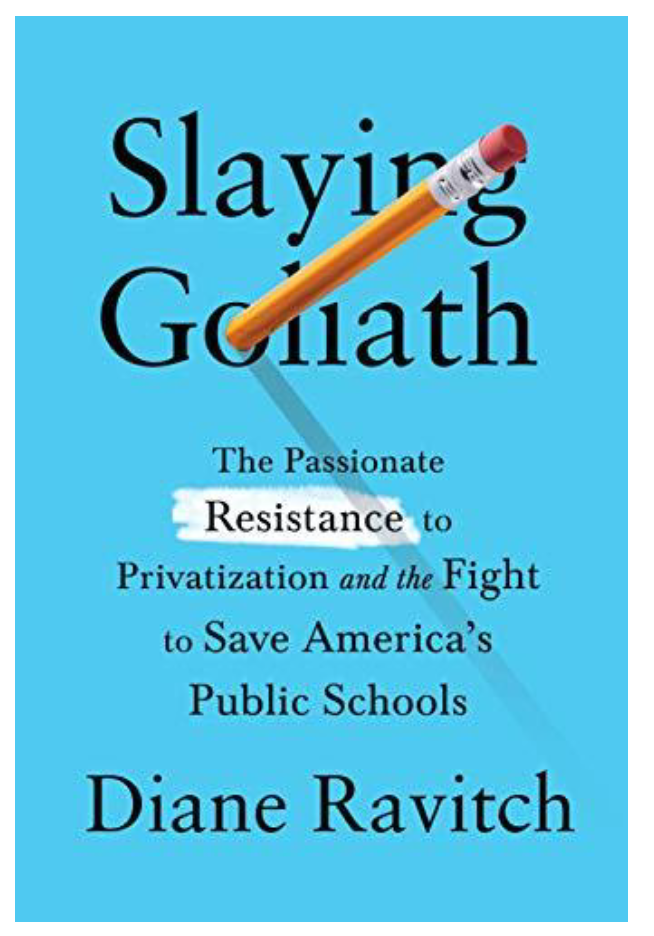
Tim Slekar is a fearless warrior for public schools, teachers, and students. I will be talking to him about Slaying Goliath and the struggle to protect public schools from the depredations of billionaires and zealots.
This Thursday on Civic Media: Dive Back into “Slaying Goliath” with Diane Ravitch
Grab your pencils—BustEDpencils is gearing up for a no-holds-barred revival of Diane Ravitch’s game-changing book, *Slaying Goliath*, live this Thursday on Civic Media.
Launched into a world on the brink of a pandemic, *Slaying Goliath* hit the shelves with a mission: to arm the defenders of public education against the Goliaths of privatization. But then, COVID-19 overshadowed everything. Despite that, the battles Diane described haven’t paused—they’ve intensified. And this Thursday, we’re bringing these crucial discussions back to the forefront with Diane herself.
This Thursday at 7pm EST on BustEDpencils, we’re not just revisiting a book; we’re reigniting a movement. Diane will dissect the current threats to public education and highlight how *Slaying Goliath* still maps the path to victory for our schools. This isn’t just about reflection—it’s about action.
**It’s time to get real. It’s time to get loud. It’s time to tune in this Thursday at 7 PM EST on Civic Media.**
If you believe that without a robust public education system our democracy is in jeopardy, then join us. Listen in, call in (855-752-4842), and let’s get fired up. We’ve got a fight to win, and Diane Ravitch is leading the charge.
Mark your calendars and fire up Civic Media this Thursday at 7pm Central.
Tom Ultican, retired teacher in California, smells a scam in the making. The science behind “the Science of Reading” movement is not very scientific, he writes. Publishers and vendors are preparing to cash in on legislative mandates that force reading teachers to use only one method to teach reading despite the lack of evidence for its efficacy. Ultican zeroes in on the role of billionaire Laurene Powell Jobs as one of the key players in promoting SofR.
He writes:
Laurene Powell Jobs controls Amplify, a kids-at-screens education enterprise. In 2011, she became one of the wealthiest women in the world when her husband, Steve, died. This former Silicon Valley housewife displays the arrogance of wealth, infecting all billionaires. She is now a “philanthropist”, in pursuit of both her concerns and biases. Her care for the environment and climate change are admiral but her anti-public school thinking is a threat to America. Her company, Amplify, sells the antithesis of good education.
I am on Amplify’s mailing list. April third’s new message said,
“What if I told you there’s a way for 95% of your students to read at or near grade level? Maybe you’ve heard the term Science of Reading before, and have wondered what it is and why it matters.”
Spokesperson, Susan Lambert, goes on to disingenuously explain how the Science of Reading (SoR) “refers to the abundance of research illustrating the best way students learn to read.”
This whopper is followed by a bigger one, stating:
“A shift to a Science of Reading-based curriculum can help give every teacher and student what they need and guarantee literacy success in your school. Tennessee school districts did just that and they are seeing an abundant amount of success from their efforts.”
A shift to SoR-based curriculum is as likely to cause harm as it is to bring literacy success. This was just a used-car salesman style claim. On the other hand, the “abundance of success” in Tennessee is an unadulterated lie. National Assessment of Education Progress (NAEP) tracks testing over time and is respected for education testing integrity. Tennessee’s NAEP data shows no success “from their efforts.” Their reading scores since 2013 have been down, not a lot but do not demonstrate an “abundance of success”.
NAEP Data Plot 2005 to 2022
Amplify’s Genesis
Larry Berger and Greg Dunn founded Wireless Generation in 2000 to create the software for lessons presented on screens. Ten years later, they sold it to Rupert Murdoch and his News Corporation for $360 million. Berger pocketed $40 million and agreed to stay on as head of curriculum. Wireless Generation was rebranded Amplify and Joel Klein was hired to run it.
Murdoch proposed buying a million I-pads to deliver classroom instruction. However, the Apple operating system was not flexible enough to run the software. The android system developed at Google met their needs. They purchased the Taiwanese-made Asus Tablets, well regarded in the market place but not designed for the rigors of school use. Another issue was that Wireless Generation had not developed curriculum but Murdoch wanted to beat Pearson and Houghton Mifflin to the digital education market place … so they forged ahead.
In 2012, the corporate plan was rolling along until the wheels came off. In Guilford County, North Carolina, the school district won a Race to the Top grant of $30 million dollars which it used to experiment with digital learning. The district’s plancalled for nearly 17,000 students in 20 middle schools to receive Amplify tablets. When a charger for one of the tablets overheated, the plan was halted. Only two months into the experiment, they found not only had a charger malfunctioned but another 175 chargers had issues and 1500 screens were kid-damaged.
This was the beginning of the end.
By August of 2015, News Corporation announced it was exiting the education business. The corporation took a $371 million dollar write-off. The next month, they announced selling Amplify to members of its staff. In the deal orchestrated by Joel Klein, who remained a board member, Larry Berger assumed leadership of the company.
Three months later, Reuters reported that the real buyer was Laurene Powell Jobs. She purchased Amplify through her LLC, the Emerson Collective. In typical Powell Jobs style, no information was available for how much of the company she would personally control.
Because Emerson Collective is an LLC, it can purchase private companies and is not required to make money details public. However, the Waverley Street Foundation, also known as the Emerson Collective Foundation, is a 501 C3 (EIN: 81-3242506) that must make money transactions public. Waverly Street received their tax exempt status November 9, 2016.
Navigating tells readers that it helps teachers move away from ineffective legacy practices and start making shifts to evidence-based practices. The claim that “legacy practices” are “ineffective” is not evidence-based. The other assertion that SoR is evidence-based has no peer-reviewed research backing it.
Sally Riordan is a Senior Research Fellow at the University College London. In Britain, they have many of the same issues with reading instruction. In her recent research, she noted:
“In 2023, however, researchers at the University of Warwick pointed out something that should have been obvious for some time but has been very much overlooked – that following the evidence is not resulting in the progress we might expect.
“A series of randomised controlled trials, including one looking at how to improve literacy through evidence, have suggested that schools that use methods based on research are not performing better than schools that do not.”
In Symposium, we see quotes from Kareem Weaver who co-founded Fulcrum in Oakland, California and is its executive director. Weaver also was managing director of the New School Venture Fund, where Powell Jobs served on the board. He works for mostly white billionaires to the detriment of his community. (Page 15)
Both Symposium and Navigating have the same quote, “Our friends at the Reading League say that instruction based on the Science of Reading ‘will elevate and transform every community, every nation, through the power of literacy.”’
Who is the Reading League and where did they come from?
Dr. Maria Murray is the founder and CEO of The Reading League. It seems to have been hatched at the University of Syracuse and State University of New York at Oswego by Murray and Professor Jorene Finn in 2017. That year, they took in $11,044 in contributions (EIN: 81-0820021) and in 2018, another $109,652. Then in 2019, their revenues jumped 20 times to $2,240,707!
Jorene Finn worked for Cambria Learning Group and was a LETRS facilitator at Lexia. That means the group had serious connections to the corporate SoR initiative before they began.
With Amplify’s multiple citations of The Reading League, I speculated that the source of that big money in 2019 might have been Powell Jobs. Her Waverly Street Foundation (AKA Emerson Collective Foundation) only shows one large donation of $95,000,000 in 2019. It went to the Silicon Valley Community Foundation (EIN: 20-5205488), a donor-directed dark money fund.
There is no way of following that $95 million.
The Reading League Brain Scan Proving What?
Professor Paul Thomas of Furman University noted the League’s over-reliance on brain scans and shared:
“Many researchers in neurobiology (e.g., Elliott et al., 2020; Hickok, 2014; Lyon, 2017) have voiced alarming concerns about the validity and preciseness of brain imaging techniques such as functional magnetic resonance imaging (fMRI) to detect reliable biomarkers in processes such as reading and in the diagnosis of other mental activity….
“And Mark Seidenberg, a key neuroscientist cited by the “science of reading” movement, offers a serious wcaution about the value of brain research: “Our concern is that although reading science is highly relevant to learning in the classroom setting, it does not yet speak to what to teach, when, how, and for whom at a level that is useful for teachers.”
“Beware The Reading League because it is an advocacy movement that is too often little more than cherry-picking, oversimplification, and a thin veneer for commercial interests in the teaching of reading.”
The push to implement SoR is a new way to sell what Amplify originally called “personalized learning.”This corporate movement conned legislators, many are co-conspirators, into passing laws forcing schools and teachers to use the SoR-related programs, equipment and testing.
SoR is about economic gain for its purveyors and not science based.
Drew Harrell of The Washington Post published a sad article about the Trump devotees who have put their life savings into his DJT stock offering and have no concerns about its value or its future. They are so certain that he is a financial genius that they expect the stock to soar, once the “liberals” stop depressing its market price.
Jerry Dean McLain first bet on former president Donald Trump’s Truth Social two years ago, buying into the Trump company’s planned merger partner, Digital World Acquisition, at $90 a share. Over time, as the price changed, he kept buying, amassing hundreds of shares for $25,000 — pretty much his “whole nest egg,” he said.
That nest egg has lost about half its value in the past two weeks as Trump Media & Technology Group’s share price dropped from $66 after its public debut last month to $32 on Friday. But McLain, 71, who owns a tree-removal service outside Oklahoma City, said he’s not worried. If anything, he wants to buy more.
“I know good and well it’s in Trump’s hands, and he’s got plans,” he said. “I have no doubt it’s going to explode sometime.”
For shareholders like McLain, investing in Truth Social is less a business calculation than a statement of faith in the former president and the business traded under his initials, DJT.
Even the company’s plunging stock price — and the chance their investments could get mostly wiped out — doesn’t seem to have shaken that faith. The company has lost $3.5 billion in value since its public debut last month.
As a business, Trump Media has largely underwhelmed: The company lost $58 million last year on $4 million in revenue, less than the average Chick-fil-A franchise, even as it paid out millions in executive salaries, bonuses and stock.
And in two years, Truth Social has attracted a tiny fraction of the traffic other platforms see, according to estimates from the analytics firm Similarweb — one of the only ways to measure its performance, given that the company says it “does not currently, and may never, collect, monitor or report certain key operating metrics used by companies in similar industries.”
But for some Trump investors, the stock is a badge of honor — a way to show their devotion beyond buying Trump merchandise, visiting Trump golf courses or donating to Trump’s presidential campaign….
Trump Media has boasted that it has benefited from a flood of “retail investors” — small-time and amateur shareholders betting their personal cash. Its merger partner, Digital World Acquisition, said its shares were bought by nearly 400,000 retail investors, and Trump Media’s chief executive, Devin Nunes, told Fox News anchor Maria Bartiromo on Sunday that the company had added over 200,000 new ones in the past couple of weeks.
“There’s not another company out there that has retail investors like this,” said Nunes, who this year will receive a $1 million salary, a $600,000 retention bonus and a stock package currently worth $3.7 million…
One investor said “the recent drops in share price have been the result of “stock manipulation” from an “organized effort” to make the company look bad. There’s no proof of such a campaign, but Schlanger is convinced. “It’s got to be political,” he said, from all the “liberals that are trying to knock it down…”
After the billionaire media mogul Barry Diller called Trump Media a “scam” stock bought by “dopes,” one account, @Handbag72, claimed to have bought more shares, arguing Diller didn’t “get it” or was “at risk of [losing] $$$$.” The next day, the account shared a 2021 blog post from the investing forum Seeking Alpha saying Truth Social could be worth $1 trillion in the next 10 years.
Soon after it was launched March 26 on NASDAQ, the stock reached $79. By last Monday, it had fallen to $26.61, after news broke that DJT intends to issue millions of additional shares, which would dilute the value of the original shares.
Bibles, sneakers, perfume, wine, steaks, now stocks. Trump will keep selling, and his cult will keep buying.
I am almost four years late in discovering this review by two scholars for whom I have the greatest respect: David C. Berliner and Gene V. Glass.
I was happy to read this review because Slaying Goliath had a checkered fate. It was published in mid-January 2020. I went on a book tour, starting in Seattle. By mid-February, I made my last stop in West Virginia, where I met with teachers and celebrated the two-year anniversary of their strike, which shut down every school in the state.
As I traveled, news emerged of a dangerous “flu” that was rapidly spreading. It was COVID; by mid-March, the country was shutting down. No one wanted to read about the fight to save public schools or about its heroes. The news shifted, as it should have, to the panicked response to COVID, to the deaths of good people, to the overwhelmed hospitals and their overworked staff.
To make matters worse, the New York Times Book Review published a very negative review by someone who admired the “education reform” movement that I criticized. I thought of writing a letter to the editor but quickly dropped the idea. I wrote and rewrote my response to the review in my head, but not on paper.
Then, again by happenstance, I discovered that Bob Shepherd had reviewed the review of my book in The New York Times. He said everything that I wish I could have said but didn’t. His review was balm for my soul. Shepherd lacerated the tone and substance of the review, calling it an “uniformed, vituperative, shallow, amateurish ‘review.’” Which it was. His review of the review was so powerful that I will post it next.
Then, a few weeks ago, I found this review by Berliner and Glass.
The review begins:
Reviewed by Gene V Glass and David C. Berliner Arizona State University, United States
They wrote:
In a Post-Truth era, one must consider the source.
In this case, the source is Diane Rose Silvers, the third of eight children of Walter Silverstein, a high school drop-out, and Ann Katz, a high school graduate. The Silvers were a middle-class Houston family, proprietors of a liquor store, and loyal supporters of FDR.
After graduation from San Jacinto High School, she enrolled in Wellesley College in September, 1956. Working as a “copy boy”for the Washington Post, Diane met Richard Ravitch, a lawyer working in the federal government and son of a prominent New York City family. They married on June 26,1960, in Houston, two weeks after Diane’s graduation from Wellesley. The couple settled in New York City, where Richard took employment in the family construction business. He eventually served as head of the Metropolitan Transit Authority and Lieutenant Governor in the 2000s, having been appointed by Democratic Governor David Paterson.
Diane bore three sons, two of whom survived to adulthood. Diane and Richard ended their 26-year marriage in 1986. She had not been idle. For a period starting in 1961, Diane was employed by The New Leader, a liberal, anti-communist journal. She later earned a PhD in history of education from Columbia in 1975 under the mentorship of Lawrence Cremin.
Diane was appointed to the office of Assistant Secretary of Education, in the Department of Education by George H. W. Bush and later by Bill Clinton. In 1997, Clinton appointed her to the National Assessment Governing Board (NAGB), on which she served until 2004.
Ravitch worked “… for many years in some of the nation’s leading conservative think tanks.
President Biden managed to raise $25 million in one night by holding a panel discussion with former Presidents Clinton and Obama at Rockefeller Center Music Hall.
Trump was determined to outdo Biden, so he held a fundraiser at Mar-a-Lago, with a fee of $814,600 required to be named as a co-chairman and a fee of $250,000 to be a member of the Host Committee. Trump claimed he raised $50 million in one night, but let’s wait and see what he reports to the Federal Elections Commission.
Step back from the festivities and ask yourself, why is it so expensive to run for office? Why should the person who raises the most money have a better chance of winning?
This is a time when we lament the loss of Senator John McCain, who really wanted campaign finance reform. No othrr Republican does.
The dependence on big donors creates obligations that are at odds with the common good.
The Supreme Court’s “Citizens United” decision of 2010 removed limits on corporate contributions to political campaigns. Since then, all electoral races have become dependent on fundraising.
This is a shameful state of affairs. It erodes democracy. Elections are decided by money, not policy.






 Diane Ravitch's blog