Archives for category: Academic Freedom

Perhaps you remember the tragic murders of a dozen members of the staff of the French satiric magazine “Charlie Hebdo.” Knowing that Muslims oppose any visual detection of their Prophet Mohammed, the magazine printed an issue with several cartoons about Mohammed, all making fun of the taboo. Two brothers, who were Muslims and terrorists, burst into their offices and gunned down 23 people, murdering 12.

The story was widely reported but very few newspapers or magazines dared to reprint the offending images for fear of inspiring more terrorism.

Recently an adjunct professor at Hamline University in Minnesota, showed two respectful historical images of Mohammed. She warned her students in advance. One Muslim student complained, who happened to be president of the Muslim Students Association, and the professor was fired.

The story by Sarah Cascone in Artnet shows the two images, which are respectful, even devotional.

In a controversial move, an adjunct professor at Hamline University in St. Paul, Minnesota, has lost her job after showing her class Medieval paintings depicting the Prophet Muhammad, founder of the Islamic religion.

The school’s decision not to renew the professor’s contract for the current semester has sparked debates over free speech, including a Change.org petition in support of the teacher, signed by at least 2,500 scholars and students of Islamic studies and art history, and a condemnation from PEN America of the “egregious violation” of academic freedom.

But there is also a tradition of painting Muhammad, often in miniature, especially in Persia, Turkey, and India. Examples can be found in the collections of museums such as the Louvre, the Metropolitan Museum of Art, and the Asian Art Museum of San Francisco. It was a selection of two of those artworks shown to the class that cost the professor her job.

Though it is not mentioned in the Koran, many Muslims believe it is idolatrous to show Muhammad’s face. Most mosques instead are decorated with geometric designs and calligraphy featuring passages from the Koran, and Islamic figurative art is now rare.

The teacher, identified by the Art Newspaper as Erika Lopez Prater, is said to have displayed the images during on online lecture on October 6, 2022. There was a two-minute content warning prior to the artworks’ appearance, to allow students to opt out of viewing the potentially offensive imagery should they feel it was against their faith.

A day later, Vimeo Patel of The New York Times reported the controversy in greater detail. The story included the offending images, as well as one that belongs to Omar Safi, a Duke University Professor of Asians and Middle Eastern Studies, who said he regularly shows images of the Prophet in his classes.

Erika López Prater, an adjunct professor at Hamline University, said she knew many Muslims have deeply held religious beliefs that prohibit depictions of the Prophet Muhammad. So last semester for a global art history class, she took many precautions before showing a 14th-century painting of Islam’s founder.

In the syllabus, she warned that images of holy figures, including the Prophet Muhammad and the Buddha, would be shown in the course. She asked students to contact her with any concerns, and she said no one did.

In class, she prepped students, telling them that in a few minutes, the painting would be displayed, in case anyone wanted to leave.

Then Dr. López Prater showed the image — and lost her teaching gig.

Officials at Hamline, a small, private university in St. Paul, Minn., with about 1,800 undergraduates, had tried to douse what they feared would become a runaway fire. Instead they ended up with what they had tried to avoid: a national controversy, which pitted advocates of academic liberty and free speech against Muslims who believe that showing the image of Prophet Muhammad is always sacrilegious.

After Dr. López Prater showed the image, a senior in the class complained to the administration. Other Muslim students, not in the course, supported the student, saying the class was an attack on their religion. They demanded that officials take action.

Officials told Dr. López Prater that her services next semester were no longer needed. In emails to students and faculty, they said that the incident was clearly Islamophobic. Hamline’s president, Fayneese S. Miller, co-signed an email that said respect for the Muslim students “should have superseded academic freedom.” At a town hall, an invited Muslim speaker compared showing the images to teaching that Hitler was good.

Free speech supporters started their own campaign. An Islamic art historian wrote an essay defending Dr. López Prater and started a petition demanding the university’s board investigate the matter. It had more than 2,800 signatures. Free speech groups and publications issued blistering critiques; PEN America called it“one of the most egregious violations of academic freedom in recent memory.” And Muslims themselves debated whether the action was Islamophobic….

University officials and administrators all declined interviews. But Dr. Miller, the school’s president, defended the decision in a statement.

“To look upon an image of the Prophet Muhammad, for many Muslims, is against their faith,” Dr. Miller’s statement said, adding, “It was important that our Muslim students, as well as all other students, feel safe, supported and respected both in and out of our classrooms…”

The painting shown in Dr. López Prater’s class is in one of the earliest Islamic illustrated histories of the world, “A Compendium of Chronicles,” written during the 14th century by Rashid-al-Din (1247-1318).

Shown regularly in art history classes, the painting shows a winged and crowned Angel Gabriel pointing at the Prophet Muhammad and delivering to him the first Quranic revelation. Muslims believe that the Quran comprises the words of Allah dictated to the Prophet Muhammad through the Angel Gabriel.

The image is “a masterpiece of Persian manuscript painting,” said Christiane Gruber, a professor of Islamic art at the University of Michigan. It is housed at the University of Edinburgh; similar paintings have been on display at places like the Metropolitan Museum of Art. And a sculpture of the prophet is at the Supreme Court.

Dr. Gruber said that showing Islamic art and depictions of the Prophet Muhammad have become more common in academia, because of a push to “decolonize the canon” — that is, expand curriculum beyond a Western model.

Dr. Gruber, who wrote the essay in New Lines Magazine defending Dr. López Prater, said that studying Islamic art without the Compendium of Chronicles image “would be like not teaching Michaelangelo’s David.”

What a shame that Dr. Prater does not have tenure. This unfortunate case demonstrates the value of tenure. Most professors in higher education work foe low wages as adjunct faculty. It saves their university money, but it deprives them of protection from marauding politicians like Ron DeSantis and over-zealous students, as is the situation at Hamline, a good small private university that has unnecessarily damaged its reputation by not protecting academic freedom.

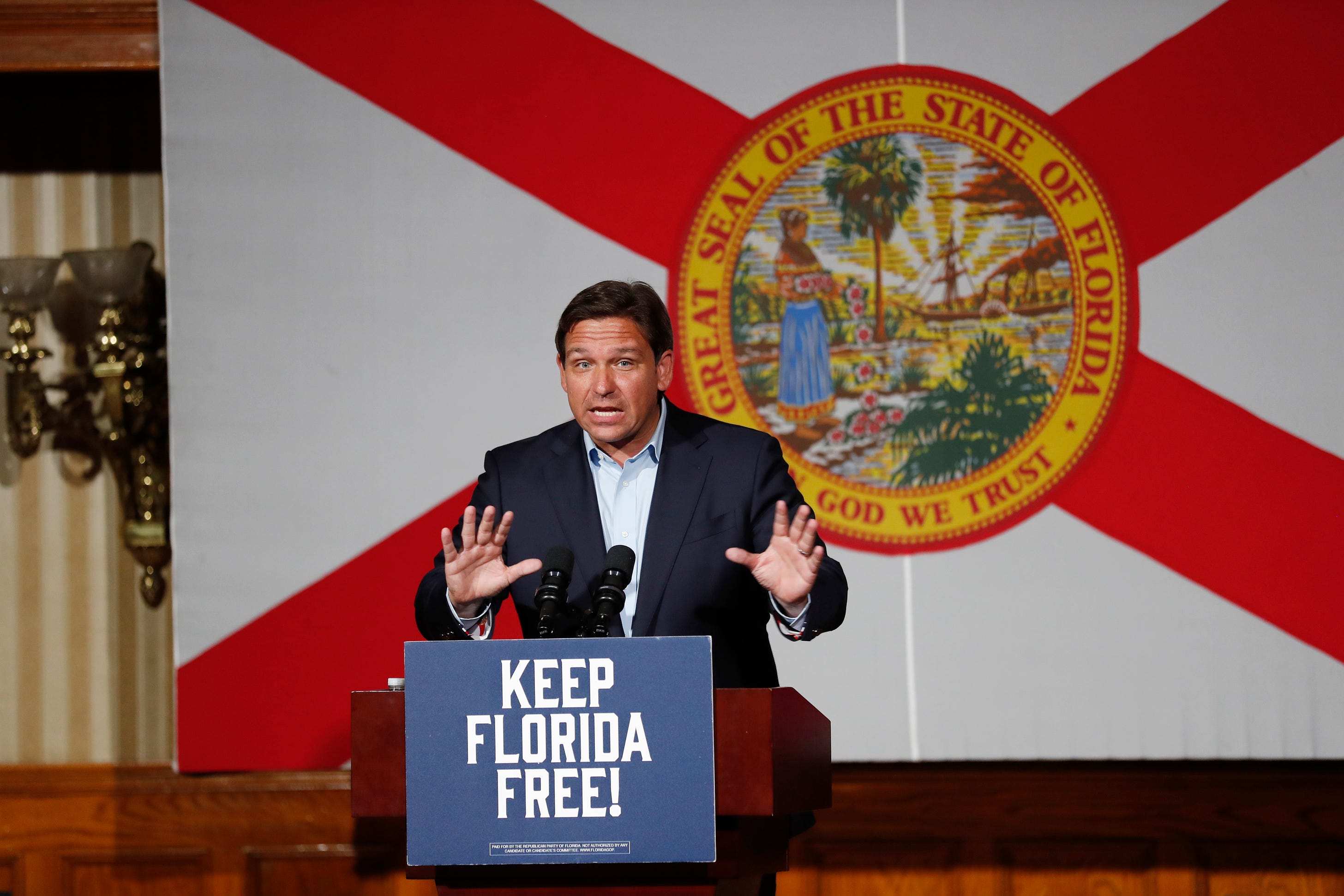
Governor DeSantis has pushed through laws that ban the teaching of “critical race theory” and gender studies. The effect of this law and his denunciation of anyone who dares to say that racism is real has been to silence academic freedom. This article in ProPublica (Read the story) shows how professors are dropping the courses they usually teach or changing their names. Untenured teachers— the majority of professors in higher education in Florida and elsewhere worry about being fired if they offend DeSantis’ thought police.

Ironically, the story includes a photograph of a truck owned by a rightwing group, festooned with the words “Freedom of Speech.” To be clear, DeSantis and his rightwing goons are silencing academic freedom and freedom of speech. They are the Thought Police, practicing “cancel culture.”

The article begins:

Jonathan Cox faced an agonizing decision. He was scheduled to teach two classes this past fall at the University of Central Florida that would explore colorblind racism, the concept that ostensibly race-neutral practices can have a discriminatory impact. The first, “Race and Social Media,” featured a unit on “racial ideology and color-blindness.” The second, “Race and Ethnicity,” included a reading on “the myth of a color-blind society.” An assistant sociology professor, Cox had taught both courses before; they typically drew 35 to 40 undergraduates apiece.

As recently as August 2021, Cox had doubted that the controversy over critical race theory — which posits, among other things, that racism is ingrained in America’s laws and power structure — would hamstring his teaching. Asked on a podcast what instructors would do if, as anticipated, Florida restricted the teaching of CRT in higher education, he said that they would need to avoid certain buzzwords. “What many of us are looking at doing is just maybe shifting some of the language that we’re using.”

But a clash with state law seemed inevitable, once Florida’s governor, Ron DeSantis, proposed what he called the strongest legislation in the nation against “the state-sanctioned racism that is critical race theory.” Last April, DeSantis signed the Individual Freedom Act, also known as the “Stop Woke Act,” into law. It bans teaching that one race or gender is morally superior to another and prohibits teachers from making students feel guilty for past discrimination by members of their race. And it specifically bars portraying racial colorblindness — which the law labels a virtue — as racist. A DeSantis spokesperson, Jeremy Redfern, told me in an email that the law “protectsthe open exchange of ideas” (italics in the original) by prohibiting teachers from “forcing discriminatory concepts on students.”

Whatever one thinks of critical race theory, the state’s interference limits the freedom of professors who are experts in their fields to decide what to teach their students. Cox worried, not without reason, that the law effectively banned him from discussing his ideas in class, and that teaching the courses could cost him his livelihood. Cox, who is the only Black professor in the sociology department, will not be considered for tenure until this fall. His salary was his family’s only income while his wife stayed home with their baby.

A month before the fall 2022 semester was set to start, he scrapped both courses. Students scrambled to register for other classes. “It didn’t seem like it was worth the risk,” said Cox, who taught a graduate course on inequality and education instead. “I’m completely unprotected.” He added, “Somebody who’s not even in the class could come after me. Somebody sees the course catalog, complains to a legislator — next thing I know, I’m out of a job.”

Cox’s decision, along with another professor’s cancellation of a graduate course because of similar apprehension, created an unusual gap in the sociology curriculum at UCF, which, with almost 69,000 students, is Florida’s largest university.


Cox’s department chair, Elizabeth Mustaine, said she went along with the professors’ wishes because “I thought: ‘I’m not going to stress anyone out about this. It’s crazy.’” Still, she added, “it’s an absolute tragedy that classes like this get canceled.” Of the 39 courses offered this past fall by a department that specializes in the study of human society, none focused primarily on race.

In just over two years, critical race theory has gone from a largely obscure academic subject to a favorite bogeyman for Republican candidates. Activists such as Christopher Rufo, a senior fellow at the conservative Manhattan Institute, conceived of targeting CRT to foment a backlash against measures enacted following George Floyd’s murder in May 2020. At that time, Rufo told me in an email, “school districts across the country suddenly started adopting ‘equity statements,’ hiring ‘diversity and inclusion’ bureaucrats, and injecting heavily partisan political content into the curriculum.” Black Lives Matter and the left were riding high, said Rufo, who denies that structural racism exists in America. In our email exchange, Rufo described “the fight against critical race theory” as “the most successful counterattack against BLM as a political movement. We shifted the terrain and fought on a vector the Left could not successfully mobilize against.”

The anti-CRT campaign quickly expanded from sloganeering to writing laws. Seven states, including Florida, have passed legislation aimed at restricting public colleges’ teaching or training related to critical race theory. Those laws face impediments. On Nov. 17, 2022, a federal judge temporarily blocked enforcement of the higher-education provisions of Florida’s Individual Freedom Act. “The First Amendment does not permit the State of Florida to muzzle its university professors, impose its own orthodoxy of viewpoints, and cast us all into the dark,” Judge Mark Walker wrote. The DeSantis administration filed a notice of appeal on Nov. 29 and is seeking to stay the injunction pending that appeal. The 11th Circuit, where most of the judges are Republican appointees, will hear the appeal, with briefs to be filed in the next few months and oral arguments potentially this coming summer.

Additionally, with DeSantis’ landslide reelection — after a campaign in which he repeatedly denounced “woke” education — and Republicans gaining a supermajority in both chambers of the state’s Legislature, they are likely to look for new ways to crack down on CRT and what they perceive as higher education’s leftist tilt. And at the federal level, conservatives are drafting a “potential suite of executive orders in 2024,” in case the next presidential election goes their way, to “disrupt the national network of left-wing ideological production and distribution,” according to Rufo.

It’s easy to dismiss the conservative crusade against critical race theory as political theater without real consequences. But most colleges and universities offer social science and humanities courses that address racial inequality and systemic racism, and the anti-CRT laws are already having repercussions for people who teach or take these classes in red states. Moreover, the push against CRT is hitting academia after decades of declines in the proportion of professors protected by tenure, meaning that most faculty members are not in positions secure enough to resist political pressure. Now, forced to consider whether they face any legal or career risk, some are canceling courses or watering down content, keeping quiet rather than sharing their expertise with students.

“When you implement a law like this, you’re asking professors to leave out things that clearly happen or have happened in the past,” Grace Castelin, a UCF undergraduate who plans to introduce a resolution in the student senate condemning the law, told me. “It’s making us more ignorant in this generation and generations to come.”


Fearful that legislators will retaliate by cutting their budgets, few top university administrators have publicly criticized the laws, which put institutions as well as individual teachers at risk. Indeed, UCF Provost Michael Johnson told faculty last July that the university would “have to take disciplinary action” against any faculty member who repeatedly violated the Individual Freedom Act because it couldn’t afford to lose a “catastrophic amount” — $32 million — in state funding linked to graduation rates and other metrics. (Johnson declined an interview request.)

Other states have left professors similarly undefended. In Tennessee, which passed a law much like Florida’s, the provost of the state university’s flagship Knoxville campus made clear to professors that the administration wouldn’t necessarily help them. If they were sued under the law, Provost John Zomchick told faculty, Tennessee’s Republican attorney general would decide whether the university would represent them in court. “People freaked out,” said Anne Langendorfer, a senior lecturer at UT Knoxville and the president of a union for campus workers at the state’s public universities.

A university spokesperson, Kerry Gardner, said that the attorney general makes the final decision in “any situation” where individuals are sued in their capacity as university employees. Administrators “wanted to be fully transparent about how the process works,” while assuring faculty that “we will take every step to defend them,” Gardner said. Zomchick, she added, “does not agree with the view of some faculty” that the law “infringes on the First Amendment or academic freedoms.”

With uncertain support from above, most full and associate professors at least enjoy the protection of tenure, which shields scholars whose insights or research are politically unpopular. Tenured professors can’t be fired without cause and a hearing by their peers. Other faculty typically work on contracts, which the university can decide not to renew without specifying a reason.

Some tenured professors in Florida have resisted anti-CRT pressure. The historian Robert Cassanello, the president of the UCF chapter of United Faculty of Florida, was comfortable becoming a plaintiff in one of the lawsuits contending that the Individual Freedom Act violates free speech. Cassanello, who keeps a life-size cutout of Karl Marx in his office window, told me that he’s less threatened by the law than his untenured colleagues are.

Robert Cassanello, a tenured professor, teaches history at the University of Central Florida and became a plaintiff in a lawsuit challenging a state law that restricts the teaching of critical race theory. (Tara Pixley, special to ProPublica and The Atlantic)

By contrast, Juan Salinas, an assistant sociology professor at the University of North Florida in Jacksonville, declined to be a plaintiff. “For me to stick my name out, I didn’t feel comfortable,” Salinas said. “If I had tenure, I would be more active.”

But even having tenure didn’t feel like “adequate protection” to Scott Carter, the other UCF sociologist who scrapped a course on race in the fall semester. “It’s very sad for students,” Carter told me. “They won’t get the experience of hearing from scholars on contemporary race relations.”

David C. Berliner is one of the most honored researchers in the field of education.

He sent the following reflections on censorship. His thoughts reflect my views about censorship and abortion. If you are opposed to certain books, don’t read them. If you oppose abortion, don’t have one. Don’t impose your views on others.

Dr. Berliner wrote:


I was asked some time ago to write about censorship for the Horace Mann League. My explorations of the topic led me first to a personal statement:

“It is the right of people to not listen to, and not read, anything they find offensive. But this right is limited: it does not give them the right to limit what others choose to hear or read. It gives concerned citizens absolutely no right to forbid anyone else to listen to or read what they choose.

The only exception to this statement is with one’s own children. Parents do have both a right, and an obligation, to react to what their children are listening to and reading.

But that right and obligation is limited to their own children—not mine! I will make such decisions for myself. And I happen to trust school teachers, and librarians, to act for me, to act in “locus parentis.”

And I hope that every librarian and teacher is thoughtful enough to remember that merely avoiding certain discussions is itself a form of censorship!”

David C. Berliner

Some of the thoughts of others that I thought worth thinking about follow:

“The real heroes [in our society] are the librarians and teachers who at no small risk to themselves refuse to lie down and play dead for censors.”
― Bruce Coville

“What is freedom of expression? Without the freedom to offend, it ceases to exist.”
― Salman Rushdie

“There are worse crimes than burning books. One of them is not reading them.”
― Joseph Brodsky

“Free societies…are societies in motion, and with motion comes tension, dissent, friction. Free people strike sparks, and those sparks are the best evidence of freedom’s existence.”
― Salman Rushdie

“Everyone has the right to freedom of opinion and expression; this right includes freedom to hold opinions without interference and to seek, receive and impart information and ideas through any media and regardless of frontiers.”
― United Nations, Universal Declaration of Human Rights

“Censorship, like charity, should begin at home; but unlike charity, it should end there.”
― Clare Luce Booth

“Don’t join the book burners. Don’t think you’re going to conceal faults by concealing evidence that they ever existed. Don’t be afraid to go in your library and read every book…”
― Dwight D. Eisenhower

“If all printers were determined not to print anything till they were sure it would offend nobody, there would be very little printed.”
― Benjamin Franklin

“Censorship is telling a man he can’t have a steak just because a baby can’t chew it.”
― Mark Twain

[I]t’s not just the books under fire now that worry me. It is the books that will never be written. The books that will never be read. And all due to the fear of censorship. As always, young readers will be the real losers.”
― Judy Blume

“Books cannot be killed by fire. People die, but books never die. No man and no force can abolish memory… In this war, we know, books are weapons. And it is a part of your dedication always to make them weapons for man’s freedom.”
― Franklin D. Roosevelt

“If you can’t say “Fuck” you can’t say, “Fuck the government.”
― Lenny Bruce

“Censorship is the child of fear and the father of ignorance.”
― Laurie Halse Anderson

“All censorships exist to prevent anyone from challenging current conceptions and existing institutions. All progress is initiated by challenging current conceptions, and executed by supplanting existing institutions. Consequently, the first condition of progress is the removal of censorship.”
― George Bernard Shaw, Mrs. Warren’s Profession

“[Public] libraries should be open to all—except the censor.
[Response to questionnaire in Saturday Review, October 29 1960]”
― John F. Kennedy

I

“Only the nonreader fears books. ”
― Richard Peck

“Censorship of anything, at any time, in any place, on whatever pretense, has always been and always will be the last resort of the boob and the bigot.”
― Eugene Gladstone O’Neill

“If there’s one American belief I hold above all others, it’s that those who would set themselves up in judgment on matters of what is “right” and what is “best” should be given no rest; that they should have to defend their behavior most stringently. … As a nation, we’ve been through too many fights to preserve our rights of free thought to let them go just because some prude with a highlighter doesn’t approve of them.”
[Bangor Daily News, Guest Column of March 20, 1992]”
― Stephen King

“When the Washington Post telephoned me at home on Valentine’s Day 1989 to ask my opinion about the Ayatollah Khomeini’s fatwah, I felt at once that here was something that completely committed me. It was, if I can phrase it like this, a matter of everything I hated versus everything I loved. In the hate column: dictatorship, religion, stupidity, demagogy, censorship, bullying, and intimidation. In the love column: literature, irony, humor, the individual, and the defense of free expression. Plus, of course, friendship—though I like to think that my reaction would have been the same if I hadn’t known Salman at all. To re-state the premise of the argument again: the theocratic head of a foreign despotism offers money in his own name in order to suborn the murder of a civilian citizen of another country, for the offense of writing a work of fiction. No more root-and-branch challenge to the values of the Enlightenment (on the bicentennial of the fall of the Bastille) or to the First Amendment to the Constitution, could be imagined. President George H.W. Bush, when asked to comment, could only say grudgingly that, as far as he could see, no American interests were involved…”
― Christopher Hitchens,

“The important task of literature is to free man, not to censor him, and that is why Puritanism was the most destructive and evil force which ever oppressed people and their literature: it created hypocrisy, perversion, fears, sterility.”
― Anaïs Nin, The Diary of Anaïs Nin, Vol. 4: 1944-1947

“Every burned book or house enlightens the world; every suppressed or expunged word reverberates through the earth from side to side.”
― Ralph Waldo Emerson, Essays: First Series

“Fear of corrupting the mind of the younger generation is the loftiest form of cowardice.”
― Holbrook Jackson

“Censors never go after books unless kids already like them. I don’t even think they know to go after books until they know that children are interested in reading this book, therefore there must be something in it that’s wrong.”
― Judy Blume

“The fact is that censorship always defeats its own purpose, for it creates, in the end, the kind of society that is incapable of exercising real discretion. In the long run it will create a generation incapable of appreciating the difference between independence of thought and subservience.”
― Henry Steele Commager

“Our freedoms are vanishing. If you do not get active to take a stand now against all that is wrong while we still can, then maybe one of your children may elect to do so in the future, when it will be far more riskier — and much, much harder.”
― Suzy Kassem

“I also hold very strong personal convictions about censorship. I don’t believe in forbidden knowledge.”
― Andrea Cremer

John G. Rodden writes on the website American Purpose about the educational struggle between Ukrainians and Russiand. Ukrainians want their children to learn the Ukrainian language and literature. Wherever Russia has captured tos, cities, or villages, it switches the curriculum to Russian language and literature. Rodden is a scholar who has written several books about George Orwell.

Rodden writes:

The 2022–23 school year in war-torn Ukraine began this fall under conditions that Americans—and even Europeans old enough to remember World War II—can barely fathom. Three-quarters of the schools have been unable to open at all because they lack bomb shelters, air raid sirens nearby, or underground classrooms and lavatories. Russian bombing campaigns can last for several hours; all classes are therefore held remotely, insofar as children have access to computers and Wi-Fi.

Understandably, the attention of the world, including that of President Volodymyr Zelenskyy and his advisors in Kyiv, is focused on battlefield advances and reversals. And yet a parallel war is under way, one that has received only spotty attention in the English-language media, though the German and French presses have covered it more extensively. It is a culture war, a Slavic “Battle of the Books” that goes far beyond the imaginary world in Jonathan Swift’s 1704 book. In Swift’s Battle of the Books, he imagined an epic battle in a library—a so-called “quarrel between the Ancients and the Moderns”—where books come alive, with authors both classical (e.g., Homer, Pindar, Plato, Aristotle, Vergil) and contemporary (e.g., Bacon, Hobbes, Descartes, Dryden, Aphra Benn) duking it out.

The twenty-first century Eurasian counterpart is no mere entry in a game of literary fisticuffs conducted with courtly fellow men of letters. It is a deadly serious affair that Ukrainian officials regard as a retaliatory counteroffensive. For the Ukrainians this isn’t just a Battle of Books–this is a deep, visceral, and emotional reaction to their country being eviscerated and destroyed by Russian forces.

In their view, they have been forced into it by the ruthless “reeducation” policy that Russia has undertaken in occupied Ukraine. The Slavic Battle of the Books is about which authors Ukrainians will read and study. It is a war to “win the minds of men,” as the old Stalinist slogan phrased it. Wherever it leads, it has already validated one venerable contention about which both the Ancients and the Moderns were in full agreement: Ideas have consequences.

The rest of the article is behind a paywall.

The Boston Globe wrote about the activities of a Dark Money group called Parents Defending Education, which has filed lawsuits against the public schools in Wellesley and Newton in their quest to ban books and cleanse the schools of teaching about racism and gender.

Maurice Cunningham wrote a letter to the Globe explaining the reason for the harassment. He thinks their goal is intimidation. He’s right. But there is more. I think their goal is to undermine confidence in public schools and build support for privatization.

He wrote:

LETTERS

In its challenges to schools, group’s object lesson is intimidation

Updated November 18, 2022, 2:30 a.m.

Moms for Liberty, represented at an event last month in Vero Beach, Fla., is among the groups associated with Parents Defending Education, which has been promoting conservative values in education and challenging school districts in court.

Re “Schools wary as nonprofit targets teaching: Right-leaning group’s complaints cite bias in lessons on gender, race, sexuality” (Page A1, Nov. 15): Parents Defending Education is an obedient franchise of right-wing interests, including Charles Koch and the Council for National Policy, that are working to destroy public education.

Legal actions such as Parents Defending Education’s civil rights complaint against the Newton Public Schools and its lawsuit against Wellesley Public Schools are meant to generate publicity and foster intimidation. As the Globe has reported previously, the group’s civil rights “complaints likely will go nowhere.” The lawsuit settled on terms favorable to Wellesley.


However, Parents Defending Education isn’t after legal recourse; it’s after harassment. Wellesley School Superintendent David Lussier said he has received “obscene” and “awful” e-mails from people connected to the group. In December 2021, the Globe reported that two Black school principals in Newton had received “racist and confrontational” messages after the right-wing publisher Breitbart published an article misrepresenting how the principals’ schools were handling lessons about the verdicts in the trials of Kyle Rittenhouse and the men convicted of killing Ahmaud Arbery. Breitbart’s story was framed by Parents Defending Education.

Racist and obscene messages menacing educators are not an unfortunate consequence of Parents Defending Education’s machinations; they are entirely foreseeable.

Maurice T. Cunningham

Cambridge

The writer is the author of “Dark Money and the Politics of School Privatization.” He is a retired associate professor at the University of Massachusetts Boston and a former state assistant attorney general in Massachusetts.

When Florida Governor Ron DeSantis won re-election, he declared that Florida is the state where WOKE goes to die. By WOKE, he means any teaching about racism that makes white students uncomfortable. Teaching anti-racism is WOKE.

Well, WOKE isn’t dead yet.

A federal judge ruled yesterday that the WOKE act is “dystopian” and banned its enforcement in higher education.

A federal judge on Thursday ordered Florida to stop enforcing its new Stop WOKE Act at the state’s public colleges and universities.

The ruling came in two lawsuits — one filed by a University of South Florida student and professor and another led by Florida A&M law professor LeRoy Pernell — both alleging that the law illegally prevents frank discussions about the nation’s racial history in classrooms. The same judge issued a ruling in August that blocked the law from applying to workplace training.

The legislation prohibits advancing concepts that make anyone feel “guilt, anguish or other psychological distress” related to race, color, national origin or sex because of actions “committed in the past.” It is also tied to proposed regulations that would govern tenure reviews of faculty members.

Professor Adriana Novoa and student Sam Rechek, both from USF, argued the law was unconstitutional. The state countered that it has not harmed the plaintiffs and does not prohibit some of the discussions of the race-related topics mentioned in the lawsuit.

In Pernell’s lawsuit also challenging the act, the same defense lawyers wrote that because faculty members are employees of the state, “the First Amendment simply has no application in this context” because their employer “has simply chosen to regulate its own speech.”

Adam Steinbaugh, a lawyer for the Foundation for Individual Rights Expression, said the ruling was important for faculty of all political persuasions — including those who may have favored the Stop WOKE Act. The foundation is representing Novoa and Rechek.

The ruling “recognizes that faculty members are hired by the state but they don’t speak for the state,” Steinbaugh said. “They’re hired to engage in the robust exchange of views and ideas. Some of those views and ideas are going to be ones the state doesn’t like.”

In his 139-page order issuing a preliminary injunction against the law, U.S. District Judge Mark Walker quoted George Orwell. “‘It was a bright cold day in April, and the clocks were striking thirteen,’ and the powers in charge of Florida’s public university system have declared the State has unfettered authority to muzzle its professors in the name of ‘freedom,’ ” his ruling said.

He wrote that the state was trying to argue that professors only had academic freedom if they expressed the viewpoint of the state. “This is positively dystopian,” he wrote.

In a statement, USF said, “We are carefully reviewing the order and will promptly update our guidance, as needed.”

University of Florida Provost Joe Glover said the school was suspending its investigation procedures for reported violations of the law. The State University System said it does not comment on pending litigation. And the office of Gov. Ron DeSantis, who pushed the law, did not respond to requests for comment.

Steinbaugh, the plaintiffs’ lawyer, said he expects the state to appeal Walker’s ruling.

Novoa contended that she would have to remove readings from her courses, such as one about Jackie Robinson, the first Black man to play in baseball’s major leagues. A court filing said her instruction “advances and engages the question of how baseball’s racial past continues to shape both the game and society today.” In its response, the state contended that the act applied to the present, not historical fact.

Faculty in the Pernell case alleged universities had been taking down “public-facing statements that espoused anti-racist principles” and canceling anti-racist trainings, “creating a climate of increased racial hostility and harassment” and “generating fear among plaintiffs and other Black instructors and students who teach or take coursework in which the viewpoints disfavored by the Legislature are likely to be discussed.”

DeSantis first unveiled the framework for the law in December 2021 as he ramped up his fight against the influence of critical race theory and “wokeness” in schools and businesses across the state. Its formal name is the Stop the Wrongs to Our Kids and Employees Act.

During the 2022 legislative session, the measure spurred fierce debates and criticism, particularly from Democrats and Black lawmakers who said it would exacerbate inequities faced by minorities. The law took effect July 1.

Read more at: https://www.miamiherald.com/news/local/education/article268882172.html#storylink=cpy

PEN America is an organization that represents authors and defends freedom of expression, here and elsewhere in the world. I am proud to be a member. I support their belief in the freedom to write and the freedom to read.

PEN has closely followed the recent upsurge in book banning and has kept a list of books that have been attacked and removed from school libraries and public libraries. The American Library Association also maintains a list of banned books and highlights the books most frequently banned. The ALA lists the 10 most challenged books and the 100 most challenged books.

The overwhelming number of banned books deal with race and gender. The censors apparently think that no one will learn about race or gender if no books are available.

They forget about the Internet and television, which they can’t censor.

The only book, to my knowledge, that has been specifically banned by state legislation, is The 1619 Project. That’s a shame because it is enormously informative about the history of racism.

Our nation is experiencing a resurgence of censorship and gag laws that take us back to the 1950s, to the era of McCarthyism, and even to the 1930s and 1940s, when teachers were suspected of subversive activities if they offended rightwing sensibilities. Alan Singer writes here about the upsurge in restrictions on academic freedom in Florida. Undoubtedly, there are other states where Know-Nothings have taken control but Florida stands out because it’s governor is a leading contender for the Republican nomination for the Presidency in 2024.

Florida Governor Ron DeSantis wants to control what children learn, what teachers can speak about in and out of the classroom, and ultimately what people think. Lawyers for the State of Florida argued in a recent court filing that professors at the state’s public colleges and universities have no right to freedom of speech when they teach. Florida is defending the state’s Individual Freedom Act, more commonly known as the “Stop WOKE Act.” The law bars teachers at public institutions from introducing discussion of race, racism, and sex. The big danger is that the rightwing majority on the United States Supreme Court may give him his wish. With DeSantis a leading candidate for the 2024 Republican Party Presidential nomination, this would be another step towards suppressing democracy in the United States.

The out-of-control rightwing majority on the Supreme Court is likely to approve the DeSantis ban on free speech and academic freedom. In 2006, in the case of Garcetti v. Ceballos, a 5-4 rightwing majority of the Supreme Court already ruled that first amendment protection does not apply to employee speech and protect them “from discipline based on speech made pursuant to the employee’s official duties.” At the time the Court did not rule on whether the ban included teachers. But today, an even more rightwing Court majority could rule that teachers, K-12 and college, as government employees in Florida, are subject to discipline including being fired if they exercise speech in their official capacities that violates Florida laws including its notorious “Don’t Say Gay” bill and banning any language that might make a student feel uncomfortable such as recognition that Florida was a slave state and attempted to cede from the United States during the Civil War. Since many teacher contracts have a public behavior clause, saying gay or discussing racism outside the classroom but in in public setting could be construed as a violation of professional responsibility and the Florida law.

Florida is not the only state trying to silence teacher and students. According to a June 2021 article in Education Week, in the previous six months bills were introduced in 42 states to restrict teaching about racism and sexism. Anti-CRT laws went into effect in Alabama, Florida, Georgia, Idaho, Iowa, Kentucky, Mississippi, Montana, New Hampshire, North Dakota, Oklahoma, South Carolina, South Dakota, Tennessee, Texas, Utah, and Virginia. The Alabama law forbids teachers from teaching “concepts that impute fault, blame, a tendency to oppress others, or the need to feel guilt or anguish to persons solely because of their race or sex.” A problem that the Alabama and Florida legislators may not have understood is that slavery in the Americas was race-based. Florida’s law adds that teaching that “people are privileged or oppressed due to their race or sex” effectively wipes out any discussion of Jim Crow segregation, limits on the rights of women, and Florida’s long history of voter suppression.

This is not the first time the fundamental rights of teachers have been under attack in the United States because of their beliefs or speech. In the 1930s and 1940s teachers were made to sign loyalty oaths and fired if they held unpopular political beliefs. In the 1940s, New York State prevented the City College of New York from hiring the noted philosopher and mathematician Bertrand Russell condemning Russell’s views on premarital sex as “immoral and salacious.” In 1941, the New York State Legislature established the Rapp-Coudert Committee to investigate teachers in the state’s educational system. Sixty faculty and staff members at City College were dismissed because they were unwilling to testify before the committee.

In New York City, 1,150 teachers were investigated and 378 teachers were either fired of forced to take early retirement in the 1950s because they were suspected of being current or past members of the Communist Party or had invoked the Fifth Amendment when subpoenaed to testify about their activities. During the Cold War Red Scare teachers were also investigated in other major U.S. cities. At a Congressional sub-committee hearing accusations were made that 1,500 of the country’s one million teachers were “card-carrying Communists.”

In 1954, the school committee in Wayland, Massachusetts removed a second-grade teacher accused of being “[unfit] to teach” because she had been a member of the Communist Party. It accused the teacher of lacking “perception, understanding, and judgment necessary in one who is to be entrusted with the responsibility for teaching the children of the Town.”

The witch-hunts not only impacted the teachers who were fired. Other teachers were frightened into silence and students were denied exposure to ideas that needed to consider, and could potentially reject, about the nature of American society. An earlier version of the Supreme Court recognized this and in Sweezy v. New Hampshire (1957), Keyishian v. Board of Regents (1967) and Pickering v. Board of Education (1968) the Supreme Court, led by Chief Justice Earl Warren, recognized the importance of freedom of speech for teachers. In his majority opinion for the Court in Sweezy, Warren argued, “The essentiality of freedom in the community of American universities . . . Scholarship cannot flourish in an atmosphere of suspicion and distrust. Teachers and students must always remain free to inquire, to study and to evaluate, to gain new maturity and understanding; otherwise, our civilization will stagnate and die.”

Unfortunately Florida Republicans and current Supreme Court seem committed to overturning these rulings and the right of teachers to teach.

John Thompson, retired teacher and historian in Oklahoma, urges his fellow Oklahomans to vote for Joy Hofmeister for Governor. I heartily endorse Joy. When I visited Oklahoma a few years ago, I had the chance to speak with her at length. She is intelligent, public-spirited, and devoted to public service. I met her in her role of State Superintebdent of Schools and was deeply impressed by her understanding of the issues and to public schools. I join John in urging you to vote for Joy!

Thompson writes:

The main arguments for electing Oklahoma State Superintendent Joy Hofmeister as governor are grounded in her rescue of public education. Her record proves that Hofmeister is the best possible candidate for uniting the state and pulling ourselves out of the messes that Gov. Kevin Stitt and Trumpists created. And her current campaign, like her approach to reviving public education, illustrates Hofmeister’s ability to bring diverse people together.

In contrast, Stitt supposedly illustrated his commitment to students by rushing down school halls with a semi-automatic rifle.

When Hofmeister switched from being a moderate Republican to a Democrat, a number of young progressives said they supported Joy because she was the candidate who is best able to defeat Stitt. Fearing that young people who just believed that might be less motivated to vote, I’ve been sharing concrete examples of why Hofmeister deserves enthusiastic support; Hofmeister led the rescue of our public schools, and laid the foundation for meaningful and long-lasting school improvements. If voters remember how bleak the future of schools was in 2014, and how she successfully defended them, they will agree that Hofmeister is the proven leader for saving public education and our other public institutions from today’s rightwing assault.

I like to start by asking Gen Z and Millennials about their experiences with schools after the corporate school reformer, Janet Barresi, was elected in 2010. This was the height of the “Teacher Wars,” when schools were to be closed based on an invalid A–F grading system, and educators were to be fired based on an even worse algorithm.As documented byOklahoma City University’s Dr. Jonathan Willner, School grades were supposed to measure student learning, but they had little or nothing to do with teacher quality. They actually reflected:

The number of single-parents in the district; students on free and reduced lunch at the school; school mobility (proportion of new students each year); educational attainment in the district, and the median household income in the district. None of these have anything to do with the actions of teachers and administers. The damage became even worse when almost every teacher and students became subject even more invalid and unreliable high-stakes testing.

This was a time of education funding cuts, nonstop attacks on “Bad Teachers,” who supposedly could have transformed student learning had they wanted to, and increased segregation by economics and school choice. Hofmeister was elected in 2014, when urban schools could have easily crossed the “tipping point” if Oklahoma stuck with the mandate that required students to pass Common Core graduation tests that were written on levels that often were years above their reading levels. A key to Joy’s success was her professional team’s effort to assist in returning more of the authority for developing education policy to local districts.

Hofmeister led the fight to repeal seven inappropriate End of Instruction tests (EOI), to “reduce time testing and allow more time for rich instruction, personalized learning and multiple pathways to college and career readiness.” She also prioritized high-quality pre-K instruction and reading for comprehension by 3rd grade. Joy was successful in bringing back high school students’ access to Career Tech, mentoring, and internships. And she addressed our severe teacher shortage by helping lead the way to significant teacher pay raises, and listening to teachers about policies for making schools better.

I haven’t always agreed with Hofmeister on issues. But after listening to her, and her professional team, neither could I say I was right and she was wrong. Most of the time, a growing body of evidence now argues that her administration was right and I was wrong.

Yes, Kevin Stitt faced strong competition, but he has earned his spot as the worst governor in Oklahoma history. As COVID-19 surged, long before the vaccine was developed, Stittundermined the public health system and disrupted testing programs, as well as ridiculing masks and social distancing while posting family photographs from crowded restaurants. The governor purchased a stockpile of hydroxychloroquine, and later sought to suspend vaccine requirements for the Oklahoma National Guard. During the COVID-19 delta variant surge, Stitt signed a bill attempting to ban public schools’ masking requirements.

Stitt and his appointee, Secretary of Education Ryan Walters, have led the attacks on the so-called teaching of Critical Race Theory (CRT). Walters ramped up attacks on a teacher, Summer Boismier, for posting a QR code to the Brooklyn Library’s banned books lists. He then called on the Oklahoma State Board of Education to revoke Boismier’s certification because, “There is no place for a teacher with a liberal political agenda in the classroom.”

Stitt’s appointee is being investigated for distributing the federal, COVID-19 relief money for the Bridge the Gap program without following safeguards to prevent fraud or abuse. Stitt defended Walters, saying, “Secretary Walters is doing a great job fighting for parents’ right to be in charge of their child’s education and advocating for funding students.” Moreover, in addition to his state salary, Walters was paid around $120,000 a year by Every Kid Counts Oklahoma.

Stitt politicized the appointment process for the Oklahoma Court of Civil Appeals and the Supreme Court. He also obtained excessive control over the Oklahoma Department of Corrections, the Oklahoma Health Care Authority, the Oklahoma Department of Transportation, the Oklahoma Office of Juvenile Affairs, and the Oklahoma Department of Mental Health and Substance Abuse Services. And his change in the Tourism Department’s governance, apparently led to the Swadley’s Foggy Bottom Kitchen investigation and other conflicts

Stitt opposed Medicaid expansion in Oklahoma, and he has reversed gun safety regulations. And he has continually fought against established state rights of Oklahoma tribes, as well as rights newly established by the U.S. Supreme Court’s McGirt vs. Oklahoma decision.

Stitt also supported, and signed into law, SB 612, which makes performing an abortion a crime punishable by 10 years in prison or a $100,000 fine, with exceptions for medical emergencies but none for rape or incest. Stitt then signed into law a ban on “abortions from the stage of ‘fertilization’ and allowing private citizens to sue abortion providers who ‘knowingly’ perform or induce an abortion ‘on a pregnant woman.'”

Stitt issued an executive order that prohibited transgender individuals from changing the gender on their birth certificates. He said that “people are created by God to be male or female. There is no such thing as nonbinary sex.” Finally, Stitt signed a bill into law requiring public school students “to use locker rooms and bathrooms that match the sex listed on their birth certificate.”

So, it is understandable that some would vote for a moderate former-Republican simply because of the havoc created by the current governor and his administration. I am very confident, however, that many, many more Oklahomans now realize that a Gov. Hofmeister will succeed in the two battles that have become even more important, and dangerous, than those she first faced eight years ago. Once again, she is revealing a talent for respectful listening and teamwork. Joy is the leader we need for building a 21st century Oklahoma that represents the best of our state.

Paul Horton is a history teacher at the University of Chicago Lab School, one of the very few private schools whose teachers are unionized. This article appeared in History Matters, the journal of the National Council on History Education.

Horton writes:

History teachers are beginning the new school year in a difficult place. Librarians and history teachers are being singled out all over the country as either not “woke” enough or too “woke.”

Constant and often contradictory messages from the left and the right, and self-censorship are on the rise as teachers and librarians either say they are going to quit or they intend to “quiet-quit” to stay off of the radars of “helicopter parents” and scared-to-death administrators.

Like most of my colleagues, I have given some thought this summer about how to navigate the minefield that has become social studies, civics, and history teaching.

I plan to take two steps to support my students’ critical historical thinking. First, to engage my students in talking about current events, I hope to begin each class with five minutes of time for them to read the “Reuters Daily Briefing.” According to “Media Bias/Fact Check,” Reuters is the most objective media source that is mostly free. In addition, the “Daily Brief” is all news and no opinion. This is important because many current events discussions are side-tracked by references to opinion segments that comprise much of the “news” on cable news.

Second, I intend to turn my first major United States History unit into a student evaluation of differing perspectives on American History: controversies surrounding the “1619 Project,” “Critical Race Theory,” and “presentism.”

Rather than ignoring these controversies, my classes will openly discuss and debate the issues surrounding them. My class will use a consensus standard textbook that combines political history and social history and integrates the standard lessons of America’s founding and the writing of the Constitution with what we have learned in the past fifty years about the history of slavery and the histories of peoples and cultures that were marginalized in textbooks until the 1970s.

But my class will also review representative texts that are championed by the left and the right. Student groups will examine the textbook used in the Hillsdale College 1776 History Curriculumcalled, Land of Hope: An Invitation to the Great American Story by Hillsdale College historian, Wilfred M. McClay. In contrast, the same groups will also review Roxanne Dunbar-Ortiz’s, Not ‘A Nation of Immigrants’: Settler Colonialism, White Supremacy, and a History of Erasure and Exclusionthat represents a virtually opposite perspective to that of the Hillsdale curriculum.

After student groups have studied both texts and noted comparisons and contrasts, they will assume roles in a simulated State Board of Education hearing. Some students will be asked to represent Board members, while other students will represent interested groups and individuals that will offer their professional opinions on the texts. For example, in the simulation a representative from the National Association of Scholars, a conservative history advocacy group, will testify in addition to a representative from the American Historical Association. Parents representing a range of views will also be asked to testify.

At the simulation’s conclusion, the classroom school board will consult and make public a statement that justifies the state’s course of action. Will either book be banned? Will the board allow the teaching of excerpts from both books? Will the state adopt either book for exclusive use in the state’s classrooms?

To finish the unit, our student school board will be charged with the task of writing a letter to the state school board that establishes criteria for History textbook adoptions.

Rather than allowing our history classrooms to be censored, shouldn’t we use free speech to help our students grow beyond the Procrustean Bed of the stilted and shortsighted “culture wars”?