Trump can’t keep his hands off anything. In his mad dash to be king, he has decided to reshape the Smithsonian Institution. Will he close exhibits he doesn’t like? We know he’s completely ignorant of history, so whatever he does will suit his prejudices. He has put JD Vance in charge. Will he withdraw references to “the trail of tears”? Will he remove references to the brutality of slavery?
The Smithsonian, a sprawling, 21-museum institution tasked with telling the story of the United States and much more, could see changes under President Donald Trump, who in a Thursday executive order set his sights on ridding the institution of ideas that he says “undermine the remarkable achievements of the United States.”
According to a White House fact sheet summarizing the order, the president has instructed the vice president “to eliminate improper, divisive, or anti-American ideology” from the institution’s entities.
Trump’s unprecedented call to influence programming at an institution that has operated largely independently for its more than 175-year history raises questions about the fate of millions of items the country holds in what’s sometimes called “the nation’s attic.”
But who runs and funds the Smithsonian and can Trump overhaul it like he is the federal government? Here’s what to know.
The Smithsonian was created by Congress in 1846 with funds from James Smithson, a British scientist who left his estate to the United States to establish an institution “for the increase and diffusion of knowledge.” Smithson never visited the United States, though his remains are now housed at the Smithsonian Institution Building, known as the Castle.
These days, the Smithsonian is about 62 percent federally funded by a combination of congressional appropriation along with federal grants and contracts. The rest comes from trust funds or nonfederal sources, which include endowments, donations and memberships, as well as revenue from magazines, restaurants, concessions and more. The institution’s federal budget for the 2024 fiscal year was more than $1 billion.
Is the Smithsonian a government agency?
No, the Smithsonian is not a federal agency but a “trust instrumentality” of the United States, tasked with carrying out the responsibilities undertaken by Congress when it accepted Smithson’s donation. It’s overseen by the secretary, currently Lonnie G. Bunch III, who is appointed by the Board of Regents — made up of the chief justice, vice president, three members of the Senate, three members of the House and nine citizens.
The Smithsonian describes itself as the “world’s largest museum, education, and research complex” and includes 21 museums — two in development — 14 education and research centers, and the National Zoo. It holds a dizzying array of objects, from fighter jets hanging from the high ceilings of the Udvar-Hazy Center all the way down to the tiny specimens at the National Museum of Natural History.
Audrey Watters is a veteran blogger who has written about Ed-tech for many years, including a book about the history of Ed-tech, Teaching Machines: A History of Personalized Learning. Ed-tech concerns all of us so you might consider following her blog.
The Secretary of Education Linda McMahon will speak at the ASU+GSV Summit next month.
The conference makes no mention in its blurb promoting the Secretary’s appearance of what happened last week: President Trump’s executive order to dismantle her department. There’s no mention of any of the other actions that this administration has taken since January to undermine public education: defunding federal programs, firing federal employees, suing colleges, withholding funding, undermining civil rights initiatives, slashing university research, targeting trans students and athletes, arresting and deporting foreign students and professors. No mention at all of any controversy or crisis. Just this: “Guided by our North Star of unity, the ASU+GSV Summit brings together leaders shaping the future of learning and work—because when all voices are heard, innovation thrives to improve education and access for ALL.”
And that, my friends, is some bullshit.
The ASU+GSV Summit, held every year since 2010, is one of the go-to events of the year for entrepreneurs and investors, a gathering place for those seeking to reform (read: privatize) education. The only “unity” I’ve witnessed at the event – both in person and from afar – has been in the conformity of its attendees to a neoliberal vision for a technological future of individualized achievement…
Indeed, it’s quite telling that many who work in and with education technology seem awfully amped about what’s going on – the cooing about the possibility of more technology now that the Department of Education is being gutted, not to mention, of course, the non-stop narratives about the inevitability, the promise of AI in schools – impossible not read as a threat alongside DOGE’s plans to “unleash AI” across the public sphere. All this should underscore that education technology is an industry, a field that appears quite comfortable with its complicity in this autocratic move away from democracy and towards fascism.
“Not me!” perhaps you’re spluttering. “That’s not what I think.” “That’s not how I use technology.” “That’s not what my school is doing.” “That’s not the product we’re building.” But I’m not sure how long people can keep saying this when ideology, when evidence, when procurement not just points but pushes in another direction.
It’s akin to Eduardo Bonilla-Silva’s description of the enigma of “racism without racists“: funny how we have woken up in techno-fascism without anyone being techno-fascist.
See, ASU+GSV isn’t some weird outlier. It is ed-tech. And the most powerful voices in ed-tech have, for some time now, called for the end of public education, the end of teachers’ unions, the end of local school boards, the end of democracy.
This isn’t some recent or radical takeover of ed-tech either – folks, the fascist phone-call is coming from inside the building. It’s been ringing off the hook for decades now.
In the second portion of this post, Watters describes two new Ed-tech startups inspired by Elon Musk. She relates the new Ed-tech ventures and AI enthusiasm to the rebirth of eugenics and the resurgence of white supremacy and racism. Some of the Ed-tech gurus reject democracy altogether.
You should read the piece in its entirety. I found it on the web, read it for free, then subscribed.
Three noted scholars of history, philosophy, and fascism at Yale University announced that they are moving to a university in Canada. One, Jason Stanley, made clear that he was leaving because of his fear that the U.S. was dangerously close to becoming fascist under Trump.
Three prominent critics of President Donald Trump are leaving Yale’s faculty — and the United States — amid attacks on higher education to take up positions at the University of Toronto in fall 2025.
Philosophy professor Jason Stanley announced this week that he will leave Yale, while history professors Timothy Snyder and Marci Shore, who are married, decided to leave around the November elections. The three professors will work at Toronto’s Munk School of Global Affairs and Public Policy.
Stanley wrote to the Daily Nous that his decision to leave was “entirely because of the political climate in the United States.” On Wednesday, he told the Guardian that he chose to move after seeing how Columbia University handled political attacks from Trump.
After the Trump administration threatened to deport two student protesters at Columbia and revoked $400 million in research funding from the school, Columbia agreed on Friday to concede to a series of demands from the Trump administration that included overhauling its protest policies and imposing external oversight on the school’s Middle Eastern studies department.
“When I saw Columbia completely capitulate, and I saw this vocabulary of, well, we’re going to work behind the scenes because we’re not going to get targeted — that whole way of thinking presupposes that some universities will get targeted, and you don’t want to be one of those universities, and that’s just a losing strategy,” Stanley told the Guardian…
Yale has not released a statement addressing the revocation of Columbia’s funding. Yale College Dean Pericles Lewis has told the News that he does not anticipate any changes in Yale’s free expression and protest policies. University President Maurie McInnis previously said that she is prioritizing lobbying for Yale’s interests in Washington over issuing public pronouncements.
Shore wrote that the Munk School had long attempted to recruit her and Snyder and that the couple had seriously considered the offers “for the past two years.” Shore wrote that the couple decided to take the positions after the November 2024 elections. However, a spokesperson for Snyder told Inside Higher Ed that Snyder’s decision was made before the elections, was largely personal and came amid “difficult family matters.” The spokesperson also said that he had “no desire” to leave the United States.
Shore wrote that her and Snyder’s children were factors in the couple’s decision.
Snyder and Shore both specialize in Eastern European history and each has drawn parallels between the fascist regimes they have studied and the current Trump administration. Stanley, a philosopher, has also published books on fascism and propaganda, including the popular book “How Fascism Works.”
In 2021, Stanley and Snyder co-taught a course at Yale titled “Mass Incarceration in the Soviet Union and the United States.” Earlier this week, Stanley and Shore joined nearly 3,000 Jewish faculty across the U.S. to sign a letter denouncing the arrest of a Columbia student protester and urging their respective institutions to resist the Trump administration’s policies targeting colleges.
In an email, he writes that “the decision was entirely because of the political climate in the United States.” He had had an offer from Toronto, and decided to accept it last Friday night after Columbia’s capitulation to the Trump administration’s demands…
Stanley writes that he has been “very happy at Yale, with the department and the university,” but that he wants “to raise my kids in a country that is not tilting towards a fascist dictatorship.”
A Yale professor who studies fascism is leaving the US to work at a Canadian university because of the current US political climate, which he worries is putting the US at risk of becoming a “fascist dictatorship…”
He said in an interview that Columbia University’s recent actions moved him to accept the offer. Last Friday, Columbia gave in to the Trump administration by agreeing to a series of demands in order to restore $400m in federal funding. These changes include crackdowns on protests, increased security power and “internal reviews” of some academic programs, like the Middle Eastern studies department.
“When I saw Columbia completely capitulate, and I saw this vocabulary of, well, we’re going to work behind the scenes because we’re not going to get targeted – that whole way of thinking pre-supposes that some universities will get targeted, and you don’t want to be one of those universities, and that’s just a losing strategy,” he said.
Stanley added: “You’ve got to just band together and say an attack on one university is an attack on all universities. And maybe you lose that fight, but you’re certainly going to lose this one if you give up before you fight.
“Columbia was just such a warning,” he said. “I just became very worried because I didn’t see a strong enough reaction in other universities to side with Columbia. I see Yale trying not to be a target. And as I said, that’s a losing strategy.”
Stanley said he wasn’t concerned about his ability to continue his scholarship at Yale, but the broader climate against universities played a role. He praised other faculty at Yale for standing up against the attacks on their profession and said he wished he could stay and fight with them.
“But how could you speak out loudly if you’re not an American citizen?” he questioned. “And if you can’t speak out loudly if you’re not an American citizen, when will they come for the American citizens? It’s inevitable.”
Social media posts spread on Wednesday, noting the alarm sounded by a scholar of fascism leaving the country over its political climate. Nikole Hannah-Jones, the journalist and creator of the 1619 Project, wrote on the social media platform Bluesky: “When scholars of authoritarianism and fascism leave US universities because of the deteriorating political situation here, we should really worry.”
In a statement, Yale said it remains a “home to world-class faculty members who are dedicated to excellence in scholarship and teaching”.
“Yale is proud of its global faculty community which includes faculty who may no longer work at the institution, or whose contributions to academia may continue at a different home institution,” the university said. “Faculty members make decisions about their careers for a variety of reasons and the university respects all such decisions.”skip past newsletter promotion
Stanley recently wrote for the Guardian about a new Department of Education directive that said teaching about systemic racism and other topics could be grounds for a civil rights violation, according to the Trump administration’s legal interpretations. Stanley said this order sets the country “on a path to educational authoritarianism”.
He said he considered leaving the US in 2017, but that the second Trump administration has “definitely” proved worse than the first. Stanley’s profile has also risen since then after the publication of several books on propaganda and fascism. The Munk school is building a program with the view that there’s an “international struggle against democracy” and provides a “very exciting intellectual opportunity”, he said.
“I don’t see it as fleeing at all,” he said. “I see it as joining Canada, which is a target of Trump, just like Yale is a target of Trump.”
What does it say that a scholar of fascism is leaving the US right now? Said Stanley: “Part of it is you’re leaving because ultimately, it is like leaving Germany in 1932, 33, 34. There’s resonance: my grandmother left Berlin with my father in 1939. So it’s a family tradition.”
President Trump and Vice President Vance berate President Zelensky at the White House, February 28, 2025 (OSV News photo/Brian Snyder, Reuters)
John Connelly is a historian of East Central Europe at the University of California at Berkeley. This essay appeared in Conmonweal. I urge you to subscribe. How I wish someone would read this essay out loud to Donald Trump. Among other things, it demonstrates the importance of learning history and the dangers of historical ignorance.
Connelly writes:
For decades pundits have been urging us to do something about this or that dictator because he was “Hitler.” A quarter century ago, David Brooks was equating Saddam Hussein with the Nazi leader, and a quarter century before that, newspapers portrayed Ho Chi Minh and Fidel Castro as their day’s equivalent of the Führer. The historical episode these writers had in mind was the 1938 Munich Agreement, when Chamberlain and Daladier surrendered Czechoslovakia’s fortified border areas in return for “peace.” Half a year later, Hitler helped himself to the rest of that undefended country, until then the last surviving democracy east of the Rhine. The lesson was that we must not appease dictators: it only encourages them.
In 2022, history finally produced an actual parallel to the attack on Czechoslovakia when Vladimir Putin invaded Ukraine, a functioning East European democracy. Yet, in contrast to 1938, this time the democracy fought back, and the West stood in united support—that is, until the pusillanimous and unprincipled acts of the Trump administration. The U.S. president has already gone far beyond anything Chamberlain might have dreamed of. Trump has not only appeased a dictator but adopted the dictator’s own language and reasoning, and he seems willing to award Putin vast Ukrainian territories before peace negotiations have even begun. As if all this weren’t strange enough, he also sent Vice President J. D. Vance to a conference in Munich to berate our allies for their allegedly undemocratic behavior. He then met with the leader of a party that has downplayed the importance of Hitler to German and world history and who opposes support of Ukraine.
The explosive exchange between President Trump and Ukrainian president Volodymyr Zelensky in the Oval Office prompted commentators to look for other historical parallels. Bartosz T. Wieliński, who writes for Poland’s Gazeta Wyborcza, recalled that the evening before Hitler sent his armies to seize Prague in March 1939, he summoned Czech president Emil Hácha to Berlin and threatened to lay waste to the Czech capital if Hácha did not accept “peace” on German terms. Luftwaffe chief Hermann Göring stood by nodding, nearly causing old Hácha to collapse. By contrast, writes Wieliński, president Zelensky has stood firm.
But an even more apt parallel occurred a few months later, in August 1939, when Hitler and Stalin decided to divide Poland and treat themselves to the spoils, including the country’s grain and oil. Careful historians could list many differences between now and then, but the underlying intention to expropriate a small country’s resources has a familiar ring, as does the imperial attitude behind it. Stalin’s transactional mentality continued after World War II, when he insisted that Poles repay the USSR for having cleared their lands of German troops by awarding it Polish oil and coal.
The United States of that period, led by men committed to defending freedom, behaved very differently. With much of Eastern Europe occupied by the Red Army, it invested huge sums (most in outright aid) to get Western Europe back on its feet and to sustain its democratic governments. The investments served the interests of peace because democratic states seldom go to war with each other.
The current administration relegates such thinking to the past, with Trump likening international affairs to a card game, with some holding stronger “hands” than others. Yet card games at least have rules, while what imperial powers do is help themselves to new cards as they see fit and knock over the card table whenever fair play displeases them. The best-known advocate of such behavior is the Nazi theorist Carl Schmitt, who wrote that different rules apply to great powers; he might be the only serious thinker who would justify Trump’s ambitions to seize Greenland or the Panama Canal.
The Trump team’s imperial attitude was on full display in the Oval Office meeting with Zelensky. Vice President Vance badgered Ukraine’s president to express more gratitude to the United States, even though he has done so profusely for years. What Vance seemed to expect was the sort of self-abasement that vassals once rendered to their lords. As long as humans can think and write freely, that fiasco will go down as a special disgrace for the United States, a low point in meanness and absence of compassion. It is we who should be grateful to Ukrainians—the same way we’re grateful to the men who landed in Normandy in June 1944 or to the soldiers of George Washington’s army. Like those heroes of yesteryear, today’s Ukrainians are putting their lives on the line for the sake of freedom.
That sort of argument may mystify the American right, but it also surprises some people on the left. I’ve heard colleagues in Berkeley denigrate the Ukrainian struggle as one driven by “nationalism” fueled by ancient ethnic chauvinism. In the midst of the Bosnian war, even the well-read and well-meaning Bill Clinton expressed frustration with such “Old World” nationalism, saying, “until those people over there get tired of killing one another, bad things will continue to happen.” Trump himself shows some of this impatience, portraying Zelensky as yet another Eastern European closed to reason.
But what’s happening in Ukraine is not difficult to understand. What we have been witnessing, in the years since 2014, is an East European democratic revolution much like our own, if not more dramatic. The colonists who took up arms in the 1770s were responding to everyday colonialism, of living under an empire that left them little voice in their own affairs and blithely exploited their lives and treasures. At some point, those Americans decided freedom was a cause worth dying for.
This was the sentiment an audience in Berkeley heard last September from Taras Dobko, the rector of the Ukrainian Catholic University. A missile had recently struck an apartment house in Lviv, wiping out a whole family, including Daria Bazylevych, a second-year cultural-studies major. For years, students and professors have been going off to fight and sometimes die, and now the hundreds of mourners at Daria’s funeral Mass recognized a consensus that has strengthened over time: human life is precious, but some things are more important than simple survival.
The Trump team’s imperial attitude was on full display in the Oval Office meeting with Zelensky.
The comparisons I have been invoking are approximate. The imperial aggressors Ukrainians face are endlessly more sinister than George III’s forces. But the similarities are nevertheless striking. Recall the early images from three years ago, just after Russian troops had crossed Ukraine’s borders. All kinds of people sought to repel the invaders—the young, the old, the tough, the nerdy, workers, students. The real issue was not territory on a map but how human beings on any territory are allowed to live their lives. These human beings were desperate not to fall under a regime of lawlessness, where human life is for sale and dignity is trampled by tyranny. Today’s Ukrainian patriotism is not about ethnicity. Many of the troops defending Ukraine are Russian-speaking; the religious communities represented among these troops range from Greek Catholic (Uniate) to atheist.
In the summer of 2022, President Zelensky, who is Jewish, demonstrated his acute historical vision by calling his country a “new nation.” Technically, the claim is wrong. Sources referred to a Ukrainian nation back in the seventeenth century. But the nation Zelensky means transcends that past. He is placing Ukraine in the small company of nations that define their identities by looking forward and not backward. The new Ukraine is a place and a people that seeks to create a future free from tyranny.
Here, Ukraine’s democratic revolution has precedents in European history, but they are few. There was 1789, when the French people walked onto the historical stage with the novel insistence that they had a right to self-rule. There was 1848, when peoples across Europe tried to follow the French example, but that movement soon came apart in ethnic bickering. And then there were the revolutions of 1989, when Europeans between France and Russia rose up against the Soviet empire. In world history, the closest parallel is indeed 1776, when North American colonists rebelled regardless of language and creed and dated their nation from the moment they determined to live freely.
But our day’s Americans can have short memories, a fact that frustrated Zelensky when he visited the Oval Office. For Trump and Vance, the indiscriminate torture and killing of hundreds of civilians committed by Putin’s soldiers just three years ago at Bucha are irrelevant to the challenges of “peace making.” Accusing Zelensky of “hating” Putin, as Trump did, is a bit like criticizing the Czechs or Poles for their animosity toward Hitler. Putin belongs to a small group of strongmen—including Pol Pot and Slobodan Milošević—who have presided over genocidal acts. Of course, sometimes one has to engage in diplomacy with such men, but the reports of U.S. diplomats becoming chummy over shared meals with Sergei Lavrov, Russia’s foreign minister, evoke disgust. Neville Chamberlain at least had the decency to appear uncomfortable in the presence of cynical despots.
American ignorance of the past can extend beyond facts to a misunderstanding of what America is about. Trump’s betrayal of Ukraine is, deep down, a betrayal of the United States. Last summer, Vance said that his ancestors are buried in Kentucky, and he hoped that seven generations of his family would find their final resting places there as well: even if they “would die fighting to protect it. That is the source of America’s greatness.” In fact, where our ancestors lie is irrelevant for our identities as Americans; their graves may be anywhere in the world. We are not a community of soil and blood.
But the sentiment Vance expressed is not unknown elsewhere. In 1984, I went on a field trip to eastern Poland with historians from Jagiellonian University in Krakow. My roommate on the trip, a young instructor, explained to me why Poles could not forget the territories that had once belonged to Poland yet now lay in Ukraine: “Remember, our graves are there.” Fortunately, when their country became free in 1989, the better angels in Polish society prevailed. As Timothy Snyder explained in The Reconstruction of Nations, émigré intellectuals determined that Poland needed peace and not more land. Eastern Europeans have suffered from territorial disputes for centuries, and that moment was a time to look forward and consign destructive bickering to history.
Hence the extraordinary incomprehension with which Poles and other Europeans view the Trump regime, which seems more intent on expanding America’s borders than on protecting existing ones in Europe. Washington now joins Moscow in calling Zelensky a “dictator.” That is why Europeans insist upon security guarantees for Ukrainians: as long as pernicious and demonstrably false ideas about Ukraine are taught as dogma to tens of millions of Russians, there can be no return to normal. An expansionist state backed by an aggressive ideology cannot be appeased; it can only be stopped.
Ukraine’s democratic revolution has precedents in European history, but they are few.
Today’s Ukrainian fighters live in trenches. They spend weeks in puddles of cold water, unable to rest properly, subsisting on terrible food. Like the men of D-Day or those who accompanied Washington to fight in wintry Princeton, they face not only death but discomforts that are difficult to imagine and usually forgotten in history books. Soldiers then and now have suffered these things so that their fellow citizens can say what they want in public, so that journalists can report without fear of retribution from civil authorities, so that teachers can speak freely in their classrooms without having to worry about being reported for indoctrinating their students with “Western ideology.” Growing threats to civil liberties under the Trump regime are of a piece with his admiration for Putin and with Vance’s meeting with neo-fascists in Munich. We are letting our freedoms slip away, and it’s not clear why.
Our founders, despite the checks and balances they built into the new republic, had gloomy forebodings. No matter how brilliantly conceived, they knew a constitution alone could not guarantee civic virtue. Perhaps Benjamin Franklin was right that the demos would one day succumb to corruption, but what would he say about voters who abandoned their God-given critical faculties and supported a man who, just four years earlier, had whipped up a mob to storm the Capitol to prevent the peaceful transfer of power? Video images show the attackers beating police with flagpoles.
For decades, I have been teaching students about interwar Germany’s last free elections in 1932, and when class is over we leave the lecture hall with pained incomprehension at those strange people back then. No longer. Germans of that time faced unemployment, destitution, street violence; they had suffered more in a war than we can imagine. Still, that July, far fewer than half of them voted for the radical right (37.2 percent). The numbers went down to 32 percent in November. His party in decline, Hitler was considering suicide when a coterie of conservatives schemed to bring him to power.
In November 2024, the United States was enjoying high employment, steady growth, and decreasing inflation, yet more than half of us voted for our own brand of right-wing populism. Yes, I am aware there are deep problems with housing, health care, and education, but that is no justification for casting a ballot that jeopardizes democracy. There was no reason to think that a second Trump administration would address those basic problems.
Is it not a kind of civic corruption for a nation to be blessed with abundant resources and fortuitous geography and not appreciate it? (Zelensky, ever the keen student of history, gently tried to remind Vance and Trump that Americans were protected by an ocean—a lesson that did not go over well.) Our conspicuously pious vice president might consider thanking the Almighty that we have peace-loving, democratic Canada on our northern border and not, like the Ukrainians, a rapacious, occasionally genocidal empire three times our size.
We are not in the 1930s. Our European allies have drawn lessons that make a return to Munich unlikely if not impossible. Unlike Czechoslovakia, Ukraine is not isolated, but an object of genuine neighborly concern. In Poland, France, and Austria, centrist forces have rallied to keep the far right out of power. The German elections suggest that when Elon Musk and J. D. Vance promote right-wing extremists abroad, it only drives Europe’s democrats closer together. Europeans display a wariness of neo-fascism that we, who have been spared direct experience of totalitarian rule, evidently lack.
Against the background of an Eastern Europe where nationhood has usually been about ethnicity, Ukraine’s brand of civic nationhood is a world-historical miracle. We don’t know what mysterious pool of ingredients permits democracies to arise and thrive, we know only that, unlike so many places where the United States has involved itself militarily, democracy has taken root in Ukraine. Unlike in 1938, when Czechs hoped that the West would sacrifice blood for their democracy, all that Ukrainians ask of other democracies is military aid, which in our case amounts to about four percent of the defense budget.
But even more important than our material support is their own faith: that some things, like freedom, are worth dying for, as Dobko reminded us in Berkeley. That belief can fade, and when it does, the effect can be contagious. In 1938, Czechs witnessed allies unwilling to stand for shared principles, and after World War II, Czechoslovakia—once the lone democracy east of the Rhine—became the sole European country to submit willingly to totalitarianism. Soviet troops left Czechoslovakian territory in December 1945, yet Czechs streamed into the Communist Party and the final seizure of power in 1948 was generated from below. It took democracy decades to recover.
Who would have thought an American president would make Neville Chamberlain look good? In 1938, the British PM sought peace to avert millions of deaths, while Trump seeks peace to advance “U.S. interests,” which he understands in purely material terms. Peace not for the sake of people, but of mineral rights. All talk of values like freedom or solidarity is anathema, and if “democracy” is invoked, it is only to aid its enemies. History writers of the future will pay close attention to what the United States does now. Far less is asked of us than was asked of the Western powers in 1938, and unless we change course, those historians will judge us far more severely than the men who once tried to appease Hitler.
John Connellyteaches the history of East Central Europe at the University of California, Berkeley, and is the author of From Peoples into Nations: A History of Eastern Europe(Princeton, 2020).
ICE has become the American Gestapo. They are snatching foreign students on American campuses and whisking them away, often to undisclosed locations, with no hearings, no due process.
The latest snatch-and-grab occurred yesterday at Tufts University in Massachusetts.
The Trump administration’s campaign against pro-Palestinian activists reached the Boston area Tuesday evening when an international PhD student at Tufts was arrested by masked federal immigration agents on a residential street and sent to a detention facility in Louisiana, according to federal immigration records and the student’s attorney.
Plainclothes officers handcuffed Rumeysa Ozturk, a 30-year-old Turkish nationalin the US on a student visa, and loaded her into an unmarked SUV with tinted windows as she pleaded for explanations, according to video of the arrest. She was transferred to Louisiana despite a federal judge ordering US Immigration and Customs Enforcement Tuesday night not to remove Ozturk from Massachusetts without prior notice.
The precise timing of Ozturk’s transfer to Louisiana and the issuance of the judge’s order was unclear.
It was also unclear why the government targeted Ozturk, who is doctoral candidate at Tufts department of child study and human development. She had voiced support for the pro-Palestinian movement at Tufts, but was not known as a prominent leader. Her lawyer said she is not aware of any charges against her.
“I don’t understand why it took the government nearly 24 hours to let me know her whereabouts,” her lawyer, Mahsa Khanbabai, said. ”Why she was transferred to Louisiana despite the court’s order is beyond me. Rumeysa should immediately be brought back to Massachusetts, released, and allowed to return to complete her PhD program.”
A spokesperson for the Department of Homeland Security asserted Ozturk “engaged in support of Hamas,” a US-designated terror group behind the Oct. 7 attack on Israel that led to Israel’s retaliatory military campaign in Gaza, but did not provide evidence of that claim.
“A visa is a privilege not a right. Glorifying and supporting terrorists who kill Americans is grounds for visa issuance to be terminated,” the spokesperson said.
A screen grab from a video shows Tufts graduate student Rumeysa Ozturk, in white coat, being approached by federal immigration authorities before being detained on Tuesday, March 25 in Somerville.
Ozturk is the latest international student arrested by the Trump administration, which has vowed to deport non-citizen pro-Palestinian activists whom it accuses of engaging in antisemitic or illegal protests. That campaign is part of Trump’s wider crackdown on elite universities, including funding cuts, bans on diversity programs, and investigations over schools’ alleged inaction on antisemitism.
Earlier in March, Trump’s antisemitism task force canceled $400 million of federal funding for Columbia University. The administration also arrested Mahmoud Khalil, a recent Columbia graduate and Algerian citizen who was a leader of the school’s pro-Palestinian movement. Officials are trying to deport him, too, after Secretary of State Marco Rubio declared his continued presence in the United States was detrimental to US foreign policy.
Ozturk’s lawyer said information about her client was recently added to Canary Mission, a website that compiles information about pro-Palestinian students and professors, and which activists say has led to harassment and doxxing. The website noted Ozturk co-wrote an op-ed in the Tufts student newspaper last year criticizing the university’s response to the pro-Palestinian movement,urging Tufts to “end its complicity with Israel insofar as it is oppressing the Palestinian people and denying their right to self-determination.”
Pro-Palestinian activists and free speech advocates have decried the arrests as unconstitutional repression of political speech.
Massachusetts Attorney General Andrea Campbell called the footage of the arrest “disturbing.”
“Based on what we now know, it is alarming that the federal administration chose to ambush and detain her, apparently targeting a law-abiding individual because of her political views. This isn’t public safety. It’s intimidation that will, and should, be closely scrutinized in court,” Campbell said.
Ozturk’s arrest took place slightly after 5 p.m. Tuesday on Mason Street in Somerville near Tufts, according to a resident who witnessed the arrest and spoke with the Globe on condition of anonymity due to fear of retaliation by the government, as well as security camera footage obtained by the Globe.
While walking his dog, the witness said, he saw a woman screaming outside a house. Half a dozen officers in plainclothes and wearing masks surrounded her, he said. As they handcuffed her, she cried and said, “OK, OK, but I’m a student,” he recalled.
Then they placed her in an unmarked SUV with tinted windows….
Reyyan Bilge, an assistant teaching professor in psychology at Northeastern University, told the Globe she has known Ozturk for more than a decade since Bilge taught Ozturk at Şehir University in Istanbul. Ozturk came to the United States to get her master’s degree at Columbia as a Fulbright scholar, Bilge said.
She graduated in 2020 from the developmental psychology program at Columbia Teacher’s College, according to a 2021 social media post by the school.
Bilge described Ozturk as soft-spoken andkind. “If you were to actually have a chat with her for about five minutes, you would understand how kind and how decent a person she is,” she said….
Tufts University president Sunil Kumar disclosed the arrest in a campus-wide message Tuesday night.
The university “had no pre-knowledge” of the arrest, he said, and Tufts did not share information with authorities, adding that the location of the arrest was not affiliated with the university.
The university was told Ozturk’svisa status was “terminated,” Kumar said in the email.
“We realize that tonight’s news will be distressing to some members of our community, particularly the members of our international community,” he said.
In a three-page order issued Tuesday, federal Judge Indira Talwani ordered ICE to submit a written explanation for relocating Ozturk and notify the court 48 hours before any effort takes place to allow the judge time to review the added information.
Ozturk’s lawyer filed a habeas petition in court on Tuesday asking for her release. Talwani also directed ICE officials to respond to the petition by Friday.
All of Ozturk’s family is in Turkey, and she only has friends here in the United States, Bilge said.
Bilge said Ozturk would never say anything to hurt anyone. “She’s not antisemitic,” Bilge said. But like many other Muslims, Bilge said, Ozturk is concerned about the human rights of Palestinian people. “But that’s freedom of speech,” Bilge said. “That’s just being human.”
On Wednesday evening, more than 2,000 people rallied insupport ofOzturk at a park near Powder House Square and the Tufts campus. Among them were students from Tufts and Harvard, as well as residents from the surrounding neighborhoods. Some wore keffiyehs, a patterned scarf associated with Palestinian nationalism. Others wore yarmulkes, the Jewish skullcap. “Stand up, fight back!” they chanted.
The cruelty and sheer meanness of the Trump administration can never be overestimated. As the administration closes down USAID, without Congressional authorization, it announced a series of cuts that will kill millions of people. Having an ardent opponent of vaccines in charge of Heakth and Human Services removes any advocacy to distribute proven methods to save lives and prevent epidemics.
The Trump administration intends to terminate the United States’ financial support for Gavi, the organization that has helped purchase critical vaccines for children in developing countries, saving millions of lives over the past quarter century, and to significantly scale back support for efforts to combat malaria, one of the biggest killers globally.
The administration has decided to continue some key grants for medications to treat H.I.V. and tuberculosis, and food aid to countries facing civil wars and natural disasters.
Those decisions are included in a 281-page spreadsheet that the United States Agency for International Development sent to Congress Monday night, listing the foreign aid projects it plans to continue and to terminate. The New York Times obtained a copy of the spreadsheet and other documents describing the plans.
The documents provide a sweeping overview of the extraordinary scale of the administration’s retreat from a half-century-long effort to present the United States to the developing world as a compassionate ally and to lead the fight against infectious diseases that kill millions of people annually.
The cover letter details the skeletal remains of U.S.A.I.D. after the cuts, with most of its funding eliminated, and only 869 of more than 6,000 employees still on active duty.
In all, the administration has decided to continue 898 U.S.A.I.D. awards and to end 5,341, the letter says. It says the remaining programs are worth up to $78 billion. But only $8.3 billion of that is unobligated funds — money still available to disburse. Because that amount covers awards that run several years into the future, the figure suggests a massive reduction in the $40 billion that U.S.A.I.D. used to spend annually.
A spokesperson for the State Department, which now runs what is left of U.S.A.I.D., confirmed the terminations on the list were accurate and said that “each award terminated was reviewed individually for alignment with agency and administration priorities, and terminations were executed where Secretary Rubio determined the award was inconsistent with the national interest or agency policy priorities.”
The memo to Congress presents the plan for foreign assistance as a unilateral decision. However because spending on individual health programs such as H.I.V. or vaccination is congressionally allocated, it is not clear that the administration has legal power to end those programs. This issue is currently being litigated in multiple court challenges.
Among the programs terminated is funding for the United Nations Food and Agriculture Organization, which conducts surveillance for diseases that can be transmitted from animals to humans, including bird flu, in 49 countries. Some major programs to track and fight malaria, one of the world’s top killers of children, have also been ended.
Dr. Austin Demby, the health minister of Sierra Leone, which relies on Gavi’s support to help purchase vaccines, said he was “shocked and perturbed” by the decision to terminate U.S. funding and warned that the ramifications would be felt worldwide.
“This is not just a bureaucratic decision, there are children’s lives at stake, global health security will be at stake,” he said. “Supporting Gavi in Sierra Leone is not just a Sierra Leone issue, it’s something the region, the world, benefits from.”
“The guiding principle of my work is ‘go there.’ I want to hear directly from the people who are affected by disease, or lack of access to a new drug. I’ve been writing about global health for 30 years and have reported from more than 80 countries.”
In addition to trying to reach all children with routine immunizations, Sierra Leone is currently battling an mpox outbreak, for which Gavi has provided both vaccines and critical support to deliver them, he said.
“We hope the U.S. government will continue to be the global leader it always been — putting money in Gavi is not an expenditure, it’s an investment,” Dr. Demby said
Gavi is estimated to have saved the lives of 19 million children since it was set up 25 years ago. The United States contributes 13 percent of its budget.
The terminated grant to Gavi was worth $2.6 billion through 2030. Gavi was counting on a pledge made last year by President Joseph R. Biden Jr. for its next funding cycle.
The loss of U.S. funds will set back the organization’s ability to continue to provide its basic range of services — such as immunization for measles and polio — to a growing population of children in the poorest countries, let alone expand to include new vaccines.
By Gavi’s own estimate, the loss of U.S. support may mean 75 million children do not receive routine vaccinations in the next five years, with more than 1.2 million children dying as a result.
Stephen Dyer is a former state legislator in Ohio. He is a practicing lawyer, an accomplished journalist, and a close observer of state education policy.
He wrote on his blog 10th Period:
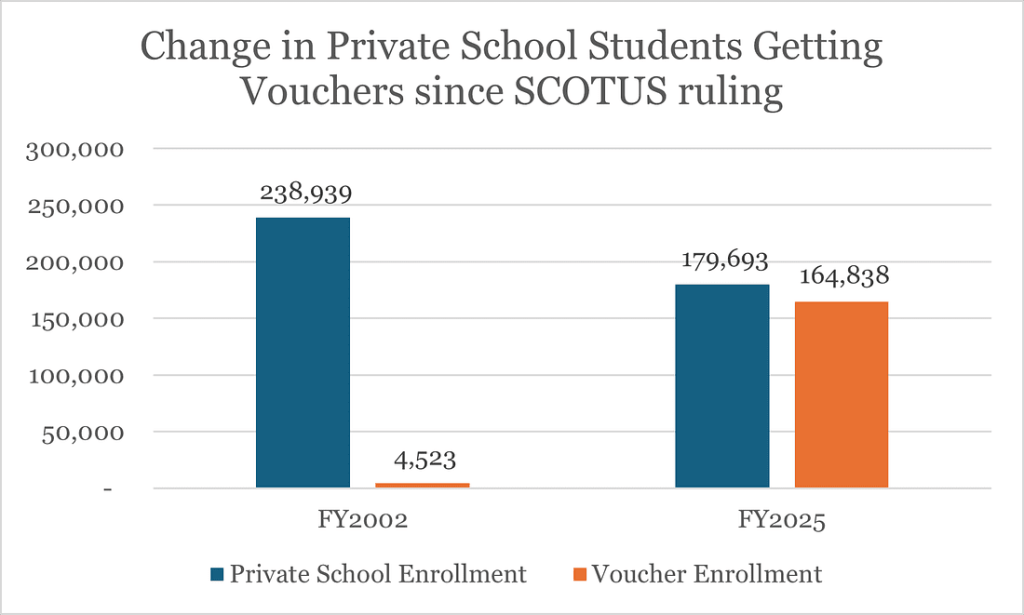
According to state data from this year, a whopping 91% of parents with enrolled private school students are getting publicly subsidized tuition.
Ninety. One. Percent.
Back when the U.S. Supreme Court ruled that Cleveland’s voucher program was Constitutional in 2002, that number was 1.9%…
This has been done at the expense of Ohio’s 1.5 million public school students.
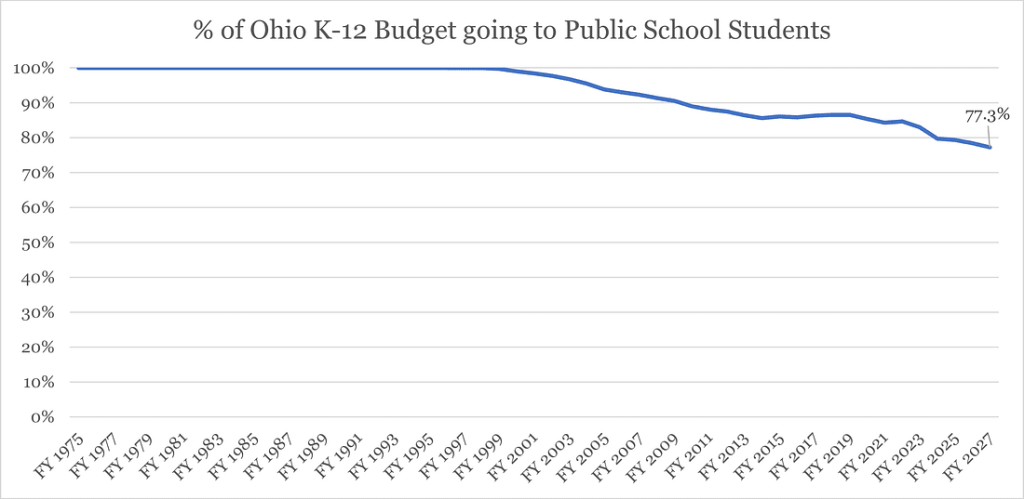
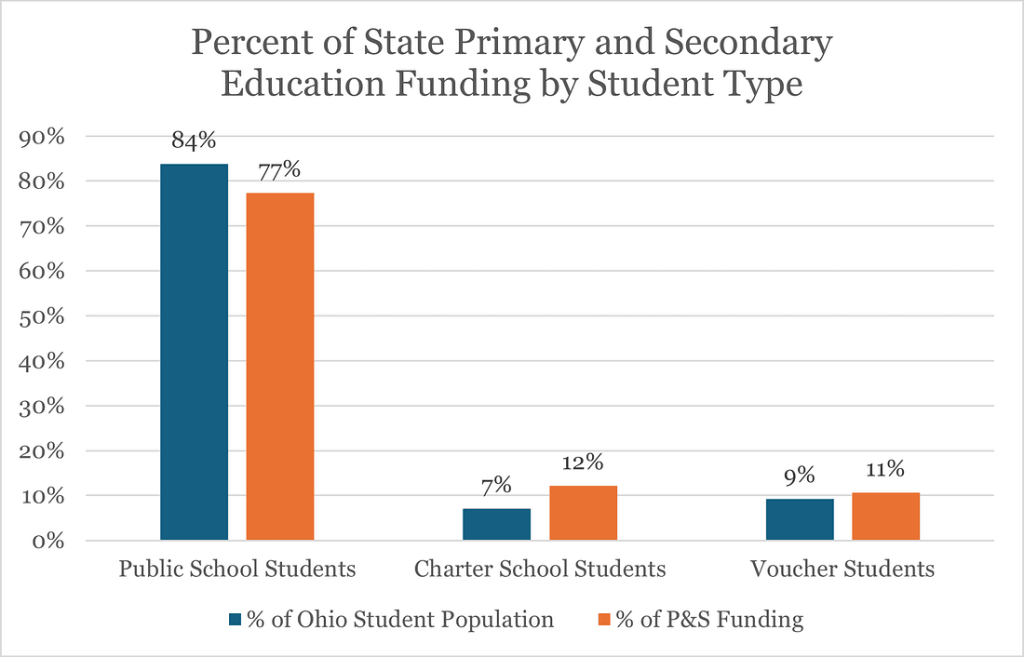
By the end of the currently proposed state budget, Public School students, who make up 84% of Ohio’s total student population, will receive 77.3% of all state K-12 funding. While the 9% of students whose parents receive taxpayer tuition subsidies will eat up 11% of all state K-12 funding¹.
Once again, the “money following the student” bullshit is laid bare by actual facts.
If money were really just “following the student”, then each of the three systems’ share of funding should match their share of population.
Yet the state’s privately run Charter Schools and private school tuition subsidies for mostly wealthy parents make up a larger share of funding than they do population.
At whose expense?
Public School students. And Public School parents, who now have to raise more property taxes to make up for this massive diversion of state funds that has meant they’re receiving 8% less state funding than their population would demand.
Footnote:
(1). And this just includes formula funding for Charter Schools and the Voucher payments. If you include all the additional funding streams for Charter School facilities (and other giveaways), and the administrative cost and auxiliary services reimbursements for private schools, along with transportation funding for both privately run systems, these percentages are even a few percentages higher for Charters and Vouchers and lower for publics. But I wanted to be conservative in my estimate and keep it to just the foundation payments to Charters and the Vouchers only for privates.
Elon Musk’s team of vandals, known as DOGE, have raided government agencies in search of deep cuts that they can take credit for. Most of their claims of savings turn out to be false or inflated but they persist in canceling contracts and firing government employees. The effects are now being felt at the Social Security Administration.
The Social Security Administration website crashed four times in 10 days this month, blocking millions of retirees and disabled Americans from logging in to their online accounts because the servers were overloaded. In the field, office managers have resorted to answering phones at the front desk as receptionists because so many employees have been pushed out. But the agency no longer has a system to monitor customers’ experience with these services, because that office was eliminated as part of the cost-cutting efforts led by Elon Musk.
And the phones keep ringing. And ringing. The federal agency that delivers $1.5 trillion a year in earned benefits to 73 million retired workers, their survivors and poor and disabled Americans is engulfed in crisis — further undermining its ability to provide reliable and quick service to vulnerable customers, according to internal documents and more than two dozen current and former agency employees and officials, customers and others who interact with Social Security.
Financial services executive Frank Bisignano is scheduled to face lawmakers Tuesday during a Senate confirmation hearing as President Donald Trump’s pick to become the permanent commissioner. For now, the agency is run by a caretaker leader in his sixth week on the job who has raced to push out more than 12 percent of the staff of 57,000. He has conceded that the agency’s phone service “sucks” and acknowledged that Musk’s U.S. DOGE Service is really in charge, pushing a single-minded mission to find benefits fraud despite vast evidence that the problem is overstated.
The turmoil is leaving many retirees, disabled claimants and legal immigrants who need Social Security cards with less access or shut out of the system altogether, according to those familiar with the problems.
“What’s going on is the destruction of the agency from the inside out, and it’s accelerating,” Sen. Angus King (I-Maine) said in an interview. “I have people approaching me all the time in their 70s and 80s, and they’re beside themselves. They don’t know what’s coming.”
King’s home state has the country’s oldest population. “What they’re doing now is unconscionable,” he said.
Leland Dudek — the accidental leader elevated to acting commissioner after he fed data to Musk’s team behind his bosses’ backs — has issued rapid-fire policy changes that have created chaos for front-line staff. Under pressure from the secretive Musk team, Dudek has pushed out dozens of officials with years of expertise in running Social Security’s complex benefit and information technology systems. Others have left in disgust.
The moves have upended an agency that, despite the popularity of its programs, has been underfunded for years, faces potential insolvency in a decade and has been led by four commissioners in five months — just one of them Senate-confirmed. The latest controversy came last week, when Dudek threatened to shut down operations in response to a federal judge’s ruling that Dudek claimed would leave no one with access to beneficiaries’ personal information to serve them.
Alarmed lawmakers are straining to answer questions from angry constituents in their districts. Calls have flooded into congressional offices. The AARP announced on Monday that more than 2,000 retirees per week have called the organization since early February — double the usual number — with concerns about whether benefits they paid for during their working careers will continue. Social Security is the primary source of income for about 40 percent of older Americans…
With aging technology systems and a $15 billion budget that has stayed relatively flat over a decade, Social Security was already struggling to serve the public amid an explosion of retiring baby boomers. The staff that reviews claims for two disability programs was on life support following massive pandemic turnover — and still takes 233 days on average to review an initial claim.
But current and former officials, advocates and others who interact with the agency — many of whom spoke on the condition of anonymity for fear of retribution — said Social Security has been damaged even further by the rapid cuts and chaos of Trump’s first two months in office. Many current and former officials fear it’s part of a long-sought effort by conservatives to privatize all or part of the agency….
Musk’s DOGE team began poring through Social Security’s massive trove of private data on millions of Americans, working in a fourth-floor conference room at the Woodlawn, Maryland, headquarters, with blackout curtains on the windows and an armed security guard posted outside.
Their obsession with false claims that millions of deceased people were fraudulently receiving benefits consumed the DOGE team at first. Then came new mandates designed to address alleged fraud: Direct deposit transactions and identity authentication that affect almost everyone receiving benefits will no longer be able to be done by phone. Customers with computers will be directed to go through the process online — and those without access to one to wait in line at their local field office. A change announced internally last week will require legal immigrants with authorization to work in the United States and newly naturalized citizens to apply for or update their Social Security cards in person, eliminating a long-standing practice that sent the cards automatically through the mail.
The article goes on much longer to describe the confusion and chaos among elderly people seeking information. Wait times for telephone calls, which used to be answered to 10-15 minutes, may take two hours, three hours or longer.
Peter Greene, veteran teacher, master writer, the voice of wisdom and experience, sets the record straight about the purpose of the U.S. Department of Education. Contrary to what wrestling-entrepreneur Linda McMahon (Trump’s Secretary of Education) says, the Department was not created to raise test scores. The Department was created to promote equal access to educational opportunity. That equalization of resources has not yet been achieved, but Trump intends to abolish the goal altogether. In his thinking, everyone should pull themselves up by their bootstraps, unlike him, who was born into wealth and privilege.
Peter Greene writes:
The official assault on the Department of Education has begun.
If it seems like there’s an awful lot more talking around this compared to, say, the gutting of the IRS or USAID, that may be because the regime doesn’t have the legal authority to do the stuff that they are saying they want to do. The executive order is itself pretty weak sauce– “the secretary is to investigate a way to form a way to do stuff provided it’s legal.” And that apparently involves sitting down in front of every camera and microphone and trying to make a case.
A major part of that involves some lies and misdirection. The Trumpian line that we spend more than anyone and get the worst results in the world is a lie. But it is also a misdirection, a misstatement about the department’s actual purpose.
Likewise, it’s a misstatement when the American Federation of Children characterizes the “failed public policy” of “the centralization of American education.” But the Department wasn’t meant–or built–to centralize US education.
The department’s job is not to make sure that American education is great. It is expressly forbidden to exert control over the what and how of education on the state and local level.
The Trump administration is certainly not the first to ignore any of that. One of the legacies of No Child Left Behind is the idea that feds can grab the levers of power to attempt control of education in the states. Common Core was the ultimate pretzel– “Don’t call it a curriculum because we know that would be illegal, but we are going to do our damnedest to standardize the curriculum across every school in every state.” For twenty-some years, various reformsters have tried to use the levers of power in DC to reconfigure US education as a centrally planned and coordinated operation (despite the fact that there is nowhere on the globe to point to that model as a successful one). And even supporters of the department are speaking as if the department is an essential hub for the mighty wheel of US education.
Trump is just working with the tools left lying around by the bipartisan supporters of modern education reform.
So if the department’s mission is not to create central organization and coordination, then what is it?
I’d argue that the roots of the department are not the Carter administration, but the civil rights movement of the sixties and the recognition that some states and communities, left to their own devices, would try to cheat some children out of the promise of public education. Derek Black’s new book Dangerous Learning traces generations of attempts to keep Black children away from education. It was (roughly) the 1960s when the country started to grapple more effectively with the need for federal power to oppose those who would stand between children and their rights.
The programs that now rest with the department came before the department itself, programs meant to level the playing field so that the poor (Title I) and the students with special needs (IDEA) would get full access. The creation of the department stepped up that effort and, importantly, added an education-specific Civil Rights office to the effort.
And it was all created to very carefully not usurp the power of the states. When Trump says he’ll return control of education to the states, he’s speaking bunk, because the control of education has always remained with the states– for better or worse.
The federal mission was to make the field more level, to provide guardrails to keep the states playing fair with all students, to make sure that students had the best possible access to the education they were promised.
Trump has promised that none of the grant programs or college loan programs would be cut (and you can take a Trump promise to the… well, somewhere) but if all the money is still going to keep flowing, then what would the loss of the department really mean?
For one thing, the pieces that aren’t there any more. The Office of Civil Rights is now gutted and repurposed to care only about violations of white christianist rights. The National Center of Education Statistics was the source of any data about how education was working out (much of it junk, some of it not). The threat of turning grants into unregulated block grants, or being withheld from schools that dare to vaccinate or recognize diversity or keep naughty books in the library.
So the money will still flow, but the purpose will no longer be to level the playing field. It will not be about making sure every child gets the education they’re entitled to– or rather, it will rest on the MAGA foundation, the assumption that some people deserve less than others.
That’s what the loss of the department means– a loss of a department that, however imperfectly, is supposed to protect the rights of students to an education, regardless of race, creed, zip code, special needs, or the disinterest and prejudice of a state or community. Has the department itself lost sight of that mission from time to time? Sure has. Have they always done a great job of pursuing that mission? Not at all. But if nobody at all is supposed to be pursuing that goal, what will that get us?
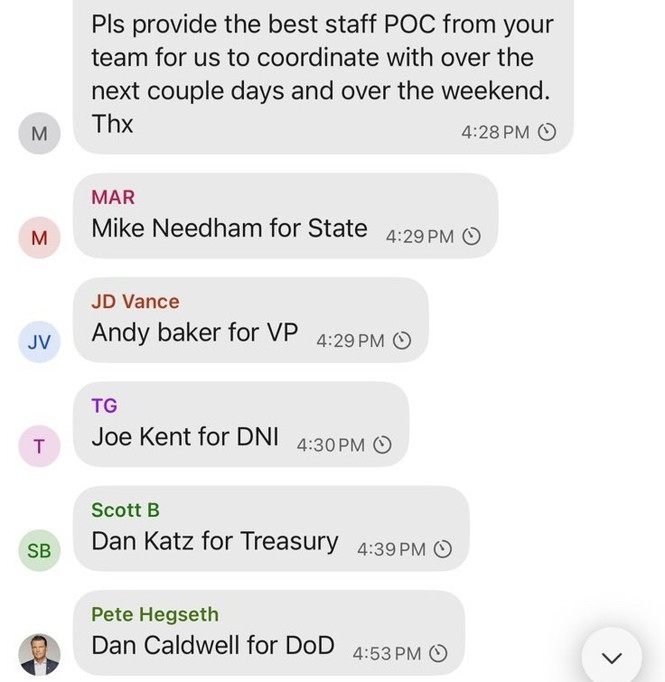
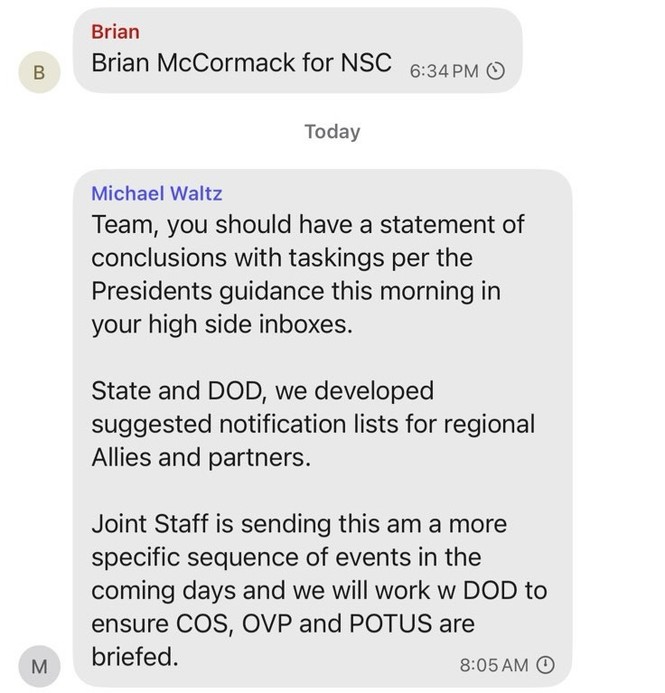
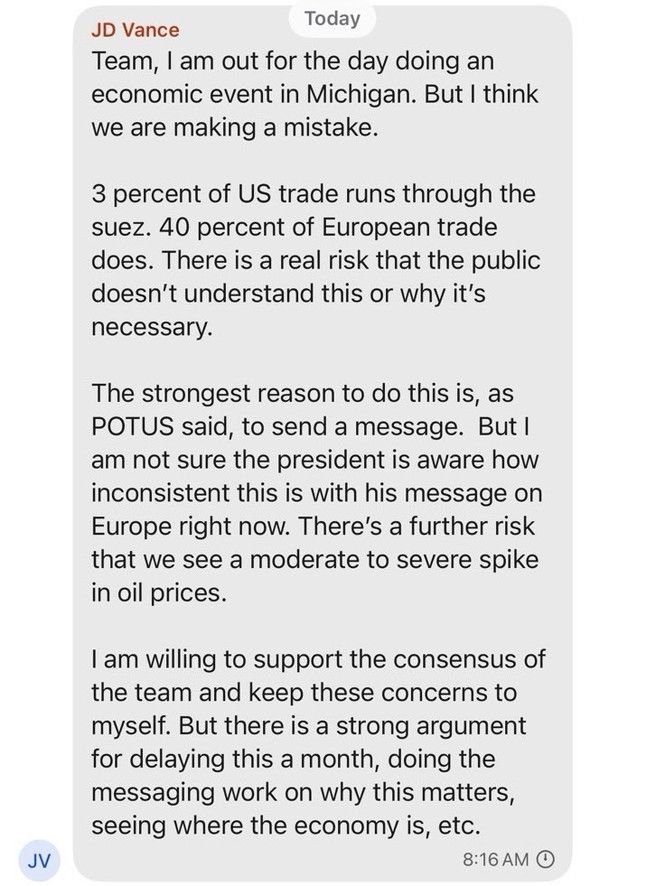
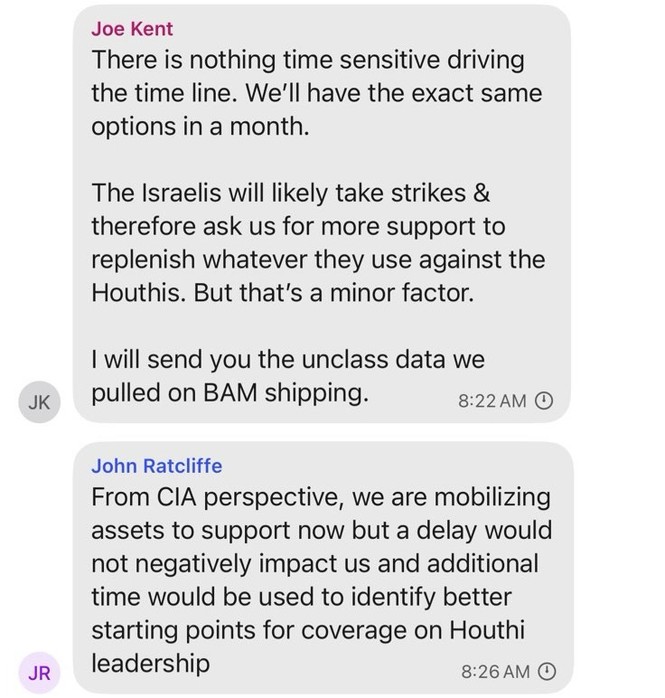
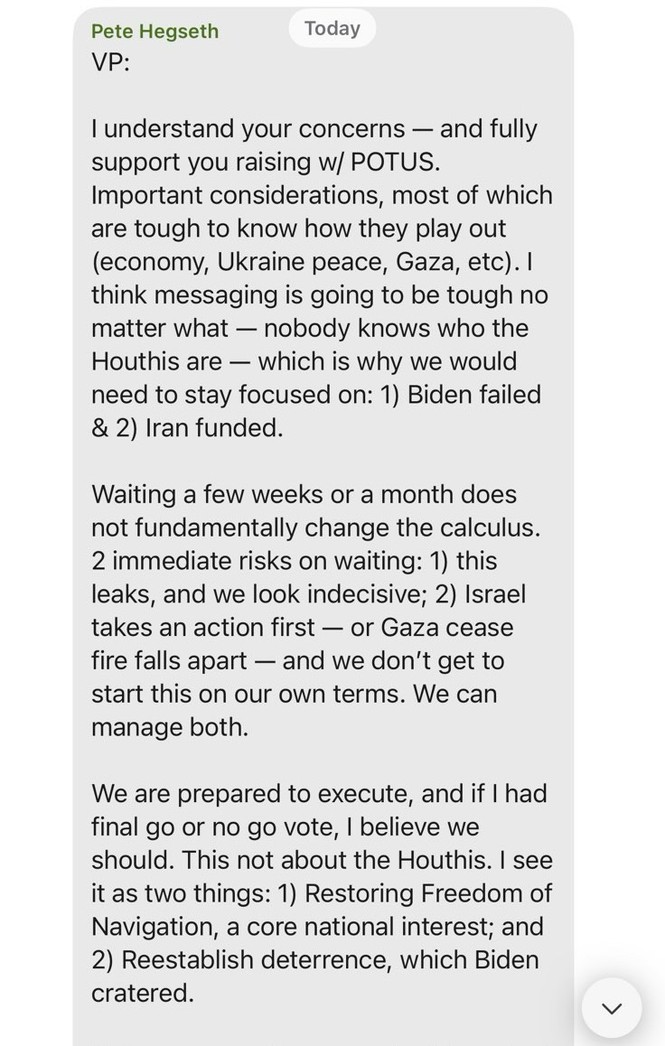
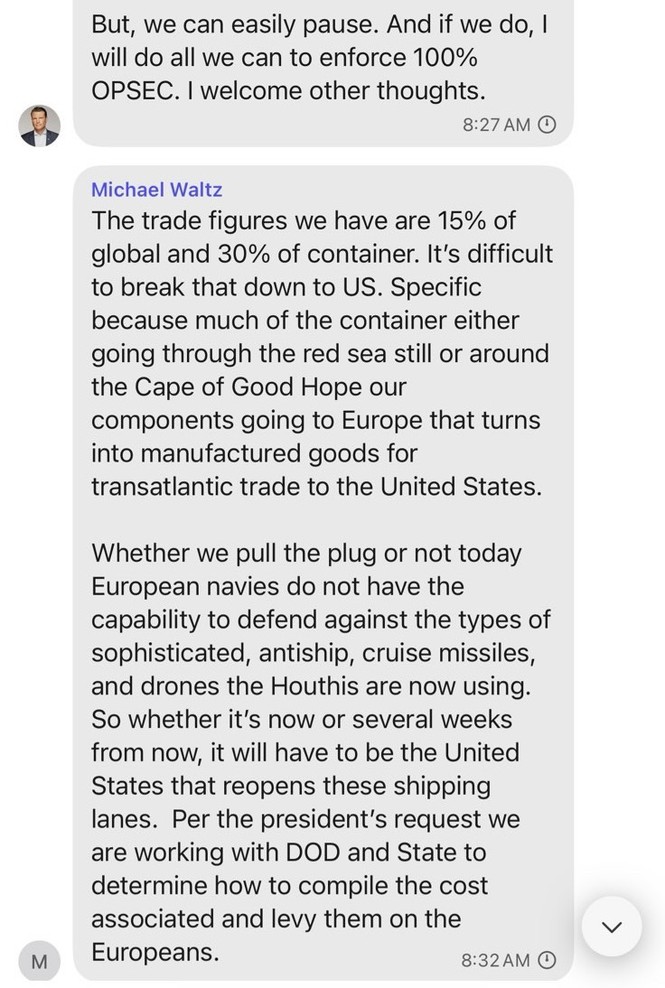
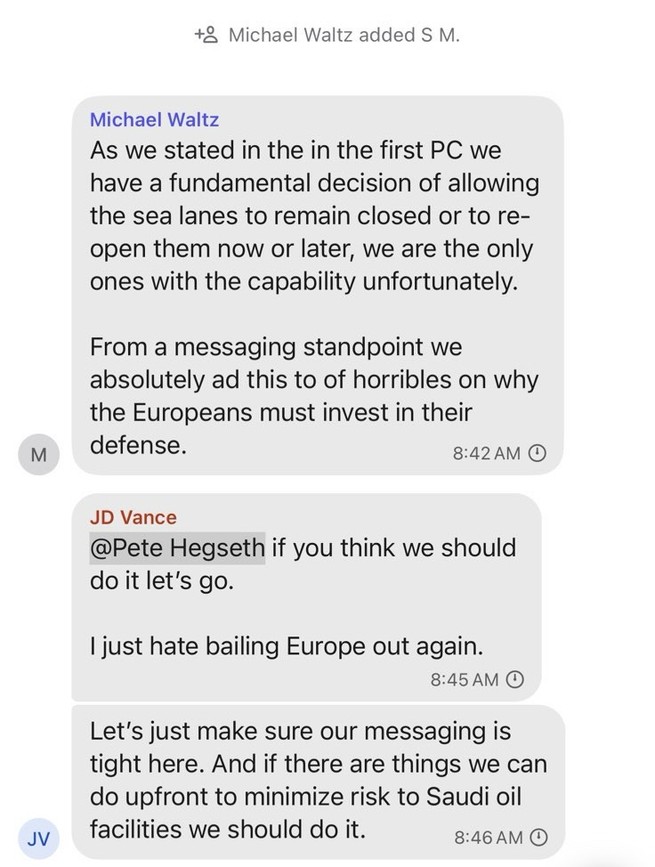
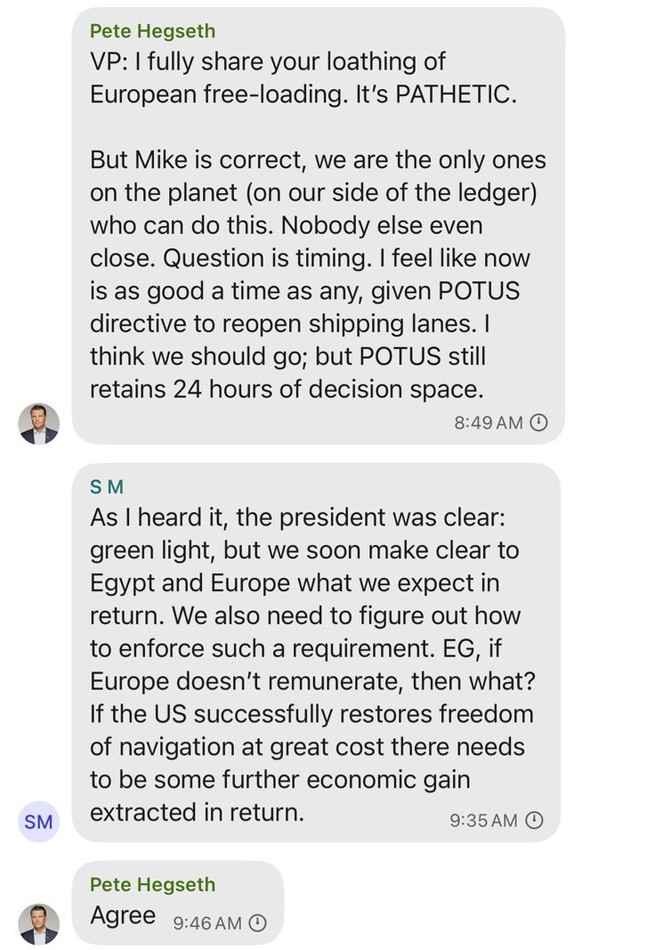
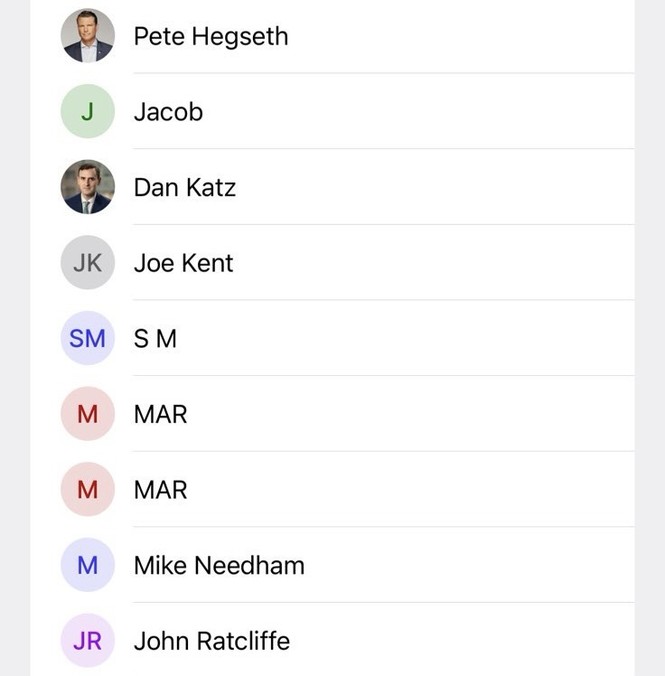
In the first big scandal of the Trump administration, the editor-in-chief of The Atlantic was invited to participate in a top-secret texting session about bombing the Houthis. Jeffrey Goldberg first thought it was a joke or a scam, but he joined the group and discovered it was real. He wrote about it in The Atlantic (“The Trump Administration Accidentally Texted Me It’s War Plans”), and the story went viral. But everyone involved other than Goldberg said that it was not a top-secret meeting, that no confidential information was discussed, and Pete Hegseth insulted Goldberg by suggesting he was lying. The messaging used an app called Signal, which disappears after a certain period of time and is not secure. One participant, Steve Witkoff, was in Russia at the time of the exchange.
So, about that Signal chat. On Monday, shortly after we published a story about a massive Trump-administration security breach, a reporter asked the secretary of defense, Pete Hegseth, why he had shared plans about a forthcoming attack on Yemen on the Signal messaging app. He answered, “Nobody was texting war plans. And that’s all I have to say about that.”
At a Senate hearing yesterday, the director of national intelligence, Tulsi Gabbard, and the director of the Central Intelligence Agency, John Ratcliffe, were both asked about the Signal chat, to which Jeffrey Goldberg, the editor in chief of The Atlantic, was inadvertently invited by National Security Adviser Michael Waltz. “There was no classified material that was shared in that Signal group,” Gabbard told members of the Senate Intelligence Committee.
Ratcliffe said much the same: “My communications, to be clear, in the Signal message group were entirely permissible and lawful and did not include classified information.”
President Donald Trump, asked yesterday afternoon about the same matter, said, “It wasn’t classified information.”
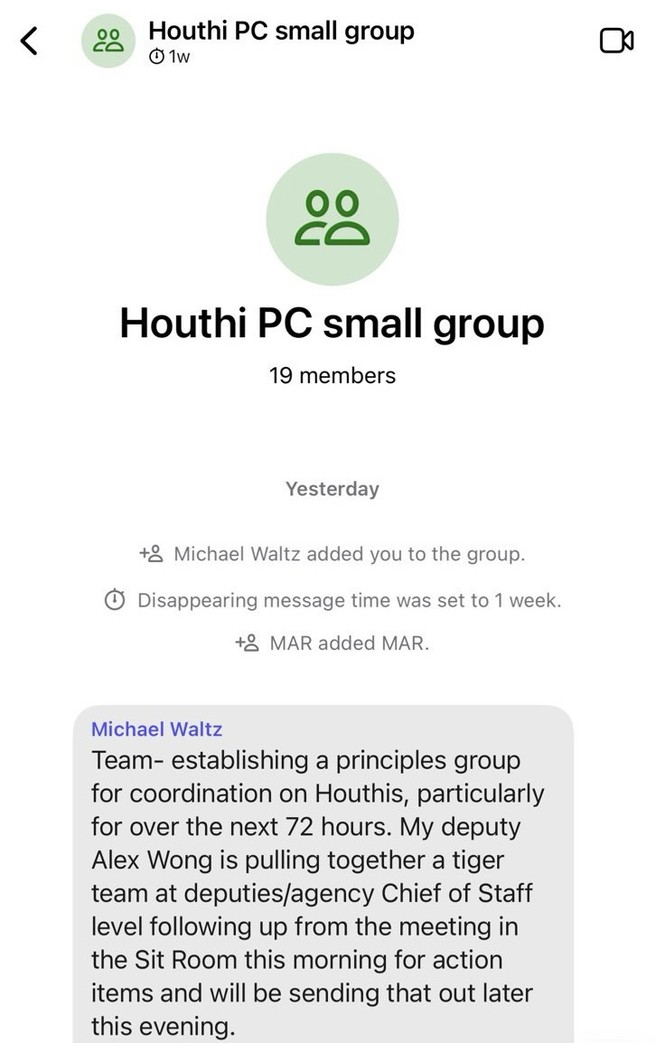
These statements presented us with a dilemma. In The Atlantic’sinitial story about the Signal chat—the “Houthi PC small group,” as it was named by Waltz—we withheld specific information related to weapons and to the timing of attacks that we found in certain texts. As a general rule, we do not publish information about military operations if that information could possibly jeopardize the lives of U.S. personnel. That is why we chose to characterize the nature of the information being shared, not specific details about the attacks.
The statements by Hegseth, Gabbard, Ratcliffe, and Trump—combined with the assertions made by numerous administration officials that we are lying about the content of the Signal texts—have led us to believe that people should see the texts in order to reach their own conclusions. There is a clear public interest in disclosing the sort of information that Trump advisers included in nonsecure communications channels, especially because senior administration figures are attempting to downplay the significance of the messages that were shared.
Experts have repeatedly told us that use of a Signal chat for such sensitive discussions poses a threat to national security. As a case in point, Goldberg received information on the attacks two hours before the scheduled start of the bombing of Houthi positions. If this information—particularly the exact times American aircraft were taking off for Yemen—had fallen into the wrong hands in that crucial two-hour period, American pilots and other American personnel could have been exposed to even greater danger than they ordinarily would face. The Trump administration is arguing that the military information contained in these texts was not classified—as it typically would be—although the president has not explained how he reached this conclusion.
Yesterday, we asked officials across the Trump administration if they objected to us publishing the full texts. In emails to the Central Intelligence Agency, the Office of the Director of National Intelligence, the National Security Council, the Department of Defense, and the White House, we wrote, in part: “In light of statements today from multiple administration officials, including before the Senate Intelligence Committee, that the information in the Signal chain about the Houthi strike is not classified, and that it does not contain ‘war plans,’ The Atlantic is considering publishing the entirety of the Signal chain.”
We sent our first request for comment and feedback to national-security officials shortly after noon, and followed up in the evening after most failed to answer.
Late yesterday, White House Press Secretary Karoline Leavitt emailed a response: “As we have repeatedly stated, there was no classified information transmitted in the group chat. However, as the CIA Director and National Security Advisor have both expressed today, that does not mean we encourage the release of the conversation. This was intended to be a an [sic] internal and private deliberation amongst high-level senior staff and sensitive information was discussed. So for those reason [sic] — yes, we object to the release.” (The Leavitt statement did not address which elements of the texts the White House considered sensitive, or how, more than a week after the initial air strikes, their publication could have bearing on national security.)
A CIA spokesperson asked us to withhold the name of John Ratcliffe’s chief of staff, which Ratcliffe had shared in the Signal chain, because CIA intelligence officers are traditionally not publicly identified. Ratcliffe had testified earlier yesterday that the officer is not undercover and said it was “completely appropriate” to share their name in the Signal conversation. We will continue to withhold the name of the officer. Otherwise, the messages are unredacted.
As we wrote on Monday, much of the conversation in the “Houthi PC small group” concerned the timing and rationale of attacks on the Houthis, and contained remarks by Trump-administration officials about the alleged shortcomings of America’s European allies. But on the day of the attack—Saturday, March 15—the discussion veered toward the operational.
At 11:44 a.m. eastern time, Hegseth posted in the chat, in all caps, “TEAM UPDATE:”
The text beneath this began, “TIME NOW (1144et): Weather is FAVORABLE. Just CONFIRMED w/CENTCOM we are a GO for mission launch.” Centcom, or Central Command, is the military’s combatant command for the Middle East. The Hegseth text continues:
“1215et: F-18s LAUNCH (1st strike package)”
“1345: ‘Trigger Based’ F-18 1st Strike Window Starts (Target Terrorist is @ his Known Location so SHOULD BE ON TIME – also, Strike Drones Launch (MQ-9s)”
Let us pause here for a moment to underscore a point. This Signal message shows that the U.S. secretary of defense texted a group that included a phone number unknown to him—Goldberg’s cellphone—at 11:44 a.m. This was 31 minutes before the first U.S. warplanes launched, and two hours and one minute before the beginning of a period in which a primary target, the Houthi “Target Terrorist,” was expected to be killed by these American aircraft. If this text had been received by someone hostile to American interests—or someone merely indiscreet, and with access to social media—the Houthis would have had time to prepare for what was meant to be a surprise attack on their strongholds. The consequences for American pilots could have been catastrophic.
The Hegseth text then continued:
“1410: More F-18s LAUNCH (2nd strike package)”
“1415: Strike Drones on Target (THIS IS WHEN THE FIRST BOMBS WILL DEFINITELY DROP, pending earlier ‘Trigger Based’ targets)”
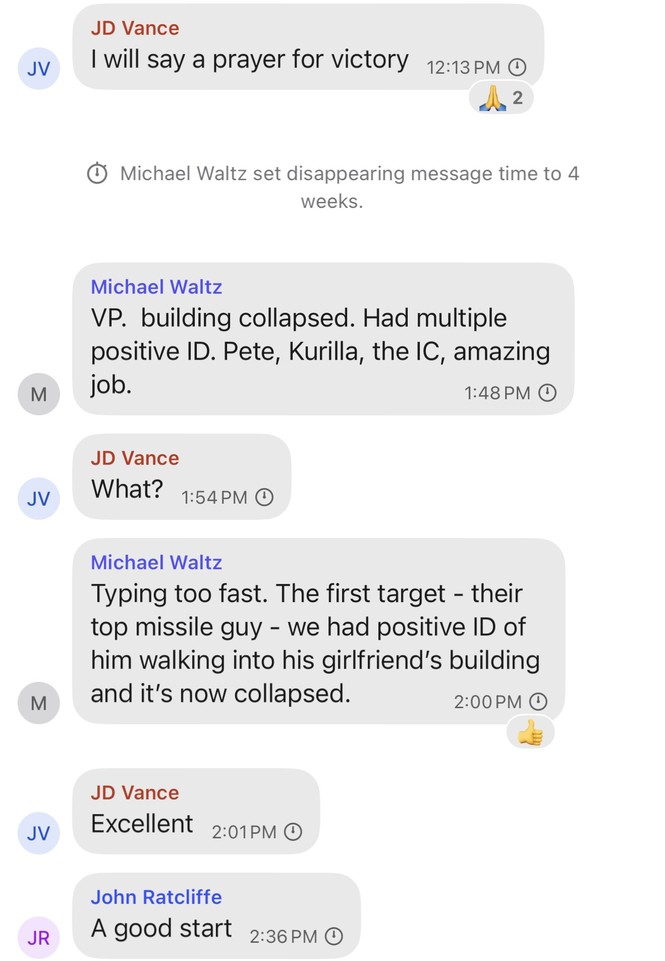
At 1:48 p.m., Waltz sent the following text, containing real-time intelligence about conditions at an attack site, apparently in Sanaa: “VP. Building collapsed. Had multiple positive ID. Pete, Kurilla, the IC, amazing job.” Waltz was referring here to Hegseth; General Michael E. Kurilla, the commander of Central Command; and the intelligence community, or IC. The reference to “multiple positive ID” suggests that U.S. intelligence had ascertained the identities of the Houthi target, or targets, using either human or technical assets.
Six minutes later, the vice president, apparently confused by Waltz’s message, wrote, “What?”
At 2 p.m., Waltz responded: “Typing too fast. The first target – their top missile guy – we had positive ID of him walking into his girlfriend’s building and it’s now collapsed.”
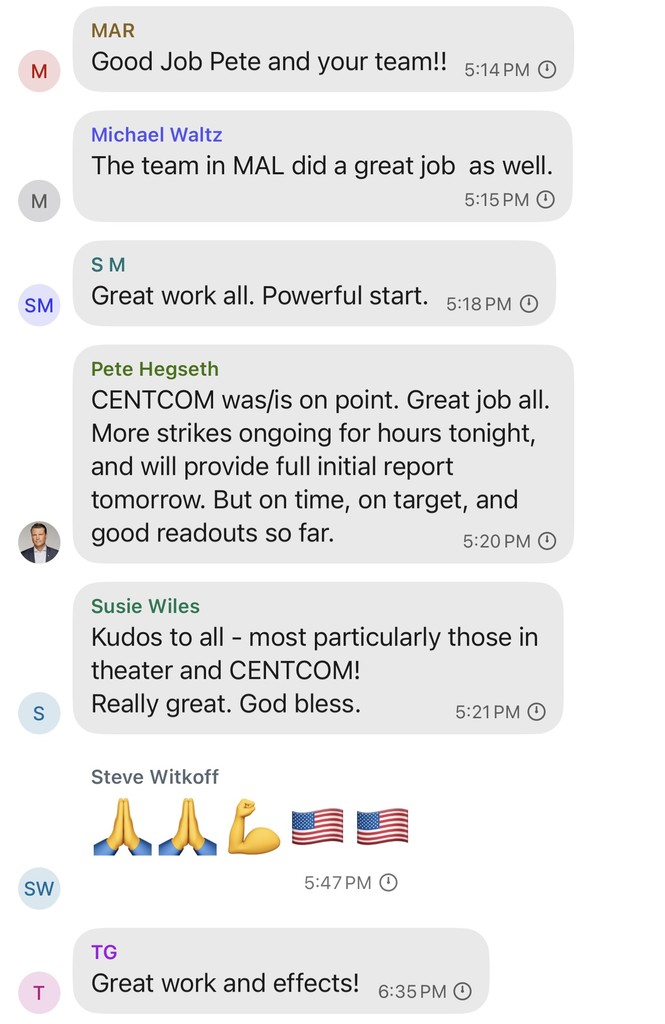
Vance responded a minute later: “Excellent.” Thirty-five minutes after that, Ratcliffe, the CIA director, wrote, “A good start,” which Waltz followed with a text containing a fist emoji, an American-flag emoji, and a fire emoji. The Houthi-run Yemeni health ministry reported that at least 53 people were killed in the strikes, a number that has not been independently verified.
Later that afternoon, Hegseth posted: “CENTCOM was/is on point.” Notably, he then told the group that attacks would be continuing. “Great job all. More strikes ongoing for hours tonight, and will provide full initial report tomorrow. But on time, on target, and good readouts so far.”
It is still unclear why a journalist was added to the text exchange. Waltz, who invited Goldberg into the Signal chat, said yesterday that he was investigating “how the heck he got into this room.”
All those who participated in the meeting lied.
Stupid, incompetent liars are in charge of our national security.







 Diane Ravitch's blog