Indiana’s Republican-controlled General Assembly decreed this year in House Enrolled Act 1447 that every public school board and charter school governing body must establish a procedure for the parent of any student, or any person residing in the school district, to request the removal of library materials deemed “obscene” or “harmful to minors.”
The procedure may provide for an intermediate response by school personnel to a request to remove a library book, but it must include the school board reviewing, and possibly implementing, each removal request at its next public meeting.
The new law followed claims by Hoosier Republicans that Indiana school libraries are secretly loaded with books containing pornography and other content inappropriate for children.
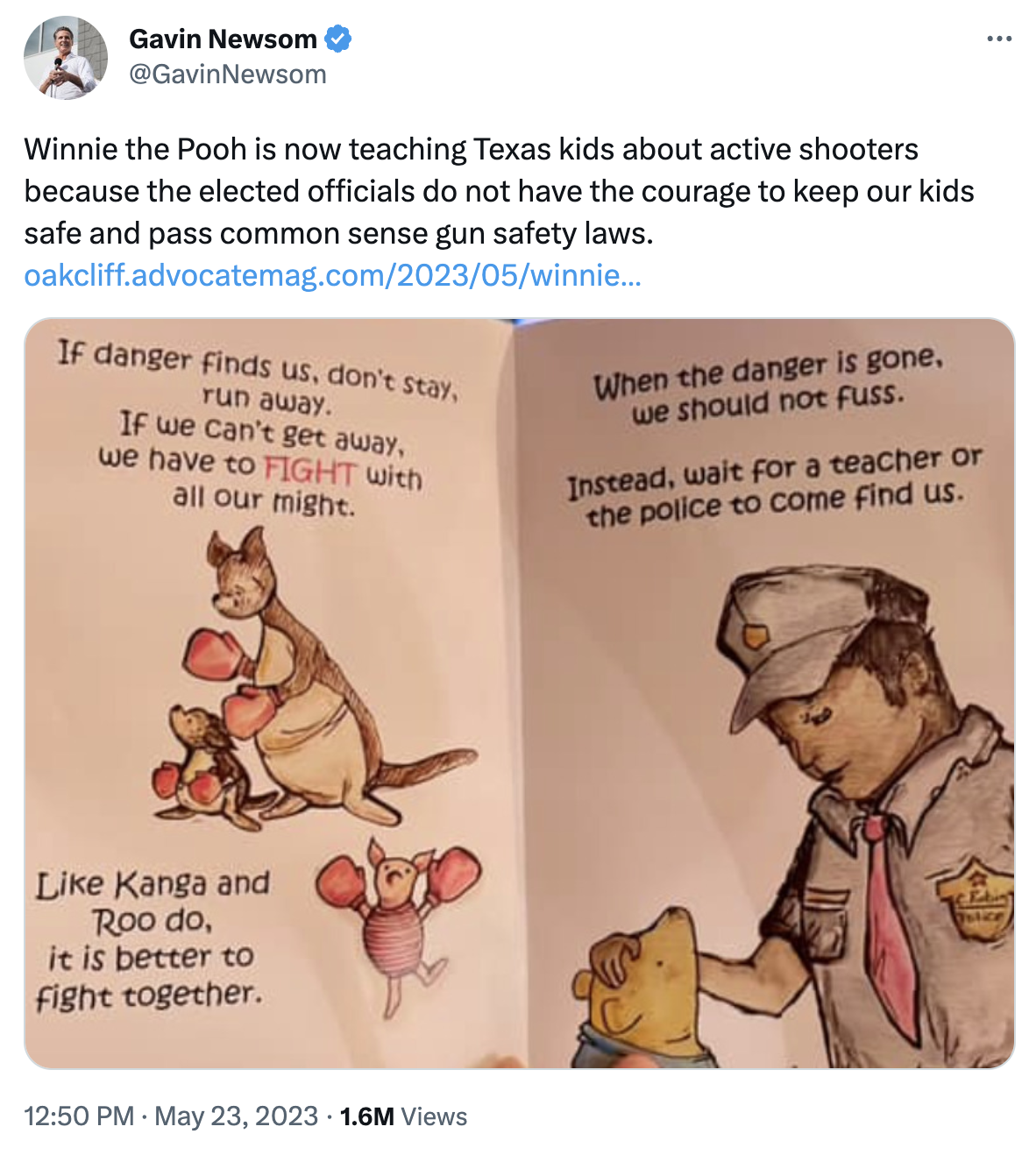
California Governor Gavin Newsom has been blasting away at knuckle-headed Republican governors like Ron DeSantis and Greg Abbott for their cruel indifference to other people. He’s already suggested he may sue DeSantis for kidnapping, after Florida sent two private planes with Venezuelan immigrants to Sacramento. Now, he’s going after Abbott for his refusal to take action against gun violence.
He wrote:
Texas… where elected officials are relying on Winnie the Pooh to teach their kids about active shooters because they don’t have the courage to keep our kids safe.
Texas… where Greg Abbott signed a law to send DNA kits to parents of school children so their bodies can be identified after a shooting.
Guns are the leading cause of death for kids in America. Kids!
We’re not talking about accidents, or cancer or something unpreventable. We know the steps to take to save our kids lives. But leaders like Greg Abbott lack the courage to act.
Until then… It’s Winnie the Pooh for Texas families.
J.B. Pritzker, Governor of Illinois, gave a terrific commencement address at Northwestern University, with a fabulous explanation about how to spot an idiot. He says that idiots are not necessarily stupid. They may be your boss. They may even be elected President.
SPRINGFIELD, IL — Banned books will soon be a thing of the past at public libraries in Illinois now that the Library Freedom Act has been signed into law. Gov. J.B. Pritzker signed the bill Monday at the Harold Washington Library in Chicago.
Under the new law, public libraries must reject outside attempts at banning books for reasons that are partisan or doctrinal, to retain their eligibility for Illinois state grants.
The law allows Illinois to withhold state funding from public libraries and schools that remove books from their shelves and do not follow the American Library Association’s “Bill of Rights,” which states that books “should not be removed or restricted because of partisan or personal disapproval.”
“Here in Illinois, we don’t hide from the truth, we embrace it,” Gov. Pritzker said in a statement. “Young people shouldn’t be kept from learning about the realities of our world; I want them to become critical thinkers, exposed to ideas that they disagree with, proud of what our nation has overcome, and thoughtful about what comes next. Everyone deserves to see themselves reflected in the books they read, the art they see, the history they learn. In Illinois, we are showing the nation what it really looks like to stand up for liberty.”
Ron DeSantis got the Florida legislature to pass strong legislation that puts undocumented immigrants at risk of deportation and puts anyone who helps them at risk of arrest.
Meanwhile, the agriculture industry—a key driver of the state’s economy—is worried about finding enough workers to harvest the crops.
But farmers are pleading with immigrants not to leave the state. Even Republican legislators worry that the anti-immigrant law was a mistake.
Republican lawmakers in Florida concerned about the state’s new anti-immigration law and its possible economic consequences begged Latinos to not leave the state in clips from a Monday morning meeting.
The footage, which provides evidence of the law’s “downstream impacts on the state economy” according to MSNBC, shows two conservative Florida legislators attempting to minimize the harm that the law, Senate Bill 1718, could cause, with one asking attendees to advise Latinos against leaving Florida.
“This bill is 100% supposed to scare you,” Republican state Rep. Rick Roth said in a clip shared on Twitter by Democratic activist Tom Kennedy. “I’m a farmer, and the farmers are mad as hell. We are losing employees. They’re already starting to move to Georgia and other states. It’s urgent that you talk to all your people and convince them that you have resources — state representatives and other people — that can explain the bill to you.”
But no one blames DeSantis, who needed to prove his contempt for immigrants.
Agriculture is a big part of Florida’s economy. Who will bring in the crops?
Here’s a chance for DeSantis to create jobs for his fervent white supporters. They can pick oranges and grapefruit and other crops in the blazing sun. At minimum wage.
Peter Greene was a teacher in Pennsylvania for 39 years. He is now a regular writer at Forbes and a super star blogger. This column appeared on his blog. He responded to Rick Hess’s claim that school choice is not an attack on public education but part of a long history of trying to improve them. From my perspective, it’s hard to understand how public schools improve by defunding them and replacing them with religious schools, low-quality private schools, home schooling, and cyber charters.
This is what Peter Greene wrote:
Rick Hess (American Enterprise Institute) is one of those occupants of the reformy camp that I take seriously, even when I think he’s wrong. So when he raises the question of whether or not school choice is an “attack” on public education, I think it’s a question worth talking about, because I think the answer is a little bit complicated. So let me walk through his recent piece on that very question bit by bit.
After an intro suggesting that choice expansion flows directly from the pandemic while ascribing opposition to choice to a shadowy cabal that flows from teachers unions, Hess gets to his point, which is that seeing choice as an anti-public school is “misleading and misguided.”
Hess puts choice in the context of a century’s worth of public school fixer-uppers, “a barrage of reforms.” He offers a list–“compulsory attendance, district consolidation, larger schools, smaller schools, magnet schools, standards, test-based accountability, merit pay, and more.”
Some of these ideas were good. Some weren’t. But in hindsight, it’s pretty clear that they weren’t “attacks” on public education; rather, they were attempts to improve it.
I disagree. Some of these ideas were offered with sincere hope for the best. But I’m going to single out the standards movement and test-based accountability for special recognition here.
If you weren’t teaching during the rise of No Child Left Behind, Common Core, and Race To The Top, I’m not sure if I can really capture for you the dawning sense of horror, frustration and futility among teachers at the time.
Word came down that new regulations required us to get test scores up– a little bit per year for starters, then ramping up to an impossible climb, until somehow every single student would be above average. If not, there would be penalties, maybe the complete dismantling and rebuilding of the district, perhaps as a privately-run charter school. “This is not possible,” educators said. “All will learn all,” replied the Powers That Be. “Don’t you believe that students can learn? And which child do you propose to leave behind.”
Then there were the tests themselves. Not very good, and with results coming back with so little detail–and so very late in the game–that they were less than no help at all. “Well, if we just teach the standards, the tests scores will follow,” said some optimistic educators. That didn’t happen. Schools rejiggered curriculum, pulled students away from untested material like art and recess so that they could be double-whammied with test prep.
“Maybe Obama will fix it,” we hoped. He did not. He doubled down. And 2014–the year for 100%–came closer and closer, the year when anyone dealing with educational reality knew that every district in the country would be either a) failing or B) cheating.
And through those years, one at a time or in small groups, teachers arrived at an unpleasant conclusion.
They are setting us up for failure. They want us to fail.
Why would they want that? The rhetoric had already been around on the far right, back all the way to Milton Friedman and on through his intellectual spawn– public education should be dismantled. There was a new push for vouchers and especially charter schools, and that coincided with rising noise about “failing” public schools. There was very little “let’s expand the educational ecosystem” and an awful lot of “we must help students escape failing public schools.” The constant refrain of “school choice will force public schools to improve because competition” was also an omnipresent crock, a slap in the face to educators who were already working their butts off and resented the suggestion that they were either incompetent or lazy. And that thread runs all the way up guys like Christopher Rufo arguing that to get to universals school choice, you have to get to universal distrust of public schools.
Maybe school choice wasn’t in and of itself an attack on public education, but it certainly seemed as if attacking public education was a means of promoting school choice.
I have no doubt that there are people who believe that education would work better if handled by the free market (I think their belief is magical, misguided and wrong, but I do believe it’s sincere). I believe there are technocrats who believe that standards, tests and data would improve education (ditto).
But to be a public school educator on the receiving end of all this (and more) absolutely felt like an attack. The irony is that when reformsters eventually figured out that the attack-filled rhetoric wasn’t helping and they dialed it back, the attacks themselves had become more real.
But let’s get back to Hess.
Public education can encompass a lot of approaches, and it can be organized in many different ways. Rather than blindly insist that “defending public schooling” requires clinging to outdated policies from decades (or centuries) past, we would do better to clarify principles, examine particulars, and then debate proposals.
All of this language is doing a lot of work, but as far as it goes, Hess and I probably agree more than we disagree. But the disagree part comes in the very next paragraph.
Indeed, the pandemic was a stark reminder that there are lots of ways to deliver schooling, including innovations such as learning pods, microschools, virtual tutors, and education savings accounts.
Learning pods and microschools are okay if you’re wealthy. As policy ideas in the vein of the DeVosian, “Well, your voucher may not be enough to get into a good private school, but you can always start a microschool,” they suck. I don’t think there are more than a hundred people in the country who came out of the pandemic thinking virtual education is a great idea. And education savings accounts are just vouchers with extra super-powers and porcine lip gloss. And none of these are really new ideas. They also all suffer from the same issue, which is the notion that any school choice system must be done free market style. We can do a great choice system without the free market at all (but that’s a post for another day).
Hess identifies one of the issues as the fuzziness of the word “public.” On this point, I think he gets some things wrong.
Choice opponents assert that public schools are “public” because they’re funded by public tax dollars.
No, that’s choicers. It’s been part of the charter school argument that charter schools are public schools because they are funded with public dollars. This pro-public ed writer (I’m not anti-choice, but I am anti-most-of-the-versions-of-choice-with-which-we’ve-been-presented) would say that public schools are public because they the public funds them, owns them, and operates them via representatives. Furthermore, they are public schools because they have a responsibility to the public to serve all students.
You can argue, as Hess and others do, that districts regularly hire outside firms to handle certain functions and occasionally outsource the teaching of certain students with exceptional special needs. But in all those cases, the responsibility for the management of those outside contracts rests with the public school district. A charter or private voucher-fed school carries no such responsibility. A public school district cannot, as can charters and voucher schools may, simply show parents the door and say, “Good luck. Your child is not our problem.” Do all public systems meet that responsibility as well as they ought to? Absolutely not. But at least the responsibility exists. A parent who thinks the public system is short-changing their child can (and often will) sue the district. They have no such option in a choice system, as such systems are currently conceived.
Hess is correct in calling public education “a pretty expansive category.” But it hinges on far more than whose money is being used.
In fact, I’d argue that it is the responsibility portion that is the big difference in the brand of choice being pushed by many these days. Our public system is based, however imperfectly, on the notion that we bear a collective responsibility for educating the young. Modern choice, particularly the current version sold under the culture warrior parental right brand, is about saying that getting a child an education is the responsibility of the parents, and that’s it. Yes, many choicers are also trying to privatize the ownership and provision of education, but it is the privatizing of responsibility for a child’s education that is perhaps the most profound and fundamental shift.
More importantly, simply calling something “public” doesn’t make it a good thing. While the phrase “public schooling” is suffused with happy notions of inclusivity and fairness, “public” isn’t a magic word.
Ain’t it that truth. Public education has a wide variety of issues–though some of those are the direct result of reformster attempts to “fix” things (see above re: standards and testing). But I’ve never argued that I’m against modern school choice and ed reform because public schools are perfect the way they are and everything else sucks. My most fundamental issue is that public schools have some serious issues, and modern ed reform and school choice don’t solve any of them (yes, that is also another long post). They just weaken public school’s ability to work on them while blowing through a giant pile of taxpayer money.
The point isn’t to play word games but to understand that things are less clear-cut than defenders of the status quo are prone to acknowledge. There are many ways to provide and serve the aims of public education.
After all these decades in the ed biz, I’m inclined to assert, repeatedly, that everything in education is less clear-cut that the vast majority of people acknowledge. Some folks on my side of the aisle are quick to infer nefarious and/or greedy motives when, sincere ideology is sufficient explanation (much as some folks in the choice camp assume that the only reason someone would stick up for public ed is because she’s on the union payroll). Some choicers are simply ignorant of how any of this school stuff works. Some are up against a particularly dysfunctional local version of public education. Some are anti-democrats for whom this is just one issue of many, one more way in which the government steals their money to spend it on Those People. Some want to recapture education for a particularly conservative version of christianist religion. Some want to social engineer their way to a more efficient society. Some are serious people, and some are not.
In short, the choicer and reformster camp contains a great variety of individuals.
Are some of those individuals interested promoting school choice as a way of making public education better? Is it possible to make public education better by incorporating some choice ideas? I believe that latter is true, and I swear I’m going to post about it in the not too distant future, and as for the former, well… yes, but.
But for all the variety in the choicer camp, they mostly adhere to two flawed premises– that a choice landscape should rest on a bedrock of free market mechanics and that the resulting system shouldn’t cost a cent more than the current one. As long as we start with those premises, school choice must be a zero sum game, and even if all the people who have spent the past four decades trying to tear public ed down so that choice will look better–even if all those people shut up, the zero sum game feature seems guaranteed to turn school choice into an attack on public education.
Kathryn Joyce is an outstanding journalist who has written several excellent articles about the far-right conspiracy to destroy public education. In this important article, published by both the Hechinger Report and Vanity Fair, she examines the rightwing takeover of public schools in Sarasota, Florida, by the extremist Moms for Liberty and their hero Governor DeSantis.
Joyce begins:
SARASOTA COUNTY, Fla. — On a Sunday afternoon in late May 2022, Zander Moricz, then class president of Sarasota County’s Pine View School, spent the moments before his graduation speech sitting outside the auditorium, on the phone with his lawyers. Over the previous month, the question of what he’d say when he stepped to the podium had become national news. That March, Florida Governor Ron DeSantis had signed the Parental Rights in Education Act, quickly dubbed the “Don’t Say Gay” law for its ban on all mention of gender identity and sexuality in K–3 classrooms and restriction of those discussions in higher grades as well. Moricz, a student LGBTQ+ activist, had led several protests against the act that spring and joined a high-profile lawsuit against the state. In early May, he charged on Twitter that Pine View’s administration had warned that if he mentioned his activism or the lawsuit at graduation, his microphone would be cut. (In a statement released last year, the school district confirmed that students are told not to express political views in their speeches.)
In the tumultuous weeks leading up to the ceremony, Pine View — Sarasota’s “gifted” magnet institution, consistently ranked one of the top 25 public high schools in the country — was besieged with angry calls and news coverage. Moricz stayed home for three weeks, he said, thanks to the rvolume of death threats he received, and people showed up at his parents’ work. When a rumor started that Pine View’s principal would have to wear a bulletproof vest to graduation, he recalled, “the entire campus lost their minds,” thinking “everyone’s going to die” and warning relatives not to come. His parents worried he’d be killed.
But after all the controversy, graduation day was a success. Moricz, now 19, delivered a pointedly coded speech about the travails of being born with curly hair in Florida’s humid climate: how he worried about the “thousands of curly-haired kids who are going to be forced to speak like this” — like he was, in code — “for their entire lives as students.” Videos of the speech went viral. Donations poured into Moricz’s youth-led nonprofit. That summer, he left to study government at Harvard.
Half-a-year later though, when Moricz came home, Sarasota felt darker.
“I’m wearing this hat for a reason,” he said when we met for coffee in a strip mall near his alma mater in early March. “Two years ago, if I was bullied due to my queerness, the school would have rallied around me and shut it down. If it happened today, I believe everyone would act like it wasn’t happening.”
These days, he said, queer kids sit in the back of class and don’t tell teachers they’re being harassed. A student at Pine View was told, Moricz said, that he couldn’t finish his senior thesis researching other states’ copycat “Don’t Say Gay” laws. (The school did not respond to a request for comment through a district spokesperson.) When Moricz’s nonprofit found a building to house a new youth LGBTQ+ center — since schools were emphatically no longer safe spaces — they budgeted for bulletproof glass.
“The culture of fear that’s being created is doing exactly what it’s supposed to do,” he said. And much of it was thanks to the Sarasota County School Board.
Over the last two years, education culture wars have become the engine of Republican politics nationwide, with DeSantis’s Florida serving as the vanguard of the movement. But within the state, Sarasota is more central still.
Its school board chair, Bridget Ziegler, cofounded the conservative activist group Moms for Liberty and helped lay the groundwork for “Don’t Say Gay.” After a uniquely ugly school board race last summer, conservatives flipped the board and promptly forced out the district’s popular superintendent. In early January, when DeSantis appointed a series of right-wing activists to transform Florida’s progressive New College into a “Hillsdale of the South” — emulating the private Christian college in Michigan that has become a trendsetting force on the right — that was in Sarasota too. In February, DeSantis sat alongside Ziegler’s husband and Moms for Liberty’s other cofounders to announce a list of 14 school board members he intends to help oust in 2024—Sarasota’s sole remaining Democrat and LGBTQ+ board member, Tom Edwards, among them. The next month, Ziegler proposed that the board hire a newly created education consultancy group with ties to Hillsdale College for what she later called a “‘WOKE’ Audit.” (Ziegler did not respond to interview requests for this article.)
The dizzying number of attacks has led to staffing and hiring challenges, the cancelation of a class, a budding exodus of liberals from the county, and fears that destroying public education is the ultimate endgame. In January, Ziegler’s husband, Christian — who chairs the Florida Republican Party — tweeted a celebratory declaration: “SARASOTA IS GROUND ZERO FOR CONSERVATIVE EDUCATION.”
It wasn’t hyperbole, said Moricz. “We say that Sarasota is Florida’s underground lab, and we’re its non-consenting lab rats.”
For as long as Florida has been grading schools and school districts — a late 1990s innovation that helped spark the “school reform” movement — Sarasota, with its 62 schools and nearly 43,000 students, has enjoyed an “A” rating. Perched on the Gulf Coast just south of Tampa, the county’s mix of powder-soft beaches and high-culture amenities — including an opera house, ballet and museums — have made it a destination for vacationers and retirees. And that influx has made Sarasota one of the richest counties in the state.
Since many of those retirees, dating back to the 1950s, have been white Midwestern transplants, it’s also made Sarasota a Republican stronghold and top fundraising destination for would-be presidential candidates. Both the last and current chairs of the state GOP — first State Senator Joe Gruters and now Christian Ziegler — live in the county. Sarasota arguably launched Donald Trump’s first presidential campaign, thanks to Gruters’s early support. These days, though, Sarasota isn’t just conservative, but at the leading edge of Florida’s turn to the hard right.
Partly that’s thanks to the Zieglers, who have become one of Florida’s premier power couples, with close ties to both Trump world and the DeSantis administration and a trio of daughters enrolled in local private schools. As founder of the digital marketing company Microtargeted Media, Christian did hundreds of thousands of dollars of work for pro-Trump PACs in 2021, the Sarasota Herald-Tribune reported. After being elected state GOP chair this February, he announced his goal was “to crush these leftist in-state Democrats” so thoroughly that “no Democrat considers running for office.” Although Bridget stepped down from Moms for Liberty shortly after its founding, she subsequently helped draftFlorida’s Parents’ Bill of Rights, which helped pave the way for DeSantis’s 2021 ban on mask mandates and ultimately last year’s “Don’t Say Gay” law. In 2022, the right-wing Leadership Institute hired her as director of school board programs, and built a 6,000-square-foot headquarters in Sarasota to serve as a national hub for conservative education activism. This winter, DeSantis also appointed her to a new board designed to punish the Disney Company for criticizing his anti-LGBTQ laws….
Last year, when Ziegler was up for reelection and two other board members were terming out, she ran as a unified slate with former school resource officer Tim Enos and retired district employee Robyn Marinelli. The candidates drew support from both DeSantis’s administration — which unprecedentedly endorseddozens of school board candidates across the state — and local members of the far-right. A PAC partially funded by The Hollow’s owner campaigned for the “ZEM” slate (a shorthand for the candidates’ surnames) by driving a mobile billboard around the county, calling one of their opponents a “LIAR” and “BABY KILLER” because she’d once worked for Planned Parenthood. Proud Boys hoisted ZEM signs on county streets and a mailer was sent out, castigating the liberal candidates as “BLM/PSL [Party of Socialism and Liberation]/ANTIFA RIOTERS, PLANNED PARENTHOOD BABY KILLERS, [who] WANT GROOMING AND PORNOGRAPHY IN OUR SCHOOLS.” (Enos and Marinelli did not respond to requests for comment for this article.)
Open the link and read all of the article. It is a devastating article about the takeover of the school board by hateful extremists whose tools are fear and divisiveness.
John Merrow reports on his ambitious birthday bike ride: he turned 82 and he successfully biked 82 miles! He was so exhilarated that he added another ten miles for good measure!
But, the bad news is that he was scammed in the process.
Jeff Bryant writes often about education. He lives in North Carolina. In this article, he tries to solve the mystery of why Democratic state legislator Tricia Cotham switched sides and joined the Republican Party, giving them a supermajority in both houses of the General Assembly?
Cotham was a Democrat who had campaigned in promises to oppose school vouchers; to defend LGBT rights; and support abortion rights.
Once she gave the Republicans the decisive vote in the lower house, the Republicans had a veto-proof majority and were in a position to override any veto by Democratic Governor Roy Cooper.
Cotham, the new Republican, reversed her vote on everything she campaigned for or against. She supported Republicans’ efforts to reduce abortion rights; she endorsed school vouchers; and she sided with Republicans in their attack on trans youth.
In other words, she betrayed the people who voted for her and cast her lot with the hard-right Republicans who have aligned themselves with anti-progressive, anti-liberal, anti-Democrat policies.
Why? She said the Democrats were mean to her. She said they ignored her. She said she didn’t get the committee assignments she wanted. Are these good reasons to join forces with a party that has sought to destroy public education, demoralize teachers, and gerrymander the state to protect its advantages?
None of this made sense. A person doesn’t change their fundamental values because of hurt feelings.
Jeff investigated and determined that her decision was transactional. What did she get in exchange for double-crossing her constituents and her colleagues? Read his article to find out.


 Diane Ravitch's blog