Archives for the month of: February, 2023

When Republican Matt Bevin was Governor of Kentucky, the state legislature passed a bill in 2017 authorizing charter schools. The law mandated that Louisville open a charter school. When it came time to set up a funding mechanism for charters, Democratic Governor Andy Beshear vetoed it.

When it came time to open a charter school, no one applied. The usual chains were not interested in opening a charter without funding.

The Louisville Courier-Journal reported:

Last year, Kentucky lawmakers demanded that school district leaders in Louisville seek and approve at least one application for a charter school in 2023.

Just one problem: No one applied.

Jefferson County Public Schools’ charter school information portal shows just one group formally notified the district of their intent to apply. The group, however, did not end up actually doing that.

Kentucky Department of Education spokesperson Toni Konz Tatman similarly confirmed Thursday no one applied to open a charter school in Northern Kentucky – the second location mandated to have a charter. District leaders in that region get until July 1, 2024 under state law.

Nuria Martinez-Keel wrote in The Oklahoman about the ouster of a state attorney who defied the state superintendent by supporting transgender people, whose numbers in the state must be minuscule. Since Republicans have decided that transgender people are a threat to national security, Lori Murphy had to go.

An attorney known for her support of transgender people and objections to the state’s rulemaking on classroom race and gender discussions was fired last week from the Oklahoma State Department of Education.

Assistant general counsel Lori Murphy worked at the agency for eight and a half years.

The Education Department terminated her employment “effective immediately” on Thursday, according to a letter to Murphy from the agency’s human resources office.

The letter did not cite a cause for her firing.

“I no longer speak for the agency (that’s what it means when you fire your lawyer), and I can’t speak to the reasoning for my termination,” Murphy wrote in a statement. “It was my honor to work my ass off on behalf of the students of Oklahoma from 2014 through January 26, 2023, a task I shared with hundreds of (Education Department) colleagues and thousands of school staff members across the state.”

New state schools Superintendent Ryan Walters is in the midst of orienting the Education Department toward his goals, one of which he said is ridding the agency and public schools of “liberal indoctrination.”

The department declined to explain the rationale for firing Murphy.

“The agency does not comment on the HR process or on personnel decisions,” spokesperson Matt Langston told The Oklahoman on Monday.

Four days after swearing in as state superintendent, Walters exempted Murphy’s position from a section of Oklahoma law that would have otherwise allowed her to file a complaint over termination, according to a human resources letter sent to Murphy on Jan. 13, which The Oklahoman also obtained.

Heads of state agencies are allowed to do so for no more than 5% of their employees.

“Just as public education serves everyone, public education builds from the truth that everyone can learn and grow when provided with the educational services and supports they need,” Murphy wrote in her statement. “From our 4-year-olds entering Oklahoma’s nationally recognized public preschool programs for the first time, to the State Superintendent of Public Instruction.”

For more than two years, Murphy has worn masks that read “Trans Ally” or “Black Lives Matter” while attending monthly meetings of the Oklahoma State Board of Education. She wore a “Trans Ally” mask again at a state board meeting on Thursday.

Walters was a champion of legislation regulating transgender students’ use of school bathrooms by birth sex rather than by gender identity.

As the state Board of Education deliberated how to give teeth to House Bill 1775, Murphy objected to the board members’ handling of the process. She resigned from her role overseeing administrative rulemaking for the board, though she continued as an assistant general counsel for the state agency.

The state board ultimately approved rules that allowed it to demote a school district’s accreditation and suspend or revoke an educator’s certification over violations of HB 1775, a 2021 law that bans schools from teaching certain race and gender concepts, such as a person should feel guilt on account of their race or sex.

Although Murphy suggested rules that mostly restated the text of the law, the board opted for a rulemaking process she said operated “far outside the reach of previous emergency rule actions” and wrongly excluded public comment, according to internal emails The Oklahoman obtained at the time.

“Quite literally, I cannot sign my name to this action,” Murphy wrote to the board.

Although it did not collect public comment before approval of the temporary rules, the Education Department did so before the agency regulations became permanent.

Recently, Walters said he instructed his staff to investigate two teachers he accused of indoctrinating students. Both teachers have spoken against HB 1775.

Walters was referring to Tulsa Public Schools teacher Tyler Wrynn and former Norman High School teacher Summer Boismier. He has called for both of their teaching certificates to be revoked.

“I, as the state superintendent and the Department of Education, will do everything within our power to not allow our kids to be indoctrinated by far-left radicals and to hold those accountable who have done so,” Walters said in a video posted to social media.

Wrynn was captured in an edited video identifying himself as an anarchist who wants to “burn down the whole system,” beliefs he said he had to hide because of HB 1775.

Boismier made national news when she posted a QR code link in her classroom to the Brooklyn Public Library’s collection of banned books. She resigned from Norman Public Schools in opposition to HB 1775 and has since moved to New York to accept a position with the Brooklyn library.

“I feel like I cannot do my job and follow that law at the same time,” Boismier said in an August interview with The Oklahoman. “It puts teachers in an impossible position. It forces educators to commit educational malpractice in order to keep our jobs.”


Reporter Nuria Martinez-Keel covers K-12 and higher education throughout the state of Oklahoma.

Nikole Hannah-Jones‘ edited book The 1619 Project is easily the most controversial book in many years, maybe decades. I can’t think of another book that has been banned by conservative legislatures.

It first appeared as a special issue of the New York Times Magazine, where Hannah-Jones is a contributing writer. Soon after its publication, it was criticized by several eminent historians, who disagreed with the assertion that some Founding Fathers supported the Revolution to protect slavery. They had other objections and were no doubt miffed that a journalist had written a new history of the United States. The Times triple-checked, made some revisions, then The 1619 Project was published as a book and promptly denounced by conservative politicians, who hated the idea that Black people played a major role in the nation’s history, let alone a central role.

President Trump responded in September 2020 by announcing that he would create a “1776 Commission” to write a “patriotic curriculum.” Teaching that systemic racism exists, he said, was “a form of child abuse.” The day before the election, November 2, he established the commission by executive order.

However, he was busy trying to overturn the election and didn’t get around to appointing the members of the 1776 Commission until December 18. The president of the commission was Larry Arnn, president of conservative Hillsdale College. The commission included no professional historians of the United States. It held its first meeting on January 5 and released its new curriculum on January 18, no doubt a world record for the development of a course curriculum.

Hours after Joe Biden was inaugurated on January 20, he signed an executive order disbanding the 1776 Commission.

Now The 1619 Project has been turned into a six-part series, streaming on HULU. In states where it has not been banned, it should be a great tesaching tool. Count me as an admirer of the book. I have read many books about African American history, and I learned a lot by reading it.

Jesse J. Holland, a veteran journalist, reviews it here. He says that it’s a shame that the people who most need to see it are least likely to watch it.

Steven Singer writes about the alliance among three organizations—a private equity firm, a testing company, and an EdTech company. What could possibly go wrong?

He begins:

Prepare to watch more of your tax dollars spiral down the drain of standardized testing.


A year after being gobbled up by private equity firmVeritas Capital, ed tech company Houghton Mifflin Harcourt (HMH) is acquiring K-12 assessment giant Northwest Evaluation Association (NWEA).

Let me put that in perspective – a scandal-ridden investment firm that made billions in the wars in Iraq and Afghanistan bought one of standardized testing’s big four and then added the Measures of Academic Progress (MAP) test to its arsenal.

This almost certainly means the cost of state testing is going to increase since the providers of the tests are shrinking.

“It used to be if you put out a [Request for Proposal] RFP for state assessment, you get five, six, 10 bidders,” said Scott Marion, executive director of the Center for Assessment. “Now you’re lucky to get three. When you’re doing that, there’s maybe not as much expertise and certainly the cost will go up” (emphasis mine).

Under the proposed deal announced in January, the testing company’s assessments and the ed tech company’s test prep materials will become intimately entwined.

NWEA, best known for its MAP assessment, will operate as a division of HMH. And NWEA’s tests will be aligned with HMH’s curriculum.

You can just imagine how this will affect the marketplace.

NWEA serves about 10,000 school districts and HMH estimates it works with more than 50 million students and 4 million educators in 150 countries, according to a press release about the proposed acquisition.

So we can expect districts and even entire states which rely heavily on the MAP test to beencouraged to buy as much HMH curriculum as possible. That way they can teach directly what is on their standardized tests.

That is assuming, of course, the acquisition agreement is approved after a 90-day regulatory review period.

To be honest, I would be surprised if there are any objections.


Such cozy relationships already exist with other education companies. For example, Curriculum Associates provides the aforementioned curriculum for its own i-Ready assessment.

It’s ironic that an industry built on standardization – one size fits all – continues to take steps to create books, software and courses aligned with specific tests. It’s almost like individuating information to specific student’s needs is beneficial or something. Weird!

After all, if these sorts of assessments can be gamed by increased access to materials created by the same corporate entities that create and grade the tests, are we really assessing knowledge? Aren’t we just giving students a score based on how many books and software packages their districts bought from the parent company? Is that really education?

I remember a time when curriculum was determined by classroom teachers – you know, experts in their fields, not experts in the corporate entity’s test du jour.

But I guess no one was getting rich that way…

Please open the link and read the rest of this important post.

Over the past few days, I have received a number of hostile tweets, comments on my blog, and Instagram comments, accusing me of hypocrisy because I support public schools but sent my own sons (now ages 60 and 55) to private school. I am touched, even baffled, that anyone is upset by decisions that I made half a century ago.

It was easy to see who inspired these denunciations of me: Christina Pushaw, who is one of Ron DeSantis’ closest aides, and Chris Rufo, the man who led the phony crusade against critical race theory. They seem to think they unearthed a dark secret. That’s absurd. I’m guessing that Governor DeSantis doesn’t like what I write about him in my posts and tweets. I’m flattered.

The question of where my middle-aged sons went to schools is a nothing-burger. For the past decade, my blog bio has said that my two sons went to private school.

Pushaw and Rufo were outraged that I tweeted during “school choice week”:

“The best choice is your local public school. It welcomes everyone. It unifies community. It is the glue of democracy.”

They tweeted their “discovery” that my sons went to private school. The outrage of these two prominent right wingers generated two articles attacking me as a hypocrite.

One appeared on a news site called MEAA.com, titled:

“Who is Diane Ravitch? ‘Hypocrite’ NYU prof who sent her children to private school urges parents to pick public schools”

The article quotes Pushaw’s tweets, as well as tweets from others responding indignantly to my alleged hypocrisy.

The Daily Mail in the U.K. published an unintentionally hilarious article with this title:

“NYU education professor tells parents to send their kids to public school – before being forced to admit she send hers to private schools

It was never a secret that my sons went to private school. I was never “forced to admit” that fact.

Why did I send them to a private school?

After college, I married a New Yorker in 1960 whose family had a long tradition of attending private schools. My husband enrolled in the private Lincoln School in 1936! Like him, our sons went to private schools. When I started my career as a writer, I was conservative. I wrote articles in publications like The Wall Street Journal, Commentary, and The Public Interest. I opposed affirmative action, identity politics, and the Equal Rights Amendment. I believed, like Governor DeSantis, that the law should be colorblind.

However, I was never a racist. I was never contemptuous of public schools, because I had graduated from them and was grateful for the education and teachers I had, and the opportunities they opened for me.

In 1975, I earned a Ph.D. In the history of American Education from Columbia University. I was an adjunct professor at Teachers College from 1976 to 1991, when I left to work in the first Bush administration as Assistant Secretary of Education for Research and serve as Counselor to Secretary of Education Lamar Alexander.

After my stint in the Bush administration, I rejoined the board of the conservative Thomas B. Fordham Foundation and was invited to be a Senior Fellow at the Manhattan Institute (which now employs Chris Rufo) and at the Hoover Institution. All three are very conservative and support school choice, as did I. I even went to Albany on behalf of the Manhattan Institute and testified on behalf of charter legislation in 1998.

When I came back to New York City, Teachers College asked me not to return because of my conservative views. I was hired as an adjunct at New York University, where I was a faculty member from 1995 to 2020, when I retired.

In 2007, after a long and deep immersion in the conservative education world, I began to change my views. I began to realize, based on frank conversations within the conservative think tanks, that charters were no better and possibly worse than public schools unless they cherrypicked their students; that clever entrepreneurs and grifters were using some of them to make millions; that voucher schools were usually ineffective, had uncertified staff, and did not save poor kids; that standardized tests are not valid measures of learning; that the emphasis on tests was actually ruining education by narrowing the curriculum and encouraging teaching to the tests.

The more I reflected on the poor outcomes of conservative policies, the more I doubted the ideas I had long espoused. In 2008, I began writing a book in which I renounced my conservative views. I rejected high-stakes testing, school choice, merit pay, evaluating teachers by their students’ test scores, and the entire corporatist school “reform” agenda.

The book—The Death and Life of the Great American School System: How Testing and Choice Are Undermining Education (Basic Books)—was published in 2010, and it became a national bestseller. My change of mind and change of heart were widely reported in the national media.

Today, I am no longer a conservative. I support equal opportunity and equal justice for all Americans. I am sensitive, as I always have been, to the unjust and inhumane treatment that Black Americans have suffered. I endorse critical race theory, because it is a way of studying and evaluating why racism persists in our society and devising ways to eliminate it. Racism and other forms of hatred are a cancer in our society, and we must end them.

And so, Ms. Pushaw and Mr. Rufo, I hope I have answered your question. I enrolled my youngest child in a private school in 1965 and my second child in 1970 because I was a conservative. A lot happened to me in the years between 1965 and 2023, more than I can put into a tweet. I hope you understand why today I am a passionate advocate for public schools and an equally passionate opponent of public funding for private choices.

From my life experiences and many years as a scholar of education, I have concluded that the public school teaches democracy in a “who sits beside you” way; it teaches students to live and work with others who are different from them. The public school, I realized, is the foundation stone of our diverse society. It deserves public support and funding.

Dan Rather and Elliott Kirschner write a blog called Steady. Their voice is always thoughtful, reasonable, informed, and…steady. I think that they, like me, are old enough to remember when we believed that overt racism was ebbing and that white supremacy was dead. Our hopes have been shattered since 2016. It takes the use of critical race theory to understand why we were so naive. Here is their take on the big Education story of the day:

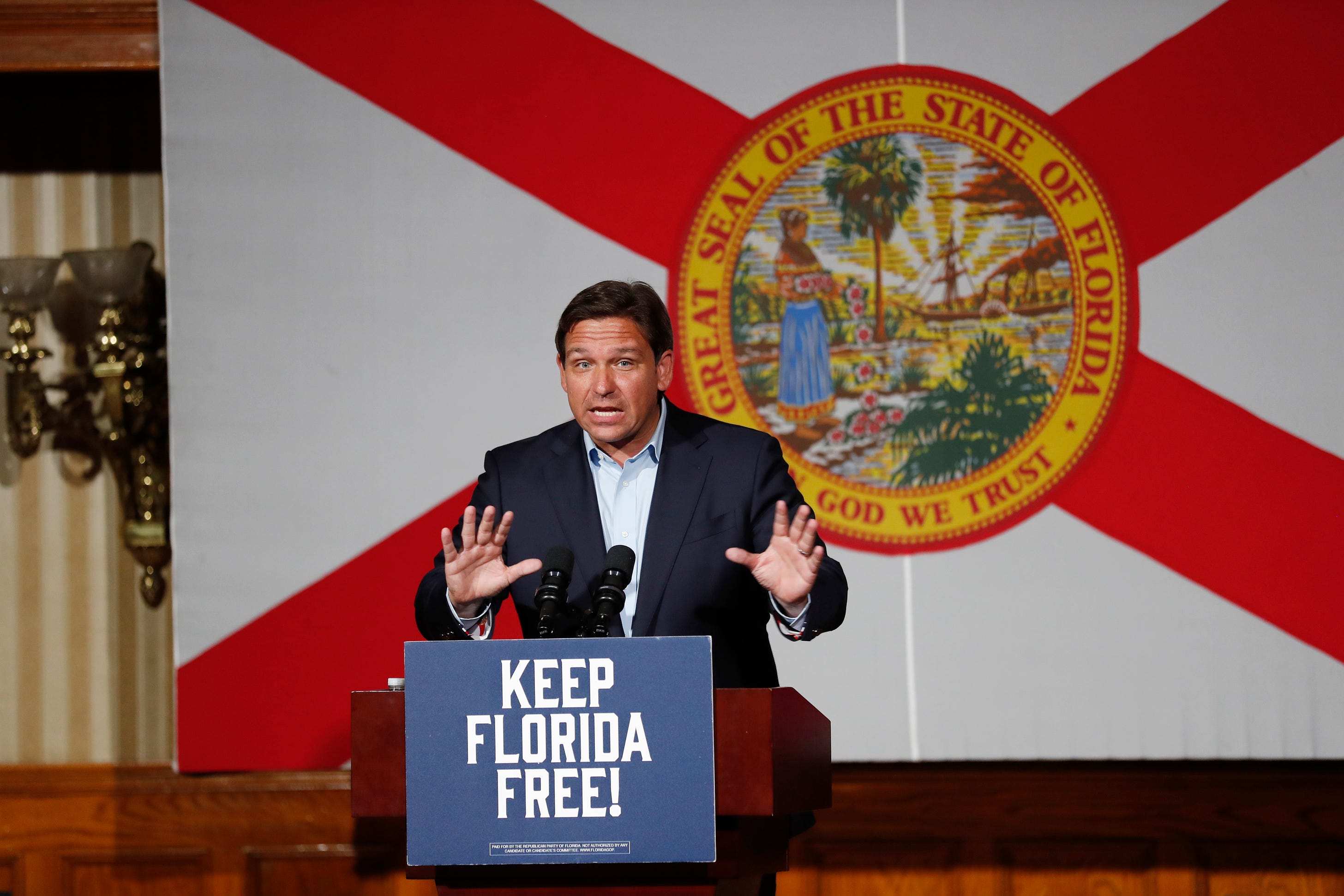
Photo credit: Octavio Jones

Editor’s note: this is an ironic banner in front of DeSantis. Florida is not free for those who don’t share his ideology. If you think racism exists today in Florida, you are not free to discuss it in school or college. You are free to agree with him.

Rather and Kirschner write:

Much of American history is entangled with racism and white supremacy. That is the reality of our beloved nation, no matter how much we wish it were not.

As we sit here nearly a quarter of the way through the 21st century, it is obvious that we need to have the maturity to look back to our past as well as ahead to the future. Can we do this with our eyes wide open? Will we study and learn from the lessons of history?

You can’t grapple with the truth if you hide it from view. Yes, our national narrative is an inspiring one — of freedom, rights, and new opportunities. But it is also a narrative of pain — of the bondage, rape, and murder of enslaved people. It is a story of mass death, broken treaties, and land stolen from Native people. And it is a story of persecution of the “other,” time and again.

The chasm between the noble promises of our founding documents and our historical realities continues to obstruct our national journey toward a more perfect union.

Yes, ours is a country that has facilitated exploration, innovation, and growth, but it is also one built upon families torn apart at the auction block, bodies whipped, and police dogs and fire hoses set against children.

Cities were redlined. Public schools were segregated. And despite our carefully cultivated national image as a meritocracy, throughout our history we have seen talent overlooked and our common humanity diminished on account of people’s race, religion, and sexual orientation.

The ripples of injustice continue to destabilize our society.

It shouldn’t be controversial to say any of this. But acknowledging these truths today is a political act, because it threatens the privileged narratives of those who seek to sugarcoat our past. These are men and women who serve their own ambitions by fortifying their cynical holds on power, delighting in division, feeding off fear, and applauding anger.

And that brings us to Florida’s Governor Ron DeSantis.

Listing all of his efforts to leverage the power of his office to attack equity, empathy, and justice would stretch this post immeasurably. But doing so would also jeopardize the central point: DeSantis is an opportunist. He is not weighing the merits of any one campaign. Rather, he wants headlines as a culture warrior standing up to “wokeness,” a term he has eagerly redefined to suit his own purposes. It allows him to sneer at and dismiss any attempt to reckon with American injustice.

DeSantis has focused his assaults on two of our society’s most traditionally marginalized groups: Black Americans and the LGBTQ community. While these populations have thus far felt the brunt of his targeting, we need to see clearly that his rhetoric is a threat to all who care about a democratic, peaceful, empathetic, and just America. Those of us with the greatest privilege should bear a special burden in rejecting this hate.

DeSantis’s pugilism has enabled him to consolidate power in Florida. Any opposition to his toxic initiatives must contend with the uncomfortable truth that voters validated his message and style via his landslide win in November. Now DeSantis thinks he can take his show on the road with a presidential bid. That remains to be seen. Florida has been trending Republican in recent years, and success there might not translate to the current battleground states, many of which saw big Democratic wins in the midterms.

All that being said, there is a great danger to framing this struggle primarily through the lens of electoral politics. This normalizes a discourse that should be rejected by society’s mainstream. Just as the outright bigotry of the past became socially unacceptable, so too should these latest attempts at divisiveness.

It should not surprise us that DeSantis is making schools — both K-12 and college — a central target. He wants to teach a distorted view of America. He wants to make dissenting speech not only suspect but even criminal. He wants to silence the voices of his critics and of critical thinking more generally. This is a playbook that has been followed by demagogues before to very dangerous ends.

It is essential that DeSantis not be covered by the press through a false equivalence paradigm. We can debate what we should teach and how to teach it. But we can’t replace the truth, as unsavory as it may be, with sanitized narratives that suit those already in power. This is a battle for the minds of the voters of the future. This is about what kind of nation we will become.

But DeSantis primarily cares about what kind of country we are now. He wants to appeal to fear because he thinks he can mine that fear for votes. That is his game plan. And he’s not hiding it. There can be no appeasement. DeSantis has already shown that he isn’t interested in deliberations or good faith compromise. Those would disrupt his approach of means to an end.

History illustrates that hatred can be taught, but so can empathy and justice. We are on a winding journey as a nation. And we have much farther to go. But we have made progress in the face of bigots and autocrats because people had the courage to forge the inequities of our past into a more equitable future.

This history, this truth, is what scares people like DeSantis the most. But it is one that can give us hope if we are determined not to look away.

I wrote today’s 9 a.m. post about the College Board capitulating to conservative critics. I wrote it without seeing the revised curriculum because I was in an airplane all day. Late last night, I opened an email and discovered that Michael Hiltzik of the Los Angeles Times had written a similar but more informative column, because he was able to do the comparison that I had not done. He pointed out that the rightwing attacks on the AP African American Studies course began in September, and the very names and topics that the right and DeSantis had condemned were either excised or made optional in the revised course.

He wrote:

One might have expected a leading national educational institution to have the gumption to push back against right-wingers like Florida Gov. RonDeSantis when they try to stick their noses into decisions about how to teach important subjects.

Sadly, no.

On Wednesday, the College Board issued its final curriculum for what should have been a ground-breaking high school course in African American studies. The College Board called the course “an unflinching encounter with the facts and evidence of African American history and culture.”

The final curriculum appears suspiciously to have been tailored to objections raised by DeSantis, Florida’s culture warrior Republican governor, and other right-wingers, after the board issued a draft version in December.

DeSantis, through his secretary of Education, called the draft “inexplicably contrary to Florida law” and forbade its use in Florida schools. The state’s education secretary, Manny Diaz Jr., attacked it for being “filled with Critical Race Theory and other obvious violations of Florida law.”

The arch-conservative National Review labeled the course part of “a new and sweeping effort to infuse leftist radicalism into America’s K–12 curriculum.”

The curriculum is part of College Board’s Advanced Placement program, which gives college-bound high schoolers exposure to university-level coursework.

The board says AP courses are “aimed at enabling students to develop as independent thinkers and to draw their own conclusions.”

To be fair, the board’s actions related to the African American Studies course are as good a workshop in allowing students to draw their own conclusions as one might hope. Any reasonably bright AP student is likely to see this affair as a demonstration of abject cowardice.

Disgustingly, the College Board released the final curriculum on the first day of Black History Month, as though trawling for praise for its unflinching devotion to truth. The board took pains to deny that the alterations in the draft curriculum had anything to do with criticism from DeSantis, the National Review or the right wing generally.

“No states or districts have seen the official framework that is released, much less provided feedback on it,” the board said. “This course has been shaped only by the input of experts and long-standing AP principles and practices.”

Raise your hand if you believe the College Board. Me neither.

The board said the final version had been completed in December. DeSantis issued his rejection of the course on Jan. 19. But criticism of the course outline had been circulating in conservative quarters for months — the National Review’s attack, for instance, was published on Sept. 12.

A preliminary, unflinching examination of the differences between the draft and the final version can only raise suspicions that the College Board refashioned the African American studies course to assuage the conservatives.

State Senator Manny Diaz Jr. posted a tweet on January 20 listing the state’s concerns about the AP course.

As a template, let’s use the list of “concerns” issued by Diaz on Jan. 20.

Diaz complained about the inclusion in the draft curriculum of writers and social activists Kimberlé Crenshaw, Angela Davis, Roderick Ferguson, Leslie Kay Jones, bell hooks , and Robin D.G. Kelley. Every single one of them has been excised from the final version.

Diaz’s list objected to the treatment, or even inclusion, of topics including the reparation debate, movements such as Black Lives Matter, Black Queer studies and “intersectionality,” which places racism and discrimination in a broadly social context.

Those topics have all been downgraded from required topics to “sample project topics” — that is, optional topics that fall outside requirements and won’t appear on the AP test. Those topics, the curriculum says, “can be refined by states and districts.”

Here’s a safe bet: None of them will be taught in Florida schools.

DeSantis has made no secret of his determination to turn Florida education into a shallow pool redolent of white supremacy by avoiding any hint that American society and politics have been infused with racism and class discrimination.

The shame of the College Board’s rewriting of its AP course is that it effectively places DeSantis and his henchmen in the position of dictating educational standards to the rest of the country.

There was scant political pushback against DeSantis when he rejected the draft curriculum, other than a letter from Illinois Gov. JB Pritzker, a Democrat, warning the College Board that his state would “reject any curriculum modifications designed to appease extremists like the Florida Governor and his allies.”

Pritzker observed, properly, that “ignoring and censoring the accurate reporting of history will not change the realities of the country in which we live.” (Like DeSantis, Pritzker is being talked up as a potential presidential candidate in 2024.)

Now that the final curriculum has been published and its dilutions can be closely scrutinized, perhaps the scope of the College Board’s capitulation will become clearer.

But the College Board has already flunked this all-important test of character. As we’ve noted before, acts of cowardice in the face of DeSantis’ goonish bullying won’t appease him, but will only encourage him.

As he works to destroy the independence and quality of the Florida K-12 and university systems, parents elsewhere around the country can take perverse satisfaction in knowing that students will emerge from Florida schools without the skill to compete with their own kids in intelligent society.

But if institutions like the College Board continue to let DeSantis transmit his virus of ignorance beyond Florida’s borders, no one will be safe from the contagion.

When I first had a chance to read the College Board’s AP African American Studies syllabus, I predicted that the College Board was likely to beat a hasty retreat if its bottom line was jeopardized. I have not yet seen the revised edition, but the media is reporting that certain hot topics and prominent names were deleted to make the course palatable to Ron DeSantis and other conservative governors.

The New York Times reported:

After heavy criticism from Gov. Ron DeSantis, the College Board released on Wednesday an official curriculum for its new Advanced Placement course in African American Studies — stripped of much of the subject matter that had angered the governor and other conservatives.

The College Board purged the names of many Black writers and scholars associated with critical race theory, the queer experience and Black feminism. It ushered out some politically fraught topics, like Black Lives Matter, from the formal curriculum.

And it added something new: “Black conservatism” is now offered as an idea for a research project.

This last addition was a direct concession to criticism from the conservative National Review, which assailed the AP course as Neo-marxist indoctrination that left out the voices of African American conservative writers and scholars.

The Times’ story continues:

But the study of contemporary topics — including Black Lives Matter, incarceration, queer life and the debate over reparations — is downgraded. The subjects are no longer part of the exam, and are simply offered on a list of options for a required research project.

And even that list, in a nod to local laws, “can be refined by local states and districts.”

The expunged writers and scholars include Kimberlé W. Crenshaw, a law professor at Columbia, which touts her work as “foundational in critical race theory”; Roderick Ferguson, a Yale professor who has written about queer social movements; and Ta-Nehisi Coates, the author who has made the case for reparations for slavery. Gone, too, is bell hooks, the writer who shaped discussions about race, feminism and class.

After the curriculum was released, Professor Crenshaw said that even if her name and others had been taken out of the curriculum because secondary sources — theorists or analysts — were being eliminated in favor of facts and lived experience, the decision sent a troubling message. “I would have made a different choice,” she said. “Even the appearance of bowing to political pressure in the context of new knowledge and ideas is something that should not be done.”

But she said she was also disappointed because she had believed the course would capitalize on a hunger of young students to learn “ways of thinking about things like police brutality, mass incarceration and continuing inequalities.”

Instead, she said, “the very same set of circumstances that presented the need for the course also created the backlash against the content that people don’t like.”

David Blight, a professor of American history at Yale University, said Wednesday that he had written an endorsement of the new curriculum, at the College Board’s request, and that he believed it had much to offer not just about history but also about Black poetry, art and the origins of the blues, jazz and hip-hop. But he withdrew his endorsement on Wednesday, after learning that some sections had been cut.

“I withdrew it because I want to know when and how they made these decisions to excise these people, because that’s also an attack on their academic freedom,” Dr. Blight said.

PEN America, a free speech organization, echoed that concern. While the College Board had said the changes were not political, the board “risked sending the message that political threats against the teaching of particular types of content can succeed in silencing that content,” said Jeremy C. Young, senior manager of free expression and education at PEN America…

Dr. Gates, who was a consultant to the curriculum, said he was “sorry that the College Board’s policy is not to require secondary sources in its curricula.” He teaches Harvard’s introduction to African American studies, “and academic subjects such as ‘Intersectionality’ and critical race theory, the 1619 Project, reparations for slavery, Black homophobia and antisemitism are fair game, of course, for such a class,” he said in an email. The 1619 Project is an initiative by The New York Times.

The College Board insists it made its changes in December before DeSantis denounced the syllabus.

But the conservative attack on the syllabus began last September, when Stanley Kurtz received a leaked copy and wrote a scathing critique in The National Review called “Neo-Marxing the College Board with AP African American Studies.”

He wrote in September:

A new and sweeping effort to infuse leftist radicalism into America’s K–12 curriculum has begun. The College Board — the group that runs the SAT test and the Advanced Placement (AP) program — is pilot-testing an AP African American Studies course. While the College Board has withheld the course’s curriculum framework from the public, I have obtained a copy.

Although K–12 teachers and academic consultants working with the College Board have publicly denied that AP African American Studies (APAAS) either pushes an ideological agenda or teaches critical race theory, those denials are false. APAAS clearly proselytizes for a socialist transformation of the United States, although its socialism is heavily inflected by attention to race and ethnicity. Even if there were no laws barring such content, states and local school districts would have every right to block APAAS as antithetical to their educational goals. In any case, APAAS’s course content does run afoul of the new state laws barring CRT. To approve APAAS would be to gut those laws.

Kurtz followed with additional articles in The National Review lambasting the course as radical leftist indoctrination that violated state laws prohibiting the teaching of critical race theory. He applauded DeSantis’s attack on the course.

Although the College Board insisted that it’s revisions had nothing to do with the conservative pushback and was completely nonpolitical, Kurtz laughed:

Here’s the reality. The College Board is in a panic. Its repeated attempts to keep the APAAS curriculum secret have failed. That curriculum has now been widely published, and the teacher’s guide has been exposed here at NRO as well. My sources tell me that at least one other red state is seriously considering pulling out of the course. More red states are likely doing the same. The College Board knows that if it doesn’t stop the bleeding, the red states will be lost.

The College Board knew it had a problem months before DeSantis condemned the course. Could it take the risk of offering a course that would be rejected by red states that had already banned “critical race theory?”

The Times pointed out:

Acceptance for the new curriculum is important to the College Board, a nonprofit, because A.P. courses are a major source of revenue. The board took in more than $1 billion in program service revenue in 2019, of which more than $490 million came from “AP and Instruction,” according to its tax-exempt filing.

The College Board is a nonprofit but it pays hefty salaries. According ito Forbes, its Chief Executive Officer David Coleman (the architect of the Common Core standards) was paid $1.8 million in salary in 2018 (the last year that figures were available), and its president received more than $1 million. The company holds over $1 billion in assets.

Could they risk publishing a course that might be rejected by every red state? Maybe. But would they? Clearly, it was decided that it was easier to drop the controversial names and topics than to offend powerful conservative figures who might hurt their revenues.
The editorial board of the Idaho Statesman—the largest newspaper in the state— published the following statement about the rush to enact vouchers in Idaho. In doing so, it confirms the suspicion that the sudden deluge of voucher bills in red states is the result of cut-and-paste model legislation written by ALEC, the corporate-funded bill-mill of the far right.

The Idaho Senate Education Committee on Tuesday agreed to print a bill that would bring school vouchers to Idaho.

Idaho Sen. Tammy Nichols, R-Middleton, introduced the bill, the “Freedom In Education Savings Accounts,” which would allow Idaho families to collect taxpayer dollars to use for private school tuition.

It’s cut-and-paste legislation from the American Legislative Exchange Council.

If approved, Idaho wouldn’t be the first state to have vouchers. Other states, such as Wisconsin, Indiana and Arizona, have had vouchers for several years. Utah legislators are considering a school voucher system.

“This legislation has been modeled after Arizona, with 10 years of experience and is considered the gold standard being used by most other states,” Nichols said in introducing her bill.

So let’s take a look at Arizona’s experience to see what’s in store for Idaho if this bill becomes law.

In November, the Grand Canyon Institute analyzed the zip code distribution of applications for Arizona’s new universal Empowerment Scholarship Account voucher program. The centrist think tank found:

High-income zip codes are overrepresented in voucher applications, and low-income zip codes are underrepresented. While only 11% of Arizona’s students live in zip codes with median incomes of more than $100,000, those students made up nearly 20% of the voucher applicants. Meanwhile, more than half of Arizona’s students live in zip codes with median incomes less than $60,000, but those students made up only 32% of the applicants.

Nearly half (45%) of the applicants came from the wealthiest quarter of students in the state, living in zip codes where the median household income is $80,000 or more.

80% of the applicants were not in public school, meaning these students were already attending private schools, being home schooled or are just entering schooling — not being “rescued” from a “failing” school.

Only 3.5% of all applicants came from zip codes that qualified for the earlier version of school vouchers that sought to help kids living in failing districts.

Arizona is unable to measure academic impacts of the voucher program because there were no accountability measures in the legislation.

A school voucher is worth $7,000, but the average private school tuition is over $10,000.

Private schools can accept or reject students as they choose.

Total private school subsidies in Arizona have now reached $600 million.

Indiana has had similar concerning results with its expanded voucher program. Since Indiana expanded its voucher program in 2011, most vouchers simply have gone to students already enrolled, according to Chris Lagoni, executive director of the Indiana Small and Rural Schools Association. Of the 44,376 students enrolled in private schools and using vouchers in Indiana, only 421 of those students had moved from a failing public school, putting a big hole in the argument that vouchers are there to “save” children from terrible schools.

Like Arizona, the cost of Indiana’s school voucher program has grown considerably, from a modest $20 million in 2011 to more than $300 million today.

And even though Indiana’s education budget has grown to $8.2 billion, per pupil funding for students in public schools is still below pre-recession levels.

Interesting to note that some of the reasons Nichols cited for the need for school vouchers are inflicted by far-right legislators like Nichols: “declining test scores, overcrowding, students not meeting grade-level benchmarks, bullying, teacher wages, staffing shortages, curriculum issues, indoctrination, and the list goes on,” she said. At least three of those reasons — overcrowding, teacher wages and staffing shortages — are direct results of underfunding public education, and perhaps more students would meet grade-level benchmarks, such as third-grade reading, if Nichols hadn’t led the charge to kill a $6 million early childhood literacy grant two years ago.

If school voucher advocates are not willing to discuss the negative impacts of school vouchers or come up with solutions to avoid these problems, then we know that this is not a serious proposal, rather an exercise in ideological pandering. Idaho is doomed to make the same mistakes other states have made if the Republican supermajority rams through vouchers.

Statesman editorials are the unsigned opinion of the Idaho Statesman’s editorial board. Board members are opinion editor Scott McIntosh, opinion writer Bryan Clark, editor Chadd Cripe, newsroom editors Dana Oland and Jim Keyser and community member Maryanne Jordan.

Read more at: https://www.idahostatesman.com/opinion/editorials/article271887797.html#storylink=cpy

Robert Hubbell writes a thoughtful, informative blog. I’m posting this as part of my personal project to understand the new face of white supremacy. White supremacy has always been there, simmering below the surface. Trump invited them to show their faces and step into the daylight. They did, and DeSantis is sending them signals that he wants to be their champion.

Florida Governor Ron DeSantis has set his anti-education sites on Florida’s state colleges. Through a series of political and legal maneuvers, he has ceded control over Florida’s state colleges to ultra-conservative culture warriors like Christopher Rufo. In short order, DeSantis has announced that he will rid Florida state colleges and universities of curricula not “rooted in Western tradition” or that “compels belief in critical race theory or related concepts such as intersectionality.”

Amid the torrent of reporting on Ron DeSantis’s attack on critical race theory and intersectionality, the quiet part is often left unsaid. So let me say it: DeSantis’s educational agenda is code for racism and white supremacy. (Other parts of his agenda seek to erase the dignity and humanity of LGBTQ people.) DeSantis’s invocation of “Western tradition” is meant to suppress knowledge regarding the people (and contributions) of Asia, Africa, South America, Oceania, and the Indigenous Peoples of the Americas. See Talking Points Memo, DeSantis Makes 2024 Ambitions Clear As He Pours Gasoline On His ‘Woke’ Education Fire.

Given DeSantis’s generalized ignorance, his call to focus on “Western tradition” is a slippery slope that will inevitably lead to the discussion of unpleasant truths about America. For example, the enslavement of Black people was a “tradition” in North America for 246 years—and the abolition of that evil practice is relatively recent (155 years ago). So, a college course that honestly addresses the Western “traditions” of North America should include an examination that the role of slavery played in the economic, social, and political development of America.

But DeSantis isn’t stopping at converting Florida’s colleges and universities into re-education camps in the worst traditions of the USSR. He is seeking to up-end centuries of “Western tradition” embodied in the Constitution and the English common law: the requirement of a unanimous jury to impose capital punishment. DeSantis has floated the idea that a less-than-unanimous jury verdict can impose a sentence of death—an unconstitutional proposal designed to inflict the death penalty on more Black and Latino Americans. See Vox, Ron DeSantis wants to make it much easier for the state to kill people.

DeSantis is willing to do all this because he wants to capture Trump’s loyal base—which is the only hope that DeSantis has of becoming a credible candidate. As Trump becomes mired in criminal prosecutions, DeSantis will become emboldened and radicalized beyond his already extremist views. Doing so ignores the lessons of the 2022 midterms: persuadable Americans are done with Trump and his MAGA extremism. Like all military generals, Ron DeSantis is fighting the last war (the presidential election of 2020) and has failed to heed the tectonic shift that occurred in the midterms.