Starting today, with the sole exception of the 9 a.m. post about censorship, there will be no more posts on Saturday or Sunday. I meant to write and say, NONE! But I could not resist the story about cartoonist Art Spiegelman.

If there is breaking news, I will post it.

Otherwise, enjoy your weekend.

The New York Times reported that a cartoon about Trump by Art Spiegelmaan was removed by the executive producer of the PBS show “American Masters.”

Trump has proposed defunding both PBS and NPR.

The Times wrote:

The executive producer of the Emmy Award-winning “American Masters” series insisted on removing a scene critical of President Trump from a documentary about the comic artist Art Spiegelman two weeks before it was set to air nationwide on public television stations.

The filmmakers say it is another example of public media organizations bowing to pressure as the Trump administration tries to defund the sector, while the programmers say their decision was a matter of taste.

Alicia Sams, a producer of “Art Spiegelman: Disaster Is My Muse,” said in an interview that approximately two weeks before the movie’s April 15 airdate, she received a call from Michael Kantor, the executive producer of “American Masters,” informing her that roughly 90 seconds featuring a cartoon critical of Trump would need to be excised from the film. The series is produced by the WNET Group, the parent company of several New York public television channels.

Stephen Segaller, the vice president of programming for WNET, confirmed in an interview that the station had informed the filmmakers that it needed to make the change. Segaller said WNET felt the scatological imagery in the comic, which Spiegelman drew shortly after the 2016 election — it portrays what appears to be fly-infested feces on Trump’s head — was a “breach of taste” that might prove unpalatable to some of the hundreds of stations that air the series. 

Note that the four panels are divided by a swastika.

Art Spiegelman drew a graphic novel called Maus, which received the Pulitzer Prize in 1992. The book is about his parents’ experiences during the Holocaust.

Maus has been banned by many libraries.

It won’t actually be available until October 10, but it’s now ready for pre-ordering on Amazon, possibly other sites as well, including your local bookstore. Support independent bookstores!

It is my memoirs, the story of my life. Growing up in Houston as third of eight children. College. Marriage. Career. Developing my views and values. Discovering that many of my convictions were wrong. Saying so. Intimate details of my personal life.

Stuff like that.

The publisher is Columbia University Press.

Published by Columbia University Press..

William Kristol was a leading figure in the conservative movement. His father Irving Kristol was renowned as the godfather of neoconservatism. Bill was the editor of the Weekly Standard for many years. But because he is a principled conservative, he loathes what Trump is doing to our nation. He writes at The Bulwark, my favorite Never-Trump blog.

What’s happening is not normal, he writes:

If the Trump administration’s sudden assault on thousands of foreign students legally studying at Harvard seems unprecedented, it’s because it is. If the abrupt abrogation of temporary protected status for hundreds of thousands of Venezuelans legally living and working in the United States seems unprecedented, it’s because it is. If the sudden arrests and deportations of law-abiding immigrants checking in as ordered at government offices seems unprecedented, it’s because it is. If the deportations of other immigrants without anything like due process and basically in defiance of court orders to prisons in third countries seems unprecedented, it’s because it is.

And if it all seems utterly stupid and terribly cruel and amazingly damaging to this country, it’s because it is.

But it turns out nativism is one hell of a drug. The Trump administration has ingested it in a big way, and it’s driving its dealers and users in the administration into a fanatical frenzy of destructive activity. And the Republican party and much of Conservatism Inc.—and too much of the country as a whole—is just watching it happen.

The United States has many problems. No one seriously thinks that Harvard’s certification to participate in the Student and Exchange Visitor Program is one of them. And the Department of Homeland Security’s announcement of the action against Harvard makes clear this isn’t just about Harvard: “Let this serve as a warning to all universities and academic institutions across the country.” Are our other institutions of higher education suffering from their ability to attract and enroll students from abroad, if they chose to do so? Are the rest of us?

No. And to the degree there are some discrete problems, nothing justifies this kind of action against Harvard. As Andrea Flores, a former DHS official, told the New York Times, “D.H.S. has never tried to reshape the student body of a university by revoking access to its vetting systems, and it is unique to target one institution over hundreds that it certifies every year.”

Similarly, what’s the justification for the Trump administration’s unprecedented sudden and early abrogation of temporary protected status for 350,000 Venezuelans who fled tyranny and are now living peacefully and working productively in this country? There is no broad unhappiness at their presence, no serious case that they are causing more harm than doing good. Nor for that matter is there a real argument that the presence of 20,000 Haitians living and working in Springfield, Ohio, is a problem that required first lies to denigrate them and now attempts to deport them.

And this week, the nominee to head U.S. Citizenship and Immigration Services said the Trump administration intends to end the well-established Optional Practical Training Program, which is the single largest channel for highly skilled immigrants to stay and work in the United States after finishing their education here. A study by a leading immigration scholar, Michael Clemens of George Mason University, finds that slashing that program would cause permanent losses to U.S. innovation, productivity, economic growth, and even job opportunities for native workers.

But here we are, with an administration where fantasy trumps reality, ideology trumps evidence, and demagoguery trumps decency. As the economist Dani Rodrik puts it, “Three things made the US a rich and powerful nation: the rule of law, its science & innovation system, and openness to foreign talent. Remarkable how Trump has taken a sledgehammer to all three. No enemy of this country could do more.”

Foreigners studying and working here are not damaging the United States. A virulently nativist administration is what’s damaging the United States. It’s doing so in ways from which it will be difficult to recover. Just as important, it’s doing so in ways that will be a permanent stain on this nation’s history.

So the U.S. government accepted the luxurious jet offered by Qatar to serve as Air Force 1, the President’s official airplane.

The New York Times published a lengthy story –“the inside story”–of Trump’s longing to accept the jet as a gift from the government of Qatar. It explains that the Qataris had been trying to sell the opulent jet for five years, with no success.

Trump wants an opulent jet, even if it is a used jet. He thinks the U.S. should have the biggest airplane for its president. The Qataris flew the jet to Palm Beach, so he could personally inspect it. He fell in love with it. He always falls for gold trappings. He thought there was no problem accepting a gift from another nation. Who would turn down a “free” gift?

The inside story begins:

President Trump wanted a quick solution to his Air Force One problem.

The United States signed a $3.9 billion contract with Boeing in 2018 for two jets to be used as Air Force One, but a series of delays had slowed the work far past the 2024 delivery deadline, possibly beyond Mr. Trump’s second term.

Now Mr. Trump had to fly around in the same old planes that transported President George H.W. Bush 35 years ago. It wasn’t just a vanity project. Those planes, which are no longer in production, require extensive servicing and frequent repairs, and officials from both parties, reaching back a decade or more, had been pressing for replacements.

Mr. Trump, though, wanted a new plane while he was still in office. But how?

“We’re the United States of America,” Mr. Trump said this month. “I believe that we should have the most impressive plane.”

The story of how the Trump administration decided that it would accept a free luxury Boeing 747-8 from Qatar to serve as Air Force One involved weeks of secret coordination between Washington and Doha. The Pentagon and the White House’s military office swung into action, and Mr. Trump’s Middle East envoy, Steven Witkoff, played a key role.

Aeronautical experts say that it would cost as much as $1 billion to renovate the jet and give it the security of an Air Force 1. It might not be ready until the end of Trump’s term, when (they said) it would be retired to the Trump Library.

The story failed to mention the Emoluments Clause of the Constitution, which prohibits the President or other federal officials from accepting gifts from foreign nations.

Brittanica says:

The emoluments clause, also called the foreign emoluments clause, is a provision of the U.S. Constitution (Article I, Section 9, Paragraph 8) that generally prohibits federal officeholders from receiving any gift, payment, or other object or service of value from a foreign state or its rulers, officers, or representatives. The clause provides that:

No Title of Nobility shall be granted by the United States: And no Person holding any Office of Profit or Trust under them, shall, without the Consent of the Congress, accept of any present, Emolument, Office, or Title, of any kind whatever, from any King, Prince, or foreign State.

The Constitution also contains a “domestic emoluments clause” (Article II, Section 1, Paragraph 7), which prohibits the president from receiving any “Emolument” from the federal government or the states beyond “a Compensation” for his “Services” as chief executive.

I have so far not seen a story that explains that the gift is unconstitutional, unless Congress gives its consent.

I think we have become so accustomed to Trump ignoring and violating the Constitution that it isn’t even worth mentioning. This is a classic demonstration of the Overton Window.

On May 10, Dana Goldstein wrote a long article in The New York Times about how education disappeared as a national or federal issue. Why, she wondered, did the two major parties ignore education in the 2024 campaign? Kamala Harris supported public schools and welcomed the support of the two big teachers’ unions, but she did not offer a flashy new program to raise test scores. Trump campaigned on a promise to privatize public funding, promote vouchers, charter schools, religious schools, home schooling–anything but public schools, which he regularly attacked as dens of iniquity, indoctrination, and DEI.

Goldstein is the best education writer at The Times, and her reflections are worth considering.

She started:

What happened to learning as a national priority?

For decades, both Republicans and Democrats strove to be seen as champions of student achievement. Politicians believed pushing for stronger reading and math skills wasn’t just a responsibility, it was potentially a winning electoral strategy.

At the moment, though, it seems as though neither party, nor even a single major political figure, is vying to claim that mantle.

President Trump has been fixated in his second term on imposing ideological obedience on schools.

On the campaign trail, he vowed to “liberate our children from the Marxist lunatics and perverts who have infested our educational system.”Since taking office, he has pursued this goal with startling energy — assaulting higher education while adopting a strategy of neglect toward the federal government’s traditional role in primary and secondary schools. He has canceled federal exams that measure student progress, and ended efforts to share knowledge with schools about which teaching strategies lead to the best results. A spokeswoman for the administration said that low test scores justify cuts in federal spending. “What we are doing right now with education is clearly not working,” she said.

Mr. Trump has begun a bevy of investigations into how schools handle race and transgender issues, and has demanded that the curriculum be “patriotic” — a priority he does not have the power to enact, since curriculum is set by states and school districts.

Actually, federal law explicitly forbids any federal official from attempting to influence the curriculum or textbooks in schools.

Education lawyer Dan Gordon wrote about the multiple laws that prevent any federal official from trying to dictate, supervise, control or interfere with curriculum. There is no sterner prohibition in federal law than the one that keeps federal officials from trying to dictate what schools teach.

Of course, Trump never worries about the limits imposed by laws. He does what he wants and leaves the courts to decide whether he went too far.

Goldstein continued:

Democrats, for their part, often find themselves standing up for a status quo that seems to satisfy no one. Governors and congressional leaders are defending the Department of Education as Mr. Trump has threatened to abolish it. Liberal groups are suing to block funding cuts. When Kamala Harris was running for president last year, she spoke about student loan forgiveness and resisting right-wing book bans. But none of that amounts to an agenda on learning, either.

All of this is true despite the fact that reading scores are the lowest they have been in decades, after a pandemic that devastated children by shuttering their schools and sending them deeper and deeper into the realm of screens and social media. And it is no wonder Americans are increasingly cynical about higher education. Forty percent of students who start college do not graduate, often leaving with debt and few concrete skills.

“Right now, there are no education goals for the country,” said Arne Duncan, who served as President Barack Obama’s first secretary of education after running Chicago’s public school system. “There are no metrics to measure goals, there are no strategies to achieve those goals and there is no public transparency.”

I have been writing about federal education policy for almost fifty years. There are things we have learned since Congress passed the Elementary and Secondary Education Act in 1965. That law was part of President Lyndon B. Johnson’s agenda. Its purpose was to send federal funds to the schools enrolling the poorest students. Its purpose was not to raise test scores but to provide greater equity of resources.

Over time, the federal government took on an assertive role in defending the rights of students to an education: students with disabilities; students who did not speak English; and students attending illegally segregated schools.

In 1983, a commission appointed by President Reagan’s Secretary of Education Terrell Bell declared that American schools were in crisis because of low academic standards. Many states began implementing state tests and raising standards for promotion and graduation.

President George H.W. Bush convened a meeting of the nation’s governors, and they endorsed an ambitious set of “national goals” for the year 2000. E.g., the U.S. will be first in the world by the year 2000; all children will start school ready to learn by 2000. None of the goals–other than the rise of the high school graduation rate to 90%–was met.

The Clinton administration endorsed the national goals and passed legislation (“Goals 2000”) to encourages states to create their own standards and tests. President Clinton made clear, however, that he hoped for national standards and tests.

President George W. Bush came to office with a far-reaching, unprecedented plan called “No Child Left Behind” to reform education by a heavy emphasis on annual testing of reading and math. He claimed that because of his test-based policy, there had been a “Texas Miracle,” which could be replicated on a national scale. NCLB set unreachable goals, saying that every school would have 100% of their students reach proficiency by the year 2014. And if they were not on track to meet that impossible goals, the schools would face increasingly harsh punishments.

In no nation in the world have 100% of all students ever reached proficiency.

Scores rose, as did test-prep. Many untested subjects lost time in the curriculum or disappeared. Reading and math were tested every year from grades 3-8, as the law prescribed. What didn’t matter were science, history, civics, the arts, even recess.

Some schools were sanctioned or even closed for falling behind. Schools were dominated by the all-important reading and math tests. Some districts cheated. Some superintendents were jailed.

In 2001, there were scholars who warned that the “Texas Miracle” was a hoax. Congress didn’t listen. In time the nation learned that there was no Texas Miracle, never had been. But Congress clung to NCLB because they had no other ideas.

When Obama took office in 2009, educators hoped for relief from the annual testing mandates but they were soon disappointed. Obama chose Arne Duncan, who had led the Chicago schools but had never been a teacher. Duncan worked with consultants from the Gates and Broad Foundations and created a national competition for the states called Race to the Top. Duncan had a pot of $5 billion that Congress had given him for education reform.

Race to the Top offered big rewards to states that applied and won. To be eligible, states had to authorize the creation of charter schools (almost every state did); they had to agree to adopt common national standards (that meant the Common Core standards, funded wholly by the Gates Foundation and not yet completed); sign up for one of two federally funded standardized tests (PARCC or Smarter Balanced) ; and agree to evaluate their teachers by the test scores of their students. Eighteen states won huge rewards. There were other conditions but these were the most consequential.

Tennessee won $500 million. It is hard to see what, if anything, is better in Tennessee because of that audacious prize. The state put $100 million into an “Achievement School District,” which gathered the state’s lowest performing schools into a new district and turned them into charters. Chris Barbic, leader of the YES Prep charter chain in Houston was hired to run it. He pledged that within five years, the lowest-performing schools in the state would rank among the top 20% in the state. None of them did. The ASD was ultimately closed down.

Duncan had a great fondness for charter schools because they were the latest thing in Chicago; while superintendent, he had launched a program he called Renaissance 2010, in which he pledged to close 80 public schools and open 100 charter schools. Duncan viewed charters as miraculous. Ultimately Chicago’s charter sector produced numerous scandals but no miracles.

I have written a lot about Race to the Top over the years. It was layered on top of Bush’s NCLB, but it was even more punitive. It targeted teachers and blamed them if students got low scores. Its requirement that states evaluate teachers by student test scores was a dismal failure. The American Statistical Association warned against it from the outset, pointing out that students’ home life affected test scores more than their teachers.

Duncan’s Renaissance 2010 failed. It destroyed communities. Its strategy of closing neighborhood schools and dispersing students encountered growing resistance. The first schools that Duncan launched as his exemplars were eventually closed. In 2021, the Chicago Board of Education voted unanimously to end its largest “school turnaround” program, managed by a private group, and return its 31 campuses to district control. Duncan’s fervent belief in “turnaround” schools was derided as a historical relic.

Race to the Top failed. The proliferation of charter schools, aided by a hefty federal subsidy, drained students and resources from public schools. Charter schools close their doors at a rapid pace: 26% are gone in their first five years; 39% in their first ten years. In addition, due to lax accountability, charters have demonstrated egregious examples of waste, fraud, and abuse.

The Common Core was supposed to lift test scores and reduce achievement gaps, but it did neither. Conservative commentator Mike Petrilli referred to 2007-2017 as “the lost decade.” Scores stagnated and achievement gaps barely budged.

So what have we learned?

This is what I have learned: politicians are not good at telling educators how to teach. The Department of Education (which barely exists as of now) is not made up of educators. It was not in a position to lead school reform. Nor is the Secretary of Education. Nor is the President. Would you want the State legislature or Congress telling surgeons how to do their job?

The most important thing that the national government can do is to ensure that schools have the funding they need to pay their staff, reduce class sizes, and update their facilities.

The federal government should have a robust program of data collection, so we have accurate information about students, teachers, and schools.

The federal government should not replicate its past failures.

What Congress can do very effectively is to ensure that the nation’s schools have the resources they need; that children have access to nutrition and medical care; and that pregnant women get prenatal care so that their babies are born healthy.

The Trump administration upped the stakes in its vindictive campaign against Harvard University. It has canceled Harvard’s enrollment of international students.

Harvard refused to cave to the Trump administration’s demands to monitor its curriculum and its admissions and hiring policies. In response, the administration has suspended billions of federal dollars for medical and scientific research.

The New York Times reported:

The Trump administration on Thursday halted Harvard University’s ability to enroll international students, taking aim at a crucial funding source for the nation’s oldest and wealthiest college in a major escalation in the administration’s efforts to pressure the elite school to fall in line with the president’s agenda.

The administration notified Harvard about the decision after a back-and-forth in recent days over the legality of a sprawling records request as part of the Department of Homeland Security’s investigation, according to three people with knowledge of the negotiations. The people spoke on the condition of anonymity because they were not authorized to discuss the matter publicly.

The latest move is likely to prompt a second legal challenge from Harvard, according to one person familiar with the school’s thinking who insisted on anonymity to discuss private deliberations. The university sued the administration last month over the government’s attempt to impose changes to its curriculum, admissions policies and hiring practices.

“I am writing to inform you that effective immediately, Harvard University’s Student and Exchange Visitor Program certification is revoked,” according to a letter sent to the university by Kristi Noem, the homeland security secretary. A copy of the letter was obtained by The New York Times.

About 6,800 international students attended Harvard this year, or roughly 27 percent of the student body, according to university enrollment data. That is up from 19.7 percent in 2010.

The move is likely to have a significant effect on the university’s bottom line…

In a news release confirming the administration’s action, the Department of Homeland Security sent a stark message to Harvard’s international students: “This means Harvard can no longer enroll foreign students, and existing foreign students must transfer or lose their legal status.”

This message came from a Cabinet member who was asked in a hearing to define “habeas corpus,” and she said it meant that the President can deport anyone he wants to.

This action is a demonstration of Presidential tyranny. It should be swiftly reversed by the courts.

When Trump promised to shut down the U.S. Department of Education during his campaign, he must have known that he couldn’t close down a department without Congressional approval. Everyone else knew it. He brought in wrestling entrepreneur Linda McMahon as Secretary of Education to preside over the Department’s demise. He never sought Congressional approval.

Elon Musk’s DOGS team did the dirty work, laying off half the Department’s employees, some 1300 people.

The most severely affected offices were the Federal Student Aid office, the Office for Civil Rights, and the Institute for Education Sciences (which oversees federal research and NAEP). The IES was eliminated, leaving future administrations of NAEP in doubt and disemboweling the government’s essential historic role in compiling data about education.

But today a federal judge ruled that the shuttering of ED was wrong and that everyone laid off should be rehired. Bottom line: a President can’t close a Congressionally authorized department by executive order.

WASHINGTON (AP) — A federal judge on Thursday blocked President Donald Trump’s executive order to shut down the Education Department and ordered the agency to reinstate employees who were fired in mass layoffs.

U.S. District Judge Myong Joun in Boston granted a preliminary injunction stopping the Trump administration from carrying out two plans announced in March that sought to work toward Trump’s goal to dismantle the department. It marks a setback to one of the Republican president’s campaign promises.

The injunction was requested in a lawsuit filed by the Somerville and Easthampton school districts in Massachusetts and the American Federation of Teachers, along with other education groups.

In their lawsuit, the groups said the layoffs amounted to an illegal shutdown of the Education Department. They said it left the department unable to carry out responsibilities required by Congress, including duties to support special education, distribute financial aid and enforce civil rights laws.

In his order, Joun said the plaintiffs painted a “stark picture of the irreparable harm that will result from financial uncertainty and delay, impeded access to vital knowledge on which students and educators rely, and loss of essential services for America’s most vulnerable student populations.”

Layoffs of that scale, he added, “will likely cripple the Department.”

Joun ordered the Education Department to reinstate federal workers who were terminated as part of the March 11 layoff announcement.

The Trump administration says the layoffs are aimed at efficiency, not a department shutdown. Trump has called for the closure of the agency but recognizes it must be carried out by Congress, the government said.

The administration said restructuring the agency “may impact certain services until the reorganization is finished” but it’s committed to fulfilling its statutory requirements.

The U.S. Supreme Court split 4-4 on the Oklahoma religious charter school issue. St. Isadore of Seville Catholic School applied for public funding to sponsor an online religious school. The tie decision means that the last decision–which ruled against the proposal–stands.

Justice Amy Coney Barrett recused herself because of a previous relationship with one of the school’s founders.

The decision was unsigned, but one of the Court’s conservative Justices voted with the three liberal Justices to produce a tie vote.

Remember, this is a Court whose conservative Justices claim to be originalists. Their decisions on matters of church and states indicate a flexible, if not hypocritical, application of “originalism.” Over more than two centuries, the U.S. Supreme Court has struggled to maintain separation of church and state. They have found exceptions to Thomas Jefferson’s “wall of separation, allowing public funds for textbooks and state-mandated services, but over the years the courts attempted to avoid the state paying for tuition or teachers’ salaries.

Yet this Court seems to laying the groundwork for tearing that Wall down completely. In previous decisions, the conservative majority has ruled that failure to fund religious schools was a denial of religious freedom.

Such a conclusion does not align with Originalism. No matter how hard Justice Clarence Thomas or Justice Sam Alito scours the historical record, they are unable to build a case that the Founding Fathers or the Supreme Court want the public to subsidize the cost of religious or private schools.

The only thing “original” about their recent decisions requiring states to pay tuition at religious schools in Maine and Montana and capital costs at a religious school in Missouri is their conclusion. They invented a right out of whole cloth.

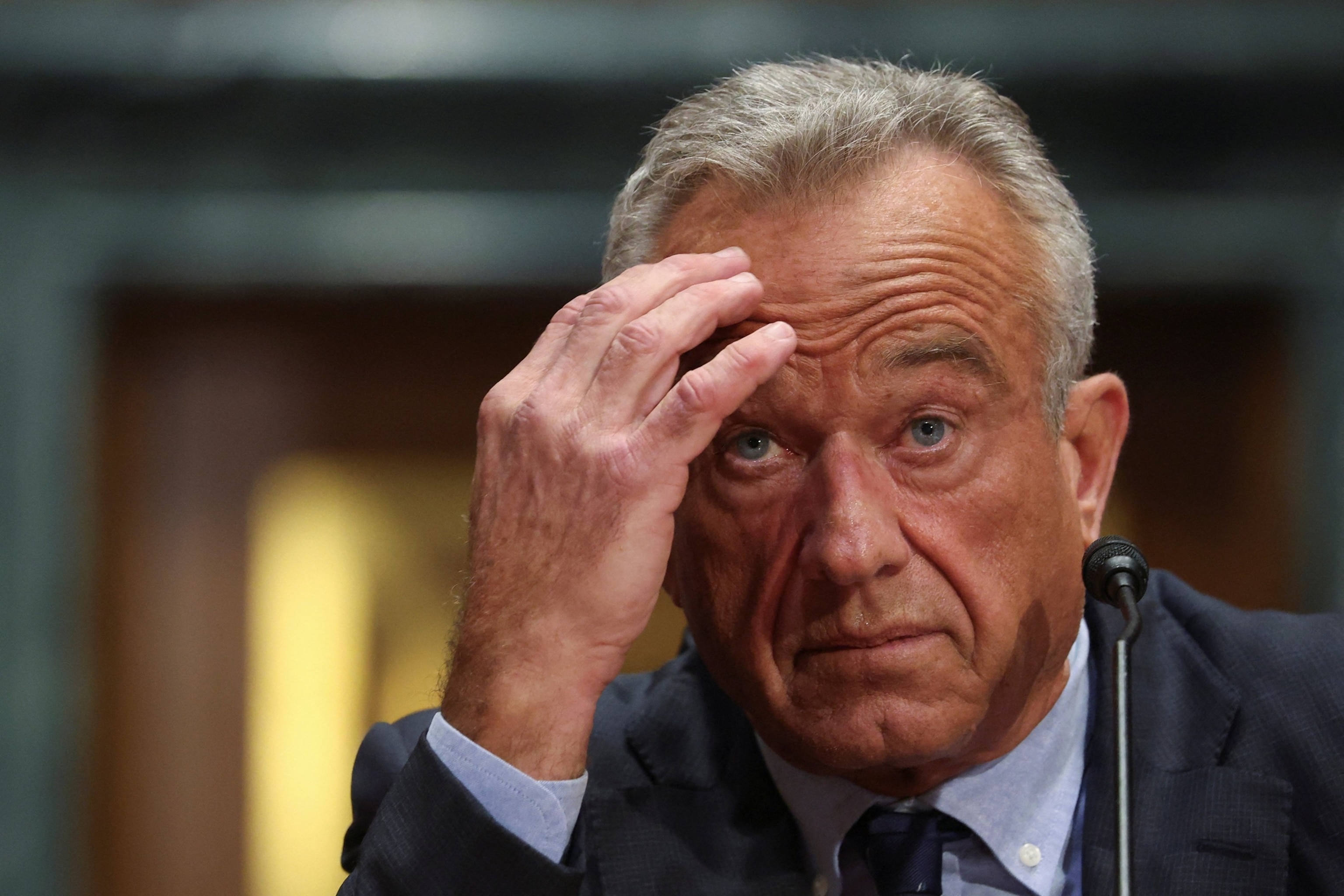
Michael Hiltzik, columnist for The Los Angeles Times, explains why Robert F. Kennedy Jr. is himself a danger to public health. Why did Trump pick him? RFK Jr. is neither a medical nor a scientific researcher. He has made his mark in public as a conspiracy theorist and a publicist for the idea that vaccines cause autism and other illnesses.

Hiltzik writes:

Americans have become woefully familiar with Health and Human Services Secretary Robert F. Kennedy Jr., the purveyor of flagrant misinformation about medical treatments. And with Robert F. Kennedy Jr., the minimizer of health crises such as the spreading measles outbreak. And with Robert F. Kennedy Jr., the antivaccine crusader.

Now let’s meet Robert F. Kennedy Jr., the promoter of a costly, time-consuming and distinctly unethical order for testing vaccines. “All new vaccines will undergo safety testing in placebo-controlled trials prior to licensure — a radical departure from past practices,” HHS announced in a May 1 statement. What it didn’t say was that the “departure” is “radical” because it’s shunned by medical authorities as a bad thing.

Just this week, Kennedy’s agency doubled down on this order with the appointment of Vinay Prasad, an oncologist at UC San Francisco, as head of the Center for Biologics Evaluation and Research, the division at the Food and Drug Administration that oversees vaccine testing.

Prasad was a strident critic of the Biden administration’s approach to the COVID-19 pandemic, including the COVID vaccines. In a blog post in late April, he called for clinical testing of COVID boosters, along the lines of Kennedy’s order. Prasad succeeds Peter Marks, a widely respected expert who resigned from the FDA in March after clashing with Kennedy.

“I was willing to work to address [Kennedy’s] concerns regarding vaccine safety and transparency,” Marks wrote in his resignation letter. “However, it has become clear that truth and transparency are not desired by the Secretary, but rather he wishes subservient confirmation of his misinformation and lies.”

The HHS announcement about Kennedy’s demand for placebo-controlled trials was unclear about how it defined “new vaccines.” But his previous claims about vaccine safety have made clear that he’s referring not only to first-generation vaccines for diseases, but also boosters and expanded formulations. That’s an important point, as I’ll cover in a moment.

The antivaccine camp, of which Kennedy has long been a leader, has pushed the claim that most childhood vaccines haven’t been adequately tested for safety because they haven’t been subjected to placebo-controlled trials — and therefore may be unsafe.

“Except for the COVID vaccine, none of the vaccines on the CDC’s childhood recommended schedule was tested against an inert placebo, meaning we know very little about the actual risk profiles of these products,” Kennedy’s spokesman at HHS, Andrew Nixon, asserted in connection with the order.

Both components of that claim are misrepresentations.

Let’s take a closer look, starting with some rudimentary points.

The testing that Kennedy and Prasad advocate are randomized control trials. They’re correct in asserting that so-called RCTs are the gold standard in clinical testing of drugs and vaccines.

RCTs typically involve at least two groups of subjects: One receives the medicine in question and another — a control group — receives something else, such as a placebo, a concoction that’s designed to resemble the medicine but is essentially inert, with no evident effect on the disease. The placebo may be an injectable saline solution, or water, or a sugar pill.

Kennedy, like other antivaxxers, is deceptive in saying that the safety of vaccines should be questioned if it hasn’t been tested against an “inert placebo.”

That brings us to the ethics of clinical testing, and why Kennedy’s policy is so dangerous.

Testing a vaccine against a true placebo is ethical and proper when it’s the first treatment for a disease for which no other safe and effective treatment exists. That’s not the case, however, when a known treatment does exist — say after a vaccine has been shown to be safe and effective and has become the standard of care.

As vaccine specialist Paul Offit of Children’s Hospital of Philadelphia has explained, subjecting new versions of those vaccines to placebo-controlled testing — giving some subjects the new vaccine and the control subjects no treatment, would be unethical, because it would require depriving the placebo group access to a known treatment. That was the conclusion of an expert panel assembled by the World Health Organization in 2014.

Offit, in a 2023 rejoinder to Kennedy’s appearance on a Joe Rogan podcast, in which he claimed that drug companies “never do placebo-controlled trials,” pointed to what may be the most famous vaccine trial to illustrate this point.
That was the nationwide trial of Jonas Salk’s polio vaccine. In 1954, 420,000 first- and second-graders were given the Salk shot, and 200,000 got a shot of salt water. Salk objected to the trial’s design. Smaller trials had established the safety and efficacy of his vaccine, so the plan meant depriving 200,000 children of immunity to a disease that was paralyzing 50,000 children a year and killing 1,500.


As Offit noted, in the full trial 16 children died from polio; all were in the placebo group. So were 34 of the 36 children paralyzed in the course of the trial. “These are the gentle heroes we leave behind,” Offit wrote.


Now let’s examine Kennedy’s order as it applies to modern vaccines. As the veteran pseudoscience debunker David Gorski has pointed out, contrary to the assertion by Kennedy’s spokesman, almost none of the vaccines on the current childhood vaccination list is a first-generation vaccine warranting placebo testing. (An exception is Gardasil, which safeguards against human papilloma virus.)

They’re upgraded preparations of vaccines that themselves underwent placebo-controlled trials, or formulations aimed at new variants of the targeted disease, or shots that inoculate against several diseases all at once.

To demand that every new formulation be tested against an inert placebo would mean turning back the clock to reproduce trials that may have taken place decades ago, but resulted in the licensing of the original vaccine after safety and efficacy were established.

That means it would have been unethical to test the new version against a saline control, because the control group would be deprived of any effective treatment. “The bottom line,” Gorski writes, “is that, if you trace back the history of the vaccines developed for a disease like, say, measles, you will eventually find the RCT testing the first effective vaccine against it and that vaccine will have had a placebo control.”
He’s right. In a tweet thread, vaccinologist Peter Hotez traced back the history of several vaccines to their initial RCTs.

What makes Kennedy’s order especially cynical is that designing and implementing a clinical trial is an extraordinarily complex, costly and time-consuming process. As a team of Canadian researchers observed in a 2018 Nature article, a full-scale Phase 3 clinical trial — the level at which drugs and vaccines are studied for safety, efficacy and dosing — requires as many as 3,000 participants and can take as long as four years.

In an online posting last month, Prasad ridiculed “the mainstream media” for being upset about the idea that COVID boosters should in effect receive full randomized clinical trials before approval. He took particular issue with an article by Helen Braswell of STAT asserting that such a requirement might well delay approval of a vaccine targeting a new COVID variant until it was too late to protect users from that variant. Prasad called the argument false because “the virus spreads year round.”

Is that so? At the height of the pandemic, new COVID variants sometimes appeared within months of one another. The virulent Delta variant, for example, appeared in the spring of 2021 and was overtaken by the Omicron variant, which also caused severe disease, that November.

Delays in rolling out vaccines to combat newly emergent disease strains and variants could cost millions of lives. Under existing vaccine approval protocols, the COVID vaccines prevented as many as 20 million deaths globally within a year after they were introduced early in 2021.

Prasad’s new job will put him in charge of developing vaccine testing policies and overseeing the design and approval of clinical trials. I asked him via email what policies he would pursue, whether he was in alignment with Kennedy’s approach, and how he expected vaccine developers to reconcile the costs and time constraints of undertaking clinical trials on the scale he advocates with the imperatives of public health. I didn’t receive a reply.

So far, the Kennedy regime at HHS has lived down to the worst expectations of his critics. His devotion to unnecessary testing of vaccines that have already shown their safety and efficacy is only one aspect of a comprehensive assault on public confidence in science-based medicine.

In a recent appearance on Sean Hannity’s Fox News program, Kennedy dismissed the severity of the current measles outbreak and denigrated the effectiveness of the measles vaccine. The current outbreak of 935 cases is by far the worst in the U.S. since 2019, when 1,274 cases were recorded; at the current rate, we are on the path to nearly 3,000 this year.

Kennedy has promoted almost useless nostrums against measles, such as vitamin A, while describing vaccination as a personal choice. That’s devastatingly wrongheaded. Kennedy confuses “medicine” and “public health.” The former concerns itself with the individual; the latter with the community. Vaccine policy belongs in the latter category because vaccines are most effective when the effort is communitywide.

Measles is among the most contagious diseases known to humankind, which means that communal vaccination is crucial. Professionals have concluded that a 95% vaccination rate is the minimum required to protect the most vulnerable, such as infants, from infection; as of 2024, the U.S. vaccination rate among kindergartners had fallen from 95.2% in 2019-20 to 92.7%.

The Centers for Disease Control and Prevention, which falls within Kennedy’s jurisdiction, says the decline in measles vaccinations leaves 280,000 kindergartners at risk. Two children in the U.S. already have died from a disease that was thought to have been eradicated in the U.S. in 2020; Kennedy doesn’t seem concerned that the toll on his watch is poised to get much worse.