Steve teaches in Polk County, Florida. He left a comment about where to find a wealth of choices: in public school. Choice advocates claim that public schools are one-size-fits-all. Nothing could be further from the truth. Charter schools and voucher schools are one-size-fits-all. They may exclude students they don’t want, for any reason. They may have a religious core that appeals to one-size. Home-schooling? You can’t get any more one-size-fits-all than learning at home. If you want indoctrination, go to a religious school; if you want education, go to a public school.

Do you want choices? Go to a public school!

Steve writes:

You want choice? Here, in the seventh largest school district in the state, you can choose AP, college-dual enrollment, Cambridge, ACCEL or International Baccalaureate for academics.

You can enter a career academy for aeronautics, health fields, architecture, criminal justice, education, culinary, graphics, CAD/CAM, engineering, legal studies, design, veterinary science, finance, biotechnology, construction. and others.

There are outstanding fine arts programs, with graduates going on to Broadway, television, and the tourism entertainment industry.

Play sports? The state lets you transfer to any school you want. You could join the state champion football team or state champion girls basketball team.

Want something hands on, such as, diesel mechanic, HVAC, auto repair, IT, or welding? Two public vo-tech high schools offer those programs.

All this choice is available in the public system.

So, the issue isn’t choice at all. This is about what vouchers have always been about since the days of massive resistance in Virginia.

Segregation?

In the late 1980s, the charter idea was brand new. AFT President Albert Shanker thought that charter schools would develop innovative ways to help the students who struggled the most in schools. He envisioned charter schools as “research and development schools” that would learn new ways of reaching the most disaffected and turned off students. He saw them as laboratories created by teachers that would first get the permission of the entire school staff at a regular public school, then get the endorsement of the local school board. In his vision, charter schools would be part of the public school system, cooperating with public schools to share whatever they learned. He also saw them as unionized schools. He imagined them getting a charter for 3-5 years, showing what they learned, then being reabsorbed into the regular public schools if they had finished their mission.

His vision did not include for-profit charter schools. He imagined collaboration between public schools and charter schools, not competition. He did not imagine charter schools run by private corporations. He did not imagine charter schools as privately managed schools run by corporations, chains, or non-educators.

When he realized that the charter idea had been corrupted by privatizers and that they had become a means of breaking teachers’ unions, he turned against charters and concluded that they were no different from vouchers. To Al Shanker, they had turned into a first step on the road to privatizing public education.

Back before the disillusionment set in, the Clinton administration authorized a federal Charter Schools Program to fund the opening of new charter schools; federal dollars were needed to jumpstart more charter schools. At its inception in 1994, the new program had a few million dollars. At the time, there were only a few hundred charter schools in the nation.

Since 1994, the federal Charter Schools Program has grown to a yearly expenditure of $440 million under the astute encouragement of the charter lobby, but between one-third and 40% of the charters funded by the federal government either never open at all or close within a couple of years. The number of failed federally funded charters has grown even larger in the past few years, as Carol Burris’s letter below documents (also see here and here.)

According to the National Alliance for Public Charter Schools, there are now nearly 8,000 charter schools in the nation, enrolling 7.5% of all public school students. (Of course, opinions are sharply divided about whether charter schools are “public” schools, since they are not overseen by elected school boards and court decisions usually rule that charters, unlike public schools, are “not state actors.”)

The time has come to ask, why is the federal government still paying to launch new charter schools? The charter sector seems to be multiplying quite well without federal aid. It is now typical for charter schools to accept not the neediest students, but the most promising ones. They drain students and resources from the public schools, which enroll nearly 90% of students. With so many deep-pocketed backers in the philanthropic sector and on Wall Stree (Walton, Gates, Bloomberg, and a never of hedge funders)t, why do new charters need federal aid?

Carol Burris, executive director of the Network for Public Education, recently wrote a letter to Secretary of Education Miguel Cardona, Deputy Secretary Cindy Marten, and Deputy Assistant Adam Schott, calling on the US. Department of Education to stop funding the federal Charter Schools Program.

I ask you, dear readers, to send a similar letter to urge the end to funding a failed federal program that is no longer necessary, if it ever was.

Here is Carol Burris’s letter:

Secretary Miguel Cardona (miguel.cardona@ed.gov)

Deputy Secretary Cindy Marten (cindy.marten@ed.gov)

Deputy Assistant Adam Schott (adam.schott@ed.gov)

Dear Secretary Cardona, Deputy Secretary Marten, and Deputy Assistant Schott:

On behalf of the 350,000 Network for Public Education members, I am writing to ask that you do not fund the Federal Charter School Programs in the FY 2024 budget. Here are the reasons why.


First, enrollment in charter schools between 2020-2021 and 2021-2022 declined by 5,323 students. That decline was identified using NCES data. The “surge” in charter enrollment was predominantly in low-quality online schools during the prior year. The need for more charter schools is not there. 


Second, a recent program audit by the Department’s Office of the Inspector General report found that of the grants issued between 2013 and 2016, only 51% of the schools promised by CSP recipients opened or expanded. 


Third, there has not been an opportunity to find out whether or not the new regulations are, in fact, being properly implemented by the State Entities and the CMOs. 


The nearly half-billion dollars saved can be used to reduce the budget deficit or, better yet, to fund our public schools.

Thank you for taking the time to read this email, for the courage to withstand the pressures to back down on the new regulations, and for all that you do for our children every day.


Carol Burris

Executive Director

The Network for Public Education

Fiona Hill and Angela Stent are experienced foreign policymakers. They published an astute analysis of Putin’s shifting reasons for invading Ukraine and of the West’s failure to explain its policy goals in Ukraine with clarity. Their article was published by the prestigious journal Foreign Policy, which usually is behind a paywall but made this article available online. I am posting the second half of the article. To read it in full, open the link.

The Kremlin is shameless in its rhetoric, and no one in Putin’s circle cares about narrative coherence. This brazenness is matched by domestic ruthlessness. Putin and his colleagues are willing to sacrifice Russian lives, not just Ukrainians’. They have no qualms about the methods Russia uses to enforce participation in the war, from murdering deserters with sledgehammers (and then releasing video footage of the killings) to assassinating recalcitrant businessmen who do not support the invasion. Putin is perfectly fine with imprisoning opposition figures while sweeping through prisons and the most impoverished Russian regions to collect people to use as cannon fodder on the frontlines.

Only 34 countries have imposed sanctions on Russia since the war started.

The domestic ruthlessness is in turn exceeded by the brutality against Ukraine. Russia has declared total war on the country and its citizens, young and old. For a year, it has deliberately shelled Ukrainian civilian infrastructure and killed people in their kitchens, bedrooms, hospitals, schools, and shops. Russian forces have tortured, raped, and pillaged in the Ukrainian regions under their control. Putin and the Kremlin still believe they can pummel the country into submission while they wait out the United States and Europe.

The Kremlin is convinced that the West will eventually grow tired of supporting Ukraine. Putin believes, for example, that there will be political changes in the West that could be advantageous for Moscow. He hopes for the return of populists to power in these states who will back away from their countries’ support for Ukraine. Putin also remains confident that he can eventually restore Russia’s prewar relationship with Europe and that Russia can and will be part of Europe’s economic, energy, political, and security structures again if he holds out long enough (as Bashar al-Assad has in the Middle East by staying in power in Syria). This is why Russia is seemingly restrained in some policy arenas. For instance, it has vested interests in working with Norway and other Arctic countries in the Norwegian archipelago of Svalbard and the Barents Sea, where Moscow has been careful to comply with international agreements and bilateral treaties. Russia does not want its misadventure in Ukraine to embroil and spoil its entire foreign policy.

Putin is convinced that he can compartmentalize Moscow’s interests because Russia is not isolated internationally, despite the West’s best efforts. Only 34 countries have imposed sanctions on Russia since the war started. Russia still has leverage in its immediate neighborhood with many of the states that were once part of the Soviet Union, even though these countries want to keep their distance from Moscow and the war. Russia continues to build ties in Africa, Asia, Latin America, and the Middle East. China, along with India and other key states in the global South, have abstained on votes in favor of Ukraine at the United Nations even as their leaders have expressed occasional consternation and displeasure with Moscow’s behavior. Trade between Russia and these countries has increased—in some cases quite dramatically—since the beginning of the conflict. Similarly, 87 countries still offer Russian citizens visa-free entry, including Argentina, Egypt, Israel, Mexico, Thailand, Turkey, and Venezuela. Russian narratives about the war have gained traction in the global South, where Putin often seems to have more influence than the West has—and certainly more than Ukraine has.

BLURRING THE LINES

One reason the West has had limited success in countering Russia’s messaging and influence operations outside Europe is that it has yet to formulate its own coherent narrative about the war—and about why the West is supporting Kyiv. American and European policymakers talk frequently of the risks of stepping over Russia’s redlines and provoking Putin, but Russia itself not only overturned the post–Cold War settlement in Europe but also stepped over the world’s post-1945 redlines when it invaded Ukraine and annexed territory, attempting to forcibly change global borders. The West failed to state this clearly after Russia’s annexation of Crimea in 2014.

The tepid political response and the limited application of sanctions after that first Russian invasion convinced Moscow that its actions were not, in fact, a serious breach of post–World War II international norms. It made the Kremlin believe it could likely go further in taking Ukrainian territory. Western debates about the need to weaken Russia, the importance of overthrowing Putin to achieve peace, whether democracies should line up against autocracies, and whether other countries must choose sides have muddied what should be a clear message: Russia has violated the territorial integrity of an independent state that has been recognized by the entire international community, including Moscow, for more than 30 years. Russia has also violated the UN Charter and fundamental principles of international law. If it were to succeed in this invasion, the sovereignty and territorial integrity of other states, be they in the West or the global South, will be imperiled.

Yet the Western debate about the war has shifted little in a year. U.S. and European views still tend to be defined by how individual commentators see the United States and its global role rather than by Russian actions. Antiwar perspectives often reflect cynicism about the United States’ motivation and deep skepticism about Ukraine’s sovereign rights rather than a clear understanding or objective assessment of Russian actions toward Ukraine and what Putin wants in the neighboring region. When Russia was recognized as the only successor state to the Soviet Union after 1991, other former Soviet republics such as Belarus and Ukraine were left in a gray zone.

Some analysts posit that Russia’s security interests trump everyone else’s because of its size and historical status. They have argued that Moscow has a right to a recognized sphere of influence, just as the Soviet Union did after 1945. Using this framing, some commentators have suggested that NATO’s post–Cold War expansion and Ukraine’s reluctance to implement the Minsk agreements—accords brokered with Moscow after it annexed Crimea in 2014 that would have limited Ukraine’s sovereignty—are the war’s casus belli. They think that Ukraine is ultimately a former Russian region that should be forced to accept the loss of its territory.

Kyiv is fighting to protect other countries.

In fact, the preoccupation of Russian leaders with bringing Ukraine back into the fold dates to the beginning of the 1990s, when Ukraine started to pull away from the Moscow-dominated Commonwealth of Independent States (a loose regional institution that had succeeded the Soviet Union). At that juncture, NATO’s enlargement was not even on the table for eastern Europe, and Ukraine’s affiliation with the European Union was an even more remote prospect. Since then, Europe has moved beyond the post-1945 concept of spheres of influence for East and West. Indeed, for most Europeans, Ukraine is clearly an independent state, one that is fighting a war for its survival after an unprovoked attack on its sovereignty and territorial integrity.

The war is about more than Ukraine. Kyiv is also fighting to protect other countries. Indeed, for states such as Finland, which was attacked by the Soviet Union in 1939 after securing its independence from the Russian empire 20 years earlier, this invasion seems like a rerun of history. (In the so-called Winter War of 1939–40, Finland fought the Soviets without external support and lost nine percent of its territory.) The Ukrainians and countries supporting them understand that if Russia were to prevail in this bloody conflict, Putin’s appetite for expansion would not stop at the Ukrainian border. The Baltic states, Finland, Poland, and many other countries that were once part of Russia’s empire could be at risk of attack or subversion. Others could see challenges to their sovereignty in the future.

Western governments need to hone this narrative to counter the Kremlin’s. They must focus on bolstering Europe’s and NATO’s resilience alongside Ukraine’s to limit Putin’s coercive power. They must step up the West’s international diplomatic efforts, including at the UN, to dissuade Putin from taking specific actions such as the use of nuclear weapons, attacks on convoys to Ukraine, continued escalation on the battlefield to seize more territory, or a renewed assault on Kyiv. The West needs to make clear that Russia’s relations with Europe will soon be irreparable. There will be no return to prior relations if Putin presses ahead. The world cannot always contain Putin, but clear communications and stronger diplomatic measures may help push him to curtail some of his aggression and eventually agree to negotiations.

The events of the last year should also steer everyone away from making big predictions. Few people outside Ukraine, for example, expected the war or believed that Russia would perform so poorly in its invasion. No one knows exactly what 2023 has in store.

That includes Putin. He appears to be in control for now, but the Kremlin could be in for a surprise. Events often unfold in a dramatic fashion. As the war in Ukraine has shown, many things don’t go according to plan.

Steve Dyer is a veteran analyst of Ohio education issues, as a former legislator and think tank budget expert. He writes here about the latest expansion of Ohio’s failed voucher program. When an independent evaluation of the Ohio voucher program was previously carried out, it concluded that kids who leave public school to use a voucher lose ground academically. The evaluation was sponsored by the Fordham Institute. Do not be fooled by the misleading summary written by Fordham staff.

In this post, he shows where the money is coming from and where it’s going:

Now that the Ohio Legislative Service Commission has officially costed out the so-called “Backpack Bill”, we know for certain that this bill has nothing to do with “rescuing” kids from “failed” public schools. It’s all about publicly subsidizing the adults who can already afford to send their kids to private school.

The LSC analysis proves definitively that the bill would instantly provide public funding to about 90,000 Ohio students who do not currently receive it. It would be through vouchers, education savings accounts, homeschoolers (including those being taught Nazi ideology) and other various devices all adding up to an additional $1.13 billion. All while the legislature is talking about massive tax cuts and continues to short-change the needs of the 90% of students in Ohio’s public schools.

These are not students who are leaving public schools. These are students who are already in private schools, whose parents can already afford private schools and who attend schools that are not audited by the state to ensure they are actually educating a single student we’re paying them to educate.

Sounds like a great idea to me! I mean, Ohio’s never had an issue with privately run schools billing the state for millions of dollars to educate kids they never actually had, right? Oh yeah, except for the ECOT scandal that was about 40% bigger than the biggest public bribery case ever brought in the state.

It would be one thing if Ohio’s private schools were doing an awesome job. However, we know that about 90% of the time, kids in Ohio’s public schools test better than students attending private schools in the same cities. We also know that the students taking vouchers are significantly more white than the communities they are from.

At this point on the post, Dyer adds the data from different counties.

This Universal Voucher bill would put an additional $1.13 billion into a program that would provide taxpayer subsidies to adults who send their kids to unaccountable schools that perform markedly worse than Ohio’s public schools all while further segregating our kids and communities by race.

Open the link to finish the post and see the data.

Columnist Thom Hartmann warns of the dangerous overreach by Congressman Jim Jordan, enabled by House Speaker Kevin McCarthy. Jordan and other House radicals intend to spend the next two years investigating government employees, in hopes of discrediting the Biden administration and critics of Traitor Trump.

He writes:

This column could get me thrown in jail.

And the fact that I’m even thinking that way is the entire point of Jim Jordan’s new Select Subcommittee on the Weaponization of the Federal Government, a subcommittee of the Judiciary Committee which Jordan chairs.

This is the same Congressman Jordan who voted to overthrow democracy and make Trump America’s first dictator on January 7th, 2001, who finally admitted he talked with Trump several times during the insurrection, and then defied the January 6th Committee’s request to tell them and America what Trump was doing on that fateful day.

He and his fellow fascist seditionists want Americans to be afraid of them, particularly Americans who may be in a position to identify their crimes and hold them to account.

Frankly, I’d be pretty low on their list. Just like the notorious Republican Senator Joe McCarthy back in the 1950s, Jordan and his buddies appear focused on using their power to intimidate those who have actual legal power. Like the FBI, IRS, regulators, and elected officials.

But it would be foolhardy to think they won’t go after members of the press. Or whatever they’re calling people like me these days: “fake news,” “lamestream media,” or the Lügenpresse in the original German.

The Committee will have the power to pry-bar their way into ongoing investigations, terrorizing agencies and government employees looking into Republican participation in the attempted coup of January 6th and the weeks around it.

They’ve even acquired, in yesterday’s vote, the power to access and use top-secret information normally reserved to the highly-vetted members of the House Permanent Select Committee on Intelligence.

Sources and methods. How the FBI knows which seditionist Members of Congress were involved in giving tours or conspiring with Proud Boys. Secrets Putin or the Saudi’s would pay billions for, as they apparently already have with Jared Kushner and Donald Trump.

As congressman Ruben Gallego said yesterday, it’s “as if we gave the mafia the right to investigate the Southern District of New York attorney’s office.”

Congressman Adam Schiff calls it The Coverup Committee. He’s right, but it’s worse than just that.

They’ve proclaimed their desire to intimidate the FBI, the Capitol Police, America’s spy agencies, and any politician who might show the temerity to suggest traitors should be held accountable for their treason.

We’ve seen this movie before, complete with the bombast, threats, lies, and bullying. And it tells us a lot about what we can expect over the next two years.

On February 9, 1950, an obscure first-term Senator who’d lied about his military service to get elected, Joe McCarthy, gave the first speech of a 5-city tour before a Republican women’s group in Wheeling, West Virginia. Apparently wanting to stir up some buzz, he pulled a random piece of paper from his pocket, waved it theatrically, and claimed it was a list of “205 known communists” who worked at the State Department.

Americans were worried about communists then, with some justification. The “communist miracle” was widely acknowledged under Stalin as just another form of brutal anti-democratic tyranny. Stalin had starved four million Ukrainians to death in what was known as the Holdomor, while he was imprisoning his own citizens in brutal gulags. The Soviet Union had exploded their first nuclear weapon just six months earlier, and that June North Korea, with help from the USSR, would invade South Korea.

By the end of McCarthy’s tour that month, reaching Salt Lake City, he’d reduced his claim to 57 communists in the State Department; in other cities he’d claimed the number was 81. It’s entirely possible he simply couldn’t keep track of his own lies.

In any case, no such list existed. Right up to the day he drank himself to death, May 9, 1957, McCarthy never was able to name a single communist in the State Department. But his demagogic claim got him on the front pages of newspapers across America.

McCarthy and his right-hand man Roy Cohn (later Donald Trump’s mentor) terrorized people working in the US government.

Being dragged before his Permanent Subcommittee on Investigations was a career-ender: over 2000 government employees lost their jobs because of his baseless accusations and innuendo.

In 1950, The Progressive magazine called McCarthy:

“[A]n ambitious faker living by his wits and guts, a ruthless egotist bent on personal power regardless of the consequence to his country, a shrewd and slippery operator with the gambler’s gift for knowing when and how to bluff.”

Even average Americans trembled before McCarthy, who was stepping into the anti-communist game late.

Three years earlier the “Hollywood Ten” (Alvah Bessie, Herbert Biberman, Lester Cole, Edward Dmytryk, Ring Lardner, Jr., John Howard Lawson, Albert Maltz, Samuel Ornitz, Adrian Scott, and Dalton Trumbo)— none of them particularly rich or famous — had all been sent to prison for a year for refusing to acknowledge subpoenas and submit to public interrogation by McCarthy’s peers on the House Un-American Activities Committee (HUAC).

Their crime? Most were writers and one, Ring Lardner Jr., had written an op-ed very much like this one in which he noted:

“One of the first acts of the Republicans who took control of Congress in 1946 (for the first time in 20 years) was to convert a temporary committee [HUAC], which had been investigating fascist sympathizers during the war, into a permanent [committee] concentrating on the … left…”

Off he went to prison.

And now, today, Jim Jordan and his colleagues have that same power of subpoena that was so bluntly wielded by McCarthy and his Republican collaborators when I was a kid.

We’ve been hearing about changes that the Republicans are making here and there in Congress since they’ve seized power, but now the full picture is coming into focus. I worried and warned about this two years ago in my book The Hidden History of American Oligarchy.

For example, back in April of 2009 the FBI/DHS issued a report titled: “Rightwing Extremism: Current Economic and Political Climate Fueling Resurgence in Radicalization and Recruitment.” It had been prepared during the presidency of George W. Bush, but Obama was now president when it was released and the reaction from the right was immediate.

John Boehner said the report was “offensive and unacceptable” and was particularly outraged that it used the word “terrorist” to, in Boehner’s words, “describe American citizens who disagree with the direction Washington Democrats are taking our nation.”

That mild response caused Obama to essentially pull the report.

But imagine if such a report were issued today by the FBI. Jordan’s new committee could call before it — as McCarthy did in the 1950s — the actual government employees who’d done the research and written it.

Their careers would be destroyed, their homes and families under constant death threat, their lives turned upside down.

It would be a long time before any other federal employee would dare expose terrorism on the American right.

This is how fascists behave. It’s how they’ve behaved throughout history. It’s how they get what they want.

Unless you confront them with overwhelming resistance, you can’t negotiate with them; they keep taking more and more right up to the point of using violence.

I hope I’m wrong, but everything I’m seeing tells me this is exactly the direction Republicans in the House are moving.

We’ve entered the new McCarthy era, and Kevin is doing everything he can to empower Jordan as the new Joe.

Only this time the goal isn’t just feeding the ego of an alcoholic narcissist: it’s to end democracy in the United States.

The GOP is always in search of slogans that rile up their angry base and distract them from the fact that the Republicans have no new ideas or policies to improve anyone’s life, other than tax cuts for the 1%.

Thus, the GOP wants to ban “critical race theory” in the schools, even though it is taught as a graduate course in some law schools, not K-12. They want to ban books about race and gender. Their current slogan is “parental rights,” which means that parents must approve what is taught. “Parental rights” is an insanely slippery slope because parents do not agree. Some white parents want to ban Black history, but other parents—Black and white—don’t. Which parents get to control the curriculum?

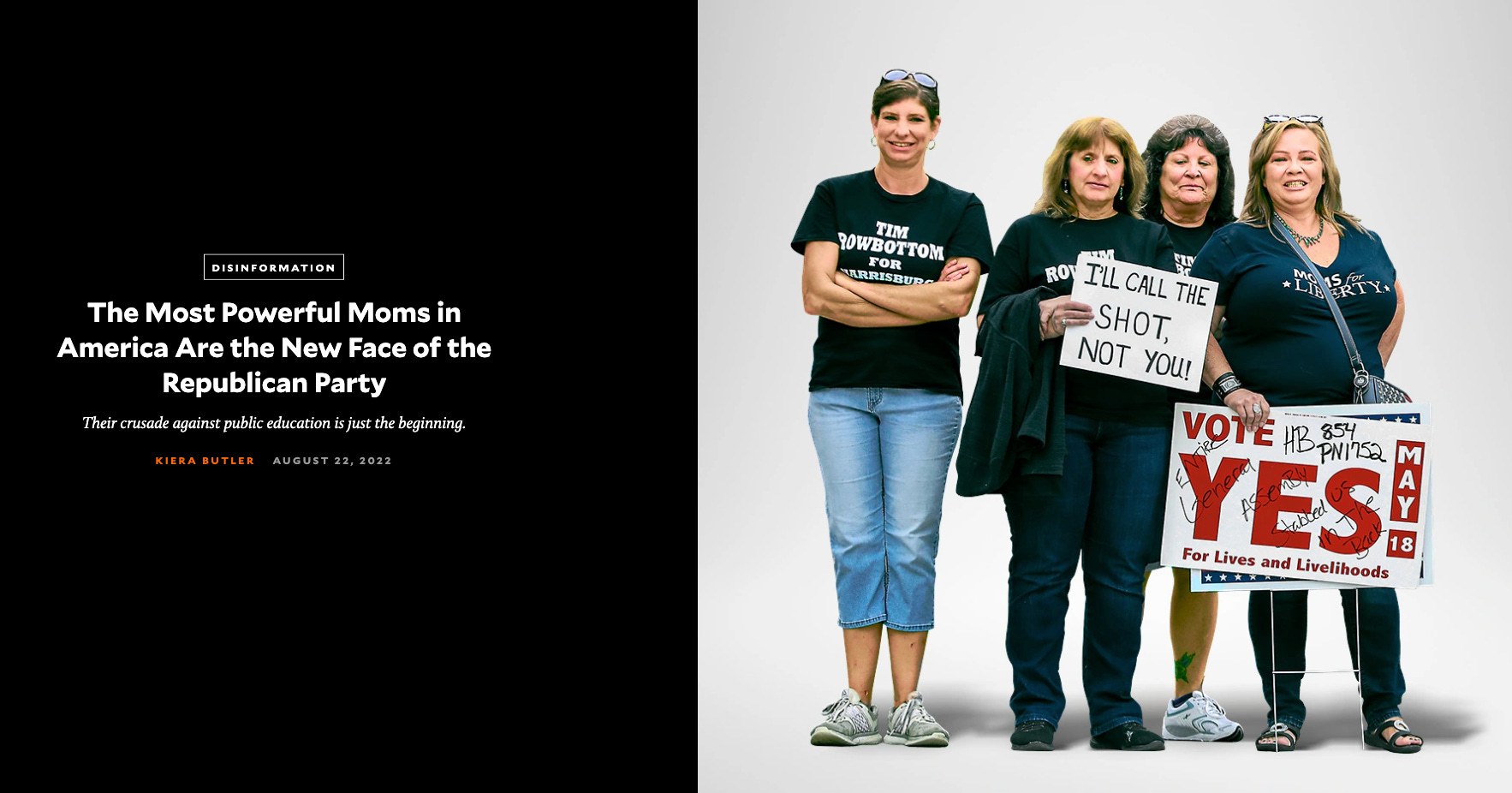
The Miami Herald editorial board published an editorial criticizing the far-right extremists of “Moms for Liberty,” who have seized on the issue of “parental rights.”

The Miami Herald editorial board says that “parental rights” is not about “true education. It’s another shot fired in Florida’s culture wars.” This effort to replace the professional judgment of teachers with the grievances of rightwing extremists explains why the state of Florida has thousands of vacancies in teaching.

Perhaps there’s no more potent political strategy — and misnomer — than the appropriation by conservatives of the term “parental rights.”

Gov. DeSantis has announced he is targeting more than a dozen school board members in next year’s elections, including Miami-Dade County’s Luisa Santos, who’s considered liberal. The Republican vision for school boards is “pro-parent” and “pro-kids,” in the words of Republican Party of Florida Chair Christian Ziegler, the Herald reported.

Their narrative goes that to be “pro-parent” you must not want your children exposed to topics like “critical race theory,” or you only support a whitewashed version of this country’s history of racism. Being pro-kid means you don’t want them to learn that there are men who date men, women who date women and people who don’t identify with the gender assigned to them at birth. It means you want school libraries sanitized from content that might offend your sensibilities.

It means that there’s one way to look at America and education and anyone with a different opinion be damned, called names like leftist, communist, anti-American.

It’s as if only groups like Moms for Liberty represent what parents want. The group seems more preoccupied with banning books than concerned that too many kids in our schools cannot read at grade level. The leader of its Miami chapter once called the protests after the death of George Floyd at the hands of police “race wars” and repeated QAnon conspiracy theories on Instagram, Politico reported.

To be a parent, under this definition, means to be a conservative in the most extreme sense of the word. So much for the parents who want teachers to speak freely in the classroom. And what about Black parents who want their children’s life experiences to be reflected in school material and who worry their children will suffer from Florida’s attack on how educators can discuss race? They, too, have a right to recourse when their public schools fail to follow a state mandate that Black history be taught. The Herald reported this month that only 11 of Florida’s 67 school districts have developed a plan for teaching African-American studies, and that DeSantis and the Legislature have in the past rejected requests for more resources.

Very little is said about these parents in the so-called parental-rights movement. But, oh, watch out for teachers and librarians indoctrinating our children!

It’s undeniable that there are many parents who agree with DeSantis, who won reelection in November by a margin unheard of in Florida. Without a doubt, the momentum turned in favor of conservatives after parents of all political stripes became frustrated with school closures and mask mandates during the pandemic. If hindsight is 20-20, closing schools did do some damage, as evidenced by declining student achievement across the country. That has turned the assumption that school officials know best how to educate students on its head. Still, closing schools also likely saved many lives, which should count for something.

However, what should have led to a healthy debate on parental participation in education, unfortunately, has been co-opted by culture wars.

Politics 101 says that anger and frustration are the best motivators. People don’t usually organize to keep things as they are. There’s no organized movement to counter or redefine what parental rights mean. Where are the “Moms for the Truth” or “Dads for the Proper Teaching of History?”

The groups that do exist are getting overshadowed by groups like Moms for Liberty, which DeSantis and the media have propped up as the only valid version of parental dissatisfaction with public education.

DeSantis and the Republican Party aren’t hiding their agenda to transform school boards from local nonpartisan bodies into an arm of partisan politics. Opposition has all but been neutered as the Democratic Party has pretty much given up on Florida.

Without a clear opposing point of view on what parental rights means, the loudest voices will dominate. Soon, local control over K-12 will be replaced with a top-to-bottom remake of education that serves only one type of parent and one — blindered — way of thinking.

I watched the latest episode of the award-winning “Abbott Elementary” show a few days ago and was pleased to see that the show depicted the predatory nature of many urban charters, as well as their super-powerful rich funders.

The teachers at Abbott, a local public school, heard the rumor that the local charter chain wants to take over their school. They are alarmed. They have heard that the teachers are forced to teach scripted lessons. They know that the charter won’t acccept all the neighborhood children. A mother shows up and asks if Abbott will take her son Josh back: he was ejected by the local charter school, Addington, for not having the right stuff. The teachers say, “That means that his test scores were not high enough for the charter.”

The principal, probably the least qualified educator at Abbott, says that turning charter will mean that the school will be renovated and get more resources. What’s wrong with that? She does not realize that if the school goes charter, she will be the first one fired.

The Philadelphia Inquirer wondered if the popular TV show was taking a swipe at Jeffrey Yass, who has donated millions to charter schools. Yass, an investor, is worth $33 billlion, according to the Bloomberg Billionaires Index.

Abbott Elementary, the ABC comedy about a fictional Philadelphia public school, took what sounded like a shot at Pennsylvania’s richest man in last week’s episode while knocking charter school backers.

At least one Jeff Yass fan is not laughing.

» READ MORE: Who is Jeff Yass, Pennsylvania’s billionaire investor and political funder?

In the episode, teachers worry a charter school operator might take over their school.

“They take our funding, not to mention the private money from wealthy donors with ulterior motives,” said Sheryl Lee Ralph, who plays teacher Barbara Howard, (and is married to State Sen. Vincent Hughes.)

Yass, a Main Line billionaire investor, has spent millions to support charter schools and political action committees that push for the election of candidates who share his goals.

Jeanne Allen, founder of the Center for Education Reform and director of The Yass Foundation for Education, was not amused when folks on Twitter linked that line to Yass.

She tweeted: “It’s pathetic when fewer than 20% of Philadelphia students can even read, write or spell at grade level that there’s a show on television that has the nerve to criticize the schools that succeed, and the people that help them. This has TEACHERS UNION written all over it.”

Actually, 36% of the city’s students scored proficient or advanced on the state standardized English language arts exam in the latest results available. That’s not great. But its certainly not “fewer than 20%.”

Allen, in an email to Clout, called the line a “gratuitous slap against people with wealth” and complained that this was not the first “hollow, evidence-lacking shot at charter schools.”

She also said she has not watched the episode and does not plan to.

Quinta Brunson created Abbott Elementary, inspired by her mom, a kindergarten teacher, and her experiences in a West Philly public school. An instant sensation, the award-winning show is in its second season, with a third planned.

“Abbott Elementary” is a delightful, lighthearted show about life in a typical urban elementary school. I recommend it. It’s a shame that Jeanne Allen refuses to watch it. Undoubtedly she would hate it because it shows a public school in a positive light, where teachers deal with their personal and professional problems and where students are lively and engaged.

It’s not surprising that she hates it because it undermines her core message that all public schools are failing. The fact that she misrepresented the city’s test scores is also not surprising. The Inquirer felt it necessary to correct her.

The fact is that a 36% proficiency rate is impressive for a city with high poverty rates. As I have said again and again, “proficiency” on the NAEP tests does not mean “grade level” or “average.” It means mastery of the material. It is equivalent to an A.

As for Jeffrey Yass, Jeanne Allen has good reason to jump to his defense. She administers the “Yass Prize” for charter school excellence, which awards millions to successful charter schools. Earlier this year, one of the the Yass Prizes was awarded to a charter school with a 100% college acceptance rate but abysmal test scores. A large number of colleges accept every applicant. Poor vetting by Jeanne Allen’s Center for Education Reform.

This is Wikipedia on Jeff Yass’s political contributions, which are tilted far-right:

Yass became a member of the board of directors of the libertarian Cato Institute in 2002[12][13] and now is a member of the executive advisory council.[14] In 2015, Yass donated $2.3 million to a Super PAC supporting Rand Paul‘s presidential candidacy.[15] In 2018 he donated $3.8m to the Club for Growth, and $20.7m in 2020.[16]

Yass and his wife, Janine Coslett, are public supporters of school choice, with Coslett writing a 2017 opinion piece for the Washington Examiner in support of then-incoming Secretary of Education Betsy DeVos‘s views at school choice.[17]

In November 2020, it was reported that Yass had donated $25.3 million, all to Republican candidates, and was one of the ten largest political donors in the US.[1]

In March 2021, an investigation in Haaretz said that Jeff Yass and Arthur Dantchik were behind a large portion of the donations to the Kohelet Policy Forum in Israel.[18][19]

In November 2021, he donated $5 million to the School Freedom Fund, a PAC that runs ads for Republican candidates running in the 2022 election cycle nationwide.[20]

In June 2022 Propublica claims Yass has “avoided $1 billion in taxes” and “pouring his money into campaigns to cut taxes and support election deniers”.[21]

When will Democrats wake up to the fact that charters and vouchers are the tools of the Destroy Public Educatuon movement?

Allen is right to avoid seeing Abbott Elementary. It is definitely off-message for the charter lobby, which insists that public schools are of necessity “failing schools.”

Ruth Ben-Ghiat is a historian of fascism and Italian Studies at New York University. The following appeared on her blog. Lucid.

“In 2016, I declared, I am your voice. Today, I add, I am your warrior, I am your justice, and for those who have been wronged and betrayed, I am your retribution.” Anyone who wants to understand how Fascist models of leadership can find expression in our own time need only read this passage from former president Donald Trump’s speech at the recent Conservative Political Action Committee meeting held in Maryland.

Trump’s CPAC speech brings forth a century of rhetoric and agendas that have been used to destroy democracy, conjuring threats that are meant to build support for authoritarian action and leadership, starting with the idea of the head of state as a vengeful victim.

“What did Italy need? An avenger!… It was necessary to cauterize the virulent wounds…and eliminate evils which threatened to become chronic,” Fascist leader Benito Mussolini wrote in his autobiography, striking a similar note to Trump as he explained why he had declared dictatorship in 1925.

Ever since Il Duce came to power a century ago, strongman leaders have proclaimed their unique ability to lead their people to greatness, including by righting the wrongs internal and external enemies supposedly perpetrate against the nation. In the process, the strongman absorbs the blows delivered by those enemies, putting his well-being at risk as he battles to save the nation and protect all that is cherished and dear.

The focus on victimhood sets up any repressive action by the state as self-defense. It justifies the literal weaponization of government, with violence used against enemies “for the good of the nation.” The “public safety laws” that jailed leftists and transformed Italy into a police state in the 1920s upheld this fiction.

And Nazi policies did not just make good on Adolf Hitler’s vows to punish elites who had “stabbed Germany in the back” by accepting the draconian terms of the Versailles Treaty (which held Germany responsible for all moral and material damages incurred during World War One). They also targeted groups that Hitler identified as threats to Germany’s survival in the future. These included Jews (“black parasites of the nation”); Bolsheviks (the “scum of humanity”); and war profiteers and international capitalists— the forerunners of the “globalists” Trump regularly denounces, including in this CPAC speech.

When such leaders feel their power is threatened, or are staging a comeback after having been voted out of office, they focus on gaining control of public institutions to exact revenge. This is one meaning of Trump’s declaration that “we’re going to finish what we started.” If he returns to the White House, he will punish all who did not collaborate with his attempt to overthrow the government.

Trump’s well-honed victimhood persona is the star of the CPAC speech, and he invokes a dizzying array of enemies who want to “kill America” and do him in as well. “A sick and sinister opposition, the radical left, communists, the bureaucrats, the fake news media, the big special interests,” as well as “Antifa thugs,” and “corrupt intelligence agencies.”

Fascist leaders pose as pure souls who risk everything to defend the nation. Trump followed suit at CPAC by presenting himself as an innocent and honest man who had never tangled with the law before “corrupt Democratic prosecutors” funded by “the George Soros money machine” sought to stop his “an epic struggle to rescue our country.”

“I had a beautiful life before I did this…”I didn’t know the word subpoena, I didn’t know the word grand jury. I didn’t know that they want to lynch you for doing nothing wrong.” Luckily for his followers, Trump is tenacious. “We’re going to complete the mission, we’re going to see this battle through to ultimate victory. we’re going to make America great again.”

But why stop at America? The true Fascist avenger fixes the world. “I will have the disastrous war between Russia and Ukraine settled. It will be settled quickly. I will get the problem solved. I will get it solved in rapid order—it will take me no longer than one day. I know what to say to each of them. I got along well with all of them. I got along well with Putin.”

In fact, as Trump remarks, had he been in office now, as fearsome and powerful as a mountain, “Russia would have never pulled the trigger. This is the most dangerous time in the history of our country and Joe Biden is leading us into oblivion…Biden is a criminal and nothing ever seems to happen to him.”

With this incitement to violence against a sitting president, Trump’s CPAC speech reaches its peak. Trump offers Americans no policy ideas, but rather a classic Fascist cocktail of negative emotions, satisfying promises of revenge, and a sense of heroism and power.

Like Mussolini and Hitler before him, Trump knows that the strongman must be everything to his people. His devoted followers must be so bonded to him that no other leader is possible in their minds. Only he can save them. “I am your warrior, I am your justice, and for those who have been wronged and betrayed, I am your retribution.”

References:

Benito Mussolini, My Autobiography (New York: Charles Scribner’s Sons, 1928), 205. Adolf Hitler, speech in Salzburg, August 1920, in Neil Gregor, “Hitler,” in Mental Maps in the Era of Two World Wars, eds. Steven Casey and Jonathan Wright (New York: Palgrave Macmillan, 2008), 189; Hitler, “Rathenau und Sancho Pansa,” Völkischer Beobachter, March 13, 1921.

The first charter school opened in 1991. Since then, charters have expanded exponentially. There are now more than 7,000 of them. Originally, charters had bipartisan support.

Bill Clinton loved the charter idea and created the federal Charter Schools Program to fund new charter schools, a modest expenditure of $6 million a year (that has since ballooned into $440 million a year, most of which has gone to grow big, wealthy charter chains).

President Barack Obama also loved charter schools , as did his Secretary of Education Arne Duncan. When Congress pumped hundreds of billions of dollars into the economy to stave off an economic collapse in 2009, it allocated $100 for schools. $95 billion went to public schools. $5 billion was set aside for the U.S. Department of Education to use as it wished for “education reform.”

Secretary Duncan, aided by helpers from the Gates Foundation and the Broad Foundation, launched a competition among the states to win a share of $4.35 billion. But the states’ eligibility to participate in Race to the Top depended on their complying with certain demands: the states had to agree to open more charter schools, to evaluate their teachers by the test scores of their students, to restructure or close schools with low test scores, to adopt national standards (I.e., the Common Core, not yet finished, never tested).

Race to the Top gave a huge boost to charter schools.

But reality intruded. Large numbers of new charters opened. Large numbers of charters closed, replaced soon by others. Charter scandals proliferated. Get-rich-quick entrepreneurs opened charter schools; grifters opened charter schools. Some charter leaders paid themselves more than big-city superintendents. Highly successful (I.e. high test scores) charters carefully curated their students, rejecting or removing those who had low scores, excluding students with disabilities.

The charter sector began to act like an industry, with its own lobbyists in D.C. and in state capitols. Sometimes the charter lobbyists wrote state legislation to assure that there was little or no accountability or oversight or transparency Fort the public funds they received.

Of course, the charter lobby maintained a strong public relations presence, booking appearances for their paid spokespeople on national TV and in the press. When state legislatures met to vote in the budget, the charters hired buses to bring thousands of students and parents to demand more money and more charters. They were coached to use the right words about the success of charters.

Since charters have been around for more than 30 years, the research on them is consistent. Their test scores, on average, are about the same as regular schools, even though they have much more flexibility. Some get high scores (typically the ones with high attrition rates who got rid of the students they didn’t want), some got very low scores. Most were in the middle. The Cybercharters were the worst by every measure: low graduation rates, poor academics, high teacher turnover, expensive for the low quality but very profitable.

Were they innovative? No. Those considered “successful” operated with 19th century modes of strict discipline. Some substituted computers for teachers.

Charters fell under a cloud when Donald Trump became President and sooointed choice zealot Betsy DeVos to be Secretary of Education. She plugged vouchers and charters and choice. Most Democrats in Congress began to open their eyes and understand that charters were a prelude to vouchers. DeVos’s strident advocacy for charters made most Democrats remember their party’s historic legacy as a champion of public schools, real public schools , not privately managed schools that were Public in Name Only.

So, where stands the charter idea now? Charters are admired and thriving (at least financially, if not academically) in red states. Most Democrats understand that the preservation and improvement of public schools is central to the party’s identity.

A reader of the blog came up with a sensible redefinition of the mission of charter schools. Since they have the freedom to try out new ideas, they should serve the neediest children. They should do whatever it takes—not to raise their test scores—but to educate the children who have struggled in regular schools. Let the charters innovate—their original mission—free of the burden of being labeled “failing” or “low performing.” Let them work their magic for the children who need it most, not for the high achievers who would succeed in any school.

Greg R. Flick, a reader of the blog and himself a blogger (“What’s Gneiss for Education”)) sent this perceptive comment about what charters should do to be truly useful to American education and to provide an exemplary service:

It seems that if we believe the narrative the charters push, we should flip the system on its ear. Let the charters be the default schools for the kids who can’t function in the public schools. Let’s have the public schools be able to cream their student populations, select only the students they want to have…the “easier” students, and have the charters be required to take those kids kicked out of the public schools.

Charters with their smaller classes and “freedom” to innovate will finally be able to help those kinds of kids. And since they are public schools (as they keep on telling us repeatedly) they can’t gripe about taking in the hard nuts, the Special ed kids, the ones with behavioral issues, etc.

The Rev. Dr. Robin Meyers writes in the Oklahoma Gazette about the state superintendent Ryan Walters, who is intent on playing the role of Ron DeSantis and indoctrinating the children of Oklahoma in his own narrow-minded views. Dr. Meyers refers to Ryan Walters as “the Tucker Carlson of education.”

This is a brilliant article. Open the link and read it in full.

Dr. Meyers writes:

Oklahoma’s new state schools superintendent is about to take a desperate situation and make it awful.

His plans for stamping out “wokeness,” critical race theory, and boys using the girl’s bathrooms sounds nothing like a plan to advance education, and more like a platform to become Ron DeSantis Jr. The irony of this culture war approach to education is transparently hypocritical. Walters claims to be all “for academics and against indoctrination,” while making it clear that he alone will decide who gets hired, who gets raises and what gets taught in our schools. That is the very definition of indoctrination.

Beware the zealot who is going to save you from something that may or may not exist and intends to burn down your house to do it. Beware the fearmonger who incites the masses to muzzle free and open discourse about dangerous ideas so that he can make duplicate zealots for even worse ideas. Beware the evangelist who rails against other people’s sins while lining his pocket from two jobs at taxpayers’ expense while vowing to cut wasteful government spending. Ryan Walters makes more than the governor.

Oklahoma is in a death-spiral when it comes to public education but the problem is not “woke” Santas and drag queens. It is an unlivable wage for one of society’s most important jobs with working conditions so abysmal, even dangerous, that teachers are burned out and leaving the profession in droves. Many are moving to Texas where they can earn far more, proving that we have lost the only Red River showdown that truly matters.

Walters’ answer is to impose a hiring and spending freeze, a decision “he alone” can make to fix it (just as Donald Trump put it), and then “he alone” will review every personnel and budget move so that “we” will hire folks who are in lockstep with his goals for our kids. Walters was a teacher, but he needs to review Venn diagrams, where “he” and “we” do not overlap.

In his attack on critical race theory, he has the audacity to quote Martin Luther King Jr.’s dream of living in a time when his four little children would not be judged by the color of their skin but by the content of their character (Walter’s campaign version of the quote is backwards, but hey, even teachers make mistakes).

“Unfortunately,” he continues, “a philosophy that teaches the opposite of this principle is ‘infecting’ our classrooms, and we need to put a stop to it.” CRT, he says, “is a dangerous and racist philosophy, and all it does is divide and characterize entire groups of people solely based on the color of their skin.”

If Walters said this in a classroom, one would hope that some very bright student might raise her hand to point out that characterizing entire groups of people based solely on the color of their skin was the norm before CRT. It is what King was fighting against and gave his life for. What sort of dream world is Walters living in? Or is that letting the whole Fox News crowd off too easily? They know exactly what they are doing.

They pretend that there is no separation of church and state because we were founded as a “Christian nation.” So, taxpayers of any religious persuasion, or no religious persuasion, can be forced to support white, wealthy, private Christian schools, while black and brown children can be warehoused in what’s left of the public schools. Then we can lie to them by pretending that America’s original sin is not systemic racism, but elite universities. We can’t assign books like Killers of the Flower Moon about the atrocities committed by white settlers against the Osage so they could steal their oil. That might make somebody “feel bad.”

Good teachers are what every kid deserves, says Walters, so let’s do merit pay based on student performance. This will guarantee that if you teach in a poor, underperforming school you will never get a raise, but if you teach in Deer Creek, you will end up making a six-figure salary. That will teach even the most idealistic among us to ignore the words of Jesus about helping “the last and the least of these.”

Walters is 100 percent pro-life of course, protecting who he calls “our most vulnerable.” But after they leave the womb, heaven help them if they are not straight white Christians. Their last, best hope to climb out of poverty would be a great public school education or a great teacher and mentor. Meanwhile, there is a mass-exodus of our best teachers, and it is about to accelerate.

As for diversity, equity, and inclusion, we will end up graduating students who don’t even know what those words mean or why they matter. As for the Second Amendment, Walters quotes the corrupt and disgraced NRA, saying that the only thing that can stop a bad guy with a gun is a good guy with a gun. This after more than one mass shooting a day since Jan. 1. Truth be known, what stops a good student with a good mind is a bad teacher with an emergency certification….

Than you, Dr. Meyers. You nailed it.

The Rev. Dr. Robin Meyers is pastor of First Congregational Church UCC in Norman and retired senior minister of Mayflower Congregational UCC in Oklahoma City. He is currently Professor of Public Speaking, and Distinguished Professor of Social Justice Emeritus in the Philosophy Department at Oklahoma City University, and the author of eight books on religion and American culture, the most recent of which is, Saving God from Religion: A Minister’s Search for Faith in a Skeptical Age. Visit robinmeyers.com

If you open the link, you will see other recent articles by The Rev. Dr. Meyers.