Archives for category: Standardized Testing

I was interviewed by Brian Lehrer of WNYC, public radio about my latest book, probably my last. He is a great interviewer. He asks good questions, followed by people who called in to disagree with me.

It’s an excellent interview.

I apologize if I’m browbeating you with stuff about my book, but the book is really good; I worked on it for two years; the mainstream media has ignored it; and I think you will enjoy reading it.

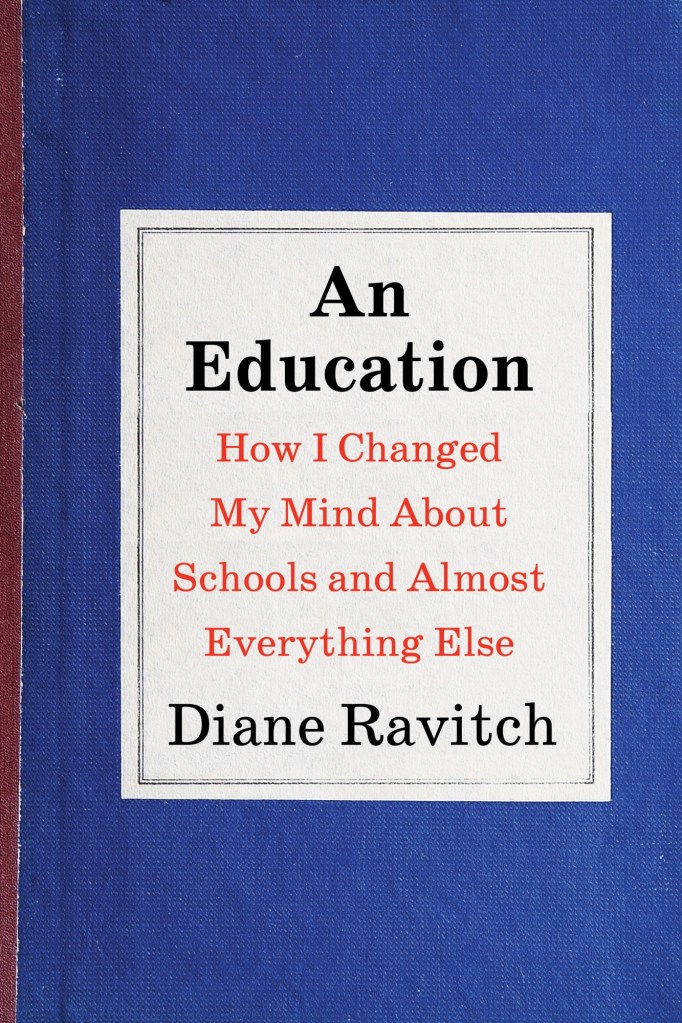
In case you haven’t noticed, the title is:

An Education: How I Changed My Mind About Schools And Almost Everything Else (Columbia University Press). You can buy it from Columbia University Press, your local independent bookstore, or Amazon.

The New York Times Sunday Magazine published an article titled “America’s Children Are Unwell. Are Schools Part of the Problem?” It was written by staff member Jia Lynn Yang.

I anticipated that the article would be another lament about test scores, of which there have been many recently. But it wasn’t!

Instead, Yang described the explosion of mental health issues among the nation’s children. And she attributed it largely to the unending pressure to compete for ever higher test scores. EXACTLY!

Yang knows that the changes in school are not the only cause of declining mental health. There are many more culprits, including social media and the pressures of contemporary life. And there is also the possibility that children are being misdiagnosed and overdiagnosed. I can’t help but recall a story from 1994 about an elite private school that received a private $2 million grant to screen children for learning disabilities. Overrun by experts, the program “got out of hand.” Nearly half the children were diagnosed with disabilities, and the program was cancelled.

We live in a stressful world. Children are pressured to succeed, to comply, to compete, to win the approval of their peers, to dress the “right” way, to be and do things by which they will be judged by their peers, by their parents, by the world they inhabit. Some children succeed, many don’t.

Schools these days are doing things to children that add to their stress. They have been doing harmful things to children by federal mandate since 2002.

Besieged by expectations, demands, and pressures, many children are breaking. It’s our fault.

She writes:

One of the more bewildering aspects of the already high-stress endeavor of 21st-century American parenting is that at some point your child is likely to be identified with a psychiatric diagnosis of one kind or another. Many exist in a gray zone that previous generations of parents never encountered.

A diagnosis of attention deficit hyperactivity disorder is practically a rite of passage in American boyhood, with nearly one in four 17-year-old boys bearing the diagnosis. The numbers have only gone up, and vertiginously: One million more children were diagnosed with A.D.H.D. in 2022 than in 2016.

The numbers on autism are so shocking that they are worth repeating. In the early 1980s, one in 2,500 children had an autism diagnosis. That figure is now one in 31.

Nearly 32 percent of adolescents have been diagnosed at some point with anxiety; the median age of “onset” is 6 years old. More than one in 10 adolescents have experienced a major depressive disorder, according to some estimates. New categories materialize. There is now oppositional defiant disorder, in addition to pathological demand avoidance…

The experience of school has changed rapidly in recent generations. Starting in the 1980s, a metrics-obsessed regime took over American education and profoundly altered the expectations placed on children, up and down the class ladder. In fact, it has altered the experience of childhood itself.

This era of policymaking has largely ebbed, with disappointing results. Math and reading levels are at their lowest in decades. The rules put in place by both political parties were well-meaning, but in trying to make more children successful, they also circumscribed more tightly who could be served by school at all.

“What’s happening is, instead of saying, ‘We need to fix the schools,’ the message is, ‘We need to fix the kids,’” said Peter Gray, a research professor at Boston College and the author of “Free to Learn: Why Unleashing the Instinct to Play Will Make Our Children Happier, More Self-Reliant, and Better Students for Life….”

Other books have echoed this critique. I think offhand of the book by Pasi Sahlberg and William Doyle: Let the Children Play: How More Play Will Save Our Schools and Help Children Thrive. This is how they summarize their argument:

“Play is how children explore, discover, fail, succeed, socialize, and flourish. It is a fundamental element of the human condition. It’s the key to giving schoolchildren skills they need to succeed–skills like creativity, innovation, teamwork, focus, resilience, expressiveness, empathy, concentration, and executive function. Expert organizations such as the American Academy of Pediatrics, the National Academy of Sciences, and the Centers for Disease Control agree that play and physical activity are critical foundations of childhood, academics, and future skills–yet politicians are destroying play in childhood education and replacing it with standardization, stress, and forcible physical restraint, which are damaging to learning and corrosive to society.”

There is an organization–Defending the Early Years–that fights for the rights of childhood, that tries to keep academic pressures out of the classrooms of very young children.

But who defends the children in grades 1-12? There are groups of parents in almost every state who oppose the pressures of high-stakes testing, oppose the efforts by tech companies to replace actual experiences with machines and technologies, oppose the interference of politicians to standardize teaching.

One group fights off the tech companies that use personal student data to market their products: The Parent Coalition for Studebt Privacy.

Corporate America now looks to the schools as a source of profit. The schools and students need to be protected from rapacious capitalism, which wants to privatize schools for profit and sell products that monetize instruction.

Yang describes the transformation of the school from the 1980s to the present:

School was not always so central to American childhood. In 1950, less than half of all children attended kindergarten. Only about 50 percent graduated from high school, and without much professional penalty. A person spent fewer years of their life in school, and fewer hours in the day furiously trying to learn. However bored a child might become sitting behind a desk, freedom awaited after the final bell rang, with hours after school to play without the direction of adults.

But as the country’s economy shifted from factories and farms to offices, being a student became a more serious matter. The outcome of your life could depend on it.

During an era of global competition, the country’s leaders also began to see school as a potential venue for national glory, or shame. In 1983, a commission created by Ronald Reagan’s secretary of education, Terrel H. Bell, released a dire report on the state of American schools called “A Nation at Risk.” It warned that “if an unfriendly foreign power had attempted to impose on America the mediocre educational performance that exists today, we might well have viewed it as an act of war.”

Over the next decade, Democratic and Republican governors such as Bill Clinton in Arkansas and Lamar Alexander in Tennessee began molding their states’ schools with new standards of testing and accountability. Schools were treated more like publicly traded companies, with test scores as proxies for profits. Before long, schools had public ratings, so ubiquitous they now appear on real estate listings.

The pressure kept rising. By 2001, 30 states had laws that imposed a system of punishments and rewards for schools based on their test scores. The next year, President George W. Bush’s signature education reform law, No Child Left Behind, made the effort national.

With school funding now on the line, there were unmistakable incentives for children to be diagnosed. Starting in the 1990s, students with autism or A.D.H.D. become newly eligible for added support in the classroom. Getting a child treated, potentially with medication, could help an entire classroom achieve higher scores, especially if the child’s behavior was disruptive to others. And in some parts of the country, children with disabilities were not counted toward a school’s overall marks, a carve-out that could boost scores.

The added metrics may well have compelled more children to receive the support they needed. Either way, educational policymaking yielded a change in diagnoses. In states that added new accountability standards, researchers found a clear rise in A.D.H.D. According to one analysis, the rate of A.D.H.D. diagnoses among children ages 8 to 13 in low-income homes went from 10 percent to 15 percent after the arrival of No Child Left Behind.

The impact of the law on autism diagnoses has been less documented. But there is a great deal of overlap among these disorders. Anywhere from 30 to 80 percent of children diagnosed with autism also have A.D.H.D. Experts have also pointed out that the rise in autism has largely taken place on the more subtle end of the spectrum, where psychiatrists expanded the diagnosis. Students with this profile often need educators who can be eminently flexible in their approach, a tough task when an entire classroom has to focus on narrowly mastering certain testable skills.

The demands on performance in higher grades trickled down into younger and younger ages. In 2009, the Obama administration offered greater funding to schools that adopted new national learning standards called the Common Core. These included an emphasis on reading by the end of kindergarten, even though many early childhood experts believe that not all children are developmentally ready to read at that age.

With each new wave of reforms, the tenor of kindergarten changed. Rote lessons in math and reading crept into classrooms, even though experts say young children learn best through play. Researchers discovered that in the span of about a decade, kindergarten had suddenly become more like first grade.

Preschool was not far behind, as even toddlers were expected to stay still for longer stretches of time to imbibe academic lessons. This again defied the consensus among early childhood experts. Children, parents and teachers struggle through this mismatch daily. In 2005, a study showed that preschoolers were frequently being expelled for misbehavior, and at rates more than three times that of school-age children.

“We’re not aligning the developmental needs of kids with the policies and practices that go on daily with schools,” said Denise Pope, senior lecturer at Stanford University and co-founder of Challenge Success, a nonprofit group that works with schools to improve student well-being.

The pressure to learn more led to a restructuring of the school day itself. Before the 1980s, American children usually had recess breaks throughout the day. By 2016, only eight states required daily recess in elementary schools. And when researchers studied what had become of lunchtime, they learned that children often had just 20 minutes to not only eat but stop to use the bathroom after class, walk to the cafeteria and wait in line for food.

I think about my own time in the public elementary public schools in Houston. We had recess every day. I don’t think it was a matter of state law. Educators then knew that children needed time to play. It was common sense. Today, parent groups organize to persuade legislatures to mandate recess. If they don’t, parents fear, every minute will be spent preparing for tests and taking tests.

They are right. The so-called “reforms” of the past quarter century–No Child Left Behind, high-stakes testing, competition, Race to the Top, punishing or rewarding teachers for their students’ test scores, closing schools and firing staff because of low test scores, the Common Core standards–have made test scores and standardization the heart of schooling.

In a continuing campaign to raise test scores, there are winners and losers. Typically, the winners are children from affluent families, and the losers are the children of not-affluent families. The winners are celebrated, the losers are stigmatized. The social class divide among children is hardened by these practices.

Worse, the pressure on students has caused an increase in anxiety, depression, and boredom. In response, parents seek diagnoses of autism or some other learning disorder so that their children will get more time or attention.

Some parents blame the public schools for the pressure and competition imposed on them by elected officials. They seek alternatives to the public schools, which are obsessed with standardization, testing, and accountability.

Yang points out:

This discontent helps empower the conservative effort to defund the public school system and let parents pick their own schools, with taxpayers covering the tuition. Each child who no longer seems to fit into the country’s education system — and more often than not they are boys — potentially expands the constituency for these ideas. And trust erodes further in the progressive project of a democracy built on giving everyone a free and equal education.

The Democratic Party is unable or unwilling to see the problems they helped create. The Republican Party is quite happy to see the public search for alternatives like charter schools and vouchers, and it has enabled the movement to have taxpayers foot the bill for private and religious schools.

By turning childhood into a thing that can be measured, adults have managed to impose their greatest fears of failure onto the youngest among us. Each child who strays from our standards becomes a potential medical mystery to be solved, with more tests to take, more metrics to assess. The only thing that seems to consistently evade the detectives is the world around that child — the one made by the grown-ups.

Who made that world? Both political parties. Governors. Legislatures. Think tanks. The wealthiest, who believe their financial success proves their superiority. Editorial boards.

Here is the most significant lesson that our elected officials refuse to learn. Their elaborate schemes for testing and measuring children have hurt children and undermined the joy of learning. They have raised the anxiety level of children while corrupting education itself.

Education is not what gets measured on standardized tests. Education is exploration, investigation, insight, observation, wanting to know more, learning to love learning.

Our politicians, prodded by so-called “reformers,” have managed to pollute education while demoralizing teachers and destroying public commitment to public schools.

Our public schools need to be freed from the failed ideas that hurt children. We need a rebirth of sturdy ideas that

Every so often, I read a story about education that is truly annoying. The most recent one is in The Atlantic. It was written by Idrees Kahloon, a staff writer at the magazine. It is titled “America is Sliding Toward Illiteracy.” The subtitle is “Declining standards and low expectations are destroying American education.”

As a historian of American education, I have read the same story hundreds of times. In the 19th century, these warnings that children were not learning anything in school were commonplace. The cry of “crisis in the schools” appeared frequently in every decade of the 20th century. We are only 25 years into this century, and similar views appear in the popular press regularly.

Long ago, attacks on the schools were intended to produce more funding for them, or higher standards for those entering teaching..

Now they serve the purposes of those pushing privatization of public schools, those who are promoting vouchers, charters, homeschooling, and every other way of destroying public schools.

Test scores have fallen! The culprit? Smart phones! Social media! Low expectations! Low standards! Bad teachers! Bad Schools!

George W. Bush’s No Child Left Behind law of 2002 raised standards and expectations but it raised them absurdly high, to a literally unreachable goal. A rebellion formed among those who didn’t think it possible that “all students” would reach “proficiency” by 2014.

NCLB required that all students would be “proficient,” not just at grade level, by 2014. By NAEP standards, “proficient” does not mean grade level. It means “A” performance. In no other nation in the world are all students rated “proficient” on the NAEP scale. Nor has any district or state ever reached that goal.

But the Cassandras of American education have monopolized the podium for many years, wailing that we will be an impoverished third-world country if test scores don’t rise dramatically.

Think about it. The biggest explosion of doom-and-gloom was caused by the Reagan-era report called “A Nation at Risk” in 1983. It flatly predicted that our economy was imperiled by a “rising tide of mediocrity.” But what has happened since 1983? Our economy is booming, we have not been eclipsed by other nations. We continue to be a land of innovation, creativity, scientific and medical pre-eminence.

How is our nation’s success possible, given the cry for more than 40 years that our schools are hobbling our economy and compromising our future?

Instead of complaining about our schools and lambasting them nonstop, the critics should be complaining about poverty and inequality. These are the root causes of poor student outcomes.

If the critics are worried about our future, they should shout out against Trump’s orders to withhold funding for research in science and medicine. If they really wanted great schools, they would stop diverting public funds to nonpublic schools and homeschoolers–where there are low or no standards for teachers– and make sure that every student has certified, experienced teachers, small classes, and the amenities available in every school that are typically available only in wealthy suburban districts.

No, our kids are not sliding into stupidity. If you don’t agree, I dare you to take an eighth grade math test and release your scores. You will be surprised.

The greatest generation sits in our public high schools today, unless our government continues to impose moronic policies of choice and competition that have failed for the past thirty-five years.

John Thompson, historian and retired teacher in Oklahoma, follows the bizarre twists and turns of education policy in Oklahoma. Since the election of Ryan Walters, MAGA extremist as State Superintendent, the changes have been dizzying.

Thompson writes:

Following the lead of Texas Gov. Greg Abbott, Oklahoma State Superintendent Ryan Walters announced that the state will stop statewide standardized testing. Instead, school districts should benchmark assessments that they purchase from private vendors.

Walters did so without receiving the approval of the U.S. Education Department’s authority to choose testing vendors and assessment schedules. He also ordered the change without consulting with educators and school patrons. In other words, Oklahomans will not get to answer questions, such as:

Would they prefer state tests that hold schools accountable for Walters’ standards regarding American exceptionalism and Christianity?

Or would they prefer benchmark metrics about evidence that President Donald Trump won the 2020 presidential election, and more than 40 references to Christianity and the Bible?

Seriously, Republicans and Democrats both expressed skepticism in regard to Walters’ impossible order.  Even the Texas legislature is also divided between those who want to compare student outcomes to specific state standards, as opposed to comparing Texas students to those in other states through a norm-referenced test.

But Oklahomans need to discuss a more fundamental question:

Why in the world do we have state tests for accountability purposes? Is there any evidence that those tests have done more good than harm to teaching and learning?

During the first half of my career, educators remembered the damage done by 1980s teach-to-the-test. In the late 1990s, when State Superintendent Sandy Garrett and her science-driven team protected the autonomy of teachers, and in 1998 when percentage of Oklahoma 8th graders who were Basic or above, according to NAEP reading scores, was eight points higher than the nation’s, teachers were given an aligned-and-paced curriculum guide. However, my school’s principal had the autonomy to tell us that she knew we wouldn’t use it but asked us not to throw it away.  It could be valuable for new and/or struggling teachers. So, we were just asked to keep it on file in case a central office administrator, with a different view, dropped by our room.

Of course, the effort to get every teacher “on the same page” to improve standardized test scores was disastrous – resulting in skin-deep, in-one-ear-out-the-other instruction documented, in part, by the collapse of NAEP scores.

On the eve of No Child Left Behind, John Q. Easton warned the OKCPS that no school improvement was possible without first building a foundation of trusting relationships. Afterwards in the parking lot, our district’s great researchers agreed with Easton. But they correctly predicted that when NCLB forced us to replace Norm Reference tests (NRT), that couldn’t be taught to, with Criterion Referenced Tests (CRT) that could be taught to, that our data would be corrupted.

Accountability-driven, competition-driven Corporate School Reform was doubly destructive because misleading metrics became one of the weapons that helped drive excessive levels of school choice. It created schools like mine with intense concentrations of extreme, generational poverty and students who endured multiple traumas, known as ACEs.

And that gets to the next conversation that we need – is there any conceivable way that school grade cards could give accurate information on the quality of educators who committed themselves to the poorest children of color? Is there any way that the benefits they might provide to students in higher-performing schools could ever match the damage they do to students left behind in the highest-challenge schools?

Especially today, when immigrants are being terrorized and mental health challenges are increasing, and chronic absenteeism is surging during a time of budget cuts, who could deny that grading schools is, at best, a distraction?

For example, we need comprehensive and expensive team efforts to address chronic absenteeism. Was there any way that punishing schools for chronic absenteeism, as well as the effects of the increased stress students are experiencing, could be a solution? 

Getting back to the bipartisan conversation we need, teachers unions, numerous Democrats, Republicans, and education leaders have a long history of opposing high-stakes testing. And Senator Julia Kirt (D) explains:

“Absolutely we should have a conversation about what testing is appropriate and when, and we’ve been bringing up that conversation up for years. … But him doing it this way, I don’t think complies with state law, and it makes us all have to do a bunch of scrambling to figure out what’s happening.”

And as Republican candidate for State Superintendent Rob Miller says, when “testing becomes less about improvement and more about sorting and ranking schools. That’s not accountability, it’s a road to nowhere.”

Or, we could trust Ryan Walters’ road to Christian Nationalism …

Our allies at Pastors for Texas Chuldren fought courageously against the passage of voucher legislation but were ultimately defeated by Governor Abbott’s plan to oust moderate Republicans from the legislature.

Funded by Pennsylvania billionaire Jeff Yass and Texas billionaires Farris Wilks and Tim Dunn, both of whom are Christian pastors and nationalists, Abbott managed to defeat the moderate Republicans who worked with Democrats to beat vouchers.

Now the Pastors have set their sights on minimizing the damage done to children by standardized testing. For many years, Texas legislators have been obsessed with test scores. They never consider the harms done by the tests to students, teachers, and the love of learning.

The Pastors did, and they issued this statement:

At Pastors for Texas Children, we believe every child is a precious gift of God, created with unique abilities and potential. Yet for decades, our public schools have been forced to rely on standardized testing as the primary measure of learning and progress. These tests were designed with good intentions, but in practice, they have done real harm to our children, our teachers, and our schools.

Standardized testing narrows the curriculum, reducing education to what can be measured on a multiple-choice exam. It discourages creativity, critical thinking, and the joy of learning. Instead of nurturing a child’s individual talents, testing forces them into a one-size-fits-all mold. For many students, especially those from vulnerable communities, these tests add unnecessary stress and stigma, often labeling children by a single score rather than recognizing their God-given worth.

Teachers, too, are burdened. Their ability to teach with passion and flexibility is restricted when their professional value is tied to test results. Entire classrooms are transformed into test-prep factories, rather than places of discovery, curiosity, and growth. Public schools—the foundation of our democracy—are weakened when accountability is reduced to a number on a page.

HB 8 purports to mitigate the damages of standardized testing and fails. The version advancing out of the Senate is even worse. There is still time to fix this bill, but the clock is ticking. Call your State Representative now and tell them to remove high stakes from these assessments and strip TEA of its authority to administer them. 

Our faith calls us to see children as whole beings, not data points. We must move toward assessments that encourage true learning, affirm student progress, and honor the dedicated work of educators. Texas children deserve classrooms that inspire and equip them, not testing regimes that drain and demean them.

We urge you to join us in advocating for an end to the overreliance on standardized testing in Texas public schools. Let us stand together for education that celebrates the fullness of every child’s potential.

Fifteen years ago, I wrote a book about the the danger that school choice and testing posed to public schools. Its title: The Death and Life of the Great American School System: How Testing and Choice Are Undermining Education. I named a few of the billionaires funding the attacks on public schools, teachers, and unions–Bill Gates, Eli Broad, and the Walton family–calling them “The Billionaire Boys Club.” Little did I know that they were the tip of the billionaire iceberg.

My hope in 2010 was that public school supporters would block the privatization of their schools. Public schools are as American as apple pie. I wanted the public to wake up, rally around their public schools, and repel the hedge fund managers and billionaires who were funding the privatization movement.

I was too optimistic.

The attacks escalated, fueled by the political power that money buys. The major media bought the corporate reform narrative hook, line, and sinker.

Neoliberal corporate reform brought us high-stakes standardized testing, A-F ratings for schools, charter schools, school closings, and rating teachers by the test scores of their students. And cheating scandals. All to get higher test scores, which never happened.

Now, Jennifer Berkshire asks on her blog The Education Wars whether it’s all over for public schools. Jennifer appreciates the importance of public schools as community builders and civic institutions that serve the common good.

Please read her smart take on the state of public education today:

I won’t lie. If you’re a member of Team Public Education, as I am, it has been a tough summer. And if you, like me, have been sounding the alarm about the dangers of school privatization, it’s impossible to ignore the sense that the future we’ve been warning about has arrived. Five years ago, education historian Jack Schneider and I wrote a book called A Wolf at the Schoolhouse Door: the Dismantling of Public Education and the Future of School that culminated in a sort of “Black Mirror” chapter called “education a la carte.” In it, we described how the ultimate vision of school privatization advocates wasn’t simply to shift the nation’s youngsters into private schools, but to ‘unbundle’ education into a vast array of products for consumers to purchase on Amazon-like exchanges. Lest you think we were exaggerating, turn your attention to Florida, where, as Sue Woltanski documents, project unbundle has arrived with a vengence.

Florida, as usual, is slightly ahead of the curve. But the accelerating collapse of public schools in the state, chronicled in this recent New York Times story, pushed along by the now universal school voucher program, will soon be coming to a state near you. The NYT piece, by the way, was just one of many ‘are public schools over?’ stories to drop in recent weeks. The Washington Post version headed to peer in the window of the GOP vision for education. Spoiler: it entails replacing public schools with “a marketplace of school options.” Then, of course, there was the annual PDK survey of attitudes towards public education, which found both sinking approval of the nation’s schools (with the usual exception for local schools) and rising warmth towards the idea of private school vouchers. As legal scholar Derek Black put it, “The deep well of faith in public education has a disastrous leak.”

To understand what’s happening, I’m going to pause here to spend some time with yet another of the ‘are public schools through?’ stories, Chandler Fritz’s eye-opening new feature for Harper’s“The Homemade Scholar.” Fritz, a teacher and writer who pens the “Arizona Room” newsletter, took a job at a private religious microschool in order to get a close up view of Arizona’s education marketplace, what he describes as “a new frontier in American education.” I recommend paying attention to this piece because 1) Fritz is a terrific writer and 2) he provides real insights into the appeal of vouchers, or as they’re billed in AZ, education savings accounts—something my own writing rarely reckons with. 

Fritz finds a grab bag of reasons that students and parents are drawn to this particular microschool, most of which will be familiar to you: a hunger for ‘customization,’ the desire for religious instruction, the appeal of a small setting, conservative backlash against public education. But there’s another reason we don’t hear as much about—the opposition to the standardized testing that shapes every aspect of what’s left of our public schools. Fritz’s piece is long (the audio version clocks in at nearly an hour), and infuriating in parts, but his observations regarding the attitudes of these ‘education consumers’ towards standardized tests get straight to the point: they hate them.

Bad math

A similar theme pops up in Dana Goldstein’s recent portrayal of the impact of vouchers on schools in Florida’s Orange County. While three quarters of the schools in the district earned an ‘A’ or a ‘B’ on the state’s school accountability report card, parents are eager to free their kids from the burden of taking the state tests, something Florida education watchdog Billy Townsend has been tartly observing for years. Now, I mention opposition to standardized testing here because, even in our deeply divided times, it is a cause that unites parents across virtually any line of division. If you don’t believe me, head down to Texas, where, in addition to re-gerrymandering the state’s electoral maps, legislators have also been pretending to address the popular revolt against the STAAR Test.

But there’s another reason to revisit the antipathy to testing. While you’ve been distracted by the relentless tide of bad and worse news, what’s left of the education reform movement has been busy reemerging, zombie style, seemingly without having learned a single thing about why it flopped in the first place. There are overt signs of the zombie’s return—like Democrats for Education Reform trying to rally the party around a vision of education ‘abundance,’ or Andrew Cuomo, flailing in the NYC mayoral race, now rebranding himself as the education reform candidate with a pledge to shut down failing schools and replace them with new ‘schools of promise.’ Then there’s the pundit-level narrative taking shape in which education reform was working just great until the teachers unions ruined everything and/or Democrats lost their nerve.

This version of events, encapsulated in this recent David Brooks column, goes like this:

School reform was an attempt to disrupt the caste system, to widen opportunity for the less privileged. Presidents Bill Clinton and Barack Obama angered core Democratic constituencies like teachers unions in order to expand opportunity down the income scale. But now Democrats have basically given up. Joe Biden didn’t devote much energy to education reform. Kamala Harris ran for president without anything like a robust education reform agenda.

Brooks goes on to cite Michael Petrilli on the ‘Southern surge,’ the rise in test scores in Mississippi, Alabama, Louisiana and Tennessee (but not Florida) that has education reformers so excited. Kelsey Piper, authoress at the brand new outlet the Argument, is excited too. In her back-and-forth with leftist policy analyst Matt Bruenig over the question of whether giving parents cash benefits poor children, Piper comes down squarely on the side of fixing the schools.

I think school reform after school reform has served every conceivable interest group except students (who do not vote) and so have failed to meaningfully increase literacy and numeracy, even though we now have a road map for how to genuinely let every child thrive.

If you guessed that the ‘road map’ referred to here is Mississippi, you would be correct. Mississippi, by the way, is a national leader in child poverty levels, an honor that the state, which just eliminated its income tax, seems determined to hold on to.

Proxy war

Such ‘if only the band would get back together’ takes somehow miss what a flop much of our recent version of education reform turned out to be. Here’s a partial list. The backlash to Common Core on the right didn’t just help to usher in Donald Trump but played a role in transforming the GOP from the party of big business (which was all in on pushing the Common Core standards) to one dominated by aggrieved populists. And the over selling of college tapped into a well of resentment so deep that the entire system of higher education is now threatened. Then there is the relentless push to narrow the purpose of school down to standardized testing and workforce prep, a bipartisan cause that, as I argue in a forthcoming essay in the Baffler, has now been abandoned by the right in favor of education that prizes ‘virtue’ over vocation, even as many Democrats continue to beat the ‘career readiness’ drum.

I’m not the only one to point this out, by the way. Teacher-turned-writer Nora De La Cour makes a compelling case that the appeal of so-called classical charter schools is due in part to the damage done to public education by neoliberal education reform. Students at these rapidly spreading classical schools encounter the ‘great books.’ Their public school peers get “decontextualized excerpts in corporate-produced test prep materials,” writes De La Cour.

Which brings me to the main point of this piece. (Finally!) Part of what’s so frustrating about our current moment is that by leaning into a deeply unpopular vision for public schools—test them, close them, make them compete—a certain brand of Democrat is essentially incentivizing parents to seek out test-free alternatives. Consider too that we’re in the midst of a fierce intraparty debate over what Democrats need to do to win. For the education reform wing of party, the answer to the question is to go hard at teachers unions and double down on school accountability, while also embracing school vouchers. 

While this vision is inherently contradictory, it’s also a loser with voters. There may be no single less appealing sales pitch than ‘we’re going to close your school.’ Just ask former Chicago mayor Rahm Emmanuel, who was so unpopular in the city’s minority neighborhoods after shuttering 50 schools that he couldn’t run for reelection. As voucher programs expand rapidly, we’re about to enter a new era of school closures. If you don’t believe me, just check out this statement from a CATO Institute spox in response to that WaPo story on Arizona:

It’s tough for some families when their school—public or private—closes. Kids miss their friends, teachers worry about their jobs, parents have to adjust their transportation plans. But stories bemoaning public schools losing enrollment due to school choice policies are missing the point. Should parents who want a different option for their children be forced to stay in their assigned school in order to prop it up? Of course not. Public schools had a virtual monopoly on enrollment for decades, but no school can serve the unique needs of all the children who happen to live near it. As we continue down the path of more educational freedom, some schools will rise to the challenge and others will close. We shouldn’t sacrifice children’s futures in an effort to save schools that aren’t meeting their needs.

Close readers will note the moving goal posts—that we’ve moved from school choice as a means of escaping ‘failing schools’ to escaping any kind of school. But the bottom line is that we’re just supposed to accept that ‘education freedom’ means that lots of schools will be closing. Or take the ‘back to the future’ sales pitch for microschools, in which parents “form pods in church basements, barns, and any space they can find. Teachers are launching microschools in their garages.” This vision of what proponents like to call ‘permissionless education’ is one many parents, indeed entire communities, will find difficult to make sense of. It also seems like a gimme for Democrats who are trying to differentiate themselves from the right’s hostility to public schools. 

I want to end on a hopeful note, because I’ve depressed us all enough by now, but also because there are some hopeful signs out there. While the education reform zombie may be reemerging, well funded as ever, a growing number of Democrats are showing us what it sounds like to run as an unabashed advocate for public schools. There’s Graham Platner, the challenger to Susan Collins in Maine, who calls out the endless attacks on public schools and teachers as “the tip of the assault on all things public.” Or how about Nathan Sage in Iowa, who puts the defense of public education at the center of his populist platform:

Public schools are the heart of our Democracy, and Republicans are tearing them down brick by brick, while treating our heroic public school teachers like dirt. They are underfunding our public schools and are diverting billions of taxpayer dollars to private schools and into the pockets of billionaires behind them.

To this list I could add Josh Cowen and Abdul El-Sayed in Michigan, or Catelin Drey in Iowa, who, if she pulls off a win in today’s special election to fill a state senate seat in a district that Trump carried by 11 points, will end the GOP’s supermajority in that chamber. Drey, by the way, is running as a pro-public-education-candidate and an outspoken opponent of Iowa’s controversial universal school voucher program. Plenty of influential Democrats will insist that that message is a loser. That the way for Democrats to win is to run against public schools—to talk about what failures they are, why we need to get tougher on them, and how maybe we don’t actually need them after all. I think they’re wrong, and that voters agree.

Drey did win in Iowa, decisively, proving that a pro-public education stand is a winning message. Drey won 55% of the vote in a district that Trump carried. Her victory broke the Republican supermajority in the state senate.

Oklahoma’s State Superintendent, Ryan Walters, changed last years’ testing cut scores, redefining the term “proficient” in the state’s accountability data. Fortunately, there has been a bipartisan backlash against Walters’ lack of transparency when making the change, which looked like an effort to trick Oklahomans into believing that he had improved student outcomes.

But, this month, the Oklahoma Commission for Educational Quality and Accountability brought back a misleading, inappropriate, and destructive definition of the term proficiency for accountability purposes.

In doing so, the Commission revitalized the use of one of the most effective weapons for privatizing public education. They perpetuated the lie that “proficiency” is “grade level,” thus making it sound like public schools are irrevocably broken. 

We need to remember the history of this propaganda which took off during the Reagan Administration, which misused data in its “A Nation at Risk” to push high-stakes testing.

The National Assessment of Educational Progress (NAEP) scores are the best estimate of students’ outcomes, but they should be used for diagnostic, not accountability purposes.   But, as the Tulsa World reported, in 2011, Jeb Bush’s Foundation for Excellence in Education (FEE) high-jacked NAEP’s terminology when writing and editing then State Superintendent Janice Barresi’s new accountability-driven A-F school report card. The World presented evidence that the FEE was engaged in a “pay-to-play” scheme to reap profits while influencing policy.

As The Washington Post reported in 2013, FEE was at the nexus of rightwing political influence in K-12 education and corporate interests seeking to profit from the nation’s schools. It claimed that raising “expectations” for students would advance their learning. In fact, NAEP scores provide evidence that starting in 2012 , when corporate reforms were in place, the opposite happened, as NAEP scores declined, reversing decades of incremental growth.

It did, however, advance the privatization of public education.

At the 2024 Oklahoma conferenceBush’s new think tank, ExcelinEd used misleading and misconstrued data from the National Assessment of Educational Progress (NAEP), to conflate NAEP “proficiency” with “grade level.”

In fact, as Oklahoma Watch’s Jennifer Palmer explained, Oklahoma’s 8th grade reading proficiency grade requires that “students demonstrate mastery over even the most challenging grade-level content and are ready for the next grade, course or level of education.” That definition of mastery of grade level skills included critical thinking, interpretation, evaluation, analysis, and synthesis when reading across multiple texts, and writing.

But, Palmer noted, “8th graders who didn’t score proficient, but are in the ‘basic’ category, can still do all this.”

Moreover, as Jan Resseger further explained, the nation’s NAEP proficiency grade “represents A level work, at worst an A-.” She asks, “Would you be upset to learn that “only” 40% of 8th graders are at an A level in math and “only” 1/3rd scored an A in reading?”

Resseger also cited the huge body of research explaining why School Report Cards aren’t a reliable tool for measuring school effectiveness.

We need a better understanding how and why the word “proficiency” has been weaponized against schools. To do so, we must master the huge body of research which explains why standardized tests aren’t fair, reliable, or valid measures of how well schools are performing.

In 2013, after surveying national experts about “misnaepery,” Education Week explained that NAEP “is widely viewed as the most accurate and reliable yardstick of U.S. students’ academic knowledge … But when it comes to many of the ways the exam’s data are used, researchers have gotten used to gritting their teeth.”

Also in 2013, James Heckman, a Nobel Prize laureate who lived in Oklahoma City as a child, warned of the dangers of misusing test data. In 2025, Heckman and his co-author, Alison Baulos, published “Instead of Panicking over Test Scores, Let’s Rethink How We Measure Learning and Student Success.” They urge us to “pause some tests and redirect resources toward more meaningful ways to promote and assess student learning.”

They don’t oppose the use of tests as one measure when used for diagnostic purposes; those metrics “may be valuable for tracking large-scale trends — such as monitoring recovery from the COVID-19 pandemic.” However, “the current overreliance on tests is costly in many ways and is not an effective strategy for improving education as a whole.” And, “standardized tests often conceal more than they reveal.” 

Getting back to recent headlines, I appreciate the press’ reporting on Ryan Walters’ lack of transparency. I’m even more impressed with their reporting on the lack of evidence to support his claims that his administration has improved outcomes. But they now need to report on the reasons why the Commission made a terrible mistake, apparently based on the alt facts generated by corporate reformers’ false public relations spin.

On May 10, Dana Goldstein wrote a long article in The New York Times about how education disappeared as a national or federal issue. Why, she wondered, did the two major parties ignore education in the 2024 campaign? Kamala Harris supported public schools and welcomed the support of the two big teachers’ unions, but she did not offer a flashy new program to raise test scores. Trump campaigned on a promise to privatize public funding, promote vouchers, charter schools, religious schools, home schooling–anything but public schools, which he regularly attacked as dens of iniquity, indoctrination, and DEI.

Goldstein is the best education writer at The Times, and her reflections are worth considering.

She started:

What happened to learning as a national priority?

For decades, both Republicans and Democrats strove to be seen as champions of student achievement. Politicians believed pushing for stronger reading and math skills wasn’t just a responsibility, it was potentially a winning electoral strategy.

At the moment, though, it seems as though neither party, nor even a single major political figure, is vying to claim that mantle.

President Trump has been fixated in his second term on imposing ideological obedience on schools.

On the campaign trail, he vowed to “liberate our children from the Marxist lunatics and perverts who have infested our educational system.”Since taking office, he has pursued this goal with startling energy — assaulting higher education while adopting a strategy of neglect toward the federal government’s traditional role in primary and secondary schools. He has canceled federal exams that measure student progress, and ended efforts to share knowledge with schools about which teaching strategies lead to the best results. A spokeswoman for the administration said that low test scores justify cuts in federal spending. “What we are doing right now with education is clearly not working,” she said.

Mr. Trump has begun a bevy of investigations into how schools handle race and transgender issues, and has demanded that the curriculum be “patriotic” — a priority he does not have the power to enact, since curriculum is set by states and school districts.

Actually, federal law explicitly forbids any federal official from attempting to influence the curriculum or textbooks in schools.

Education lawyer Dan Gordon wrote about the multiple laws that prevent any federal official from trying to dictate, supervise, control or interfere with curriculum. There is no sterner prohibition in federal law than the one that keeps federal officials from trying to dictate what schools teach.

Of course, Trump never worries about the limits imposed by laws. He does what he wants and leaves the courts to decide whether he went too far.

Goldstein continued:

Democrats, for their part, often find themselves standing up for a status quo that seems to satisfy no one. Governors and congressional leaders are defending the Department of Education as Mr. Trump has threatened to abolish it. Liberal groups are suing to block funding cuts. When Kamala Harris was running for president last year, she spoke about student loan forgiveness and resisting right-wing book bans. But none of that amounts to an agenda on learning, either.

All of this is true despite the fact that reading scores are the lowest they have been in decades, after a pandemic that devastated children by shuttering their schools and sending them deeper and deeper into the realm of screens and social media. And it is no wonder Americans are increasingly cynical about higher education. Forty percent of students who start college do not graduate, often leaving with debt and few concrete skills.

“Right now, there are no education goals for the country,” said Arne Duncan, who served as President Barack Obama’s first secretary of education after running Chicago’s public school system. “There are no metrics to measure goals, there are no strategies to achieve those goals and there is no public transparency.”

I have been writing about federal education policy for almost fifty years. There are things we have learned since Congress passed the Elementary and Secondary Education Act in 1965. That law was part of President Lyndon B. Johnson’s agenda. Its purpose was to send federal funds to the schools enrolling the poorest students. Its purpose was not to raise test scores but to provide greater equity of resources.

Over time, the federal government took on an assertive role in defending the rights of students to an education: students with disabilities; students who did not speak English; and students attending illegally segregated schools.

In 1983, a commission appointed by President Reagan’s Secretary of Education Terrell Bell declared that American schools were in crisis because of low academic standards. Many states began implementing state tests and raising standards for promotion and graduation.

President George H.W. Bush convened a meeting of the nation’s governors, and they endorsed an ambitious set of “national goals” for the year 2000. E.g., the U.S. will be first in the world by the year 2000; all children will start school ready to learn by 2000. None of the goals–other than the rise of the high school graduation rate to 90%–was met.

The Clinton administration endorsed the national goals and passed legislation (“Goals 2000”) to encourages states to create their own standards and tests. President Clinton made clear, however, that he hoped for national standards and tests.

President George W. Bush came to office with a far-reaching, unprecedented plan called “No Child Left Behind” to reform education by a heavy emphasis on annual testing of reading and math. He claimed that because of his test-based policy, there had been a “Texas Miracle,” which could be replicated on a national scale. NCLB set unreachable goals, saying that every school would have 100% of their students reach proficiency by the year 2014. And if they were not on track to meet that impossible goals, the schools would face increasingly harsh punishments.

In no nation in the world have 100% of all students ever reached proficiency.

Scores rose, as did test-prep. Many untested subjects lost time in the curriculum or disappeared. Reading and math were tested every year from grades 3-8, as the law prescribed. What didn’t matter were science, history, civics, the arts, even recess.

Some schools were sanctioned or even closed for falling behind. Schools were dominated by the all-important reading and math tests. Some districts cheated. Some superintendents were jailed.

In 2001, there were scholars who warned that the “Texas Miracle” was a hoax. Congress didn’t listen. In time the nation learned that there was no Texas Miracle, never had been. But Congress clung to NCLB because they had no other ideas.

When Obama took office in 2009, educators hoped for relief from the annual testing mandates but they were soon disappointed. Obama chose Arne Duncan, who had led the Chicago schools but had never been a teacher. Duncan worked with consultants from the Gates and Broad Foundations and created a national competition for the states called Race to the Top. Duncan had a pot of $5 billion that Congress had given him for education reform.

Race to the Top offered big rewards to states that applied and won. To be eligible, states had to authorize the creation of charter schools (almost every state did); they had to agree to adopt common national standards (that meant the Common Core standards, funded wholly by the Gates Foundation and not yet completed); sign up for one of two federally funded standardized tests (PARCC or Smarter Balanced) ; and agree to evaluate their teachers by the test scores of their students. Eighteen states won huge rewards. There were other conditions but these were the most consequential.

Tennessee won $500 million. It is hard to see what, if anything, is better in Tennessee because of that audacious prize. The state put $100 million into an “Achievement School District,” which gathered the state’s lowest performing schools into a new district and turned them into charters. Chris Barbic, leader of the YES Prep charter chain in Houston was hired to run it. He pledged that within five years, the lowest-performing schools in the state would rank among the top 20% in the state. None of them did. The ASD was ultimately closed down.

Duncan had a great fondness for charter schools because they were the latest thing in Chicago; while superintendent, he had launched a program he called Renaissance 2010, in which he pledged to close 80 public schools and open 100 charter schools. Duncan viewed charters as miraculous. Ultimately Chicago’s charter sector produced numerous scandals but no miracles.

I have written a lot about Race to the Top over the years. It was layered on top of Bush’s NCLB, but it was even more punitive. It targeted teachers and blamed them if students got low scores. Its requirement that states evaluate teachers by student test scores was a dismal failure. The American Statistical Association warned against it from the outset, pointing out that students’ home life affected test scores more than their teachers.

Duncan’s Renaissance 2010 failed. It destroyed communities. Its strategy of closing neighborhood schools and dispersing students encountered growing resistance. The first schools that Duncan launched as his exemplars were eventually closed. In 2021, the Chicago Board of Education voted unanimously to end its largest “school turnaround” program, managed by a private group, and return its 31 campuses to district control. Duncan’s fervent belief in “turnaround” schools was derided as a historical relic.

Race to the Top failed. The proliferation of charter schools, aided by a hefty federal subsidy, drained students and resources from public schools. Charter schools close their doors at a rapid pace: 26% are gone in their first five years; 39% in their first ten years. In addition, due to lax accountability, charters have demonstrated egregious examples of waste, fraud, and abuse.

The Common Core was supposed to lift test scores and reduce achievement gaps, but it did neither. Conservative commentator Mike Petrilli referred to 2007-2017 as “the lost decade.” Scores stagnated and achievement gaps barely budged.

So what have we learned?

This is what I have learned: politicians are not good at telling educators how to teach. The Department of Education (which barely exists as of now) is not made up of educators. It was not in a position to lead school reform. Nor is the Secretary of Education. Nor is the President. Would you want the State legislature or Congress telling surgeons how to do their job?

The most important thing that the national government can do is to ensure that schools have the funding they need to pay their staff, reduce class sizes, and update their facilities.

The federal government should have a robust program of data collection, so we have accurate information about students, teachers, and schools.

The federal government should not replicate its past failures.

What Congress can do very effectively is to ensure that the nation’s schools have the resources they need; that children have access to nutrition and medical care; and that pregnant women get prenatal care so that their babies are born healthy.

During his campaigns, Trump has insisted that he will ban lobbyists from his team and limit their access to him. This was part of his “drain the swamp” pledge.

But it is a new day in Trump world. Trump hired corporate lobbyist Susie Wiles as his chief of staff, and she will determine who gets meetings with him, which invitations he accepts, which phone calls.

Judd Legum wrote about her role in the new administration:

During the 2024 campaign, Trump condemned the power of lobbyists in Washington, DC, and pledged that, if he returned to the White House, they would have no influence. “Above all, you deserve leadership in Washington that does not answer to the lobbyists… or to the corrupt special interest but answers only to you, the hardworking citizens of America,” Trump said during a campaign rally in Butler, Pennsylvania, on October 5, 2024.

During an interview with podcaster Theo Von on August 20, 2024, Trump stressed that the key to effective government is to “stop listening to lobbyists,” describing himself as “not a big person for lobbyists.” Trump bemoaned that the lobbyists were “winning” at the expense of the American public. When Von pressed Trump on how, exactly, he would limit lobbyists’ influence, Trump suggested ending the revolving door between lobbying and the federal government. “[O]ne way you could stop it is to say if you’re going to go into government, you can never be a lobbyist,” Trump said.

Two days after he won the election, Trump announced his first selection for his White House staff. He picked corporate lobbyist Susie Wiles to be White House Chief of Staff.

In 2011, Wiles joined the Ballard Partners, a Florida lobbying firm founded by Republican operative Brian Ballard. In 2015, according to a report in the New York Times, Trump asked Ballard who could help him win the state. Ballard recommended Wiles. After Trump won the 2016 election, Wiles decided to help Ballard “set up a Washington office rather than join the new administration.” Prior to Trump winning the White House, Ballard Partners had no federal clients.

It was a lucrative decision, with Ballard Partners raking in $70 million in lobbying fees during the first Trump presidency. Wiles personally represented numerous corporate clients for millions in fees, including Swisher Sweets, a tobacco company that markets candy-flavored cigars, Republic Services, a waste management company seeking to avoid a federal requirement to remove radioactive material from a dump in the St. Louis suburbs, and the Consumer Energy Alliance, a front group for the fossil fuel industry.

Most controversially, Wiles registered as “a lobbyist for Globovisión, a Venezuelan TV network owned by Raúl Gorrín.” Globovisión paid Ballard Partners “$800,000 for a year of work.” The contract was purportedly to provide advice on “general government policies and regulations.” But it soon became clear that the contract was part of Gorrin’s “quiet charm offensive for Nicolás Maduro’s government that sought closer ties with Trump.” Days after Ballard Partners dropped Globovisión as a client, Gorrin was charged “for his role in a billion-dollar currency exchange and money laundering scheme.” In 2019, Wiles also registered as a foreign agent for a Nigerian political party.

Even after Wiles was tapped to lead Trump’s 2024 campaign, she continued working as a federal lobbyist, this time as the co-chair of the lobbying firm Mercury Public Affairs. Wiles reportedly maintained that position until she was named Trump’s new Chief of Staff. The Trump campaign claimed she stopped doing work for Mercury Public Affairs beginning in November 2022, but that is contradicted by federal lobbying disclosures. Wiles was listed as Mercury’s sole lobbyist for Swisher Sweets’ parent company, collecting $30,000 in fees in the first quarter of 2024.

With Wiles in the White House, corporations rush to hire Ballard

Will Wiles’ position as Chief of Staff give the lobbying clients of Ballard Partners a powerful channel to influence federal policy? Federal lobbying disclosures tell the story. Since Wiles’ was named as Trump’s top White House aide, corporations have rushed to sign up Ballard Partners to represent them.

In the 66 days since Wiles’ role was announced, Ballard Partners has signed 28 new federal clients. The amount these new clients are paying has not yet been disclosed.

Among the new clients for Ballard Partners is the crypto company Ripple Labs. The company signed with Ballard Partners on November 13, 2024 and is seeking to influence “regulation of digital assets, cryptocurrencies and blockchain and related legislation.” Last Tuesday, Brad Garlinghouse, Ripple’s CEO, and Stuart Alderoty, Ripple’s Chief Legal Officer, had dinner at Mar-a-Lago with Trump….

Ballard lobbyist nominated to be Attorney General

Pam Bondi, Trump’s nominee for Attorney General, has worked as a lobbyist for Ballard Partners since 2019. During her tenure, Bondi has represented many clients whom she would be responsible for scrutinizing as the leader of the Department of Justice (DOJ).

Bondi was hired by Uber in 2020. While Bondi was representing Uber, the company allegedly violated the Americans with Disabilities Act by denying rides to blind customers accompanied by guide dogs. According to a July 2024 report by NBC Bay Area, the DOJ is actively investigating these violations. Bondi would now be in a position to decide whether charges should be filed against Uber or her other former corporate clients. Bondi also represented General Motors, which paid a $500,000 criminal fine in November 2024 for submitting a false report regarding its self-driving cars. The fine was paid as part of a deferred prosecution agreement with the DOJ.

Geo Group, a private prison company, hired Bondi in 2019 to lobby the first Trump administration, “promoting the use of public-private partnerships in correctional services.” As Attorney General, Bondi could play a key role in Trump’s promised mass deportation campaign, an effort that could mean hundreds of millions in annual revenue to Geo Group. Amazon also employed Bondi as a lobbyist. The massive online retailer and tech company has attracted interest from the DOJ’s antitrust division and, in July 2023, paid a $25 million civil penalty to resolve charges by the DOJ that its Alexa service violated child privacy laws.

As Attorney General of Florida, a position Bondi held before joining Ballard Partners, Bondi developed a reputation for her “business-friendly” attitude. Bondi, for example, decided to drop a case involving the underpayment of state taxes by the travel site Travelocity. Contemporaneously, a lobbying firm representing Travelocity “helped cover the bill to charter a plane to fly… Bondi and other attorneys general to Mackinac Island in Michigan for a meeting of the Republican Attorneys General Association.”

Notably, Eric Holder, who served as Attorney General during the Obama administration, also worked as a federal lobbyist before taking office.

David Pepper blasts the Republican legislators in Ohio for relieving private voucher schools of any burdens associated with transparency and accountability, while simultaneously threatening to close the public schools with the lowest test scores every year.

He writes about the dangerous shenanigans of the gang in the Legislature that hates public schools:

So the bill that impressed me was an attempt to do something about this growing black hole. 

Specifically, the bill would have:

2) required that private schools receiving vouchers administer the same standardized tests that public school students take, allowing an apples to apples comparison of the private school’s performance;

1) required that private schools receiving vouchers provide an annual report on how they are spending the public dollars they receive (and post that report on-line);

3) required that schools provide data on the income of students/families that receive vouchers along with other scholarships. (In states like Ohio, where they have removed all income limitations on vouchers recipients, the vast majority of voucher recipients were already attending, and could already afford, the private school they now use the voucher to pay for).

Again, these would be the bare minimum of safeguards for this out-of-control approach.

Which is, of course, exactly why the provisions were ultimately stripped out of the bill that ultimately passed the House Education Committee (where the original bill had been submitted).

Note: One of the points made by private school advocates was that the tests used to measure public school outcomes were not a good measure of the work they did.

So as the billions flow to private schools through vouchers, we taxpayers still don’t know how the funds are actually being spent. And we still don’t have an apples-to-apples comparison to see if all this unaccountable money is actually leading to improved or worse education results. (Other data show the answer is “worse”).

But for Public Schools…Shut them Down

So that’s the treatment of private schools receiving public dollars via vouchers. 

But wouldn’t you know it? For Ohio’s publicschools, constantly the target of attack and criticism, we see the exact opposite approach.

Rushing through the current “lame duck” Ohio legislative session is a brand new bill that takes seriously the same standardized tests the voucher-funded private schools convinced lawmakers they need not take (remember, they testified it’s not a good measure of their work). So seriously, the new bill proposes that all Ohio public school buildings that fall in the bottom five and 10 percent of two measures (both determined by standardized tests) for three years be shut down

Under the bill, local school boards would be forced either “to fire its principal and majority of staff or turn over operations to a private entity, charter, or another district.”

Public school advocates have pointed out many of the flaws of this approach, including that many of the entities that would “take over” these schools have no experience providing K-12 education at all. They’ve also pointed out that this approach bears similarities to the failed top-down approach from a 2015 bill which created Academic Distress Commissions for struggling districts. After stripping away local control, the Commissions did not generate improvements, and the approach was ultimately repealed.

But bigger picture, of course, is the differential treatment of the two systems: One type of publicly funded Ohio schools doesn’t have to provide even the bare minimum of accountability and transparency, while the other set would face turmoil and even shutdowns for failing to meet certain criteria not applied to the first group. 

It’s yet another blatant tipping of the scales towards privatizing public education.

Take Action

They are trying to rush this bill through the Ohio Senate’s Education Committee tomorrow. Here are steps you can take to stop it:

  • Contact your State Rep. Tell them the Ohio Senate is trying to pass a massive new school closure bill (SB 295) without any input from the House. Ask them, “Shouldn’t the House get a say on this issue??”
  • WHAT TO SAY:
    • SB 295 would remove local control from elected school board members and parents
    • The state should not be making big, closed-door decisions with little to no community involvement.
    • Our students deserve safe, equitable, fully-resourced, engaging schools in their own area! In most cases, closing local schools is bad for our communities and bad for Ohio. In ALL cases, parents and students should be heavily involved in the decision-making processes!
  • FOR MORE INFORMATION: