Archives for category: School Choice

A recent Heritage report warns that parents can’t trust charter schools because so many of them are just as “woke” as public schools. Some are even more woke than public schools.

The report, written by Jay Greene, Ian Kingsbury, and Jason Bedrick, asserts that the major philanthropic foundations supporting charter schools—the Walton Family Foundation and the Gates Foundation—are also woke. This is where it gets crazy. Walton is woke? The anti-union, rightwing Waltons?

The solution the authors prefer is a fully funded voucher system, where schools are not regulated by the state and do not need money from woke philanthropies like Walton or Gates. That way, parents who are racist, homophobic, and sexist can find a school that teaches their values.

They begin:

There is a loose set of political and social values that can succinctly be labeled as “woke.” These woke values tend to be characterized by a departure from traditional American and classical-liberal values of individual responsibility and equal treatment in favor of emphasizing differentiated treatment by group identity and social rather than individual justice. Of course, there is a constituency of parents who favor an education infused with these woke values—but they tend to be a distinct minority. As past research suggests, when parents have more control over the education of their own children, that education tends to be less woke.

Given that parental empowerment is associated with less woke education, one might expect that charter schools—which are chosen by parents rather than strictly assigned based on the location of a family’s home—are less woke than nearby public schools operated by school districts. But school choice could produce more woke options if those choices are highly regulated and controlled by distant regulators and philanthropists. School districts still retain a fair amount of responsiveness to the preferences of the communities they serve given their democratic governance.

Charter schools, on the other hand, might become less responsive to the preferences of local parents if they have to please state authorizers to be established and remain open and if they are overly dependent on national philanthropies to subsidize their operations. Those charter schools may have to adopt woke values to gain permission to open from the public authorities that grant them their charter and to receive funding, especially for capital expenses, from large donors with progressive values.

Parents may nevertheless choose woke charter schools, either because they are among the minority that hold those values or because safety and quality of instruction may induce parents to select a school that is otherwise at odds with their values. By contrast, policies that permit private school choice with vouchers or K–12 education savings accounts do not require permission from an authorizer for schools to open their doors and therefore are less likely to require capital funds from donors since they often already have school buildings. That means that private schools are typically more directly accountable to parents than charter schools and so are more likely to reflect the values of the families they serve.

It is an open question whether highly constrained and regulated types of school choice, like charter schools, are actually less responsive to parental preferences regarding values than are public district schools, which are also regulated and insulated from parental control by unions and the imperfections of democratic governance.

The purpose of this Backgrounder is to examine whether, on average, charter schools embrace a woke education more strongly than do nearby public schools operated by school districts. By analyzing key words in student handbooks as a proxy for wokeness, the authors find that charter schools actually tend to be more woke than traditional district schools. The authors consider how regulatory and donor capture of charter schools could be reduced so that this type of school choice could be more responsive to parental preferences regarding the values emphasized in the education of their own children.

They conclude:

School choice should empower parents to obtain an education for their own children that is consistent with their values. That is still occurring with private school choice, but with charter school choice it is falling short. Regulatory and financial constraints need to be removed from charter schools so they can better align with the values preferences of parents. In states and localities where charter schools have not been able to be more responsive to parents, private school choice is the better path for avoiding the woke capture of school choice.

Leaders of the pro-public school organization called Public Schools First in North Carolina discovered that many public school parents and advocates are unaware that the state’s General Assembly has passed a budget that gives vouchers to the rich. They are distributing the following opinion piece from the Greensboro News to inform the public:

Our Opinion: Five words for GOP candidates: ‘And you’re OK with That?’

“And you’re OK with that?”

As Republican candidates for the state legislature begin to the make the rounds this fall, they should be hearing those five words over and over from constituents of all political stripes.

At every stop, on every stump, they should be pressed to give straight answers to that simple question on three issues:

Private-school vouchers

Even as they’ve increased taxpayer funding for private school tuition, adding wealthy families to the dole, many local public districts, including our own in Guilford and Forsyth counties, complain that they are seriously underfunded.

To be more specific, your party plans to plow hundreds of additional millions in taxpayer money into private school tuition assistance. Although 40% of that money ($96 million) would go to middle-class and working-class families earning between $57,721 to $115,440 a year (for a family of four), 44% (or $107 million) would go families earning $115,441 to $259,740.

And 16% (or $39 million) would go to those who need it the very least: wealthy families earning more than $259,741 annually.

One Democratic lawmaker likened it to asking low- and moderate-income taxpayers to help pay for a wealthy kid’s Porsche.

How do you square that with your rhetoric against “the welfare state” and profligate spending of other people’s money?

How do you square it with public school funding gaps throughout the state?

And how do you tell public schools no, that’s all we have to spend and then turn around and tell rich families y’all come. Who do we make the check out to?

Keeping secrets

Your party also slipped a provision into the state budget bill last fall that allows state lawmakers to decide for themselves whether they will make any of their documents accessible to the public. 

By law, they also get to choose whether to destroy or sell documents. They’re the decider. Which means they’re creating their own deep state right here and now on Tobacco Road.

What are they trying to hide and why?

And what gives them the right to membership in this exclusive club, but not others (the governor, the lieutenant governor, the attorney general and other North Carolina officials who are elected statewide need not apply)?

Easy money

Then there’s the provision the Republican-controlled legislature embedded within an (unnecessary) anti-masking bill that allows more “dark money” donations to political candidates in North Carolina.

As the current law stands, candidates must disclose the names of donors to their campaigns. They also are prohibited from taking donations from corporations, and contributions from individuals and political groups may not exceed $6,400.

This bill would change all that by making it legal for political parties in the state to take money from “Super PACs,” which are allowed to keep their donors secret and may receive unlimited amounts of money.

Those Super PACs would be able to collect the money and pass it on to the political parties, which could then funnel it to candidates, no questions asked.

At least your party has made no secret of the fact that it designed this new rule specifically with the GOP gubernatorial candidate in mind. Mark Robinson substantially trails his Democratic opponent, Josh Stein, in fundraising.

To recap, are you OK with:

Channeling taxpayer money to rich people as public schools go wanting?

Keeping documents and correspondence a secret from the public … unless you decide to share it?

And allowing anonymous cash to flow unfettered to candidates of both parties?

If the answer is yes, please explain how any of this benefits most North Carolinians and why we should vote for you anyway.

And how this in any way resembles government for, by and of the people.

Jeff Bryant, veteran education journalist, writes here about the success of community schools in Chicago, in contrast to the failed ideas of “education reform.” The latter echoed the failed strategies of No Child Left Behind and Race to the Top: testing, competition, privatization, firing staff, closing schools, ranking and rating students, teachers, principals and schools based on test scores. So-called “education reform” created massive disruption and led to massive failure.

Bryant describes the evolution of community schools in Chicago, led by grassroots leaders like Jitu Brown, where parents are valued partners.

Bryant writes:

“Until now, we haven’t even tried to make big-city school districts work, especially for children of color,” Jhoanna Maldonado said when Our Schools asked her to describe what Chicago Mayor Brandon Johnson and his supporters have in mind for the public school system of the nation’s third-largest city.

Johnson scored a surprising win in the 2023 mayoral election against Paul Vallas, a former CEO of Chicago Public Schools (CPS), and education was a key issue in the race, according to multiplenewsoutlets. Maldonado is an organizer with the Chicago Teachers Union (CTU), which is reported to have “bankrolled” Johnson’s mayoral campaign along with other labor groups, and Johnson is a former middle school teacher and teachers union organizer. What Johnson and his supporters are doing “is transforming our education system,” Maldonado said. There’s evidence the transformation is sorely needed.

For the past two decades, Chicago’s schools experienced a cavalcade of negative stories, including recurring fiscal crisis, financial scandals and mismanagement, a long downward slide in student enrollment, persistent underfunding from the state, the “largest mass closing [of schools] in the nation’s history,” and a seemingly endless conflict between the CPS district administration and CTU.

Yet, there are signs the district may be poised for a rebound.

“The people of Chicago have had enormous patience as they’ve witnessed years of failed school improvement efforts,” Maldonado said. “And it has taken years for the community to realize that no one else—not charter school operators or so-called reformers—can do the transformation. We have to do it ourselves.”

“Doing it ourselves” seems to mean rejecting years of policy and governance ideas that have dominated the district, and is what Johnson and his transition committee call, “an era of school reform focused on accountability, high stakes testing, austere budgets, and zero tolerance policies,” in the report, “A Blueprint for Creating a More Just and Vibrant City for All.”

After experiencing more than 10 years of enrollment declines between 2012 and 2022, losing more than 81,000 students during this period, and dropping from its status as third-largest school district in the nation to fourth in 2022, CPS reported an enrollment increase for the 2023-2024 school year. Graduation rates hit an all-time high in 2022. The number of students being suspended or arrested on school grounds has also declined significantly. And student scores on reading tests, after a sharp decline during the COVID-19 pandemic, have improved faster than most school districts across the country. Math scores have also rebounded, but are more comparable to other improving districts, according to a 2024 Chalkbeat article.

Johnson and his supporters have been slowly changing the district’s basic policy and governance structures. They are attempting to redefine the daily functions of schools and their relationships with families and their surrounding communities by expanding the number of what they refer to as “sustainable community schools.” The CPS schools that have adopted the community schools idea stand at 20 campuses as of 2024, according to CTU. Johnson and his transition committee’s Blueprint report has called for growing the number of schools using the sustainable community schools approach to 50, with the long-term goal of expanding the number of schools to 200.

The call to have more CPS schools adopt the community schools approach aligns with a national trend where several school districts, including big-city districts such as Los Angeles and New York City, are embracing the idea.

Community schools look different in different places because the needs and interests of communities vary, but the basic idea is that schools should address the fundamental causes of academic problems, including student health and well-being. The approach also requires schools to involve students and their families more deeply in school policies and programs and to tap the assets and resources available in the surrounding community to enrich the school.

In Chicago—where most students are non-white, more than 70 percent are economically disadvantaged, and large percentages need support for English language learning and learning disabilities—addressing root causes for academic problems often means bringing specialized staff and programs into the school to provide more academic and non-academic student and family services, often called wraparound supports. The rationale for this is clear.

“If a student is taken care of and feels safe and heard and has caring adults, that student is much more ready to learn,” Jennifer VanderPloeg the project manager of CPS’s Sustainable Community Schools told Our Schools. “If [a student is] carrying around a load of trauma, having a lot of unmet needs, or other things [they’re] worrying about, then [they] don’t have the brain space freed up for algebra. That’s just science,” she said.

“Also important is for students to see themselves in the curriculum and have Black and brown staff members in the school,” said Autumn Berg, director of CPS’s Community Schools Initiative. “All of that matters in determining how a student perceives their surroundings.”

“Community schools are about creating a culture and climate that is healthy, safe, and loving,” said VanderPloeg. “Sure, it would be ideal if parents would be able to attend to all the unmet needs of our students, but that’s just not the system we live in. And community schools help families access these [unmet] needs too.”

Also, according to VanderPloeg, community schools give extra support to teachers by providing them with assistance in all of the things teachers don’t have time to attend to, like helping families find access to basic services and finding grants to support after-school and extracurricular programs.

But while some Chicago educators see the community schools idea as merely a mechanism to add new programs and services to a school’s agenda, others describe it with far more expansive and sweeping language.

“Community schools are an education model rooted in self-determination and equity for Black and brown people,” Jitu Brown told Our Schools. Brown is the national director of Journey for Justice Alliance, a coalition of Black and brown-led grassroots community, youth, and parent organizations in more than 30 cities.

“In the Black community, we have historically been denied the right to engage in creating what we want for our community,” Brown said.

In Chicago, according to Brown, most of the schools serving Black and brown families are struggling because they’ve been led by people who don’t understand the needs of those families. “Class plays a big role in this too,” he said. “The people in charge of our schools have generally been taught to believe they are smarter than the people in the schools they’re leading.”

But in community schools, Brown sees the opportunity to put different voices in charge of Chicago schools.

“The community schools strategy is not just about asking students, parents, and the community for their input,” he said. “It’s about asking for their guidance and leadership.”

It Started with Saving a Neighborhood

Chicago’s journey of embracing the community schools movement has been long in the making, and Brown gets a lot of credit for bringing the idea to the attention of public school advocates in the city.

He achieved much of this notoriety in 2015 by leading a hunger strike to reopen Walter H. Dyett High School in Chicago’s predominantly African American Bronzeville community. Among the demands of the strikers—Brandon Johnson was a participant in the protest when he was a CTU organizer—was for the school to be reopened as a “hub” of what they called “a sustainable community school village,” according to Democracy Now.

The strike received prominent attention in national news outlets, including the New York Times and the Washington Post.

But Brown’s engagement with the community schools approach started before the fight for Dyett, going back almost two decades when he was a resource coordinator at the South Shore High School of Entrepreneurship, a school created in 2001 when historic South Shore International College Preparatory High School was reorganized into three smaller campuses as part of an education reform effort known as small schools.

Brown was responsible for organizing educators and community members to pool resources and involve organizations in the community to strengthen the struggling school. He could see that the school was being “set up,” in his words, for either closure or takeover by charter school operators.

“School privatization in the form of charter schools was coming to our neighborhood,” he said, “and we needed a stronger offer to engage families in rallying to the school and the surrounding community.”

Brown pushed for the adoption of an approach for transforming schools that reflected a model supported by the National Education Association of full-service community schools.

That approach was based on five pillars that included a challenging and culturally relevant curriculum, wraparound services for addressing students’ health and well-being, high-quality teaching, student-centered school climate, and community and parent engagement. A sixth pillar, calling for shared leadership in school governance, was eventually added.

After engaging in “thousands” of conversations in the surrounding historic Kenwood neighborhood, where former President Barack Obama once lived, Brown said that he came to be persuaded that organizing a school around the grassroots desires of students, parents, teachers, and community members was a powerful alternative to school privatization and other top-down reform efforts that undermine teachers and disenfranchise families.

Brown and his collaborators recognized that the community schools idea was what would turn their vision of a school into a connected system of families, educators, and community working together.

Open the link to continue reading this important story.

Writing in The New Yorker, Jessica Winter deftly connects the spread of vouchers with deep-seated racism, phony culture war issues, and the war on public schools. Winter is an editor at The New Yorker.

She writes:

In October, 2018, on the night of a high-school homecoming dance in Southlake, Texas, a group of white students gathered at a friend’s house for an after-party. At some point, about eight of them piled together on a bed and, with a phone, filmed themselves chanting the N-word. The blurry, seesawing video went viral, and, days later, a special meeting was called by the board of the Carroll Independent School District—“Home of the Dragons”—one of the wealthiest and highest-rated districts in the state. At the meeting, parents of Black children shared painful stories of racist taunts and harassment that their kids had endured in school. Carroll eventually convened a diversity council made up of students, parents, and district staffers to address an evident pattern of racism in Southlake, although it took nearly two years for the group to present its plan of action. It recommended, among other things, hiring more teachers of color, requiring cultural-sensitivity training for all students and teachers, and imposing clearer consequences for racist conduct.

As the NBC reporters Mike Hixenbaugh and Antonia Hylton recounted in the acclaimed podcast “Southlake,” and as Hixenbaugh writes in his new book, “They Came for the Schools: One Town’s Fight Over Race and Identity, and the New War for America’s Classrooms,” Southlake’s long-awaited diversity plan happened to emerge in July, 2020, shortly after the murder of George Floyd by a Minneapolis police officer sparked Black Lives Matter protests against racism and police brutality across the United States. It was also the same month that a journalist named Christopher Rufo published an article in City Journal headlined “Cult Programming in Seattle,” which launched his campaign to make “critical race theory”—an academic discipline that examines how racism is embedded in our legal frameworks and institutions—into a right-wing panic button. A political-action committee called Southlake Families pac sprang up to oppose the Carroll diversity plan; the claim was that it would instill guilt and shame in white children and convince them that they are irredeemably racist. The following year, candidates endorsed by Southlake Families pac swept the local elections for school board, city council, and mayor, with about seventy per cent of the vote—“an even bigger share than the 63 percent of Southlake residents who’d backed Trump in 2020,” Hixenbaugh notes in his book. Some nine hundred other school districts nationwide saw similar anti-C.R.T. campaigns. Southlake, where the anti-woke insurgency had won lavish praise from National Review and Laura Ingraham, was the blueprint.

“Rufo tapped into a particular moment in which white Americans realized that they were white, that whiteness carried heavy historical baggage,” the education journalist Laura Pappano writes in her recent book “School Moms: Parent Activism, Partisan Politics, and the Battle for Public Education,” which also digs into the Southlake controversy. Whiteness could feel like a neutral default mode in many communities because of decades of organized resistance to high-density housing and other zoning measures—the bureaucratic backhoes of suburbanization and white flight. Today, the Carroll school district, though still majority white, has significant numbers of Latino and Asian families, but less than two per cent of the district’s students are Black.

In this last regard, Southlake is not an outlier, owing largely to persistent residential segregation across the U.S. Even in highly diverse metro areas, the average Black student is enrolled in a school that is about seventy-five per cent Black, and white students attend schools with significantly lower levels of poverty. These statistics are dispiriting not least because of ample data showing the educational gains that desegregation makes possible for Black kids. A 2015 analysis of standardized-test scores, for instance, identified a strong connection between school segregation and academic-achievement gaps, owing to concentrated poverty in predominantly Black and Hispanic schools. A well-known longitudinal study found that Black students who attended desegregated schools from kindergarten to high school were more likely to graduate and earn higher wages, and less likely to be incarcerated or experience poverty. Their schools also received twenty per cent more funding and had smaller classroom sizes. As the education reporter Justin Murphy writes in “Your Children Are Very Greatly in Danger: School Segregation in Rochester, New York,” this bevy of findings “lends support to the popular adage among desegregation supporters that ‘green follows white.’ ”

These numbers, of course, don’t necessarily reflect the emotional and psychological toll of being one of a relatively few Black kids in a predominantly white school. Other recent books, including Cara Fitzpatrick’s “The Death of Public School: How Conservatives Won the War Over Education in America” and Laura Meckler’s “Dream Town: Shaker Heights and the Quest for Racial Equity,” have also considered how those costs have been weighed against the moral imperative of desegregation. This is the axial force of a lineage that runs from the monstrous chaos that followed court-ordered integration in the nineteen-fifties and sixties and the busing debacles of the seventies to the racist slurs thrown around at Southlake. As my colleague Louis Menand wrote last year in his review of Rachel Louise Martin’s “A Most Tolerant Little Town: The Explosive Beginning of School Desegregation,” “It was insane to send nine Black teen-agers into Central High School in Little Rock with eighteen hundred white students and no Black teachers. . . . Desegregation was a war. We sent children off to fight it.” To Rufo and his comrades, there was no such war left to be fought; there were only the bitter-enders who hallucinate microaggressions in the wallpaper and whose books need to be banned from school libraries. A mordant irony of Rufo’s imaginary version of critical race theory is that Derrick Bell, the civil-rights attorney and legal scholar who was most closely associated with C.R.T., eventually came to be skeptical about school-integration efforts—not because racism was effectively over or because legally enforced desegregation represented government overreach, as the anti-C.R.T. warriors would hold today, but because it could not be eradicated. In a famous Yale Law Journal article, “Serving Two Masters,” from 1976, Bell cited a coalition of Black community groups in Boston who resisted busing: “We think it neither necessary, nor proper to endure the dislocations of desegregation without reasonable assurances that our children will instructionally profit…”

In the years before Brown v. Board of Education was decided, the N.A.A.C.P.—through the brave and innovative work of young lawyers such as Derrick Bell—had brought enough lawsuits against various segregated school districts that some states were moving to privatize their educational systems. As Fitzpatrick notes in “The Death of Public School,” an influential Georgia newspaper owner and former speaker of the state’s House declared, in 1950, “that it would be better to abolish the public schools than to desegregate them.” South Carolina, in 1952, voted 2–1 in a referendum to revoke the right to public education from its state constitution. Around the same time, the Chicago School economist Milton Friedman began making a case for school vouchers, or public money that parents could spend as they pleased in the educational marketplace. White leaders in the South seized on the idea as a means of funding so-called segregation academies. In 1959, a county in Virginia simply closed down its public schools entirely rather than integrate; two years later, it began distributing vouchers—but only to white students, as Black families had refused to set up their own segregated schools.

Despite these disgraceful origins, vouchers remain the handmaiden of conservative calls for “school choice” or “education freedom.” In the run-up to the 2022 midterms, Rufo expanded his triumphant crusade against C.R.T. into a frontal assault on public education itself, which he believed could be replaced with a largely unregulated voucher system. “To get universal school choice, you really need to operate from a premise of universal public-school distrust,” Rufo explained. He had been doing his best to sow that distrust during the previous two years.

Twenty states currently have voucher programs; five states launched universal voucher programs in 2023 alone. But reams of evidence show that vouchers negatively impact educational outcomes, and the money a voucher represents—around eight thousand dollars in Florida, sixty-five hundred in Georgia—is often not nearly enough to cover private-school tuition. In practice, then, vouchers typically act as subsidies for wealthy families who already send their children to private schools; or they pay for sketchy for-profit “microschools,” which have no oversight and where teachers often have few qualifications; or they flow toward homeschooling families. Wherever they end up, they drain the coffers of the public schools. Arizona’s voucher system, which is less than two years old, is projected to cost close to a billion dollars next year. The governor, Katie Hobbs, a Democrat and former social worker, has said that the program “will likely bankrupt the state.”

Back in Texas, Governor Greg Abbott has become the Captain Ahab of school choice—he fanatically pursued a voucher program through multiple special sessions of the state legislature, failed every time to sink the harpoon, and then tried to use the rope to strangle the rest of the education budget, seemingly out of spite. Abbott’s problem is not only that Democrats don’t support vouchers but that they’ve also been rejected by Republican representatives in rural areas, where private options are scarce and where public schools are major local employers and serve as community hubs. (Southlake’s state representative, a Republican with a background in private equity, supports Abbott’s voucher scheme—a bizarre stance to take on behalf of a district that derives much of its prestige, property values, and chauvinism from the élite reputation of its public schools.) White conservatives in Texas and elsewhere were roused to anger and action by Rufo-style hysteria. But many of them may have realized by now that these invented controversies were just the battering ram for a full-scale sacking and looting of public education.

Seventy years ago, in 1954, the U.S. Supreme Court issued a decision that overturned state laws that required racially separate schools. That decision, the Brown vs. Board of Education decision, is generally considered the accelerant that launched the Civil Rights movement and led to sweeping changes in American law and society.

A few days ago, Justice Clarence Thomas attacked the Brown decision, echoing views of segregationists who always opposed it. In the early decades after the decision, the Supreme Court took an expansive view of Brown. States and school districts not only had to dismantle laws that required racial segregation, they had to demonstrate to the courts that their actions had actually produced racial integration of students and staff.

Over time, the replacement of liberal judges by conservative judges caused the Court to moderate its stand on segregation. It increasingly abandoned its stringent guidelines and withdrew its orders to districts. Districts that were under supervision by the courts are no longer monitored. School segregation has been on the rise.

At long last, a senior justice on the Court said what conservative critics had long espoused: the Court exceeded its authority by striking down state laws that enforced racial segregation. Appointed by President George H.W. Bush, Clarence Thomas has long been a critic of civil rights laws, despite the fact that he is African-American.

Axios reported:

Supreme Court Justice Clarence Thomas issued a strong rebuke of the Brown v. Board of Education ruling on Thursday, suggesting the court overreached its authority in the landmark decision that banned separating schoolchildren by race.

Why it matters: Thomas attacked the Brown decision in a concurrence opinion that allowed South Carolina to keep using a congressional map that critics say discriminated against Black voters.

Driving the news: The court “took a boundless view of equitable remedies” in the Brown ruling, wrote Thomas, who in 1991 replaced Supreme Court Justice Thurgood Marshall — the first Black Supreme Court Justice and the lead lawyer in the Brown case.

  • Those remedies came through “extravagant uses of judicial power” to end racial segregation in the 1950s and 60s, Thomas wrote. 
  • Federal courts have limited power to grant equitable relief, “not the flexible power to invent whatever new remedies may seem useful at the time,” he said, justifying his opinion to keep a predominantly white congressional district in South Carolina.

Zoom out: The U.S. marked the 70th anniversary of the landmark Brown v. Board of Education ruling last week.

  • The 9-0 decision declared the “separate but equal” doctrine unconstitutional and helped usher in the Civil Rights Movement, though it took two decades to dismantle some school segregation policies.

State of play: An Axios review found American public schools are growing more separate and unequal even though the country is more racially and ethnically diverse than ever.

  • Racial segregation in schools across the country has increased dramatically over the last three decades, according to two new reports and an Axios review of federal data.
  • The resegregation of America’s public schools coincides with the rise of charter schools and school choice options and as civil rights groups have turned away from desegregation battles.

A group of scholars at Indiana University led by Christopher Lubienski developed a methodology for ranking organizations and individuals in the field of education.

It was disheartening to see that nine of the ten most influential organizations advocate for school privatization, for charter schools and vouchers. It was also disheartening to see that these nine organizations have revenues in the millions of dollars each year. They are heavily funded by rightwing organizations and billionaires.

It was exciting, however, to see that #3 on the list of the 10 most influential organizations was the Network for Public Education!

It also was the organization with the smallest budget!

Wow! Standing up for public schools without billionaire $$$!

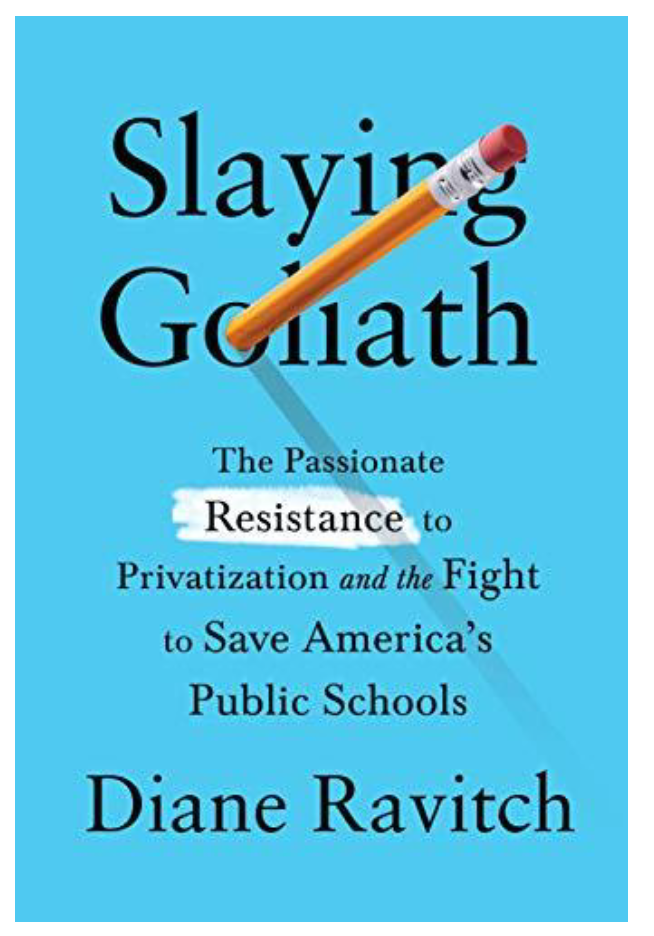
Tim Slekar is a fearless warrior for public schools, teachers, and students. I will be talking to him about Slaying Goliath and the struggle to protect public schools from the depredations of billionaires and zealots.

This Thursday on Civic Media: Dive Back into “Slaying Goliath” with Diane Ravitch

Grab your pencils—BustEDpencils is gearing up for a no-holds-barred revival of Diane Ravitch’s game-changing book, *Slaying Goliath*, live this Thursday on Civic Media. 

Launched into a world on the brink of a pandemic, *Slaying Goliath* hit the shelves with a mission: to arm the defenders of public education against the Goliaths of privatization. But then, COVID-19 overshadowed everything. Despite that, the battles Diane described haven’t paused—they’ve intensified. And this Thursday, we’re bringing these crucial discussions back to the forefront with Diane herself.

This Thursday at 7pm EST on BustEDpencils, we’re not just revisiting a book; we’re reigniting a movement. Diane will dissect the current threats to public education and highlight how *Slaying Goliath* still maps the path to victory for our schools. This isn’t just about reflection—it’s about action.

**It’s time to get real. It’s time to get loud. It’s time to tune in this Thursday at 7 PM EST on Civic Media.**

If you believe that without a robust public education system our democracy is in jeopardy, then join us. Listen in, call in (855-752-4842), and let’s get fired up. We’ve got a fight to win, and Diane Ravitch is leading the charge.

Mark your calendars and fire up Civic Media this Thursday at 7pm Central. 

Dr. Julian Vasquez Heilig is a noted scholar of charter schools, with experience as a parent of a charter school student and board member of a charter school. He is Provost and Vice-President for Academic Affairs at Western Michigan University. And, he is a founding board member of the Network for public Education!

Recently, Dr. Heilig testified before the House Committee on Education and the Workforce. He explained that the research on charters shows that they are no more successful than public schools, they close frequently, they have high teacher turnover, and they promote segregation. In addition, they exacerbate the problems of the public schools by choosing the students they want and diverting resources.

Dr. Heilig called for more accountability for charters and the need for democratic oversight.

The Republican majority of the Committee called three witnesses. The Democrats were allowed only one, and they chose Dr. Heilig.

They chose well. His testimony is succinct and excellent.

Jan Resseger reports on dramatic changes in Chicago, which has been a Petri dish for corporate school reform for at least two decades. The last mayoral election pitted Paul Vallas, an Uber reformer against Brandon Johnson, a teacher and member of the Chicago Teachers Union. Johnson is now beginning to unravel the damage done by Arne Duncan, Rahm Emanuel, and the business leadership.

Resseger writes:

Right now we are watching in real time as Chicago tries to figure out how to undo the consequences of a catastrophic, two-decades long experiment in marketplace school reform.

Chicago’s Board of Education has voted to implement an important first step in Mayor Brandon Johnson’s proposed school district overhaul: the elimination of student based budgeting.

Mayor Johnson seeks to restore equal opportunity across a school district that has become marked by magnet schools, charter schools, elite and selective public schools, struggling neighborhood schools, and neighborhoods without a a public high school or even a traditional public elementary school.

Johnson has prioritized major changes in the Chicago Public Schools, whose problems became especially obvious in June of 2013, when Mayor Rahm Emanuel closed 50 neighborhood public schools because, as he claimed, they were under-enrolled. Eve Ewing, a University of Chicago sociologist explains that, “80 percent of the students who would be affected were African American… and 87 percent of the schools to be closed were majority black.” (Ghosts in the Schoolyard, p. 54)

Chicago was an early experimenter with school reform. Brandon Johnson, the city’s elected mayor, leads Chicago’s schools as part of the 1994 mayoral governance plan imposed on the public schools by Mayor Richard M. Daley and the Illinois legislature. The Chicago Public Schools adopted universal, districtwide school choice, and the launch in 2004 of Renaissance 2010 (led by Arne Duncan) that involved the authorization of a mass of new charter schools and the subsequent closure of so-called failing neighborhood public chools. Chicago adopted a strategy called “portfolio school reform,” described in a National Education Policy Center brief: “The operational theory behind portfolio districts is based on a stock market metaphor—the stock portfolio under the control of a portfolio manager. If a stock is low-performing, the manager sells it.  As a practical matter, this means either closing the school or turning it over to an charter school….”

Then in 2014, Mayor Emanuel added a districtwide funding plan called student based budgeting. In a 2019 report, Roosevelt University professor Stephanie Farmer explained: “Student Based Budgeting fundamentally remade the approach to funding public schools. Student Based Budgeting is akin to a business model of financing public schools because funds are based on student-consumer demand and travel with the student-consumer to the school of their choice.  (The plan contrasts with)… the old public good approach to financing public schools that ensured a baseline of education professionals in each school.”

Because it is known that aggregate school test scores correlate primarily with poverty and wealth, it was predicable that student based budgeting would put schools in Chicago’s poorest neighborhoods on a race to the bottom, leading to schools with tragically limited programming for the city’s most vulnerable students and more school closures.  Farmer concludes: “Our findings show that Chicago Public Schools’ putatively color-blind Student Based Budgeting reproduces racial inequality by concentrating low budget public schools almost exclusively in Chicago’s Black neighborhoods. The clustering of low budget schools in low-income Black neighborhoods adds another layer of hardship in neighborhoods experiencing distress from depopulation, low incomes, and unaffordable housing.”

In late March of this year, WBEZ’s Sarah Karp reported that the Board of Education voted to launch a new plan to determine how much each school has to spend on teachers and programming: “Chicago Public Schools is officially moving away from a school funding formula that pitted schools against each other as they competed for students… District officials… announced (on March 21, 2024) they are implementing a formula that targets resources for individual schools based on the needs of students, such as socioeconomic status and health. They will abandon student based budgeting—a formula unveiled a decade ago under former Mayor Rahm Emanuel that provided a foundational amount of money based on how many students were enrolled…. Under the needs-based formula, every school will get at least four foundation positions, including an assistant principal, plus core and ‘holistic teachers.’… Schools will then get additional funding based on the opportunity index, which looks at barriers to opportunity including race, socioeconomic status, education, health and community factors.”

While undoing a market-based scheme for school funding and operations is clearly a moral imperative, the challenges appear daunting.  Karp continues: “This change was expected as Mayor Brandon Johnson and others have sharply criticized student based budgeting. However, it was unclear how it would play out, especially as the district faces a $391 million deficit for the next school year.  The shortfall is the result of federal COVID relief funds running out… District officials offered no information at a Board of Education meeting… on how the district will fill the budget hole.”

In addition to the threat of a serious financial shortfall, another challenge is the outcry from parents who have over the past two decades become a constituency for charter schools, magnet schools and selective high schools.  Mayor Johnson has tried to reassure parents: “(L)et me assure people that—whether its a selective enrollment school or magnet school—we will continue to invest in those goals… (A)ll I’m simply saying is that where education is working in particular at our selective enrollment schools and our magnet schools, my position is like any other parents in Chicago: that type of programming should work in all of our schools. And that has not been the case. Neighborhood schools have been attacked, they have been demonized, and they’ve been disinvested in, and Black and brown parents overwhelmingly send their children to those schools. So it’s not just demonizing and disinvesting in Black and brown schools, it’s demonizing and disinvesting in Black and brown people—and not under my administration.”

Although school choice plans like Chicago’s were originally premised on the idea of providing more choices for those who have few, in her profound book, Ghosts in the Schoolyard, Eve Ewing explains that families in Chicago do not have equal access in today’s school system based on school choice: “While choosing the best option from a menu of possibilities is appealing in theory, researchers have documented that in practice the ‘choice’ model often leaves black families at a disadvantage. Black parents’ ability to truly choose may be hindered by limited access to transportation, information, and time, leaving them on the losing end of a supposedly fair marketplace.” (Ghosts in the Schoolyard, p. 23) Families dealing with poverty and its challenges are more likely to select a neighborhood school within walking distance of their home.

Mayor Johnson and his school board are facing a fraught political battle in the midst of severe budget challenges. Chicago school reform has exacerbated inequality. The families whose children remain in traditional neighborhood schools that have been undermined by school choice and student based budgeting have watched their their schools lose staff and programs their children need. At the same time, families who have benefited from charter schools, magnet schools and selective-enrollment high schools have now become strong supporters of the programs they have come to take for granted.

Mayor Johnson has been very clear, however, about what the past two decades of portfolio school reform, school choice and student based budgeting have meant for Chicago: “What has happened in the city of Chicago is selective enrollment schools go after students who perform academically on paper.  It’s a very narrow view of education. Let’s also ensure that other areas of need are also highlighted and lifted up.  That’s arts, our humanities, technology, trades…  It’s not like we’re asking for anything radical. We’re talking about social workers, counselors, class sizes that are manageable. We’re talking about full wraparound services for treatment for families who are experiencing the degree of trauma that exists in this city.”

I am almost four years late in discovering this review by two scholars for whom I have the greatest respect: David C. Berliner and Gene V. Glass.

I was happy to read this review because Slaying Goliath had a checkered fate. It was published in mid-January 2020. I went on a book tour, starting in Seattle. By mid-February, I made my last stop in West Virginia, where I met with teachers and celebrated the two-year anniversary of their strike, which shut down every school in the state.

As I traveled, news emerged of a dangerous “flu” that was rapidly spreading. It was COVID; by mid-March, the country was shutting down. No one wanted to read about the fight to save public schools or about its heroes. The news shifted, as it should have, to the panicked response to COVID, to the deaths of good people, to the overwhelmed hospitals and their overworked staff.

To make matters worse, the New York Times Book Review published a very negative review by someone who admired the “education reform” movement that I criticized. I thought of writing a letter to the editor but quickly dropped the idea. I wrote and rewrote my response to the review in my head, but not on paper.

Then, again by happenstance, I discovered that Bob Shepherd had reviewed the review of my book in The New York Times. He said everything that I wish I could have said but didn’t. His review was balm for my soul. Shepherd lacerated the tone and substance of the review, calling it an “uniformed, vituperative, shallow, amateurish ‘review.’” Which it was. His review of the review was so powerful that I will post it next.

Then, a few weeks ago, I found this review by Berliner and Glass.

The review begins:

Reviewed by Gene V Glass and David C. Berliner Arizona State University, United States

They wrote:

In a Post-Truth era, one must consider the source. 

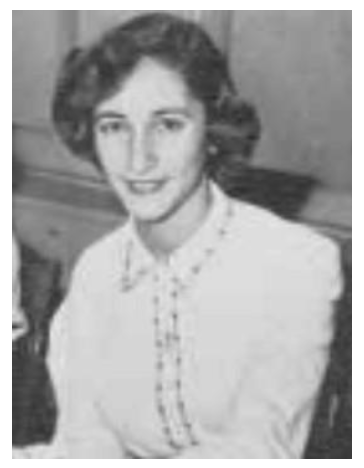
In this case, the source is Diane Rose Silvers, the third of eight children of Walter Silverstein, a high school drop-out, and Ann Katz, a high school graduate. The Silvers were a middle-class Houston family, proprietors of a liquor store, and loyal supporters of FDR.

After graduation from San Jacinto High School, she enrolled in Wellesley College in September, 1956. Working as a “copy boy”for the Washington Post, Diane met Richard Ravitch, a lawyer working in the federal government and son of a prominent New York City family. They married on June 26,1960, in Houston, two weeks after Diane’s graduation from Wellesley. The couple settled in New York City, where Richard took employment in the family construction business. He eventually served as head of the Metropolitan Transit Authority and Lieutenant Governor in the 2000s, having been appointed by Democratic Governor David Paterson.

 Diane bore three sons, two of whom survived to adulthood. Diane and Richard ended their 26-year marriage in 1986. She had not been idle. For a period starting in 1961, Diane was employed by The New Leader, a liberal, anti-communist journal. She later earned a PhD in history of education from Columbia in 1975 under the mentorship of Lawrence Cremin.

Diane was appointed to the office of Assistant Secretary of Education, in the Department of Education by George H. W. Bush and later by Bill Clinton. In 1997, Clinton appointed her to the National Assessment Governing Board (NAGB), on which she served until 2004. 

Ravitch worked “… for many years in some of the nation’s leading conservative think tanks.

Read the full pdf here.