Archives for category: Resistance

Petula Dvorak of the Washington Post wrote about the efforts by the Trump administration to rewrite American history. Trump wants “patriotic history,” in which evil things never happened and non-white people and women were seldom noticed. In other words, he wants to control historical memory, sanitize it, and restore history as it was taught when he was in school about 65 years ago (1960), before the civil rights movement, the women’s movement, and other actions that changed what historians know and teach.

Dvorak writes:

A section of Arlington National Cemetery’s website highlighting African American military heroes is gone.

Maj. Lisa Jaster was the first woman to graduate from Army Ranger school. But that fact has been scrubbed from the U.S. Army Reserve [usar.army.mil] and Department of Defense websites. [search.usa.gov]

The participation of transgender and queer protesters during the LGBTQ+ uprising at New York’s Stonewall Inn was deleted from the National Park Service’s website [nps.gov] about the federal monument.

And the Smithsonian museum in Washington, which attracts millions of visitors who enter free each year, will be instructed by Vice President JD Vance to remove “improper ideology.”

In a series of executive orders, President Donald Trump is reshaping the way America’s history is presented in places that people around the world visit.

In one order, he declared that diversity, equity and inclusion efforts “undermine our national unity,” and more pointedly, that highlighting the country’s most difficult chapters diminishes pride in America and produces “a sense of national shame.”

The president’s orders have left historians scrambling to collect and preserve aspects of the public record, as stories of Black, Brown, female or LGBTQ+ Americans are blanched from some public spaces. In some cases, the historical mentions initially removed have been replaced, but are more difficult to find online.

That rationale has galvanized historians to rebuke the idea that glossing over the nation’s traumas — instead of grappling with them — will foster pride, rather than shame.

Focusing on the shame, they say, misses a key point: Contending with the uglier parts of U.S. history is necessary for an honest and inclusive telling of the American story. Americans can feel pride in the nation’s accomplishments while acknowledging that some of the shameful actions in the past reverberate today.

“The past has no duty to our feelings,” said Chandra Manning, a history professor at Georgetown University.

“History does not exist to sing us lullabies or shower us with accolades. The past has no obligations to us at all,” Manning said. “We, however, do have an obligation to the past, and that is to strive to understand it in all its complexity, as experienced by all who lived through it, not just a select few.”

That is not to say that the uncomfortable weight of difficult truths isn’t a valid emotion.

Postwar Germans were so crushed by the burden of their people’s past, from the horrors of the Nazi regime to the protection of war criminals in the decades after the war, that they have a lengthy word for processing it: vergangenheitsbewältigung, which means the “work of coping with the past.” It has informed huge swaths of German literature and film and has shaped the physical way European cities create memorials and museums.

America’s version of vergangenheitsbewältigung can be found across the cultural landscape. From films to books to classrooms and museums, Americans are learning more details about slavery in the South, the way racism has affected everything from baseball to health care, and how sexism shaped the military.

Trump, however, looks at the U.S. version of vergangenheitsbewältigung differently.
“Over the past decade, Americans have witnessed a concerted and widespread effort to rewrite our Nation’s history, replacing objective facts with a distorted narrative driven by ideology rather than truth,” said the executive order targeting museums, called “Restoring Truth and Sanity to American History.”

That is what “fosters a sense of national shame,” he says in his order.

Historians take exception to that. “I would argue that it’s actually weird to feel shame about what people in the past did,” Georgetown history professor Katherine Benton-Cohen said.
“As I like to tell my students, ‘I’m not talking about you. We will not use ‘we’ when we refer to Americans in the past, because it wasn’t us and we don’t have to feel responsible for their actions. You can divest yourself of this feeling,’” she said.

Germans also have a phrase for enabling a critical look at their nation’s past: die Gnade der spät-geborenen, “the grace of being born too late” to be held responsible for the horror of the Nazi years.

Benton-Cohen said she honed her approach to this during her first teaching job in the Deep South in 2003, when she emphasized the generational gap between her students and the history they were studying.

“They could speak freely of the past — even the recent past, like the 1950s and 1960s, because they weren’t there,” she said. “They were free to make their own conclusions. It was exciting, and it worked. Many told me it was the first time they had learned the history of the 1960s because their high schools — both public and private — had skipped it to avoid controversy. We did fine.”

Trump hasn’t limited his attempt to control how history is presented in museums or memorials. Among the first executive orders he issued was “Ending Radical Indoctrination in K-12 Schooling.” Another one sought to eliminate diversity, equity and inclusion in the nation’s workplaces, classrooms and museums. His version of American history tracks with how it was taught decades ago, before academics began bringing more diverse voices and viewpoints into their scholarship.

Maurice Jackson, a history professor at Georgetown University who specializes in jazz and Black history, said Black Americans have fought hard to tell their full story.

Black history was first published as “The Journal of Negro History” in 1916, in a townhouse in Washington when academic Carter G. Woodson began searching for the full story of his roots. A decade later, he introduced “Negro History Week” to schools across the United States, a history lesson that was widely cheered by White teachers and students alongside Black Americans who finally felt seen.

“Black history is America’s history,” Jackson said. And leaving the specifics of the Black experience out because it makes some people ashamed gives an incomplete picture of our nation, he said.

After Trump issued his executive orders, federal workers scrambled to interpret and obey them, which in some cases led to historical milestones being removed, or covered up and then replaced.

Federal workers removed a commemoration of the Tuskegee Airmen from the Pentagon website, then restored it. They taped butcher paper over the National Cryptologic Museum’s display honoring women and people of color, then uncovered the display.

Mentions of Harriet Tubman in a National Park Service display about the Underground Railroad were removed, then put back. The story of legendary baseball player Jackie Robinson’s military career was deleted from the Department of Defense website, then restored several days later.

Women known as WASPs risked their lives in military service — training and test pilots during World War II for a nation that didn’t allow them to open a bank account — is no longer a prominent part of the Pentagon’s digital story.

George Washington University historian Angela Zimmerman calls all the activity. which happened with a few keystrokes and in a matter of days, the digital equivalent of “Nazi book burnings.”

In response, historians — some professional, some amateur — are scrambling to preserve information before it is erased and forgotten.

The Organization of American Historians created the Records at Risk Data Collection Initiative, which is a callout for content that is in danger of being obliterated

This joins the decades-long work of preserving information by the Internet Archive, a California nonprofit started in 1996 that also runs the Wayback Machine, which stores digital records.

Craig Campbell, a digital map specialist in Seattle, replicated and stored the U.S. Geological Service’s entire historical catalogue. His work was crowdfunded by supporters.

“Historical maps are critical for a huge range of industries ranging from environmental science, conservation, real estate, urban planning, and even oil and gas exploration,” said Campbell, whose mapping company is called Pastmaps. “Losing access to the data and these maps not only destroys our ability to access and learn from history, but limits our ability to build upon it in so many ways as a country.”

After astronomer Rose Ferreira’s profile was scrubbed from, then returned, to NASA’s website, she posted about it on social media. In response, an online reader created a blog, Women in STEM, to preserve stories such as Ferreira’s.

“Programs that memorialize painful truths help ensure past wrongs are never revived to harm again,” Rep. Steven Horsford (D-Nevada), said on X, noting that presidents are elected to “run our government — not rewrite our history.”

Authoritarian leaders have long made the whitewashing of history a tool in their regimes. Joseph Stalin expunged rivals from historic photographs. Adolf Hitler purged museums of modernist art and works created by Jewish artists, which he labeled “degenerate.” Museums in Mao Zedong’s China glorified his ideology.

While this may be unfamiliar to Americans, Georgetown University history professor Adam Rothman says that in the scope of human history, “these are precedented times.”

It’s not yet clear what the real-world effect of Trump’s Smithsonian order will be or exactly how it will be carried out. Who will determine what exhibits cause shame and need to be removed? What will the criteria be? Will exhibits that discuss slavery, for instance, be eliminated or altered?

“Our nation is an ongoing experiment,” says Manning, the Georgetown history professor, who has written books about the Civil War. “And what helps us do that now in 2024 compared to 1776 is that we do have a shared past.

“Every single human culture depends upon, grows out of, and is shaped by its past,” she said. “It is the past that has shaped all of us, it is our past that contains the bonds that can really hold us together.”

It’s what makes the study — and threat to — American history unique among nations. Benton-Cohen said that is what she sees happen with her students.

“The American striving to realize the democratic faith and all the difficulties it entailed and challenges overcome should inspire pride, not shame,” she said. “If you feel shame, as the kids would say, that’s a ‘you’ problem. That’s why I still fly the flag at my house; I’m not afraid of the American past, I’m alive with the possibilities — of finding common cause, of fighting for equality, of appreciating our shared humanity, of upholding our freedoms.”

H/T to Erich Martel, former history teacher in D.C. This sign carried in April 5 rally in D.C.

Nancy Flanagan is a retired veteran teacher. Her blogs are always insightful because she sees the issues from the perspective of her long career in the classroom. In this post, she explains why some conferences work and some don’t. She wrote it after returning home from the Network for Public Education conference.

She writes:

I am just back from the Network for Public Education conference, held this year in Columbus, Ohio. Columbus is an eight-hour drive from my house, and we arrived at the same time as ongoing flood warnings. But—as usual—it was well worth the time and effort expended.

For most of my career—35 years—I was a classroom teacher. Garden-variety teachers are lucky to get out of Dodge and attend a conference with their peers maybe once a year. Teachers don’t get airfare for conferences in other states and often end up sharing rides and rooms, splitting pizzas for dinner. They go with the intention of getting many new ideas for their practice toolboxes—lesson plans, subject discipline trends and tips, cool new materials—and to connect with people who do what they do. Be inspired, maybe, or just to commiserate with others who totally get it.

In the real world (meaning: not schools), this is called networking. Also in the real world—there’s comp time for days missed at a weekend conference, and an expense form for reimbursements. Conversely, in schools, lucky teachers get a flat grant to partially compensate for registration, mileage, hotel and meals. In many other schools, nobody goes to a conference, because there’s just not enough money, period.

When you hear teachers complaining about meaningless professional development, it’s often because of that very reason—there’s not enough money to custom-tailor professional learning, so everyone ends up in the auditorium watching a PowerPoint and wishing they were back in their classrooms.

Back in 1993, when Richard Riley was Secretary of Education, his special assistant, Terry Dozier, a former National Teacher of the Year, established the first National Teacher Forum. (In case you’re wondering, the Forums lasted just as long as the Clinton administration, and Riley, were in the WH.) Teachers of the Year from all 50 states attended. The purpose of the conference was to engage these recognized teachers in the decision-making that impacted their practice. In other words, policy.

It was probably the most memorable conference I ever attended. I took nothing home to use in my band classroom, but left with an imaginary soapbox and new ideas about how I could speak out on education issues, engage policymakers, and assign value to my experience as a successful teacher. The National Teacher Forum literally changed my life, over the following decades.

But—the idea that teachers would start speaking out, having their ideas get as much traction as novice legislators’ or Gates-funded researchers, was a hard sell. Education thinkers aren’t in the habit of recognizing teacher wisdom, except on a semi-insulting surface level. In the hierarchy of public education workers, teachers are at the lowest level of the pyramid, subject to legislative whims, accrued data and faulty analyses, and malign forces of privatization.

Which is why it was heartening to see so many teachers (most from Ohio) at the NPE conference. The vibe was big-picture: Saving public education. Debunking current myths about things like AI and silver-bullet reading programs. Discussing how churches are now part of the push to destabilize public schools. New organizations and elected leaders popping up to defend democracy, school by school and state by state.  An accurate history of how public education has been re-shaped by politics. The resurgence of unions as defenders of public education.

Saving public education.  A phrase that has taken on new and urgent meaning, in the last three months. Every single one of the keynote speakers was somewhere between on-point and flat-out inspirational.

Here’s the phrase that kept ringing in my head: We’re in this together.

The last two speakers were AFT President Randi Weingarten and MN Governor Tim Walz. I’ve heard Weingarten speak a dozen times or more, and she’s always articulate and fired-up. But it was Walz, speaking to his people, who made us laugh and cry, and believe that there’s hope in these dark times.

He remarked that his HS government teacher—class of 24 students, very rural school—would never have believed that Tim Walz would one day be a congressman, a successful governor and candidate for Vice-President. It was funny—but also another reason to believe that public schools are pumping out leaders every day, even in dark times.

In an age where we can hear a speaker or transmit handouts digitally—we still need real-time conferences. We need motivation and personal connections. Places where true-blue believers in the power of public education can gather, have a conversation over coffee, hear some provocative ideas and exchange business cards. Network.

Then go home–and fight. 

As you know, Trump took control of The Kennedy Center and named himself chairman of the board. He kicked all Democrats off the board and named Trumpers to replace them.

Some artists cancelled, some continued to perform. Trump’s new director, Richard Grennel, canceled the national tour of a children’s show called “Finn,” because it promoted love, kindness, and tolerance.

A band called Guster was performing at The Kennedy Center on March 29, and the band leader talked about the cancellation of “Finn.” Then he invited the cast of “Finn” to join him onstage and the audience went wild.

You have to see this.

I almost cried: tears of joy.

Marc Elias is a lawyer who leads a group called Democracy Docket. He and his team regularly sue to block threats to our democracy. He is one of the nation’s most prominent voting rights attorneys.

Elon Musk doesn’t like Elias. He doesn’t like it when Elias gets in his way.

Here is a recent exchange between them:

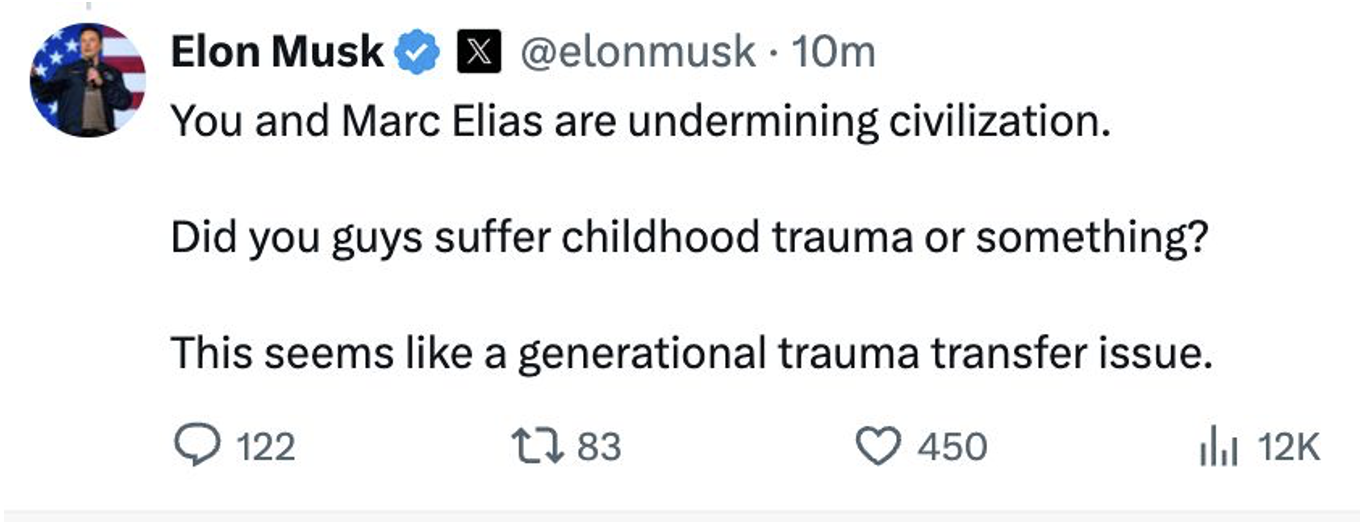
Elon Musk recently posted on his site that another lawyer and I are “undermining civilization.” He goes on to ask if we suffered childhood trauma and concludes by suggesting we are suffering from “generational trauma.” This is my response.

Mr. Musk,

You recently criticized me and another prominent lawyer fighting for the rule of law and democracy in the United States. I am used to being attacked for my work, particularly on the platform you own and dominate.

I used to be a regular on Twitter, where I amassed over 900,000 followers — all organic except for the right-wing bots who seemed to grow in number. Like many others, I stopped regularly posting on the site because, under your stewardship, it became a hellscape of hate and misinformation.

I also used to buy your cars — first a Model X and then a Model S — back when you spoke optimistically about solving the climate crisis. My family no longer owns any of your cars and never will.

But this is not the reason I am writing. You don’t know me. You have no idea whether I have suffered trauma and if I have, how it has manifested. And it’s none of your business.

However, I will address your last point about generational trauma. I am Jewish, though many on your site simply call me “a jew.” Honestly, it’s often worse than that, but I’m sure you get the point. There was a time when Twitter would remove antisemitic posts, but under your leadership, tolerating the world’s oldest hatred now seems to be a permissible part of your “free speech” agenda.

Like many Jewish families, mine came to America because of trauma. They were fleeing persecution in the Pale of Settlement — the only area in the Russian Empire where Jews were legally allowed to reside. Even there, life was difficult — often traumatic. My family, like others, lived in a shtetl and was poor. Worse, pogroms were common — violent riots in which Jews were beaten, killed and expelled from their villages.

By the time my family fled, life in the Pale had become all but impossible for Jews. Tsar Nicholas II’s government spread anti-Jewish propaganda that encouraged Russians to attack and steal from Jews in their communities. My great-grandfather was fortunate to leave when he did. Those who stayed faced even worse circumstances when Hitler’s army later invaded.

That is the generational trauma I carry. The trauma of being treated as “other” by countrymen you once thought were your friends. The trauma of being scapegoated by authoritarian leaders. The trauma of fleeing while millions of others were systematically murdered. The trauma of watching powerful men treat it all as a joke — or worse.

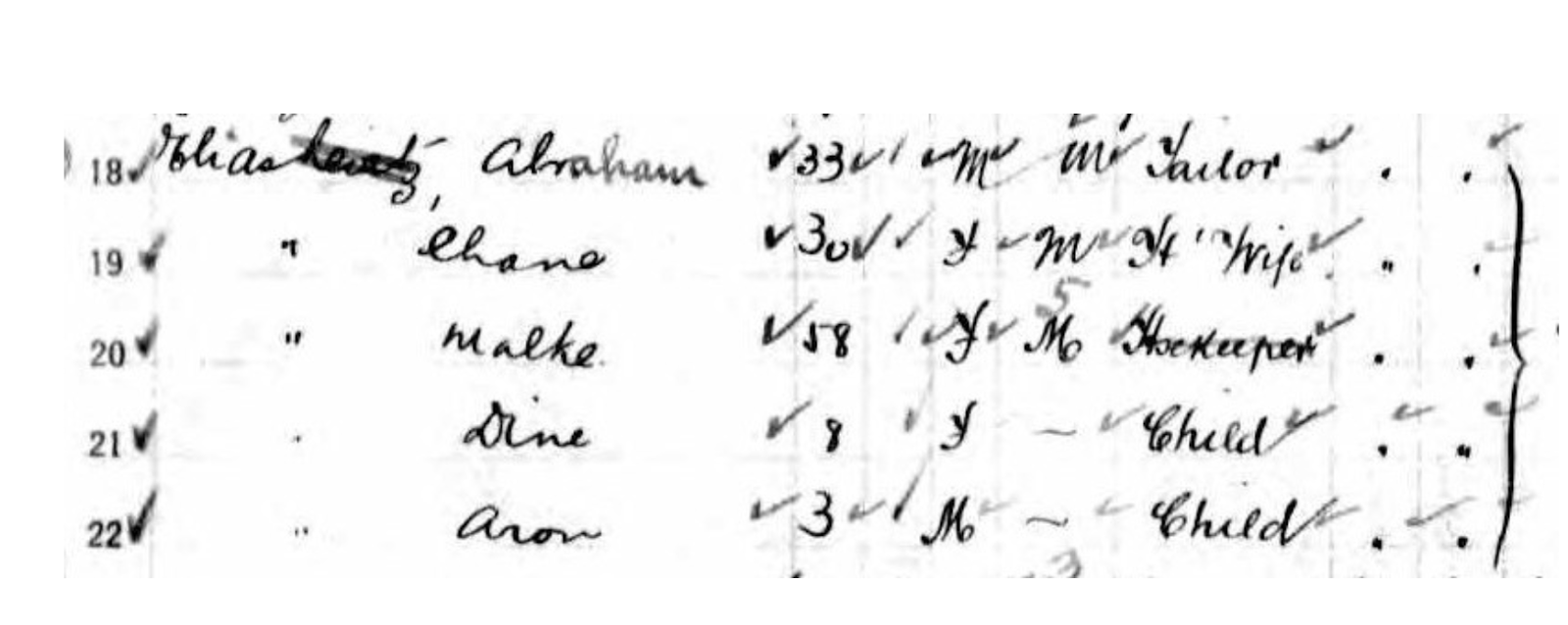
As an immigrant yourself, you can no doubt sympathize with what it means to leave behind your country, extended family, friends and neighbors to come to the United States. Of course, you probably had more than 86 rubles in your pocket. You probably didn’t ride for nine days in the bottom of a ship or have your surname changed by immigration officials. Here is the ship manifest showing that my family did. Aron, age three, was my grandfather.

As new immigrants, life wasn’t easy. My family lived in cramped housing without hot water. They worked menial jobs — the kind immigrants still perform today. 

Some may look down on those immigrants — the ones without fancy degrees — but my family was proud to work and grateful that the United States took them in. They found support within their Jewish community and a political home in the Democratic Party.

I became a lawyer to give back to the country that gave my family a chance. I specialize in representing Democratic campaigns because I believe in the party. I litigate voting rights cases because the right to vote is the bedrock of our democracy. I speak out about free and fair elections because they are under threat.

Now let me address the real crux of your post.

You are very rich and very powerful. You have thrown in with Donald Trump. Whether it is because you think you can control him or because you share his authoritarian vision, I do not know. I do not care.

Together, you and he are dismantling our government, undermining the rule of law and harming the most vulnerable in our society. I am just a lawyer. I do not have your wealth or your platform. I do not control the vast power of the federal government, nor do I have millions of adherents at my disposal to harass and intimidate my opponents. I may even carry generational trauma.

But you need to know this about me. I am the great-grandson of a man who led his family out of the shtetl to a strange land in search of a better life. I am the grandson of the three-year-old boy on that journey. As you know, my English name is Marc, but my Hebrew name is Elhanan (אֶלְחָנָן) — after the great warrior in David’s army who slew a powerful giant.

I will use every tool at my disposal to protect this country from Trump. I will litigate to defend voting rights until there are no cases left to bring. I will speak out against authoritarianism until my last breath.

I will not back down. I will not bow or scrape. I will never obey.

Defiantly,

Marc Elias

Sherrilyn Ifill is a law professor at Howard University and former president and director-counsel of the NAACP Legal Defense Fund. She writes a blog called Sherrilyn’s Newsletter, where this post appeared. Open the link to see her footnotes.

“There is never time in the future in which we will work out our salvation. The challenge is in the moment. The time is always now.”

-James Baldwin

Illustration by Nick Liu

The past week has shown us in stark terms what it means to fight – to actually fight – to protect against the rise of authoritarians. This week we also saw that somehow, despite years of preparation, some of the leaders of our most powerful institutions seem unprepared for the particular nature of this fight. Others appear just…. unwilling to engage.

Last week the Trump Administration took its most bold actions yet. Through the actions of either Trump himself, Elon Musk or members of Trump’s cabinet, this Administration has:

· Unleashed an unprecedented attack on higher education, the centerpiece of which was a targeted attack on Columbia University. In a letter sent to the University, the Administration[i]demanded that university essentially turn over its decision-making to the Trump Administration, insisting that the University close the Middle Eastern Studies Dept, ban mask-wearing, expel students involved in pro-Palestine protests, and announced the withholding of $400 million in federal dollars until the University accedes to Trump’s demands, unless the University took these actions to address “antisemitism on campus.” The Administration underscored its intentions by entering student dormitories and arresting a Palestinian student who is a legal permanent resident of the U.S. As his 8-month-pregnant wife looked on helplessly, ICE officers arrested Mr. Khalil and then disappeared him, moving him from facility to facility, and offering only vague and unsubstantiated justifications for his arrest. His central “crime” appears to be “advancing positions that are contrary to the foreign policy of this Administration,”[ii]– a concept so staggeringly outrageous it can scarcely be absorbed.

· Fired half the staff of the Department of Education[iii] – as a down-payment on the Administration’s vow to close the agency.

· Indicated its intention to “eliminate Social Security;”[iv]

· Continued firing government workers and removing funding from government agencies including NIH[v] and shuttering offices like the Voice of America.

· Intensified tariffs against Canada and rhetoric suggesting that the sovereign nation of Canada should be annexed to the U.S.;[vi] declared that the European Union was created to “screw the U.S.”; declared that the South African Ambassador to the United States is no longer welcome,[vii] continuing the Administration’s Musk-inspired determination to recognize racist white settlers as victims of Black rule.

· Issued Executive Orders targeting law firms who have litigated cases against Trump in the classified documents cases and who provided pro bono counsel to Special Counsel Jack Smith, removing security clearances and blocking government connected work.

· Argued in court that transgender soldiers should be removed from the military.[viii]

· Removed information about Black, Asian American and women military heroes from the Arlington National cemetery website,[ix]disappearing the accomplishments of people of color and women from official recognition.

And that’s just part of it.

But the resistance to Trump’s authoritarian rule has been busy as well:

· Protests across the country have demanded the release of Mahmoud Khalil, the Palestinian student taken into custody.[x]

· “Tesla Take Down” protests at Tesla dealerships across the country in protest against Elon Musk’s takeover of our government have been so effective in tanking the brand and its stock price,[xi] that President Trump turned the White House into a car lot and personally embodied the used car salesman he was destined to be (if not for his father’s money) in an attempt to gin up Tesla sales.

· Protests nationwide continue to demand an end to government worker firings.

· Voters have shown up at town halls across the country to express anger about proposed plans to cut Medicaid/Medicare and Social Security[xii].

· Lawsuits filed by parents,[xiii] and by a score of states[xiv] have challenged the closing of the Education Department.

· Perkins Coie, the law firm targeted by Trump boldly challenged the Trump administration’s effort to blackball the firm and imperil its business;[xv]

· Federal courts have required Trump to rehire thousands of federal employees fired by DOGE[xvi]

· Federal courts have enjoined Trump’s efforts to freeze spending on governments grants and other funding.[xvii]

· Federal courts enjoined the Administration from removing migrants targeted under Trump’s invocation of the Alien Enemies Act – a decision the Trump Administration has defied.[xviii]

But the big stories last week were less about those who have protested and sued, and more about those among the most powerful institutional actors who appear to have lost the plot. Political scientists Steve Levitsky and Ryan Enos offered a blistering and spot-on condemnation of universities that have remained silent in the face of Trump’s authoritarian challenge to the freedom of universities.[xix]Calling out Harvard University specifically (where both scholars teach) for its silence in the face of the hideous attacks on Columbia University, Levitsky and Enos condemned the inaction of universities that have chosen a strategy of “lying low, avoiding public debate (and sometimes cooperating with the administration) in the hope of mitigating the coming assault.”[xx]

Meanwhile on Capitol Hill, Senate Minority Leader Chuck Schumer has faced a wave of outrage and demands for resignation after his decision to vote in favor of cloture to avert a government shutdown. To be sure, the Democrats have few options for stopping the Republicans, who are firmly in the majority in the House and Senate from torching our government. But as many of us have been reminded ad nauseum during the years when Democrats controlled the Senate, the filibuster is one of the few procedural rules the party in the minority in the Senate has to counter being overrun by the majority.

But frustratingly, although Democrats were unwilling to abolish the filibuster in 2022 to advance their agenda, last week they were unwilling to use the filibuster to defy the Republican power grab. Heads the Republicans win. Tails the Democrats lose.

It was hard to understand the point of Democrats affixing their signature to a continuing resolution to fund a government that is being cut to the bone every day by Elon Musk – an unelected billionaire with no official government position – who has been permitted to usurp the appropriation power of Congress. When Trump and Musk lawlessly gut agencies and fire government workers, and Speaker Mike Johnson and his caucus cede the power of Congress to the President, we are in a constitutional crisis.

Trump and Musk’s anti-constitutional usurpation of congressional power with the complicity of the Republicans in Congress is an emergency. It demands an emergency response. Minority Leader Schumer and 7 other Democratic Senators (and I suspect more who were covered by the Leader’s unpopular action) were unprepared to meet the moment in a way that would have upped the stakes. Sometimes when the game is fixed, you have to overturn the tables.

I will concede a serious point Schumer later offered that got lost in the Comms disaster of his Wednesday night statement that suggested there would be a shutdown, and then his Thursday morning announcement that he would vote to avert one. If the government shutdown happened, there would be little chance of obtaining judicial orders enjoining decisions by Trump/Musk to eliminate programs, because legally during a government closure, the President enjoys unfettered power to determine which functions of government are “essential” – standard to which the courts would likely defer. By contrast, with the government open, challenges to DOGE firings and closures continue to do fairly well in the courts and have slowed down the force of Musk’s chainsaw.

In any case, Schumer’s decision and perhaps moreso the clumsy comms that accompanied it have resulted in boiling outrage within the base of the party, including calls for him to step down from leadership.

Of course, none of this compares to the perfidy of the Republican Party. We must never forget the unconscionable and dastardly conduct of Speaker Mike Johnson and the Republicans in the House and Senate – men and women who have abdicated their allegiance to this country and to democracy itself. Their cowardice and complicity in the destruction of this country must never be forgotten or whitewashed. Their betrayal is singular and historic. 

But there’s another group that is failing to meet this moment. America’s corporate leadership has been nearly silent during one of the most volatile economic periods in years. Last week the stock market took a nosedive – entering “correction” status as a result of Trump’s manic and unhinged tariff announcements. [xxi] Trump’s erratic tariffs – up one day, down the next, up again two weeks later – are lunacy. Every rational business leader knows that.[xxii] The predictable market response to Trump’s irrationality threatens the retirement plans of older Americans hoping to retire and the American economy. America’s leadership in the world has been compromised by Trump’s saber-rattling, and his insistence on imperialist moves towards Canada, the Panama Canal and Greenland, is destabilizing the integrity of perception of American stability. Combined with the massive government lawyers, Trump’s policies are bad for America and bad for business.

As Trump literally tanks the American economy and the trust of the international business community, where are the voices of America’s business leaders? Are they all hoping that Trump will do a commercial on the White House lawn hawking their products too? Are the leaders of the Business Roundtable (200 CEOs of the nation’s leading corporations) agnostic about the President’s stubborn insistence on policies that are wrecking the U.S. economy and our standing in the world?

These same business leaders enabled the lie that Trump is a “successful businessperson” – knowing full well that Trump does not seem to know what he’s talking about when he wades into economics, knowing of his six bankruptcies, knowing of his refusal to pay contractors, his false representations, and knowing that no responsible Fortune 500 CEO would ever have gone into business with Trump before he was elected President, or even after. Being wealthy is not the same as being a successful businessperson and they all know it. 

In an interview on CNBC, even host Maria Bartiromo – a Trump sycophant – felt compelled to remind Trump that successful business leaders need predictability to make coherent decisions about investments, infrastructure, expansion, and product development for markets. She noted that the up-and-down tariff mania undermines predictability. Trump responded, “well they say that. It sounds good to say.” Really? Is that it? Or is it a fundamental tenet of business that even a first year MBA student would know? At other times last week he has repeated with “we’re gonna have so much money from the tariffs” with a desperate insistence that suggested mental instability.

American corporations have either tried to placate Trump by paying tribute,[xxiii] or have “crawled into a protective shell” like the university officials called out by Levitsky and Enos. In either case, it is utterly irresponsible. Their voices and influence – presented collectively and forcefully – are critical to protecting the economic interests of this country, and our democracy. Their failure to act is a betrayal of their responsibility as citizens.

Media owners have shamed themselves – whitewashing their teams,[xxiv] surrendering the independence and diversity of their editorial pages,[xxv] and taking a knee before Trump’s demands rather than standing firm in the face of the challenge to our democracy.[xxvi]

In the week ahead, there will be many additional opportunities for leaders from our most powerful democratic institutions to meet this moment. Already it appears that the Trump Administration has defied a federal court order to turn around planes taking Venezuelan migrants accused of being to El Salvador.[xxvii] The Administration announced that the first 250 migrants arrived in El Salvador.[xxviii] What does that mean? Two hundred-fifty Venezuelan nationals have been disappeared into the one of the world’s most notoriously abusive prisons in El Salvador, without judicially approved trials or due process. 

What will judges do as Trump appears to defy judicial orders? This week will test the readiness of our judiciary to defend the rule of law.

Meanwhile ordinary people have been showing tremendous leadership, protesting, launching and participating in boycotts, conducting teach-ins, calling their elected representatives every week, sometimes several times a week, visiting district offices, participating in “die-ins,” writing letters and petitions, and building support for opposition candidates in special elections. A “mass march” has been announced by the organization Hands/Off for April 5th, although information is still spotty [please drop info in the comments]. Black churches have launched a 40-day Lenten boycott of Target for its obsequious abandonment of its DEI commitments.[xxix]

Every day we are called upon to meet the moment. As we see our neighbors seized by plainclothes agents without judicial warrants, and see our workplaces “obey in advance” – removing from websites, official policies and even mission statements expressing their commitment to equality and to inclusion, and as we see law firms crouch before this Administration’s threats, and media outlets silence voices that write the truth about this Administration, we have to decide how we will respond.

All over America ordinary people are looking into their toolboxes of non-violent actions and determining which ones they will use. It’s been beautiful to see.

But we must not absolve the leaders of our most powerful institutions – those who have the money and power, and influence to insulate themselves from the worst consequences of this Administration’s excesses – from their obligation to act and to meet the moment.

To those who are business leaders, captains of industry, university leaders, and media owners, decide who you will be at this moment. If we fully lose democracy in this country, it will be because the most privileged among us refused to accept the responsibility to speak out, to say “no more,” and to lead. History will not kindly remember those who left it to Americans with considerably less power and protection, to do the hard work of saving this country. Your tax cuts will not be large enough to cover your shame. And we will remember.

Robert Hubbell is a blogger with a huge following. He has that following because he is well-informed, reasonable and optimistic about the power of democracy. In the absence of any coordinated response from the Democratic Party, protests are occurring spontaneously and locally. At Tesla showrooms, where people are picketing. At town hall meetings, which Republicans have suspended. And in other public settings, where people are expressing their anger and frustration about the dismantling of their government.

He wrote recently:

It is a tough time to be an ordinary American who believes in democracy, the rule of law, and the value of good government. From the cheap seats, it appears that all three are under a brutal assault from Trump and Musk designed to weaken America as a global force for good. In a bizarre twist worthy of The Twilight Zone, Trump and Musk’s campaign of destruction seems carefully crafted to benefit the world’s worst dictator and sworn enemy of American democracy, Vladimir Putin, a goal that is warmly embraced by a party that only a decade ago wrapped itself in patriotism and pro-democracy foreign policy.

But America’s political and media classes seem oddly unconcerned and detached from reality. True, Democrats in Congress express concern—but in the same way, they express concern about policy fights over revisions to the tax code. (To be fair, a handful of notable exceptions are out on a limb without the support of their party.) Our Democratic leaders use their minority status in Congress to justify their strange quiescence—an explanation that accepts defeat as the status quo.

The media is a husk of its former self. Firebrands and self-styled crusaders who took Biden to task for every inconsequential verbal slip now report on grotesque lies and unprecedented betrayals by Trump with the ennui of a weatherman predicting increasing darkness in the late afternoon and early evening.

What is wrong with these people?

Is the failure of Democratic leaders a lack of ability? Of desire? Or the triumph of personal ambition regarding 2028 presidential politics over their willingness to serve as a leader of the loyal opposition in our nation’s hour of need?

The silence is deafening. There is a grand disconnect. I had no answer for Americans abroad wondering why the deep pool of talented politicians in the Democratic Party was missing in action at a moment of crisis for their beloved country. But I was able to assure them that the grassroots movement is responding to the call without waiting for politicians to lead the way. 

Organic protests are spreading across the US, including protests targeting Tesla dealerships. See News24, ‘We are taking action’: 9 people arrested at Tesla dealership as anti-Musk protests break out in US. (“Throngs of protesters also descended on the electric vehicle maker’s showrooms in Jacksonville, Florida; Tucson, Arizona, and other cities, blocking traffic, chanting and waving signs . . . .”)

Like the Civil Rights Era in the 20th Century and the anti-war movement of the 1960s, we are experiencing a moment in our history where the people drag their leaders kicking and screaming into the future—at which point those reluctant leaders will take credit for victory. So be it. We must stop asking, “Where are our leaders?” and start doing the work until they show up to join us on the front lines.

The pattern behind Trump’s embrace of Putin in Friday’s Oval Office meeting

On Friday, Trump ended 80 years of alliance between Western nations by attacking and dishonoring the leader of the European nation on the frontlines of the effort to halt Russian expansionism. As Trump berated President Zelensky, Trump characterized himself and Vladimir Putin as “co-victims” of the US investigation into Russia’s interference in the 2016 election.

The next day, Elon Musk agreed with a tweet asserting that the US should leave NATO and the UN.

When European leaders met on Sunday in a pre-planned security conference in London, Russia’s former president Dmitry Medvedev condemned the meeting as an “anti-Trump Russophobic coven [of witches].” Medvedev speaks for Putin.

On Sunday, the NYTimes reported that the US Department of Defense has unilaterally ceased cyber operations against Russia, hobbling the US’s ability to understand Russia’s true intentions at a critical juncture in world politics.

Late last week, The Guardian reported that the US no longer views Russian cyberattacks against the US as a priority. See The GuardianTrump administration retreats in fight against Russian cyber threats. There is no indication that Russia has stopped cyberattacks against the US or that it has “de-prioritized” American cyberattacks on Russia.

In the span of 72-hours, Trump effectively surrendered to Russia in a cyberwar that has been waged continuously for decades. Trump’s disgraceful actions in the Oval Office on Friday must be viewed in the broader context of Trump’s embrace of Russia.

The media is failing to tell that broader story by trivializing a foreign relations debacle into a “Will he, or won’t he?” story about Trump’s ludicrous demand for Zelensky to “apologize.” See BBCr eport, Laura Kuenssberg, asking Zelensky if he would “express[] some regret to President Trump after your heated confrontation at the White House on Friday.”

At least the BBC reporter didn’t ask Zelensky if he would resign, which has become the new talking point for MAGA politicians in the US: Following Trump’s Lead, His Allies Lash Out At Zelenskyy And Suggest He May Need To Resign | HuffPost Latest News


DOGE hackers shut down key IT unit designed to coordinate US government public-facing computer networks

DOGE has summarily dismantled a key information technology group at the center of the federal government’s public-facing computer systems. See Josh Marshall in Talking Points Memo, In-House Gov Tech Unit for State of the Art Web Portals Disbanded by Doge.

The unit that was disbanded was known as “18F.” Its job was to make public-facing websites of the federal government more user-friendly and functional—things like making it easier to complete and file your tax returns for free on the IRS website. 

The now-former employees of 18F published a letter on Sunday that explained what they did and why their dissolution will hurt the American people. See 18F: We are dedicated to the American public and we’re not done yet. The letter reads, in part, as follows:

[The terminations were] a surprise to all 18F staff and our agency partners. Just yesterday we were working on important projects, including improving access to weather data with NOAA, making it easier and faster to get a passport with the Department of State, supporting free tax filing with the IRS, and other critical projects with organizations at the federal and state levels.

All 18F’s support on that work has now abruptly come to a halt. Since the entire staff was also placed on administrative leave, we have been locked out of our computers, and have no chance to assist in an orderly transition in our work. . . .

Before today’s RIF, DOGE members and GSA political appointees demanded and took access to IT systems that hold sensitive information. They ignored security precautions. Some who pushed back on this questionable behavior resigned rather than grant access.

The chaos-termination of the 18F computer group is being repeated across the federal government. Doge has apparently targeted 50% of the Social Security Administration staff—a move that will hurt service levels for seniors who depend on SSA payments to meet basic living expenses.

These cuts are painful and will cause chaos. That chaos and pain will spur a backlash against Republicans that should allow Democrats to take back the House (and possibly the Senate) in 2026 if only the Democratic Party can get its act together—PRONTO! We need a daily news conference with effective messaging by dynamic, charismatic leaders who are not Chuck Schumer!…

Concluding Thoughts

Apologies that this newsletter is more like a rant and less like my usual call to action. But I am reflecting the frustration and anger that I am hearing from readers (both in person and in the Comment section). There seems to be a disconnect that is exacerbating an already mind-boggling situation.

The good news is that everyone seems to “get it”—other than politicians and the media. As I noted, they will be dragged along with the tide of history—a tide whose course we will determine by our actions.

It is up to us to save democracy—a situation that does not distinguish this moment from the thousands of perilous moments that have brought us to this point.

I acknowledge that we are living through an extraordinarily difficult moment. Our most important task is to not quit. If all we do is endure and keep hope alive, that will be enough. That is what Winston Churchill did during the darkest hours of WWII. If we can do the same, we will see victory in 2026 and 2028.

But we can do more—much more. The tide is turning. Republicans are retreating from their constituents. Spontaneous protests are spreading across America. It is happening. Be part of the movement in whatever way you can. No effort is wasted. No gesture is meaningless. No voice is unheard. Everything matters—now more than ever.


Rep. Al Green of Texas stood up and shouted during Trump’s State of the Union speech “There is no mandate for cutting Medicaid.” At the order of the Speaker, he was ejected. Today he was censured by the House for his actions. By contrast, when Marjorie Taylor Green and Lauren Boebert disrupted President Biden’s State of the Union speech, there were neither ejected nor censured.

The New York Times reported:

The House on Thursday officially rebuked Representative Al Green of Texas, the Democrat who Republicans ejected from the chamber on Tuesday night for standing and heckling President Trump during his address to a joint session of Congress.

A resolution of censure passed 224 to 198, with 10 Democrats joining Republicans in support of the punishment. Mr. Green and Representative Shomari Figures, a first-term Democrat from Alabama, both voted “present.”

But when Mr. Green stepped into the well of the House to receive his official scolding, the floor devolved once again into a scene of chaos. The Texas Democrat led a crowd of his colleagues in singing the gospel anthem “We Shall Overcome” as Speaker Mike Johnson raised his voice and finished reading out the censure.

Mr. Johnson was forced to call a brief recess as Republicans and Democrats lingered on the floor, shouting at each other. It was another dramatic moment after Mr. Green’s outburst on Tuesday night, reflecting a determination among some Democrats to aggressively resist Mr. Trump, even as others in the party urge a more staid and sober strategy for pushing back.

The Democrats who voted to censure Mr. Green were: Representatives Ami Bera of California, Ed Case of Hawaii, Jim Costa of California, Laura Gillen of New York, Jim Himes of Connecticut, Chrissy Houlahan of Pennsylvania, Marcy Kaptur of Ohio, Jared Moskowitz of Florida, Marie Gluesenkamp Perez of Washington and Tom Suozzi of New York.

A censure is one of the highest forms of reprimand in the House. The resolution is a formal and public condemnation or disapproval of a member’s individual behavior. But in recent years, the bar for such moves has lowered considerably, as Democrats and Republicans alike have used it to settle political scores….

Mr. Green told reporters on Wednesday that he would accept the consequences for his actions on Tuesday night and that he harbored no ill will toward the speaker or anyone else.

“I didn’t do it to get anybody else to join me,” he said. “I believe that on some issues, it’s better to stand alone than not stand at all.”

Mr. Green added that his act of protest was “a matter of conscience” because he believed Mr. Trump did not adequately address the issue of protecting Medicaid, a program that he said many of his constituents rely on.

“I would do it again,” he said. “I’m not saying I’m going to now contrive and try to find a way to do it again.”

The recently elected Senator Elissa Slotkin of Michigan responded to President Trump.

She was terrific.

It takes about five minutes to watch.

I’m happy to say that I contributed to her campaign. She’s smart, strong, and articulate.

The Network for Public Education works with scores of state and local grassroots groups that want to protect and strengthen public schools. Almost 90% of out nation’s children attend public schools. We are fighting libertarian billionaires and religious zealots who want to dumb down and indoctrinate our children. Above all, they want to cut their taxes by undereducating our children.

We just added a new partner!

The Network for Public Education congratulates Our Schools Our Democracy (OSOD), a new partner in our work to protect, defend, and improve public schools. Its comprehensive research exposes the harm charter schools do to Texas Public Schools and serves as a blueprint for reforming charter school laws not only in Texas but in every state.

OSOD will focus on fighting school privatization in Texas, with a special emphasis on the impact of charter schools. According to their website, “Texas public schools, governed by locally elected school board members, are the cornerstone of our democracy and the heart of our neighborhoods. However, since state lawmakers first authorized open-enrollment charter schools 30 years ago, unchecked charter expansion has harmed public school districts in every corner of the state.”

Along with the organizational launch is the launch of a comprehensive report: Facing Facts: Charter Schools in Texas. The report presents startling facts on the financial drain of charter schools on public schools, the lack of charter transparency, and the irresponsible practices presently enabled by Texas law. It provides readers with the arguments they need to actively advocate for charter reform.

Please visit their exciting new website here