Archives for category: Lies

When Ron DeSantis launched his candidacy on Twitter, he scoffed at the notion that schools were banning books in Florida. That alone should disqualify him, based on what we have seen, heard and read about the state’s encouragement of banning books that refer to gays or racism. A complaint by a single parent is sufficient to get a book removed from the school library. Most recently, a parent at an elementary school complained about Amanda Gorman’s poem “The Hill We Climb,” which she read at President Biden’s inauguration. The poem is now available to middle school children, but not to those in the elementary school.

The Miami Herald published this editorial about the phenomenon that DeSantis says is non-existent, a hoax.

Perhaps it’s because of how Amanda Gorman alluded to the Jan. 6 attack in her famous poem, finished the night after rioters stormed the U.S. Capitol: “We’ve seen a force that would shatter our nation rather than share it.”

Or maybe she wrote too bluntly about race and the legacy of slavery:

“We, the successors of a country and a time where a skinny Black girl descended from slaves and raised by a single mother can dream of becoming president, only to find herself reciting for one.”

Gorman, the youngest inaugural poet in U.S. history, read “The Hill We Climb” at President Joe Biden’s inauguration, watched by about 40 million people. She wrote the poem so “that all young people could see themselves in a historical moment,” she posted on Twitter Tuesday.

But Gorman’s poem is now deemed not age appropriate, one of four library titles Bob Graham Education Center banned, following a parent’s complaint, for elementary school students, the Herald reported. The books are now available only for middle-schoolers at the public school in Miami Lakes, even though some of them were written for younger children.

The school committee that reviewed the material didn’t offer an explanation for its decision. We’re left to wonder: What in the children’s illustrated book “The ABCs of Black History,” written for children ages 5 and up, made it so inappropriate?

Perhaps it was the mention of iconic author James Baldwin’s sexual orientation: “And he was a gay man who believed that when it comes to love, you should ‘go the way your blood beats.” Or the mention of the Little Rock Nine, the “first Black children in all-white schools,” or the Black Panther movement. Or were the colorful drawings of Black female icons like Michelle Obama and Toni Morrison — described as “ queens”— too much?

One thing is clear: Books by Black authors — and about the Black American experience — make up three of the four titles deemed inappropriate for young children at Bob Graham Education Center. The other one, “Cuban Kids,” uses photos to describe the lives of children in Cuba in the early 2000s and how different or similar they are to Americans, according to the author’s homepage. Learning about the lives of their counterparts in a socialist country — including how they got around paper shortages — is sure to turn our kids into communists.

We knew that the movement to “sanitize” school libraries that Gov. Ron DeSantis and the Legislature unleashed would eventually catch up with Miami-Dade. Our melting pot, after all, might not be so different from Escambia County in the Panhandle, whose school board has been sued for removing books about race and LGBTQ topics.

Florida’s laws have emboldened parents and activists like Moms for Liberty to challenge materials dealing with these topics. Most recently, DeSantis signed a bill that empowers one person to file a complaint and ban a book, at least temporarily, while a district reviews it. Parents not satisfied with how a district ruled on the challenge can appeal to the state. That is bound to make schools acquiesce to offended parents.

The result, as Gorman wrote on Twitter after her poem was restricted, is that “most of the forbidden works are by authors who have struggled for generations to get on bookshelves.”

Elementary students were not required to read Gorman’s work or any of the challenged titles. These were options at Bob Graham Education Center’s library. Those options also should be available for the children of all parents, not only those offended by certain content or groups skimming books to find any remote reference to race or LGBTQ issues.

“Love to Langston” was written at a second-grade reading level but no longer is accessible to second-graders at Bob Graham. The illustrated biography of Harlem Renaissancewriter Langston Hughes describes his own elementary school experience, tainted by racism, in the early 1900s:

“In Topeka, Kansas the teacher makes me sit in the corner; in the last row; far away; from the other kids.”

The parent who filed the complaint said “Love to Langston” contained critical race theory, “indirect hate messages,” gender ideology and indoctrination, the Herald reported. It’s unclear how.

It is curious, however, that “indoctrination” and “hate messages” seem to be flagged mostly when when Black authors write about being Black, or when LGBTQ authors write about being queer. The adults must ask themselves why that’s the case before making them inaccessible to children.
Michael Hiltzik of the Los Angeles Times explains how Republicans agreed to the increase in the debt ceiling: by cutting aid to the neediest. He wrote: The cruelty is the point.

No one should be surprised that the resolution of our most moronic fiscal policy, the federal debt ceiling, involved our stupidest social policy, work requirements for assistance programs.

But that appears to be the case. In negotiations between the Biden White House and House Speaker Kevin McCarthy’s Republican caucus, one of the last sticking points was whether, and by how much, to tighten work requirements for food stamps and welfare.

In coming days, as Congress moves toward votes on the deal, political commentators will thoroughly masticate the question of whether Biden or McCarthy (R-Bakersfield) prevailed in this dealmaking and which of them will be hurt or harmed politically by the outcome.

Democrats right now are willing to default on the debt so they can continue making welfare payments for people that are refusing to work.

— Rep. Garret Graves (R-La.) tells a giant lie about the debt ceiling negotiations

That’s not a very interesting parlor game. (Personally, I’d go with the judgment of Timothy Noah of the New Republic, who thinks Biden emerges as the political victor and McCarthy’s days as speaker are numbered, thanks to the choler of his far right wing.)

More important is what the deal says about the principles of both camps. The granular details of the agreement were still murky Sunday, and it could still collapse because of objections from congressional Republicans or Democrats.

The deal, as reported, freezes discretionary federal spending — that is, most of the programs for which Americans depend on the federal government — at current levels for the next two years, with increases lower than inflation. That means an effective budget cut, relative to inflation. In return, the debt ceiling is suspended for two years.

But Biden managed to preserve the accomplishments of his presidency thus far from the GOP’s knives. He fended off their efforts to torpedo the support for renewable energy in last year’s Inflation Reduction Act, their harshest proposed budget cuts, the rollback of student debt relief, and repeal of his budget increase for the Internal Revenue Service.

(Reports say that $10 billion will be shaved off the $80-billion 10-year IRS budget increase, but the money can be redirected to other programs.)

Biden rejected Republican demands to impose work requirements on Medicaid, but allowed some tightening of the rules for food stamps — the Supplemental Nutrition Assistance Program, or SNAP, and Temporary Assistance for Needy Families, or TANF, which is what’s left of traditional welfare.

Make no mistake: No rich American will be harmed even a bit by this deal. Some may even be advantaged, if the carve-out from the IRS budget comes from the agency’s enforcement efforts; that would help the rich, who are the nation’s worst tax cheats.

The most vulnerable Americans, however, will bear the brunt of the deal points. Let’s take a look.

Start with work requirements. As I’ve reported ad infinitum over the years, work requirements on safety net programs accomplish nothing in terms of pushing their beneficiaries into the job market.

They are, however, very effective at throwing people off those programs; that’s what happened in Arkansas , where 17,000 people lost Medicaid benefits in 2019 after only six months of a limited rollout of work rules. A federal judge then blocked the changes.

The debt ceiling deal will tighten work requirements for SNAP by requiring able-bodied, childless low-income adults younger than 55 to work 20 hours a week or be engaged in job training or job searches. If they don’t meet that standard, their SNAP benefits end after three months. Current law applies to those adults only up to the age of 49. The change will expire in 2030.

This rule will do virtually nothing to reduce federal spending, which Republicans say has been the whole point of holding the debt ceiling hostage. The Congressional Budget Office estimated in April that the change would reduce federal spending by $11 billion over 10 years, or $1.1 billion a year.

By my calculation, that comes to 17 thousandths of a percent of the federal budget, which this year is $6.4 trillion.

If it’s scarcely a rounding error in federal accounts, however, it’s critically important to the recipients of food aid. The CBO estimated that about 275,000 people would lose benefits each month because they failed to meet the requirement.

Biden’s negotiators did get the Republicans to waive SNAP rules for veterans and the homeless, which will probably lower that figure and limit the reduction of federal spending.

Work requirements for safety net programs have been a Republican hobby horse for decades. It’s based on the Republican image of low-income Americans as layabouts and grifters — the “undeserving poor.”

Sure enough, Rep. Garret Graves (R-La.), one of McCarthy’s debt-ceiling negotiators, couldn’t resist slandering this vulnerable population during the talks. “Democrats right now are willing to default on the debt so they can continue making welfare payments for people that are refusing to work,” he said during a break.

Of course, it was Republicans who showed willingness to default on the federal debt. Nor is there a smidgen of evidence that any sizable percentage of this target population is “refusing to work.”

The vast majority of SNAP recipients already work, but they’re in low-paying jobs that are so unstable that they often drift in and out of employment. According to the Census Bureau, 79% of all SNAP families include at least one worker, as do nearly 84% of married couples on SNAP.

In other words, the GOP insistence on work requirements is nothing but the party’s typical performative malevolence toward the poor. If they really cared about getting SNAP recipients into the job market, they’d fund job training programs and infrastructure projects. They never do.

In any case, the only cohort of beneficiaries that tends to move into the job market at all are younger recipients — not those in their 50s. All that work requirements accomplish is to erect bureaucratic barriers to enrollment in the safety net. But that’s the point, isn’t it?

The work rules for TANF are managed somewhat differently — they’re directed at the states administering the program, which have been required to ensure that a certain percentage of beneficiaries are working or looking for work. How the debt ceiling deal applies to that program is unclear.

In the next week or so, before June 5 — the putative date at which the Treasury Department says the government runs out of money to pay its bills without a debt ceiling increase and thus flirts with an unprecedented default — Biden and McCarthy will hit the hustings to claim victory.

But there’s really only one way to think about the exercise we’ve just gone through. It was a supreme waste of time.

Republicans showed they were willing to crash the U.S. economy to make some bog-standard complaints about the federal deficit, most of which they created themselves through the 2017 tax cuts they enacted for the wealthy. Their initial negotiating stance was so extreme that they must have known it could never gain Democratic votes in the House or pass the Democratic Senate.

The Democrats held reasonably firm. They agreed to some modest budget constraints for two years, moved the next debt ceiling cabaret off to beyond the next election, and saved millions of Americans from serious economic pain.

As I’ve written before, if Republicans were really serious about restraining federal spending, they wouldn’t have voted for the tax cuts and budget increases that that contribute to the deficit.

Instead, they said the only way to control spending is to refuse to pay the bills they ran up, by refusing to increase the debt ceiling. They lied, and every thinking American knows they lied. So tell me, why did we go through this again?

I served on the governing board of the National Assessment of Educational Progress (NAEP) for seven years. I was appointed by President Clinton. I learned quite a lot about standardized testing during that time. I enjoyed reading test questions and finding a few that had two right answers. Two subjects where I felt confident as a reviewer, in addition to reading, were history and civics.

I was momentarily dismayed, but not surprised, to learn that the NAEP scores in history and civics had declined, as they had in reading and math, after the disruptions and closings caused by the pandemic. This is not surprising, because fewer days of instruction translates into less learning.

So we know for sure that instructional time matters. You can’t learn what you weren’t taught.

But on second thought, I realized that in these days it is almost impossible to test history and civics and get a meaningful result.

Many states, all Republican-dominated, have censored history teaching. The legislatures don’t want students to learn “divisive concepts.” They don’t want anything taught that will make students “uncomfortable.” They don’t want “critical race theory” to be taught. These ideas have been spun out at length with other vague descriptions of what teachers are NOT allowed to teach.

The people who write test questions for NAEP history are not bound by these restrictions. They are most likely writing questions about “divisive concepts” and “uncomfortable” topics. They might even ask questions that legislators might think are tinged or saturated by critical race theory.

Given the number of states that ban the teaching of accurate, factual history, it’s seems to me impossible to expect students to be prepared to take an American history test.

Even more complicated is civics. A good civics exam might ask questions about the importance of the right to vote. It might ask questions written on the assumption that vote suppression and gerrymandering are undemocratic practices that were long ago banned by the courts. Yet courts are now allowing these baleful practices to stand. How can a student understand that a discredited practice is now openly endorsed in various state laws and have not been discredited by the courts?

Civics classes typically teach that one of the great strengths of American democracy is the peaceful transition of power from one President to another. How can they teach that idea when Trump partisans insist that he won the last election and was ousted in a coup? How can teachers explain the election process when Trump says it’s rigged (he said it before the 2016 election as well)? How can students answer questions about elections and the Electoral College when Trumpers believe they were corrupted in 2020?

How can teachers teach civics when almost every GOP leader asserts that the election was stolen?

How can civics be taught when public officials defy public opinion to allow any individual to buy guns without a background check or a permit. Having bought a gun, they may wear it openly in some states and carry it concealed in some other states. Students have been practicing in case an armed killer walks into their school during the day. They need only google to learn that a majority of the public favors gun control of varying kinds. Why, they might ask their teacher, doesn’t the legislature and Congress act to protect the lives of children?

Is it worse to teach lies or to teach the truth?

Greg B. is a regular commenter on the blog. He lives in Ohio. He is deeply knowledgeable about German history and literature. I enjoy his comments.

He wrote:

As much as many Americans crow about being the land of the free, etc., they don’t like to do the work of being citizens, much less engaged. With citizenship comes responsibility. When one is engaged with the history of this nation, one understands that the enslavement of Africans who were transported here and their descendants literally built this country. While we learn about elites, it was enslaving Americans that created capitalism and wealth for whites around the world. The descendants of those whites have benefitted immeasurably from the status quo and keeping status regardless of quo. Even those who weren’t direct descendants, yes even people who immigrated to the US in the 19th through 21st century have benefitted by virtue of not having immediately identifiable physical traits.

Those who continue to complain that they didn’t benefit from racism, who claim merit got them to where they are, conveniently forget that a large portion of the population never ever gets the chance to prove merit. And if they can, they are not promoted, they are paid less, and they are segregated to live in certain areas. Those who claim merit are scared of real competition; they like the game rigged, one that gives them advantages before they even start playing and excludes everyone else. They may claim equal opportunity, but they see in “woke” a threat to their status. Even poor whites in West Virginia and Utah don’t realize they’re being played as pawns.

For Black History Month, I reread a classic on enslavement and found these two nuggets that help explain it all: “The willingness of many white southerners to unite around the idea of hanging on to racial power made the South a swing region, and white southerners a defined interest group, willing to join whichever national party was willing to cater to its demands.” And, “…the unbending anger of former Confederates against Reconstruction morphed into their grandchildren’s suspicion of the New Deal, and the insistence of the part of white southern Democrats that measures against the Depression could do nothing to alleviate black poverty or lessen white supremacy.” That’s what they want to keep up.

Nostalgia for “The Lost Cause” and deep-seated racism keep white southerners tethered to a political party that keeps them poor.

North Carolina Representative Tricia Cotham ran for office as a Democrat. She pledged to oppose vouchers and restrictions on abortion. In April, she unexpectedly switched from Democrat to Republican. Her party switch gave the Republicans a supermajority in both houses of the General Assembly, the state legislature. This meant that the legislature now has the votes to override Democratic Governor Roy Cooper’s veto.

When the General Assembly recently passed a 12-week restriction on abortion, Governor Cooper vetoed the bill. With the vote of Rep. Cotham, the General Assembly overrode his veto. When she was a Democrat, she strongly supported women’s reproductive rights.

A few days ago, the General Assembly passed a universal voucher bill that provides vouchers to all students, rich and poor. Rep. Tricia Cotham sponsored the bill. The public schools of North Carolina will lose hundreds of millions of dollars. Every student currently enrolled in private and religious schools will get taxpayer dollars to subsidize their tuition.

Before her election, Cotham was a public school teacher, then a charter school lobbyist. After switching parties, she wasted no time in supporting a bill that removed oversight of charter schools from the State Board of Education, which is appointed by the Governor, and transferring it to a board appointed by the General Assembly.

The Washington Post reported:

Cotham, who represents part of Mecklenburg County, beat her Republican opponent by nearly 20 percentage points last year after a crowded Democratic primary. She ran on raising the minimum wage to at least $15 per hour, championing LGBTQ rights and expanding access to Medicaid, voting and affordable housing, according to her campaign website.

She switched parties, she said, because her fellow Democrats were mean to her and Planned Parenthood didn’t endorse her, despite her strong support for abortion rights.

Cotham’s mother Pat Cotham is a leading member of the North Carolina Democratic Party. She is on the executive council of the state party and a member of the Democratic National Committee.

As reported by Susan Runkunas in Jezebel, Cotham’s dejected staff members were baffled and disappointed. In the past, she was known as a passionate supporter of abortion rights. But then she supplied the one vote that Republicans needed to override the Governor’s veto. She supported gun control, but managed to be absent (along with two other Democrats) when her vote was needed to sustain his veto of a bill to eliminate the requirement of a permit to buy a handgun. .

Imagine campaigning for a Democratic politician—a thankless, low-paying job, especially at the state level—because you believe in what they stand for. The candidate gives powerful speeches about abortion rights that make you proud. You’re in a purple state, where every single seat in the legislature is critical to protecting abortion access. So you join the fight, help them win, and continue working for them in the legislature. Then inexplicably, in the middle of their term, that politician does an about-face, switches parties, and votes in favor of an extreme abortion ban, delivering Republicans the one vote they needed to override a veto and actually shutter clinics in the state.

Two (now former) aides to North Carolina State Rep. Tricia Cotham found themselves in that position earlier this month. Cotham, a Democrat until recently who was endorsed by EMILY’s List, had given speeches for years about abortion rights, sworn over and over to defend them, and even talked about her own medically necessary abortion. “My womb and my uterus is not up for your political grab,” she said in one particularly passionate 2015 speech.

Emily’s List has, of course, withdrawn its endorsement of the turncoat.

WRAL in North Carolina fact-checked her claims.

The editorial boards of the Orlando Sentinel and the South Florida Sun Sentinel published this commentary on Governor DeSantis’ campaign to demonize being “woke.” What does it mean to be woke? It means being aware of systemic injustice. Did systemic injustices occur in the past? Yes. Do they occur now? Yes. Should we banish teaching or learning about systemic injustices, as DeSantis demands? No. That would mean teaching lies. Can we blame teachers or schools for the drop in scores on NAEP (the National Assessment of Educational Progress) when politicians like DeSantis require teachers to teach their students lies?

The editorial says it’s good to be woke:

Have you noticed? Gov. Ron DeSantis doesn’t smile enough. His brand is anger, especially at anything he can ridicule as “woke.”

Disney is “woke.” Diversity is “woke.” His obsession to cleanse Florida classrooms of discussions of racism was the “Stop W.O.K.E. Act.”

He took over New College of Florida because it was “woke.” He suspended Tampa State Attorney Andrew Warren because his policies were “woke.”
Florida “is where woke goes to die,” he says. This four-letter word has lost much of its punch, purely from overuse.

But it really doesn’t matter whether people have any idea of what “woke” means — just that it sounds bad.

But what does it mean, really?

‘Systemic injustices’

As good an answer as any came from DeSantis’ general counsel, under questioning from Warren’s attorney in federal court.

“The belief there are systemic injustices in American society and the need to address them,” lawyer Ryan Newman replied, adding that DeSantis doesn’t share that belief.

He doesn’t? No society is without injustices. To pretend that ours is is ludicrous.

The term “woke” originated in Black culture almost a century ago. According to the Legal Defense Fund, it became an “in-group signal urging Black people to be aware of the systems that harm and otherwise put us at a disadvantage.”

Those are precisely the systems that DeSantis pretends don’t exist, and that he doesn’t want Florida schoolchildren and college students to learn anything about. His hijacking of the word “woke” is ironic, to say the least.

Obnoxious objectives

His objectives, like that of copycat Republican politicians, are threefold. One is to cater to bigoted and resentful white voters. Donald J. Trump taught them the effectiveness of that. No. 2: Breed a generation of future voters who will have learned nothing about racism’s history or continuing consequences.

The third objective, not quite so transparent but equally pernicious, is to desensitize the nation’s courts to systemic economic and political injustices, many of which afflict poor white people just as much as Black people. The Florida Supreme Court bought into this when it purged diversity guidelines from the Florida Bar’s continuing education criteria.

There hasn’t been such a cynical disinformation campaign since the Daughters of the Confederacy set out more than a century ago to reinvent the Civil War and Reconstruction. In that distorted looking glass, slavery had nothing to do with the war; it was the South fighting for freedom and the North fighting against it. That’s how children were to be taught.

Writing in The New York Times, Harvard Professor Henry Louis Gates Jr. described how the Daughters suppressed textbooks to the extent of rejecting any that described slaveholders as cruel. Slavery, wrote the Daughters’ historian, “was an education that taught the negro self-control, obedience and perseverance.”

“Undertaken by apologists for the former Confederacy with an energy and alacrity that was astonishing in its vehemence and reach, in an era defined by print culture, politicians and amateur historians joined forces to police the historical profession,” Gates wrote. “The so-called Lost Cause movement was, in effect, a take-no-prisoners social media war.”

The racism didn’t go away when the South lost the war and slaves were freed. It fostered sharecropping — slavery by another means. It rationalized Jim Crow laws, lynchings, inferior schools and a denial of the right to vote that persisted until 1965. It led to federal housing policies that confined Black people to urban ghettos. It was evident when Social Security initially excluded domestic and farm workers on the fiction that it would be too difficult to collect the taxes.

It remains glaring today in the statistic that Black Americans, who account for 13% of the population, are 27% of the people shot and killed by police. It was evident when the Tennessee House of Representatives expelled two Black members over a gun violence protest in their chamber, but not the Caucasian legislator who protested with them. It is apparent in the increasing re-segregation of public schools; profound racial disparities in income, health and mortality; and the persistence of fair housing and fair employment violations.

Exposure is essential

The remedy for injustice begins with exposure. It is essential. To conceal it is to be complicit in the injustice.

To teach American history through rose-colored glasses, as DeSantis intends, is to ignore the heroism and sacrifices that every generation has made toward fulfilling the belief that “all men are created equal.” That so many Americans have risen so often to that challenge speaks well of our nation, not poorly.

A federal judge has temporarily blocked one of DeSantis’ schemes — the law allowing educators and private businesses to be sued for making students and employees feel guilty about racism — but the destruction of the schools and universities goes on.

It’s up to the voters whether that continues. It’s better to be “woke” than silent any day.


The Orlando Sentinel Editorial Board includes Editor-in-Chief Julie , Opinion Editor Krys Fluker and Viewpoints Editor Jay Reddick. The Sun Sentinel Editorial Board consists of Editorial Page Editor Steve Bousquet, Deputy Editorial Page Editor Dan Sweeney, and Anderson. Send letters to insight@orlandosentinel.com.


© 2023 Orlando Sentinel

When Ron DeSantis held a press conference to celebrate his latest attacks on academic freedom, he sneeringly said, “If you want to study gender ideology, go to Berkeley,” because universities in Florida will focus on workforce preparation (which he thinks is a “classical education,” a sure sign that he never had one).

California Governor Gavin Newsom enjoys trading punches with DeSantis, and he sent out this reply:

Diane –

Ron DeSantis says if people want to study “niche subjects” they should go to Berkeley, but down in Florida they are going to focus on “the basics.”

His supporters chuckled. They thought it was a sick burn.

But some education is in order:

Six of the top ten public universities are located in California and the most popular majors at UC Berkeley are Cellular Biology, Computer Science, and Quantitative Economics.

That’s Math, Science and Technology.

It also probably explains why California outperforms Florida in all of those categories while having ten times the number of biotech companies as Florida and three times as many tech jobs as Florida.

But at least DeSantis got some laughs for his flailing presidential campaign…

Team Newsom

John Thompson, historian and former teacher, updates us on the state of education in Oklahoma. I reported a few months ago on a secret Republican poll showing that Oklahomans overwhelmingly oppose vouchers. Wouldn’t it be great if they held a state referendum? We know they won’t.

It is virtually impossible to understand the Oklahoma State Superintendent of Schools Ryan Walters recent rant against teachers unions without understanding the reason the American Federation of Teachers president, Randi Weingarten, has been targeted by MAGAs – and vice versa. Jonathan Mahler’s New York Times article about Randi Weingarten, The Most Dangerous Person in the World offers some – but not nearly enough – perspective on why teachers, unions, and schools are under such brutal, and fact-free, inter-connected assaults.

It took the threat of “arm-twisting” by Republican Oklahoma House Speaker Charles McCall to get Ryan Walters to speak to the House Appropriations and Budget Committee. Then, as the Tulsa World reports, “Tensions flared Monday as House lawmakers grilled Oklahoma’s controversial state superintendent.” He “called teachers’ unions ‘terrorist organizations’ and accused his predecessor of running the State Department of Education into the ground.” Walters said that Joy Hofmeister had left “an absolute dumpster fire.” Presumably that is why he fired 7 employees, had 37 resignations, and eliminated 17 positions.

As the Oklahoman reports:

Lawmakers were particularly concerned with whether the agency would meet deadlines to apply for federal grants this month.

The state Education Department, which recently lost its lead grant writer, manages about $100 million in competitive grants from the federal government and over $900 million in total federal funding.”

This prompted pushback by Republican Vice Chairperson Rep. Ryan Martinez, who, like McCall, supports most of the session’s anti-public education bills, complained about a lack of transparent actions by Walters:

“If we do not receive specific grants, if we do not apply for a certain grant or if those monies are not disbursed, guess who’s trying to find the money to make sure those programs don’t go away,” Martinez said. “It’s the people on this committee.”

Walters also “accused teacher unions of demanding extra government funds in exchange for their cooperation with reopening schools during the COVID-19 pandemic.” As Nondocexplains, he added, “I don’t negotiate with folks that are going to intentionally sabotage our kids. (…) You are hurting kids intentionally to shake down the federal government for money — that’s a terrorist organization in my book.”

Then, the Oklahoman reported, Walters’ “most incendiary comments prompted groans from Democrats before the meeting came to an abrupt end.” As Walters claimed, “Democrats want to strike out any mention of the Bible from our history,” Martinez “gaveled for adjournment amid vocal objections from the minority party to Walters’ comments.”

The latest performance by Walters should be seen in the context of the best parts of Jonathan Mahler’s New York Times article about Randi Weingarten, Mahler starts with former CIA Director Mike Pompeo’s charge that Weingarten is “the most dangerous person in the world.” Then he puts it in context with similar attacks on the teachers union, such as the previous claim that former AFT president Al Shanker said, “When schoolchildren start paying union dues, that’s when we start representing the interests of schoolchildren.” Mahler adds that the highly respected researcher, Richard Kahlenberg, found no evidence that Shanker ever said such a thing.

Mahler also added context to the claims rightwingers have made that teachers unions hurt students by keeping schools closed during the Covid pandemic. I wish he had been more explicit, but implicit in his narrative is a reminder that it made sense for public health institutions, like the Center for Disease Control, to consult with organizations with knowledge of diverse conditions in schools. He notes that while suburban parents were pushing for re-openings, poor and Black parents, and families with multi-generation households, opposed the early returns to in-person instruction.

The AFT plans that are now under attack came at times when deaths and/or new variants were surging. I would add Education Week’s explanation that yes, “the pandemic has massively disrupted students’ learning,” but the story is complicated. It explained, “Reading scores for students in cities (where the AFT is strongest) stayed constant, as did reading scores for students in the West of the country.”

Yes, Covid closures led to an unprecedented decline in test scores, especially for the poorest students. But Mahler, like so many other journalists, should have looked more deeply at propaganda dating back to the Reagan administration that inappropriately used NAEP test scores when arguing that public schools are broken.

First, as Jan Resseger and Diane Ravitch noted, Mahler made:

A common error among journalists, critics, and pundits who misunderstand the achievement levels of the National Assessment of Educational Progress (NAEP). “Proficient” on NAEP is not grade level. “Proficient” on NAEP represents A level work, at worst an A-. Would you be upset to learn that “only” 40% of 8th graders are at A level in math and “only” 1/3 scored an A in reading?

Secondly, Mahler should have asked why the admittedly unprecedented (and expected) fall in NAEP scores during Covid followed a decade of stagnating or declining reading and math scores, that also disproportionately hurt low performing students. Like virtually every teacher I’ve worked with, I would argue that the pre-Covid decline was due, in large part, to test-driven, competition-driven corporate school reform. (I also suspect this is especially true of the dramatic drop in History outcomes due to instruction in that subject being pushed out of classrooms by pressure to teach-to-the test.) Had Mahler taken this into account, he likely would have understood why teachers resisted corporate reforms, and chosen his words more carefully, and would not have repeatedly labeled us as “leftists.”

Such an understanding would help explain why No Child Left Behind’s and Race to the Top’s focus on “disruptive” change prompted teachers to resist policies that undermined high-quality instruction, and undermined holistic learning, especially in high-poverty schools. It also explains why, for the benefit of teachers and students, Weingarten had to seek centrist compromises when resisting doomed-to-fail mandates by the Obama administration.

As Ravitch explains, it’s okay to disagree with Weingarten, but it makes no sense to compare her balanced approach to the rightwing zealotry of those who have attacked her so viciously. She also worries that the Times Magazine’s format and attempt to present both sides as political activists could put Weingarten in danger.

Education and education politics are political. Yes, the bipartisan corporate reforms, which a full range of educators resisted, is now “a shadow of itself;” that is due to both the inherent flaws in their reward and punish policies, and the pushback by those of us who were in schools and saw the damage it did to our students. Similarly, the CDC was correct in listening to educators and parents of students who attended schools where vaccines, social distancing and masks were, due to anti-science mandates, not implemented, especially after holidays when variants were surging.

But, Mahler and others who bend over backwards to treat the words of moderates like Weingarten, and rightwing extremists and their funders as equally true, should ask what will happen if the nation’s Ryan Walters and Mike Pompeos, and their funders succeed. Surely he understands that the argument that teachers and unions are terrorists is not equal to the counter arguments of education leaders like Weingarten, and those of us who are still fighting for what we believe is best for our schools and students.

Like many other states, New Hampshire passed a law forbidding the teaching of “divisive concepts” or anything that might make students “uncomfortable.” Such laws ban teaching truthfully and direct teachers to engage in self-censorship. Teachers who dare to violate these ridiculous laws risk being fired and losing their teaching license. Such laws are, in fact, shameful and an insult to freedom of inquiry, the freedom to teach and the freedom to learn. Petty tyrants suppress knowledge.

This article was written by Gary Rayno, InDepthNH.org’s State House Bureau Chief.

History is a funny thing.

For example, two communities claim to be the birthplace of the Republican Party, Exeter, New Hampshire and Ripon, Wisconsin.

Around here Exeter is thought to be the holy place, but almost everywhere else in the country — including Wikipedia — believe it was Wisconsin.

No one disagrees its founding was in opposition to slavery, but where it started, well even Jackson, Michigan was thought to be the birthplace for a long time. So, it is anyone’s guess just where the Grand Old Party first emerged.

And the founding place for Aerosmith, which is about to begin its final tour, is also contested.

The Boston Globe and all things Boston, claim the band was formed in the city’s Allston neighborhood.

But a case can be made that the band really formed at the Barn in Georges Mills, a section of Sunapee, and not in Boston.

Two bands played the Barn in the summers of 1968 and 69 and various other places around the Lake Sunapee region, the Jam Band and Just in Time.

Tom Hamilton and Joe Perry were in the Jam Band and Steve Tyler, Joey Kramer and Ray Tabano were in the other band.

They all moved to Boston in 1970 with the idea of making it big with Tabano being replaced by Brad Whitcomb.

But they all played together here and there in Sunapee before moving to Boston.

While the origins may be contested, people in Exeter, Ripon, Sunapee or Boston still feel pride about their place in history.

But some people may not feel pride, they may be embarrassed by the notoriety.

Aerosmith may be one of the greatest American bands selling millions of records and selling out stadiums around the world.

But their lifestyle may not be what you would want your child to experience as some of the members spent considerable time in rehab.

The same could be said about the Republican Party today as it is not the party of 50 years ago and has changed considerably since its founding as an anti-slavery organization.

Several state agencies work together to put up historical markers touting some bit of the state’s history or recognizing state residents who went on to do great things.

I don’t believe there are any historical markers for Aerosmith, but there is a historical marker in Exeter in front of what once was the tavern thought to be the birthplace of the Grand Old Party.

On Route 3A in Bow is a historical marker noting the birthplace of Mary Baker Eddy, an author and religious leader who founded the Church of Christ, Science in 1879, and the Christian Science Monitor and several other publications.

While Christian Science is a well-known religion, some find its teachings controversial.

But the marker remains near the home of her birth.

In Boscawen there is a historical marker and a monument to Hannah Dustin, a woman who was captured by Native Americans in Haverhill, Massachusetts and taken north to an island in the Merrimack River. At night she killed 10 Native Americans and scalped them and freed two others who were captive.

While there were few questions asked years ago about the monument, now it is considered controversial.

There are numerous other monuments to Native Americans and settlers’ interactions, often not for the best, around the state.

In Canaan there is a historical marker for Noyes Academy, the first co-ed academy for black students.

But it was not long before the outraged local citizens forced the black students to leave and dragged the academy building down Canaan Street to the middle of town.

However, a number of the students went on to be black leaders including Henry Highland Garnet, who was the first African American to preach in Congress.

A new historical marker installed in Concord will be removed because of concerns raised by two Executive Councilors, Joe Kenney of Wakefield and David Wheeler of Milford, and backed by Gov. Chris Sununu.

The marker honors Elizabeth Gurley Flynn, “The Rebel Girl,” who was born in Concord in 1890, and went on to be a noted union organizer, women’s rights activist and a founder of the American Civil Liberties Union.

What could be the problem with any of those three accomplishments?

Well, the issue that had councilors upset was she was a member of the Communist Party.

“Wonderful, we are recognizing and honoring someone who joined the Communist Party and died a Soviet,” Kenney wrote in an email to the council. “The same Soviets I fought against during the Cold War with patriotic Americans. This is Crap!”

At the council meeting last week, he called her “Unamerican” and a “Communist.”

During her heyday, many unionists were members of the Communist Party as the polar opposite of capitalism. Many artists and musicians were also members, but as folk singer Dave Van Ronk used to say “communist with a little ‘c.’”

Flynn was convicted in 1951 under the Smith Act which made it illegal to be a member of the Communist Party and jailed for 28 months.

Flynn went to the Soviet Union where she died and is buried.

“One thing I am doing right now is review who does have the final say, the authority when it comes to state markers on state lands and all of that. So we will review that whole process,” Sununu told reporters after the Executive Council meeting. “I don’t know whether it is the council that should have the final say or view or anything like that. It is something we can definitely talk about. But we are going to look at the process internally.”

So now deciding on which historical markers will be a political decision?

Flynn was a controversial figure but so was Mary Baker Eddy and the Noyes Academy certainly is not New Hampshire’s best foot forward.

History is not always comfortable, and really shouldn’t be.

Scalping Native Americans is not a comfortable notion, neither is intimidating young black students, nor is the work Flynn spent her life doing to uplift, particularly textile workers in the mills of New England and around the country.

History should reflect what happened, not what we wished happened or what we want to hide from our children.

That is what is so troubling about the divisive concepts law passed two years ago and the rush to ban books someone doesn’t agree with for whatever reason.

If we cannot be honest about our history and what was and was not done, we cannot learn from it, and we will keep repeating it and repeating it.

History should not be Groundhog’s Day.

Garry Rayno may be reached at garry.rayno@yahoo.com.

Distant Dome by veteran journalist Garry Rayno explores a broader perspective on the State House and state happenings for InDepthNH.org. Over his three-decade career, Rayno covered the NH State House for the New Hampshire Union Leader and Foster’s Daily Democrat. During his career, his coverage spanned the news spectrum, from local planning, school and select boards, to national issues such as electric industry deregulation and Presidential primaries. Rayno lives with his wife Carolyn in New London.

Charlie Sykes is a lead writer for the Never Trumper website “The Bulwark.” He watched CNN’s “town hall” with Donald Trump and shared his reactions. He was disgusted. I did not watch. I gather he called E. Jean Carroll, the woman who won a civil case against Trump the day before the New Hampshire town hall, a “wack job.” I wonder if she will sue him again.

Sykes wrote:

Critics had worried that giving the indicted, twice-impeached, coup-plotting, chronically lying sexual predator an unedited, live television forum might turn out badly.

The reality, however, was far ghastlier: a sh*tshow for the ages, and a moment that captured the thorough degradation of both our politics and the media. “It was a f**king nightmare,” remarked one savvy observer, “and it was programmed to BE a f**king nightmare.” 

Trump was, of course, thrilled. 

For her part, Kaitlan Collins was poised, prepared, and determined, but she never stood a chance. She raised all of the key questions and tried (not always successfully) to ask followups. 

But Trump just rolled over her with a torrent of invective, jibes, and bullsh*t. The fact-checkers were reduced to asterisks. “He declared war on the truth,” CNN anchor Jake Tapper said afterward. “And I’m not sure that he didn’t win.”

Where to start?

  • Trump called a black law enforcement officer a “thug.”
  • He repeated baseless conspiracy theories about 2020.
  • He lied about losing the 2020 election. (CNN’s Oliver Darcy tweeted: “I’ve lost count of how many times Trump has lied about the election. Collins keeps fact-checking him, but he keeps lying.”)
  • He lied about calling for “terminating” the Constitution so he could be returned to power.
  • He lied about his role on January 6th.
  • He suggested that he would pardon many of the January 6th insurrectionists.
  • He insisted again that Mike Pence should have overturned the election.
  • He endorsed letting the country default on its debt, even if it would bring on an economic cataclysm.
  • He claimed that residents of the Chinatown neighborhood in Washington, D.C., “did not speak English as part of an allegation that Biden stored boxes there after his vice presidency because he had nefarious ties to Beijing.”
  • He refused to back Ukraine against Russia.
  • He lashed out at Collins as “nasty woman” — and the audience CHEERED.

But this was hardly the worst of it. Actually, not even close.

The day after a federal jury found that the ex-president had sexually abused and defamed E. Jean Carroll, Trump turned the episode into a joke, mocking and insulting his victim.

And the crowd laughed.

The former president then turned Collins’ other questions about Carroll into his version of a comedy routine, cracking up the audience CNN assembled of New Hampshire Republicans and effectively independent voters. At many points, Trump appeared to repeat the same rhetoric that led to Carroll’s suit in the first place…

Trump went on to suggest that Carroll, who vividly recounted her allegation on the witness stand, was overly promiscuous.

The CNN audience loved it. 

“What kind of a woman meets somebody and brings them up and within minutes you’re playing hanky panky in a dressing room? I don’t know if she was married then or not. I feel sorry for you John Johnson,” Trump said to a chorus of laughter.

It was a shocking moment, even for veterans of Trump-era politics.

But that was the moment we knew.

**

Even the folks at CNN seemed to recognize how bad it was. “It’s hard to see how America was served by the spectacle of lies that aired on CNN Wednesday evening,” Oliver Darcy, the network’s senior media reporter wrote in CNN’s Reliable Sources newsletter. “It felt like 2016 all over again. It was Trump’s unhinged social media feed brought to life on stage.”

But let’s be clear about this: last night was not Kaitlan Collins’s fault. The decision to amplify Trump’s firehose of disinformation on live television doomed the whole thing from start. As Mehdi Hasan writes today, the “ridiculous town hall format and an audience seemingly recruited ‘from the Mar-a-Lago parking lot’, put its own anchor in a position to fail.”

Her bosses at CNN should have known that, but they made it clear last night that they had learned nothing. Or simply didn’t care.

Increasingly, Chris Licht is to CNN what Elon Musk is to Twitter.

The network’s defenses for all of this are bullsh*t on the surface. Of course, CNN needs to “cover” and report on the frontrunning GOP candidate. He’s news. 

But this was not journalism we saw on CNN last night: this was entertainment programming, the kind of reality television show that did so much to foist Trump onto the body politic. He owned last night’s format.

In a different format, Collins could have performed a flagrant act of journalism. She could have done an in-depth taped interview with the former president, the sort that Jonathan Swan has done. She could have been given the chance to ask detailed follow-up questions, like Mehdi Hasan might do. CNN could have edited the responses, rather than simply air one lie after another. 

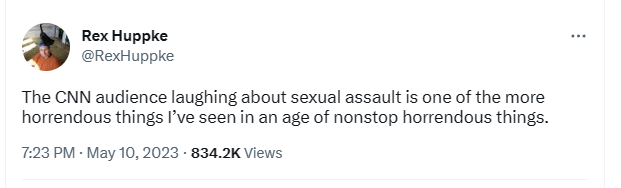
Instead, well, you saw it… (via Rex Hupke):

Sexual abuse, like the kind a jury just found Trump liable of? That’s a laugh line for these folks. Literally. They laughed during CNN’s town hall as Trump continued to likely defame E. Jean Carroll, the woman he was just found liable of defaming. 

The Jan. 6 domestic terrorist attack on the U.S. Capitol? Trump said he’ll swiftly pardon most of the now-imprisoned attackers, possibly even some of the Proud Boys who were convicted of seditious conspiracy, because they’re “great people.” And that brought applause from the crowd.

A rat-a-tat-tat string of lies about the “rigged election”? The crowd chuckled.

A lie about “finishing” the border wall he barely started? You know, the one Mexico didn’t pay for. The crowd applauded.

Lie, lie, lie, lie, lie. Laugh, applaud, chuckle, clap, cheer.

This was the moment we knew. 

We knew who Trump was of course. But last night showed us who we are and what’s about to happen. This is the GOP frontrunner. 

He is still the star who can do anything. And it will get worse.

“Listen,” wrote author Jared Yates Sexton, “if this town hall is any indication, and I think it is, the Trump Campaign of 2024 is going to be infinitely more disturbing and upsetting. I’ve spent a lot of time studying this man and his movement. I’m stunned by the depths here. This is . . . awful.”

**

More key reads:

Officer Michael Fanone:

Putting him onstage, having him answer questions like a normal candidate who didn’t get people killed in the process of trying to end the democracy he’s attempting to once again run, normalizes what Trump did. It sends a message that attempting a coup is just part of the process; that accepting election results is a choice; and that there are no consequences, in the media or in politics or anywhere else, for rejecting them.  

Tom Nichols in the Atlantic:

One might hope that Trump’s loss in New York would lead him to slink away in shame, but we now live in post-shame America. Instead, Trump will sit for a town hall on CNN tonight, where he will field questions as if he is a normal person running for office instead of a sexual abuser who incited sedition and violence against the government he is once again seeking to control.

Trump, of course, has the self-awareness of a traffic cone, and he is seemingly incapable of remorse. But CNN’s decision to move ahead with the event, as if nothing has happened, is disappointing. A more defensible position would have been to scrap the town-hall format and tell Trump that he is still invited to sit, one-on-one, with a CNN reporter. To present him to voters as just another candidate, however, is the very definition of normalizing his behavior.

Kara Swisher on Twitter:

A thread: As I said before, this was an impossible stage. But there were a few key moments where CNN could have taken back the con from Trump, even tho his cavalcade of lies made it very difficult and the audience was gamed in his favor. Here’s my quick thoughts as an interviewer.

In no particular order, you need to top Trump early and often, despite accusations of being unfair. For example, the obvious Nasty Woman retort would have been: “And a jury just yesterday unanimously called you a sexual predator. So here we are. Do you want to keep going here, because to quote Captain America, ‘I can do this all day.’” Make sure you can do it all day. (I can.)…

The Trump loving audience would jar anyone and it is easy to let it get to you. But it is also an opportunity to win some over, which is especially powerful if you are in someone’s home base. You only need one. 

So, when the crowd started snickering about E. Jean Carroll, for example, I would have stopped the interview cold, told Trump politely to sit still for a second, walked over to a man and a woman in the crowd who laughed and said: “Do you have a daughter? I do. She’s just three.”

Then, in the kindest tone possible, ask them if they said they did have a daughter or sister or wife, if they thought a man forcibly touching a woman’s genitals was actually funny, because I could not imagine they would since they did not look cruel. In any case, I would have interacted with the crowd a lot more, as most tend to fold when you pull individuals away from the mob. People don’t like to be found when they are acting badly and are usually embarrassed….

Amanda Carpenter in the Bulwark:

At times, it seemed like just another Trump rally. Even down to the moment where Trump turns the crowd against the press, as he did when he called Collins a “nasty person” to her face. (To her credit, she didn’t flinch.)

The event was a disaster for the reason that all of Trump’s live events are problematic: It’s much easier to spew lies on live television than it is for anyone to push back against them. Live coverage privileges the liar, no matter how nimble the interviewer.

But it all happened because CNN wanted a show. And they sure got one. No one should pretend it was some kind of public service.

The Daily Beast:

Throughout the 70-minute town hall, Trump refused to accept reality. When Collins tried to fact-check him, Trump just spoke over her and repeated his falsehoods. When she tried to correct Trump about his election lies, noting that Trump and his supporters lost more than 60 court cases, Trump simply kept lying.

“They found millions of votes on camera, on government cameras, where they were stuffing ballot boxes,” Trump falsely claimed.

Collins repeatedly tried to rectify the record, but Trump just kept forging ahead. When he said the “government cameras” showed “people going to 28 different voting booths”—something that never happened—Collins tried to correct him to no avail.

Halfway through the town hall, CNN staffers were acknowledging the event was a disaster for the truth.

“This is so bad,” one of CNN’s on-air personalities told The Daily Beast before the first commercial break. “I was cautiously optimistic despite the criticism… it is awful. It’s a Trump infomercial. We’re going to get crushed.”

“One of the worst hours I’ve ever seen on our air,” another CNN staffer told The Daily Beast.

Politico’s Playbook:

By the end of the night, the reviews were abysmal. The words “disaster” and “disgrace” were plastered all over Twitter….

Even network talent and talking heads participating on CNN panels following the event seemed shell-shocked. And sources inside the network confided their deep regrets.

“It was a complete disaster,” one CNN employee told Playbook, arguing that the format — specifically, stacking the audience with Trump supporters who cheered his lies — was a “strategic error.”

“It made it seem like CNN was endorsing that behavior,” the employee said. “Incredibly disappointing.”