Archives for category: Injustice

In the past few years, we have seen the rise of something called the “parental rights” movement. This movement consists of angry white parents, mostly women, like “Moms for Liberty” and “Parents Defending Freedom,” who insist that they as parents have the “right” to decide what their children are taught in school and what books they read. They strenuously object to teaching about race and racism, which they say makes their children “uncomfortable.” They believe that teachers are “grooming” their children to be gay or transgender by teaching them about gender or sexuality. Of course, if the last were true, almost everyone would now be transgender, since most students have taken a sex-ed course at some point, focused mainly on health.

In response to the outcry from these groups, a number of states, led by Florida and Virginia, have passed laws they describe as “parental rights” laws, which ban the teaching of “divisive concepts” because they make students “uncomfortable.” The most “divisive” concept of all is “critical race theory,” which states ban. Since legislators don’t know what critical race theory is, their laws are meant to remove any teaching about race and racism from the curriculum.

Bottom line: only white parents have parental rights.

But what about Black parents? Do they have rights? Apparently not.

What about other parents who do not identify with angry white parents? Don’t their children have the right to learn an accurate history of the state, the U.S., and the world?

Why do Moms for Liberty get to define what all parents want?

Shouldn’t Black children learn about the history of race and racism?

Why shouldn’t all students learn accurate history, even if it makes them “uncomfortable”?

Why should a small subset of far-right fringe white parents get the power to censor what everyone else is taught and is allowed to read?

These “parental rights” laws are a paper-thin veneer for censorship, gag orders, lies and propaganda. They are the product of arrogant racists who can’t be bothered to hide their venomous racism.

They prefer ignorance to knowledge. They should not be allowed to impose their hateful ideology on others.

Florida is led by a Republican governor and legislature determined to crush public schools. The state is overrun by unregulated voucher schools, where teachers and principals need no certification. Some of these openly discriminate and indoctrinate. The Orlando Sentinel ran a series about the voucher schools called “schools without rules.”

Florida has a thriving charter industry, many of them operated by for-profit corporations.

Now the state has passed a new law making it easier to open new charter schools and suck money out of the public schools.

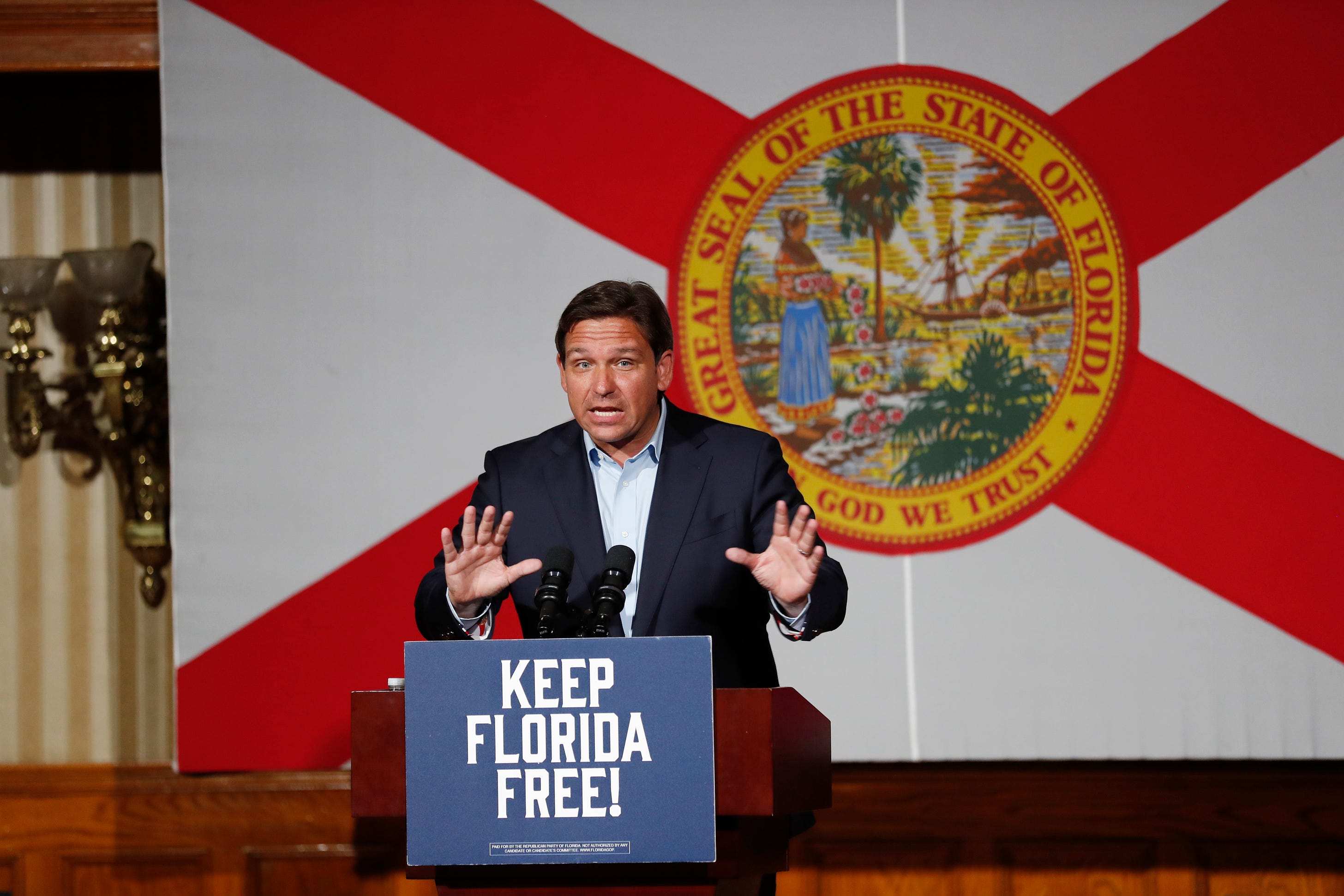
As this rampant privatization continues, Governor DeSantis keeps up a barrage of attacks on public schools and their teachers, accusing them of “indoctrinating” their students with anti-racist views and “grooming” children to be transgender.

CNN posted an important article about two billionaires in Texas who are spending heavily to push state politics to the extreme right fringes on social issues. Tim Dunn and Farris Wilks despise gays, love guns, and preach a version of Christianity that is suffused with hate, not love or charity or kindness. Above all, they aim to destroy public education, which they see as the root of America’s cultural decline.

If you read one article today, make it this one. It explains the drive for vouchers for religious schools. What Dunn and Wilks want is not “choice,” but indoctrination into their selfish, bumigored world view.

CNN’s investigative team writes:

Gun owners allowed to carry handguns without permits or training. Parents of transgender children facing investigation by state officials. Women forced to drive hours out-of-state to access abortion.

This is Texas now: While the Lone Star State has long been a bastion of Republican politics, new laws and policies have taken Texas further to the right in recent years than it has been in decades.

Elected officials and political observers in the state say a major factor in the transformation can be traced back to West Texas. Two billionaire oil and fracking magnates from the region, Tim Dunn and Farris Wilks, have quietly bankrolled some of Texas’ most far-right political candidates — helping reshape the state’s Republican Party in their worldview…

Critics, and even some former associates, say that Dunn and Wilks demand loyalty from the candidates they back, punishing even deeply conservative legislators who cross them by bankrolling primary challengers. Kel Seliger, a longtime Republican state senator from Amarillo who has clashed with the billionaires, said their influence has made Austin feel a little like Moscow.

“It is a Russian-style oligarchy, pure and simple,” Seliger said. “Really, really wealthy people who are willing to spend a lot of money to get policy made the way they want it — and they get it…”

Former associates of Dunn and Wilks who spoke to CNN said the billionaires are both especially focused on education issues, and their ultimate goal is to replace public education with private, Christian schooling. Wilks is a pastor at the church his father founded, and Dunn preaches at the church his family attends. In their sermons, they paint a picture of a nation under siege from liberal ideas…

Dunn and Wilks have been less successful in the 2022 primary elections than in past years: Almost all of the GOP legislative incumbents opposed by Defend Texas Liberty, a political action committee primarily funded by the duo, won their primaries this spring, and the group spent millions of dollars supporting a far-right opponent to Gov. Greg Abbott who lost by a wide margin.

But experts say the billionaires’ recent struggles are in part a symptom of their past success: Many of the candidates they’re challenging from the right, from Abbott down, have embraced more and more conservative positions, on issues from transgender rights to guns to voting.

“They dragged all the moderate candidates to the hard right in order to keep from losing,” said Bud Kennedy, a columnist for the Fort Worth Star-Telegram newspaper who’s covered 18 sessions of the Texas legislature…

People who’ve worked with Wilks and Dunn say they share an ultimate goal: replacing much of public education in Texas with private Christian schools. Now, educators and students are feeling the impact of that conservative ideology on the state’s school system.

Dorothy Burton, a former GOP activist and religious scholar, joined Farris Wilks on a 2015 Christian speaking tour organized by his brother-in-law and said she spoke at events he attended. She described the fracking magnate as “very quiet” but approachable: “You would look at him and you would never think that he was a billionaire,” she said.

But Burton said that after a year of hearing Wilks’ ideology on the speaking circuit, she became disillusioned by the single-mindedness of his conservatism.

“The goal is to tear up, tear down public education to nothing and rebuild it,” she said of Wilks. “And rebuild it the way God intended education to be.”

In sermons, Dunn and Wilks have advocated for religious influence in schooling. “When the Bible plainly teaches one thing and our culture teaches another, what do our children need to know what to do?” Wilks asks in one sermon from 2013.

Dunn, Wilks and the groups and politicians they both fund have been raising alarms about liberal ideas in the classroom, targeting teachers and school administrators they see as too progressive. The billionaires have especially focused on critical race theory, in what critics see as an attempt to use it as a scapegoat to break voters’ trust in public schooling.

In the summer of 2020, James Whitfield, the first Black principal of the mostly White Colleyville Heritage High School in the Dallas suburbs, penned a heartfelt, early-morning email in the wake of George Floyd’s murder, encouraging his school to “not grow weary in the battle against systemic racism.”

The backlash came months later. Stetson Clark, a former school board candidate whose campaign had been backed by a group that received its largest donations from Dunn and organizations he funded, accused Whitfield during a school board meeting last year of “encouraging all members of our community to become revolutionaries” and “encouraging the destruction and disruption of our district.” The board placed Whitfield on leave, and later voted not to renew his contract. He agreed to resign after coming to a settlement with the district. Clark did not respond to a request for comment.

Whitfield said he saw the rhetoric pushed by Dunn and Wilks as a major cause of his being pushed out.

“They want to disrupt and destroy public schools, because they would much rather have schools that are faith-based,” Whitfield said. “We know what has happened over the course of history in our country, and if we can’t teach that, then what do you want me to do?”

Meanwhile, the legislature has also been taking on the discussion of race in classrooms, passing a bill last year that bans schools from making teachers “discuss a widely debated and currently controversial issue of public policy or social affairs.” The legislation was designed to keep critical race theory out of the classroom, according to Abbott, who signed the bill into law.

Some of the co-authors and sponsors of the bill and previous versions of the legislation received significant funding from Dunn and Wilks.

The billionaires “want to destroy the public school system as we know it and, in its place, see more home-schooling and more private Christian schools,” said Deuell, the former senator.

By the power of their money, these two billionaires are reshaping public policy in Texas to make it as narrow-minded and bigoted as they are. Their reactionary vision will indoctrinate students and crush the freedom to teach and the freedom to learn.

If you live in Texas, vote for Beto O’Rourke for Governor, Mike Collier for Lt. Governor, and for legislators who support public schools.

Veteran educator Arnold Hillman and his wife Carol retired to South Carolina. But instead of golfing, they devoted themselves to a high-poverty high school and worked directly with the students to encourage them to aspire them to go to college.

Arnold writes here about what he has learned about South Carolina:

As with the beginning of any sports season, odds makers, fans, team owners, managers and coaches and players look forward to the onset of the games. In single person sports like golf, tennis, combat sports such as real wrestling, boxing, UFC, and the martial arts, expectations are even greater.

How do successful teams, individuals and those who are in charge, manage to rise above others? Why are certain teams and individuals levels of expectations so very high? Why is it that former doormats become champions in a few short years?

There are many examples of those kind or turnarounds. How about Cassius Clay (Muhammed Ali) destroying the world champion Sonny Liston? How did the 1980 USA hockey team come from obscurity to defeat the greatest teams in the world?. For pitysake, how did the New York Mets go from nothingness to World Series Champs in 1969?

There are so many examples of these kind of things that apply to what is happening in education here in South Carolina. Let’s go back to sports for a moment. Certainly, individuals have their own expectations of how they will succeed. Whether nature or nurture, is always a question. If a group of players on a football team have their own beliefs, and they are not shared by the coach, there will be little success.

Try and explain the success of the New England Patriots and then the Tampa Bay Buccaneers. In the case of New England, players wanted to be traded there because of the level of expectations the teams always had of themselves. Tom Brady and Bill Belicheck knew how to win and how to inspire others. Mediocre players who migrated to the Pats soon became integral parts of the success of the team.

Now that Tom Brady is with the Bucs and Bruce Arians, the Coach, there is also an expectation of victories. So, they win the Super Bowl in their first year together. On the other end is the Jacksonville Jaguars, with a super quarterback and a coach who had no level of expectations.

What does this have to do with education in South Carolina? Do we ever wonder why our state is always at the bottom of any ranking list in education? The history is long and continual. Here is a site that will take you a while to read. It is, however, a clear picture of why education has not flourished in our state.

Now that you understand our history, you can see why the level of expectation for our children is so low. Pat Conroy and his “Corridor of Shame,” described the situation in many of our poor and rural school districts. He taught in one of those districts. He understood.

For some reason, it appears that those in charge of education at the state level continue to treat parts of our state in a way that encourages low expectations. Here are some historical reasons why South Carolina’s education system has floundered though the years:


“1. A strong tradition brought from England that public support for education should be limited to the poor

2. Education seen as more of the responsibility of the Church than the State

3. Attitudes of those outside the wealthy class that worked against a unified system, including low regard for learning, reluctance to accept charity through free tuition, and the need to keep children in the family labor force

4. The very high cost in the 1700s and 1800s to provide quality schools outside the citiesand coastal areas, population was sparse and transportation poor

5. Strong resistance to local taxation for schools until the late 1800s

6. Interruption of a burgeoning “common school movement” in South Carolina by the CivilWar, and the subsequent disruption of a tax base

7. Increased white resistance to the public school idea following the Reconstruction government’s attempts to open schools to all races

8. An attitude on the part of some 20th century leaders that too much education would damage the state’s cheap labor force

9. The slow growth of state supervision of the schools due to strong sentiments toward local control

10. The financial burden of operating a racially segregated system, and the social and educational impact of combining two unequal systems”


(The History of South Carolina Schools

Edited by Virginia B. Bartels

Study commissioned by the Center for Educator Recruitment, Retention, and Advancement)

(CERRA–SC)


These historical happenings still are partially responsible for our current education system. Low test scores in the poor and rural sections of the state confound state leadership. Therefore, they have come to expect these outcomes year after year.

Yet, in travels across the state, SCORS (South Carolina Organization of Rural Schools) has seen how those school districts and their children make huge efforts to improve education. We have worked with these children in one local high school and seen the lack of resources, lack of quality of instruction, and actual lack of teachers in math and sciences.

In many of the rural and poor school districts, there has been “white flight” to private schools, charter schools, religious schools and home schoolings. Once again the wealthier the school district, the higher they are in the rankings of school districts in the state.

So, what is left- a lack of expectations for those left in the public schools. Why, say the talking heads and misunderstanders, aren’t these schools doing better. The system is really stacked against those poor and rural folks. However, are the children really unable to learn or compete, on any level, with the lighthouse districts? You bet they can. I have seen it.

Let me give you some anecdotal evidence. Dr. Vernon (not her real name) was the superintendent of a rural school district in South Carolina. She was, in fact, a product of the public schools in SC. She came from humble beginings and rose to her position as superintendent with some help from people and a great desire to help youngsters like herself.

After 5 years as superintendent, her board changed dramatically. One of her board members said that the students test scores on certain state tests were not true and that she had elevated those test scores. The Department of Education was called in and found none of those charges to be true. Board members could not believe that the children could be this good. By the way the superintendent and board parted ways with much acrimony.

Certainly there was much politics in her leaving. She also sued the board for defamation of character and won. Was all this because the level of expectations for the poor, minority and rural children were unable to improve on their test scores?

Another anecdote centers about a student (and an excellent basketball player) was placed in a prep school outside of Philadelphia. He spent a year there as a post graduate. After the first four weeks of school, he retook the SATs and got 120 more points than he had at his old school. He got an athletic scholarship from a prestigious university.

So what does all that mean? We can tell you from my 61 years in education that there is a blanket on our poor and rural children that leads to a lack of expectations and a lack of will to help these children.

Bob Shepherd, polymath and educator, predicts the truly extraordinary goal of the far-right extremist Supreme Court. It mainly consists of dismantling the federal government’s powers. This was proclaimed by Steve Bannon in 2016 before the Trump election. In this rightwing dream, all federal laws protecting civil rights, women’s rights, climate change, etc. would disappear.

Shepherd writes:

Let me be as clear about this as I can be. My reading of what the Extreme Court has been up to is NOT that it means to do away with the doctrine of stare decisis. No. It means to establish, with Dobbs v Jackson Women’s Health and West Virginia v. EPA, in this term, and with Moore v. Harper in the next term a new set of precedents designed to fulfil the conservative goals of a) shrinking the federal government down to a size at which it can be drowned in a bathtub and b) turning over power to state governments, many of which will be de facto theocracies under the new legal order. Dobbs provides a template or boilerplate for eliminating whole bodies of federal law and regulation related to unenumerated rights and with these these agencies and departments that do that regulation and enforcement. WV v. EPA is a template or boilerplate for eliminating government agencies or departments (or parts of these) that promulgate regulations pursuant to Congressional legislation on the basis of an argument that Congress can’t turn such decision-making over to Executive Branch agencies or departments because the Constitution insists that these are legislative matters. The idea, again, is to shrink the power and authority of the federal administrative state in full knowledge the fact that Congress,being divided, will not step into these various roles (will not, for example, agree on real climate change). And again, the effect of that will be, with the federal executive and legislature and courts all out of the picture, to turn all this power back to the states. And, finally, Moore will enable the court to rule that the feds cannot pass legislation to protect voting rights because determination of how voting is to be conducted is entirely up to state legislatures under this extremist reading of the Constitution. Again, the effect will be to eliminate federal power and agencies/departments and turn this all over to the states.

All this is revolutionary and is meant to be. It’s the fulfillment of a dream that conservatives in America have had for a long, long time. They have long believed in state’s rights, in the federal government being a monster not envisioned by the founders. This Extreme Court is simply making good on that.

And, btw, as with the various coup methods undertaken by Trump and his team, this has all been discussed on Steve Bannon’s War Room podcast (or whatever he wants to call it). He recently devoted much of a program to this very topic: the ways in which work is underway to completely “dismantle the administrative state.”

What is happening to the America that we swore allegiance to every day in public school? what happened to the America that was “indivisible, with liberty and justice for all”? How did we get a rogue Supreme Court that recklessly demolishes women’s rights, the separation of church and state, gun control, public safety, and efforts by government to prevent climate disasters? Who kidnapped the conservative Republican Party that believed in stability and tradition? From whence came the people who scorn the commonweal and ridicule Constitutional norms?

Former state legislator Jeanne Dietsch has an answer. Connect the dots by looking at what has happened to New Hampshire. The coup failed in Washington, D.C. on January 6, she writes. But it is moving forward in New Hampshire, with many of the same characters and all of the same goals.

If you read one post today, read this.

She writes:

During the last few weeks, US House leaders documented the nearly successful January 6 coup piece by piece, before our eyes. That personal power grab failed. Meanwhile, the steps clinching takeover of our government by radical reactionaries have nearly triumphed. A plan decades in the making. A plan nearly invisible to the ordinary public.


I can barely believe myself how this story weaves from Kansas to Concord to DC to the fields of southern Michigan over the course of six decades. It starts in Witchita. Koch Industries is the largest privately held company in the US, with over $115 billion in revenues, mostly fossil-fuel related. For many years, two of the founders’ sons, Charles and David Koch, each owned 42% of the company.


The younger, David, studied in the engineering department of MIT for 5 years, simultaneous with young John H. Sununu. Both finished their Master’s degrees in 1963.

1980: THE KOCHS SET THEIR GOALS


Seventeen years later, David Koch ran for Vice President of the US on the Libertarian ticket. The campaign was largely funded by Koch interests. The Libertarian platform of 1980, shown below, may look disturbingly familiar to those following news today.

Open her post to read the Koch Libertarian platform of 1980.

Libertarians demanded the abolition of Medicare, Medicaid, Social Security, public schools, aid to children, the Post Office, the Environmental Protection Agency, the Department of Energy, and more.

The infrastructure for achieving that platform was founded two years later. It was called the Federalist Society. It was a plan by a “small but influential group of law professors, lawyers, and judges.” Its goal?

To train members of their professions to believe in “originalism.” Originalists “strictly construe” the Constitution as they believed the Framers designed it way back in 1787. This matched David Koch’s 1980 platform. It would leave corporations free to do whatever profited them most without regard for social costs or regulations. Older Federalist Society members used their influence to advance their followers to higher judgeships.

SUNUNU FAMILY ROLES


Meanwhile, John Sununu became governor of New Hampshire, then Chief of Staff for President George W. Bush. In that role, John thwarted a plan for the US to join the international conference to address climate change in 1989. Actions like this, that benefitted Koch and the rest of the fossil-fuel industry, would become a hallmark of the Sununu family.


In 1993, an executive of Charles and David’s Koch Industries Michigan subsidiary, Guardian Industries, became a founding trustee of the Josiah Bartlett Center for Public Policy [JBC] in NH. Its mission was to advance many of the policies listed on David Koch’s platform of 1980. John Sununu, and later his son James, would chair the JBC board through today. Another of Sununu’s sons, Michael, would become a vocal climate denier and industry consultant. Still another, Senator John E. Sununu, would oppose the Climate Stewardship Act of 2003. But the Sununus were not coup leaders, just complicit.

BUILDING INFRASTRUCTURE FOR THE COUP


But let’s jump back to the Federalist Society. Its mission was succeeding. They were stacking the lower courts.?..Those justices hired young lawyers as clerks. From 1996-97, Thomas employed a Federalist Society clerk named John Eastman.


Twenty-three years later, Eastman would meet secretly with President Donald Trump. He would convince him that Vice President Pence could refuse to accept electoral college ballots on January 6. But back in 1999, Eastman became a senior fellow at the Claremont Institute. “The mission of the Claremont Institute is to restore the principles of the American Founding to their rightful, preeminent authority in our national life.”


Now we’re almost at the secret clubhouse of the coup. The Claremont Institute was run by a fellow regressive named Larry Arnn.(Photo below) In late 1999, Arnn was in the process of replacing the president of Hillsdale College because of a scandal that made national news. Hillsdale promotes conservative family values. Yet its leader was having an affair with his daughter-in-law. She committed suicide. Hillsdale was the central hub for Libertarian radicals so they needed a strong leader to pull them out of the mud.

Please read the rest of this fascinating post. There is one blatant error: she refers to “Clarence Thomas and Stephen Breyer” as Koch justices, but Breyer was a liberal justice appointed by Clinton. She must have meant the crackpot Alito.

Blogger Robert Hubbell brings clarity and reason to the abortion debate. The Court’s decision overturns a precedent that had been in place for 49 years. Both Justices Gorsuch and Kavanaugh pledged to Senators that they would not overturn roe. They lied. What now?

Hubbell writes:

There is much to discuss after the Supreme Court’s brutal ruling in Dobbs v Jackson Women’s Health, but the most important question is, “What are we going to do about it?” We have several effective paths forward and must pursue all simultaneously.

First, Alito claims he is returning the decision of reproductive freedom “to the people and their state representatives.” Let’s ignore (for the moment) Alito’s smoldering bad faith and thinly veiled contempt for the rights of women. We need to flip state legislatures to repeal antiabortion legislation and capture statewide executive offices that can veto legislation abortion bans. While this path is not an answer in every state, it can make a difference in states where the GOP margin of control is thin.

Second, we must demand that Congress pass legislation codifying Roe. That means gaining a 54-seat majority in the Senate, carving out an exception to the filibuster, and retaining control of the House. Will national legislation be challenged? Sure! Will the Supreme Court invalidate it? Possibly, but it is worth the effort.

Will national legislation be challenged? Sure! Will the Supreme Court invalidate it? Possibly, but it is worth the effort.

Third, we must break the Supreme Court. Democrats should expand the Court to thirteen justices. This path also requires holding the House, gaining a 54-seat majority in the Senate, and carving out an exception to the filibuster. Expanding the Court requires only a majority vote in both chambers of Congress and signing of the bill by the president. Will Republicans expand the Court to nineteen? Maybe. But what Republicans might do in the future shouldn’t deter us now. Will tit-for-tat expansions of the Court undermine its legitimacy? It is far too late for that.

Fourth, reproductive choice must be on the ballot in every race. Republicans have finally achieved what they wanted—no right to abortion and no exceptions for rape or incest. We must make every Republican running for every office in the land own the GOP position on abortion in its ugliest manifestation. The outcome in Dobbs is opposed by a strong majority of Americans and should provide a basis for a sweeping Democratic victory in 2022.

Finally, the right to same-sex marriage, same-sex relations, contraception, and other privacy-based rights must be on the ballot in every race. Justice Clarence Thomas’s concurrence declared war on those rights and invited reactionary legislatures to pass laws to serve as test cases. We would be foolish to assume that the other members of the reactionary majority will not follow his lead, given a chance.

None of these approaches will be easy or provide a complete answer. Readers have already sent emails that preemptively identify the problems with some of these approaches and dismiss their chances of success. But these are the paths available to us. We can choose to pursue them or do nothing. We must pursue them relentlessly until we have regained control of every branch of government, including the Supreme Court. Only then can we reverse the ruling in Dobbs and preserve other liberties grounded in the same right to privacy that supported reproductive rights for a half-century.

We are the majority, and American democracy presumes majority rule while protecting the rights of the minority. Republicans are attempting to reverse that presumption by seeking to impose permanent minority rule with no protection for the rights of the majority. That cannot stand. It will not stand. But it is up to us to restore the natural balance to democracy. It is not enough that we vote with greater passion or conviction. We must motivate those who did not believe this day would not come or who were not paying attention. We can do that—if we act with greater passion, conviction, and urgency.

The ruling.

Alito’s final decision is a judicial insult. In a single blow, he has demoted American women to second-class citizens. It is filled with venom and contempt in addressing a contentious issue on which people of good faith can disagree. He refers to physicians as abortionists when they seek to save a woman’s life or terminate a pregnancy forced on a teenager by a rapist. He misrepresents, minimizes, and dismisses the burdens and risks of pregnancy. He substitutes his Catholic dogma for judicial analysis.

Alito’s final version of his opinion changed little from the draft leaked last month. As such, it retains the dishonesty and intellectual sophistry of the “deeply rooted tradition” analysis contained in the draft—an analysis that deliberately misrepresents the American tradition relating to abortion. See Aaron Tang in The Los Angeles Times, Op-Ed: The Supreme Court flunks abortion history.

But most ominously, Alito’s “deeply rooted” analysis signals Alito’s intent to attack other privacy-based rights, such as same-sex marriage. Alito dissented in the Court’s decision recognizing same-sex marriage, Obergefell v. Hodges. Alito wrote in Obergefell, as follows:

          To prevent five unelected Justices from imposing their personal vision of liberty upon the American people, the Court has held that “liberty” under the Due Process Clause should be understood to protect only those rights that are ‘deeply rooted in this Nation’ s history and tradition.’ And it is beyond dispute that the right to same-sex marriage is not among those rights.

There it is: Alito’s analysis in overruling Roe v. Wade does not stop with reproductive rights. It reaches to same-sex marriage. He said so in his dissent in Obergefell. And Justice Thomas made that explicit in his concurrence in Dobbs:

          In future cases, we should reconsider all of this Court’s substantive due process precedents, including Griswold, Lawrence, and Obergefell.

Griswold recognized the right to use contraceptives of choice; Lawrence recognized the right to enter into a same-sex relationships; and Obergefell recognized the right of same-sex couples to marry. Justice Thomas notably omitted a right based on “substantive due process precedents”—the right of members of different “races” to marry, a right first granted in Loving v. Virginia in 1967. If the Court reverses Loving v. Virginia, Thomas’s marriage to Ginny Thomas would be illegal in some states.

For a longer discussion of the threat to other rights, see Mark Joseph Stern in Slate, The Supreme Court decision overruling Roe v. Wade puts marriage equality in immediate jeopardy.

It will take weeks to understand the implications of Justice Alito’s decision, but a good place to start is with Ian Millhiser’s analysis in Vox, The Roe v. Wade abortion decision, explained.

Finally, for a discussion of self-inflicted damage to the Court’s legitimacy, see Dahlia Lithwick, in Slate, Roe v. Wade overturned: The Supreme Court will pay for abortion decision.

The corruption and illegitimacy of the Supreme Court.

As currently constituted, the Supreme Court is illegitimate and corrupt. It is illegitimate because two justices appointed by Trump resulted from norm-busting “rules” made up by Mitch McConnell on the fly. Gorsuch sits in a seat stolen from an Obama appointee, and Barrett sits in a seat that belonged to the incoming president.

The Court is corrupt because Gorsuch, Kavanaugh, and Barrett lied to the Senate about their pre-determined intent to overrule Roe v. Wade. And it is corrupt because Justice Thomas has refused to recuse himself from cases in which his wife assisted in an attempted coup.

The trust of the American public in the Court has plummeted to an all-time low of 25%. It will decline further if the January 6th Committee proves that Ginny Thomas funneled information about Court deliberations to John Eastman. It will fall further if the Committee demonstrates that Justice Thomas knew of and condoned his wife’s insurrectionist activities.

Jennifer Rubin succinctly summarizes the death blow to the Court’s legitimacy in her column in WaPo, The Supreme Court eviscerates abortion rights and its own legitimacy. Per Rubin,

The hypocrisy and intellectual dishonesty of the court’s right-wing justices lead to the conclusion that they have simply appointed themselves super-legislators free to impose a view of the United States as a White, Christian and male-dominated society despite the values, beliefs and choices of a majority of 330 million modern Americans.

The court’s decision may result in women’s deaths. But it has certainly killed off what is left of the court’s credibility. And for that, there is no solution in sight.

Concluding Thoughts.

On a day like today, it does not feel right to end on an optimistic note. Rather, we should acknowledge the anger, frustration, fear, and grief that tens of millions of women in America are feeling after the ruling. There will be a time to rally and rejoin the fight for the dignity and equality of women—a fight we will win.

But today, we should acknowledge what women have lost and give them the time and space to absorb and recover from a once-in-a-generation shock. As they do, everyone in their lives should let them know we are at their side every step of the way. Walk along in silence and listen. Nothing can be “fixed” today, but we can begin the long journey back in the coming days.

As expected, the US Supreme Court overturned Roe v. Wade, which stood for half a century as a guarantee of women’s reproductive rights. About half or more states have already passed or are about to pass laws banning abortions, even for women who were victims of rape or incest, even for women whose life is in danger. The “right to life” so prized by anti-abortion activists does not include the life of the woman.

As was not quite so expected, the Supreme Court gutted the Miranda rights of people who are arrested. Police may fail to tell prisoners of their legal rights, including their right to remain silent.

The Trump Court is remaking and redefining the law in a radical way. There is nothing “conservative” about their willingness to toss out precedent. There is something very radical about the jackhammer they are using to change social and legal norms.

Women will die because of the Court’s decision to throw out Roe, which several of them pledged in public not to do. The old coat hanger routine and the unlicensed abortionists will return. Women who can afford to flee to a state where abortion is available will do so. Those who can self-medicate with Internet anti-abortion drugs will do so, although some states are trying to ban Internet abortion drugs (will they open every package to every woman of child-bearing age?).

The Court’s decision on New York’s gun law is terrifying. Be prepared to see armed men (and women, don’t forget Congresswoman Lauren Bobert) strolling through your neighborhood or shopping malls. If the six justices actually think that open carry is a fine idea, why won’t they permit it in their own courtroom?

Make no mistake: the current majority on the Supreme Court is not conservative; it is radical, in its reckless disregard for precedent and the safety of citizens.

The Court is not libertarian; its decisions require millions of people to abide by their cramped view of the way things ought to be. The state must fund religious schools, no matter how bigoted and discriminatory they are, if the state funds any private schools. States and cities must not protect their public by enacting laws that prevent them from openly carrying a deadly weapon.

We can expect even more intrusive decisions, valuing property rights over human rights, corporate rights over workers’ rights.

We will be living with this narrow-minded, bossy, intrusive Court for many years. My generation has failed. I look to the enlightened young people, the product of America’s much-maligned public schools, to reverse course in the future and preserve this fragile experiment in democracy from the ideologues who seek to destroy it.

For an insightful assessment of how the Supreme Court’s decision on abortion will affect women in Texas, read this article in The Texas Monthly.

An excerpt:

An excerpt: As trigger laws go into effect around the country, Texans seeking surgical abortions will likely find themselves in either Kansas or New Mexico, the two nearest states where the procedure will remain legal—though both have a limited number of clinics, which is likely to make scheduling an appointment difficult. Kansas has four clinics, which currently serve 530,000 potential patients of reproductive age. Now the state’s clinics will be the nearest alternative for 7.7 million such patients, according to theGuttmacher Institute, a nonprofit group that researches reproductive health. New Mexico, which has seven clinics, will be the nearest option for 1.9 million potential patients, the vast majority of whom will be Texans.

What about abortion pills?

Medication abortions, which are nonsurgical and administered by taking a two-dose regimen of pills that terminate a pregnancy, are currently illegal in Texas after the seventh week of pregnancy; after HB 1280 goes into effect on July 24, medication abortions, which are currently the most common type of abortions in Texas, are included in the total ban on the procedure in the state.

As of last December, Texas law also forbids the shipment of pills that induce an abortion “by courier, delivery, or mail service.” It’s unclear how Texas officials plan to enforce this law, as many U.S. and international organizations offer the pills by mail, or whether those who seek care after a self-administered abortion could face criminal charges under HB 1280, depending on how the law is applied.

Legislators see the Supreme Court ruling as a green light to outlaw abortion and criminalize anyone who performs one. The penalties are as stiff as murder.

I am tired of rightwing politicians distorting our language to suit their bigoted ideology.

They have the nerve, for example, to quote Dr. Martin Luther King Jr. when he spoke at the March on Washington in 1963 and said he hoped for the day when his children would be judged by the content of their character, not the color of their skin. Dr. King was projecting a vision of a world without racism, when people would see each other as friends, neighbors, and fellow human beings.

But rightwing politicians twist his words to insist that we should ignore racism right now, stop teaching about it, and pretend it does not exist. They use his words to justify prohibitions on teaching about or discussing the racism in the here and now. They use his appeal for an unrealized future to blind us to a cruel present.

I propose that we make a conscientious effort to reclaim the plain meaning of words.

One of the hot-button words that has been appropriated by rightwing politicians is “woke.” They are trying to turn it into a shameful word. I looked up the definition of WOKE. It means being aware of injustice and inequality, specifically when referring to racism. I strive to be aware of injustice and inequality and racial discrimination and to do whatever I can to change things for the better. Shouldn’t we all do that?

My acronym for WOKE is “Wide Open to Knowledge and Enlightenment.”

What would you say about someone who is not WOKE? They are “asleep,” “unconscious,” “indifferent.” They are “Mind Closed, Mouth Open.”

Yes, I am WOKE. I want Dr. King’s dream someday to be true. It is not true now.

Governor Ron DeSantis of Florida believes it is terrible to be woke. He demeans those he says are woke. He claims that the woke are politically correct and are intimidated by organized efforts to reduce racism in schools and the workplace. He thinks that being woke is so dreadful that it must be made illegal.

He urged the Florida legislature to pass “anti-woke” legislation in March. And they did. The so-called STOP WOKE” Act means “Stop the Wrongs to Our Kids and Employees Act.”

This legislation is intended specifically to silence discussions and study of racism. It bans the teaching of critical race theory in schools and colleges and bans diversity training in the workplace.

Governor DeSantis doesn’t want people to be opposed to injustice and inequality. He doesn’t want them to be opposed to racism. Such awareness makes some people feel uncomfortable, he says. We should teach nothing that makes anyone uncomfortable.

Who is uncomfortable when racism is discussed? In my experience, the people who don’t want any discussion of racism are either racist or are embarrassed by their acts of racism in the past.

To protect the tender sensibilities of white people, we must avoid any discussion that makes them or their children uncomfortable. We must not take the risk that they or their children might feel uncomfortable for terrible things that happened long ago. So don’t talk about them. Don’t read books that discuss slavery, the Ku Klux Klan, lynchings, or segregation. Don’t mention the distant past or the wrongs of the present. Don’t dare to talk about discrimination against black people, or the passage of laws that impair their right to vote, or the persistence of racially segregated schools.

Not only is it wrong to be woke, in the eyes of those who prefer to stifle all recognition of racial discrimination, it is absolutely forbidden for teachers or professors to examine the causes of racism and its persistence today in our laws and policies. Making a conscientious effort to understand the causes of racism and to seek remedies is called “critical race theory” (CRT).

The attacks on critical race theory are intended to intimidate teachers and to prevent students from learning about racism, past or present.

In states that have banned the teaching of critical race theory, the legislators can’t define CRT, so they make it illegal to teach “divisive concepts” or anything that makes some students “uncomfortable.”

When a white supremacist massacred ten Black people in Buffalo, New York, teachers in anti-CRT states were not sure if they were allowed to teach about what happened. Would they lose their jobs if they taught the truth?

The states that prohibit the teaching of critical race theory are banning the teaching of honest history, for fear that someone might be uncomfortable when they learn the facts about what was done to Black people in our history. Some states have explicitly banned Nikole Hannah-Jones’ “The 1619 Project,” because it might make some white people uncomfortable. I may be wrong, but I can’t recall a state that ever passed a law censoring a single book. This book is obviously very powerful and very frightening to those who feel the need to ban it. It cannot be refuted by the DeSantis faction so it must be banned.

The same states that want to ban honest teaching about racism are also banning books about gender identity and sexuality. The legislatures in Republican states think that the schools are filled with pedophiles. The rightwing zealots claim that teachers are “grooming” their students to become gay or transgender. They pass laws like Florida’s “Don’t Say Gay” law, which bans teaching about gender identity and sexuality in grades K-3 (where gender identity and sexuality are not taught) and tolerate only “age-appropriate” discussion of gender identity and sexuality in other grades.

Like the STOP WOKE law, the “Don’t Say Gay” law is vague, which makes teachers fearful of teaching anything related to gender or sexuality. If schools can’t teach about gender identity, then they cannot teach about married couples of any gender. If you take them literally, you should not refer to Moms and Dads, men and women. Dare we teach young children about heterosexuality? Apparently not, if you follow the letter of the law.

The groups that are behind these attacks are familiar to us. They are Moms for Liberty, Moms for America, Parents Defending Freedom, and a bevy of other groups funded by rightwing billionaires.

Not coincidentally, these are the same groups that are fighting to pass funding for charter schools and vouchers.

What is their motive? They want to destroy not only freedom of thought but public schools.

Recently, I watched the far-right provocateur Chris Rufo give a speech at Hillsdale College. He called on his audience to act in a speech titled “Laying Siege to the Institutions.” (Please watch it: https://www.youtube.com/watch?v=W8Hh0GqoJcE). Rufo claims credit for making CRT a national issue. He boasts that a few years ago, CRT had virtually no public recognition. Thanks to his lies and distortions, most people have heard of it and some think it is a radical, Marxist plot to destroy America by turning race against race. Because he says so.

This is absurd.

For the past four decades, CRT was known as a law school study of the origins of systemic racism and the extent to which it is embedded in our laws and institutions. Its founder was Derrick Bell of Harvard Law School. He was a friend of mine. He was not a Marxist or a radical. He was a great American who wanted America to live up to its promises. Unlike Rufo, he didn’t believe in gag orders and bans. He believed in study, scholarship, debate and discussion.

Chris Rufo offers one solution to all the problems he sees: school choice.

To him, the public school is the most dangerous of all institutions, because it teaches equality, justice, and critical thinking. It teaches students to respect others. It teaches them to abhor racism and other forms of bigotry. It teaches students about American history without censoring the unpleasant and horrifying parts. The laws passed to ban CRT and to gag teachers have one purpose: Teach lies, not honest history.

Here is what I suggest.

Fight censorship.

Fight privatization of our public assets.

Read without fear.

Read “The 1619 Project,” which will open your minds. Read critiques of “The 1619 Project” by reputable scholars, not by rightwing ideologues.

Think about it. Discuss and debate the issues.

Say gay.

Stand up to the craven politicians who attack your freedoms.

Vote against them when you have the chance.

Fearlessly defend the freedom to read, the freedom to teach, and the freedom to learn.

Work towards the day when we treat each other with respect.

Wake up.

Jan Resseger, now retired, spent her career as an activist for social justice. Her recent essay was reposted by the Network for Public Education. It seemed appropriate to post it on the 68th anniversary of the Brown v. Board of Education Decision of 1954. In trying to assess the meager progress towards the ideals of Brown—specifically, equality of educational opportunity—she lays some of the blame on No Child Left Behind and the corporate school reform movement,

Jan Resseger attended the recent Network for Public Education conference, where she took inspiration from speaker Jitu Brown, director of the Journey for Justice Alliance. Reposted with permission.

She wrote:

A highlight of the Network for Public Education’s recent national conference was the keynote from Jitu Brown, a gifted and dedicated Chicago community organizer and the national director of the Journey for Justice Alliance. His remarks made me think about the meaning of the last two decades of corporate school reform and the conditions today in his city and here where I live in greater Cleveland, Ohio. It is a sad story.

Brown reflected on his childhood experience at a West Side Chicago elementary school, a place where he remembers being exposed to a wide range of information and experience including the study of a foreign language. He wondered, “Why did we have good neighborhood schools when I went to school but our kids don’t have them anymore? For children in poor neighborhoods, their education is not better.”

Brown described how No Child Left Behind’s basic drilling and test prep in the two subjects for which NCLB demands testing—math and language arts—eat up up more and more of the school day. We can consult Harvard University expert on testing, Daniel Koretz, for the details about why the testing regime has been particularly hard on children in schools where poverty is concentrated: “Inappropriate test preparation… is more severe in some places than in others. Teachers of high-achieving students have less reason to indulge in bad preparation for high-stakes tests because the majority of their students will score adequately without it—in particular, above the ‘proficient’ cut score that counts for accountability purposes. So one would expect that test preparation would be a more severe problem in schools serving high concentrations of disadvantaged students, and it is.” (The Testing Charade, pp. 116-117)

Of course, a narrowed curriculum is only one factor in today’s inequity. Derek W. Black and Axton Crolley explain: “(A) 2018 report revealed, school districts enrolling ‘the most students of color receive about $1,800 or 13% less per student’ than districts serving the fewest students of color… Most school funding gaps have a simple explanation: Public school budgets rely heavily on local property taxes. Communities with low property values can tax themselves at much higher rates than others but still fail to generate anywhere near the same level of resources as other communities. In fact, in 46 of 50 states, local school funding schemes drive more resources to middle-income students than poor students.”

Again and again in his recent keynote address, Jitu Brown described the consequences of Chicago’s experiment with corporate accountability-based school reform. Chicago is a city still coping with the effect of the closure of 50 neighborhood schools in June of 2013—part of the collateral damage of the Renaissance 2010 charter school expansion—a portfolio school reform program administered by Arne Duncan to open charter schools and close neighborhood schools deemed “failing,” as measured by standardized test scores. On top of the charter expansion, Chicago instituted student-based-budgeting, which has trapped a number of Chicago public schools in a downward spiral as students experiment with charter schools and as enrollment diminishes, both of which spawn staffing and program cuts and put the school on a path toward closure.

As Jitu Brown reflected on his inspiring elementary school experience a long time ago, I thought about a moving recent article by Carolyn Cooper, a long time resident of Cleveland, Ohio’s East Glenville neighborhood: “I received a stellar education in elementary, junior high, and high school from the… Cleveland Public School system… All of the schools I attended were within walking distance, or only a few miles from my home. And at Iowa-Maple Elementary School, a K-6 school at the time, I was able to join the French Club and study abroad for months in both Paris and Lyon, France… Flash forward to this present day… To fight the closure of both Iowa-Maple and Collinwood High School, a few alumni attended a school facilities meeting held in October 2019 at Glenville High School… Despite our best efforts, Collinwood remained open but Iowa-Maple still closed down… Several generations of my family, as well as the families of other people who lived on my street, were alumni there. I felt it should have remained open because it was a 5-Star school, offering a variety of programs including gifted and advanced courses, special education, preschool offerings, and Individualized Education Programs (IEPs).”

In his keynote address last week, Jitu Brown explained: “Justice and opportunity depend on the institutions to which children have access.” Brown’s words brought to my mind another part of Cleveland’s Glenville neighborhood less than a mile from Iowa-Maple Elementary School. If you drive along Lakeview Road between Superior and St. Clair Avenues, you see a neighborhood with older homes of a size comfortable for families and scattered newer rental housing built about twenty years ago with support from tax credits. You also see many empty lots where houses were abandoned and later demolished in the years following the 2008 foreclosure crisis. Separated by several blocks, you pass two large weedy tracts of land which were once the sites of two different public elementary schools—abandoned by the school district and boarded up for years before they were demolished. You pass by a convenience store surrounded by cracked asphalt and gravel. Finally you pass a dilapidated, abandoned nursing home which for several years housed the Virtual Schoolhouse, a charter school that advertised on the back of Regional Transit Authority buses until it shut down in 2018.

My children went to school in Cleveland Heights, only a couple of miles from Glenville. Cleveland Heights-University Heights is a mixed income, racially integrated, majority African American, inner-ring suburban school district. Our children can walk to neighborhood public schools that are a great source of community pride. Our community is not wealthy, but we have managed to pass our school levies to support our children with strong academics. We recently passed a bond issue to update and repair our old high school, where my children had the opportunity to play in a symphony orchestra, and play sports in addition to the excellent academic program.

Jitu Brown helped organize and lead the 2015 Dyett Hunger Strike, which forced the Chicago Public Schools to reopen a shuttered South Side Chicago high school. Brown does not believe that charter schools and vouchers are the way to increase opportunity for children in places like Chicago’s South and West Sides and Cleveland’s Glenville and Collinwood neighborhoods. He explains: “When you go to a middle-class white community you don’t see charter schools…. You see effective, K-12 systems of education in their neighborhoods. Our children deserve the same.”

In the powerful final essay in the new book, Public Education: Defending a Cornerstone of American Democracy, Bill Ayers, a retired professor of education at the University of Illinois, Chicago, agrees with Jitu Brown about what ought to be the promise of public education for every child in America:

“Let’s move forward guided by an unshakable first principle: Public education is a human right and a basic community responsibility… Every child has the right to a free, high-quality education. A decent, generously staffed school facility must be in easy reach for every family… What the most privileged parents have for their public school children right now—small class sizes, fully trained and well compensated teachers, physics and chemistry labs, sports teams, physical education and athletic fields and gymnasiums, after-school and summer programs, generous arts programs that include music, theater, and fine arts—is the baseline for what we want for all children.” (Public Education: Defending a Cornerstone of American Democracy, pp. 314-315) (emphasis in the original)