• Lawmakers in several states are discussing enacting or expanding school voucher tax credits, which reimburse individuals and businesses for “donations” they make to organizations that give out vouchers for free or reduced tuition at private K-12 schools. In effect, these credits allow contributing families to opt out of paying for public education and other public services.
• New data—published here for the first time—reveal that wealthy families are overwhelmingly the ones using these credits to opt out of paying tax to public coffers. In all three states providing data, most of the credits are being claimed by families with incomes over $200,000.
• Wealthy families’ interest in these programs is being driven partly by a pair of tax shelters that can make “donating” profitable. These shelters hinge on stacking state and federal tax cuts and are being advertised in the states as a way to get a “double tax benefit” and “make money” in the process. This kind of language is a far cry from most nonprofit fundraising pitches and gives some sense of the supersized nature of the tax benefits being offered for private and religious K-12 schooling.
• Voucher tax credits are without merit and should be repealed. Short of that, states can end their use as profitable tax shelters with straightforward reforms. A national solution to this problem, however, will require action by the IRS.
One of the most disturbing recent shifts in U.S. public policy has been the renewed push to privatize the nation’s K-12 education system.[1] Originally born out of a desire to preserve school segregation and racial inequality more broadly, the so-called “school choice” movement is enjoying a resurgence as many state lawmakers look for ways to move more kids into private and religious schools.[2] That end is being hastened through the tax code in major ways. In short, school privatization proponents have managed to set up state policies that harness deficiencies in federal tax law and the self-interest of wealthy families to gin up enthusiasm for privatizing the U.S. public education system.
Voucher Tax Credits
State voucher tax credits are among the most significant tools eroding the public education system and propping up private schools. These policies are on the books in 21 states and proposals to create or expand them are being discussed this year in places like Alabama, Georgia, Kansas, Montana, Nebraska, South Carolina, and Texas.[3]
Voucher tax credits reimburse individuals and businesses for “donations” they make to organizations that give out vouchers for free or reduced tuition at private K-12 schools—the overwhelming majority of which are religious in nature.[4]
Unlike charitable gifts to other causes where taxpayers save less than 10 cents in state taxes for every dollar donated, these supersized incentives often give private school “donors” their full donation back. This unusual payoff scheme necessitated a whole new set of regulations from the IRS to enforce the commonsense notion that families being reimbursed for their “gifts” have not done anything genuinely charitable and should not receive federal charitable deductions.[5] Before those regulations took effect, it was common for private schools to tell wealthy families that pairing voucher credits with the federal charitable deduction was a great way to “make money.”[6]
While the IRS has taken steps to prevent taxpayers from misusing the charitable deduction in combination with these state tax credits, significant tax avoidance is still occurring through less-scrutinized channels. The fact that these programs continue to allow many high-income taxpayers to turn a profit for themselves is helping accelerate the diversion of public funding into private schools. States have the power to prevent aggressive tax avoidance through their voucher tax credits, as explained below, but many have turned a blind eye in the interest of maximizing growth in these programs.
A Subsidy for the Wealthy
Despite voucher tax credits’ charitable facade, the reality is they allow wealthy families to opt out of paying for public education and other public services, and to redirect their tax dollars to private and religious instruction instead. If a taxpayer sends $1,000 to a private school organization and receives a $1,000 state tax credit in return, the plain result of that is that the tax dollars have been rerouted away from public coffers and to private organizations instead.
We now know that wealthy families are overwhelmingly the ones using these credits to opt out of paying tax to public coffers because new data—published here for the first time—that we’ve obtained from tax agencies in three states show exactly that.
Please open the link and read the rest of this important study and analysis.
A reader named JCGrim posted an important fact about vouchers: Voucher schools are not required to comply with the federal law that protects the rights of students with disabilities.
Vouchers are a backdoor scheme to make kids with disabilities disappear. Move them off the books & into unaccountable, unstable, non-transparent places.
The Council for Exceptional Children (CEC) oppose vouchers on the grounds that voucher & voucher-like programs fail to comply with IDEA’s provision of a free, appropriate, public education (FAPE).
Position on Use of Public Education Dollars to Fund School Vouchers and Other Voucher-Type Programs Approved July 2020 pubpol@exceptionalchildren.org CEC opposes school vouchers and voucher-type programs for all children and youth including those with disabilities. Such programs are contrary to the best interests of all children and youth and their families, the public-school system, local communities, and taxpayers.
Mercedes Schneider writes here about Governor Ron DeSantis’s shameless moves to wipe out courses in K-12 and in higher education that he does not like. He is leading an audacious attack on academic freedom that has not been seen in this country since the early 1950s during the Joe McCarthy era. Then the enemy was Communism, now it is fear of those who want to investigate the roots and practices of social and political injustice.
Such people, to DeSantis, are enemies of the social order. They are WOKE, awake to inequity; they make students want to change the status quo. They cannot be tolerated. Their ideas must be eliminated. DeSantis is leading this purge, he says, to protect “freedom.” The language is Orwellian. He means to stamp out the freedom to teach and learn while boasting of his love of freedom.
In addition, he wants to transfer the power to hire new faculty from the faculty to college presidents, whom he appoints. The entire state university would become subservient to his authoritarian impulses.
Schneider describes what is happening, mostly under the radar, as DeSantis wages war on freedom of inquiry:
The current ultra-conservative education platform seeks to stifle all formal or informal discussion of diversity, equity, or inclusion in public K12 and postsecondary education, with Florida apparently leading such efforts.
Though as of yet not a formally-declared 2024 candidate, Florida governor, Ron DeSantis is in the GOP polls as an assumed and formidible GOP presidential primary candidate.
DeSantis, and the Florida legislature are working hard to exercise power over what courses or majors could exist in Florida universities, with legislative efforts to kill womens and gender studies and, as the Insider notes, “gut” a variety of majors. Meanwhile, the February 24, 2023, Tampa Bay Times reports that the Florida Department of Education (FDOE) “told school districts to produce detailed information about the programs and materials they use to address some of the state’s most hotly debated subjects.” Continuing:
In an email delivered late Tuesday, the department instructed superintendents to fill out a 34-question survey identifying titles of books and programs they have relating to sex education, social-emotional learning, culturally relevant teaching and diversity, and equity and inclusion, among other topics. It asked for specifics for student courses and employee training.
The department requested names and examples from district and charter schools.
FDOE wants the information by Monday, February 27, 2023, though it did not offer any reason.
The FDOE request came on the same day that Florida HB 999 was filed by Alex Andrade (R-Pensacola). The bill would remove faculty input from the hiring process; prohibit hiring based on diversity, equity, and inclusion (DEI); remove majors and minors related to Critical Race Theory, gender studies or intersectionailty.
This rewrite of the previous bill seeks to remove any mention of “politics,” including striking through statements such as, “Motivate students throughout the Florida State University to become aware of the significance of government and civic engagement at all levels and politics in general”; “Provide students with an opportunity to be politically active and civically engaged”, and “Nurture a greater awareness of and passion for public service and politics.”
DeSantis does not want to encourage students to become engaged in civic action. He wants to nurture complacence and passivity “in this best of all possible worlds.
Please open her post to read the gory details of this audacious attempt to put the governor of the state in charge of whatever is taught in his state.
What DeSantis is doing is not conservative. It is radical. It is authoritarian. He shows no respect for critical thinking or debate. He is unwilling to allow students to learn anything he does not like. His desire for control of what can be taught or learned is dangerous to democracy. He is attempting to establish a dictatorship and has a super-majority of both houses in the legislature who will give him whatever he wants.
Peter Goodman is a long-time commentator on education issues in New York City and New York State. In this post, he raises important questions: Have charter schools met the goals set when they were authorized? Should they have the right to exclude students they don’t want? Why should the city fund two competing school systems?
As you can see by the response of an editor at the pro-charter New York Post, part of Rupert Murdoch’s media empire, charter supporters oppose this idea and find it outrageous. What do you think?
Carol Burris is the executive director for of the Network for Public Education. in this post, which she wrote exclusively for the blog, she reveals the details of Arkansas Governor Sarah Huckabee Sanders’ plan to defund and destroy the public schools in her state.
Burris writes:
Sarah Huckabee Sanders, the daughter of Baptist minister and former Governor Mike Huckabee, missed learning the 9th commandment that prohibits telling a lie. As press secretary to Donald Trump, her distortions of the truth resulted in the editor of Forbes warning corporations against hiring Sanders and other Trump “propagandists,” writing, “Forbes will assume that everything your company or firm talks about is a lie.”
Now she is the Governor of Arkansas. On her first day in office and in her response to Biden’s State of the Union, she parroted the old “education is the civil rights issue of our time” line that has been used to justify horrible policies from school closures to charter schools and vouchers. However, the disconnect between what she says and what she does quickly became apparent. On her first day in office, she issued an executive order prohibiting “indoctrination and critical race theory in schools” and another banning the term “Latinx” from being used in state documents. State authorities are investigating AP African American Studies at Little Rock Central High School, where the majority of students are Black.
If we need further proof that this self-proclaimed champion of Civil Rights is more aptly described as a champion of Civil Wrongs, look at her recently leaked ed reform plan.
Here are its features:
The Privatization of Public Education:
· Her voucher plan is a universal ESA—the plan now favored by the far-right. These plans have few rules and no family eligibility requirements. They have become Entitlement Spending Accounts–cash going into the pockets of private school families regardless of income. The leaked plan does not say how taxpayers will pay for it. But everyone will be eligible by 2025. It includes Voucher funding for homeschools. The only restrictions will apply to vendors, so those who enroll their children in those recently uncovered Neo-Nazi homeschools can find ways to cash in.
· Increased tax credits for contributions to an existing voucher program.
· Local School Boards can contract with an open-enrollment charter school or private company to run a school campus at risk of state takeover due to low performance—and if they do, they get a financial incentive.
· Establishment of a charter-school construction fund for new charters and expansion.
· Elimination of the cap on charters.
· Charter school applications no longer need to be reviewed and approved by the local school district board of directors.
· All students attending a public school can take courses and earn credit for classes not offered in their school. By the beginning of the 2025-2026 school year, students attending a public school that receives a letter grade of “C”, “D”, or “P” from the Arkansas School and District Accountability System may take their required courses (i.e. math, English, etc.) through the course choice program. Bet your bottom dollar that these courses will be online, with vendors like Stride K12 making a fortune.
Censoring and Controlling Curriculum
· K-3 literacy evaluation will be aligned with the “science of reading.”
· Before grade 5, teachers cannot provide classroom instruction on the following topics: sexually explicit materials, sexual reproduction, sexual intercourse, gender identity, and sexual orientation.
· School districts must implement an age-appropriate child sexual prevention program for grades K-12, allowing parents to preview materials and exempt their children from instruction. (I have no idea what a child sexual prevention program even is.)
· The Secretary of Education will review the Department of Education regulations, policies, materials, and communications to ensure they do not indoctrinate students with ideologies that conflict with the principle of equal protection under the law.
· No school employee or student must attend training on prohibited indoctrination or Critical Race Theory.
Harmful Policies for Students
· 3rd-grade retention based on deficits in reading proficiency.
· An accountability system for pre-school education that includes student data.
· Literacy testing three times a year for all students in K-3.
· Curriculum tracking in Grade 8.
· Community service requirements, which may, for some students, be challenging to meet.
· Mandated cops on campus.
· Career-ready pathways in partnership with local business and industry leaders” translate workforce training programs to track students into low-paying and middle-wage jobs.
Punitive Policies for Teachers
· Elimination of due process in dismissals.
· Base salaries will no longer increase by years of experience or for Master’s degrees.
· Bonuses based on VAM.
There are a few likable initiatives in her plan, such as paid maternity leave for teachers, but if she makes districts fund them even as she drains their funding with charter schools and voucher expansion, a good initiative will be one more financial pressure on already underfunded schools.
Sarah Huckabee Sanders’ education plan is a hodgepodge of all the awful and ineffective ideas proposed since No Child Left Behind. The fingerprints of JEB! and the Walton family are over the leaked legislation.
Despite its hodgepodge nature, one thing is clear—its ultimate intent is to destroy public education in the state by slamming a fist down on students, public schools, and their teachers while propping up a wild and largely unaccountable privatized system.
Dan Rather and Elliott Kirschner write a blog called Steady. Their voice is always thoughtful, reasonable, informed, and…steady. I think that they, like me, are old enough to remember when we believed that overt racism was ebbing and that white supremacy was dead. Our hopes have been shattered since 2016. It takes the use of critical race theory to understand why we were so naive. Here is their take on the big Education story of the day:
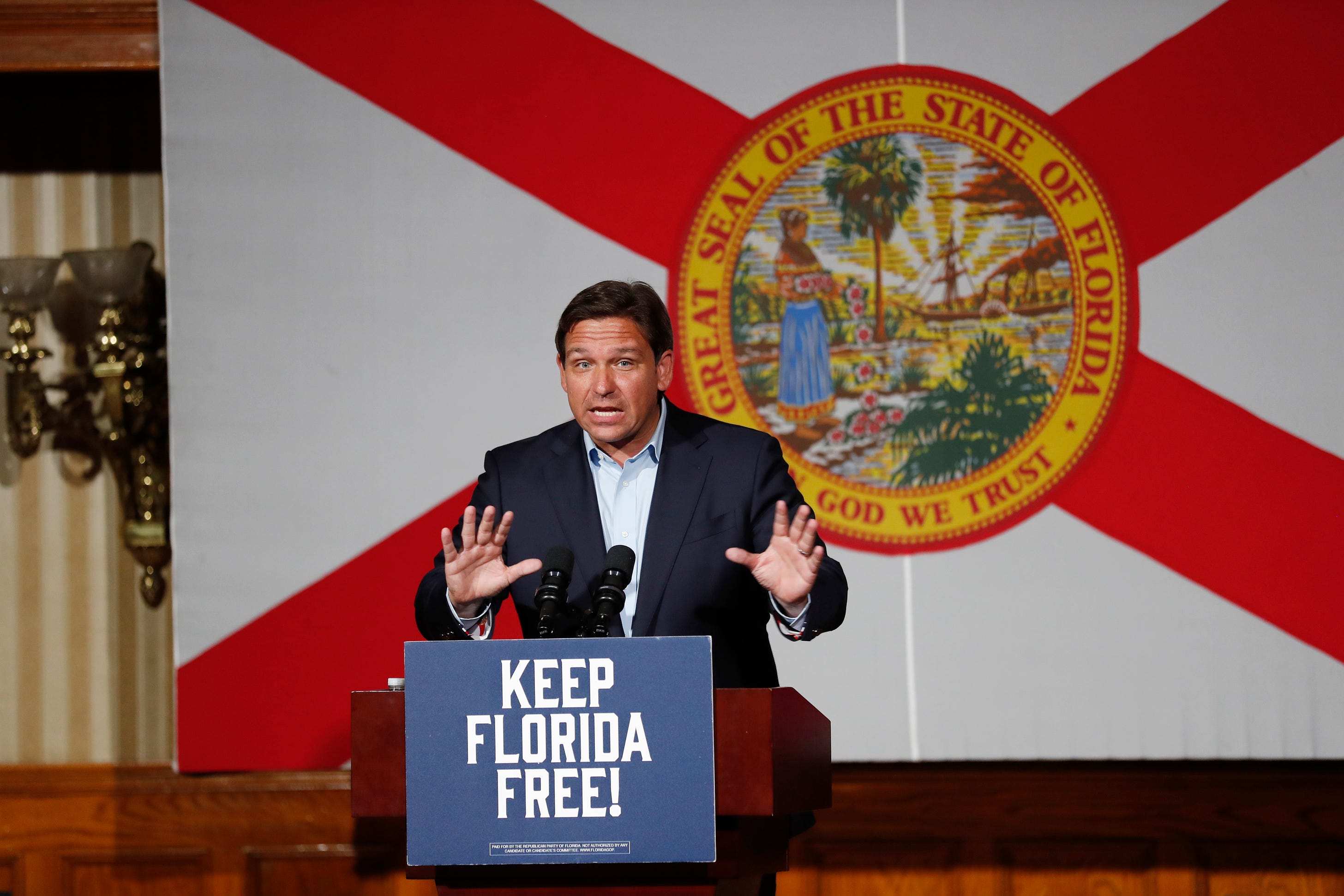
Photo credit: Octavio Jones
Editor’s note: this is an ironic banner in front of DeSantis. Florida is not free for those who don’t share his ideology. If you think racism exists today in Florida, you are not free to discuss it in school or college. You are free to agree with him.
Rather and Kirschner write:
Much of American history is entangled with racism and white supremacy. That is the reality of our beloved nation, no matter how much we wish it were not.
As we sit here nearly a quarter of the way through the 21st century, it is obvious that we need to have the maturity to look back to our past as well as ahead to the future. Can we do this with our eyes wide open? Will we study and learn from the lessons of history?
You can’t grapple with the truth if you hide it from view. Yes, our national narrative is an inspiring one — of freedom, rights, and new opportunities. But it is also a narrative of pain — of the bondage, rape, and murder of enslaved people. It is a story of mass death, broken treaties, and land stolen from Native people. And it is a story of persecution of the “other,” time and again.
The chasm between the noble promises of our founding documents and our historical realities continues to obstruct our national journey toward a more perfect union.
Yes, ours is a country that has facilitated exploration, innovation, and growth, but it is also one built upon families torn apart at the auction block, bodies whipped, and police dogs and fire hoses set against children.
Cities were redlined. Public schools were segregated. And despite our carefully cultivated national image as a meritocracy, throughout our history we have seen talent overlooked and our common humanity diminished on account of people’s race, religion, and sexual orientation.
The ripples of injustice continue to destabilize our society.
It shouldn’t be controversial to say any of this. But acknowledging these truths today is a political act, because it threatens the privileged narratives of those who seek to sugarcoat our past. These are men and women who serve their own ambitions by fortifying their cynical holds on power, delighting in division, feeding off fear, and applauding anger.
And that brings us to Florida’s Governor Ron DeSantis.
Listing all of his efforts to leverage the power of his office to attack equity, empathy, and justice would stretch this post immeasurably. But doing so would also jeopardize the central point: DeSantis is an opportunist. He is not weighing the merits of any one campaign. Rather, he wants headlines as a culture warrior standing up to “wokeness,” a term he has eagerly redefined to suit his own purposes. It allows him to sneer at and dismiss any attempt to reckon with American injustice.
DeSantis has focused his assaults on two of our society’s most traditionally marginalized groups: Black Americans and the LGBTQ community. While these populations have thus far felt the brunt of his targeting, we need to see clearly that his rhetoric is a threat to all who care about a democratic, peaceful, empathetic, and just America. Those of us with the greatest privilege should bear a special burden in rejecting this hate.
DeSantis’s pugilism has enabled him to consolidate power in Florida. Any opposition to his toxic initiatives must contend with the uncomfortable truth that voters validated his message and style via his landslide win in November. Now DeSantis thinks he can take his show on the road with a presidential bid. That remains to be seen. Florida has been trending Republican in recent years, and success there might not translate to the current battleground states, many of which saw big Democratic wins in the midterms.
All that being said, there is a great danger to framing this struggle primarily through the lens of electoral politics. This normalizes a discourse that should be rejected by society’s mainstream. Just as the outright bigotry of the past became socially unacceptable, so too should these latest attempts at divisiveness.
It should not surprise us that DeSantis is making schools — both K-12 and college — a central target. He wants to teach a distorted view of America. He wants to make dissenting speech not only suspect but even criminal. He wants to silence the voices of his critics and of critical thinking more generally. This is a playbook that has been followed by demagogues before to very dangerous ends.
It is essential that DeSantis not be covered by the press through a false equivalence paradigm. We can debate what we should teach and how to teach it. But we can’t replace the truth, as unsavory as it may be, with sanitized narratives that suit those already in power. This is a battle for the minds of the voters of the future. This is about what kind of nation we will become.
But DeSantis primarily cares about what kind of country we are now. He wants to appeal to fear because he thinks he can mine that fear for votes. That is his game plan. And he’s not hiding it. There can be no appeasement. DeSantis has already shown that he isn’t interested in deliberations or good faith compromise. Those would disrupt his approach of means to an end.
History illustrates that hatred can be taught, but so can empathy and justice. We are on a winding journey as a nation. And we have much farther to go. But we have made progress in the face of bigots and autocrats because people had the courage to forge the inequities of our past into a more equitable future.
This history, this truth, is what scares people like DeSantis the most. But it is one that can give us hope if we are determined not to look away.
Vouchers were originally sold as a way to “save” poor children of color from failing schools. We now know that this claim is not true. Poor kids who use vouchers typically fall behind their peers in public school. In state after state, vouchers are subsidizing students who are already enrolled in private schools and never attended public schools. The funding of vouchers takes money away from the public schools attended by most students, meaning larger classes, fewer resources.
Nearly Half of Universal Voucher Applicants are from Wealthier Communities
Total State Private School Subsidies Reach $600M
Dave Wells, Research Director
Curt Cardine, Research Fellow
Distribution of Universal ESAs vs. Distribution of Students
Key Findings:
45% of universal Empowerment Scholarship Account (ESA) applicants come from the wealthiest quarter of students in the state. Their families live in zip codes where the median household income is $80,000 or more, more than 30% greater than the state’s median income.
32% of universal ESA applicants are from families with a median income less than $60,000, which comprise just over half the students in the state.
80% of universal ESA applicants are not in public school, meaning these students are already attending private schools, being home schooled, or just entering schooling. At a cost of about $7,000 per voucher this equates to potential new cost to the state of $177 million.
Arizona will spend more than $600 million on private school subsidies—universal ESAs and Student Tuition Organization Scholarships—in the 2022-23 school year.
Only 3.5% of all applicants came from zip codes that had a district high school or 2 K-8 district schools with a D or F grade. No zip codes with a median income above $80,000 had a district high school or 2 K-8 district schools receiving a D or F grade.
There will be an increased risk of fraud with lax oversight to ensure that families don’t double dip by using both ESA and STO scholarship funds.
Now that the October 15, 2022 deadline to apply has passed, the Grand Canyon Institute (GCI) has analyzed the zip code distribution of applications for the new universal Empowerment Scholarship Account (ESA) voucher program that Gov. Ducey signed into law in July. GCI’s analysis finds that the program’s primary beneficiaries are students from wealthier families, similar to its previous analysis before the deadline, and that 92.5% of those students have access to well-performing schools.
Zip codes were provided by the Arizona Dept. of Education for universal voucher applicants. The total number of universal voucher applicants numbered 31,750. From that number GCI deducted 69 that were either out of state or had left the zip code blank. This report updates an earlier GCI analysis published on October 6. In September, GCI evaluated details of the program, including the inability to measure academic impacts of the program due to the absence of accountability measures in the legislation. Academic impacts were also part of a 2018 GCI report regarding Arizona’s private school subsidy programs.
GCI compared the distribution of applications to both the median household income as well as the distribution of K-12 students in the zip codes of applicants using data from the 2020 American Community Survey by the U.S. Bureau of the Census.
As noted in the graphs below, about 45% of all applications come from parents or guardians residing in zip codes that have a median household income of $80,000 or more, more than 30% greater than the state’s median household income.($61,529) These represent the wealthiest quarter of students in the state (gold and silver parts of the graphs). This is similar to GCI’s October analysis.
By contrast, parents or guardians in zip codes with a median household income less than $60,000 which comprise just over half the students in the state, represent not quite one-third of all applications (blue section). This is also similar to GCI’s October analysis.
Gov. Ducey in his press release after signing the universal voucher expansion noted, “This is a monumental moment for all of Arizona’s students. Our kids will no longer be locked in under-performing schools.” GCI examined this claim by identifying zip codes that either contained a district high school with a D or F grade OR had at least two K-8 district schools with a D or F grade. One school with a D or F grade hardly speaks poorly for a zip code. For instance, one Kyrene District elementary school in 85284 (South Tempe) received a “D,” but that is not indicative of the very highly rated schools in that relatively affluent zip code. Zip codes typically have many schools, so even in the D or F zip codes, most schools (district or charter) did not receive a D or F. Consequently, GCI’s D or F zip code identifier understates school grades within those zip codes.
GCI found only 3.5% of all applicants came from zip codes that had a high school or 2 K-8 schools with a D or F grade. No zip codes with a median income above $80,000 had a high school or 2 K-8 schools receiving a D or F grade.
These results belie the claim that the program was primarily designed for average and lower income families. Rather, similar to the flat tax passed by the legislature, the primary beneficiaries of this government policy are wealthier families.
Total Private School Subsidies $600 Million
($180 Million from Universal ESAs)
Arizona has extensive subsidy programs for private schools. Dollar-for-dollar tax credit donations to private Student Tuition Organizations amounted to $250 million in FY2021 from individuals and corporations. In addition, the existing ESA program which serves a large number of students with disabilities was on track to cost the state at least $190 million plus administrative costs for FY2023 based on program growth. Collectively private school subsidies likely cost at least $440 million since tax credit data was less current.
Universal voucher access looks to add up to $180 million to that number taking the total cost of private school subsidies to in excess of $600 million dollars.
The Arizona Department of Education reports that about 80% of universal ESA applicants are not in public school, meaning these students are already attending private schools, being home schooled, or just entering schooling. At a cost of about $7,000 per voucher this equates to a cost of $177 million.
The remaining 20% of applicants are currently attending public district or charter schools. The voucher formula provides 90% of the state’s per pupil funding formula for charter schools plus charter additional assistance. While students moving from charters to private schools represent a net savings of about $700, vouchers to students who attended district schools represent a net cost to the state’s general fund. The voucher exceeds what the state is currently paying because district additional assistance is significantly less than charter additional assistance. Charter additional assistance is between $2,000 and 2,300 per pupil while district additional assistance is between $500 and $550. The difference exceeds the 10% overall reduction from charter payments for vouchers. In addition, students moving from wealthier district schools cost the state even more. Under the state’s education equalization formula their districts rely primarily on local property taxes, not state funding.
Movement from charter schools is more likely to occur, from GCI’s past analysis. However, the loss from district movement is significantly more, such that it’s likely to be an overall net cost to the state.
An unknown number of these students may already be using the STO private school scholarship program, so some parents may switch to ESAs which would reduce the net cost to the state. Likewise, not every applicant may qualify.
The estimated total cost of up to $180 million is significantly higher than the $33.4 million projected by the Joint Legislative Budget Committee for FY2023. The 31,7500 applicants are more than five times what the Joint Legislative Budget Committee projected of about 5,800 applicants in the first year of the program. The JLBC estimate though was very rough and saw the program doubling in year two.
STO scholarship award amounts are likely to increase in order for them to stay more competitive with the universal ESAs and because the number of of STO scholarship applicants may decline. Keep in mind, STO scholarships are administered by privately-run organizations that can take up to 10% of tax credit donations to cover administrative costs. Universal ESAs represent competition for their business. Some past STO scholarship awardees may switch to the universal ESA program, which could reduce contributions to STOs (it was common for STO donors to contribute on behalf of a particular recipient), but since the tax credit costs contributors nothing, they may persist.
Many of the new applicants are likely homeschooled students, which the JLBC had estimated at 38,000 who are now eligible for state funding.
Risk of Misuse Rises Significantly
Two potential issues arise with universal vouchers that might fall under the general category of fraud-whether pursued civilly or more likely with internal enforcement-relates to violations of the ESA contract. These occur if an ESA recipient were to misspend monies or double dip by receiving an STO scholarship simultaneously in violation of the ESA contract. Since ESAs go through the Department of Education, students are well tracked. An audit process is designed to prevent misspent dollars.
As GCI noted in September, already a number of permitted ESA expenses are questionable. But with a wider program that expands to homeschool, such oversight may be more challenging. Parents or guardians accepting ESAs sign a contract where they also agree not to accept an STO scholarship. However, the state does not track recipients of STO scholarships outside broad aggregate reporting to the Arizona Department of Revenue. It has been evident for a number of years that many parents or guardians seek and receive scholarships from multiple STOs, such that in 2019-2020 about 90,000 scholarships were awarded to around 50,000 private school students who were not receiving an ESA voucher (see diagram above). While some parents or guardians may not currently be in compliance with this restriction, the narrower scope of ESA eligibility limited that opportunity. However, with universal vouchers, the potential that a parent or guardian might attempt to double dip from both the ESA and STO scholarship programs rises significantly and an effective mechanism to catch when that occurs does not appear to exist.
For more information, contact: Dave Wells, Research Director dwells@azgci.org, 602.595.1025, Ext. 2
The Grand Canyon Institute (GCI) is a nonpartisan, nonprofit organization dedicated to informing and improving public policy in Arizona through evidence-based, independent, objective, nonpartisan research. GCI makes a good faith effort to ensure that findings are reliable, accurate, and based on reputable sources. While publications reflect the view of the institute, they may not reflect the view of individual members of the board.SUPPORT US
GOP-controlled West Virginia enacted a voucher program that allots $4,300 to attend private schools. A Circuit judge enjoined the program, and it is now being argued before the State Supreme Court.
Critics point out that $4,300 is insufficient to pay for any private school, and the money will be used to underwrite the tuition of affluent students. The poor and students with disabilities will be left behind in underfunded public schools.
The vouchers, cynically called HOPE scholarships, violate the state constitution’s promise of a free public education for every child.
Note: if you open the link, which I hope you will, read the article in one sitting. After one look, it goes behind a pay wall.
Sit down and prepare for a long but very important read. You might conclude that the elected officials of South Carolina–Governor Henry McMasters, Senator Lindsay Graham, Senator Tim Scott, and the State Legislature–don’t give a damn about the children of South Carolina. You might be right.
Seven years ago, Arnold Hillman and his wife Carol retired as educators in Pennsylvania and moved to South Carolina. Instead of taking up golf, they became deeply involved in helping high school students in impoverished schools. Having served as volunteers in the schools, Arnold Hillman quickly realized that South Carolina ignores the needs of its children. There is no real system, he says. Charter schools have been a distraction, not a solution. He concludes that the schools of South Carolina need radical change. What are the chances of a deep Red state acting on his proposals? Sadly, not great. South Carolina has a well established record of tolerating neglect of its children, especially those who are impoverished and Black.
Arnold Hillman can be reached at arnold@scorsweb.org
Arnold Hillman writes:
THE NEED FOR RADICALIZATION IN EDUCATION
It’s time for us to look seriously at completely redoing the education system in South Carolina. As Senator Greg Hembree, Chair of the Senate Education Committee of the South Carolina Assembly told Barnett Berry, “ It is time to stop nibbling around the edges of school reform and the teaching profession.”1
No truer words have been spoken about our present education system. In fact, there really is no system. In the long scheme of things, our present way of doing education is a bunch of pile-ons from the original manufacturing design of Frederick Taylor and his scientific management.
While Taylor was creating the assembly line process, Ford was dehumanizing it by considering people as cogs in a great machine. If you don’t see any relationship between these two mammoth names in our economic history, go to your local high school and watch when the bells ring and students change classes.
More specifically, South Carolina ranks low on education state rankings that use multiple variables. They are variously ranked from 40thin the nation to 49th. Education Week gives South Carolina a C- for education quality.2 While the Annie Casey Foundation grades education as 43rd in the nation.3
Each year the legislature and the administration in South Carolina claim that we have a new program that will increase test scores and general education standards. According to the numbers, that just is not so. We may introduce the newest panaceas and claim that they will create higher state, federal and NAEP scores, but that does not usually happen.
This is not a single person’s opinion. In this article in the State Newspaper of August 5, 2022, it declares that “ SC has among worst school systems in US, new ranking shows. Here’s why and what’s being done.”
The problems will continue. The same people will present small ideas that will hold forth for a while. Then these ideas and programs will fade into the distance and new people with other small ideas will approach these problems and fail once more. Take a gander at the history of education in South Carolina over the past 50 or so years.
If what you see in our history disturbs you, then you are on the correct path to starting over again and creating a new way of teaching our children.
WHERE DO WE BEGIN ?
Minnesota passed the first Charter School law in 1991. It was followed by Massachusetts in 1993. The basic tenets of the laws were that these were going to be public schools, with independent management. They were also less restricted by state law and could become examples of innovation.5
Public schools would then have a chance to look at these innovations and use them in the regular public schools. That is not what happened. Charter schools became independent entities, sometimes managed by profit making organizations. Their history of innovation is slim. Furthermore, since they were able to disregard state law in many instances, while regular public schools could not copy any of the alleged innovations.
Here was a panacea that really had no possible way of succeeding for the overwhelming majority of public school children. Once again, here was an idea that would propel education into the 21st century and improve education for our children. It did not work that way.
As almost all of these panaceas fell by the wayside. It is evident that none of them had any chances of succeeding. The ideas that created these programs never seemed to begin with the children. They were always ideas that were promulgated to somehow enter the system and make things right. Few, if any of them, began with the needs of the children.
In any radicalization of education, students need to come first. All other things are just trimmings that come after. What is evident from all of these efforts to improve public education, is that they have no basis in children’s needs. Whether you agree with Maslow’s Hierarchy of Needs or its revision or not, children have absolute needs when they are in school.5
Proof of these needs has been highlighted recently when mass school shootings have created social and emotional disturbances among children. These children need to feel safe.
We can list children’s needs from pre-school to 12th grade. They will all be familiar to you.
Safe and Stable environment
Proper nutrition
Structure
Sense of belonging
Consistency
Health Care
Emotional Support
Education
There are many more items that could be added to the list. The author has chosen these because of consistent information about South Carolina’s children that appears in public journals and media. Here are some statistics.
One in six (or 178,710) children in South Carolina are food insecure — numbers that are growing due to the pandemic-induced unemployment.
• Over 12,000 students experienced homelessness in 2017-19, and another unidentified 34,000 were estimated to be without a home.
• Over 40 percent of South Carolinians live in childcare deserts — a term used to describe a Census tract of more than 50 children under the age of five where there are no childcare providers.
• In 2019, about 10 percent of the 15,000 children referred to the Department of Juvenile Justice were for status offenses (truancy, curfew violation, etc.) reflecting underlying personal, family, or community problems, not criminal ones.
The simple truth is that many children in our state have few of the basic needs outlined above. This is not just a problem of poor and minority communities. 6
A kindergarten assessment at the beginning of the 2020- 21 school year was modified because of the pandemic. However, the results published by the Westend Corporation, the creator of the assessment, found these numbers statewide:
33% of the 48,000 of the kindergartners tested at the beginning of the year had an Emerging Readiness. This means that they will need significant help to reach readiness.
40% of the children were classified as approaching readiness and would need some kind of intervention.
27% of the children are actually demonstrating readiness.7
During the early days of the pandemic there were contrary opinions about wearing masks and getting vaccinations. Even today cases of Covid variants are spiking in a number of counties in the state, according to the DHEC. The situation is confusing. There is an elected Superintendent of Education who had differing views from those of the administration.
This confusion made life difficult for local decision makers. Who does one listen to, the Governor, the Superintendent of Education or the Department of Health and Environmental Control? Consequently, there was little consistency across the state.
Leadership at the local level became a problem when 32 of the 78 school superintendents turned over from March of 2020 to June of 2022. That is 41%.8 This lack of consistency has propelled many school districts into micro-management by school boards. These kinds of happenings are never a positive event for the children.
If South Carolina has a system of education, it is not apparent. The funding mechanisms for school districts relies on many layers of bureaucratic meddling. As in most states in the union, school districts are governed by local school boards. At the upper levels of the state government, the Governor, or an appointed official, such as a Chief State School Officer actually operates the system.
Leadership at the local level became a problem when 32 of the 78 school superintendents turned over from March of 2020 to June of 2022. That is 41%.8 This lack of consistency has propelled many school districts into micro-management by school boards. These kinds of happenings are never a positive event for the children.If South Carolina has a system of education, it is not apparent. The funding mechanisms for school districts relies on many layers of bureaucratic meddling. As in most states in the union, school districts are governed by local school boards. At the upper levels of the state government, the Governor, or an appointed official, such as a Chief State School Officer actually operates the system.
South Carolina is one of 12 states that elects its chief state school officer. There are pros and cons to this system. In some cases, it can stimulate cooperative action, while in others it stimulates conflict.In South Carolina, there are a number of bureaucratic layers to school governance. At the local level, there are school boards, superintendents of schools, county councils, and something called a legislative committee whose power is ill defined. It is composed of both state senators and state house members. There is also the Education Oversight Committee (EOC). This is the legislators’ way of keeping on eye on education and how it is performing across the state.
SO WHAT IS THE CONCLUSION ?
Underneath the edujargon and the political palaver, most folks know that education is not doing well in South Carolina. We will not delveinto higher education. This is a concluding thought from many people.
Now, who do you blame? We blame everyone and no one. Many good hearted people of all political stripes have tried to fix things. They have not succeeded. The Covid-19 pandemic has pointed out that our system cannot deal with the realities of our current world. We have left our children to the devices of companies who are producing online products. We have left our teachers out there in the universe of online education with no tools at their disposal. They have tried mightily to do their job. It was mostly a futile attempt.
staff reports | Results from end-of-year examination scores revealed that South Carolina students are struggling in U.S. history, algebra and biology. More than a third of high school students failed algebra last year and 24% got a “D.” They scored even worse in history and biology with a mean of 65% and 66%, respectively.The culprit: Pandemic-related learning loss, education officials suspect.
State Superintendent of Education Molly Spearman said more work needed to be done to help students recover: “Preparing students to meet college and career-readiness standards must not just be an aspiration in our state,” she said, according to published reports. “It’s a responsibility that all of us must play a role in as we pursue meaningful solutions.16
As we get back to in-person education, the children have been besieged with social and emotional problems. Teachers are not able to handle such things by themselves. It is a gross miscalculation that all children are getting the help that they need. In fact, when they do get help, who is it that provides it ?
We are even further behind than we were in March of 2020. Yet, some school districts still seem to shine. In larger school districts, with many schools, there still seem to be those whodo well. They are singularly in the minority. How can we compare a school district with a median household income of $101,284 with one whose income is $26,074?9
Think of the resources that wealthy parents can provide for their child, compared to a child whose parents are just getting by and have no resources for their child, except for love.
O.K. RADICALS, WHAT DO WE DO ABOUT IT?
We begin with the children and the things that they need. We can look at the above-mentioned items as a beginning. As was said, there are many more things that children need. As they mature through the school and life experiences, their needs change. Do we know enough Piaget to list the things that the children need at particular ages. Notice, I did not say grades. As a noted educator and speaker Sam Clemens once said, “ How do you handle a kindergartner who comes into school carrying a New York Times when you also have a little one who walks in and needs to learn his alphabet?
It all begins at birth, or maybe even before. Without proper health care for expectant moms, the chances of a child having a normal entrance into this world is diminished. South Carolina’s infant mortality rate of 6.5% per 1000 live births is higher than the national average of 5.4% per 1000 live births. Pre-natal medical care is most lacking in rural areas of the state.
How does one prevent this kind of statistic? There are a number of ways, if the state is of a mind. One way is a massive public campaign aimed at areas with few physicians and few clinics. The need for medical facilities in these places should become a state priority.
A second, and more accelerated way is for consortia of school districts, local municipalities and hospitals to purchase medical vans. These vans have been in use in many rural and urban areas in the United States. The van could be under the jurisdiction of one of these entities for financial responsibility. The driver would be a staff member of one of these entities.
Medical personnel could be secured with volunteers, dentists, school psychologists, doctors, nurses, PAs and others. The vans could advertise when they would be in a certain area. Pre-natal exams could be a major function, while children from 0-4 could also be seen by some of these specialists.
A third method of securing health care for pre and post-natal care is an outreach program that is run by a local school district. The Appleton, Wisconsin School District has created a birth through five program that focuses on entire community resources to help parents in the community.
85% of the foundation for a child’s intellect, personality and skills is formed by age 5. Appleton Area School District’s Birth-Five Outreach offers an inclusive network of family care services, school information, and community support.Birth–Five Outreach builds positive relationships with families by offering connections to many school and community resources early on.11
A fourth possible method is to establish a 0-5 school building, or community building that will have all of the services needed by families with children from 0-5 and pre-natal care. In the early 1980’s such a school was created by the Titusville School District in Northwestern Pennsylvania.
All of these suggestions are now in effect in the United States of America, but not in South Carolina. These programs are not only helpful to the individual parent and child, but to the community and to the schools that these children will go to.
SO NOW THEY WALK INTO SCHOOL, OR DO THEY?
If we are going to deal with children where they are at, can we still use the old fashioned age requirement for kindergarten. Not only don’t we want to do that, but maybe we don’t even call the first year of school by that old name. There are things attached to the word, that it may be necessary to use some other word or some other description.
So many of the children that walk through those school doors are at variance with what we consider “ready to learn.” The differences between the children is immense. So what do we do? Here are some programs that could exist in a public school, a vocational school or a technical college.
A. Pre and postnatal care
B. Teenage pregnancy
C. Day Care for community members orschool staff
D. Day Care to programming 0-5
E. On site medical care
F. Training for students to learn day care skills
G. Special education programs for children with disabilities
H. Eldercare
I. Job Placement
J. Home for state reps and congress people
K. Psychological services
There are many definitions of what a school or series of schools might be. The origin of the term, “Community School” comes from Stewart Mott’s vision of the Flint community in Michigan in the mid 1930’s. As the head of General Motors, he was able to fund these programs through his Mott Foundation, which still exists today.
A simple definition of the term Community School comes from the NEA.
Community Schools are built with the understanding that students often come to the classroom with challenges that impact their ability to learn, explore, and develop to their greatest potential.
Because learning never happens in isolation, community schools focus on what students in the community truly need to succeed—whether it’s free healthy meals, health care, tutoring, mental health counseling, or other tailored services before, during, and after school. 13
In recent times, here in South Carolina, Professor Barnett Berry has coined the term “ Whole Child,” education.14His thesis is that unless we take care of the complete needs of children, they will not achieve their maximum capabilities. He also believes that “Whole Child” education begins at birth. Although teaching, “The Whole Child” was concept from the 1950’s, Berry’s description of the process of “Whole Child Education” is much wider and includes so much more than just teachers in a classroom.
One form of “Community School” has been a building that was open 24 hours a day and accommodated an entire community’s needs. The current administration in Washington has increased funding for these kinds of “community schools.” That is not to say that they do not exist already. Here is an example of a school district that has recognized the problems their children bring with them to school and has taken action.
The federal government has recently sent out a request for proposals with the intent of distributing the funding to school districts across the country to promulgate or expand community schools. The total of 468 million dollars in the federal budget proposal for 2023 expands the program. It will be distributed to schools that provide medical assistance, nutritional assistance, mental health, tutoring, enrichment and violence prevention services. The schools will have to be those who have been involved in these programs for a decade.
SO WHAT DOES ALL THIS HAVE TO DO WITH SOUTH CAROLINA EDUCATION ?
For the most part, South Carolina’s education system does not work for most of its children. The state has tried a number of changes, but to no avail. There is a feeling among educators and those who view the system, that caring for the students is not the priority that it should be.
A good example of this kind of attitude is the recent return of one billion dollars in taxes, rather than using these funds to upgrade education. The needs are so great in many districts.
The establishment of public education in the 19th century was challenged by churches and by religious organizations across the burgeoning country. In some states, religious leaders imposed their religious beliefs upon these new schools. As one example, in a number states, there were no events in schools on Wednesdays afternoons and evenings. Those times were set aside for religious experiences.
In other states, there were established times when students could be released early to go to religious studies in their churches. Certainly, no sporting events were to be held on Sunday. Bibles were distributed to 6th grade students in many schools across the nation.
These were but a few instances of church actions in public schools. Sometime at the end of the 1960’s, groups of right wing religionists and their acolytes met to try and undo public education in its entirety. Now, some 50 years later, that they are succeeding in their efforts.
There can be no doubt that elite billionaires with a religious bent are moving to destroy public education. The issue of the separation of church and state is dissolving amidst a cacophony of yelps from these right wing relgionists, or faux religionists, that they are being discriminated against.
It is a apparent that these plans are not only to create a side by side educational system, but to allow students, who they feel are not up to par,to remain in public schools.
In the prior administration, billions of dollars were distributed to charter school privateers, religious schools, private schools and others. This Paycheck Protection Plan was to be used for businesses that had not been doing well during the Covid 19 pandemic. Interestingly enough, none of these dollars could go to public schools.15
The history of public education both here and in all parts of our land is the history of our success as a country. The forces that continue to try and dissolve public education have no idea what will come next. Here in an essay by Anya Kamenetz, reporter from NPR, explains the history and a possible future of public education.
END NOTES
1 “ A Whole Child Policy Analysis,” Barnett Berry, University of South Carolina, SC4Ed P. 4 2022
2. Annie Casey Foundation 2022 Kids Count data book
3 “Map A-F Grades Rating States of School Quality”, Education Week Research 2021
4 “Minnesota is the Birthplace of Charter Public Schools” Minnesota Association of Charter Schools
5 “ Maslow’s Hierarchy of Needs” Simply Psychology April 2022
6 1 “ A Whole Child Policy Analysis,” Barnett Berry, University of South Carolina, SC4Ed P. 62022
Jeremy Mohler is communications director for the nonpartisan organization “In the Public Interest,” which fights the privatization of public goods and services. This article draws a link between policies of privatization and the rise of rightwing populism
He writes:
It’s one sentence in a 1,244-word article, but it made me pause and think deeply.
The article is a guest essay in the New York Times about the rise of Sweden’s far-right political party, which was created out of a neo-Nazi group and resembles the increasingly Trumpian Republican Party with its hatred of immigrants, journalists, and others.
The sentence: “Once one of the most economically equal countries in the world, Sweden has seen the privatization of hospitals, schools and care homes, leading to a notable rise in inequality and a sense of profound loss.”
That makes me wonder: How much has privatization contributed to soaring far-right populism, white nationalism, and fascism in the U.S.?
In Sweden, argues journalist and author Elisabeth Asbrink, high levels of political and economic inequality leaves people looking for answers to why they’re suffering and who is to blame—and far right leaders are happy to provide them.
“It was better in the good old days, [those leaders] say, and people believe them,” Asbrink writes. “Back to red cottages and apple trees, to law and order, to women being women and men being men.”
Sound familiar?
As we have documented, the privatization of public schools, water, and other public goods increases inequality. Government contractors create new fees for things like delinquent tax payments and probation. They lower wages and benefits for workers. Privatization also has helped shred crucial parts of the social safety net, like Medicaid.
Scholars have argued along these lines for some time now. “Neoliberalism creates a failed democracy,” says cultural critic Henry A. Giroux, “and in doing so, opens up the fascists’ use of fear and terror to transform a state of exception into a state of emergency.”
But I think it’s important to highlight the role of privatization—something embraced by both parties for the past 40 or so years.
A Democratic candidate for governor of Pennsylvania, Josh Shapiro, recently endorsed private school vouchers, which would take public money from the state’s lowest funded public schools and give it to private schools.
Like privately operated charter schools, private school vouchers might help some students, but they leave most of the others behind in public schools starving for resources.
Conservatives have long pushed for such privatization schemes, and Democrats have too often joined them. Meanwhile, America’s far too many underfunded schools continue to suffer—with policies like charter schools and vouchers only making things worse.
And we wonder why “Make America Great Again” resonates with so many people.


 Diane Ravitch's blog