Archives for category: Home Schooling

Project 2025’s section on education proposes that the U.S. Department of Education’s largest funding streams for K-12 schools be turned into block grants to the states with minimal oversight. The two big programs are Title 1 for poor kids and the funding for students with disabilities (IDEA).

The states would be free to convert these funds into vouchers, instead of spending them on low-income students or students with disabilities.

The National Education Association explains here:

Block Grant Overview

Typically, the deal between the federal government and states when specific program funds are block-granted is that the federal government will provide less funding in return for less regulation and requirements. With less regulation, the assumption is that states should be able to do as much or more with less money. While it may be appealing initially to those who administer federal grants at the state and local level, in reality, fewer dollars mean fewer programs and services. States and school districts may have more flexibility in using federal funds but it comes at the expense of the students the federal grant program was designed to help in the first place.

 Many states already underfund their commitment to public education. If states and districts don’t cover the shortfall, students receiving Title I and IDEA services will suffer. Furthermore, both Title I and IDEA have maintenance of effort and supplement, not supplant requirements to ensure states and districts hold up their levels of spending when receiving federal funds. Those requirements will fall away, too, and, most likely, so will the funding commitments by states and districts.

Title I of the ESEA and IDEA were created to ensure all students have equal access to an education, regardless of family income or disability. Many states were failing to adequately educate students in these populations, if at all. The federal role here was clear: where a student lived or their circumstances should not determine the quality of their education. ESEA and IDEA enshrined this principle and attached specific conditions and requirements that states must follow, in return for federal financial assistance, to ensure that students from lower-income families and communities and those with disabilities have the same opportunity to learn as any other student. “No-strings-attached” block grant funding turns the clock back 60 years on education policy and progress, and turns its back on our nation’s commitment to educating all students. While one would like to think that we can trust states to do the right thing on behalf of all students, history tells us differently. 

Providing states with federal aid and fewer requirements leaves the door open for states to do as they wish. Title I of ESEA and IDEA include important requirements and protections for students and families precisely because they were lacking previously. At its core, the Department of Education is a civil rights agency, providing dollars, regulations, requirements, guidance, technical assistance, research, monitoring, and compliance enforcement to preserve and protect students’ access to a free and appropriate education. Strip it away, and you strip away the rights of certain students to a meaningful education.  


Former entertainment entrepreneur Linda McMahon is now U.S. Secretary of Education. She released her first statement, reiterating Trump’s attacks on “diversity, equity, and inclusion,” as well as “gender ideology” (I.e. recognizing the existence of ONLY the male-female binary and not recognizing those who are LGBT, such as Secretary of the Treasury Scott Bessent, who is openly gay).

McMahon’s views are closely aligned with those of Moms for Liberty. Check out the website of the America First Policy Forum, where McMahon was chair of the board.

This statement was released by the department’s press office.

SPEECH

Secretary McMahon: Our Department’s Final Mission

MARCH 3, 2025

Secretary Linda McMahon

When I took the oath of office as Secretary of Education, I accepted responsibility for overseeing the U.S. Department of Education and those who work here. But more importantly, I took responsibility for supporting over 100 million American children and college students who are counting on their education to create opportunity and prepare them for a rewarding career. 

I want to do right by both. 

As you are all aware, President Trump nominated me to take the lead on one of his most momentous campaign promises to families. My vision is aligned with the President’s: to send education back to the states and empower all parents to choose an excellent education for their children. As a mother and grandmother, I know there is nobody more qualified than a parent to make educational decisions for their children. I also started my career studying to be a teacher, and as a Connecticut Board of Education member and college trustee, I have long held that teaching is the most noble of professions. As a businesswoman, I know the power of education to prepare workers for fulfilling careers. 

American education can be the greatest in the world. It ought not to be corrupted by political ideologies, special interests, and unjust discrimination. Parents, teachers, and students alike deserve better. 

After President Trump’s inauguration last month, he steadily signed a slate of executive orders to keep his promises: combatting critical race theory, DEI, gender ideology, discrimination in admissions, promoting school choice for every child, and restoring patriotic education and civics. He has also been focused on eliminating waste, red tape, and harmful programs in the federal government. The Department of Education’s role in this new era of accountability is to restore the rightful role of state oversight in education and to end the overreach from Washington. 

This restoration will profoundly impact staff, budgets, and agency operations here at the Department. In coming months, we will partner with Congress and other federal agencies to determine the best path forward to fulfill the expectations of the President and the American people. We will eliminate unnecessary bureaucracy so that our colleges, K-12 schools, students, and teachers can innovate and thrive. 

This review of our programs is long overdue. The Department of Education is not working as intended. Since its establishment in 1980, taxpayers have entrusted the department with over $1 trillion, yet student outcomes have consistently languished. Millions of young Americans are trapped in failing schools, subjected to radical anti-American ideology, or saddled with college debt for a degree that has not provided a meaningful return on their investment. Teachers are leaving the profession in droves after just a few years—and citing red tape as one of their primary reasons. 

The reality of our education system is stark, and the American people have elected President Trump to make significant changes in Washington. Our job is to respect the will of the American people and the President they elected, who has tasked us with accomplishing the elimination of bureaucratic bloat here at the Department of Education—a momentous final mission—quickly and responsibly. 

As I’ve learned many times throughout my career, disruption leads to innovation and gets results. We must start thinking about our final mission at the department as an overhaul—a last chance to restore the culture of liberty and excellence that made American education great. Changing the status quo can be daunting. But every staff member of this Department should be enthusiastic about any change that will benefit students. 

True change does not happen overnight—especially the historic overhaul of a federal agency. Over the coming months, as we work hard to carry out the President’s directives, we will focus on a positive vision for what American education can be. 

These are our convictions: 

  1. Parents are the primary decision makers in their children’s education. 
  2. Taxpayer-funded education should refocus on meaningful learning in math, reading, science, and history—not divisive DEI programs and gender ideology. 
  3. Postsecondary education should be a path to a well-paying career aligned with workforce needs. 

Removing red tape and bureaucratic barriers will empower parents to make the best educational choices for their children. An effective transfer of educational oversight to the states will mean more autonomy for local communities. Teachers, too, will benefit from less micromanagement in the classroom—enabling them to get back to basics. 

I hope each of you will embrace this vision going forward and use these convictions as a guide for conscientious and pragmatic action. The elimination of bureaucracy should free us, not limit us, in our pursuit of these goals. I want to invite all employees to join us in this historic final mission on behalf of all students, with the same dedication and excellence that you have brought to your careers as public servants. 

This is our opportunity to perform one final, unforgettable public service to future generations of students. I hope you will join me in ensuring that when our final mission is complete, we will all be able to say that we left American education freer, stronger, and with more hope for the future.

Sincerely,

Linda McMahon
Secretary of Education

Trump has always expressed contempt for public schools. In his first term, he appointed billionaire religious zealot Betsy DeVos to be Secretary of Education. She has spent many millions over decades to promote charters and vouchers, and she shoveled as much money as she could to charter schools, especially large chains.

His nominee for Secretary of Education, wrestling-entertainment entrepreneur Linda McMahon, will be no less spiteful towards public schools than DeVos. McMahon is chair of the extremist America First Policy Institute, which peddles the lie that public schools “indoctrinate” their students to hate America.

In his 2024 campaign, Trump pushed school choice as one of his major issues.

Yesterday he signed an executive order directing that discretionary federal funds be spent to promote all forms of choice, and he praised states with universal vouchers.

His executive order lambastes the “failure” of the public schools, a refrain we have heard from privatizers for the past 30 years, and he makes false claims about the benefits of private choices.

He says:

When our public education system fails such a large segment of society, it hinders our national competitiveness and devastates families and communities.  For this reason, more than a dozen States have enacted universal K-12 scholarship programs, allowing families — rather than the government — to choose the best educational setting for their children.  These States have highlighted the most promising avenue for education reform:  educational choice for families and competition for residentially assigned, government-run public schools.  The growing body of rigorous research demonstrates that well-designed education-freedom programs improve student achievement and cause nearby public schools to improve their performance. 

This paragraph is larded with lies. Despite decades of loud complaining about how public schools hurt our economic competitiveness, we have the most vibrant and successful economy in the world. Our public schools, which enroll 85-90% of our nation’s students, contributed to that success.

Next is his patently false claim that universal choice is the best path to educational success. There is no evidence for that claim. In fact, Florida–a leader in universal choice–just experienced a sharp drop in its NAEP scores. Its reading and math scores dropped to their lowest level in more than 20 years.

And most ridiculous is his assertion that “rigorous research demonstrates that well-designed education-freedom programs improve student achievement and cause nearby public schools to improve their performance.”

Josh Cowen’s new book The Privateers: How Billionaires Created a Culture War and Sold School Vouchers thoroughly debunks those claims.

The most rigorous research, which Cowen reviews, shows that poor kids who take vouchers and switch to a private school experience a dramatic decline in their test scores. Many return to public schools.

The most rigorous research shows that most students who use vouchers were already enrolled in private schools. The voucher is a subsidy for their religious and private school tuition.

The most rigorous research shows that universal vouchers in every state that has them are used by affluent families. They are welfare for the rich.

The most rigorous research shows that public schools lose funding when new and existing state funding goes to nonpublic schools.

The most rigorous research shows that universal choice busts the budgets of states that fund all students, including private school students.

Trump has sharpened his knife to destroy public education.

Fight back!

Join the Network for Public Education and link up with people in your community, your state, and the nation who believe that public dollars should be spent on public schools.

Sign up for the annual conference of the Network for Public Education in Columbus, Ohio, April 5-6 and meet your allies.

Organize, strategize, resist!

Yeah, yeah, I know it’s a strange headline, but it’s true.

Here is the story: Politico reporter goes to Arizona to cover the voucher story. Discovers that the chief advocate for vouchers is a beautiful, charming mom who uses state money to home-school her five children.

Writer is wowed by this mom. Writer notes that mom is funded by DeVos and Koch machine. It doesn’t matter. She’s so charming and pretty, who cares that vouchers are busting the state budget?

Writer pays more attention to the adorable mom than to those fighting to stop the damage she is doing to kids, public schools, and communities. Somehow she becomes the hero of the story.

Who cares that vouchers are used mostly by families whose kids never went to public schools? Who cares that vouchers are harming the state’s public schools?

Who cares that Arizona voters overwhelmingly rejected voucher expansion? Who cares that the legislature ignored their vote?

Who cares that less than 5% of the state’s students are undermining the state budget and the schools that educate the other students?

Families, mostly from high-income zip codes, have applied the taxpayer funds for everything from ski lift passes to visits to trampoline parks, a $4,000 grand piano, more than a million dollars in Legos, online ballet lessons, horse therapy and cookie-baking kits. Proponents justify expenditures like these in the name of parents’ prerogative to shape their children’s education or by pointing to wasteful spending by public schools. As a result, ESA costs have ballooned from the legislature’s original estimated price tag of $100 million over two years, to more than $400 million a year — a figure, critics have noted, that would explain more than half of Arizona’s projected budget deficit in 2024 and 2025.

Ain’t it grand?

Love is love, even when it is underwritten by billionaires!

Umair Haque, an economist, warns us that democracy is in deep trouble and only one force can save it. We the people.

He writes:

Code Red for American Democracy

The last week or two’s felt like a lifetime. It’s been body blow after body blow for democracy in America.

The Supreme Court ruled Trump was effectively already something like a dictator, enjoying “presumptive immunity.” A lunatic tried to assassinate Trump, and the far right promptly blamed it on the center and left, despite the assassin being a Republican. Meanwhile, Trump announced Vance as Vice Presidential pick. And all that came on the heels of the media carrying water for Trump, while trying their very best, it seemed, to take down Joe Biden, time and again, this time with character assassination of every stripe and form.

A lifetime.

So what does all this add up to? 

Code red. 

If this moment feel severe, historic, let me assure that it is.

Democracies rarely and barely face as much and as many troubles as all this.

Let’s now simplify some of the above. The range of forces arrayed against democracy by now includes: billionaires, a supine press, lunatics, crackpots, pundits, the judiciary. And even that’s an incomplete list. That is a long and powerful list of forces inimical to democracy.

And on the other side awaits what we can all now openly call fascism.


Are These the Final Stages of American Collapse?

It’s been a decade or so since I began predicting American collapse. And we went through a familiar cycle, many of you right along with me. I’d bet that even many of you who are long time readers might have been skeptical, then grudgingly accepting, and by now, your hair’s on fire.

By now, it’s hard to deny.

My prediction, in other words, was all too prescient, and I take no comfort from that. I warned precisely because I didn’t want this to happen.

But you might wonder: what happens next? Where are we, precisely?

America’s now in a very bad place.

Let’s now put some of the above even more formally. 

  • The Supreme Court’s mounting what amounts to a rolling judicial coup, assigning the Presidency unassailable powers.
  • The press appears uninterested in providing people facts, information, or basic knowledge with which to make informed decisions, focusing on personal attacks on Biden and other forms of tabloid journalism.
  • The GOP’s effectively been transformed into an instrument of Trumpism.
  • Project 2025 is its agenda, and it involves essentially creating a totalitarian state, or at least the beginnings of one. Who’s going to check, after all, that people are obeying all these new rules which cause them to lose their basic freedoms? 

I could go on, but the point should already be clear.

All these are forms of institutional collapse. Pretty advanced and severe institutional collapse. Democracy’s a fragile thing, and each of its institutions must work in tandem to provide it the sustenance and support it needs. Those institutions, at their most basic level, are the rule of law, the press, political “sides” not being against openly authoritarian, their bases accepting basic democratic norms of peace and consent and the transfer of power and so forth, aka civil society, and of course, leaders not openly aspiring to dictatorship.

You can think of all that as kind of a checklist for the basic health of a democracy.

And the frightening thing in America right now is that almost none of that checklist can be ticked off anymore. Almost none of democracy’s institutions work anymore. Some work partially, some barely, and many, not at all.

Worse, you can see the sort of degeneration before your eyes. Take the example of the press. A few weeks or months ago, even, its behavior today would have been unthinkable to many. Hundreds of articles attacking Biden, while portraying Trump as a hero, a martyr, a glorious and noble figure? Today, as we’ve discussed, the media’s enabling the strongman myth before our eyes, perhaps “obeying in advance,” as Timothy Snyder, the scholar, calls it.

The point is that the rate, scale, and pace of collapse is increasing swiftly. Institutions which are fundamental to democracy’s functioning are simply ceasing to function before our very eyes.


Democracy’s Last institution, and Why It’s the One Which Matters Most

All of that leaves us with one remaining institution. Have you guessed it yet?

The people.

This isn’t some kind of idealistic paean. I’m just going to tell it like it is, as a scholar and survivor of social collapse.

When the people are united, all those other institutions can fail, and democracy, in the end, can still survive. We’ve seen recent examples of just such a thing, in Poland, for example, and arguably, a very close call in other parts of Europe.

All of that brings us to Biden. Should he drop out? Shouldn’t he? This is politics as sport. Don’t fall for it. The truth is that it doesn’t matter very much. Whomever comes next? They’ll face precisely the same brutal abuse and hazing by media as Biden has, and most likely, even worse, since they’ve done it to everyone from Carter to Hillary to Al Gore and beyond.

The point isn’t the candidate. It’s the people.

Right now, America’s in a very perilous—and very singular—place. If those who are sane, and thoughtful, and on the side of democracy unite in its defense, then they will win. They’ll win decisively, in fact. At 60% turnout, it’s an easy victory, at 70%, it’s a landslide. The numbers are clear. 

The questions are unity, and motivation. In that sense, you might say, the candidate counts, but that’s an evasion. Like I said, whomever the candidate is—they’ll be portrayed as weak by a media that’s now dismally attached to the strongman myth. Weak, feminine, incompetent, inexperienced (never mind Trump being a reality TV star), shallow, inept, not an orator to rival Cicero, not as fearless as Alexander the Great, not as wise as Sun Tzu, and so on. 

The candidate counts, but only in a weak sense. And that weak sense is: are Americans willing to grit their teeth, roll up their sleeves, and unify, whomever the candidate is? Enough of them, on the side of democracy and sanity? If they’re not, then it’ll be always and altogether too easy to divide them—there’ll always be some kind of foolish myth, some kind of fatal flaw, that the press, pundits, and the enemies of democracy will cook up, and spit out, over and over again.

So are Americans on the side of democracy willing to stop playing this game of fatal flaws? And say enough is enough: whomever the candidate is, we back them? In European politics, we call this, simply, voting for your party. The GOP, by the way, excels at it, too. The Democrats, never having built a party of great solidarity, or a modern party organization, rich in networks and communities, are poor at it. So people in America, on the center and left, don’t vote for the party. They look down on it, in fact. But there is nothing to be contemptuous of here: this is precisely how Europe and Canada built social democracies to begin with.


The Myth of the Fatal Flaw, or Democracy’s Greatest Test

In other words, this is democracy’s greatest test.

It goes like this.

When the chips are down—this down—and every institution has failed, welcoming fascism with open arms, every institution save one, will the people themselves remember they are that crucial institution?

You see, this is what fascism hopes to terrorize people away from realizing. To give up on their power, and instead succumb to fatalism—that’s why it’s so loud, explosive, violent, threatening, always intimidating, never shutting up, always promising the worst. Because it’s trying to terrorize the people into submission, giving up on their own unity and togetherness, and thus ceding it all in advance. We’ll discuss all that more tomorrow.

This is democracy’s greatest test. On the one side, fascism. Now behind it, every institution that should be preserving democracy. Save one, the people. And the people, in situations like this, find themselves easily divided, because all this is frightening, upsetting, destabilizing, even terrifying. Finding themselves demoralized, the people give up, focusing on the very Fatal Flaws that a failed media and those in league with the fascists trumpet over and over again.

But in truth none of these are Fatal Flaws. Sure, Biden’s old. Would you rather have an old guy or a dictator? Easy choice—if you’re thinking rationally and sanely. But if you’re scared out of your wits, then maybe, suddenly, all that clear thinking goes foggy. 

The next Fatal Flaw? Let’s rewind, so you really understand this. Al Gore wasn’t “likable.” Hillary was “difficult.” Carter wasn’t manly enough. Howard Dean was a “weirdo.”  Doesn’t matter—do you get the point yet? There’ll always—always—be a fatal flaw.

In fact, I can point out plenty in advance, and you should be able to, too, now that I’ve taught you how to think about all this. Kamala will probably be “unlikable,” too, like “Al Gore,” or “distant,” or even more “difficult” than Hillary. Gavin Newsom will be “slick” or too “polished” or not enough a “man of the people.” Anyone remotely to their left will be a socialist, etcetera. See how simple this is once you get the hang of it?

So this test of democracy, the greatest one of all? It’s never really about the candidates. Because nobody is perfect. Least of all politicians. This test is about the people, who must be willing to brook some degree of imperfection, and come to their senses, instead of being frightened into searching for an unattainable degree of perfection because…

That’s The Only Thing That Can Win.

That’s the reason we’re told to search for Unattainable Perfection, isn’t it? Anything less is Doomed to Lose. And yet the fact—the fact—is that united, the people can’t be defeated. That sounds trite, but let me remind you, we’re talking about statistical realities. Even in the most extreme social collapses, the majority never support the extremists, which is why they are extremists. Hitler had to seize power, the Bolsheviks had to revolt, Mao had to “re-educate” a society, and so on. The people united cannot be defeated.

But that unity is hard—incredibly hard—to come by. Because the more destabilized a society gets, the less of it it has. And so a kind of vicious cycle sets in, what in complexity theory we call an dynamic system: destabilization destroys unity, which intensifies destabilization.

That is how extreme minorities collapse societies. And it’s why despite the majority not backing the fanatics and lunatics even in the most extreme social collapses, we see social collapses. Because the unity of the majority in the thinking, sane center doesn’t hold.

So. This is democracy’s greatest test of all. When the chips are this down, so far they’re in the abyss, can the people remember that united, they can’t be defeated? That through unity, the preservation of democracy is assured—but in its absence, all history’s horrors and follies recur, like a waking nightmare?

Understand my words, my friends. I say none of this lightly. I predicted American collapse. I can tell you what happens next. But that’s not the part you need to know. It’s that you still have the power to change it.
Home schooling is booming in Florida, thanks to vouchers paid for with tax dollars. Governor DeSantis was recently a keynote speaker at the state homeschooling association, and he said that Florida is now the nation’s leading state for homeschooling. He said, “When you think about education and your kids, as a parent, the kids are in many ways an open book. And do you want to turn them over for eight hours a day to some indoctrination factory? Of course not. And so you want to be able to have choice to be able to direct the education and upbringing of your kids.” Ten years ago, 77,000 children were homeschooled. Today the number is 155,000.

Homeschooling families receive vouchers of $7,000-$9,000 for education expenses. However, some parents have used the voucher to pay for trampolines, swim goggles, snorkels, masks, fins, skateboards, and for televisions up to 55 inches and admission to theme parks.

I assume some parents are qualified to teach their children at home. I’ve met a few. But I also assume that even more parents are totally unqualified to teach their children at home. I fear that the increase in the number of children taught at home will result in a larger pool of poorly educated, ignorant Americans, whose education leaves them unprepared for the 21st century. Unlike DeSantis, who went to Florida’s public schools, before going to Harvard and Yale Law School, the state’s home-schooled children will not be taught by certified teachers of history, science, mathematics, and literature, nor will they have access to advanced courses. They will learn what their parents know. They will avoid the strict accountability that the state considers essential for public schools. Their parents, if they have three children, will get nearly $30,000 from the state, and be free to immerse their children in ideological, political or religious zealotry or to teach them total nonsense. This is insane.

The Orlando Sentinel reported:

TALLAHASSEE — A state voucher program that began in the 2023-2024 school year is on pace to at least double as applications roll in from families who teach their children at home in search of funds to make a range of purchases.

What’s known as the Personalized Education Program provides voucher money to students not enrolled full-time at public or private schools. The program was established through a 2023 law (HB 1) that massively expanded the state’s voucher programs…

The law allowed for the Personalized Education Program to provide vouchers for 20,000 students in its inaugural year, and the program almost hit its cap, with vouchers for 19,514 students funded.

It’s allowed to grow by 40,000 students a year under the law, meaning the maximum capacity would grow in the 2024-2025 school year to 60,000 students.

As of late last week, 39,690 applications had been submitted for the coming school year, and 31,991 vouchers had been awarded, with months to go for applications to come in, potentially increasing the number toward the maximum of 60,000.

As the homeschool vouchers increase year by year, in time there will be even more homeschooled students, and the state will pay out more than a billion dollars annually.

A side note: last fall, I visited Germany. I learned that homeschooling is banned there. In our society, teachers must pass exams to demonstrate their competence, but parents who homeschool do not. We subsidize the cultivation of ignorance. Florida leads the way.

Ron DeSantis has been determined as governor of Florida to privatize the funding of schools, and he has had a compliant legislature to help him achieve his goal of destroying public schools.

Andrew Atterbury of Politico wrote about the fiscal crisis of many public school districts as they lose students to private schools, charter schools, religious schools, and home schools.

Most vouchers are claimed by students already enrolled in private schools—a subsidy for the rich and upper-middle-class—but the public funds are causing serious enrollment declines in some districts. Those districts are now considering closing public schools as tax money flows to unaccountable private schools.

Atterbury writes:

Gov. Ron DeSantis and Florida Republicans have spent years aggressively turning the state into a haven for school choice. They have been wildly successful, with tens of thousands more children enrolling in private or charter schools or homeschooling.

Now as those programs balloon, some of Florida’s largest school districts are facing staggering enrollment declines — and grappling with the possibility of campus closures — as dollars follow the increasing number of parents opting out of traditional public schools.

The emphasis on these programs has been central to DeSantis’ goals of remaking the Florida education system, and they are poised for another year of growth. DeSantis’ school policies are already influencing other GOP-leaning states, many of which have pursued similar voucher programs. But Florida has served as a conservative laboratory for a suite of other policies, ranging from attacking public- and private-sector diversity programs to fighting the Biden administration on immigration.

“We need some big changes throughout the country,” DeSantis said Thursday evening at the Florida Homeschool Convention in Kissimmee. “Florida has shown a blueprint, and we really can be an engine for that as other states work to adopt a lot of the policies that we’ve done.”

Education officials in some of the state’s largest counties are looking to scale back costs by repurposing or outright closing campuses — including in Broward, Duval and Miami-Dade counties. Even as some communities rally to try to save their local public schools, traditional public schools are left with empty seats and budget crunches.

Since 2019-20, when the pandemic upended education, some 53,000 students have left traditional public schools in these counties, a sizable total that is forcing school leaders to consider closing campuses that have been entrenched in local communities for years.

In Broward County, Florida’s second-largest school district, officials have floated plans to close up to 42 campuses over the next few years, moves that would have a ripple effect across Fort Lauderdale and Hollywood.

The district has lost more than 20,000 students over the last five years, a decline that comes as charter schools in particular experienced sizable growth in the area. Enrollment in charters, which are public schools operating under performance contracts freeing them of many state regulations, increased by nearly 27,000 students since 2010, according to Broward school officials.

Broward County Public Schools claims to have more than 49,000 classroom seats sitting empty this year, a number that “closely matches” the 49,833 students attending charter schools in the area, officials noted in an enrollment overview.

These enrollment swings are pressing Broward leaders to combine and condense dozens of schools, efforts that would save the district on major operating costs. So far, some of the ideas are meeting heavy resistance…

Enrollment among charters has increased by more than 68,000 students statewide from 2019-20 to this school year, according to data from the Florida Department of Education. More than a third of that rise happened in Broward, Duval and Miami counties alone.

Private school enrollment across Florida rose by 47,000 students to 445,000 students from 2019-20 to 2022-23, according to the latest data available from the state. Much of that growth is from newly enrolled kindergartners, with only a small fraction of these students having been previously enrolled in public schools, according to Step Up for Students, the preeminent administrator of state-sponsored scholarships in Florida.

A growing number of families also chose to homeschool their children during this span, as this population grew by nearly 50,000 students between 2019-20 and 2022-23, totaling 154,000 students in the latest Florida Department of Education data.

As all of these choice options ascend, enrollment in traditional public schools across the state decreased by 55,000 students from 2019-20 to this year, state data shows. But enrollment isn’t down everywhere. While Duval County has lost thousands of students, enrollment is up by more than 7,700 students at neighboring St. John’s County, the state’s top-ranked school district…

The state’s scholarship program is expected to grow, which could lead to more students leaving traditional public schools. While most new scholarship recipients previously attended private schools already, there is space for 82,000 more statewide — nearly 217,000 total — to attend private school or find a different schooling option on the state’s dime next school year.

Across the state, public schools are facing budget cuts, layoffs. and school closures, all to satisfy Gov. DeSantis’ love of school choice. Over time, billions of public dollars will flow every year to unaccountable private schools that are allowed to discriminate. And the outcomes will be worse, not better, as students flock to low-cost schools whose teachers and principals are uncertified.

It the main win for DeSantis is to subsidize the cost of private schools for parents whose children were already enrolled in private schools.

Gwen Frisbie-Fulton is a columnist for the News & Observer in North Carolina. She explains in this column why extremist Michelle Morrow is unqualified to be elected as state superintendent of public instruction. What the public knows about her is that she homeschools her children, she has called the public execution of Obama, Biden, Clinton, and other leading Democrats. But there’s more.

Frisbie-Fulton writes:

After years of being a science nerd, devouring books about space and astrophysics, my son recently became very athletic. This came as a surprise — he comes from a long line of artists and wanderers.

I embraced this new development wholeheartedly and cheered enthusiastically for his team from the sidelines. Next to me, always, was his coach, yelling support until his throat was raw.

A book-smart high school logic teacher, his coach was also learning the sport. He threw himself all in, researching and bringing different hill sprints and threshold runs into their practices. He read, researched and frequently solicited advice from others. The team never became top- tier, but every single runner improved their times and they made it to the regionals. Measured by wins, he might not have been the greatest coach — but he was a very solid leader.

This year, North Carolinians will head to the polls. While elections are inherently about politics, we will also be tasked to determine which candidates are equipped to lead.

To lead, someone must of course be experienced, but he or she also must be curious and open to about the world around them. And that is why I think that my son’s coach — whose politics I disagree with substantially —would be a better, more qualified candidate for superintendent of public instruction than GOP nominee Michelle Morrow.

Experience matters in leadership and Michele Morrow’s experience is extremely limited. While my son’s coach spends nine hours a day at the school, plus another two hours outside it on practice days, Morrow has homeschooled her children. Nonetheless, she has formed rigid opinions about North Carolina’s public schools, calling them “socialism centers” and “indoctrination centers” (WRAL).

Morrow not only lacks experience with public education, but she also lives a life very distant from what most students who rely on our schools know. While my son’s coach lives in an apartment complex where, no doubt, many of his students also live, Morrow lives in a wealthy suburb of Raleigh in a house valued at more than twice the average North Carolina home. In contrast to the Morrows, nearly half of all students in North Carolina are considered economically disadvantaged (with family incomes less than 185% of the federal poverty line). Morrow might believe that “the whole plan of the education system from day one has actually been to kind of control the thinking of our young people” (WRAL), but she fails to understand the supportive, stabilizing impact of public schools in children’s lives.

Good leaders are curious. While my son’s coach has a lot of experience with kids and schools, he didn’t have a much experience coaching — which is why he read, researched and sought advice from others. Morrow appears curiously uncurious. Active on the internet, she puts herself in an echo chamber of views, falling victim to conspiracy theories. During the pandemic, she used the QAnon hashtag #WWG1WGA multiple times and she spread disinformation about vaccinations (Fox 8).

Offline, Morrow further surrounds herself with people who will reinforce, not challenge or grow, her understanding of the world. She was photographed at a far-right candidate training session alongside John Fisher, a Proud Boy, and Sloan Rachmuth, an extremist provocateur who famously trolls and harasses her opponents on social media. Morrow served on the board of one of Sloan’s anti-public education projects (Libertas Prep, which appears to have never launched) alongside extremist Emily Rainey, who at one point claimed to have information about the attack on Moore County’s electrical grid. This insular clique mimics one anothers’ anti-diversity, anti-LGBTQIA+, and anti-education stances, just as Morrow parroted insurrectionist talking points while filming herself on her way to the U.S. Capitol on Jan. 6: “If you’re going to commit treason, if you’re going to participate in fraud in a United States election, we’re coming after you,” she said into her livestream.

If you don’t have experience, and you don’t surround yourself with different ideas and opinions, you must at least have a deep, principled commitment to fight for everyone to be a leader. My son and his coach spar regularly about politics and culture, but he makes sure my kid is always included, respected and heard. On the contrary, Michele Morrow prides herself on her intolerance, calling repeatedly for the “execution” of people she disagrees with (CNN).

She supports banning Islam (HuffPost), though our state has the 10th-largest Muslim population in the country. She has made anti-inclusivity a cornerstone of her campaign, railing against the LGBTQIA+ community, saying “There is no pride in perversion” (Media Matters). Morrow’s ability to lead schools that include many Muslim and LGBTQIA children is, in a word, impossible.

Having opinions doesn’t make you a leader: Experience, curiosity and the desire to work for everyone does.

When fully funded and at their best, North Carolina’s schools are creating our state’s future leaders — and our students need to see what good leadership looks like. The many teachers and coaches who model good leadership to our children day in and day out are not running for office this year; unfortunately Michele Morrow is.

Can things get worse for teachers and public schools in North Carolina? Yes!

An ultra-conservative beat out a conservative for the state’s top education position in the Republican primary.

A homeschooling mother with extremist views upset the establishment incumbent for the position of state superintendent of public schools. The incumbent had a 10-1 financial advantage but still lost.

Ultra-conservative challenger Michele Morrow defeated incumbent Catherine Truitt in the Republican primary for state superintendent of public instruction.

With 99% of precincts reporting, Morrow has 52% of the vote to 48% for Truitt, who is the only incumbent Council of State member who lost to a primary challenger. Truitt had entered the Republican primary with a major fundraising lead and the endorsement of many prominent GOP elected officials.

Morrow will face off against former Guilford County Superintendent Mo Green, who has nearly two-thirds of the vote in the Democratic primary…

Truitt, 53, was elected superintendent in 2020. The former classroom teacher has political credentials such as having been senior education adviser to then GOP Gov. Pat McCrory. 

Truitt’s endorsements included U.S. Rep. Virginia Foxx; state Sens. Phil Berger and Ralph Hise; and state Reps. John Bell, Destin Hall and Jason Saine. Truitt had raised $327,003 compared to $37,764 for Morrow.

But Morrow and her supporters portrayed Truitt has being a liberal, pointing to how she had been supported by U.S. Sen. Thom Tillis, who is unpopular with many conservative Republicans.

Morrow, 52, is a home-school parent and former missionary who is an activist working with groups such as Liberty First Grassroots and the Pavement Education Project.

Morrow was among the supporters of then President Donald Trump who protested in Washington on Jan. 6, 2021, but says she did not storm the Capitol Building.

During her unsuccessful run for the Wake County school board in 2022, Morrow apologized for past social media posts that included “ban Islam” and “ban Muslims from elected offices.”

She says her plan is to “Make Academics Great Again” in North Carolina by prioritizing scholastics and safety over Critical Race Theory and DEI (Diversity, Equity and Inclusion). Morrow has accused public schools of indoctrinating students, “teaching children to hate our country” and training students in “transgender theory.”

If elected, Morrow says she will “make sound basic moral instruction priority number one.” Morrow also promises that “you better believe that our teachers will be well versed in the true history of our great nation.”

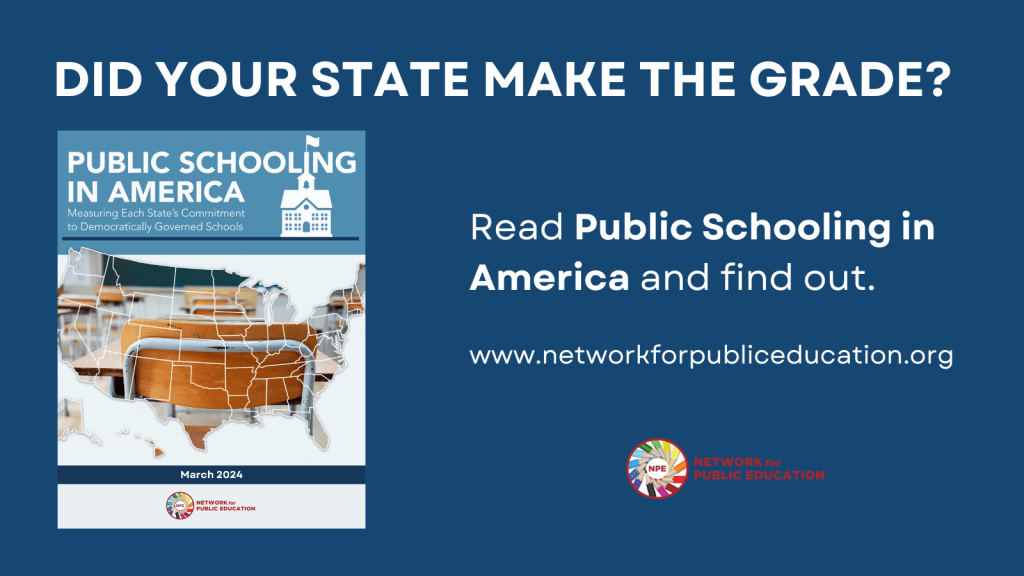
The Network for Public Education released a report card today grading the states on their support for democratically-governed public schools. Which states rank highest in supporting their public schools? Open the report to find out.

Measuring Each State’s Commitment to
Democratically Governed Schools

EXECUTIVE SUMMARY


Neighborhood public schools remain the first choice of the overwhelming majority of Ameri-
can families. Despite their popularity, schools, which are embedded in communities and gov-
erned by elected neighbors, have been the target of an unrelenting attack from the extreme
right. This has resulted in some state legislatures and governors defunding and castigating
public schools while funding alternative models of K-12 education.

This 2024 report, Public Schooling in America: Measuring Each State’s Commitment to
Democratically Governed Schools
, examines these trends, reporting on each state’s commit-
ment to supporting its public schools and the children who attend them.

What We Measure

We measure the extent of privatization in each state and whether charter and voucher laws
promote or discourage equity, responsibility, transparency, and accountability. We also rate
them on the strength of the guardrails they place on voucher and charter systems to protect
students and taxpayers from discrimination, corruption and fraud.

Recognizing that part of the anti-public school strategy is to defund public schools, we rate
states on how responsibly they finance their public schools through adequate and equitable
funding and by providing living wage salaries for teachers.

As the homeschool movement grows and becomes commercialized and publicly funded,
homeschooling laws deserve public scrutiny. Therefore, we rate states on laws that protect
children whose families homeschool.

Finally, we include a new expansive category, freedom to teach and learn, which rewards
states that reject book bans, and the use of unqualified teachers, intolerance of LGBTQ stu-
dents, corporal punishment, and other factors that impinge on teachers’ and students’ rights.

How does your state rank?