Back in the midst of the War in Vietnam, protestors used to torment President Lyndon B. Johnson by chanting, “Hey, hey, LBJ, how many kids did you kill today?” Johnson became President after President Kennedy’s assassination, then was elected by a landslide in 1964. He had an ambitious domestic agenda, which sailed through Congress, but then got ensnared in pursuing the war, which was a disaster.
As soon as Donald Trump was re-elected, he invited his billionaire friend to slash the federal government. Trump created a fictional “department” called the Department of Government Efficiency (DOGE), headed by Musk and Vivek Ramaswamy. Vivek soon left to run for governor of Ohio.
Musk and his little group of computer nerds ransacked the agencies, fired thousands of career employees, and copied confidential files from Social Security and the Treasury Department. Throughout this daring attack on our government, Republican majorities in Congress remained silent.
One of the first agencies killed by Musk was U.S. AID, which supplied food and medicine to impoverished people around the world. Musk celebrated his success and told the world that he had used a jeweled chainsaw to kill a program that saved lives and that bought billions of dollars of grain from American farmers.
It’s been reported that DOGE saved very little money, that many government agencies that lost employees had to rehire some, pay severance to others, and that dramatic savings never materialized.
And now we know that whatever savings were realized by Musk’s brief foray have been totally wiped out by the cost of the war in Iran.
What remains of the work of Musk and his DOGE?
Millions of deaths in countries where people died because U.S. AID stopped sending aid. Not only did people die of starvation and preventable diseases, but violence followed the AID cuts.
Science Advisor, published by Science magazine, reported:
Scientists merged two datasets, one that mapped worldwide foreign aid disbursements and another recording violent events. Cuts to USAID, the team reports, were associated with significant increases in violent conflict, armed clashes, protests and riots across a large swath of Africa. The effects began immediately after USAID withdrawal, persisted for months, and were most pronounced in areas that had previously relied the most on aid from the United States. “With the USAID shutdown, there was a rapid increase in the likelihood of violence, the severity of violence, and the lethality of violence,” study co-author Austin L. Wright told 404 Media.
As economist Axel Dreher wrote in a related Science Perspective, the findings reveal “the effect of a sudden and unexpected disruption,” which, beyond just removing resources, can open the door to civil unrest by interrupting ongoing initiatives and eroding trust in local governments. “A sudden cut can be destabilizing even if the aid program being cut was inefficient or unsustainable in the long run.”
There’s not much these days that can shock the sensibilities of ordinary human beings, but this story might be one of those exceptions.
FBI Director Kash Patel went swimming on a “VIP Snorkel” trip near the remains of the USS Arizona, in which nearly 1,000 American sailors and Marines have been entombed since December 7, 1941. Some people may say it’s no big deal but others are shocked by his lack of discretion and decency.
Last summer, the F.B.I. director, Kash Patel, capped a whirlwind South Pacific trip with a snorkel trip in Hawaii.
There, Navy SEALs used two boats to transport and escort Mr. Patel and nine other people on what a Defense Department email called a “V.I.P. Snorkel” next to one of the military’s most sacred sites, the underwater tomb of the U.S.S. Arizona that holds the remains of more than 900 Navy sailors and Marines who died at Pearl Harbor.
Mr. Patel swam in the vicinity of the tomb for 30 minutes, according to the Navy.
Out of respect for the dead entombed in the wreck of the Arizona, rules bar visitors even from wearing swimwear at the memorial. With some exceptions over the years for dignitaries, the only people allowed in the water around the tomb are military and National Park Service divers interring the remains of the last Arizona survivors in the wreck, or conducting annual maintenance surveys, according to a former Navy officer and a former National Park Service official familiar with restrictions at the site.
Officials from the Navy and the Defense Department said V.I.P. “tours” near the Arizona were common, but they declined to say how often they take people snorkeling. A Navy spokeswoman declined to identify the nine people who joined Mr. Patel on the trip. The F.B.I. said that Adm. Samuel J. Paparo Jr., the head of the United States Indo-Pacific Command, invited Mr. Patel to Pearl Harbor.
The New York Times obtained details of the Pearl Harbor trip through a Freedom of Information Act request and information from a former F.B.I. official. Mr. Patel’s participation in the snorkeling trip was reported earlier by The Associated Press.
The idea of a high-ranking government official receiving an escort from the SEALs for a recreational swim near the tomb is “horrifying,” said William M. McBride, a Navy veteran and professor emeritus of history at the U.S. Naval Academy in Annapolis.
“This is a war grave with the same legal status as Arlington National Cemetery,” Mr. McBride said in an interview. “Snorkeling around Arizona is as disrespectful as playing kickball on top of the graves at Arlington.”
The Pearl Harbor trip was at the end of an itinerary in which Mr. Patel visited F.B.I. facilities in Hawaii, Australia and New Zealand. Disclosure of the snorkeling tour, and new details about other trips he has taken, comes as Mr. Patel is already under scrutiny for blending leisure travel with official business or instructing F.B.I. employees to make accommodations for him and his girlfriend, Alexis Wilkins.
Robert Reich, who served as Secretary of Labor during the Clinton administration, posted a provocative column overnight.
Friends,
My first quote of the week comes from Trump on Air Force One, on his way back from Beijing on Friday — telling David Sanger of The New York Times:
“I had a total military victory. But the fake news, guys like you, write incorrectly. You’re a fake guy. We had a total military victory. I actually think it’s sort of treasonous what you write. You should be ashamed of yourself. I actually think it’s treason.”
Note Trump’s use of the pronoun “I.” He didn’t say “we” had a military victory. Trump’s malignant narcissism is worsening.
Also take note of his blatant lie. His war in Iran has been anything but a victory. His delusions and deceptions about the war are escalating.
Americans are far worse off today than we were before Trump started his war. We’re now paying $1.50 a gallon more for gas, on average. Paying even more, indirectly, for the diesel fuel powering trucks that transport much of what we buy. Food costs are also rising because the fertilizer used to grow much of the food we eat can’t move through the Strait of Hormuz. The soaring cost of jet fuel is also being passed on to those of us who fly.
And none of these costs will come down soon, even if the war ends tomorrow, because the price for oil is largely set in a global market, and much of the oil infrastructure of the Middle East is in ruins.
Trump has made it harder for us to switch from oil and gas to renewable sources of energy, in which China is excelling. Trump loves fossil fuels — he’s subsidizing oil and gas and has ended subsidies for renewables (remember his election deal with Big Oil?) — but the future lies with wind, solar, and biomass, and the batteries that store them.
And note the not-so-subtle threat Trump directed at Sanger — that Sanger could be accused of treason if he continued to report that Trump’s war is failing. Trump’s dangerous accusations are intensifying.
“I don’t think about Americans’ financial situation. I don’t think about anybody. I think about one thing: We cannot let Iran have a nuclear weapon. That’s all. That’s the only thing that motivates me.”
Which brings me to my other quote of the week — Trump’s comment just before leaving for China that:
I believe the first part, that Trump doesn’t think about Americans’ financial situation; he never has and never will. But it can’t possibly be that the only thing motivating him is preventing Iran from having a nuclear weapon.
I say this because we were much closer to achieving this goal when Iran was still observing the nuclear deal it struck with Barack Obama — in which Iran agreed to limit its nuclear activities, including reducing its enriched uranium stockpile and modifying reactors to prevent the production of weapons-grade plutonium. (In exchange, the United States, United Nations, and European Union agreed to lift international economic and financial sanctions on Iran.)
But Trump pulled out of that deal. And Iran’s new leadership is hellbent on creating a nuclear weapon. Trump’s and Israel’s aggression apparently have proven to Iran’s new (and more extremist) leaders how much they need it. And the Trump regime has no idea where Iran is storing its near-weapons-grade plutonium.
Friends, a madman is in charge of American foreign policy — but almost no Republican member of Congress, no major CEO or university president or head of a major foundation, and certainly no member of Trump’s regime is willing to sound the alarm. They are all cowards.
I mentioned to you earlier this week that I had dinner with a group of political operatives who gave 30 percent odds that JD Vance and Marco Rubio would lead a coup within the next three to four months, invoking the 25th Amendment to get rid of the madman. Those odds may be higher now.
But you and I are not powerless. We can achieve the next best outcome — limiting Trump’s power to do more damage — by getting out the vote on or before November 3 and throwing the cowardly Republican senators and representatives out on their assets.
We have less than six months to get the largest midterm turnout in American history — a blue tsunami that will start the process of repair, reform, and return to sanity.
I know how frightening and discouraging all of this has been. I know how daunting the forces of cruelty and corruption can sometimes feel. I also know how hard you’ve been fighting, while at the same time working to keep yourself, your family, and your community on an even keel. And I thank you for it.
Despite Trump, please do not feel shame in America. Feel pride in the ideals we share. Feel honored that you are an activist warrior on the right side of history. Feel strength in our conviction. Feel power in our cause.
Have no doubt: We will prevail against the madman-in-chief and his lawless regime.
Heather Cox Richardson sums up the struggle for equal rights since the Brown decision of May 17, 1954. The struggle has continued in the years since then, aided especially by the Voting Rights Act of 1965.
The VRA enabled Black Americans to have a voice, representation, and genuine political power. The U.S. Supreme Court decided on April 29, 2026, in Louisiana v. Callais that there is no longer any need for federal protection of voting rights for Black Americans, and they made a decision that is certain to lead to the loss of meaningful representation for Blacks, who–the Court majority decided–no longer needed federal protection. The former Confederacy proceeded to enact redistricting that will wipe out many Black-held seats in Congress. Racism is alive.
Seventy-two years ago tomorrow, on May 17, 1954, the Supreme Court unanimously decided Brown v. Board of Education of Topeka, Kansas. That landmark decision declared racial segregation in public schools unconstitutional because segregated schools denied Black children “the equal protection of the laws guaranteed by the Fourteenth Amendment.”
Three years after the Brown v. Board decision, in the face of massive resistance to desegregation in the South, President Dwight D. Eisenhower proposed the Civil Rights Act of 1957 to protect the right of Black Americans to vote, using the federal government to overrule the state laws that limited voter registration and kept Black voters from the polls. To prevent the passage of the first federal civil rights legislation since 1875, South Carolina senator Strom Thurmond launched the longest filibuster in U.S. history, speaking for 24 hours and 18 minutes.
(Senator Cory Booker (D-NJ) broke Thurmond’s record on March 31 through April 1, 2025, speaking for 25 hours, 5 minutes, and 59 seconds, but his speech was not a filibuster.)
Southern Democrats known as “Dixiecrats” managed to weaken the measure, but Senate majority leader Lyndon B. Johnson (D-TX) managed to wrestle the Civil Rights Act of 1957 through Congress, and Black Americans and their white allies began trying to register Black Americans to vote.
But the law proved too weak to force white registrars to allow Black voters onto the rolls, and by 1961, activists with the Student Nonviolent Coordinating Committee (SNCC, pronounced “snick”) were at work in Mississippi to promote voter registration. In 1964 they launched the “Freedom Summer,” bringing college students from northern schools to work together with Black people from Mississippi to educate and register Black voters.
Just as the project was getting underway, three organizers—James Chaney, from Mississippi, and Andrew Goodman and Michael Schwerner from New York—disappeared outside Philadelphia, Mississippi. Lyndon Johnson, president by then, used the popular rage over the three missing voting rights workers to pressure Congress into passing the Civil Rights Act of 1964, designed to try to hold back the white supremacists and to make it possible for Black Americans to register to vote. The measure passed, and on July 2, Johnson signed it into law.
On August 4, investigators found the bodies of the three missing men. Ku Klux Klan members working with local law enforcement officers had murdered them and then buried the bodies in an earthen dam that was under construction.
And still, white officials refused to accept the idea of Black voting. In Selma, Alabama, where the city’s voting rolls were 99% white even though Black Americans outnumbered white Americans among the 29,500 people who lived there, local Black organizers had launched a voter registration drive in 1963, but a judge stopped voter registration meetings by prohibiting public gatherings of more than two people.
Selma voting rights activist Amelia Boynton invited the Reverend Dr. Martin Luther King Jr. to the city to draw national attention to its struggle, and he and other prominent Black leaders arrived in January 1965. For seven weeks, Black residents made a new push to register to vote. County sheriff James Clark arrested almost 2,000 of them on a variety of charges, including contempt of court and parading without a permit. A federal court ordered Clark not to interfere with orderly registration, so he forced Black applicants to stand in line for hours before taking a “literacy” test. Not a single person passed.
Then, on February 18, white police officers, including local police, sheriff’s deputies, and Alabama state troopers, beat and shot an unarmed man, 26-year-old Jimmie Lee Jackson, who was marching for voting rights at a demonstration in his hometown of Marion, Alabama, about 25 miles northwest of Selma. Jackson died eight days later, on February 26. Black leaders in Selma decided to defuse the community’s anger by planning a long march—54 miles—from Selma to the state capitol at Montgomery to draw attention to the murder and voter suppression.
On March 7, 1965, the marchers set out. As they crossed the Edmund Pettus Bridge, state troopers and other law enforcement officers met the unarmed marchers with billy clubs, bullwhips, and tear gas. They fractured the skull of young activist John Lewis and beat Amelia Boynton unconscious. A newspaper photograph of the 54-year-old Boynton, seemingly dead in the arms of another marcher, illustrated the depravity of those determined to stop Black voting.
On March 15, President Johnson addressed a nationally televised joint session of Congress to ask for the passage of a national voting rights act. “Their cause must be our cause too,” he said. “[A]ll of us…must overcome the crippling legacy of bigotry and injustice. And we shall overcome.” Two days later, he submitted to Congress proposed voting rights legislation.
Under the protection of federal troops, the Selma marchers completed their trip to Montgomery on March 25. Their ranks had grown as they walked until they numbered about 25,000 people. That night, Viola Liuzzo, a 39-year-old mother of five who had arrived from Michigan to help after Bloody Sunday, was murdered by four Ku Klux Klan members who tailed her as she ferried demonstrators out of the city.
A bipartisan majority of Congress passed the Voting Rights Act by a vote of 77–19 in the Senate and 333–85 in the House. Dr. King and Mrs. Boynton were guests of honor as President Johnson signed the Voting Rights Act of 1965 on August 6. Recalling “the outrage of Selma,” Johnson said: “This right to vote is the basic right without which all others are meaningless. It gives people, people as individuals, control over their own destinies.”
And yet, on April 29, 2026, the Supreme Court gutted the protections for the Black-majority districts Congress provided for in the Voting Rights Act after years of weakening the law in other ways. In its wake, Republican-dominated southern state legislatures are rushing to redraw their district lines to dilute the votes of Black Democrats.
Today, thousands of Americans, including eighteen members of Congress, traveled to Selma and Mongomery to call Americans to action to protect voting rights. Pastor Kenneth Sharpton Glasgow told Joseph D. Bryant of Alabama news site AL, “This moment is bigger than Democrats or Republicans. This is about democracy itself. This is about whether Black communities, poor communities, rural communities, formerly incarcerated people, and marginalized voices will continue to have representation and political power in America.”
Speakers united around the theme that those trying to gerrymander their way into control of Congress in defiance of voters had reawakened a movement. “They think they can draw us out of power,” Representative Alexandria Ocasio-Cortez (D-NY) told an audience in Montgomery.
“They do not know the sleeping giant that they just awakened. Because it is not a coincidence, and our whole country must understand, that it was not until voting rights were ratified in this country that we got the Great Society. Because when Black Americans have the right to vote and that vote is protected, our schools get funded. When voted rights are protected, healthcare gets expanded. When voted rights are protected, our country moves forward. And Montgomery, that’s what they’re actually afraid of. They’re afraid of us coming together. They’re afraid of us protecting one another.”
This a great article that will uplift your spirits!
Jennifer Rubin is a journalist and lawyer who was hired by The Washington Post to be its conservative columnist. But Trump radicalized her, and she became a leading voice for liberal policies. After Jeff Bezos decided to placate and woo Trump, she resigned her job and started a new and wildly popular blog called “The Contrarian,” where she and other brilliant writers gathered to critique the madness of MAGA.
She recently posted an optimistic analysis of American politics. Despite the gerrymandering, despite horrible court decisions, Democrats are in a great position to wash the MAGA stain out of the nation’s government.
It’s the most optimistic piece I’ve read in a long while, and I think you will enjoy it too.
Rubin writes:
In a span of less than two weeks, the U.S. Supreme Court (contravening the text and intent of the post-Civil War amendments and decades of court precedent) and the Virginia State Supreme Court (overturning the will of Virginia voters and inventing a new definition of “election”) have bulldozed through the electoral landscape to slant the 2026 midterm playing field in Republicans’ favor.
In Louisiana v. Callais, the U.S. Supreme Court demolished 60 years of progress in voting rights, robbed Black and Hispanic communities of the power to elect representatives of their own choosing, and aimed to decimate the ranks of non-white U.S. House members, state legislators, and local officials. This is nothing short of an attempt to reimpose white supremacy.
This decision will bleach the halls of Congress, state legislatures, and local bodies like city councils, by ending the protections of Section 2 of the act, which had provided a pathway to assure that voters of color would have some rudimentary fair representation. It’s the culmination of the life’s work of Chief Justice John Roberts and Samuel Alito, who have shown persistent resistance to the idea of the United States as a multiracial democracy, and a brazen willingness to reject Congress’ judgment that fair representation for minority voters sometimes requires race-conscious legislation…. It protects Alito’s core constituency: aggrieved white Republican voters.
As infuriating, partisan, and legally unsound as these rulings are, they are not the final word on either the midterms or the future of our multi-racial democracy.
The Midterms
Even with the loss in Virginia, Democrats’ five-seat pick up in California should more than counteract the original Texas re-redistricting (where two of the five seats Republicans sought to steal may well go to Democrats). And despite the Virginia decision, Democrats may still pick up one to two more seats under Virginia’s old map. The net pickup for Republicans currently is less than ten before Democrats pursue their own redistricting in New York, Illinois, Colorado, and Maryland.
However, even with the advantage of, say, a dozen rigged seats, Republicans are unlikely to keep the House majority. Since 2024, Democrats have swung the electorate substantially in their direction, over-performing in comparison to Kamala Harris in 193 of 226 state legislative races, by 20 points in some cases. On average, Democrats are doing more than 10 points better than they did in 2024. (Brookings’ William A. Galston wrote: “In the six special elections for the House conducted in 2025-2026, the swing toward Democratic candidates averaged about 15 points, while the swing toward Democratic gubernatorial candidates in New Jersey and Virginia averaged 14 points.”)
More than 20 Republican House seats were won by less than 10 points in 2024; 43 Republicans won by less than 15%. Given the electoral shift, Democrats’ list of targeted seats expands each week.
The New York Times reported that gerrymandering “tells only part of the story” about the midterms. While “Democrats could end up losing at least half a dozen safe seats, and possibly more,” depending on new maps drawn in Southern states, Republicans face gale-force “headwinds” thanks to Donald Trump’s atrocious approval numbers, his reviled Iran war, soaring gas and other consumer prices, snatching away healthcare coverage from millions, disaffection of Hispanic voters, and rampant corruption.
In short, gerrymandering, however outrageous, will not be enough to save Republicans if Democrats generate huge turnout, especially among those voters enraged that they have been stripped of voting power. (As Hungary demonstrated, a determined opposition can overcome a raft of unfair impediments imposed by a corrupt, unpopular regime.)
Democrats, independents, and disaffected Republicans know that the MAGA cult has no message — which is why MAGA lawmakers and courts must rig the election to cement white supremacy. That’s all they’ve got.
Democrats have their targets
The enormity of reversing 60 years of progress on voting rights necessitates a new era of intense organizing and public education — a new civil right movement to counter MAGA’s court-imposed Jim Crow. That effort kicks off with a grassroots National Day of Action on Saturday, May 16, in Alabama. Organizers declared, “The dismantling of the Voting Rights Act is a reminder that we have unfinished business. The fight is ours and we are going to finish it.” Scores of democracy groups, faith-based organizations, and civil rights organizations will rally to oppose Jim Crow redistricting and to support multi-racial democracy.
The goal: Democrats must win, and win big, in 2026 and 2028. Senate seats, governorships, and other statewide offices cannot be gerrymandered. A massive registration and turnout-the-vote operation must expand deep into Republican areas, appealing to disgruntled independents and Republicans while firing up the base. Democrats will need a broad, inclusive electoral coalition to pursue bold reform. As former attorney general Eric Holder likes to say, progressives “need to be comfortable with acquiring power and using power.”
What then? If Democrats come out of the 2028 election with House and Senate majorities, and the presidency, they will have all the motivation and tools required to reverse the slide into Jim Crow, beginning with substantial reform of the discredited Supreme Court. The MAGA justices’ willful misreading of the Voting Rights Act and the Constitution to concoct a “color blind” interpretation of voting rights (coupled with their monstrous expansion of executive power and abuse of the emergency docket) should unify democracy defenders on the urgency of Supreme Court reform through court expansion, term limits, revised appellate jurisdiction, and ethics reform.
The Supreme Court itself has shown itself to be the enemy of democracy. If and when Democrats retake control of the political branches, it will be incumbent on them not only to write new voting legislation protecting minority voters and all voters in the ability to participate fairly in elections that reflect the will of all the people. They will also have to consider reform of the Supreme Court itself.
With the election of aggressive Senate Democrats running in 2026 and 2028, Democrats should have little trouble carving out a filibuster exception, especially if they win by large margins that affirm voters’ rejection of MAGA assault on pluralistic democracy.
Though the tools to sustain multi-racial democracy may be different from those employed in the 1960s, Madeleine Greenberg of the Campaign Legal Center reminded us: “Every generation has faced attempts to restrict access to the ballot box, and every generation has pushed back.” If Democrats win elections decisively and fully exercise the power they obtain, they can fix what MAGA white supremacists have broken. Only then can we fulfill the promise of pluralistic democracy.
The midterm elections of 2026 are approaching. Start working now to reclaim our democracy! Our time is now.
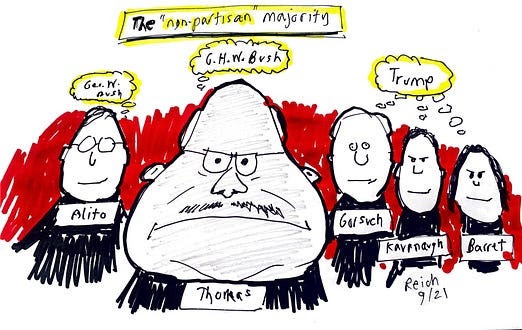
The six conservative-right wing justices on the U.S. Supreme Court gutted the Voting Rights Act of 1965, by striking down Section 2, which requires that minorities have districts in which their voting preferences may be heard. This section led to the creation of districts that elected Black representatives.
We can now expect redistricting of Congressional districts and state legislative districts to sharply reduce the number of Black elected officials.
Richard L. Hasen of Slatewrote that the decision “will go down in history as one of the most pernicious and damaging Supreme Court decisions of the last century. All six Republican-appointed justices on the court signed onto Justice Samuel Alito’s opinion gutting what remained of the Voting Rights Act protections for minority voters, while pretending they were merely making technical tweaks to the act.
This decision will bleach the halls of Congress, state legislatures, and local bodies like city councils, by ending the protections of Section 2 of the act, which had provided a pathway to assure that voters of color would have some rudimentary fair representation. It’s the culmination of the life’s work of Chief Justice John Roberts and Samuel Alito, who have shown persistent resistance to the idea of the United States as a multiracial democracy, and a brazen willingness to reject Congress’ judgment that fair representation for minority voters sometimes requires race-conscious legislation. It gives the green light to further partisan gerrymandering. It protects Alito’s core constituency: aggrieved white Republican voters. It’s a disaster for American democracy.
Future generations of legal scholars will review the Republicans’ retreat from civil rights protections enacted in the 1960s. Perhaps psychologists will figure out why Justice Clarence Thomas consistently opposes laws intended to protect people like him.
Robert Reich has selected the Supreme Court Justice whom he believes is the worst in modern history. The two likeliest nominees are clearly Samuel Alito, who wrote the decision that reversed Roe v. Wade and that is responsible for the deaths of many women who were unjustly denied medical care because of Justice Alito.
But no, he chooses Justice Clarence Thomas. In this post, he explains why.
Friends,
I’ve long assumed that Samuel Alito was the worst.
Alito — who authored the majority opinion in Dobbs v. Jackson Women’s Health Organization (2022), the case that ended constitutional abortion rights by merely asserting that the high court’s prior opinion in Roe v. Wade (1973) was wrongly decided; who accepted a 2008 luxury fishing trip to Alaska, including private jet travel, from hedge fund billionaire and GOP donor Paul Singer yet failed to disclose it on Alito’s financial forms and didn’t even recuse himself from decisions involving Singer’s subsequent business before the Supreme Court; who hoisted an inverted American flag outside his Virginia home shortly after the January 6 Capitol riot, a symbol of support for Trump’s false claims of a stolen 2020 election — has the moral and intellectual stature of a poisonous toad.
But I’ve come to revise my view of the court’s worst Justice.
Clarence Thomas is 77 years old. He has now served on the Supreme Court for over 34 years, making him the longest-serving member of the Court. He is a bitter, angry, severe hard-right, intellectually dishonest, ideologue. After reading his latest thoughts on America, I’ve concluded Thomas is even worse than Alito.
Last Wednesday, Thomas gave a rare public address at the University of Texas in Austin that began as a banal tribute to the Declaration of Independence before degenerating into a misleading screed against progressivism.
“At the beginning of the twentieth century, a new set of first principles of government was introduced into the American mainstream,” Thomas intoned. “The proponents of this new set of first principles, most prominently among them the twenty-eighth president, Woodrow Wilson, called it progressivism.”
Thomas went on to blame progressives for the worst crimes of the 20th century, insisting that “Stalin, Hitler, Mussolini, and Mao” were all “intertwined with the rise of progressivism,” as was “racial segregation,” “eugenics,” and other evils.
This is pure rubbish.
In reality, America’s Progressive era emerged at the start of the 20th century from the corruption and excesses of America’s first Gilded Age (we’re now in the second, if you hadn’t noticed) — its record inequalities of income and wealth, its “robber barons” who monopolized industries and handed out sacks of money to pliant legislators, it’s dangerous factories and unsafe working conditions, its violent attacks on workers who tried to form unions, its corporate control over all facets of government, its widespread poverty and disease, and its corrupt party machines.
In many ways, the Progressive Era — whose most prominent leader was Republican president Theodore Roosevelt, not Woodrow Wilson, by the way — saved capitalism from its own excesses by instituting a progressive income tax, an estate tax, pure food and drug laws, and America’s first laws against corporate influence in politics.
Then, under Teddy Roosevelt’s fifth cousin (Franklin D.), came Social Security, the 40-hour workweek (with time-and-a-half for overtime), the right to form unions, and laws and regulations that limited Wall Street’s ability to gamble with other people’s money.
Clarence Thomas got it exactly backwards. Had we not had the Progressive Era and its reforms extending through the 1930s, America might well have succumbed to fascism — as did Germany under Hitler, and Italy under Mussolini, or to communist fascism, as did Russia under Stalin. Progressive and New Deal reforms acted as bulwarks against the rise of fascism in America.
In fact, it’s been the demise of such reforms since Ronald Reagan that have opened the way to Trumpian neo-fascism.
Over a third of American workers in the private sector were unionized in the 1950s, giving them bargaining leverage to get higher wages and better working conditions. Now, fewer than 6 percent are unionized, which has contributed to the flattening of wages, a contracting middle class, inequalities of income and wealth rivaling the first Gilded Age, and an angry and suspicious working class that’s become easy prey for demagogues.
Wall Street has been deregulated — allowing it to go on gambling sprees such as the one that produced the financial crisis of 2008, which claimed millions of working peoples’ homes, savings, and jobs.
America’s social safety nets have become so frayed that almost a fifth of the nation’s children are now in poverty. Yet Reagan, George W. Bush, and Trump have slashed taxes on the rich and on big corporations and have allowed giant corporations to merge into giant monopolies rivaling the trusts of the first Gilded Age. And Trump has ushered in an era of corruption the likes of which America hasn’t seen since that earlier disgraceful era.
Thomas claims that “The century of progressivism did not go well.” Baloney. It helped America create the largest middle class the world had ever seen, while also extending prosperity to millions of Black and brown people.
The tragedy is that America turned its back on progressivism and on social progress, in part because of the Supreme Court and Justice Clarence Thomas.
Flashback: I was in law school in 1973 when the Supreme Court decided Roe, protecting a pregnant person’s right to privacy under the 14th amendment to the Constitution.
Clarence Thomas was in my law school class at the time, as was Hillary Rodham (later Hillary Clinton) and Bill Clinton.
The professors used the “Socratic method” – asking hard questions about the cases they were discussing and waiting for students to raise their hands in response, and then criticizing the responses. It was a hair-raising but effective way to learn the law.
One of the principles guiding those discussions is called stare decisis — Latin for “to stand by things decided.” It’s the doctrine of judicial precedent. If a court has already ruled on an issue (say, on reproductive rights), future courts should decide similar cases the same way. Supreme Courts can change their minds and rule differently than they did before, but they need good reasons to do so, and it helps if their opinion is unanimous or nearly so. Otherwise, their rulings appear (and are) arbitrary — even, shall we say? — partisan.
In those classroom discussions almost fifty years ago, Hillary’s hand was always first in the air. When she was called upon, she gave perfect answers – whole paragraphs, precisely phrased. She distinguished one case from another, using precedents and stare decisis to guide her thinking. I was awed.
My hand was in the air about half the time, and when called on, my answers were meh.
Clarence’s hand was never in the air. I don’t recall him saying anything, ever.
Bill was never in class.
Only one of us now sits on the Supreme Court. And he has shown no respect for stare decisis.
Nor has he respected judicial ethics.
A federal law — 28 U.S. Code § 455 — requires that “any justice, judge, or magistrate judge of the United States shall disqualify himself in any proceeding in which his impartiality might reasonably be questioned.”
In the aftermath of the 2020 election, Thomas’s wife, Ginni, actively strategized with White House chief of staff Mark Meadows on overturning the election results. Between Election Day 2020 and the days following the January 6th attack on the Capitol, she exchanged 29 text messages with Meadows, in which she spread false theories about the election, urged Meadows to overturn the election results, and called for specific actions from the White House to help overturn the election. She also served as one of nine board members of a group that helped lead the “Stop the Steal” movement and called for the punishment of House Republicans who participated in the U.S. House Select Committee investigating the January 6th attack.
Yet Clarence Thomas has repeatedly participated in cases that have come to the high court directly or indirectly involving the 2020 election results, refusing to disqualify himself.
In addition, he failed to disclose his wife’s income from her work at the Heritage Foundation, in violation of the Ethics in Government Act.
Finally, there’s his speech last week in Austin. How can Americans be expected to believe in the impartiality of the Supreme Court in general and Clarence Thomas in particular when he condemns an entire philosophy of government — progressivism — and all the people who continue to call themselves progressives, in effect labeling them neo-fascists?
At the start of his speech last week in Austin, Clarence Thomas noted that “My wife Virginia and I have many wonderful friends and acquaintances here, and it is so special to have our dear friends Harlan and Kathy Crow join us today.”
He was, of course, referring to the Republican mega-donor who has spent the last twenty years lavishing Thomas with personal gifts, luxury yacht trips, fancy vacations, and funding for Ginni Thomas’s political organization.
Small wonder that Clarence Thomas prefers the Gilded Age over the Progressive Era. He’s the living embodiment of The Gilded Age’s public-be-damned excesses.
Hence, he’s my nominee for the worst justice in modern Supreme Court history.
While the U.S. has eliminated its agencies that speak to the world, like Voice of America, Iran has been producing videos mocking the United States, portraying its history as a long series of atrocities, and linking the current war to Jeffrey Epstein.Virginia Heffernan tells the story in The New Republic.
She writes:
There’s a new way to teach American history. It’s not woke. But it’s not patriotic, either. It’s not the 1619 Project or the 1776 project.
It’s the Iranian History of the United States, as seen in “One Vengeance for All,” the most cosmological of the recent pieces of pro-Iran Lego-style agitprop. This is the series you’ve probably caught a glimpse of—the obscene, masterful, and viral AI videos that have hammered the internet since the start of Donald Trump’s ruinous war in Iran. The series, which has been labeled “slopaganda,” is sometimes called “Operation Epstein Fury.”
The strongest entries in the series are producedby an anonymous student activist group called Explosive News (Akhbar Enfejari). Shorter videos in the same style, which look less polished, are reportedly fan-made. All of the videos treat the war with max cartoonery and max ideological torque. Russian and Iraniangovernment accounts regularly boost them. (China has also made its own anti-American propaganda pegged to the war.)
Scare up the extremely violent videos at your own risk, but here’s a plot summary. In an early one, Trump, panicked about his culpability in the Epstein affair, smashes a red button to strike Iran as a distraction. After Iran strikes back and slams shut the Strait of Hormuz, Trump and Benjamin Netanyahu run scared from Iran’s strategic genius and godlike military might. In the next few videos, the U.S. Army loses personnel, planes, helicopters, and popular support; capital markets spiral. Coffins draped in American flags pile up.
“One Vengeance for All” stands out from the rest because it contains more American history than breaking news. And what a way to see our once-promising nation. The Iranian History of the United States features no pilgrims, Revolutionary War, Civil War, or wars in Europe. Also absent: slavery, civil rights, feminism, and unions.
Instead, you get 53 seconds of 600 years of American jingoism and genocide. The video opens on an AI caricature of an Indigenous man in a headdress looking to the heavens from the Western plains. Cut to a little boy carrying a dead infant amid smoldering rubble in Hiroshima. These are ghosts.
From there to Vietnam. A middle-aged woman carries a scythe, in a rice field, and again looks skyward. Then come slain Iranian leaders: Qassem Soleimani in 2020, Ayatollah Ali Khamenei in February. All ghosts. Now there’s a girl at a refugee camp in Gaza. We’re given to understand from her hopeful expression that help is coming, and that the help is the Iranian army, though it has no intention of “liberating” or “saving” the ghosts. Instead, with centuries of pent-up resentment in its arsenal, Iran will avenge their suffering with fire and fury.
About two-thirds of the way in, the narrative rounds on the American people, and finds Trump’s victims among us. A blond girl in a pink dress, no older than 6, is pictured in a tropical landscape. It’s Epstein Island. The island’s enigmatic blue-striped building, which some speculate is a reference to the Israeli flag, stands behind her. This girl is also a victim of American imperialism, courtesy of the Trump-Epstein class that merged capital and executive power; private-sector monopolies with political world domination.
This girl’s Iranian counterpart appears in the next image, a young schoolgirl in a blue coat and white hijab, and she seals the connection. She’s abandoned in the deserted courtyard of the Shajareh Tayyebeh girls’ school in Minab, Hormozgan Province. This is the schoolyard where around 170 people were murdered, elementary school students, when the school was bombed by U.S. forces back in February on the war’s first day.
At once, a sisterhood of ghosts coalesces. From Epstein Island to southern Iran, schoolgirls pair with schoolgirls, the specters of abused children whose lives or spirits have been extinguished by sadistic American tyrants.
Trump is globally known for sex crimes and, like Hegseth, charges of sex crimes—and the Iranian videos depict the two men explicitly as rapists. In one video, the Lego Trump has doll-like girl figures on his bed and lap, and Hegseth is shown in military garb, repeatedly committing rape. Assaults on girls are the modus vivendi of these videos’ versions of Trump and Hegseth.
These sequences are not idle trolling. Rape is, of course, a crime against humanity. But rape is implicated more immediately in the brief for this war, which centers not on strategic goals but on the relentless use of violence against innocents to humiliate an entire people.
As Jamelle Bouie put it recently, “Forcing others to submit through the indiscriminate use of force does not really sound like war. That does sound like something else. It sounds like rape.” He concluded that the ideology of Trump and Hegseth is “the ideology of the rapist.”
After 9/11, President Bush used to tell Americans that our enemies resented “our way of life.” In his memorable “Why Do They Hate Us?” speech of September 20, 2001, Bush answered his own question, “They hate our freedoms—our freedom of religion, our freedom of speech, our freedom to vote and assemble and disagree with each other.”
This may or may not have been true of the terrorists a quarter century ago. But it’s not at all true now of Iran, which the U.S. attacked without permission from the people or provocation from Iran. Iran hates the American government for its cruelty toward hundreds of millions of people across six centuries. It’s hard not to see the logic in it.
In Trump, the ideology of the rapist was unmistakable a decade ago, when he crowed about the joy he takes in humiliating human beings by mauling their crotches. With this war, he’s trying, as usual, for highly aestheticized spectacles of humiliation, and he’s getting them—but not for Iran. For himself, and for the United States.
Writing in The Atlantic, Anne Applebaum questions Trump’s ability to think through his decisions. Is he acting on a whim, an impulse? Does he remember today what he said the day before?
She writes:
Donald Trump does not think strategically. Nor does he think historically, geographically, or even rationally. He does not connect actions he takes on one day to events that occur weeks later. He does not think about how his behavior in one place will change the behavior of other people in other places.
He does not consider the wider implications of his decisions. He does not take responsibility when these decisions go wrong. Instead, he acts on whim and impulse, and when he changes his mind—when he feels new whims and new impulses—he simply lies about whatever he said or did before.
For the past 14 months, few foreign leaders have been able to acknowledge that someone without any strategy can actually be president of the United States. Surely, the foreign-policy analysts murmured, Trump thinks beyond the current moment. Surely, foreign statesmen whispered, he adheres to some ideology, some pattern, some plan. Words were thrown around—isolationism, imperialism—in an attempt to place Trump’s actions into a historical context. Solemn articles were written about the supposed significance of Greenland, for example, as if Trump’s interest in the Arctic island were not entirely derived from the fact that it looks very large on a Mercator projection.
This week, something broke. Maybe Trump does not understand the link between the past and the present, but other people do. They can see that, as a result of decisions that Trump made but cannot explain, the Strait of Hormuz is blocked by Iranian mines and drones. They can see oil prices rising around the world and they understand that it is difficult and dangerous for the U.S. Navy to solve this problem. They can also hear the president lashing out, as he has done so many times before, trying to get other people to take responsibility, threatening them if they don’t.
NATO faces a “very bad” future if it doesn’t help clear the strait, Trump told the Financial Times, apparently forgetting that the United States founded the organization and has led it since its creation in 1949. He has also said he is not asking but ordering seven countries to help. He did not specify which ones. “I’m demanding that these countries come in and protect their own territory, because it is their territory,” Trump told reporters aboard Air Force One on the way from Florida to Washington. “It’s the place from which they get their energy.” Actually it isn’t their territory, and it’s his fault that their energy is blocked.
But in Trump’s mind, these threats are justified: He has a problem right now, so he wants other countries to solve it. He doesn’t seem to remember or care what he said to their leaders last month or last year, nor does he know how his previous decisions shaped public opinion in their countries or harmed their interests. But they remember, they care, and they know.
Specifically, they remember that for 14 months, the American president has tariffed them, mocked their security concerns, and repeatedly insulted them. As long ago as January 2020, Trump toldseveral European officials that “if Europe is under attack, we will never come to help you and to support you.” In February 2025, he told Ukrainian President Volodymyr Zelensky that he had no right to expect support either, because “you don’t have any cards.” Trump ridiculed Canada as the “51st state” and referred to both the present and previous Canadian prime ministers as “governor.” He claimed, incorrectly, that allied troops in Afghanistan “stayed a little back, a little off the front lines,” causing huge offense to the families of soldiers who died fighting after NATO invoked Article 5 of the organization’s treaty, on behalf of the United States, the only time it has done so. He called the British “our once-great ally,” after they refused to participate in the initial assault on Iran; when they discussed sending some aircraft carriers to the Persian Gulf conflict earlier this month, he ridiculed the idea on social media: “We don’t need people that join Wars after we’ve already won!”
At times, the ugly talk changed into something worse. Before his second inauguration, Trump began hinting that he wouldn’t rule out using force to annex Greenland, a territory of Denmark, a close NATO ally. At first this seemed like a troll or a joke; by January 2026, his public and private comments persuaded the Danes to prepare for an American invasion. Danish leaders had to think about whether their military would shoot down American planes, kill American soldiers, and be killed by them, an exercise so wrenching that some still haven’t recovered. In Copenhagen a few weeks ago, I was shown a Danish app that tells users which products are American, so that they know not to buy them. At the time it was the most popular app in the country.
The economic damage is no troll either. Over the course of 2025, Trump placed tariffs on Europe, the United Kingdom, Japan, and South Korea, often randomly—or again, whimsically—and with no thought to the impact. He raised tariffs on Switzerland because he didn’t like the Swiss president, then lowered them after a Swiss business delegation brought him presents, including a gold bar and a Rolex watch. He threatened to place 100 percent tariffs on Canada should Canada dare to make a trading agreement with China. Unbothered by possible conflicts of interest, he conducted trade negotiations with Vietnam, even as his son Eric Trump was breaking ground on a $1.5 billion golf-course deal in that country.
Europeans might have tolerated the invective and even the trade damage had it not been for the real threat that Trump now poses to their security. Over the course of 14 months, he has, despite talking of peace, encouraged Russian aggression. He stopped sending military and financial aid to Ukraine, thereby giving Vladimir Putin renewed hope of victory. His envoy, Steve Witkoff, began openly negotiating business deals between the United States and Russia, although the war has not ended and the Russians have never agreed to a cease-fire. Witkoff presents himself to European leaders as a neutral figure, somewhere between NATO and Russia—as if, again, the United States were not the founder and leader of NATO, and as if European security were of no special concern to Americans. Trump himself continues to lash out at Zelensky and to lie about American support for Ukraine, which he repeatedly describes as worth $300 billion or more. The real number is closer to $50 billion, over three years. At current rates, Trump will spend that much in three months in the Middle East, in the course of starting a war rather than trying to stop one.
The result: Canadian Prime Minister Mark Carney has declared that Canada will not participate in the “offensive operations of Israel and the U.S., and it never will.” German Defense Minister Boris Pistorius says, “This is not our war, and we didn’t start it.” The Spanish prime minister refused to let the United States use bases for the beginning of the war. The U.K. and France might send some ships to protect their own bases or allies in the Gulf, but neither will send their soldiers or sailors into offensive operations started without their assent.
This isn’t cowardice. It’s a calculation: If allied leaders thought that their sacrifice might count for something in Washington, they might choose differently. But most of them have stopped trying to find the hidden logic behind Trump’s actions, and they understand that any contribution they make will count for nothing. A few days or weeks later, Trump will not even remember that it happened.
Timothy Snyder, scholar of European history, of tyranny and genocide, warns about the consequences of Trump threatening to wipe Iran and its ancient Persian civilization, off the earth. That’s genocide. Trump is an immoral monster.
“A whole civilization will die tonight, never to be brought back again.”
These are not the words of Hitler, or Stalin, or Mao, or Pol Pot, or Assad, or Putin. These are the words of the president of the United States, today.
Do not be distracted by circumstances. Of course there are emotions, personalities, politics, a war. None of this excuses that sentence. The reason we have a notion of genocide, and a convention on genocide, is to define certain actions as always and definitively wrong.
Are these “only words”? No, they cannot be “only words.” As any historian of mass atrocity knows, there is no such thing as “only words.” The notion of killing a whole civilization, once spoken, remains. It enables others to say similar things, as when another elected representative compared the entire country of Iran to a cancer that had to be removed.
Whatever happens tonight, the president, by saying such things, has already changed the world for the worse, and made acts of mass violence more likely. If we are Americans, he has also changed our country. He has changed us, because he represents us; we voted for him, or we didn’t vote and allowed him to come to power, or we didn’t do enough to stop him. These words are America’s words, until and unless Americans reject them.
Yes, there have been other genocides, and there are other politicians who endorse genocide. That makes the words of the president worse, not better. Yes, the United States has undertaken atrocities before. That makes it all the more important, all the more urgent, that we catch ourselves now. Neither the evil nor the good in our history determines who we are. It is what we do now.
If we do not say something ourselves about this horror, we allow ourselves to be changed.
Around the president there will be people, sadly, who work deliberately to normalize the language of genocide. There will be other politicians who find the right words to reject it. One can hope that there will be politicians who find the courage to remove the man who speaks genocide from office. And these words should lead to resignations by everyone who works closely with the president.
But we cannot count on politicians. This is ultimately up to us, the citizens: for our own sake, for the sake of the future of the country, for the sake of a possibility of new beginnings, we need to say something, to someone else, to ourselves: this is simply wrong.
Whatever happens tonight, or any other night in this war, is now legally defined by the president’s statement. In the practical application of the law of genocide, the Genocide Convention of 1948, the difficulty is usually in proving “the intent to destroy, in whole or in part, a national, ethnical, racial or religious group.” Henceforth the intent is on the record, in the published words of the president of the United States and the commander-in-chief of the armed forces about the death of “a whole civilization.”
We all have good ethical and political reasons to reject the president’s words. But those who serve in government, and in the armed forces, have been placed under the legal shadow of genocide by what Trump wrote. To bomb a bridge or a dam or a power plant or a desalinization facility, very likely a war crime in any event, could very well have a different legal significance, a genocidal one, if it takes place after the expression of genocidal intent by the commander and head of state.
The concept of genocide was created by a survivor and an observer of atrocities, Rafał Lemkin, so that we could see ourselves, judge ourselves, stop ourselves. But genocide is not only a concept. It is also a crime under international law, signed by the United States in 1948 as a convention, ratified by the United States as a treaty in 1988. That makes the words I have quoted here the law of the land.
The president speaks genocide. And so we too must speak. Not only about crimes, but about their legal punishment.