Archives for category: History

In 1958, Senator John F. Kennedy of Massachusetts published a book titled A Nation of Immigrants. During the years of the Soviet Union’s existence, politicians liked to point out that Communist nations locked their borders to keep people from moving out, while we welcomed those who managed to escape from Communism. It may be hard to remember in a climate where immigrants are demonized and called rapists and murderers, but our nation used to boast of its immigrant heritage.

In this article, Heather Cox Richardson reflects on that heritage and points out that the Republican Party championed immigration. She does not mention the immigration restriction acts of the late 19th and early 20th centuries, which excluded or limited admission of Asians, Italians, Russians, Poles, and others who were not Northern Europeans (Nordics).

In the past days, we have learned that the six maintenance workers killed when the bridge collapsed were all immigrants, natives of Mexico, Honduras, Guatemala, and El Salvador. Around 39% of the workforce in the construction industry around Baltimore and Washington, D.C., about 130,000 people, are immigrants, Scott Dance and María Luisa Paúl reported in the Washington Post yesterday. 

Some of the men were undocumented, and all of them were family men who sent money back to their home countries, as well. From Honduras, the nephew of one of the men killed told the Associated Press, “The kind of work he did is what people born in the U.S. won’t do. People like him travel there with a dream. They don’t want to break anything or take anything.”  

In the Philadelphia Inquirer today, journalist Will Bunch castigated the right-wing lawmakers and pundits who have whipped up native-born Americans over immigration, calling immigrants sex traffickers and fentanyl dealers, and even “animals.” Bunch illustrated that the reality of what was happening on the Francis Scott Key Bridge when it collapsed creates an opportunity to reframe the immigration debate in the United States.

Last month, Catherine Rampell of the Washington Post noted that immigration is a key reason that the United States experienced greater economic growth than any other nation In the wake of the coronavirus pandemic. The surge of immigration that began in 2022 brought to the U.S. working-age people who, Director Phill Swagel of the nonpartisan Congressional Budget Office wrote, are expected to make the U.S. gross domestic product about $7 trillion larger over the ten years from 2023 to 2034 than it would have been otherwise. Those workers will account for about $1 trillion dollars in revenues. 

Curiously, while Republican leaders today are working to outdo each other in their harsh opposition to immigration, it was actually the leaders of the original Republican Party who recognized the power of immigrants to build the country and articulated an economic justification for increased immigration during the nation’s first major anti-immigrant period. 

The United States had always been a nation of immigrants, but in the 1840s the failure of the potato crop in Ireland sent at least half a million Irish immigrants to the United States. As they moved into urban ports on the East Coast, especially in Massachusetts and New York, native-born Americans turned against them as competitors for jobs.

The 1850s saw a similar anti-immigrant fury in the new state of California. After the discovery of gold there in 1848, native-born Americans—the so-called Forty Niners—moved to the West Coast. They had no intention of sharing the riches they expected to find. The Indigenous people who lived there had no right to the land under which gold lay, native-born men thought; nor did the Mexicans whose government had sold the land to the U.S. in 1848; nor did the Chileans, who came with mining skills that made them powerful competitors. Above all, native-born Americans resented the Chinese miners who came to work in order to send money home to a land devastated by the first Opium War.

Democrats and the new anti-immigrant American Party (more popularly known as the “Know Nothings” because members claimed to know nothing about the party) turned against the new immigrants, seeing them as competition that would drive down wages. In the 1850s, Know Nothing officials in Massachusetts persecuted Catholics and deported Irish immigrants they believed were paupers. In California the state legislature placed a monthly tax on Mexican and Chinese miners, made unemployment a crime, took from Chinese men the right to testify in court, and finally tried to stop Chinese immigration altogether by taxing shipmasters $50 for each Chinese immigrant they brought.   

When the Republicans organized in the 1850s, they saw society differently than the Democrats and the Know Nothings. They argued that society was not made up of a struggle over a limited economic pie, but rather that hardworking individuals would create more than they could consume, thus producing capital that would make the economy grow. The more people a nation had, the stronger it would be.

In 1860 the new party took a stand against the new laws that discriminated against immigrants. Immigrants’ rights should not be “abridged or impaired,” the delegates to its convention declared, adding that they were “in favor of giving a full and efficient protection to the rights of all classes of citizens, whether native or naturalized, both at home and abroad.”

Republicans’ support for immigration only increased during the Civil War. In contrast to the southern enslavers, they wanted to fill the land with people who supported freedom. As one poorly educated man wrote to his senator, “Protect Emegration and that will protect the Territories to Freedom.”

Republicans also wanted to bring as many workers to the country as possible to increase economic development. The war created a huge demand for agricultural products to feed the troops. At the same time, a terrible drought in Europe meant there was money to be made exporting grain. But the war was draining men to the battlefields of Stone’s River and Gettysburg and to the growing U.S. Navy, leaving farmers with fewer and fewer hands to work the land. 

By 1864, Republicans were so strongly in favor of immigration that Congress passed “an Act to Encourage Immigration.” The law permitted immigrants to borrow against future homesteads to fund their voyage to the U.S., appropriated money to provide for impoverished immigrants upon their arrival, and, to undercut Democrats’ accusations that they were simply trying to find men to throw into the grinding war, guaranteed that no immigrant could be drafted until he announced his intention of becoming a citizen. 

Support for immigration has waxed and waned repeatedly since then, but as recently as 1989, Republican president Ronald Reagan said: “We lead the world because, unique among nations, we draw our people—our strength—from every country and every corner of the world. And by doing so we continuously renew and enrich our nation…. Thanks to each wave of new arrivals to this land of opportunity, we’re a nation forever young, forever bursting with energy and new ideas, and always on the cutting edge, always leading the world to the next frontier. This quality is vital to our future as a nation. If we ever closed the door to new Americans, our leadership in the world would soon be lost.”

The workers who died in the bridge collapse on Tuesday “were not ‘poisoning the blood of our country,’” Will Bunch wrote, quoting Trump; “they were replenishing it…. They may have been born all over the continent, but when these men plunged into our waters on Tuesday, they died as Americans.”

Shirley Moody-Turner wrote in the Washington post about a forgotten hero of American education: Dr. Anna J. Cooper. Cooper was the principal of the M Street School in the District of Columbia, one of the most successful schools in the city. She insisted on a demanding academic curriculum for her Black students. Despite the school’s success, she was removed on trumped-up charges. The Black community fought back but lost. The M Street School eventually became the celebrated Dunbar High School.

Moody-Turner begins:

In January 1902, Anna Julia Cooper, one of the most highly educated Black women in the country, was appointed the seventh principal of Northwest D.C.’s famed M Street High School, the first and most prestigious public high school for Black education. Black people from around the country aspired to send their children to M Street, and its roster of teachers and graduates read like a Who’s Who of Washington’s Black educational and cultural elite. Under Cooper’s leadership, M Street students won scholarships and gained admissions to top colleges and universities — including Harvard, Brown, Yale and Dartmouth.

But just four years into her tenure, days before the start of a new school year, the White director of Washington high schools convinced the D.C. Board of Education not to reappoint M Street’s acclaimed principal. When Cooper arrived for the first day of school, the school janitor barred Cooper from entering the building. Police officers observed from across the street. They were ordered to arrest Cooper if they deemed she was creating a disturbance. With her students watching from the windows, Cooper — always a model of dignity and decorum — exited the school grounds.

Cooper’s story, now largely forgotten, was part of a wider movement to control the direction of Black public education in the early 20th century. Then, like now, battles over education — and especially the question of who was permitted to lead elite institutions, training the next generation to excel — were proxies in the larger culture wars. Today, with female and minority leaders of universities facing resistance from people who assume they have not earned the right to hold their positions, Cooper’s story is an illuminating one. What happened to her illustrates not only how the tactics around removing such leaders have persisted for more than a century, but also what was at stake — and still is — in the battles over educational access and leadership.

Born enslaved in Raleigh, N.C., in 1858, Cooper began her fight for an equal education early in life. As a student at St. Augustine’s Normal School and Collegiate Institute, she successfully petitioned for the right to take what were designated as “boys” classes, including courses in Greek, Latin, French, science and math. She went on to Oberlin College in Ohio, where she again protested for access to the full curriculum. She graduated Oberlin with a BA and MA in mathematics and began writing, teaching and lecturing around the country on Black civil rights and gender equality. In 1892, she published a book called “A Voice from the South: By a Black Woman of the South,” arguing for Black women’s unique role in the struggles for racial and gender equality, which garnered international acclaim.


In 1887, Cooper was recruited to join the faculty at the famed M Street High School. She taught there for 14 years and served one year as vice principal before agreeing to serve as the school’s principal. She did so, however, at precisely the moment when the sovereignty of Black public schools — M Street, in particular — was under attack.

For decades, the public school system in D.C. was looked to as a shining example of what was possible for Black education. Since 1868, M Street had operated under a Black superintendent, and through a combination of Black political influence, community support, committed teachers and congressional appropriations, the Black community managed to secure the resources and maintain relative autonomy to create a model public school system for Black students in the District.

By the end of the 19th century, however, with the backlash over Reconstruction gains in Black civil and political rights and the national ascendancy of Jim Crow segregation, Black control over Black schools came under attack. In 1900, Congress restructured school oversight in the District so that the Black superintendent — now reassigned to be an assistant superintendent — no longer oversaw M Street High School directly, instead placing it under the supervision of the White director of public high schools, Percy M. Hughes. As Hughes took his post, Cooper took hers.

Hughes was determined to remove her, and he did. He wanted to impose a “colored curriculum” on the school but she insisted on a college prep curriculum. As the author put it, Cooper was “punished for leading.” After she left, she earned a doctorate at the Sorbonne. She later returned to the M Street School as a teacher for another 20 years.

Open the link and read the rest of the story.

Thom Hartmann wrote an ominous column about the possible origins and consequences of the terrorist attack in Moscow that killed scores of people at a concert.

He fears that Putin may use this horrific event as a pretext to step up his attacks on Ukraine and do to Ukraine what he did to Chechnya, which was to reduce the would-be breakaway region to a wasteland.

In his article, he recalls the Reichstag fire, which Hitler used as a pretext to initiate his dictatorship, crush democratic institutions, and round up dissidents.

He draws other analogies of leaders who were warned of pending catastrophes, but chose to ignore the warnings in order to solidify their hold on the population and secure their power.

In that group, he includes President George W. Bush, who ignored warnings about 9/11, and Benjamin Netanyahu, who ignored warnings about a likely attack by Hamas from the Gaza Strip. The Israeli newspaper Haaretz has written about the IDF “spotters,” the young women who watched activity at the Gaza border and warned their superiors about the military exercises they observed; they were ignored. Almost every one of these unarmed 18-and 19-year-old women were killed or taken hostage.

Hartmann wrote:

Like Hitler, Netanyahu, and Bush all did, Putin just claimed that up is down, that the terrorist attack he knew was coming was an unprovoked surprise, and that it came from Ukraine, not ISIS-K…

Friday, a group of ISIS extremists claimed credit for the attack on a Moscow theater that killed at least 133 people and left the building a smoldering ruin. But Russian President Vladimir Putin, in his public comments today, didn’t mention ISIS-K: instead, he placed the blame on Ukraine….

We’ve seen this movie before, both here, in Israel, and Germany, and it never ends well…

Ukraine, of course, has denied any involvement or knowledge of the attack. But don’t be surprised if Putin uses this as an excuse to massively bomb Kiev the way he utterly destroyed Grozny the capital of Chechnya, to subdue that nation. The attacks could begin as early as this coming week.

If that happens, it could provoke a stronger response from EU countries who see Poland, Latvia, Lithuania, Estonia, and Moldova as being next on Putin’s menu: both he and his spokesmen have already said as much. 

And that could lead to a major escalation of the Ukraine war beyond the borders of Ukraine and into Poland or the Baltics, triggering Nato’s Article 5 mutual defense provision, which would instantaneously draw the US directly into the conflict.

All because Republicans have convinced Putin that they can prevent further US aid, so he believes now is a good time to use the time-tested “pretext of an unexpected attack” strategy to go from a “military operation” to an all-out war. 

In fact, just yesterday afternoon his official spokesman, Dmitry Peskov, said that the country is now officially “at war.”

That Ukrainian conflict, particularly if Putin-aligned Republicans like Rand Paul, Ron Johnson, Mark Johnson, Marjorie Taylor Greene, etc. are able to continue to prevent the US from helping Ukraine push Russia into a stalemate, could make China’s dictator Xi Jinping think it’s a great time to attack Taiwan.

And that, particularly since we recently stationed troops on Taiwanese territory, throws us straight into WWIII, regardless of Republican obstructionism and isolationist rhetoric.

I hope I’m wrong. Praying, frankly, that I’m wrong.

The North Carolina NAACP petitioned the state courts to remove a Confederate statue from the front of the Alamance County courthouse.

The News & Observer reported:

An appeals court has rejected the NAACP’s arguments for removing the Confederate monument standing outside the Alamance County courthouse, citing state law that prohibits its removal.

Both the state and Alamance branches of the civil rights group filed suit in 2021, arguing that the 30-foot rebel soldier’s statue is an enduring symbol of white supremacy and should be relocated to a “historically appropriate location.”

The suit followed a nationwide string of protests that saw Confederate statues pulled down in Raleigh, Durham and Chapel Hill, along with numerous Black Lives Matter protests in downtown Graham, including one in 2020 that saw demonstrators pepper-sprayed during a march to the polls.

In their lawsuit, lawyers for the NAACP argued that the monument in Graham violates the state Constitution by ”maintaining and protecting a symbol of white supremacy in front of an active courthouse.”

They further argued that Alamance officials kept the statue in its place out of a spirit of discrimination, which would violate the state’s equal-protection clause.

But the court brushed these arguments aside by invoking the Monuments Protection Law passed by the General Assembly in 2015.

“The record conclusively shows that the Monument is a monument located on public property which commemorates military service that is part of North Carolina’s history,” read the N.C. Appeals Court’s decision. “In so concluding, we note our federal government recognizes that service in the Confederate Army qualifies as “military service. … We conclude that, under the Monument Protection Law, (Alamance County and its commissioners) lack authority to remove the Monument.”

Read more at: https://www.newsobserver.com/article286861880.html#storylink=cpy

Jim Hightower is a Texan who represents the best of the state. He blogs at “Jim Hightower’s Lowdown.” This is a terrific post.

In my view, the greatest of America’s “Founding Fathers” was not Washington or Jefferson – nor, technically, he wasn’t even an American. Rather, he was a British immigrant and itinerate agitator for real democracy, enlightenment, and universal human rights.

He was Thomas Paine, a prolific, profound, persuasive, and widely popular pamphleteer in the movement for American Independence. With plain language and genuine passion for the cause, Paine’s 47-page pamphlet, Common Sense, was so compelling in its support of the Revolution that it was passed around from person to person – and even read aloud in taverns! But Paine wasn’t content with democratic rhetoric – he actually believed in an egalitarian society, and his post-revolution writings (including Age of Reason, and Agrarian Justice) unabashedly demanded that the new hierarchy of US leaders fulfill the promise of democracy.

Even before the War for Independence, Paine called for slaves to be freed and slavery prohibited. After the war, he terrified most of the gentlemen of means who’d signed the Declaration of Independence by insisting that non-landowners be eligible to vote and hold office (John Adams was so appalled by this that he decried Common Sense as a “crapulous mess”).  But Paine just kept pushing, calling for women’s suffrage, progressive taxation, state-funded childcare, a guaranteed minimum income, universal public education, strict separation of church and state, and adoption of some of the democratic principles of the Iroquois Nation.

This is Jim Hightower saying… Don’t tell small-minded, right-wing demagogues like Ron DeSantis and Greg Abbott – but Thomas Paine was WOKE! Some 250 years before their push to impose autocracy, plutocracy, and theocracy over us, this revolutionary founder championed social justice and economic fairness. As one historian noted, “we are today all Paine’s children,” for he imbued America’s destiny with democratic impulse and aspiration.

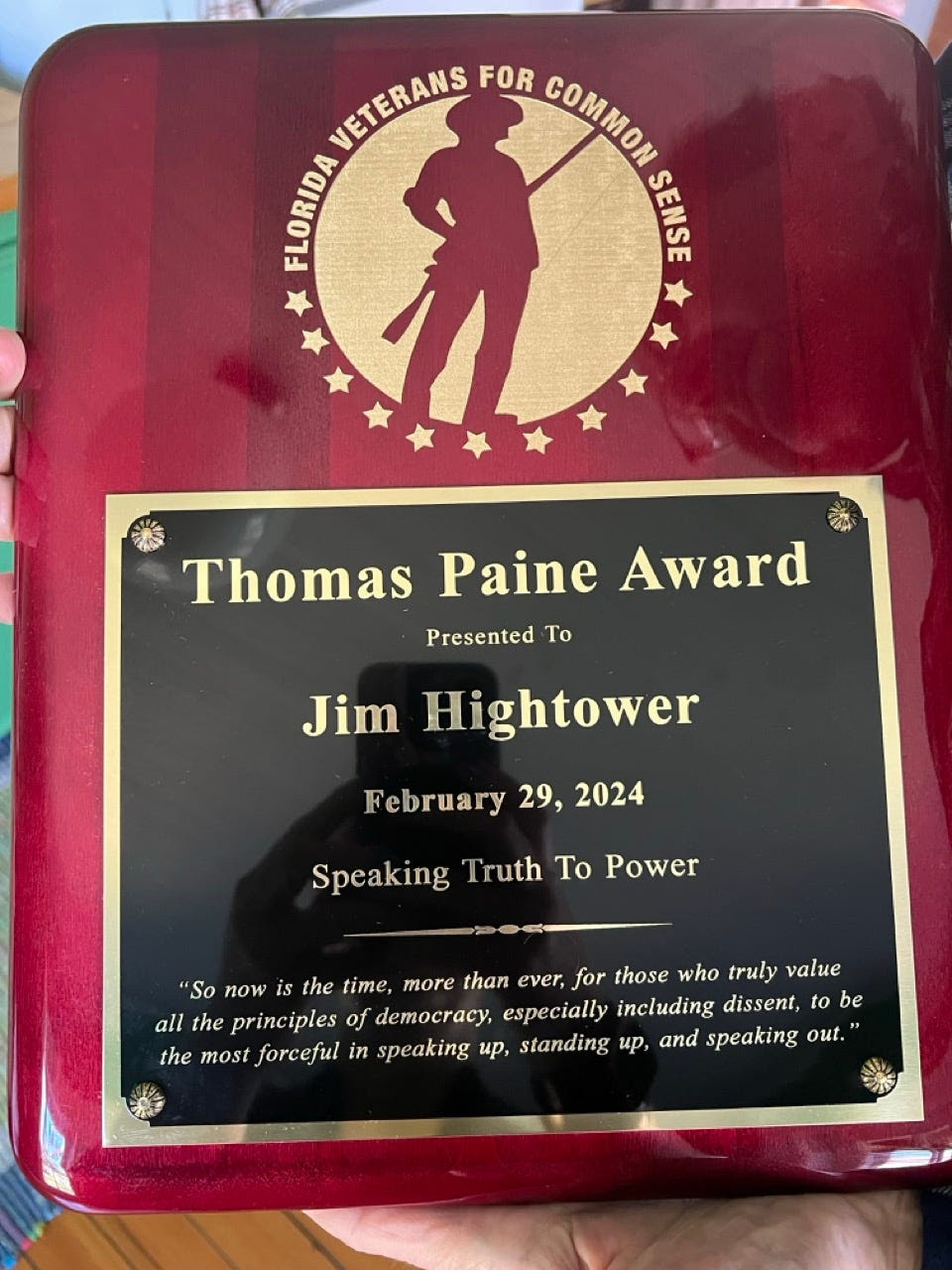
PS, from the staff— Hightower was recently give the Thomas Paine award by the Florida Veterans for Common Sense, where he learned a ton about Paine that he never knew. Hence the inspiration for this commentary! Thanks FLVCS!

Jim Hightower’s Lowdown is a reader-supported publication. To receive new posts and support my work, consider becoming a free or paid subscriber.

Subscribed

Thanks again for being a paid subscriber to the Lowdown. If you like the work we do here, please consider referring your friends— you’ll earn credits towards your own subscription when they sign up. 

Refer a friend

Or consider giving the gift of agitation! A Lowdown subscription makes a great gift:

Give a gift subscriptionLIKECOMMENTRESTACK

© 2024 Jim Hightower
PO Box 40446 Austin TX 78704 
Unsubscribe

Start writing

Thom Hartmann has written a new book titled The Hidden History of Monopolies: How Big Business Destroyed the American Dream. He has decided to offer it for free, a chapter at a time, on his blog.

He writes:

Because the Founders set up America to be resistant to the coercive and corruptive influence of monopoly and vested interest, the monopolists didn’t have any direct means of taking over the American government. So, two processes were necessary.

First, they knew that they’d have to take over the government. A large part of that involved the explicit capture of the third branch of government, the federal judiciary (and particularly the Supreme Court), which meant taking and holding the presidency (because the president appoints judges) at all costs, even if it required breaking the law; colluding with foreign governments, monopolies, and oligarchs; and engaging in massive election fraud, all issues addressed in previous Hidden History books.

Second, they knew that if they were going to succeed for any longer than a short time, they’d need popular support. This required two steps: build a monopoly-friendly intellectual and media infrastructure, and then use it to persuade people to distrust the US government.

Lewis Powell’s 1971 memo kicked off the process.

Just a few months before he was nominated by President Richard Nixon to the US Supreme Court, Powell had written a memo to his good friend Eugene Sydnor Jr., the director of the US Chamber of Commerce at the time.32 Powell’s most indelible mark on the nation was not to be his 15-year tenure as a Supreme Court justice but instead that memo, which served as a declaration of war against both democracy and what he saw as an overgrown middle class. It would be a final war, a bellum omnium contra omnes, against everything FDR’s New Deal and LBJ’s Great Society had accomplished.

It wasn’t until September 1972, 10 months after the Senate confirmed Powell, that the public first found out about the Powell memo (the actual written document had the word “Confidential” at the top—a sign that Powell himself hoped it would never see daylight outside of the rarified circles of his rich friends). By then, however, it had already found its way to the desks of CEOs all across the nation and was, with millions in corporate and billionaire money, already being turned into real actions, policies, and institutions.

During its investigation into Powell as part of the nomination process, the FBI never found the memo, but investigative journalist Jack Anderson did, and he exposed it in a September 28, 1972, column in the Washington Post titled, “Powell’s Lesson to Business Aired.” Anderson wrote, “Shortly before his appointment to the Supreme Court, Justice Lewis F. Powell Jr. urged business leaders in a confidential memo to use the courts as a ‘social, economic, and political’ instrument.”33

Pointing out that the memo hadn’t been discovered until after Powell was confirmed by the Senate, Anderson wrote, “Senators . . . never got a chance to ask Powell whether he might use his position on the Supreme Court to put his ideas into practice and to influence the court in behalf of business interests.”34

This was an explosive charge being leveled at the nation’s rookie Supreme Court justice, a man entrusted with interpreting the nation’s laws with complete impartiality. But Anderson was a true investigative journalist and no stranger to taking on American authority or to the consequences of his journalism. He’d exposed scandals from the Truman, Eisenhower, Johnson, Nixon, and Reagan administrations. In his report on the memo, Anderson wrote, “[Powell] recommended a militant political action program, ranging from the courts to the campuses.”35

Powell’s memo was both a direct response to Franklin Roosevelt’s battle cry decades earlier and a response to the tumult of the 1960s. He wrote, “No thoughtful person can question that the American economic system is under broad attack.”36

When Sydnor and the Chamber received the Powell memo, corporations were growing tired of their second-class status in America. The previous 40 years had been a time of great growth and strength for the American economy and America’s middle-class workers—and a time of sure and steady increases of profits for corporations—but CEOs wanted more.

If only they could find a way to wiggle back into the minds of the people (who were just beginning to forget the monopolists’ previous exploits of the 1920s), then they could get their tax cuts back; they could trash the “burdensome” regulations that were keeping the air we breathe, the water we drink, and the food we eat safe; and the banksters among them could inflate another massive economic bubble to make themselves all mind-bogglingly rich. It could, if done right, be a return to the Roaring Twenties.

But how could they do this? How could they persuade Americans to take another shot at what was widely considered a dangerous “free market” ideology and economic framework that had crashed the economy in 1929?

Lewis Powell had an answer, and he reached out to the Chamber of Commerce—the hub of corporate power in America—with a strategy. As Powell wrote, “Strength lies in organization, in careful long-range planning and implementation, in consistency of action over an indefinite period of years, in the scale of financing available only through joint effort, and in the political power available only through united action and national organizations.” Thus, Powell said, “the role of the National Chamber of Commerce is therefore vital.”37

In the nearly 6,000-word memo, Powell called on corporate leaders to launch an economic and ideological assault on college and high school campuses, the media, the courts, and Capitol Hill. The objective was simple: the revival of the royalist-controlled “free market” system. As Powell put it, “[T]he ultimate issue . . . [is the] survival of what we call the free enterprise system, and all that this means for the strength and prosperity of America and the freedom of our people.”

The first front that Powell encouraged the Chamber to focus on was the education system. “[A] priority task of business—and organizations such as the Chamber—is to address the campus origin of this hostility [to big business],” Powell wrote.38

What worried Powell was the new generation of young Americans growing up to resent corporate culture. He believed colleges were filled with “Marxist professors” and that the pro-business agenda of Harding, Coolidge, and Hoover had fallen into disrepute since the Great Depression. He knew that winning this war of economic ideology in America required spoon-feeding the next generation of leaders the doctrines of a free-market theology, from high school all the way through graduate and business school.

At the time, college campuses were rallying points for the progressive activism sweeping the nation as young people demonstrated against poverty, the Vietnam War, and in support of civil rights. Powell proposed a list of ways the Chamber could retake the higher-education system. First, create an army of corporate-friendly think tanks that could influence education. “The Chamber should consider establishing a staff of highly qualified scholars in the social sciences who do believe in the system,” he wrote.39

Then, go after the textbooks. “The staff of scholars,” Powell wrote, “should evaluate social science textbooks, especially in economics, political science and sociology. . . . This would include assurance of fair and factual treatment of our system of government and our enterprise system, its accomplishments, its basic relationship to individual rights and freedoms, and comparisons with the systems of socialism, fascism and communism.”

Powell argued that the civil rights movement and the labor movement were already in the process of rewriting textbooks. “We have seen the civil rights movement insist on re-writing many of the textbooks in our universities and schools. The labor unions likewise insist that textbooks be fair to the viewpoints of organized labor.”41 Powell was concerned that the Chamber of Commerce was not doing enough to stop this growing progressive influence and replace it with a pro-plutocratic perspective.

“Perhaps the most fundamental problem is the imbalance of many faculties,” Powell pointed out. “Correcting this is indeed a long-range and difficult project. Yet, it should be undertaken as a part of an overall program. This would mean the urging of the need for faculty balance upon university administrators and boards of trustees.” As in, the Chamber needed to infiltrate university boards in charge of hiring faculty to make sure that only corporate-friendly professors were hired.

Powell’s recommendations targeted high schools as well. “While the first priority should be at the college level, the trends mentioned above are increasingly evidenced in the high schools. Action programs, tailored to the high schools and similar to those mentioned, should be considered,” he urged.

Next, Powell turned to the media, instructing that “[r]eaching the campus and the secondary schools is vital for the long-term. Reaching the public generally may be more important for the shorter term.” Powell added, “It will . . . be essential to have staff personnel who are thoroughly familiar with the media, and how most effectively to communicate with the public.” He advocated that the same system “applies not merely to so-called educational programs . . . but to the daily ‘news analysis’ which so often includes the most insidious type of criticism of the enterprise system.”

Following Powell’s lead, in 1987 Reagan suspended the Fairness Doctrine (which required radio and TV stations to “program in the public interest,” a phrase that was interpreted by the FCC to mean hourly genuine news on radio and quality prime-time news on TV, plus a chance for “opposing points of view” rebuttals when station owners offered on-air editorials), and then in 1996 President Bill Clinton signed the Telecommunications Act of 1996, which eliminated most media-monopoly ownership rules. That same year, billionaire Rupert Murdoch started Fox News, an enterprise that would lose hundreds of millions in its first few years but would grow into a powerhouse on behalf of the monopolists.

From Reagan’s inauguration speech in 1981 to this day, the single and consistent message heard, read, and seen on conservative media, from magazines to talk radio to Fox, is that government is the cause of our problems, not the solution. “Big government” is consistently—more consistently than any other meme or theme—said to be the very worst thing that could happen to America or its people, and after a few decades, many Americans came to believe it. Reagan scare-mongered from a presidential podium in 1986 that “the nine most terrifying words in the English language are: I’m from the government and I’m here to help.”

Once the bond between people and their government was broken, the next steps were straightforward: Reconfigure the economy to work largely for the corporate and rich, reconfigure the criminal justice system to give white-collar criminals a break while hyper-punishing working-class people of all backgrounds, and reconfigure the electoral systems to ensure that conservatives get reelected.

Then use all of that to push deregulation so that they can quickly consolidate into monopolies or oligopolies.

Michael Podhorzer is a political analyst who has worked for the AFL-CIO. His is a widely respected voice thanks to the depth of his knowledge and wisdom. He maintains here that the MAGA movement is more aligned with the Confederacy than most people realize. He posted this piece soon after the U.S. Supreme Court ruled that states could not remove Trump from their ballots even though he participated in an insurrection.

I am posting it in part. Open the link to read it all.

Podhorzer writes:

Note: A version of this piece was published at The Washington Monthly.  

The Supreme Court rejected Colorado’s decision to keep Trump off the ballot. Ahead of the ruling, many constitutional scholars and historians made strong legal arguments that Section 3 of the 14th Amendment disqualifies Trump from holding public office again. Others argued that if the Supreme Court upheld a Colorado high court ruling it would compromise the legitimacy of our democratic process. 

Here, I want to use this episode to show how the debate itself was really about the legitimacy of America itself. 

Since the January 6, 2021, insurrection, there has been speculation about whether America might break apart as it did in 1861. Some even fear that removing Trump from the ballot will ignite a new civil war. But when we describe what happened in the 19th century and what we fear coming now as a “Civil War,” we undermine the legitimacy of the American nation. We put the secessionists then—and the MAGA movement now—on an equal footing with the legitimate American government. By doing so, we not only mislabel the threats that Trump and MAGA represent, but also underestimate their dangers.

The original designation of the military engagement from 1861 through 1865 was the “War of Rebellion.” This wasn’t just the Union’s perspective; the Confederate States understood themselves to be seceding to form an independent “slaveholding republic.” They called themselves “rebels.” It was not a civil war in which combatants fought to control one nation. 

The leaders of what I call the Red Nation, which has 10 of the 11 Confederate states at its core, consistently reveal that they do not recognize the legitimacy of the United States. (See the Appendix of my post on “The Two Nations of America” for more on how I define Red Nation.) They continue to be in the same relationship with America today as the Confederate states were before the War of Rebellion—unwilling to acceptthe legitimacy of the federal government, even if, in most periods, they have acquiesced to its superior force.

When the 14th Amendment was ratified in 1868, it was obvious why Section 3 was included. When a nation cannot disqualify from public office those who have sought to destroy it, it casts doubt on its own legitimacy. That is especially true of the unrepentant Trump. Even Confederate generals admitted they lost by swearing allegiance to the United States. Trump still insists that he didn’t lose. Meanwhile, most Republicans dodge whether President Joe Biden won the election legitimately by grudgingly acknowledging that Biden is president. 

The MAGA faction is not “conservative,” and even calling it “extremist” misses the point dangerously. Those advocating for conservative and even extreme policies should be welcome in a democratic polity. But those acting in ways that reject legitimately constituted authority are neither conservative nor extreme. They are criminal. Thus, if we hope to be a single America, then we must acknowledge that those who claim that the 2020 election was stolen, decry the prosecution of Trump as a crime, call those convicted for their January 6 crimes “political hostages,” and claim that the Rio Grande is Texas’s to defend and not the federal government’s, do not recognize the legitimacy of the United States. They, like their Confederate ancestors, are not patriots. 

When the Constitution was ratified in 1788, the free states saw it as most of us do today—enshrining a government for a unified nation. To the enslaving states, however, the Constitution did not create a single nation. Rather, as Texas Governor Gregg Abbott and two dozen other Red States say, it is merely a “compact” among the states. Due to the gravity of threats from abroad (Britain, France, Spain) and at home (Native Americans and enslaved people), the enslaving states agreed to a mutual defense pact (the Constitution) only insofar as they were confident that it protected their “peculiar institution.” 

At Appomattox, Virginia, in 1865, the Confederates did not surrender so much as acknowledge that their best hope to preserve their “way of life” was not on the battlefield where they were badly outmatched but in a campaign of terror against Reconstruction. Once the South had made Reconstruction too costly to continue, it enacted Jim Crow Constitutions and updated its forced labor economy. This is a well-told story, for example, in Heather Cox Richardson’s How the South Won the Civil War. 

Our devotion to an “America” that strives to be a “government of the people, by the people, for the people” has never been accepted by the Confederate faction, which has always been (and remains) committed to theocracy. We believe that the warrant for government is “the consent of the governed”; they believe its legitimacy is God-given….

Cutting the Branches, Leaving the Roots

Consider Germany, which is rightly credited for taking responsibility for the Holocaust. Last summer, I visited Berlin and saw how robust these efforts have been. For example, the sidewalks in residential neighborhoods have been broken up by Stolpersteine—stumble blocks—which call attention to the homes the Nazis stole from Jews and, where known, the fate of those Jews. But it’s not as if there aren’t similar landmarks commemorating our past, including the Legacy Museum/Lynching Memorialin Montgomery, Alabama, the National Center for Civil and Human Rights in Atlanta, Georgia, and the National Museum of African American History and Culture in Washington, D.C. 

No, the real difference is exactly the difference between conceptualizing today’s toxic politics as “civil war” or “polarization” instead of a rebellion. In Germany, the idea that there would be monuments or streets named after Adolf Hitler or his generals is unthinkable. No popular culture there valorizes those who fought for the Führer or waxes nostalgic for a lost way of life. There’s no bawdy comedy, The Dukes of Bavaria…

Please open the link to read this provocative article in full.

Robert Hubbell is outraged by the Supreme Court’s latest decision regarding the insurrection clause (Section 3 of the Fourteenth Amendment). The conservative majority on the Court usually claim to be “originalists” who scrutinize the language in the Constitution and divine the intent of those who wrote it.

In this case, the language was crystal clear. Any officer of the federal government who swore an oath to defend the Constitution and then participated in an insurrection against the Constitution was disqualified from running again for office. But the majority said that the official who had engaged in insurrection must first be subject to a Congressional vote; that language is not in the Constitution although there is specific language about the vote needed to remove the disqualification.

Hubbell was furious that Clarence Thomas was allowed to vote in this case since his wife was an active participant in the plot to overturn the election. He should have recused himself but that would require an ethical compass that the justice lacks.

Here is an excerpt from Hubbell’s post. You should open the link and read it in full.

He writes:

The most important lesson from Monday’s disqualification ruling is that the Supreme Court is broken beyond repair. The reactionary majority made that fact abundantly clear by unilaterally amending the Constitution to remove the Insurrection Clause from the 14th Amendment. 

Those sworn to protect the Constitution are dismantling it. The protectors of the Constitution have become its adversary in order to protect a failed insurrectionist who has promised a second effort to overthrow the Constitution. (“I said I want to be a dictator for one day.”)

There are many reasons to ensure that Donald Trump is not elected to the presidency in 2024. Rehabilitating and reforming the Court is chief among them. Sadly, reforming the Court is below the radar for most voters. But the lawless reactionary majority has already denied women the full protection of the liberty clause of the 14th amendment; it is refusing to enforce the clear intent of the 14th to ensure that descendants of enslaved people have a meaningful right to vote and equal protection under law. And the logical force of the Dobbs opinion strongly suggests that the Court will withdraw existing protections for same-sex marriage, contraception, and “inter-racial” marriages.

Monday’s opinion is a clear warning to all Americans that the threat to their liberties is immediate and real. Those who seek to protect existing liberties (and reclaim those already abrogated Court) must vote as if their freedoms depend on the outcome of the 2024 election—because they do! 

The Court has abandoned the Constitution; the last line of defense is the American people exercising their most fundamental right—the right to elect their representatives, who can (in turn) enlarge the Court and limit its jurisdiction.

There is abundant evidence that many Americans are not inspired by either presidential candidate or feel betrayed, forgotten, or ignored by the political process. But one candidate will seek to defend their freedoms by preserving and enforcing the Constitution (in part, by reforming the Court). The other has promised to overturn the Constitution “for one day”—which means “overturn the Constitution” period. The duration of a suspension of the Constitution is irrelevant.

Feelings of anger and upset over Monday’s ruling are understandable and warranted. But the most appropriate response is to redouble our efforts to defeat Trump. Nothing else matters. If we achieve that goal, we can work to advance all other goals. If we do not, we will be at the mercy of a renegade majority on the Court and an out-of-control, aspiring dictator for four years.


What happened?

On Monday, the Court overruled the Colorado Supreme Court’s decision removing Trump from the Colorado primary ballot. The opinion is here: 23-719 Trump v. Anderson (03/04/2024).

The ruling was ostensibly 9-0 with three justices writing a concurring opinion that reads like a dissent and a concurrence by Amy Coney Barrett that criticized the overreach of reactionary majority. In fact, as explained below, the ruling was 5-4, meaning that Justice Thomas’s refusal to recuse himself (as required by statute and rule) was outcome-determinative. Justice Thomas’s corruption saved Donald Trump’s slot on the Colorado ballot.

Distilled to its essence, the US Supreme Court’s ruling in Trump v. Anderson removed the Insurrection Clause from Section 3 of the 14th Amendment.


How did the Court effectively remove the Insurrection Clause from the 14th Amendment?

The 14th Amendment creates a self-executing disqualification for insurrectionists who previously took an oath to support the Constitution. The self-executing nature of that disqualification is consistent with other provisions of the 14th Amendment (equal protection, due process) that are likewise self-executing—as are other qualifications on the presidency (such as age, citizenship, and tenure of residency in the US).

Despite the plain language of the 14th Amendment—which creates a bar to holding federal office based on the conduct of the insurrectionist standing alone—the Court ruled that the Insurrection Clause is ineffective unless Congress affirmatively passes legislation that conforms to narrow prescriptions of the Court’s opinion in Trump v. Anderson.

The reactionary majority ignores that Section 3 of the 14th Amendment speaks to the role of Congress in enforcing the Insurrection Clause. It says that Congress can remove an insurrectionist’s disqualification by a two-thirds vote. But under the Court’s ruling in Trump v. Anderson, Congress can prevent any disqualifications of insurrectionists by simply refusing to pass the enabling legislation prescribed by the reactionary majority.

As Justice Sotomayor wrote in her concurring opinion,

It is hard to understand why the Constitution would require a congressional supermajority to remove a disqualification if a simple majority could nullify Section 3’s operation by . . . declining to pass implementing legislation.

As George Conway noted on Monday on MSNBC, the reactionary majority arrived at its conclusion by simply ignoring the language of the Constitution. The reactionary majority regularly uses the text of the Constitution as a cudgel when they want to deny liberties embraced by the language of the Constitution. But when they seek to ensure that a failed insurrectionist and aspiring dictator remains on the ballot, they act as if the text of the Constitution does not exist.

A reader wrote to me after the issuance of the opinion and asked, “What can we do?” My answer is this:

Elect Democrats. Reform the Court. Defend the Constitution. Preserve Democracy.


If you are old enough to remember a different America, an America of neighborhood shops, of local bakeries, butchers, drugstores (with a soda fountain), shoe stores, bookstores, and dress shops, you may have wondered why most of them have been replaced by national chain stores and anonymous strip malls. Now we see even neighborhood public schools replaced by national charter chains, some even operated by for-profit corporations. Thom Hartmann explains the roots of this change in his new book The Hidden History of Monopolies: How Big Business Destroyed the American Dream. He is releasing the book a chapter at a time on his blog, which should whet our appetite to buy and read the book. This chapter describes the legal ploy that resulted in crushing local enterprise and creating billionaires.

He writes:

Robert Bork was Richard Nixon’s solicitor general and acting attorney general and had a substantial impact on the thinking in the Reagan White House—so much so that Reagan rewarded his years of hard work on behalf of America’s monopolists with a lifetime appointment to the federal bench in the DC Circuit, frequently a launching pad for the Supreme Court.

In the years following Lewis Powell’s 1971 memo, as numerous “conservative” and “free market” think tanks and publications grew in power and funding, Bork’s ideas gained wide circulation in circles of governance, business, and the law.

In 1977, in the case of Continental T.V., Inc. v. GTE Sylvania, the Supreme Court took up Bork’s idea and, for the first time in a big way, embraced the “welfare of the consumer” and “demonstrable economic effect” doctrines that Bork had been promoting for over a decade.

Neither of those phrases exists in any antitrust law, at least in Bork’s context. Nonetheless, the Supreme Court embraced Bork’s notion that the sole metric by which to judge monopolistic behavior should be prices that consumers pay, rather than the ability of businesses to compete or the political power that a corporation may amass.

When Ronald Reagan entered the White House in 1981, bringing with him Bork’s free market philosophy and a crew from the Chicago School, he ordered the Federal Trade Commission to effectively stop enforcing antitrust laws even within the feeble guidelines that the Supreme Court had written into law in GTE Sylvania.

The result was an explosion of mergers-and-acquisitions activity that continues to this day, as industry after industry concentrated down to two, three, four, or five major players who function as cartels. (A brilliant blow-by-blow cataloging of that decade is found in Barry C. Lynn’s book Cornered: The New Monopoly Capitalism and the Economics of Destruction.)

Bork’s reasoning—that antitrust law should defend only the consumer (through low prices), and not workers, society, democracy, or local communities—has become such conventional wisdom that in the 2014 Supreme Court case of FTC v. Actavis, Chief Justice John Roberts wrote a virtual word-for-word parroting of Bork: “The point of antitrust law is to encourage competitive markets to promote consumer welfare.”

Barak Orbach, professor of law at the University of Arizona, is one of a small number of scholars today who are genuine experts in the field of antitrust law. In a 2014 paper published by the American Bar Association, he wondered if Bork knew he was lying when he wrote that the authors of the Sherman Antitrust Act intended to reduce prices to advance “consumer welfare,” instead of protecting the competitiveness of small and local businesses, and the independence of government at all levels.

His conclusion, in “Was the ‘Crisis in Antitrust’ a Trojan Horse?” was that Bork was probably just blinded by ideology and had never bothered to go back and read the Congressional Record, which, he noted, says nothing of the kind.74

While Bork wrote that “the policy the courts were intended [by the Sherman Antitrust Act] to apply is the maximization of wealth or consumer want satisfaction,” Orbach said, “Members of Congress . . . were determined to take action against the trusts to stop wealth transfers from the public.” So much for that: today the Walton (Walmart) family is the richest in America and one of the richest in the world. They’re worth more than $100 billion, having squirreled away more wealth than the bottom 40% of all Americans. And they spend prodigiously on right-wing political causes, from the national to the local.

Amazon’s Jeff Bezos is now wealthier than any Walton; with a registered net worth of $112 billion, he is the richest single person in the world. Bezos is so rich that when he divorced his wife, MacKenzie Bezos, she received 19.7 million shares of Amazon worth $36.8 billion. She instantly became the world’s third-richest woman, and Jeff Bezos remained the world’s wealthiest man.75 While local newspapers are shutting down or being gobbled up all over the country, Bezos personally purchased the 140-year-old Washington Post in 2013 for $250 million. Now Bezos, like the Walton family, can use his sub- stantial wealth to obtain political ends that protect his wealth and allow Amazon to continue to grow.

Heather Cox Richardson put the Alabama court decision declaring embryos to be children into historical context. The Founders did not want the nation to be controlled by theocrats. They understood the importance of separating church and state. That separation was and is important for the protection of the church from the state and for the protection of the state from the church.

She writes:

The Alabama Supreme Court on February 16, 2024, decided that cells awaiting implantation for in vitro fertilization are children and that the accidental destruction of such an embryo falls under the state’s Wrongful Death of a Minor Act. In an opinion concurring with the ruling, Chief Justice Tom Parker declared that the people of Alabama have adopted the “theologically based view of the sanctity of life” and said that “human life cannot be wrongfully destroyed without incurring the wrath of a holy God.”

Payton Armstrong of media watchdog Media Matters for America reported today that on the same day the Alabama decision came down, an interview Parker did on the program of a self-proclaimed “prophet” and Q-Anon conspiracy theorist appeared. In it, Parker claimed that “God created government” and called it “heartbreaking” that “we have let it go into the possession of others.” 

Parker referred to the “Seven Mountain Mandate,” a theory that appeared in 1975, which claims that Christians must take over the “seven mountains” of U.S. life: religion, family, education, media, entertainment, business…and government. He told his interviewer that “we’ve abandoned those Seven Mountains and they’ve been occupied by the other side.” God “is calling and equipping people to step back into these mountains right now,” he said. 

While Republicans are split on the decision about embryos after a number of hospitals have ended their popular IVF programs out of fear of prosecution, others, like Republican presidential candidate Nikki Haley agreed that “embryos, to me, are babies.” 

House speaker Mike Johnson (R-LA) identifies himself as a Christian, has argued that the United States is a Christian nation, and has called for “biblically sanctioned government.” At a retreat of Republican leaders this weekend, as the country is grappling with both the need to support Ukraine and the need to fund the government, he tried to rally the attendees with what some called a “sermon” arguing that the Republican Party needed to save the country from its lack of morality.

As Charles Blow of the New York Times put it: “If you don’t think this country is sliding toward theocracy, you’re not paying attention.”

In the United States, theocracy and authoritarianism go hand in hand. 

The framers of the Constitution quite deliberately excluded religion from the U.S. Constitution. As a young man, James Madison, the key thinker behind the Constitution, had seen his home state of Virginia arrest itinerant preachers for undermining the established church in the state. He came to believe that men had a right to the free exercise of religion. 

In 1785, in a “Memorial and Remonstrance against Religious Assessments,” he explained that what was at stake was not just religion, but also representative government itself. The establishment of one religion over others attacked a fundamental human right—an unalienable right—of conscience. If lawmakers could destroy the right of freedom of conscience, they could destroy all other unalienable rights. Those in charge of government could throw representative government out the window and make themselves tyrants.

In order to make sure men had the right of conscience, the framers added the First Amendment to the Constitution. It read: “Congress shall make no law respecting an establishment of religion, or prohibiting the free exercise thereof….” 

Madison was right to link religion and representative government. In the early years of the nation, Americans zealously guarded the wall between the two. They strictly limited the power of the federal government to reflect religion, refusing even to permit the government to stop delivery of the U.S. mails on Sunday out of concern that Jews and Christians did not share the same Sabbath, and the government could not choose one over the other. The Constitution, a congressional report noted, gave Congress no authority “to inquire and determine what part of time, or whether any has been set apart by the Almighty for religious exercises.”   

But the Civil War marked a change. As early as the 1830s, southern white enslavers relied on religious justification for their hierarchical system that rested on white supremacy. God, they argued, had made Black Americans for enslavement and women for marriage, and society must recognize those facts.

A character in an 1836 novel written by a Virginia gentleman explained to a younger man that God had given everyone a place in society. Women and Black people were at the bottom, “subordinate” to white men by design. “All women live by marriage,” he said. “It is their only duty.” Trying to make them equal was a cruelty. “For my part,” the older man said, “I am well pleased with the established order of the universe. I see…subordination everywhere. And when I find the subordinate content…and recognizing his place…as that to which he properly belongs, I am content to leave him there.” 

The Confederacy rejected the idea of popular government, maintaining instead that a few Americans should make the rules for the majority. As historian Gaines Foster explained in his 2002 book Moral Reconstruction, which explores the nineteenth-century relationship between government and morality, it was the Confederacy, not the U.S. government, that sought to align the state with God. A nation was more than the “aggregation of individuals,” one Presbyterian minister preached, it was “a sort of person before God,” and the government must purge that nation of sins.

Confederates not only invoked “the favor and guidance of Almighty God” in their Constitution, they established as their motto “Deo vindice,” or “God will vindicate.”

The United States, in contrast, was recentering democracy during the war, and it rejected the alignment of the federal government with a religious vision. When reformers in the United States tried to change the preamble of the U.S. Constitution to read, “We, the people of the United States, humbly acknowledging Almighty God as the sources of all authority and power in civil government, the Lord Jesus Christ, as the Ruler among nations, and His revealed will as of supreme authority, in order to constitute a Christian government, and in order to form a more perfect union,” the House Committee on the Judiciary concluded that “the Constitution of the United States does not recognize a Supreme Being.” 

That defense of democracy—the will of the majority—continued to hold religious extremists at bay. 

Reformers continued to try to add a Christian amendment to the Constitution, Foster explains, and in March 1896 once again got so far as the House Committee on the Judiciary. One reformer stressed that turning the Constitution into a Christian document would provide a source of authority for the government that, he implied, it lacked when it simply relied on a voting majority. A religious amendment “asks the Bible to decide moral issues in political life; not all moral questions, but simply those that have become political questions.” 

Opponents recognized this attempt as a revolutionary attack that would dissolve the separation of church and state, and hand power to a religious minority. One reformer said that Congress had no right to enact laws that were not in “harmony with the justice of God” and that the voice of the people should prevail only when it was “right.” Congressmen then asked who would decide what was right, and what would happen if the majority was wrong. Would the Supreme Court turn into an interpreter of the Bible?

The committee set the proposal aside. 

Now, once again, we are watching a minority trying to impose its will on the majority, with leaders like House speaker Johnson noting that “I try to do every day what my constituents want. But sometimes what your constituents want does not line up with the principles God gave us for government. And you have to have conviction enough to stand [up] to your own people….”