Archives for category: Florida

Robert Hubbell writes a thoughtful, informative blog. I’m posting this as part of my personal project to understand the new face of white supremacy. White supremacy has always been there, simmering below the surface. Trump invited them to show their faces and step into the daylight. They did, and DeSantis is sending them signals that he wants to be their champion.

Florida Governor Ron DeSantis has set his anti-education sites on Florida’s state colleges. Through a series of political and legal maneuvers, he has ceded control over Florida’s state colleges to ultra-conservative culture warriors like Christopher Rufo. In short order, DeSantis has announced that he will rid Florida state colleges and universities of curricula not “rooted in Western tradition” or that “compels belief in critical race theory or related concepts such as intersectionality.”

Amid the torrent of reporting on Ron DeSantis’s attack on critical race theory and intersectionality, the quiet part is often left unsaid. So let me say it: DeSantis’s educational agenda is code for racism and white supremacy. (Other parts of his agenda seek to erase the dignity and humanity of LGBTQ people.) DeSantis’s invocation of “Western tradition” is meant to suppress knowledge regarding the people (and contributions) of Asia, Africa, South America, Oceania, and the Indigenous Peoples of the Americas. See Talking Points Memo, DeSantis Makes 2024 Ambitions Clear As He Pours Gasoline On His ‘Woke’ Education Fire.

Given DeSantis’s generalized ignorance, his call to focus on “Western tradition” is a slippery slope that will inevitably lead to the discussion of unpleasant truths about America. For example, the enslavement of Black people was a “tradition” in North America for 246 years—and the abolition of that evil practice is relatively recent (155 years ago). So, a college course that honestly addresses the Western “traditions” of North America should include an examination that the role of slavery played in the economic, social, and political development of America.

But DeSantis isn’t stopping at converting Florida’s colleges and universities into re-education camps in the worst traditions of the USSR. He is seeking to up-end centuries of “Western tradition” embodied in the Constitution and the English common law: the requirement of a unanimous jury to impose capital punishment. DeSantis has floated the idea that a less-than-unanimous jury verdict can impose a sentence of death—an unconstitutional proposal designed to inflict the death penalty on more Black and Latino Americans. See Vox, Ron DeSantis wants to make it much easier for the state to kill people.

DeSantis is willing to do all this because he wants to capture Trump’s loyal base—which is the only hope that DeSantis has of becoming a credible candidate. As Trump becomes mired in criminal prosecutions, DeSantis will become emboldened and radicalized beyond his already extremist views. Doing so ignores the lessons of the 2022 midterms: persuadable Americans are done with Trump and his MAGA extremism. Like all military generals, Ron DeSantis is fighting the last war (the presidential election of 2020) and has failed to heed the tectonic shift that occurred in the midterms.

Governor Ron DeSantis hates the fact that there is a progressive public college called New College that openly teaches diversity, equity, inclusion, feminist studies, ethnic studies, and gay studies. That’s WOKE, and he vowed to crush anything WOKE.

He named 6 conservatives to the 13-member board, and the board of the state university system added another, meaning that Rightwingers are in charge. A hard-right board needs a hard-right president, and they got one.

Their first meeting was this afternoon, and they are expected to appoint former State Commissioner of Education Richard Corcoran as the new president. From the following story, it appears that no one bothered to let the current president of the New College know that she was being shown the door.

DeSantis is showing how to stamp out ideas he doesn’t like, with power, not subtlety. Is he a fascist or is he pretending?

A new board of trustees at New College of Florida intends to name Richard Corcoran as its next President.

Corcoran, a former House Speaker, served as Gov. Ron DeSantis’ first Education Commissioner.

Carlos Trujillo, president and founder of Continental Strategy, revealed the plans in a letter to clients and colleges.

“We are beyond excited to announce that one of our Partners, former Department of Education Commissioner Richard Corcoran, will be returning to higher education to serve as the Interim — and hopeful permanent — President of the New College of Florida, in Sarasota,” Trujillo wrote.

“This move comes as part of Gov. DeSantis ongoing work to refocus the university on providing the most value to its students and their parents.”

Corcoran was a founding partner for the consulting firm.

The news comes hours before the first board meeting since DeSantis appointed six new trustees on the 13-member board. The State University System Board of Governors also appointed a new trustee with a similar conservative think tank background.

Of note, work of Corcoran’s apparent hire comes before any news of current President Patricia Okker’s future with the school. Eddie Speir, co-founder of Inspiration Academy, wrote a blog post this weekend promising to call for Okker to be renamed as interim President and to terminate all faculty and staff before deciding who still fit in the new vision for the college.

While Florida’s Sunshine Law requires all decisions by the board to be made in publicly noticed meetings, Trujillo treats the matter like a done deal.

“The selection of Richard distinguishes our firm as a leader in innovation and strategic solutions for the clients we serve. We look forward to finding new synergies that can better serve our current clients and ensure their goals are made a reality,” his letter reads.

The Miami Herald reported today on Governor DeSantis’ plans to cleanse higher education in the state. Conservatives are creating “civics” institutes as a vehicle for patriotic indoctrination, not as a means to think critically about how to improve democracy. Censorship, which DeSantis practices, would be condemned in any genuine civics class.

Gov. Ron DeSantis on Tuesday announced a package of major reforms to Florida’s higher education system, including tighter controls on faculty tenure, the establishment of “civics institutes” at three universities and prohibitions on diversity, equity and inclusion programs.

Speaking at a news conference in Bradenton, the governor unveiled a plan that would allow university boards of trustees and presidents to conduct reviews of tenured faculty members “at any time,” in addition to the periodic reviews that now take place. Regarding university presidents in particular, he proposes “reestablishing their authority over the hiring process.”

Currently, according to a flier distributed by the governor’s staff, “faculty committees can tie the hands of university presidents and bind them to only consider a small pool of recommended candidates.”

And under a heading in the flier that reads “Education not indoctrination,” he proposes changes in standards and course content “to ensure higher education is rooted in the values of liberty and western tradition.” His plan would require schools to “prioritize graduating students with degrees that lead to high-wage jobs, not degrees designed to further a political agenda.”

The proposal also would prohibit state schools from “supporting campus activities or programs that promote divisive concepts like DEI and CRT.” The letters refer to diversity, equity and inclusion programs and critical race theory.

In addition, he proposes establishing “world-class civics institutes” at the University of Florida, Florida International University and Florida State University. The institutes, according to the flier, would develop courses and curricula “that can be used to educate the next generation on the values of liberty and constitutionalism.”

The flier included information on the governor’s higher education budget proposals as well. He proposes $100 million for “recruitment and retention of highly qualified faculty at state universities” and $15 million for faculty and student recruitment at New College of Florida, where he recently appointed six conservative members to the board of trustees.

The New College board meets Tuesday for the first time since the appointments.

Read more at: https://www.miamiherald.com/article271870522.html#storylink=cpy

Now that Florida is a red state, the legislature plans to offer vouchers to every student. The legislators expect to do maximum damage to public schools, which will inexorably lose funding and students. Nothing has been said about how to pay for the proposal. Voucher schools in the state are mostly religious and are completely unregulated. Neither their principals nor their teachers need to be credentialed. They are also free to discriminate on any grounds.

The Miami Herald reports:

Florida Republican lawmakers this year will consider offering every K-12 student thousands of dollars each year for their families to spend on education.

Parents would have access to state-funded accounts and use them to pay for private school tuition plus a wide variety of school-related expenses.

The proposal, if approved, would make the state’s school voucher program bigger than ever. But one key fact about the pitch remains elusive: its cost. It could total billions of dollars.

House Speaker Paul Renner said last week he plans to make the proposal, House Bill 1, a priority during the annual legislative session, which starts March 7.

The measure is already being fast-tracked. It will have its first committee hearing Thursday morning in Tallahassee.

So far, the measure carries no financial impact statement. That’s despite the knowledge that hundreds of thousands more children would be eligible for annual payments of about $8,000 each.

The cost, according to the staff analysis, is “indeterminate.” And that “is not reasonable,” said Norín Dollard, a senior research analyst at Florida Policy Institute, a nonpartisan organization that focuses on quality of life issues for Floridians. The group issued a report on voucher funding in September.

HUNDREDS OF THOUSANDS NEW STUDENTS WOULD BE ELIGIBLE

About 266,000 Florida children attend private schools without using any current state scholarship or voucher, Dollard notes. All would be eligible for education savings accounts under the proposal. In addition, approximately 150,000 children receive home schooling.

HB 1 would provide accounts to as many as 10,000 of them in the first year, with more to come in following years. Conservative back-of-the-napkin math suggests that if just 25% of the newly eligible students participate, and those currently in the program remain, the added cost would reach $600 million, Dollard said.

As participation grows, the total could approach $4 billion or more within five years, she added. If that’s the policy decision in leadership, so be it, Dollard said. But it needs to be funded somehow.

A RECURRING FINANCIAL OBLIGATION

State Rep. Anna Eskamani, D-Orlando, focused on that issue during a hastily called Monday evening Zoom meeting to discuss the measure with public education advocates.“

“We have very, very serious concerns,” Eskamani said during an interview. “This is an annual shift of money. Where is it coming from?”

When unveiling the measure at a news briefing, Renner said it was too early to know how much money might be needed. Much depends on how many children want to avail themselves of the vouchers, he said, and where the Legislature sets per-student funding for the year.

At the same time, Renner stressed his goal is to further open school choice so “no one is left out.” The bill would eliminate most eligibility restrictions, though it would prioritize children whose family income is at or below 185% of the federal poverty level — or $55,500 for a family of four.

It also would broaden uses of the money beyond private school tuition to include education expenses such as tutoring, testing and college courses. It would allow students to bank up to $24,000 for those uses, and further permit children already attending private schools without state support to request a share of the funds.

“To effectively deliver a quality education, policy makers and education advocates must accept that every student has unique learning needs, that education dollars belong to the student and not a system, and that public school choice offers every student an opportunity to customize their own education,” Renner said Tuesday, when asked about the associated costs.

A SPIKE IN PARTICIPATION IS EXPECTED

Dollard and others said they anticipate wide interest in participation, with much of it coming from families already paying for private schools. In Arizona, which has a similar education savings account program, the state reported 80% of applicants never attended public schools.

That flips the idea of money following the student on its head, Dollard suggested, because those students never had their education covered by state money in the first place.

School district finance officers said they understood the leadership’s position that the details aren’t firm enough to know the full financial impact.

But using the state’s most recent voucher expansion plan as a guide, they had concerns that this initiative would take money away from district budgets and leave them little ability to plan.

That’s what happened the last time the state expanded vouchers in 2021 with the taxpayer-funded Family Empowerment Scholarship. Officials touted the program as adding $200 million for vouchers, allowing 61,000 more children to afford private school.

Districts saw some money go out the door, but nothing like what happened in 2022. Halfway through the 2021-22 school year, school budget officers across the state learned that three times the amount of money they had set aside to send to voucher programs would be required, based on updated attendance figures from the state.

In some counties, such as Pasco, efforts to provide employee raises were derailed as the money officials expected to use was diverted to the vouchers. All told, the cost had grown to $1 billion.

The current year has provided similar sticker shock. The Legislature approved a budget with no specific amount set for the scholarships. By the second education funding calculation in July, the price tag had increased to $1.3 billion.

That meant the Miami-Dade County school district would have to send $225 million from its budget to the voucher program, for example, and the Hillsborough County school district would send $75 million.

When the third calculation came out this week, districts learned they would be losing even more. If the state lifts the eligibility restrictions, Pinellas County Schools chief finance officer Kevin Smith predicted, it will become even more difficult to predict the financial impact.

He suggested the state should at least consider taking the money out of the public education funding program and create a separate line item.

That way, schools would know what to expect and they could budget appropriately. In recent years, the DeSantis administration has taken the position that unexpected changes in enrollment can pose a financial strain on local school districts.

Read more at: https://www.miamiherald.com/news/local/education/article271630112.html#storylink=cpy
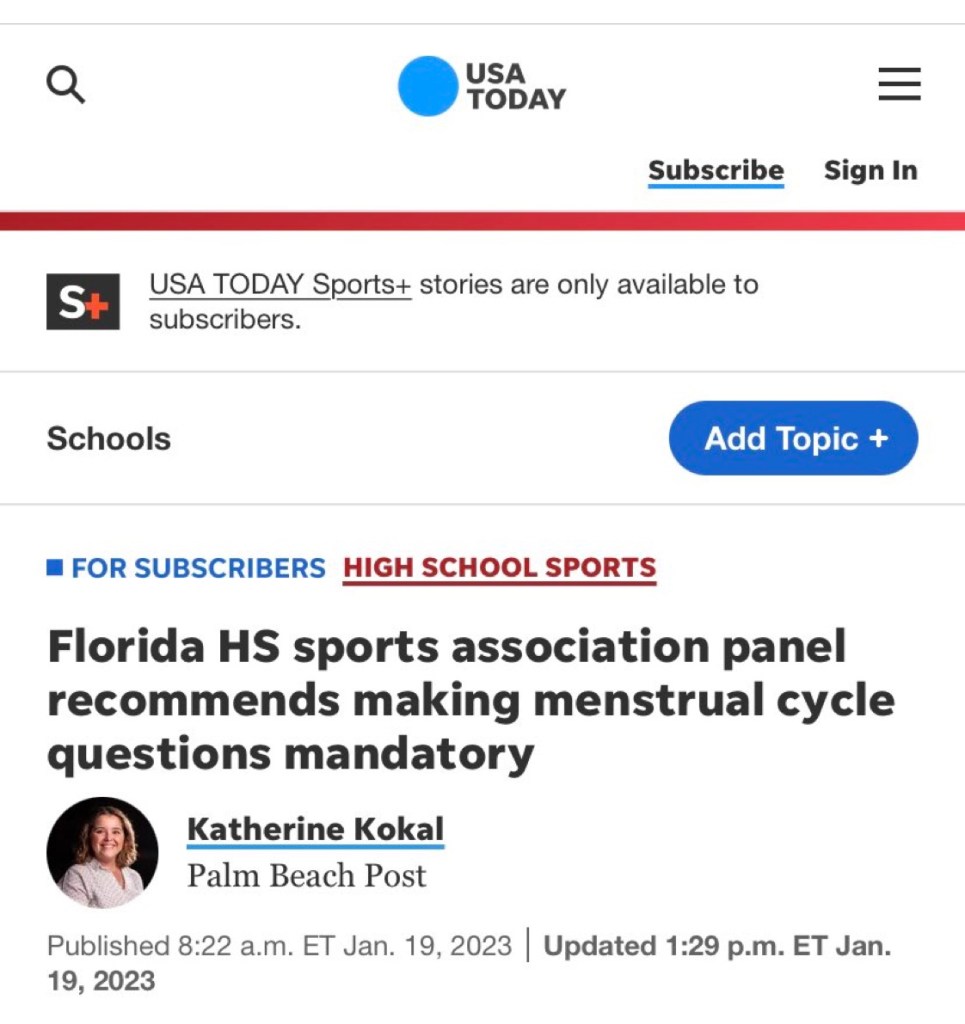
No freedom in Florida! The state where personal privacy goes to die! Soviet-style mind & body control! I’m guessing the purpose of this diktat is to check to make sure no trans women are competing in women’s sports. But there are worse things at stake her. Privacy. Freedom. An intrusive state, a government that counts your menstrual cycle. Gross!

#DictatorDeSantis

Civil rights attorneys out the state of Florida on notice that it was prepared to sue if the state bans the new AP course in African American studies.

Florida’s Black leaders delivered a warning to Gov. Ron DeSantis on Wednesday that if he doesn’t stop attempts “to exterminate Black history” in Florida classrooms, they would sue him for violating the constitutional rights of students.

“We are here to give notice to Gov. DeSantis,’’ said Ben Crump, a Tallahassee civil rights attorney, to a cheering crowd of supporters in the Capitol Rotunda, as three high school students stood at his side.

They were protesting the announcement last week by the Florida Department of Education that it had rejected a new Advanced Placement elective course on African-American studies, developed by the College Board for high school students.

“If he does not negotiate with the College Board to allow AP African-American Studies to be taught in the classrooms across the state of Florida, these three young people will be the lead plaintiffs,’’ said Crump, who has represented families in several high-profile civil rights cases.

The College Board is expected to release its updated version of the AP course on Feb. 1, the first day of Black History Month. As a pilot program taught in 60 select classrooms around the country, the board has been soliciting feedback from teachers for modifications to the curriculum. It is unknown how many schools in Florida are involved in the pilot program.

Read more at: https://www.miamiherald.com/news/local/education/article271651587.html#storylink=cpy

A Florida judge threw out a lawsuit that Donald Trump filed against Hillary Clinton and fined Trump’s lawyers nearly $1 million.

A federal judge in South Florida who threw out Donald Trump’s lawsuit against Hillary Clinton and other Democrats over the 2016 election campaign slammed the former president’s attorneys with legal fees and costs totaling nearly $1 million for filing a “completely frivolous” complaint against them.

U.S. District Judge Donald Middlebrooks on Thursday ruled in his sanctions order that lawyer Alina Habba and her law firm Habba Madaio & Associates must pay $937,989.39 in attorneys’ fees and costs to the lawyers for Clinton and 30 other plaintiffs in the case. Middlebrooks had dismissed Trump’s lawsuit last year.

Middlebrooks concluded the suit was a bad-faith use of the federal court system, in which Trump’s lawyers echoed his allegations that Clinton, the Democratic National Committee and others orchestrated a “Russia Hoax” that falsely portrayed Trump in a conspiracy with the Russians to meddle in the 2016 election campaign. Clinton lost the election to Trump, who was investigated by special counsel Robert Mueller but was not charged with a crime after Mueller found that the Russian government meddled in the U.S. presidential campaign.

In the lawsuit filed in South Florida, Trump’s lawyers claimed that Clinton and other major Democrats had “orchestrated a malicious conspiracy to disseminate patently false and injurious information about Donald J. Trump and his campaign, all in the hope of destroying his life, his political career, and rigging the 2016 Presidential Election in favor of Hillary Clinton.”

Middlebrooks, responding to the defense lawyers’ motion for sanctions, found that “this case should never have been brought.”

“Its inadequacy as a legal claim was evident from the start,” Middlebrooks wrote in a scathing 46-page sanctions order. “No reasonable lawyer would have filed it. Intended for a political purpose, none of the counts of the amended complaint stated a cognizable legal claim.” The judge alluded to the “telltale signs” of Trump’s “playbook”: “Provocative and boastful rhetoric; a political narrative carried over from rallies; attacks on political opponents and the news media; disregard for legal principles and precedent; and fundraising and payments to lawyers from political action committees.”

“Thirty-one individuals and entities were needlessly harmed in order to dishonestly advance a political narrative,” Middlebrooks concluded. “A continuing pattern of misuse of the courts by Mr. Trump and his lawyers undermines the rule of law, portrays judges as partisans, and diverts resources from those who have suffered actual legal harm.”

Trump’s lawyers will appeal. However, after the Florida ruling, Trump dropped his $250 million lawsuit against New York State Attorney General Letitia James. His lawyers must have persuaded him that they did not want to risk their own firm’s assets.

Read more at: https://www.miamiherald.com/news/politics-government/article271418742.html#storylink=cpy

In other Florida news, another federal judge ruled against Governor DeSantis for firing the elected state attorney for Hillsborough County, Andrew Warren. DeSantis has already named a replacement for Warren. So Warren wins the case but does not get his job back. DeSantis fired Warren because he signed a statement saying that he would not prosecution for “abortion crimes.” DeSantis accused Warren of being “woke,” which he cannot tolerate.

Despite concluding that Gov. Ron DeSantis violated the Florida Constitution and the First Amendment when he suspended Hillsborough State Attorney Andrew Warren last year, a federal judge ruled Friday that he didn’t have the power to restore Warren to office.

U.S. District Judge Robert L. Hinkle found that DeSantis suspended Warren based on the allegation that the state attorney had blanket policies not to prosecute certain kinds of cases. ”The allegation was false,” Hinkle wrote in a ruling issued Friday morning.

“Mr. Warren’s well-established policy, followed in every case by every prosecutor in the office, was to exercise prosecutorial discretion at every stage of every case. Any reasonable investigation would have confirmed this.” Yet Hinkle concluded that the U.S. Constitution prohibits a federal court from awarding the kind of relief Warren seeks, namely to be restored to office.

Read more at: https://www.miamiherald.com/news/politics-government/article271422712.html#storylink=cpy

What’s going on in Florida? Governor DeSantis thinks that he should control what is taught in all public schools and in public higher education. He wants to make sure that everyone is exposed only to approved thoughts, his thoughts. He told all the state colleges and universities to report what they are spending on diversity, of which he disapproves. He has made it illegal to teach about racism, which he thinks is synonymous with critical race theory.

To understand Ron DeSantis and his ideology, you should first study critical race theory.

The Chronicle of Higher Education reported that the state’s colleges and community colleges pledged not to “promote” critical race theory. What does that mean? Does it mean they will scrub the curriculum of any courses that teach about race and racism? Does it mean there will be no courses called “critical race theory?” I would love to hear from some professors in Florida.

The presidents of Florida’s 28 state and community colleges said in a statement on Wednesday that they would identify and eliminate, by February 1, any academic requirement or program “that compels belief in critical race theory or related concepts such as intersectionality.”

The unusual statement comes on the heels of a request by the office of the state’s Republican governor, Ron DeSantis, for public colleges and universities to submit comprehensive lists of their spending related to diversity initiatives and critical race theory. It’s unclear if Wednesday’s announcement is directly related to that request.

The presidents’ joint statement is unclear. Read into it what you will.

What is disturbing is the stench of thought control. I am gobsmacked by DeSantis’ total disregard for academic freedom and the First Amendment. Day after day, he chips away at norms, seeking the power to censor ideas he doesn’t like. Of course he goes after public schools and public higher education. But as he showed in his smack down of Disney, he’s quite willing to give orders to private corporations as well.

He appears to be growing into nativism, fascism, authoritarianism. It comes naturally to him.

Florida has one of the largest voucher programs in the nation, and Republicans expect to make the program even larger. With a large majority in both houses and a choice-friendly governor, they will push their bill through with little or no resistance. Florida’s voucher schools are not required to hire certified teachers; their students do not take state tests. Although accountability was a major thrust of the Florida “reforms,” voucher schools are exempt from any accountability. Most are religious schools.

The Miami Herald reported:

Florida’s school voucher program could see a major expansion under new legislation filed Thursday by House Republicans. Standing at a lectern with a sign reading “Your Kids, Your Choice,” House Speaker Paul Renner introduced House Bill 1 to make vouchers available to all Florida children eligible to enter kindergarten through 12th grade. Children from families with incomes up to 185% of the federal poverty level, which is $55,500 plus $9,509 for each additional family member, would continue to get priority for the funding. Children in foster care also would receive priority.

The bill would allow voucher recipients to use the public funds for more than tuition at a private school and transportation, as is currently in law. Families would be allowed to spend the money on home-schooling, college courses, private tutoring and specialized testing such as Advanced Placement exams, among other expenses.

Students may not be in public school to qualify for a voucher, which is the equivalent of per-student funding in a public school — currently about $8,216 per year.

Families would receive the money through state-funded education savings accounts, a longtime goal for Florida Republicans. “It’s about freedom and opportunity,” Renner, R-Palm Coast, said during his news conference. “We empower parents and children to decide the education that meets their needs.”

State Rep. Kaylee Tuck, chairperson of the House Choice and Innovation subcommittee, is carrying the bill. The Lake Placid Republican said the measure should allow families to customize education for their children.

Renner predicted broad bipartisan support for the bill, which he said also should clear the waiting list for students with special education needs to receive a state scholarship. Currently about 9,400 children are on that list, according to Renner’s staff.

DEMOCRATS CALL IT ‘DEFUNDING PUBLIC EDUCATION’

House Democratic Leader Rep. Fentrice Driskell disagreed with Renner’s comments regarding support for the bill. She called it a “defunding of public education” and said she expected most members of her party to oppose it. “There is nothing in this bill that I like, because we continue to take these public dollars and use them for private purposes,” Driskell, D-Tampa, said.

Other Democrats attending a news conference to counter the Republicans’ announcement held similar views. They said they support vouchers for students who need special services, and agreed that parents deserve choices — including within the public schools, which 2.9 million children attend.

“Let’s not defund one institution to fund another one,” said Rep. Felicia Robinson, D-Miami Gardens, who also called for more accountability in the voucher system. Schools that accept vouchers should at least have certified teachers, Robinson said.

And parents who accept funding should have to prove the money is going toward approved education services, added Rep. Yvonne Hayes Hinson, D-Gainesville. ”There is no accountability for tracking funds,” said Hinson.

“This might be a get-rich scheme. I’ve seen it all over the country.” Rep. Allison Tant, D-Tallahassee, referenced her city’s Red Hills Academy, a charter school that closed within weeks of opening last year, citing low enrollment and processing issues, according to the Tallahassee Democrat. ”They got state funding to go create themselves,” Tant said. “Then they turn the kids back to public schools and guess what? They kept the funding.” In Palm Beach County, the founder of one charter school was found profiting off the venture by steering school contracts to companies he owned, according to the Palm Beach Post.

RENNER OFFERS REBUTTAL ON FUNDING

Renner said critics who claim the Republicans are seeking to dismantle public education ignore the fact that the Legislature has put more total dollars into district schools every year, something he said would likely continue. He also pointed to the state’s efforts to improve teacher pay, adding millions of dollars to boost the base salary.

“It’s going to be a good year for our traditional public schools as well,” Renner said.

Read more at: https://www.miamiherald.com/news/local/education/article271373917.html#storylink=cpy

Just in case there was any doubt about what Governor DeSantis and Florida legislature banned when they outlawed any discussion of “critical race theory,” that doubt has been resolved. They do not want schools and teachers to acknowledge race, racism, or the very existence of people of color in the United States. Sight unseen, the DOE has banned an AP course on African American studies. The Department claimed that the content of the course is historically inaccurate and violates state law, even though the Department has never seen the course syllabus.

The Miami Herald reported today:

Without a detailed explanation, Gov. Ron DeSantis’ administration has rejected a new Advanced Placement course on African American studies for high school students, broadly claiming it violates state law and that it “lacks educational value.”

When asked for specifics on the content, the Florida Department of Education did not respond, making it unclear what items the state believes are unlawful or objectionable.

“In the future, should College Board be willing to come back to the table with lawful, historically accurate content, FDOE will always be willing to reopen the discussion,” the state wrote in a letter to the College Board, the company that administers the course as well as other interdisciplinary courses and the SAT exam.

The Advanced Placement program is the first course in African American studies to be offered by the College Board. It would allow high school students to earn credits and advanced placement at many colleges across the country.

The course has been in development for more than a decade, and it focuses not just in history, but explores the “vital contributions and experiences of African Americans” in literature, the arts, political science, geography and science, according to the College Board. A syllabus is not yet publicly available.

Read more at: https://www.miamiherald.com/news/local/education/article271362032.html#storylink=cpy