Here is a brief interview about what should never be taught in school.
Archives for category: Florida
Florida has strong laws about giving the public access to public records. A taxpayer recently sued to find out who was advising Governor DeSantis when he selected judicial nominees. DeSantis argued that this information was a matter of executive privilege and was not covered by the state’s open records law. A judge agreed. The Miami Herald was outraged. They sense, as do I, that DeSantis not an ordinary Governor. He wants to be in total control of the state. He wants to do what he wants to do. He doesn’t tolerate dissent. He gives off the smell of a fascist. Since he seems to be a front runner to beat Trump, I watch him closely. Everyone should.
Gov. Ron DeSantis has opened yet another front in his endless war to remake Florida in his image. This time, it’s an attack on the public’s right to know and a claim of “executive privilege” that could result in a new level of unfettered power for the governor.
The latest effort to control our state goes to the heart of what government is supposed to do: Represent the people. Governors are not kings. They cannot do whatever they like. Their work is our work. Their records are our records.
We paid for them with our taxes — just like we pay for all the work that is done in Tallahassee, work done in our name and to which we should have almost complete access, except for rare situations in which the government can prove the reason for a (narrow) exception.
But now we have a ruling in a lawsuit, John Doe v. Gov. Ron DeSantis and the Executive Office of the Governor, that runs counter to all of those well-defined concepts of government-by-the-people.
As the Miami Herald reported, an anonymous person filed suit last year asking for documents showing any communication between the governor’s office and “six or seven pretty big legal conservative heavyweights” that DeSantis revealed on a podcast that he’d consulted when making judicial picks for the Florida Supreme Court.
DeSantis’ legal team (which we are no doubt paying for) argued in court that he shouldn’t have to hand over the documents because such things should be kept secret.
The governor needs to be able to talk to anyone and everyone in private if it helps him make good decisions for the rest of us, or so the argument went. In other words, just trust DeSantis, voters. He knows best. Now run along outside and play.
DeSantis is claiming that he does not have to reveal the names of what may amount to a shadow Cabinet because he has executive privilege, a hazy concept even on a federal level, though many presidents have tried to assert it.
Perhaps Florida’s governor has gotten confused about which job he has, amid the talk of a 2024 presidential run.
But the fact remains: No such thing was ever agreed on by voters in this state. Executive privilege is not in the state Constitution or statutes; DeSantis’ lawyers just want it to be so. They want it so badly they’ve tried it in other cases. This time, though, the judge bought it.
BEHIND CLOSED DOORS
In a Jan. 3 ruling, Leon County Circuit Judge Angela C. Dempsey said the governor does indeed have executive privilege and therefore John Doe — and the rest of us — aren’t entitled to see what he does behind closed doors. How does he select judicial nominees? None of your business, you annoying voters. (We’ll be over here cashing your checks, though.)…
And while executive privilege isn’t in the Florida Constitution, public records laws are. Florida voters in 1992 amended the Constitution to include open records and open meeting laws.
Only the Legislature can make exceptions. Take a look at Article 1, Section 249(c) of the Constitution if you want to read it for yourself. The exceptions must be approved by a two-thirds vote of both houses.
And any exception must overcome high hurdles including that it be a “public necessity” and narrowly tailored to fit only the specific bit of information to be kept secret.
It’s not supposed to be used just because the governor doesn’t want people to know the identities of his secret advisers.
Read more at: https://www.miamiherald.com/opinion/editorials/article271924982.html#storylink=cpy
Time and again, Florida Governor Ron DeSantis has exceeded his authority by one-man stunts, created to win national publicity and demonstrate that he’s more fascist than Trump.
Now, his puppet legislature is meeting in special session to clean up the mess DeSantis left behind.
The Miami Herald editorial board excoriates his authoritarian control of weak-kneed legislators.
With Gov. DeSantis’ iron-fisted control of the legislative process in Florida, it’s not elected officials who must conform to the limits of the law; it’s the law that gets modified according to the whims of elected officials.
If you pass a half-baked bill in vengeful haste, someone will clean up your mess. When you get sued for allegedly violating your own migrant-relocation program, no worries, your friends in the Legislature will expand that program and give you ample power — and cash — to make it “right.” When you tout illegal voting arrests of people who the state allowed to vote, and it turns out you might have chosen the wrong prosecutors to bring those charges, you simply change the law.
That’s the story of the special legislative session that began this week in the Florida Capitol. The urgent matter the Republican-controlled Legislature must address is cleaning up the governor’s most controversial policies. Lawmakers couldn’t even wait another month until their regular two-month session that starts in March.
To be fair, there are other valid issues being discussed: providing relief for Hurricane Ian victims and expanding a law that allows college athletes to sign endorsement deals. But this is no ordinary special session. The bulk of it is about giving DeSantis more — and unchecked — power.
Take the law that tried to dissolve the Reedy Creek Improvement District in Central Florida last year. Created in the 1960s, the special taxing district is controlled by Disney and serves as the governing body for the Walt Disney World Resort. Was it time to revisit this unusual arrangement that ceded so much power to a private company (the district can even build its own nuclear power plant)? Maybe, but good governance wasn’t really top of mind. The Legislature, egged on by DeSantis, was retaliating against Disney for opposing the parental-rights law critics nicknamed “Don’t say gay.”
When lawmakers passed a bill to dissolve Reedy Creek last year, they didn’t hash out what to do with Disney’s $1 billion debt that, without the company’s ability to tax itself, would fall on the residents of Orange and Osceola counties.
There’s no mea culpa on the part of Republicans, though they did give themselves until June 1 to make changes to the law. They now want to maintain the district under a different name, take away Disney’s power to control it and give it to our almighty governor, who would nominate the five people who make up the district’s board. We suppose there’s one silver lining: The board would lose the authority to build a nuclear plant.
House Bill 5B and Senate Bill 6B are another gift to the governor from lawmakers. The state is defending a lawsuit filed by a Democratic state senator challenging the taxpayer-funded flights of mostly Venezuelan migrants from Texas to Martha’s Vineyard. Those migrants were duped into believing they would find jobs and resources on the island.
The lawsuit centers on a key component of the relocation program lawmakers funded last year at DeSantis’ urging: that it relocate migrants from Florida, not other states.
Republicans want to get rid of that fine print and give DeSantis the unchecked authority to relocate migrants from anywhere in the country as long as they have been released by the federal government pending the resolution of their case. He also would get $10 million and the possibility to access $500 million in emergency funds because he signed an executive order declaring an immigration emergency in January, the Herald reported.
This gives DeSantis the ability to tap into millions of dollars to target any voter-rich Republican primary state in his expected presidential run, courtesy of taxpayers. The premise of the program is that the border crisis presents a threat to Floridians, but whether or not those migrants would ever make it to the Sunshine State is inconsequential at this point.
The other legislative clean-up relates to the state’s new election-crimes office, created by the Legislature after Donald Trump’s lies about widespread voter fraud in the 2020 election became a major plank in the Republican Party platform. Last year, DeSantis proudly boasted the office had arrested 20 felons who voted illegally.
Those voters told the Herald and other news outlets they were given voter registration cards by their local election offices. DeSantis’ own administration didn’t flag them as ineligible. Some cases were dismissed by judges who found that the statewide prosecutors who filed the charges didn’t have the jurisdiction to do so.
The Legislature’s first order should be to prevent more ineligible voters from slipping through the cracks. Instead, its solution is to make it easier to prosecute them after they have already cast ballots. Legislation would clarify that the Office of Statewide Prosecution can investigate voting-related crimes. The office reports to a Republican, Attorney General Ashley Moody, and is a safer way for DeSantis to score wins than going through Florida’s 20 states attorney, prosecutors who are elected locally.
One-party control of Florida’s government is nothing new. What’s new is that the Legislature has become just another arm of the governor’s office. Its role isn’t to serve as a check on the executive power anymore, but to rubber stamp and inflate the man whose ambition and thirst for the spotlight have turned governing into a power-grabbing spectacle.
Governor Ron DeSantis and his Education Commissioner Manny Diaz Jr. denounced the new AP African American Studies course in January. They listed specific objections to the syllabus. When the College Board released its final draft on February 1, everything that Florida opposed had been deleted.
The College Board insisted that it did not bow to political pressure because the revisions were made before Florida officials denounced the original.
The New York Times reported that the College Board and Florida officials were in frequent contact between September and February 1. The first attack on the AP course was written by Stanley Kurtz and published in the National Review on September 12. Kurtz warned that the AP course was “NeoMarxist” and takes “leftist indoctrination to a whole new level.”
About the same time, the College Board and Florida officials began negotiations.
The Times said today:
While the College Board was developing its first Advanced Placement course in African American studies, the group was in repeated contact with the administration of Gov. Ron DeSantis of Florida, often discussing course concepts that the state said it found objectionable, a newly released letter shows.
When the final course guidelines were released last week, the College Board had removed or significantly reduced the presence of many of those concepts — like intersectionality, mass incarceration, reparations and the Black Lives Matter movement — though it said that political pressure played no role in the changes.
The specifics about the discussions, over the course of a year, were outlined in a Feb. 7 letter from the Florida Department of Education to the College Board.
The existence of the letter was first reported by The Daily Caller, aconservative news site. A copy of the letter was posted on Scribd. Its authenticity was verified by a spokeswoman for the Florida Department of Education, which released a copy early Thursday.
The College Board responded to the letter with one of its own, released on Thursday, saying that Florida’s concerns had not influenced any revisions to the course, which had been shaped instead by feedback from educators.
“We provide states and departments of Education across the country with the information they request for inclusion of courses within their systems,” the letter said, adding, “We need to clarify that no topics were removed because they lacked educational value. We believe all the topics listed in your letter have substantial educational value.”
The discussions between the College Board and the state took place as right-wing activists across the country were increasingly taking aim at school lessons that emphasize race and racism in America. Governor DeSantis, who has presidential ambitions, has cast himself as the voice of parents who are fed up with what he has called “woke indoctrination” from progressive educators.
The back and forth between Florida and the College Board is sure to add to the controversy over the Advanced Placement curriculum, which has prompted a debate among academics in the fields of Black studies, U.S. history and beyond. It has also cast suspicion on the College Board, long criticized for producing exams that seemed to favor white and affluent students.
Supporters of the new A.P. course — which can yield college credit for high school students who do well in it — say it encourages the study of Black history and culture, which have often had only a limited place in high schools. They see another advantage as well, saying that the class will attract Black and Hispanic students, who have not enrolled in A.P. classes as frequently as white students, enriching their study skills and potentially enabling them to amass college credit.
The Florida letter suggests discrepancies with the College Board’s account of events. Florida publicly announced that it had rejected the A.P. course in January, a few weeks before the College Board released its final guidelines — too little time, the board said, to make any politically motivated revisions. But according to the letter, the state informed the College Board months before, in September 2022, that it would not add the African American Studies class to the state’s course directory without revisions.
The Florida letter also outlines a key Nov. 16 meeting to air differences between the state and the College Board over the course. In the meeting, the state claimed that the A.P. African American Studies course violated regulations requiring that “instruction on required topics must be factual and objective and may not suppress or distort significant historical events.”
According to the state, the College Board acknowledged that the course would undergo revisions, while pushing back against the state’s request to remove concepts like “systemic marginalization” and “intersectionality,” which the College Board saw as integral to the class.
Nevertheless, by the time the course’s final framework was released on Feb. 1, those terms had largely been removed, except that intersectionality was listed as an optional subject for the course’s required final project, in which students can choose their area of focus.
In its response to the Florida letter, the College Board said, “We are confident in the historical accuracy of every topic included in the pilot framework, as well as those now in the official framework.” The board has also said that students and teachers could still engage with ideas like intersectionality through optional lessons or projects and through A.P. Classroom, a free website that will serve as a repository for important texts for the class.
Even so, many scholars have noted the omission of terms that, according to the College Board’s own research documents, are considered central to African American Studies as it is taught on college campuses.
Intersectionality, for example, is an influential theory first laid out by the legal scholar Kimberlé Crenshaw in 1989. It posits that race, class, gender, sexuality and other forms of identity intersect in ways that shape individuals’ experience of the world.
Professor Crenshaw’s work is important to several disciplines, including African American studies, gender studies and legal studies. She is also closely associated with critical race theory, a concept that has become a lightning rod among conservative curriculum activists, who object to schools emphasizing the concepts of racism or white privilege.
Ron DeSantis threw his weight around, and the College Board capitulated. He is now the official arbiter of what history may be taught to advanced students in American high schools.
Florida leaders want to remove requirements to register and get a permit to carry a concealed weapon. In the ideal libertarian state, there would be no gun control at all. More murders, more killing. Does Florida have a minimum age requirement? That will be next to go.
Florida House Speaker Paul Renner is pushing a measure that would allow people to carry concealed firearms without a permit and without training, saying he wants to remove the “government permission slip.”
Renner had previously said that he wanted a permitless carry bill — something Gov. Ron DeSantis has also advocated for — during this year’s legislative session, which starts March 7.
He announced the legislation during a news conference Monday, surrounded by the bill’s sponsors and Florida sheriffs.
Standing alongside Renner, Hernando County Sheriff Al Nienhuis, president of the Florida Sheriff’s Association, endorsed the legislation. “I think we can assume that our citizens are gonna do the right thing when it comes to carrying and bearing arms,” he said.
Twenty-five states already have what supporters call “constitutional carry” measures, meaning they don’t require a permit to carry a concealed firearm.
Read more at: https://www.miamiherald.com/news/politics-government/state-politics/article271838402.html#storylink=cpy
However, gun lovers complained that the proposed bill doesn’t go far enough. They want every Floridian to be able to carry their gun in the open. They call it “constitutional carry,” because the Constitution doesn’t say anything about background checks, training or any of the other requirements sought or imposed by gun control advocates.
The red states are competing, it seems, to see who can go farthest to erase any limits on gun ownership and use.
The opposition to Florida’s proposed legislation to allow Floridians to carry concealed firearms without a permit or training was expected from gun safety advocates.
But at a Tuesday hearing on the bill, there were just as many disgruntled Second Amendment supporters, who said the bill didn’t go far enough because it doesn’t allow for open carry, the visible carrying of a firearm.
Only a few of the dozens of public commenters told legislators they were happy with the measure as written.
But Republican members of the House Constitutional Rights, Rule of Law & Government Operations Subcommittee passed the bill out of the committee on a 10-5 vote along party lines.
The bill now only has one other committee hearing to move through before it goes to a vote on the House floor. House Speaker Paul Renner has expressed strong support for the bill, holding a news conference last month with uniformed sheriffs to announce its filing.
Senate President Kathleen Passidomo has also expressed her support for the measure, though no matching legislation has yet been filed in the Senate. Sen. Jay Collins, R-Tampa, has said he will be the bill’s sponsor.
‘CONSTITUTIONAL CARRY’ IN PLAY
Permitless carry, often called constitutional carry by supporters, allows people within certain legal parameters to carry weapons without having to go through the permitting process.
In Florida, that includes a background check, fingerprinting, a payment of $97 for a new application and the completion of a training course, which includes firing a live round in front of an instructor. Gun carriers would be required to carry a personal ID.
Some of those gun rights advocates said Florida’s proposal is not true “constitutional carry” because it applies only to people being able to carry a concealed weapon; it doesn’t permit open carry of weapons in public and still restricts gun possession for people under the age of 21 and on college campuses.
“To call this bill constitutional carry is an insult to our intelligence,” said Bob White, the chairman of the Republican Liberty Caucus of Florida. Luis Valdes, Florida director of Gun Owners of America, said the bill is a step in the right direction compared to prior years when similar bills didn’t make it out of committees.
But he said it doesn’t go far enough. “The governor has pledged he wants constitutional carry, he didn’t pledge that he wants permitless concealed only,” Valdes said.
Should there be any age limit for purchasing or owning or carrying guns? Is 10 years old okay? How about 6? Should guns be okay in schools? How about in the legislature? Why not let prisoners carry guns? Why should they lose their “constitutional rights”?
Read more at: https://www.miamiherald.com/news/politics-government/state-politics/article272248473.html#storylink=cpy
Florida has become a Petri dish for potential fascism. DeSantis has made war on African Americans, on gays, on transgender people, on drag queens, on public schools, on higher education, even on private corporations (Disney). He likes to stand behind signs that declare Florida is “free,” but no one is free to disagree with him. That’s not freedom.
Now DeSantis has proposed to create a military force that answers only to him. To call out the National Guard, he must get federal permission. That’s not good enough for him. He wants a Florida state guard. Some other states have them, but they are not in the hands of a would-be dictator whose vanity knows no limits.
CNN reports:
St, Petersburg, Florida (CNN) — Florida Gov. Ron DeSantis wants to reestablish a World War II-era civilian military force that he, not the Pentagon, would control.
DeSantis pitched the idea Thursday as a way to further support the Florida National Guard during emergencies, like hurricanes. The Florida National Guard has also played a vital role during the pandemic in administering Covid-19 tests and distributing vaccines.
But in a nod to the growing tension between Republican states and the Biden administration over the National Guard, DeSantis also said this unit, called the Florida State Guard, would be “not encumbered by the federal government.” He said this force would give him “the flexibility and the ability needed to respond to events in our state in the most effective way possible.” DeSantis is proposing bringing it back with a volunteer force of 200 civilians, and he is seeking $3.5 million from the state legislature in startup costs to train and equip them.
States have the power to create defense forces separate from the national guard, though not all of them use it. If Florida moves ahead with DeSantis’ plan to reestablish the civilian force, it would become the 23rd active state guard in the country, DeSantis’ office said in a press release, joining California, Texas and New York. These guards are little-known auxiliary forces with origins dating back to the advent of state militias in the 18th century. While states and the Department of Defense share control of the National Guard, state guards are solely in the power of a governor.
Will DeSantis use his state guard to break up peaceful demonstrations? Will he send it to drag shows to close them down? Will he it to harass teachers accused of being woke? The possibilities are frightening.
Two of the reddest states in the nation had the largest numbers of people signing up for Obamacare. This reflects the size of their population but also their needs. Their governors may rant against the federal government and its programs, but actions speak louder than words. The public wants what the politicians deride. Yet the public elects the people who deny their basic needs.
Florida led the way with the highest number of people in the country who signed up for health insurance under the Affordable Care Act, with more than 3.2 million people enrolling, or 20 percent of the country’s totals.
A record 16.3 million people nationwide signed up for plans on the federal health insurance exchange during the open enrollment period, which began Nov. 1 and ended on Jan. 15, the Centers for Medicare & Medicaid Services reported Wednesday.
In Florida, enrollment ballooned to 3.2 million, a 19% jump over last year’s open enrollment period under the health law, commonly known as Obamacare.
The 3.2 million represents 20 percent of all enrollees nationwide, even though Florida, the third most populous state in the country with 22 million people, accounts for only about 7 percent of the U.S. population…
For University of Miami professor Dr. Olveen Carrasquillo, an expert on the Affordable Care Act, Florida’s enrollment spike is likely an indication ofoutreach efforts, a lack of jobs that provide health coverage, and that Florida is one of 11 states that did not expand Medicaid eligibility through the Affordable Care Act (ACA).
About 425,000 adults in Florida don’t have health insurance because they are too poor to qualify for coverage under the ACA and the state hasn’t expanded Medicaid, according to the Center on Budget and Policy Priorities. More than half of those adults are Hispanic or Black.
“It shows that there’s a major need for health insurance in our state,” said Carrasquillo, who serves as UM’s dean for Clinical and Translational Research and is also co-director of the Clinical Translational Science Institute.
Almost a million Floridians could lose their Medicaid coverage starting in April once the federal COVID-19 emergency comes to an end, and because Florida didn’t expand its Medicaid eligibility.
Floridians fall into this coverage gap because their incomes fall above the state’s eligibility for Medicaid but below the federal poverty line, making them ineligible for Medicaid, a health insurance program run jointly by the federal government and states.
They would also be ineligible for coverage within the Affordable Care Act marketplace. To qualify for Medicaid in Florida, parents must earn less than 31 percent of the federal poverty line, or less than $6,807 for a family of three, the Center on Budget and Policy Priorities estimates.
Texas has the second-highest enrollment in Affordable Care Act plans among states that used the federal marketplace, with 2.4 million enrollees, according to the Centers for Medicare & Medicaid Services.
Read more at: https://www.miamiherald.com/news/health-care/article271638107.html#storylink=cpy
Dan Rather and Elliott Kirschner write a blog called Steady. Their voice is always thoughtful, reasonable, informed, and…steady. I think that they, like me, are old enough to remember when we believed that overt racism was ebbing and that white supremacy was dead. Our hopes have been shattered since 2016. It takes the use of critical race theory to understand why we were so naive. Here is their take on the big Education story of the day:
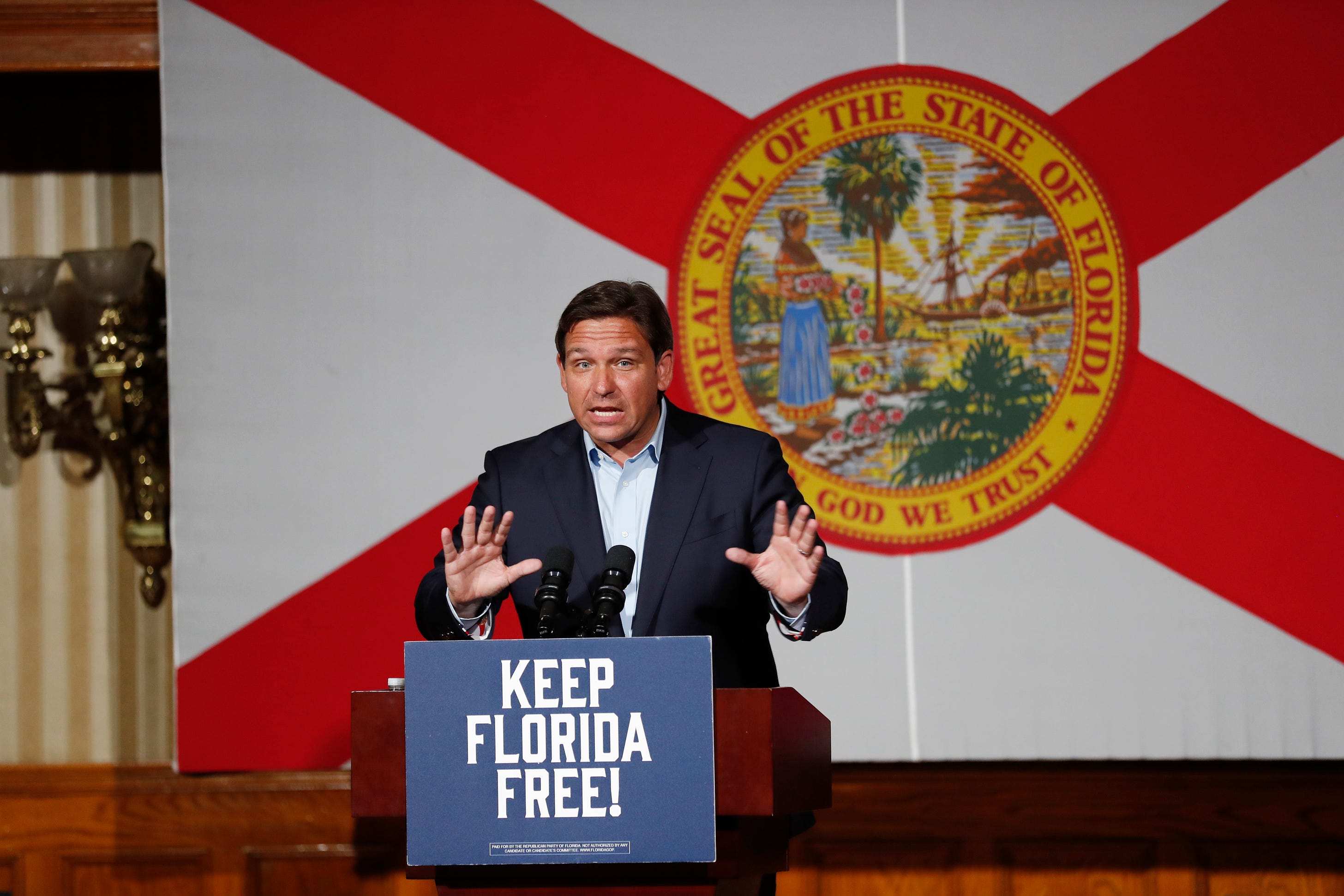
Photo credit: Octavio Jones
Editor’s note: this is an ironic banner in front of DeSantis. Florida is not free for those who don’t share his ideology. If you think racism exists today in Florida, you are not free to discuss it in school or college. You are free to agree with him.
Rather and Kirschner write:
Much of American history is entangled with racism and white supremacy. That is the reality of our beloved nation, no matter how much we wish it were not.
As we sit here nearly a quarter of the way through the 21st century, it is obvious that we need to have the maturity to look back to our past as well as ahead to the future. Can we do this with our eyes wide open? Will we study and learn from the lessons of history?
You can’t grapple with the truth if you hide it from view. Yes, our national narrative is an inspiring one — of freedom, rights, and new opportunities. But it is also a narrative of pain — of the bondage, rape, and murder of enslaved people. It is a story of mass death, broken treaties, and land stolen from Native people. And it is a story of persecution of the “other,” time and again.
The chasm between the noble promises of our founding documents and our historical realities continues to obstruct our national journey toward a more perfect union.
Yes, ours is a country that has facilitated exploration, innovation, and growth, but it is also one built upon families torn apart at the auction block, bodies whipped, and police dogs and fire hoses set against children.
Cities were redlined. Public schools were segregated. And despite our carefully cultivated national image as a meritocracy, throughout our history we have seen talent overlooked and our common humanity diminished on account of people’s race, religion, and sexual orientation.
The ripples of injustice continue to destabilize our society.
It shouldn’t be controversial to say any of this. But acknowledging these truths today is a political act, because it threatens the privileged narratives of those who seek to sugarcoat our past. These are men and women who serve their own ambitions by fortifying their cynical holds on power, delighting in division, feeding off fear, and applauding anger.
And that brings us to Florida’s Governor Ron DeSantis.
Listing all of his efforts to leverage the power of his office to attack equity, empathy, and justice would stretch this post immeasurably. But doing so would also jeopardize the central point: DeSantis is an opportunist. He is not weighing the merits of any one campaign. Rather, he wants headlines as a culture warrior standing up to “wokeness,” a term he has eagerly redefined to suit his own purposes. It allows him to sneer at and dismiss any attempt to reckon with American injustice.
DeSantis has focused his assaults on two of our society’s most traditionally marginalized groups: Black Americans and the LGBTQ community. While these populations have thus far felt the brunt of his targeting, we need to see clearly that his rhetoric is a threat to all who care about a democratic, peaceful, empathetic, and just America. Those of us with the greatest privilege should bear a special burden in rejecting this hate.
DeSantis’s pugilism has enabled him to consolidate power in Florida. Any opposition to his toxic initiatives must contend with the uncomfortable truth that voters validated his message and style via his landslide win in November. Now DeSantis thinks he can take his show on the road with a presidential bid. That remains to be seen. Florida has been trending Republican in recent years, and success there might not translate to the current battleground states, many of which saw big Democratic wins in the midterms.
All that being said, there is a great danger to framing this struggle primarily through the lens of electoral politics. This normalizes a discourse that should be rejected by society’s mainstream. Just as the outright bigotry of the past became socially unacceptable, so too should these latest attempts at divisiveness.
It should not surprise us that DeSantis is making schools — both K-12 and college — a central target. He wants to teach a distorted view of America. He wants to make dissenting speech not only suspect but even criminal. He wants to silence the voices of his critics and of critical thinking more generally. This is a playbook that has been followed by demagogues before to very dangerous ends.
It is essential that DeSantis not be covered by the press through a false equivalence paradigm. We can debate what we should teach and how to teach it. But we can’t replace the truth, as unsavory as it may be, with sanitized narratives that suit those already in power. This is a battle for the minds of the voters of the future. This is about what kind of nation we will become.
But DeSantis primarily cares about what kind of country we are now. He wants to appeal to fear because he thinks he can mine that fear for votes. That is his game plan. And he’s not hiding it. There can be no appeasement. DeSantis has already shown that he isn’t interested in deliberations or good faith compromise. Those would disrupt his approach of means to an end.
History illustrates that hatred can be taught, but so can empathy and justice. We are on a winding journey as a nation. And we have much farther to go. But we have made progress in the face of bigots and autocrats because people had the courage to forge the inequities of our past into a more equitable future.
This history, this truth, is what scares people like DeSantis the most. But it is one that can give us hope if we are determined not to look away.
I wrote today’s 9 a.m. post about the College Board capitulating to conservative critics. I wrote it without seeing the revised curriculum because I was in an airplane all day. Late last night, I opened an email and discovered that Michael Hiltzik of the Los Angeles Times had written a similar but more informative column, because he was able to do the comparison that I had not done. He pointed out that the rightwing attacks on the AP African American Studies course began in September, and the very names and topics that the right and DeSantis had condemned were either excised or made optional in the revised course.
He wrote:
One might have expected a leading national educational institution to have the gumption to push back against right-wingers like Florida Gov. RonDeSantis when they try to stick their noses into decisions about how to teach important subjects.
Sadly, no.
On Wednesday, the College Board issued its final curriculum for what should have been a ground-breaking high school course in African American studies. The College Board called the course “an unflinching encounter with the facts and evidence of African American history and culture.”
The final curriculum appears suspiciously to have been tailored to objections raised by DeSantis, Florida’s culture warrior Republican governor, and other right-wingers, after the board issued a draft version in December.
DeSantis, through his secretary of Education, called the draft “inexplicably contrary to Florida law” and forbade its use in Florida schools. The state’s education secretary, Manny Diaz Jr., attacked it for being “filled with Critical Race Theory and other obvious violations of Florida law.”
The arch-conservative National Review labeled the course part of “a new and sweeping effort to infuse leftist radicalism into America’s K–12 curriculum.”
The curriculum is part of College Board’s Advanced Placement program, which gives college-bound high schoolers exposure to university-level coursework.
The board says AP courses are “aimed at enabling students to develop as independent thinkers and to draw their own conclusions.”
To be fair, the board’s actions related to the African American Studies course are as good a workshop in allowing students to draw their own conclusions as one might hope. Any reasonably bright AP student is likely to see this affair as a demonstration of abject cowardice.
Disgustingly, the College Board released the final curriculum on the first day of Black History Month, as though trawling for praise for its unflinching devotion to truth. The board took pains to deny that the alterations in the draft curriculum had anything to do with criticism from DeSantis, the National Review or the right wing generally.
“No states or districts have seen the official framework that is released, much less provided feedback on it,” the board said. “This course has been shaped only by the input of experts and long-standing AP principles and practices.”
Raise your hand if you believe the College Board. Me neither.
The board said the final version had been completed in December. DeSantis issued his rejection of the course on Jan. 19. But criticism of the course outline had been circulating in conservative quarters for months — the National Review’s attack, for instance, was published on Sept. 12.
A preliminary, unflinching examination of the differences between the draft and the final version can only raise suspicions that the College Board refashioned the African American studies course to assuage the conservatives.
State Senator Manny Diaz Jr. posted a tweet on January 20 listing the state’s concerns about the AP course.
As a template, let’s use the list of “concerns” issued by Diaz on Jan. 20.
Diaz complained about the inclusion in the draft curriculum of writers and social activists Kimberlé Crenshaw, Angela Davis, Roderick Ferguson, Leslie Kay Jones, bell hooks , and Robin D.G. Kelley. Every single one of them has been excised from the final version.
Diaz’s list objected to the treatment, or even inclusion, of topics including the reparation debate, movements such as Black Lives Matter, Black Queer studies and “intersectionality,” which places racism and discrimination in a broadly social context.
Those topics have all been downgraded from required topics to “sample project topics” — that is, optional topics that fall outside requirements and won’t appear on the AP test. Those topics, the curriculum says, “can be refined by states and districts.”
Here’s a safe bet: None of them will be taught in Florida schools.
DeSantis has made no secret of his determination to turn Florida education into a shallow pool redolent of white supremacy by avoiding any hint that American society and politics have been infused with racism and class discrimination.
The shame of the College Board’s rewriting of its AP course is that it effectively places DeSantis and his henchmen in the position of dictating educational standards to the rest of the country.
There was scant political pushback against DeSantis when he rejected the draft curriculum, other than a letter from Illinois Gov. JB Pritzker, a Democrat, warning the College Board that his state would “reject any curriculum modifications designed to appease extremists like the Florida Governor and his allies.”
Pritzker observed, properly, that “ignoring and censoring the accurate reporting of history will not change the realities of the country in which we live.” (Like DeSantis, Pritzker is being talked up as a potential presidential candidate in 2024.)
Now that the final curriculum has been published and its dilutions can be closely scrutinized, perhaps the scope of the College Board’s capitulation will become clearer.
But the College Board has already flunked this all-important test of character. As we’ve noted before, acts of cowardice in the face of DeSantis’ goonish bullying won’t appease him, but will only encourage him.
As he works to destroy the independence and quality of the Florida K-12 and university systems, parents elsewhere around the country can take perverse satisfaction in knowing that students will emerge from Florida schools without the skill to compete with their own kids in intelligent society.
But if institutions like the College Board continue to let DeSantis transmit his virus of ignorance beyond Florida’s borders, no one will be safe from the contagion.
When I first had a chance to read the College Board’s AP African American Studies syllabus, I predicted that the College Board was likely to beat a hasty retreat if its bottom line was jeopardized. I have not yet seen the revised edition, but the media is reporting that certain hot topics and prominent names were deleted to make the course palatable to Ron DeSantis and other conservative governors.
After heavy criticism from Gov. Ron DeSantis, the College Board released on Wednesday an official curriculum for its new Advanced Placement course in African American Studies — stripped of much of the subject matter that had angered the governor and other conservatives.
The College Board purged the names of many Black writers and scholars associated with critical race theory, the queer experience and Black feminism. It ushered out some politically fraught topics, like Black Lives Matter, from the formal curriculum.
And it added something new: “Black conservatism” is now offered as an idea for a research project.
This last addition was a direct concession to criticism from the conservative National Review, which assailed the AP course as Neo-marxist indoctrination that left out the voices of African American conservative writers and scholars.
The Times’ story continues:
But the study of contemporary topics — including Black Lives Matter, incarceration, queer life and the debate over reparations — is downgraded. The subjects are no longer part of the exam, and are simply offered on a list of options for a required research project.
And even that list, in a nod to local laws, “can be refined by local states and districts.”
The expunged writers and scholars include Kimberlé W. Crenshaw, a law professor at Columbia, which touts her work as “foundational in critical race theory”; Roderick Ferguson, a Yale professor who has written about queer social movements; and Ta-Nehisi Coates, the author who has made the case for reparations for slavery. Gone, too, is bell hooks, the writer who shaped discussions about race, feminism and class.
After the curriculum was released, Professor Crenshaw said that even if her name and others had been taken out of the curriculum because secondary sources — theorists or analysts — were being eliminated in favor of facts and lived experience, the decision sent a troubling message. “I would have made a different choice,” she said. “Even the appearance of bowing to political pressure in the context of new knowledge and ideas is something that should not be done.”
But she said she was also disappointed because she had believed the course would capitalize on a hunger of young students to learn “ways of thinking about things like police brutality, mass incarceration and continuing inequalities.”
Instead, she said, “the very same set of circumstances that presented the need for the course also created the backlash against the content that people don’t like.”
David Blight, a professor of American history at Yale University, said Wednesday that he had written an endorsement of the new curriculum, at the College Board’s request, and that he believed it had much to offer not just about history but also about Black poetry, art and the origins of the blues, jazz and hip-hop. But he withdrew his endorsement on Wednesday, after learning that some sections had been cut.
“I withdrew it because I want to know when and how they made these decisions to excise these people, because that’s also an attack on their academic freedom,” Dr. Blight said.
PEN America, a free speech organization, echoed that concern. While the College Board had said the changes were not political, the board “risked sending the message that political threats against the teaching of particular types of content can succeed in silencing that content,” said Jeremy C. Young, senior manager of free expression and education at PEN America…
Dr. Gates, who was a consultant to the curriculum, said he was “sorry that the College Board’s policy is not to require secondary sources in its curricula.” He teaches Harvard’s introduction to African American studies, “and academic subjects such as ‘Intersectionality’ and critical race theory, the 1619 Project, reparations for slavery, Black homophobia and antisemitism are fair game, of course, for such a class,” he said in an email. The 1619 Project is an initiative by The New York Times.
The College Board insists it made its changes in December before DeSantis denounced the syllabus.
But the conservative attack on the syllabus began last September, when Stanley Kurtz received a leaked copy and wrote a scathing critique in The National Review called “Neo-Marxing the College Board with AP African American Studies.”
He wrote in September:
A new and sweeping effort to infuse leftist radicalism into America’s K–12 curriculum has begun. The College Board — the group that runs the SAT test and the Advanced Placement (AP) program — is pilot-testing an AP African American Studies course. While the College Board has withheld the course’s curriculum framework from the public, I have obtained a copy.
Although K–12 teachers and academic consultants working with the College Board have publicly denied that AP African American Studies (APAAS) either pushes an ideological agenda or teaches critical race theory, those denials are false. APAAS clearly proselytizes for a socialist transformation of the United States, although its socialism is heavily inflected by attention to race and ethnicity. Even if there were no laws barring such content, states and local school districts would have every right to block APAAS as antithetical to their educational goals. In any case, APAAS’s course content does run afoul of the new state laws barring CRT. To approve APAAS would be to gut those laws.
Kurtz followed with additional articles in The National Review lambasting the course as radical leftist indoctrination that violated state laws prohibiting the teaching of critical race theory. He applauded DeSantis’s attack on the course.
Although the College Board insisted that it’s revisions had nothing to do with the conservative pushback and was completely nonpolitical, Kurtz laughed:
Here’s the reality. The College Board is in a panic. Its repeated attempts to keep the APAAS curriculum secret have failed. That curriculum has now been widely published, and the teacher’s guide has been exposed here at NRO as well. My sources tell me that at least one other red state is seriously considering pulling out of the course. More red states are likely doing the same. The College Board knows that if it doesn’t stop the bleeding, the red states will be lost.
The College Board knew it had a problem months before DeSantis condemned the course. Could it take the risk of offering a course that would be rejected by red states that had already banned “critical race theory?”
The Times pointed out:
Acceptance for the new curriculum is important to the College Board, a nonprofit, because A.P. courses are a major source of revenue. The board took in more than $1 billion in program service revenue in 2019, of which more than $490 million came from “AP and Instruction,” according to its tax-exempt filing.
The College Board is a nonprofit but it pays hefty salaries. According ito Forbes, its Chief Executive Officer David Coleman (the architect of the Common Core standards) was paid $1.8 million in salary in 2018 (the last year that figures were available), and its president received more than $1 million. The company holds over $1 billion in assets.
Could they risk publishing a course that might be rejected by every red state? Maybe. But would they? Clearly, it was decided that it was easier to drop the controversial names and topics than to offend powerful conservative figures who might hurt their revenues.

 Diane Ravitch's blog