Archives for category: Education Reform

If you read only one article today, read this one. It’s powerful and poignant. The article was written by Forrest Wilder and appears in the Texas Monthly, a terrific publication.

To understand why Republican legislators from rural districts helped to defeat vouchers in Texas, read this article about the schools of Fort Davis in Jeff Davis County in rural West Texas. The superintendent is a bedrock conservative who is dead set against vouchers. His schools are on the verge of bankruptcy due to the state’s Byzantine school-finance system. The state government doesn’t care. At the end, you will understand Governor Abbott’s long-term goal: to eliminate property taxes and completely privatize education.

Texas doesn’t have a mile-high city, but Fort Davis comes close at 4,892 feet. The tiny unincorporated town is nestled in the foothills of the Davis Mountains, where bears and mountain lions and elk stalk among pine-forested sky islands. Fort Davis is the seat of Jeff Davis County, whose population of 1,900 is spread among 2,265 square miles, 50 percent bigger than Rhode Island. The sparsely populated desert country of Mongolia has nearly seven times the population density of Jeff Davis County. Odessa, the nearest city to Fort Davis, is two and a half hours away. The state Capitol is six and a half.

For Graydon Hicks III, the far-flunged-ness of Fort Davis is part of its appeal. He likes the high and lonesome feel of his hometown—the “prettiest in Texas,” he says. But these days, it has never felt further from the state’s political center of gravity.

For years, Hicks, the superintendent of Fort Davis ISD, has been watching, helplessly, as a slow-motion disaster has unfolded, the result of a flawed and resource-starved public-school finance system. Over the last decade, funding for his little district, which serves just 184 K–12 students, has sagged even as costs, driven by inflation and ever-increasing state mandates, have soared. The math is stark. His austere budget has hovered around $3.1 million a year for the past six years. But the state’s notoriously complex school finance system only allows him to bring in about $2.5 million a year through property taxes.

Hicks has hacked away at all but the most essential elements of his budget. More than three-quarters of Fort Davis’s costs come in the form of payroll, and the starting salary for teachers is the state minimum, just $33,660 a year. There are no signing bonuses or stipends for additional teacher certifications. Fort Davis has no art teacher. No cafeteria. No librarian. No bus routes. The track team doesn’t have a track to train on.

But Hicks can’t cut his way out of this financial crisis. This school year, Fort Davis ISD has a $622,000 funding gap. To make up the difference, Hicks is tapping into savings. Doug Karr, a Lubbock school-finance consultant who reviewed the district’s finances, said Fort Davis ISD was “wore down to the nub and the nub’s all gone. And that pretty much describes small school districts.”

“I am squeezing every nickel and dime out of every budget item,” Hicks said. “I don’t have excess of anything.” When I joked that it sounded like he was holding things together with duct tape and baling wire, he didn’t laugh. He said: “I literally have baling wire holding some fences up, holding some doors up.”

The district’s crisis comes at a time when the state is flush with an unprecedented $33 billion budget surplus. Hicks is a self-described conservative, but he thinks the far right is trying to destroy public education. For years, the state has starved public schools of funding: Texas ranks forty-second in per-pupil spending. And yet Governor Greg Abbott is spending enormous political capital on promoting a school voucher plan, which would divert taxpayer funds to private schools. Public education, Abbott has repeatedly said, will remain “fully funded,” though public-education spending is lower now than when he took office in 2015, and the Legislature recently passed a $321.3 billion budget with no pay raise for teachers and very little new funding for schools. Unable to get his voucher plan through the regular legislative session, Abbott is threatening to call lawmakers back to Austin until he gets his way.

Lieutenant Governor Dan Patrick, long a champion of vouchers, is backing legislation that would attempt to appease rural Republican legislators—a bloc long wary of vouchers—by offering $10,000 to districts that lose students to private schools. Hicks can barely contain his anger when he hears such talk. He has been lobbying state leaders for years to fix the crippling financial shortages that plague districts like his. “Take your assurances and shove ’em up your ass,” he says, before softening a bit. “I’m so tired. I’m so frustrated. We have tried. I have fought and fought and fought.”

With each passing month, his rural district inches closer to financial ruin. If nothing changes by next summer or fall, Fort Davis will have depleted its savings. He doesn’t know the exact day that his school district will go broke, but he can see it coming.

It’s easy enough to grasp the basic problem in Fort Davis. But what’s going on beneath the surface is another story.

During my twenty years of reporting on Texas politics, I’ve often heard that only a handful of people in the state understand the school-finance system, with its complicated formulas, allotments, maximum compressed tax rates, guaranteed yields, and “golden pennies.” A former colleague of mine, who once spent months trying to make sense of the topic, warned me against writing about it. Karr, the school finance consultant, compares the process of making sense of our public education funding to encountering a fire at a roadside cotton gin on some lonely West Texas highway. “You drive off into that smoke and you might never drive out,” he said. “You might end up getting killed.”

A thorough explanation of the system is the stuff of graduate theses, but the broad strokes are straightforward enough. How a school district is funded begins with two key questions: How much money is the district eligible for? And who pays for it?

Here it’s helpful to use a venerable school finance analogy: buckets of water. The size of a school district’s bucket—how much money it’s entitled to—is largely determined by the number of students in attendance. Every district receives at least $6,160 per pupil, an amount known as the basic allotment, an arbitrary number dreamed up by the Legislature and changed according to lawmakers’ whims.

At this point in the article, Wilder goes into the intricacies of school finance in Texas. Very few people understand it. All you need to know is that some districts are lavishly funded while others, like Fort Davis, are barely scraping by and may go bankrupt.

Hicks is not alone in thinking the opaqueness is intentional. “They make it just as complicated as they can,” he said of state officials. “Because how do you explain something so complicated to the average voter?” In other words, if constituents can’t easily grasp the perplexing and unnecessarily knotty framework, it’s tougher to hold officials accountable for budget decisions.

Though the spreadsheets may be head-spinning, they tell a story. In a state where some wealthy suburban communities build $80 million high school football stadiums, Fort Davis ISD is one of many rural communities literally struggling to keep the lights on.

I first heard from Hicks in March 2021, when he emailed state officials and journalists with a dire message: “What, exactly, does the state expect us to do? What more can we do? What more do our children need to be deprived of? At what point does our community break?” Hicks has received few answers, even as his situation has grown more desperate.

When I visited him in April, we met in his office, where he keeps a book on Texas gun laws, a photo of his West Point 1986 graduating class (which included Donald Trump’s secretary of state Mike Pompeo), and a list of quotes from General George Patton (“Genius comes from the ability to pay attention to the smallest details”). Hicks, who’s stout and serious and talks in a sort of shout-twang because of partial hearing loss, wore a cross decorated in the colors of the American flag. He was eager to show me the fine line he walks between fiscal prudence and dilapidation. The first lesson came as he stood from his desk and I noticed the holstered handgun on his hip. The district, he explained, can’t afford to hire a school security officer, so he and eleven other district employees carry firearms.

His family has been in the area since the 1870s, when federal soldiers still pursued Comanche and Apache from the town’s namesake garrison. His great uncle was one of the first superintendents of Fort Davis ISD. (At one point, Hicks showed me a copy of his great-uncle’s 1942 master’s thesis, “The Early Ranch Schools of the Fort Davis Area.”) Later, as we were walking around campus, Hicks’s ten-year-old grandson, a thin fourth-grader wearing blue-rimmed glasses and blue jeans tucked into a pair of cowboy boots, ran up to Hicks and gave him a hug.
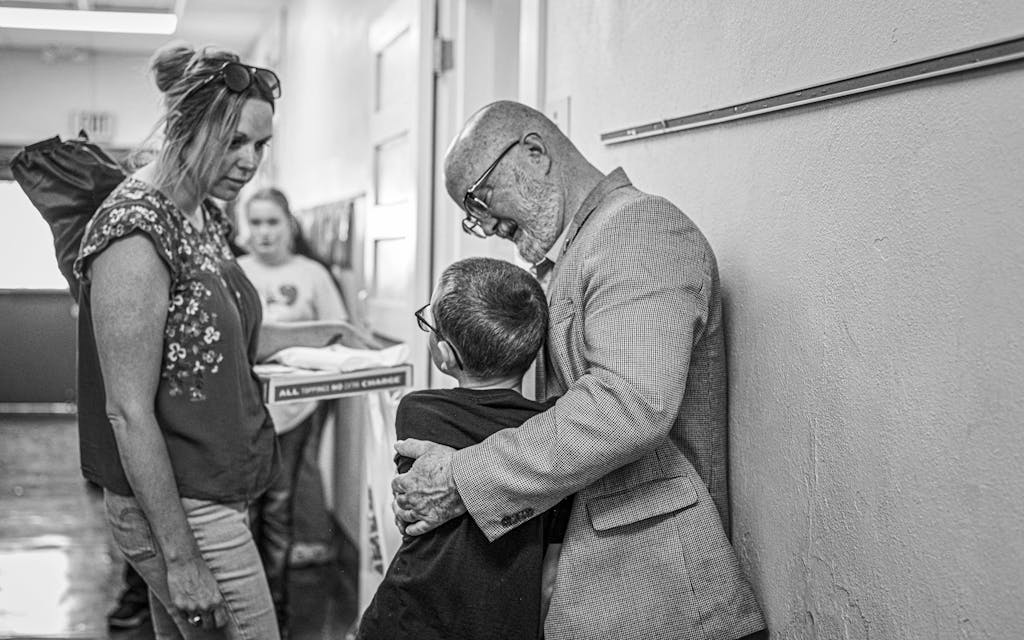
Fort-Davis-Superintendent-Graydon-Hicks-grandson-Dirks-Anderson-Elementary-School-BW
Superintendent Hicks hugs his grandson in the hallway at Dirks-Anderson Elementary School in Fort Davis.Photograph by Maisie Crow

Both the elementary school and the high school—where Hicks graduated in 1982—were built in 1929, Hicks explained. Walking through their timeworn hallways is to step back in time. In places, the plaster is flaking off the original adobe walls. The elementary school gym floor is bubbling up because of a leak under the foundation. The wooden seats in the high school auditorium have never been replaced. The urinals in the elementary school are original too. The newest instructional facility, a science lab, was built in 1973. In the summer, Hicks mows the football field, the same one he played on five decades ago. “Every bit helps,” he said.

The funding challenges create all manner of ripple effects. Hicks has trouble recruiting and retaining teachers, and some students drift away from school without extracurriculars to hold their interest. “You lose teachers, then you start losing kids, and then your funding gets worse,” he said. “It’s a circle-the-drain kinda thing. And it’s really speeding up for Fort Davis.”

The first problem is the size of the district’s bucket. For the last decade, TEA has calculated that Fort Davis’s Tier I annual allotment is between $2 million and $2.5 million, well short of its already spartan $3.1 million budget.

And then there’s the matter of how that bucket is filled. In the 2011–2012 school year, the state covered two-thirds of Fort Davis’ entitlement, about $2.1 million. Today, it chips in about $150,000, a 93 percent decrease. How to explain that change?…

In June 2019, the Big Three figures in state government—Abbott, Patrick, and then–House Speaker Dennis Bonnen—gathered at an elementary school in Austin for an almost giddy bill-signing ceremony. As a bipartisan group of lawmakers watched, Abbott signed into law House Bill 3, an $11.6 billion package of property tax cuts and education funding that had received near-unanimous support in both the House and Senate, a rarity in the highly polarized Legislature. “This one law does more to advance education in the state of Texas than any law that I have seen in my adult lifetime,” said Abbott.

For almost a year, an appointed commission of experts had met to discuss how to overhaul the school-finance system, issuing a report in December 2018 that called on the Lege to “redesign the entirety of our state’s funding system to reflect the needs of the 21st century.” HB 3 was the by-product of that prompt. Lawmakers rejiggered many of the system’s outdated formulas, offered pay raises to teachers, fixed some of the most glaring inequities, and reduced the amount of money recaptured by the state from property-wealthy districts. Most important, HB 3 represented a much-needed infusion of cash for struggling schools. The basic allotment was raised from $5,140 to $6,120 per student.

But HB 3 also exacerbated disparities among property-wealthy and property-poor districts. Because of changes to the way Tier II enrichment funding works, some communities were able to cut tax rates and generate significant new revenues from their tax base. For others, a minority of districts, HB 3 actually created new problems. Around 10 percent of districts saw a decrease in formula funding. This year, Alpine has $220,000 less than it would have had under the old system, even as some of the richest districts in the state—tiny West Texas communities with lots of oil wealth—saw their funding explode. Rinehart contrasts Alpine, which has almost no mineral wealth, with Rankin ISD, 130 miles northeast in the Permian Basin oil patch. While Alpine’s funding went down 2 percent, Rankin’s went up 339 percent. Even though Rankin is projected to return close to $100 million in recapture payments to the state this year, the district is fabulously wealthy. “Alpine’s budget is $10 million,” Rinehart points out. “Rankin’s is $14 million. We educate a thousand kids and they educate three hundred kids. So they are a third of our size and have a budget 40 percent larger than ours.”

Rinehart doesn’t begrudge Rankin’s wealth—she recently served as assistant superintendent there—but uses the Alpine–Rankin comparison as a “wild” example of how HB 3 exacerbated inequities, making the rich richer and the poor poorer.

Hicks, too, has noticed. “Rankin just built a whole new school,” he told me. “They got a new fieldhouse, a new gym. Two new science labs. A turf practice field, a turf game field. A new track, a new stadium. And my buildings were built in 1929.” Rankin is planning to build ten new “teacherages”—district-funded housing for teachers, important to attracting and retaining talent in areas with scant or affordable residences.

Jeff Davis County, on the other hand, has no oil and gas and very little industry; any school debt would thus be borne by homeowners through bonds. Hicks’s district has never issued a bond, in part because it would be unlikely to pass; the voters wouldn’t support a tax increase. The school’s ag barn was built in 2019 with local donations. The band program, suspended for nine years as a cost-saving measure, was only revived in 2023 after a philanthropist left his estate to the school.

To be sure, Alpine and Fort Davis are outliers. Most districts saw an immediate boost to their finances from HB 3, and advocates celebrated a meaningful investment in public education after $5.4 billion in devastating cuts in 2013. But even for those districts, the sugar rush from HB 3 didn’t last long. According to Chandra Villanueva, the director of policy and advocacy at the progressive nonprofit Every Texan, the $1,000 increase in the basic allotment was “roughly enough to cover one year of inflation….”

The property tax system and the school finance system are inextricably linked, Rube Goldberg–style. Twist a dial here and a light will come on over there. Slip a gear here and spring a leak there. As state lawmakers have prioritized tax cuts over public education funding, the trade-offs have grown clearer. This year represents a potential turning point. But rather than trying to solve the problem using the $33 billion budget surplus—a generational bonanza—Abbott and Patrick have overwhelmingly focused their attention on property tax cuts and a school-voucher plan loathed by almost everyone in public education, in part because it would threaten to strip even more funding from school districts.

The just-completed regular session was a bloodbath. The 88th Legislature began in January with the governor and lieutenant governor promising to pass a transformative voucher program and a record-setting $17 billion in property-tax cuts. Funding for public education, often a banner issue, was scarcely discussed. Even the House, the friendlier chamber toward public education, only proposed raising the basic allotment by $140, from $6,160 to $6,300 per student—far less than the $1,500 increase needed to keep up with inflation since 2019, according to the Texas American Federation of Teachers. But in the end, teachers and public schools got virtually nothing.

Teachers and administrators were stunned. Zeph Capo, the president of Texas AFT, called it a “joke.” HD Chambers, the executive director of the Texas School Alliance, accused Patrick and Abbott of playing a “hostage game” with Texas’s teachers and public school students by tying education funding to vouchers. “It’s pretty simple. The governor and Senate says, ‘If you don’t give us the kind of vouchers we want, we’re not giving you any money.’” The House refused to budge, and the regular session concluded without a deal on property tax relief, vouchers, and other GOP priorities.

Now, the governor has promised to convene multiple special sessions to take up the unresolved issues. The first special session began three hours after the regular one ended, and effectively wrapped up less than 24 hours later, with the House rejecting the Senate property-tax plan, passing its own program consisting solely of property-tax compression, and then abruptly adjourning. Abbott threw his support behind the House plan. The message to the Senate was clear: take it or leave it. If the Senate yields, the House version would push some school districts down to as low as $0.60 per $100, with no new source of revenue to backfill for the reduced funding in case of a bad economy.

Abbott has said his goal is to completely eliminate the main school property tax. In such a scenario, Texas’s thousand-plus school districts would be at the mercy of the Legislature for funding—a troubling scenario, says Villanueva. She suspects vouchers would then become inevitable. “At that point, it’s like, ‘You know what, we don’t have the money to fund schools. Everyone take five thousand bucks, figure it out for yourselves.’”

That day, if it ever comes, may still be far off. But the education system is in crisis right now, and unlike previous hard times, the state is flush with cash. The pain, Chambers says, is being intentionally inflicted by Abbott and Patrick. “Because of this one pet project that the governor has”—vouchers—“they are purposely creating a financial environment where every school district in Texas is being set up to fail.”

The result is that Texas schools, already operating on “shoestring budgets,” will have a harder time attracting and retaining educators, said Josh Sanderson, the deputy executive director of the Equity Center, a nonprofit that represents six hundred Texas school districts. They will run up deficits. They may have to cut extracurriculars and athletic programs. Some, like Fort Davis, may become insolvent and be forced to consolidate with another district, an often painful process.

As we were sitting in his red pickup with the engine idling outside his office, Hicks told me that he’d given up on lobbying the Legislature. He mentioned again that Patrick and other GOP lawmakers are trying to destroy public education by using vouchers to privatize schools, and he said that most other politicians “don’t give a shit about West Texas.” But for the time being he was still fighting: writing op-eds, firing off plaintive missives, asking concerned citizens to contact their legislators.

Toward the end of our visit, I asked Hicks what’s going to happen to his schools. “I don’t know,” he said. “I’m not patient enough to spend time with assholes in Austin, and I’m not rich enough to buy any votes.” TEA has suggested consolidating with another district—most likely nearby Valentine ISD—but Hicks said this would harm both Fort Davis and the other district.

He seemed resigned to his role as a Cassandra warning of impending doom, destined to be ignored. He reminded me that his grandson goes to school here, and that the painful road ahead feels both personal and existential. “If you don’t have a school,” he said, “you don’t have a community.”

Two months later, Hicks called me with some news. He’d decided to resign this summer, joining the mass exodus of school leaders that have fled the profession in the past few years. To anyone who closely follows public education in Texas, his reasoning was tragically familiar: He said he was too tired to fight anymore.

Please join me and your many allies in D.C. on October 28-29 for our 10th anniversary conference. It promises to be our best ever!

Sign up now.

You will have a wonderful time!

And you will meet your favorite bloggers, hear great speakers, and meet people who are fighting against privatization across the nation.

Retired educator Rich Migliore knows that the current rightwing demands for censorship violate the Constitution. Sadly, the current Supreme Court seems determined to obliterate the long-honored tradition of separation of church and state, creating a breach into which religious zealots are eagerly pushing their creeds. The high court has signaled through several of its recent decisions that at least five, possibly six, of its members are willing to eviscerate that separation.

He writes:

Freedom of thought, freedom of belief, freedom of religion, freedom of speech, freedom of expression, and the freedom to read books of our choice are among our most precious human rights. And the freedom from having other people’s religion and beliefs imposed upon us is among our basic human rights as a free people. That is why they were placed first in the Bill of Rights.

When we allow others to impose their religion and beliefs upon us we cease to be a free people. May I again quote from my favorite Supreme Court Opinion issued in the year that I graduated from high school.

“The vigilant protection of constitutional freedoms is nowhere more vital than in the community of American schools.” Tinker v. Des Moines Independent Community School District; U.S. Supreme Court (1969), (quoting Justice Brennan in Keyishian v. Board of Regents.

“The classroom is peculiarly the ‘marketplace of ideas.’ The nation’s future depends upon leaders trained through wide exposure to that robust exchange of ideas which discovers truth ‘out of a multiple of tongues, (rather) than through any kind of authoritative selection.”

Our founders wisely separated church and state. And the Fourteenth Amendment’s Due Process clause protects our liberty interest in freedom of thought, freedom of belief and freedom of religion.

We do not give up those rights “when we cross the school house gates.” Nor do our children.

Nicholas Kristof is a columnist who is terrific on many issues but consistently wrong when he writes about education. As far back as 2009, I criticized Kristoff for a column in which he called American education “our greatest national shame,” citing Eric Hanushek’s since-discredited work on teachers (the best get students to produce high test scores, bad teachers don’t). Peter Greene took Kristoff to task in 2015 for being an educational tourist, making quick visits and issuing pronouncements that are wrong. I also chastised him in 2017 for endorsing for-profit schools in Africa.

Now, he has outdone all of his previous gaffes. He has discovered the amazing, miraculous, astonishing transformation of Mississippi.

Based on the impressive rise of 4th grade reading scores on NAEP, Kristof proclaims that Mississippi has lessons for the nation.

With an all-out effort over the past decade to get all children to read by the end of third grade and by extensive reliance on research and metrics, Mississippi has shown that it is possible to raise standards even in a state ranked dead last in the country in child poverty and hunger and second highest in teen births.

In the National Assessment of Educational Progress, a series of nationwide tests better known as NAEP, Mississippi has moved from near the bottom to the middle for most of the exams — and near the top when adjusted for demographics. Among just children in poverty, Mississippi fourth graders now are tied for best performers in the nation in NAEP reading tests and rank second in math.

Its success wasn’t because of smaller classes. That would cost money.

It wasn’t because of increased funding.

It wasn’t because Mississippi reduced child poverty.

It wasn’t because of desegregation.

It was because Mississippi embraced the “science of reading,” strict discipline, relentlessly focusing on test scores, and using behavioral methods that sound akin to a “no excuses” charter school.

In 2000, Mississippi received a gift of $100 million from a Mississippi-born tech entrepreneur to launch a statewide reading initiative. In 2013, the legislature invested in full-day pre-K, where children got a start on letters, numbers, and sounds.

The 2013 legislation also enacted third-grade retention. Any child who didn’t pass the third-grade reading test was retained. Most researchers think retention is a terrible, humiliating policy. But Kristof assures readers that failing students get a second chance to pass. 9% of students in third grade flunked. He considers this policy to be a great success, inspiring third graders to try harder, citing a study funded by Jeb Bush’s foundation (Florida also practices third grade retention, which lifts its fourth grade reading scores on NAEP).

Kristof writes:

“Mississippi is a huge success story and very exciting,” David Deming, a Harvard economist and education expert, told me. What’s so significant, he said, is that while Mississippi hasn’t overcome poverty or racism, it still manages to get kids to read and excel.

“You cannot use poverty as an excuse. That’s the most important lesson,” Deming added. “It’s so important, I want to shout it from the mountaintop.” What Mississippi teaches, he said, is that “we shouldn’t be giving up on children.”

The lessons: it’s okay to forget about poverty; forget about segregation; forget about funding. Rely on “the science of reading” and third-grade retention. It’s cheap to follow Mississippi’s lead, which Kristof considers an advantage.

But!

Kristof minimizes Mississippi’s eighth-grade scores on NAEP. He writes: “One challenge is that while Mississippi has made enormous gains in early grades, the improvement has been more modest in eighth-grade NAEP scores.

That’s an understatement.

Eighth grade reading scores in Mississippi have gone up over the past two decades, but scores went up everywhere. In the latest national assessment (NAEP), 37 states had scores higher than those of Mississippi on the NAEP eighth grade reading test. Only one state (New Mexico) was lower. The other 13 were tied. In Mississippi, 25% of the state’s students in 2019 (pre-pandemic) were at or above proficient, compared to 20% in 2003. Nationally, in 2019, 29% of students were at or above proficient*.

In 2019, 42 states and jurisdictions outperformed Mississippi in percentage of students at or above proficient in eighth grade math, eight were tied, and only two scored below Mississippi. 24% were at or above proficient in 2019, a big increase over 2009 when it was 15%. But Mississippi still lags the national average, because scores were rising in other states.

Has Mississippi made progress in the past decade? Yes. Is it a model for the nation? No. When impressive fourth grade scores are followed by not-so-impressive scores in eighth grade, it suggests that the fourth grade scores were anti Oakley boosted by holding back the 9% who were the least successful readers. A neat trick but not an upfront way to measure progress.

It seems fairly obvious that the big gains in NAEP in fourth grade were fueled by the policy of holding back third graders. Jeb Bush boasted of the “Florida Miracle,” which was based on the same strategy: juice up fourth grade scores by holding back the lowest performing third graders.

In 2019, fourth graders in Florida scored 7th in reading and 5th in math on NAEP, by scale scores. However, Florida’s eighth grade scores, like those of Mississippi, are middling, compared to other states. Florida eighth graders ranked #35 in eighth grade math. In eighth grade reading, 21 states and jurisdictions ranked higher than Florida, 21 are not significantly different, and 10 were below Florida.

Florida’s eighth grade reading scores have been flat since 2009; so have its its eighth grade math scores. Florida is a state that has gamed the system. Mississippi is following its lead.

Mississippi has made progress, to be sure. But it is not a national model. Not yet.

What’s worrisome about this article is that Kristof asserts that poverty doesn’t matter (it does); funding doesn’t matter (it does); class size doesn’t matter (it does). In his account, states that want to improve test scores can do it without raising teachers’ salaries, without upgrading buildings, without spending a nickel to improve the conditions of the schools or the well-being of children. Children who are hungry, lack medical care, and are homeless or ill-housed are not likely to learn as well as those who have advantages.

Does this explain why so many rightwingers love “the science of reading”? Publishers are rolling out new programs. Education can be reformed in the cheap. Can’t expect taxpayers to foot the bill, can you?

Kristof’s fundamental error is his determination to find miracles, silver bullets, solutions that fix everything. He did it again.

The U.S. Department of Education appends this disclaimer to every NAEP publication.

*NAEP achievement levels are performance standards that describe what students should know and be able to do. Results are reported as percentages of students performing at or above three achievement levels (NAEP Basic, NAEP Proficient, andNAEP Advanced). Students performing at or above the NAEP Proficient level on NAEP assessments demonstrate solid academic performance and competency over challenging subject matter. It should be noted that the NAEP Proficient achievement level does not represent grade level proficiency as determined by other assessment standards (e.g., state or district assessments). NAEP achievement levels are to be used on a trial basis and should be interpreted and used with caution. Find out more about the NAEP reading achievement levels.

Paul Bonner is a retired teacher and principal. He suggests a way to undermine the complaints about CRT, WOKE, and other scarecrows.

Perhaps the greatest injustice of all of this sound and fury for nothing, is that few of the individuals who are the most outspoken concerning cultural disinformation have set foot in a school in the last decade, much less observed or engaged in classroom instruction. Most of the right wing celebrities who profit from all of this noise send their children to private schools. Well intentioned policy makers and Washington politicians also opt for private schools when they are available. It is my experience that when school officials open their doors the reception from the public is very positive. I was principal of an elementary school where my predecessors actually barred members of the community from the building. There was a metal pull down door at the front of the office that was always closed by 4:00 pm. The neighborhood perception of the school was bad because there were no relationships between the school and community.

When I got there, I stopped using the metal door and invited the real estate developers to come and see what we were doing. The overall outlook toward the school from all constituencies, including the staff, improved dramatically. I took similar steps at my previous school, invited the “difficult” parents in, and increased afternoon activities to accentuate the positive. According to Gallup (August 2022) 76% of parents are satisfied with their child’s public school (Compare that to 22% for Congress), it was 82% before the pandemic.

My experience has taught me that if we are open to parents being in the schools and participating in activities, the dissatisfaction reduces significantly. Yes, it is well documented on this blog and through other media outlets that there are nefarious actors pushing a destructive agenda, but it is important that we fight their lies with the good that takes place in schools. The knee jerk firing and isolation of teachers who teach about diversity is one example of the the defensive posture taken by district and state leaders.

Part of the reason, certainly not all, that the right wing disinformation campaigns take root is because school officials too often take cover and act to separate schools from the greater community. We simply don’t know one another. Our best weapon against false opaque charges of indoctrination is to open our doors, invite the community in, and get the positive out.

This may be the best article about education that you will read all year. It is as good an explanation as you will find of “the Finnish miracle.”

As Chaltain explains, the success of the schools is only one part of the picture. For the sixth year in a row, Finland has been named “the happiest country in the world,” based on these metrics: “healthy life expectancy, GDP per capita, social support, low corruption, generosity in a community where people look after each other and freedom to make key life decisions.

The secret to happiness: “Taking a holistic view of the well-being of all the components of a society and its members makes for better life evaluations and happier countries.”

Sam Chaltain writes:

I spent last week in Finland, the small Scandinavian country that, for educators, has become a Mecca of sorts. And while I was there, a surprising thing happened:

I came for the schools.

I stayed for the library.

It’s hard not to be aware of the schools, which have experienced a dramatic metamorphosis over the past half-century.

For much of the early 20th century, Finland was agrarian and underdeveloped, with a GDP per capita trailing other Nordic countries by 30 to 40 percent in 1900. But in 1917, Finland declared its independence from Russia, and insisted that women be heavily represented in its first parliament.

As a result, the new nation prioritized a whole slate of policies that have helped support the development over time of a society that values and protects children. Free preschool programs enroll 98 percent of children in the country. Compulsory education begins at the age of seven, and after nine years of comprehensive schooling, during which there is no tracking by ability, students choose whether to enroll in an academic or a vocational high school. The graduation rate is nearly 95 percent.

Finland’s deep investments in the welfare of all people impact every aspect of public life. “It seems to me that people in Finland are more secure and less anxious than Americans because there is a threshold below which they won’t fall,” said Linda Cook, a political scientist at Brown University who has studied European welfare states. “Even if they face unemployment or illness, Finns will have some payments from the state, public health care and education.”

On our tour of schools in Helsinki and Turku (the current and former capitals), we saw evidence of both the “Finnish Miracle,” and features far less miraculous.

In every location, the atmosphere in the rooms and hallways were marked by an orderly, active hum, the kind that emerges only when everyone knows one’s role, responsibility and contribution. Classes are just four or five hours a day, and as many as one-third of the courses Finnish students take are non-academic.

Lest a visitor decide that any one of these solutions would solve their country’s own problems, our host for the week — Ari Koski of Turku University — warned us that “a Finnish system doesn’t work in any school outside Finland. Everything influences everything else — and if you take one piece out, it doesn’t work anymore.”

Of those influences, Koski believes Finland’s teacher preparation program is the most important. Only eight universities are permitted to prepare teachers, and admission to these programs is highly competitive: less than one of every ten applicants is accepted.

You can imagine my surprise, then, when almost every classroom lesson I observed was . . . OK. As one of my traveling colleagues said, “I feel like I’ve seen this movie before.” And that’s because we have seen it before — teacher-driven, content-heavy, “sit and get” instruction.

Where’s the miracle in that?

Then I remembered that the goal of the Finnish system is equity — as in, choose any school, anywhere, and it will be of a certain quality — and that they have actually achieved it.

In other words, Finland’s goal is not to spark the creation of spectacular schools — it’s to ensure an entire country of good ones.

Its miracle, therefore, flows from its integration, not its innovation.

Whereas its schools may not be hotbeds of innovative teaching, the newest public library in its capital city may be the most spectacular model for the future of learning that I have ever seen.

It’s known simply as Oodi. It opened in 2018 — a gift to the Finnish people to honor a century of independence. And it is a beautiful, vibrant, multigenerational civic hub for creativity and connection.

“Oodi is what you want it to be,” explains its website. “Meet friends, search for information, immerse yourself in a book or work. Create something new in a studio or an Urban Workshop — seven days a week, from early in the morning till late in the evening.

“Oodi is a meeting place, a house of reading and a diverse urban experience. Oodi provides its visitors with knowledge, new skills and stories, and is an easy place to access for learning, relaxation and work.”

It is, in other words, the ideal “school” of the future — a living meeting place of discovery that is open to all….

Please open the link and read the rest of this wonderful post. The secret of Finland’s success is not its schools; nor even its wonderful new library. It’s the nation’s determination to ensure that everyone does well.

Compare the Finnish approach to what is happening here:

In education: competition, standardization, winners and losers, privatization, state-funded religious schools, charters and vouchers; schools without nurses. The search for silver bullets, innovation, miracles.

In society: high income inequality, high wealth inequality, many people in poverty, many people without healthcare, many homeless people.

What are our politicians talking about: critical race theory, drag queens, trans kids, book banning, censorship, making people work for any government assistance.

Do you see a pattern here?

Nancy Goldstein writes in the Texas Observer about her pleasure in watching the state’s Republican-controlled House of Representatives impeach Ken Paxton, the state’s Attorney General. Paxton, a stalwart MAGA-man, has been under indictment for corruption for eight years. Eight years! Paxton is the Trump ally who filed a lawsuit after the 2020 elections, joined by other Republican attorneys general, to throw out the votes of states that Biden narrowly won. The Supreme Court rejected his suit, saying that Texas had no standing to sue.

For another account of Ken Paxton’s pickle, read this story in The Texas Tribune.

Was yesterday’s performance by the Texas House of Representatives intended to restore public faith in the body’s commitment to the rule of law? Separate the good cops in the GOP from the bad cops? Or prove that a legislature that spent a year cravenly ignoring the pleas of Uvalde victims’ relatives for common-sense gun safety laws before rejecting them outright while rushing through an attempt to put the Ten Commandments in every classroom isn’t really the 10th circle of hell? If so, the hearing leading up to a 121-23 vote to impeach Attorney General Ken Paxton for corruption was an epic fail.

What the public saw—regardless of the lawmakers’ intentions—were the open of fissures that have more to do with pride and power than justice. It was a cross between the state’s largest intra-party catfight and its most public self-inflicted gunshot wound, as the bad blood between Paxton and Texas House Speaker Dade Phelan, who serve as proxies for Trump and Republicans trying to distance themselves from Trump in advance of next year’s elections, finally spilled out into the open.

The lineup featured, on the one hand, GOP representatives who suddenly had a lot of worries about “due process,” “precedent,” and “evidence” that had not been evident while banning abortionand stripping transgender youth and their families of access to healthcare. Opposing them were those GOP colleagues who solemnly intoned about what appears to be their newly discovered “obligation to protect the citizens of Texas from elected officials who abuse their office and their powers for personal gain.”

Various media outlets, and a few of Paxton’s defenders, have made much of the lightning speed of this past week. But while it may have been mere days between the Republican-led House General Investigating Committee’s announcement of their investigation and their unanimous vote to introduce 20 articles of impeachment to the full House for Saturday’s hearing and impeachment vote, Paxton has been under felony indictment for securities fraud since he became attorney general in 2015. The FBI had been investigating Paxton on allegations that he used his office to benefit a wealthy donor, Nate Paul, since late 2020. Only in February of this year did the Department of Justice take over that probe, breathing new life into it.

Paxton’s overreach the next month, in March of this year, appears to have been the second-to-last straw. According to the committee’s own memo, released the day before the full House hearing: “But for Paxton’s own request for a taxpayer-funded settlement over his wrongful conduct, Paxton would not be facing impeachment.” Not, please note, the wrongful conduct—that is, Paxton’s firing of four whistleblowing members of his own senior staff after they accused him of using his office to help out Paul. Nor Paxton’s decision this past spring to pay $3.3 million to settle out of court. Or even the $600,000 the House spent defending Paxton. But Paxton’s request that taxpayers pay that $3.3 million—and that his fellow GOP colleagues go on record approving that request.

The final straw? Paxton, likely knowing that Phelan was going to try to gloss this most recent disgusting legislative term by ending it on a high note, called on him to resign last week over alleged drunkenness—via a tweet. Making it look super-extra-duper political when the House General Investigating Committee revealed that afternoon that it had been investigating Paxton in secret since March. The committee then heard a three-hour presentation from its investigators detailing allegations of corruption against the attorney general and voted to forward 20 articles of impeachment to the full House.

Believe me when I say that I, like many people who have been burned by the Texas GOP’s seemingly endless appetite for cruelty, ignorance, and hypocrisy, felt a certain satisfaction as I watched yesterday’s coverage of it setting itself on fire. Top moment? When the first group to appear outside the Capitol in Austin in response to Paxton’s call for supporters to turn out was around 100 people preparing for the “Trot for Trans Lives,” a 5K run held in support of transgender Americans affected by the waves of anti-trans rights legislation passed in recent years, including by Texas lawmakers.

Small pleasures aside, none of this is as satisfying as it sounds, nor do I think it will end well. First of all, because of all the bureaucracy that lies ahead. Governor Greg Abbott, who has remained curiously silent this past week while he sticks his finger into the political wind, has 10 days to tell the Senate to start a trial. A trial that would be presided over by Paxton buddy arch-conservative Lieutenant Governor Dan Patrick, and that’s likely to be kicked down the road infinitely and/or end with an acquittal.

But ultimately because the bottom line is that while Paxton burns—or simmers or escapes entirely—and intra-party fighting and dirty laundry airing be damned, the members of the USA’s largest, richest, and most powerful wing of the GOP have screwed Texas on such a large, systemic level that they’ll still prevail. In the state, through control of both chambers and the governor’s seat, held in place by voter suppression and gerrymandering. Nationally, with courts packed with ideologues, including a Supreme Court that has already demonstrated its willingness to let Texas gut constitutional rights, overturn precedent, and play an enthusiastic role in the new national sport: playing on whatever field offers your agenda the best advantage. That means valorizing states’ rights when it’s convenient, or passing the ball to the Supreme Court if a federal ban looks more likely or appealing.

Call this, with apologies to Taylor Swift, the “Errors Tour” or, in a nod to the Ziegfeld Follies, “Hypocrisy on Parade.” Or let’s go “Paris is Burning” and give the representatives a Realness Award for their impersonation of legislators who seriously care about integrity, democracy, and the will of voters.

But whatever you do, don’t hold your breath waiting for justice.

VOX reported on a peculiar twist of fate that temporarily saved abortion rights in Wyoming. Last week, Wyoming District Court Judge Melissa Owens blocked the state’s new abortion ban. The reason she did so was because the abortion ban violated an amendment to the state constitution intended to cripple Obamacare that passed in 2012.

This was the second time she blocked the abortion law, based on the amendment’s guarantee of the individual’s right to control their healthcare decisions.

On Wednesday, a judge in the deep-red state of Wyoming temporarily blocked a state law that would make performing nearly any abortion in that state a felony. She relied on a 2012 amendment to the state constitution that was intended to spite then-President Barack Obama.

Wyoming district court Judge Melissa Owens’s Wednesday decision temporarily halting her state’s abortion ban is the second time she intervened to prevent this ban from going into effect. Wyoming’s abortion ban is quite strict, although it does provide exceptions for rape, incest, or when either a pregnant patient or the fetus has certain medical conditions.

Last summer, shortly after the Supreme Court’s decision overruling Roe v. Wade, an array of patients, doctors, and nonprofit groups brought a suit arguing that Wyoming’s abortion ban violated the state’s constitutional provision protecting each adult’s right to individual health care decisions. That case is known as Johnson v. Wyoming.

Regardless of the political circumstances that led to this amendment being written into the state constitution, Owens reasoned that the amendment “unambiguously provides competent Wyoming citizens with the right to make their own health care decisions,” and she was bound by that unambiguous text. “A court,” she wrote, “is not at liberty to assume that the Wyoming voters who adopted” the amendment “did not understand the force of language in the provision.”

Just as significantly, Owens construed the amendment to give people in Wyoming a “fundamental right” to make their own health care decisions, including the decision to seek an abortion. This designation matters because fundamental rights can only be abridged when the state seeks to advance a “compelling state interest” and when it uses the “least intrusive” means to do so.

So the Wyoming legislature’s effort to hobble Obamacare turned into a shield for abortion rights, at least temporarily.

The Associated Press published this article about how DeSantis has unleashed a nation-wide zeal for censorship. It appeared in newspapers across the nation.

TALLAHASSEE — As he vies for the Republican presidential nomination, laws pushed by Gov. Ron DeSantis have led to an upswing in banned or restricted books not only in Florida schools but also in an increasing number of other conservative states.

Florida last year became the first in a wave of red states to enact laws making it easier for parents to challenge books in school libraries they deem to be pornographic, deal improperly with racial issues or are in other ways inappropriate for students.

Books ensnared in the Florida regulations include explicit graphic novels about growing up LGBTQ+, a children’s book based on a true story of two male penguins raising a chick in a zoo and “The Bluest Eye,” a novel by Nobel laureate Toni Morrison that includes descriptions of child sexual abuse. Certain books covering racial themes also have been pulled from library shelves, sometimes temporarily, as school administrators try to assess what material is allowed under the new rules.

While efforts to ban books or censor education material have come up sporadically over the years, critics and supporters credit DeSantis with inspiring a new wave of legislation in other conservative states to regulate the books available in schools — and sometimes even in public libraries.

The number of attempts to ban or restrict books across the U.S. last year was the highest in the 20 years the American Library Association has been tracking such efforts.

EveryLibrary, a national political action committee, said it’s tracking at least 121 proposals introduced in state legislatures this year targeting libraries, librarians, educators and access to materials. The group said 39 of those proposals would allow for criminal prosecution.

“He really is blazing a trail,” said Tiffany Justice, the Florida-based co-founder of the conservative group Moms for Liberty, whose members have filed challenges to books in libraries in several states. “What Ron DeSantis does that I think is effective is he uses all the levers of power to make long-term change happen.”

“Other governors,” Justice said, “are paying attention and following suit.

In Arkansas, Republican Gov. Sarah Huckabee Sanders signed a law, set to take effect this summer, that could impose criminal penalties on librarians who knowingly provide “harmful” materials to minors. The law also would establish a process for the public to challenge materials and ask they be relocated to a section minors can’t access.

“It’s a perverse world when we’re talking about trying to criminalize librarians,” said Nate Coulter, executive director of the Central Arkansas Library System in Little Rock, which is expected to sue over Arkansas’ law.

In Indiana, school libraries will be required by July 1 to publicly post a list of books they offer and provide a complaint process for community members under a law Republican Gov. Eric Holcomb signed this month. In Texas, a bill creating new standards for banning books from schools that the government considers too explicit has been sent to Republican Gov. Greg Abbott’s desk.

In Oklahoma, the state school board has approved new rules that prohibit “pornographic materials and sexualized content” in school libraries and allow parents to submit formal complaints. The rules still must be approved by Republican Gov. Kevin Stitt.

DeSantis insists books aren’t being banned, preferring to call the forced removal of some books “curation choices that are consistent with state standards.

“There has not been a single book banned in the state of Florida,” DeSantis said Wednesday. He later said, “our mantra in Florida is education, not indoctrination.”

Librarians, free speech advocates and some parents and educators say the push is driven by a small, conservative minority that happens to have outsized clout in Republican primaries like the one DeSantis is now competing in.

“This is all part of his plan to run for president, and he believes his vilification of books and what’s happening in public schools is his path to the presidency,” said Andrew Spar, president of the Florida Education Association, the state’s main teachers union.

Kasey Meehan, who directs the Freedom to Read program at the writers’ organization PEN America, said that, when books are targeted in Florida, they later become the subject of complaints filed by parents in other states.

“It’s something that continues to cause alarm for individuals who are advocating for the freedom to read or for a diversity of knowledge, ideas and books to be available to students across the country,” Meehan said.

There have been challenges to books in schools for decades — “The Bluest Eye” has been targeted in various states for years, long before DeSantis became governor.

But the restrictions accelerated in Florida after DeSantis signed bills last year barring discussion of sexual orientation and gender identity in kindergarten through third-grade classrooms, a ban that has since expanded through 12th grade. He also created a mechanism for parents to challenge books in school libraries and has targeted how race is taught in Florida schools.

Many teachers and districts complain that the laws’ standards are so vague they don’t know what books might place them in legal jeopardy.

Michael Woods, a special education teacher in Palm Beach, said new rules compelling him to catalog books in his classroom led him to empty a small library he set up where students could choose to read something that interested them. Now those volumes are stored in a box he’s stashed in his closet for fear of getting in trouble.

“That kind of positive connection to reading is no longer there,” he said.

The individual challenges to books might be coming from a fairly narrow segment of the population, according to PEN and the American Library Association, which track requests to pull books. The library association said 40% of all requests challenged 100 or more books at a time.

Raegan Miller of Florida Freedom to Read, a group fighting the book restrictions, said she has talked about education issues with fellow parents of all political persuasions for years, and no one has ever complained about inappropriate material in their children’s schools. She contends the issue has been ginned up by a small group of conservative activists.

“Do you really think we are all just happily dropping our kids off at Marxist indoctrination and pornography?” Miller said. “You only hear this stuff at school board meetings.”

Moms for Liberty, which boasts 285 chapters, has a strong presence at school board meetings in the state and nationwide. It also has successfully backed several candidates for school board.

Greg Sergeant of the Washington Post reviews the decision in Florida to ban Amanda Gorman’s Inaugural poem, keeping it out of the reach of elementary age children. Librarians are just following orders, as DeSantis knew they would. He doesn’t need to name the books. Hyper-vigilant parents do his dirty work for him.

At this point, it should be obvious that Florida Gov. Ron DeSantis’s culture-war directives are designed to encourage parents to indulge in book purges for sport. Precisely because removals have become so easy, lone right-wing actors are feverishly hunting for offending titles, getting them pulled from school libraries on absurdly flimsy grounds, sometimes by the dozens.

A new turn in the explosive saga involving the poem that Amanda Gorman read at President Biden’s inauguration underscores the point. DeSantis is now defending a Florida school’s decision to restrict access to “The Hill We Climb” — a move that has become a national controversy.

“It was a book of poems that was in an elementary school library,” DeSantis told a convention on Friday, though it was in fact one poem. DeSantis insisted the school district in question merely “moved it from the elementary school library to the middle school library,” and ripped “legacy media” for calling this a “ban,” complaining of a “poem hoax.”

That’s a shameless but revealing characterization of what happened. It’s true that Gorman’s poem was removed from the elementary school section of the library at Bob Graham Education Center in Miami Lakes and that access was preserved for middle school students. But this came in response to an objection from one parent.

The woman who complained about Amanda Gorman’s poem filled out a card. She thought the poem was written by Oprah Winfrey. She admitted that she had not read Gorman’s poem.

It turns out that Amanda Gorman’s poem is not freely available to students in middle school. As the Washington Post reported, a student must request it from a media specialist, then prove that they can read at a fifth-grade level. Otherwise it is restricted.

As this blogger wrote:

Imagine having to take a test to check out a book with one poem in it!

The reality of what DeSantis and Moms for Liberty are doing is now clear to everyone: With a combination of lies, misinformation and intimidation, they want to create an America where it’s easier for a white supremacist to ban a book than it is for a Black child to read a poem.