Archives for category: Disruption

Michael Podhorzer is a keen political analyst who the assistant to the president for strategic research for the AFL-CIO, a federation of 55 labor unions representing 12.5 million members. His observations in this post are well worth reading.

His insightful article begins:

When, in the Dobbs decision, Samuel Alito declared that Roe v. Wade had been “wrongly decided,” he succinctly stated the credo of a resurgent revanchist coalition that believes the Twentieth Century was wrongly decided. Over the last two decades, the Supreme Court has been instrumental in advancing this coalition’s agenda, which is to dismantle the New Deal order and reverse the civil and social rights gains made since the postwar period.

The execution of this agenda has been nothing short of a slow-motion coup against our freedoms. The Supreme Court has not only transformed itself into a democratically unaccountable lawmaking body; it has used this illegitimate power to create a one-way ratchet that makes the rest of our system less democratically accountable. Yet no matter how many times the Court tightens this ratchet, our political and opinion leaders keep asking whether the Court risks losing its legitimacy if it keeps this up – not what we should do now that legitimacy is a distant memory at best.

We hear of “conservative” judges, yet not one of the six Republican-appointed justices demonstrate fealty to any consistent set of principles beyond giving more power to the gatekeepers who put them on the Court. Instead, we must call them the Federalist Society justices. All six are current or former members of the Federalist Society, an enterprise sponsored by right wing billionaires and corporations whose intention was capture of the legal system – and capture it they did. They knew this capture would be necessary in order to implement their agenda, since they couldn’t count on the majority of Americans to vote against their own rights and freedoms.

The campaign to repeal and replace the 20th century is an extremely well-funded enterprise, organized by people who have never made any secret of their plans. None of this is happening by accident.

Yet for the most part, media coverage of SCOTUS continues to focus on the details of the individual cases on the docket: the arguments each side is putting forth, the likelihood that certain justices will find those arguments persuasive, and what a “win” for either side could look like. In the context of our current crisis, however, doing this is like narrating each segment of a bullet’s trajectory without naming the assassin or his target.

In this post, we’ll take a few steps back from that “what did the bullet do today” perspective.

  1. The Coalition Against the Twentieth Century – This section identifies the antagonists, outlines how they came together through the Southern Strategy, and shows how two historical accidents – the 2000 presidential elections and the 2010 midterms – enabled the massive power grabs that have brought us to our current crisis.
  2. The Originalist Con – This section reveals just how blatant and unprincipled the Federalist Society Majority has been in its execution of the coalition’s agenda.
  3. The Federalist Society Majority Juggernaut – This section lays out the enormous progress the Federalist Society Majority has already made to overturn the “wrongly decided” 20th century. This has included giving MAGA state legislatures new license to curtail voting rights and gerrymander themselves impregnable majorities that closely resemble the region’s one-party authoritarian rule during the Jim Crow era.
  4. No Longer Legitimate? We conclude with a look at how the Court’s “crisis of legitimacy” is actually a crisis for American democracy as a whole.

The Coalition Against the Twentieth Century

This revanchist coalition has two factions, which have come together through the Federalist Society to capture the nation’s legal system. One faction, which I call the MAGA industrial complex, is a symbiotic combination of white grievance media (e.g. Fox, Breitbart), white Evangelical churches and their political expressions dedicated to white Christian nationalism, as well as supremacist militias and the NRA.

When most of us hear “Make America Great Again,” we think of voters in their MAGA caps being stoked on by white grievance entrepreneurs like Trump and Tucker Carlson. We should instead be thinking of the elites and institutions that helped make MAGA one of America’s most successful political movementsto date. We know, for instance, that the white Christian nationalist movement was built not around a moral concern for fetal life, but around panic over the court-ordered revocation of tax-exempt status for religious schools—particularly Bob Jones University, as well as the private religious “segregation academies” that were founded in response to Brown v. Board of Education.¹

The other faction in the coalition against the 20th century consists of the plutocrats and rapacious capitalists whose efforts long predate Trump and MAGA. Their efforts were largely unsuccessful until the 1960’s. Until then, the Republican Party, which was the party of business, nonetheless acquiesced to the New Deal order. This sentiment was famously expressed by President Eisenhower:

Should any political party attempt to abolish social security, unemployment insurance, and eliminate labor laws and farm programs, you would not hear of that party again in our political history. There is a tiny splinter group, of course, that believes you can do these things. Among them are H. L. Hunt (you possibly know his background), a few other Texas oil millionaires, and an occasional politician or businessman from other areas. Their number is negligible and they are stupid.

The Southern Strategy

And then … in 1964 that “splinter” of “Texas oil millionaires” and “conservative” activists wrested the Republican presidential nomination for Barry Goldwater. Goldwater was trounced by 23 points. But rather than dispatching the Goldwater forces to the dustbin of history, this defeat simply convinced many that they would have to give ground on their ambition of electing anyone as “pure” as Goldwater. They were ready when, in 1968, Nixon reversed his position on civil rights, becoming the candidate that fused segregationists’ racist agenda with the traditional Republican business agenda. Nixon’s narrow victory in 1968 was deceptive. George Wallace siphoned off 14 percent of the most extremist voters, and combining Wallace’s and Nixon’s vote share reveals that there was a substantial majority consisting of Democrats (the backlash to the Civil and Voting Rights Acts) and traditional Republican voters. Kevin Phillips best laid out this blueprint in his book The Emerging Republican Majority.

We generally think of the success of the Southern Strategy depending on the direct appeals of national Republicans to southern segregationist Democrats, with those voters changing their party affiliation without changing any of their values. The following map makes vivid something that has gone remarkably unnoticed. As Robert Jones and others have documented, from even before the Civil War, Christian churches played a critical role providing the “moral” basis for white supremacy. In this period, southern Evangelical and Fundamentalist churches continued to provide essential organizational scaffolding for preserving those attitudes and the salience of “social” issues in the region.
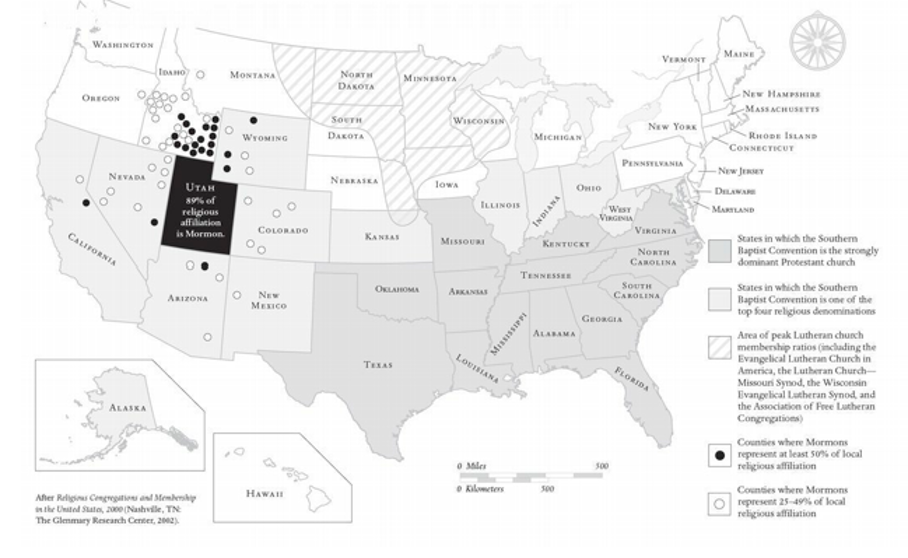
Map of U.S. showing regions shaded by religious denomination

Source: American Theocracy, Kevin Phillips

The Tea Party & the Takeover of the Republican Party

Until the election of Barack Obama, Republican presidential candidates and congressional leaders placated the reactionary, nativist, white Christian faction of the party by nominating right-wing judges and embracing the dog whistles and symbolism of white Christian identity, while making little or no progress reversing the civil rights gains of the 1960’s. Indeed, as late as 2006, the Voting Rights Act was reauthorized with nearly unanimous congressional support, with Bush claiming credit. This White House press releaseannouncing Bush’s signing would be unimaginable coming from any MAGA Republican now.

We very much remember the 2000 election for its razor thin margin and the Supreme Court brazenly intervening to stop the count and select Bush. But we have all but forgotten that the reason the race was as close as it was can be attributed to Bush’s consolidation of the white Evangelical establishment, and with it, Bible Belt voters that made the race that close in the first place.² While Clinton won the Bible Belt by a hair in 1996, Gore lost it by 12 points – and more consequentially, he lost the electoral votes in 7 Bible Belt states Clinton had won.³ And Kerry would lose the region by an even larger margin, 16 points. Bush stressed his own born again experience and did much for the white Christian establishment, including his “faith based” initiatives.

In response to Obama’s victory – and McCain and the Republican establishment’s immediate acceptance of his legitimacy – the nativist faction formed the Tea Party and focused on developing a political strategy to purge the Republican Party of “RINOs.” The last straw for this faction was Romney’s nomination and defeat. They revolted against the business wing’s “Autopsy” report, which in 2013 urged the GOP to moderate on immigration policies and dampen its racial rhetoric to stay competitive in an increasingly diverse electorate. Trump rushed into that political vacuum, smearing Mexicans as rapists and drug dealers. Crucially, unlike Goldwater, who faced a uniformly hostile and demeaning national media, Trump now had the advantage of the extensive right-wing media system that had since been established, which proved essential to his nomination and victory.

Please continue reading this deeply informed post about the underlying trends that have shaped the present moment in American politics.


Mimi Swartz, a writer for the Texas Monthly, explored the background, the funders, and the consequences of the well-coordinated campaign to privatize public schools—by defaming them and discrediting those who run for local school board seats. She focuses on the travails of one dedicated school board member, Joanna Day in Dripping Springs, Texas, who contended with insults and threats in her life.

The following is a small part of a long article, which I encourage you to read in full:

The motivations for these attacks are myriad and sometimes opaque, but many opponents of public education share a common goal: privatizing public schools, in the same way activists have pushed, with varying results, for privatization of public utilities and the prison system. Proponents of school privatization now speak of public schools as “dropout factories” and insist that “school choice” should be available to all. They profess a deep faith in vouchers, which would allow parents to send their children not just to the public schools of their choice but to religious and other private schools, at taxpayers’ expense.

But if privatizing public education is today cloaked in talk of expanded liberty, entrepreneurial competition, and improved schools for those who need them most, its history tells a different story. In 1956, two years after the U.S. Supreme Court handed down its landmark Brown v. Board of Education decision, a group of segregationist legislators in Texas, with support from retiring governor Allan Shivers, began concocting work-arounds for parents appalled by the prospect of racial integration of public schools. One idea: state-subsidized tuition at private schools. That never came to pass, but it was Texas’s first flirtation with vouchers.

Privatization proponents have since switched up their rhetoric, pitching vouchers as an opportunity for poor urban families to save their children from underperforming neighborhood schools. That hasn’t worked out either. In various experiments across the nation, funding for vouchers hasn’t come close to covering tuition costs at high-quality private schools, and many kids, deprived of the most basic tools, haven’t been able to meet the standards for admission.

School funding in Texas is based largely on attendance—as the saying goes, the money follows the child. Considerable evidence suggests that vouchers would siphon money from underfunded public schools and subsidize well-to-do parents who can already afford private tuition. Critics frequently cite a program in Milwaukee, where four out of ten private schools created for voucher students from 1991 to 2015 failed.

“I don’t think that vouchers serve any useful purpose at all,” said Scott McClelland, a retired president of H-E-B who now chairs Good Reason Houston, an education nonprofit. Ninety-one percent of Texas students attend public schools. “There isn’t enough capacity in the private school network to make a meaningful difference in their ability to serve economically disadvantaged students in any meaningful numbers, and it will divert funding away from public schools.”

In Texas, an unusual alliance of Democratic and rural Republican leaders has for decades held firm against voucher campaigns. The latter, of course, are all too aware that private schools aren’t available for most in their communities and that public schools employ many of their constituents. But the spread of far-right politics and the disruption of public schools during the pandemic created an opening for activists to sow discontent and, worse, chaos. “If they can make the public afraid of their public school, they will be more likely to support privatizing initiatives. Then that puts us back to where we used to be with segregation of public schools,” says former Granbury school board member Chris Tackett, who, with his wife Mendi, has become an outspoken advocate for public education and a relentless investigator of the attempts to undermine it.

They have their work cut out for them. In the past, just a few right-wing legislators pushed for privatization and were routinely ignored. After all, the state constitution spelled out “the duty of the Legislature of the State to establish and make suitable provision for the support and maintenance of an efficient system of public free schools.” But as times have changed, so has the interpretation of that guarantee.

Betsy DeVos, President Donald Trump’s former Education Secretary, set up shop in Dallas with her American Federation for Children to push against “government schools” in favor of “school choice.” Political PACs such as Patriot Mobile Action, an arm of a Christian wireless provider in North Texas, continue pouring millions into school board races and book bans to promote more religious education. Patriot has joined other recently formed PACs with inspirational names such as Defend Texas Liberty and Texans for Excellent Education, all of which supposedly support better public schools but are actually part of the privatization push. But by far the most powerful opponents of public schools in the state are West Texas oil billionaires Tim Dunn and the brothers Farris and Dan Wilks. Their vast political donations have made them the de facto owners of many Republican members of the Texas Legislature through organizations such as the now dissolved Empower Texans and the more recent Defend Texas Liberty, which the trio uses to promote restrictions on reproductive rights, voter access, and same-sex marriage. Almost as influential is the Texas Public Policy Foundation, where Dunn is vice board chair.

A November 2021 TPPF fund-raising letter, sent to supporters in advance of the Eighty-eighth Legislature convening, argued that “public education is GROUND ZERO” in the fight for freedom. “The policy team and board of the Texas Public Policy Foundation (TPPF) believe it is now or never,” it read, signaling that the long-standing and robust alliance against vouchers was unusually vulnerable. “The time is ripe to set Texas children free from enforced indoctrination and Big Government cronyism in our public schools.” The letter went on to herald a $1.2 million “Set the Captives Free” campaign to lobby legislators to save Texas schoolchildren from “Marxist and sexual indoctrination” funded by “far-Left elites for decades.”

Lieutenant Governor Dan Patrick, generously backed by Dunn, the Wilks brothers, and their organizations, has long been a proponent of privatizing public education (and of starving it through reductions in property taxes). He has made vouchers a primary legislative goal of the current session. Mayes Middleton, of Wallisville, a Republican state senator and former chair of the TPPF-aligned Texas House Freedom Caucus, filed a bill to create the “Texas Parental Empowerment Program,” proposing education savings accounts that are essentially a form of vouchers. Representative Matt Shaheen, of Plano, who is a member of the Texas Freedom Caucus, has introduced a measure that would guarantee state tax credits for those who donate to school-assistance programs—such as scholarships for kids wishing to go to private schools.

Governor Greg Abbott, knowing all too well the political headwinds that vouchers have faced, has long been wary of publicly supporting them, so he has undermined public schools in other ways. While campaigning early last year, he promised to amend the Texas constitution with a “parental bill of rights,” even though most, if not all, of those rights already existed. By then, “parental rights” had become a dog whistle to animate opponents of public education. (As the Texas Tribune put it: “Gov. Greg Abbott taps into parent anger to fuel reelection campaign.”)

During the recent intensifying crisis on the border, Abbott publicly floated a challenge to the state’s constitutional obligation to give all Texas children, including undocumented ones, a publicly funded education—a step his Republican predecessor, Rick Perry, had denounced years earlier as heartless. Then last spring, Abbott made headlines with his first full-throated public endorsement of a voucher program.

So here we are, with distrust in public schools advancing as fast as the latest COVID-19 variant. The forces behind the spread of this vitriol are no mystery. Those who would destroy public schools have learned to apply three simple stratagems: destabilize, divide, and, if that doesn’t work, open the floodgates of fear

Ohio has poured taxpayer dollars into charter schools, even though public schools consistently outperform charter schools. Ohio has poured more than $1 billion into virtual charters, even though the biggest of them (ECOT, or The Electronic Classroom of Tomorrow) had the lowest graduation rate in the nation and declared bankruptcy rather than pay back $67 million to the state for large numbers of phantom students. But despite its dismal statistics, it collected $1 billion over its 20 years in business. Vouchers were evaluated by a researcher chosen by a pro-choice think tank, and the report said that voucher students were falling behind.

Given this long history of school choice failure, wouldn’t you think the state would step back and evaluate its commitment to failure?

Of course not. The GOP dominated Legislature wants to expand vouchers.

Why does the Ohio GOP invest in failure?

Morgan Trau of News5Cleveland explains:

https://www.news5cleveland.com/news/politics/ohio-politics/as-some-lawmakers-debate-nazi-home-schooling-scandal-others-propose-expansion-to-school-voucher-program?_amp=true

COLUMBUS, Ohio — A bill to expand the school voucher system and provide more money to home-schoolers has been proposed in Ohio as the Department of Education is investigating a Nazi home-schooling scandal. This is not the first Holocaust education issue the state has had in one year.

Ohio’s public schools have been pushing for consistent funding for decades.

William Philis, executive director of the Ohio Coalition for Equity & Adequacy of School Funding, has spent his career fighting against the voucher system.

“We don’t have a constitutional system and they’re exacerbating the unconstitutionality of the system by draining money out of the public school system,” Philis said.

A new bill introduced to the state Senate will continue to leave public schools behind in favor of supporting private schools, he added.

Senate Bill 11 is expected to use taxpayer money to give $5,500 to elementary and middle school students and $7,500 to high schoolers so they can attend any public, community or charted nonpublic school. Ashtabula Republican Sen. Sandra O’Brien introduced the bill because, “Ohio should act now to put parents, not government, in control of their children’s education,” she said in sponsor testimony Tuesday.

Eric Frank, president of School Choice Ohio, believes the legislation allows children to get the best education possible.

“Primarily, what those do is they target scholarships to families that either live in what we typically refer to as under-performing public school areas, not necessarily districts, but buildings within districts and also low-income families,” Frank said.

The bill would expand the current EdChoice Scholarship to give universal eligibility to all students in the state of Ohio.

There are two sections of the current program:

  • EdChoice Expansion, which the state reported had 17,152 students participating in fiscal year 2021, requires income verification. Eighty-five percent of these students were below the 200% poverty rate.
  • Standard EdChoice, which the state reported has 33,129 student in FY 2021, does not require income verification. More than 75% of the students utilizing this program were not low-income qualified.

Of the total 50,281 students, 25,180 are low-income qualified, with 25,101 that are not. This means that half of the students utilizing taxpayer money to go to a private or charter school are not designated as “needing government assistance.”

This is not to say that people who aren’t in that designation don’t struggle to have to pay the full price of the tuition — but it just means it is unknown if they do struggle to pay or not.

“Most people are really happy with their public schools,” Frank added. “But families that aren’t, they should have another option.”

Philis strongly disagreed.

“I’d say that’s pure poppycock,” Philis said. “I don’t get a voucher for a backyard swimming pool because I don’t want to go to the public pool.”

Even if a student takes a voucher, private schools choose who will be admitted, the advocate said.

“What we’re doing in Ohio right now is that we’re funding segregation,” he stated. “We are funding, with taxpayer money, White Flight.”

The Fair School Funding Plan (FSFP), was somewhat attempted to be put into place for fiscal year 2021-22. It was supposed to change how the state delegates funding for school districts.

Starting in the 2021 FY, lawmakers added hundreds of millions of state dollars in both direct funding and tax credits to subsidize families sending their children to private and charter schools. Critics, like Ohio Education Association, said this makes taxpayers pay for these for-profit schools and diverts money away from public education, which desperately needs it.

The bill would also expand the home-school tax credit from $250 to $2,000, which raises concerns.

Ohio’s Nazi Education Problem

The Ohio Dept. of Education is investigating a family in Upper Sandusky after it was revealed that their home-school program was allegedly a Nazi propaganda school, where children were taught how to love Hitler and become a “wonderful Nazi.”

Logan and Katja Lawrence were the alleged creators of the “Dissident Homeschool” group which had 2,500 members on its Telegram channel when they were exposed in a late January article from VICE News.

“We need to ensure that home-schooling is not an opportunity for parents to systemically teach their children hatred,” state Sen. Catherine D. Ingram (D-Cincinnati) said. “Senate Bill 1, which is pending in Education Committee, weakens home-schooling requirements. The legislature must protect our children from instruction fueled by racism and intolerance.”

News 5 asked Sen. President Matt Huffman (R-Lima) if there should be oversight over the home-school program, which he said “absolutely,” but there are specific rules and regulations.

“I hope we’re long past the point in our society where we take the actions of one person or a small group of people and paint the entire group as though somehow they’re participating in that,” Huffman responded.

The Department of Education should be figuring out what is going on, he added.

“I hope, frankly, that people will not try to take some political advantage or policy advantage… basically trying to decide that a couple of sociopaths somewhere in Ohio who are doing strange things that… somehow should affect the policy of the rest of the state is anathema to me,” the GOP leader said (anathema means something that a person hates).

Democrats have already been jumping at making sure a situation like this does not happen again.

There are only two Jewish members in the Ohio House — Democratic Reps. Casey Weinstein of Hudson and Dani Isaacsohn of Cincinnati.

Weinstein consistently tweets about antisemitism, including a recent post advocating for more home-schooling regulations. Republican state Rep. Riordan McClain, who represents the area in which the alleged Nazi-group resides, responded to him.

“Let’s not take freedom away from all for the terrible ideas of a few,” McClain said. “I can tell you as a home-educating parent from Upper, I’ve never heard of these people.”

In a statement to the press, McClain condemned the Nazi-based teachings and “racial hatred.” He, however, acknowledged that “differing opinions exist in a free society and our job as community members is to have robust ongoing debates.”

“Get the public system out of the way, give the parents the money — we’re going to have a school that involves the Ku Klux Klan mentality,” Philis said.

Frank argued back.

“There are 50,000 families in Ohio that are home-schooling their kids,” Frank said. “And my guess is 99.9% of them probably do a good job and they are their kids, and so it’s their right.”

News 5 continues to search to find out if the Lawrence family has received any funding from the state.

This is not the first time Ohio has dealt with a Holocaust-related scandal in the past year.

Back in March of 2022, News 5 aired an exclusive report about comments made by one of the primary sponsors of a bill to ban schools from teaching “divisive topics” — H.B. 327. The report stemmed from an interview exchange between state Rep. Sarah Fowler Arthur (R-Ashtabula) and News 5 Statehouse reporter Morgan Trau.

During the interview, Fowler Arthur was asked about the financial aspect of the bill. While attempting to talk about funding, she brought up the Holocaust, saying that students needed to hear the massacre from the perspective of the “German soldiers.”

After the exclusive story went international, the original divisive concepts bill had been renamed the “both sides bill” or the “both sides of the Holocaust bill.”

Former Speaker of the Ohio House Bob Cupp (R-Lima) responded to a question about the lawmaker’s comments on the Holocaust, saying they were “inappropriate remarks, they were uninformed remarks.”

The bill swiftly died, despite Fowler Arthur’s repeated efforts to bring it back to life, a records request by News 5 showed. Also in the records were dozens of angry emails to the lawmaker.

She was previously on the state Board of Education but has never participated in the public education system as a student or a parent. She was home-schooled and did not attend college.

In the new General Assembly, the lawmaker will have more power than she has ever had. News 5 shared in January that Fowler Arthur will be the primary and secondary Education Committee’s vice chair.

“I think that in terms of the committee makeup, is it concerning to me that that individual has been given a leadership position on an education committee? Absolutely,” Minority House Leader Allison Russo (D-Upper Arlington) told News 5 in a one-on-one interview.

Luckily, Russo said, the vice chair shouldn’t have a huge role in leading the direction of a committee.

Follow WEWS statehouse reporter Morgan Trau on Twitter and Facebook.

Michael Podhorzer is a keen political analyst who works as political director of the AFL-CIO. His observations in this post are well worth reading.

We are living in a perilous that demonstrates the need for tenure and unions. With so many astroturf parent groups making spurious charges against public schools and their teachers, who will dare to stand up to bullies? In New Hampshire, it’s the president of the state AFTDeb Howes.

Contact:
Deb Howes
president@aft-nh.org
603-930-9248


AFT-NH Statement on Bill on ‘Obscene Materials’ in K-12 and Higher Education Classes, Public Libraries

CONCORD, N.H.—The following is a statement from AFT-New Hampshire President Deb Howes on HB 514, a bill to provide a procedure for people to complain about so-called obscene materials in K-12 and higher education classes and public libraries but that does not even clearly define what would be considered obscene:

“For all intents and purposes, this legislation about the dissemination of obscene materials is a book ban bill. Incredibly, the bill’s sponsors don’t even have the guts to clearly define what would be considered obscene, so it’s really meant to intimidate teachers and deprive students—both school-aged and adults—of books that one person who files a complaint deems objectionable. It practically begs parents or guardians to complain about a particular book to their local school board in the case of public schools, opening the way to a chaotic free-for-all. For public universities, public libraries and museums, it adds the Department of Education to the agencies that can initiate legal hearings to find material ‘obscene’ after receiving anonymous citizen complaints. Higher education faculty actually could be arrested, charged and indicted if they are found to be using a book that is judged to be obscene, whatever that means.

“This is disgusting and meant to censor students’ education and deprive them of quality books. Book bans have no place in New Hampshire K-12, public libraries or higher education classes. We will fight vigorously to ensure that our students have the books they need to receive a well-rounded, honest education. We also will stand firm for the right to access the whole world of ideas through public libraries and universities.”

# # #

Oklahoma State Superintendent Ryan Walters seems to have absorbed all his talking points from ALEC, the rightwing bill mill or he may just be trying to duplicate whatever Florida Governor Ron DeSantis is doing. All the talking points are there about critical race theory, “diversity, equity, and inclusion,” the “science of reading,” the fear of students turning transgender or being recognized as such, the readiness to censor anything that mentions sexuality or gender, and of course, vouchers for home schoolers and religious schools.

Superintendent Walters adds another item to his “reform” agenda: pay for performance, which has been tried for a century and never worked anywhere. It is hard to find an educational program that has been more thoroughly discredited, especially in the past dozen years. Performance these days equals test scores, and the teachers in the most affluent schools always come out in top, while those who teach the most vulnerable children are always on the bottom. No need to reinvent that broken wheel. Even Republican legislators know instinctively that “performance,” defined as test scores favors those in the whitest, most advantaged schools.

John Thompson, historian and former teacher, writes:

Last week, rightwing Oklahoma Secretary of Education Ryan Walters tried to “Shove ‘Choice’ Down the Throats of Unwilling Schools and Parents,” but he received serious pushback by influential Republicans for ignoring legislative norms in budget-making. This week, Walters’ revealed more of his plans to divide and conquer public schools, while ramping up the stakes for educators who don’t comply with ambiguous and weird mandates. The response by numerous Republicans, however, seems to indicate that a bipartisan effort against Walters’ and Gov. Kevin Stitt’s extremism is growing.

Walters started the Board of Education meeting, where his budget was presented with a prayer, which included a “reference to his school choice goals.” He then condemned “a loud and vocal crowd, a minority for sure, that say that all that is needed to fix the problems in education is to toss more money and to leave everything alone.” Walters then promised:

“There will be school choice. We will ensure that indoctrination and CRT (critical race theory) are eliminated in our state. We will also make sure that our kids are safe. There will be no boys in the girls bathrooms. There will be no pornography in our schools. We will make sure all of our vendors and the schools are focused on education and not diversity, equity and inclusion.”

Then, Walters met with rural superintendents in Atoka, the home of the Republican Speaker of the House Charles McCall, who has opposed voucher expansion. Walters explained that his “incentive pay plan that would reward a select few highly rated teachers in each school with up to $10,000 on top of their salaries.”

Walters then complained that:

“Tulsa has done so poor that if you took Tulsa Public Schools out of what we’re doing, we’re in the top half nationally. If you take Tulsa and OKC out, we’re in the top 15.”

So, the Tulsa World reported that Walters said:

“He would be open to pushing for Tulsa Public Schools to be broken up into smaller schools because of academic results there he says are dismal and parents who complain they are locked in because they can’t afford private school tuition and suburban schools bursting at the seams.”

At the same time, Walters’ allies are revealing more options for punishing educators who don’t comply with confusing mandates. While Walters seems to be backing off from his suggestion that all federal education funds be rejected, Sen. David Bullard filed a bill to “develop a ten-year plan to phase out the acceptance and use of federal funds for the support of K-12 education.” Sen. Shane Jett would “add seven more prohibited topics to House Bill 1775, which bans eight race and gender concepts from K-12 schools.” Jett and Rep. Terry O’Donnell seek to ban “teaching about sexual orientation and gender identity to elementary-age children,” And Jett “would outlaw any school policies that respect or promote ‘self-asserted sex-based identity narratives,’” as well as hosting “drag queen story time.”

Moreover, Sen. Cody Rogers “would prohibit school employees from calling students by names or pronouns that differ from the students’ birth certificates, unless having received written consent from the child’s parent.” Rep. Danny Williams would completely ban sex education from public schools.

Then, it was learned, Walters fired the Oklahoma State Department of Education’s Assistant general counsel Lori Murphy. The veteran attorney was “known for her support of transgender people and objections to the state’s rulemaking on classroom race and gender discussions.”

And the Tulsa World reported, the Oklahoma State Regents for Higher Education responded to Walters’ “urgent request” to audit spending on diversity, equity and inclusion, or DEI, programs. The Regents, “scrambled hundreds of employees to compile a 10-year review of its spending history on and current materials used for … DEI programs.” They found that DEI spending was “a third of 1%” of the budget.

But, on the eve of submitting his budget to the legislature, Walters, as well as his ally Gov. Stitt, faced more bad news. As the Oklahoman reports, Attorney General Gentner Drummond, who defeated Stitt’s appointee, John O’Conner, announced an “investigation into misspent education funds” which “hung over the state Capitol on Wednesday.” As an investigation by Oklahoma Watch and The Frontier found, Connors’ lawsuit led “some critics to question whether the lawsuit was an honest attempt to recoup the funds.” Consequently, The Oklahoman reported, “some high-ranking lawmakers appeared hesitant to heed funding requests from Oklahoma’s new state superintendent because of his alleged part in the controversy.” The reason was it was “a mix of Walters’s and Gov. Kevin Stitt’s staff, not a state agency [that] was overseeing the program.”

The Republican Chair of the House Appropriations and Budget subcommittee for Education, Mark McBride, said (and Speaker Charles McCall confirmed) he had been authorized to investigate the lawsuit, and was wrong in not doing so. But now, as Nondoc reports, A.G. Drummond said he “would pursue accountability for state officials, potentially including Walters owing to his prior role as director of an organization tasked with dispersing the funds.” (for what it’s worth McCall, a likely candidate for governor, attended the budget presentation.)

The Tulsa World added that Stitt had blamed the parent company of ClassWallet for the “unflattering audit of federal pandemic relief funds under Stitt’s control.” But, the audit was critical of how the Stitt administration spent $31 million to provide pandemic relief for students’ educational needs.”

Nondoc further explained that Walters’ presentation to the committee “took the opportunity with some of the lawmakers’ questions to expound on campaign rhetoric, including addressing questions regarding his ‘liberal indoctrination’ comments and past declarations to get federal funding out of Oklahoma public education.” And, his two-point plan, funding “science of reading” and pay-for-performance, drew plenty of criticism.

Republican Rhonda Baker, chair of the Common Education Committee, told Walters, “We have, as a legislative body, voted on the science of reading.” She added, “We’ve been very supportive of that, and we have made sure that there has been funding for that, so none of that is new. What is challenging, though, … is that we are not keeping teachers.”

Moreover, Democrat Rep. Andy Fugate said Walters performance pay plan would backfire by drawing teachers away from high-challenge schools and finding schools where “it’s easiest to teach.” Similarly, McBride said:

“Merit pay, I’m OK with it if you work in the oil field or some industry, but in education I just don’t see it working. … If you’ve got a classroom of troubled youth, how do you compare that to the classroom over here where the teacher’s got all the A and B students? It’s just almost impossible to me to evaluate that.”

I’ve heard mixed appraisals as to whether Walters really believes his own words. Regardless, as his ideology-driven claims become more extreme, it seems more likely that there will be more bipartisan pushback against Walters, Stitt, and MAGA true-believers. And, who knows, maybe it will open the door to Republican Adam Pugh’s bill, based on discussions with hundreds of superintendents and education leaders and over a thousand educators, that “would spend $241 million on teacher pay raises, guarantee 12 weeks of maternity leave for teachers and offer $15 million in scholarships to future educators who pledge to work in high-poverty schools,” while bestowing respect on teachers.

Sara Stevenson was a librarian in an Austin, Texas, middle school. The following opinion piece was published in the Fort Worth Telegram.

When schools went remote at the beginning of the coronavirus era, parents were briefly in awe at teachers’ patience and skills.

As schools remained closed and parents grew angry, educators quickly fell from grace, and 370,000 have left the profession since the beginning of the pandemic.

Even at that, school librarians experienced the steepest fall.

During my 15 years as a public middle-school librarian, I frequently received affirmation for my vocation to encourage young people to read.

But ever since then-Rep. Matt Krause of Fort Worth published a list of 750 questionable books in fall 2021, Texas librarians have been put on the defensive.

School librarians fully support parents’ rights to monitor their children’s reading choices. In fact, some parents use the selection of library books as a way to facilitate conversations and even read books together.

Problems arise when particular parents try to usurp this role from the professionally trained librarians and decide which books belong or don’t belong in the library — not just for their kids but for all children.

School librarians in Texas are required to hold master’s degrees (or be working towards them) as well as teaching certificates and are charged with curating their library collections.

Each school population has different age levels, interests, needs and community standards, and the librarian’s duty is to choose suitable titles while making sure many points of view are represented.

A book’s inclusion in a library is not a librarian’s endorsement of the content. The book is there to provide access and choice.

Now, several Texas House members have introduced bills that would directly affect school libraries.

House Bill 338, filed by Republican Rep. Tom Oliverson of Cypress, would skip the role of the librarian altogether by putting the onus directly on the book publishers. Under this measure, publishers would have to rate every book for age appropriateness and display these ratings on their covers.

The labels wouldn’t just rate for sexual content; they would even warn if a book might be too scary for a child younger than 7.

How can anyone possibly decide this for all children? How would Maurice Sendak’s “Where the Wild Things Are” be rated? It has monsters, yes, but it’s also adorable.

The consequence for a publisher’s failure to include the rating would be that its books will not be available for school libraries to purchase.

This demand on private companies certainly seems like overreach, and it would significantly slow down the process of getting new books into the hands of eager readers.

And once again, we are faced with the question of who decides. Is it the publisher, who may be quite liberal or overly strict in standards? Will the publisher hire readers to count “dirty words” and “inappropriate” or “scary” scenes, or will the book be judged as a whole? Will every parent in every Texas community agree with these ratings? And why bypass the professional librarian in this process?

At the other end of the pendulum, we have House Bill 552 from Republican Rep. Ellen Troxclair of Austin. This law would remove the education protection clause, “repealing the affirmative defense to prosecution for the criminal offense of sale, distribution, or display of harmful material to a minor.”

This stems from the accusation that certain librarians are “groomers” for sexual deviancy.

This threat will affect the contents of libraries, causing librarians to self-censor and limit books with mature or controversial themes, LGBT characters or racial conflict.

Librarians cannot possibly read through every book acquired, so they will err on the side of safety and limit the choices of their students, especially when threatened with arrest.

During the last year and a half, I’ve watched clips of school board meetings that have been hijacked by Moms for Liberty and other organizations that ironically seek to curtail the liberty of students to select and parents to monitor their children’s reading choices.

When schools have to compete with Tik Tok and every new app that comes along to get children to read in the first place, this manufactured fight against libraries is not just misdirected but harmful.

If you want to protect kids from bad influences, take away their phones, not their library books.

Read more at: https://www.star-telegram.com/opinion/opn-columns-blogs/other-voices/article271647162.html#storylink=cpy

Governor Ron DeSantis hates the fact that there is a progressive public college called New College that openly teaches diversity, equity, inclusion, feminist studies, ethnic studies, and gay studies. That’s WOKE, and he vowed to crush anything WOKE.

He named 6 conservatives to the 13-member board, and the board of the state university system added another, meaning that Rightwingers are in charge. A hard-right board needs a hard-right president, and they got one.

Their first meeting was this afternoon, and they are expected to appoint former State Commissioner of Education Richard Corcoran as the new president. From the following story, it appears that no one bothered to let the current president of the New College know that she was being shown the door.

DeSantis is showing how to stamp out ideas he doesn’t like, with power, not subtlety. Is he a fascist or is he pretending?

A new board of trustees at New College of Florida intends to name Richard Corcoran as its next President.

Corcoran, a former House Speaker, served as Gov. Ron DeSantis’ first Education Commissioner.

Carlos Trujillo, president and founder of Continental Strategy, revealed the plans in a letter to clients and colleges.

“We are beyond excited to announce that one of our Partners, former Department of Education Commissioner Richard Corcoran, will be returning to higher education to serve as the Interim — and hopeful permanent — President of the New College of Florida, in Sarasota,” Trujillo wrote.

“This move comes as part of Gov. DeSantis ongoing work to refocus the university on providing the most value to its students and their parents.”

Corcoran was a founding partner for the consulting firm.

The news comes hours before the first board meeting since DeSantis appointed six new trustees on the 13-member board. The State University System Board of Governors also appointed a new trustee with a similar conservative think tank background.

Of note, work of Corcoran’s apparent hire comes before any news of current President Patricia Okker’s future with the school. Eddie Speir, co-founder of Inspiration Academy, wrote a blog post this weekend promising to call for Okker to be renamed as interim President and to terminate all faculty and staff before deciding who still fit in the new vision for the college.

While Florida’s Sunshine Law requires all decisions by the board to be made in publicly noticed meetings, Trujillo treats the matter like a done deal.

“The selection of Richard distinguishes our firm as a leader in innovation and strategic solutions for the clients we serve. We look forward to finding new synergies that can better serve our current clients and ensure their goals are made a reality,” his letter reads.

John Thompson, a retired teacher and historian in Oklahoma, has written frequently about events in his state for this blog. Here, he describes the political coercion that determined right-wingers are promoting in Oklahoma and calling it “choice.” From his description, some Republican legislators are worried about “liberal indoctrination,” transgender students using the “wrong” bathroom, litter boxes for children who think they are cats (this seems to be a QAnon idea), and the danger of “social-emotional learning.” Apparently students in Oklahoma have no social or emotional issues.

Ryan Walters, Oklahoma’s newly elected, extreme rightwing Secretary of Education, first says that “the state should have the ‘most comprehensive school choice in the country.’” Secondly, Walters pushes the rightwing Michigan-based Hillsdale College curriculum; he doesn’t want to allow schools to choose to retain research-based curriculums that he identifies as “liberal indoctrination.” As Clark Frailey, executive director of Pastors for Oklahoma Kids, says, Walters seems to be pushing for “Christian Dominionism,” which is “based on the philosophy that Christianity is at the core of America’s foundation and all institutions need to align with that viewpoint. If people won’t convert, then a government religion must be forced upon them.”

Two voucher programs for private schools and homeschools have been filed. The most interesting one is Sen. Shane Jett’s Oklahoma Parent Empowerment Act for Kids (PEAK). Even extremely conservative Republicans legislators worry that vouchers would undermine the finances of their rural schools. Jett seems to be offering a carrot and a stick to those vulnerable constituencies. He would impose vouchers only in counties with a population of more than 10,000 people. But, vouchers would be offered in counties with fewer than 10,000 residents if they are served by a “trigger district.”

The Oklahoman then reports:

Jett defined a “trigger district” as a public school system that allows or tolerates House Bill 1775 violations, use of school bathrooms according to gender identity, anthropomorphic behavior known as “furries,” disparagement of the oil and gas industry, lesson plans promoting social-emotional learning and animal rights activism, among other topics.

In other words, the bill would coerce schools into “choosing” to comply with the entire extremist agenda. But that begs the question about how educators would choose to deal with today’s threats to public education. Republican Sen. Adam Pugh’s newly revealed plan for school improvement was based on meetings with 200 public school superintendents; every college president in Oklahoma; and “hundreds, if not thousands” teachers and parents and advocacy groups.  Based on these listening sessions, Pugh did not propose vouchers.

Pugh’s plan would raise teacher pay so the minimum starting salary was $40,000, “with graduated raises to the minimum salary schedule based on longevity.” The estimated cost would be $241 million, which is less than the cost of Sen. Julie Daniels’ voucher bill ($275 million). They would  also create an “Oklahoma Teacher Corps” and a teacher mentoring system;  provide certain teachers at least 12 weeks of maternity leave; update the school funding formula, and pass Pugh’s seven other constructive reforms. 

As Pugh explained, “I hope this plan will demonstrate to teachers that we’re serious about the work that you do, and we appreciate how you pour your heart and your soul into educating kids, as we need you to stay in the classroom, and we need more of you.”

But, the Stillwater News Press offers an equally important response:

While that offers us a bit of a sigh of relief, Oklahomans should be aware that the push [to] move taxpayer money into private schools isn’t going anywhere. It’s a well-funded campaign and the state’s administrators and board members have been handpicked to make that a top priority.

I’m afraid I agree with the Stillwater News. Pugh’s bills raise hope. But Oklahoma Republicans will continue to coerce schools into compliance with their extremist privatization and Christian Dominionism ideologies – and call it “choice.”

On the other hand, more Republicans sound like they are getting fed up by Walters and his minions. This week, the Secretary of Education was supposed to present a budget to a legislative subcommittee for planning purposes, but a letter obtained by the Tulsa World shows that Walters seems to be prioritizing “ridding public education of ‘liberal indoctrination.’” Walters’ “spokesman” said he “has requested additional information on diversity, equity, inclusion programs (DEI) to fully understand the extent of indoctrination happening in higher education.”

The letter said:

Please provide a full outline and review of every dollar that has been spent over the last 10 years on diversity, equity, inclusion. Additionally, I want an overview of your staffing and the colleges underneath your oversight as the Chancellor of Oklahoma Higher Regents within every DEI program … and expenditures,” Walters wrote on letterhead of the Office of the Secretary of Education. “Lastly, please provide a copy of the materials that are being used in any of these programs.”

Neither has Walters followed legislative norms for presenting a public education budget. As Nondoc reported, Walters said he instituted a hiring freeze and a spending freeze for the State Department of Education when he took office and all related decisions require his approval. And, in addition to demanding vouchers, he has insisted on any teacher pay raise being performance-based. Above all, Walters said he would be bringing a completely different budget than the one his predecessor drafted. 

Republican Toni Hasenbeck (R-Elgin) responded saying, “district superintendents had expressed concern for ‘the next four years’” because of Walters’ campaign comments. Rep. Dell Kerbs, (R-Shawnee) commented, “I don’t need elevator speeches. I need details.” Subcommittee Chairman Mark McBride (R-Moore) understood the argument that performance pay could be a part of teacher pay, but he said that Walters’ plan went too far. And then he tried to get Walters back to the normative procedures which the subcommittee follows for helping craft funding priorities.

McBride “interrupted Walters,” and asked, “Are you saying the budget will totally change — you’re presenting a budget that’s not going to be the same budget, and you’re going to totally change it?”

Nondoc reported that “McBride seemed confused and paused for a moment.” When Walters tried to change the subject, [McBride] interrupted him and asked why Walters was presenting a budget that would not exist in a week. Walters again changed the subject and, as Nondoc reported, “McBride interrupted him again, asking him to stay on topic presenting monetary figures rather than discussing policy and slipping into “campaign rhetoric.” McBride said, “With all due respect, I need the performance review for last year. That’s what you’re here to present.” Then, after that interruption, Walters stopped his presentation.

 After the meeting, Matt Langston, Walters’s “spokesman” (a paid GOP consultant based in Texas) said, “Not one person in Oklahoma is surprised that Democrats are unhappy with the political theater that was orchestrated today.” According to Langston:

They do not want transparency, accountability or even basic reform because they are used to playing in the shadows. Union bosses, whining and liberal tears will not stop education reform, and the superintendent is looking forward to next week’s actual budget hearing.

Stay tuned! When Walters reveals his budget, chaos and vitriol will increase, and we’ll see whether Walters really believes he can implement his promise or “suggestion,” that “received some pushback from lawmakers in 2022,” a ten-year plan to reject all federal spending on education

Jeffrey Fleishman of the Los Angeles Times describes the assault on librarians by rightwing groups and parents who want to ban books. Across the country, but especially in red states, librarians are vilified as “the arm of Satan” by those who want to control what books are on the library shelves. If you want to read a concise summary of book-banning, read my book The Language Police, published by Knopf.

He writes:

In her time as a Texas school librarian, Carolyn Foote watched the image of her profession veer from “shrinking violets behind spectacles” cataloging titles to “pedophiles and groomers” out to pollute the minds of the nation’s youth.

“Librarians came from a climate of being so appreciated to hearing this message that we’re reviled,” said Foote, co-founder of Freadom Fighters, an advocacy group for librarians that has nearly 15,000 Twitter followers. “It was an astonishing turn of events.” A lot of librarians are asking themselves whether they want to remain in the profession, she added. “At least five people I know have retired early.”

Once a comforting presence at story circle and book fairs, librarians have been condemned, bullied and drawn into battles over censorship as school and library boards face intensifying pressure from conservatives seeking to ban books exploring racial and LGBTQ themes. Those voices have grown stronger in red states since the pandemic, when parental groups opposed to mask mandates expanded their sights and became more involved in how and what their children were taught.

Recent polls suggest most Americans are not in favor of banning books. But concentrated pressure by politically connected parental groups, said Peter Bromberg, a board member at EveryLibrary, a nonprofit library advisory group, “has librarians facing a great deal of stress. There are signs on people’s lawns calling librarians pedophiles.” They face pressure from principals and administrators over book displays, and “neighbors talk about them being an arm of Satan.”

Books are displayed at the Patmos Library

The Patmos Library in Jamestown, Mich., which lost public funding after a campaign by conservatives, forcing it to rely on donations.

(Joshua Lott / Washington Post via Getty Images)

Some librarians are fighting back; others have lost or left their jobs. The culture wars over books come at a time when about 27% of public libraries have reduced staff because of budget cuts and other reasons, according to a 2021 national survey. Lessa Kanani’opua Pelayo-Lozado, president of the American Library Assn., said librarians’ problems are compounded by attacks that are part of an effort “seeking to abolish diverse ideas and erode this country of freedom of expression. I see it as the dismantling of education.”

::

A number of school board meetings in recent years have become explosive and emblematic of the country’s political animosities. Parents yell, boo, shake fists and hold up sexually graphic images in dramas that play out on social media. Similar scenes have erupted at public libraries, including at the Patmos Library in western Michigan, where at least two librarians have quit amid pressure and harassment from residents demanding the removal of LGBTQ books and young adult graphic novels.

(Joshua Lott / Washington Post via Getty Images)

At the library’s December board meeting, librarian Jean Reicher denounced critics a week after the building closed early over fears for the staff’s safety. She said that signs around town labeled her a pedophile and that she’d received abusive phone calls and had iPhones pointed at her. Her emotional retort came a month after a campaign led by conservatives succeeded in defunding the library, forcing it to rely on donations.

“We have been threatened. We have been cursed,” said Reicher. “How dare you people. You don’t know me. You don’t know anything about me. You have said I’ve sexualized your children. I’m grooming your children.”

She raised her hands. Her anger welled.

“I have six grandkids out there,” she said, ticking off the offenses aimed at her. “I moved to this town 2½ years ago, and I regret it every day for the last year. This has been horrible,” she continued. “I wasn’t raised this way. I believe in God. I’m a Catholic. I’m a Christian. I’m everything you are.”

School and library boards are encountering demands from conservative lawmakers and parental groups, such as Moms for Liberty and Mama Bears Rising, and in a few instances the far-right extremist group the Proud Boys, to scour libraries of what they consider upsetting pornographic and LGBTQ depictions. Many conservatives criticize schools as overrun with progressive ideas that are confusing children about race and gender.

“By exposing our children to adult concepts such as gender identity we are asking them to carry a load that is much too heavy for them,” Kit Hart, a Moms for Liberty member, said in a video posted last year from a school board meeting in Carroll County, Md. “A 10-year-old should not be reduced to his sexuality.”

A video posted on the Moms for Liberty website shows another one of its members outlining her concerns at a public meeting in Mecklenburg, N.C.: “Parents beware of terms like social justice, diversity, equity, inclusion. Those inherently good things are being used to disguise a biased political agenda,” she said. “Our schools are becoming indoctrination camps and a breeding ground for hatred and division.”

Florida and other states have placed tougher restrictions on books that schools can stock. A Missouri law passed last year makes it a crime for a school to provide sexually explicit material to a student. After a discrimination complaint filed by the American Civil Liberties Union, the U.S. Education Department’s Office for Civil Rights is investigating a Texas school district after a superintendent directed librarians to remove LGBTQ-related books.

“We have been thrown to the forefront of the cultural wars whether we want to be there or not,” said Amanda Jones, a middle school librarian in Livingston Parish, La., who last year broke out in hives and fell into depression after she was threatened for speaking against censorship. “It’s not fun to be vilified in your small town or the country at large. It’s all related to their using political fear and outrage. And they’re using children to do it.”

Jones was skewered by conservative activists, including Citizens for a New Louisiana, after she warned at a library meeting that “hate and fear disguised as moral outrage have no place in Livingston Parish.” A picture of her appeared online with a red circle around her head — resembling a target — and she was called a pig and a supporter of teaching anal sex to 11-year-olds. Someone suggested she should be slapped.

Martha Hickson, a high school librarian in Annandale, N.J., endured similar stress and said she lost 12 pounds in one week after she was accused by a parent at a school board meeting of being a groomer by providing graphic novels and memoirs, such as “Gender Queer” by Maia Kobabe and “Lawn Boy” by Jonathan Evison, that could influence children toward “heinous acts.”

“What really stung was that my name was used in that context,” said Hickson, 63,who in 2020 received the American Assn. of School Librarians’ Intellectual Freedom Award. “It was devastating. I broke down and I couldn’t stop crying.” She couldn’t catch her breath, she said, and “couldn’t speak in full sentences. I cracked two teeth from grinding and was fitted with a night guard. I go to the pool now and swim three times a week. It washes the stress away.”

Jessica Brassington, head of the Texas-based Mama Bears Rising, which advocates for increased parental oversight in education, said her intent is not to rebuke librarians or teachers but to get stricter state guidelines on selecting school books in what she sees as a broader war against her Christian faith.

“We want to protect our children. We’ve seen the dark side of what can happen beyond the book. Suicide. Alienation,” said Brassington, whose organization has pressed for the removal of books in school districts and warned against children being indoctrinated by an “evil” sexual agenda. “We want to know what books are available to our children. … The parents are being bypassed.”

::

Calls to ban certain books in schools have arisen for generations among liberal and conservative parents, educators and activist groups. Classics such as Mark Twain’s “Adventures of Huckleberry Finn” and Maya Angelou’s “I Know Why the Caged Bird Sings” have been pulled from reading lists. Books deemed to be obscene such as “The Catcher in the Rye” and “Tropic of Cancer” were censored for decades. In the 1980s, well-funded and organized groups like the Christian right Moral Majority condemned books on secular humanism.

Florida Gov. Ron DeSantis speaks at a press conference

Florida Gov. Ron DeSantis has pushed laws to restrict school instruction on gender identity and sexual orientation.

(Paul Hennessy / SOPA Images/LightRocket via Getty Images)

Those battles echo today and have accelerated as religious conservatives and right-leaning politicians, including Florida Gov. Ron DeSantis, have backed bills to limit school instruction on gender identity and sexual orientation. Of the 1,648 titles banned in schools across the country in the 2021-22 school year, according to a PEN America study, 41% had prominent LGBTQ characters or explicitly explored LGBTQ themes.

“It’s hard to compare this to anything other than the Red Scare in the 1950s,” said Foote, a retired high school librarian of 29 years who was named a Champion of Change by President Obama. “There’s nothing else remotely close to this.”

Open the link and read the rest of the article. It might be behind a paywall. I subscribe to the Los Angeles Times. It’s a terrific newspaper.