Archives for category: Disruption

Stephen J. Klees is Distinguished Scholar-Teacher and Professor of International Education Policy at the University of Maryland. Klees recently gave a talk at the Comparative and International Education Society’s (CIES) annual meeting in Washington D.C.. He considers the privatization of education to be a juggernaut of patriarchal racial neoliberal capitalism. Dr. Klees shared his talk with me.

Privatization is a scourge. Basic services should be public, publicly owned and run. It is not a question of effectiveness or costs. Privatized basic services are inequitable and violate human rights.

In education, the advent of neoliberalism in the 1980s drastically changed the narrative. Before neoliberalism, it was generally believed that basic education (primary and secondary) should usually be provided by governments, with private schooling mostly the preserve of the wealthy and religious schools. The changed narrative brought by neoliberalism no longer asked whether privatization was necessary; instead, it asked when and how should we privatize? This assault on public sector motivations, competence, and budgets happened almost overnight – due completely to ideology, there was no evidence for this shift.

This shift has led to the massive expansion of private schooling around the world, most especially in developing countries, with critics fighting a rear-guard action against this juggernaut. The fight has given us efforts like the work of PEHRCand others that led to the Abidjan Principles, Education International’s Global Response campaign, high-level reports by UN Special Rapporteurs, as well as groups in most countries challenging the privatization of education. Have all these efforts slowed the juggernaut? Perhaps, but not noticeably. Have they changed the narrative? Perhaps some, but certainly not enough.

Critical researchers have responded to the slew of studies by privatization advocates pointing out their ideological biases and methodological flaws and pointing to contrary evidence. While we critics must respond to the advocates, to me, all this research is in many ways a waste of time and money. In terms of the narrow measurement of “learning,” embodied in test scores in a few subjects, the conclusion is what we all know – with similar students, sometimes private schools perform a little better, sometimes public schools do, and often there are no important differences. The other conclusion, hardly challenged by the right, is that privatization, even with low-cost private schools, further stratifies the system exacerbating inequality. But has this critical research changed the narrative or slowed the juggernaut? Perhaps a little, but far from enough.

What can slow or stop the juggernaut and change the story? I see more hope in increased mobilization across sectors. In 2019, there was a conference in Amsterdam that brought together public service advocates and this past December an even bigger one in Santiago, Chile that had over a thousand representatives from over one hundred countries fighting for public services in education, health, water, energy, housing, food, transportation, social protection, and care sectors. The Global Manifesto produced prior to the meeting and the Santiago Declaration produced after are marvelous documents with excellent analyses of the problem and principles for universal quality public services that will hopefully serve as a rallying cry for cross-sector mobilization by civil society and social movements around the world. The argument that there is not enough money to fund needed public services is simply a refusal to change priorities and tax those who are well-off.

However, the underlying reason we don’t have essential basic public services – the big picture – are the structures of patriarchal racial neoliberal capitalism. Neoliberalism exalts the market, but what does this mean? The market is a euphemism. It means the private sector should basically run the world. Critics of capitalism are accused of believing in a conspiracy by the rich and powerful; the critics response is there is no need for conspiracy. The reproduction of poverty and inequality, environmental destruction, racism, sexism, and more are built into the very structures that surround us.

Yet let’s not dismiss conspiracies too soon. What is the World Economic Forum but the rich and powerful getting together to set an agenda for the world? How many have heard of the Trilateral Commission? It’s the same people as the WEF getting together without much publicity each year to do the same. The WEF has been pushing its 2010 Global Redesign Initiative which essentially wants to turn the UN itself into a giant PPP – with quite a bit of success. These patriarchal racial capitalist institutions, run essentially by rich white men, may not have bad intentions but they are deluded into the self-interest of believing that all we need are win-win solutions to reform current polices, supposedly for everyone – without, of course, changing any of the structures that maintain their wealth and power.

We will not stop or reverse the privatization of education juggernaut without system change. Under patriarchal racial capitalism, especially the neoliberal version, privatization is the solution to most of our ills. But business leaders are singularly unqualified to deal with education or other social problems that have no simple bottom line (like profits) and whose real solution may threaten their dominance and power. While system change is very difficult, there are many groups, organizations, and movements around the world working on exactly that. The Santiago Declaration explicitly recognizes that the battle for public services means we need to “move away from the racial, patriarchal, and colonial patterns of capitalism and towards socio-economic justice, ecological sustainability, human rights, and public services.”

In what kind of world is it considered legitimate to charge the poorest for basic services? The answer is in a patriarchal, racist, capitalist world. I hope and believe that future generations will look back in horror at the fundamentally uncivilized nature of today’s world.

The state board of education in Massachettts approved a new charter for Worcester that plans to siphon state funds to subsidize a museum, Old Sturbridge Village.

Local officials, including the mayor, opposed the new charter. It was supported by officials from other charter schools and from Old Sturbridge Village.

Concerns included nearly $7 million that would be taken from the Worcester Public School district’s budget; that the school would act as a revenue stream for Old Sturbridge Village; and that it would not provide anything new that the Worcester Public School district does not already offer to its students.

Ties to Diocese of Worcester

Mailman [a school committee member] raised concerns over the school’s ties to the Diocese of Worcester, with which it has a lease agreement at 81 Plantation St., where the school would be located upon opening, and how that could impact things like sex education curriculum and treatment of LGBTQ+ students.

Concerns had been raised previously about the lease agreement and that it would not allow the school to teach material that is “inconsistent with the doctrines or teachings of the Roman Catholic Church, ” in the building.

Louise Burrell, a parent from Worcester who said she was speaking on behalf of other parents, said she was concerned that the organization behind the proposed school has not had any contact with families in the district.

She also had concerns about how the budget drain would exacerbate increased class sizes and staffing shortages, and have a negative impact on vulnerable students, particularly those who are Black, Indigenous or other persons of color.

Who benefits? Not the vast majority of children in Worcester. They will have larger classes so that a charter can choose the 350 students it wants.

Bill Phillis, retired deputy state superintendent of education and tireless advocate for public schools, discovered that the latest Republican effort to gut the State Board of Education violates the State Constitution.

He writes:

Unbelievable—Senate Bill 1, the Bill to render ineffective the State Board of Education violates the 1953 constitutional amendment which established the Board.

The Department of Education in Ohio is comprised of the State Board of Education, the superintendent of Public Instruction and the staff. Prior to the 1953 amendment, the education department, including the Superintendent of Public Instruction and staff (state education agency), constituted an administrative arm of the Governor’s office. This arrangement had been in place since 1913 after the Delegates to the 1912 Constitutional Convention proposed to replace the State Commissioner of Common Schools with the Superintendent of Public Instruction, which proposal, the citizens of Ohio approved on a statewide ballot. In 1939 a constitutional amendment proposal to establish a State Board of Education failed by a near two to one margin. The Depression may have been a factor in the overwhelming defeat.

In 1953 Ohioans passed a constitutional amendment to establish a State board of Education and Superintendent of Public Instruction to be selected by the Board. Prior to the 1953 amendment, the state education agency was completely under the control of the Governor. The State Board of Education, with the newly selected Superintendent of Public Instruction, began operation in January 1956; hence the state education agency operated as a 4th branch of government until the mid-1990’s when legislation was enacted to allow the appointment of eight members by the Governor.

Article VI, section 4 of the Ohio Constitution states that the respective powers and duties of the Board and Superintendent of Public Instruction shall be prescribed by law; however, this language does not authorize the legislature to transfer the core functions of the State Board to the Governor’s office. The 1953 amendment transferred the core functions from the Governor’s office to the State Board. That is why the amendment was passed.

The legislature should deal with this matter in a manner that respects the intent and language of the Constitution. This question should be submitted to the citizens of Ohio to determine if the 1953 amendment should be reversed.

Learn more about the EdChoice voucher litigation

https://vouchershurtohio.com/learn-about-vouchers-hurt-ohio/

https://vouchershurtohio.com/8-lies-about-private-school-vouchers/

Like us on Facebook: https://www.facebook.com/OhioEandA

VOUCHERS HURT OHIO

William L. Phillis | Ohio Coalition for Equity & Adequacy of School Funding | 614.228.6540|ohioeanda@sbcglobal.net| http://ohiocoalition.org

I am going to do something unusual with this topic, the topic being Florida Governor Ron DeSantis’ bold and disgusting effort to take control of what may and may not be taught in the schools of Florida.

I wrote this post. It will be followed by one written by Mercedes Schneider. We don’t disagree, but we provide different content. Read them both and add your thoughts.

In Florida, a “controversial topic” is any concept that governor Ron DeSantis doesn’t like. This is what he calls “freedom.” Schools are not free to teach anything he dislikes. Last week, the Florida Department of Education told districts to provide detailed information about the books and materials they were using to teach topics that offend DeSantis.

To readers, I apologize for writing so much about this tinpot dictator. But the reality is that he is leading the way towards purging the schools of content that would be standard fare in many other states, and other red states are following his lead.

The Miami-Herald reports:

The Florida Department of Education this week told school districts to produce detailed information about the programs and materials they use to address some of the state’s most hotly debated subjects.

In an email delivered late Tuesday, the department instructed superintendents to fill out a 34-question survey identifying titles of books and programs they have relating to sex education, social-emotional learning, culturally relevant teaching and diversity, and equity and inclusion, among other topics. It asked for specifics for student courses and employee training. The department requested names and examples from district and charter schools. And it gave the districts until Monday to respond. “It sounds very much like what they have done to the state university system,” said Pasco County Superintendent Kurt Browning.

In recent months, the administration of Gov. Ron DeSantis has asked universities and colleges to provide information about their work in diversity, equity and inclusion, and related to gender-affirming care.

DeSantis followed those requests with speeches criticizing many of the concepts and calling on the Legislature to end spending for such items. College presidents quickly announced they would end diversity programs. Legislation mirroring the governor’s agenda soon followed.

“What concerns me about the questions is they are all the hot-button topics and issues that are in the news,” Browning said, noting that the department did not explain its request. “What is it that they’re looking for?”

The department did not respond to calls and emails seeking added information. Superintendents across Florida said their staffs are working to submit all the items, which include uploaded examples in addition to lists of titles and data about the percentages of schools that use the materials and programs.

A spokeswoman for Miami-Dade Public Schools said Friday “district staff is currently in the process of compiling responses to the survey.” The Broward school district did not immediately respond to the Herald’s query. I

“We’ve never had to get this in-depth before,” said Bay County Superintendent Bill Husfelt, president of the state superintendents association. He suggested that politically involved parent and community groups such as Moms for Liberty have played a part in the rising demand for specifics about what books, curriculum and other materials the schools use. Moms for Liberty chapters across Florida have pressed school districts to remove books they claim contain pornography or other materials harmful to minors. The organization’s co-founders recently sat with DeSantis and other Republican officials to identify 14 sitting school board members statewide to target for removal in the 2024 elections, including Miami-Dade School Board member Luisa Santos.

“Politics has always been like this,” said Husfelt, who has led his North Florida district for 15 years. “But I don’t know that I’ve ever seen public education as involved as it is right now.”

Browning said he found it frustrating that the state appears to be targeting approaches such as positive behavior interventions and trauma-informed care, while at the same time requiring schools to address students’ mental health needs. “It seems like they are saying, ‘Do it, but you can’t use this and you can’t use that,’ ” he said.

“My question would be, ‘What is it you want me to use?’ There is nothing inherently evil in any of this stuff, in any of these topics that they are wanting information on.”

The state previously has made clear its disdain for social-emotional learning and culturally relevant teaching, banning it from math and social studies textbooks as they come up for adoption. It also has restricted lessons about human growth and development, which includes sex education.

Social-emotional learning is a strategy that aims to help students manage their emotions and develop empathy, among other traits. The state promoted it as a way to keep students safe after the mass shooting at Marjory Stoneman Douglas High School in Parkland.

Culturally relevant teaching attempts to present lessons in ways that better resonate with students of color. It was developed with the recognition that the teaching force in public schools is predominantly white while the majority of students are from other groups. In Florida, 57% of public school students are Black or Hispanic.

Andrew Spar, president of the Florida Education Association, said Floridians should recognize that the state’s efforts to remove such concepts from schools is “messing with kids.”

“Kids learn best when they feel safe, when they feel secure, when they have a connection to their teacher,” Spar said. “When you hear the governor talking about how we shouldn’t do [social-emotional learning] or culturally responsive teaching, what we’re saying is, we shouldn’t teach kids the way they learn.”

While many of the state’s survey questions relate to approaches that DeSantis and others have reviled, others focus on models that they have applauded. For instance, the survey asks about the use of the “whole child approach,” which has been embraced by classical education schools such as those supported by Hillsdale College in Michigan.

Browning expected the survey would be a precursor to legislation. “Isn’t everything?” he said.

Read more at: https://www.miamiherald.com/news/local/education/article272596280.html#storylink=cpy

Governor Greg Abbott and Lt. Governor Dan Patrick want vouchers in Texas, just like other red states. So they swallow a bunch of myths about the benefits of choice. They want a subsidy of $10,000 for every child who wants to attend a private or religious school, and they ignore research that tells them their assumptions about vouchers are wrong. For one thing, if every one of the 300,000 plus students asked for a voucher, it would immediately cost the state $3 billion! But they are indifferent to actual evidence. Is it wishful thinking or the desire to please their hard-right funders that drives them to overlook the needs of the more than 5 million students in public schools?

The editorial board of the Houston Chronicle, one of the state’s largest newspapers, dissected the shabbiness of their claims:

Here are the best arguments for vouchers — and why they’re wrong.  

Claim: Vouchers increase choice.

Who could be against choice? Not us. We’re just against a lack of accountability.

Texas is already awash in choice.

Take Houston ISD, with its mix of magnet schools, charter schools and traditional public schools. Texas also allows districts to participate in interdistrict open enrollment. And even if the districts don’t participate, students in certain low-performing schoolscan still request a transfer to another school in their district or even in another district.

If lawmakers want more choice, the state should be looking for ways to double down on what’s already working —and in some people’s eyes, that includes charters. Research is mixed there, too, on whether charter schools really perform any better than traditional public schools but at least there’s a thin layer of oversight. Over private schools, there could be none.

Claim: Vouchers increase choice for all students.

As more states adopt large-scale voucher systems, a clearer picture of who tends to benefit first is emerging: families already enrolled in private schools. “The only people it’s going to help are the kids who don’t need the help,” was how one rural Republican representative put it in November.

In Arizona, 80 percent of recipients were already enrolled in private schools. And when private school tuition at the top schools is tens of thousands of dollars, the benefit of a $10,000 subsidy might close the gap for a middle-income family, but is decidedly less able to do so for a low-income one. Those top tier private schools aren’t, by and large, the ones suddenly within reach. And they’re still able to reject students.

So what does that leave?

“The typical voucher school is what I call a sub-prime provider,” Joshua Cowen, a policy analyst and professor of education policy at Michigan State University, said. “They often pop up once a state passes a voucher program.”

Claim: Vouchers improve outcomes.

In the early days of smaller, more targeted voucher programs, the research seemed promising. But that promise has largely evaporated as programs have scaled up.

“I’ve been in both eras of this work,” Cowen explained. The early studies “are still the best evidence we have that vouchers work and they are 20 years old.” Instead he said more recent studies of Louisiana, Ohio and other large-scale voucher programs have shown “catastrophic, devastating outcomes” in student test scores, on par with the disruption caused by disasters including Hurricane Katrina.

Why? In part, lack of accountability.

“They don’t have to take STAAR, they don’t have to fall under A-F, they don’t have to accept all kids with a voucher,” said Bob Popinski, the senior director of policy at Raise Your Hand Texas, a public policy nonprofit that advocates for public education.

There are some programs that have added accountability guardrails with some positive effect, but without knowing what might take shape in Texas, a state that already struggles to regulate the proliferation of choice that exists today, we’re not hopeful.

Claim: Vouchers fight indoctrination.

In Texas, this latest fight for “school choice” has been tied just as often to supposed fights over curriculum and library books as it has been to improving learning.

It’s a dubious argument, alleging that public schools are indoctrinating children with what Abbott called “woke agendas.” Meanwhile, private schools that actually do follow a particular dogma of one stripe or another would actually stand to benefit the most through expanded voucher programs that suddenly mean public dollars can, in fact, support private religious schools free to teach whatever they believe.

That fight has been funded by conservative groups with deep pockets and focuses on buzz words and book titles – things that most parents aren’t really concerned about.

Literacy. Math. Bullying. Responsiveness.

Those are the issues that Colleen Dippel, director of Families Powered, hears most often from the parents who rely on her service to help navigate the many school choices currently available. Her organization supports more choice, including in the form of an effective voucher program, but she stressed that she’s equally likely to steer a parent to a public school as she is a charter or private school.

“It’s not the job of the parents to fix the schools,” she said of helping parents find the best fit for their child. “We have to start listening to them.” We agree but we believe the solutions should and can happen within our public schools.

Claim: We can fund both vouchers and public schools.

“We can support school choice and, at the same time, create the best public education system in America,” Lt. Gov. Dan Patrick wrote in support of vouchers back in 2022 when he was gearing up for this legislative session. “These issues are not in conflict with each other.”

In the State of the State, Abbott promised that public schools will remain fully funded if the state expanded its limited education savings accounts available to families with students with special education needs.

These statements are laugh-to-keep-from-crying wrong.

Despite Abbott’s repeated “all-time high” claims about school funding, Texas already fails to support schools adequately now, falling well below the national average in per pupil spending. Other states, meanwhile, are already showing just how costly voucher schemes are and how they can further drain public education in the long-term.

At first, school district funding looks stable, maybe even stronger thanks to occasional sweeteners such as a boost in the basic allotment or a one-time teacher pay increase, according to Cowen.

“Those are all short-term ways to make it harder to vote against,” he said. “But you can’t sustain that in the long-run.”

Within two or three budget cycles, he said, the state can’t keep up funding two parallel education systems. And eventually the state aid to school districts takes a hit. That’s what public school districts say happened in Ohio in a lawsuit that claims the state’s voucher system has siphoned “hundreds of millions of dollars of taxpayer funds into private (and mostly religious) institutions.”

Here in Texas, one-ranking official even confirmed as much in a secretly recorded conversation in which he said that public schools could lose out on funding if a student opted for a voucher: “maybe that’s one less fourth grade teacher,” the official explained.

In short: vouchers don’t make sense, or cents, for Texas. Lawmakers should reject them. Again.

The Network for Public Education posts regular features from the perspective of parents about their public schools. Some stories have a happy theme, some don’t. This post was written by Matt Gawkowski, a parent in Colorado who was very happy with the local public school. Then a slate of extremists took control of the local school board and created disruption. Matt became an activist. He had to.

I Never Thought I’d Become a Public School Activist. Then Extremists Took Over the School Board.

Matt Gawlowski

Like so many school districts across the country right now, rural Woodland Park, Colorado is being torn apart by politics. School board meetings are contentious, students are afraid and teachers are threatening to leave. Our community is fracturing.

It hasn’t always been this way. While Woodland Park is a politically conservative place, the schools have always felt isolated from politics. The political affiliation of parents, teachers and school board members didn’t matter because everyone worked together and took pride in the local schools. I was one such proud parent.

When I was asked to join the School Accountability Committee at my daughter’s school many years ago, I jumped at the chance. As a data nerd, I came away feeling deeply impressed by the school’s fiscal responsibility. When I sat in on a presentation by the superintendent at the time about the district budget, the fiscal conservative side of me was similarly dazzled. This was a school district that had its act together, I recall thinking.

Then in the fall of 2021, a group of four candidates who’d promoted themselves as ‘the conservative choice’ were elected to the school board. They quickly moved to transform the district, starting with the adoption of a sharply adversarial tone. In an email, one board member described teachers and their union as ‘the enemy.’ The founder of our local Christian bible college, an uncredited evangelical school that set up shop here several years ago, bragged about taking over the school board and announced that he’d sent a spy into the district to identify “homosexual books.”

And that was just the start. The new board approved a controversial charter school, one that the previous board had rejected, in part because enrollment in our rural district is declining. The rushed process not only violated open meeting laws but saddled the district with enormous consulting and legal fees. The board also terminated the previous superintendent’s contract, once again at great expense to the district, then chose controversial former school board member Ken Witt to serve as interim. Witt briefly served on the school board in Jefferson County but was recalled by voters after he accused the AP US history course of being insufficiently patriotic.

During a raucous meeting, the board voted to hire Witt over widespread opposition from students, parents, teachers and community members. The last member of the original school board, and the lone voice of reason in meetings, resigned. Students led two walkouts to protest and began showing up at board meetings to voice their opposition. The board blamed a teacher for the students’ actions and put her on administrative leave.

We fear that much worse is still to come. Radical curriculum reform (the board recently adopted the conservative American Birthright civics program, even after the state rejected it as too extreme), merit pay for teachers, and an effort to transform Woodland Park into an all-charter district will likely be on the agenda. Already, dozens of teachers have indicated that they’ll be leaving at the end of the school year. I am not opposed to honest, well-planned efforts to improve our district. But this board’s politically motivated actions have created massive disruption in the schools and the community.

My front row view of the battles taking place in my daughter’s school district has turned me into something I never thought I’d become: an activist. I certainly never thought I’d see the day when I’d be called a “hard left union lap dog wanna be thug,” as one director of the school board recently referred to me. In fact, I’m neutral on unions. A former registered Republican who once purchased a book by Rush Limbaugh I like low taxes, balanced budgets, and limited government. The truth is that I’d much rather just go back to being a dad and an introverted engineer, not the guy who is now an expert on submitting open records requests, and is a prominent voice in a Facebook group of similarly minded parents and community members.

I love our public schools and look at the country they have helped mold with pride. When I saw that the teachers and students in our local schools needed parents like me to speak up when they couldn’t, I had no choice but to step up. I hope that my story will inspire folks in communities where similar battles are raging to do the same.


Matt Gawlowski is a longtime parent in the Woodland Park RE-2 school district in Colorado. When not working as a mechanical engineer, you’ll find him outside trail running, backpacking, or skiing, depending on the season. You can follow him on Twitter and Instagram at @EspressoMatt or at http://supportwpschools.com

Peter Greene takes a hard look at the real goals of the voucher crowd: to kill public education. Not by offering better choices but by defunding it, step by step.

Doug Mastriano was not out of step with the movement; he was just a bit early.

Mastriano ran for governor of Pennsylvania with the idea that he could end real estate taxes entirely and cut state funding for public schools to $0.00. Just give everyone a tiny voucher and send them on their way. The idea was far enough out there that the campaigntried to back away from it (without entirely disowning it) and even other GOP politicians raised eyebrows and said, “No, not that.”You slice them off at the knees, right here–

The thing is, this is not a new idea. It has been the fondest dream of some choicers all along. Nancy MacLean, professor of history and public policy at Duke University, offered a succinct digest in the Washington Post of what Milton Friedman, granddaddy of the not-overtly-racist wing of the school choice movement, thought about the movement and its ultimate goals.Friedman, too, was interested in far more than school choice. He and his libertarian allies saw vouchers as a temporary first step on the path to school privatization. He didn’t intend for governments to subsidize private education forever. Rather, once the public schools were gone, Friedman envisioned parents eventually shouldering the full cost of private schooling without support from taxpayers. Only in some “charity” cases might governments still provide funding for tuition.

Friedman first articulated this outlook in his 1955 manifesto, but he clung to it for half a century, explaining in 2004, “In my ideal world, government would not be responsible for providing education any more than it is for providing food and clothing.” Four months before his death in 2006, when he spoke to a meeting of the conservative American Legislative Exchange Council (ALEC), he was especially frank. Addressing how to give parents control of their children’s education, Friedman said, “The ideal way would be to abolish the public school system and eliminate all the taxes that pay for it.

You don’t have to set the wayback machine to find folks saying this quiet part out loud. Utah is one of several red states racing to ram through a voucher bill. Here’s Allison Sorenson, executive director of Utah Fits For All, an outfit marketing the voucher plan like crazy; in this clip, she’s explaining that the folks who back Utah’s plan can’t come right out and say they’re going to defund public education entirely, that admitting the goal is to destroy public education would be too politically touchy.

Vouchers are not about choice. Just look at Florida, which has worked to disrupt, defund and dismantle public schools for years, while simultaneously shutting down and limiting what choices schools are allowed to offer. Look at every state’s voucher law; they all enshrine a private “education provider’s” right to deny and discriminate as they wish, thereby denying choice to any students they wish to deny choice to. One of the biggest limiters of school choice is not the public system, but the private system’s unwillingness to open their doors to all these students who, we hear, are just thirsting for choices.

We know what a free market education system looks like–it looks like the US post-secondary education system. Occasional attempts at free-to-all schools are beaten down by racist and classist arguments, along with charges of socialist indoctrination. You get as much choice as you can afford, the private schools only accept (and keep) the students they want, and those who aspire to certain levels of schooling have to sink themselves in debt to get it. Meanwhile, state’s slowly but surely withdraw financial support from the few “public” universities left.

Please open the link and finish his article.

The Chicago mayoral election is February 28. Nine candidates are running. If no candidate wins a majority, there will be a runoff on April 4. You can read about the candidates here.

One of the candidates who is faring well in the polls is Paul Vallas. He is of interest to parents and educators because most of his professional career has been spent as a leader of school districts, although he is not an educator. He introduced a bold experiment in privatization in Philadelphia, which failed. After Vallas left Philly, the district was taken over by the state. He lost his position as superintendent in Bridgeport, Connecticut, because of his lack of credentials. If Vallas should win, the charter crowd would descend on Chicago to reap their rewards.

Julie Vassilatos is the parent of two students who graduated from the Chicago Public Schools in 2017 and 2021. She was outraged that the Chicago Tribune endorsed Vallas. (The tribune is behind a paywall.) She wrote a response to the editorial. The Tribune was impressed by Vallas’ long resume, but Julie writes that he left behind chaos and budget deficits wherever he was in charge of a school district.

She writes:

It’s unclear to me exactly what motivated the members of the Chicago Tribune editorial board to endorse Paul Vallas for mayor in our upcoming election.

Vallas has run for mayor before. In 2018 I wrote about why he was not a good candidate, and these reasons all hold true today. I could simply re-run that piece today on its own and that would be nearly sufficient as a response to the Tribune’s endorsement. (Notably, they didn’t endorse him last time around.) But there are specifics in Sunday’s editorial that require a response, so I will do that here, with the former piece, from my now-disappeared blog “Chicago Public Fools,” appended below.


The Tribune editorial board gave their reasons. But they’re poor reasons at best, and at worst, wrong or disingenuous. Let’s go through their claims.

I. First, the Tribune editorial highlights Vallas’s “expertise in city financing, policing, and public education.” Expertise can mean, I suppose, “someone did a thing, maybe a lot.” But doing it well and successfully should be inherent in the word. “Expertise” in this case is absurdly unsupported by facts. Cities he’s worked in—rapidly, and left rapidly—were left with complicated budget problems, vast deficits, and controversy. He was superintendent of schools in Philadelphia for 5 years (ousted after causing ballooning budget deficits, OR he resigned in order to gallop to New Orleans, you pick), New Orleans for 4 (he left in order to run unsuccessfully for Cook County Board President), and Bridgeport, CT for 2 (ousted because he did not meet the job qualification of being an educator, OR he resigned to run unsuccessfully with IL gubernatorial candidate Pat Quinn, you pick). A quick recap of each stint:

In Philadelphia

Vallas’s record here is complicated. From The Notebook in 2007:

One thing is certain – Paul Vallas certainly shook up the Philadelphia School District.

Full of energy and confident that he could solve any problem, Vallas’s five-year tenure was a whirlwind of bold initiatives and dramatic changes in policy.

At the same time, he is leaving a district in tumult, with the same deep financial problems that he inherited – running a large deficit, and still without stable, reliable funding that meets the extraordinary needs of the city’s students.

His legacy here has much to do with the Broad Institute’s brand of “reformers.” Recapping the history of “reform” in Philadelphia, Thomas Ultican writes of Vallas in 2018’s “Philadelphia Story: Another School Choice Failure”:

He also opened the door for billionaire Eli Broad to infest Philadelphia with administrators trained at his unaccredited Broad Academy.

Broad believes that leaders of school district need financial and business management skills but require little or no experience in education. He also says that the best way to reform education is through competition and market forces.

Vallas is an example of the kind of school leader Broad sought to foster. He was someone who had little to no experience in education but understood finance.

We have some experience of the Broad Academy here in Chicago. You remember. Barbara Byrd-Bennett was a Broadie. [She was convicted of taking kickbacks and sent to prison.]

In New Orleans:

Even those who accept the rising test scores narrative know there are vast problems in New Orleans post Vallas, as recounted in a 2015 New York Times article. “The rhetoric of reform often fails to match reality.” Privatization here, as elsewhere, hurts the most disadvantaged students.

“We don’t want to replicate a lot of the things that took place to get here,” said Andre Perry, who was one of the few black charter-school leaders in the city. “There were some pretty nefarious things done in the pursuit of academic gain,” Mr. Perry acknowledged, including “suspensions, pushouts, skimming, counseling out, and not handling special needs kids well.”

Privatization, writes teacher, scholar, and author Mercedes Schneider, was not a better way to run schools. Schneider has researched and written substantially on this topic, speaking of expertise; if you have any interest in the long-term effects of school privatization, do yourself a favor and learn from her.

Has Vallas’s brand of reform been sustainable in New Orleans? In a 2008 piece in nola.com, a principal presciently considered this question:

Cheryllyn Branche, the principal of Bannecker Elementary School, wonders about sustainability. ‘I have a vested interest in this community. No matter what, it will always be home,’ she said. ‘If we don’t have people who have a commitment to this place in the long term, it won’t come back.’

‘Sometimes I want to ask him, “What happens when you are gone?”’


In Bridgeport CT:

Vallas was hired shortly after the state takeover of Bridgeport, CT public schools, subject to his fulfilling CT law that he be trained as an educator. A special condition was created just for him, non-trained-educator that he was: that he complete an educational leadership program. Instead of doing this he took a single independent study course that was later deemed not to fulfill the special condition. The whole thing ended in a tangled lawsuit, explained in this 2013 piece in the Stamford (CT) Advocate:

[I]t is a case study about the arrogance and abuse of power that have become the hallmark of the so-called reform movement.

The Vallas saga is the story of how an infamous reformer broke the law — a law written expressly for him — and how senior officials put personal and political connections above the law and welfare of Bridgeport’s children.

The court ruled against Vallas, but later reversed the decision in an appeal; Vallas had already left to join Pat Quinn’s IL campaign for governor. His short tenure in Bridgeport was largely colored by this controversy.

It’s clear that the expertise the Tribune touts, based largely on his school district leadership, is fraught with complications and possibly wildly overrated. The parts that worry me in this history include the rapid fire breaking and destruction coupled with simultaneous rapid spending and rapid budget slashing. The failure to listen to constituents. The repeated disadvantaging of already-disadvantaged children.

I know reformers like Vallas do not see that the upshot of their work turns out to be racist. But oddly, districts subjected to the Vallas type of reform somehow get a whole lot whiter—from administrators, through teachers, and on down to students. Saying “choice is the civil rights issue of our time” over and over like a magic spell does not make it true. School choice has never, and will never, increase equity in a school district. School choice originates in the racist response to Brown v. Board of Education and the creation of schools not subject to federal oversight. Today choice is instrumental in breaking down democracy in our communities. [These claims were the subject of my blog that ran for 7 years; though I want to go on and on about this, we’ve got to keep moving or I’ll never get through this post!]

Just on a practical level, Vallas’s plans for keeping schools open on nights and weekends baffle me. How does he propose to pay for all that staffing? Our schools don’t even have libraries. They have hardly any extracurriculars. Some of them are lacking in utter basics. What is he talking about? I can’t even imagine the epic Godzilla versus Mothra battles that would ensue between him and the CTU over this.

No, Chicago Tribune. No. No to someone who is a serial privatizer. No to someone who set corporate ed reform in motion in Chicago decades ago. No to someone who blows things up and leaves. No to someone who’s left increased racial inequity in his wake. We don’t need a mayor who has this kind of proven track record on education.

II. Next, the Tribune loves that Vallas “has the ear of rank and file police officers on the street.”What they mean by this is that he is very cozy—one could say uncomfortably cozy—with FOP president and disgraced cop John Catanzara. Last month the FOP endorsed Vallas; this week Vallas spoke at an FOP event for retired police officers alongside Catanzara; and he recently accepted a $5K donation from a retired policeman involved in the Laquan McDonald murder. When WBEZ reported on that connection, his campaign acknowledged that, and rather than returning the money, they gave $10K to Parents for Peace and Justice.

His public safety plan is full of dog whistles, like so: “Our city has been surrendered to a rogue element who act with seeming impunity in treating unsuspecting, innocent people as prey.” Kicking CPD Superintendent David Brown to the curb is Job One. Bypassing Kim Foxx when necessary is key. And adding thousands of police officers is a priority, so that CPD is staffed “like it was under Rahm Emanuel.” Said new cops would be recruited from military bases (?!), the fire department, retirees, and private security forces; residency requirements would be waived (but wait, didn’t he say having cops from the local community was best?). Every CTA station would be staffed with cops. In a just and good world, these are not inherently problematic proposals. In the world we live in, with out of control, hostile, already overly militarized cops, these ideas would implement a semi-privatized dystopian police state with watchful cops on every corner trying to snatch the city back from the rogue element. Of course rank and file cops like these ideas.

The Tribune is hopeful that Vallas would use the trust of the police “to improve police conduct.” Again with the saying it/wishing it connection. I think the next mayor needs more concrete proposals about improving police conduct than we see in Vallas’s plan.


III. In discussing some of Vallas’s challengers, the Tribune is “troubled by [their] associations”
(in this case, Chuy Garcia’s connection to Madigan). But how can the editorial board overlook Vallas’s own troubling associations? Let me detail a few.

He spoke at an Awake IL event this past summer. Days later, after he was roundly criticized for joining forces with the group, he walked back his connection with them, assuring folks that he, himself, is not in any way homophobic or racist. It would have taken a 5 second internet search to see that Awake IL has a history of being unhinged about covid restrictions, threatens trans people regularly, refers to the governor as a “groomer,” was instrumental in the vandalism of UpRising Bakery, and is connected to the Proud Boys. But Vallas didn’t make a 5 second internet search when he was invited to serve on a panel that Awake IL leader Shannon Adcock called “the Continental Congress of school choice.”

He received a $7.5K donation from disgraced former CPS Board of Ed member Deborah Quazzo, whose notoriety derives chiefly but not solely from the large profits she secured as a result of contracts obtained while serving on the Board of Ed. Her husband threw in another $10K for good measure. Interestingly, in his last at-bat for mayor, Vallas received a much smaller donation from Quazzo, then returned it after he was asked about it by WBEZ. Time heals all wounds, apparently. Vallas now says, 4 years ago there were allegations being made about her that didn’t seem great, and his campaign was wary. Now he thinks “nothing came of those investigations” into what Quazzo did on the Board, and besides, “She has a reputation for being very active in school reform.” (Again, a 5 second internet search would yield the CPS Inspector General’s report on all matters Quazzo. Allegations sustained.)

I’ve already mentioned the deeply problematic John Catenzara. At least the $5K donation of the Laquan McDonald-involved cop, Richard Hagen, did cause a twinge of conscience.

Disgraced Barbara Byrd-Bennett partner in crime Gary Solomon was also an associate of Vallas’s—for years. Solomon went with Vallas to Philadelphia, then New Orleans. “In a series of letters to Louisiana officials who oversaw the New Orleans district, Vallas vouched for Synesi Associates,” Gary Solomon’s education consulting firm. “Synesi landed two no-bid contracts worth nearly $893,000 in New Orleans during Vallas’ time running the Recovery School District from 2007 to 2011, records obtained by the Chicago Sun-Times show.” Solomon’s prison term for his involvement in the Barbara Byrd-Bennett kickback scandal ended early because of covid. He’ll be released from home confinement in October.

Vallas owes one of his jobs to yet another shady connection, former governor Bruce Rauner, who set him up as Chief Administrative Officer of Chicago State University, in hopes of turning it around. This scenario didn’t end well—CSU cut ties with Vallas when he announced his run for mayor in the middle of his tenure. “I find it unfortunate that he would attempt to use Chicago State University as a platform to run for the mayor of the city of Chicago,” [Board Vice President Nicholas] Gowen said. “It is not the role of Mr. Vallas to try to use Chicago State University to try to bolster his bona fides to the black community.”


IV. The Tribune touts the need for “turnaround specialists” like Vallas and hopes others join him. But what is this? Do we want this? What does a turnaround actually do beyond slash-and-burn destruction of communities and gentrification outcomes that turn out looking quite racist? Educator and author Larry Cuban asks if turnaround “experts” are what struggling school districts (and presumably by extension, cities) really require.

Vallas is (or was) the premier “turnaround specialist.” Whether, indeed, Vallas turned around Chicago, Philadelphia, and New Orleans is contested. Supporters point to more charter schools, fresh faces in the classroom, new buildings, and slowly rising test scores; critics point to abysmal graduation rates for black and Latino students, enormous budget deficits, and implementation failures.

“Turnarounds” as a school strategy have been notorious, and notoriously ineffective. On the school level, a turnaround means every staff member of a school is fired, down to the last lunch lady, and replaced with new staff members. These supposedly higher quality (and perplexingly, usually way whiter) staff members are supposed to fix everything. Break it all fast. Rebuild it fast. Voila! It is fixed. On the district level, it means replacing traditional public schools with charters, lots of firing, much slashing of budgets. Poof! District is fixed, and it is a miracle! Until said turnaround experts leave town with the district and city holding the bag—and the bag is usually empty.

What in the world does a “turnaround expert” do in charge of a whole city? What parts are going to be dismantled? What parts remade? What parts gentrified? What budgets slashed and burned?

I can’t picture it. More significantly, Vallas hasn’t really articulated it.

The Tribune lauds Vallas for his expertise in education—which is questionable—and his rapport with CPD—which is dubious. It overlooks some super sketchy connections and wants to bring down the cursed turnaround upon Chicago. You know, and I know, that Paul Vallas is not the mayor we Chicagoans need—not in 2019 and not now.

If you want to read the author’s appraisal of Vallas in 2018, when he captured a little more than 5% of the vote, open the link. It follows this post.


John Thompson sees some hopeful signs that educators and legistors—especially Republican legislators—are willing to speak out against the attacks on public schools. Perhaps they saw the recent poll that showed that 75% of the public is opposed to vouchers. Perhaps they read in one of my books that merit pay has repeatedly failed and that it discourages collaboration and teamwork.

He writes:

Oklahoma schools have faced a long history of ideology-driven attacks that produced a “culture of compliance” where educators learned to keep their heads low, and avoid being targets. The two biggest exceptions were the1990 teacher rally at the Capitol and the passage of HB 1017’s funding increases, and the 2018 teacher walkout. But today’s MAGA-driven assaults have put previous threats on steroids, seeking to cripple or destroy public education and other public services. After this year’s reelection of Gov. Kevin Stitt and State Superintendent Ryan Walters, a worst case scenario seemed to be unfolding. It now looks like brazen falsehoods being spread by corporate powers such as the Koch brothers and ALEC, and local MAGAs have energized a diverse, bipartisan coalition of truth tellers.

Frankly, I’ve never seen so many education supporters opening up like they have this February. And as the legislature convened, more and more allies of public education have begun to say what’s on their minds.

In his latest tantrum, Ryan Walters further spurred the pushback by threating the accreditation of the Oklahoma City and Putnam City school systems for making “a pornographic book called ‘Let’s Talk About It’” available to students. Both districts deny they have the book. Walters’ source was a rightwing social media account, “Libs of TikTok.”

The Tulsa World’s Ginnie Graham challenged Walters’ attacks on diversity, equity, and inclusion (DEI), writing, “DEI is not a euphemism for race, affirmative action or critical race theory. It is not a liberal indoctrination to make white people feel shame. It is neither Marxism nor socialism.” Graham also explains that only 26% of Oklahomans have a bachelors degree, but within five years, “two-thirds of the top 100 critical professions will require a college degree.” And as Chancellor Allison Garrett explains, DEI is an essential tool for meeting that challenge.

The head of the Oklahoma City Public School Foundation, Mary Melon-Tully, editorialized in the Oklahoman, “A lot of the headlines and media attention have been focused on these divisive bills.” She then wrote in support of pro-education Republicans’ bills, like those of Sen. Adam Pugh and Rep. Rhonda Baker who have focused on “a multi-level pay raise,” paid maternity leave, creation of an Oklahoma Teacher Corps, mentoring, changes to the A-F report card, STEM preparedness, updating the funding formula, and better accountability for virtual and in-person charter schools, as well as “funding literacy instructional teams,” career-readiness, modernizing state graduation requirements, modifying the computer science curriculum, and “adding definition for English Language Learners.”

Similarly, Dr. Pam Deering wrote in the Oklahoman that it’s time to stop being “dominated by divisive culture war talking points,” [and] “focus on the true issues at hand.” Dr. Deering gave an overview of successes in schools, such as Lawton’s Life Ready Center, northwest Oklahoma’s High Plains Technology Center and Technical Applications Programs, Oklahoma City’s STEM academy, Norman’s Oklahoma Aviation Academy, and Sand Spring’s hybrid and virtual programs.”

Then the Stillwater News Press editorialized:

It would be nice to see the focus go to pumping more of that money into public schools, the ones that can’t refuse a child based on disability or who their parents are or how bad they are at basketball.

It would be good if the money wasn’t eventually going to be funneled to a for-profit lobbyist.

It would be great if the focus was on hiring and retention of dedicated teachers and staff.

As Walters pushes for pay-for-performance, the press has displayed a candor that previously would have usually been seen as too risky to articulate bluntly. For instance, the Enid News reported on the thoughts of Erika Wright, founder of the Oklahoma Rural Schools Coalition, who said, that the “politicizing a pay scale and a pay raise for teachers that are college-educated that are educating our children is ridiculous.” … “That is just an effort to add more divisiveness and inflammatory rhetoric.”

Bixby’s School Superintendent Rob Miller’s Tulsa World editorial was even blunter. He described teacher merit pay as “one of the more persistent and seemingly indestructible zombie ideas related to education.” It’s been “tried again and again since the 1920s.” And it’s only been 12 years since “the $12 billion merit pay experiment failed once more.” He also cited W. Edwards Deming, who “argued that merit pay ‘nourishes short-term performance, annihilates long-term planning, builds fear, demolishes teamwork, and nourishes rivalry and politics.’”

Our last pay-for-performance experiment, as was predicted, started by corrupting school data. Now, Miller adds, the teachers “who are supposed to reap the rewards” … “know that merit pay undermines collaboration and teamwork. They understand that it would corrupt the culture of their school.”

And it is especially encouraging that bipartisan collection of legislators, and Republicans like Sen. Dave Rader, chairman of the Senate Finance Committee and Rep. Jeff Boatman, are making such thoughtful arguments against Walters’ and Stitt’s plans. The Tulsa World reports, Sen. Rader says “the state’s tax structure is being reviewed but that he feels no great urgency to make sudden, drastic changes. The state “is in a good position,” he said, with “a nice surplus and a relatively low tax burden.”

Moreover, Rep. Boatman “said there are ways to return value to taxpayers besides just cutting taxes.” He said, “Sure, there’s going to be some tax cuts,” but “there’s going to be some things we invest in through agencies and through services we do as a state. We can give money back that way.” Then Boatman suggested using some of the reserves to fund “some pretty incredible” community projects.

Finally, the Tulsa World’s Carmen Foreman reports, “House Speaker Charles McCall, R-Atoka, recently reiterated his opposition to school vouchers.” But she also reports, “House Republicans are expected to unveil an education plan that would expand school choice options in Oklahoma without vouchers.”

And, as Oklahoma Watch’s Jennifer Palmer explains, the Statewide Virtual Charter School Board “is set to consider a Catholic charter school this week in what is viewed as a national test case for publicly-funded religious education.”

Given Oklahoma’s Republican majority, and the unconscionable number of Republicans who have remained largely silent regarding the assaults on democracy and public institutions during the Trump era, our future requires more conservatives and Republicans to embrace the wisdom and values of their colleagues and other supporters who are making a stand for our schools. The future remains uncertain, it’s looking more likely that the legislature will come together and at least stop the most destructive rightwing campaigns.

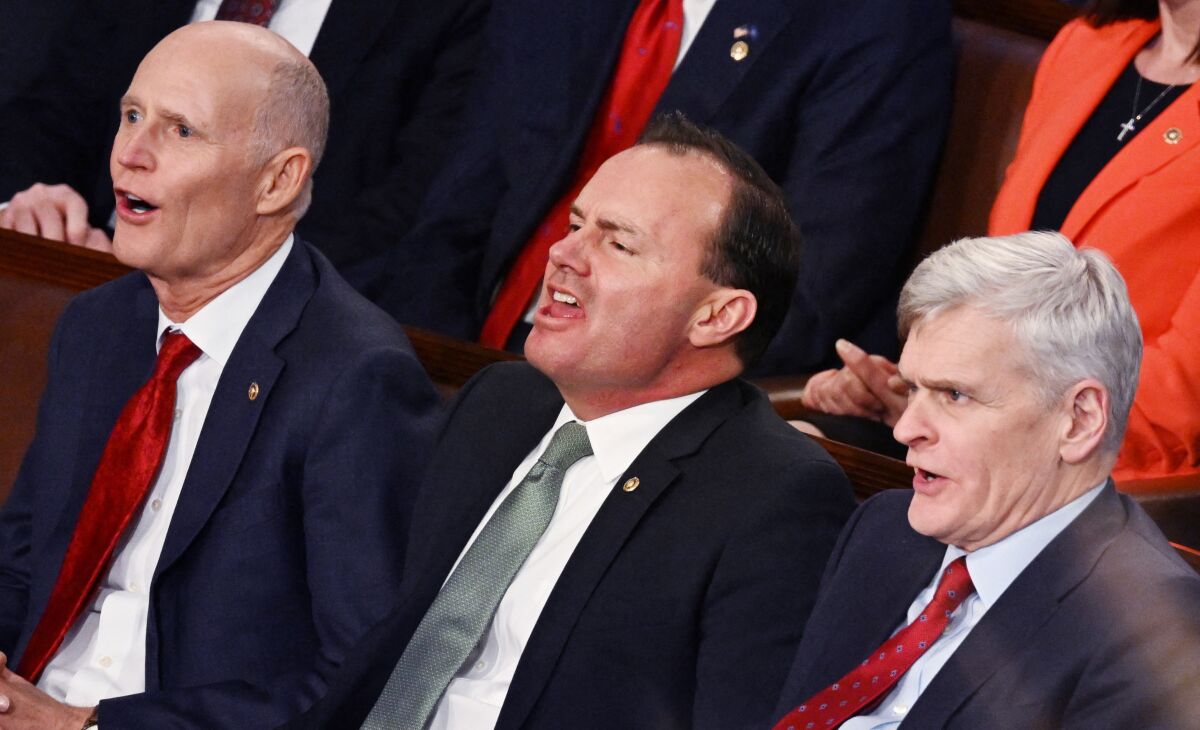
During President Biden’s State of the Union address, he said that Republicans want to cut Social Security and Medicare, and the Republican side of the chamber erupted in jeers and shouts of “liar!” Two of those loudly jeering—Senators Rick Scott of Florida and Mike Lee of Utah—had explicitly made those proposals. Biden then masterfully got the Republican caucuses in both Houses to declare their support for both big entitlement programs.

Michael Hiltzik, business columnist for the Los Angeles, sets the record straight about the Republican stance on Social Security.

From left, U.S. Sens. Rick Scott and Mike Lee jeer.

From left, GOP Sens. Rick Scott of Florida and Mike Lee of Utah jeer during the State of the Union address when President Biden accused Republicans of wanting to cut Social Security. Both senators have proposed exactly that.

(Andrew Caballero-Reynolds / AFP/Getty Images)

Hiltzik writes:

President Biden has congressional Republicans all asquirm as he conducts a post-State of the Union speech national tour.

Why? Because Biden has doubled down — or as Fox News has it, “tripled down” — on his assertion during the speech that the GOP has been planning to cut Social Security.

Not so, they say. Never happened. Sens. Mike Lee (R-Utah) and Rick Scott (R-Fla.) were even caught on camera during the speech wearing “Who, me?” expressions of injured innocence.

It will be my objective to phase out Social Security, to pull it out by the roots.

— Sen. Mike Lee (R-Utah), during his 2010 campaign for the Senate

Unfortunately for them, we have the evidence, as does Biden. Cutting Social Security along with Medicare has been part of the Republican platform for decades.

As I’ve reported before, they often hide their intentions behind a scrim of impenetrable jargon, plainly hoping that Americans won’t do the necessary math to penetrate their subterfuge.

Let’s take a jaunt through the GOP approach to Social Security and Medicare.

Start with their description of these programs as “entitlements,” which they’ve tried to turn into a dirty word. The truth is that they are entitlements, in the sense that most Americans have been paying into these programs for all their working lives, mostly through the payroll tax. So, yes, they’re “entitled” to receive benefits in return.

Republicans, including former Senate Majority Leader Mitch McConnell (R-Ky.), have consistently blamed the federal debt on “entitlements” — never mind that their 2017 tax cut for the wealthy has blown a multitrillion-dollar hole in the budget.

They know they’re on thin ice with the public when they talk about benefit cuts, which is why Sen. Joni Ernst (R-Iowa) once recommended discussing their ideas only “behind closed doors.”

Now we can turn to the specifics of Lee’s and Scott’s plans. In widely circulated videos from Lee’s first successful Senate campaign in 2010 he can be seen and heard stating as follows: “It will be my objective to phase out Social Security, to pull it out by the roots.” He said that was why he was running for the Senate, and added, “Medicare and Medicaid are of the same sort. They need to be pulled up.”

As for Scott, his 12-point “Rescue America” plan, issued last year, included a proposal to sunset all federal legislation after five years. “If a law is worth keeping, Congress can pass it again.” The implications for Social Security and Medicare, which were created by federal legislation, were unmistakable — so much so that the proposal made Republican officeholders’ skin crawl.

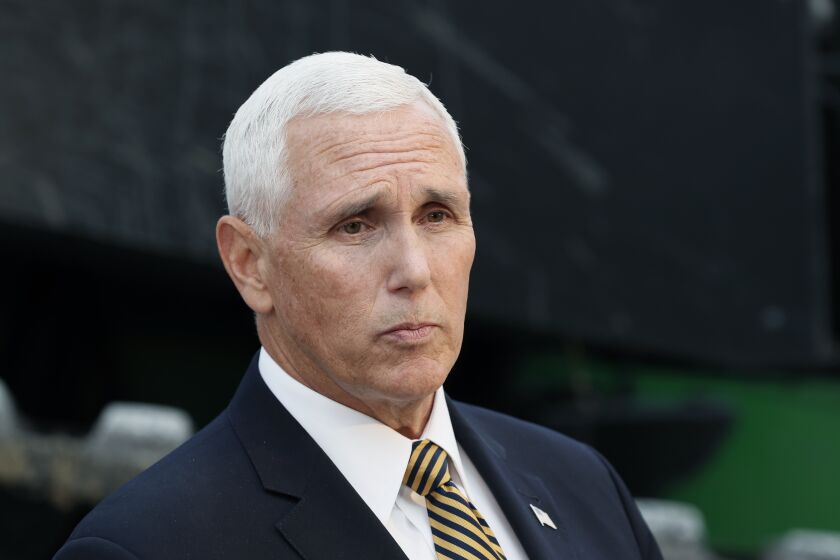
Vice President Mike Pence speaks to reporters during a visit to the Manning Farms, Wednesday, Oct. 9, 2019, in Waukee, Iowa. (AP Photo/Charlie Neibergall)

Column: Mike Pence, would-be president, has a plan to kill Social Security. It will cost you

McConnell disavowed the proposal on the spot and has continued to do so, telling a home-state radio host after the Biden speech that the sunset provision is “not a Republican plan.That was the Rick Scott plan.”

That said, it’s a priceless foil for Biden. When Republicans brayed during his speech that he was lying about it, he offered to make Scott’s manifesto available to anyone who called his office for it. At one of his subsequent appearances, a copy of Scott’s plan was placed on every seat.

The GOP can’t easily wriggle away from its intentions. Let’s examine the fiscal 2023 budget proposal issued by the Republican Study Committee, a key policy body, last June under the title “Blueprint to Save America.”

This plan would increase the Social Security full retirement age, which today is 66 or 67 (depending on one’s year of birth), to 70 by 2040. According to Kathleen Romig, the Social Security expert at the Center on Budget and Policy Priorities, this would translate into a 20% cut in lifetime benefits compared with current law.

As I’ve reported before, raising the full retirement age is a Trojan horse that would affect all retirees across the board, but harm Black workers, lower-income workers and those in physically demanding jobs the most.

It would create particular hardships for those choosing to retire early and collect their benefits prior to their full retirement age.

Doing so exacts a lifetime reduction in monthly benefits, based on a formula aimed at equalizing the lifetime benefit among those who retire early, those who wait until their full retirement age, and those who defer collecting until that age (they receive a bump-up in benefits for every year they delay, topping out at age 70).

Raising the full retirement age to 70, Romig calculates, would mean that retirees who start collecting at the minimum age of 62 would receive only 57% of their full benefit….

The Republican Study Committee also would make it harder for disabled workers to qualify for benefits, and would lengthen the period before those who are disabled and younger than 65 qualify for Medicare to five years from two. This falls into the category of balancing the budget on the backs of the most vulnerable members of society.


As for Medicare, the Republican Study Committee proposes raising the eligibility age, currently 65, so it matches the Social Security retirement age. It also would transfer many more Medicare accounts to private insurance. The committee claims this would save money.

The rest of his incisive analysis is behind a paywall, unfortunately. He demonstrates beyond doubt that Republicans have wanted for years to put these big programs on the chopping block, which are lifelines for senior citizens. They have no objections, however, to cutting the taxes of the wealthiest. That was Trump’s biggest accomplishment: tax cuts for those with the most.