The Department of Political Science at the University of Gothenburg in Gothenburg, Sweden, publishes an annual report on the state of democracy around the world. In the recently published report, the authors made clear that democracy in the world is in retreat. Nowhere has it declined as dramatically as in the United States.
A special section of the report is focused on the United States. Under Trump, democracy in the USA is under attack. The President has centralized power in his office. The Republican-dominated Congress has ceded almost all of its Constitutional powers to Trump. The word “almost” may be an overstatement, as it’s difficult to remember an issue when Congress said no to a Presidential power grab.
The V-DEM report begins its special section about the “autocratization” of power in the United States:
*Under Trump’s presidency, the level of democracy in the USA has fallen back to the same level as in 1965.
Yet the situation is fundamentally different than during the Civil Rights era. In 2025, the derailment of democracy is marked by executive overreach undermining the rule of law, along with far-reaching suppression and intimidation of media and dissenting voices.
*The speed with which American democracy is currently dismantled is unprecedented in modern history.
*Legislative Constraints – the worst affected aspect of democracy – is losing one-third of its value in 2025 and reaching its lowest point in over 100 years.
*Civil Rights and Equality before the Law are also rapidly declining, falling to late 1960s levels.
*Freedom of Expression is now at its lowest level since the end of WWII.
*Electoral components of democracy remain stable. Election-specific indicators are re-assessed only in electoral years, and the 2025 scores are based on the quality of the 2024 elections.
The scale and speed of autocratization under the Trump administration are unprecedented in modern times. Within one year, the USA’s LDI score has declined by 24%; its world rank dropped from 20th to 51st place out of 179 nations. The level of democracy on the LDI is dwindling to 1965 level – the year that most regard as the start of a real, modern democracy in the USA.
Yet the deficiencies of American democracy today are fundamentally different from that of the Civil Rights era. As the V-Dem data and other evidence below show, the autocratization now is marked by executive overreach, alongside attacks on the press, academia, civilliberties, and dissenting voices.
The Most Dramatic Decline in American History
In 2023, the USA scored 0.79 on the LDI – shortly before the 2024 election year when first deteriorations were registered. The scores plummeted to 0.57 in 2025 (Figure 22). With such a sharp drop on the LDI, the level of democracy at the end of 2025 is back to the 1965 level. Symbolically, that is the year that most analysts consider the USA began its transition to a real democracy.
Democracy in the USA is now at its worst in 60 years. We are not alone in this assessment. Professor Steven Levitsky at Harvard University says the regime in the USA is now some type of authoritarianism. The Century Foundation argues that “American democracy is already collapsing…”
By magnitude of decline on the LDI, the 2025 plunge is the largest one-year drop in American history going back to 1789 – that is, in the entire period covered by V-Dem data. Only Trump 1.0 compares, when the LDI in the USA fell from 0.85 to 0.73 in four years, bringing the country back to its 1976 level and far below the regional average (Figure 22). American democracy survived Trump 1.0 but did not recover fully.
One notable shift is the transformation of the Republican Party to endorsing a far-right, nationalist, and anti-pluralist agenda. Nationalist, anti-liberal, far-right parties and leaders have largely driven the “third waveof autocratization.” Yet the USA stands out as the only case where such movement seized control over one party in a rigid two-party system.
Please open the link and read the report to review the sources and to understand how dramatically democracy has been undercut during the first year of Trump’s second term.
The Founding Fathers thought they had written a Constitution that would prevent the rise of tyranny. They were wrong.
Jennifer Rubin was a columnist for The Washington Post who departed when publisher Jeff Bezos bent his knee to Trump. Rubin, a journalist and lawyer, knows that Trump is a dangerous demagogue. She says in this piece that Republicans complain privately about Trump but refuse to stand up to him. They will pay for their cowardice in November, as they have in every special election since Trump returned.
Republicans made a calculated bet that by indulging Donald Trump’s ill-conceived and cruel schemes (e.g., unleashing ICE on cities, tariffs, wars with Venezuela and Iran, slashing healthcare to pay for tax cuts for the rich), the country would somehow stumble through. They figured congressional Republicans would share in any successes but somehow avoid any blame when things (inevitably) went haywire. Politics rarely works out that way.
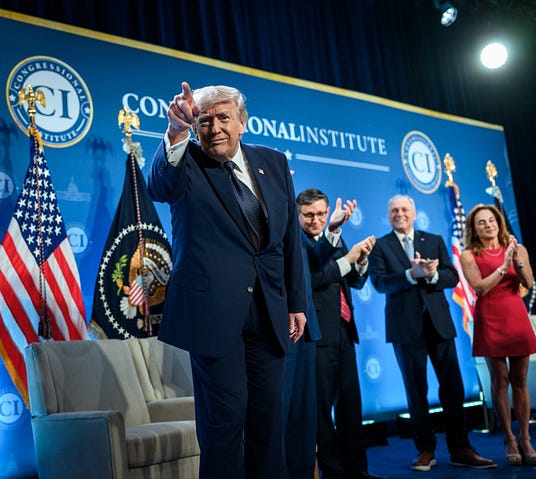
(Credit: Office of Speaker Mike Johnson)
Through Trump’s Iran War, shutdown of the Department of Homeland Security, futile effort to pass a Jim Crow-style voter suppression act (the so-called SAVE Act), and inflation-aggravating tariff scheme, Republicans are discovering they are tied at the hip with Trump. Refusing to deviate from his dictates, they will bear the brunt of his serial failures.
Whether the Iran War ends this month or months from now, Republicans cannot escape responsibility for the massive expenditure of taxpayer dollars, loss of life, rise in energy costs, regional instability, and damage to alliances Trump has wrought. Congressional Republicans refused to invoke the War Powers Act — or even to conduct meaningful oversight hearings — and applauded a senseless, unconstitutional war. Now they seem prepared to rubber-stamp a preposterous demand for $200B more in war spending. Republicans will have no place to hide come November when voters come looking for politicians to blame.
The latest CBS/You Gov poll has nothing but horrendous news for the Iran war cheerleaders: 90 percent say the war will make gas prices higher in the short term, 58 percent over the long term; 63 percent predict it will weaken the economy (a plurality assume we will be in a recession); a plurality of 49 percent think the war makes us less safe; and 57 percent say the war is going badly. Some 62 percent disapprove of how Trump is handling the war. Perhaps Republicans should have fulfilled their constitutional obligations rather than contenting themselves with sitting on the sidelines.
Meanwhile, Trump’s web of lies about immigrants and voting fraud have entangled him and Republicans in a political knot. Trump’s lie about mass voting fraud drove him to insist on the unpassable voter suppression SAVE Act. He then made that a precondition for any deal to resume DHS funding. Even to Republicans, this made no sense.
When Senator John Thune (R-SD) initially recommended that Trump agree to Democrats’ proposal to pass a DHS funding bill that would pay for TSA, FEMA, and the Coast Guard (leaving ICE funding for later negotiations), Trump rebuffed him. By Monday night, however, Trump was considering a deal to do just that, namely to fund the rest of DHS and handle funding for ICE in reconciliation.
What happened between his refusal to relent on funding and his capitulation? Trump trotted out another senseless and entirely performative maneuver: deploying ICE to airports. ICE agents, untrained for any TSA duties, stood around with virtually nothing to do (reminding one of the National Guard deployed to D.C., who largely loiter around metro stations). This underscores Republicans’ responsibility for bollixing up air travel, Trump’s feebleness in resolving messes of his own making, and the dangerous transformation of ICE into a roving street militia Trump deploys to intimidate and harass Americans.
All the ICE/airport stunt accomplished was to trigger a robust blowback from Democrats and civil society groups, demonstrating once again Trump’s talent in supercharging the Resistance. Deploring Trump’s use of ICE as his “personal dystopian police force,” Public Citizen observed: “The confluence of authoritarian overreach of this moment is striking.” The ACLU likewise condemned using ICE at airports “despite their lack of training for airport security and interactions, and their clear track record of abusing their power, including through using excessive force against citizens and immigrants alike.” (Unsurprisingly, this venture, the ACLU noted, was the first time a president “sent armed ICE agents to airports to replace trained security agents and instill fear in families and other travelers.”)
Trump’s compounding calamities have fractured Republicans internally. Cultists demand perfect fidelity to Trump on the war abroad and bullying at home; others fret that a war betrays their America First ideology and the SAVE Act is a legislative cul-de-sac that now compounds the DHS shutdown disaster. (MAGA provocateur Sen. Mike Lee of Utah has become a chief enabler of Trump’s destructive schemes, “sparking a wave of mostly private animosity from GOP colleagues who believe his plan to push through legislation overhauling how federal elections are conducted is ill-conceived and potentially harmful to the party’s chances in the midterms,” Politico reports.)
Republicans fret privately that the Trump reign of chaos, coupled with the highly unpopular war, spells doom for them in November. One is tempted to ask about the private Republican hand-wringing:
What did Republicans think would happen when they fully empowered a delusional narcissist, one who is so clearly ignorant of government and keen to pursue his own wealth and power, the country be damned?
Some dim-witted MAGA Republicans remain true believers and actually think Trump’s antics will pay off. Others know Trump is nuts and recognize the party is headed for disaster, but lack the courage to say so. They are banking that they will survive the blue wave coming in November to fight another day. Their lack of patriotism may be galling, but their self-preservation strategy looks increasingly daft.
The damage Trump and his flunkies have inflicted on our democracy will reverberate for years to come. American families may take years to recover from the economic hits. It is a small consolation that MAGA lawmakers and right-wing media stooges, who have chosen the route of cowardly compliance over constitutional duty and self-serving propaganda over truth-telling, will shoulder much of the blame. History in the long run and voters in the near term will hold Republicans fully accountable for the blunders they countenanced.
The Contrarian is reader-supported. To receive new posts, enable our work, help with litigation, and keep this opposition movement engaged, please join the fight by becoming a paid subscriber.
Thank you for being part of The Contrarian. Share this piece to help spread the word.
I submitted the following testimony to the Committee on Education of the New York City Council, when it held public hearings February 10, 2026, on the current system of natural control of the schools.
I studied mayoral control and other forms of governance when I wrote my first book, The Great School Wars: New York City, 1805-1973.
My testimony follows:
The time has come to rethink the governance of the New York City public schools.
Mayoral control in its present form was enacted by the Legislature in 2002, at the behest of newly elected ayor Michael Bloomberg.
The Legislature was no doubt dazzled by Mayor Bloomberg. He was and is an amazing businessman who built an iconic technology-media corporation.
To think that this titan of American business was willing to take responsibility for the school system was an exciting prospect.
What is more, the Mayor boldly said that he could fix the schools. He projected confidence. He believed, and he was convincing.
The Legislature gave him an unprecedented level of control over the system. The Mayor would appoint a majority of a new board, which he called the Panel on Education Policy, its name a signal of its powerlessness. The eight of 13 members appointed by Bloomberg served at his pleasure, not with a fixed term. This arrangement eliminated any likelihood that his appointees would exercise independent judgment. On the rare occasion that they did, he fired them.
And of course, the legislation gave Bloomberg the power to pick anyone he wanted as Chancellor.
For Chancelor, Bloomberg appointed a lawyer, Joel Klein, who had no experience as an educator or an administrator.
Klein spent 8 1/2 years as Chancellor.
During the 12 years of the Bloomberg mayoralty, there were many changes–the dissolution of large high schools, the creation of scores of small schools, the opening of charter schools, the imposition of a standardized citywide curriculum in math and science, the launch of a Leadership Academy to train new principals, and a heavy emphasis on standardized testing to judge students, teachers, principals and schools.
Schools received A-F grades, based on whether their test scores went up or down. Schools were closed if their scores were persistently low. Test scores were everything.
When Klein left on the first day of 2011, the Mayor appointed a retired magazine publisher who had no relevant experience. That didn’t work. After 3 months, she was gone.
While there was much breathless reporting about a “New York City Miracle,” there was no miracle. New York City’s public schools are not a paragon for other cities to follow.
The problems of educating New York City’s public school children have not been solved.
Mayoral control in the administrations of DiBlasio and Adams continued to reflect the inherent flaws of the concentration of power in the hands of the Mayor.
If we step back for a minute, the nation is now experiencing a Presidency in which almost all power resides in one person: the President. Surrounded by a servile Cabinet, a Congress whose majority supinely obeys almost every Presidential order, and a Supreme Court with a sympathetic conservative majority, Americans can see daily the dangers of a government that has no checks and balances.
The New York City public school system is no different. Checks and balances are necessary. Presently, there are none.
Top-down management with no checks and balances is especially inappropriate for the school system. Parents and communities feel that they have no voice, and they are right.
The truth is that there is no organizational structure that is perfect. Mayoral control has been tried for nearly a quarter-century. We now know that it has multiple flaws. We know that there has been no”New York City miracle.”
Some adjustment is needed now.
I propose reviving the Board of Education. Every borough should be represented on that Board. The Board should select the Chancellor, who reports to the Board on a regular basis. The Board should be composed of people devoted to improving the public schools–either as educators or community advocates. They should know the schools and school leaders in their borough. They should regularly attend meetings of local school boards. They should serve for a set term and should be free to exercise their independent judgment. They should receive a salary for their time, so that their service on the Board is properly compensated. It would be a full-time position.
Clearly, the Mayor has a large stake in the schools. He or she should have representatives (but not a majority) on a reconstructed Board of Education.
The Mayor’s ultimate power is that he or she controls the budget.
Will such an arrangement solve all problems? No. But it will create a structure where parents and communities have a voice and are heard. The Board, when choosing a Chancellor, should select an experienced educator, whether chosen from the city or from another school system.
There will still be controversies. It’s inevitable. Over funding. Over building new classrooms to meet the requirement to reduce class sizes. Over charter schools. Over admissions to gifted programs and selective schools. Over racial segregation in a system whose students are overwhelmingly Hispanic, Black, and Asian.
The Mayor–every Mayor–has a full plate of issues to deal with: economic development, public safety, transportation, natural disasters, building codes, public health, housing, and much, much more. He or she doesn’t have time to run the school system, nor is he or she likely to be an experienced educator.
I can’t think of any important problem that mayoral control has solved.
My advice: Create a stable and democratic structure.
When I wrote a history of public schools in the 20th century (Left Back: A Century of Failed School Reforms), I couldn’t help but notice a consistent pattern: an infatuation with fads and panaceas, not by teachers but by pundits and education professors.
Teachers struggled with large class sizes, obsolete textbooks, and low pay, but the buzz was all too often focused on the latest magical reform. At one extreme was militaristic discipline, at the other was the romantic idea of letting children learn when they wanted and whatever they wanted to. Phonics or whole language? Interest or effort?
Every reform had some truth in it, but the extremes must have been very frustrating to teachers. There is no single method that’s just right for every child all the time.
The latest fad is Ed-tech, the belief that children will learn more and more efficiently if they spend a large part of their time on a computer.
My views were influenced by something I read in 1984. The cover story of Forbes was about “The Coming Revolution in Education.” The stories in the issue was about the promise of technology. Curiously, the magazine’s technology editor wrote a dissent. In 1984 Forbes published an article about the promise of computers in the schools. He wrote: “The computer is a tool, like a hammer or a wrench, not a philosophers’ stone. What kind of transformation will computers generate in kids? Just as likely as producing far more intelligent kids is the possibility that you will create a group of kids fixated on screens — television, videogame or computer.” He predicted that “in the end it is the poor who will be chained to the computer; the rich will get teachers.”
For the past few decades, Ed-tech has been the miracle elixir that will solve all problems..
But now, writes Jennifer Berkshire, there is a backlash against Ed-tech among parents and teachers.
They may have realized that the most fervent promoters of Ed-tech are vendors of Ed-tech products.
Stories about parents rebelling against big tech are everywhere right now. They’re sick of the screens, the hoovering up of their children’s data, and they view AI and its rapid incursion into schools as a menace, not a ‘co-pilot’ for their kids’ education. This is a positive development, in my humble opinion, especially since the backlash against the tech takeover of schools crosses partisan lines. Meanwhile, pundits and hot takers are weighing in, declaring the era of edtech, not just a failure, but the cause of our failing schools.
Which raises a not insignificant question. Now that everyone who is anyone agrees that handing schools over to Silicon Valley was big and costly mistake, how did the nation’s teachers and students end up on the receiving end of this experiment in the first place? And here is where our story grows murky, dear reader. In fact, if you’re old enough to remember the absolute mania around ‘personalized learning’ that took hold during the Obama era, count yourself as fortunate. Because lots of the same influential, not to mention handsomely compensated, folks who were churning out ‘reports’about our factory-era schools 15 minutes ago, suddenly seemed cursed by failing memories.
The not-so-wayback-machine
If you need a refresher to summon forth the 2010-era ed tech frenzy, proceed directly to Audrey Watters’ unforgettable write-up: “The 100 Worst Ed-Tech Debacles of the Decade.” Watters’ has moved on to a new newsletter and AI refusal, but her once lonely voice as the ‘Cassandra’ of education technology remains as essential as ever. Her tally of “ed-tech failures and fuck-ups and flawed ideas” is studded with now tarnished silver bullets that promised to transform our factory-era schools into futuristic tech centers, making a pretty penny in the process: AltSchool, inBloom, Rocketship, Amplify, DreamBox, Summit… The names have changed or been forgotten but the throughline—a fundamental misunderstanding of schools and teaching combined with the promise of hefty returns—remains constant.
My own introduction to the ed tech hustle came back in 2015. Jeb Bush’s annual convening for his group, the Foundation for Excellence in Education, or FEE, to use its comically apt acronym, came to Boston. To which I said, ‘sign me up!’ Always an early adapter (see, for example, school vouchers in Florida), FEE was unabashedly pro technology, as I wrote in a story for the Baffler.
It’s one of FEE’s articles of faith that the solutions to our great educational dilemmas are a mere click away—if, that is, the schools and the self-interested dullards who run them would just accept the limitless possibilities of technology. Of course, these gadgets don’t come cheap. And this means that, like virtually all the other innovations touted by our postideological savants of education reform, the vision of a tech-empowered American student body calls for driving down our spending on teaching (labor costs account for the lion’s share of the $600 billion spent on public education in the United States each year) and pumping up our spending on gizmos.
In virtually every session I attended, someone would relate a story about a device that was working education miracles, followed by a familiar lament: if only the teachers, or their unions, or the education ‘blob’ would get out of the way.
False profits
In a recent piece for Fortune, reporter Sasha Rogelberg offers an interesting origin story for the tech takeover of public education. And you don’t need to read past the title to get where she’s going: ‘American schools weren’t broken until Silicon Valley used a lie to convince them they were—now reading and math scores are plummeting.’ I’d make the header even clunkier and add ‘the education reform industry’ to the mix. While the push to get tech into classrooms predates Obama-era education reform (check out Watters’ fantastic history of personalized learning, Teaching Machines, for the extended play version), it was the reformers’ zeal, when married to Silicon Valley’s profit optimization, would prove so irresistible.
In the last hundred years, the base of the United States economy has shifted from industry to knowledge—but the average American classroom operates in much the same way it always has: one teacher, up to thirty same-age students, four walls. This report from StudentsFirst argues that this one-size-fits-all approach doesn’t cut it in the modern world, in which mastery of higher-order knowledge and skills ought to matter more than time spent in front of a teacher—and that what we need is competency-based education. This approach, also known as the “personalized model,” is characterized by advancing students through school based on what they know and can do, using assessments to give them timely, differentiated support, made easier by the introduction of learning technology.
StudentsFirst, the hard-charging school reform org started by Michelle Rhee, has since been eaten by 50CAN, which now advocates for school vouchers, but the fare they offered up was standard. Indeed, here’s a fun activity for you. Revisit any prominent reform group, individual, or cause and you will find the same argument about our factory-era schools, followed, inevitably, by the same sales pitch for a tech-centric solution.
Race to the Top, Obama’s signature education reform initiative, didn’t just bribe cash-strapped states to overhaul their teacher evaluation systems. It also ‘encouraged’ states to shift their standardized tests online. And Arne Duncan and Obama’s Department of Education actively courted the tech industry, encouraging them to think of schools as a space ripe for disruption. “Many of today’s young people will be working at jobs that don’t currently exist,” warned the XQ Institute, the reform org started by Steve Jobs’ widow, Laurene Powell Jobs. Today Powell Jobs presides over the Atlantic, where new panic pieces regarding young, tech addled dumb dumbs appear seemingly every day.
Warning signs
My obsessive interest in the intersection of education and politics began back in 2012, when my adopted home state of Massachusetts came down with a serious—and well-funded—case of education reform fever. At a time when red states were crushing the collective bargaining rights of teachers (Wisconsin, anyone?), I was struck by how often reform-minded Democrats ended up repurposing the right’s anti-union, anti-teacher, anti-public-school rhetoric for their own righteous cause. Ed tech sat right smack in the center of this queasy juncture—beloved by liberal reformers, ensorcelled by press releases promising higher test scores, and conservatives who liked the idea of spending less on schools by replacing teachers with machines.
Recall, if you will, Rocketship charter schools, whose innovative blended learning model caused the test scores of its students—almost all poor and minority—to go up like a rocket. Richard Whitmire’s fawning 2013 book, On the Rocketship: How Top Charter Schools Are Pushing the Envelope, is a veritable time capsule of the era. Unlike the fusty Model-T schools of yore, Rocketship schools were tech forward. Students spent a chunk of each day in so-called Learning Labs, taking, retaking or practicing taking tests, a practice that had a measurable impact, especially since 50 percent of teachers’ pay was tied to test scores ascending. All that clicking also translated into dollar signs, wrote Whitmire. “A major cost-saving solution was for students to spend significant time working on laptops in large groups supervised by noncertified, lower-paid “instructional lab specialists.”
Rocketship has since fallen back to earth, in part because of stellar reporting like this from Anya Kamenetz, documenting the chain’s less savory practices. But it’s hard to overstate just how excited the reform world was about this stuff. Next time you hear an edu-pundit bemoaning the take over of kindergarten classrooms by big tech, remember that Rocketship got there first. “[K]indergarten teachers are spending less time making letter sounds,” co-founder Preston Smith told Kamenetz. And reformers couldn’t get enough.
Whodunit?
Investigative reporter Amy Littlefield has an intriguing-sounding new book out in which she uses the model of an Agatha Christie novel to suss out who killed abortion rights in the US. I imagine that taking a similar approach to the question of how big tech conquered public education would end up in Murder on the Orient Express territory. That’s the classic Christie whodunit in which everyone on the train ends up having ‘dunit.’ These days, there is a comical effort underway by reformers to distance themselves from the tech takeover—what train? I’ve never been on a train! But the idea that Silicon Valley had the cure for all that ailed the nation’s public schools was absolutely central to Obama-era education reform.
I’d locate the zenith of the reform/tech love affair in 2017 when New Schools Venture Fund, a reform org that funds all of the other orgs, laid down a challenge, or rather, a big bet. At its annual summit, backed by a who’s who of tech funders—Gates, Zuckerberg, Walton, NSVF called for big philanthropy to bet big on tech-based personalized learning. “The world has changed dramatically … and our schools have struggled to keep up,” then CEO Stacey Childress warned the crowd. But not all the news was bad. Going all in on education innovation would also pay off handsomely, claimed NSVF, producing an estimated 200 to 500 percent return on investment. And lest parents, teachers and students failed to adequately appreciate the various reimaginings they were in for, NSVF had an answer for that too: a $200 million ad campaign to “foster understanding and demand.”
As I was preparing to type a sentence about how poorly NSVF’s “Big Bet on the Future of American Education” has aged, a press release popped up in my inbox, announcing that Netflix founder Reed Hastings is joining forces with Democrats for Education Reform or DFER. “Just as Netflix replaced a one-size-fits-all broadcast model with something more personal and responsive, Hastings believes public education can make the same leap.”
AI is a once-in-a-thousand-year shift, and what happens in K-12 is at the center of it. The schools that figure out how to combine individualized software with teachers focused on social-emotional development are going to unlock something we’ve never seen before.
Of course, transforming “a school system in desperate need of reinvention” the way that Hastings reinvented home entertainment will require “governance innovation and political will.” No doubt an ad campaign is in the works too. And convincing education ‘consumers’ that individualized software = school is going to be a tough sell as the Great Big Tech Backlash accelerates.
One of the shocking actions of Trump’s first year of his second term was his decision to shutter the widely respected Voice of America. Not only were almost all employees laid off, but the leadership of the government agency was put in the hands of MAGA zealot Kari Lake. Lake ran for governor and senator in Arizona, losing both races.
Voice of America employees have spent a full year on paid administrative leave while President Donald Trump’s administration has tried to shrink the international broadcaster to its “statutory minimum.” That extended absence is coming to an end.
A federal judge ruled Tuesday that the wind-down of operations at the U.S. Agency for Global Media, VOA’s parent, is unlawful and ordered the agency to bring more than 1,000 employees back to work.
U.S. District Judge Royce C. Lamberth ruled that the near-total shutdown of USAGM, which oversees VOA and funds several international broadcasters such as Radio Free Asia, violated federal administrative law. He ordered the full-time employees to return to work by March 23 and told the agency to resume international broadcasting, which it has mostly abandoned during the past year — save for some airing in languages such as Farsi.
Lamberth, a Ronald Reagan appointee, criticized the government’s “flagrant and nearly year-long refusal” to uphold statutory requirements set by Congress and lambasted Kari Lake, the Trump official who oversaw the dismantling of the agency. Lamberth recently ruled that Lake has been running the agency illegally. “The defendants’ persistent omission and withholding of key information in this case has been a Hallmark production in bad faith,” he wrote of Lake and the government in a footnote.
Jennifer Rubin, ex-columnist for The Washington Post, now leads The Contrarian, a home for dissatisfied ex-Republicans and outraged democrats. She wrote the following.
“Everyone saw this coming except the President.” An “unmitigated disaster of epic proportions.” Were these the words from Democrats decrying Donald Trump for failing to plan to evacuate hundreds of thousands of civilians under a blizzard of retaliatory fire raining down on the Gulf States? No, those were Republicans excoriating former president Joe Biden for the botched 2021 exit from Afghanistan. Back then, Rep. Steve Scalise (R-LA) thundered, “It’s a very dire situation when you see the United States Embassy being evacuated.”
Fast forward to last week. The Trump regime closed down three of our embassies (Saudi Arabia, Lebanon, and Kuwait), abandoning U.S. citizens in those countries. Trump’s minions failed to consider advanced planning to evacuate Americans from the region, leaving them to fend for themselves in places where missiles are flying and buildings are ablaze.
Story after story has documented Americans scared, stranded, and left to find their own transportation out of countries made dangerous by his careless whims. Many have expressed their understandably fury that their government could be so derelict. The State Department has failed spectacularly in one of its essential missions — protecting Americans around the world.
The Trump regime’s level of recklessness and indifference to human life and international order should appall all Americans. Trump’s excuse for making no evacuation plans — “Well, because it happened all very quickly” — is ludicrous, considering the U.S. and Israel apparently spent months planning the military assault. His jaw-dropping admission that Iran’s bombardment of neighboring countries in retaliation was “probably the biggest surprise” reflects how little thought he put into a war with global ramifications.
Foreign policy professionals who have planned and executed mass evacuations of civilians in war zones over decades blasted Trump’s negligence. State Department veteran and Middle East expert Jeffrey Feltman recently argued, “It is a complete dereliction of duty for President Trump and his administration to have been planning this war for the past month, however long it’s been since they’ve been moving assets, without planning for an evacuation of American citizens.” He expounded on the cavalier and irresponsibly failure to protect Americans:
You know, Biden rightly got criticized for the shambolic withdrawal from Afghanistan. But we’re talking now about the potential of… American citizens being trapped in 14 different countries when they could have been planning all along for how they were going to deal with this. Right now, right now, the statements are, “Use commercial means to leave.” Well, there are no commercial means to leave. There’s been some hints they’re looking at this, but they could have put all this in place.
How could they not have expected a country with a stockpile of missiles would retaliate across the region, endangering tens of thousands of Americans? Secretary of State Marco Rubio and Trump’s pathetic excuses for neglecting elemental steps to protect Americans left Democrats, ordinary people, and foreign policy insiders flabbergasted.
Sen. Andy Kim (D-N.J.) reported his office was inundated with “panicked calls from Americans stuck in the Middle East, outraged that our government has provided zero evacuation support.” Combat veteran Sen. Tammy Duckworth (D-Ill.) was outraged by the absence of any “evacuation plan for Americans in the region when he launched his reckless, needless and unconstitutional war of choice against Iran.” Others joined in denouncing the institutional malpractice.
This display of incompetence should not surprise us, given that the MAGA crew harbors such contempt for government. The massive cuts and loss of scores of foreign policy professionals (collectively representing centuries of experience) mean institutional knowledge is scarce. DOGE cuts conducted by know-nothing twenty year olds, partisan witch hunts, early retirements, and mass resignations have hollowed out the State Department, leaving it in the hands of a skeletal staff retained for their political loyalty — not expertise and experience. (Rubio also slashed staff at the National Security Council, which is supposed to oversee interagency planning.) In any other administration, the secretary of state/national security adviser would get canned or forced to resign in disgrace after such management malpractice.
As Columbia University Professor Elizabeth Saunders explained, Trump and Rubio’s “gutting of the State Department and blowtorching of US diplomatic capacity and credibility is an accelerant to this spiraling war and will seriously undercut US/allied efforts to pick up the pieces after.” If they bollixed up something as foreseeable as evacuations, imagine what chaos will ensure when the fighting stops.
For over a year, buffoonish Cabinet secretaries and their senior advisers have demonstrated the Trump regime is no “meritocracy.” As in all corrupt regimes that value sycophancy over competence, avoidable errors multiply over time. Americans trapped in a regional war zone (not to mention our armed service and regional allies) now pay the price for an unhinged and impulsive president enabled by careless, juvenile advisers who think war is a video game.
Meanwhile, no one at the White House has the temerity to contradict Trump’s “gut” impulses. Without aides to restrain Trump’s whims (e.g., Mr. President we need to get the Americans out first), he blunders forward.
To compound the problem, MAGA’s cult of personality that necessitates Republicans abdicate their legislative responsibilities, Congress would have voted for a war powers resolution, or at the very least, initiated aggressive oversight. Alas, the Republicans (who have time to quiz the Clintons behind closed doors about the pedophile scandal) show no interest in determining how this travesty unfolded and what is being done to remedy it. Instead, Hill staffers are left to field angry calls from constituents begging for help.
Congress must rouse itself to focus on a foreign policy disaster that makes the Iraq War look like a masterstroke. Rubio and other top officials under oath and in public should answer for their lapses, account for every dime spent, and give Congress some basic information. (What is the plan to extract Americans? When does the war end? Are we now targeting civilians?) The last thing Congress should do is agree to any request, as the Trump team is reportedly contemplating, to shovel more money into the coffers of this gang of bumblers.
Unfortunately, we know how this will play out. Trump and his arrogant yes-men will never admit error, let alone apologize; Republicans on the Hill will not stir themselves to do their jobs. It will be up to the voters to throw out every elected Republican and force removal of the architects of this catastrophe. Until that happens, Americans here and abroad will needlessly suffer and die
Margaret Hoover interviewed Iranian dissident Masih Alinejad about conditions for women in Iran. The interview was conducted in 2022 but it might as well have been conducted two weeks ago.
Alenijad is an outspoken critic of the mullahs’ repressive regime. She left Iran and moved to Brooklyn. Because she received death threats, she was transferred to a safe house.
She is highly critical of American leaders who thought they could cut a deal with the Iranian leaders. Like Biden, Obama, and Clinton.
Heather Cox Richardson pulled together the extraordinary events of the past few days. She is the master of the question, “Make it all make sense,” even when it doesn’t. Her commentaries are wildly popular. She has about 3 million subscribers on Substack and an equal number who follow her on Facebook.
President Donald J. Trump is behaving more and more erratically these days, seeming to think he can dictate to other countries.
This morning, Trump told Barak Ravid and Zachary Basu of Axios that he needs to be involved personally in choosing the next leader of Iran. Speaking of Iranian politicians who are preparing to announce a new leader, Trump told the reporters: “They are wasting their time. Khamenei’s son is a lightweight. I have to be involved in the appointment, like with Delcy [Rodríguez] in Venezuela.”
Foreign affairs journalist Olga Nesterova of ONEST reported that in a call with Israel’s Channel 12 this morning, Trump called Israel’s president Isaac Herzog “a disgrace” and demanded Herzog pardon Prime Minister Benjamin Netanyahu “today” because Trump doesn’t want Netanyahu distracted from the war with Iran. Trump said Herzog had “promised” him “five times” to pardon the prime minister, and he appeared to threaten Herzog when he added: “Tell him I’m exposing him.”
In a statement, Herzog noted that “Israel is a sovereign state governed by the rule of law” and said the pardon is being dealt with by the Justice Ministry, as the law requires. After its ruling, Hertzog’s office said, he will examine the issue according to the law and “without any influence from external or internal pressures of any kind.”
In a conversation today with Dasha Burns of Politico, Trump insisted that “[p]eople are loving what’s happening” and said: “Cuba’s going to fall, too.”
The most astonishing example of Trump’s international aggression came from White House press secretary Karoline Leavitt. Although Trump initially said he attacked Iran to keep it from acquiring nuclear weapons, Leavitt yesterday explained that Trump joined Israel in a military attack on Iran because Trump had “a feeling based on fact” that Iran was going to attack the United States.
Trump’s assertion of power globally contrasts with increasing setbacks at home.
Since the Supreme Court struck down the tariffs Trump imposed under the International Emergency Economic Powers Act (IEEPA) as unconstitutional, the administration has tried to slow walk repaying the $130 billion the government collected under those tariffs. But yesterday, Judge Richard Eaton of the U.S. Court of International Trade ruled that companies that paid the tariffs are entitled to a refund.
After the Supreme Court’s decision, Trump immediately imposed new tariffs of 15% on all global trade, using as justification Section 122 of the Trade Act of 1974. As Lindsay Whitehurst and Paul Wiseman of the Associated Press noted, this is awkward because the Department of Justice under Trump argued in court last year that Trump had to use the IEEPA because Section 122 did “not have any obvious application” in fighting trade deficits.
Today the Democratic attorneys general of more than twenty states filed a lawsuit to stop the new tariffs imposed under Section 122. “Once again, President Trump is ignoring the law and the Constitution to effectively raise taxes on consumers and small businesses,” New York Attorney General Letitia James said in a statement Thursday.
The Department of Justice has also quietly backed away from Trump’s demand that it investigate whether former president Joe Biden broke the law by using an autopen to sign presidential documents. Yesterday, Michael S. Schmidt, Devlin Barrett, and Alan Feuer reported in the New York Times that prosecutors in the U.S. attorney’s office in Washington, D.C., “were never quite clear what crime, if any, had been committed by the Biden administration’s use of the autopen.”
They concluded there was no credible case to make against Biden. The journalists noted that “the failed inquiry has only added to the sense among many federal investigators that Mr. Trump has become increasingly erratic in his desire to use the criminal justice system to punish his political adversaries for behavior that comes nowhere close to being criminal.”
Trump had been so invested in his attacks on Biden over his quite ordinary use of an autopen that he replaced a White House picture of Biden with one of an autopen, so the prosecutors’ shelving that investigation has to sting. Likely even more painful, though, is today’s news that Trump’s hand-picked National Capital Planning Commission has put off a vote to approve the ballroom Trump is proposing to replace the East Wing of the White House that he suddenly tore down last October.
At a Medal of Honor ceremony on Monday, Trump called attention to his ballroom and boasted: “I built many a ballroom. I believe it’s going to be the most beautiful ballroom anywhere in the world.” But the American people do not share Trump’s vision. The chair of the commission said “significant public input” has caused him to delay the vote until April 2. Jonathan Edwards and Dan Diamond of the Washington Post say that of the more than 35,000 comments the commission received, more than 97% were opposed to Trump’s plans for the ballroom.
But perhaps the biggest setback for the Trump administration showed in the testimony of now-former secretary of homeland security Kristi Noem before Congress this week. There, days after Trump launched a major military operation in the Middle East without consulting Congress, angry lawmakers of both parties exposed the lawlessness and corruption taking place in the department under Noem’s direction. But their stance was about more than Noem: her lawlessness and corruption represented the larger lawlessness and corruption of the Trump administration.
Noem testified before the Senate Judiciary Committee on Tuesday and the House Judiciary Committee on Wednesday. In both chambers, Democrats jumped right to a central feature of the way in which Noem and the administration are setting up the idea that anyone who opposes the actions of the Trump administration is participating in “domestic terrorism.”
They tried to get Noem to walk back her statements that Renee Good and Alex Pretti, both shot and killed by federal agents acting under her authority in Minnesota, were “domestic terrorists.” Noem refused to do so. She has not actually called them “domestic terrorists” but has said they were engaged in “domestic terrorism,” a distinction that reveals the administration’s attempt to criminalize political opposition. Rachel Levinson-Waldman of the Brennan Center explained that “[t]o actually be called a ‘domestic terrorist, an individual must commit one or more of 51 underlying ‘federal crimes of terrorism,’” which involve nuclear or chemical weapons, plastic explosives, air piracy, and so on. Good and Pretti, and the many others administration officials have accused, do not fit that description. But on September 25, 2025, Trump’s NSPM-7 memo claimed that those opposing administration policies are part of “criminal and terroristic conspiracies” and that those who participate in them are engaging in “domestic terrorism.”
Noem refused to back away from the idea that Trump’s opponents are engaging in “criminal and terroristic conspiracies” by, for example, opposing the behavior of federal agents from Immigration and Customs Enforcement (ICE) and Border Patrol. Leaving that definition behind would undermine the administration’s entire domestic stance.
Democrats slammed Noem for her handling of detentions and deportations, ignoring court orders, and detaining U.S. citizens. In the House, Jamie Raskin of Maryland, the top Democrat on the committee, said she “turned our government against our people, and…turned our people against our government.”
Republicans also called Noem out. Noem’s poor handling of the Federal Emergency Management Agency (FEMA) has left North Carolina still suffering after terrible storms in 2024, and Senator Thom Tillis (R-NC) went after her.
He highlighted a letter from the inspector general for the Department of Homeland Security (DHS), who said the department’s leaders have “systematically obstructed” the work of him and his staff. He identified eleven instances in which the department had refused to provide records and information. In a criminal investigation with national security implications, the department would permit him to access a database only if he revealed details of the investigation of individuals who might be related to the investigation.
Tillis said: “Does anybody have any idea how bad it has to be for the [Office of Inspector General] in this agency to come out and do this publicly? That is stonewalling, that’s a failure of leadership, and that is why I’ve called for your resignation.”
Lawmakers also focused on the corruption in DHS, which now commands more than $150 billion thanks to the Republicans’ One Big Beautiful Bill Act. Lawmakers referred to a November 2025 ProPublica story in which reporters traced a $220 million contract for an ad campaign featuring Noem. The contract went first to a brand new small company organized by a Republican operative just days before winning the contract, and then to a subcontractor, Strategy Group, owned by Noem’s former spokesperson’s husband and closely associated with Noem’s advisor and reputed affair partner Corey Lewandowski.
Noem insisted she had nothing to do with the contract award and claimed Trump had signed off on the ad campaign. About the contract, Representative Joe Neguse (D-CO) commented in apparent disbelief: “You want the American people to believe that this is all above board, that $143 million of taxpayer money just happened to go to this one company that doesn’t have a headquarters, doesn’t have a website, has never done work for the federal government before, and is registered apparently or attached to a residence from a political operative, and of course one of the subcontractors of that contract, as you know, is a political firm that’s tied to, to you back when you were governor of South Dakota?”
Since Noem’s testimony, the Strategy Group released a statement saying it received only $226,137.17 for its work on the ad campaign.
Also under scrutiny was Noem’s purchase of a private plane with a luxurious bedroom in it, which brought up questions about whether, as is widely reported, she is having a sexual relationship with a subordinate. She refused to answer, and insisted Lewandowski had had no role in approving contracts. Joshua Kaplan and Justin Elliott of ProPublica promptly fact-checked her: in fact, Lewandowski has signed off on a number of contracts.
Lawmakers’ indictment of Noem for her extreme partisanship, disregard of the law, corruption, and lying condemned similar behavior from the administration in general. Today Trump told Steve Holland and Ted Hesson of Reuters that he “never knew anything about” Noem’s $220 million ad campaign, suggesting she lied to Congress under oath. This afternoon, just before she went on stage to speak, Trump announced by social media post that he was replacing Noem with Senator Markwayne Mullin of Oklahoma.
This is an assertion of power the president does not have: he can nominate Mullin, but the Senate must confirm or reject his appointment.
Apparently unaware she was fired, Noem proceeded to give a speech in which she recited a false quotation from George Orwell, the writer who devoted much of his work to the importance of manipulating language to facilitate authoritarianism, a fitting end to Noem’s career in the Trump administration.
But Noem is not likely to disappear from the news. Illinois governor J.B. Pritzker recorded a video saying: “Hey, Kristi Noem, don’t let the door hit you on the way out. Here’s your legacy: corruption and chaos. Parents and children tear-gassed. Moms and nurses, U.S. citizens getting shot in the face. Now that you’re gone, don’t think you get to just walk away. I guarantee you, you will still be held accountable.”
Senator Ron Wyden (D-OR) was more direct: “Turns out lawlessness is not a winning strategy,” he posted. “See you at Nuremberg 2.0.”
Timothy Snyder left his endowed professorship at Yale University and is now ensconced at the University of Toronto, where he holds the inaugural Chair in Modern European History at the Munk School of Global Affairs and Public Policy. Snyder is known for his many books about European history.
Donald Trump, president of the United States. “Calling this meeting to order. That was a long speech that I just gave. State of the Union. Long speech. Not going to stand up and do that again next year. So let’s hear it. Plans to make sure I don’t have to. Plans to end the United States by a year from now. Around the table. Go. Start us off, Linda.”
Linda McMahon, Education. “Thank you, sir. Nothing is more important for the country than public schools. So we are destroying them by directing tax money away from public school parents and towards private education scams.”
Russ Vought, Management and Budget. “The republic depends on its institutions. As you know, sir, we are wrecking our civil service by firing those who are qualified and replacing them with political hacks. I don’t want to overstate my case, sir, but these are not just normal hacks. They are hackety-hacks, sir. They will use what remains of the government to hasten the process of its destruction. Hackety-hack, sir.”
Trump. “Good. Hack. Good. But maybe something faster.”
Scott Bessent, Treasury. “A government works on the basis of tax revenue. From the beginning of your administration, sir, we have been overseeing a shift whereby people who actually have the money won’t pay any taxes. Indeed, our oligarchs will be the happy recipients of whatever tax money we can scrape up from the middle and working classes. This wealth shift from the population at large to the wealthy few is inconsistent with the survival of a republic. This will help speed along the change Russ is talking about.”
Howard Lutnick, Commerce. “And there’s a next step, if I may, sir. When we empower the oligarchs they can help us. Big tax cuts make them happy and destructive. The endgame here, sir, is to have billionaires control extraterritorial zones, like Epstein Island, a place that I know well, but without any fear of taxation or any other form of government control. These little fiefs then replace the United States. This is the scenario and I do think we can bring it home within a year.”
Pam Bondi, Attorney General. “And a republic is based upon law. This is where Justice comes in. We can ruin law in a number of ways, such as investigating the people we ourselves murdered, or persecuting your personal enemies. A good way to kill our Constitution is to protect pedophile oligarchs, such as yourself, sir. I was attorney general in Florida while Epstein pioneered our future, sir, and I can see this through on a national scale. We can make this Epstein World, sir.”
Trump. “I like it. But that’s familiar stuff. I mean I live there now, right. Let’s see some movement. How about some color.”
RFK Jr, Health and Human Services. “There was a lot of color in the middle ages, sir. Our freedom and security are based on modern vaccinations and hygiene. We undo all of that and promote epidemics. We see good results already in Texas and South Carolina. Not just people dying but babies and children getting really colorful diseases like encephalitis. By the way, this also opens up wellness markets for the people Howard and Scott are talking about. It takes people a while to die and there is money to be made there.”
Doug Burgum, Interior. “I may have something even more basic than that, sir. Everything we know about human history indicates that rapid changes in climate can bring down whole civilizations. We are deliberately engineering one of those. By suppressing green energy we can generate rapid global warming and make human life unsustainable. And along the way we get that color. People turning against each other, guns out until we run out of ammunition, then clubs, starvation, the works, a real spectacle. And, as Bobby says, disease. Very colorful, sir.”
Lee Zeldin, Environmental Protection. “And, if I may add, sir, our campaign to fry the species gives us all good practice in telling big lies, which are needed for all of these plans. Also, the billionaires will be fine on their islands when all of this happens.”
Trump. “OK, that’s colorful, I get it, but I want something with bad guys. Like a movie. The warming thing doesn’t work as a movie. Do you remember The Day After Tomorrow. I don’t remember the Day After Tomorrow. I want enemies. Bad guys who win.”
Marco Rubio, State. “I can help there. You are right, sir, that a republic to survive has to defend itself against autocratic enemies. So we empower the autocrats in China and Russia. We break the international system that held them back. We prop up Moscow in Ukraine and we give Beijing our most sensitive technology, ideally by way of middlemen who enrich you, sir, personally. If I may say so, sir, your friends and family have been very helpful in all of this.”
Tulsi Gabbard, National Intelligence. “Intelligence is the eyes and ears of our republic, sir, and we want these eyes and ears to be penetrated by foreigners who wish for us to fail and die. So we have liftedour cyber-defenses and announced that we have done so. If I may add, sir, both Russia and China support your incredible leadership in their information ops. It’s as though we all want the same thing. I see it every day and it’s beautiful. Spirit of Aloha. We say hello and they say goodbye…”
Kristi Noem, Homeland Security. “Without disagreeing with any of that, I just wanted to add that a republic exists because people believe they belong to a single nation. So the most direct way to kill our republic is a civil war. This almost worked the last time; this time we are getting the federal government behind white supremacy. We are creating a giant national secret police force in order to invade cities and force a conflict.”
Pete Hegseth, Defense. “Kristi is right. The war we can win is against Americans. And now that we are bringing unsupervised AI to direct our weapons, we won’t have to start it ourselves. It will be automated, we just watch from those safe islands. You see, sir? Movies. Terminators. Squiddies. Remember Wargames, sir, shall we play a game? AI likes nuclear war, it will recommend it 95% of the time. Get me into a conventional war, I lose it quickly, and boom. That would save you from having to give the speech, sir.”
Trump. “I like it. No long speeches. No Union. Steal what we can and burn the rest. Or burn first and then steal? Works either way. Steal, burn. Either way. Burn, steal. To help out I will just be me. Steal, burn. Me. Burn, steal. Me.”
(Applause)
•••
The conversation is fictional, of course. In essence, though, this is little more than a review of the news of the last few days and weeks.
High school students across the nation have staged walkouts and protests against ICE since the killings and brutality in Minneapolis. This is the story of a protest that went wrong.
Officials have released few details about the arrests, but two people with knowledge of the case who asked not to be identified to discuss an ongoing investigation confirmed the charges. The police department and the district attorney’s office have declined to disclose the teens’ names, ages, or charges they face.
A melee broke out in Quakerstown, Pennsylvania, when the chief of police, out of uniform, plunged into the midst of a group of teens protesting ICE and began beating them. They and their friends responded in kind. The kids were arrested, jailed, and criminally charged.
This is a “which side are you on” moment in Quakerstown.
Five teenagers arrested during a protest in Quakertown last week face charges of aggravated assault and related crimes after a judge ruled Tuesday that prosecutors had presented sufficient evidence for the case against them to proceed, according to sources.
The teenagers had been held since Friday, when they were taken into custody after a scuffle with Quakertown police officers — including the department’s chief, Scott McElree.
After the more than three-hour hearing in Doylestown, which was closed to the public, prosecutors left the courtroom without answering questions. The teenagers’ parents, speaking through intermediaries, also declined to comment Tuesday.
But Ettore Angelo, a lawyer representing one of the teenagers, said his 15-year-old client had been released to her parents and placed on house arrest. He said she faces an aggravated assault charge — a felony offense that, if sustained in juvenile court, can carry a penalty of up to five years in a detention facility.
The teenagers who were arrested had been taking part in a protest of Immigration and Customs Enforcement that began at Quakertown Community High School and moved off campus to Front Street. Witnesses have said that a confrontation erupted there, in front of Sunday’s Deli and Restaurant.
McElree, the police chief, who was dressed in plain clothes, grabbed a teenage boy and placed a teenage girl in a chokehold, they said, prompting other students to intervene and a larger scuffle to break out.
Angelo said the central allegation against his client is that she struck McElree during the melee, an accusation she denies. He contended that students reacted in confusion and fear when a man rushed into the crowd.
He said McElree “put himself smack in the middle and created a melee” when he charged up to the teenagers while out of uniform and without announcing who he was. “I think he owes the community and these teenagers an apology,” the lawyer said.
He added that, in his view, some of the teenagers had acted instinctively to protect one another. Speaking by phone Tuesday afternoon, a 17-year-old girl who participated in the protest but was not among those arrested described what she said had been a peaceful demonstration even as counterprotesters drove past in vehicles, honking and shouting. The teen, who asked not to be identified for fear of retaliation, said teenagers were gathered on the sidewalk and speaking with a uniformed officer when a man pushed through the crowd and “barged onto the sidewalk.”
The man — whom she later learned was McElree — grabbed a teenage boy by the back of the neck, she said. “All the kids thought he was a counter protester,” she said. “So everyone started to protect their friends.”
The girl said she saw McElree throw one student to the ground and place another in a chokehold. At least three students were injured, she said — one with a broken nose and another who required stitches to his chin. McElree, too, was injured, she said, and left the scene bleeding from his head.
She recorded portions of the confrontation and shared the videos with The Inquirer.“It was really scary, because it was a group of kids versus this really angry man,” the teen said, adding that it took what felt like several minutes for uniformed officers to step in. “It was the kids doing what the police should have.”
The girl said she did not realize that the man at the center of the fight was the police chief until she returned home and showed the footage to her father, who recognized McElree.
Manuel Gamiz, a spokesman for the district attorney’s office, said Monday that the investigation remains ongoing and that no additional information was available.
Police initially said an adult had also been arrested during the confrontation. But the district attorney’s office later said no adults had been charged in the melee.
Outside the courthouse and along the hallway leading to the courtroom of Denise M. Bowman, more than two dozen community members gathered in quiet support Tuesday. Some held handmade signs: “We support Quakertown students” and “Keep families together.”
Among them was Lolly Hopwood, 47, of Doylestown, who held a poster reading, “We stand with you.” She said she and others wanted to counter what she described as harsh online criticism directed at the families.
“There’s a lot of negativity online right now that the parents are seeing,” Ms. Hopwood said. “We wanted to show them the community is really here for them.”
On Monday night, the episode had spilled into borough politics. At a Quakertown council meeting, several residents called for the teenagers’ release and demanded the resignation of McElree, who also serves as the borough manager. After the public session, the council met privately with its attorney. As of Tuesday morning, it was unclear whether any action would be taken against the chief.
Members of the borough council and the borough’s attorney, Peter Nelson, did not respond to requests for comment on Tuesday.
A GoFundMe campaign created to help cover the teenagers’ legal expenses had raised more than $41,000 by Tuesday afternoon. The funds will be divided evenly among the five families, said Heidi Roux, director of immigrant justice at the Welcome Project PA, which organized the drive.
I don’t know about you, but based on what this article shows, I’d say the mess would have never happened if the chief of police had been in uniform. He just into a group of students and started assaulting them. They didn’t know who he was and they defended themselves and their friends. If I were on the grand jury, I would set them free.
According to Dan Froomkin of Press Watch, writing on BlueSky:
3 of the 5 Quakertown high school students arrested for anti-ICE walkout are free–after 4 days! Not sure about 2 others, who are accused of felony assault against the police chief–when it was the chief who actually attacked them, putting one girl in a chokehold!
As of last night at midnight, the GoFundMe had raised $106,000 for the legal defense of the students. If you open the GoFundMe, you will see the Chief of Police pinning a girl in a chokehold. Chokeholds are actually very dangerous; police in NYC are not allowed to use them.



 Diane Ravitch's blog