Archives for category: Disruption

Andrew Egger of The Bulwark describes the chaotic atmosphere in which Trump’s precious Big Bad Beastly Budget Bill is being rushed to completion. Most Senators have no idea what’s in the bill. They know only that Trump wants it done by July 4. Why? Because he does. The Bulwark is the home of many Republican Never Trumpers.

Egger writes:

A 9 a.m. newsletter is, apparently, a poor fit for the ungodly timetables of today’s Congress. As of this writing, we don’t know whether Senate Republicans will manage to squeeze through their Frankenstein’s monster of a big beautiful bill. What we do know is that this has been one of the most ridiculous and embarrassing spectacles of “legislating” we’ve ever had the displeasure of witnessing.

There have been three driving forces behind this bill. The first has been the “pass something or everyone’s taxes go up” pressure created by the soon-to-expire 2017 Tax Cuts and Jobs Act. The second has been President Donald Trump, who took a shine to the simplicity of slamming together a bunch of things he wanted done into a single package and who has imposed an artificial deadline of July 4.¹ And the third is the Senate’s utterly dysfunctional procedures surrounding the filibuster, which make it basically impossible for majorities to pass new laws unless they get significant minority buy-in or glue them together into a “budget reconciliation” package that doesn’t need 60 votes.

What we’re left with is a bill that’s bigger than big and anything but beautiful. Although maybe it overstates it to even say we have a bill. As the Senate barrels to a vote (we think) they’re still crafting the actual text of the legislation. There will be no hearings, no comprehensive analysis, and certainly not enough time to read the thing. Whether it will pass now depends on whether Senate leaders can find a sweetener good enough to woo one of the four remaining Republican holdouts. Would any other institution operate in this way?

Yes, it’s common, in our sclerotic era of idiotic megabills, for such packages’ opponents to complain about “the process.” But the BBB has taken that situation to new heights.

It’s Trump’s bill, but even he doesn’t seem to be staying up to speed on what’s in it. He keeps posting that the bill will deliver “NO TAX ON SOCIAL SECURITY FOR OUR SENIORS,” a provision that hasn’t been in the legislation for weeks.²

Massive policy amendments keep getting papier-mâchéd onto the package or peeled off by the Senate parliamentarian. One particularly egregious example is a new tax on wind and solar projects that threatens to bankrupt the entire fledgling renewables sector, which suddenly appeared in the bill during this week’s marathon cram session. Not only were a number of senators taken aback by the provision, many didn’t even know how it made it into the bill.

“I don’t know where it came from,” Budget Committee Chairman Lindsey Graham (R-S.C.) told NBC News yesterday evening.

“It wasn’t part of any consideration,” said Sen. Lisa Murkowski (R-Alaska), one of the holdouts whose consent the bill will likely need to pass. “It’s like, surprise! It’s Saturday night.”

Surprise! We’re just gonna cripple an industry and not tell you who did it!

Whether that provision will remain in the bill remains to be seen, as several amendments have been proposed to blunt it. My personal favorite is from Sen. John Curtis (R-Utah), who would leave the new tax in place but give the treasury secretary broad discretion to suspend it. Just what we need, more policy levers for the White House to pull to inflict or relieve pain on private companies at its discretion! What could go wrong?

Other tentpoles of the bill have remained more or less the same. It still contains a staggering increase in federal immigration enforcement, with only a pittance of new funding for immigration courts—a congressional blessing of the White House’s agenda of arresting every migrant we can now, and figuring out how to get around the courts to deport them later. It still blows a massive new hole in federal deficits: $3.3 trillion over the next 10 years, according to a weekend Congressional Budget Office report. And it will still slash Medicaid funding by nearly $1 trillion, knocking nearly 12 million people off their insurance despite Trump’s own continual promises not to cut the program. (But hey, no tax on tips!)

This last provision has been one of the most interesting to watch play out among Republicans online. As many have noted, the bill’s changes to Medicaid will hit many of Trump’s own supporters, who tend to be poorer and more rural, the hardest. But there’s been no grassroots groundswell against the package. Instead, many Trump supporters seem to be operating on the assumption—this is becoming a theme—that it’s other people whom the cuts will hit. Point out online that Trump’s own base stands to hurt from the provision and you’ll be swamped by a wave of MAGA derision: We see through these media lies! We know they’re only taking Medicaid away from fraudsters and illegals!

If this monstrosity of a bill ever becomes law, it will be interesting to see the unstoppable force of this delusion meet the immovable object of people actually losing their coverage en masse. For the sake of the country, we hope we never get to see it. That would be a mess far bigger than the process of putting this bill together.
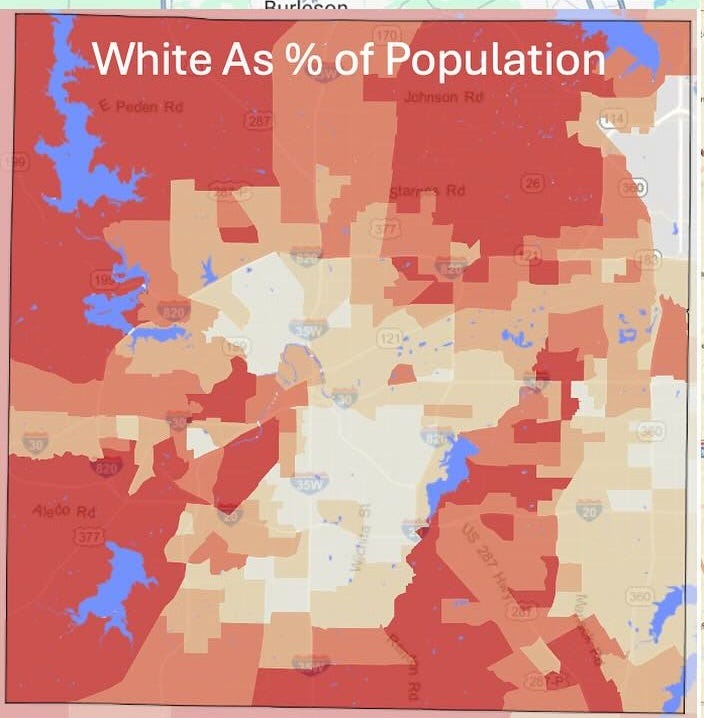
Michelle H. Davis writes a thoughtful blog on Substack called “Lone Star Left,” where she reports incisively on politics in Texas. This column explains how white supremacists keep Blacks and Hispanic unrepresented and disenfranchised: gerrymandering voting district. What’s happening in Texas is happening in other states, especially the South.

It’s hard to remember that Congress passed the Voting Rights Act in 1965.

Davis writes:

In the early 1960s, Black residents in Leflore County, Mississippi, comprised two-thirds of the population. Despite that, they had no political representation. In 1962, when voter registration of Black voters increased, the all-white Board of Supervisors (similar to a Commissioners’ Court in Texas) cut off federal surplus food aid, a lifeline for over 20,000 poor Black sharecroppers and farmworkers. This move came to be known as the Greenwood Food Blockade.

This move by the white Board of Supervisors exacerbated widespread poverty-induced hunger and malnutrition among Mississippi Delta sharecroppers. This laid the groundwork for long-term food insecurity, economic marginalization, and ongoing inequality in Mississippi that persists to this day.

This pattern is not new. Every time Black Americans have taken even a step toward political power, white supremacy has moved to snatch it back. In Greenwood, it meant starving families to stop them from voting. In Tarrant County today, it means redrawing district lines to erase Black representation, again, by a white-majority governing body.

What happened in Mississippi in 1962 wasn’t just about food. It was about control. And what happened in Tarrant County today isn’t just about maps. It’s about the same thing.

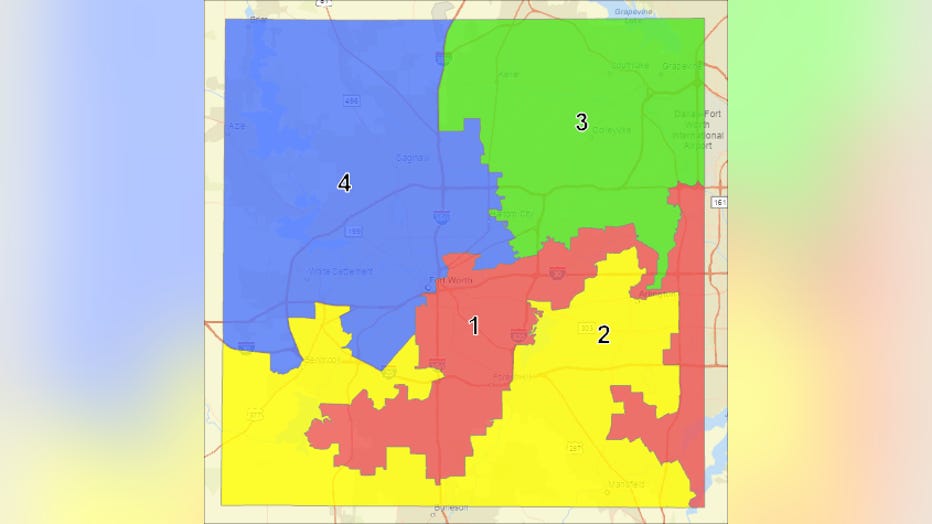
Today, the Tarrant County Commissioners Court voted to approve a redistricting map that effectively eliminates the seat of Commissioner Alisa Simmons, the only Black woman on the court.

It’s not a coincidence. It’s not neutral. It’s not “routine.” It is the calculated removal of a voice that dared to speak up for all of us.

Commissioner Simmons has stood firmly against the racist agenda pushed by Judge Tim O’Hare and the Republican Commissioners on the court. She spoke out against the rise in jail deaths under their watch. She called out the cruelty of defunding Girls Inc., a nonprofit that empowers young women of color. She opposed the elimination of free rides to the polls, which made it harder for working-class people, especially Black and brown voters, to cast a ballot.

And now, she’s being punished for it.

Commissioner Simmons wasn’t just a name on a ballot. She is my commissioner. I voted for her. I campaigned for her. And like thousands of others in Precinct 2, I saw her as a voice for the voiceless, a woman unafraid to shine a light on white supremacy, even when it came dressed in a suit and tie.

That light scared them. So they tried to snuff it out.

What we witnessed today was retaliation. It was white supremacy striking back at a Black woman who told the truth. And just like in Greenwood in 1962, they’re using the tools of power, maps, votes, and bureaucratic language, to do what they couldn’t do in public: silence her.

But we see it. We name it. And we will fight it.

The new map that the County Commissioners voted on today.

The Republican Commissioners and their defenders kept repeating the same excuse over and over again, “This wasn’t about race. It was just about politics.”

They said the map was designed to secure a Republican majority, not to silence Black voters. As if those two things aren’t deeply intertwined.

It’s the same argument Greg Abbott’s lawyers made in Shannon Perez v. Abbott, when Texas was caught racially gerrymandering districts. Their defense?

A direct quote from Greg Abbott

“It is not our intent to discriminate against minorities. It is our intent to discriminate against Democrats. If minorities happen to vote Democrat, that is their fault, not ours.”

That’s not a denial. That’s a confession….

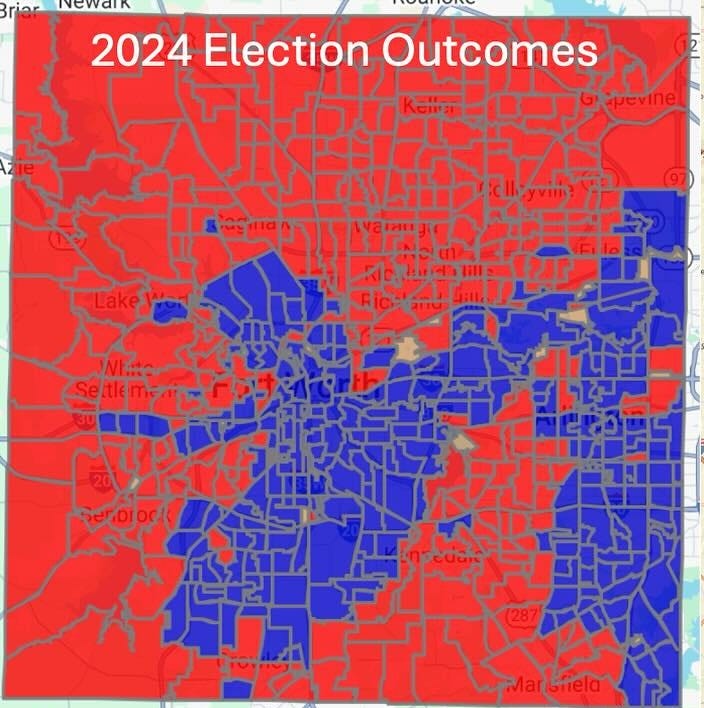
Let’s stop pretending this distinction between race and party means anything in Texas. In Tarrant County, in Harris County, across the South, voter suppression by “party” is voter suppression by race. When you target the communities who dare to elect Black women, working-class progressives, young organizers, and civil rights leaders, you are targeting those communities on purpose.

They can say it’s about partisanship all they want. But we know what it’s really about.

Because when Conservatives talk about “conserving” something, they mean it.

They want to conserve white supremacy.

They want to conserve inequality, corporate power, and police brutality.

They want to conserve a system where jails are full, books are banned, teachers are silenced, and women don’t have autonomy.

They want to conserve a Texas where your zip code decides your worth, and where Black and brown voices are only welcome if they stay quiet.

And when people like Alisa Simmons refuse to stay quiet, they get erased.

But erasing her seat won’t erase her power, or ours….

And just when we thought we might get a win, it vanished as quickly as it came.

Yesterday, far-right extremist Tony Tinderholt (R-HD94) announced he would not seek reelection to the Texas House. For a brief moment, there was celebration across Arlington. A man who built his career on cruelty, censorship, and conspiracy was finally stepping aside. But the celebration didn’t last.

Because today, just minutes after the Tarrant County Commissioners voted to dismantle Precinct 2, Tinderholt announced he would run for that very seat, Alisa Simmons’ newly gutted district.

And he didn’t come alone.

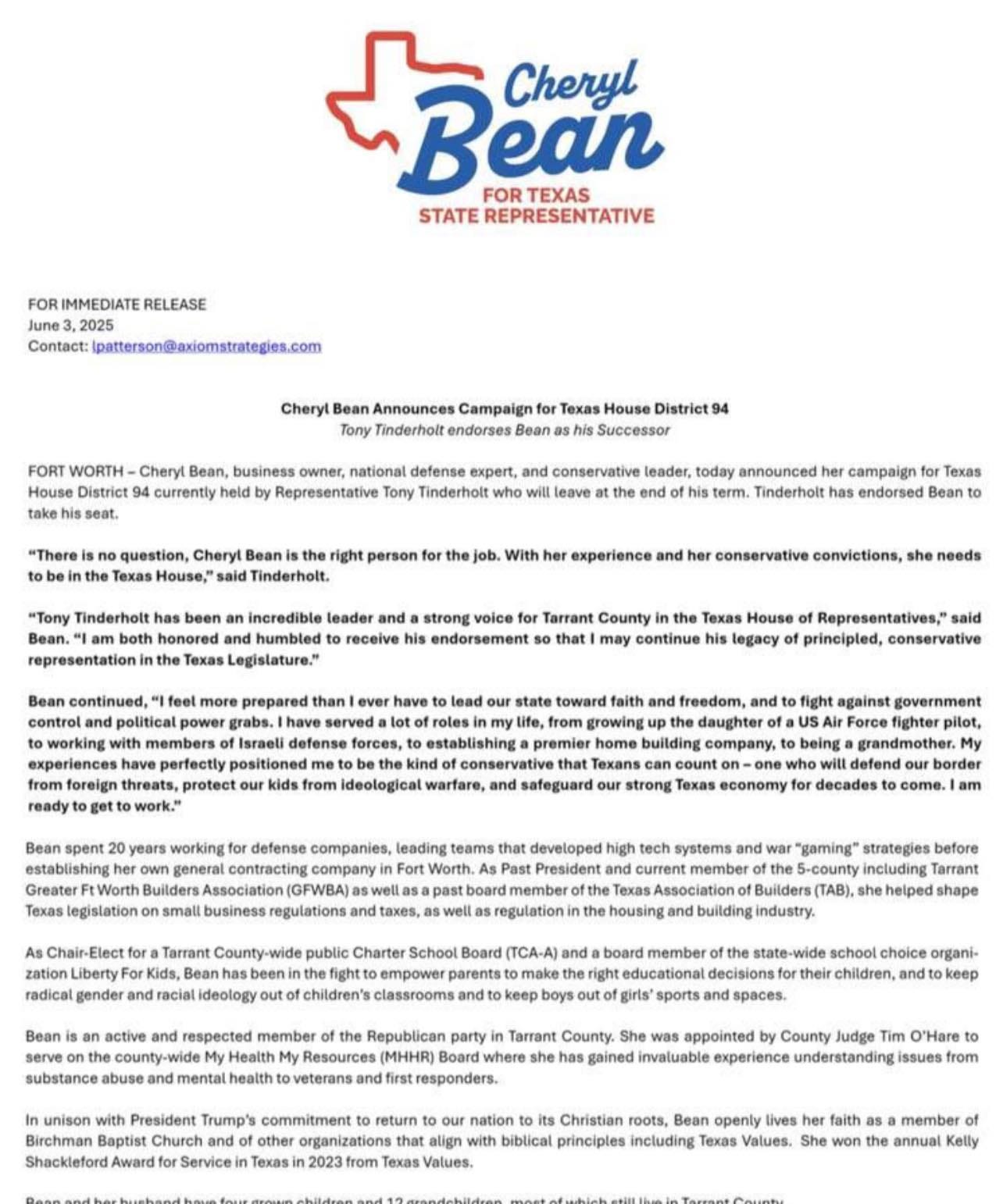
Cheryl Bean, another far-right extremist and ally of Tinderholt, announced her run for the now-open HD94 seat. A seat that was, conveniently, made safer for someone like her under the new maps.

Bean doesn’t even live in the district. She changed her voter registration to a new address inside it—an address she doesn’t own, according to the Tarrant Appraisal District. Her real home? Still outside the district lines. But facts don’t matter when the plan is to bulldoze through communities with precision and arrogance.

This wasn’t a coincidence. It was a coordinated political hit job, plain and simple.

A rigged map. A choreographed retirement. A handoff. A handpicked replacement. All timed to disempower the voices of Black and brown voters in Tarrant County. All orchestrated by Tim O’Hare and the extremist wing of the Republican Party.

They knew Simmons couldn’t be beaten fairly.

So they changed the lines.

They cleared the field.

And then they tried to rewrite the future.

But we see them.

We know the playbook.

And we’re not going to let this go unanswered.

This is part of a broader, coordinated strategy across Texas to suppress the political power of Black and brown communities under the guise of partisan politics…..

To read the post in full, open the link.

Stephen Dyer is a public policy expert, a specialist in school finance, and a former legislator in Ohio. He warned 11 years that vouchers would drive the state budget over a fiscal cliff. The court decision a few days ago proves that he was right on target.

Let this be a warning to all the other states that are adopting vouchers (without the consent of the governed, in every case).

He writes:

Proponents have claimed for years that Ohio and U.S. Supreme Court cases from the program’s infancy allows for explosive growth. Judge Jaiza Page warns, “Not so fast.” Just like I did 11 years ago.

Dyer wrote the following 11years ago:

“Overall, the state is sending nearly $144 million to private schools this year. In 2010-2011, that number was $78.85 million — nearly half the amount. Makes you wonder whether the case upholding Ohio’s Vouchers in 2002 would have the same outcome today. Also makes me want to kind of find out.” — Stephen Dyer on 10th Period blog, Jan. 25, 2014

Now he writes:

I guess we found out Tuesday, didn’t we?

To be clear, I had no idea that anyone would actually file a lawsuit against Ohio’s unconstitutional Voucher system when I wrote that on Blogspot 11 years ago (though I really did want someone to do that). But given the Ohio and U.S. Supreme Court’s rulings on vouchers at the turn of the century, I did question whether the state’s explosive funding of vouchers actually was justified under those rulings.

Guess who else agreed with me? Franklin County Judge Jaiza Page. While I focused in 2014 on the 2002 U.S. Supreme Court case Zelman v. Simmons-Harris, Judge Page focused on the 1999 Ohio Supreme Court case Simmons-Harris v. Goff

Goff reached a similar conclusion as Zelman — that given the program’s then-small educational footprint, both in terms of kids and money — it did not interfere with Ohio’s overall ability to educate its public school students, so the program (which at the time only included Cleveland) was ok.

However, when Goff was decided, the Cleveland Voucher Program cost $5.7 million. The just-passed state budget allocated $2.5 billion over the biennium to the current program.

And that’s where voucher proponents got waaaay out over their skis. I realized this 11 years ago. But now, it’s even more obvious. The programs examined by the U.S. and Ohio Supreme Courts at the turn of the century look very different from the current budget hog Judge Page examined.

And she made that factual difference really clear in her ruling:

“As to the thorough and efficient challenge, the court ultimately held, “[w]e fail to see how the School Voucher Program, at the current funding level, undermines the state’s obligation to public education.” (Emphasis added.) Id. From this language, the Court concludes that the Goff court foresaw a renewed challenge to a larger scholarship or voucher program like EdChoice as an unconstitutional state supported system of private schools. Goff warned that a system that does not create but supports nonpublic schools in a way that jeopardizes the thoroughness and efficiency of the State’s system of public schools violates Article VI Section 2 of the Ohio Constitution.”

Added to this is this incredible fact that was brought out in the court case: 

Not a single penny of voucher money goes to a single parent or student. It goes directly to private, mostly religious schools.

Let me repeat that for those of you in the back:

Not a single penny of voucher money goes to a single parent or student. It goes directly to private, mostly religious schools.

That’s right. This whole money-following-the-kid/parental-choice narrative that voucher proponents are still spilling out is complete, utter Grade A Bullshit.

In 1999, the money did go to parents and kids. Page was quite concerned about this payment change because the Ohio Constitution bans state establishment of religious schools. And if state money flows directly to religious schools that rely heavily on taxpayer subsidies (she mentioned that some private schools have 75% or more of their kids on vouchers), that is establishment and unconstitutional.

“By bestowing participating private religious schools with complete control over prospective students’ participation, the “school choice” here is made by the private school, not “as the result of independent decisions of parents and students.””

It’s as if the original creators of the Voucher program carefully crafted the legislation to pass judicial muster. Then when they got a favorable ruling, the gloves came off.

Oh yeah. One more thing: Not a single penny of the nearly $9 billion we will have spent on vouchers since 1997 has ever been audited. So we have no idea how the money on this unconstitutional program has actually been spent.

But I digress.

Luckily for Ohio’s 1.5 million public school kids, Judge Page recognized the program’s current reality rather than voucher proponents’ fictional account.

Just as your friendly neighborhood blogger did 11 years ago.

Not to brag. 

Well, maybe a little!

In a long and comprehensive article, three New York Times reporters document what happened when DOGE (or DOGS, as I prefer to say) arrived at the Social Security Administration to root out “waste, fraud, and abuse.” Determined to prove that their services were needed, they misinterpreted data and spun outright lies about finding “millions” of dead people collecting Social Security checks.

The Times titled the article “The Bureaucrat and the Billionaire: Inside DOGE’s Chaotic Takeover of Social Security.” The bureaucrat in the title is Leland Dudek, who became the acting administrator of the giant Social Security Administration, even though he never previously oversaw more than a dozen employees. The billionaire, of course, is Elon Musk.

I wish I could give you a gift article but that option was not available to me as a subscriber.

The bottom line of the article is that the young wizards of DOGE came looking for “waste, fraud, and abuse,” and when they didn’t find it, they made it up. While rummaging through the huge agency, which sends out retirement checks to some 74 million senior citizens, they fired senior officers and thousands of other employees. These checks, by the way, are not government beneficence; people pay a percentage of their income into Social Security throughout their work life, which they collect monthly after they retire.

The DOGS sought access to the agency’s huge computer system, which contains sensitive personal data about those who receive those monthly checks. At first, the federal courts rejected their request but ultimately the U.S. Supreme Court decided that these 20-somethings were entitled to access the data. Privacy is dead. Yours and mine. Elon Musk has the data. What has he done with it, along with information about your taxes? No one knows or says. Musk referred to Social Security as a “Ponzi scheme.”

Here are a few of the high points:

Elon Musk stood before a giant American flag at a Wisconsin political rally in March and rolled out an eye-popping allegation of rampant fraud at the Social Security Administration. Scammers, he said, were making 40 percent of all calls to the agency’s customer service line.

Social Security employees knew the billionaire’s claim had no basis in fact. After journalists followed up, staff members began drafting a response correcting the record.

That’s when Leland Dudek — plucked from a midlevel job only six weeks earlier to run Social Security because of his willingness to cooperate with Mr. Musk’s Department of Government Efficiency — got an angry call from the White House, according to several people familiar with the exchange.

“The number is 40 percent,” insisted Katie Miller, a top administration aide who was working closely with Mr. Musk, according to one of the people familiar with the April 1 call. President Trump believed Mr. Musk, she said. “Do not contradict the president.”

Throughout the early months of this Trump presidency, Mr. Musk and his allies systematically built a false narrative of widespread fraud at the Social Security Administration based on misinterpreted data, using their claims to justify an aggressive effort to gain access to personal information on millions of Americans, a New York Times investigation has found.

Their work has led to the departures of thousands of employees, thinning an already overstretched work force and setting off a wave of public anxiety over the state of an agency administering politically sacrosanct retirement benefits that Mr. Trump has vowed to protect.

Mr. Musk has left Washington amid a blowup with Mr. Trump, and some of his top aides at DOGE have also departed, leaving federal workers and the public to assess what Mr. Musk’s tornadolike path through Washington yielded. At Social Security, Mr. Musk’s efforts amount to a case study in what happened when his team of government novices ran a critical government agency through misinformation and social media blasts.

Musk’s senior aide was Katie Miller, wife of Stephen Miller, one of Trump’s closest aides and the architect of the ICE crackdown on immigrants. When Musk left, she left with him. Don’t ask me to explain how that works, because I don’t know. Did she move to Texas to join his sister-wives? Did she take her three children? Or did she stay in DC? I don’t know.

When he started the investigation of the SSA, Musk believed that he would find “massive fraud,” especially the millions of dead people that he believed were collecting Social Security. He didn’t believe the career bureaucrats who said that he was wrong, nor did he accept a secret DOGE memo concluding that the “massive fraud” didn’t exist. Trump’s presss secretary said on FOX News that “tens of millions” of dead people were collecting Social Security checks. Trump lowered the number in his March 4 address to Congress. He said that Social Security records reported “3.5 million people from ages 140 to 149….And money is being paid to many of them.”

The Times reporters found:

One audit from 2015 found only 13 people older than 112 still receiving benefits. Other audits found payments being sent to an estimated 24,000 people who generally died more recently — a sign of Social Security needing tighter controls and monitoring — but not the millions Mr. Musk claimed.

DOGE did not find the waste, fraud, and abuse they searched for but they pursued something of perhaps even greater value to them: the personal data of everyone who had a Social Security card, which is almost every citizen except young children.

DOGE demanded that the SSA hire a “21-year-old former intern at Palantir, a data analysis and technology firm, and grant him access to the personal data of every Social Security cardholder despite the executives’ concerns that he lacked sufficient training to handle such sensitive information.”

Despite their objections, the U.S. Supreme Court ordered the SSA to give the young man whatever he wanted.

DOGE used its power to advance Trump’s political goals. When Trump quarreled with Maine Governor Janet Mills over transgender athletes, DOGE staffers canceled contracts with the state of Maine.

But under pressure from Mr. Musk’s team, nearly half of the Social Security Administration’s 140 senior executives, and thousands of employees overall, have taken buyouts or retired. As many as 12 percent of staff members, out of a bureaucracy that numbered around 57,000 people, are expected to depart their jobs as part of DOGE’s cost-cutting plan.

To try to make up for the staffing shortfall, the agency has encouraged specialized professionals like lawyers, human resources staff and technologists to take reassignments in customer service jobs — often at higher pay than what the people they’re replacing had made. Workers have said they felt pressured to volunteer for reassignments, or else risk being fired later.

No one knows at this juncture whether DOGE saved money by firing workers at the SSA. But the benefits to DOGE and Musk are enormous: they now have personal data on almost every American.

What will they do with it?

Scott Maxwell, opinion columnist for The Orlando Sentinel, wrote about the unusual public protest against the Legislature’s plan to cut funding for AP classes in public schools. For years, Republicans who run the state have inflicted blow after blow on the public schools, preferring to divert billions of public dollars to private and religious schools. But not this time. This time, the public organized fought back and blocked the latest effort to inflict damage on the state’s public schools.

Maxwell writes:

Chalk one up for the Floridians who are willing to stand up and make themselves heard.
Tallahassee politicians were forced last week to abandon their plans to gut funding for AP classes in public schools after they ran into something they rarely encounter in this state — a wall of public opposition.

GOP lawmakers have been pulling the rug out from under public education for the better part of two decades, driving away teachers, injecting political wars into classrooms and diverting public money to private schools. But their plan to cut funding to AP, IB and dual enrollment programs was a bridge too far.

Why? Because this plan to sabotage public schools would’ve impacted a population beyond the marginalized families that these insulated politicians are usually happy to short-change. Legislators were trying to undercut the college prospects of kids who go to high school in Windermere and Winter Park — the children of parents who normally write campaign checks.

And everyone banded together to object.
“I was getting emails from people asking: ‘What do I do? How do I help? Who do I email?’” said Orange County School Board member Stephanie Vanos. “And before long, we started hearing legislators saying: ‘Please make the parents stop emailing us. Please, just make it stop.’”

My thanks to those of you who did not relent, because this idea was as bone-headed as it was backwards.

Basically, Republican lawmakers in both chambers wanted to cut funding allocated for AP (Advanced Placement), IB (International Baccalaureate), AICE (Advanced International Certificate of Education) and even dual enrollment programs at places like Valencia College for students who want to get ahead.

One of the most nonsensical parts about this attack was that it targeted a program that awarded funding based on students who passed these courses. In other words, one that only paid for successful results.

The politicians were also targeting one of the few things Florida really does well in public schools. While Florida’s scores for the SAT and other tests have plummeted in recent years, Florida’s AP test scores have historically been quite good. The College Board ranked Florida in the Top 5 for passage rate in 2021, largely because of this successful and aggressive funding model.

So Republican lawmakers were attacking something that was both successful and popular, affecting more than 110,000 students.
There was no valid reason for this funding cut, other than trying to make public schools less attractive.

See, AP classes are one of the advantages public schools have over many private schools, especially the fly-by-night voucher ones that hire uncertified teachers and can’t even think about offering classes like AP calculus, Chinese and 3-D art and design.

“These are the programs that are among the most popular in our high schools,” Vanos said. “Families come back to our high schools specifically for these programs.”

So parents and supporters of public education banded together and spoke up.

I sensed a revolt brewing as soon as I published a column on the topic a few weeks ago entitled: “Cutting AP classes would dumb down Florida schools.”

House Republicans had just advanced their defunding plan by a vote of 22-6 in a subcommittee, and I urged anyone who thought this was a rotten idea to let their lawmakers know. Boy, did they.

One reader said she and her sister, a retired teacher, were gathering as many others as possible to get “riled up to action.”

Another said she sent Gov. Ron DeSantis an email that asked him a simple question: “Are you TRYING to drive us out of the Republican Party?”
Conservatives objected alongside liberals.

Seniors alongside teens. I heard from everyone from fired-up retirees in Osceola County to a genuinely perplexed Eagle Scout in Maitland.
Even Florida TV stations that usually pay more attention to car crashes than legislative subcommittees carried stories about Floridians who were up in arms.

Local elected officials noticed the widespread discontent and decided to weigh in as well. Jacksonville’s large and heavily Republican city council voted 16-1 to tell GOP lawmakers to back off their plan to sabotage AP classes.

The pressure ultimately worked. When leaders from both chambers went behind closed doors last week to hash out their final budget proposal, they ditched this latest attack on public schools in quiet, unceremonial fashion.

Imagine for a moment if Floridians used their voices more often.

Not just to protect public education, but to support other issues that the vast majority of Floridians on both sides of the aisle support.
We might not live in a state where more than 20,000 families grappling with special needs are stuck on a years-long waiting list for services.

Or a state that has allowed so much pollution to kill so many manatees that two rounds of federal judges had to step in to tell the state it had to stop allowing the slaughter of the state’s official marine mammal.

It’s often said that we get the government we deserve. But we also get the government we demand.

In this case, Floridians demanded that the politicians take their stinkin’ hands off a successful educational program that has helped countless students get a head start in college, careers and life.

Imagine if we all did that more often.
“Advocacy works,” Vanos said. “It’s all about people power.”

If you haven’t heard of Curtis Yarvin, you should learn about him now. Yarvin does not believe in democracy. He believes in a society commanded by a king or autocrat. He was a prodigy as a child and now considers himself to be a political genius. Powerful men in the tech industry and politics pay him court and admire him, men like the billionaires Peter Thiel and Marc Andreessen, and Vice-President JD Vance.

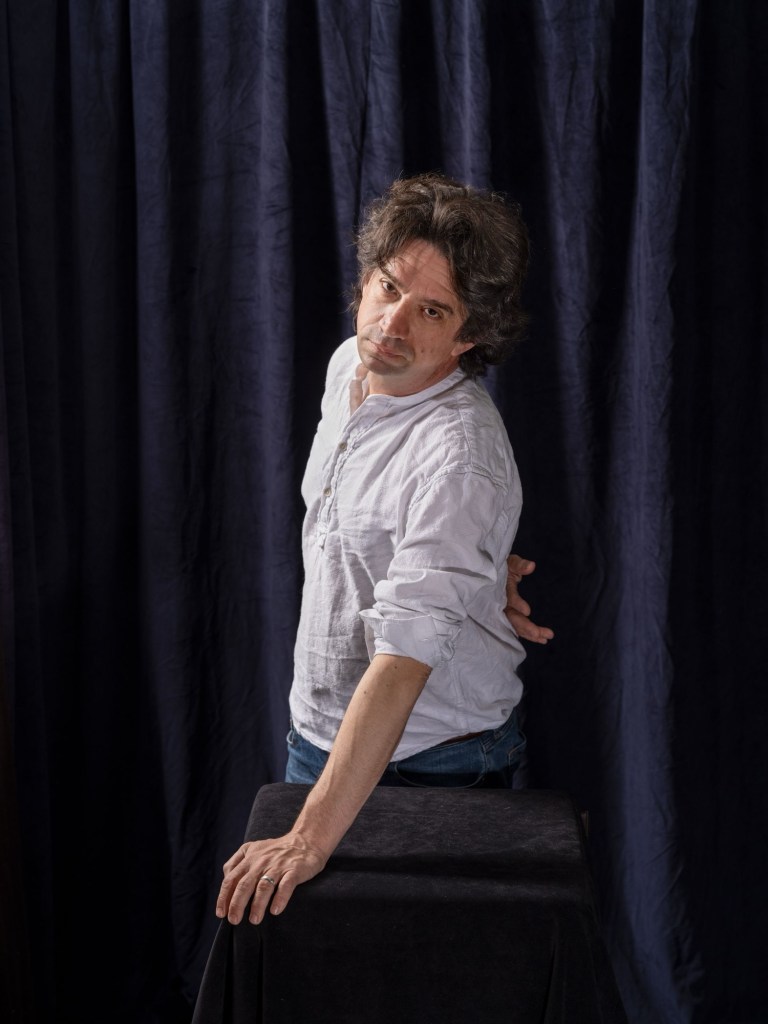
Curtis Yarvin, advisor to Peter Thiel, Donald Trump

This article in The New Yorker by Ava Kolman paints a biographical portrait of Yarvin, summarizes his major ideas and describes his international standing as a philosopher of far-right leaders of the tech industry.

Kolman writes about Yarvin’s extensive range of contacts among the Trump administration and his influence on them, as well as his contact with royalists in other countries..

Kolman begins:

In the spring and summer of 2008, when Donald Trump was still a registered Democrat, an anonymous blogger known as Mencius Moldbug posted a serial manifesto under the heading “An Open Letter to Open-Minded Progressives.” Written with the sneering disaffection of an ex-believer, the hundred-and-twenty-thousand-word letter argued that egalitarianism, far from improving the world, was actually responsible for most of its ills. That his bien-pensant readers thought otherwise, Moldbug contended, was due to the influence of the media and the academy, which worked together, however unwittingly, to perpetuate a left-liberal consensus. To this nefarious alliance he gave the name the Cathedral. Moldbug called for nothing less than its destruction and a total “reboot” of the social order. He proposed “the liquidation of democracy, the Constitution, and the rule of law,” and the eventual transfer of power to a C.E.O.-in-chief (someone like Steve Jobs or Marc Andreessen, he suggested), who would transform the government into “a heavily-armed, ultra-profitable corporation.” This new regime would sell off public schools, destroy universities, abolish the press, and imprison “decivilized populations.” It would also fire civil servants en masse (a policy Moldbug later called rage—Retire All Government Employees) and discontinue international relations, including “security guarantees, foreign aid, and mass immigration.”

Does anything on his wish-list sound familiar to you?

It should. Trump has loaded up his administration with people who imbibe Yarvin.

A decade on, with the Trumpian right embracing strongman rule, Yarvin’s links to élites in Silicon Valley and Washington are no longer a secret. In a 2021 appearance on a far-right podcast, Vice-President J. D. Vance, a former employee of one of Thiel’s venture-capital firms, cited Yarvin when suggesting that a future Trump Administration “fire every single mid-level bureaucrat, every civil servant in the administrative state, replace them with our people,” and ignore the courts if they objected. Marc Andreessen, one of the heads of Andreessen Horowitz and an informal adviser to the so-called Department of Government Efficiency (doge), has started quoting his “good friend” Yarvin about the need for a founder-like figure to take charge of our “out of control” bureaucracy. Andrew Kloster, the new general counsel at the government’s Office of Personnel Management, has said that replacing civil servants with loyalists could help Trump defeat “the Cathedral.”

“There are figures who channel a Zeitgeist—Nietzsche calls them timely men—and Curtis is definitely a timely man,” a State Department official who has been reading Yarvin since the Moldbug era told me. Back in 2011, Yarvin said that Trump was one of two figures who seemed “biologically suited” to be an American monarch. (The other was Chris Christie.) In 2022, he recommended that Trump, if reëlected, appoint Elon Musk to run the executive branch. On a podcast with his friend Michael Anton, now the director of policy planning at the State Department, Yarvin argued that the institutions of civil society, such as Harvard, would need to be shut down. “The idea that you’re going to be a Caesar . . . with someone else’s Department of Reality in operation is just manifestly absurd,” he said.

Yatvin’s ideas are quirky, inhumane, and extreme, to say the least:

On his blog, he once joked about converting San Francisco’s underclasses into biodiesel to power the city’s buses. Then he suggested another idea: putting them in solitary confinement, hooked up to a virtual-reality interface. Whatever the exact solution, he has written, it is crucial to find “a humane alternative to genocide,” an outcome that “achieves the same result as mass murder (the removal of undesirable elements from society) but without any of the moral stigma.”

Yarvin’s call for an American strongman is often treated as an eccentric provocation. In fact, he considers it the only answer to a world in which most people are unfit for democracy….

Yarvin’s influence on Trump’s inner circle is noticeable:

Last month, an anonymous doge adviser told the Washington Post that it was “an open secret that everyone in policymaking roles has read Yarvin.” Stephen Miller, the President’s deputy chief of staff, recently quote-tweeted him. Vance has called for the U.S. to retrench from Europe, a longtime Yarvin desideratum. Last spring, Yarvin proposed expelling all Palestinians from the Gaza Strip and turning it into a luxury resort. “Did I hear someone say ‘beachfront?’ ” he wrote on Substack. “The new Gaza—developed, of course, by Jared Kushner—is the LA of the Mediterranean, an entirely new charter city on humanity’s oldest ocean, sublime real estate with an absolutely perfect, Apple-quality government.” This February, during a joint press conference with Benjamin Netanyahu, the Israeli Prime Minister, Trump surprised his advisers when he made a nearly identical proposal, describing his redeveloped Gaza as “the Riviera of the Middle East.”

Trump, who doesn’t like to read, is unlikely to have read Yarvin’s philosophical treatises about the proper functioning of a modern society–without benefit of a popular vote–but certainly Trump’s view of the unlimited, imperial powers of the Presidency are similar to those of Yarvin.

Read the article if you can access it. Make yourself aware of the man who wields an outsize influence on Trump right now.

To learn more about Yarvin’s influence among rightwing billionaires, read:

https://theconversation.com/an-antidemocratic-philosophy-called-neoreaction-is-creeping-into-gop-politics-182581

Henry David Thoreau wrote: “In wildness is the preservation of the world.” Thoreau understood that as humans we need to be nourished by contact with or immersion in the natural world. Environmentalists understand this. They fight the inexorable march of what we call progress, which clear-cuts forest and paves over what once were boundless plains. Today, most of us get into a car and drive for hours to connect to wilderness. And we find solace in those encounters.

Most presidents take pride in the number of acres of wilderness that they have saved for future generations and the number of national monuments they designated to preserve unique natural formations. Not Trump. Trump has been openly hostile to environmental protection and to any measures that reduce the risks of climate change.

Yesterday the administration announced that it was opening up 58 million acres for commercial development.

Lisa Friedman wrote in The New York Times:

The Trump administration said on Monday that it would open up 58 million acres of back country in national forests to road construction and development, removing protections that had been in place for a quarter century.

Agriculture Secretary Brooke Rollins announced plans to repeal the 2001 “roadless rule” that had preserved the wild nature of nearly a third of the land in national forests in the United States. Ms. Rollins said the regulation was outdated.

“Once again, President Trump is removing absurd obstacles to common-sense management of our natural resources by rescinding the overly restrictive roadless rule,” Ms. Rollins said in a statement. She said the repeal “opens a new era of consistency and sustainability for our nation’s forests.”

Environmental groups said the plan could destroy some of America’s untouched landscapes and promised to challenge it in court.

The unspoiled land in question includes Tongass National Forest in Alaska, North America’s largest temperate rainforest; Reddish Knob in the Shenandoah Mountains, one of the highest points in Virginia; and millions of acres of the Frank Church-River of No Return Wilderness in Idaho.

“Most Americans value these pristine backcountry areas for their sense of wildness, for the clean water they provide, for the fishing and hunting and wildlife habitat,” said Chris Wood, the chief executive of Trout Unlimited, an environmental group.

Businesses are eager to chop down the timber. There’s profit in those untouched forests, maybe even tracts for homes. The word “pristine” in not in their vocabulary.

In 2017, when Trump passed his first budget bill, his allies inserted into it an unprecedented tax on institutions of higher education that have large endowments. The tax was 1.4%. But that 1.4%, though it seemed small, was money that would not be available for low-income students at expensive colleges and universities. The next logical step–once the government starts taxing nonprofits– would have been to tax megachurches but that didn’t happen.

This year, the Trump administration has included in its “One Big Ugly Budget Bill” a dramatic increase in the tax on higher education endowments.

Instead of 1.4%, the highest rate would climb to 21%.

This onerous tax would limit colleges’ ability to cover the tuition of students who are fully qualified but lack the financial resources to pay. The inevitable result of this tax will be to restrict the number and size of scholarships.

I received this letter from President Paula A. Johnson of Wellesley College, my alma mater. Dr. Johnson grew up in Brooklyn, where she graduated from a large public high school (Samuel J. Tilden), then to Radcliffe and to Harvard Medical School. She was a cardiologist before she was chosen as Wellesley’s president almost a decade ago. She is dedicated to providing scholarships for students who need them.

She wrote to all alumnae:

It is hard to overstate the importance of this moment for higher education. We are being threatened in previously unimaginable ways that cut to the core of our values and endanger a large proportion of our students. At Wellesley, we are deeply concerned about changes that could affect academic freedom, our need-blind status, and our ability to build a diverse community, one made richer by our international students.  

One of the most significant threats comes from the likelihood of a major increase to the tax on college endowments. Last month, the U.S. House of Representatives passed a budget bill that would raise the tax from 1.4% to as much as 21%. Under this proposal, Wellesley would be taxed at 14%, which means our liability under the tax would increase from $3 million, where it is currently, to $30 million per year—an amount equal to fully funding financial aid for 325 students. 

When you consider that more than two-thirds of the $82 million Wellesley spent last year to support financial aid came from our endowment, the disastrous impact of this tax becomes clear. This is a punitive tax on students and families who need financial aid.

The tax would also have a disproportionate impact on small colleges like Wellesley that, without other revenue streams such as graduate programs or large research budgets, rely on endowments to support their mission.

At Wellesley, 43% of our operating budget comes from the endowment, making it our largest source of revenue. A tax increase would have a severe impact on our academic program and our ability to meet students’ financial needs. In addition, the tax would override the intent of generations of alumnae who have given to the endowment to support financial aid and our academic mission. 

That is why Wellesley has joined a coalition of more than two dozen small colleges and universities from 17 states across the country that together serve more than 50,000 students. The coalition’s core argument, which we are sharing with members of Congress, is that endowments are not a luxury for small colleges; they are essential to continuing our commitments to access, opportunity, and educational excellence for students. 

If this totally unwarranted tax is passed, the number of meritorious students from low-income, even middle-income families would shrink dramatically.

This is wrong.

Raise taxes on corporations and billionaires.

Tax megachurches.

Raise the taxes and tariffs on super yachts.

Don’t tax the endowments of institutions of higher education.

Matt Barnum and Richard Rubin of The Wall Street Journal describe the harm that Trump’s One Big Ugly Budget Bill will do to public schools.

They wrote:

Republicans’ tax-and-spending megabill would give the school-choice movement a major, long-sought victory—and deliver an unusually generous tax break to wealthy taxpayers.

The bill includes a new way for taxpayers—whether they are parents or not—to direct tax dollars to private-school scholarships instead of the Treasury. There is an extra twist: It could deliver virtually risk-free profits to some savvy investors.

The proposal has excited school-choice advocates, infuriated public school leaders and stunned tax experts.

“Overnight, this would give millions of students access to the school of their choice,” said Tommy Schultz, CEO of the American Federation for Children, an advocacy group pushing the provision. “This is a revolution within the tax code.”

The American Federation for Children is the far-right wing group created by Betsy DeVos to promote charter schools and vouchers.

The incentive is structured as a dollar-for-dollar federal tax credit. Give to a charity known as a scholarship-granting organization and you would get the same amount subtracted from your federal tax bill. 

It is equivalent to redirecting your taxes to a scholarship-granting organization (SGO), with the benefit capped at 10% of adjusted gross income or $5,000, whichever is greater. That is a far better deal than what is offered by normal charitable donations, which generally just reduce your taxable income and only if you itemize deductions….

For people with appreciated stock, the proposal could be even more attractive than a dollar-for-dollar credit, potentially creating net profits. 

Consider someone who bought a stock for $100 that is now worth $1,100. Selling that stock would trigger capital-gains taxes of up to $238. But under the bill, he could donate the $1,100 stock to an SGO. The government would give $1,100 back and he wouldn’t pay capital-gains taxes. 

He could then buy the same $1,100 stock on the open market. The result? He’s better off than when he started, spending nothing to erase a potential capital-gains tax liability. 

“In terms of something that is deeply offensive to basic tax logic, it’s hard to beat this,” said Lawrence Zelenak, a law professor at Duke University who expects donors to line up every Jan. 1 to take advantage. “Unless you actively hate the charity, you would want to do it…”

A federal program would expand private-school tuition subsidies into states such as New York and California that have resisted school choice programs….

The House bill caps credits at $5 billion annually, which would climb by 5% in subsequent years if the program is heavily used. That bill would run from 2026 through 2029. The Senate version released Monday includes $4 billion annually, starting in 2027 but without an expiration date. 

The credit would mark a significant injection of resources to private education as the Trump administration separately seeks to cut federal grants for public schools. Still, it would pale in comparison to funding for public schools, which receive several hundred billion dollars annually, mostly from state and local governments. 

Democrats hope the breadth of the policy changes will prompt the Senate parliamentarian to determine that it’s out of bounds for the budgetary fast-track process Republicans are using.

Public school advocates say the program would benefit better-off families at religious private schools. “The federal government needs to fund the neighborhood school that serves children from every walk of life,” said Sasha Pudelski, a lobbyist with the school superintendents’ association.

Opponents also say the idea has been rejected by voters. In November, three states voted down school-choice ballot measures.

Note: not only were vouchers defeated in three states last November, voters have rejected vouchers in every state referendum since 1967.

The new tax credit could become a model for Congress to direct money to other causes through the tax code, said Carl Davis, research director at the Institute on Taxation and Economic Policy, a progressive group that criticizes the plan.

Civil rights laws prohibit certain forms of discrimination in schools that receive federal funding, but it isn’t likely this would apply to private schools that benefit from the proposed tax credit, said Kevin Welner, a research professor at the University of Colorado Boulder. The House bill includes a provision barring discrimination against students with disabilities in school admissions; the Senate version doesn’t. 

State voucher plans do not bar discrimination in voucher-receiving schools. They can and do discriminate at will. Some require that families are members of their faith. Some bar LGBT students and families. Some bar students with disabilities. Some bar students with low test scores.

Trump’s funding of school choice is the fever dream of Christian nationalists. With one blow, they eliminate the separation of church and state, they get funding for religious schools, and they gut civil rights laws that barred discrimination.

It also permits the revival of school segregation, under the once-discredited banner of school choice. White Southerners who don’t like “race mixing” have dreamed of this day since May 17, 1954.

Voice of America is known worldwide for its straightforward, unbiased presentation of world news. Trump placed MAGA enthusiast Keri Lake in charge. At his behest, she just laid off most of the VOA staff. Remember when America was great? We thought we had a message for the world and that the truth would set us free.

But Trump doesn’t want to “Make America great Again.” He wants to make America a land of bitter divisions, where the rich get richer, and the poor get poorer and sicker, unable to get health insurance, medical care, good schools, or any opportunity to rise into the middle class. For that, you need unions and good jobs.

The New York Times just reported:

The Trump administration sent layoff notices on Friday to more than 600 employees at Voice of America, a federally funded news organization that provides independent reporting to countries with limited press freedom.

The layoffs, known as reductions in force, will shrink the staff count at the news organization to less than 200, around one-seventh of its head count at the beginning of 2025. They put Voice of America journalists and support staff on paid leave until they are let go on Sept. 1.

The termination notices are the latest round of the Trump administration’s attack on federally funded news networks, including Voice of America.

In March, President Trump accused the news group of spreading “anti-American” and partisan “propaganda,” calling it “the voice of radical America.” He then signed an executive order that effectively called for dismantling of the news agency and put nearly all Voice of America reporters on paid leave, ceasing its news operations for the first time since its founding in 1942.

Kari Lake, a fierce Trump ally and a senior adviser at the news organization’s oversight agency, U.S. Agency for Global Media, notified Congress earlier this month that her agency intended to eliminate most positions at Voice of America. Her letter identified fewer than 20 employees who must remain at the media organization, according to laws passed by Congress to establish and fund it. Friday’s termination notices leave around 200 employees.

Ms. Lake’s decision “spells the death of 83 years of independent journalism that upholds U.S. ideals of democracy and freedom around the world,” Patsy Widakuswara, a former Voice of America White House bureau chief who was placed on leave and is leading a lawsuit against Ms. Lake and the U.S. Agency for Global Media, said in a statement.

She encouraged Congress to intervene and to signal support for Voice of America, which was founded to combat Nazi propaganda and reported in countries that suppress independent reporting and free speech.

“Moscow, Beijing, Tehran and extremist groups are flooding the global information space with anti-America propaganda,” Ms. Widakuswara said. “Do not cede this ground by silencing America’s voice.”