Archives for category: Disruption

Mike DeGuire is a veteran educator in Denver. He says it’s time to take stock and assess the damage that “reform” has inflicted on students and public schools in Denver.

He writes in the Colorado Times Recorder:

Is public education a public or a private good? This issue is at the heart of the school choice debate sweeping the country.  

Advocates for school choice are advancing policies that move us toward the privatization of our schools, treating our children’s futures as commodities rather than community investments. This well-funded bi-partisan coalition promotes privatization through charter school expansion, vouchers, tax credits, and education savings accounts. Republicans use the words “parental rights, freedom and competition,” while neoliberal Democrats brand it as “innovation and expanding opportunity.” 

Public education is one of the last shared institutions that binds us together across race, class, and geography; when we weaken it, we weaken democracy itself.

The result is the same for communities when privatization becomes a reality in red states with vouchers or in blue cities where most charter schools are located. Vouchers segregate schools by class and race, diminish the importance of community, and severely limit funding for public schools.

Charter schools operate like private schools, create competition for students, often have unelected boards. Additionally, the charter schools, not the community, get to determine who enrolls, who stays, and what kind of learning takes place. As marketplace ideology takes over, public dollars and democratic control move from local neighborhood schools to private boards and political operatives.

Denver Public Schools (DPS) shows how this movement works in a blue city, and why it matters now in Trump’s vision of America’s education system.

Different slogans, same destination

On the right, and in most Republican-led states, legislatures enacted policies to privatize education with vouchers and education savings accounts (ESAs) designed to route public funds to private and/or religious schools. Often, these tactics originate with model bills written and promoted by the American Legislative Council (ALEC) and their allies. The goal is to let public dollars “follow the child,” which means diverting them away from democratically governed school districts.

On the neoliberal Democratic side, the mechanism is the charter-centric “portfolio model.” Local school boards often elected with large amounts of pro-reform money approve policies to close or “restart” neighborhood schools. Then they open new charters, bring in “operators” deemed to be “effective,” and the district “manages” the schools and their networks like an investment portfolio. 

This storyline was supercharged under the Obama administration’s Race to the Top, which rewarded states for removing barriers to charter growth and for aggressively initiating school “turnarounds.”

The overlap with Republicans and Democrats is structural. Both sides define schooling as a marketplace and shift authority from elected school boards to private actors, like charter boards, appointed authorities, and national nonprofits. In their book, “Wolf At the Schoolhouse Door,” Jack Schneider and Jennifer Berkshire describe “how Republicans and Democrats joined to support failed policies whose ultimate goal was to eliminate public education and replace it with a free-market approach to schooling.”

Charles Siler, who worked as a lobbyist for the libertarian Goldwater Institute, told the Washington Post that “Charter schools are part of the incremental march towards full privatization. In many ways, charter schools are the gateway to total public-school dismantling.” Since vouchers are unpopular with the public and some lawmakers, Siler continued, “privatizers have to engage in incrementalism, and they use different names to create a sort of moving target.” 
Privatization by Nick Youngs

Selling school closures with a false narrative

Both camps sell the public on privatization by claiming that “failing test scores” prove neighborhood schools, especially those serving Black and Brown students, are broken beyond repair. They argue the racial achievement gap is proof that these schools must be shut down and replaced with charters through “school choice.”

This narrative is deeply misleading. First, decades of research show that standardized test scores mostly measure socioeconomic status and neighborhood inequality, not the quality of individual schools. Poverty, housing insecurity, and systemic racism drive disparities, not the mere fact of attending a district school.

Second, the research demonstrates that replacing schools with charters has not closed achievement gaps. Denver Public Schools illustrates the point: after years of churn, closures, and huge charter expansion, racial disparities in achievement persist. Black and Latino students continue to score lower on state tests than white peers — not because they are “trapped in failing schools,” but because privatization has siphoned resources from their neighborhoods, destabilized communities, and ignored root causes.

Bipartisan funding for similar goals

The funding networks and foundations knitting these free-market agendas together are deep-pocketed and bipartisan. For instance, the conservative Walton Family Foundation underwrites charter startups and charter facilities nationwide, spending well over $1 billion on this effort. The majority of their political spending goes to Republican causes, with over 2/3 of their PAC money going to Americans for Prosperity, founded by the Koch brothers. 

In his book, “Kochland: The Secret History of Koch Industries and Corporate Power in America,” journalist Christopher Leonard describes how the American Legislative Exchange Council (ALEC), a Koch-funded right-wing group, creates model legislation which can be introduced in state legislatures. Many of these bills aim towards privatizing schools by implementing voucher programs.

City Fund raised millions, largely from Netflix founder Reed Hastings and hedge fund manager John Arnold, to spread charter schools in over 40 cities through portfolio management systems and by bankrolling local political action groups. While Hastings supports Democratic causes, he is opposed to teacher unions and believes that local school boards should be abolished. Arnold, also a Democrat, gifted the KIPPcharter network millions, and like many billionaires today, is seen as cozying up to the Trumpadministration for influence.

The Bradley Foundation and ALEC financed the policy and political infrastructure for vouchers and ESAs for decades. The Bradley Foundation, the Colorado-based Coors family, and the Koch foundation were three of the six billionaire families that funded Project 2025, which has been the playbook for Trump since he took office in January. 

Many of these same philanthropic and political dollars fund both a Republican voucher push and a Democratic-branded charter expansion — two lanes of the same privatizing highway.

Denver: a “portfolio” laboratory

Denver is often cited by education reformers as a national model as it implemented unified enrollment, systematic school closures, and rapid charter school growth. But the backstory behind who paid for these policies is less sanguine. A Network for Public Education report details how Denver Public Schools became a neoliberal “experiment,” using a web of nonprofits and political groups to expand charters and restructure the school district.

Both Republicans and Democrats contributed large amounts of money in Denver school board elections to promote corporate reforms, such as teacher pay for performance, school choice systems, and enrollment zones. In the 2017 DPS school board election, billionaires gave huge sums to the Denver candidates favoring charter school expansion. According to a report from the Network for Public Education Action, these included “Colorado billionaires Phillip Anschutzand Kenneth Tuchman, and out-of-state billionaires John Arnold of Texas and the Alice, Jim and Stuart Waltons of Arkansas.”

Both sides define schooling as a marketplace and shift authority from elected school boards to private actors, like charter boards, appointed authorities, and national nonprofits. 

Meanwhile, years of churn and school closures left communities reeling. Even reform-friendly analyses concede that the “portfolio model” era meant opening lots of charters and closing or “replacing” dozens of neighborhood schools. Researchers studying this model have cited significant concerns with the efficacy of the model, including equity issues, narrow reliance on test scores, instability and churn, tensions among schools, and loss of democratic control and community voice.

In a 2016 article, progressive education advocate David Osborne documented that “Since 2005 [Denver] has closed or replaced 48 schools and opened more than 70, the majority of them charters.” 

The billionaires’ money helped maintain a pro-charter majority school board until 2019 when teacher union-backed candidates were elected because of organized community backlash to the reforms and unrest after a teacher-led strike that year. That shift caused alarm bells among the billionaire backers of the pro-charter movement. They moved quickly to expand their funding to two political action groups in Denver.  

RootED and Denver Families for Public Schoolsreceived over $38 million from Reed Hastings’ City Fund organization, which they used to promote their pro-charter agenda through grants to charter schools, local think tanks, and other community groups. Their efforts paid off in the 2023 school board election, when three of their endorsed candidates won their elections after Denver Families Action spent nearly $1 million to promote their campaign.

Outside spending has transformed Denver board elections into major dark money funding events, with the 2023 election hitting $2.2 million, just shy of the 2019 record of $2.3 million. 

In an op-ed for Charter Folks, Clarence Burton and Pat Donovan, leaders for Denver Families for Public Schools, described their plans to repeat the 2023 wins in the upcoming November 2025 school board election. They may spend some of their vast resourcesfrom City Fund to sway voters.

In the next four years, DPS faces continued enrollment declines, and district leaders seem inclined to approve more closures to rebalance finances. That is the portfolio playbook’s endgame: when money is scarce, close neighborhood schools and expand privately run options. If successful in electing their endorsed candidates, Denver Families Action is poised to help that happen.

Do charters drain district resources? What the evidence says

District leaders and parents feel the fiscal squeeze when enrollment flows to charters. Fixed costs don’t disappear just because 5% or 10% of students leave. Research consistently warns that losses to enrollment can trigger costs that are not fully “variable” — you can’t cut 1/20th of a teacher or 1/10th of a bus route. Studies from New York and other locales estimate significant per-pupil losses in host districts as charter school share rises. 

A policy brief from the National Education Policy Center summarizes the structural mechanisms that occur with fixed costs, diseconomies of scale, and shifting student composition. The brief describes how “a network of philanthropists and wealthy donors have reshaped the political economy of school finance, advocating for school voucher policies, charters, and privatization in the face of declining public-school enrollments.”

Pro-charter think tanks argue the picture is “mixed,” especially longer-term if districts close schools and cut staffing, the very things communities have fought against. But even those reviews concede there are short-term inefficiencies and significant harms. In practice, these policies mean closures, layoffs, and program cuts in neighborhood schools. 

This bipartisan push undermines neighborhood schools, deepens inequality, and places corporate interests above the common good.

Trump-world raises the stakes

Under President Trump’s second term, privatization is not just encouraged; it’s federal policy. A January 29, 2025, White House directive ordered the Education Department to steer states toward using federal formula funds to support K-12 “choice” initiatives, which was a direct push for vouchers and related schemes.  

Trump’s “Agenda47” likewise spotlights universal school choice as a signature plank, tied to dismantlingprior civil-rights guidance and reshaping federal oversight. Plans to weaken or abolish the Education Department are framed as clearing the path for parental choice. 

Trump’s Education Secretary Linda McMahon increased the federal department budget for charter schools by $60 million to a historic record of $500 million. At the closing session of the National Democratic Governors Association meeting, McMahonstressed to the governors they should open charterand micro-schools to promote more competition. This is the Republican Lane, wide open.

The Heritage Foundation’s Project 2025 promoted federal tax credits for vouchers, which are now approved federal legislation. The CEO of Democrats for Education Reform is pushing Democratic governors to use these new federal vouchers to expand learning opportunities for economically disadvantaged students or lose “free federal money.” 

The policy highway already built by the neoliberal Democrats (charter growth, closures, portfolio management) has made it easier for a voucher-first administration to push public taxpayer dollars out of democratically governed systems. That’s the interlock: Democrats normalized the market; Trump-world aims to privatize the whole store.

The bottom line

Denver is not an outlier — it’s a warning. A bipartisan coalition normalized the idea that public education should be run like an investment portfolio, where schools are opened, closed, and “reconstituted” based on technocratic dashboards and political spending. The Trump administration’s voucher agenda, promoted for decades by the Koch brothers and other conservatives accelerates the same logic, now directs federal policy to help states route public dollars out of public governance altogether. 

If we believe education is a public good — funded equitably, governed democratically, and accountable locally — the public must see charter expansion and vouchers as two halves of the same privatization project. When education is treated as a public good, it is essential for democracy, civic participation, economic stability, and social cohesion. 

Every child deserves an equal chance in life. Therefore, education must remain a public good — not a marketplace where opportunity is limited to the school’s choice of selecting students. The question isn’t whether our schools should be run like private businesses. It’s whether we are willing to fight for education as a right, not a privilege.

And, if the public cares about our children’s future,they need to vote, organize, and promote legislation accordingly.


Mike DeGuire, Ph.D., is the vice chair of Advocates for Public Education Policy. He has been a teacher, district level reading coordinator, executive coach, and a principal in the Denver metro area for most of his education career. He also worked as a leadership consultant for several national education organizations, and as an educator effectiveness specialist with the Colorado Department of Education. His writing is also featured on a4pep.org.

Ashana Bigard is a parent activist in New Orleans. From her perspective as a parent leader and as the parent of a child with special needs, the New Orleans experiment has been a very expensive flop.

She wrote this overview for Public Voices for Public Schools:

Twenty years after Hurricane Katrina, the nation’s most radical education overhaul has produced stunning inequality alongside modest test gains

As I sit in Bricolage Academy’s office, frustrated but trying to remain pleasant, I’m having the same conversation again about my son. He’s on the autism spectrum. He is high performing, extremely quiet, and sweet. Despite his IEP, he wasn’t receiving the required services. The special education coordinator had quit in frustration, the school counselor was cut due to budget issues, and my fifth-grader was falling through the cracks.

I’m not just any parent. I’m an advocate who has worked with the CEO since the school’s creation. I have written for national magazines about our system’s problems and challenged the school’s “diversity by design” narrative. Yet here I was, fighting for basic services. If this is my experience, imagine what average parents face.

The Numbers Don’t Add Up

Twenty years after Hurricane Katrina replaced New Orleans’ traditional public schools with the nation’s first all-charter system, the grand experiment presents a troubling paradox. With half the students and double the funding, the system has achieved modest academic gains while disempowering the communities it promised to serve.

Before Katrina, New Orleans educated over 65,000 students in 126 schools. Today, just 47,667 students attend 70 schools–a 27% enrollment reduction. Yet per-pupil spending has exploded to approximately $17,000-$20,000, significantly above Louisiana’s state average.

“When you have half the students and twice the resources, you should see transformational results,” says Neil Ranu, a civil rights attorney with the Southern Poverty Law Center. “Instead, we see money flowing upward to administrators while classrooms struggle.”

The money trail is revealing. Charter CEOs earn over $200,000 annually, while average teachers make between $44,000-$55,000 if they stay long enough.

The Human Cost

The city’s teacher turnover rate of 28% for new educators doubles that of comparable cities. The displacement began when the state fired the entire education workforce after Katrina, including over 4,000 teachers with an average of 15 years of experience. The teaching force dropped from 71% Black to under 50%.

When ‘Success’ Crumbles

The system’s fragility became apparent at John F. Kennedy High School in spring 2019. On graduation day, 177 students walked across the stage. A month later, state auditors revealed nearly half were ineligible to graduate due to grade changes from F’s to D’s, improper credit recovery, and students taking unsupervised classes at home.

Antonio Travis, director of Black Man Rising, mentored several affected students. “There was shame, self-blame. Many felt they wouldn’t be successful in college.” Families canceled graduation celebrations, uncertain about the future.

The Illusion of Choice

Parents quickly learn that “choice” often means choosing between bad options, especially for children with special needs. At Benjamin Franklin High School, Louisiana’s top-ranked public school, students from minority backgrounds face significant admission barriers. The school serves 39% white students in a city where whites comprise only 10% of public enrollment.

Special Education Crisis

In 2010, ten families sued the state over charter schools admitting too few special-needs students and failing to provide proper services. The resulting federal consent decree remains in effect today, with monitors continuing to find systematic violations, including parents being excluded from meetings, services not being provided, and evaluations being denied.

Right now, Louisiana U.S. District Judge Jay Zainey is currently presiding over the dissolution of the special-needs consent decree related to New Orleans schools. Because New Orleans public schools have no oversight, and no unions to fight to ensure the law is followed, we, as parents of children with special needs, have to fight to get our stories to the judge so hopefully he will keep it in place.

Economic Verdict

For a system serving 84% Black students, the economic impact is devastating. The racial wealth gap has widened dramatically since Katrina. White households now hold 13 times the wealth of Black families–$181,000 versus $18,000 median net worth. New Orleans went from 67% Black to 57%, losing over 120,000 Black residents.

Missing Pieces

Walk through charter schools and notice what’s absent or insufficient. Arts programs have declined; fewer offer pre-kindergarten, and students average 35-minute bus commutes. Basic skills, such as cursive instruction—required by state law for signing legal documents—are often ignored. “The children only learn what’s tested,” observes one advocate. “Everything else gets cut.”

The Honest Assessment

As the 20th anniversary of Katrina approaches,New Orleans offers a sobering lesson. With unprecedented resources and freedom, the charter system produced modest academic gains alongside community economic decline and systematic exclusion of vulnerable students.

“When people ask if they should move out of the city for better education,” says one advocate, “my answer is: if you can afford to move, you should. This system is not built to support our children.”

The comment hangs like an indictment not just of a school system, but of a 20-year experiment that promised everything and delivered prosperity for some, displacement for others, and continued struggle for families who need excellent public education most.


Ashana Bigard is a fifth generation New Orleanian and lifelong resident of the Crescent City. A mother of three, Ashana is a tireless advocate for equity and social justice, especially in her work advocating for children and families in New Orleans and Louisiana. She leads the Education Justice Project of New Orleans, where she organizes and advocates for the rights of students and parents. Ashana is an adult ally advisor to United Students of New Orleans. She also serves as a Community Faculty member with Tulane University’s Center for Public Service.

Joe Perticone of The Bulwark describes the committee that has been created by House Republicans to recast what happened on January 6, 2021. They aim to show that it was mostly staged by anti-Trump provocateurs, with substantial help from the FBI. And at the same time, despite what everyone saw with their own eyes, it was “a day of love,” because Trump said so.

Frankly, I can’t make sense of it. Why would Trump praise a large group of people driven and controlled by anti-Trump forces?

Perticone wrote:

A new House subcommittee has been established to finally, at long last, give the January 6th attack on the U.S. Capitol the investigation Donald Trump thinks it deserves. Two weeks ago, Republicans tucked its formation into a rule vote that, among other things, approved a resolution expressing support for the House Oversight Committee’s Jeffrey Epstein investigation. The new subcommittee’s Republican members, appointed by House Speaker Mike Johnson, have all held conspiratorial views about what transpired at the Capitol that day.

Atop the subcommittee will be Rep. Barry Loudermilk (R-Ga.). The other Republicans joining him will be:

  • Rep. Morgan Griffith (R-Va.)
  • Rep. Troy Nehls (R-Texas)
  • Rep. Clay Higgins (R-La.)
  • Rep. Harriet Hageman (R-Wyo.)

Democrats, for their part, put their more pugnacious members on the subcommittee as a counterbalance of sorts. The list includes Reps. Eric Swalwell (D-Calif.), Jasmine Crockett (D-Texas), and Jared Moskowitz (D-Fla.).

Loudermilk had been advocating for the formation of this panel for quite some time, saying over the summer that setting it up was a high priority for Trump. The nature and extent of the proposed subcommittee’s jurisdiction had been debated for months before Loudermilk introduced the resolution establishing it in July. The Capitol riot has been a consistent focus of Loudermilk’s throughout the 119th Congress and even before it was convened: Back in December, he oversaw the publication of a report that downplayed January 6th by emphasizing—as the lawmaker put it in a prefatory letter—“that there was not just one single cause for what happened at the U.S. Capitol . . . it was a series of intelligence, security, and leadership failures at several levels and numerous entities.”

The committee structure is unique. Loudermilk will have unilateral subpoena authority, allowing him to go through with decisions that even a majority of subcommittee members might oppose.

But I don’t think Loudermilk need worry much about being stymied in his quest to uncover the real truth behind January 6th. The new subcommittee is stacked with lawmakers who have peddled baseless conspiracy theories about that day.

Loudermilk himself claimed widespread voter fraudleading up to the attack and voted againstestablishing the original January 6th Committee that then-Speaker Nancy Pelosi put together.

Over the years, Higgins’s conspiracy theories have proliferated like daisies in an unmowed field. He claimed that “ghost buses” had provided transportation to many of the rioters, by which he meant that the buses were most likely non-MAGA plants being used to cause trouble for Trump.¹ His evidence for the “ghost buses” claim, which he presented on blown-up posters in a hearing with former FBI Director Christopher Wray, consisted of photographs showing that there were many buses parked at Union Station on the day of the attack. (Union Station hosts more than 2.6 million intercity bus riders per year.)

The FBI was not only involved in actions on January 6th from within. They had, I suspect, over two-hundred agents embedded within the crowd, including agents—or as they would call [them], “human assets”—inside the Capitol dressed as Trump supporters before the doors were opened.

Higgins has also claimed a large portion of the January 6th crowd consisted of actual FBI agents. As he told Newsmax in 2023:

Along with Higgins, Nehls has spread the “fedsurrection” conspiracy theory that the FBI was behind the attack, elevating claims that wedding planner Ray Epps was one of the government’s plants. Epps, a two-time Trump voter who became a central character in a wild yarn of conspiraciesaround that day, later pleaded guilty to January 6th–related charges. He was ultimately pardoned by Trump as part of the mass absolution on the first day of the new administration.

Hageman, who defeated Rep. Liz Cheney (R-Wyo.) in a Republican primary after Cheney worked on the original January 6th Committee, has cosponsored legislation claiming Trump didn’t engage in any wrongdoing with regard to the attack. Hageman also signed on to an October 2024 letter to then–Attorney General Merrick Garland demanding he not withhold any evidence that could show how the FBI may have been involved in January 6th.

“The American people deserve to know those federal employees involved in formulating and carrying out the events on January 6th,” Hageman said in a statement accompanying the letter. “With today’s weaponized federal government, led in no small part by an FBI that continues to target conservatives, we should take every measure to ensure the truth is revealed.”

And while Griffith hasn’t openly promoted conspiracy theories in the way that Nehls and Higgins have, he did, like the others, vote against the 2020 election certification.

If you’re wondering why Republicans feel there is a need to relitigate the findings of the original January 6th Committee, the simplest explanation is purely political. The new subcommittee is meant to downplay the events of the attack, shift blame to the Democratic lawmakers and staff who hid behind locked doors while Trump watched television footage of the mob roaming the hallways of the Capitol, and—perhaps most importantly—to validate the president’s longstanding delusion that January 6, 2021, was a “day of love” for all involved.

The Idaho state legislature passed a $50 million plan to subsidize vouchers. The usual arguments for vouchers–choice and competition–don’t apply in a largely rural state. The primary beneficiaries will be wealthy families whose children are already enrolled in private schools. The biggest losers will be rural schools, which desperately need upgrades.

Parents in Idaho are taking their challenge to the state courts, based on the explicit language of the State Constitution. The editorial board of the Idaho Statesman agrees with the parents.

Here is its editorial on the subject:

“(I)t shall be the duty of the legislature of Idaho, to establish and maintain a general, uniform and thorough system of public, free common schools.” — Article IX, Section 1, Idaho Constitution

A coalition of public school advocates announced Wednesday that it is asking the Idaho Supreme Court to rule that a refundable tax credit for families who send their kids to private schools is a violation of the Idaho constitution’s education clause.

We say it’s about time.

And just in time, since House Bill 93, which was passed last legislative session, allows families to start applying for the credits in January.

The law set aside up to $50 million for the tax credits.

We would much rather see that $50 million go toward the public education system, hiring more teachers, more counselors, repairing derelict school buildings and properly funding special education, which has an $80 million shortfall, according to the Office of Performance Evaluations.null

We have enumerated many times before the reasons vouchers for private schools is a terrible idea.

Most voucher schemes in other states started out like Idaho’s — small, limited and targeted. But state after state, the vouchers grew and are blowing holes in state budgets everywhere.

Many of these vouchers go to wealthy families who already have the means to pay for private school, and the vouchers merely subsidize part of the cost of a private school tuition.

The vouchers are open to fraud, waste and abuse.

There’s no accountability built into Idaho’s voucher system.

The Idaho Supreme Court won’t be interested in such policy discussions, but justices will be interested in hearing what we think is a valid constitutional argument.

One word, in particular, provides their best legal challenge: “uniform.”

In essence, by providing a refundable tax credit to families to send their children to a private school, the Legislature is establishing a second school system that isn’t the same as the public education system. It’s not uniform.https://f0fd809050f339b050a5948ada000ea9.safeframe.googlesyndication.com/safeframe/1-0-45/html/container.html?n=0

We are compelled by the testimony Wednesday of one mother who said her children were denied entry to a public school based on their religion. A public school can’t do that.

The argument is not without precedent.

A district court judge in Salt Lake City halted Utah’s education savings account programearlier this year, according to Idaho Education News. The state’s teachers’ union argued that the Utah Constitution bars state dollars from funding an education system that’s not free or open to all students.

The same could be said for Idaho’s voucher scheme.https://f0fd809050f339b050a5948ada000ea9.safeframe.googlesyndication.com/safeframe/1-0-45/html/container.html?n=0

In June, an Ohio state judge struck down that state’s voucher program, ruling that the program created a separate, unfunded, nonpublic system and funneled public money to private religious institutions. That, the judge ruled, violated constitutional mandates to fund a single public school system.

In 2024, the South Carolina Supreme Court struck down a 2023 law that created a private school voucher system. The court said the law illegally funneled state public funds to private schools, which is prohibited by the state constitution. The decision said vouchers undermine the state’s mandate to support public schools for all students.

We find it particularly appropriate that Idaho’s organizers announced this legal challenge on Constitution Day. Yes, it’s referring to the U.S. Constitution, but Idaho legislators should hold Idaho’s Constitution in equally high regard.

How we wish Idaho legislators would honor it all the time, not just when it’s convenient or when they want to change the constitution’s clear meaning to fit their agenda.https://f0fd809050f339b050a5948ada000ea9.safeframe.googlesyndication.com/safeframe/1-0-45/html/container.html?n=0

Where are all of Idaho’s “original meaning,” “not a living document” conservatives in this state when it comes to the state constitution’s education clause?

Because, if you read the Idaho Constitution plainly, vouchers just don’t pass muster.

Let’s hope the Idaho Supreme Court sees it the same way.

Statesman editorials are the opinion of the Idaho Statesman’s editorial board. Board members are opinion editor Scott McIntosh, opinion writer Bryan Clark, editor Chadd Cripe, newsroom editors Dana Oland and Jim Keyser and community members John Hess, Debbie McCormick and Julie Yamamoto

The U.S. Department of Education announced that it will work with numerous rightwing groups to design a civics curriculum. It will, of course, be patriotic. It will also be illegal. Since 1970, federal law prohibits any federal official from being involved in curriculum in any way.

The law is clear. Federal officials are prohibited from seeking to influence or direct curriculum in any way.

The federal law is the General Education Provisions Act (GEPA), 20 U.S.C. § 1232a.

This section says:

“No provision of any applicable program shall be construed to authorize any department, agency, officer, or employee of the United States to exercise any direction, supervision, or control over the curriculum, program of instruction, administration, or personnel of any educational institution, school, or school system…”

Secretary of Education Linda McMahon probably doesn’t know that she is breaking the law. Why doesn’t the legal staff at of ED warn her?

Justine McDaniel and Laura Meckler of The Washington Post reported:

The Education Department said Wednesday that it is partnering with conservative organizations to present educational programming about patriotism, liberty and what it described as American values, as part of the observation of America’s 250th anniversary next year.

The initiative is led by the America First Policy Institute, a right-leaning group founded by senior veterans of President Donald Trump’s first-term administration. It convened 40 other conservative organizations on Wednesday, including Turning Point USA, Hillsdale College, the Heritage Foundation and Moms for Liberty, to begin planning. Christian evangelical groups, such as the Faith and Freedom Coalition, are also participating.

Called the America 250 Civics Education Coalition, the initiative was billed by the Education Department as an effort to renew patriotism and advance “a shared understanding of America’s founding principles in schools across the nation.”

The department provided few details about what the programming would entail and how it would reach students or schools. The coalition appears to mark another step in the Trump administration’s effort to push a rosy narrative about American history and to use education about civics, a traditionally nonpartisan topic, as a vehicle for that mission.

“We are proud to announce this coalition to ensure every young American understands the beauty of our nation and is equipped with the civic knowledge required to contribute meaningfully to its future,” Education Secretary Linda McMahon, a former chair of the board at the America First Policy Institute, said in a statement.

Scott Maxwell is my favorite opinion writer at The Orlando Sentinel. He always makes sense, in a state led by a Governor and Leguslature that make no sense at all.

In this column, he asks a straightforward question: Why is there no accountability for school vouchers? Why are taxpayers shelling out money for substandard schools? Why is money diverted from public schools to pay for schools where the curriculum is based on the Bible, not facts?

Maxwell writes:

Florida recently joined about a dozen states in passing new rules that say participants in the Supplemental Nutrition Assistance Program, formerly known as food stamps, can’t use their vouchers on junk food.

I think that makes sense to most people. This program, after all, is supposed to provide “nutrition” to people in need, most of whom are children, elderly or people with disabilities.
Basically, if taxpayers are providing $330 a month for basic food needs, that money shouldn’t be used on Red Bull and Oreos.

So now let’s take that a step further.

Taxpayer money also shouldn’t be used to send students to the junk-food equivalent of school — places that hire “teachers” without degrees, use factually flawed curriculum or that hand out A’s to every kid, regardless of what they actually learn, just to make their parents feel better.

Just like with food stamps, taxpayers have a right to know that the money they’re providing for schools is actually funding a quality education.

Yet in Florida that is not the case. Here, the voucher-school system is the Wild West with a lack of accountability and scary things funded with your tax dollars.

The Orlando Sentinel has documented this mess for years through its “Schools without Rules” investigation that found taxpayer-funded voucher schools where:


• “Teachers” lacked degrees or any kind of basic teaching certification
• Finances were so disastrous that schools actually shut down in the middle of the school year, stranding families and students
• Science classes taught students that dinosaurs roamed the earth alongside man, and history lessons claimed slavery and segregation weren’t really all that bad

• Administrators refused to admit students with disabilities or who had gay parents
• Parents filed complaints that included “Cleaning lady substituting for teacher,” “They don’t provide lunch and they don’t even have a place to eat” and “I don’t see any evidence of academics”

I don’t care how pro-school choice you are, tax dollars shouldn’t fund that kind of nonsense.

Some of these fly-by-night schools set up in strip malls seem to thrive because they tell parents what they want to hear — that their kids who were struggling in public schools magically became straight-A students at voucher schools with little to no standards or legitimate measures of success.

Well, that’s the educational equivalent of junk food. And taxpayers wouldn’t fund that kind of nonsense if the state enacted basic accountability measures.

Namely, all voucher-eligible schools should be required to:

• Publish graduation rates and nationally accepted test scores
• Hire teachers who are certified or at least have a college degree
• Disclose all the curriculum being taught
• Ban discrimination

Most good schools already do this. Think about it: what kind of reputable school wouldn’t agree to hire qualified teachers? Or wouldn’t want the public to see what kind of test scores their students produce?

If you want to send your kid to a school that’s unwilling to clear those ground-level hurdles, you shouldn’t expect taxpayers to fund it.
Similarly, if you want to run a school that refuses to serve kids in wheelchairs or who are gay, you shouldn’t fund your discrimination with money that belongs to the people against whom you’re discriminating.

In Florida, some of the worst voucher schools are faith-based. But so are some of the best. Parents and taxpayers deserve to see the difference — the test scores that show whether students are actually learning.

Many faith-based schools embrace science and history. But some try to replace proven facts with their own beliefs or opinions, using “biology” books that claim evolution data is false and “history” books that try to put sunny spins on slavery and segregation.

The people who defend — and profit off — Florida’s unregulated voucher system usually cite “freedom” and “parental rights” as a justification for unfettered choice. But you know good and well that virtually every other taxpayer-funded system has sensible guardrails.

You can’t take Medicaid money to a witch doctor or a psychic “healer.” And just like we don’t give parents the “choice” to use SNAP vouchers to buy their kids Snicker bars, they don’t deserve the “freedom” to take money meant to provide a quality education to a school that can prove it’s providing one.


Basic transparency and accountability measures are needed for any program to be effective. So whenever you hear anyone protesting them, you have to wonder what it is they don’t want you to see.

Have you heard of Horst Wessel? He was a 22-year-old member of the Nazi paramilitary who was assassinated in 1930 by two Comminists. After his death, his name became a propaganda prop for the Nazi party. Lyrics that Wessel had written were turned into the Nazi anthem and called “The Horst Wessel Song.”

I thought of Wessel when I saw how the Trump administration is turning Charlie Kirk into a symbol of leftwing, liberal perfidy that must and will be punished.

Charlie had extremist views about race, immigration, and gender, but he was no Nazi.

I discovered that I was not the only person who was struck by the parallel between Wessel and Kirk, not in what they did, but in how their legacy was used by powerful men. Benjamin Cohen and Hannah Feuer wrote in the Forward, an independent Jewish journal, about the comparison. They interviewed Daniel Siemens, a historian who wrote a book about Wessel. Siemens insisted that the two men should not be compared because Wessel engaged in violence and Kirk did not.

Cohen and Feuer conclude:

The rush to invoke Horst Wessel’s name reflects two realities. On the right, there’s a dangerous willingness among some extremists to valorize Nazi symbols. On the left, a fear that Kirk’s death will be used to erode civil liberties.

It is time to worry about the erosion of civil liberties.

Today, JD Vance became host of “The Charlie Kirk Show.” Among his guests was Stephen Miller, Trump’s Deputy Chief of Staff and Chief ideologue. Miller is known for his hatred of immigrants.

The New York Times just reported that they discussed their plans to crack down on liberal groups, whom they hold responsible for the murder of Charlie Kirk. They believe this even though no evidence has emerged tying the alleged assassin Tyler Robinson to any group, right or left. No one can say whether Tyler moved to the left or to the right of Kirk. The Utah governor said Tyler had a “leftist ideology,” but Kirk had lately been feuding with far-right white nationalist Nick Fuentes, who accused Charlie of being too moderate, a sell-out.

Without any evidence, Vance and his colleagues are forging ahead on the assumption that liberal groups indoctrinated and funded Tyler Robinson.

Katie Rogers and Zolan Kanno Youngs wrote in today’s Times:

Trump administration officials on Monday responded to the activist Charlie Kirk’s assassination by threatening to bring the weight of the federal government down on what they alleged was a left-wing network that funds and incites violence, seizing on the killing to make broad and unsubstantiated claims about their political opponents.

Investigators were still working to identify a motive in Mr. Kirk’s killing, but the Republican governor of Utah, Spencer Cox, has said that the suspect had a “leftist ideology” and that he acted alone.

The White House and President Trump’s allies suggested that he was part of a coordinated movement that was fomenting violence against conservatives — without presenting evidence that such a network existed. America has seen a wave of violence across the political spectrum, targeting Democrats and Republicans.

On Monday, two senior administration officials, who spoke anonymously to describe the internal planning, said that cabinet secretaries and federal department heads were working to identify organizations that funded or supported violence against conservatives. The goal, they said, was to categorize left-wing activity that led to violence as domestic terrorism, an escalation that critics said could lay the groundwork for crushing anti-conservative dissent more broadly.

Open the link to finish reading.

I wonder which groups will be targeted. The ACLU? Marc Elias’s “Democracy Docket”? Bloggers like those at The Contrarian, The Bulwark, Rick Wilson, Paul Krugman, Joyce Vance, Heather Cox Richardson, Mary Trump, Norman Eisen of Citizens for Responsibility and Ethics in Washington (CREW), and dozens of others. Will they try again to shut down Act Blue, which many Democrats use as their primary fundraising platform?

Hang on to your hat. Our political system is in for some difficult, challenging times.

Mercedes Schneider reviews Kristen Buras’ new book about a Black high school that was closed against the wishes of the community it served. The book is What We Stand to Lose: Black Teachers, the Culture They Created, and the Closure of a New Orleans School (2025, Beacon Press). Buras describes a school whose teachers went beyond the call of duty to help their students. If you care about education, if you care about social justice, you should read this book. I did not post the review in full, so please open the link to finish reading.

Mercedes Schneider writes:

I was born in 1967 in Chalmette, Louisiana (St. Bernard Parish), a suburb of New Orleans so close to the city that is is the actual site of the 1815 Battle of New Orleans.

I did not know that my father moved to Chalmette in the mid-1950s as part of the “white flight” from New Orleans. 

I did not know why the St. Bernard-Orleans Parish line was so starkly white on the St. Bernard side and black on the Orleans side.

I did not know that the black teachers at my all-white elementary and middle schools were part of an effort for local officials to dodge federal mandates to racially integrate the schools (as in integrating the student body).

(I do remember seeing what I think was one black student in the special education, self-contained classroom of my elementary school– such an unusual, remarkable event that it puzzled my young mind to see him as a student assistant in the cafeteria, and the moment remains clearly in my memory to this day.)

I did not know that when I moved to a more rural section of St. Bernard Parish as I started high school that the African-American residents “down the road” knew full well of the dangers of trying to reside in certain sections of the parish (namely, Chalmette and Arabi).

I did not know that the school-superintendent uncle of one of my favorite teachers tried circa 1961 to create an “annex school” near the Arabi-New Orleans city line in order to enable white parents in the city to avoid racial integration by using school vouchers from New Orleans to enroll their children in an all-white public school just across the parish line.

I did not know that the proliferation of parochial schools in New Orleans was fueled by white flight from the New Orleans public schools.

I did not know that the reason I attended an all-girls public middle- and high school was for local officials to try to sham-integrate the St. Bernard public schools but to keep “those black boys away from our white girls.”

There’s a lot that I did not know and did not begin to learn until I was in my twenties and started asking questions.

But there were a lot of lessons that many white adults in my life tried to instill in me, lessons that indeed needed some serious questioning:

“You know property values will drop if the blacks start moving into a neighborhood.”

“It is better for a white woman to have a physically-abusive white boyfriend or husband than a black one, even if he does treat her well.”

“Interracial marriage is cause for a family disowning a child.”

“The city is a wreck because blacks are lazy and destroy everything.”

As I began reading about New Orleans officials’ cross-generational efforts to obliterate the black middle class in New Orleans (by, for example, by destroying multiple black owned businesses in order to build both the Desire housing project in 1956 and construct Interstate 10 in 1966), I felt like I had been lied to for decades– and my views as a white child and young adult repeatedly manipulated in order to purposely cement in me a sense of white superiority that no amount of personal maturity would ever shake.

Nevertheless, I am happy to say that such twisted, misplaced superiority is indeed and forever shaken in me and shown to be the mammoth lie that it is– the very lie that happens to fuel the white saviors who would impose themselves on black communities– including the center of the community:

The community school.

The community should be the final word on its schools, and when it is, those schools are successful, even in the face of racially-imposed hardship and intentional, multi-generational deprivation of basic resources, including physical space, current textbooks, and even ready supplies of toilet paper. 

Such is the story of George Washington Carver High School in New Orleans– a school created as part of a school complex and housing project and build in New Orleans, Louisiana, to intentionally be a segregated school despite its opening post-Brown vs. Board of Education.

In her book, What We Stand to Lose: Black Teachers, the Culture They Created, and the Closure of a New Orleans School (2025, Beacon Press), Dr. Kristen Buras offers to readers a detailed history and daily life of G. W. Carver High School in New Orleans, from its inception to its white-savior closure in 2005, post-Katrina, when the state of Louisiana refused to grant the returning Carver community a charter to operate their own school. Buras details what no pro-charter, education reformer discussed at any length as regards traditionally-black New Orleans public schools: the repeated, intentional, multi-generational, systematic fiscal neglect of both the schools and the black community in New Orleans.

In contrast, Buras not only discusses these issues; she brings them to life through her numerous interviews with Carver faculty and staff, a life that begins even before Carver High School opened its doors in the 1958-59 school year.

Right out of the gate, the community served by Carver High School– families residing in the Desire Housing Project– had to face the reality that the project homes were poorly constructed and were starting to fall apart due to a lack of concrete foundations on swampland, no less.

Indeed, the location of what was known as the “Carver Complex” was originally a Maroon colony for escaped African slaves in a backswamp area that 1973 Carver graduate describes as “really not made for residential living.”

Separate was not equal, but to the Carver community, it was theirs, and in the midst of profound racism, the faculty and staff at Carver High devoted themselves to their students and the students’ families, who also happened to be their neighbors.

What speaks loudly to the teacher commitment to Carver High students, as Buras notes, is their multi-decade commitment. Despite being chronically underfunded and under-maintained across its almost-fifty years pre-Katrina, Carver High School had a very low teacher turnover.

In What We Stand to Lose, readers are introduced to the precise and disciplined teachings of music teacher Yvonne Busch, who was known for offering free music lessons during summer break. Former student Leonard Smith produced a documentary about Busch, who retired in 1983 after a 32-years at Carver. We learn of the 38-year career of social studies teacher, Lenora Condoll, who wanted so much for her students to experience the larger world that she organized fundraisers to take her students on Close-Up trips to Washington, DC, and who, on a practical note, showed students that they could make a dressy wardrobe out of a few basic items, including her “black, cashmere skirt.” We meet Enos Hicks, head coach of track and football and athletic director once Carver High opened. By that time, Hicks had been teaching for twenty years already. When Hicks’ students saw “his bag of medals” for track and field, they believed that they, too, could excel and receive their own medals.

These are real teachers whose legacy is undeniable among Carver alumni. They inspired their students to hold their heads high in self-respect despite the cultural pressures and dangers to be pressed into a Whites Only mold of “forever less-than.”

Carver High School was at most 30 minutes from my own high school. I had no idea such quality against the odds was so nearby.

To continue reading the review, open the link.

We have not forgotten that Robert F. Kennedy Jr. promised Republican Senator (and medical doctor) Bill Cassidy that he would not impose his past anti-vaccine views on the Departnent of Health and Human Services if he were confirmed. He lied. He fired every member of the Department’s vaccine advisory board and replaced them; some of his choices are decidedly anti-vaccine. He has since restricted access to COVID vaccines.

Here are some updates from ABC News:

As Kennedy testifies in front of senators on major vaccine changes at HHS, polls show most Americans support vaccine requirements.

Most U.S. adults — 79% — say parents should be required to have children vaccinated against diseases like measles, mumps and rubella to attend school, according to a June poll from the Harvard T.H. Chan School of Public Health.

That figure includes 72% of all parents, 90% of Democrats and 68% of Republicans surveyed.

Additionally, 81% of parents across all political backgrounds said they believe public schools should require measles and polio vaccines for students, allowing for some health and religious exceptions, according to a recent Kaiser Family Foundation and Washington Post poll of parents and guardians of children under 18 years old surveyed in July and August.

What’s more, a Reuters/Ipsos poll from August found that 55% of Americans say the country’s public health is going in the wrong track, with 29% saying it’s going in the right direction. 

-ABC News’ Dan Merkle, Oren Oppenheim and Benjamin Siegel

Kennedy claims ‘no cuts to Medicaid’ as millions expected to lose coverage

Kennedy, in an exchange with Democratic Sen. Mark Warner, said there are “no cuts to Medicaid” in the sweeping Trump spending cut and tax bill.

“That is absurd,” Warner responded.

The megabill passed by Republicans in Congress in early July includes $1 trillion in cuts to Medicaid and Medicare spending. The nonpartisan Congressional Budget Office estimated the law will result in 10 million Americans losing health insurance over the next decade, with more than 7 million people expected to lose Medicaid coverage.

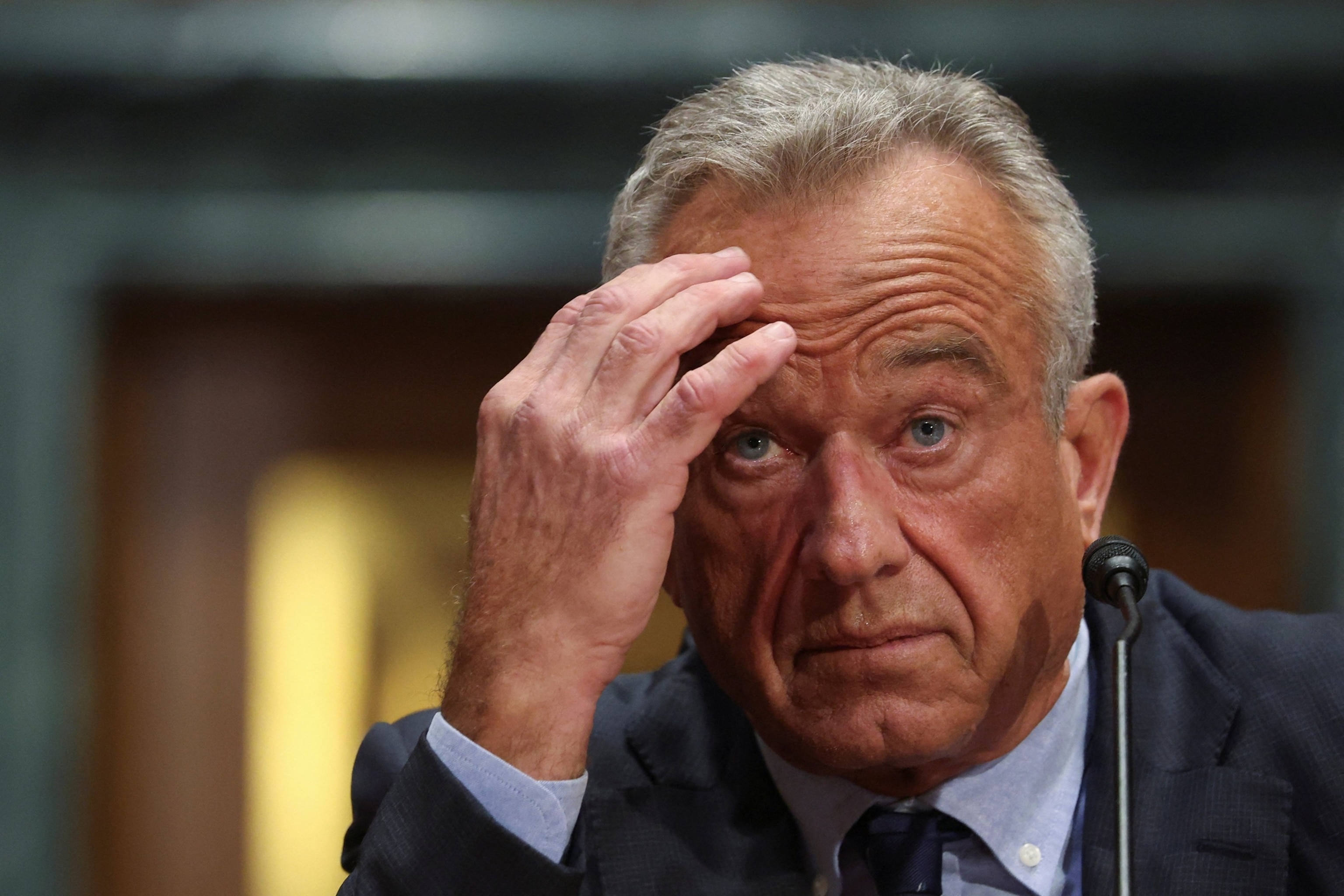
Health and Human Services Secretary Robert Kennedy Jr. testifies before the Senate Finance Committee at the Dirksen Senate Office Building, September 4, 2025 in Washington.Jonathan Ernst/Reuters

Warner, Kennedy have heated exchange over COVID deaths

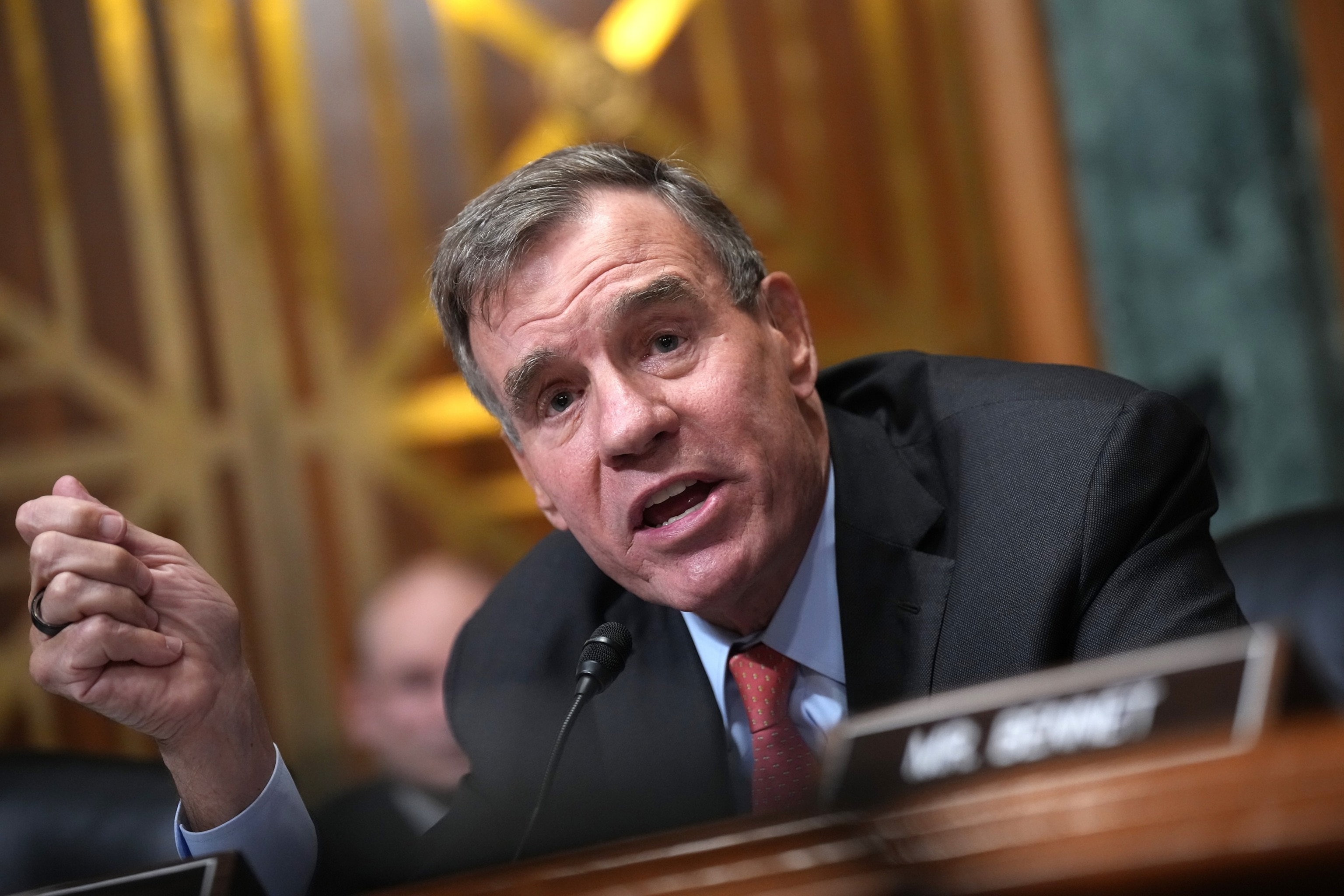
Sen. Mark Warner, a Democrat from Virginia, had a heated exchange with Kennedy over how many Americans died from COVID-19.

“Do you accept the fact that a million Americans died from COVID?” Warner asked.

“I don’t know how many died,” Kennedy replied.

“You’re the Secretary of Health and Human Services,” Warner said. “You don’t have any idea how many Americans died from COVID?”

Sen. Mark Warner questions Health and Human Services Secretary Robert Kennedy Jr. during a Senate Finance Committee, September 4, 2025 in Washington.Andrew Harnik/Getty Images

“I don’t think anybody knows, because there was so much chaos coming out of the CDC,” Kennedy continued.

Data on the CDC’s website, which is publicly available, shows that at least 1,231,440 deaths related to COVID-19 have been reported in the U.S. since 2020.

GOP’s Cassidy says, ‘We’re denying people vaccines’

Republican Sen. Bill Cassidy, a longtime physician whose vote was critical in Kennedy’s ascension to HHS secretary, read out emails he received from people who say they’ve had difficulty accessing vaccines. Cassidy submitted the emails to the record.

“I would say, effectively, we’re denying people vaccines,” Cassidy said as he ended his questioning of Kennedy.

Kennedy responded, “You’re wrong.”

Democratic senator to RFK Jr.: ‘You’re a charlatan’

Democratic Sen. Maria Cantwell picked up the questioning from Cassidy and continued to scrutinize Kennedy’s stance and actions concerning vaccines. 

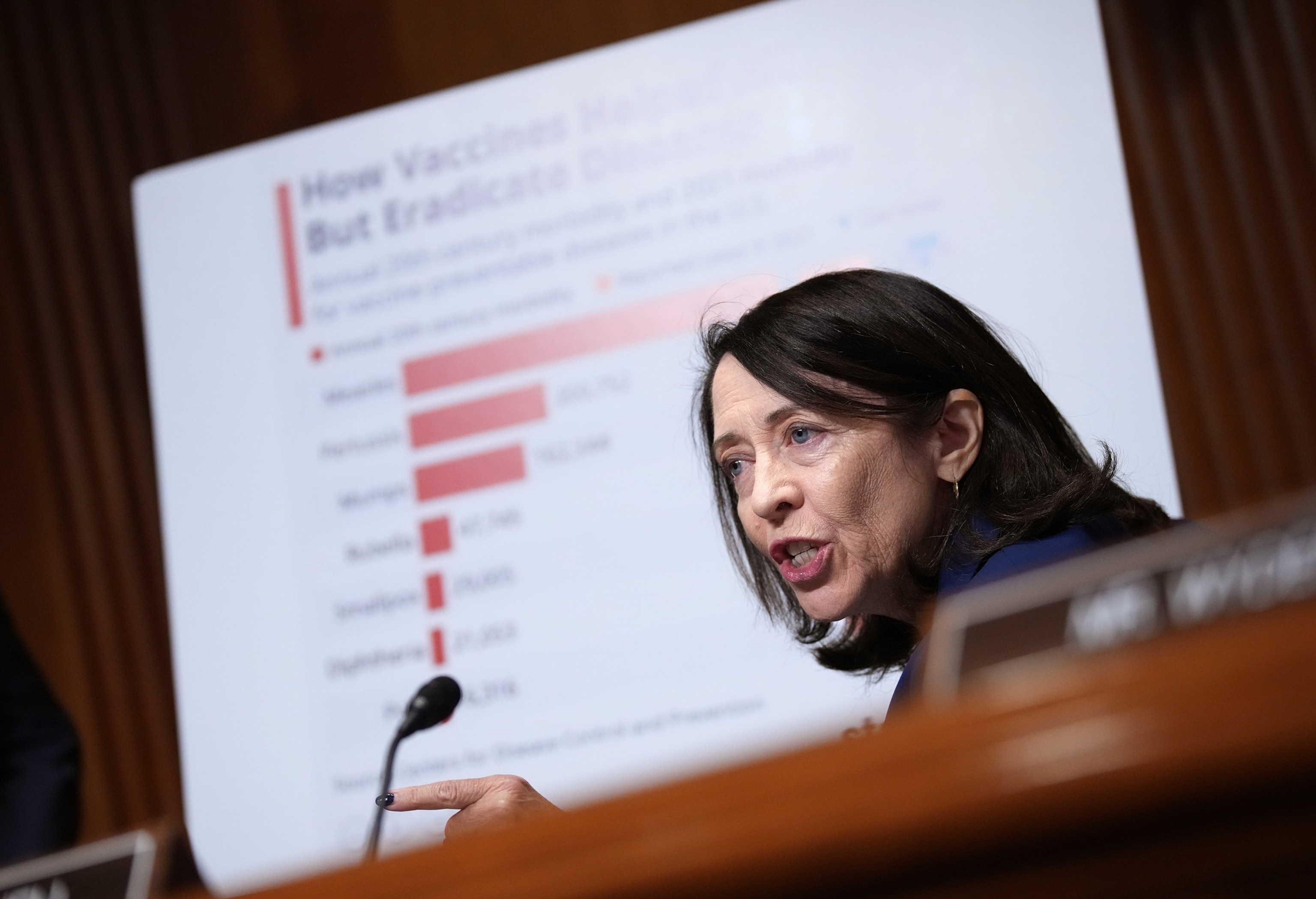
The Washington senator brought up a chart showing the number of deaths following the introduction of vaccines since the 20th century.

Sen. Maria Cantwell questions Health and Human Services Secretary Robert Kennedy Jr. during a Senate Finance Committee, September 4, 2025 in Washington.Andrew Harnik/Getty Images

“You’re a charlatan. That’s what you are. You’re the ones who conflate chronic disease with the need for vaccines,” she said.


“You are perpetrating hoaxes,” Cantwell later added.

Cassidy expresses concerns over ACIP members’ conflicts of interest

Sen. Bill Cassidy, a Republican from Louisiana, whose vote was crucial in confirming Kennedy, expressed concerns over conflicts of interest among new members of the CDC’s vaccine advisory committee.

In June, Kennedy removed all 17 sitting members of the Advisory Committee on Immunization Practices (ACIP) and replaced them with his own hand-picked members, many of whom have expressed vaccine-skeptic views.
“What I am concerned about is that many of those who you’ve nominated for ACIP have received revenue as serving as expert witnesses for plaintiffs, attorneys, suing vaccine makers,” Cassidy said.

Cassidy continued, “Now, one of my colleagues in another setting alleged that you seem more interested in settlements than science. If we put people who are paying witnesses for vaccine, people suing vaccines, that actually seems like a conflict of interest real quickly. Do you agree with that?”

Kennedy disagreed saying it may be a “bias” but not a conflict of interest.

Bennet, Kennedy spar over vaccines

Democratic Sen. Michael Bennet grilled Kennedy on his firing of all 17 members of the CDC’s vaccine advisory panel, the Advisory Committee for Immunization Practices, and the panel’s upcoming review of childhood vaccine schedule recommendations later this month.

The exchange turned heated as both men raised their voices.

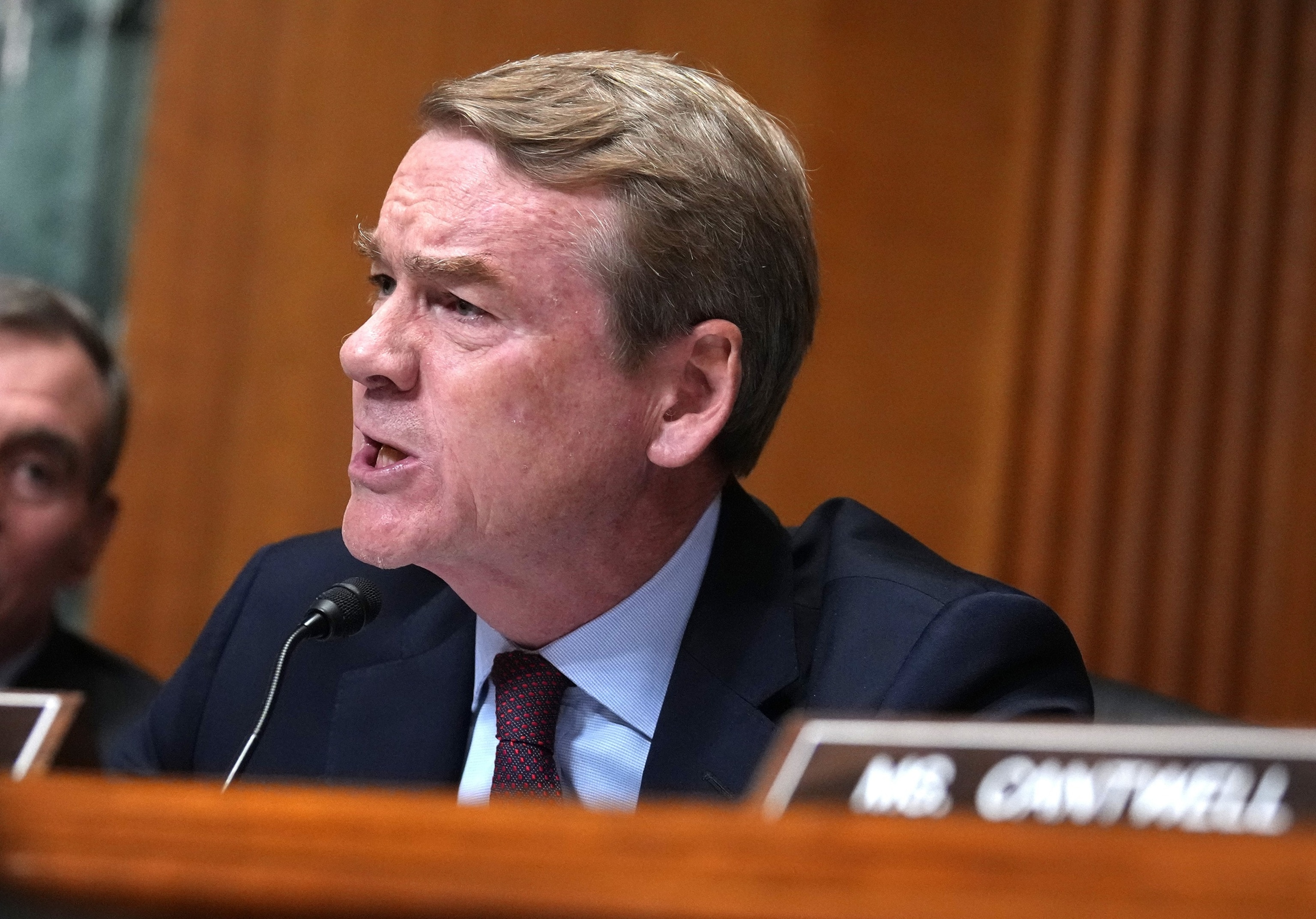
“I’m asking the questions, Mr. Kennedy, on behalf of parents and schools and teachers all over the United States of America who deserve so much better than your leadership,” Bennet yelled. “That’s what this conversation is about.”

“Senator, they deserve the truth, and that’s what we’re going to give them for the first time in the history of that agency,” Kennedy responded.

Sen. Michael Bennet questions Health and Human Services Secretary Robert Kennedy Jr. during a Senate Finance Committee, September 4, 2025 in Washington.Andrew Harnik/Getty Images

RFK Jr. claims COVID pandemic was ‘politicized’

Kennedy claimed the COVID-19 pandemic was “politicized” and that Americans were lied to.

He claimed it was untrue that COVID-19 vaccines would prevent transmission and infection.

Studies of the original vaccine found it to be 90% effective against lab-confirmed, symptomatic infection and 100% effective against moderate and severe disease, according to Yale Medicine.

Kennedy says Susan Monarez lied in her WSJ op-ed detailing ouster

Kennedy said former CDC Director Susan Monarez lied in her op-ed published in the Wall Street Journal on Thursday morning, in which she detailed the pressure she faced from Kennedy.

Monarez wrote that in that meeting, she was “told to preapprove the recommendations of a vaccine advisory panel newly filled with people who have publicly expressed antivaccine rhetoric … It is imperative that the panel’s recommendations aren’t rubber-stamped but instead are rigorously and scientifically reviewed before being accepted or rejected.”

“Did you in fact, do what Director Monarez said you did, which is tell her just go along with vaccine recommendations even if she didn’t think such recommendations aligned with scientific evidence?” Democratic Sen. Ron Wyden asked Kennedy.

“No, I did not say that to her, and I never had a private meeting with her,” Kennedy said. 

“So she’s lying today to the American people in the Wall Street Journal?” the senator asked.

“Yes, sir,” Kennedy said.

RFK Jr. says most Americans suffering from chronic disease

Kennedy said that he received latest numbers from the CDC that 76.4% of Americans now have a chronic disease.

“This is stunning … This is a national security issue,” he said. “When my uncle was president, we spent zero on chronic disease. We [have now] spent $1.3 trillion.”

Kennedy claimed this is why peopled needed to be fired at the CDC, saying they “didn’t do their job” to keep Americans healthy.

From Twitter (Republicans Against Trump):

Sen. Bill Cassidy: “Do you agree with me that President Trump deserves a Nobel Prize for Operation Warp Speed?”

RFK Jr: “Absolutely.”

Cassidy: “But you just told Sen. Bennet that the Covid vaccine killed more people than Covid”

Vermont Senator Bernie Sanders wrote an article for The New York Times calling for Health and Human Services Secretary Robert F. Kennedy Jr. to resign. Since Sanders was chairman of the Senate Committee overseeing HHS, he argues with facts, not just indignation.

He writes:

Robert F. Kennedy Jr., the secretary of health and human services, is endangering the health of the American people now and into the future. He must resign.

Mr. Kennedy and the rest of the Trump administration tell us, over and over, that they want to Make America Healthy Again. That’s a great slogan. I agree with it. The problem is that since coming into office President Trump and Mr. Kennedy have done exactly the opposite.

This week, Mr. Kennedy pushed out the director of the Centers for Disease Control and Prevention after less than one month on the job because she refused to act as a rubber stamp for his dangerous policies. Four leading officials at C.D.C. resigned the same week. One of those officials said Mr. Kennedy’s team asked him to “change studies that have been settled in the past” apparently to fit Mr. Kennedy’s anti-vaccine views. This is not Making America Healthy Again.

Despite the overwhelming opposition of the medical community, Secretary Kennedy has continued his longstanding crusade against vaccines and his advocacy of conspiracy theories that have been rejected repeatedly by scientific experts.

It is absurd to have to say this in 2025, but vaccines are safe and effective. That, of course, is not just my view. Far more important, it is the overwhelming consensus of the medical and scientific communities.

The American Academy of Pediatrics, the country’s largest professional association of pediatricians, representing over 67,000 doctors who treat our children every day, calls immunizations “one of the greatest public health achievements,” which prevents tens of thousands of deaths and millions of cases of disease.

The American Medical Association, the largest professional association of physicians and medical students, representing over 270,000 doctors along with 79 leading medical societies, recently said that vaccines for flu, R.S.V. and Covid-19 are “the best tools to protect the public against these illnesses and their potentially serious complications.”

The World Health Organization, an agency with some of the most prominent medical experts around the globe, recently noted that over the past 50 years, vaccines have saved at least 154 million lives and reduced the infant deaths by 40 percent.

Against the overwhelming body of evidence within medicine and science, what are Secretary Kennedy’s views? He has claimed that autism is caused by vaccines, despite more than a dozen rigorous scientific studies involving hundreds of thousands of children that have found no connection between vaccines and autism.

He has called the Covid-19 vaccines the “deadliest” ever made despite findings cited by the W.H.O. that Covid shots saved over 14 million lives throughout the world in 2021 alone.

He has ridiculously questioned whether the polio vaccine has killed more people than polio itself did even though scientists have found that the vaccine has saved 1.5 million lives and prevented around 20 million people from becoming paralyzed since 1988.

He has absurdly claimed that “there’s no vaccine that is safe and effective.”

Who supports Secretary Kennedy’s views? Not credible scientists and doctors. One of his leading “experts” that he cites to back up his bogus claims on autism and vaccines had his medical license revoked and his study retracted from the medical journal that published it.

Many of his supporters are from Children’s Health Defense — the anti-vaccine group he founded and profited from — and a small circle of loyalists that have spread misinformation and dangerous conspiracy theories on vaccines for years.

The reality is that Secretary Kennedy has profited from and built a career on sowing mistrust in vaccines. Now, as head of H.H.S., he is using his authority to launch a full-blown war on science, on public health and on truth itself.

What will this mean for the health and well-being of the American people?

Short term, it will be harder for Americans to get lifesaving vaccines. Already, the Trump administration has effectively taken away Covid vaccines from many healthy younger adults and kids, unless they fight their way through our broken health care system. This means more doctor’s visits, more bureaucracy and more people paying higher out-of-pocket costs — if they can manage to get a vaccine at all.

Covid is just the beginning. Mr. Kennedy’s next target may be the childhood immunization schedule, the list of recommended vaccines that children receive to protect them from diseases like measles, chickenpox and polio. The danger here is that diseases that have been virtually wiped out because of safe and effective vaccines will resurface and cause enormous harm.

Two years ago, when I was the chairman of the Senate Health, Education, Labor and Pensions Committee, I held a hearing with the major government officials responsible for protecting us from a new pandemic, including the head of the C.D.C. Without exception, every one of these agency heads said that, while they could not predict the exact date, there will be a future pandemic and we must be much better prepared for it than we are today.

Unfortunately, Secretary Kennedy’s actions are making a worrisome situation even worse by defunding the research that could help us prepare for the next pandemic. This month, he canceled nearly $500 million in research for the kinds of vaccines that helped us stop the Covid pandemic. At the same time, Mr. Kennedy is cutting funding to states to prepare and respond to future outbreaks of infectious diseases. This is unacceptable.

America’s health care system is already dysfunctional and wildly expensive, and yet the Trump administration will be throwing an estimated 15 million people off their health insurance through a cut of over $1 trillion to Medicaid and the Affordable Care Act. This cut is also expected to result in the closing of or the decline in services at hundreds of nursing homes, hospitals and community health centers. As a result of cuts to the Affordable Care Act, health insurance costs will soar for millions of Americans. That is not Making America Healthy Again.

Secretary Kennedy is putting Americans’ lives in danger, and he must resign. In his place, President Trump must listen to doctors and scientists and nominate a health secretary and a C.D.C. director who will protect the health and well-being of the American people, not carry out dangerous policies based on conspiracy theories.