Archives for category: Cruelty

Writing in The Daily Yonder, which covers the rural South, Skylar Baker-Jordan writes about Governor Andy Beshear’s selection of Silas House as the state’s poet laureate and about his own painful childhood in Kentucky.

Kentucky is usually a red state, but Governor Beshear is a popular Democrat. While the Republican-dominated legislature has passed bills that are anti-gay, Governor Beshear boldly selected House, an openly gay man, for the prestigious honor. Republicans are furious because House, a highly regarded author, insulted them with a tweet.

Baker-Jordan writes:

After Kentucky Governor Andy Beshear announced Silas House as the new poet laureate of Kentucky, there has been a significant backlash against his appointment from Republicans who claim that House “hates” Kentucky.

The Republican Governors Association called him a “radical” who thinks most Kentuckians are “bigots.” Meanwhile, a gay Republican activist wrote in the Louisville Courier-Journal that he has “no respect for Mr. House, nor should Republican Kentuckians,” arguing that it was Mr. House (as opposed to his own party, which recently passed a slate of anti-LGBTQ laws) which is standing in the way of LGBTQ rights. That’s because House once dared to tell Trump voters to “kiss [his] gay country ass” in a tweet.

I can understand Silas House’s sentiment. Sometimes, to paraphrase my friend and fellow Appalachian Neema Avashia, it is very hard to love a place that does not always love you back. Just like me, Silas House is from Leslie County, Kentucky. He loves his home state, but his home state does not always love him back.

On the one hand, Kentucky truly is the “land of milk and honey” early white settlers described: Verdant forests atop rugged mountains giving way to rolling hills of the richest soil that in turn become the most beautiful wetlands as the muddy waters of the Ohio meander ever closer to the Mississippi. There is hardly an inch of that commonwealth, a name which doubles as a promise, I haven’t tread upon.

Kentucky’s hollows raised me. Its rivers saved me. Its backroads take me home, for better or for worse.

For there is another side to Kentucky. As the only openly gay student in my high school at the dawn of the 21st century, I suffered what I have often described as “a daily crucible of homophobia.” Slurs were hurled, threats were made, and hellfire was preached – all before the morning bell had tolled.

You might be tempted to tell someone to kiss your gay country ass, too. Indeed, if that is the worst thing you say to them, no less than Job would be impressed.

As you drive into Leslie County, you see signs bragging about the accomplished individuals who have called that hidden corner of southeastern Kentucky home: Tim Couch, who played in the NFL; the Osborne Brothers, legendary bluegrass performers; a Miss Basketball from the last century; and, of course, Mary Breckinridge, who revolutionized nurse-midwifery. I often joke that they will never put up a sign claiming me as one of their own. It’s just that – a joke – but it is tinged with a painful truth: no matter how much I accomplish, Leslie County will never claim me.

I know this because they do not claim Silas House. There is no sign proudly proclaiming the county as home of the acclaimed award-winning novelist, even though he has based at least one of his books in a fictionalized version of the county. House is one of the most accomplished sons of Leslie County, but because he does not fit the narrow definition of acceptability, he goes unacknowledged. His name is verboten. Other names, though, are immortalized on a green highway sign.

Perhaps this will change now that he is the commonwealth’s poet laureate. I hope so. House reminds me of the best of Kentucky, of all the reasons why despite the pain it has caused me, I long to move back. He reminds me of Johnny Cummings, who as the first openly gay mayor of Vicco, Kentucky, ushered through a fairness ordinance to protect LGBTQ people from discrimination. He reminds me of Georgia Davis Powers, who defied racism and misogyny to become the first Black woman in the state senate. He reminds me of Loretta Lynn, who clawed her way from poverty to the top of the music charts. He reminds me of all of the countless kindhearted and decent people I have met in every corner of the commonwealth who do believe that I belong, who understand that “y’all” means all, and who work every single day to make sure the rest of the commonwealth understands that too.

Please open the link and read the rest of the article.

Then go to Amazon and look for books by Silas House. You might be tempted to buy one.

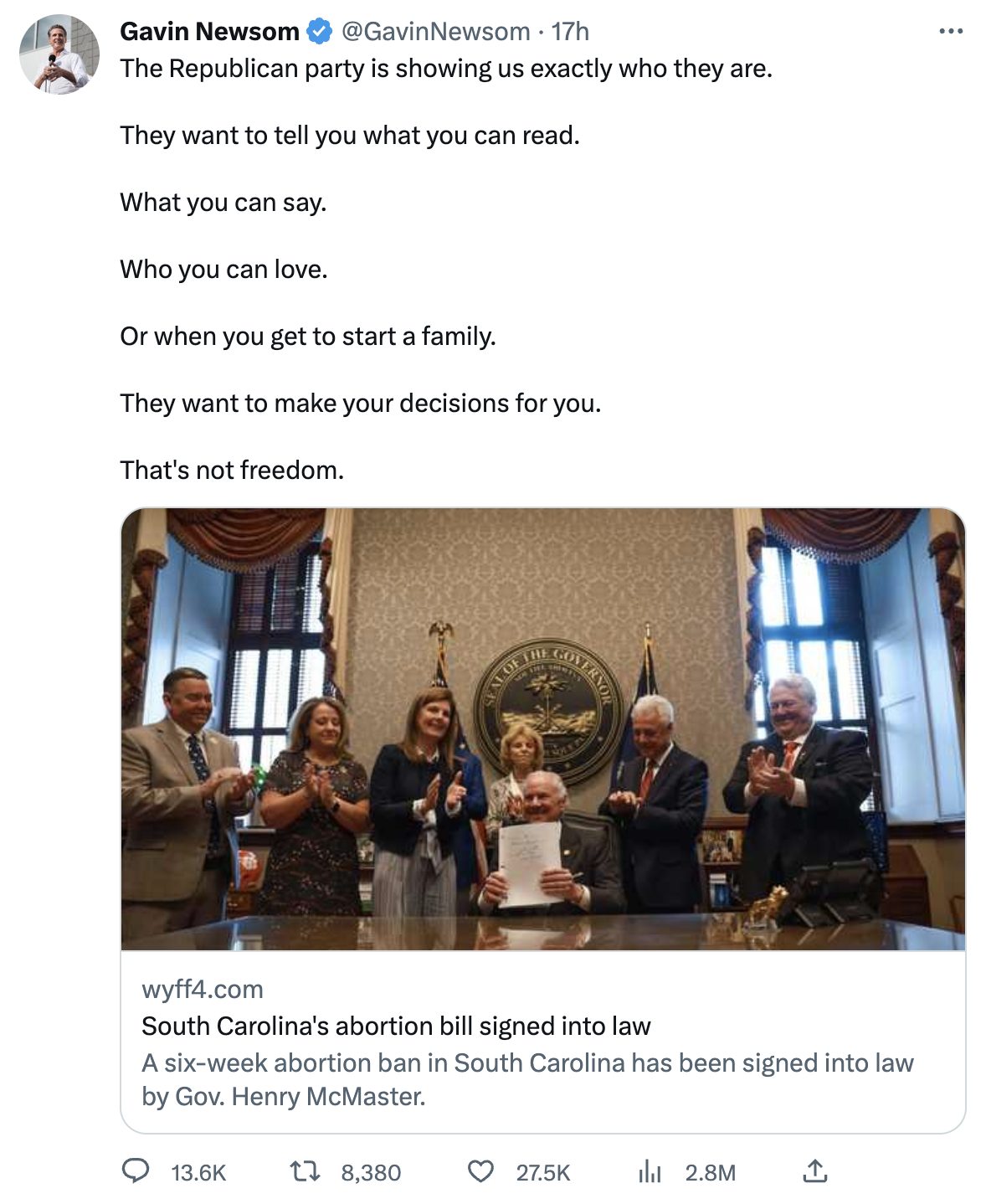
Gavin Newsom, Governor of California, regularly sends out emails pointing out the errors and hypocrisies of Republicans in other states. I enjoy them.

South Carolina, Diane…

Where the Republican governor just signed a six-week abortion ban, which he says will “begin saving lives.” All while that very same governor refuses to do anything about the fact South Carolina has one of the highest homicide rates in the country — more than 2x the rate of California.

Tweet from Gavin Newsom: 'The Republican party is showing us exactly who they are. They want to tell you what you can read. What you can say. Who you can love. Or when you get to start a family. They want to make your decisions for you. That's not freedom.'

You can’t make this up.

Today’s Republican party refuses to regulate assault weapons while gun violence is the leading cause of death of kids in America, but will champion the regulation of women’s bodies and take away reproductive freedom.

This is what Republicans want to do nationally.

And worse.

Be outraged.

Gavin

Ron DeSantis wants to make America just like Florida, where the maximum leader (Ron DeSantis) has a docile legislature that lets him decide what everyone else is allowed to do and punishes those bold enough to ignore his orders.

That’s why he is running for President. He thinks the whole nation needs and wants a maximum leader with a reactionary view of behavior and morality.

Florida is where you are free to do whatever Ron DeSantis tells you to do and free to think what he believes. If you disagree, you are no longer free.

The Miami Herald editorial board says DeSantis has turned Florida into a mean state. No, you don’t want to make America Florida.

Florida, under Gov. Ron DeSantis and Republican Legislature, is increasingly hard to recognize. It’s an intolerant and repressive place that bears scant resemblance to the Sunshine State of just a few years ago.

The 2023 legislative session cemented those appalling setbacks. Florida is now a state where government intrusion into the personal lives of Floridians is commonplace. What will it take for citizens to push back on this unprecedented encroachment on their rights? And, more broadly, what if Desantis supporters get what they want, which is to “make America Florida”?

The latest round of laws makes Florida sound more and more dystopian — something voters in the rest of the nation should note if they are considering what a DeSantis presidency could look like. The state has new rules for who can use which bathroom, what pronouns can be used in schools, which books can be taught and when women can get an abortion (almost never.) There are measures to strip union protections from public employees, keep transgender children and their parents from choosing to seek medical treatment, prevent universities from discussing diversity or inclusion and ban talk of gender identity or sexuality in schools all the way through 12th grade.

The Washington Post tells the story of Baby Milo. His mother learned midway through her pregnancy that the fetus had a rare fatal condition. It would die within hours or days of its birth. She wanted to get an abortion but Florida abortion law made it impossible. The unborn baby had a heartbeat. No doctor would break the law by performing an abortion despite the fatal diagnosis. She had to carry the baby for three months. Baby Milo was born, then died in 99 hours. That must have made legislators happy to know the baby was born, despite the toll on its mother and father.

Milo Evan Dorbert drew his first and last breath on the evening of March 3. The unusual complications in his mother’s pregnancy tested the interpretation of Florida’s new abortion law.

Deborah Dorbert discovered she was pregnant in August. Her early appointments suggested the baby was thriving, and she looked forward to welcoming a fourth member to the family. It didn’t occur to her that fallout from the U.S. Supreme Court’s decision to overturn a half-century constitutional right to abortion would affect them.

A routine ultrasound halfway through her pregnancy changed all that.

Deborah and her husband, Lee, learned in late November that their baby had Potter syndrome, a rare and lethal condition that plunged them into an unsettled legal landscape.

The state’s ban on abortion after 15 weeks of gestation has an exception for fatal fetal abnormalities. But as long as their baby’s heart kept beating, the Dorberts say, doctors would not honor their request to terminate the pregnancy. The doctors would not say how they reached their decision, but the new law carries severe penalties, including prison time, for medical practitioners who run afoul of it. The hospital system declined to discuss the case.

Instead, the Dorberts would have to wait for labor to be induced at 37 weeks.

For the next three months, the Dorberts did their best to prepare for their second son’s short life. They consulted with palliative care experts and decided against trying to prolong his life with high-tech interventions.

“The most important thing for us was to let him know he was loved,” Deborah said.

The day before Milo was born, the Dorberts sat down with their son Kaiden to explain that the baby’s body had stopped working and that he would not come home. Instead, someday, they told Kaiden, they would all meet as angels. The 4-year-old burst into tears, telling them that he did not want to be an angel….

Without functioning kidneys, a fetus with Potter syndrome cannot produce the amniotic fluid that allows the lungs to expand and that cushions the growing body. The babies who survive until birth typically have contracted limbs, club feet and flattened features from being compressed against the uterus wall.

But after Deborah’s 12-hour labor, Milo turned out to be 4 pounds and 12 ounces of perfection, with tiny, flawlessly formed hands and feet and a head of brown hair.

“I thought I had my miracle,” said Peter Rogell, the baby’s grandfather, who attended the delivery. He allowed himself a moment of hope until the obstetrician cut the umbilical cord that for 37 weeks had performed the functions Milo’s underdeveloped lungs and missing kidneys would now take over.

He never cried or tried to nurse or even opened his eyes, investing every ounce of energy in intermittent gasps for air.

“That was the beginning of the end,” Rogell said, recalling the persistent gulps that he thought at first were hiccups but turned out to be his grandson’s labored efforts to inhale.

Lee read a book to his dying son — “I’ll Love You Forever,” a family favorite that the Dorberts had given Kaiden for Valentine’s Day — and sang Bob Marley’s “Three Little Birds.”

For 99 minutes that lasted a lifetime, they cuddled and comforted their newborn.

Ron DeSantis recently changed the Florida abortion law to make it more restrictive: abortions not permitted after six weeks. The Governor and legislature have essentially banned abortion in the state since few women know they are pregnant within six weeks. They may think their period is delayed, and they won’t have time to get the required doctor’s approval.

The six-week ban won’t go into effect until after the state’s Supreme Court has decided a challenge to the 15-week ban. Since DeSantis appointed four of seven justices, the court’s approval is expected.

Expect more heart-breaking stories, more grief, more sadness.

Michael Hiltzik of the Los Angeles Times explains how Republicans agreed to the increase in the debt ceiling: by cutting aid to the neediest. He wrote: The cruelty is the point.

No one should be surprised that the resolution of our most moronic fiscal policy, the federal debt ceiling, involved our stupidest social policy, work requirements for assistance programs.

But that appears to be the case. In negotiations between the Biden White House and House Speaker Kevin McCarthy’s Republican caucus, one of the last sticking points was whether, and by how much, to tighten work requirements for food stamps and welfare.

In coming days, as Congress moves toward votes on the deal, political commentators will thoroughly masticate the question of whether Biden or McCarthy (R-Bakersfield) prevailed in this dealmaking and which of them will be hurt or harmed politically by the outcome.

Democrats right now are willing to default on the debt so they can continue making welfare payments for people that are refusing to work.

— Rep. Garret Graves (R-La.) tells a giant lie about the debt ceiling negotiations

That’s not a very interesting parlor game. (Personally, I’d go with the judgment of Timothy Noah of the New Republic, who thinks Biden emerges as the political victor and McCarthy’s days as speaker are numbered, thanks to the choler of his far right wing.)

More important is what the deal says about the principles of both camps. The granular details of the agreement were still murky Sunday, and it could still collapse because of objections from congressional Republicans or Democrats.

The deal, as reported, freezes discretionary federal spending — that is, most of the programs for which Americans depend on the federal government — at current levels for the next two years, with increases lower than inflation. That means an effective budget cut, relative to inflation. In return, the debt ceiling is suspended for two years.

But Biden managed to preserve the accomplishments of his presidency thus far from the GOP’s knives. He fended off their efforts to torpedo the support for renewable energy in last year’s Inflation Reduction Act, their harshest proposed budget cuts, the rollback of student debt relief, and repeal of his budget increase for the Internal Revenue Service.

(Reports say that $10 billion will be shaved off the $80-billion 10-year IRS budget increase, but the money can be redirected to other programs.)

Biden rejected Republican demands to impose work requirements on Medicaid, but allowed some tightening of the rules for food stamps — the Supplemental Nutrition Assistance Program, or SNAP, and Temporary Assistance for Needy Families, or TANF, which is what’s left of traditional welfare.

Make no mistake: No rich American will be harmed even a bit by this deal. Some may even be advantaged, if the carve-out from the IRS budget comes from the agency’s enforcement efforts; that would help the rich, who are the nation’s worst tax cheats.

The most vulnerable Americans, however, will bear the brunt of the deal points. Let’s take a look.

Start with work requirements. As I’ve reported ad infinitum over the years, work requirements on safety net programs accomplish nothing in terms of pushing their beneficiaries into the job market.

They are, however, very effective at throwing people off those programs; that’s what happened in Arkansas , where 17,000 people lost Medicaid benefits in 2019 after only six months of a limited rollout of work rules. A federal judge then blocked the changes.

The debt ceiling deal will tighten work requirements for SNAP by requiring able-bodied, childless low-income adults younger than 55 to work 20 hours a week or be engaged in job training or job searches. If they don’t meet that standard, their SNAP benefits end after three months. Current law applies to those adults only up to the age of 49. The change will expire in 2030.

This rule will do virtually nothing to reduce federal spending, which Republicans say has been the whole point of holding the debt ceiling hostage. The Congressional Budget Office estimated in April that the change would reduce federal spending by $11 billion over 10 years, or $1.1 billion a year.

By my calculation, that comes to 17 thousandths of a percent of the federal budget, which this year is $6.4 trillion.

If it’s scarcely a rounding error in federal accounts, however, it’s critically important to the recipients of food aid. The CBO estimated that about 275,000 people would lose benefits each month because they failed to meet the requirement.

Biden’s negotiators did get the Republicans to waive SNAP rules for veterans and the homeless, which will probably lower that figure and limit the reduction of federal spending.

Work requirements for safety net programs have been a Republican hobby horse for decades. It’s based on the Republican image of low-income Americans as layabouts and grifters — the “undeserving poor.”

Sure enough, Rep. Garret Graves (R-La.), one of McCarthy’s debt-ceiling negotiators, couldn’t resist slandering this vulnerable population during the talks. “Democrats right now are willing to default on the debt so they can continue making welfare payments for people that are refusing to work,” he said during a break.

Of course, it was Republicans who showed willingness to default on the federal debt. Nor is there a smidgen of evidence that any sizable percentage of this target population is “refusing to work.”

The vast majority of SNAP recipients already work, but they’re in low-paying jobs that are so unstable that they often drift in and out of employment. According to the Census Bureau, 79% of all SNAP families include at least one worker, as do nearly 84% of married couples on SNAP.

In other words, the GOP insistence on work requirements is nothing but the party’s typical performative malevolence toward the poor. If they really cared about getting SNAP recipients into the job market, they’d fund job training programs and infrastructure projects. They never do.

In any case, the only cohort of beneficiaries that tends to move into the job market at all are younger recipients — not those in their 50s. All that work requirements accomplish is to erect bureaucratic barriers to enrollment in the safety net. But that’s the point, isn’t it?

The work rules for TANF are managed somewhat differently — they’re directed at the states administering the program, which have been required to ensure that a certain percentage of beneficiaries are working or looking for work. How the debt ceiling deal applies to that program is unclear.

In the next week or so, before June 5 — the putative date at which the Treasury Department says the government runs out of money to pay its bills without a debt ceiling increase and thus flirts with an unprecedented default — Biden and McCarthy will hit the hustings to claim victory.

But there’s really only one way to think about the exercise we’ve just gone through. It was a supreme waste of time.

Republicans showed they were willing to crash the U.S. economy to make some bog-standard complaints about the federal deficit, most of which they created themselves through the 2017 tax cuts they enacted for the wealthy. Their initial negotiating stance was so extreme that they must have known it could never gain Democratic votes in the House or pass the Democratic Senate.

The Democrats held reasonably firm. They agreed to some modest budget constraints for two years, moved the next debt ceiling cabaret off to beyond the next election, and saved millions of Americans from serious economic pain.

As I’ve written before, if Republicans were really serious about restraining federal spending, they wouldn’t have voted for the tax cuts and budget increases that that contribute to the deficit.

Instead, they said the only way to control spending is to refuse to pay the bills they ran up, by refusing to increase the debt ceiling. They lied, and every thinking American knows they lied. So tell me, why did we go through this again?

The editorial board of the prestigious journal “Scientific American” lambasted Ron DeSantis’ hostility to science, which endangers the people of Florida. Should he be successful in his quest for the Presidency, his retrograde ideology would endanger the entire nation. His combination of “cruelty, bigotry, and megalomania” will cause endless harm to the U.S.

Ron DeSantis, the governor of Florida, is running for president of the United States on a record of anti-diversity, pro-censorship, white nationalistmeasures. He has targeted education, LGBTQ rights and access to health care, and should he prevail, his anti-science candidacy stands to harm millions of Americans.

DeSantis has banned books in school libraries, restricted teachers’ classroom discussions about diversity, prohibited high school classes that focus on Black history and people, politicized college curricula, limited spending on diversity programs, ignored greenhouse gas reduction in climate change policy, diminished reproductive rights and outlawed transgender health care.

The governor has refused all evidence that masks are safe and help prevent COVID, appointed a surgeon general who advised against vaccines, and continues to paint science and evidence as restrictions to the freedom of Floridians. Instead of limiting the role of government, as he claimed in his fight against masks, he is expanding it to selectively promote a particular religious agenda.

The maternal mortality rate in Florida is rising, yet DeSantis signed one of the most restrictive abortion laws in the country, outlawing it after six weeks of pregnancy and endangering people who have life-threatening complications that termination could help. Black women in Florida have the worst maternal mortality rates of any group in the state, and research has shown that people who are denied abortions and forced to give birth suffer mentally, financially and educationally. These statistics surely won’t improve under these new laws, which are pushing health care providers to move out of the state.

By making gender-affirming care for youth illegaland disparaging the use of preferred pronouns and names, the governor and his followers will undoubtedly add to the suffering of transgender individuals. Multiple studies have looked at the mental health of transgender teens. Researchers have found that giving puberty blockers to youth questioning the gender they were assigned at birth reduces depression, anxiety and anger. In another study, 56 percent of transgender youth surveyed had attempted suicide, and causes included feeling they didn’t belong, being excluded and a profound lack of self-worth.

Despite Florida’s vulnerability to climate change, whether through natural disaster or sea-level rise, DeSantis has ignored scientific evidence again, refusing to address the role of greenhouse gas emissions in global warming. He has focused instead on adaptation, or resiliency measures. He’s also nixed sustainable investment efforts like bonds that would fund renewable energy measures in the state. But adaptation and mitigation go hand-in-hand. Without reducing the cause of climate change, adaptation will only go so far, and under DeSantis, Florida remains at high risk of climate-related disaster.

DeSantis has signed bills allowing people to challenge school library books they deem unfit for children. To date, books pulled from library shelves include a biography of baseball player Roberto Clemente (which was later restored), poetry from Amanda Gorman, Margaret Atwood’s The Handmaid’s Tale and books about Black, Cuban and LGBTQ perspectives.

The authors of several books that have been pulled from Florida’s shelves have sued the state for violating both their First Amendment rights to free speech and their 14th Amendment rights to equal protection under the law. The teachers’ union and other groups are suing on the grounds that the law extends beyond schools into public libraries.

His “Don’t Say Gay” law prevents teachers from talking about homosexuality or being transgenderthrough high school. Such rules prevent comprehensive sex education and invalidate LGBTQ students, adding to the mental health burden of a state that has a severe shortage of child and adolescent psychiatrists.

DeSantis and the far right misrepresent critical race theory (which examines the role of race in the legal system) and pressured the College Board to remove references to the theory from the Advanced Placement African American Studies curriculum. The governor’s actions are part of a large-scale misinformation campaign to stoke white fear and uphold white nationalism. Yet, racism is reality, and in our multicultural, multilingual, global society, promoting white nationalism will create a generation of students who cannot reason and think as critically as their peers.

The governor has also banned Florida colleges’ efforts to promote diversity, inclusion and equity. The bans could affect all aspects of education, including efforts to recruit nonwhite STEM students and scientists to higher education. He has stacked the New College of Florida board of trustees, historically apolitical, with conservative ideologues to create an institute of higher learning that adheres to his version of American education and white exceptionalism, which is explicitly modeled on conservative evangelical Christian colleges.

What Ron DeSantis has done in Florida mirrors efforts in other states, including Texas. He is among a new class of conservative lawmakers who speak of freedom while restricting freedom. This political maneuvering is part of building his national presence yet it does not represent most Americans’ views. The population of Florida is growing fasterthan most other places in the U.S., but the state is now poised to have fewer critical thinkers, fewer people of color as educators and as the subjects of education, more deaths in childbirth, and scores of people in the throes of crisis because of their identities. A country led by someone wielding such cruelty, bigotry and megalomania will never be “a more perfect Union.”

Pro Publica investigated the case of a child at Success Academy who was disruptive and learned that at a charter school, the chain is free to write its own disciplinary rules. The public schools are governed by regulations, but Success Academy is exempt from those regulations.

ProPublica told the story of Ian, whose mother left work repeatedly to find out why Success Academy had called the police about the child. It seems clear that the school was trying to persuade her to withdraw Ian. But she kept showing up. It also seems clear that Ian’s behavior got worse because of the school’s rigid discipline.

In a panic, if she floors it, Marilyn Blanco can drive from her job at the Rikers Island jail complex to her son Ian’s school in Harlem in less than 18 minutes.

Nine times since December, Blanco has made the drive because Ian’s school — Success Academy Harlem 2 — called 911 on her 8-year-old.

Ian has been diagnosed with ADHD. When he gets frustrated, he sometimes has explosive tantrums, throwing things, running out of class and hitting and kicking anyone who comes near him. Blanco contends that, since Ian started first grade last year, Success Academy officials have been trying to push him out of the school because of his disability — an accusation similar to those made by other Success Academy parents in news stories, multiple lawsuits that resulted in settlements and a federal complaint.

When giving him detentions and suspensions didn’t stop Ian’s tantrums, Blanco said, the school started calling 911. If Blanco can’t get to Ian fast enough to intervene, a precinct officer or school safety agent from the New York Police Department will hold him until an ambulance arrives to take him to a hospital for a psychiatric evaluation — incidents the NYPD calls “child in crisis” interventions.

The experience has been devastating for Ian, Blanco said. Since the 911 calls started late last year, he’s been scared to leave his house because he thinks someone will take him away. At one ER visit, a doctor wrote in Ian’s medical file that he’d sustained emotional trauma from the calls.

Citywide, staff at the Success Academy Charter School network — which operates 49 schools, most of them serving kids under 10 years old — called 911 to respond to students in emotional distress at least 87 times between July 2016 and December 2022, according to an analysis of NYPD data by THE CITY and ProPublica.

If Success Academy were run by the city Department of Education, it would be subject to rules that explicitly limit the circumstances under which schools may call 911 on students in distress: Under a 2015 regulation, city-run schools may never send kids to hospitals as a punishment for misbehavior, and they may only involve police as a last resort, after taking mandatory steps to de-escalate a crisis first. (As THE CITY and ProPublica reported this month, the rules don’t always get followed, and city schools call 911 to respond to children in crisis thousands of times a year.)

But the regulation doesn’t apply to Success Academy, which is publicly funded but privately run and — like all of the city’s charter school networks — free to set its own discipline policies.

The consequence, according to education advocates and attorneys, is that families have nowhere to turn if school staff are using 911 calls in a way that’s so frightening or traumatic that kids have little choice but to leave.

“Sure, you can file a complaint with the Success Academy board of trustees. But it isn’t going anywhere,” said Nelson Mar, an education attorney at Legal Services NYC who represented parents in a 2013 lawsuit that led to the restrictions on city-run schools.

Success Academy did not respond to questions about the circumstances under which school staff generally call 911 or the criteria they use to determine whether to initiate child-in-crisis incidents.

Regarding Ian, Success Academy spokesperson Ann Powell wrote that school staff called EMS because Ian “has repeatedly engaged in very dangerous behavior including flipping over desks, breaking a window, biting teachers (one of whom was prescribed antibiotics to prevent infection since the bite drew blood), threatening to harm both himself and a school safety agent with scissors, hitting himself in the face, punching a pregnant paraprofessional in the stomach (stating ‘I don’t care’ when the paraprofessional reminded him that ‘there’s a baby in my belly’), punching a police officer and attempting to take his taser, and screaming ‘I wish you would die early.’”

Powell also provided documentation that included contemporaneous accounts of Ian’s behavior written by Success Academy staff, photographs of bite marks and a fractured window, an assessment by a school social worker concluding that Ian was at risk for self-harm, and a medical record from an urgent care facility corroborating the school’s account that a teacher had been prescribed antibiotics.

Blanco said that Success Academy administrators have regularly exaggerated Ian’s behaviors. When he was 6, for example, Ian pulled an assistant principal’s tie during a tantrum, and school staff described it as a choking attempt, according to an account Blanco gave to an evaluator close to the time of the incident. Each time Success Academy has sent Ian to an emergency room, doctors have sent him home, finding that he didn’t pose a safety threat to himself or others, medical records show. (Success Academy did not respond to questions about the assertion that staffers have exaggerated Ian’s behaviors.)

Blanco knows that Ian is struggling. No one is more concerned about his well-being than she is, she said. But villainizing her 8-year-old only makes the situation worse.

“It’s like they want to tarnish him,” Blanco said. “He’s just a child, a child who needs help and support.”

Blanco chose Success Academy because she wanted Ian to have better education that what’s available in his neighborhood public school.

Success Academy, which has avid support from many parents and is led by former New York City Councilmember Eva Moskowitz, promotes itself as an antidote to educational inequality, offering rigorous charter school options to kids who might not have other good choices. On its website, the network advertises its students’ standardized test scores (pass rates for Black and Latino students are “double and even triple” those at city-run schools) and its educational outcomes: 100% of high school graduates are accepted to college, the network says.

Success Academy administrators say that strict and consistent discipline policies are essential to kids’ learning. Students are required to follow a precise dress code and to sit still and quietly, with hands folded in their laps or on their desks. When students break the rules, the school issues a progressive series of consequences, including letters home, detentions and suspensions.

Once students are accepted through the Success Academy lottery, the network is required to serve them until they graduate or turn 21, unless they withdraw or are formally expelled…

In Harlem, Ian started struggling at Success Academy just a few weeks into first grade. He’d never been aggressive before he started school, Blanco said. Because of the COVID-19 pandemic, he’d attended kindergarten online. When schools went back to in-person instruction, he was a high-energy 6-year-old who couldn’t follow Success Academy’s strict rules requiring him to sit still and stay quiet. By the end of first grade, he’d been suspended nearly 20 times.

The more Ian got in trouble, the worse he felt about himself and the worse his behavior became, Blanco said. He started falling behind because he missed so much class time during his suspensions, according to his education records. At home and at school, he said that teachers disciplined him because he was a “bad kid.”

At first, Blanco worked hard to cooperate with the school, she said. She was worried by the change in Ian’s behavior, and she thought that school staff had his best interests at heart. But then an assistant principal called her into an office and told her that Success Academy wasn’t a “good fit” for Ian, Blanco said to THE CITY and ProPublica, as well as in a written complaint she sent to Success Academy at around that time. (Success Academy’s board of trustees investigated the complaint and did not find evidence of discrimination against Ian, according to a September 2022 letter to Blanco from a board member.)

“That didn’t sit right,” said Blanco, who is an investigator at Rikers Island and is accustomed to gathering paper trails. She asked the assistant principal to put the statement in writing, but he told her she had misunderstood, she said. (Success Academy did not respond to questions about this incident.)

Several times, when the school called Blanco to pick Ian up early, staff told her to take him to a psychiatric emergency room for an evaluation. But the visits didn’t help, Blanco said. “You could be sitting there for six, seven, eight hours,” waiting to talk to a psychologist. Because Ian never presented as an immediate threat to himself or others, hospital staff couldn’t do much but refer him to outpatient care and send him home, according to hospital discharge records.

Eventually, Blanco found an outpatient clinic that would accept her insurance to evaluate Ian for neurological and behavioral disorders. She said she begged school staff to stop disciplining Ian while she worked to get him treatment, but the suspensions were relentless. Once, he missed 15 straight days of school.

At the beginning of Ian’s second grade year, Blanco reached out to Legal Services NYC, where Mar, the education attorney, took her on as a client.

The school twice reported Blanco to child welfare services as a negligent mother. An investigator came to her home to interview her and Ian. She said she was humiliated.

One month after the child welfare visit, things got even worse. Blanco was in Queens, heading to work to pick up some overtime, when the school called to say that Ian had had another tantrum. This time, she was too late to bring Ian home herself. He was in an ambulance, on his way to Harlem Hospital….

Two weeks ago, Success Academy sent Blanco an email informing her that they requested a hearing to have Ian removed from school for up to 45 school days because he “is substantially likely to cause injury to himself and others while in the Success Academy community.”

Ian would be barred from Success Academy immediately, the email said, even though it could take up to 20 days to schedule the hearing, which will be held at the special education division of the city’s Office of Administrative Trials and Hearings. If the hearing officer agrees with Success Academy, Ian will miss the rest of the school year..

To Blanco, the hearing seems like just another way for the school to get rid of her son. She thinks about pulling Ian out of Success Academy all the time, she said, but it feels like there’s no good alternative. She doesn’t want to give up on the idea of him getting a better shot than the one she got at a failing neighborhood school.

“I want him to get free of this cycle of disadvantage,” Blanco said. “I want to fight for my son’s rights and let them know that you’re not going to treat my child this way. I’ve made it my mission. You don’t get to pick and choose who you give an education to.”

.
Several red states have passed laws requiring people to use the public restroom that is aligned with the gender that appears on their birth certificate. Florida and Texas are the most recent states to pass such laws.

The intent, clearly, is to prevent trans people from using the bathroom that corresponds to their gender, which is not the one they were born with.

So, imagine this: a guy with stubble on his face and muscular biceps will use the women’s restroom, because he was born a she. And a beautiful woman wearing a dress, lipstick, and high heels will go to the men’s room, because she was born a he.

How will this law be enforced?

Clearly, every state with such a law must do two things:

1. Everyone must wear a replica of their birth certificate on a chain around their neck.

2. Every public restroom must have a genital guard to check birth certificates at the door. No birth certificate, no entry.

But with one exception:

In the event that a person wants to use a public restroom but forgot their birth certificate, the genital guard would take the person into a private cubicle and do a visual inspection, a genital check.

Of course, each state would have to hire thousands of genital guards for schools, cinemas, hospitals, restaurants, hotels, etc. It would be expensive but it would likely create full employment.

NPR reported on a warning issued by the nation’s oldest civil rights organization, the NAACP. Travelers should avoid Florida, where there is a pervasive air of bigotry and easy access to guns. The warning nearly coincided with Ron DeSantis’ declaration of his campaign, on a media platform with billionaire Elon Musk. DeSantis will tout his record of stern opposition to migrants, gays, drag queens, transgender people, Black history, and his unwavering support for censorship and guns.

ORLANDO, Fla. — The NAACP over the weekend issued a travel advisory for Florida, joining two other civil rights groups in warning potential tourists that recent laws and policies championed by Gov. Ron DeSantis and Florida lawmakers are “openly hostile toward African Americans, people of color and LGBTQ+ individuals.”

The NAACP, long an advocate for Black Americans, joined the League of United Latin American Citizens (LULAC), a Latino civil rights organization, and Equality Florida, a gay rights advocacy group, in issuing travel advisories for the Sunshine State, where tourism is one of the state’s largest job sectors.

The warning approved Saturday by the NAACP’s board of directors tells tourists that, before traveling to Florida, they should understand the state of Florida “devalues and marginalizes the contributions of, and the challenges faced by African Americans and other communities of color.”

Critics say Florida aims to rewrite history by rejecting African American studies

An email was sent Sunday morning to DeSantis’ office seeking comment. The Republican governor is expected to announce a run for the GOP presidential nomination this week.

Florida is one of the most popular states in the U.S. for tourists, and tourism is one of its biggest industries. More than 137.5 million tourists visited Florida last year, marking a return to pre-pandemic levels, according to Visit Florida, the state’s tourism promotion agency. Tourism supports 1.6 million full-time and part-time jobs, and visitors spent $98.8 billion in Florida in 2019, the last year figures are available.

DeSantis’s efforts to exclude migrants may hurt Florida more than the boycott. Will the tourism industry have the staff it needs for hotels and restaurants? Will the agricultural industry have enough laborers to pick crops?

DeSantis’s war on teaching accurate, factual history about American history, his demands for book banning, and his support for vouchers for every student in the state, even those already in private schools, degrades education and intelligence in Florida.

DeSantis is running on a platform of hate, bigotry, and disunity. Let’s see how that plays.

School officials in a Mississippi high school told a graduating senior that she must wear boys’ clothing at her high school graduation; if she didn’t, she would not be permitted to participate in the ceremony. The girl is transgender and has worn girls’ clothing for the four years of high school. The mother sued with the legal help of the Mississippi ACLU. The Trump-appointed federal judge ordered the trans girl to wear boys’ clothing.

The Mississippi Free Press reported:

A federal judge ruled late Friday evening that the Harrison County School District can prohibit a 17-year-old transgender girl from attending her graduation Saturday unless she dresses in attire designated for boys, the Sun Herald’s Margaret Baker reported.

U.S. District Court Judge Taylor McNeel issued the ruling after hours of testimony from the Harrison Central High School senior and school district officials. Former President Donald Trump appointed the conservative judge to the U.S. District Court for the Southern District of Mississippi in 2020.

“The court’s decision to uphold the school district’s explicit discrimination of our client is deeply disappointing and concerning,” the ACLU of Mississippi responded in a Twitter thread this morning. “Our client should be focused on celebrating this life milestone alongside her friends and loved ones. Instead, this ruling casts shame and humiliation on a day that should be focused on joy and pride. All Mississippi students should have the right and autonomy to be who they are—not who judges and school officials think they should be…”

“On May 9, 2023—less than two weeks before graduation day, Defendants informed Plaintiff L.B. that she could not attend or participate in her high school graduation ceremony while wearing a dress and heeled shoes,” says a complaint the American Civil Liberties Union of Mississippi filed in the U.S. District Court for the Southern District of Mississippi on Thursday.

“Defendants based this instruction on the HCHS gender-based dress code policy for graduation, which provides that girls must wear a white dress and dress shoes and that boys must wear a white button-down shirt, black dress pants, black dress shoes, and a tie or bowtie,” the complaint continues.

“Defendants instructed that L.B. must dress in accordance with her sex assigned at birth—in other words, that L.B. must dress in accordance with the stereotypical male standards, even though she entered high school as a girl and has lived every aspect of her high school career as a girl.

L.B. would be humiliated in the company of her classmates if compelled to dress as a boy after living as a girl for four years. Why should it matter to school officials if she chooses to dress as a girl and her parent(s) permits it. Does her mother have no parental rights?