Archives for category: Cruelty

The people in Florida who wrote the standards for African American studies had a challenge: how to write them to satisfy Governor DeSantis’ hatred for anything that speaks about racism and injustice. Admitting that whites who enslaved Blacks were racist might make whites today feel “uncomfortable” and would be “woke.” So how is it possible to paper over the brutality and inhumanity of slavery?

Heather Cox Richardson explains how they did it.

The Florida Board of Education approved new state social studies standards on Wednesday, including standards for African American history, civics and government, American history, and economics. Critics immediately called out the middle school instruction in African American history that includes “how slaves developed skills which, in some instances, could be applied for their personal benefit.” (p. 6). They noted that describing enslavement as offering personal benefits to enslaved people is outrageous.

But that specific piece of instruction in the 216-page document is only a part of a much larger political project.

Taken as a whole, the Florida social studies curriculum describes a world in which the white male Founders of the United States embraced ideals of liberty and equality—ideals it falsely attributes primarily to Christianity rather than the Enlightenment—and indicates the country’s leaders never faltered from those ideals. Students will, the guidelines say, learn “how the principles contained in foundational documents contributed to the expansion of civil rights and liberties over time” (p. 148) and “analyze how liberty and economic freedom generate broad-based opportunity and prosperity in the United States” (p. 154).

The new guidelines reject the idea that human enslavement belied American principles; to the contrary, they note, enslavement was common around the globe, and they credit white abolitionists in the United States with ending it (although in reality the U.S. was actually a late holdout). Florida students should learn to base the history of U.S. enslavement in “Afro-Eurasian trade routes” and should be instructed in “how slavery was utilized in Asian, European, and African cultures,” as well as how European explorers discovered “systematic slave trading in Africa.” Then the students move on to compare “indentured servants of European and African extraction” (p. 70) before learning about overwhelmingly white abolitionist movements to end the system.

In this account, once slavery arrived in the U.S., it was much like any other kind of service work: slaves performed “various duties and trades…(agricultural work, painting, carpentry, tailoring, domestic service, blacksmithing, transportation).” (p. 6) (This is where the sentence about personal benefit comes in.) And in the end, it was white reformers who ended it.

This information lies by omission and lack of context. The idea of Black Americans who “developed skills” thanks to enslavement, for example, erases at the most basic level that the history of cattle farming, river navigation, rice and indigo cultivation, southern architecture, music, and so on in this country depended on the skills and traditions of African people.

Lack of context papers over that while African tribes did practice enslavement, for example, it was an entirely different system from the hereditary and unequal one that developed in the U.S. Black enslavement was not the same as indentured servitude except perhaps in the earliest years of the Chesapeake settlements when both were brutal—historians argue about this— and Indigenous enslavement was distinct from servitude from the very beginning of European contact. Some enslaved Americans did in fact work in the trades, but far more worked in the fields (and suggesting that enslavement was a sort of training program is, indeed, outrageous). And not just white abolitionists but also Black abolitionists and revolutionaries helped to end enslavement.

Taken together, this curriculum presents human enslavement as simply one of a number of labor systems, a system that does not, in this telling, involve racism or violence.

Indeed, racism is presented only as “the ramifications of prejudice, racism, and stereotyping on individual freedoms.” This is the language of right-wing protesters who say acknowledging white violence against others hurts their children, and racial violence is presented here as coming from both Black and white Americans, a trope straight out of accounts of white supremacists during Reconstruction (p. 17). To the degree Black Americans faced racial restrictions in that era, Chinese Americans and Japanese Americans did, too (pp. 117–118).

It’s hard to see how the extraordinary violence of Reconstruction, especially, fits into this whitewashed version of U.S. history, but the answer is that it doesn’t. In a single entry an instructor is called to: “Explain and evaluate the policies, practices, and consequences of Reconstruction (presidential and congressional reconstruction, Johnson’s impeachment, Civil Rights Act of 1866, the 13th, 14th, and 15th Amendments, opposition of Southern whites to Reconstruction, accomplishments and failures of Radical Reconstruction, presidential election of 1876, end of Reconstruction, rise of Jim Crow laws, rise of Ku Klux Klan)” (p. 104).

That’s quite a tall order.

But that’s not the end of Reconstruction in the curriculum. Another unit calls for students to “distinguish the freedoms guaranteed to African Americans and other groups with the 13th, 14th, and 15th Amendments to the Constitution…. Assess how Jim Crow Laws influenced life for African Americans and other racial/ethnic minority groups…. Compare the effects of the Black Codes…on freed people, and analyze the sharecropping system and debt peonage as practiced in the United States…. Review the Native American experience” (pp. 116–117).

Apparently, Reconstruction was not a period that singled out the Black population, and in any case, Reconstruction was quick and successful. White Floridians promptly extended rights to Black people: another learning outcome calls for students to “explain how the 1868 Florida Constitution conformed with the Reconstruction Era amendments to the U.S. Constitution (e.g., citizenship, equal protection, suffrage)” (p. 109).

All in all, racism didn’t matter to U.S. history, apparently, because “different groups of people ([for example] African Americans, immigrants, Native Americans, women) had their civil rights expanded through legislative action…executive action…and the courts.”

The use of passive voice in that passage identifies how the standards replace our dynamic and powerful history with political fantasy. In this telling, centuries of civil rights demands and ceaseless activism of committed people disappear. Marginalized Americans did not work to expand their own rights; those rights “were expanded.” The actors, presumably the white men who changed oppressive laws, are offstage.

And that is the fundamental story of this curriculum: nonwhite Americans and women “contribute” to a country established and controlled by white men, but they do not shape it themselves.

One senses the hand of advisors from Hillsdale College in this prettified version of U.S. history.

To read the standards, open the link and see the footnote.
Jennifer Rubin is a super-smart journalist-lawyer who became a regular columnist for The Washington Post, where she was supposed to express conservative views. However, the election of Trump changed her political outlook. Here, she writes about how Ron DeSantis’ hate policies are hurting the state of Florida.

Florida Gov. Ron DeSantis (R) and his obedient Republican legislature have made bullying and attacking the vulnerable the hallmarks of their governance. Whether it is “don’t say gay” legislation (and retribution against Disney for supporting inclusion), denying medical care to transgender youths, muzzling teachers and professors who address systemic racism in the United States, firing a county prosecutor who dared object to DeSantis’s refusal to protect women’s bodily autonomy, or shipping unwary immigrants to other states, Florida has become not where “woke” died but rather where empathy, decency and kindness go to die.


DeSantis’s stunts frequently fail in court and cost taxpayers money. But his MAGA war on diversity and tolerance might be negatively impacting the state in other ways.


DeSantis likes to brag that more people are moving to Florida than ever. Not so fast. “An estimated 674,740 people reported that their permanent address changed from Florida to another state in 2021. That’s more than any other state, including New York or California, the two states that have received the most attention for outbound migration during the pandemic,” according to the American Community Survey released in June tracking state-by-state migration.

Moreover, Florida already is one of the states with the oldest average populations, and the MAGA culture wars risk alienating young people and the diverse workforce the state needs. In February, USA Today reported, “Florida may be the most moved to state in the country, but not when it comes to Gen Z. They are the only generation that chose to exit Florida, with an outflux of 8,000 young adults, while every other generation moved in.”

In addition, evidence points to a brain drain from Florida universities and colleges, although data is hard to come by. Records show “an upward tick in staff departures at some of Florida’s largest universities. … Across the State University System, the murmurs are getting louder: Some Florida schools are having trouble filling positions,” the Orlando Sentinel reported. “At the University of Florida, 1,087 employees resigned in 2022 — the only time in the last five years that the number exceeded 1,000.” Record numbers of faculty are not returning to University of Central Florida, Florida State University and the University of South Florida. This is hardly surprising, given DeSantis’s assault on academic independence and his suggestion that students go out of state if they want to study topics such as African American studies.

In addition, some businesses might be getting cold feet about spending convention dollars in the Sunshine State. The Sun Sentinel reported, “Broward County has lost more than a half-dozen conventions as their organizers cite the divisive political climate as their reason to stay out of Florida.” If the trend continues, the significant share of jobs and state revenue attributable to convention business could shrink. DeSantis and his supporters counter that tourism is still booming. They insist low taxes will continue to attract the wealthy and businesses.

There is little sign that the rest of the country is enamored of censorship, book bans or anti-immigrant and anti-LGBTQ+ sentiment. The question remains whether DeSantis’s act wears thin at home.

The following is a press release from Democrats on the House Appropriations Committee, reacting to deep cuts in the funding bill proposed by House Republicans for federal programs in education, health, labor, and human services. The Title I funding program, which supports schools serving low-income students, is subject to a draconian cut which could lead to layoffs of 220,000 teachers. Every other program sustains cuts. Though not mentioned here, the federal Charter Schools Program received additional funding, one of the few to escape the Tepunlican axe.,

From: House Appropriations Democrats <DemApprops.Press@mail.house.gov>
Sent: Thursday, July 13, 2023 10:04 AM
Subject: House Republican Funding Bill Kicks Teachers Out of Classrooms, Takes Away Job Opportunities, and Harms Women and Children

FOR IMMEDIATE RELEASE

July 13, 2023

Contact:

Katelynn Thorpe, 202-225-1599


House Republican Funding Bill Kicks Teachers Out of Classrooms, Takes Away Job Opportunities, and Harms Women and Children


In the midst of a teacher shortage, Republicans are kicking more than 220,000 teachers from classrooms.

WASHINGTON — House Appropriations Committee Republicans today released the draft fiscal year 2024 Labor, Health and Human Services, Education, and Related Agencies funding bill, which will be considered in subcommittee tomorrow. The legislation is an assault on education and job training, decimates research funding, and abandons ongoing public health crises.


For 2024, the bill provides $163.0 billion, a cut of $63.8 billion – 28 percent – below 2023. This year’s Republican allocation was the lowest for the Labor, Health and Human Services, Education, and Related Agencies bill since 2008. The legislation:


  • Decimates support for children in K-12 elementary schools and early childhood education.
  • Abandons college students and low-income workers trying to improve their lives through higher education or job training.
  • Stifles lifesaving biomedical innovation by cutting funding for cancer research, mental health research, and neurological research, and by slashing funding for advanced research projects intended to develop new cures and therapies.
  • Surrenders to ongoing public health crises in mental health, opioid use, HIV/AIDS, and health disparities.
  • Harms women’s health by cutting programs that support maternal and child health, eliminating programs that provide access to health services and contraception, and adding numerous partisan and poison pill riders related to abortion and reproductive health.


“When 161 House Republicans voted earlier this year to eliminate all K-12 funding at the Department of Education, I was horrified, but that was just the beginning. Now, in the midst of a teacher shortage, they have introduced a bill that would kick 220,000 teachers from classrooms. We are witnessing a widespread attack on public education that should horrify all of us” Appropriations Committee Ranking Member Rosa DeLauro (D-CT-03) said. “Regardless of age or stage in life, this bill means you cannot count on government for any help.  It limits women’s access to abortion while stripping maternal health services and making diapers more expensive. It decimates access to preschool, education, and job training. People can only hope they do not get cancer or need mental health services—you will not find support from House Republicans. These awful cuts will make it very hard for people and should not even be considered by this committee.”

Key provisions included in the draft fiscal year 2024 Labor, Health and Human Services, Education, and Related Agencies bill are below. The text of the draft bill is here. The subcommittee markup will be webcast live and linked on the House Committee on Appropriationswebsite.

The 2024 funding bill:

Department of Education (ED) – The bill includes a total of $57.1 billion in discretionary appropriations for ED, a cut of $22.5 billion – 28 percent – below the FY 2023 enacted level. Of this amount:

  • The bill includes $3.7 billion for Title I Grants to Local Educational Agencies, a cut of $14.7 billion below the FY 2023 enacted level. This cut could force a nationwide reduction of 220,000 teachers from classrooms serving low-income students.
  • The bill eliminates funding for English Language Acquisition, a cut of $890 million that would remove vital academic support for 5 million English learners nationwide.
  • The bill eliminates funding for Title II-A (Supporting Effective Instruction State Grants), a cut of $2.2 billion below the enacted level.
  • The bill eliminates funding for Promise Neighborhoods, a cut of $91 million below the enacted level.
  • The bill eliminates funding for Social and Emotional Learning (SEL) grants within the Education Innovation and Research program, a cut of $87 million below the enacted level.
  • The bill eliminates funding for Magnet Schools, a cut of $139 million below the enacted level.
  • The bill includes $100 million forFull-Service Community Schools, a cut of $50 million below the enacted level.
  • The bill fails to provide an increase for the maximum Pell Grant award for the first time since 2012.
  • The bill eliminates funding for Federal Work Study, a cut of $1.2 billion that would eliminate work-based assistance to 660,000 students nationwide
  • The bill eliminates funding for Federal Supplemental Educational Opportunity Grants, a cut of $910 million that would eliminate need-based financial aid for 1.7 million students nationwide
  • The bill includes $1.8 billion for Student Aid Administration, a cut of $265 million below the enacted level.
  • The bill eliminates funding for Teacher Quality Partnerships, a cut of $70 million below the enacted level.
  • The bill eliminates funding for Child Care Access Means Parents in School, a cut of $75 million below the enacted level.
  • The bill eliminates funding for Hawkins Centers of Excellence, a cut of $15 million below the enacted level.
  • The bill eliminates funding for HBCU, TCU, and MSI Research and Development Infrastructure Grants, a cut of $50 million below the enacted level.
  • The bill includes $105 million for theOffice for Civil Rights, a cut of $35 million below the enacted level.


Department of Labor (DOL) – The bill includes a total of $9.1 billion in discretionary appropriations for DOL, a cut of $4.7 billion – 34 percent – below the FY 2023 enacted level. Of this amount:

  • The bill eliminates funding for WIOA Adult Job Training state grants, a cut of $886 million that would eliminate job training and employment services for 300,000 adults who face barriers to employment.
  • The bill eliminates funding for WIOA Youth Job Training state grants, a cut of $948 million that would eliminate job training and employment services for 128,000 youth who face barriers to employment.
  • The bill eliminates funding for Job Corps, a cut of $1.8 billion that would eliminate job training and employment services for 50,000 youth who face barriers to employment.
  • The bill eliminates funding for the Senior Community Service Employment Program, a cut of $405 million that would eliminate community service positions for more than 40,000 low-wage seniors.
  • The bill includes $1.4 billion for theWorker Protection Agencies at the Department of Labor, a cut of $313 million below the enacted level, including—
    • $153 million for the Employee Benefits Security Administration, a cut of $38 million below the enacted level
    • $185 million for the Wage and Hour Division, a cut of $75 million below the enacted level
    • $537 million for theOccupational Safety and Health Administration, a cut of $95 million below the enacted level
  • The bill includes $98 million for theOffice of the Solicitor, a cut of $33 million below the enacted level.
  • The bill eliminates funding for theBureau of International Labor Affairs (ILAB), a cut of $116 million below the enacted level.
  • The bill eliminates funding for theWomen’s Bureau, a cut of $23 million below the enacted level (including elimination of the Women in Apprenticeship & Nontraditional Occupations program).

Department of Health and Human Services (HHS) – The bill includes a total of $103.7 billion for HHS, a cut of $17.4 billion – 14 percent – below the FY 2023 enacted level. Of this amount:

  • National Institutes of Health (NIH) – The bill includes a total of $44.6 billion for NIH, a cut of $2.8 billion below enacted level, including:
    • $7.1 billion for the National Cancer Institute (NCI), a cut of $216 million below the enacted level
    • $2.7 billion for the National Institute of Neurological Disorders and Stroke (NINDS), a cut of $139 million below the enacted level
    • $2.2 billion for the National Institute of Mental Health(NIMH), a cut of $139 million below the enacted level
    • $5.1 billion for the National Institute of Allergy and Infectious Diseases (NIAID), a cut of $1.5 billion below the enacted level


  • Advanced Research Projects Agency for Health (ARPA-H) – The bill includes $500 million for ARPA-H, a cut of $1 billion below the enacted level.
  • Centers for Disease Control and Prevention (CDC) – The bill includes a total of $7.6 billion for CDC, a cut of 1.6 billion below the enacted level.
    • The bill eliminates funding for Firearm Injury and Mortality Prevention Research, a cut of $12.5 million below the enacted level
    • The bill eliminates funding for Tobacco Prevention and Control, a cut of $247 million below the enacted level
    • The bill eliminates funding for the Ending the HIV Epidemic initiative, a cut of $220 million below the enacted level
    • The bill includes $100 million forPublic Health Infrastructure and Capacity, a cut of $250 million below the enacted level
    • The bill includes $75 million forPublic Health Data Modernization, a cut of $100 million below the enacted level
    • The bill includes $371 million forGlobal Health, a cut of $322 million below the enacted level
    • The bill eliminates funding for the Climate and Health program, a cut of $10 million below the enacted level
    • The bill eliminates funding for the Center for Forecasting and Analytics, a cut of $50 million below the enacted level


  • Substance Abuse and Mental Health Services Administration (SAMHSA) – The bill funds SAMHSA at $7.1 billion, a cut of $234 million below the enacted level. 
     
  • Health Resources and Services Administration (HRSA) – The bill includes $7.3 billion for HRSA, a cut of more than $700 million below the enacted level. (The comparison does not include Community Project Funding included in the FY 2023 enacted bill.)
    • The bill eliminates funding for Title X Family Planning, a cut of $286 million below the enacted level
    • The bill includes $781 million for the Maternal and Child Health Block Grant, a cut of $35 million below the enacted level
    • The bill eliminates funding for Healthy Start, a cut of $145 million below the enacted level
    • The bill eliminates funding for the Ending HIV Epidemic initiative, a cut of $220 million below the enacted level
    • The bill eliminates funding for multiple programs to support diversity in the healthcare workforce, including—
      • Health Careers Opportunity Program($16 million)
      • Centers of Excellence($28 million)
      • Nursing Workforce Diversity ($24 million)


  • Agency for Healthcare Research and Quality (AHRQ) – The billeliminates funding for AHRQ, a cut of $374 million below the enacted level.
  • Centers for Medicare & Medicaid Services (CMS) – The bill includes a total of $3.3 billion for CMS administrative expenses, a cut of $798 million below the enacted level.
  • Administration for Children and Families (ACF) – The bill provides $28.3 billion for ACF, a cut of $4.8 billion below the enacted level.
    • The bill includes a total of $11.2 billion for Head Start, a cut of $750 million below the enacted level. This cut would result in more than 50,000 children losing access to Head Start programs.
    • The bill eliminates funding for Preschool Development Grants, a cut of $315 million below the enacted level
    • The bill includes $457 million for refugee programs, includingTransitional and Medical Services and Refugee Support Services, a cut of $414 million below the enacted level
    • The bill includes $2.25 billion for the Unaccompanied Children program, a cut of $3.3 billion below the enacted level.


  • Administration for Community Living (ACL) – The bill includes $2.5 billion for ACL, a cut of $22 million below the enacted level.


  • Office of the Secretary—General Departmental Management – The bill includes $344 million for GDM, a cut of $258 million below the enacted level.
    • The bill eliminates funding for the Teen Pregnancy Prevention Program, a cut of $108 million below the enacted level
    • The bill includes $26 million for the Office of Minority Health, a cut of $49 million below the enacted level.
    • The bill includes $28 million for the Minority HIV/AIDS Initiative, a cut of $24 million below the enacted level.
    • The bill includes $20 million for the Office on Women’s Health, a cut of $49 million below the enacted level.


Related Agencies –

  • The bill eliminates funding for theCorporation for Public Broadcasting, a cut of $595 million below the enacted level.
  • The bill includes $661 million for theCorporation for National and Community Service, a cut of $652 million below the enacted level.


  • The bill includes $200 million for theNational Labor Relations Board, a cut of $99 million below the enacted level.
  • The bill includes $13.8 billion for theSocial Security Administration, a cut of $183 million below the enacted level.

Policy Riders –


  • The bill includes multiple policy riders to block the Department of Labor from implementing regulatory changes that would improve working conditions for workers in various industries.
  • The bill includes a prohibition on funding to conduct or support research using fetal tissue.
  • The bill includes a prohibition on funding for Planned Parenthood health centers.
  • The bill includes multiple policy riders to block access to abortion services or reproductive healthcare services.
  • The bill includes multiple policy riders to block the Biden Administration’s policies to ensure nondiscrimination on the basis of gender identity or sexual orientation.
  • The bill includes a rider to amend the Public Health Service Act to create a right to monetary damages in a civil action for a violation of the Weldon amendment (which allows health care providers to discriminate against patients by refusing to provide, pay for, cover, or refer for abortion).
  • The bill includes a rider to block the Department of Education from issuing a final rule to prevent sex discrimination and sex-based harassment at schools or a final rule to clarify how all students can participate in athletics.
  • The bill includes multiple riders to block the Department of Education from implementing regulations related to student loans and income-driven repayment.
  • The bill includes a rider to prevent the NLRB from implementing a rule related to Joint Employer status.
  • The bill includes a rider to block funding related to Critical Race Theory.
  • The bill includes multiple riders to prevent policies or programs intended to promote diversity, equity, or inclusion.
  • The bill includes a rider to block funding to take action against a person who opposes marriage equality.
  • The bill includes a rider to limit which flags can be flown over a federal facility.


###

The Republican primary is shaping up as a carnival of horrible. Coasting in the lead is former President Donald Trump, whose ignorance, lying, and braggadocio are well-documented and on display whenever he speaks. His indictments tend to increase his poll numbers, and apparently are no bar to bring re-elected.

In the second spot, far ahead of the rest of the pack is Ron DeSantis, who wants to be known as the meanest one in the race. He will boast about how he crushed academic freedom, how he outlawed drag queens and demonized gays, how he made honest teaching of history illegal, how he encouraged book banning.

In this article, Reid Friedson contends that DeSantis’s full-blown fascism should disqualify him from office. But if the public wants fascism, there he stands, ready to suppress and criminalize dissent, debate, anyone who offends him.

The Virginia Democratic Party took a strong and well-informed stand in opposition to attacks on public schools.

It issued the following statement:

The Democratic Party of Virginia

Condemns the Right-Wing, Dark Money-Funded, Republican Agenda to Dismantle Public Education, Divert Public Education Funding to Private Education Management, and

Eliminate Critical Thinking and Evidence-based Curricula from America’s Public Schools

Whereas, 

GOP leaders have for decades sought to dismantle public education by reducing public support to facilitate moving  public funds from public to for-profit schools. 

Rather than focusing explicitly on promoting privatization, the coordinated, right-wing, special-interest-bankrolled,  decades-long effort has established such schemes as the annual “National School Choice Week” event and deployed  “parent” groups such as “Moms for Liberty,” “Parents Defending Education” and the “Independent Women’s Forum”  to make it appear that there is wide opposition to public school policies. Their current tactics are to attack public  schools by opposing masking policies, remote learning, and evidence-based curricula; harassing school board  members, administrators, and staff; and threatening to burn books. “School choice” is rooted in efforts to keep  schools segregated by race, class, and disability. 

Truthout wrote, “’Shock Doctrine author Naomi Klein predicted in March 2020 that COVID-19 presented an ideal  opportunity for ‘disaster capitalism,’ a tactic pushed by school privatizers in the wake of the last financial crisis. She  identified the global pandemic as a ‘shock,’ or disruptive event that global elites often use to introduce free-market  ‘solutions’ that redistribute wealth upwards.” Vindicating Klein’s prediction, since the pandemic, a Koch-funded  group produced an “Opportunity on Crisis” report listing numerous school privatization schemes. 

Education is a multibillion-dollar market, and the private sector is eager to get its hands on those dollars. Shrinking  public education also furthers the overarching Republican Party goal of drastically reducing the public sector overall.  Privatization also significantly undermines teacher unions, thereby reducing the voice and power of teachers to  affect the terms and conditions of their workplace. Unions are also a strong and active part of the Democratic base  and hobbling them hobbles their capacity to support Democrats. 

Corporate-focused extreme-right Republican leaders want to censor, control, and narrow the exposure of most  students to the broad knowledge base that would enable them to analyze, understand and accurately evaluate, and  manage the forces that affect their lives. They want to consign the masses of America’s children to for-profit,  unregulated, unaccredited, tax-funded “schools,” with large classes of inexperienced staff or digital platforms with  no teachers at all, designed to supply a less-educated, malleable citizenry and subservient labor pool. Meanwhile,  the children of the financial and corporate elite are to be taught a broad, rich curriculum in small classes led by  experienced teachers in exclusive private schools. 

Preparing people for democratic citizenship was a major reason for the creation of public schools. The Founding  Fathers maintained that the success of American democracy would depend on the competency of its citizens and  that preserving democracy would require an educated population that could understand political and social issues,  participate wisely in civic life, and resist tyrants. Early leaders proposed the creation of a more formal and unified  system of publicly funded schools. 

Thomas Jefferson wrote: “Above all things I hope the education of the common people will be attended to; convinced  that on their good sense we may rely with the most security for the preservation of a due degree of liberty.” Jefferson  further explained: “The object is to bring into action that mass of talents which lies buried in poverty in every country,  for want of the means of development, and thus give activity to a mass of mind, which, in proportion to our  population, shall be double or treble of what it is in most countries.” 

In the 1830s, Massachusetts legislator Horace Mann advocated for the creation of public schools that would be  universally available to all children, free of charge, and funded by the state. He emphasized that a public investment  in education would benefit the whole nation by preparing students to obtain jobs that will strengthen the nation’s  economic position and promote cohesion across social classes. Proponents later reasoned that public schools would  not serve as a unifying force if private schools drew off substantial numbers of students, resources, and parental  support from the most advantaged groups. To succeed, a system of common schooling would require children from  all social classes, and educating children from different religious, and European ethnic backgrounds in the same 

schools would also help them learn to get along. Despite its founding ideals, throughout the historical development  of early public education, there was discrimination against access for girls, children of color, new immigrants, minority religious groups, children with disabilities and others. However, the founding rationale has guided the  evolution of the public-school mission to promoting equity of access to all in the mid-20th century, addressing social  needs after WW II and ensuring that all students receive a high-quality education in the 21st century. 

The original reasons for public schools — preparing people for jobs and citizenship, unifying a diverse population,  and promoting equity–remain relevant and urgent today. The Republican agenda to dismantle public education will  reverse all of these. 

Virginia Governor Glenn Youngkin is facilitating this ongoing right-wing scheme of school privatization and blocking  of evidenced-based curricula with his executive orders allowing parents to opt out of mask mandates in Virginia  schools, and ending “the use of divisive concepts, including critical race theory, in public education.” Meanwhile,  Virginia’s Democratic legislators are introducing and protecting legislation that supports and promotes public  schools with enriched and broad curricula to prepare students for citizenship and work in the 21st century. 

Most American parents, students, and teachers do not agree with this privatization and curricula-limiting scheme,  and many are standing up for schools that protect kids’ health, teach the truth, and promote equality for all. Our  democracy 

requires informed citizens. Public education enables its citizens to develop their full potential, which enables our  democracy to flourish. It enables individuals to learn and grow and creates a successful and prosperous society. 

Therefore, be it resolved that the Democratic Party of Virginia: 

1. Calls on local, state, and federal officials, within the purview of their offices and roles, to: 

a. Investigate, expose, and prosecute all individuals and groups who deploy intimidation tactics, threats of  violence and violence against school board members, administrators, teachers, and others; 

b. Initiate a public campaign, including forums, social and other media, etc., to highlight the historical  compact establishing universal primary and secondary public education as a necessity to prepare an  informed citizenry for their role in a democracy; illuminate the accomplishments of many decades of public  education and the benefit to our country’s democracy; and provide a platform for people, including doctors,  scientists, business leaders, and religious leaders, to relate their stories of the public school teachers who  were instrumental in their success; 

c. Increase funding and support for public schools and educator, administrator, and staff compensation;  and 

d. Introduce legislation and support an enriched, broad, public-school curricula for all students in liberal  arts, science, technology, engineering, and mathematics (STEM), and career and technical education. 

2. Commends Officials at all levels, including democratically elected school boards, who implement and parents  who support an enriched, broad, public-school curricula for all students in liberal arts, science, technology,  engineering, and mathematics (STEM), and career and technical education. 

3. Calls on grassroots activists and organizations to launch a campaign to expose the right-wing, special-interest funded, Republican agenda to dismantle public education, divert public education tax dollars to private management  of public schools, and to eliminate critical thinking and evidence-based curricula from America’s public schools. 

4. Calls on grassroots activists, organizations, community and faith groups, parents, and the public to support increased funding for public schools and educator, administrator, and staff compensation, and to support an enriched, broad, public-school curricula for all students in liberal arts, science, technology, engineering, and mathematics (STEM), and career and technical education.

Margaret Renkl is a contributing opinion writer in the South for the New York Times. In this article, she notices that access to civil rights increasingly depends on which state you live in. Red state legislatures exert extreme control over private decisions. Those who live in Tennessee are not free to make their own decisions about medical care.

NASHVILLE — Two weeks ago, while the rest of America was absorbed by the hunt for a doomed submersible, people in Tennessee discovered that their attorney general was conducting a witch hunt.

As part of a “run-of-the-mill” inquiry into possible billing fraud — as officials described their investigation — the attorney general’s office demanded that Vanderbilt University Medical Center hand over a vast array of documents from its clinic for gender-affirming care. According to Tennessee Lookout, a nonprofit journalism site, those documents include, among others:

  • complete medical records for an undisclosed number of patients
  • Resumes of clinic physicians
  • information about the clinic’s Trans Buddy volunteers
  • emails sent to and from a public portal for questions about L.G.B.T.Q. health
  • the names of people referred to the gender-affirming clinic for care

Tell me this isn’t a witch hunt. Tell me this isn’t an open campaign of terror against already vulnerable citizens who had every reason to believe that their medical records — their medical records! — were confidential and every reason to believe that the medical clinic of a major university hospital was a safe space.

During the Juneteenth holiday weekend, Vanderbilt notified patients whose confidential medical records were now in the possession of the state attorney general. The hospital has not detailed which documents it provided the state. When two Tennessee Lookout reporters, Sam Stockard and Anita Wadhwani, asked whether Vanderbilt had complied with every state request in connection with the investigation, a hospital spokesman said, “The short response to your question is no.”

State officials contend that they are investigating only the hospital and certain providers, not the patients they serve, and that all the data they’ve gathered will be kept private. But given the sweeping nature of the documents and the obsessive and relentless way that the Republican supermajority in this state — and in virtually every state governed by a Republican supermajority — has persecuted trans people, it’s impossible to trust such claims…

Though the courts have generally sided with transgender families when these laws have faced legal challenges, the behavior of red-state lawmakers and officials remains in lock step with intimidation campaigns conducted against transgender people by right-wing media figures like the Daily Wire’s Matt Walsh, who staged an anti-trans rally in Nashville last fall

Increasingly, this is exactly what it’s like to live in a red state, and not just for vulnerable minorities. The age at which it is possible to marry, the testing required to drive a car, the conditions under which it is possible to carry a firearm — such matters have always varied a bit from state to state. But this is a whole new reality.

Now that Republican-appointed justices dominate the U.S. Supreme Court, we can’t count on the courts to protect us from the most extreme agendas being enacted in Republican-dominated statehouses. Essential civil liberties that citizens of other states can take for granted are no longer liberties that we in the red states enjoy.

Maybe you can count on being able to make health care decisions yourself, following the advice of your doctor. No such luck here, whether you’re seeking transgender care or the safe end to an unsafe or unwanted pregnancy.

Maybe you’re a physician, trained and board-certified in an area of expertise that exactly zero legislators in your state share. You may be under the impression that your education and experience give you the right to recommend medical treatment for your patients. Not in many places here. Even in the case of life-threatening situations, your hands are tied.

Maybe you feel relatively confident that your children are safe in their schools because you live in a state that has enacted measures to keep firearms out of the hands of dangerous people. My state has done nothing of the kind.

Maybe you are represented in Congress by an elected official whose political positions align with the political positions of a vast majority of people who live in the city they represent. In Nashville, as in other blue cities whose voting districts were determined by a Republican legislature, we don’t.

Maybe classrooms and school libraries in your community offer books and other materials that experienced teachers and librarians have chosen for their excellence and their relevance to children’s lives. In the red states, that’s not something parents can count on, for our school boards are being bullied by a minority of conservative parents, and our Republican legislators believe they know better than education professionals which books students are ready to read.

Maybe the full range of birth control options is now available to you in planning whether, or when, to have a baby. Many anti-abortion activists erroneously define birth control measures like intrauterine devices and the medication known as Plan B as abortifacients. If you live in a state where such groups have the ear of legislators, you’d better start paying attention to what’s happening in your statehouse because these folks are coming for you.

We live in two countries now: one in which basic civil and human rights are recognized and enshrined in law, and another in which ideological extremists can decide how everyone else lives.

I learned to love the USA from a very young age. I was 7 when World War 2 ended, and I remember very well how patriotic everyone was. From my earliest years, I learned to love America because it provided a safe haven for my family at a time when the Jews of Europe were targeted for mass extinction.

I was brought up in the 1940s and 1950s when our public schools taught only about our goodness and greatness, while leaving out the shameful chapters of our history.

Today, we are challenged to believe that one can study those shameful chapters and still love your country. Today, too many politicians—notably Republicans—are censoring textbooks and banning library books, anything that students may read, to ensure that they never encounter the ugly parts of our history or anything that includes references to sex or gender identity. Our schools confront a multi-pronged assault built on racism, bigotry, prudishness, and fear of the Other.

Too many Republicans practice the politics of hate and division. Instead of talking about their plans to improve the economy, they use their time in the public eye to demonize the powerless.

My wish is that we could strive again towards the Founding Fathers’ ideals of freedom, reason, equality, justice, and respect for the right of others to dissent, to practice their own religion, to live as they wish within a context of laws. The Founders enunciated these ideals but did not live up to them. It’s up to us to reclaim their vision.

Our Founding Fathers did not want to create a Christian nation. There are several clauses in the Constitution assuring that no one would have to conform to a state-sponsored religion, no one would have to pass a religious test to qualify for office. Whatever your religion or if you practice no religion, the Constitution protects you.

And yet, today religious zealots speak as if the nation belongs to them. It doesn’t. It belongs to all of us.

The greatest threat to our democracy at this moment is the Supreme Court, which seems intent on reversing every precedent and returning the USA to a time before the New Deal, when the government did not actively protect anyone’s rights. It is beyond my understanding that this Court ruled that one’s sincere religious views—no matter how hateful—gives you license to be a bigot.

Our ability to thrive as a nation depends on our ability to work with and value people who are not the same as us. We may be the most diverse people in the world. We cannot succeed unless everyone believes that this is their nation too and that they too can have a fulfilling life regardless of where they came from and when they arrived.

Whether we can keep our democracy rests on our shoulders. Trump and his passionate base have done their best to undermine the pillars of our democracy by questioning the legitimacy of any election they lose, by insulting the rule of law, and by assailing the free press.

The strength of our democracy depends on all of us to get involved. Join an organization that defends our rights and freedoms. Encourage others to do the same. Run for office. Democracy is not a spectator sport. 2024 may be an election that determines our future. Take action.

This is one of the best letters that Heather Cox Richardson has written since I started reading her posts. It puts the current Supreme Court’s radical decisions into historical perspective. This Court, hand-picked by Leonard Leo and the Federalist Society, is engaged in a shameless effort to move the clock back to the world as it existed before the New Deal. This Court threatens our democracy and our rights.

She writes:

Today the Supreme Court followed up on yesterday’s decision gutting affirmative action with three decisions that will continue to push the United States back to the era before the New Deal.

In 303 Creative LLC v. Elenis the court said that the First Amendment protects website designer Lorie Smith from having to use words she doesn’t believe in support of gay marriage. To get there, the court focused on the marriage website designer’s contention that while she is willing to work with LGBTQ customers, she doesn’t want to use her own words on a personalized website to celebrate gay marriages. Because of that unwillingness, she said, she wants to post on her website that she will not make websites for same-sex weddings. She says she is afraid that in doing so, she will run afoul of Colorado’s anti-discrimination laws, which prevent public businesses from discriminating against certain groups of people.

This whole scenario of being is prospective, by the way: her online business did not exist and no one had complained about it. Smith claims she wants to start the business because “God is calling her ‘to explain His true story about marriage.’” She alleges that in 2016, a gay man approached her to make a website for his upcoming wedding, but yesterday, Melissa Gira Grant of The New Republic reported that, while the man allegedly behind the email does exist, he is an established designer himself (so why would he hire someone who was not?), is not gay, and married his wife 15 years ago. He says he never wrote to Smith, and the stamp on court filings shows she received it the day after she filed the suit.

Despite this history, by a 6–3 vote, the court said that Smith was being hurt by the state law and thus had standing to sue. It decided that requiring the designer to use her own words to support gay marriage violated the First Amendment’s guarantee of free speech.

Taken together with yesterday’s decision ruling that universities cannot consider race as a category in student admissions, the Supreme Court has highlighted a central contradiction in its interpretation of government power: if the Fourteenth Amendment limits the federal government to making sure that there is no discrimination in the United States on the basis of race—the so-called “colorblind” Constitution—as the right-wing justices argued yesterday, it is up to the states to make sure that state laws don’t discriminate against minorities. But that requires either protecting voting rights or accepting minority rule.

This problem has been with us since before the Civil War, when lawmakers in the southern states defended their enslavement of their Black (and Indigenous) neighbors by arguing that true democracy was up to the voters and that those voters had chosen to support enslavement. After the Civil War, most lawmakers didn’t worry too much about states reimposing discriminatory laws because they included Black men as voters first in 1867 with the Military Reconstruction Act and then in 1870 with the Fifteenth Amendment to the Constitution, and they believed such political power would enable Black men to shape the laws under which they lived.

But in 1875 the Supreme Court ruled in Minor v. Happersett that it was legal to cut citizens out of the vote so long as the criteria were not about race. States excluded women, who brought the case, and southern states promptly excluded Black men through literacy clauses, poll taxes, and so on. Northern states mirrored southern laws with their own, designed to keep immigrants from exercising a voice in state governments. At the same time, southern states protected white men from the effects of these exclusionary laws with so-called grandfather clauses, which said a man could vote so long as his grandfather had been eligible.

It turned out that limiting the Fourteenth Amendment to questions of race and letting states choose their voters cemented the power of a minority. The abandonment of federal protection for voting enabled white southerners to abandon democracy and set up a one-party state that kept Black and Brown Americans as well as white women subservient to white men. As in all one-party states, there was little oversight of corruption and no guarantee that laws would be enforced, leaving minorities and women at the mercy of a legal system that often looked the other way when white criminals committed rape and murder.

Many Americans tut-tutted about lynching and the cordons around Black life, but industrialists insisted on keeping the federal government small because they wanted to make sure it could not regulate their businesses or tax them. They liked keeping power at the state level; state governments were far easier to dominate. Southerners understood that overlap: when a group of southern lawmakers in 1890 wrote a defense of the South’s refusal to let Black men vote, they “respectfully dedicated” the book to “the business men of the North.”

In the 1930s the Democrats under President Franklin Delano Roosevelt undermined this coalition by using the federal government to regulate business and provide a social safety net. In the 1940s and 1950s, as racial and gender atrocities began to highlight in popular media just how discriminatory state laws really were, the Supreme Court went further, recognizing that the Fourteenth Amendment’s declaration that states could not deprive any person of the equal protection of the laws meant that the federal government must protect the rights of minorities when states would not. Those rules created modern America.

This is what the radical right seeks to overturn. Yesterday the Supreme Court said that the Fourteenth Amendment could not address racial disparities, but today, like lawmakers in the 1870s, it signaled that it would not protect voting in the states either. It rejected a petition for a review of Mississippi’s strict provision for taking the vote away from felons. That law illustrates just how fully we’re reliving our history: it dates from the 1890 Mississippi constitution that cemented power in white hands. Black Mississippians are currently 2.7 times more likely than white Mississippians to lose the right to vote under the law.

The court went even further today than allowing states to choose their voters. It said that even if state voters do call for minority protections, as Colorado’s anti-discrimination laws do, states cannot protect minorities in the face of someone’s religious beliefs. In her dissent, Justice Sonia Sotomayor wrote that for “the first time in its history,” the court has granted “a business open to the public a constitutional right to refuse to serve members of a protected class.”

It is worth noting that segregation was defended as a deeply held religious belief.

Today, using a case concerning school loans, the Supreme Court also took aim at the power of the federal government to regulate business. In Biden v. Nebraska the court declared by a vote of 6 to 3 that President Biden’s loan forgiveness program, which offered to forgive up to $20,000 of federally held student debt, was unconstitutional. The right-wing majority of the court argued that Congress had not intended to give that much power to the executive branch, although the forgiveness plan was based on law that gave the secretary of education the power to “waive or modify any statutory or regulatory provision applicable to the student financial assistance programs…as the Secretary deems necessary in connection with a…national emergency…to ensure” that “recipients of student financial assistance…are not placed in a worse position financially in relation to that financial assistance because of [the national emergency]”.

The right-wing majority based its decision on the so-called major questions doctrine, invented to claw back regulatory power from the federal government. By saying that Congress cannot delegate significant decisions to federal agencies, which are in the executive branch, the court takes on itself the power to decide what a “significant” decision is. The court established this new doctrine in the West Virginia v. Environmental Protection Agencycase, stripping the EPA of its ability to regulate certain kinds of air pollution.

“Let’s not beat around the bush,” constitutional analyst Ian Millhiser wrote today in Vox, today’s decision in Biden v. Nebraska “is complete and utter nonsense. It rewrites a federal law which explicitly authorizes the loan forgiveness program, and it relies on a fake legal doctrine known as ‘major questions’ which has no basis in any law or any provision of the Constitution.”

Today’s Supreme Court, packed as it has been by right-wing money behind the Federalist Society and that society’s leader, Leonard Leo, is taking upon itself power over the federal government and the state governments to recreate the world that existed before the New Deal.

Education Secretary Miguel Cardona called out the lurch toward turning the government over to the wealthy, supported as it is by religious footsoldiers like Lorie Smith: “Today, the court substituted itself for Congress,” Cardona told reporters. “It’s outrageous to me that Republicans in Congress and state offices fought so hard against a program that would have helped millions of their own constituents. They had no problem handing trillion-dollar tax cuts to big corporations and the super wealthy.”

Cardona made his point personal: “And many had no problems accepting millions of dollars in forgiven pandemic loans, like Senator Markwayne Mullin from Oklahoma had more than $1.4 million in pandemic loans forgiven. He represents 489,000 eligible borrowers that were turned down today. Representative Brett Guthrie from Kentucky had more than $4.4 million forgiven. He represents more than 90,000 eligible borrowers who were turned down today. Representative Marjorie Taylor Greene from Georgia had more than $180,000 forgiven. She represents more than 91,800 eligible borrowers who were turned down today.”

In the majority opinion of Biden v. Nebraska, Chief Justice John Roberts lamented that those who dislike the court’s decisions have accused the court of “going beyond the proper role of the judiciary.” He defended the court’s decision and urged those who disagreed with it not to disparage the court because “such misperception would be harmful to this institution and our country.” But what is at stake is not simply these individual decisions, whether or not you agree with them; at stake is the way our democracy operates.

Norman Ornstein of the American Enterprise Institute didn’t offer much hope for Roberts’s plea. “It is not just the rulings the Roberts Court is making,” he tweeted. “They created out of [w]hole cloth a bogus, major questions doctrine. They made a mockery of standing. They rewrite laws to fit their radical ideological preferences. They have unilaterally blown up the legitimacy of the Court.”

In a shot across the bow of this radical court, in her dissent to Biden v. Nebraska, Justice Elena Kagan wrote that “the Court, by deciding this case, exercises authority it does not have. It violates the Constitution.”

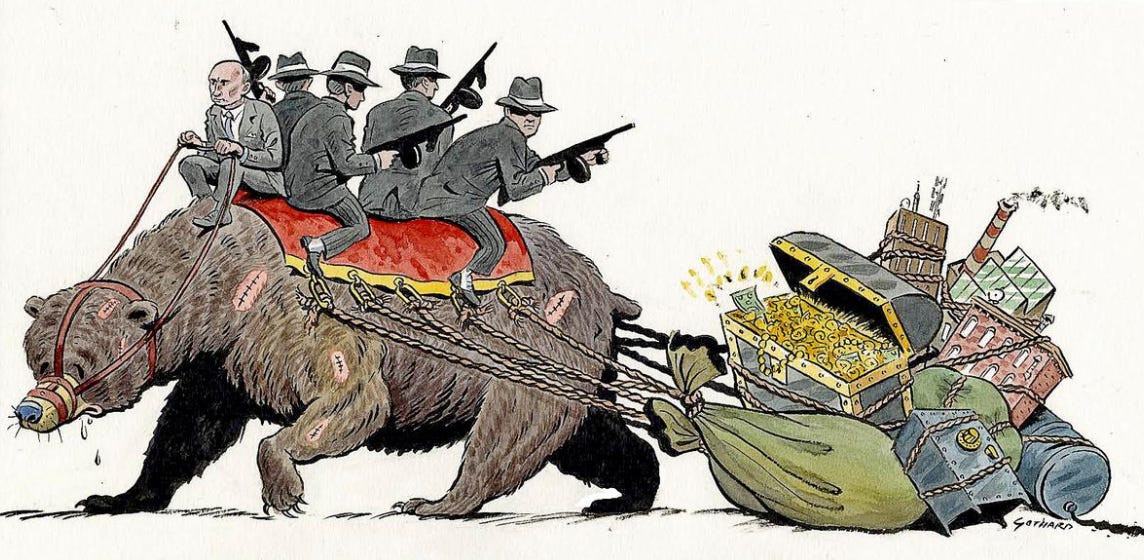
I discovered Diane Franscis’s blog while reading the latest Robert Hubbell. She writes here what many people suspected: Russia is controlled by a ruthless gang. In this country, we call them the mafia. In Russia, they are the government.

She writes:

The bizarre events in Russia over the weekend provide a glimpse into the reality that the country is not a nation, but an empire with warring factions that is run by a mafia. Vladimir Putin has reigned as the “Boss” for 23 years and remained in place by enriching Russia’s thugs, bridling them, and playing one off against another. Under his rule, they have built palaces, stolen the national wealth, become warlords, amassed staggering portfolios, and lived like Czars. But on February 24, 2022, Putin decided to escalate the grift by invading Ukraine to steal more of its resources. Now this war is failing, as is Russia’s economy and Putin’s grip on power. And on June 23, Putin’s inability to control a wartime feud between warlord Yevgeny Prigozhin and Russia’s military brass turned into a full-blown armed mutiny. Prigozhin pulled his mercenaries from the frontline in Ukraine and led a “march for justice” against Putin’s military inside Russia. Putin labeled Prigozhin a “traitor” on national television, ordered his arrest, then instructed his puppet in Belarus, Aleksandr Lukashenko, to make an offer to Prigozhin that he couldn’t refuse: Stand down, charges would be scrapped, and move to Minsk. The crisis ended quickly, but Putin, the Russian Federation, and the war in Ukraine, will never again be the same.

Putin and the gangsters. David Gothard. WSJ

Prigozhin grew up in St. Petersburg, where Putin did, and went to jail as a young man for fraud and theft. He has since become a billionaire oligarch as a result of his connections to Putin and business smarts. More recently, he has become a household word in Russia because of the success of his personal army, the Wagner Group mercenaries, as well as his diatribes on social media against Russia’s generals. He has accused them of poor strategies, corruption, and of using Russian soldiers as cannon fodder. His gutsy stances have made him a populist hero even though he is also a member of the elite. But Prigozhin is different. He’s gone “native” and dons fatigues, is on the frontlines with his mercenaries in the Ukrainian war zone, and excoriates Putin’s generals for drafting young Russians from poor families and regions then sending them to their deaths by the thousands without training or proper equipment.

“The children of the elite smear themselves with creams, showing it on the internet; ordinary people’s children come in zinc, torn to pieces,” said Prigozhin, a reference to metallic coffins. “Those killed in action had tens of thousands of relatives, and society always demands justice and, if there is no justice, then revolutionary sentiments arise.”

Prigozhin warns of revolution but is not a revolutionary. He became a successful chef, then caterer and started a mercenary army that has operated for years surreptitiously around the world on Putin’s behalf. For instance, Wagner helped Putin occupy Crimea and Donbas in 2014, it fought in Syria and various African countries for Moscow for years, and has been involved in the 2022 invasion, fighting alongside Russian regulars in Ukraine. But last year he began to aggressively criticize Russia’s Minister of Defense, Sergei Shoigu, and Chief of General Staff, Gen. Valery Gerasimov and Putin never intervened. This was because he was doing Putin’s dirty work again and blaming the generals for military failures. But Shoigu and Gerasimov struck back by sabotaging the Wagner Group on the battlefield. Prigozhin claimed they withheld ammunition and provided only sub-standard equipment. Then, last month, he alleged that the two actually shelled Wagner troops.

By June, Prigozhin’s success in the battlefield and growing social media presence across Russia and abroad was becoming a threat, so Putin sided with his generals. He ordered Wagner fighters to sign contracts with the Ministry of Defense by July 1. This represented a de facto expropriation which is why Prigozhin pulled his troops from the front line in Ukraine on June 23 and marched them into Russia. That night, Putin condemned Prigozhin on state television and ordered Lukashenko to deliver the deal. Putin has not surfaced since June 24, and unconfirmed reports are that he fled Moscow.

A coup or armed conflict was avoided, but damage was done. Putin’s climb-down and capitulation to a man he had just called a “traitor” destroyed his tough-guy image. It’s obvious that he is not the “Boss”, but merely a figurehead who sits atop a rotten system of squabbling and greedy oligarchs. Prigozhin’s stunt also unveiled Russia’s vulnerability. He was able to march two-thirds of the way toward Moscow in a few hours without resistance. His troops also reportedly shot down six Russian helicopters and an IL-22 airborne command-center plane, killing 13 airmen, along the way, without consequences.

Prigozhin backed down and agreed to self-exile, but he’s not going to disappear, except physically. The generals he demanded that Putin fire still remain in power so he will continue to broadcast his criticisms from afar and plot a comeback, either from a dacha somewhere around the world or on a yacht. He will rebuild Wagner and may attract allies inside and outside Russia who want to overthrow Putin and his generals. He may aspire to be President but that is unlikely. He would be thoroughly unsuitable as President, but, unless assassinated, his ongoing crusade will be a catalyst for change inside Russia and serve the interests of Ukraine and the West. Prigozhin has already undermined Russia’s leadership, damaged frontline morale, stirred up the public, and shredded Putin’s concocted narrative that the invasion was necessary because Ukraine and NATO were a threat to Russia’s existence.

There’s little likelihood that a grassroots movement against Moscow will sprout around Prigozhin because it is a reign of terror and because he’s another thug whose forces have killed many Ukrainians and others. But his popularity was rising in polls before his armed mutiny because his rants resonated with civil society, mostly younger people. He also attracted international recognition with his condemnation of the war itself in the days leading up to the confrontation: “The war wasn’t needed to return Russian citizens to our bosom, nor to demilitarize or denazify Ukraine,” he said. “The war was needed so that a bunch of animals could simply exult in glory.”

The weekend’s events may not have brought about regime change, but Prigozhin has already dealt Putin, and Russia as currently constituted, a fatal blow. As the war continues to backfire, Ukraine and its alliance will push harder and so will separatist movements inside Russia who want autonomy or secession. Putin’s weakness is now apparent, and his tenure uncertain, which will also convince neighboring nations and Russian allies to recalibrate their relationship or forge new ones. Most significantly, Putin’s cave-in and cowardice concerning Prigozhin also means that his many “red lines” in this war are meaningless which is why many have been crossed and more should be ignored in future.

It is ironic that Prigozhin has opened a Pandora’s Box about corruption and injustice in a country run by criminals like himself. His lightning attack also raises fears internationally as to how secure Russia’s nuclear arsenal is from seizure by disgruntled factions such as Wagner or others. Experts say the events haven’t altered the security status of Russia’s nuclear weapons, and the West carefully monitors their movement and storage facilities.

But the country is run by gangsters who have upended the world order. Only “100 beneficiaries and several thousand accomplices” own everything, said Mikhail Kodorovsky, an oligarch jailed by Putin in 2005 on trumped-up charges. “Most of these people began their careers in the criminal underworld of St. Petersburg. Despite having now taken control of the Presidency, the group retains every aspect of the criminal ilk from which they came.”

Putin’s Russia is a criminal organization that must be overthrown. And finally, one of its own has told the world, and Russian people, why it must disappear.

I kept seeing references in the news toa documentary called “Shiny Happy People,” so I turned on Amazon Prime and watched four episodes at one sitting. It’s a fascinating look inside the world of Christian fundamentalism. The documentary focuses on the Duggar family, which achieved fame and fortune because they had 19 children. They live in Arkansas.

The Duggar family had its own TV program on TLC. Television cameras recorded every event in the family. They were the perfect, wholesome American family. Until they weren’t.

This is a good summary of the four episodes. You can see that the family was very attractive. Beautiful girls. Handsome boys. All the children did their chores. And all were home-schooled.

The Duggars belonged to a fundamentalist organization (a cult) called the Institute in Basic Life Principles. It was run by an evangelical preacher who taught a strict and patriarchal way of life. God reigns over man. Man rules over his wife. The parents rule over the children. Good parents administer corporal punishment.

The leader of IBLP knew how every family should act, but he was unmarried.

The father of the Duggar family was elected to the legislature.

It was the perfect family until word got out that the oldest son had molested some of his sisters. Eventually, you learn that the leader of the IBLP was accused of sexually assaulting a number of the attractive young women he chose as his assistants.

There are many interviews with thoughtful people, including some of the adult Duggar children, who reflect on being brainwashed.

We need to know who these Christian nationalists are because they are taking a major role in reshaping our nation and its politics. Nothing is said about national politics but it’s clear that the fundamentalists are a rock-solid part of the Republican Party.

To the extent they gain power, this will be a less tolerant, less open-minded society, indifferent to knowledge and hostile to science.

I hope you watch it.