Archives for category: Cruelty

Jan Resseger is a social justice warrior who worked for the United Church of Christ. In retirement, she writes lucid, carefully researched articles about social policy and its effect on the nation’s most vulnerable people.

I should post everything she writes but I miss some. Here is Jan on Trump’s Big Ugly Bill and how it will hurt the neediest children and families.

This article about Trump’s assault on civil rights law was posted by the National Education Policy Center.

She writes:

On Wednesday, April 23rd, President Donald Trump released an executive order banning the use of disparate impact when the Department of Education’s Office for Civil Rights investigates disparities in school discipline under the Civil Rights Act of 1964.

Under the concept of disparate impact, officials in the Office for Civil Rights have been able to document discrimination by measuring the effects of a school’s or school district’s discipline practice on the mass of the  school’s or school district’s students even when there is no proof that staff members intended to punish some students mores severely due their race or ethnicity or sexual orientation. Staff at the Brookings-Brown Center on Education Policy, Rachel Perera and Jon Valant, define “disparate impact”: “Disparate impact is the idea that school discipline policies that disproportionately harm students of color may constitute illegal racial discrimination even if those policies are… applied in an evenhanded way.”

Academic researchers have been examining unjust school discipline policies for decades. In 2014, the Civil Rights Project at UCLA described groundbreaking work to define “the school-to-prison pipeline” as a metaphor for disparate impact in discipline policies across many U.S. public schools. Researchers documented differences in the kind of punishment imposed on students based on their race or ethicity or disability: “The Civil Rights Project has been working on the school discipline issues since 1999, under the leadership of Daniel Losen. Research from CRP’s Center for Civil Rights Remedies… finds that far too many districts suspend students in droves, while many others have little or no racial disparities and adhere to the common sense philosophy that suspensions, expulsions and arrests are strictly measures of last resort.”

In her new book, Original Sins, sociologist Eve Ewing describes how a punitive, prison-like, school culture, including systemic disparate impact, can infuse a school’s treatment of different groups of students because individual teachers and staff just get caught in the system in which they operate every day: “As sociologist Carla Shedd has written, the ‘routines and rituals’ created by carceral logic—everything from interacting with police officers in schools to strict uniform codes of conduct—become integral to the way a school functions, and can ultimately undermine the ostensibly educational purpose of the school building by making students feel unsafe… From within the space of the school, such regimes of discipline can become so routine that they escape notice by those who are accustomed to them.” (Original Sins, pp, 156-157)

For decades, disparate impact in school discipline has been at the heart of many of the complaints filed and consent decrees established between school districts and the U.S. Department of Education’s Office for Civil Rights. But on April 23, as the NY Times’ Erica Green reports, “President Trump has ordered federal agencies to abandon the use of a longstanding legal tool used to root out discrimination against minorities, a move that could defang the nation’s bedrock civil rights law. In an expansive executive order, Mr. Trump directed the federal government to curtail the use of ‘disparate-impact liability,’ a core tenet used for decades to enforce the Civil Rights Act of 1964 by determining whether policies disproportionately disadvantage certain groups… ‘This order aims to destroy the foundation of civil rights protections in this country, and it will have a devastating effect on equity for Black people and other communities of color,’ said Dariely Rodriguez, the acting co-chief counsel at the Lawyers Committee For Civil Rights Under Law….”

Green explains: “The disparate-impact test has been crucial to enforcing key portions of the landmark Civil Rights Act, which prohibits recipients of federal funding from discriminating based on race, color or national origin. For decades, it has been relied upon by the government and attorneys to root out discrimination in areas of employment, housing, policing, education and more. Civil rights prosecutors say the disparate-impact test is one of their most important tools for uncovering discrimination because it shows how a seemingly neutral policy or law has different outcomes for different demographic groups, revealing inequities… Mr. Trump’s order resurrects a last-ditch effort made in the final days of his first term to repeal disparate-impact regulations through a formal rule-making process… Now the Justice Department’s embattled civil rights division has halted the use of disparate-impact investigations altogether, officials said.”

It is important to note that the Trump administration has not attempted, so far, to change the law itself, but instead to amend the federal guidance and rules that the Department of Education’s Office for Civil Rights has used in its investigations.  The Washington Post‘s Kim Bellware explains: “Trump’s order directs federal agencies to ‘deprioritize enforcement’ of statutes and regulations that include disparate-impact liability, which has long enabled courts to stop policies and practices that unfairly exclude people on the basis of protected characteristics such as race, gender, and disability.”

When disparate impact is cited, the disparities are regularly documented with large data studies.  For example, back in 2008, in his powerful book, So Much Reform: So Little Change, the University of Chicago’s Charles Payne described national data indicating the widespread disparate impact of discriminatory school discipline: “According to data collected by the U.S. Department of Education for the 2004-2005 school year, African American students nationally are suspended or expelled at nearly three times the rate of white students. In Minnesota, Black students are six times as likely to be suspended as whites, but that seems downright friendly compared to New Jersey, where they are almost 60 times more likely to be expelled. In 21 states, the percentage of Black suspensions is more than double their percentage in the student body. These disproportions affect middle-class as well as working-class Black students and there is no reason to believe that they can be reduced to actual differences in student behavior. At least some of the discrepancy seems to be about teachers interpreting similar behaviors differently when they come from students of different races… We shouldn’t be surprised to learn that African American students perceive school climate less favorably than white students or staff.” (So Much Reform: So Little Change, p. 112)

In 2014, in its own “Dear Colleague Letter,” the Obama administration announced a formal policy affirming the use of “disparate impact” as evidence in school discrimination cases. Here is constitutional law professor, Derek W. Black, in a 2016 book, Ending Zero Tolerance: The Crisis of Absolute School Discipline: “On January 8, 2014, the Departments of Education and Justice went beyond individual enforcement actions and formally announced their policy on school discipline moving forward… The policy guidance distinguished between disparate treatment (treating minority students and whites differently in terms of discipline) and disparate impact (facially neutral policies that result in racially disparate outcomes). It came as no surprise that schools cannot suspend an African American student for fighting and only send his white classmate to study hall. But the (formal policy) guidance on racial disparities was significant.” (Ending Zero Tolerance, p. 84)

In 2018, the first Trump administration tried to end the use of disparate impact as a way to measure civil rights violations by ending Obama’s rules and guidance. Perera and Valant reported: “When the Trump administration rescinded the Obama Dear Colleague Letter in 2018… it dropped any reference to disparate impact theory and defined much narrower conditions (for) OCR investigations.”

Perera and Valant add that the Biden administration did, in another Dear Colleague Letter, try to restore Obam’s rules and guidance, but they write that Biden administration’s “letter lacks a definition of illegal discrimination, information about how the federal government will enforce civil rights law, guidance for school districts on mandated data collection, or suggested practices and policies to prevent discrimination.”

Nevertheless, despite the weak Biden policy statement, President Biden’s Department of Education continued to investigate and enforce civil rights violations in school discipline based on disparate treatment.

Here we are now in 2025 with President Trump’s new executive order that attempts to cancel the use of disparate impact in civil rights enforcement altogether. Fortunately Trump’s new executive order will likely face lawsuits.  Erica Green explains why: “Mr. Trump’s executive order, which is likely to face legal challenges, falsely claimed that the disparate-impact test was ‘unlawful’ and violated the Constitution. In fact, the measure was codified by Congress in 1991, upheld by the Supreme Court as recently as 2015 as a tool in the work of protecting civil rights, and cited in a December 2024 dissent by Justice Samuel A. Alito Jr.”

In the meantime in late March 2025, a month before Trump’s new executive order banning the use of disparate treatment in civil rights investigations, Trump’s Office for Civil Rights, in a move demonstrating Trump’s view of civil rights enforcement using “disparate impact,” dismissed a consent degree established in the Biden years to address discriminatory school discipline. The Washington Post‘s Laura Meckler describes what happened in Rapid City, South Dakota: “For years, Native American students in the Rapid City, South Dakota, school district were more likely to be disciplined and less likely to enroll in advanced courses than their White peers. In 2010, the Education Department opened an investigation to see if racial discrimination was to blame… The original investigation found that Native American students in the district were twice as likely as White students to be referred for discipline, more than four times as likely to be suspended and more than five times as likely to be referred to law enforcement officials.”

Meckler continues: “The effort lingered until last year, when investigators came to a voluntary agreement with the district. In a 28-page letter signed last May, the federal government outlined its concerns that Native American and White students had been treated differently. The school district, which is the second-largest in South Dakota, agreed to take a number of steps, including staff trainings, better communication with parents and ongoing monitoring.”

At the end of March 2025, reports Meckler, “the Trump administration told the Rapid City Area School District it was terminating the agreement.”  But school district personnel in Rapid City did not consider the termination of the consent agreement to be a victory: “The Trump administration letter, sent March 27, came as a shock to the Rapid City Area School District, which did not ask for a change, a district spokeswoman said. She said the district plans to continue to abide by its terms, even though federal officials will not be monitoring to see if it does so. ‘While political priorities may shift, our core educational values remain steadfast,’ Cory Strasser, the district’s acting superintendent said in a statement. ‘Our mission remains to provide a safe, positive, and nondiscriminatory learning environment where all students can achieve their full potential.’ “
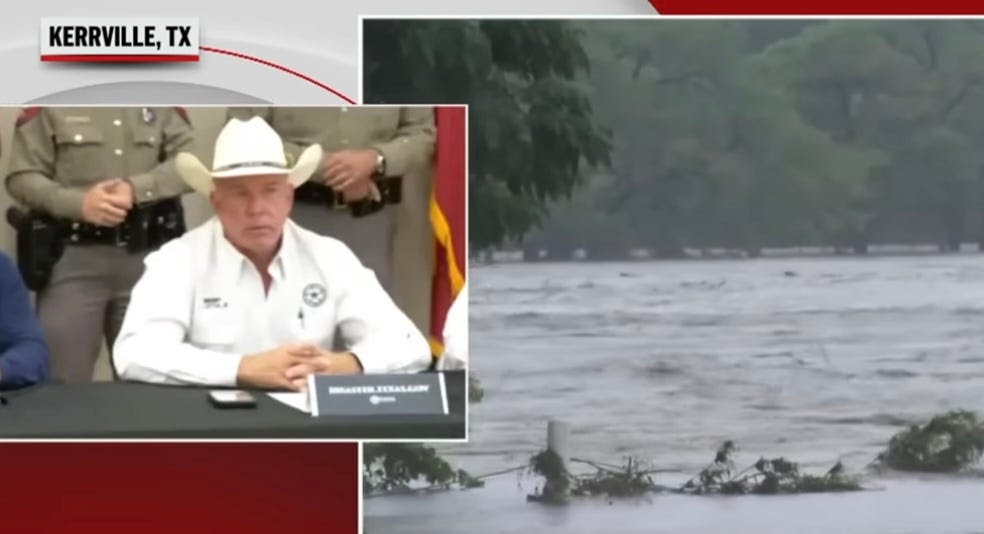
The leaders of Texas have shown again and again that they are indifferent to the lives of the people of their state. Governor Greg Abbott has repeatedly refused to participate in the federal summer lunch program for low-income children, which would have fed nearly four million children. Abbott and his fellow Republicans imposed one of the strictest laws in the nation blocking abortion and the death rate of pregnant women has shot up. He has repeatedly refused to expand Medicaid to reach more than one million Texans who have no health insurance. Governor Abbott and Lieutenant Governor Dan Patrick want to do as little as possible to provide public services or to improve the lives of the poor. They want low taxes. They believe in individual responsibility. That’s their highest priority.

The following article was written by Michael Cohen, Trump’s former lawyer. It appeared on the Meiselas blog. He called it: “When the System Drowns Its People.”

Cohen writes:

There are disasters, and then there are premeditated failures dressed up as acts of God. What’s unfolding across Central Texas isn’t just a freak storm or an unfortunate tragedy; it’s the culmination of arrogance, willful neglect, and a depraved obsession with austerity over human life. More than 100 are confirmed dead, and over 160 remain missing. This is not just weather. This is the rotting fruit of a political doctrine that puts dollars before dignity, and ideology before infrastructure.

This is Flash Flood Alley. They’ve called it that for decades. Scientists warned. Local officials knew. But Texas chose not to prepare. The topography is unforgiving: limestone hills, shallow rivers, rapid runoff. When the sky opens up, this region doesn’t flood. It drowns. It suffocates. And still, nothing. No modernized alert systems. No meaningful statewide plan. Just the usual chest-beating about “personal responsibility” while entire families were swept into the dark.

Here’s the insult to injury: Texas is sitting on $30 billion in a rainy-day fund. That’s not a metaphor; that’s a literal pile of untouched cash that could’ve bought sirens, early-warning systems, elevated infrastructure, floodplain mapping, and the staffing to support it all. Instead, it sat in a bank account while children drowned in their camp bunks.

Now comes the scapegoating. Right on cue, Texas officials have turned their aim at the National Weather Service, claiming it failed to provide sufficient warning. But the San Antonio Express-News called it what it is: a coward’s deflection. The NWS issued alerts—repeatedly. The problem wasn’t the forecast. The problem was that the system built to respond to that forecast had been deliberately dismantled.

Let’s talk about DOGE: the Department of Government Efficiency. This isn’t satire. This is a real federal agency, created in 2025 under Trump’s second administration. Its stated mission? To “streamline” government. Its real job? Gut it from the inside out. Think of DOGE as the ideological Molotov cocktail thrown into the machinery of public service. Under the guise of saving taxpayer money, it laid off meteorologists, froze critical positions at FEMA, slashed NOAA’s coordination grants, and eviscerated the very agencies that make emergency response possible. Efficiency? No. This is strategic sabotage dressed up in a four-letter acronym.

DOGE didn’t just cut fat; it amputated limbs. In the name of small government, they made us small-minded. In the name of freedom, they left us unprotected. And in the name of fiscal responsibility, they created the exact scenario that led to over a hundred preventable deaths in Texas. It’s bureaucratic manslaughter. And it’s spreading.

Texas didn’t just follow DOGE’s lead; it internalized it. Governor Abbott didn’t need to be told to ignore warnings. He’s been doing it for years. Flash Flood Alley has seen repeated disasters, and each time, the response has been more anemic than the last. Why fund a new emergency alert system when you can cut taxes and call it liberty? Why invest in preparedness when you can just blame someone else after the storm?

But here’s the fundamental question: What the hell is government for if not to protect its people?

If your ideology leads you to hoard billions while people drown, then your ideology is broken. If your system prioritizes “lean governance” over living children, then your system is immoral. And if your political leaders shrug at death tolls while quoting spreadsheets, then they shouldn’t be in office; they should be in court.

We live in a nation of deep denial. We still treat climate change as an abstraction. We pretend billion-dollar disasters are flukes. But we are in the age of permanent emergency. The floods are coming every year now. The fires, the heat domes, the inland hurricanes—they’re all part of the new American experience. And yet, our government—federal, state, and local—is being stripped down to the studs in the name of a 1980s fiscal fever dream about trickle-down competence.

Let’s not forget: FEMA, too, is on the chopping block. The same anti-government crusade that birthed DOGE has its sights set on dismantling the last institutions capable of responding to disaster. Because in the minds of these so-called “efficiency experts,” saving lives is a luxury. The bare minimum is too expensive.

Texas is the cautionary tale. It’s what happens when the government decides its job is not to serve the people, but to shrink until it disappears. The dead in Flash Flood Alley didn’t need to die. They died because warnings went unheeded, because funds went unused, and because the infrastructure built to protect them was methodically, proudly destroyed.

So no, this wasn’t just rain. It wasn’t just a storm. It was a policy choice. And that choice killed people.

Let this be the moment we stop pretending that slashing budgets is a moral good. Let this be the moment we say, with clarity and fury: government is not the problem; government is the responsibility. And if it can’t do the basics—warn, protect, rescue—then it isn’t just broken. It’s complicit.

Flash Flood Alley didn’t have to be a graveyard. But thanks to DOGE and the cowardice it inspires, it is.

And if we don’t change course, it won’t be the last.

The New York Times published a long article about the rise and power of Stephen Miller. Miller is one of Trump’s closest aides. His title is Deputy Chief of Staff but he seems to be in charge of immigration policy and many more areas. His goal is to deport every immigrant out of the U.S.

This is a gift article, so you should be able to open it and read it.

Here are a few choice selections.

About the turmoil in Los Angeles, where Trump nationalized the state Guard and sent in hundreds of Marines, which generated protests:

The crisis, from the immigration raids that sparked the protests to the militarized response that tried to put the protests down, was almost entirely of Mr. Miller’s making. And it served as a testament to the remarkable position he now occupies in Mr. Trump’s Washington. Kristi Noem, the homeland security secretary, who reportedly accompanied Mr. Miller on his visit to ICE headquarters, seems to defer to him. “It’s really Stephen running D.H.S.,” a Trump adviser said. The attorney general, Pam Bondi, is so focused on preparing for and appearing on Fox News that she has essentially ceded control of the Department of Justice to Mr. Miller, making him, according to the conservative legal scholar Edward Whelan, “the de facto attorney general.” And in a White House where the chief of staff, Susie Wiles, is not well versed or terribly interested in policy — “She’s producing a reality TV show every day,” another Trump adviser said, “and it’s pretty amazing, right?” — Mr. Miller is typically the final word.

There is much truth to the conventional wisdom that the biggest difference between the first and second Trump presidencies is that, in the second iteration, Mr. Trump is unrestrained. The same is true of Mr. Miller. He has emerged as Mr. Trump’s most powerful, and empowered, adviser. With the passage of the big policy bill, ICE will have an even bigger budget to execute Mr. Miller’s vision and, in effect, serve as his own private army. Moreover, his influence extends beyond immigration to the battles the Trump administration is fighting on higher education, transgender rights, discrimination law and foreign policy….

Mr. Miller is more obdurate when it comes to domestic policy, particularly immigration. For Mr. Trump’s second term, he has led the president to stake out a series of maximalist positions, from the ICE raids to the use of the Alien Enemies Act to raising the possibility of suspending habeas corpus for people suspected of being undocumented immigrants. Mr. Trump seems to enjoy having Mr. Miller play the heavy on immigration. During his first term, he jokingly told people who urged him to take more moderate stances on immigration that Mr. Miller would never go for them. Last year, he reportedly quipped during a campaign meeting that if it was up to Mr. Miller, the population of the United States would be only 100 million people and they’d all resemble Mr. Miller. The humor, however, underscores something serious: On immigration, Millerism is a more consistent ideology than Trumpism.

While Mr. Miller is an ardent restrictionist, seeking to reduce all immigration to the United States, Mr. Trump has at times backed H-1B visas for skilled foreign workers; created a wait-list for a proposed special visa, called a Trump Gold Card, that wealthy immigrants could buy for $5 million apiece; and expressed regret about the impact ICE raids were having on the agriculture and hospitality industries. Indeed, the backlash to the ICE raids was so great that in early June, Mr. Trump reversed himself and declared the agriculture and hospitality sectors off-limits to that sort of strict immigration enforcement — before, after intense lobbying from Mr. Miller, he reversed himself again. Still, the hiccup was enough to hint at a broader potential rupture, especially if Mr. Miller’s immigration policies continue to prove unpopular. A recent Quinnipiac poll found that 57 percent of Americans disapprove of Mr. Trump’s handling of immigration, once his greatest political strength.

From Day 1 of the Trump administration, the strategy of the Trumpers was to “flood the zone.” That is, to roll out so many new policies that the public could not keep track, and the media couldn’t deal with them all. Trump’s staff had the blueprint in Project 2025, and they were prepared with dozens of executive orders. That, plus the depredations of Elon Musk’s DOGE kids made it seem as if we had suddenly been swarmed by an invasion from outer space of aliens intent on destroying our government.

Now that Congress has passed Trump’s One Big Ugly Bill, we are in the same situation. The near 1000-page bill has so many policy reversals that no one knows all of its contents. The goal seems to be to wipe out anything that Biden or Obama accomplished.

Michael Tomasky, editor of The New Republic, insists that we pay attention to the dramatic increase in funding for ICE. Will we have labor camps spread across the country where detainees can be hired out to farmers to perform the labor they used to be paid for?

Tomasky writes:

One aspect of the Republicans’ big, ugly bill that didn’t get enough attention until Rep. Alexandria Ocasio-Cortez elevated it over the last few days is the massive amounts of money it directs to the apprehension and detention of immigrants. On Thursday, right after the bill passed the House, AOC posted on Bluesky:

I don’t think anyone is prepared for what they just did w/ ICE. This is not a simple budget increase. It is an explosion – making ICE bigger than the FBI, US Bureau of Prisons, DEA,& others combined. It is setting up to make what’s happening now look like child’s play. And people are disappearing.

— Alexandria Ocasio-Cortez (@aoc.bsky.social)July 3, 2025 at 2:58 PM

The next day—the Fourth of July, as fate would have it, when President Trump signed the bill into law—historian Timothy Snyder posted a columnon Substack under the blunt headline “Concentration Camp Labor.” If AOC’s post and Snyder’s headline sound hyperbolic to you, consider what’s actually in this new law.

It includes $170 billion for immigration enforcement: about $50 billion to build a wall on the Southern border; $30 billion for Immigration and Customs Enforcement (ICE); and $45 billion for detention camps.

A little perspective: ICE’s existing annual budget has been around $8 billion, so $30 billion is nearly quadruple. As AOC noted, it will make ICE into a huge police force that will indeed be larger than the FBI ($11.3 billion), the Bureau of Prisons ($9 billion), and the Drug Enforcement Administration ($3.3 billion) combined.

What is ICE going to do with all that money? One thing, obviously, is that it will try to hire enough people to hit MAGA apparatchik Stephen Miller’s target of rounding up 3,000 people a day. That’s a target it apparently still hasn’t even hit. On June 5, NBC News reported that ICE hit a then-record of 2,200 detentions that day. That included hundreds of people who showed up at regional ICE offices to check in as required by the release program they were enrolled in—a program under which these people were deemed not to be threats to public safety and whose movements were already monitored by ankle bracelets or geo-locator apps.

In other words, ICE has already been detaining thousands of people who, yes, entered the United States illegally, but ever since just lived, worked, and even paid taxes. Some may have gotten into some trouble with the law, but they’re wearing monitors and showing up for their appointments. Others have had no scrapes with the law at all. And now ICE is going to have the resources to detain thousands more such people.

And no—the American public emphatically does not support this. A late June Quinnipiac poll found that 64 percent of respondents said undocumented people should be given a path to citizenship, and only 31 percent said they should be deported. And that 64 percent is up from 55 percent last December, meaning that people have watched six months of Trump’s immigration policies in action and turned even more strongly against deporting everyone.

So that’s what ICE is going to do with its $30 billion. Now think about $45 billion for detention camps. Alligator Alcatraz is expected to cost $450 million a year. Right now, a reported 5,000 detainees are being held there. The Trump administration says the new $45 billion will pay for 100,000 beds. So that’s 20 more Alligator Alcatrazes out around the country. But it’s probably even going to be worse than that, because the state of Florida, not the federal government, is footing the bill for that center. If the Trump administration can convince other states to do the same, or pay part of the freight, we’re looking at essentially a string of concentration camps across the United States. Besides, there’s something odd about that $450 million a year price tag. (Here’s an interesting Daily Kos community post asking some good questions about that astronomical cost. The math doesn’t add up.)

Forty-five billion will build a lot of stuff. As a point of comparison: In 2023, the United States budgeted $12.8 billion to build new affordable housing. We’re about to spend nearly four times on detention centers what we spend on housing.

Open the link to finish reading.

It is sickening to realize that the US, our beloved country, is now aligned with Russia and Putin. It is sickening to realize that when the UN took a vote to condemn Putin’s illegal invasion of Ukraine, the U.S. voted “no,” allied with Russia, North Korea, and Iran. It is sickening to realize that the U.S. is now in cahoots with the enemies of freedom and democracy.

It is sickening to see the Justice Department turned into a weapon for Trump’s personal revenge. It is sickening to see Trump’s vicious assault on higher education and academic freedom. It is sickening to watch the arrest and detention of immigrants by masked men without ID without a semblance of due process. It is sickening to see the massacre of civilians in Gaza. It is sickening to see the Trump family scoop up billlions in real estate deals, crytocurrency and other ventures. It is sickening to see the Republican Party pass a budget that cancels the health insurance of millions of low-income Americans to pay for tax cuts for the richest Americans.

One man is responsible: Trump. He worries about Putin’s feelings, not about Russian bombs hitting Ukrainian schools, playgrounds, hospitals, homes, and its energy supply. He plays with tariffs as a way to humiliate other countries, carelessly wiping out the life savings of people who trusted him. Was it by accident that he excluded Russia, North Korea, Belarus, and Cuba from his tariff threats? Trump jokes about turning Gaza into a luxury resort instead of demanding an end to the war. The cruel budget that takes from the poor and gives to the rich was his budget. It is his massive ego that has turned the Department of Justice into his personal revenge and retribution machine.

I wish he could watch Charlie Chaplin in this speech from his film The Great Dictator. It is only three minutes. Please watch. These thoughts are needed today more than at any time since 1945.

The editorial board of the Sun-Sentinel in Florida expressed shock and disgust at the creation of the detention camp for immigrants now called Alligator Alley. The existence of this hell-hole offended their sense of decency but they were offended even more by the casual glee that Trump, DeSantis, Noem and others expressed about the inhumanity of the detention center. Inmates will die of the scorching heat and humidity. That’s predictable. And these swells in their air-conditioned offices will laugh.

The editorial board wrote:

Unable to resist the political clickbait, President Donald Trump muscled Gov. Ron DeSantis and
Florida Attorney General James Uthmeier out of the limelight Tuesday, to celebrate the opening
of a Florida first.

It is an armed camp where thousands of immigrants targeted as undesirables will be confined, possibly without hearings, under the brutal conditions of a swamp in the Everglades in a place most Floridians have never heard of, called Ochopee.

It wasn’t the construction of “Alligator Alcatraz” that brought the president to the camp.

It’s not Florida’s fast-tracking of construction that’s entrancing right-wing media, breathing new life into DeSantis’s national political dreams, and boosting Uthmeier’s reelection profile.

It is the savagery.

The headline-grabbing power of “Alligator Alcatraz” lies entirely in the imagery of brown people getting out of line and being ripped bloody by alligators or suffocated by snakes.

Strip out the celebration of suffering and grotesque inhumanity and it’s just a row of tents in the middle of nowhere.

No respect for the land

This is one more scar on land environmentalists are waging a decades-long battle to save.

It’s just one more insult to the Miccosukee Tribe, which called it home long before Uthmeier embraced it as a stepping-stone to his election campaign.The imagined torment of immigrants at this camp is not a glitch. It’s the main selling point.

This distinguishes it from World War II’s horrific internment of families and orphans of Japanese descent in tar-paper shacks, because they were of the wrong ethnicity at the wrong time. Even President Franklin D. Roosevelt called them concentration camps.

But FDR didn’t hawk T-shirts emblazoned with images suggesting gruesome deaths or show AI-generated images of alligators in ICE hats. The Republican Party of Florida did. So did the U.S. Department of Homeland Security.

The World War II White House did not mark the opening of an internment camp by breathlessly reporting a ravenous cannibal detainee said to be eating himself while in federal custody on a deportation flight. DHS did.

DHS Secretary Kristi Noem and internment cheerleaders want you to believe that comparisons to other inhumane camps is hysterical hyperbole, as if the cynical marketing of Alligator Alcatraz is not.

The heat and humidity

In a particularly vivid example of his trademark cluelessness, DeSantis rebuffed criticism of inhumane conditions by pointing out the new camp’s showers.

Of course it is inhumane. Of course Trump, DeSantis, Noem and Uthmeier will deny bathing in the specter of savagery, even as Trump’s GOP raised money off it, while sidestepping their role in likely deaths that will have much less soundbite potential.

As Floridians know so well, heat is among the deadliest of weather events. High humidity prevents the body from cooling. Combined, the two are lethal.

The detention camp will place thousands of immigrants in wire cages in a humidity-intense swamp that is all but inaccessible to hospital ambulances, and where the summertime heat index can soar above 100 degrees.

Evacuating in advance of severe storms presents its own dangers, especially as it does not take a hurricane to flood a swamp or the two-lane road running next to it.

On Tuesday, when a typical summer shower dumped less than two inches of rain during the opening tour, water seeped through the edges of buildings, walls shook and water spread across electrical cables, Spectrum News video showed.

On Wednesday, forecasters upped the odds of a major windstorm moving across Florida.

Trump has bigger plans

Environmentalists are suing to stop construction, but Trump has even bigger plans for detention.

It’s wishful thinking to believe South Florida’s immigrant communities within driving distance of Alligator Alcatraz will be exempted, regardless of citizenship status.Trump made clear during Tuesday’s tour that naturalized U.S. citizens — who live in virtually every community in Miami-Dade, Broward and Palm Beach counties — may be next to face detention and deportation.

“I think we ought to get them the hell out of here, too, if you want to know the truth,” Trump told reporters. “So maybe that will be the next job.”

The Sun Sentinel Editorial Board consists of Opinion Editor Steve Bousquet, Deputy Opinion Editor Dan Sweeney, editorial writers Pat Beall and Martin Dyckman, and Executive Editor Gretchen Day-Bryant. To contact us, email at letters@sun-sentinel.com.

Anand Girihadaras writes in his blog “The Ink” that the billionaire elite have given up their pretense of using their fortunes to make a better world. Two events stripped away the veil: one, the greedy gaudy wedding of Jeff Bezos and Lauren Sanchez in Venice and the announcement by Mark Zuckerberg and his wife Priscilla Chan that they are abandoning their lofty goals of curing the world of disease.

Naked greed is in, big-hearted philanthropy is out. The oligarchs revel in their splendor.

Anand writes:

Like bottomless mimosas and a mother’s unsolicited advice, eras don’t just end. The new thing elbows its way in, the old thing lingers like a houseguest, and they compete for primacy. Only eventually — sometimes long after — do you notice the eclipse.

No one was ever going to announce that the era of performative elite do-gooding had ceded to the era of naked oligarchy. But this week three events made that eclipse clear.

The first was the multi-billionaire Jeff Bezos’s wedding, in Venice, to Lauren Sánchez, who would surely float if she fell into a canal. As celebrities poured into a city already strained by tourism, and the happy couple was photographed frolicking in a literal foam party aboard a yacht, there was an almost refreshing, well, nakedness to the avarice, to the carelessness, to the not-giving of civic fucks.

There was a reminder of the omnipotence and the utter loneliness at the commanding heights: you can get anyone you want to your wedding, and the people you want are the people you’d invite if you told your assistant to run to the dentist’s office, pick up People magazine, write down names in it, and invite them. These are people who have everything, and who don’t have the thing everybody else does.

The second was the inevitable announcement by multi-billionaire Mark Zuckerberg’s charitable foundation, run with his wife, Priscilla Chan, that it is no longer focused on ending all the diseases, as it once promised. Rather, in the Trump era, it is focused on things that would not be any trouble to Trump. “Can we cure all diseases in our children’s lifetime?” read a screen behind the couple at a rehearsal in 2016. The answer turns out to be: No. The Washington Post, owned by the oligarch in the above item, nonetheless rightly warned, in the Zuckerberg-Chan case, of “the risks for communities reliant on wealthy private donors.”

The third event was the passage today of Donald Trump’s and the Republicans’ budget, a document of searing meanness that former Labor Secretary Robert Reich calls the “Worst Bill in History” — a “giant budget-busting, Medicaid-shattering, shafting-the-poor-and-working-class, making-the-rich-even richer bill.” Like the Bezos wedding and the Zuckerberg-Chan pivot, the bill had one refreshing quality, though. It made zero effort to mask its ugliness. It said the cruel part out loud.

There is a nakedness to our oligarchy now, and it is pruny as hell. But at least there is this: As far as I can tell, the era of highly performative elite do-gooding is passing. The billionaires who felt the need to give TED talks about eradicating poverty while also causing poverty. The incessant blabbing about Africa by oligarchs who rarely left Connecticut. The pledges to save democracy, save the planet, and, yes, end all diseases. The buy-one-donate-one products. Red things involving Bono.Subscribe

I wrote a whole book about that era and its maneuvers and deceptions and costs, and it occurs to me now that the entire complex of activities I chronicled is giving way to something altogether different. What is ascendant now is nakedness — of greed, of sociopathy, of power thirst. Somewhere along the way, the professed goal of the elite morphed from fighting inequality from above to defending their castles in the sky.

There is a kind of progress in this, because what is naked is easier to see, even if pruny.

This eclipsing of performative virtue by pungent avarice, of fake billionaire “change” by real billionaire wolfishness, is part of why figures like Zohran Mamdani are rising. When I published Winners Take All in 2018, the things I was trying to deconstruct took explaining. That is, after all, why you write a book. I’m not sure a book is needed now.

The moves, the lust, the underlying goals — all of it is in the open. This era is less confusing. And people are voting accordingly.

It’s also why a generation gap is opening. The old guard power elite, seeing Mamdani’s rise, is terrified that the Soviet Union could soon be coming to a bodega near them, even though they probably don’t live near any bodegas and probably think the word “bodega” is Arabic. But their children and grandchildren are not afraid of free buses and childcare. They’re willing to take a chance on something that would switch their trajectory off the track from nothing to nowhere and on to a course of life.

Among its many stupid decisions, Elon Musk’s DOGE cut the staff of NOAA and the Natuonal Weather Service. Experts warned that people would die without accurate warnings. Trump ignored the warnings; so did Republicans in Congress. The cuts were imposed. The savings were a pittance. Unprepared for the storm and flooding in Texas a few days ago, people died.

Ron Filipowski wrote at The Meidas Report:

As the best and the brightest were being fired at the National Weather Service and the National Oceanic and Atmospheric Administration by senseless and draconian ‘DOGE’ cuts earlier this year under Trump, with no reason given except for the need to cut a paltry amount of the government’s budget, experts warned repeatedly that the cuts would have deadly consequences during the storm season. And they have.

Dozens and dozens of stories have been written in the media citing hundreds of experts which said that weather forecasting was never going to be the same, and that inaccurate forecasts were going to lead to fewer evacuations, impaired preparedness of first responders, and deadly consequences. I quoted many of them in my daily Bulletins and wrote about this issue nearly 20 different times. 

And the chickens have come home to roost. Hundreds of people have already been killed across the US in a variety of storms including deadly tornadoes – many of which were inaccurately forecasted. And we are just entering peak hurricane season. Meteorologist Chris Vagasky posted earlier this spring on social media: “The world’s example for weather services is being destroyed.” 

Now, after severe flooding in non-evacuated areas in Texas has left at least 24 dead with dozens more missing, including several young girls at a summer camp, Texas officials are blaming their failure to act on a faulty forecast by Donald Trump’s new National Weather Service gutted by cuts to their operating budget and most experienced personnel. 

At a press conference last night, one official said: “The original forecast we received on Wednesday from the National Weather Service predicted 3-6” of rain in the Concho Valley and 4-8” of rain in the hill country. The amount of rain that fell in these locations was never in any of their forecasts. Everybody got the forecast from the National Weather Service. They did not predict the amount of rain that we saw.” 

Reuters published a story just a few days ago, one of many warning about this problem: “In May, every living former director of the NWS signed on to an open letter with a warning that, if continued, Trump’s cuts to federal weather forecasting would create ‘needless loss of life’. Despite bipartisan congressional pushback for a restoration in staffing and funding to the NWS, sharp budget cuts remain on pace in projections for the 2026 budget for the NOAA, the parent organization of the NWS.”

But Commerce Secretary Howard Lutnick, whose agency oversees NOAA, testified before Congress on June 5 that the cuts wouldn’t be a problem because “we are transforming how we track storms and forecast weather with cutting-edge technology. Under no circumstances am I going to let public safety or public forecasting be touched.” Apparently the “cutting edge technology” hasn’t arrived yet.

And now presumably FEMA will be called upon to help pick up the pieces of shattered lives in Texas – an agency that Trump said repeatedly that he wants to abolish. In fact, Trump’s first FEMA director Cameron Hamilton was fired one day after he testified before Congress that FEMA should not be abolished. 

The voters of Texas decided that they wanted Donald Trump and Greg Abbott to be in charge of the government services they received. That is exactly what they are getting. And as of this writing on Saturday morning, Trump still hasn’t said a word about the storm and the little girls who were killed at the camp. 

However, Trump was seen dancing on the balcony of the White House last night celebrating the latest round of cuts in his budget bill that just became law so billionaires and corporations can have huge tax cuts. People are dying and more will die because of their recklessness, just like we saw during covid. And now millions won’t even have health insurance to deal with the consequences.

Jan Resseger reports on an unprecedented stoppage in federal funding of Congressionally authorized school programs. School districts across the nation were informed on June 30 that the funding for five important programs would be withheld on July 1 pending further review. The administration really would like to terminate the programs but since they can’t do that under current law, they decided to withhold funding for undetermined reasons for an indeterminate length of time.

She writes:

Last week, this blog reported, “Chaos and Confusion at U.S. Department of Education May Threaten School Programming this Fall.”  This week the situation intensified.

“The U.S. Department of Education told states in a three-sentence memo on Monday afternoon (June 30) that when federal funding for the next school year arrived July 1, as it typically does and is supposed to under federal law, funding for five key programs would not be there.”  Education Week‘s Mark Lieberman published that explanation on Tuesday, July 1, 2025, the day the federal funding failed to arrive.  Lieberman adds: “Those formula programs—worth $6.8 billion in total—are under review, the memo said, without specifying when the review would wrap up, what the review is aiming to determine, or whether the funds will go out once it’s finished.”

The problem is that the funds aren’t merely late; the Trump administration is trying to cancel the programs altogether.  The NY Times‘ Sarah Mervosh and Michael Bender explain: “The administration has suggested that it may seek to eliminate the nearly $7 billion in frozen funding. Russell Vought, the director of the White House Office of Management and Budget, said during a Senate Appropriations Committee hearing last week that the administration was considering ways to claw back the funding through a process known as rescission. The administration would formally ask lawmakers to claw back a set of funds it has targeted for cuts. Even if Congress fails to vote on the request, the president’s timing would trigger a law that freezes the money until it ultimately expires. ‘No decision has been made,’ Mr. Vought said.”

In an article published on Monday afternoon, right after states received the memo declaring that funding would not arrive as scheduled, Education Week‘s Lieberman provides some background: “(I)n an unsigned email message sent after 2 p.m. Monday… the Education Department informed states that the agency won’t be sending states any money tomorrow from the following programs:

  • “Title I-C for migrant education ($375 million),
  • “Title II-A for professional development ($2.2 billion),
  • “Title III-A for English-learner services ($890 million),
  • “Title IV-A for academic enrichment ($1.3 billion),
  • “Title IV-B for before-and after-school programs ($1.4 billion.).”

Lieberman adds: “In a separate email sent (Monday) at 4:27 p.m., the department told congressional staffers that it’s holding back funds from all the programs listed above, as well as grants for adult basic and literacy education ($729 million nationwide). Questions about the changes, the letter says, must go to the Office of Management and Budget, not the Education Department.”

The elimination of these programs had been proposed in the Trump administration’s formal FY 2026 budget proposal for next fiscal year—which, if passed by Congress, would fund public schools beginning in fall 2026. In proposing to cancel the programs this fall, the Trump administration is attempting to eliminate programs already promised under an FY 2025 continuing budget resolution. (To make things even more complicated, it’s important to remember that the “One Big Beautiful” bill is a tax and reconciliation bill and not, in fact, the current year’s FY 2025 federal budget—which remains unaddressed by Congress.)

Last week Mark Lieberman clarified the schedule by which federal public school funding is supposed to be delivered: “The federal fiscal year begins Oct. 1, but for most education programs, half the upcoming year’s allocated funding flows to states each year on July 1. Congress still hasn’t agreed on a final budget for the current fiscal year, even though it’s almost over.  Instead, lawmakers in March approved a continuing resolution bill that broadly carries over funding levels from the previous fiscal year. That means states and schools have been expecting for months that funding levels for key federal programs would closely mirror last year’s numbers. Thousands of school districts and nearly 30 states have already locked in their own budgets for the upcoming fiscal year.”

In his coverage on Monday, June 30, of the complex wrangling behind the holdup of funds for the current school year, Lieberman places responsibility not on Linda McMahon or staff at the Department of Education, but instead on Russell Vought, who was the co-author of the Heritage Foundation’s Project 2025 and who now heads the Office for Management and Budget:

“Lawsuits are likely to follow, as they have for similar funding changes the administration implemented earlier this year. Federal law prohibits the executive branch from withholding congressionally appropriated funds unless it gives federal lawmakers an opportunity to approve or reject the move within 45 days. The U.S. Constitution gives Congress, not the president, the power of the purse—but top administration official Russell Vought, whom Trump appointed to lead the Office of Management and Budget, has said he believes restrictions on impoundment are unconstitutional. On Capitol Hill last week, Vought said the administration hadn’t decided whether to ask Congress for permission to impound education funding.”

Last week, the Washington Post‘s Jeff Stein, Hannah Natanson, Carolyn Johnson, and Dan Diamond predicted that Russell Vought will attempt to interfere with spending as the year continues: “Though billionaire Elon Musk’s U.S. DOGE Service drew significant attention for its speedy cuts, Russell Vought, Trump’s budget director, is expected to be key to the coming fight over spending. Vought has spearheaded the administration’s campaign to assert sweeping executive power over spending, arguing that the Impoundment Control Act, the law at issue now, is unconstitutional. The Trump administration has justified its cost-cutting measures by pointing out that the United States is $36 trillion in debt, although the type of funding that officials have targeted represents a small fraction of the overall budget.”

Although costs for federally funded 21st Century Learning Center after-school programs, federally funded professional development programs for teachers, federally funded classes for English language learners in public schools, federally funded programs for the education of the children of migrant workers, and federally funded academic enrichment programs make up only a minute percentage of the federal budget, the abrupt obliteration of these programs will cause enormous disruption right now as public school leaders are getting crucial programming for their schools in place for fall. Public schools are incredibly complex institutions. In addition to providing special services for disabled students, school boards and school leaders patch together local, state, and federal dollars for programming to serve the specific needs of their students, which differ by region, by the income level of a school district’s families, by the primary languages of the families in their communities, and by enormous inequity in states’ investment in public education.

Clearly Russell Vought neither understands nor cares how the programs he is is cutting will affect students. Clearly he fails to grasp how these cuts will interfere with hiring already underway for the upcoming school year or how the absence of these funding streams will undermine the stability of public school operations come September.

On the other hand, say I, maybe Russell Vought knew exactly what it mean to freeze funds at the last minute. Maybe his intent was to sow chaos and disruption. Maybe he wanted to send a message to Congress: we can withhold funds Congress appropriated without regard to the law. Maybe he wanted to send a message to states and school districts: If the program is important to you, pay for it yourself. Stop expecting the federal government to send you money.

Since this is a mostly education blog, I have covered the budget debate by focusing on what the GOP is doing to maim public schools and enrich private (especially religious schools). In the past, Republicans were strong supporters of public schools. But the billionaires came along and brought their checkbooks with them.

The rest of the Ugly bill is devastating to people who struggle to get by. Deep cuts to Medicaid, which will force the closure of many rural hospitals. Cuts to anything that protects the environment or helps phase out our reliance on fossil fuels. Well, at least Senator Schumer managed to change the name of the bill, new name not yet determined.

One Republican vote could have sunk the bill. But Senator Murkowski got a mess of pottage.

David Dayen writes in The American Prospect:

Welcome to “Trump’s Beautiful Disaster,” a pop-up newsletter about the Republican tax and spending bill, one of the most consequential pieces of legislation in a generation. Sign up for the newsletter to get it in your in-box.

By the thinnest of margins, the U.S. Senate completed work on the One Big Beautiful Bill Act on Tuesday morning, after Sen. Lisa Murkowski (R-AK) decided that she could live with a bill that takes food and medicine from vulnerable people to fund tax cuts tilted toward the wealthy, as long as it didn’t take quite as much food away from Alaskans.

The new text, now 887 pages, was released at 11:20 a.m. ET. The finishing touches of it, which included handwritten additions to the text, played out live on C-SPAN, with scenes of the parliamentarian and a host of staff members from both parties huddled together.

At the very end, Senate Minority Leader Chuck Schumer knocked out the name “One Big Beautiful Bill Act” with a parliamentary maneuver, on the grounds that it was ridiculous (which is hard to argue). It’s unclear what this bill is even called now, but that hardly matters. The final bill passed 51-50, with Vice President JD Vance breaking the tie.

Murkowski was able to secure a waiver from cost-sharing provisions that would for the first time force states to pay for part of the Supplemental Nutrition Assistance Program (SNAP). In order to get that past the Senate parliamentarian, ten states with the highest payment error rates had to be eligible for the five-year waiver, including big states like New York and Florida, and several blue states as well. 

The expanded SNAP waivers mean that in the short-term only certain states with average or even below-average payment error rates will have to pay into their SNAP program; already, the language provided that states with the lowest error rates wouldn’t have to pay. “The Republicans have rewarded states that have the highest error rates in the country… just to help Alaska, which has the highest error rate,” thundered Sen. Amy Klobuchar (R-MN), offering an amendment to “strike this fiscal insanity” from the bill. The amendment failed along party lines.

The new provision weakens the government savings for the bill at a time when the House Freedom Caucus is calling the Senate version a betrayal of a promise to link spending cuts to tax cuts. But those House hardliners will ultimately have to decide whether to defy Donald Trump and reject the hard-fought Senate package, which only managed 50 votes, or to cave to their president.

In addition, Murkowski got a tax break for Alaskan fishing villages and whaling captains inserted into the bill. Medicaid provisions that would have boosted the federal share of the program for Alaska didn’t get through the parliamentarian; even a handwritten attempt to help out Alaska on Medicaid was thrown out at the last minute. But Murkowski still made off with a decent haul, which was obviously enough for her to vote yes.

All Republicans except for Sens. Rand Paul (R-KY), Thom Tillis (R-NC), and Susan Collins (R-ME) voted for the bill. Tillis and Collins are in the two most threatened seats among Republicans in the 2026 midterm elections; Tillis decided to retire rather than face voters while passing this bill. Paul, a libertarian, rejected the price tag and the increase in the nation’s debt limit that is folded into the bill.

Other deficit hawks in the Senate caved without even getting a vote to deepen the Medicaid cuts. That could be the trajectory in the House with Freedom Caucus holdouts. But the House also has problems with their handful of moderates concerned about the spending slashes in the bill.

The bill was clinched with a “wraparound” amendment that made several changes, including the elimination of a proposed tax on solar and wind energy production that would have made it impossible to build new renewable energy projects. The new changes now also grandfather in tax credits to solar and wind projects that start construction less than a year after enactment of the bill. Even those projects would have to be placed in service by 2027. The “foreign entities of concern” provision was also tweaked to make it easier for projects that use a modicum of components from China to qualify for tax credits.

The bill still phases out solar and wind tax credits rather quickly, and will damage energy production that is needed to keep up with soaring demand. But it’s dialed down from apocalyptic to, well, nearly apocalyptic. And this is going to be another source of anger to the Freedom Caucus, which wanted a much quicker phase-out of the energy tax credits.

The wraparound amendment also doubled the size of the rural hospital fund to $50 billion. The Senate leadership’s initial offer on this fund was $15 billion. Overnight the Senate rejected an amendment from Collins that would have raised the rural hospital fund to $50 billion. Even at that size—which will be parceled out for $10 billion a year for five years—it hardly makes up for nearly $1 trillion in Medicaid cuts, which are permanent. The hospital system is expected to buckle as a result of this legislation, if it passes.

Some taxes, including a tax on third-party “litigation finance,” were removed in the final bill. But an expanded tax break for real estate investment trusts, which was in the House version, snuck into the Senate bill at the last minute.

The state AI regulation ban was left out of the final text after a 99-1 rejection of it in an amendment overnight.

The action now shifts to the House, where in addition to Freedom Caucus members concerned about cost, several moderates, including Reps. David Valadao (R-CA) and Jeff Van Drew (R-NJ), have balked at the deep spending cuts to Medicaid and other programs.