Archives for category: Courage

Anand Giridharadas is a brilliant writer and thinker who blogs at The Ink. In this post, he interviews Michael Roth, the President of Wesleyan College in Connecticut, who describes how he has handled student protests without calling in the police or trampling on free speech rights. Just days ago, Roth wrote an article in The New York Times advising that the best college choice is one where you don’t fit in; go outside your comfort zone. Be a nonconformist.

Anand writes:

In recent weeks, the wave of antiwar protest that began at Columbia University spread across the country, as did the backlash against it.

Many university leaders responded by shutting down student speakerscanceling commencement ceremonies, and ultimately calling in police to clear encampments and campus building occupations with mass arrests. Thousands of students, professors, and other protestors have been arrested nationwide; meanwhile, protests are ongoing, the House Committee on Education and the Workforce continues its fishing-expedition investigation of higher education, and the domestic battle over the campus protests continues to distract attention from the ongoing war in Gaza.

What is right here? Should universities crack down on students who disrupt campus life, even if their cause is just? Are there steps student groups could take to more clearly separate their movements from elements of antisemitism? Can the rest of society muster enough historical memory and thick enough skin to remember that students are often telling us something that we need to hear, even if we don’t want to?

One university leader has been grappling with these questions in an especially thoughtful way, in part because, in addition to running a university, he is a scholar of universities and of education. That grounding shows. Under Michael Roth, Wesleyan University has cut a different path from many campuses, by clearly and calmly reiterating students’ right to protest peacefully, as Roth did in this letter:

The students there know that they are in violation of university rules and seem willing to accept the consequences. The protest has been non-violent and has not disrupted normal campus operations. As long as it continues in this way, the University will not attempt to clear the encampment.

At the same time, Roth has been clear about the importance of keeping people’s focus on the underlying war, not elite campuses; on the very real problem of antisemitic elements in and around the protests; and about the need to sustain campuses as places where students and teachers and others expect a mix of safety and challenge.

We caught up with Roth the other day for a conversation you won’t want to miss if you’ve been following not only the war but the fight over the war and are craving, as we have been, more light and less heat.


A request for those who haven’t yet joined us: The interviews and essays that we share here take research and editing and much more. We work hard, and we are eager to bring on more writers, more voices. But we need your help to keep this going. Join us today to support the kind of independent media you want to exist.

And today we’re offering new paying subscribers a special discount of 20 percent. You will lock in this lower price forever if you join us now!

Get 20% off forever


Your statement of Wesleyan’s position on the continuing protests is notable for its simple recognition of the rights and responsibilities of all parties. 

Can you talk about the decisions that went into your statement and why such statements have been so rare?

I am happy to talk about my statement, but I really want to emphasize that we need to turn more political energy toward demanding that the U.S. force a humanitarian ceasefire in Gaza, a return of the hostages, and, then, negotiations toward a sustainable peace.

As for protests at Wesleyan University: We could have immediately closed down the encampment because the protesters hadn’t gotten advance permission for tents, or because they were writing messages on the adjacent buildings in chalk. But in the context of national protest movements, it seemed wrong to me to use “time and place restrictions” other schools have cited as reasons for shutting down protests. 

Over the last week, I’ve gotten many notes from alumni, parents, and strangers chastising me for not making the protesters “pay a price” for breaking the rules.

So why haven’t I made them feel those consequences? Cops don’t always give people tickets for going a few miles over the speed limit. Context matters, whatever Congresswoman Elise Stefanik says.

In this case, I knew the students were part of a broad protest movement, and protest movements often put a strain on an institution’s rules. They are meant to do that. The encampment was “non-violent and has not disrupted normal campus operations,” I wrote, and “as long as it continues in this way, the University will not attempt to clear the encampment.” I added that we would “not tolerate intimidation or harassment of students, staff, or faculty,” and that the protesters, as far as I could tell, were not moving in those directions. I want to emphasize that this can change and that if the protesters choose to more seriously disrupt our work as an educational institution, they will face much more significant repercussions.

Last Tuesday we saw two very different conclusions to major campus protests; at Columbia, the administration — claiming it had “no choice” — called in the NYPD, made multiple arrests and cleared the Hamilton Hall occupation and lawn encampment. (Yale, UCLA, and others did similarly.) Reportedly, Columbia has arranged for the NYPD to remain on campus through the conclusion of the term on May 17. On the other hand, student protestors at Brown finally reached an agreement with the Corporation of Brown University to dismantle their encampment in exchange for a vote on divestment from firms connected to the Israeli military campaign. Admittedly, I am asking you to speculate, but can you think through what the process behind these different decisions might have been? 

At Columbia, the combination of outside participants, intimidating antisemitic chants, and — most importantly — the destructive occupation of a building necessitated a much stronger response than has been necessary elsewhere. Administrators seemed to judge that the university couldn’t safely continue to operate. If that was the case — and I know there remain significant disputes about the facts — the protesters had to be cleared, and the penalties on offenders, I suspect, will be severe. 

At UCLA, early indications are that police allowed counter-protesters to engage in violence. At other schools, students and administrators have been able to decide to do something positive for the situation in Gaza without engaging in empty but symbolically satisfying gestures. Divestment is a distraction. There is little indication that it has the desired effects, even in the long run. Gazans need a ceasefire and massive humanitarian aid now.

I’m curious as to how your scholarly work might have informed your thinking on this. Several of your books speak pretty directly to what’s happening (I think in particular of Beyond the UniversitySafe Enough Spaces,and The Student: A Short History). How does your work as a theorist of liberal education figure into your response to these protests?

All my scholarship is animated by a pragmatist approach, which means that I have a general suspicion of abstract principles and a commitment to working through problems so as to be in a better position to pursue one’s most important goals. My work before these education books was heavily influenced by Hegelian and Freudian models of thinking: an expectation that conflict is necessary for any important change and that unconscious motivations are always in play in crises. To put it simply: I expect conflict, and I expect acting out. 

I believe that liberal education in America is always connected to civic engagement. We want our students to learn how to be better citizens while they come to understand the ideas and the contexts of whatever field they study. In Safe Enough Spaces, I argue that civic preparedness (to use Danielle Allen’s term) develops when students value free speech and political participation in contexts that prohibit violence and intimidation. Students don’t need to be protected from offensiveness, but they do need to be educated in situations in which they learn to think for themselves in the company of others. That’s what I call “practicing freedom.”

That’s why ideally we can make crisis moments like ours educational for the students. This does not mean we pander to them. On the contrary, they learn from teachers who resist their popular but dumb ideas, and who help students understand better how to pursue meaningful objectives over time.

Leave a comment

The House Education Committee has now called three more university presidents — for the first time, three men, and two of them leading public universities: Peter Salovey, president of Yale University; Gene Block, chancellor of the University of California at Los Angeles; and Santa Ono, president of the University of Michigan.

It seems quite clear that the committee’s animus towards the elite universities isn’t actually about the threat of antisemitism, protecting free-speech rights, or even ensuring student safety. What do you think the goal actually is for Foxx, Stefanik, and the other Republican members?

Despite my many years working on Freud and psychoanalysis, I don’t understand the deep motivations behind people who on some days cozy up to Replacement Theory and Christian Nationalism and on other days paint themselves as anti-antisemites.

For over a century, one has said that antisemitism is the socialism of fools. Today, anti-antisemitism has become the conservatism of knaves.

The political motivations of extreme right politicians are clear: they are riding the anti-elites train, the wave of rejecting people with expertise and credentials. By attacking so-called cultural elites, the extreme right avoids talking about economic elites. It distracts people with real grievances from the profound issues of inequality that plague this country. Rather than deal with child poverty, the so-called conservatives attack Ivy Leaguers; rather than force billionaires to pay their fair share of taxes, they turn our attention to protesters on campus.

Some news coverage has described university actions against protesters as driven by these Congressional hearings. Is that the case? What about donors or boards? Are you feeling any such pressure? 

No.

What do you make of the charge that the protesters are antisemitic? Do you have a sense that there are actual connections among opposition to Israeli military action, anti-Zionism, and antisemitism? Or are we seeing a toxic mixture of bad-faith political entrepreneurship and angry, less-than-fully-informed student groups?

Of course, one can be anti-Zionist and not be antisemitic. It is clear that many Jewish students have joined the protests and that one can be very much opposed to the politics of Israel’s government (I am) and not be antisemitic (I am not).

I also think it’s pretty obvious that some of the protesters use antisemitic tropes, and that some of them don’t consider it possible for a Jew to be an innocent civilian. Hamas, which some protesters applaud, is viciously antisemitic. It considers the rape of Jewish women and the killing of Jewish babies not just tactics of war but an occasion for ecstatic rejoicing. It doesn’t get more antisemitic than that. 

I remain appalled (but, alas, no longer shocked) that many protesters don’t seem to be concerned about their association with this terrorist organization. They don’t care. Although only a small minority of protesters might be overtly antisemitic, it is far too easy for many to accept Jewish deaths as the price for someone to be free.

This doesn’t have to be explicit for it to be hateful, especially from people who not long ago were concerned with microaggressions against other groups. Antisemitism enables far too many to accept the cheapening of Jewish life; it’s classic scapegoating. This is a very old story on the right, and also for more than fifty years among people who want to be thought of as progressive. If Israel changed its ways, would these people still be antisemitic? Yes. The thrill of being part of a movement trumps their basic moral sense.

Speaking of Trump, of course this will help him. If his people were smart enough to instigate the protests to divide the left and to whip up anger at kids on campus, they couldn’t have done a better job. My hope is that the civic preparedness that may be enhanced by young folks’ involvement in this movement will energize them to protect democracy in the fall.

Share

What are the protesters’ specific demands at Wesleyan? What’s your sense of their actual overall motivations?

Also, what do you make of the common media framing of the protesters as “pro-Palestinian” versus counterprotestors who are “pro-Israel?” If we’re making the 1968 comparison, why not “antiwar” instead, since in a practical context they are mainly pushing for a ceasefire at this point?

The demands at Wesleyan resemble the BDS demands of some years ago. Very little to do with Gaza in particular; the demands have to do with isolating Israel economically and culturally. I would hope that students will turn their attention to having an impact on U.S. foreign policy and not the “cancellation” of a complicated country with a complex history.

As for being antiwar, I wish there was more of that idealism across the country. I prefer that good old naivete to what one hears from many in today’s movement. Many in today’s movement seem to think war (violence) is justified as long as you are “on the right side of history,” which today for them means the “anti-colonial” side. This is insipid, lazy thinking, and it leads to some of the self-righteous, close-minded rhetoric of people who in other moods might be defending free speech, democracy, and the development of the rule of law. It also leads to the same vicious moral callousness that the U.S. displayed in, say, Iraq and that Israel displays today in Gaza. People who had “God on their side” have done lots of damage, as will people who think they have “history on their side” today.

One thing I’ve been wondering is whether everyone is making a mistake by thinking of this movement in light of 1968. Is there built-in hyperbole here — on the left, seeing a protest movement as a looming problem for the Democratic convention, as a threat to a second Biden term; on the right, the useful specter of 60s-style counterculture opposition — that works against peaceful resolution of the conflict, regardless of how the students might see themselves? I don’t see as much media comparison to the actions against apartheid of the 1980s, which seems more useful (and in many cases then, university administrators either ignored or came to terms with the student movement).

Some of the opposition to the students is based on procedures. They are in the wrong space at the wrong time. Other opposition is based on the clear indications from many protesters that Israel should not exist as a state. These protesters have yet to opine as far as I know about the legitimacy of other states in the region.

Yes, I think the protests are a problem for politics in the fall unless young people take the political energies they’ve experienced and turn those energies toward building coalitions at home to win the next round of elections and to pass legislation that might facilitate the creation of a more just and peaceful world. 

But at a time when we should be putting our full attention on getting a humanitarian ceasefire in Gaza, we are instead talking about fancy college campuses. At some schools, protesters seem more interested in investment policies or in campus disruption than in doing anything meaningful for Gazans. The media finds it easier to cover Columbia than Rafah. Let’s instead pay attention to the right things: We need a ceasefire and a return of the hostages now, and we need to get aid to Gaza.

This article in The Washington Post by Hanna Natanson and Anymita Kaye provides a national review of states that are trying to stop book censorship and protect librarians and states that not only ban books for sexual and racial content but threaten jail time for librarians who dispense such books. The state-by-state descriptions on the legal status of librarians is valuable. Open the link if you can to see where your state ranks and what actions it is taking to protect or threaten librarians.

Sam Lee, a leader of the Connecticut Library Association, heads to work these days torn between hope and fear.

She’s encouraged because legislators in her state proposed a bill this year making it harder for school boards to ban library books. But she’s fearful because Connecticut, like America, is seeing a sustained surge in book challenges — and she wonders if objectors will see the legislation as a reason to file more complaints.
“I would like to be optimistic,” Lee said. “But having been in my position for the last few years … I don’t know, it really feels like it’s been forever. And I am worried the book banners are just going to be emboldened.”

The bill in Connecticut, pending before an education committee, is one of a raft of measures advancing nationwide that seek to do things like prohibit book bans or forbid the harassment of school and public librarians — the first such wave in the country, said John Chrastka, director of library advocacy group EveryLibrary.

Legislators in 22 mostly blue states have proposed 57 such bills so far this year, and two have become law, according to a Washington Post analysis of state legislative databases and an EveryLibrary legislative tracker.

But the library-friendly measures are being outpaced by bills in mostly red states that aim to restrict which books libraries can offer and threaten librarians with prison or thousands in fines for handing out “obscene” or “harmful” titles. At least 27 states are considering 100 such bills this year, three of which have become law, The Post found. That adds to nearly a dozen similar measures enacted over the last three years across 10 states.

Lawmakers proposing restrictive bills contend they are necessary because school and public libraries contain graphic sexual material that should not be available to children. Some books’ “sole purpose is sexual gratification,” said West Virginia Del. Brandon Steele (R), who introduced a bill that would allow librarians to be prosecuted for giving obscene titles to minors.
“It is strictly about pornography,” Steele said. “On that limited basis, this isn’t going to have the chilling effect people think it’s going to.”

But other lawmakers say bills like Steele’s are ideologically driven censorship dressed up as concern for children. They note that, as book challenges spiked to historic highs over the past two years, the majority of objections targeted books by and about LGBTQ people and people of color…

The protective library laws being pushed around the country run the gamut: From increasing funding to adding school librarians to campuses to forbidding “discrimination” in choosing which books to stock…

Some restrictive library bills give parents more power over book selection, for example requiring schools obtain parental sign-off before providing children sexually explicit content. Another common move is to require that libraries post lists of their books for parental review.

But the majority of the bills work the same way. They eliminate long-established exemptions from prosecution for librarians — sometimes teachers and museum employees, too — over obscene material. Almost every state adopted such carve-outs decades ago to ensure schools, museums and libraries could offer accurate information about topics such as sex education.

Removing the exemption means librarians, teachers and museum staffers could face years of imprisonment or tens of thousands in fines for giving out books deemed sexually explicit, obscene or “harmful” to minors. For example, an Arkansas measure passed last year says school and public librarians can be imprisoned for up to six years or fined $10,000 if they hand out obscene or harmful titles.

The law protects children and doesn’t harm librarians unless they’re doing something awful, bill sponsor Sen. Dan Sullivan (R) said at the time: “If they don’t knowingly violate [the law], they’re free and clear.”

Seventeen states are weighing some version of this measure, The Post found. That comes after at least eight states enacted such laws between 2021 and last year, although two were later vetoed and one was blocked by the courts.

The Post could not find an instance in which a librarian has been charged under these laws. But Peter Bromberg of the Utah Library Association pointed out several recent cases in which police were called to schools or launched investigations over books — in Missouri, Texas and South Carolina…

Tara White was appointed Elkhart Community Schools’ director of literacy in 2015. For the first several years, she never fielded a book challenge — until 2021, when community members objected to 60 titles, she said. When she defended the books, a conservative website claimed she was fighting for porn in school.

Then last year, Indiana passed a law declaring school employees can face criminal prosecution — leading to a possible $10,000 fine or 2½ years of jail time — for handing out sexual material that is “harmful to minors.”

White resigned.

“I loved being a librarian and … helping every student find themselves in a book,” White said. But while certain she wasn’t actually “breaking the law, nobody wants to go through that process.”

Nobody wants to go to jail, she said, for giving children books.

Tim Slekar is a fearless warrior for public schools, teachers, and students. I will be talking to him about Slaying Goliath and the struggle to protect public schools from the depredations of billionaires and zealots.

This Thursday on Civic Media: Dive Back into “Slaying Goliath” with Diane Ravitch

Grab your pencils—BustEDpencils is gearing up for a no-holds-barred revival of Diane Ravitch’s game-changing book, *Slaying Goliath*, live this Thursday on Civic Media. 

Launched into a world on the brink of a pandemic, *Slaying Goliath* hit the shelves with a mission: to arm the defenders of public education against the Goliaths of privatization. But then, COVID-19 overshadowed everything. Despite that, the battles Diane described haven’t paused—they’ve intensified. And this Thursday, we’re bringing these crucial discussions back to the forefront with Diane herself.

This Thursday at 7pm EST on BustEDpencils, we’re not just revisiting a book; we’re reigniting a movement. Diane will dissect the current threats to public education and highlight how *Slaying Goliath* still maps the path to victory for our schools. This isn’t just about reflection—it’s about action.

**It’s time to get real. It’s time to get loud. It’s time to tune in this Thursday at 7 PM EST on Civic Media.**

If you believe that without a robust public education system our democracy is in jeopardy, then join us. Listen in, call in (855-752-4842), and let’s get fired up. We’ve got a fight to win, and Diane Ravitch is leading the charge.

Mark your calendars and fire up Civic Media this Thursday at 7pm Central. 

Frank G. Splitt is a regular reader of the blog and a retired engineer of great distinction. He sent me his Amazon review of Liz Cheney’s best-selling book about the Congressional hearings conducted by the January 6 Select Committee. I have been meaning to review the book myself but put it off and am glad to print Frank’s review, as I agree with him.

I found the book to be absorbing, revealing what Congressional leaders said to one another on the day of the insurrection, as well as the inner workings of the January 6 Committee. Cheney doesn’t pull her punches. She was appalled by Trump’s disrespect for the Constitution and his egregious lying. She is contemptuous of Congressionals leaders like Kevin McCarthy who first condemned the violent attack, then turned on a dime to bend his knee to Trump.

Liz Cheney gave up her leadership role because of strong principles. Chief among these was her oath to the Constitution. She refused to betray it, and by doing so, she gave up the likelihood that she would one day be Speaker of the House. Very few Republicans were willing to follow her lead. I have immense respect for her.

Frank G. Splitt writes:

Liz Cheney wrote the book with purpose in mind: to assure that the January 6 Select Committee’s work that revealed the culpability of former president Donald Trump in the January 6.2021, attack on the U.S. Capital would not only be thoroughly documented for posterity, but would also illuminate in detail his criminal behavior backed by solid evidence via trustworthy testimony, mostly from members of his own administration.


The book is fact-based and well organized—providing the author’s first-hand beginning-to-end account of the January 6th, 2021, insurrection from outside and inside the halls of the Capital. She tells in consummate detail how, in the aftermath of the 2020 presidential election, Donald Trump ignored the rulings of dozens of courts, plotted to overturn a lawful election, and provoked a violently egregious attack on our Capitol. Cheney goes on to tell how Trump and his congressional enablers broke their oaths of office— betraying the American people and the Constitution in their attempt to prevent the counting of electoral votes and so keep Trump in office.


Liz Cheney helped organize and lead the Congressional Select Committee investigation into how it happened. In her book she tells the story of this perilous moment in our history—exposing those who helped Trump spread his stolen-election lie while forsaking her promising political career in the process.


In the end, I am disappointed not only with the gullibility of so many American citizens who buy into Trump‘s lies, but even more so with craven politicians who keep silent for fear of losing their positions in Congress. No doubt, Cheney would have been near the top of the list of courageous U. S, Senators in John Kennedy’s 1956 book Profiles in Courage.


I am also somewhat disappointed that Trump did not respond to the Select Committee’s subpoena to testify before the committee. By not appearing, Cheney was denied the opportunity to emulate Senate lawyer Joseph Welch’s admonition of lying Wisconsin Senator Joseph McCarthy at the 1953 Army-McCarthy hearing by saying: Mr. Former President, you’ve done enough. Have you no sense of decency, sir, at long last? Have you left no sense of decency?


This should be a must-read book for every American voter as Cheney’s warning concerning the likely consequences of Trump’s return to office is indeed chilling.

Thom Hartmann warns that we will install a fascist regime if Trump should be re-elected.

Every one of us must do what we can to prevent this from happening.

Our democracy has many defects and it sorely needs fundamental change, but it needs change for the better, not change for the worse. We need a government that will roll back the rule of the oligarchy, we need more equality of wealth and income, we need fewer billionaires, we need Medicare for all, we need to reverse Citizens United. We need many changes. But we don’t need fascism.

Hartmann writes:

Fascism doesn’t typically take over countries by military means (WWII’s temporary order notwithstanding); instead, it relies on rhetoric. 

Words. Speeches. News conferences. Rallies. Media. Money. And they all point in one direction: violence in service of the fascist leader.

The rhetorical embrace and appreciation of violence is one of the cardinal characteristics of fascism, and a big step was taken this week in a New York City courtroom to push back against the current fascist campaign being waged by Donald Trump against our American form of government.

Noting that Trump’s “statements were threatening, inflammatory, [and] denigrating” Judge Juan Merchan imposed a gag order on the orange fraudster and rapist, forbidding him from further attacks against the court’s staff, the DA’s staff, witnesses, and jurors. 

Why? Because all were concerned about becoming the victims of Trump’s fascist army.

Because the judge omitted himself from the list, as its his job to try send bad guys to prison, Trump got slick and attacked the judge’s daughter (who’s also not on the list). Now she’sgetting death threats. 

This isn’t the first time. Whenever Trump finds himself in trouble, fraud or violence follow, as has already been determined by a court in New York this month and we saw in the pattern of his presidency….

Analysts of fascism from Umberto Eco to Hannah Arendt to Timothy Snyder and Ruth Ben-Ghiat generally agree on a core set of characteristics of a fascist movement. It includes:

— A romantic idealization of a fictional past (“Make America Great Again”)
— Clear definition of an enemy within that is not quite human but an “other” (“vermin,” “rats,” “animals,” all phrases Trump has used just in past weeks to describe immigrants and employees of our criminal justice system)
— Vilification of the media (“fake news” or lugenpresse)
— Repeated attacks on minorities and immigrants as a rallying point for followers (shared hatred often binds people together)
— Disparagement of elections and the rule of law (because neither favors the fascist movement)
— Glorification of political violence and martyrdom (the January 6th “patriots” and Ashley Babbitt)
— Hostility to academia and science leading to the elevation of Joe Sixpack’s ability to “do his own research” (simple answers to complex questions or issues)
— Embrace of fundamentalist religion and the moral codes associated with it
— Rejection of the rights of women and members of the queer community as part of the celebration of toxic masculinity
— Constant lies, even about seemingly inconsequential matters (Hannah Arendt noted in 1978: “If everybody always lies to you, the consequence is not that you believe the lies, but rather that nobody believes anything any longer.”)
— Performative patriotism that replaces the true obligations of citizenship (like voting and staying informed) with jingoistic slogans, logos, and mass events: faux populism
— Collaboration with oligarchs while claiming to celebrate the average person

Donald Trump and his MAGA movement check every single box.

So did the American Confederacy and the Democratic Party it seized in the 1860s. And the American fascist movements of the 1920s and 1930s (albeit, they were much smaller). And the white supremacy movement of the mid-20th century, from the KKK to the White Citizens’ Councils (ditto).

This is not our first encounter with fascism, as I detail in The Hidden History of American Oligarchy. Nor will it be our last: fascism has a long history and an enduring appeal for insecure, angry psychopaths who want to seize political power and the great wealth or opportunity that’re usually associated with it…

Preventing a fascist takeover is not particularly complex, and there are encouraging signs that America is beginning to move in this direction. It involves a few simple steps:

— Recognize and call out the fascists and their movement as fascists

With Trump and his fascist MAGA movement, this is happening with greater and greater frequency. Yesterday, for example, the Financial Times’ highly worldwide-respected columnist Martin Wolf published an article titled Fascism has Changed, but it is Not Dead.

“[W]hat we are now seeing,” Wolf writes, “is not just authoritarianism. It is authoritarianism with fascistic characteristics.” He concludes his op-ed with: “History does not repeat itself. But it rhymes. It is rhyming now. Do not be complacent. It is dangerous to take a ride on fascism.”

For a top columnist in one of the world’s senior financial publications to call a candidate for US president and his movement fascists would have been unthinkable at any other time in modern American history. And it’s happening with greater and greater frequency across all aspects of American media.

— Debunk and ridicule extremism while ostracizing fascists from “polite company”

Increasingly, Trump’s fascist movement and those aligned with it are becoming caricatures of themselves. Book-banners and disruptors of public education are reaching the end of their fad-like existence. Moms for Liberty is a sad joke founded by some of the country’s more bizarre examples of hypocrisy; the former head of the RNC was fired from NBC for her participation in Trump’s fascist attempt to overthrow our government; and CPAC has shriveled into a hardcore rump (pun intended) faction of the conservative movement.  

Political cartoonists lampoon Trump followers as toothless rubes and obese, gun-obsessed men; so many women are rejecting Republicans as dating partners that both sociologists and media have noticed; and the GOP is looking at a possible bloodbath (to use Trump’s favorite term) this November, regardless of how many billions in dark money their billionaires throw into the races. We saw the first indicator of that this week in Alabama.

— Support democratic institutions and politicians who promote democracy

The media landscape of America has become centralized, with a handful of massive and mostly conservative corporations and billionaires owning the majority of our newspapers, radio and TV stations, and online publications.

Nonetheless, there are many great online publications beating the drum for democracy, and many allow subscriptions or donations. My list includes Raw StoryAlternetDaily KosCommon DreamsSalonTalking Points MemoThe New RepublicMother JonesThe NationThe GuardianDemocratic UndergroundJacobinOpEdNewsSlate, and Free Speech TV. In addition, there are dozens of worthwhile publications that share this Substack platform with Hartmann Report: you can find my recommendations here. And I’m live daily on SirusXM Channel 127 (Progress) and on Free Speech TV, as are many of my progressive colleagues. Read, use, listen, share, and support them.

There are also multiple organizations dedicated to promoting democracy and democratic values in America. They range from your local Democratic Party to IndivisibleProgressive Democrats of AmericaMove to AmendMoveOn.orgRoots ActionProgressive Change Campaign Committee (PCCC)EMILY’s ListRun for SomethingNextGen AmericaAdvancement ProjectLeague of Women VotersDemocracy InitiativeCommon Cause, and Citizens for Responsibility and Ethics in Washington (CREW).

Other democratic institutions we should be supporting by joining, donating, or participating in their governance include public schools, libraries, city councils, county government groups, etc. When MAGA fascists show up to disrupt these institutions and intimidate their members, we should be there to defend them.

President Biden, speaking last fall at an event honoring John McCain, laid it on the line and challenged all of us:

“As I’ve said before, we’re at an inflection point in our history — one of those moments that only happens once every few generations. Where the decisions we make today will determine the course of this country — and the world — for decades to come.

“So, you, me, and every American who is committed to preserving our democracy carry a special responsibility. We have to stand up for America’s values embodied in our Declaration of Independence because we know MAGA extremists have already proven they won’t. We have to stand up for our Constitution and the institutions of democracy because MAGA extremists have made clear they won’t.

“History is watching. The world is watching. Most important, our children and grandchildren are watching.”

I recently went to see “Cabrini,” the story of America’s first saint. It’s a wonderful film, and I highly recommend it.

Mother Cabrini, as she was known, founded an order of sisters in Italy that created orphanages and homes for poor children. She longed to launch a mission to China but the Pope denied her request and told her to go to America instead, where there were large numbers of impoverished Italian immigrants.

She and several of her sisters traveled by ship to New York City in 1889 and immediately established residence in the Five Points, a congested and dirty neighborhood teeming with indigent Italian immigrants. The sisters opened a home and school for vagrant children living in squalid conditions.

Mother Cabrini was always in frail health but she had an iron will and surmounted every obstacle that blocked her desire to serve. She was a fearless feminist. The Archbishop of New York was not welcoming but she overcame his opposition. The Mayor of the city tried to close down her orphanage and frustrate her plans to grow, but she persisted.

She was ingenious. She sought out a reporter for The New York Times, brought him to see the living conditions of her district, and he wrote about her work. Children were “living worse than rats,” in sewers under the streets, he wrote. Anything to stay alive. Mother Cabrini ran a school where they learned English but sang songs in Italian. She wanted them to fit into their new homeland but not to lose touch with their ancestral home.

Let me emphasize that while the story centers on a nun with an iron will, there is no religious propagandizing. None. It’s a movie about courage, dedication, kindness, and a fierce desire to help the neediest. Mother Cabrini eventually established orphanages and hospitals around the world.

The lesson that I took away from the film was about the hard life of immigrants and the valor of those who reached out to help them survive. In the 19th and early 20th centuries, there were no government services. People came pouring in and had to make it in their own or die from hunger and disease.

Mother Cabrini’s love for the immigrants of her time stand in sharp contrast to the political rhetoric of today, when they are vilified as rapists, drug dealers, murderers, invaders. Even the children.

As I watched the film, I found myself wishing that Trump might see it. I know he never will. Its message is not religious. It’s about kindness, compassion, dedication, and selflessness. He would say that Mother Cabrini was a radical socialist, a Communist, a sucker, a fool, and not his type.

In addition to the story line, I loved the depiction of early New York City (even though the credits say the film was made in Buffalo).

I am not a huge fan of professional ice skating but I am a huge fan of excellence. I just watched a 10–minute clip of Ilia Malinin’s World Championship performance yesterday in Montreal. It was mesmerizing!

Ilia was born in Virginia. His parents were professional skaters in Uzbekistan, as was his grandfather. His parents are his coaches.

Watching this brilliantly accomplished young man reminded me of the book written by Senator John F. Kennedy in 1958 titled A Nation of Immigrants.

The subject was on my mind because yesterday I saw a moving and beautiful film called Cabrini. That too made me reflect on today’s hateful rhetoric about immigrants.

Ilia’s magnificent performance in Montreal was hailed by the sportscasters as one of the most remarkable events in the history of ice skating. Watch it!

Glenn Rogers is a veterinarian and a rancher who lives in Graford, Texas. In addition to his duties as a vet and a rancher, he served on the school board of the Graham Independent School District. He was elected to represent District 60 in the Texas Legislature in 2021. He is a conservative, and he tries to represent his rural constituents faithfully. They don’t want vouchers. They want more funding for their local public schools and higher salaries for their teachers. People know their teachers. The teachers know their students and their families. The public schools are important for the local economy. The tradition of Friday night high school football games unifies the community; it’s known as “Friday night lights.”

When Representative Rogers voted against vouchers along with other rural Republicans, Governor Abbott unleashed an advertising blitz against them. The ads accused them of being “weak on security,” which was a lie. Money from billionaires poured into the district to smear Rep. Rogers. He lost.

Rep. Rogers released this statement, which was published in The Weatherford Democrat:

“I’ll Wear No Man’s Collar”

-Davy Crockett

First, I want to thank my supporters, those who voted for me and those who supported me prayerfully, financially, and in so many other ways. It has been the greatest honor to serve this district.

The corruption that exists at the highest level of Texas state government would have made Governor “Pa” Ferguson blush.

Governor Greg Abbott has defiled the Office of Governor by creating and repeating blatant lies about me and my House colleagues, those who took a stand for our public schools. I stood by the Governor on all his legislative priorities but just one, school vouchers. For just one disagreement, and for a $6 million check from Jeff Yass, a Pennsylvanian TikTok investor, and voucher vendor, Abbott went scorched earth against rural Texas and the Representatives who did their jobs-representing their districts.

My tenure in the Texas House included two general sessions, seven special sessions, redistricting, Covid, winter storm Uri, a Democrat quorum break, expulsion of a House member and the impeachment of Ken Paxton. It also includes a litany of conservative victories that made Texas safer, reigned in out-of-control government bureaucracy, lessened what had become a crushing tax burden on our families and businesses, and fostered economic growth.

I am not a good politician. I am just a Texas rancher who wanted to make a difference in my community. Who knew this simple mission would have resulted in three brutal campaigns?

Throughout my three campaigns, because of my unwillingness to be compliant with the two billionaire, “Christian” Nationalist, power brokers that run this state, I have been unmercifully slandered through the politics of unwarranted personal destruction on social media, radio, post mail, streaming sites, and cable television.

In my first race the opposition was the Wilks, Tim Dunn, Empower Texans, and the entire enterprise of dozens of PACs and “non-profits” they financed. The race ended in a hard fought Covid-delayed runoff victory against Farris Wilks’ son-in-law.

In my second race, my opposition was Wilks and Dunn, Empower Texans (rebranded to Defend Texas Liberty), and the Voucher Lobby, including the American Federation for Children and the School Freedom Fund (based in Virginia). In that race, we dealt with a runoff and an expensive, unnecessary recount.

In my third race the opposition was all the above, but now included a rebranded Defend Texas Liberty (Texans United for a Conservative Majority), vastly greater money from the Voucher Lobby, and Governor Greg Abbott.

This time the millions of dollars spent spreading lies about my record and the non-stop false impugning of my integrity were just too much to overcome. The real losers in this race are:

1) Texas public schools;

2) Rural Texas; and

3) Representative Government.

This morning, I have no regrets. I believe in the words of Sam Houston, “Do right and risk the consequences.”

History will prove Ken Paxton is a corrupt, sophisticated criminal. History will prove vouchers are simply an expensive entitlement program for the wealthy and a get rich scheme for voucher vendors. History will prove Governor Greg Abbott is a liar.

History will prove that our current state government is the most corrupt ever and is “bought” by a few radical dominionist billionaires seeking to destroy public education, privatize our public schools and create a Theocracy that is both un-American and un-Texan.

May God save Texas!

[Editors Note: the Wilks brothers and Tim Dunn are oil-and-gas billionaires who are evangelical Christians; they want vouchers, and they use their money to control state government. Ken Paxton is the State Attorney General who was impeached by the Texas House of Teprrsentatibes on multiple charges of corruption, based on whistleblower reports from his own staff. After Paxton’s billionaire friends came to the rescue, giving a campaign contribution of $2 million to Lt. Gov. Dan Patrick, who conducted the trial in the Srnate, Paxton was acquitted. In this week’s election, Attorney General Paxton and his wealthy friends ousted legislators and judges who tried to hold him accountable.]

I am a native Texan. I was born and raised in Houston. I attended Houston public schools from kindergarten until my high school graduation. The public schools of Texas gave me a strong foundation, and I will always be grateful to my teachers and my schools.

The public schools in Texas will be harmed by vouchers. Yet Governor Greg Abbott is demanding that the Legislature endorse vouchers, so that the public will subsidize every student who goes to private and religious schools. No wonder he campaigned for vouchers by visiting private and religious schools.

Some Republican legislators know that vouchers will hurt their public schools.

Governor Abbott has spent millions of dollars to defeat those brave Republican legislators who oppose vouchers.

The primary is March 5.

Funded by oil and gas billionaires and by Jeff Yass, a Pennsylvania billionaire, Abbott has tried and repeatedly failed to pass a voucher bill. He failed because these Republican legislators stood up for their communities and their public schools.

These legislators know their local teachers. They are friends and neighbors. The legislators know they are hard-working dedicated teachers. They teach the children; they don’t “indoctrinate” them, as Governor Abbott falsely claims. Many have taught in the same schools for decades, raising up the children in the way they should go.

The teachers are underpaid, and the school buildings need upgrades. But the Governor won’t put another penny into paying teachers and funding public schools unless he gets his vouchers.

In every state that has vouchers, most of them are used by students who never attended public schools. Vouchers are nothing more than a public subsidy for students already attending private and religious schools.

Voucher schools are free to discriminate and are excused from all accountability.

These heroic and principled legislators deserve your thanks and your vote on March 5:

  • Steve Allison, District 121, San Antonio
  • Ernest Bailes, District 18, Shepherd
  • Keith Bell, District 4, Forney;
  • DeWayne Burns, District 58, Cleburne;
  • Travis Clardy, District 11, Nacogdoches
  • Drew Darby, District 72, San Angelo
  • Jay Dean, District 7, Longview
  • Charlie Geren, District 99, Fort Worth
  • Justin Holland, District 33, Rockwall
  • Ken King, District 88, Canadian
  • John Kuempel, District 44, Seguin
  • Stan Lambert, District 71, Abilene
  • Glenn Rogers, District 60, Mineral Wells
  • Hugh Shine, District 55, Temple
  • Reggie Smith, District 62, Sherman
  • Gary VanDeaver, District 1, New Boston

For their courage in defending their community schools, their teachers, their parents, and their students, I place them on the blog’s Honor Roll.

Now get out there and vote for them!

Jess Piper is a Democratic activist in rural Missouri. She is a fierce advocate for rural communities and public schools. She lives on a farm where she and her husband raise hogs and chickens. She blogs, she makes videos for TikTok, she tweets, she hosts a podcast called Dirt Road Democrats and is executive director of Blue Missouri. She taught American literature for 16 years. She often writes about the absurdity of vouchers and school choice. In this post, she goes to towns in her district to gather signatures to restore abortion rights in Missouri..

I live at the tippy top of NWMO on a small 7 acre farm in a 125 year old farmhouse with a few dogs, a couple cows, a gaggle of kids and grandkids, and a miniature donkey. Everyone perks up when I mention the donkey…he’s 36 inches high and his name is Augustus.

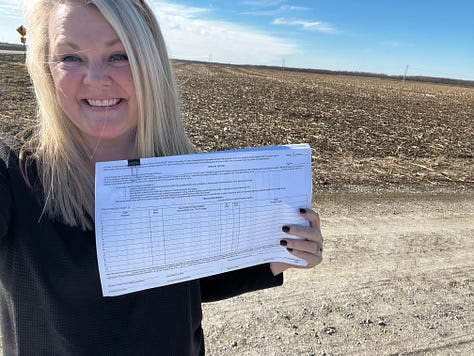
I drive across the state often these days and I am usually headed to a small town and this week was no different—I visited Chillicothe (the home of sliced bread), Carrolton, and Marceline and you’ll never guess why. I was getting rural folks and their Bible groups to sign the petition to restore abortion rights in Missouri.

Dirt Road organizing.

Missouri is in the process of putting abortion on the ballot and I have the petition—I have to tell you it’s kind of hard to get a petition, so I was excited to get them and also overwhelmed. I have to get this out to rural folks, and it’s not as easy as it would seem. 

First, there is the opposition to the petition—the Missouri Right to Life (Right to force others to gestate and deliver) has a literal snitch line to report folks accepting signatures. Now, I have no idea what they plan to do if they find us accepting signatures. I was raised to take care of myself and they shouldn’t mess with me, and I’m not the least bit intimidated, but I don’t want them to harass other rural folks who are signing quietly.

Second, folks have written off my congressional district—even some progressives who need signatures on a ballot initiative. They assume that we are too red to get enough signatures, so what’s the point, right? I’ll tell you the point: it creates excitement and solidarity in rural spaces. It acts to uplift us living in among MAGA extremists. It gives us hope.

Chillicothe was my first stop, and it is a pretty big town at over 9K folks. Chilli is also known for having a “patriot” group who have been successful in putting their extremists on the local health board — they also regularly object to school library books. Folks were on long text chains to get others to the event. I was able to gather about 30 signatures on a Tuesday at 9am. 

I was directing folks to the petition and how to fill it in correctly. One woman filled it out, stood up, and started texting. She told me, “I’m reminding my Bible group to come sign.” 

Wait…what?

The second place I drove was Carrolton, with a population of about 3,400. Still not tiny, but small. I sat in the basement of the library for almost 2 hours with…wait for it…a local pastor. A woman pastor. She signed the petition and then stayed the length of the signing event and visited with every single person who came in. Several folks attended her church or a neighboring church. 

Are you seeing a theme here?

My last stop of the day was in Marceline, population 2,100. I sat in the fire station with a local Dem organizer and we accepted signatures a few feet from the active train crossing. I met with a local candidate running for state house and again, folks signed, stood up, texted friends and relatives and their church community, and then headed back out to their farms and rural life.

This is why I organize in rural spaces across the state. This is why I drive 5 or 6 or 10 hours to meet with rural folks. They matter—we matter.

When we cede ground because it’s too red, because it’s too evangelical, because it’s too far of a drive, we create a self-fulfilling prophecy. It’s become more red, more uncontested. When we tell rural folks that their votes and signatures don’t matter because there aren’t enough of them, they agree and stop showing up. When we say Democrats and progressives support everyone, yet fail to have a presence in rural spaces, they notice…they know it’s a lie.

We can’t win Missouri if we avoid rural parts of the state. Missouri is 1/3 rural…33% of the state is outstate. 

I’m here and so are thousands of my friends. If state-level organizers will remember us, we can bring sanity back to the entire state.

Dirt Road Democrats are here.

~Jess