Archives for category: Civil Rights

The editorial board of the Miami Herald knows exactly what Ron DeFascist is up to: He wants to remove local control of public schools and gather complete power over what is taught in the schools. He wants to crush unions. He wants to censor books in school libraries. He wants to make sure that students use the bathroom assigned to the gender on their birth certificate. He wants to control the pronouns that teachers use in their classroom (check every student’s birth certificate so you don’t break the last two laws). He wants to control the state curriculum and tests to be certain that only patriotic history is taught. It’s not at all clear whether Black history can be taught (even though it is mandated) unless it meets his approval. He wants to control school boards, and he doesn’t hesitate to select and endorse candidates who share his views. He is power-mad. And he thinks his authoritarian behavior is a model for the nation! He must have skipped history at Harvard.

Florida Republicans’ ‘ideology patrol’ is coming to a school near you | Opinion

The Florida Legislature could de-certify many teacher unions in charge of negotiating salaries and working conditions.

Florida Republicans’ ‘ideology patrol’ is coming to a school near you | OpinionBY THE MIAMI HERALD EDITORIAL BOARD

It’s the biggest irony of a state that calls itself “free.”

A basic tenet of America’s political system — one that conservatives, more than liberals, have staunchly defended — is that the government closest to the people is best. But the Florida Legislature, egged on by Gov. DeSantis, is poised to further constrain locally elected school boards from making decisions about books, what teachers can say in the classroom and even school bathroom rules.

If the Republican-led House and Senate get their way, by the time they are done local education will be a mere arm of state leaders who act like the ideological patrol of Florida’s K-12 system. Meanwhile, there’s not enough talk about real issues like post-pandemic learning losses and the shortage of teachers. In fact, lawmakers might make the latter even worse with a union-busting bill that could de-certify many teacher unions in charge of negotiating salaries and working conditions.

So strong is the Legislature’s desire to turn K-12 into a field of culture battles, they are seeking to turn school board races, which are currently nonpartisan, into partisan contests. This would play right into DeSantis’ hands. He’s said that his goal is to elect candidates of his choosing in 2024 local races, including for the Miami-Dade County School Board.

This move would exclude millions of Floridians who aren’t registered with either major party — and who outnumberRepublican voters in Miami-Dade — from voting for their board member in primaries. The saving grace is that this measure would only go into effect if at least 60% of voters in the state approve it as an amendment to the Florida Constitution.

Another bill would relax residency requirements for school board candidates. They would not have to live in the district they want to represent until taking office. This isn’t unheard of in Florida. The same requirement applies to sheriffs and other constitutional officers. But it would allow any outsider with money and backing from, say, a powerful governor to run to represent communities they have no connection to.

To be fair, there are some sound proposals making their way forward at the Capitol. Lawmakers want shorter, eight-year term limits for school board members, down from 12 years. There’s a bill to require instruction on the effects of social media on young people and to ban the use of a school’s internet for social media, unless it’s for education purposes. Senate Bill 52 is ready for a Senate vote and also would ban cellphones in class.

But lawmakers are too busy fighting gender pronouns, sex education and transgender youth.

SB 1674 would make it a second-degree misdemeanor for adults to use a bathroom or “changing facility” that doesn’t align with their sex assigned at birth. The bill also would require districts to come up with “disciplinary procedures” to deal with students who violate the ban, further stigmatizing trans kids who already are often the target of ridicule.

Republican lawmakers want to prohibit teachers and staff from calling students by pronouns that differ from those given to them at birth, even when a parent is OK with it. SB 1320 expands a law that bans instruction on sexual orientation and gender identity — known by critics as “Don’t say gay” — through the eighth grade.

That same bill would also give outsized power to a single person to, at least temporarily, ban books from schools. Districts would be required to pull books that have been challenged while a complaint is being heard. It allows not just parents, but any county resident, to file an objection, likely resulting in blanket attempts by activists to ban books about LGBTQ issues and race.

SB 1320 also would take away school boards’ power to choose textbooks for sexual and reproductive health classes. Instead, that would be up to the Department of Education, which reports to the governor.

Current law already requires districts to teach that abstinence is the “certain way” to prevent pregnancy and sexually transmitted diseases and about “the benefits of monogamous heterosexual marriage.” But lawmakers seem to think we still cannot trust the people we elected to run our schools with basic decisions about curriculum.

We’re not fools. This isn’t simply a traditional power grab by Tallahassee. This is an attempt to ensure only certain voices are allowed in public education. Parents and educators who think differently be damned.
Peter Greene has written several columns about the U.S. Supreme Court’s step-by-step effort to tear down the wall of separation between church and state. With its June 21: 2022, decision called Carson v. Makin, the High Court ordered the state of Maine to pay the tuition for students at two religious schools. Under Maine law, districts that do not have a public high school must pay tuition for high school students to attend a private non-religious school. A majority of the justices ruled that Maine violated the students’ free exercise of religion rights by denying them the same benefits as those who go to private schools at the public’s expense.

The decision was 6-3. The majority were all appointed by Republican presidents (Roberts, Alito, Thomas, Gorsuch, Kavanaugh, and Barrett). The minority were appointed by Democratic presidents (Breyer, Sotomayor, Kagan). All six of the Justices in the majority were born Catholic; Gorsuch graduated from Georgetown Preparatory Academy, a Jesuit school (Brett Kavanaugh was two years behind him.) Gorsuch and his family now attend an Episcopal church. The minority bloc consists of two Jews and a Catholic (Sotomayer).

Before the case was decided, Peter Greene expressed concern that the two religious schools openly discriminated against student, families, and staff by refusing to accept into the school’s community.

He wrote six months before the decision was released:

Bangor Christian Schools require adherence to a code of conduct; trans or gay students will be expelled, even if celibate. Their religious indoctrination is inseparable from their academic instruction. A fifth grade social studies objective is to “recognize God as Creator of the world,” while a ninth grade objective is to “refute the teachings of the Islamic religion with the truth of God’s word.” Teachers at BCS must certify that they are born again Christians.

Temple Academy is an extension of the Centerpoint Community Church. TA is unlikely to admit students that do not come from a Christian family; that family must sign a Family Covenant saying they agree with TA’s views on abortion, marriage, and homosexuality. Again, only born again Christians may be hired to teach; teachers also sign an employment agreement acknowledging that the Bible says that God considers “homosexuals and other deviants as perverted.”

The issue, he wrote, was not about freedom of religion or free exercise of religion, but about whether taxpayers should pay for schools that discriminated against defined groups of people.

For several years, fans of school choice have been pushing the argument that a religious school is not free to exercise its religious faith if it does not get to share in taxpayer dollars. The wall between church and state has thus been characterized as discrimination against religion. Turns out you can’t be really free without taxpayer funding.

A few weeks ago, Peter returned to the subject and reviewed some of the Justices’ arguments. Quite simply, he wrote, the Supreme Court was ordering the state of Maine to pay tuition at schools that engage in discrimination.

Justice Breyer asked:

What happens once “may” becomes “must”? Does that transformation mean that a school district that pays for public schools must pay equivalent funds to parents who wish to send their children to religious schools?

Justice Sotomayor said:

In 2017, I feared that the Court was “lead[ing] us . . . to a place where separation of church and state is a constitutional slogan, not a constitutional commitment.” Today, the Court leads us to a place where separation of church and state becomes a constitutional violation.

But the case goes on, because Maine passed a law stating that it would not fund schools that discriminate. The Bangor Christian Academy sued the state and asserted its right to discriminate.

Bangor Christian Schools is now suing the state of Maine, asking first for an injunction against the Maine Human Rights Act (MHRA) restriction that bars them from receiving state money as long as they continue to discriminate. Their assertion is that the “poison pill” of human rights law in Maine violates their religious liberty, that they cannot exercise that liberty unless they can both receive state funds and continue to discriminate against students and prospective faculty that don’t meet their religious requirements.

The state of Maine insists that it will not fund schools that discriminate:

Attorney General Aaron Frey said that “all Mainers deserve to be treated with dignity and respect, whether it be in their workplace, their housing, or in their classrooms. The Maine Human Rights Act is in place to protect Mainers from discrimination and the Office of the Attorney General is steadfast in upholding the law. If abiding by this state law is unacceptable to the plaintiffs, they are free to forego taxpayer funding.”

Peter continued his dissection of the decision in a third post, wherein he debated the libertarian Neil McCluskey of the CATO Institute. McCluskey asserts that secular schools are hostile to religion, and the only way to secure true freedom of religion is to fund all choices, all religions.

Peter writes:

First, I don’t accept the premise that “secular” requires hostility to religion. If you play in the percussion section, you aren’t hostile to melody–it’s just not your job to handle it. A secular education system doesn’t try to fulfill any religious functions, for a variety of reasons we’ll get into.

There’s another issue in that first point, which is the newly revived idea among some folks that they cannot fully and freely practice their religion unless they are free to discriminate against people of whom they disapprove, like the Mom who objects to having her child taught empathy because she believes there are some people her child should not feel empathy for. This is a whole other post, but my short answer is this–there is no placating these people as long as circumstances find them in a pluralistic society.

But where I really disagree with McCluskey is in his central notion that by allowing everyone to retreat to their own personal bubbles, we can end all the various battles over culture and religion…

The whole choice thesis is that by not using taxpayer funds to support private religious choice, the government is discriminating against religious folks (with the newest legal test of this theory coming to a courtroom in Maine). Again, this reasoning goes, I am not fully free to exercise my religion if the taxpayers aren’t subsidizing my choice.

I should get to practice in my little bubble, and the taxpayers should help pay for the bubble.

That’s how this vision of choice leads to religious discrimination on an unprecedented scale and takes us all the way back to the question of separate but equal.

Peter demonstrates a variety of scenarios that show how thorny this issue is.

A variety of secular schools realize that if they re-configure themselves as religious schools, the “free exercise” clause is a ticket to the Land of Do As You Please and they can start discriminating against students and faculty in pretty much any way they wish as long as they claim that it’s an essential part of their religion. This will force taxpayers to fund all sorts of things that they (and not just liberal especially) object to, from aryan supremacists to gender theory schools. One worst case scenario will be a government agency given the task of figuring out which religious schools are “real” religious schools and which are just playing games. The other worst case scenario will be states figuring out how to regulate these schools so that they can’t discriminate in ways that would be illegal for anyone else. Or maybe we’ll just have a government office of educational equality that makes sure that every religion gets an equal shake in the school funding/free exercise department. No way that could end badly. None of these “solutions” will be popular.

Now that we’re establishing that I can’t have freedom to exercise my religion without enough of a taxpayer subsidy, who is going to decide how much subsidy is enough?…

I can imagine taxpayers rejecting bond unissued because they don’t to subsidize all those religious schools.

Peter concludes:

I can imagine plenty of awful scenarios. What I can’t imagine is how vouchers + religious schools results in a free and adequate education for every child or greater harmony and cohesions for our pluralistic nation. Yes, yes, I understand we haven’t exactly mastered either of those things currently, but I don’t see how vouchers + religious schools does anything except make matters worse.

Fred Klonsky is a retired teacher who blogs regularly about Chicago, Illinois, the nation, politics, and culture. In this post, he draws an interesting comparison between the recent expulsion of two Black legislators in Tennessee and events concurrent with the end of the Reconstruction era and the reign of Jim Crow. There is this difference: The two ousted members are very likely to be restored to their seats in the legislature by their local elected officials. The Tennessee Three are now national figures revealing the fascist hand in the iron glove of the Republican Party when it has the majority.

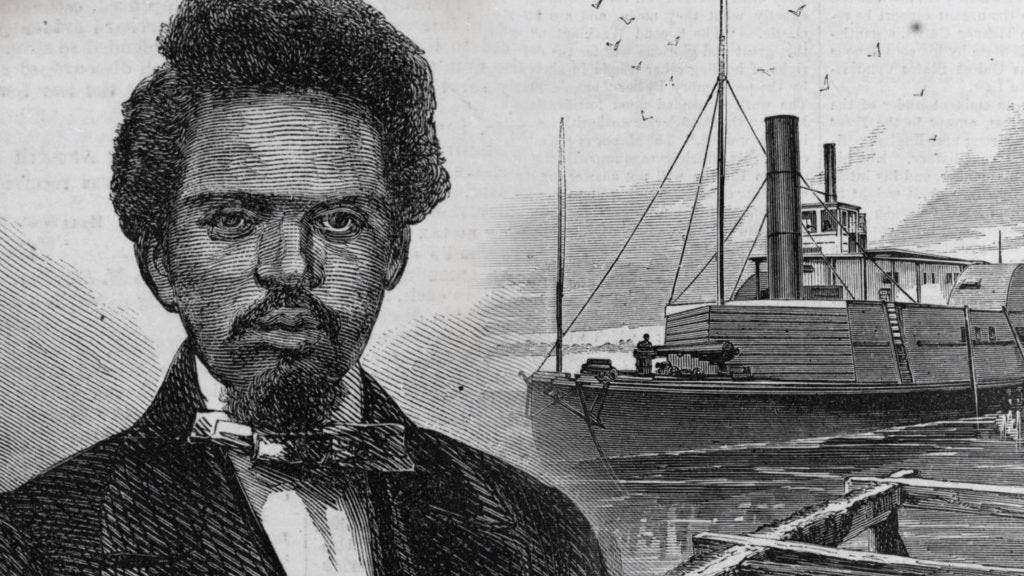
Robert Smalls, Congressman during Reconstruction.

The expulsion of Rep. Justin Jones and Rep. Justin Pearson from the Tennessee legislature has a direct historical link to the overthrow of real democracy and Reconstruction following the Civil War.

On May 13, 1862 an enslaved man named Robert Smalls, who labored on a Confederate steamer in South Carolina’s Charleston harbor, set into motion a daring plan.

As his great-great-grandson Michael Boulware Moore explained, “He saw that the Confederate crew had left, and he knew that oftentimes they left for the evening, not to come back until the next day.”

For Smalls and six other enslaved people and their families, the stakes couldn’t have been higher. “They knew that if they got caught, that they would be, not just killed, but probably tortured in a particularly egregious and public manner,” said Moore.

Disguising himself in the straw hat and long overcoat of the ship’s white captain, Smalls piloted the ship past Fort Sumter towards the Union blockade, and freedom.

After serving on a Union Naval vessel during the Civil War, Smalls returned home to Beaufort, S.C., and was elected to the U.S. House of Representatives – one of more than a dozen African Americans to serve in Congress during the period known as Reconstruction, when the formerly-rebel states were reabsorbed into the Union, and four million newly-freed African Americans were made citizens.

South Carolina, and throughout the former Confederacy, the era of Reconstruction saw the rise of Black political power and representation in both the U.S. Congress and Southern state legislatures.

During the 1870s, more than a dozen African American men, many of whom had been born into slavery, were elected to the U.S. Congress. 

It was a great democratic movement that ended all too quickly.

Former Southern insurrectionists, aided by the rise of the Ku Klux Klan, violently organized an anti-democratic counterrevolution.

Born in South Carolina, Aaron A. Bradley was a shoemaker in Augusta Georgia. Sometime around 1834 he ran away to the North, where he became a lawyer. 

In 1865 he returned to Georgia. He was the most outspoken member of the Black delegation to the constitutional convention. 

In 1868 he was elected state senator from the First District. Bradley rallied plantation workers around Savanah with his insistence that the formerly enslaved people be given land.

But Black political power and Reconstruction was short lived.

One quarter of the Black legislators in Georgia were killed, threatened, beaten, or jailed. In the December 1870 elections the Democrats won an overwhelming victory in overthrowing democracy and Reconstruction.

In 1906 W. H. Rogers from McIntosh County was the last Black legislator to be elected before Black voters were legally disenfranchised in 1908.

The actions by white Republican members of the Tennessee legislature to expel two elected Black members has all the stench of the overthrow of Reconstruction and the establishment of Jim Crow.

Donna Ladd wrote a compelling story about how white flight in Noxubee County, Mississippi, killed hopes for integration in the 1950s and 1960s. Ladd is the founder and editor of the Mississippi Free Press.

Whites had long controlled the county and its schools. They were determined not to permit any racial integration. Their response to the Brown decision of 1954 was to stall, stall, stall.

When whites realized that the federal courts were determined to integrate the schools, they had two strategies to defy court orders. One was to open “segregation academies,” like today’s charter schools. The other was to create voucher programs so that white children could participate at all-white private academies.

The story is fascinating. It’s not likely to be taught in public schools, because some people might think this honest retelling of what happened might make white students—more likely, their parents—uncomfortable.

The Florida legislature passed a universal voucher plan, meaning that the state will subsidize the tuition of every student, no matter their family income, Rich or poor. The state will hand out subsidies to rich families whose children go to elite private schools. All money deducted from public schools. Short-sighted and stupid, a giveaway to families who can afford private schools.

Currently, there are more than 400,000 students enrolled in private schools. About 80,000 may already have a voucher. Now, even those attending an exclusive school will be subsidized by the state. Homeschoolers will also be subsidized by the state, at least 20,000 in the fumigation year.

Most of the schools that take vouchers are religious and most are not accredited.

Likely new cost: 320,000 students already enrolled in private schools without a voucher plus 20,000 homeschooled kids x $7,800=$2.65 billion. And that’s without a single student now in public school asking for a voucher. A realistic estimate for the annual cost of Florida’s universal voucher would be at least $3 billion a year.

The Center for Budget and Policy Priotities notes that the Florida voucher funding is designed to reduce the funding of public schools, which currently enroll about 80-85% of the state’s children:

While voucher programs are often funded as line-item appropriations in state budgets or through private donations (which over time reduces the revenues available for education and other state priorities), this Florida voucher is actually designed to take money away from the state K-12 funding formula designated for public school districts.

Scott Maxwell of the Orlando Sentinel says that Florida’s universal voucher program is likely to blow a billion-dollar hole in the state budget. As I pointed out above, $1 billion is a low estimate. That hole in the budget will be closer to $3-4 billion, when you include the students whose parents can already afford to pay tuition.

He writes:

Florida lawmakers are about to take the biggest educational gamble in American history — financed with your tax dollars.

They want to offer every child in Florida the chance to use publicly funded vouchers at private schools that have virtually no regulation and offer no guarantee that the students will get educated.

Florida’s existing network of voucher schools is so infamously unchecked that the Orlando Sentinel has found schools employing teachers that don’t have high-school diplomas themselves. Some refuse to serve children with disabilities or gay parents. Others were such financial wrecks that they shut down in the middle of the school year, stranding students.

Flaw #1:

Voucher schools in Florida are unregulated. They can hire teachers who are not certified. They can hire teachers who never finished college. Voucher schools do not take state tests. They need not disclose their graduation rate or their curriculum. They are not overseen by state officials. Some voucher schools ignore safety codes, because they are not required to comply with them. The Orlando Sentinel conducted an investigation called “Schools Without Rules,” demonstrating that voucher schools take tax money without any oversight, transparency or accountability.

Flaw #2:

Voucher schools operate in secrecy. They are not required to report anything to the state.Not test scores, graduation rates, SAT scores, or anything else. Florida is operating on the principle of “Trust But Don’t Verify.” Public schools are held to tight accountability requirements. Voucher schools, none at all. If accountability is good for public schools, why is it unnecessary for voucher schools?

Flaw #3:

Voucher schools can discriminate against any group. Unlike public schools, voucher schools can discriminate on any grounds. They don’t have to accept students with disabilities, gay students, students who don’t speak English, or students from a religion they don’t like.

Flaw #4:

Legislators think that choice is the only accountability needed. If a parent is unhappy, make a different choice. The only choice that parents do not have is to stop paying their tax dollars to fund this sector.

There is another grievous flaw:

The Florida voucher program reduces funding for the schools that the overwhelming majority of students attend. Why does this make sense?

Maxwell says there are good voucher schools, and they should have no objection to accountability, transparency, and oversight. Maxwell recommends the following fixes for the state voucher program.

All voucher-eligible schools should be required to:

  1. Publish graduation rates and nationally accepted test scores.
  2. Hire teachers who are certified or at least have a college degree.
  3. Disclose all the curriculum being taught.
  4. Ban discrimination. (If discrimination is a key tenet of a religious organization’s belief system, they should fund that discrimination with their own money. Any group that receives public dollars should serve all the public.)

Maxwell does not address the two glaring defects of the voucher program:

1. 75-80% of the students who take vouchers already attend private schools. Why is it in the interest of Florida to pay their tuition?

2. About 60% of the students who switch from a public school to a voucher school will drop out within two years. The vast majority of voucher studies conclude that students lose ground academically when they take a voucher. Shouldn’t parents be warned of the risk that they are taking by accepting a voucher?

The statehouse in Nashville, Tennessee, was surrounded by parents and students demonstrating in favor of gun control and against the GOP-controlled legislature’s protection of guns. The protest follows the murder of three children and three staff members at the Coventry School in Nashville.

Three Democratic members of the legislature joined the protest, chanting with the protestors.

The GOP leadership threatened to expel the Democrats. The speaker of the House absurdly claimed that the three Democrats were encouraging an insurrection.

Parents and children held signs and shouted chants during a large protest at the Tennessee capitol last week following a deadly school shooting. And while no one was arrested or injured, Republican House Speaker Cameron Sexton is comparing the demonstration to the Jan. 6 insurrection.

During the House Floor session on Thursday — days after the Covenant School shooting — Reps. Gloria Johnson, D-Knox, Justin Pearson, D-Memphis, and Justin Jones, D-Nashville, stood up and chanted with protestors in the gallery.

Pearson and other Democrats attempted to acknowledge the large group of protesters during session, but were told to stick to the subject of the bill by Speaker Cameron.

“We listened to them and helped to elevate the issue that they are demanding justice for,” said Pearson.

House Speaker Cameron Sexton said their actions were more than a breach of decorum, comparing it to the January 6th insurrection in remarks to outlets.

“Two of the members; Representative Jones and Representative Johnson, have been very vocal about Jan. 6 and Washington, D.C., about what that was,” said Sexton. “What they did today was equivalent, at least equivalent, maybe worse depending on how you look at it, to doing an insurrection in the State Capitol.”

Sexton warned that there will likely be consequences for the trio.

“It could be removal of committees; it could be censorship; it could be expulsion from the General Assembly. Anywhere in between,” said Sexton.

Leaders in the Democratic caucus are defending their colleagues. Nashville Democrat John Ray Clemmons says he believes Speaker Sexton is exaggerating.

“You show me the broken windows, you show me anyone who went into the speaker’s office and put their chair up on his desk and trashed his office, you show me where a noose was hanging anywhere on the legislative plaza,” said Clemmons, citing damage committed during the Capitol riot, which resulted in five deaths before and after the event.

The three rebellious Democrats were stripped of their committee assignments. Their member badges were deactivated. Their telephones were disconnected.

In a press conference Monday, Jones says Sexton is more focused on politics than addressing last week’s mass shooting.

“We are members, who are standing in the well, telling our speakers and our colleagues that kids should not be murdered in school,” Jones said, “and rather than address that issue, the speaker has spent more time on Twitter this weekend talking about a fake insurrection than he did about the deaths of six people including 9-year-old children.”

It is not yet clear if the lawmakers will face expulsion. Sexton has not commented on whether they will face further discipline.

A tweet:

Three Tennessee Democrats have been stripped of their committee and subcommittee assignments by the Republican dominated legislature for speaking out against gun violence in the wake of the Nashville shooting that killed three children.

Democracy is dead in Tennessee.

@Sethaweitz

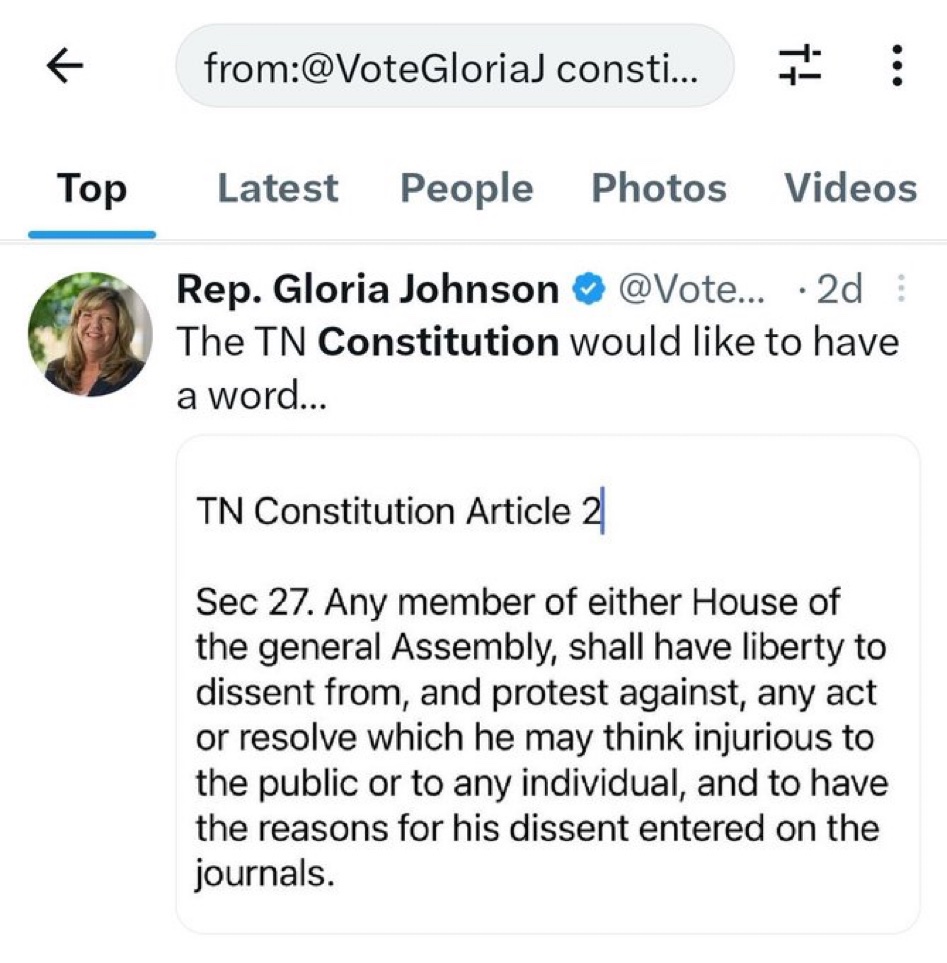
Rep. Gloria Johnson, one of the three Democrats, tweeted:

The New York Times published an article about a tenured professor at the University of Pennsylvania Law School, Amy Wax, who has frequently made statements that are racist, homophobic, sexist, xenophobic, the whole range of prejudices, not what you expect of someone who supposedly teaches students that everyone is equal in the eyes of the law.

Amy Wax, a law professor, has said publicly that “on average, Blacks have lower cognitive ability than whites,” that the country is “better off with fewer Asians” as long as they tend to vote for Democrats, and that non-Western people feel a “tremendous amount of resentment and shame.”

At the University of Pennsylvania, where she has tenure, she invited a white nationalist to speak to her class. And a Black law student who had attended UPenn and Yale said that the professor told her she “had only become a double Ivy ‘because of affirmative action,’” according to the administration.

Professor Wax has denied saying anything belittling or racist to students, and her supporters see her as a truth teller about affirmative action, immigration and race. They agree with her argument that she is the target of censorship and “wokeism” because of her conservative views.

All of which poses a conundrum for the University of Pennsylvania: Should it fire Amy Wax?

The university is now moving closer to answering just that question. After long resisting the call of students, the dean of the law school, Theodore W. Ruger, has taken a rare step: He has filed a complaint and requested a faculty hearing to consider imposing a “major sanction” on the professor…

For years, Mr. Ruger wrote in his 12-page complaint, Professor Wax has shown “callous and flagrant disregard” for students, faculty and staff, subjecting them to “intentional and incessant racist, sexist, xenophobic and homophobic actions and statements.”

The complaint said she has violated the university’s nondiscrimination policies and “standards of professional competence.”

The article goes on to cite the many times that Professor Wax has offended women, Blacks, gays, foreign students, or anyone else who does not agree with her idyllic view of the culture of the 1950s. Implicitly she means an era when Blacks were subservient, women were compliant wives, gays were in the closet, and foreigners were tourists.

What should the university do?

…many free speech groups, including the Academic Freedom Alliance, PEN America and the Foundation for Individual Rights and Expression, have criticized the dean and said that Professor Wax should not be fired because of her public statements.

My view: She should not be fired. Perhaps she should be admonished for behavior that is insulting to students, but her academic freedom and tenure protect her job.

Academic freedom protects not just the views that one likes, not just the views of the majority, but the views you hate. I might wish that Professor Wax were open-minded and wish that she had a keener sense of humanity, but I defend her right to be offensive, inconsiderate, and obnoxious. Students are not required to take her courses. Those who take her courses should challenge her views if they disagree.

But academic freedom must prevail.

Voltaire: “I may not agree with what you have to say, but I will defend to the death your right to say it.”

We saw this coming. The GOP candidates for President have decided, for now, to focus their campaigns against “critical race theory,” Black history, the threat posed by transgender students, and any teaching about race, sex, and gender.

Juan Perez of Politico reports:

CULTURE CLASH — Once upon a time, back when people used fax machines, education policy — test scores, spending, school choice and the like — were a notable feature of Republican presidential campaigns.

Former President George W. Bush’s support for education spending and the transformative No Child Left Behind Act was enshrined in the party’s 2004 platform. Former Arkansas Gov. Mike Huckabee railed that a general lack of concern about education in the 2008 presidential field “frustrates the fire out of me.” Bush’s brother, Jeb, invoked Martin Luther King Jr.in 2016 when he proposed a detailed education platform before his campaign fizzled.

This year, education is re-emerging as a prominent issue for the budding 2024 GOP field. But America is poised to witness a presidential contest where the debate over school policy sounds dramatically different — with discussions over academic standards and the stunning, once-in-a-generation hitto test scores taking a back seat to issues with a more distinct culture war bent.

Former South Carolina Gov. Nikki Haley is salting a back-to-basics education mantra with brimstone, targeting school lessons on race and sexuality. Former Vice President Mike Pence has put a small Iowa school system’s gender identity policy in the national spotlight. And Former President Donald Trump is stirring up concerns about “pink-haired communists teaching our kids.”

Haley’s campaign launch last week offered a sign of the heightened role the education wars are about to play in the GOP primary.

“They’re talking about critical race theory, where if you send a five year old kindergartner into school — if she’s white, you’re telling her she’s bad, and if she’s brown or Black you’re telling her she’s never going to be good enough and she’s always going to be a victim,” Haley said of the academic practice to a New Hampshire crowd last week. “That’s abusive.”

She added that a Florida ban on sexual orientation and gender identity lessons for young students — championed by rival Republican Gov. Ron DeSantis and dubbed by critics as the “Don’t Say Gay” law — “didn’t go far enough.”

“When I was growing up, we didn’t have sex ed until seventh grade,” Haley said to applause in New Hampshire. “That’s the kind of stuff you do at home, you don’t do that at school. That’s the kind of thing parents do.”

For his part, Pence has focused attention on an Iowa dispute, in which the conservative Parents Defending Education organization is suing the Linn-Mar Community School District to stop it from enforcing a policy that directs educators to protect their students’ gender identities on campus.

The court case has garnered supportive briefs from the Pence-backed Advancing American Freedom organization plus a coalition of Christian groups and Republican state attorneys general. The legal battle is also the focus of a Pence political initiative— funded with an initial budget of $1 million — that will advocate for “parental rights” policies embraced by conservatives.

“We’re told that we must not only tolerate the left’s obsessions with race and sex and gender but we must earnestly and enthusiastically participate or face severe consequences,” Pence told supporters last week. “Nowhere is the problem more severe, or the need for leadership more urgent, than in our public school classrooms,” he said.

Trump’s education plan, unveiled last month, calls for cutting federal funding for any school or program that includes “critical race theory, gender ideology, or other inappropriate racial, sexual, or political content onto our children.”

Trump would also open civil rights investigations into any school district that has engaged in race-based discrimination, particularly against Asian American students. He also called to “keep men out of women’s sports,” make significant cuts to school administrative personnel, elect school principals and end teacher tenure.

“As the saying goes, personnel is policy and at the end of the day if we have pink-haired communists teaching our kids we have a major problem,” Trump said.

Sen. Tim Scott, who is testing the waters on a potential presidential bid, is taking a less combative approach. Speaking at a GOP Black History Month event in Charleston last week, the South Carolina senator said “the story of America is not defined by our original sin, the story of America is defined by our redemption” and urged Republicans to “be the party of parents.”

Scott and others are responding to the GOP grassroots energy surrounding issues at the intersection of race, gender, culture and education — which Virginia GOP Gov. Glenn Youngkin successfully harnessed in his 2021 blue-state victory.

The sharp-edged rhetoric might get sanded down for the general election. But for now, not getting outflanked on education controversies that currently animate the right appears to be the first order of business for the 2024 field.

MEDIA ADVISORY:

Tomorrow, on Saturday, parents and community members from the Alliance to Reclaim Our Schools (AROS) and HEAL Together, alongside organizations from Florida and Pennslyvania, will hold a press conference opposing Governor Ron DeSantis’ harmful policies attacking our children’s freedom to learn. The press conference will take place opposite the site of DeSantis’ keynote speech at the Pennsylvania Leadership Conference. Florida advocates will speak at the press conference to warn that DeSantis’ policies are bringing chaos to Florida families.

The full media advisory is below. Feel free to reach out to the media contact: Moira Kaleida | 412-760-0030 | moira@reclaimourschools.org


FOR IMMEDIATE RELEASE: March 31, 2023


**MEDIA ADVISORY**PARENTS, COMMUNITY FROM PA & FL STAND UP AGAINST DESANTIS ATTACKS ON EDUCATION AND OUR COMMUNITIES— PRESS CONFERENCE AND ACTION


Harrisburg, PA – Saturday, April 1, 2023, parents and community members from the Alliance to Reclaim Our Schools (AROS) and HEAL Together, alongside Moms Rising, Red Wine & Blue, 412 Justice and Common Purpose (West Palm Beach, FL), and parents and community members from Florida to Pennsylvania will hold a press conference opposing Governor DeSantis’ harmful policies attacking our children’s freedom to learn.

The press conference will take place opposite the site of DeSantis’ keynote speech at the Pennsylvania Leadership Conference.

Concerned parents and community members will speak in response to the attacks on public education, including the passage of classroom censorship laws, the voucher bill which is a $5 billion giveaway to rich families, and the ban on life-saving education and healthcare for LGBTQIA+ youth.

Florida advocates will speak at the press conference to warn that these policies are bringing chaos to Florida families.


Education justice groups will be holding rallies also on April 1 in Miami, Orlando, Pinellas County and other sites throughout Florida to protest DeSantis’ anti-Black and anti-LGBTQ policies that have had a devastating impact on Florida’s children.

Pennsylvanians have voted against these policies in the past, and through solidarity with Floridians, Pennsylvanians have an opportunity to oppose DeSantis’ divisive tactics in order to ensure that all children have the freedom to learn and build a better future.

WHAT: Press conference with Pennsylvanians and Floridians to oppose Governor Ron DeSantis’ harmful policies attacking our children, our schools and our educational freedom after DeSantis’ keynote speech at the Pennsylvania Leadership Conference.


WHEN: April 1, 2023. Press Conference begins at 1 PM EST.


WHERE: In front of Harrisburg Academy (10 Erford Rd, Wormleysburg, PA 17043). The press conference location is across the street from Penn Harris Hotel (1150 Camp Hill Bypass, Camp Hill, PA 17011) where the Pennsylvania Leadership conference takes place.


WHO: Alliance to Reclaim Our Schools (AROS), with HEAL Together, Moms Rising, Red Wine & Blue, Common Purpose, 412 Justice, and parents, educators, and community members.


For on-site interviews, contact: Moira Kaleida | 412-760-0030 | moira@reclaimourschools.org

image.png
###

The Alliance to Reclaim Our Schools (AROS) is a coalition of parent, youth, community and labor organizations fighting to reclaim the promise of public education as our nation’s gateway to a strong democracy and racial and economic justice. AROS is uniting parents, youth, teachers and unions to drive the transformation of public education, shift the public debate and build a national movement for equity and opportunity for all.

HEAL (Honest Education Action & Leadership) Together is building a movement of students, educators, and parents in school districts across the United States who believe that an honest, accurate and fully funded public education is the foundation for a just, multiracial democracy.

Cassie Creswell and Diane Horwitz wrote the following article for Valerie Strauss’s blog “The Answer Sheet” at the Washington Post. Both residents of Chicago, they are fearful of what Paul Vallas will do to the Chicago Public Schools if he is elected Mayor. They urge Chicagoans to reject his candidacy. The latest poll shows the two candidates tied. Every vote matters.

Valerie Strauss wrote the introduction.

On April 4, Chicago voters will choose a new mayor — and the decision could have a profound effect on the future of the country’s third-largest public school district, which is under mayoral control. The two candidates in the runoff election are Paul Vallas and Brandon Johnson, Democrats who offer vastly different views of public education.

Vallas is a politician and a former education superintendent in Bridgeport, Conn.; at the Recovery School District of Louisiana (most of the schools were in New Orleans); and in Philadelphia and Chicago. Vallas became known as a “turnaround” specialist, meaning he moved into troubled districts and supposedly turned them around.

However, as education historian Larry Cuban wrote: “Whether, indeed, Vallas turned around Chicago, Philadelphia, and New Orleans is contested. Supporters point to more charter schools, fresh faces in the classroom, new buildings, and slowly rising test scores; critics point to abysmal graduation rates for Black and Latino students, enormous budget deficits, and implementation failures.”

Vallas has also unsuccessfully run for several offices, including mayor of Chicago in 2019 and lieutenant governor of Illinois in 2014.

Johnson was a public school teacher in high-poverty areas where school closures and gun violence affected the communities. He then became an organizer for the Chicago Teachers Union and fought to keep neighborhood schools open, expand state funding to district schools and reduce the use of high-stakes standardized tests. He has said he will not cut funding from Chicago public schools if he is elected mayor.In 2018, he was elected commissioner of the 1st District of Cook County, where he led a successful effort to ban housing discriminating against formerly incarcerated people.

The following was written by Cassie Creswell and Diane Horwitz, who are concerned about the privatization of public education. Creswell is a public school parent in Chicago and director of Illinois Families for Public Schools, a nonprofit advocacy group that lobbies for policies that support public education, which it sees as a public good. Horwitz is a graduate of Chicago public schools, a retired educator and a board member of Illinois Families for Public Schools. Both are writing as individuals and are not speaking for the organization.

By Cassie Creswell and Diane Horwitz


In just a week, the future direction of Chicago Public Schools will be decided by voters in a pivotal mayoral election. The two candidates, Paul Vallas, a former CEO of Chicago Public Schools, and Brandon Johnson, a former teacher and teachers union organizer, offer diametrically opposed visions for schools in Chicago, which will remain under mayoral control at least through January 2027.

We see the choice as stark. Will Chicago move in the direction of school privatization, a movement gaining ground in a number of states around the country with the growth of charter schools as well as school funding programs that use public money to fund private and religious education?

Or will there be a commitment to well-resourced neighborhood schools and increased funding that would be used to reduce class size, expand mental health services and bilingual education, and ensure that every school has a nurse and a librarian?
Will there be a recognition that the conditions in which many Chicago public school students live — in impoverished and segregated communities marked by violence and disinvestment — must be tackled as part of a broad education improvement agenda?

Johnson’s education platform emphasizes that families should not have to leave their communities or compete to secure a spot in a school that meets their needs and includes a library, music and art program, and small class sizes. He says that neighborhood schools contribute not only to the well-being of students but also to that of the communities in which they are located.

Saying that Chicago public schools are underfunded, he has called for more resources from the state that would be distributed based on the needs of a school’s student population and not solely on enrollment numbers. He has called for creating sustainable community schools with wraparound supports and his education plan integrates proposals for affordable housing, transportation and safety.

Vallas has criticized the operation of Chicago public schools and says he will make schools safer while creating new programs to bring back students who have left the system. He also said he would work to expand alternatives to public schools for families and would change the way schools are funded to “follow the student.”

Vallas has long supported initiatives that critics say are aimed at privatizing public education. He spelled out his vision for the future of Chicago’s school system in a little-noticed op-ed that he wrote for the Chicago Tribune in February 2022, months before declaring his candidacy — and that is what we focus on here. Here are some of his most revealing statements:

Expanding vouchers

Vallas supports expanding Illinois’ existing “Invest in Kids” voucher program, a tax credit scholarship program that offers a 75 percent income tax credit to individuals and businesses that contribute to organizations that pay for private and religious schools. A full 95 percent of participating schools are religious. More than 4,000 Chicago students were funded in this way in the last school year.

Vallas has also floated the idea of using tax increment financing (TIF) dollars to pay for K-12 school vouchers during the current campaign. TIF is a complex, and often misused, public financing initiative designed to fund development through investments and infrastructure in economically struggling communities.

The details of Vallas’ proposal in the Tribune highlight a fiscal initiative that we think is rash. He proposes applying TIF surplus dollars to cover teachers’ pension costs, and then using money that should be earmarked for pensions for vouchers. Vallas says this will allow these diversions of funds to be “legally accomplished.” One of the key concerning legacies of Vallas’ time as the chief executive officer of Chicago Public Schools was years of unpaid pension debt, generated by diverting funds that should have gone to teachers’ pensions into operating costs.

Religious charter schools

In Oklahoma, the Catholic Church recently asked the state to establish a virtual, openly religious charter school. In December 2022, Oklahoma’s outgoing attorney general issued a controversial legal opinion supporting the church’s application, saying that prohibiting religious charter schools violated the First Amendment. It was praised by Oklahoma’s Republican governor and state superintendent.

Ten months earlier, Paul Vallas’ op-ed called for religious contract schools, a type of charter school, to be established in Chicago. He wrote: “Longer term, the city can invite state-recognized parochial and private schools to become ‘contract schools’ in which the district contributes to or covers tuition for students who attend.”

Oklahoma’s new attorney general, a conservative Republican, took office in January and quickly rescinded his predecessor’s opinion, saying it “misuses the concept of religious liberty by employing it as a means to justify state-funded religion.”

Vallas also gave a nod of support to the 2022 Supreme Court Carson v. Makin decision, in which six ultraconservative justices ruled that the state of Maine could not exempt religious institutions from a school voucher program.

An unusual precedent

Vallas justified his vision for charter school expansion on “a long history of contracting out for private educational services. There is precedent.”

He then wrote:

“The Supreme Court’s landmark 1954 decision in Brown v. Board of Education grants the right to equitable educational opportunity. It is a right guaranteed by the Equal Protection Clause of the 14th Amendment. Those in power in Chicago have chosen to interpret this right as a mandate that all public financing of education be allocated exclusively to ‘public’ or government-run schools.”

Let it be noted that after Brown v. Board of Education, many communities in Southern states responded by spending public dollars on private schools using voucher schemes — private academies created for White students whose families refused to send them to public schools with Black children and were given public dollars to fund tuition.

It seems to us that Vallas is twisting the import of the Brown v. Board of Education ruling, using it to include the use of public dollars to fund children’s departure from public — or, as he called them, “government- run” — schools. His use of the phrase “government-run schools” mirrors the language used by former president Donald Trump and his education secretary, Betsy DeVos, who framed public education as a government institution essentially holding students hostage.

Private and religious schools that take public funds are not bound by the same anti-discrimination regulations as public schools, leaving them free to discriminate on the basis of disability, LGBTQ+ status, parenting and pregnancy status, English-language learner status and religion itself.

“Dollars follow students”


Vallas ended his op-ed by saying that he supports the “explicit endorsement of a reconstituted system in which parents get to direct the per-pupil public dollars to the school (or education model) of their choosing.”

This is exactly what DeVos has long advocated: “Fund students, not systems.”

DeVos is a leader in the national movement toward the privatization of our public schools, via vouchers, charter schools — which are publicly funded but privately operated — and other often poorly regulated funding programs. Those include education savings accounts and direct financial support for home schooling. The goal: discrediting and dismantling our public schools districts.
Vallas was clear about his plans, which would work toward that goal in Chicago. It’s up to the voters now.