This story could be told again and again. George Reyes was on his way to work. He is a citizen and a veteran. ICE agents stopped his vehicle, smashed his windshield, dragged him away, and jailed him for three days.
The author being detained by federal agents on July 10 / Credit: Blake Fagan via AFP
“A body of men holding themselves accountable to nobody ought not to be trusted by anybody.” – Thomas Paine
By George Retes
Last Wednesday, February 18, I officially launched my lawsuit against the federal government. For me, this was something that felt like it was never going to happen. Not because I didn’t want to or because I was afraid, but because I thought that was just the way the law works when you’re trying to hold federal officials—and the government that employs them—accountable for violating someone’s rights.
On July 10, 2025, I was driving to my job as a security guard at a licensed farm in Camarillo, CA. Federal immigration agents were lined across the road that led to the farm I worked at. I clearly stated my citizenship and fully complied with officers, even though they were all yelling contradictory orders and no one was clearly in charge. Yet, despite doing everything right, I was detained and treated as if I had no rights. Agents engulfed my car with tear gas, smashed my window, sprayed pepper spray in my face, and dragged me out. I was choking on gas, unable to breathe, and even though I wasn’t resisting, I had one agent kneeling on my back and another kneeling on my neck while my hands were already behind my back.
I was first taken to a Navy base, where the agents took my fingerprints, picture, and swabbed my DNA. I was then taken off the base to a detention center and held for three days without charges. No phone call. No lawyer. No medical care, even though my skin burned from the chemicals. I never even got to shower. Friday morning, I was put on suicide watch, which means they put me in a yellow concrete room with a concrete bed and tiny mattress on top. They left the light on 24/7. I was in a hospital gown, and a guard watched me. I was in those conditions from Friday morning to the point I was released. I was released with zero charges and no explanation for anything that happened.
After my release, the harm did not stop. Instead of correcting the record, officials from DHS, specifically DHS spokesperson Tricia McLaughlin, used social media to spread false and misleading statements about me, in an attempt to justify my detention and undermine my credibility.
I was wrongfully detained and then publicly misrepresented by the very agency that violated my rights. That is not transparency. That is damage control at the expense of the truth. And since they only respond through social media, I would like to ask them to answer these questions, not only to me, but to the world: Why didn’t I ever get a phone call? Or a shower? Or a lawyer? If your accusations are true, why was I released without charges?
Under a law called the Federal Tort Claims Act (FTCA), a person filing a lawsuit against the government must wait six months before they are even allowed to file suit. And even after all that, the chances of actually prevailing in your lawsuit are very low because of the so-called “discretionary function immunity” that the federal government gets. It is even harder to sue federal officials individually. Not because the court system is defending this, but because there is no clear law that allows people to sue individual federal officials for violating their rights.
There is another law that’s sadly relevant here: 42 USC 1983. As my attorneys wrote in Bloomberg Law, Section 1983 “allows constitutional claims to be brought against those acting under color of state law.” But, if, instead, an official is acting under color of federal law (which generally means an official working for the federal government), the result is “near-complete immunity from conventional lawsuits.”
All of that could be easily fixed by Congress. All Congress would have to do is amend the law to allow us to hold federal officials accountable for violating someone’s rights. The law already does this for state officials, so this change would be an easy fix that would hold all law enforcement to the same standards, implying that no one, no matter the badge, is above the law.
This week, I attended the State of the Union as a guest of Rep. Mark Takano (D-Calif.). I was honored and extremely grateful for the opportunity. Never did I think I would be in this situation, surrounded by these people, and yet here I was. By attending, I was a living reminder of government overreach and how it has impacted so many people, contrary to this administration’s claims that they are only going after “the worst of the worst.” I listened as the president painted DHS’s actions as appropriate simply because we need to fix the border issue. But this characterization is not true. This is not immigration enforcement; it’s madness.
When injustice becomes law, resistance becomes duty.
I’m fully aware that my lawsuit might fail; that the world might look at my story and choose to just move on; that the federal officials who did this to me might get off scot-free. But there’s another future possible here: one where we succeed in court, where people choose not to look away, where federal agents can’t unjustifiably detain a US citizen with impunity. That’s the future I choose to believe in, and the one I’m fighting to make real—not only for myself, but for every single person in this country.
What happened to me is not about politics. It is not about immigration policy. And it is not about one bad decision made in a chaotic moment. It is about power without accountability. If a US citizen, an Army veteran, someone who complied with officers’ directions, identified himself, and broke no law, can be treated this way—detained without charges, denied basic rights, physically restrained, and then publicly smeared to justify it—then no one in this country is as safe as they believe they are.
The Constitution does not only apply when it is convenient. Civil rights do not disappear because an agency makes a mistake. And truth does not stop mattering because it is uncomfortable. I am asking for accountability and my day in court, not just for myself, but for everyone who does not have a platform, a lawyer, or the ability to stand in front of you and tell their story. Because if this can happen to me, it can happen to anyone.
The measure of this country is not whether we admit when we are wrong, but whether we are willing to correct it.
George Retes is a US citizen and Army veteran who served in Iraq and was jailed by ICE and held for three days without an explanation.
In his first term, Trump wanted the U.S. Census to ask about citizenship. Critics worried that inserting the question would lower the response rate, leading to an undercount. In June 2019, the U.S. Supreme Court “ruled that Trump had not provided a sufficient rationale to add a citizenship question to the 2020 census as part of his broader campaign to stop illegal immigration.”
But that was then, this is now.
Science reports that the Trump administration scrapped plans to overhaul the census and inserted the citizenship question. The result, say knowledgeable insiders, will be an inaccurate census.
The U.S. Census Bureau spent 6 years preparing for a test this spring of ways to make the 2030 decennial census both more accurate and less expensive. In 1 day this month, the administration of President Donald Trump discarded many of those changes and replaced them with an approach researchers warn will likely do the opposite. That’s in part because the test will now include a citizenship question—something Trump has wanted to add since the previous census.
The agency originally planned to ask more than 650,000 residents in six test sites to respond to the same nine questions as on the 2020 census. But on 3 February, the Census Bureau posted a notice that “turned the plan on its head,” says Terri Ann Lowenthal, former staff director of a congressional panel that oversees the agency. In addition to paring down the sites to two, both midsize cities in the South, the agency said it would use some version of the much longer American Community Survey (ACS), an annual survey that monitors demographic changes and asks where residents were born and whether they are a U.S. citizen.
Taken together, the changes blow up the agency’s carefully crafted plans to better reach groups who are traditionally undercounted and to hold down costs, which reached $13 billion in 2020, says former Census Bureau Director and statistician Robert Santos. “It’s no longer a test of how to conduct the decennial census,” explains Santos, an appointee of former President Joe Biden who stepped down 1 month after Trump took office. “The changes make no sense and are not something the Census Bureau would have done on its own.”
Heather Cox Richardson pays attention to the rhetoric of President Trump’s close advisor Stephen Miller. She hears echoes of the Confederacy. Miller thinks that immigrants should never be allowed to be on a path to citizenship. If that had been the policy when his great-grandparents arrived from Belarus in the early 20th century, little Stephen would be a serf, a slave, or a laborer, not a well-educated white nationalist advising the President to expel millions of immigrants and close the door to others.
White House deputy chief of staff Stephen Miller posted on social media this morning:
“Plenty of countries in history have experimented with importing a foreign labor class. The West is the first and only civilization to import a foreign labor class that is granted full political rights, including welfare & the right to vote. All visas are a bridge to citizenship. In America, for generations now, the policy has been that anyone who would economically benefit from moving to the US can do so, exercise the franchise in the US and their children, the moment they are born, will be full American citizens with all the rights and benefits therein.”
After his call for a “labor class” excluded from citizenship and a voice in government, Miller went on to reject the idea that Haitians living and working legally in Ohio should be described as part of Ohio communities. Calling out Democratic former senator Sherrod Brown, who is running for the Senate again this year, for including them, Miller posted: “Democrats just flatly reject any concept of nationhood that has ever existed in human history.”
History is doing that rhyming thing again.
In 1858, Senator James Henry Hammond (D-SC), a wealthy enslaver, rose to explain to his northern colleagues why their objection to human enslavement was so badly misguided. “In all social systems there must be a class to do the menial duties, to perform the drudgery of life,” he said. Such workers needed few brains and little skill; they just had to be strong, docile, and loyal to their betters, who would organize their labor and then collect the profits from it, concentrating that wealth into their own hands to move society forward efficiently.
Hammond called such workers “the mud-sill of society and political government.” Much like the beams driven into the ground to support a stately home above, the mudsill supported “that other class which leads progress, civilization, and refinement.” The South had pushed Black Americans into that mudsill role. “We use them for our purpose, and call them slaves,” he said. The North also had a mudsill class, he added: “the man who lives by daily labor…in short, your whole hireling class of manual laborers and ‘operatives,’ as you call them, are essentially slaves.”
But Hammond warned that the North was making a terrible mistake. “Our slaves do not vote,” he said. “We give them no political power. Yours do vote, and, being the majority, they are the depositories of all your political power. If they knew the tremendous secret, that the ballot-box is stronger than ‘an army with banners,’ and could combine, where would you be? Your society would be reconstructed, your government overthrown, your property divided…by the quiet process of the ballot-box.”
Hammond was very clear about what he believed the world should look like. Black Americans should always be subordinate to white men, of course, but white women, too, were subordinate. They were made “to breed,” as “toy[s] for recreation,” or to bring men “wealth and position,” he had explained to his son in 1852. Hammond’s promising early political career had been nearly derailed when he admitted that for two years he had sexually assaulted his four young nieces, the daughters of the powerful Wade Hampton II (although he insisted he was being wronged because he should get credit for showing any restraint at all when faced with four such “lovely creatures”).
If women and Black people were at the bottom of society, southern white men were an “aristocracy” by virtue of their descent from “the ancient cavaliers of Virginia…a race of men without fear and without reproach,” “alike incapable of servility and selfishness.” By definition, whatever such leaders did was what was good for society, and any man who had not achieved that status was excluded because of his own failings or criminal inclinations.
The southern system, Hammond told the Senate, was “the best in the world…such as no other people ever enjoyed upon the face of the earth,” and spreading it would benefit everyone.
The next year, rising politician Abraham Lincoln told an audience at the Wisconsin state fair in Milwaukee that he rejected Hammond’s mudsill theory. Lincoln explained that Hammond’s “mud-sill theory” divided the world into permanent castes, arguing that men with money drove the economy and workers were stuck permanently at the bottom.
For his part, Lincoln embraced a different theory: It was workers, not wealthy men, who drove the economy. While men of wealth had little incentive to experiment and throw themselves into their work, men on the make were innovative and hardworking. Such men could—and should—rise. This “free labor” theory articulated the true meaning of American democracy for northerners and for the non-slave-holding southerners, who, as Lincoln reminded his listeners, made up a majority in the South. “The prudent, penniless beginner in the world, labors for wages awhile, saves a surplus with which to buy tools or land, for himself; then labors on his own account another while, and at length hires another new beginner to help him,” he explained.
In the election of 1860, southern Democrats tried to get voters to back their worldview by promising they were reflecting God’s will and by using virulent racism, warning that Black Americans must be kept in their place or they would destroy American society.
But, in a nation of immigrants and men who had worked their way up from day laborers to become prominent men, Lincoln stood firm on the Declaration of Independence. He warned that if people started to make exceptions to the idea that all men are created equal, they would not stop. They would “transform this Government into a government of some other form.” “If that declaration is not the truth,” Lincoln said, “let us get the Statute book, in which we find it and tear it out!” To cries of “No! No!” he responded: “[L]et us stand firmly by it then.”
Miller’s white nationalism is not the concept on which this nation was built. The United States of America was built on the principles of the Declaration of Independence and the sweat and blood of almost 250 years of Americans, often those from marginalized communities, working to make those principles a reality.
The hierarchical system Miller embraces echoes the system championed by those like Hammond, who imagined themselves the nation’s true leaders who had the right to rule. They were not bound by the law, and they rejected the idea that those unwilling to recognize their superiority should have either economic or political power.
The horrors of the Epstein files show a group of powerful and wealthy men and women who sexually assaulted children and showed no concern either for their crimes or that they might have to answer to the law. The public still does not know the extent of the horrors or the human-trafficking business in which Epstein and others were engaged. Deputy Attorney General Todd Blanche told reporters yesterday that the Department of Justice was not releasing any item from the Epstein files that showed “death, physical abuse, or injury.”
“You [know] the biggest problem with being friends with you?” Dr. Peter Attia wrote in an email to Epstein in response to an email with the subject line “Got a fresh shipment.” Attia answered his own question: “The life you lead is so outrageous, and yet I can’t tell a soul.”
Trump echoed Hammond in a different way tonight on Air Force One as he traveled to Florida. Asked by a reporter how he would handle being on both sides of his $10 billion lawsuit against the IRS, he suggested that taking the money of the American people into his own hands would enable him to use it for the public good. “I’m supposed to work out a settlement with myself,” he said. “We could make it a substantial amount, nobody would care because it’s gonna go to numerous, very good charities.”
Another story tonight indicated the degree to which the president sees himself as part of a wealthy caste that is above the law. Sam Kessler, Rebecca Ballhous, Eliot Brown, and Angus Berwick of the Wall Street Journal published a blockbuster report showing that four days before Trump’s 2025 inauguration, men working for an Abu Dhabi royal signed a secret deal with the Trump family to buy 49% of their brand-new cryptocurrency venture World Liberty Financial. The investors would pay half immediately, sending $187 million to entities held by the Trump family and at least $31 million to entities held by Steve Witkoff, a co-founder of World Liberty Financial whom Trump had named U.S. envoy to the Middle East weeks earlier.
The deal was backed by Sheikh Tahnoon bin Zayed Al Nahyan, who is the brother of the president of the United Arab Emirates and oversees more than $1.3 trillion that includes the country’s largest wealth fund. Tahnoon has wanted access to U.S. AI technology, but the Biden administration blocked access out of concern it could end up in Chinese hands. The Trump administration, in striking contrast, has committed to allowing the United Arab Emirates to buy about half a million of the most advanced AI chips a year.
Federal agents acting for the Trump administration are trying to enforce the authority of those like Miller, tear-gassing, arresting, and killing American citizens. Thousands marched peacefully in Portland, Oregon, today but, as Alex Baumhardt of the Oregon Capital Chronicle recorded, “federal officers outside the ICE facility in Portland…indiscriminately threw loads of gas and flash bangs” at marchers, including children. Portland, Oregon, city councillor Mitch Green reported: “I just got tear gassed along with thousands of union members, many of whom had their families with them. Federal agents at the ICE facility tear gassed children. We must abolish ICE, DHS, and we must have prosecutions.”
Tim Dickinson of The Contrarian wrote: “Today I saw ICE gas little white kids in the streets of Portland with chemical weapons. Imagine what they’re doing to brown and black kids in the detention camps.”
And yet, in another echo of the 1850s, MAGA Republicans are reversing victim and offender, blaming the people under assault for the violence. Trump officials insist that community watch groups and protesters are engaging in “domestic terrorism.” Greg Jaffe and Thomas Gibbons-Neff of the New York Times flagged that Representative Eli Crane (R-AZ) told right-wing podcaster Benny Johnson on Monday that those people protecting their neighbors from the violence of federal agents want “revolution.” “They want to fundamentally remake and tear down the institutions and the culture of this country.”
In an order requiring the release of five-year-old Liam Conejo Ramos and his father, asylum seeker Adrian Conejo Arias, from detention, U.S. District Judge Fred Biery noted that in their crusade against undocumented immigrants, U.S. officials are ignoring the Constitution and the Declaration of Independence. “[F]or some among us,” the judge wrote, “the perfidious lust for unbridled power and the imposition of cruelty in its quest know no bounds and are bereft of human decency. And the rule of law be damned.”
Judge Biery signed the order after saying he was putting “ a judicial finger in the constitutional dike.” Under his signature, he posted the now-famous image of the little boy detained in his blue bunny hat and Spiderman backpack, along with the notations for two biblical passages: “Jesus said, ‘Let the little children come to me, and do not hinder them, for the kingdom of heaven belongs to such as these,’” and “Jesus wept.”
Tonight, voters flipped a seat in the Texas Senate from Republican to Democratic in a special election. Democrat Taylor Rehmet, an Air Force veteran and machinist, defeated right-wing Republican Leigh Wambsganss for a seat that Republicans have held since the early 1990s. Robert Downen of Texas Monthly noted that in the final days of the campaign, the Wambsganss campaign spent $310,000 while Rehmet spent nothing, and Daniel Nichanian of Bolts Mag posted that overall, Wambsganss spent nearly $2.2 million more than Rehmet in the campaign. Both Texas governor Greg Abbott and Trump himself publicly supported Wambsganss.
And yet, as G. Elliott Morrisof Strength in Numbers noted, voters flipped a district that Trump won in 2024 by 17 points to Rehmet, electing him by a 14.4-point margin. After removing the minor-party candidates in the vote, the swing from the Republican in 2024 was 32 points toward the Democrats. In Texas.
—
Notes:
James Henry Hammond, Speech on the Admission of Kansas, March 4, 1858, in Selections from the Letters and Speeches of the Hon. James H. Hammond of South Carolina (New York: John F. Thrown & Co., 1866), pp. 301–322.
Drew Gilpin Faust, James Henry Hammond and the Old South: A Design for Mastery (Baton Rouge: Louisiana State University Press, 1982), pp. 37–104, 312–314.
Garry Rayno, veteran journalist, explains how New Hampshire’s politicians of both parties have failed to approve equitable taxes to educate the state’s children. The libertarians, who play a large role in the state legislature, would prefer to have no taxes at all. The Koch machine has funded candidates who oppose fair state funding. This does not bode well for the future of the state.
The courts have spoken many times over the last three decades about the state’s public education system and its funding.
In the ensuring 30 years since the Claremont I and Claremont II decisions were released by the state Supreme Court, little has changed in a meaningful way.
The Claremont I decision simply said the state has a constitutional obligation to provide every child in New Hampshire with an adequate (or worthwhile) education and to fund it.
Claremont II was a tax decision that says the current funding system is unconstitutional because it relies on a tax that is not assessed on every property owner in the same way with the same rate. Under the New Hampshire Constitution state taxes have to be proportional and reasonable.
The Legislature has yet to address either of the two basic decisions — there have been others — in the most fundamental way.
In New Hampshire, property owners in a school district’s community or communities primarily pay for public education.
Property taxes of one kind or another pay about 70 percent of the cost of education, other state funding accounts for a little over 22 percent and federal money about 8.5 percent
The local property taxes pay for about 61 percent and the statewide education property tax for about 8 percent.
That does not all add up to 100 percent because there is other money raised through tuition, food and other local contributions and insurance settlements, etc..
The national average for state contributions to public education is about 47 percent or more than double what the state pays even with the statewide property tax.
What makes the state system unconstitutional and inequitable for both students and taxpayers is the over reliance on property taxes to pay for the bulk of the cost.
Local property taxes have varying rates across the state ranging from a little over $5 per $1,000 of valuation in New Castle and Moultonborough, to nearly $35 per $1,000 in Colebrook and Orford.
The statewide property tax is supposed to have the same rate for everyone in the state, but doesn’t because property wealthy communities retain the excess money they raise to pay for their students’ adequate education, and unincorporated places have negative local education property rates to offset what they would pay in statewide education property taxes.
That ought to be enough to acknowledge the system is broken, but it isn’t for lawmakers who frankly lack the political will to fix the system so that it is more equitable — I didn’t say fair — for both students and taxpayers.
Students whose parents are fortunate enough to live in a property wealthy community receive a more robust education than do those students whose parents live in a property poor community.
Likewise the parents and other property owners in the property wealthy communities pay far less in property taxes than those in property poor communities do to educate their children.
Judging from the bills filed for the upcoming session, most of the offered solutions tinker around the current system’s edges.
One interesting bill from Rep. Walter Spilsbury, R-Charlestown, proposes raising the statewide education property tax rate to $5 per $1,000 of equalized evaluation, producing more than $1 billion for public education to provide about $10,000 per student.
Currently the tax assessed for the 2025 tax year is $1.12 per $1,000 and the current per pupil state aid is $4,266.
His plan would have exemptions and offsets that essentially would mean the bulk of the collection would be on second homes and non-residential properties.
His plan would be very helpful to property poor communities that should see a significant reduction in their property taxes, but residents in property wealthy communities would see a hefty increase in their property taxes.
But like several other plans that use the statewide property tax as the base solution, it is still a property tax, which is the most regressive tax in the state’s quiver of levies.
Property taxes are not tied to a person’s income or resources, which can go up or down, while it does not. In fact, the trend is for property taxes to increase as the state downshifts more and more of its financial responsibilities to local government, which lawmakers do every time they have trouble balancing their budget, like they do now.
One shortfall of the state’s current tax system is it no longer has any mechanism to tax an individual’s wealth growth since it repealed the interest and dividends tax last year.
The tax was largely paid by individuals with investment income at the top 10 percent..
The state business profits taxes 7.5 percent of companies’ profits with multinational conglomerates paying the largest share.
The largest source of funds from the business enterprise tax comes from its assessment on all compensation paid or accrued, and also from the amount of interest paid and on its dividends.
But like property taxes, the BET has to be paid whether a company makes money or not.
Wealth generated by individuals is not taxed in New Hampshire, but it is for businesses and that is what makes New Hampshire an outlier to most other states and why billionaires and millionaires — or the oligarchs — want to use New Hampshire as an example for the rest of the country.
That is why the Koch Foundation and other similar organizations have poured millions into state elections over the last decade to place libertarian leaning Republicans in the State House in sufficient numbers to run the place.
The slogans are no new taxes at any cost which means much of the cost of public education has been shifted more and more to local property taxpayers.
At the same time, these oligarch-backed libertarians put a more than $100 million obligation on funds reserved for public education in the Education Trust Fund through the Education Freedom Account program.
That is money that could otherwise be used for public education.
Coming into the next session, the Republican leadership does not want to do what needs to be done if the state’s public education system is to be made more equitable for both students and taxpayers.
State lawmakers need to find another source of money to bring the state’s obligation to local children and property owners in line with what other states pay and provide.
That is what the New Hampshire legislature does not want to do and has not wanted to do — both parties — since the first two Claremont decisions were released three decades ago.
It is not as though New Hampshire cannot afford to live up to its constitutional obligation to its children and its property owners, it is one of the richest per-capita states in the country, it does not have the political will to live up to that obligation.
Until enough lawmakers are elected with a backbone, nothing will change. The state’s medium age will continue increasing, fewer and fewer children will call New Hampshire home, and more and more young adults will leave for greater opportunities elsewhere.
Under that scenario, New Hampshire is not a sustainable state going forward.
A reader who uses the name Quickwrit parses the Constitutionnand finds that Trump is doing today exactly what King George did to the colonists.
Quickwrit writes:
WHAT TRUMP IS DOING TODAY is the very same thing that our Declaration of Independence lists as the violations of liberty that triggered our Declaration of Independence. Take a look:
The King used armed forces to control American cities and towns, without first asking permission from the legislatures; quoting the Declaration, it says: “He has kept among us, in times of peace, Standing Armies without the Consent of our legislatures.” Just like King Trump sending armed National Guard units into our cities today.
The King replaced local police with his armed forces. The Declaration says: “He has affected to render the Military independent of and superior to the Civil Power.
The King’s armed forces were protected from killing civilians: “For protecting them, by a mock Trial from punishment for any Murders which they should commit on the Inhabitants of these States.” People die today in ICE custody, and nothing happens.
The King ignores civil courts: “He has obstructed the Administration of Justice by refusing his Assent to Laws for establishing Judiciary Powers.”
“He has made Judges dependent on his Will alone for the tenure of their offices.”
“He has erected a multitude of New Offices, and sent hither swarms of Officers to harass our people.”
“He has forbidden his Governors to pass Laws of immediate and pressing importance, unless suspended in their operation till his Assent should be obtained.” Today, not only do governors of Red States do nothing without Trump’s approval, neither does Congress.
The Declaration also says that we also declare our independence from the King for his:
“cutting off our Trade with all parts of the world’ (just like Trump’s tariffs);
“depriving us in many cases of the benefit of Trial by Jury” and “transporting us beyond Seas to be tried for pretended offences” (just like Trump deporting people without trial to be imprisoned in foreign nations).
The Declaration says Americans are breaking away because the King has opposed immigration that is vital to America’s economic growth, by “obstructing the Laws for Naturalization of Foreigners; refusing to pass others to encourage their migrations hither.” Already in 1740, laws had been passed to grant “natural born” citizenship status to immigrants who lived there for seven consecutive years.
The King has also been “redistricting” Americans out of their right to representation: “He has refused to pass Laws for the accommodation of large districts of people, unless those people would relinquish the right of Representation in the Legislature, a right inestimable to them and formidable to tyrants only.” Just like the redistricting going on today.
Americans today truly need to read the history of our Revolution and what went into and is actually in our Declaration of Independence and our Constitution. Read the ACTUAL WRITINGS of our Founding Fathers, not just listen to or read the “analyses” of political talking heads on today’s TV and social media.
That kind of reading takes time, and too few Americans today are willing to spend the time.
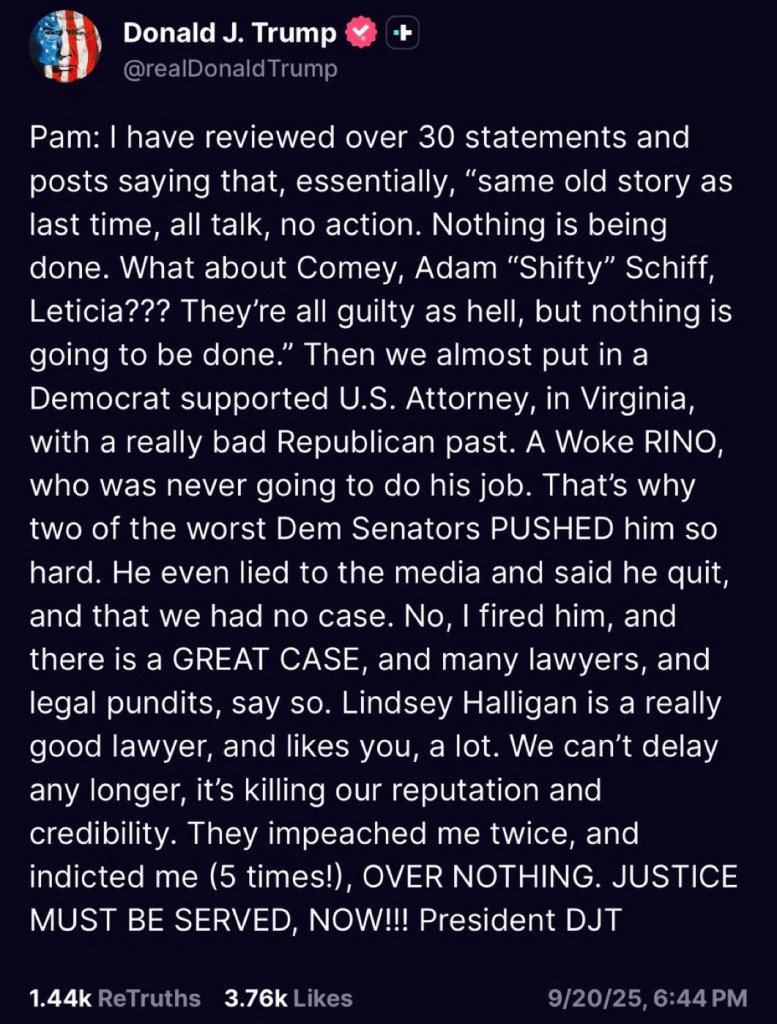
The New Republic tells the shameful story of Trump’s decision to fire Eric Siebert, the U.S. Attorney for the Eastern District of Virginia for his failure to find evidence to indict New York State Attorney General Letitia James.
Trump has said repeatedly that he wants to bring retribution on his enemies. His Attorney General Pam Bondi has protected and obliged him, not only by not releasing the unredacted Epstein files, but by firing any lawyers who worked on Trump investigations while he was out of office.
Trump is determined to prosecute Letitia James, the New York Attorney General, James Comey, and Adam Schiff.
He assigned Erik Siebert, the U.S. Attorney for the Eastern District of Virginia, the job of prosecuting Letitia James. Trump hoped to get her criminally prosecuted for mortgage fraud, for having obtained a mortgage on a vacation home, getting a favorable rate by claiming it as her home. Unfortunately, the case fell apart when evidence emerged that she had not claimed her second home as her primary residence.
Trump was furious at Siebert.
Siebert announced that he had resigned since the President didn’t want him. Trump quickly contradicted him and said Siebert had not resigned, he was fired. Trump promptly announced a replacement, a conservative Republican, Mary “Maggie” Cleary.
Trump is set to remove Erik Siebert, the U.S. attorney for the Eastern District of Virginia, for being faithful to facts, evidence, and guidelines governing good prosecutorial conduct, rather than fully corrupting his office to target Trump’s enemies.
That’s not a rhetorical cheap shot. It’s what Trump is actually doing, per ABC:
President Donald Trump is expected to fire the U.S. attorney for the Eastern District of Virginia after his office was unable to find incriminating evidence of mortgage fraud against New York Attorney General Letitia James, according to sources.
Federal prosecutors in Virginia had uncovered no clear evidence to prove that James had knowingly committed mortgage fraud when she purchased a home in the state in 2023, ABC News first reported earlier this week, but Trump officials pushed U.S. Attorney Erik Siebert to nevertheless bring criminal charges against her, according to sources.
Nixon tried to hide his plots against his enemies. Trump says the quiet parts out loud.
What are they guilty of? Criticizing Trump and–in the case of Schiff and James– trying to hold him accountable.
The crowds were larger and more animated at the No Kings rallies than on Constitution Avenue, where Trump summoned up a parade in honor of his 79th birthday.
Yesterday evening, I saw tweets comparing the demeanor of the American service members to their parade counterparts in Russia, North Korea, and China. The soldiers in other countries marched in perfect symmetry, with not an eye or a boot out of place. The Americans seemed to be strolling. The tweets were meant to mock us. Some were posted by someone in another country. I responded, “Those Russian troops in perfect formation have not been able to beat Ukraine in three years. If they engaged American troops, our army would kick them all the way back to Moscow.”
The country that invented jazz was never going to be good at putting on a military parade. It was never going to be us.
In the wake of Donald Trump’s flaccid, chaotic, lightly attended, and generally awkward military parade, a meme began doing the rounds. Its basic format was the juxtaposition of images of the kinds of parades Trump presumably wanted with the parade he actually got.
Over here, thousands of Chinese soldiers marching in perfectly synchronized lockstep; over there, a lone U.S. soldier holding up a drone. Over here, North Korean legs kicking up and coming back down with astounding precision; over there, a dozen U.S. soldiers walking somewhat purposelessly through Washington.
Trump’s biggest mistake was wanting a military parade in the first place. The United States military is not a birthday party rental company. Any therapist will tell you that no number of green tanks on the street is enough to heal the deep void left by a father’s withheld love.
But, setting aside the wisdom of wanting a military parade, there is the issue of execution. Even if you’re going to do the wrong thing, do it well. Do it with flair. With the most powerful military in history at his disposal, Trump couldn’t even pull off a decent parade.
But I’m here to say it’s not his fault alone. It’s hard to wring a military parade of the kind he dreamed of from a people free in their bones.
You see, it is a good thing not to be good at some things. The great beauty of his terrible parade is the reminder that Trump is waging a war against the American spirit, and this fight he is struggling to win.
No matter how much money and effort you throw at the parade, you cannot escape the fact that America is not the country of North Korean unity. We’re the country of Korean tacos.
The Korean-American comedian Margaret Cho once described those tacos, as made famous by the chef Roy Choi, of similar heritage, thus: “There were so many things happening: The familiarity of the iconic L.A. taco, the Korean tradition of wrapping food, the falling-apart short rib that almost tastes like barbacoa, the complementing sweetness of the corn tortilla.” Korea running into Mexico, running into North Carolina, and beyond. Today on the website of the Kogi food empire that Choi built, these are some of the recipes: a Korean barbecue pizza, a Korean Philly cheesesteak, a kimchi fried chicken sandwich, a Korean gyro, and Korean pulled pork nachos. I may be wrong, but here is my hypothesis: the kinds of places good at putting on parades like North Korea’s will never come up with food like this; and the kinds of places good at making food like this will never rival the give-me-synchronicity-or-give-me-death parades of places like North Korea.
America is not the country of perfectly synced swinging arms. It’s the country of “It Don’t Mean a Thing (If It Ain’t Got That Swing).” That song, by the legendary Duke Ellington, belongs to a genre of music that could only have been invented in America — jazz. As the documentarian Ken Burns explained, jazz was born in New Orleans when and because people from so many heritages were jammed together — the sounds of Africa and the sounds of Appalachia and the sounds of Germany and the sounds of indigenous people colliding to make something new. It was never scripted, always improvisational. Ellington himself made the connection to democracy:
Put it this way: Jazz is a good barometer of freedom…In its beginnings, the United States of America spawned certain ideals of freedom and independence through which, eventually, jazz was evolved, and the music is so free that many people say it is the only unhampered, unhindered expression of complete freedom yet produced in this country.
I may be wrong, but it seems to me societies that have the thing Trump wanted in his parade don’t got that swing, and societies that got that swing don’t have the thing he craved.
America is not a country of uniformity, even in its uniforms. It’s a big multicolored mess.
What is striking in the images of Chinese and North Korean and Iranian parades is the uniformity, right down to the uniforms themselves. The soldiers are often seen wearing the same thing. It gives the kind of picture Trump likes. But the images this weekend were not like that at all. In America, different units wear different uniforms. Images from the parade this weekend showed one uniform after another. The military is not a monolith. It is made up of units with their own histories and traditions and identities and loyalties. There are rivalries and competing slogans.
I may be wrong, but I would wager that societies that have first-rate matchy-matchy uniform aesthetics may look good but fight wars mediocrely, and societies that allow for variety and diversity may give less pleasant aerial shots during parades but fight wars better.
Today is ten years to the day since Trump came down the escalator and changed the course of the country and, in so many ways, changed us. It is a moment to think back and think of how much coarser, uglier, crueler the nation has become in the hands of an unwell man. The daily drumbeat of abductions and cuts and eviscerations and illegal actions and sadistic policy ideas slowly corrodes the heart. We are being remade in Trump’s sickness.
And yet. And yet what the parade reminded me is that Trump, in one regard, at least, faces steep odds. His project depends on turning Americans into something we are deeply not: uniform, cohesive, disciplined, in lockstep.
But we are more hotsteppers than locksteppers. We are more improvised solo than phalanx. We are more unruly than rule-following. Trump has a lot working in his favor as he seeks to build a dictatorship for his self-enrichment. But what will always push against him is this deep inner nature that has stood through time: the chaotic, colorful spontaneity of the American soul. We don’t march shoulder to shoulder. We shimmy.
Heather Cox Richardson demonstrates the negative effects of Elon Musk’s DOGS, which protected his interests and saved little, if any, money. With Trump’s “big, beautiful” tax plan, the deficit will increase by $4-5 trillion, so Musk’s chainsaw contributed nothing but demoralization and destruction of the federal workforce. She also summarizes the multiple ways in which Trump is sabotaging the rule of law. She includes footnotes, as usual. Subscribe to her blog to see them.
She writes:
In July 2024, according to an article published today by Kirsten Grind and Megan Twohey in the New York Times, billionaire Elon Musk texted privately about his concerns that government investigations into his businesses would “take me down.” “I can’t be president,” he wrote, “but I can help Trump defeat Biden and I will.”
After appearing on stage with Trump on October 5, Musk texted a person close to him: “I’m feeling more optimistic after tonight. Tomorrow we unleash the anomaly in the matrix.” About an hour later, he added: “This is not something on the chessboard, so they will be quite surprised. “‘Lasers’ from space.”
Musk invested about $290 million in the 2024 election and, when Trump took office, became a fixture in the White House, heading the “Department of Government Efficiency.” It set out to kill government programs by withholding congressionally approved funds, a practice that courts have ruled unconstitutional and Congress expressly prohibited with the 1974 Impoundment Control Act.
Musk vowed that his “Department of Government Efficiency” would cut $2 trillion from the U.S. budget, but he quickly backed off on those numbers. In the end, DOGE claimed savings of $175 billion, but that claim is unverifiable and CNN’s Casey Tolan says it’s probably wrong: less than half of it is backed up with any documentation.
Instead, as CNN’s Zachary B. Wolf reported today, since DOGE cut staffing at the enforcement wing of the Internal Revenue Service, for example, and cut employees at national parks, which also generate revenue, its cuts may well end up costing money. Max Stier, who heads the Partnership for Public Service, suggests DOGE cuts could cost U.S. taxpayers $135 billion because agencies will need to train and hire replacements for the workers DOGE fired. Stier called DOGE’s actions “arson of a public asset.”
Grind and Twohey reported that Musk’s drug consumption during the campaign—they could not speak to his habits in the White House, although he appeared high today at a White House press conference—was “more intense than previously known.” He was a chronic user of ketamine, took Ecstasy and psychedelic mushrooms, and traveled with a box that held about 20 pills for daily use. Those in frequent contact with him worried about his frequent drug use, erratic behavior, and mood swings. As a government contractor, Musk should receive random drug tests, but Grind and Twohey say he received advance warning of those tests.
It was never clear that Musk’s role at DOGE was legal, and the White House has tried to maintain that he was only an advisor, despite Trump’s February 19 statement, “I signed an order creating [DOGE] and put a man named Elon Musk in charge.” On Tuesday, U.S. District Judge Tanya Chutkan ruled that 14 states can proceed with their lawsuit against billionaire Elon Musk and the “Department of Government Efficiency,” saying the states had adequately supported their argument that “Musk and DOGE’s conduct is ‘unauthorized by any law.’”
Trump posted today on social media: “This will be his last day, but not really, because he will, always, be with us, helping all the way. Elon is terrific!” In a press conference today, Trump reiterated that Musk “is not really leaving.”
Musk’s time at the helm of DOGE might not have saved taxpayer money, but it has changed the world in other ways. Musk has used his time in the government to end investigations into his companies, score government contracts, and get the government to press countries to accept his Starlink communications network as a condition of tariff negotiations. According to John Hyatt of Forbes, Musk’s association with Trump has made him an estimated $170 billion richer.
The implications of DOGE’s actions for Americans are huge. DOGE operatives are now embedded in the U.S. government, where they are mining Americans’ data to create a master database that can sort and find individuals. Former Ohio Democratic Party chair David Pepper called it “a full-scale redirection of the government’s digital nervous system into the hands of an unelected billionaire.”
Today, Sheera Frenkel and Aaron Krolik of the New York Times reported that Musk put billionaire Peter Thiel’s Palantir data analysis firm into place across the government, where it launched its product Foundry to organize, analyze, and merge data. Thiel provided the money behind Vice President J.D. Vance’s political career. Wired and CNN had previously reported how the administration was using this merged data to target undocumented immigrants, and now employees are detailing their concerns with how the administration could use their newly merged information against Americans more generally.
Internationally, Musk’s destruction of the United States Agency for International Development, slashing about 80% of its grants, is killing about 103 people an hour, most of them children. The total so far is about 300,000 people, according to Boston University infectious disease mathematical modeller Dr. Brooke Nichols. Ryan Cooper of The American Prospect reported today that about 1,500 babies a day are born HIV-positive because Musk’s cuts stopped their mothers’ medication.
In the New York Times today, Michelle Goldberg recalls how Musk appeared uninterested in learning what USAID actually did—prevent starvation and provide basic healthcare—and instead called it a “radical-left political psy-op,” and reposted a smear from right-wing provocateur Milo Yiannopoulos calling USAID “the most gigantic global terror organization in history.” Goldberg also recalls Musk’s tendency to call people he disdains “NPCs,” or non-player characters, which are characters in role-playing games whose only role is to advance the storyline for the real players.
Aside from DOGE, the focus of Trump’s administration—other than his own cashing in on the presidency—has been on tariffs and immigration. Like the efforts of DOGE, those show a disdain for the law in favor of concentrating power in the executive branch.
During the campaign, Trump fantasized that constructing a high tariff wall around the U.S. would force other countries to fund the national deficit, enabling a Republican Congress to extend Trump’s 2017 tax cuts for the wealthy and corporations. In fact, domestic industries and consumers bear the costs of tariffs. Trump’s high tariffs, many of which he imposed by declaring an economic emergency and then using the 1977 International Emergency Economic Powers Act (IEEPA), created such havoc in the stock and bond markets that he backed off.
Yesterday, Sayantani Ghosh, David Gaffen, and Arpan Varghese of Reuters reported that although most of the highest tariffs have yet to go into effect, Trump’s trade war has cost companies more than $34 billion in lost sales and higher costs.
Trump has changed tariff policies at least 50 times since he took office, and traders have figured out they can buy stocks cheaply when markets plummet after a dramatic tariff announcement, and sell when Trump changes his mind. This has recently given rise to Trump’s nickname “TACO,” for “Trump Always Chickens Out.”
This moniker has apparently irritated Trump so much he has taken to social media to defend his abrupt dropping of tariffs on China, saying he did it to “save them” from “grave economic danger,” although in fact, China turned to other trading partners to cushion the blow of U.S. tariffs. Trump went on to suggest China did not live up to what he considered its part of the bargain, and he would no longer be “Mr. NICE GUY!”
On Wednesday a three-judge panel at the U.S. Court of International Trade ruled that President Donald J. Trump’s sweeping “Liberation Day” tariffs based on the IEEPA are illegal. The Constitution gives to Congress, not to the president, the power to levy tariffs. Trump launched a social media rant in which he attacked the judges, insisted that “it is only because of my successful use of Tariffs that many Trillions of Dollars have already begun pouring into the U.S.A. from other Countries,” and said that he could not wait for Congress to handle tariffs because it would take too long—in fact, most of Congress does not approve of the tariffs—and that following the Constitution “would completely destroy Presidential Power.” “The President of the United States must be allowed to protect America against those that are doing it Economic and Financial harm.”
Yesterday the U.S. Court of Appeals for the Federal Circuit paused that ruling until at least June 9, when both parties will have submitted legal arguments about whether the stay should remain in place as the government appeals the ruling that the tariffs are illegal. White House senior counsel for trade and manufacturing Peter Navarro, the key proponent of Trump’s trade war, said: “Even if we lose, we’ll do it another way.”
Today Trump said he will double the tariff on steel imports from 25% to 50%.
The other major focus of the administration has been expelling undocumented immigrants from the U.S. During the 2024 campaign, Trump whipped up support by insisting that former President Joe Biden had permitted criminals to walk into the U.S. and terrorize American citizens. Trump vowed to launch the “largest domestic deportation operation in American history” and often talked of deporting the estimated 11 million undocumented immigrants in the U.S., although his numbers have ranged as high as 21 million without explanation.
The administration has hammered on immigration to promote the idea that it is keeping Americans safe. But its first target of arresting at least 1,200 individuals a day has fallen far short. In Trump’s first 100 days, Immigration and Customs Enforcement says it arrested an average of about 660 people a day.
On Wednesday, White House deputy chief of staff Stephen Miller, who along with Secretary of Homeland Security Kristi Noem is the face of the administration’s immigration policy, told the Fox News Channel that the administration is now aiming for “a minimum of 3,000 arrests…every day.” Administration officials hope to deport a million people in Trump’s first year in office.
CNN reported yesterday that those officials are putting intense pressure on law enforcement agencies to meet that goal. This means that hundreds of FBI agents have been taken off terror threats and espionage cases involving China and Russia to be reassigned to immigration duties. Some FBI offices are offering overtime pay if agents help with “enforcement and removal operations.” Officers from other agencies, including the Bureau of Alcohol, Tobacco, Firearms, and Explosives (ATF) have also been deployed against immigrants in place of their regular duties.
Steven Monacelli of The Barbed Wire noted today that local law enforcement and state troopers have also been diverted to immigration, using a national network of cameras that read license plates. Joseph Cox and Jason Keobler of 404 Media reported yesterday that a Texas sheriff used the same system over the course of a month to look for a woman whom he said had a self-administered abortion, saying her family was worried about her safety.
Their attempt to appear effective has led to very visible arrests and renditions of undocumented migrants to prisons in third countries, especially the notorious CECOT terrorist prison in El Salvador. The administration has deliberately flouted the right of persons in the United States to due process as guaranteed by the Constitution. The administration has met court orders with delay and obfuscation, as well as by attacking judges and the rule of law.
The administration continues to insist those it has arrested are dangerous criminals who must be deported without delay, but more and more reporting says that many of those expelled from the country had no criminal convictions. Today, ProPublica reported that the Trump administration’s own data shows that officials knew that “the vast majority” of the 238 Venezuelans it sent to CECOT had not been convicted of crimes in the U.S. even as it deported them and called them “rapists,” “savages,” “monsters,” and “the worst of the worst.”
ICE has increasingly met quotas by arresting immigrants outside of immigration check-ins and courtrooms: yesterday Dina Arévalo of My San Antonio reported that ICE arrested five immigrants, including three children, outside of an immigration court after a judge had said they were no longer subject to removal proceedings. The officers used zip ties on all five individuals.
At stake is the turn of the United States away from democracy and toward the international right wing. Yesterday the U.S. State Department notified Congress that it intends to use the Bureau of Democracy, Human Rights, and Labor to promote “Democracy and Western Values.” On Tuesday a senior advisor for that bureau, Samuel Samson, who graduated from college in 2021, explained that the State Department intends to ally with the European far right to protect “Western civilization” from current democratic governments.
It also plans to turn the Bureau of Population, Refugees, and Migration, which manages the flow of people into the U.S., into an “Office of Remigration” to “actively facilitate” the “voluntary return of migrants” to other countries and “advance the president’s immigration agenda.”
“Remigration” is a term from the global far right. As Isabela Dias of Mother Jones notes, its proponents call for the “mass expulsion of non–ethnically European immigrants and their descendants, regardless of immigration status or citizenship, and an end to multiculturalism.” Of the congressional report, a person who works closely with the State Department told Marisa Kabas of The Handbasket: “All of it is pretty awful with some pieces that definitely violate existing law and treaties. But institutionalizing neo-Nazi theory as an office in the State Department is the most blatantly horrifying.”
This concept is behind not only the expulsion of undocumented immigrants, but also the purge of foreign scholars and lawful residents. The Supreme Court blessed this purge today when, during the period that litigation is underway, it allowed the administration to end immigration paroles for about 500,000 people from Cuba, Haiti, Nicaragua, and Venezuela admitted under a Biden-era program, instantly making them undocumented and subject to deportation.
The court decided the case on the shadow docket, without briefings or explanation. In a dissent joined by Justice Sonia Sotomayor, Justice Ketanji Brown Jackson wrote: “[S]omehow, the Court has now apparently determined…that it is in the public’s interest to have the lives of half a million migrants unravel all around us before the courts decide their legal claims.”
Jackson added a crucial observation. The court, she wrote, “allows the Government to do what it wants to do regardless [of the consequences], rendering constraints of law irrelevant and unleashing devastation in the process.”
As I read this frightening post by Thom Hartmann, I was reminded of the many times in first term that he longed for protestors or suspects to be roughed up. He spoke to police officers in New York and urged them not to be so gentle when they apprehended suspects. He encouraged his audience to beat up troublemakers and send him their legal bills. He has a strange love of violence, though he himself dodged the draft five times.
Hartmann describes the freedom of ICE to arrest and detain anyone without a warrant, without any due process. Where is this going?
Imagine stepping off a plane in the United States, fully expecting to enter the country without issue, only to be surrounded by armed agents, handcuffed, and thrown into a freezing detention center. No trial. No lawyer. No contact with the outside world.
In Trump’s America, you are no longer guaranteed your rights or freedom—because now, it takes nothing more than an ICE agent’s “suspicion” to make you disappear.
This isn’t a mistake. It’s part of an expanding system of cruelty, where ICE—once an agency tasked with immigration enforcement—is now operating like an unchecked police force, targeting legal residents, visitors, and even US citizens with impunity.
People who follow every rule, complete all the required paperwork, and obey every regulation are still finding themselves locked away, held in horrific conditions, and stripped of their rights—all based on the whims of an agent who doesn’t even need evidence to justify an arrest.
A U.S. citizen from Chicago was among 22 people recently subjected to unlawful arrests and detention by ICE. The U.S. Government Accountability Office found that during Trump’s first term, immigration authorities asked to hold approximately 600 likely citizens and actually deported about 70 likely citizens.
But now, in part because of the Laken Riley Act, it’s getting worse. Forty-two Democrats in the House and fourteen in the Senate voted to pass this execrable GOP bill last month; it was named after a young woman murdered by an undocumented alien whose story was relentlessly promoted by Fox “News” and other rightwing hate media.
That law, recently signed by Trump, says that ICE now has the authority to detain anybody — anybody — for an indefinite period of time — no time limit whatsoever — if an ICE agent simply says that he or she “suspects” the person is in the country illegally or without documentation.
Fabian Schmidt, a German-born engineer, has lived in the United States for nearly two decades, legally working, paying taxes, and contributing to his community. None of that mattered when he returned home from a trip abroad. As soon as he landed at Logan Airport in Boston, ICE agents pulled him aside. His green card renewal was “flagged” for some unknown reason—no explanation, no opportunity to clarify, just a red mark in a government system.
That was all it took. ICE stripped him of his clothes, subjected him to hours of aggressive questioning, and locked him in a detention center. They threw him into an ice-cold shower and left him shivering on the concrete floor, humiliated and terrified.
For days, his mother, Astrid, desperately tried to find him. She called ICE, Customs and Border Protection, and any agency that might give her an answer. They either ignored her or outright lied, claiming they had no record of her son. When she finally learned where he was, Fabian was barely holding himself together. “They treat us like animals,” he told her.
And why was he there? Because of a supposed “bureaucratic error.” ICE used a minor paperwork issue as an excuse to detain a legal resident of the United States without due process, a tactic that’s becoming frighteningly common.
For Jessica Brösche, a German tattoo artist, her visit to the United States was supposed to be brief—just a trip to see friends and enjoy the country. She had a valid passport, a return ticket, and legal permission to enter under the Visa Waiver Program. Yet, ICE decided that she might try to work while visiting, a baseless assumption that required no proof and no justification.
Just “suspicion.” That was enough to detain her indefinitely.
Once inside, the nightmare deepened. They threw her into a cell with no bed and no access to legal assistance. For eight straight days, they kept her in solitary confinement. The lights never dimmed, and the sounds of other detainees screaming in despair echoed through the walls. She started hallucinating, her grip on reality slipping. Desperate to feel something, anything real, she punched the walls until her knuckles bled.
Meanwhile, her best friend, Amelia, searched frantically for her. ICE refused to confirm her location or even acknowledge that they had detained her. No charges, no trial, no legal recourse—just silence.
Jessica’s case isn’t unique. People who follow all immigration rules are being detained under vague suspicions, often disappearing into a bureaucratic black hole. And once they’re inside the system, their rights mean nothing.
Consider Jasmine Mooney, the actor who starred in the American Pie franchise anda Canadian businesswoman who played by the rules. She secured a job offer, completed all visa paperwork, and followed every U.S. immigration law to the letter. But that didn’t stop ICE from shackling her, chaining her wrists, ankles, and waist as if she were a violent offender.
For days, she was trapped in a brutal private, for-profit detention facility, laying on the bare floor with nothing but a crinkled foil sheet for warmth. Then, in the dead of night, ICE dragged her from her cell, bound her in chains again, and forced her onto a bus with dozens of other women. They drove for hours, denying them food, water, or bathroom breaks. By the time she arrived at another facility, she had been awake for 24 hours and was too weak to stand.
To this day, ICE refuses to explain why she was detained. And why would they? They don’t have to. The agency operates with absolute power, detaining people for as long as they want, answering to no one.
Moody tells her horrifying story to The Guardian, writing:
“I was then placed in a real jail unit: two levels of cells surrounding a common area, just like in the movies. I was put in a tiny cell alone with a bunk bed and a toilet. …
“There were around 140 of us in our unit. Many women had lived and worked in the US legally for years but had overstayed their visas – often after reapplying and being denied. They had all been detained without warning.”
These aren’t isolated cases. ICE has transformed itself into an authoritarian force that detains people indefinitely on suspicion alone. No evidence? No trial? No problem.
And the for-profit prison industry that’s holding many if not most of them has no incentive to help these people; the more they detail and the longer they stay, the more money the prison companies make (which they then share as campaign donations with Republican politicians).
ICE agents don’t need proof. They only need the power to act—and Trump has given it to them.
######
Please open the link to continue reading this important post.
Robert Reich is a relentless fighter for our democracy. He served in the administrations of Gerald Ford, Jimmy Carter, and Bill Clinton, in whose administration he was secretary of Labor.
He wrote recently to urge people to organize against Trump’s violations of the law.
Friends,
Before I post my Sunday cartoon, I want to share with you some thoughts about the third hellish week of Trump II.
As of Friday, Trump has signed more than 50 executive orders, covering every aspect of American life and much foreign policy.
It’s not just that this number of executive orders is unprecedented in modern American politics. Many are unlawful, unconstitutional, or both.
In the age of monarchs, kings issued decrees. The tsars of imperial Russia proclaimed ukases. The dictators of the 20th century made diktats.
Trump issues executive orders.
Average people in the age of monarchs, tsars, and dictators were largely powerless. Resistance meant almost certain death.
Many people were resigned to vulnerability. They practiced passivity. They knew no life other than repression. But their deference entrenched and ensured the power of monarchs, tsars, and dictators.
Arbitrary power depends on the acquiescence of everyone subjected to it.
Right now, after three weeks of Trump’s “flooding the zone” (as Trumpers like to say) some of you may be feeling powerless.
Trump wants you to feel powerless. He depends on your passivity in the face of his takeover of American democracy.
He wants to be a strongman who can act unilaterally and arbitrarily — who can issue orders about anything that pops into his head. Purging, firing, prosecuting, or deporting anyone he wants removed. Obliterating, freezing, and pummeling any institution he wants destroyed. Unleashing the richest man in the world to do whatever the hell he wants with the government of the United States.
If you are dumbfounded into inaction, if you don’t even want to hear the news, if you feel as though you’re living through a nightmare over which you have no control, I get it. Every other day I feel the same.
But hear me out.
You and I have no real choice but to stand up to Trump, Musk, and their lapdogs. To allow them to bully us into submission invites more bullying, more lawlessness, more gonzo executive orders.
Last week I suggested a number of actions we can take. It wasn’t an exhaustive list, of course, only some possibilities.
Millions of Americans — including many who have been purged from their positions of responsibility — are standing up to Trump and Musk’s tyranny.
Republican Senator Lisa Murkowski says the Senate phone system has been receiving around 1,600 calls each minute, compared to the 40 calls per minute it usually gets — thus disrupting the system.
We are beginning to flood Trump and Musk’s zone.
Let’s flood it out.
This coming April 19 will mark the 250th anniversary of the battles of Lexington and Concord, which began the American Revolution and our war against monarchical power.
Anti-royalist militia in Massachusetts refused to disperse when ordered to by British troops. A shot was fired, and the troops kept firing, killing eight of those American resisters. Later that day, the militiamen returned that fire, killing a number of British soldiers. The revolution had begun.
Please don’t get me wrong. I do not advocate violence. I’m simply reminding you that this nation was founded on resistance to arbitrary authority. We built American democracy in the face of what seemed to be impossible odds.
And we will never, ever give up that fight.
My friend Harold Meyerson suggests that on April 19 we stage massive peaceful protests in every city and town — crowds of Americans celebrating the anti-monarchical uprising of 1775 and pledging their allegiance to that heritage by denouncing Trump’s increasingly autocratic rule: Thereby flooding Trump and Musk’s zone still further.




 Diane Ravitch's blog