Archives for category: Accountability

Stephen Sawchuk wrote in Education Week about the ways that public controversy about “critical race theory” is affecting the drafting and revision of state history standards. He looks closely at three states that revised their history standards in 2021: Louisiana, New Mexico, and South Dakota.

For months, GOP officials and FOX news kept up a steady and alarming drumbeat, falsely claiming that public schools were indoctrinating white students to hate America and to be ashamed of their race. This weird notion was suddenly discovered in the last year of the Trump regime, when beating up on public schools became a cultural wedge issue. The governor’s race in Virginia showed that the campaign against CRT was effective in rousing people’s fears.

As Sawchuk shows, the effort to twist U.S. history to leave out anything bad that happened in the past is working its way into state standards. Message from the GOP, FOX News, and Chris Rufo: Teach lies about U.S. history!

He writes:

Spiked drafts. Allegations of political interference. Confusing terminology. And thousands of angry comments: The volatile debate over how to teach about America’s racist past is wreaking havoc on states’ processes for deciding what students will learn about history and social studies.

In state after state, commentators and politicians contended that proposed expectations for social studies embedded “critical race theory”—even as the educators sitting on the panels writing the new standards defended them for providing an honest, if sometimes challenging, view of America.

Education Week reviewed hundreds of standards and thousands of pages of public comment relating to the standards-writing processes in South Dakota, Louisiana, and New Mexico, all of which took up revisions in 2021, and interviewed writers, educators, and state officials. Across the three states, we found:

  • None of the three states’ drafts mentioned the term critical race theory, but in written comments, people attacked dozens of standards in Louisiana’s and New Mexico’s drafts for purportedly embedding it.
  • In South Dakota, state officials removed about 20 references to Native Americans from the draft submitted by the standards-writing panel—then scotched the draft altogether.
  • The critiques about CRT in Louisiana led the writers to recast some standards and to delete others. And public comment protocols in Louisiana were changed out of fear for the writers’ physical safety.
  • The teaching method of having students take civic action to address classroom and local problems—an approach some conservatives contend is indoctrination—was mysteriously cut from both Louisiana’s and South Dakota’s drafts.
  • About 1 in 10 of some 2,900 pages of comments on the New Mexico standards referenced CRT, often citing language in the draft about “social justice,” “group identity,” and “critical consciousness.” Those terms also attracted confusion from district leaders wondering how those tenets should be taught.

The findings illustrate how the fallout from the confusing and often misleading debate about CRT stands to alter history education in U.S. schools through subtle—but material—changes to day-to-day teaching expectations.

“Standards provide teachers with cover to teach hard things—controversial things,” noted Lynn Walters-Rauenhorst, an instructor and student-teaching supervisor at the University of New Orleans, who was among the writers of Louisiana’s draft. “If we don’t have standards that support deep inquiry about things that may not be the easy topics to cover, then teachers aren’t going to do it.”

And the discord stands as another testament to how the country’s polarization has affected K-12 policymaking at large.

“The uncivil discourse centering around these issues is detrimental not only to the process, but really, it’s also detrimental to these embedded ideas in our constitutional democracy of compromise, of listening to each other, not always agreeing,” said Tammy Waller, the director for K-12 social studies at the Arizona education department.

Arizonans, she noted, faced some controversies over topics like civil rights and the LGBTQ movement when completing the state’s 2018 social studies revisions, but ultimately officials were able to complete a set everyone could live with. That is getting harder.

“In the past I feel like we could have disagreements, and even really intense disagreements, but in the end, it wasn’t a zero-sum game,” Waller said. “We felt like we had something bigger that we were responsible for.”


Critical race theory—originally an academic tool for analyzing how racism manifests in public policy—has morphed into a catch-all term wielded by critics of districts’ efforts to rid schools of systemic racism.

Since the topic exploded in the national discourse last year, a media frenzy has focused on sensational incidents, like reductive diversity trainings for administrators on “white supremacy culture”; a handful of fired teachers and principals who led controversial lessons about racism; and, most recently, on the removal of books written by Black authors from school libraries dealing with themes of racism.

Those are important stories. But states’ revisions to history standards have attracted far less attention, even though they stand to affect millions more students.

Unlike education expectations in reading, science, or math, history standards serve a unique civic function. They are the starting point for textbooks—the narratives that make up most students’ first, and often only, introduction to the American story. In theory, the discipline also gives students an introduction to the tools historians use to interrogate, question, and revise those narratives.

Crafting these K-12 standards is by definition a normative process. It demands that states reach consensus about what students should know. And implicitly, the standards either help tee up—or elide—the difficult and subjective question about the extent to which our country’s practices have matched its ideals.

That question is especially relevant for K-12 students, who are now 54 percent Asian, Black, Latino, and Native American. Where—and how—are these students reflected in this complex story? What does their inclusion or erasure mean for their understanding of who they are as Americans? To what extent should K-12 teaching reflect academic scholarship, which has produced increasingly rich insights over the past three decades about cultural history, especially the experiences of women, Black Americans, and immigrants?

States update teaching standards—the key guide for the content and skills that teachers must cover—about once every seven years. Teachers are legally and professionally obligated to cover these standards, which are usually drafted by panels of teachers, content experts, and lay people. The public also offers feedback before final versions are adopted by state boards of education. …Read more

To illustrate these complex issues, take one representative standard currently under debate in Louisiana in grade 7. The standard, a broad one, directs teachers to explain events and ideas in U.S. history between 1789 and 1877, “including, but not limited to, the Whiskey Rebellion, Indian Removal Act, Fugitive Slavery [sic] Act, Reconstruction amendments.”

As currently written, the standard highlights uneven progress towards true participation in the American democratic experiment. But several commentators in the state suggested replacing those examples with touchstones emphasizing expansion and enfranchisement, though mainly of white Americans: “Jacksonian democracy, Texan independence, Manifest Destiny, and Reconstruction,” they wrote.

What the state standards address also has huge implications for the type of instruction teachers deliver. The current political climate means few teachers are likely to put their careers on the line to go beyond the text of the standards. In some 14 states, officials have passed vaguely worded laws or regulations that constrain how teachers can talk about race and gender. Administrators have largely advised frightened and confused teachers by the mantra: Keep to the standards.

“Teachers are not going to stick their neck out to teach something they think they ethically should talk about, but isn’t going to be assessed,” said Walters-Rauenhorst. “There’s no upside for them.”

EdWeek selected the three states—Louisiana, South Dakota, and New Mexico—for analysis because all three issued at least one draft set of standards in 2021, and received public feedback on that draft.

Other states in the beginning of rewriting their standards are already starting to see the same sort of contention. Minnesota, midway through its own process, has faced tensions over an ethnic-studies portion of its standards; in Mississippi, legislators filed a bill in November to outlaw critical race theory just weeks before the state education department posted a history draft for review….


LOUISIANA: A CRT Reckoning Awaits

Image of a proposed Louisiana standard.

One by one, the commentators stood up at a June public meeting, one of three that the standards-writing committee held to present updates. And one by one, they condemned the state’s draft history standards for purportedly including critical race theory or indoctrinating students.

A typical example: “There is no reason to make students feel guilty,” one speaker said. “We should teach the good things about this country.”

Another: “If you want to continue to talk about slavery, [you should] go to China now…”

Now it’s unclear what will happen to the draft, which is set to be taken up by the state board of education in March.

“I went to law school; I learned critical race theory in law school; I have a Ph.D. This is not something we use in K-12,” said Belinda Cambre, a social studies instructor at a lab school located at Louisiana State University who contributed to the draft. “Really the whole issue saddened me more than anything else, that it could be so weaponized to turn people against talk of diversity.”

The criticism took its toll. Even before the Louisiana department opened up an online public-comment portal, the writers had made significant changes in response to the bruising June feedback.

By August, they had removed the word “equitable” from one kindergarten standard. (That word, along with “equity,” is considered shorthand by some critics for critical race theory.)

Some revisions reframed a standard in a more optimistic way: One in the high school civics course originally called for students to “examine issues of inequity in the United States with respect to traditionally marginalized groups.” In its rewritten form, it calls on them to “analyze the progression and expansion of civil rights, liberties, social and economic equality, and opportunities for groups experiencing discrimination.”

By far, the most substantive revision to the draft was the deletion of one of the overarching skills for students—meant to be embedded across the grade levels and courses—called “taking informed action.”

This thread aimed to get students to take civic action to address classroom, school, and community problems—they might, for example, brainstorm ways to reduce waste or prevent bullying at school. Now, the entire practice has been removed—an irony, given the robust civic participation by those Louisianans who showed up to critique the draft at the June meeting….

Louisiana’s board-appointed State Superintendent Cade Brumley, a former social studies teacher, wrote in a July op-ed that the standards should strike a balance between critique and patriotism, but should not include critical race theory, which he defined as “suggest[ing] America was intentionally founded on racism, oppression, supremacy.” By October, he said that he could not recommend the draft as written.

The Washington Post reports that more than half the school districts in Virginia are defying Governor Youngkin’s order to eliminate mask mandates.

Youngkin boasted on a conservative radio program that only a small percentage of districts were not complying with his belief that masks should be optional.

But a Washington Post analysis shows that the majority of Virginia public school districts — enrolling more than two-thirds of the state’s students — have opted to disobey Youngkin’s mask-optional order. As of Wednesday, two days after the order was supposed to take effect, 69 districts, or 53 percent, are still requiring masks for all students inside schools. Cumulatively, those districts enroll 846,483 students, or about 67 percent of the state’s public school student population. The divide falls along partisan lines, although not perfectly: Almost every district that opted to make masks optional is in a locality that voted for Youngkin in the 2021 gubernatorial election.

The widespread defiance suggests Youngkin will have enormous difficulty in enforcing his mask-optional mandate, which is already the subject of two lawsuits: one from parents in Chesapeake, and one from seven school boards that oversee some of the state’s largest, most prominent school districts. A hearing on the second suit is scheduled for next week. Youngkin has said he will use every tool at his disposal to carry out his order as those cases wind through the court system, and his spokeswoman did not rule out disciplining disobedient districts by yanking their state funding…

Frederick Hess, a senior fellow and director of education policy at the right-leaning American Enterprise Institute, said he thinks Youngkin should stay the course on his masking policies, while vigorously fighting back against the two lawsuits challenging the executive order.

If parents prioritize the health and safety of their children, they will tell them to wear a mask in school and wherever groups of people congregate.

The Holocaust is personal to me. My mother and grandmother left Balti, Bessarabia, and arrived in the United States in 1917. My grandfather came before the war. Most of the family stayed in Europe. My father’s parents came in the 19th century from Lomza, Poland. Most of their family stayed in Poland.

Not one member of my family survived the war. All perished in the Holocaust.

Inappropriate comparisons to the Holocaust are common and undermine its significance. Just today, Robert F. Kennedy, Jr., apologized on Twitter for comparing the effort to vaccinate people to the Holocaust. An incredibly vicious comparison since vaccines save lives; no one’s family is being burned in a furnace because of getting vaccinated.

A message from the Anti-Defamation League.

Soon after the reunification of Germany, ADL organized a leadership mission to a united Germany. One of our most significant meetings was with Dr. Rita Süssmuth, then-head of the Bundestag (Germany’s House of Representatives). One member of our group asked her about teaching young Germans about the Holocaust.

Her answer is even more relevant today than it was then.

She said that one can’t talk about that horror in the same way to the young generation as speaking to their parents or grandparents. They are too far removed from the events of World War II. What is necessary, she reasoned, are creative approaches to make the history relevant and visceral.

Süssmuth’s comment comes to mind as we observe International Holocaust Remembrance Day on Jan. 27, which is also the anniversary of the liberation of the Nazi concentration camp Auschwitz-Birkenau. There is no doubt that more than 80 years after World War II, a variety of factors are coming together posing challenges to Holocaust memory, but all the news in this arena is not bad. It’s a good time to take stock.

The negatives are abundant. First, as is often discussed, a major instrument for educating young people — the living testimony of survivors — is diminishing rapidly as most survivors are gone. One hears over and over again that a survivor speaking about his or her experience before a classroom or school assembly has awakened the students as to what the Holocaust was all about and why they should care about it.

Second, the statistics on the lack of knowledge about even the basics of the Holocaust are concerning. A Pew survey revealed that more than 80 percent of Americans know that it was an attempt at the annihilation of Jews, but far fewer have any idea as to how Hitler came to power and how the horrors came to pass.

The Claims Conference surveyed younger Americans and found that 63 percent of millennials and Gen X-ers did not know that six million Jews had been murdered in the Holocaust.

And ADL’s Global 100 Survey several years ago found that only 54 percent of people worldwide had ever heard of the Holocaust and 32 percent thought it was greatly exaggerated or a myth.

Third, the meaning of the Holocaust is undermined seemingly every day by its trivialization through inappropriate analogies. In the hyper-political and polarized world we live in, exacerbated by social media, it seems that everything one doesn’t like is compared to the Nazis or the Holocaust.

And, of course, one of the most egregious comparisons — often meant to undermine the significance of Holocaust memory — is equating Israeli treatment of the Palestinians to the Nazi treatment of Jews. In other words, so the warped logic goes: The world had its Holocaust, now “the Jews have their own.”

Fourth, Holocaust denial continues to have a life of its own and has found a particular lifeline as extreme right groups look for respectability. There is no doubt that historically the association of the murder of six million Jews with Nazism and fascism has been the major obstacle for decades for such groups to gain legitimacy in political circles. Denying or at least diminishing the Holocaust can open a pathway for revival for extreme right groups who until now have been largely excluded from a role in democratic societies.

This is a powerful combination of factors. There is, however, the other side, where a good deal of progress has been made in Holocaust awareness and acknowledgement.

In the early days, it was Jews and Israelis who were the leaders in educating about the Holocaust. Israel, as a home for the largest number of survivors, invested in the matter with Yad Vashem, Yom HaShoah and the Eichmann trial. Over the last few decades, however, we have seen growing involvement of other governments and broader societies in this project. This is a good development.

So, the U.N., often seen as hostile to the Jewish people because of its many anti-Israel stances, has incorporated two important Holocaust-related elements into its programming and policies. The first is that of today, International Holocaust Remembrance Day, which produces annual programs, statements and recollections and keeps the attention of the international community on this genocide for one day.

The second is a resolution passed just recently which denounces Holocaust denial as against U.N. values.

Another cross-country effort, initiated by Sweden, is the International Holocaust Remembrance Alliance, which, in effect, builds on the U.N. initiative to implement educational processes about the Holocaust in participating countries. Recently, its participants met in Malmo, Sweden to discuss practical ways to move forward on Holocaust education and combatting antisemitism. And, of course, many Holocaust museums have cropped up across the U.S. and Europe, the most important the U.S. Holocaust Memorial Museum, which attracts large numbers of visitors, most of whom are not Jewish.

And then there are the many efforts by non-governmental organizations, two of particular significance being the Shoah Foundation’s vital interview project of survivors and ADL’s Echoes and Reflections public school education curriculum and program on the Holocaust.

These and many others try to live up to Süssmuth’s plea for creativity in connecting young people to the Holocaust. Holocaust knowledge and awareness are clearly more important than ever because of the passage of time, the surge of antisemitism, the loss of shame about antisemitism as the Holocaust is more distant, and the rise in extremism of all kinds and the efforts to legitimize fascism.

Examples are the use of artifacts, photographs and testimony to encourage students to present their own questions about those events; real time questions and responses from Holocaust survivors using hours of pre-recorded video footage; and the use of local U.S. news sources during the period of Nazi rule and how events were seen from an American perspective. Holocaust awareness and acknowledgement are clearly more important today than ever.

Kenneth Jacobson, ADL

Governor Youngkin invited parents to report the names of teachers who are violating the state’s vague and ill-defined law banning the teaching of “divisive concepts,” critical race theory, and anything else any parents object to.

Peter Greene describes the creative responses of respondents. Responses to an email address can come from anywhere, not just Virginia. You too can write to Youngkin’s Stasi.

Anyone can send their reports to the tip line email:

helpeducation@governor.virginia.gov

Greene writes:

But of course you know what else happened next. The tip line has apparently been hit with a variety of reports, like a complaint that Albus Dumbledor “was teaching that full blooded wizards discriminated against mudbloods.” Some of this has been goaded on Twitter by folks like human rights lawyer Qasim Rasgid. And John Legend correctly pointed out that under the guidelines of the decree, Black parents could legitimately complain about Black history being silenced (because, as sometimes escapes the notice of anti-CRT warriors, some parents are Black). Ditto for LGBTQ parents.

Greene also includes a useful list of questions to answer if you write the Governor: like, “who was your favorite teacher and what did they teach?”

In 2014, Russia invaded Ukraine and took control of the Crimean Peninsula, which was then absorbed into Russia. Presently, Putin has stationed at least 100,000 troops on Ukrainian borders, and leaders in the West are fearful that he intends to invade and seize control of all Ukraine. Ukraine has a long and terrible history under Russian control. In the late 1920s and 1930s, Stalin collectivized Ukrainian agriculture and sent troops to export Ukrainian crops to Russia. Millions of Ukrainians were killed or starved to death in the ensuing famine. Historian Robert Conquest wrote a history of these events callled Harvest of Sorrow. It is a terrifying history. Today, it appears that Vladimir Putin wants to reassemble the Soviet Union. He once called its dissolution the worst geopolitical tragedy of the 20th century.

Here are the views of Britain’s Secretary of Defence.

Secretary of State for Defence Ben Wallace discusses NATO, Ukraine and Russia.

Defence Secretary in Olsztyn, Poland.

Defence Secretary in Olsztyn, Poland.

I have lost count of how many times recently I have to had to explain the meaning of the English term “straw man” to my European allies. That is because the best living, breathing “straw man” at the moment is the Kremlin’s claim to be under threat from NATO. In recent weeks the Russian Defence Minister’s comment that the US is “preparing a provocation with chemical components in eastern Ukraine” has made that “straw man” even bigger.

It is obviously the Kremlin’s desire that we all engage with this bogus allegation, instead of challenging the real agenda of the President of the Russian Federation. An examination of the facts rapidly puts a match to the allegations against NATO.

First, NATO is, to its core, defensive in nature. At the heart of the organisation is Article 5 that obliges all members to come to the aid of a fellow member if it is under attack. No ifs and no buts. Mutual self-defence is NATO’s cornerstone. This obligation protects us all. Allies from as far apart as Turkey and Norway; or as close as Latvia and Poland all benefit from the pact and are obliged to respond. It is a truly defensive alliance.

Second, former Soviet states have not been expanded ‘into’ by NATO, but joined at their own request. The Kremlin attempts to present NATO as a Western plot to encroach upon its territory, but in reality the growth in Alliance membership is the natural response of those states to its own malign activities and threats.

Third, the allegation that NATO is seeking to encircle the Russian Federation is without foundation. Only five of the thirty allies neighbour Russia, with just 1/16th of its borders abutted by NATO. If the definition of being surrounded is 6% of your perimeter being blocked then no doubt the brave men who fought at Arnhem or Leningrad in the Second World War would have something strong to say about it.

It is not the disposition of NATO forces but the appeal of its values that actually threatens the Kremlin. Just as we know that its actions are really about what President Putin’s interpretation of history is and his unfinished ambitions for Ukraine.

We know that because last summer he published, via the official Government website, his own article “On the Historical Unity of Russians and Ukrainians”. I urge you to read it, if you have time, because while it is comprehensive on his arguments it is short on accuracy and long on contradictions.

We should all worry because what flows from the pen of President Putin himself is a seven-thousand-word essay that puts ethnonationalism at the heart of his ambitions. Not the narrative now being peddled. Not the straw man of NATO encroachment. It provides the skewed and selective reasoning to justify, at best, the subjugation of Ukraine and at worse the forced unification of that sovereign country.

President Putin’s article completely ignores the wishes of the citizens of Ukraine, while evoking that same type of ethnonationalism which played out across Europe for centuries and still has the potential to awaken the same destructive forces of ancient hatred. Readers will not only be shocked at the tone of the article but they will also be surprised at how little NATO is mentioned. After all, is NATO ‘expansionism’ not the fountain of all the Kremlin’s concerns? In fact, just a single paragraph is devoted to NATO.

The essay makes in it three claims. One: that the West seeks to use division to “rule” Russia. Two: that anything other than a single nation of Great Russia, Little Russia and White Russia (Velikorussians, Malorussians, Belorussians) in the image advanced in the 17th Century is an artificial construct and defies the desires of a single people, with a single language and church. Third, that anyone who disagrees does so out of a hatred or phobia of Russia.

We can dispense with the first allegation. No one wants to rule Russia. It is stating the obvious that just like any other state it is for the citizens of a country to determine their own future. Russia’s own lessons from such conflicts as Chechnya must surely be that ethnic and sectarian conflicts cost thousands of innocent lives with the protagonists getting bogged down in decades of strife.

As for Ukraine, Russia itself recognised the sovereignty of it as an independent country and guaranteed its territorial integrity, not just by signing the Budapest Memorandum in 1994 but also its Friendship Treaty with Ukraine itself in 1997. Yet it is the Kremlin not the West that set about magnifying divisions in that country and several others in the Europe. It has been well documented the numerous efforts of the GRU and other Russian agencies to interfere in democratic elections and domestic disputes is well documented. The divide and rule cap sits prettiest on Moscow’s head not NATO’s.

Probably the most important and strongly believed claim that Ukraine is Russia and Russia is Ukraine is not quite as presented. Ukraine has been separate from Russia for far longer in its history than it was ever united. Secondly the charge that all peoples in Belarus, Russia and Ukraine are descendants of the ‘Ancient Rus’ and are therefore somehow all Russians. But in reality, according to historian Professor Andrew Wilson in his excellent essay for RUSI entitled “Russia and Ukraine: ‘One People’ as Putin Claims?” they are at best “kin but not the same people”. In the same way Britain around 900AD consisted of Mercia, Wessex, York, Strathclyde and other pre-modern kingdoms, but it was a civic nation of many peoples, origins and ethnicities that eventually formed the United Kingdom.

If you start and stop your view of Russian history between 1654 and 1917 then you can fabricate a case for a more expansive Russia, perhaps along the lines of the motto of the Russian Tsar before the Russian Empire “Sovereign of all of Rus: the Great, the Little, and the White” – Russia, Ukraine and Belarus respectively. And crucially you must also forget the before and after in history. You must ignore the existence of the Soviet Union, breaking of the Russian-Ukrainian Friendship Treaty, and the occupation of Crimea. Far more than footnotes in history, I am sure you will agree.

Ironically, President Putin himself admits in his essay that “things change: countries and communities are no exception. Of course, some part of a people in the process of its development, influenced by a number of reasons and historical circumstances, can become aware of itself as a separate nation at a certain moment. How should we treat that? There is only one answer: with respect!” However, he then goes on to discard some of those “historical circumstances” to fit his own claims.

Dubious to say the least, and not in anyway a perspective that justifies both the occupation of Crimea (in the same way Russia occupied Crimea in 1783 in defiance of the Russo-Turkish Treaty of Kuchuk-Kainarji in 1774) or any further invasion of modern Ukraine, as an independent sovereign country.

The last charge against the West by many in the Russian Government is that those who disagree with the Kremlin are somehow Russophobes. Leaving aside that GRU officers deployed nerve agents on British streets or that cyber hacking and targeted assassinations emanate from the Russian state, nothing could be further than the truth.

Russia and the UK share a deep and often mutually beneficial history. Our allegiances helped to finally defeat Napoleon and later Hitler. Outside of conflict, across the centuries we shared technology, medicine and culture. During the 18th Century Russia and Britain were deeply tied. Between 1704 to 1854, from age of Peter the Great through Catherine the Great and well into the 19th Century the British were to be found as admirals, generals, surgeons, and architects at the highest level of the Russian Court. The father of the Russian Navy – one Samuel Greig – was born in Inverkeithing in Fife.

That shared admiration is still true today. The British Government is not in dispute with Russia and the Russian people – far from it – but it does take issue with the malign activity of the Kremlin.

So, if one cold January or February night Russian Military forces once more cross into sovereign Ukraine, ignore the ‘straw man’ narratives and ‘false flag’ stories of NATO aggression and remember the President of Russia’s own words in that essay from last summer. Remember it and ask yourself what it means, not just for Ukraine, but for all of us in Europe. What it means the next time…

I am delighted to invite you to join a webinar where the eminent Duke historian Nancy MacLean and I will discuss “Public Education in Chains,” on February 3 at 3 pm EST.

To register, open the link and sign up.

The event is sponsored by Public Funds Public Schools and the Network for Public Education.

Dr. MacLean is author of the brilliant book Democracy in Chains, which documents the Koch brothers’ relentless efforts to privatize government functions.

North Carolina has been in the forefront of destructive education policies ever since the Tea Party won control of the state’s General Assembly (legislature) in 2010. Charters, vouchers, TFA, high-stakes testing, hostile indifference to teachers, etc.

But the rightwingers in NC wanted more. They wanted their own version of the Tennessee Achievement School District. They knew that Tennessee lawmakers had created a special district containing the state’s lowest-scoring schools; these schools would show dramatic improvement if handed over to charter operators.

The North Carolina legislators ignored the clear evidence that the Tennessee ASD was a failure, despite the state’s investment of $100 million from Race to the Top funding. Failure was no deterrent, no way to dissuade them from launching the magic elixir of privatization.

In 2016, the North Carolina General Assembly created its very own Achievement School District, which was soon renamed the Innovative School District. Now we know it too has failed. The General Assembly is defunding it.

The Innovative School District was supposed to contain five schools, but every time a school was designated, its district fought to keep the school. The ISD opened with only a single school, and that one school had a principal, a superintendent, and a charter management organization. An awful lot of administrators for one school.

Alex Granados wrote about the collapse of this bad idea in EdNC:

In an experiment, a hypothesis is tested. In the case of the Innovative School District(ISD), the hypothesis was that some of the state’s lowest-performing schools could be improved if they were grouped into one district, given charter school-like flexibility, and turned over to the management of alternative operators.

To judge by the biennium budget passed by the General Assembly in November 2021, North Carolina lawmakers must have concluded that the ISD experiment did not yield the result of improving schools, at least not in the way it was originally conceived. What other conclusion can be drawn from the fact that lawmakers put an end to the project in their two-year spending plan?

Background

The Achievement School District bill was passed during the 2016 General Assembly short session. At the heart of the legislation was the creation of a district that would eventually include five low-performing schools from around the state that could be turned over to charter school operators.

It was originally called the Achievement School District and its first superintendent, Eric Hall, said at the time that it was modeled after similar experiments from other states that had “mixed results.”

“We have an opportunity as a state to redefine what it means in North Carolina,” Hall told the State Board of Education in 2017. But that redefinition never quite came to be.

A single school

The initial plan was that all five schools in the ISD would be up and running by the 2018-19 school year. It is now the 2021-22 school year, and there is still only one school. That is thanks to, in large part, massive resistance from some of the districts approached by the state.

The single school that was taken over as part of the ISD was Southside-Ashpole Elementary School in Robeson County. And it’s been a tough journey both for the school and for the district — since its inception, the ISD has had four superintendents and the school has had three principals.

Current ISD Superintendent Ron Hargrave told the State Board of Education in December 2021 about visiting a kindergarten class at Southside-Ashpole on his first day. A teacher said to him: “‘Well, you’ll be number four,’ and she was talking about the number of superintendents who’ve come through there,” he said.

Hargrave replied, “I’m going to do everything in my power to make sure you don’t need a number five, because I’m here to stay.”

But turnover hasn’t been the only issue.

The nonprofit charter organization that was running the operation was ultimately relieved of its responsibilities by the State Board of Education. You can read about the difficulties with that organization, Achievement for All Children (AAC), in N.C. Policy Watch here and here.

‘No common ground’

Did Southside-Ashpole improve? According to data, no.

Trip Stallings, whose team conducted the external evaluation of the ISD when he was with the Friday Institute for Educational Innovation, said that a single school’s performance can’t really tell us anything about how well the ISD concept might work as a multi-school turnaround program.

“Because they only had one school in three years, you can’t really use that experience to validate or disprove the ISD approach,” he said. But there are a number of issues evident from even the experience of a single school that may have weakened the ISD structurally, according to Stallings.

One issue was that the legislation that created the ISD assumed there would be a wide variety of Charter Management Organizations (CMOs) vying to manage schools in the ISD. Instead, only three CMOs applied to manage Southside-Ashpole. The State Board of Education asked all three to resubmit their original proposals and, ultimately, the revised proposal from AAC was accepted.

“The real question is, ‘Why did other CMOs not apply?’” Stallings said.

Former ISD Superintendent Eric Hall presents to the State Board of Education Thursday, April 5, 2018. Alex Granados/EducationNC

Another problem, according to Stallings, was the disconnect among the operator, the State Board of Education, and the state Department of Public Instruction (DPI) regarding how the ISD as a program should be implemented and managed.

“For example, none of the parties really reached agreement on the question of what this ‘charter-like flexibility’ means,” he said.

As a result, a superintendent, principal, and CMO leader all tried to assert separately how the single school in the district needed to operate. This led to confusion and dysfunction, he said.

Finally, Stallings said that the remote nature of the program was a “significant handicap.” DPI, AAC, and the school were all in separate locations and remote from each other not just geographically, but also culturally.

“They didn’t see many things in the same way,” he said. “For some issues, there was no common ground.”

According to the budget, Southside-Ashpole Elementary School will continue as part of the ISD until 2023-24 at the latest, when it will be returned to the Public Schools of Robeson County.

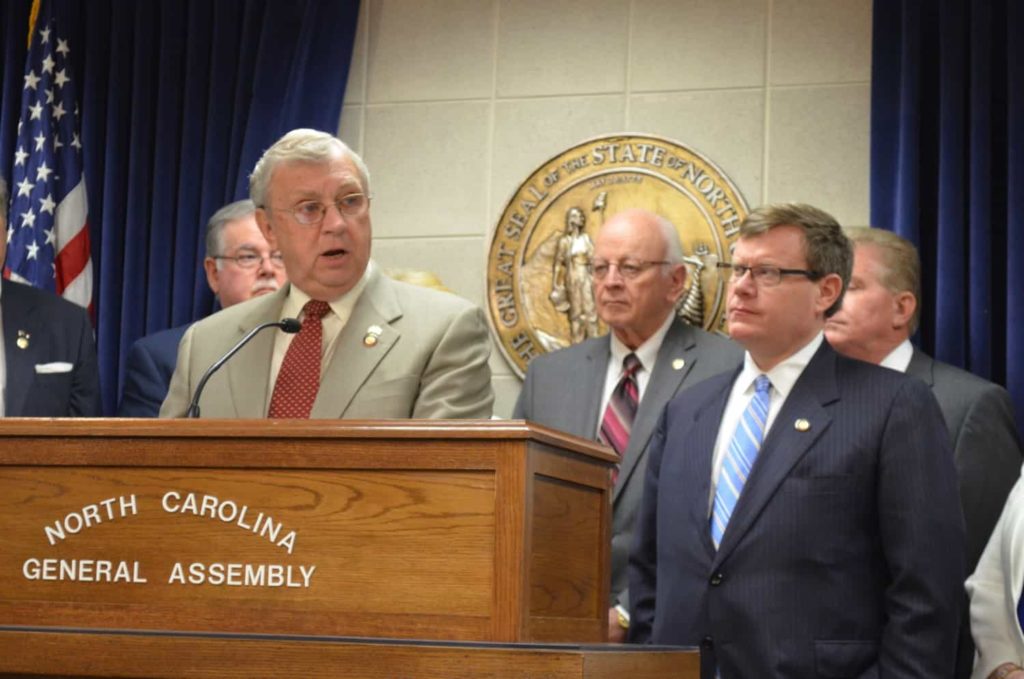
Craig Horn, a former Republican state representative from Union County, said this is terrible news. Not because he was a big fan of the ISD — he said he wasn’t — but because it is indicative of how the General Assembly operates.

Rep. Craig Horn, R-Union, talking about the education portions of the budget at a 2017 press conference. Alex Granados/EducationNC

Horn, an influential legislator when it came to education, lost his seat when he ran for the state superintendent position and lost to Catherine Truitt in 2020. He was there for the inception of the ISD.

“I’m going to suggest that rather than sit down and work out the problems, it’s easier and faster to say, ‘Ok, we’re done. We’re not doing it,’” he said.

Horn had a lot of problems with the ISD program, but said that if it has failed, he hopes lawmakers have done their homework to understand why.

“If we can say that we did our homework, we actually talked to the people inside, we actually talked to parents and students, we actually made some adjustments and we’re still failing, OK, then we made an informed decision,” he said. “But my experience with the General Assembly is they don’t always make informed decisions.”

Preparing for transition

The State Board of Education heard from the current leaders of the ISD and Southside-Ashpole at the December 2021 meeting.

Derrick Jordan, associate superintendent of agency schools, told the Board that efforts to improve the school are still happening.

“There is absolutely still work to be done, but there is an unwavering commitment to improving outcomes for the students at Southside-Ashpole,” he said.

And Hargrave stressed to Board members that the students in that school are “full of potential.”

“It is a school full of children who desire to be loved and desire to be taught, and they have a hunger for learning,” he said.

Freddie Williamson, superintendent of the Public Schools of Robeson County, said the district is ready to have the school back and is already working with the school and the ISD to prepare for a “smooth, seamless transition.”

There isn’t yet a timeline for the transition, but when Southside-Ashpole does return back to the control of Robeson County schools, State Board of Education member Olivia Oxendine said she hopes it keeps innovation a priority. She said innovation takes a long time, and whatever the ISD, the new teachers, new principal, or the community have done, it should continue.

“Whatever is beginning to happen called innovation, let’s carry it forward,” she said.

Nothing on the record shows that there was either innovation or achievement at the one school in the experimental district. But whatever it is, says Ms. Oxendine, keep doing it, even though it yielded no improvement.

The full story of North Carolina’s failed experiment is fascinating. The bill to create the state’s Innovative School District was sponsored by Republican Rob Bryan. The money to promote the bill was supplied by an ultra-conservative businessman from Oregon named John Bryan (no relation to the legislator). After the bill passed, the state Board of Education selected Achievement for All Children (AAC) as the charter operator, although it had no experience turning around low-performing schools.

Here’s the context, which appeared in NC Policy Watch.

Mecklenburg County Republican Senator Rob Bryan sponsored the bill as a member of the House in 2016 that became law and created the ISD. That law specifies that the ISD can have up to five schools, selected from the lowest-performing in North Carolina.

Bryan argued at the time that the new district would provide much-needed reforms, but the following year, as Policy Watch reported, he received at least $5,000 as a “stipend” for his work with AAC.

Several other low-performing schools, including two in Durham, were targeted for state takeover in 2017, but resisted the move. Then-ISD Superintendent Eric Hall ended his pursuit of those schools.

That left Southside-Ashpole, which began operating as the state’s first and only school within the Innovative School District at the start of the 2018-19 school year. Southside-Ashpole has an enrollment of 270, 95% of whom are students of color: Black, Latinx and American Indian.

In its first year as an ISD school, there was a wholesale house cleaning at Southside-Ashpole: After Superintendent Allen abruptly left, the State Board of Education hired Ellerbe to replace her. School principal Bruce Major also suddenly resigned, and AAC then hired Bowen.

It remains unclear whether the changes were due to job performance.

Meanwhile, there has also been a major upheaval within AAC’s business partner, TeamCFA, a Charlotte-based nonprofit that provides financial, instructional and management support to more than a dozen schools in North Carolina and four in Arizona.

TeamCFA is AAC’s curriculum partner, according to the ISD website.

Tony Helton, one of the state’s most influential charter school leaders, resigned his $160,000-a-year post as southeastern regional director of TeamCFA last August. While holding that position, Helton also worked as chief operating office of AAC. He was replaced by Cotham.

TeamCFA was started by John Bryan (no relation to Rob Bryan), a retired Oregon businessman who has used his wealth to promote school choice causes.

John Bryan is also a major contributor to Republican lawmakers and was instrumental in helping to pass the North Carolina law that created the ISD. From 2013 to 2016, Rob Bryan’s campaign received more than $22,000 in contributions from John Bryan, state reports show. John Bryan also contributed to then-Gov. Pat McCrory, Lt. Gov. Dan Forest, NC House Speaker Tim Moore and Senate President Pro Tem Phil Berger.

Raleigh’s News & Observer reported in October that Bryan and the Challenge Foundation, which Bryan also formed, stopped funding TeamCFA. In his final founder’s letter, Bryan talked about passing on the responsibility to other private investors and philanthropists.

TeamCFA had received as much as 95% of its annual revenue from Bryan and the Challenge Foundation, the paper reported. TeamCFA also receives $510,000 annually from the Charles Koch Foundation.

The NC Republican leadership was heavily funded by John Bryan from Oregon. Bryan was the funder of TeamCFA. TeamCFA was the partner of the only charter operator that applied to manage the district that was created by legislation funded by John Bryan.

What happened to the 270 students in the one school in the Innovative school District? Well, they have had a constant turnover of principals and superintendents. They were Guinea pigs for legislators who don’t know them and apparently don’t care about them.

This is a remarkable document in the New York Times. It details the planning and coordination for violent action that began as soon as the results of the 2020 were clear. The Oathkeepers, extremists who refused to accept Trump’s loss, started their efforts to stockpile weapons and convene in D.C. on January 6. Of course, other groups and unaffiliated individuals joined them.

This account directly contradicts the claims by Trumpers that Antifa or the FBI were behind the riots or that the insurrectionists were peaceful protestors exercising their First Amendment rights.

Gary Rubinstein began his career as a Teach for America recruit in 1991 and got to know many of the key figures in the corporate reform movement. He is currently a career high school teacher of mathematics in a New York City public school. Over time, he became disillusioned with the phony promises of TFA and charter schools and became one of the most tenacious critics of their hypocrisy.

KIPP, he notes, is considered the gold standard of charter schools. The organization has about 250 charter schools across the nation. It benefited from being featured in the nefarious film “Waiting for ‘Superman'” as a school that was able to “save” kids who were allegedly trapped in failing public schools. The implication of the film was that charter schools had some magic knowledge that enabled them to transform children who had been faring poorly in school. Mostly, that claim is a hoax, but it is good marketing for recruitment of students.

In this post, he reports on the crisis of KIPP in Tennessee. KIPP had seven schools. But in 2020, two were closed because of low test scores and low growth scores. Now two more are on the chopping block due to poor performance.

He writes:

In the cities of Memphis and Nashville, TN there are a lot of charter schools fueled, in part, by the Race To The Top money they received while Teach For America alumni were in leadership positions at the Tennessee Education Department. By 2019, they had grown to seven KIPP schools in Tennessee. In 2020 the network announced that they were shutting down two of those seven schools. The headline from the Chalkbeat, TN article contains the quote from the network ‘‘We’ve been unable to fulfill our academic promise’. So as of 2020 they were down to five schools in Tennessee.

According to a new article in Chalkbeat, TN, this coming Tuesday, January 25th, the Shelby County school system will vote on whether or not to shut down two of the remaining KIPPs: KIPP Memphis Academy Middle School and KIPP Memphis Collegiate Elementary.

Rubinstein researched the remaining five KIPP schools [including the two at risk of closure] in Tennessee and discovered that none of them is successful.

The fact that the schools are even at risk of getting shut down for poor performance definitely should convince anyone that the ‘Waiting For Superman’ narrative that if you give charters flexibility in exchange for accountability, they will outperform the ‘failing’ public schools. But there might be some people who say “There’s bound to be a few bad apples in any bunch so maybe these are just some outliers and the ‘average’ KIPP is still very good.’

To see if that was true in Tennessee I went to the state web portal and looked up the test scores and the growth scores for all five of the remaining KIPP schools there. What I found was that not only did those schools have very low test scores, but all of them had the lowest possible ‘growth’ score (a 1 out of 5). Now I know that sometimes this ‘growth’ score is not the most accurate calculation but if reformers are going to use them to label some public schools as failing, then they would have to label all the KIPPs in Tennessee as failing too.

The Chalkbeat article says:

Three-year TN Ready test averages from the 2016-17 to 2018-19 school years show only about 6% of KIPP Memphis Academy Middle students reached or approached mastery in math, according to district records. During the same time period, about 10% of students reached or approached mastery in English. 

At KIPP Memphis Collegiate Elementary, about 10% of students reached or approached mastery in English and 18% in math, during the same period.

The CEO of KIPP Memphis defends the low test scores and low growth scores by pointing to the students’ disadvantaged backgrounds.

Rubinstein points out the irony of a charter school using this excuse:

The response from KIPP comes from the CEO of KIPP Memphis schools, Antonio Burt. According to the article “Antonio Burt, CEO of KIPP Memphis Schools, said he’s not satisfied with the two schools’ academic performance, but said many KIPP students come from economically disadvantaged backgrounds and often face greater learning challenges.” This is striking to me. The whole narrative of charter schools was that unionized teachers believe ‘poverty is destiny’ and use the economic status of students as an ‘excuse’ for low expectations and for low performance but that charters are ‘no excuses’ and will certainly not say that the students underperformed because of these ‘greater learning challenges.’ But Antonio Burt is saying what he can since he has to give the school board some reason to vote to not close these two schools.

The article in Chalkbeat noted that some board members were inclined to give Antonio Burt more time because he “received national acclaim for his work turning two low-performing Memphis schools into models of student achievement.”

That line was an invitation to Rubinstein to discover Antonio Burt’s prowess as a turnaround specialist who had received “national acclaim for his work.”

Rubinstein goes to the record and checks the data for the schools that Burt led in Memphis. Both of them were and remain among the lowest performing schools in the state.

Gary traces Burt’s career path and can’t find any schools that have been turned around by Burt.

So I see Antonio Burt as someone who has spent 2 years at one school, 3 years at another, then a year and a half overseeing eight schools. He hasn’t turned around any of those schools in any kind of lasting way yet he is hailed as a turnaround guru who will likely use that inaccurate title as a way to save the two KIPP schools from being shut down because they now finally have an expert to improve them.

On Tuesday, January 25, the Shelby County School board will decide whether to close the two failing KIPP schools or to leave them open.

You may recall that charter schools are supposed to be more accountable than public schools. When public schools post low scores, they are closed. When charters fail, they too are supposed to close. Let’s see whether that happens in Memphis. Or are charter schools–especially KIPP charter schools–held to a different (and lower) standard than public schools?

Paul Waldman is an opinion columnist for The Washington Post. In this article, he criticizes Democrats for failing to stand up to Republican slanders and lies about public schools. He raises an important point: Why aren’t Democrats fighting Republican lies about the schools? Why aren’t the billionaires who claim to be liberal speaking out against this vicious campaign to destroy our public schools? One reason for the silence of the Democrats: Arne Duncan derided and insulted public schools and their teachers as often as Republicans.

Waldman wrote recently:

For the last year or so, Republicans have used the “issue” of education as a cudgel against Democrats, whipping up fear and anger to motivate their voters and seize power at all levels of government.

Isn’t it about time Democrats fought back?
Republicans have moved from hyping the boogeyman of critical race theory to taking practical steps to criminalize honest classroom discussions and ban books, turning their manufactured race and sex panic into profound political and educational change. Meanwhile, Democrats have done almost nothing about it, watching it all with a kind of paralyzed confusion.

Look no further than Florida Gov. Ron DeSantis, who is pushing legislation with the colorful name of the Stop Woke Act. As the Republican governor told Fox News this weekend, we need to allow people to sue schools over their curriculums, not only because of CRT but also because “there’s a lot of other inappropriate content that can be smuggled in by public schools.”

If you liked the Texas bill that effectively banned abortion in the state, you’re in luck. Republicans apparently want to use a version of that bill’s tactic — putting enforcement in the hands of private vigilantes — to make teachers and school administrators live under the same fear as abortion providers.

It’s happening elsewhere, too. A bill in Indiana allows the same kind of lawsuits. And last week, during a hearing on the bill, a GOP state senator got in trouble for saying that “I believe that we’ve gone too far when we take a position” on things like Nazism, because in the classroom, “we need to be impartial.” The state senator, Scott Baldwin, previously attracted attention when it was revealed that he made a contribution to the far-right Oath Keepers (though he claims he has no real connection to the extremist group).

Everywhere you look, Republicans are trying to outdo one another with state laws forcing teachers to parrot far-right propaganda to students. A Republican bill in Oklahoma would ban teachers from saying that “one race is the unique oppressor” or “victim” when teaching the history of slavery in America; its sponsor says that would bring the appropriate “balance” to the subject.

So ask yourself: What are Democrats telling the public about schools? If you vote for Democrats, what are you supposed to be achieving on this issue? If any voters know, it would be a surprise.
We’re seeing another iteration of a common Republican strategy: Wait for some liberal somewhere to voice an idea that will sound too extreme to many voters if presented without context and in the most inflammatory way possible, inflate that idea way beyond its actual importance, claim it constitutes the entirety of the Democratic agenda and play on people’s fears to gin up a backlash.

That was the model on “defund the police.” Now it’s being used on schools, which Republicans have decided is the issue that can generate sufficient rage to bring victory at the polls.
Devoted as they are to facts and rational argumentation, liberals can’t help themselves from responding to Republican attacks first and foremost with refutation, which allows Republicans to set the terms of debate. So their response to the charge that critical race theory is infecting our schools is something like this: “No, no, that has nothing to do with public education. It’s a scholarly theory taught mostly to graduate students.”

But that doesn’t allow for this response: “Republicans want to subject our kids to fascist indoctrination. Why do they want to teach our kids that slavery wasn’t bad? Why are they trying to ban books? Who’s writing their education policy, David Duke? Don’t let them destroy your schools!”


That, of course, would be an unfair exaggeration of what most Republicans actually want. Is a state senator who worries that public school teachers might be biased against Nazism really representative of the whole Republican Party? Let’s try to be reasonable here.

Or maybe being reasonable isn’t the best place to start when you’re being overrun. Maybe Democrats need to begin not with a response to Republican lies about what happens in the classroom, but an attack on what Republicans are trying to do to American education.

After Glenn Youngkin won the Virginia governorship with a campaign largely focused on schools, Republicans everywhere decided that nurturing a CRT-based White backlash is the path to victory. That is their plan, whether Democrats like it or not.

This isn’t just coming from national Republicans. At the state and local level, far-right extremists are taking over education policy, leaving teachers terrified that if they communicate the wrong idea to students — like, apparently, being too critical of Nazis — they might get sued.

The implications of the GOP war on schools and teachers are horrifying, and with some exceptions, Democrats are watching it happen without anything resembling a plan to do anything about it. It might be time for all the party’s clever strategists to give it some thought.