Archives for category: Accountability

Robert Hubbell shares some interesting and informative comments about our Supreme Court, which seems determined to roll back the past century of social progress. The Court is whittling away—in some cases, hacking away—at our rights. Whereas we long believed that the High Court would always defend the rights of citizens, we can no longer count on it. The Court majority seems determined to impose a far-right “Originalist” philosophy on the entire nation. Of course, if they were really Originalists, pretending that it was 1790, Amy Coney Barrett and Clarence Thomas would resign at once. The Founding Fathers never imagined that women and Blacks would vote, become lawyers and judges. Resign, Amy and Clarence.

Robert Hubbell writes:

Last week’s rulings from the Supreme Court continue to lead the news as the nation celebrates the 4th of July holiday. The Washington Post’s headline reads Biden faces renewed pressure to embrace Supreme Court overhaul. The details matter less than the fact that the notion of Supreme Court reform is the top story on a day when the Court issued no opinions. And the Supreme Court is top of mind for many readers, many of whom recommended articles and action items for other readers in yesterday’s Comment section. Chief among those recommendations was Rebecca Solnit’s exhortation in The Guardian, The US supreme court has dismantled our rights but we still believe in them. Now we must fight.

Solnit is a gifted writer who hit the mark in capturing the feelings of millions of Americans. She first addresses the feelings of anger and frustration about a Court that is out of control:

The first thing to remember about the damage done by the US supreme court this June and the June before is that each majority decision overturns a right that we had won. [¶]

Each of those victories was hard-won, often by people who began when the rights and protections they sought seemed inconceivable, then unlikely, then remote, and so goes the road of profound change almost every time. [¶]

To recognize the power of this change requires a historical memory. . . . Memory is a superpower, because memory of how these situations changed is a memory of our victories and our power. Each of these victories happened both through the specifics of campaigns to change legislation but also through changing the public imagination. The supreme court can dismantle the legislation but they cannot touch the beliefs and values.

In words that I wish I had written, Solnit urges us to action:

[H]istory shows us that when we come together with ferocious commitment to a shared goal we can be more powerful than institutions and governments. The right would like us to feel defeated and powerless. We can feel devastated and still feel powerful or find our power. This is not a time to quit. It’s a time to fight.

Other readers shared Jennifer Rubin’s op-ed in The Washington Post, Self-government is worth defending from an illegitimate Supreme Court.

On this Independence Day, we should reaffirm the twin pillars of democracy: Voters (not the mob) pick their leaders, and elected leaders (not unelected judges) make policy decisions for which they are held accountable.

On this Independence Day, we should reaffirm the twin pillars of democracy: Voters (not the mob) pick their leaders, and elected leaders (not unelected judges) make policy decisions for which they are held accountable.

Rubin identifies the many ways in which the Court has strayed from its legitimate role as a judicial body (familiar ground for readers of this newsletter) but highlights the particularly destructive role of the “Major Questions Doctrine.” That judge-made doctrine arrogates to the Court the right to overturn any decision by a federal agency with which the reactionary majority disagrees. The pseudo-rationale for the doctrine is that if Congress intends to delegate discretion to federal agencies on “major questions,” it should use a level of specificity that is to the liking of the Supreme Court.

Says who?

The doctrine was invented from whole cloth to justify judicial activism in service of an anti-government agenda. As Jennifer Rubin writes,

The mumbo-jumbo “major questions doctrine” is not the stuff of judging. No wonder the chief justice got touchy when Kagan pointed out that the court “is supposed to stick to its business — to decide only cases and controversies and to stay away from making this Nation’s policy about subjects like student-loan relief.”

Ian Millhiser explains the Major Questions Doctrine in detail in his article in Vox, entitled, The Supreme Court’s student loan decision in Biden v. Nebraska is lawless and completely partisan. Millhiser does not mince words:

Let’s not beat around the bush. The Supreme Court’s decision in Biden v. Nebraska, the one canceling President Joe Biden’s student loan forgiveness program, is complete and utter nonsense. It rewrites a federal law which explicitly authorizes the loan forgiveness program, and it relies on a fake legal doctrine known as “major questions” which has no basis in any law or any provision of the Constitution.

Roberts’s opinion in Nebraska effectively overrules the decision of both elected branches of government. It overrides Congress’s unambiguous decision to give this power to the secretary of Education. And it overrules the executive branch’s judgment about how to exercise the authority that Congress gave it. As Kagan writes in dissent, “the Secretary did only what Congress had told him he could.”

Like Rebecca Solnit, Jennifer Rubin ends her op-ed on a note of optimism and determination to right the wrongs of the Court:

On this Independence Day, which celebrates rebellion against a monarch lacking consent of the governed, it behooves us to dedicate ourselves to robust and authentic democracy: government of the people, by the people, for the people — not by arrogant right-wing justices….

Without regard to any of the present controversies surrounding the Court, substantially increasing the Court’s size is a reasonable proposition. But considering the Court’s descent into illegitimacy and usurpation of legislative power, increasing its size substantially is an easy call: We must do it to overcome the reactionary majority. We have no other choice.

Enlarging the Court requires only a majority vote in both chambers of Congress, while virtually every other structural reform would require a constitutional amendment—a 2/3rds approval in both chambers of Congress and ratification by 3/4ths of the states. That will never happen. (If you propose imposing 18-year term limits, I urge you to read the plain words of the Constitution: Article III Section 1 | U.S. Constitution.)

Urgency is required. As reader John C. posted in response to my 4th of July newsletter,

I agree that the long term looks promising, but many people cannot wait for the long term. Women who want abortions, victims of gun violence, refugees, same-sex couples who want goods or services, students who are barred from colleges, and so forth are suffering now and lack the luxury of waiting.

We can work our way out of this daunting situation in the short term at the ballot box—by retaking the House and defending the Senate in 2024. And then demand boldness from our leaders. While they have temporized and appointed commissions and fretted about the “legitimacy” of an enlarged Court, tens of millions of Americans have been injured by a rogue Court that abandoned the rule of law and adopted the agenda of religious nationalism. The solution is staring us in the face and is within our grasp. Let’s take it!

In the words of Rebecca Solnit, “This is not a time to quit. It’s a time to fight.”

And if you are looking for guidance on where and how to direct your fighting spirit, there is no better place to look than Jessica Craven’s Chop Wood Carry Water on Substack. Her post on the 4th of July is filled with action steps you can take, including word scripts for calling your elected officials in Washington, D.C., and important organizing / fundraising events, such as:

  • An event on Wednesday, July 5th at 5:30 PM Eastern with Senator Sherrod Brown and Ohio Democratic Party Chairwoman Liz Walters about how you can help get out the “NO” vote in the Ohio special election set for August 8th. Register here.
  • A Force Multiplier event with Senators John Tester and Raphael Warnock on Monday, July 10, 7:00 PM Eastern. The event will help build grass roots support for Senator Tester in what is expected to be a hard-fought campaign. Register and donate here.

While you are at it, sign up for Jessica Craven’s Chop Wood, Carry Water for the latest on daily actions you can take to help defend democracy!

Please open the link to read Robert Hubbell’s concluding thoughts.
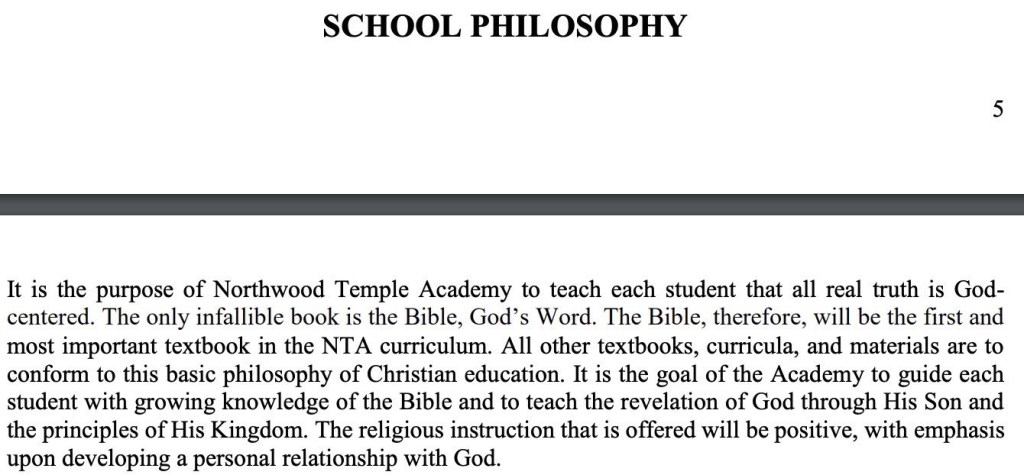
Justin Parmenter, NBCT teacher in North Carolina tweeted that the the state is funding Christian fundamentalist schools with vouchers. He identified on Christian school is not academics but devotion to the words of the Bible.

He tweeted:

Northwood Temple Academy in Fayetteville got more than $1.1 million in NC taxpayer voucher funds this year.

Their school philosophy is “The Bible, therefore, will be the first and most important textbook in the NTA curriculum.”

They should not get public $ #nced #ncga

Greg Olear is a novelist and journalist who writes a blog called PREVAIL. The following post appeared there. I post only part of it. If you want to see his complete list of Leonard Leo’s claque, open the link and continue reading. This is part one of a two-part report.

Greg Olear writes:

He’s one of the most powerful individuals in the country. His spiderweb of connections is extensive. But most Americans, including many working in Washington, have never heard of him.

Occupying the center of an intricate web of political, legal, religious, and business connections, Leonard Leo is the quintessential Man in the Middle, a veritable dark-money spider. Like a spider, he is patient, painstaking, relentless, and much more powerful that he appears. And like a spider, he prefers to stay hidden.

I first wrote about him in February 2021, in a piece called “Leo the Cancer.” Leo, who I described as “a dandier George Constanza, or if The Penguin worked at Jones Day,” has, I explained,

made himself one of the most powerful figures in the United States. He’s put five—count ‘em, five!—justices on the Supreme Court: Amy Coney Barrett, Brett Kavanaugh, Neil Gorsuch, Sam Alito, and John Roberts. A sixth, Clarence Thomas, is one of his closest friends. And, perhaps most impressively, he quietly led the 2016 crusade to deny Merrick Garland a hearing, when Barack Obama nominated the highly-regarded jurist to replace the late Antonin Scalia (another of Leo’s pals). In the lower courts, he’s been even busier. He’s installed so many judges on so many courts, it makes you wonder if he really is the instrument of God’s will he believes himself to be. I mean, there are only three branches of government. One of those three—arguably the most important one—is Leonard Leo’s domain.

When I began researching that piece, I didn’t know much about the guy beyond his silly, comic-book-villain name. I was surprised to discover that he was, like me, a middle-class product of Catholic upbringing and Italian descent who graduated from a public high school in New Jersey—not at all the well-heeled, oenophilic Master of the Universe he has become. He’s also much younger than I expected; born in 1965, he’s solidly Gen X—only seven years older than Yours Truly.

Yet Leonard Leo, somehow, is the individual most responsible for stripping away federal abortion rights. (The anniversary of the odious Dobbs decision was this past weekend.) As his admiring chum Ed Wheelan presciently wrote in 2016, “No one has been more dedicated to the enterprise of building a Supreme Court that will overturn Roe v. Wade than the Federalist Society’s Leonard Leo.”

As Politico reported—and as I outlined on these pages three months ago—Leo has been rewarded handsomely for his troubles. “I personally don’t believe that Leonard is motivated by greed,” Steven Calabresi, who founded the Federalist Society with Leo and still runs the organization, told Politico. “I think Leonard is motivated by ideology and ideas. I do think he likes to live a high-rolling lifestyle, but I don’t think he’s in the business because of the money.”

To be fair, Leo does spread that money around. He endows more organizations than I can succinctly list here. Friends like Ginni Thomas get a taste. He brings his SCOTUS cronies on lavish fishing trips with his billionaire backers. And yet Payoff Lenny—as I call him—has amassed a fortune for himself, and spends that fortune lavishly: on tailored suits, palatial vacation homes in Maine, and bottles of wine that cost more that what most Americans pay for a month’s rent.

Jesus liked wine, yes, and Jesus hung out with fishermen, sure, but I’m not sure the Son of God would approve of Leo’s stockpile of dirty loot—although his fellow Knights of Malta don’t seem to mind. Money washes away a lot of sins, as anyone familiar with the history of the Catholic Churchwell knows.

And so the rich and powerful Leonard Leo presides spider-like over Washington, moving chess pieces across the great board, raising unfathomably vast sums of money, and cultivating his extensive network, which I have attempted to map out here.

Note: Leo has so many connections that it became unwieldy to confine them to a single dispatch. In today’s installment, I will cover the judges, non-profiteers, lawyers, media members, and titled Europeans. Part Two will focus on the billionaire donors, the politicians, and the religious contacts.


Judges

Antonin Scalia (1936-2016), Clarence Thomas (b. 1948), John Roberts (b. 1955), Sam Alito (b. 1950)
Supreme Court justices

Leonard Leo worshiped at the altar of Scalia, has been close with Thomas for decades and regards him as a sort of godfather, and worked maniacally to secure the confirmations of Roberts and Alito. Thomas and Alito, in particular, he remains tight with, as recent reporting by ProPublica has made clear.

Regarding Alito, the author of the dreadful Dobbs decision: in his 2018 Daily Beast piece on Leo, Jay Michelson points out that “few people had heard of [Alito] before Leo first promoted him.” Alas, we’ve all heard of that sneeringly arrogant dickhead now.

To learn more about Leonard Leo’s circle, open the link and keep reading.

Gavin Newsom sent out July 4 greetings with a question: Where do people have true freedom?

Newsom writes:

Happy 4th of July from the Freedom State of California.

Freedom.

While Republicans cry freedom, they dictate the choices that people are allowed to make. Fanning the flames of these exhausting culture wars. Banning abortion, banning books and banning free speech in the classroom and in the boardroom.

But the truth is, true freedom means being able to love the person you love without fear or discrimination.

True freedom means you can afford to get the health care you need without going bankrupt.

True freedom means you can go to a movie, a parade, a church or an elementary school without fear of getting shot.

True freedom is a woman and her doctor making the health care decisions she needs.

True freedom means you don’t have to choose between covering the cost of your utilities or the medicine you need to live.

True freedom means living life without fear that large portions of the planet will be uninhabitable for future generations.

More than any people, in any place, California has bridged the historic expanse between freedom for some, and freedom for all.

Freedom is our essence, our brand name – the abiding idea that right here, anyone from anywhere can accomplish anything.

So with that, I want to wish you and your family a safe, happy and healthy 4th of July from the Freedom State of California.

Thank you,

Gavin Newsom

Michael Hiltzik, the invaluable columnist for the Los Angeles Times, wrote about the medical experts who pushed bad advice on COVID, costing innumerable lives, but never paid a price.

They’ve held credentials from some of the world’s most elite universities — Harvard, Stanford, Johns Hopkins, Oxford. They’ve been welcomed into the highest government policy councils. They became fixtures on television news shows and were quoted incessantly by some of the nation’s leading newspapers.


They’re a cadre of academics and scientists who pushed a discredited solution to the COVID pandemic, shunning masks, school closings, even vaccines, all in the name of reaching the elusive goal of “herd immunity,” resulting in what may have been hundreds of thousands of unnecessary American deaths.


That’s the contention of “We Want Them Infected,” a painstakingly documented new book by Jonathan Howard, a neurologist at New York University and a veteran debunker of the pseudoscience contaminating our efforts to fight the pandemic.

Howard takes his title from Paul Alexander, an epidemiologist in the Health and Human Services Department during the Trump administration.
In July 2020, Alexander offered his view of how to exploit the relative risks of COVID to discrete populations to reach herd immunity. The idea was that so many people would eventually become naturally infected with the virus, and therefore immune from further infection, that the virus would be unable to spread further.


“Infants, kids, teens, young people, young adults, middle aged with no conditions etc. have zero to little risk,” he told top HHS officials. “So we use them to develop herd … we want them infected.”
Alexander’s proposal was essentially a screed against lockdowns. That suited the Trump White House, which was searching for ways around the economic dislocations caused by the virus. But he was wrong about the toll of sickness and death that would result, allowing the virus to rage among these ostensibly low-risk groups, and wrong about the prospects of reaching herd immunity naturally.

“We Want Them Infected” may be the most appalling and infuriating book you’ll read about America’s response to the pandemic. It’s also essential reading.


The book is populated by quacks, mountebanks and charlatans — and not a few scholars with distinguished academic records — many of whom appear to have been seduced by the embrace of the right-wing echo chamber into promoting unproven and disproved policies.


“It’s unbelievable that while doctors like myself were working to treat sick COVID patients, begging people to stay at home and be safe,” Howard told me, “there was another group of doctors working at cross-currents to us — prominent doctors wanting to purposely infect unvaccinated young people with the promise that herd immunity would arrive in a couple of months.”


They consistently minimized the gravity of the pandemic, but rarely if ever acknowledged that their optimistic forecasts of illness and deaths were consistently proved wrong.


There are a number of problems with the herd immunity theory. One is that immunity from COVID infection tends to wane over time rather than become permanent. Also, infection with one variant of the virus doesn’t necessarily confer immunity from other variants, of which there have been many.

Another problem is that COVID can be a devastating disease for victims of any age. Allowing anyone to become infected can expose them to serious health problems.


Moreover, the prospect that COVID could be defeated by the natural expansion of herd immunity persuaded many people not to bother with proven countermeasures, including social distancing, masking and vaccination.

Today, more than three years after COVID first appeared, the U.S. still has not achieved herd immunity although it is nearing the goal, in the view of Robert Wachter, chair of the department of medicine at UC San Francisco. The disease’s trajectory has been cataclysmic — the U.S. death toll stands at 1.13 million, hundreds of children have died, and an estimated 245,000 children have lost one or both parents to COVID. The U.S. leads the world in COVID deaths; its death rate of 3,478 per million population is worse than that of Britain, Spain, France, the Nordic countries, Canada and Israel.


Some herd immunity advocates offered their blithe forecasts in a misguided, if not dishonest, attempt to provide comfort to the American public. Scott Atlas, a senior fellow at the Hoover Institution of Stanford University, urged HHS officials in March 2020 to advocate against lockdowns on grounds they were “inciting irrational fear” of the virus, which he estimated would cause about 10,000 deaths. “The panic needs to be stopped,” Atlas wrote.


Atlas soon became a top advisor to Trump, promoting the herd immunity theory in the White House despite the objections of more experienced advisors such as Dr. Deborah Birx.


Howard is especially disturbed at how politicizing the pandemic has allowed fringe ideas to infiltrate public health policies.


“In 2019 you would have been considered a quack if you suggested that the best way to get rid of a virus is to spread the virus,” he says. “But that became mainstream and influenced politicians at the highest levels.”


In his book, Howard reserves his deepest scorn for the promoters of the “Great Barrington Declaration,” a manifesto for herd immunity published in October 2020 and signed initially by epidemiologists Jay Bhattacharya of Stanford; Martin Kulldorff, then of Harvard; and Sunetra Gupta of Oxford. (Thousands of other academics and scientists would later add their signatures.)


The core of the declaration was opposition to lockdowns. Its solution was what its drafters called “focused protection,” which meant allowing “those who are at minimal risk of death to live their lives normally to build up immunity to the virus through natural infection, while better protecting those who are at highest risk” — chiefly seniors.


Older people living at home, the declaration said, should be kept apart from other family members except by meeting them outside, and “should have groceries and other essentials delivered to their home.”

Focused protection, the promoters wrote, would allow society to achieve herd immunity and return to normalcy in three to six months.


As Howard documents, the declaration was little more than a libertarian fantasy. That may not have been surprising, because one of its organizers was an arch-libertarian named Jeffrey Tucker.

For a taste of Tucker’s worldview, consider a 2016 article entitled “Let the kids work.” There he ridiculed the Washington Post for publishing a photo gallery of child laborers from 100 years ago, including miners and sweatshop workers as young as 10.


Tucker’s response was that those children were “working in the adult world, surrounded by cool bustling things and new technology. They are on the streets, in the factories, in the mines, with adults and with peers, learning and doing. They are being valued for what they do, which is to say being valued as people…. Whatever else you want to say about this, it’s an exciting life.”


A better life, at least, than “pushed by compulsion into government holding tanks for a full decade” — that is, going to school.


The declaration’s promoters, Howard writes, never specified how to achieve their goals. Delivering food and supplies to millions of housebound seniors? In a Hoover Institution interview, Bhattacharya said, “We could have offered free DoorDash to older people.”


As Howard observes, Bhattacharya was remarkably sanguine about “creating a program overnight to deliver fresh food to tens of millions of seniors for months on end throughout the entire country.”

Similar hand-waving addressed the problems of multigenerational households, in which millions of vulnerable elders live. Older family members, the declaration authors wrote, “might temporarily be able to live with an older friend or sibling, with whom they can self-isolate together during the height of community transmission. As a last resort, empty hotel rooms could be used for temporary housing.”


Of course, hermetically sealing off tens of millions of “nonvulnerable” people from tens of millions of vulnerable people in a few weeks would be “the single greatest logistical challenge humanity had ever undertaken,” Howard observes. “Nowhere in the world used focused protection to achieve herd immunity in three to six months, as the Great Barrington Declaration promised.”


What the declaration really promoted was complacency. Its drafters, Howard says, were “people with no real-world responsibility for much of anything who made impossible things sound very easy. The task of actually getting food into the houses of elderly people was left up to public health authorities who were understaffed, overwhelmed and underfunded.”

What may be the most inexcusable element of the herd immunity movement was its implication that children could be used as shields for the rest of the population. Its advocates counseled against vaccinating young children on the grounds that their susceptibility to the virus was minimal or even nonexistent, so they could safely acquire immunity naturally — and perhaps, as Vinay Prasad of UC San Francisco implied, provide an immunity boost to adults in their families.
Yet although children tended to suffer less from symptoms when they were infected, they were anything but immune. According to the Centers for Disease Control and Prevention, more than 1,600 American children under the age of 18 have died from COVID during the pandemic.


In any case, death is not the only serious outcome from COVID. The CDC says more than 14,000 children were hospitalized for COVID during the pandemic. An untold number of children may suffer from long COVID or other lifelong manifestations of the disease. For doctors to counsel deliberately exposing children to COVID when a vaccine is available, especially if the purpose is to protect adults, is “a moral abomination,” Howard says. He’s right.


In a world guided by science, the promoters of an unsuccessful herd immunity theory would long ago have lost their credibility and their public soapboxes.

The opposite has happened. Bhattacharya and Kulldorff still have their platforms (Kulldorff is now associated with the right-wing Hillsdale College). Both were appointed in December by Florida’s anti-vaccine governor, Ron DeSantis, to a “Public Health Integrity Committee” charged with questioning federal public health policies.


Scott Atlas, meanwhile, was tapped to deliver the commencement address at New College of Florida, a once-renowned liberal arts institution that DeSantis has turned into a haven for right-wing pedagogy. He was greeted with boos from the audience of graduating seniors, however, indicating that the youth of America perhaps can’t be gulled as easily as their parents.


At this moment, anti-science ideology on the right appears to be in the ascendance. Agitation against the COVID vaccine is metastasizing into an opposition movement against all childhood vaccinations, a trend that threatens to produce a surge in other vaccine-preventable diseases such as measles and polio.


“The anti-vaccine movement has spotted an opportunity to sow doubt,” Howard told me. “Getting rid of all school vaccine mandates has always been the Holy Grail for them.”


Howard’s book is a warning. We may be on the verge of a public health disaster, because the promoters of a failed theory that COVID could be fought through “natural immunity” without vaccines have been able to wrap themselves in the mantle of truth-tellers. But they’re not.

Governor Greg Abbott of Texas likes to say that he supports vouchers because he wants “education, not indoctrination.” This is hilarious because most vouchers are used for religious schools, whose purpose is indoctrination. They certainly do not teach students to think critically, as that might refute their mission.

Tom Ultican read the recent report by the Network for Public Education about the growth of faith-infused charter schools. The report is called “A Sharp Right Turn.” If you want your child to learn critical thinking, these schools would be the wrong choice. Critical thinking means that you are encouraged to question what you are taught.

Ultican writes:

Carol Burris and team at Network for Public Education (NPE) just published, “A Sharp Turn Right” (STR). NPE President Diane Ravitch noted there are several problems associated with charter schools’ profiteering, high closure rates, no accountability…

“This new report, A Sharp Turn Right, exposes yet one more problem — the creation of a new breed of charter schools that are imbued with the ideas of right-wing Christian nationalism. These charter schools have become weapons of the Right as they seek to destroy democratically governed public schools while turning back the clock of education and social progress by a century.” (STR Pages 3 and 4)

STR focuses on two types of charter schools. One characterizes themselves as “classical academies” and the other touts “back to basics,”without noting they also employ the same “classical” curriculum. Both provide right-wing clues on their web-sites, alerting parents of alignment with Christian nationalism. Marketing is often red, white and blue, with pictures of the American founding fathers, and discussions on patriotism and virtue. Some schools include direct references to religion like Advantage Academy’s claim of educating students in a “faith-friendly environment…”

Using keyword searches, NPE identified 273 active charter schools fitting this description and noted they surely missed more. Nearly 30% of them were for-profit; about double the rate for the charter sector in general. Almost 50% of them have opened since Donald Trump was inaugurated president in 2017… (STR Page 7)

It identifies the largest charter school systems indoctrinating students with Christian nationalist ideology and discloses where they are operating. Discussing, in some depth, Hillsdale College with its Barney charter schools and the large number of new charter affiliates, the report asserts:

“What they all have in common is teaching Hillsdale’s prescriptive 1776 curriculum, which disparages the New Deal and affirmative action while downplaying the effects of slavery. Climate change is not mentioned in the science curriculum; sixth-grade studies include a single reference to global warming.” (STR Page 15)

The reality is today’s taxpayers are forced to pay for schools teaching a form of Christianity associated with white superiority; politically indoctrinating students with specific rightist orthodoxy. What happened to the principal of separation of church and state? This charter schools for indoctrination movement must be stopped before American democracy is sundered.

Ultican reviews the long-held belief in separation of church and state, and the Supreme Court’s decisions that balanced the Constitution’s protection of freedom of religion and its prohibition of any establishment of religion.

This balancing act was disrupted by Reagan’s appointment of Justice Antonin Scalia, who saw no reason to separate church and state. The appointment of Justice Clarence Thomas gave Scalia an ally. Scalia and Thomas believed that all religious activity is religious speech and therefore protected. We saw the most recent example of this reasoning in the Court’s decision holding that discrimination against gay people was acceptable if their very existence offended the religious beliefs of the service provider, since in this case she feared she might be expected to give he assent to their wedding. The Court called its license to discriminate a vindication of free speech rights.

Ultican concludes:

Time to wake up and smell the coffee; the modern Supreme Court is corrupt and needs reformation. Instead of deciding issues based on law and precedence, they create theories designed to support a political philosophy rather than showing fidelity to the constitution. This reflects a complete degradation of jurisprudence. The poorly formed decisions regularly undermine the rights and protections the founders bestowed on citizens; all while some Justices appear to be ethically compromised.

For the first time in American history, billions of taxpayer dollars are flowing to private religious schools. The STR report shines a light on charter schools with religious agendas. Even more disturbing, these new taxpayer funded privatized schools are literally indoctrination centers, teaching a depraved political ideology.

This is one of the best letters that Heather Cox Richardson has written since I started reading her posts. It puts the current Supreme Court’s radical decisions into historical perspective. This Court, hand-picked by Leonard Leo and the Federalist Society, is engaged in a shameless effort to move the clock back to the world as it existed before the New Deal. This Court threatens our democracy and our rights.

She writes:

Today the Supreme Court followed up on yesterday’s decision gutting affirmative action with three decisions that will continue to push the United States back to the era before the New Deal.

In 303 Creative LLC v. Elenis the court said that the First Amendment protects website designer Lorie Smith from having to use words she doesn’t believe in support of gay marriage. To get there, the court focused on the marriage website designer’s contention that while she is willing to work with LGBTQ customers, she doesn’t want to use her own words on a personalized website to celebrate gay marriages. Because of that unwillingness, she said, she wants to post on her website that she will not make websites for same-sex weddings. She says she is afraid that in doing so, she will run afoul of Colorado’s anti-discrimination laws, which prevent public businesses from discriminating against certain groups of people.

This whole scenario of being is prospective, by the way: her online business did not exist and no one had complained about it. Smith claims she wants to start the business because “God is calling her ‘to explain His true story about marriage.’” She alleges that in 2016, a gay man approached her to make a website for his upcoming wedding, but yesterday, Melissa Gira Grant of The New Republic reported that, while the man allegedly behind the email does exist, he is an established designer himself (so why would he hire someone who was not?), is not gay, and married his wife 15 years ago. He says he never wrote to Smith, and the stamp on court filings shows she received it the day after she filed the suit.

Despite this history, by a 6–3 vote, the court said that Smith was being hurt by the state law and thus had standing to sue. It decided that requiring the designer to use her own words to support gay marriage violated the First Amendment’s guarantee of free speech.

Taken together with yesterday’s decision ruling that universities cannot consider race as a category in student admissions, the Supreme Court has highlighted a central contradiction in its interpretation of government power: if the Fourteenth Amendment limits the federal government to making sure that there is no discrimination in the United States on the basis of race—the so-called “colorblind” Constitution—as the right-wing justices argued yesterday, it is up to the states to make sure that state laws don’t discriminate against minorities. But that requires either protecting voting rights or accepting minority rule.

This problem has been with us since before the Civil War, when lawmakers in the southern states defended their enslavement of their Black (and Indigenous) neighbors by arguing that true democracy was up to the voters and that those voters had chosen to support enslavement. After the Civil War, most lawmakers didn’t worry too much about states reimposing discriminatory laws because they included Black men as voters first in 1867 with the Military Reconstruction Act and then in 1870 with the Fifteenth Amendment to the Constitution, and they believed such political power would enable Black men to shape the laws under which they lived.

But in 1875 the Supreme Court ruled in Minor v. Happersett that it was legal to cut citizens out of the vote so long as the criteria were not about race. States excluded women, who brought the case, and southern states promptly excluded Black men through literacy clauses, poll taxes, and so on. Northern states mirrored southern laws with their own, designed to keep immigrants from exercising a voice in state governments. At the same time, southern states protected white men from the effects of these exclusionary laws with so-called grandfather clauses, which said a man could vote so long as his grandfather had been eligible.

It turned out that limiting the Fourteenth Amendment to questions of race and letting states choose their voters cemented the power of a minority. The abandonment of federal protection for voting enabled white southerners to abandon democracy and set up a one-party state that kept Black and Brown Americans as well as white women subservient to white men. As in all one-party states, there was little oversight of corruption and no guarantee that laws would be enforced, leaving minorities and women at the mercy of a legal system that often looked the other way when white criminals committed rape and murder.

Many Americans tut-tutted about lynching and the cordons around Black life, but industrialists insisted on keeping the federal government small because they wanted to make sure it could not regulate their businesses or tax them. They liked keeping power at the state level; state governments were far easier to dominate. Southerners understood that overlap: when a group of southern lawmakers in 1890 wrote a defense of the South’s refusal to let Black men vote, they “respectfully dedicated” the book to “the business men of the North.”

In the 1930s the Democrats under President Franklin Delano Roosevelt undermined this coalition by using the federal government to regulate business and provide a social safety net. In the 1940s and 1950s, as racial and gender atrocities began to highlight in popular media just how discriminatory state laws really were, the Supreme Court went further, recognizing that the Fourteenth Amendment’s declaration that states could not deprive any person of the equal protection of the laws meant that the federal government must protect the rights of minorities when states would not. Those rules created modern America.

This is what the radical right seeks to overturn. Yesterday the Supreme Court said that the Fourteenth Amendment could not address racial disparities, but today, like lawmakers in the 1870s, it signaled that it would not protect voting in the states either. It rejected a petition for a review of Mississippi’s strict provision for taking the vote away from felons. That law illustrates just how fully we’re reliving our history: it dates from the 1890 Mississippi constitution that cemented power in white hands. Black Mississippians are currently 2.7 times more likely than white Mississippians to lose the right to vote under the law.

The court went even further today than allowing states to choose their voters. It said that even if state voters do call for minority protections, as Colorado’s anti-discrimination laws do, states cannot protect minorities in the face of someone’s religious beliefs. In her dissent, Justice Sonia Sotomayor wrote that for “the first time in its history,” the court has granted “a business open to the public a constitutional right to refuse to serve members of a protected class.”

It is worth noting that segregation was defended as a deeply held religious belief.

Today, using a case concerning school loans, the Supreme Court also took aim at the power of the federal government to regulate business. In Biden v. Nebraska the court declared by a vote of 6 to 3 that President Biden’s loan forgiveness program, which offered to forgive up to $20,000 of federally held student debt, was unconstitutional. The right-wing majority of the court argued that Congress had not intended to give that much power to the executive branch, although the forgiveness plan was based on law that gave the secretary of education the power to “waive or modify any statutory or regulatory provision applicable to the student financial assistance programs…as the Secretary deems necessary in connection with a…national emergency…to ensure” that “recipients of student financial assistance…are not placed in a worse position financially in relation to that financial assistance because of [the national emergency]”.

The right-wing majority based its decision on the so-called major questions doctrine, invented to claw back regulatory power from the federal government. By saying that Congress cannot delegate significant decisions to federal agencies, which are in the executive branch, the court takes on itself the power to decide what a “significant” decision is. The court established this new doctrine in the West Virginia v. Environmental Protection Agencycase, stripping the EPA of its ability to regulate certain kinds of air pollution.

“Let’s not beat around the bush,” constitutional analyst Ian Millhiser wrote today in Vox, today’s decision in Biden v. Nebraska “is complete and utter nonsense. It rewrites a federal law which explicitly authorizes the loan forgiveness program, and it relies on a fake legal doctrine known as ‘major questions’ which has no basis in any law or any provision of the Constitution.”

Today’s Supreme Court, packed as it has been by right-wing money behind the Federalist Society and that society’s leader, Leonard Leo, is taking upon itself power over the federal government and the state governments to recreate the world that existed before the New Deal.

Education Secretary Miguel Cardona called out the lurch toward turning the government over to the wealthy, supported as it is by religious footsoldiers like Lorie Smith: “Today, the court substituted itself for Congress,” Cardona told reporters. “It’s outrageous to me that Republicans in Congress and state offices fought so hard against a program that would have helped millions of their own constituents. They had no problem handing trillion-dollar tax cuts to big corporations and the super wealthy.”

Cardona made his point personal: “And many had no problems accepting millions of dollars in forgiven pandemic loans, like Senator Markwayne Mullin from Oklahoma had more than $1.4 million in pandemic loans forgiven. He represents 489,000 eligible borrowers that were turned down today. Representative Brett Guthrie from Kentucky had more than $4.4 million forgiven. He represents more than 90,000 eligible borrowers who were turned down today. Representative Marjorie Taylor Greene from Georgia had more than $180,000 forgiven. She represents more than 91,800 eligible borrowers who were turned down today.”

In the majority opinion of Biden v. Nebraska, Chief Justice John Roberts lamented that those who dislike the court’s decisions have accused the court of “going beyond the proper role of the judiciary.” He defended the court’s decision and urged those who disagreed with it not to disparage the court because “such misperception would be harmful to this institution and our country.” But what is at stake is not simply these individual decisions, whether or not you agree with them; at stake is the way our democracy operates.

Norman Ornstein of the American Enterprise Institute didn’t offer much hope for Roberts’s plea. “It is not just the rulings the Roberts Court is making,” he tweeted. “They created out of [w]hole cloth a bogus, major questions doctrine. They made a mockery of standing. They rewrite laws to fit their radical ideological preferences. They have unilaterally blown up the legitimacy of the Court.”

In a shot across the bow of this radical court, in her dissent to Biden v. Nebraska, Justice Elena Kagan wrote that “the Court, by deciding this case, exercises authority it does not have. It violates the Constitution.”

There’s been a rash of unexplained “suicides” since Putin invaded Ukraine. Was it something they said?

The young vice president of a Russian bank plunged to her death from her 11th-floor apartment window in Moscow, marking yet another mysterious fatal fall in the country, according to reports.

Kristina Baikova, the 28-year-old VP of Loko-Bank, plummeted from her window June 23 and was pronounced dead at the scene, according to the Baza Telegram channel…

Dan Rapoport, a well-known critic of President Vladimir Putin who was exiled from Russia, was found dead after plunging from his Washington, DC, luxury apartment building last August in what some had suggested was a suicide — claims his wife disputed.

Weeks later, Russian oil giant Lukoil chair Ravil Maganov fell from a sixth-floor window at a hospital in Moscow and died. Before his death, Lukoil had been vocal in its criticism of Putin and the Russian invasion of Ukraine, according to Euro Weekly News.

Then in December, the creative director of an IT company, Grigory Kochenov, plunged from his apartment balcony and fell to his death while Russian authorities searched his apartment.

The same month, a Russian sausage tycoon fell to his death from a hotel window in India just two days after his friend, also from Russia, died at the same hotel. A Russian real estate tycoon also took a fatal tumble down a flight of stairs while in the French Riviera in December.

And earlier this month, a federal judge, Artyom Bartenev, fell 12 stories from his apartment building and was pronounced dead at the scene.

The Daily Mail has a long list of other business tycoons, oligarchs and government officials who mysteriously died. Some fell from a high window, some fell down the stairs, some became ill and suddenly died. Not to worry. The KGB is investigating.

Peter Greene writes here about the latest news from Pennsylvania, where he lives. The Republican-dominated state senate passed a voucher bill. Newly elected Democratic Governor Josh Shapiro has said he supports vouchers. He’s getting lots of kudos from Rightwingers. Is this why we was elected? It’s now up to House Democrats, who have a sliver majority, to stop this giveaway to private and religious schools.

Peter Greene writes:

Choicers in Pennsylvania are so close they can taste it, and everyone has come off the bench to help push this newest bill past a governor who has said he likes vouchers just fine—under certain condition. This is from my piece from Forbes.com this morning.

Democrat Josh Shapiro made no secret of his support for school vouchers when he was campaigning for the Pennsylvania governor’s seat. Now conservatives are pushing him to put that support to work.

The Senate passed the newest school voucher bill Thursday night; House Democrats say that it will not advance. Supporters are still hoping that it can be saved in the budget process.

The Lifeline Scholarship Program has been kicking around Harrisburg in a variety of bills that presented a variety of school voucher formats as voucher supporters looked for a version that would garner enough support to pass. The current iteration is a traditional school voucher, essentially a taxpayer funded tuition subsidy for students attending private schools.

Under this bill, students in the lowest 15% of schools in the commonwealth (as determined by standardized test scores) would be eligible.

The vouchers, named a top priority by Pennsylvania’s GOP, have become a key part of the current budget negotiations in the state that is already under a court order to fix its funding system for public schools.

The voucher system would be a chance for school voucher proponents to get their foot in the door, an especially tasty victory in a state with a Democratic governor. To add to the pressure to pass, a coalition of right wing voucher fans has sent Shapiro a letter arguing for the voucher program.

Open the link to the article to find the link to the entire article in Forbes.

John Thompson writes here about the negative consequences of shallow reporting on NAEP data. Reporters are sensitive to whether scores are up or down, but tend to ignore contextual factors that may play a role in student performance.

He writes:

Despite the problems with education metrics, the decline in the nation’s 2022 math and reading scores on the National Assessment of Educational Progress (NAEP) test is worrisome – if we look at the big picture. 

As Diane Ravitch explained, the decline in scores during the pandemic was a “duh” moment. Rather than publishing panicky headlines, these predictable drops in scores should be seen in the broader context of the decade of declines which followed the implementation of rushed and simplistic corporate school reforms. And, as we should have done previously, we must acknowledge what reformers should have previously understood – meaningful increases in learning require inter-connected, holistic team efforts, as opposed to metric-driven instructional shortcuts.    

And we should also listen to Peggy Carr, commissioner of the National Center for Education Statistics (NCES), which administers the tests. “The new data, she said, ‘reinforces the fact that recovery is going to take some time.” Carr and other experts also warn that the “academic decline is part of a broader picture that includes worsening school climate and student mental health.”

For example, “Oklahoma NAEP results reflect pandemic-fueled decline in math and reading scores.” Eighth grade reading in Oklahoma (which reopened schools more quickly than most states) declined by 7 points, compared to a three-point average national decline. Our Eighth grade math scores declined by 12 points, compared to a nationwide decline of eight points. And the state’s and the nation’s “plunge” in history scores has been worse.

But the story behind those numbers is complicated. So, before we can understand the mixed messages of short- and long-term NAEP findings, we how they have often been misrepresented by the non-education press.

Chalkbeat properly quoted Peggy Carr, “There is nothing in this data that tells us there is a measurable difference between states and districts based solely on how long schools were closed.” And Education Week appropriately explained that all but the top-performing students saw declines, but the biggest drops were for the lowest-performing students, who were more likely to have parents who were “essential workers” who were disproportionately exposed to Covid, who were more likely to live in multi-generational households, and had the least access to medical care. Moreover, it further explained, “Reading scores for students in cities (where schools tended to be slower to reopen) stayed constant, as did reading scores for students in the West of the country.”

Yes, Covid closures led to an unprecedented decline in test scores, but many commentators should look more deeply at public relations spin dating back to the Reagan administration that inappropriately used NAEP test scores when arguing that public schools are broken. They stressed low levels of “proficiency” claiming that it correlated with grade level. And Jan Resseger explained:

A common error among journalists, critics, and pundits who misunderstand the achievement levels of the National Assessment of Educational Progress (NAEP). “Proficient” on NAEP is not grade level. “Proficient” on NAEP represents A level work, at worst an A-. Would you be upset to learn that “only” 40% of 8th graders are at A level in math and “only” 1/3 scored an A in reading?

On the other hand, the admittedly unprecedented (but expected) fall in NAEP scores during Covid followed a decade of stagnating or declining NAEP scores. Moreover, the recent release of falling history scores should lead to an open discussion about why the U.S. History scores have declined by 9% since 2014.

And Chalkbeat stresses the need for conversations about the last two years, when “nearly every state has considered a bill that would limit how teachers can discuss racism and sexism in their classrooms, and 18 states have bans or other restrictions in place, according to a tracker compiled by Education Week.”  For reasons I explain later, I’m especially impressed with its recommendation regarding the need for “weaving the (historical) material into other places in their (classrooms’) schedule.”

I began teaching History at John Marshall H.S. in the early 1990s during the crack and gangs crisis and after the standardized testing of the 1980s peaked. For the next 1-1/2 decades, outcomes improved at Marshall and in the nation as a whole. Marshall had serious problems, but I couldn’t believe how many great teachers it had. We had the autonomy necessary to teach in a holistic inter-connected, cross-disciplinary manner. When I saw students carrying copies of Ralph Ellison’s The Invisible Man, I had the freedom to deviate from the curriculum schedule, and teach about Ellison’s childhood in Oklahoma City, and how it informed his novel. We took fieldtrips to the Capitol, and had regular classroom visits by legislators and local leaders. And we watched excellent programs on OETA (which our Gov. Kevin Stitt recently tried to defund.).

Rather than teach to the test, I’d post the day’s State Standards, and History in the News topic. Students would drop by before class to peek at the day’s History in the News question. They quickly learned how to “weave” historical narratives into contemporary issues. 

Marshall improved more than any other OKCPS neighborhood high school until the No Child Left Behind Act of 2001’s and Race to the Top’s test-driven mandates became dominant. By the time I retired in 2010, my students who came from the poorest neighborhoods complained that they had been robbed of an education. When guest teaching up to 2020, I saw young teachers who wanted to offer culturally meaningful instruction but it was hard for educators and students to do something that they rarely saw in a 21st century classroom.

Getting back to the type of solutions discussed in Chalkbeat and Education Week, Education Watch’s Jennifer Palmer wrote a hopeful piece about a pilot program at F.D. Moon Middle School. It uses “a social studies curriculum built on encouraging students to engage in civil discourse and celebrate American ideals while also examining darker chapters of history.” The program was created by iCivics, founded by retired U.S. Supreme Court Justice Sandra Day O’Connor. Its U.S. History curriculum is “based on the Roadmap to Educating for American Democracy, a joint project with iCivics, Harvard, Tufts and Arizona State universities.”

Palmer witnessed the energy displayed by Beatrice Mitchell’s 8th grade social studies class. All of them “passed the U.S. naturalization test, a new graduation requirement starting this school year.” This stands in contrast to a recent survey which “found just 1 in 3 adults can pass the exam … Oklahoma’s passing rate was even lower at 1 in 4 adults.”

It is unclear whether this nonpartisan program will clash with the Oklahoma Board of Education’s special report on “diversity, equity and inclusion programs at the request of State Superintendent Ryan Walters.” As Palmer noted, “Walters, a former history teacher, claimed such programs are ‘Marxist at its core.’” At any rate, it’s not just history that must be woven into other subjects. If we hope to teach critical thinking and 21st century skills, schools must abandon their test-driven silos, and teach students to be independent thinkers who listen, and learn how to learn. And, holistic instruction must be restored, as one part of serving each whole child. A first step, however, should be the non-education press shifting from alarmist headlines to meaningful solutions reported in the education press.