Archives for category: Academic Freedom

Summer Boismier took a stand against censorship of books in her classroom. A teacher in the high school of Norman, she had been ordered to remove from her classroom any books that might violate state law HB 775. That law declares that if any educator makes part of their curriculum teachings that “an individual, by virtue of his or her race or sex, bears responsibility for actions committed in the past by other members of the same race or sex” or that “an individual, by virtue of his or her race or sex, is inherently racist, sexist or oppressive, whether consciously or unconsciously,” they could be suspended or have their license removed. She said teachers were instructed to remove such books or cover them with butcher paper. She did cover them up and posted a warning not to read banned books but posted the QR code of the Brooklyn Public Library, where students can gain access to banned books. The state superintendent Ryan Walters moved to suspend her teaching license. He said, “There is no place for a teacher with a liberal political agenda in the classroom.”

Boissier wrote the following opinion article in The Oklahoman to explain her opposition to censorship and book banning:

May 2, 2004, was a Monday. How do I know, you ask? Well, I was 15 at the time, and like most 15-year-olds, I was at school. I know, shocking! But what you might not know is that a mere 24 hours before, I had lost my father to suicide. I went to school the following day because that is where I wanted to be. That is where, in the worst moments of my life to date, I believed I’d be safe. School — specifically public school — had always been the place where I felt seen and heard and valued for who I was and, most importantly, for who I was becoming as a result. As both an educator and a public school proud Oklahoman, I want something similar for all — and I mean ALL — of my students, including the many amazing learners who often look, think, love, live and/or pray differently than I do. Every single child who walks through the doors of a public school in this state should have the opportunity to feel centered, to feel valued, to feel celebrated, to feel affirmed and sustained for who they are and for the lived experiences and diverse communities they bring to class.

Education is political, and the classroom — by extension — is a political space. Let me say it louder: Education is inherently political, but it is not automatically partisan. That would be, to use the word of the day, indoctrination. Politics encompasses the ideologies supporting a person’s daily choices, or lack thereof. Politics is power — who has it and who wants it. If knowledge is also power, then it would stand to reason that the classroom is indeed political. Who gets to learn what, from whom, and how is steeped in a political reality that Oklahomans would be foolish at best and reprehensible at worst to ignore. Laws such as House Bill 1775 fail to account for the fact that some pre-K-12 students are rarely afforded the luxury of experiencing “discomfort” only at school. When skin color and/or gender presentation is weaponized, discomfort isn’t just a poor word choice in some poorly worded legislation. It is a matter of survival.

Actions can sometimes speak louder than words; however, inaction can often speak just as loudly. Silence can even scream. There is power in what we say, but there is also power in what we don’t. What does it communicate when adults in leadership positions repeatedly and loudly target books by and about the 2SLGBTQ+ and BIPOC communities, among others? Make no mistake, when students — some of whom are also members of these communities — walk into public schools, they’ll get the message loud and clear that the state sees such stories as smut and such lives as less than.

Mother of multicultural children’s literature, Dr. Rudine Sims Bishop, argued that stories are mirrors, windows and sliding glass doors. Stories are also telescopes and prisms and ladders. Stories are safety. Stories are possibility. Stories are connection and validation. Stories are power. And stories are political. Empathy is dangerous precisely because it takes a sledgehammer to fear. If we don’t “other” differences and hold them at arm’s length, then those driving division by justifying censorship in our schools lose the power they’ve amassed keeping Oklahomans apart.

This is not a zero-sum game. What a student gains when teachers prioritize inclusive stories in the classroom is not another’s loss. Privilege is not a euphemism for guilt; it is a means to better understand the power a person has and the ways they can use that power to uplift others. In a perfect world, we wouldn’t need to defend a student’s right to read, to be represented and — by extension — to simply exist. But alas, this world is as far from perfect as I am from retirement. This incessant debate over (insert whatever term best reflects your particular belief system) books is evidence enough of that.

The lives of historically marginalized people should not be up for debate, but as Michael Brown, Ariyanna Mitchell, Sandra Bland, Breonna Taylor, David Kato and George Floyd prove, they frequently are. Their stories cannot and should not be separated from the context of their lived experiences. No story — including the ones we teach and thereby validate in our public schools — exists in a vacuum. In the same way charges of indoctrination are an insult to their critical thinking skills, Oklahoma’s students are certainly capable of speaking for themselves. For instance, one student stated, “Being an openly gay student myself, who is witnessing LGBTQ+ characters for the first time emerging in our own curriculum, gives other LGBTQ+ students and I a more elevated self-worth and pride towards our own respective identities.”

It is time to come together as Oklahomans and side with a politics of critical thinking and compassion. This November you have a choice to make for the future of our state and the state of our public schools: a politics of inclusion or exclusion. So what’s your story? What side are you on?
John Merrow’s title is sarcastic. Of course he wants you to read banned books, and he is deeply concerned about the large number of eligible voters—especially young people—who don’t bother to vote.

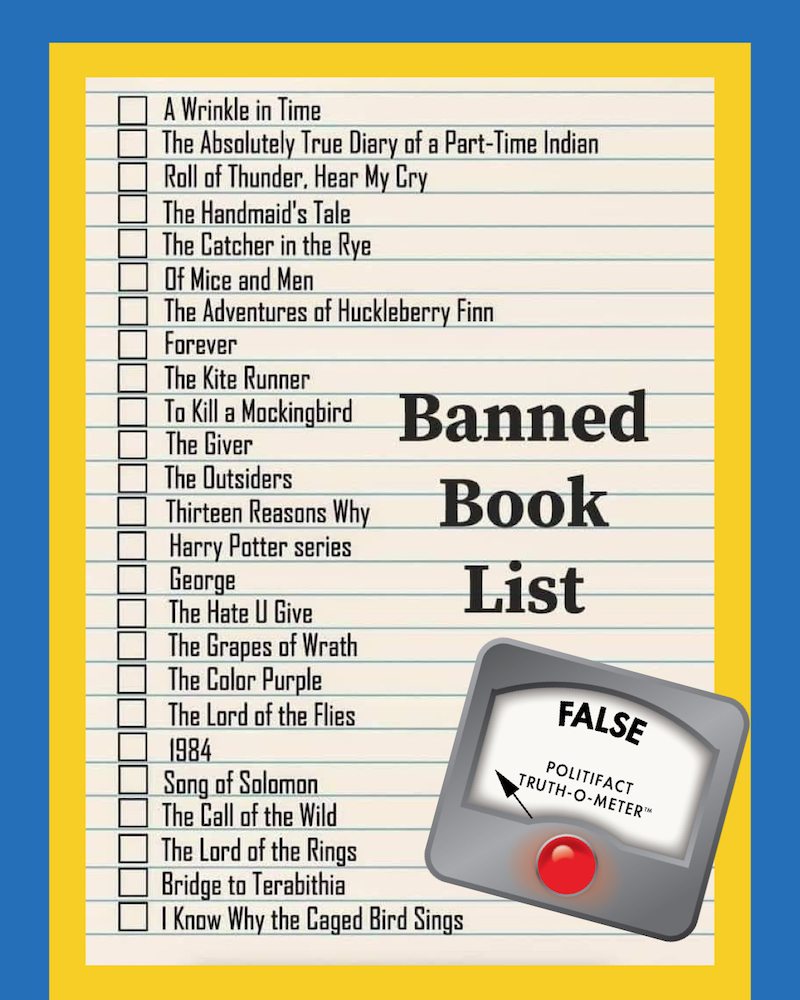
When someone on Twitter posted a list of 25 popular books that Florida Governor Ron DeSantis had supposedly banned from the state’s public schools, people went crazy. The list included Harper Lee’s “To Kill a Mockingbird,” Alice Walker’s “The Color Purple” and Madeleine L’Engle’s “A Wrinkle in Time.”

Below is a screenshot of the list. How many of these books have you read? Have your children read most of them? What on earth is going on in Florida?

People familiar with DeSantis’s efforts to restrict classroom discussion of controversial topics had no trouble believing that he would try to prevent young people from reading controversial or challenging books. If DeSantis did draw up a list, these books might well be on it.

But the list is a fake, a clever satire.

Many people were fooled, including teacher union President Randi Weingarten and “Star Wars” actor Mark Hamill. Hamill’s screenshot of the list amassed more than 100,000 likes and 24,000 retweets.

(Add my name to the list of those who were taken in.)

Like all good satire, that fake list of banned books is rooted in truth, because book banning is real and growing. Florida school districts have banned around 200 books, according to a report published by PEN America, a nonprofit that tracks book banning in the U.S. Pen America ranks Florida third among US states for banning books, trailing only Texas and Pennsylvania.

We are in the midst of a pandemic of book banning, so it’s hard to imagine any title that would never be banned by some zealous or timid school board or ignorant legislator.

One way to stop this outbreak of censorship is to get active, vote, attend school board meetings, run for school board. Passivity and complaining is a losing strategy.

Time to turn back the rising tide of incipient fascism.

The George Dawson Middle School in the Carroll Independent School District in Texas is named for a man who was enslaved, learned to read at the age of 98, and died at 103.

The school board is now reviewing whether Dawson’s biography should be read by students at the school. After all, its references to slavery and segregation might defy the state law against teaching “critical race theory.”

When Dawson’s book was published, it was hailed as an inspiring story. Its title: “Life Is So Good.”

A book about the grandson of a slave who learned to read when he was 98 years old is currently under review for use in the school named after him in Southlake.

The book, “Life is So Good,” tells the story of George Dawson’s life, from segregation and the civil rights movement to learning to read at 98. It’s one of about 10 under review by Carroll ISD….

Dawson gained worldwide attention for his 2000 memoir and was profiled on the Discovery Channel, Oprah, Nightline, and in People magazine. A grandson of slaves, he become a face for literacy before his death in 2001 at age 103.

The district insists that the book has not been banned…yet.

Others in the district say it has already been banned and the “administrative discussion” is a cover.

I wrote recently about Amanda Jones, the librarian in Louisiana who is fighting back against censorship and harassment in court.

One of our regular readers said she belongs on the honor roll of this blog. He’s right.

Amanda Jones joins the honor roll for her courage and integrity in fighting censorship!

Her GoFundMe page is raising money for her legal defense. Consider helping her fight for free thought!

Beth L. Matters on is a college professor in Florida. She describes how she will respond to DeSantis’ censorship laws: She will ignore them.

She writes:

In a couple of weeks, I’ll walk back into my college classroom and continue my second decade of teaching at one of Florida’s universities. Despite the recently passed HB 7 Amendment (Stop WOKE Act), I won’t be adjusting my syllabi to remove readings or discussions that make students “uncomfortable,” and I won’t pretend that systemic racism, sexism, homophobia, Islamophobia and other forms of oppression do not exist. I will not “whitewash” our country’s history or minimize the challenges and oppression that so many still experience, especially those who are women and/or members of the BIPOC and LGBTQIA+ communities.

Instead, I will do what I have always done. I will select the creative work of writers who belong to all sorts of communities, and I will require students to read their stories and discuss the work and their themes. Some of those themes are difficult and may make many of us uncomfortable, no matter how we identify or what community we’re in….

I purposefully select work by members of marginalized communities, because many of my students have not yet heard these voices… and many of my students belong to these communities. Recently, among other work, my students read, “Heavy: An American Memoir″ by Kiese Laymon and poems by Danez Smith. Both of these authors address race, class, whiteness, sexuality, politics, family and body image. Smith’s work also addresses homophobia and police brutality, and other topics that are “uncomfortable.”

What if every teacher in Florida did the same? They can’t arrest everyone.

Massive resistance.

Florida professors are feeling the chilling effect of Ron DeSantis’ gag orders and bans on teaching about race and gender. DeSantis will not stop his crusade for censorship in K-12. Higher education knows they are his targets as well. DeSantis has an authoritarian mindset and will not be satisfied until he has squelched all teaching, study, and research into racism and gender. When does the book-burning begin?

The Miami Herald reported:

Florida university professors are facing unprecedented challenges as a spate of new laws could soon crack down on research, discourse on race and gender identity and create an environment in which employees feel their political beliefs are being scrutinized at the risk of losing tenure.

The measures are backed by Gov. Ron DeSantis and the Republican-led Legislature and are seen as just the start by some educators. Those concerns have been fueled by reports that DeSantis had drafted even more attempts to rewrite laws governing public higher education, including stripping university presidents of the ability to hire professors.

The underlying message from eight professors from four public universities across the state interviewed by the Miami Herald is this: It is not easy to be an educator in Florida. Two professors who spoke to the Herald declined to be identified out of their concern for retribution.

It isn’t just history or politics professors who are worried about the chilling effects of restrictions on academia as they head back to class later this month, it appears to ripple through many academic disciplines. Some professors even suggested that they were considering leaving Florida to teach in other states and said they knew colleagues who had similar thoughts.

“In Florida, we know that these policies have really led to increased efforts to silence and surveil academic speech,” said Emily Anderson, an assistant professor of International Relations and Intercultural Education at Florida International University. “Academic speech matters, because it’s a fundamental freedom that is really how our university system is grounded. When we have policies that threaten speech, in my view, it shadows threats to all other protected rights.”

Read more at: https://www.miamiherald.com/news/local/education/article263966316.html#storylink=cpy

PBS ran a special about the love affair between America’s far-right extremists and Hungary’s authoritarian leader Viktor Orban. Here is the transcript. It’s worth reading to understand the extremism and not-so-latent fascism embedded in America’s right wing.

The Oklahoma State Board of Education lowered the rating of two districts—Tulsa and Mustang—for offering lessons or training that violated state bans on “critical race theory.”

Let’s be clear: hardly anyone in the state of Oklahoma knows what “critical race theory” is.

The board punished the two districts because they asked students or teachers to reflect on the meaning of racism.

In Mustang, one teacher complained.

Tulsa is a majority-minority district, but it made the mistake of teaching something other than lily-white stories about America., where racism might have long ago existed. Teaching about racism today is intolerable.

Representatives for the Tulsa and Mustang school districts did not immediately respond to requests for comment Saturday. In a statement to the Oklahoman, Tulsa Public Schools denied that the training stated that people of a certain race were inherently racist, saying it would “never support such a training,” but the system defended the need for implicit bias training.


“In Tulsa, we are teaching our children an accurate — and at times painful, difficult, and uncomfortable — history about our shared human experience,” the district told the newspaper. “We also teach in a beautifully diverse community and need our team to work together to be prepared to do that well.”


Charles Bradley, the superintendent of Mustang Public Schools, said in a statement published by News 9 that he was “shocked” by the board’s demotion, which he called a “harsh action.”


H.B. 1775 prohibits teaching that any individual “bears responsibility for actions committed in the past by other members of the same race or sex.” It also bans any course material that would make a student “feel discomfort, guilt, anguish or any other form of psychological distress on account of his or her race or sex.”

Message: Never teach the truth!

At a meeting in Tampa recently, the organization of far-right agitators called “Moms for Liberty” took aim at public schools, teachers, and curriculum. They believe their children are indoctrinated in public schools, which is utter nonsense. What is clear is that they want to indoctrinate all children into their racist, bigoted worldview.

The so-called “Moms” are terrified by teaching about racism and gender. They want the power to censor books they don’t like. They want to stifle teachers who teach the truth about American history.

Their first national conference was addressed by Fovernor Ron DeSantis, Senator Rick Scott, and Betsy DeVos, all of whom are contemptuous of public schools.

Who are the Moms for Liberty? They are the female version of the John Birch Society. The latter spied Communists everywhere. The Moms are terrified that someone might teach children that racism was and is a blight on our country.

Known largely for speaking out against mask mandates in the pandemic, demanding access to school curricula, rooting out offensive or explicit content in literature and voicing their suspicions about the pervasiveness of “woke ideology” at school board meetings across the country, members of Moms For Liberty said they now hope to expand their political influence and the scope of parental rights laws, which exist in about one third of states.

The Houston Chronicle reports that a participant in the January 6 assault on the U.S. Capitol is likely to be elected to the Texas State Board of Education. She has pledged to fight “critical race theory” (i.e. teaching about racism) and to support charter schools.

Underscoring Texas lawmakers’ rightward lurch on education issues in recent years, the candidate likely to replace a moderate Republican on the State Board of Education in a district outside Houston is a right-wing activist who participated in protests at the U.S. Capitol on Jan. 6, 2021.

After winning the primary in March, the front-runner in the District 7 race is Julie Pickren, a former trustee for Alvin Independent School District. Pickren was voted off that board last year after her participation in the protest at the U.S. Capitol was revealed — the basis of a campaign against her by the Brazoria County NAACP.

Pickren is a former delegate to the GOP’s national and state conventions, her LinkedIn says, and on Facebook she blamed antifa, rather than Trump supporters, for violence during the Capitol riot, a claim that other Republicans have made without proof. She declined a request for an interview….

Republicans have moved further to the right on education issues in Texas over the past 18 months. Earlier this summer, Gov. Greg Abbott announced his support for private school vouchers and endorsed a “Parental Bill of Rights” to give parents more power over what and how their kids are taught in schools. Last year, the Legislature passed and Abbott signed a slew of conservative bills relating to education, including restrictions on how social studies can be taught and on transgender children playing school sports.

At the local level, school board politics have become increasingly heated, with often angry discussions over diversity and equity policies in the schools. Parent groups have organized PACs in opposition to what they view as progressive activism in education, raising substantial amounts of money to reshape local school boards around the state.

Next year’s State Board of Education is set to be more conservative, with Robinson leaving as well as two other Republicans who lost their March primaries to opponents supported by right-wing PACs. There are currently nine Republicans and six Democrats serving on the board.

The board’s core responsibilities include writing Texas’ public school curriculums, managing the permanent fund that backs debt taken out by schools, and deciding whether to allow new charter schools in the state; Pickren has said she supports adding more of them.

Moderate pushed out

The District 7 seat opened up last year, when the Legislature during redistricting moved incumbent Matt Robinson into a different district so he couldn’t run for re-election. Robinson, a doctor from Friendswood, has said he feels Republican political leaders in the state did this intentionally because they did not believe he was sufficiently supportive of charter schools and other conservative policy goals.

In a rare move in today’s increasingly polarized politics, Robinson is endorsing the Democrat in the race, Galveston ISD teacher Dan Hochman, to be his successor.

Why?

“Because he’s running against Julie Pickren. And she will be bad for public education,” Robinson said.

In lists of the most important issues to her campaign, Pickren has named ridding public schools of critical race theory, an academic theory that critics use as a catchall term to describe diversity and equity initiatives as well as discussion of systemic or historical racism. Pickren is also supportive of “parents rights” initiatives such as those espoused by Abbott.

“She is leading a fight, an assault on public education that’s going on right now. It’s not among all Republicans, but it’s among a good number and she’s kind of leading that fight. And the idea that critical race theory is going on in most schools and most districts, which is entirely false. So her overall approach is, in my view, anti-public education,” Robinson said…

Soul of public education

Hochman acknowledged that he’s facing an uphill climb in the race, as the district leans conservative. Pickren’s campaign has spent about $40,000 so far, while Hochman’s has spent about $10,000. Hochman said his campaign bank account currently had less than $100 in it…

“It really, truly is a fight for the soul of public education in the state of Texas, which is failing right now,” Hochman said of the race. Hochman added that he would oppose expansion of charter schools.

“I’m up against a woman who is clearly anti-public education. She’s being funded by the far right, whose agenda has been publicly clear that they want to dismantle public education and replace it with private schools and charter schools so they can push through a far-right Christian agenda in schooling. And that’s not like a conspiracy, that’s been pretty much out in the open.”

edward.mckinley@chron.com