Archives for category: Academic Freedom

Ron DeSantis is a dangerous ideologue and a wannabe Mussolini. He speaks of freedom but practices coercion and cancel culture. In Florida, you are free to echo his beliefs but not to disagree. He is a bully.

This frightening story by Kathryn Joyce in Vanity Fair is a MUST-READ. DeSantis engineered the right-wing takeover of New College, a small, progressive college by installing new board members and ousting the President of New College. The extremists are portraying their swift decapitation of a left wing college as a model for other red states. Their plan is to turn New College into its ideological opposite, the “Hillsdale of the South.” Public colleges and universities in other red states should be on high alert. Vanity Fair (to which I subscribe) is usually behind a paywall, but this article is a one-time freebie.

The article begins:

It took New College president Patricia Okker three attempts to deliver her farewell remarks. She kept being interrupted during last week’s board meeting in Sarasota, Florida, including once by a member of the school’s board of trustees, making a motion to terminate her without cause. Okker had been addressing the dozens of students, faculty, and parents who’d come to defend her record—and the hundreds more outside who weren’t admitted—saying she was sorry to disappoint them, but she couldn’t represent the mandate New College was being given through this “hostile takeover.” And she refused to support the claims of right-wing critics that the school had been indoctrinating its students.

In the audience, supporters hugged one another and students left in tears. The trustees moved on, voting to replace Okker with interim president Richard Corcoran, Florida’s recently departed education commissioner who, in a 2021 speech at Michigan’s right-wing Hillsdale College, came close to calling for the collapse of the public school system through student attrition and said the political war “will be won in education.” The trustees replaced the board chair too, made plans to replace the general counsel, and instructed administrators to start preparing to dismantle the college’s diversity offices. null

It was hard to imagine a starker change in leadership for New College, the small, nontraditional honors college of the Florida public university system, known for its lack of grades, individualized majors, and leftist student body, but which has also been eyed skeptically for years by Florida’s conservative-dominated legislature for its low enrollment and graduation rates. But that was exactly the transformation intended when Governor Ron DeSantis last month appointed six new trustees to the school’s 13-member board, in hopes they would remake New College into a right-leaning “classical college, more along the lines of a Hillsdale of the south,” as his education commissioner Manny Diaz put it.

After the Republican-controlled Board of Governors appointed a seventh trustee, the new majority represented a team uniquely qualified to carry out DeSantis’s scorched-earth, right-wing education wars. There was Manhattan Institute fellow and anti-critical race theory hype man Christopher Rufo, who has most recently turned his efforts to laying “siege” to diversity, equity, and inclusion programs; one of Hillsdale’s graduate school deans, Matthew Spalding, who also helped lead Donald Trump’s short-lived 1776 Commission; Charles Kesler of the right-wing Claremont Institute, which spent the Trump years retconning an intellectual platform for the MAGA movement; a senior editor at a religious right magazine; the Catholic author of a book accused of “fram[ing] LGBTQ+ identity as a mental illness”; and a private Christian school cofounder with a penchant for Covid disinformation.

Following his appointment, Rufo immediately began speaking in martial terms: that conservatives were “recapturing higher education,” mounting a “landing team” to survey the school as well as a “hostage rescue operation” to “liberate” it from “cultural hostage takers.” Another new trustee, the private Christian academy cofounder Jason “Eddie” Speir, started a Substack to chronicle the transformation, sparking further panic in late January with a post proposingthe board declare a financial emergency, firing the entire staff and rehiring only those professors aligned with the school’s new business model. (Speir also used his newsletter to propose banning USA Today affiliates from covering campus events over a reader comment suggesting people throw dog poop on the new trustees; to request the entire board be given his essay, “‘Florida, Where Woke Goes to Die’ What Does It Mean?” as “supporting material”; and to ask if any readers had a copy of Robert’s Rules of Order he could borrow.)

Students, faculty, and alumni from New College and far beyond decried the takeover as an attack on academic freedom with national implications. Multiple scholarly organizations, including the American Anthropological Association and the American Historical Association, denounced it as “an orchestrated attack on academic integrity.” The University of Florida graduate assistants’ union tweeted a message of “Solidarity with New College students, faculty, and staff as DeSantis appoints a card-carrying fascist to the presidency.” At a campus rally preceding last Tuesday’s meeting, former Democratic state representative Carlos Guillermo Smith warned, “New College is their first test, their first trial run.” Repeating a Twitter hashtag protesting students had used, Smith added, “your campus is next.”

As though to prove them right, on February 1, Florida Republican state representative Spencer Roach—who cosponsored a recent Florida law mandating ideological surveys of public university campuses to “stem the tide of Marxist indoctrination”—tweeted that Okker’s termination should be replicated “at every university of the state.” In a January essay published in the Manhattan Institute’s City Journal, Rufo touted the opportunities for emulation as well, writing that “If we are successful” in carrying out the mission of “institutional recapture,” what happens at New College “can serve as a model for other states.”

One horrified alum, Cayenne Linke, who attended New College in the 1990s, compared the takeover to a violent assault. “I feel like I’m standing at the precipice of the Fourth Reich, and I’m mostly powerless to fight back,” Linke said. “I weep for our nation if DeSantis wins a presidential bid and inevitably installs Rufo as education secretary.”

Please open the link and read the article in its entirety.

The College Board released this letter last night. It seeks to demonstrate that it did not cave in to Florida’s demands. It does not explain why all of Florida’s targeted names and topics were deleted.

Our commitment to AP African American Studies, the scholars, and the field

COLLEGE BOARD COMMUNICATIONSFebruary 11, 2023

Our commitment to AP African American Studies is unwavering. This will be the most rigorous, cohesive immersion that high school students have ever had in this discipline. Many more students than ever before will go on to deepen their knowledge in African American Studies programs in college. 

Teachers and students piloting this course are everywhere voicing their enthusiasm for the discoveries they are making. They are thriving in the openness and respect of the classroom environments they have built.

There is always debate about the content of a new AP course. That is good and healthy; these courses matter. But the dialogue surrounding AP African American Studies has moved from healthy debate to misinformation. 

We are proud of this course. But we have made mistakes in the rollout that are being exploited.

We need to clear the air and set the record straight.

  1. We deeply regret not immediately denouncing the Florida Department of Education’s slander, magnified by the DeSantis administration’s subsequent comments, that African American Studies “lacks educational value.” Our failure to raise our voice betrayed Black scholars everywhere and those who have long toiled to build this remarkable field.
  2. We should have made clear that the framework is only the outline of the course, still to be populated by the scholarly articles, video lectures, and practice questions that we assemble and make available to all AP teachers in the summer for free and easy assignment to their students. This error triggered a conversation about erasing or eliminating Black thinkers. The vitriol aimed at these scholars is repulsive and must stop.

    Rather, scholars are essential to this course, and each AP teacher must select works by scholars to include in the syllabus they submit for AP course authorization, as they do in a range of other AP courses that require secondary sources in the syllabus. We are requesting copyright permission to include works on our AP Classroom digital platform by every author mentioned in any iteration of the framework, bringing these readings to students worldwide by enabling AP teachers to assign them with one click.
  3. We should have made clear that contemporary events like the Black Lives Matter movement, reparations, and mass incarceration were optional topics in the pilot course. Our lack of clarity allowed the narrative to arise that political forces had “downgraded” the role of these contemporary movements and debates in the AP class. The actual pilot course materials teachers used were completed on April 29, 2022—far prior to any pushback. In these pilot materials, teachers were told to pick only one such topic. This topic could be assigned after the exam since it didn’t count and would have no impact on the student’s AP score.

    The official framework is a significant improvement, rather than a watering down: three weeks are now dedicated to a research project of the student’s choice, which counts as 20% of the student’s AP Exam score for college credit. This model better aligns with the flexibility colleges themselves often provide students to do an extended paper on a topic of their choice. We encourage students to focus their projects on contemporary issues and debates to ensure their application of knowledge to the present.
  4. We have not succeeded in focusing the conversation on the remarkable work and flexibility of the pilot teachers in different states. The fact is that pilot teachers everywhere are introducing the core concepts of this discipline with skill and care. Sadly, in some states teachers have more room to maneuver than others. We recognize that in some states teachers and students will be able to draw more widely on Black Studies scholarship than in others. But we must resist the narrative that teachers in states with restrictions are not doing exceptional work with their students, introducing them to so much and preparing them for so much more.

    By filling the course with concrete examples of the foundational concepts in this discipline, we have given teachers the flexibility to teach the essential content without putting their livelihoods at risk. The committee will continue to evaluate this approach, making further changes to the framework if they decide to do so.
  5. While it has been claimed that the College Board was in frequent dialogue with Florida about the content of AP African American Studies, this is a false and politically motivated charge. Our exchanges with them are actually transactional emails about the filing of paperwork to request a pilot course code and our response to their request that the College Board explain why we believe the course is not in violation of Florida laws.

    We had no negotiations about the content of this course with Florida or any other state, nor did we receive any requests, suggestions, or feedback.

    We were naive not to announce Florida’s rejection of the course when FDOE first notified us on September 23, 2022, in a letter entitled “CB Letter AP Africain [sic] Studies.” This letter, like all written communications we received from Florida, contained no explanation of the rejection. Instead, Florida invited us to call them if we had any questions.

    We made those calls, as we would to any state that says they have unstated concerns about an AP course. These phone calls with FDOE were absent of substance, despite the audacious claims of influence FDOE is now making. In the discussion, they did not offer feedback but instead asked vague, uninformed questions like, “What does the word ‘intersectionality’ mean?” and “Does the course promote Black Panther thinking?” FDOE did not bring any African American Studies scholars or teachers to their call with us, despite the presence in their state of so many renowned experts in this discipline.

    Since FDOE did not make any requests or suggestions during the calls, we asked them if they could share specific concerns in writing. They said they had to check with their supervisors and get permission. They never sent us any feedback, but instead sent a second letter to us on January 12, 2023, as a PR stunt which repeated the same rejection but now with inflated rhetoric and posturing, saying the course lacked “educational value.”

    On the day after Florida sent us that second letter, the AP executive overseeing the process of developing this course—the only AP leader who participated in the telephone calls with FDOE—followed up with the College Board’s FDOE liaison to ask whether we should ever expect any actual feedback from Florida. This is the response:

    “I don’t think they [FDOE] intend to provide any notes. My guess is that [the FDOE staff member] shared his notes with leadership (as he told us he would) and they shut it down. He might have even been instructed not to share notes.”
    We have made the mistake of treating FDOE with the courtesy we always accord to an education agency, but they have instead exploited this courtesy for their political agenda. After each written or verbal exchange with them, as a matter of professional protocol, we politely thanked them for their feedback and contributions, although they had given none.

    In Florida’s effort to engineer a political win, they have claimed credit for the specific changes we made to the official framework. In their February 7, 2023, letter to us, which they leaked to the media within hours of sending, Florida expresses gratitude for the removal of 19 topics, none of which they ever asked us to remove, and most of which remain in the official framework.

    They also claimed that we removed terms like “systemic marginalization” and “intersectionality” at their behest. This is not true. The notion that we needed Florida to enlighten us that these terms are politicized in several states is ridiculous. We took a hard look at these terms because they often are misunderstood, misrepresented, and co-opted as political weapons. Instead we focused throughout the framework on providing concrete examples of these important concepts. Florida is attempting to claim a political victory by taking credit retroactively for changes we ourselves made but that they never suggested to us.

    FDOE’s most recent letter continues to deride the field of African American Studies by describing key topics as “historically fictional.” We have asked them what they meant by that accusation, and they have failed to answer. The College Board condemns this uninformed caricature of African American Studies and the harm it does to scholars and students.

This new AP course can be historic—what makes history are the lived experiences of millions of African Americans, and the long work of scholars who have built this field. We hope our future efforts will unmistakably and unequivocally honor their work.

APTag

Contact

All Accessallaccess@collegeboard.org

The College Board respects your privacy, and we are committed to protecting it. Access our Data Privacy Principles, Privacy Statement, and Program-Specific Privacy Policies here.

Writing in the Tampa Bay Times, journalist Jeff Solochek reports that the College Board released a letter last night denouncing the Florida State Department of Education. The College Board says it was naive in trusting the latter agency, which wanted to score political points.

Taken aback by Florida’s attacks against its new AP African American studies course, the College Board late Saturday denounced the state Department of Education, saying it used the course to advance a politically motivated agenda.

The organization’s letter, published at 8 p.m. Saturday, came just two days after it released another statement that did not take such a harsh tone as it pushed back against the department’s claims that portions of the course are “historically fictional.”

“There continue to be conversations and misinformation, and we felt the urgency to set the record straight and not wait another day to do so,” a College Board spokesperson said. The College Board publishes AP courses and exams.

In its latest unsigned statement, the College Board said it is proud of its “historic” course, which has been crafted by renowned scholars. It acknowledged it made mistakes during the rollout and accused Florida of exploiting the situation.

Gov. Ron DeSantis has criticized the course and said Florida would not accept it without revisions. DeSantis has been using attacks against the way race is taught in schools, calling it “woke,” in many speeches amid wide speculation that he will use the issue as part of a presidential campaign.

Neither the governor’s office nor the Department of Education could be reached for comments late Saturday on the College Board’s statement.

Related: Florida claims about AP African American studies are false, College Board says

The College Board stated in its latest letter that it regrets not having denounced the Florida Department of Education’s “slander” that the course “lacks educational value.” The failure to speak up “betrayed Black scholars everywhere,” College Board wrote.

It said it also should have made more clear that the course outline did not include all the scholarly articles, lectures and other materials that will be part of the course. That led to the idea that some important thinkers were eliminated, it said — something Florida officials claimed credit for.

“The vitriol aimed at these scholars is repulsive and must stop,” the group wrote.

College Board made other defenses of the materials and the course preparation. Then it turned its sights on Florida’s interaction with the course.

It called the Department of Education’s claims that it had been in frequent dialogue with College Board over the course content “a false and politically motivated charge.”

Florida officials have claimed credit for changes made to the course outline.

“We had no negotiations about the content of this course with Florida or any other state, nor did we receive any requests, suggestions or feedback,” College Board wrote.

It said the organization was “naive” not to publicize Florida’s course rejection when it first came in September. It said the letter misspelled the word “African” and contained no explanation of the rejection.

The article continues with more detail. What it does not explain is why every objection raised by Florida was met by either a deletion of the name or topic, or a shift from “included” to optional.

Did the College Board cave to Florida or reject Florida’s demands? You decide.

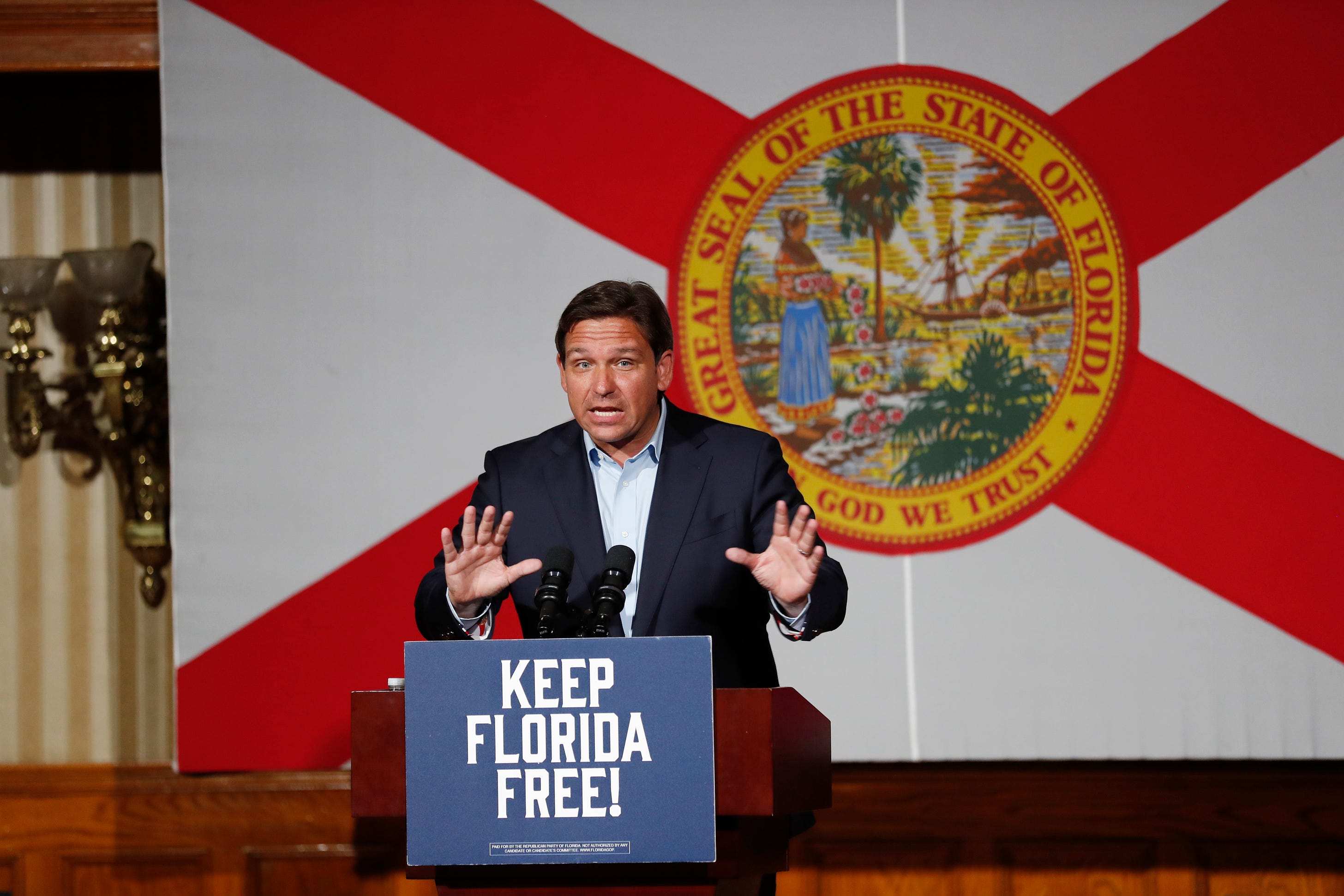
Florida has become a Petri dish for potential fascism. DeSantis has made war on African Americans, on gays, on transgender people, on drag queens, on public schools, on higher education, even on private corporations (Disney). He likes to stand behind signs that declare Florida is “free,” but no one is free to disagree with him. That’s not freedom.

Now DeSantis has proposed to create a military force that answers only to him. To call out the National Guard, he must get federal permission. That’s not good enough for him. He wants a Florida state guard. Some other states have them, but they are not in the hands of a would-be dictator whose vanity knows no limits.

CNN reports:

St, Petersburg, Florida (CNN) — Florida Gov. Ron DeSantis wants to reestablish a World War II-era civilian military force that he, not the Pentagon, would control.

DeSantis pitched the idea Thursday as a way to further support the Florida National Guard during emergencies, like hurricanes. The Florida National Guard has also played a vital role during the pandemic in administering Covid-19 tests and distributing vaccines.

But in a nod to the growing tension between Republican states and the Biden administration over the National Guard, DeSantis also said this unit, called the Florida State Guard, would be “not encumbered by the federal government.” He said this force would give him “the flexibility and the ability needed to respond to events in our state in the most effective way possible.” DeSantis is proposing bringing it back with a volunteer force of 200 civilians, and he is seeking $3.5 million from the state legislature in startup costs to train and equip them.

States have the power to create defense forces separate from the national guard, though not all of them use it. If Florida moves ahead with DeSantis’ plan to reestablish the civilian force, it would become the 23rd active state guard in the country, DeSantis’ office said in a press release, joining California, Texas and New York. These guards are little-known auxiliary forces with origins dating back to the advent of state militias in the 18th century. While states and the Department of Defense share control of the National Guard, state guards are solely in the power of a governor.

Will DeSantis use his state guard to break up peaceful demonstrations? Will he send it to drag shows to close them down? Will he it to harass teachers accused of being woke? The possibilities are frightening.

Dan Rather and Elliott Kirschner write a blog called Steady. Their voice is always thoughtful, reasonable, informed, and…steady. I think that they, like me, are old enough to remember when we believed that overt racism was ebbing and that white supremacy was dead. Our hopes have been shattered since 2016. It takes the use of critical race theory to understand why we were so naive. Here is their take on the big Education story of the day:

Photo credit: Octavio Jones

Editor’s note: this is an ironic banner in front of DeSantis. Florida is not free for those who don’t share his ideology. If you think racism exists today in Florida, you are not free to discuss it in school or college. You are free to agree with him.

Rather and Kirschner write:

Much of American history is entangled with racism and white supremacy. That is the reality of our beloved nation, no matter how much we wish it were not.

As we sit here nearly a quarter of the way through the 21st century, it is obvious that we need to have the maturity to look back to our past as well as ahead to the future. Can we do this with our eyes wide open? Will we study and learn from the lessons of history?

You can’t grapple with the truth if you hide it from view. Yes, our national narrative is an inspiring one — of freedom, rights, and new opportunities. But it is also a narrative of pain — of the bondage, rape, and murder of enslaved people. It is a story of mass death, broken treaties, and land stolen from Native people. And it is a story of persecution of the “other,” time and again.

The chasm between the noble promises of our founding documents and our historical realities continues to obstruct our national journey toward a more perfect union.

Yes, ours is a country that has facilitated exploration, innovation, and growth, but it is also one built upon families torn apart at the auction block, bodies whipped, and police dogs and fire hoses set against children.

Cities were redlined. Public schools were segregated. And despite our carefully cultivated national image as a meritocracy, throughout our history we have seen talent overlooked and our common humanity diminished on account of people’s race, religion, and sexual orientation.

The ripples of injustice continue to destabilize our society.

It shouldn’t be controversial to say any of this. But acknowledging these truths today is a political act, because it threatens the privileged narratives of those who seek to sugarcoat our past. These are men and women who serve their own ambitions by fortifying their cynical holds on power, delighting in division, feeding off fear, and applauding anger.

And that brings us to Florida’s Governor Ron DeSantis.

Listing all of his efforts to leverage the power of his office to attack equity, empathy, and justice would stretch this post immeasurably. But doing so would also jeopardize the central point: DeSantis is an opportunist. He is not weighing the merits of any one campaign. Rather, he wants headlines as a culture warrior standing up to “wokeness,” a term he has eagerly redefined to suit his own purposes. It allows him to sneer at and dismiss any attempt to reckon with American injustice.

DeSantis has focused his assaults on two of our society’s most traditionally marginalized groups: Black Americans and the LGBTQ community. While these populations have thus far felt the brunt of his targeting, we need to see clearly that his rhetoric is a threat to all who care about a democratic, peaceful, empathetic, and just America. Those of us with the greatest privilege should bear a special burden in rejecting this hate.

DeSantis’s pugilism has enabled him to consolidate power in Florida. Any opposition to his toxic initiatives must contend with the uncomfortable truth that voters validated his message and style via his landslide win in November. Now DeSantis thinks he can take his show on the road with a presidential bid. That remains to be seen. Florida has been trending Republican in recent years, and success there might not translate to the current battleground states, many of which saw big Democratic wins in the midterms.

All that being said, there is a great danger to framing this struggle primarily through the lens of electoral politics. This normalizes a discourse that should be rejected by society’s mainstream. Just as the outright bigotry of the past became socially unacceptable, so too should these latest attempts at divisiveness.

It should not surprise us that DeSantis is making schools — both K-12 and college — a central target. He wants to teach a distorted view of America. He wants to make dissenting speech not only suspect but even criminal. He wants to silence the voices of his critics and of critical thinking more generally. This is a playbook that has been followed by demagogues before to very dangerous ends.

It is essential that DeSantis not be covered by the press through a false equivalence paradigm. We can debate what we should teach and how to teach it. But we can’t replace the truth, as unsavory as it may be, with sanitized narratives that suit those already in power. This is a battle for the minds of the voters of the future. This is about what kind of nation we will become.

But DeSantis primarily cares about what kind of country we are now. He wants to appeal to fear because he thinks he can mine that fear for votes. That is his game plan. And he’s not hiding it. There can be no appeasement. DeSantis has already shown that he isn’t interested in deliberations or good faith compromise. Those would disrupt his approach of means to an end.

History illustrates that hatred can be taught, but so can empathy and justice. We are on a winding journey as a nation. And we have much farther to go. But we have made progress in the face of bigots and autocrats because people had the courage to forge the inequities of our past into a more equitable future.

This history, this truth, is what scares people like DeSantis the most. But it is one that can give us hope if we are determined not to look away.

I wrote today’s 9 a.m. post about the College Board capitulating to conservative critics. I wrote it without seeing the revised curriculum because I was in an airplane all day. Late last night, I opened an email and discovered that Michael Hiltzik of the Los Angeles Times had written a similar but more informative column, because he was able to do the comparison that I had not done. He pointed out that the rightwing attacks on the AP African American Studies course began in September, and the very names and topics that the right and DeSantis had condemned were either excised or made optional in the revised course.

He wrote:

One might have expected a leading national educational institution to have the gumption to push back against right-wingers like Florida Gov. RonDeSantis when they try to stick their noses into decisions about how to teach important subjects.

Sadly, no.

On Wednesday, the College Board issued its final curriculum for what should have been a ground-breaking high school course in African American studies. The College Board called the course “an unflinching encounter with the facts and evidence of African American history and culture.”

The final curriculum appears suspiciously to have been tailored to objections raised by DeSantis, Florida’s culture warrior Republican governor, and other right-wingers, after the board issued a draft version in December.

DeSantis, through his secretary of Education, called the draft “inexplicably contrary to Florida law” and forbade its use in Florida schools. The state’s education secretary, Manny Diaz Jr., attacked it for being “filled with Critical Race Theory and other obvious violations of Florida law.”

The arch-conservative National Review labeled the course part of “a new and sweeping effort to infuse leftist radicalism into America’s K–12 curriculum.”

The curriculum is part of College Board’s Advanced Placement program, which gives college-bound high schoolers exposure to university-level coursework.

The board says AP courses are “aimed at enabling students to develop as independent thinkers and to draw their own conclusions.”

To be fair, the board’s actions related to the African American Studies course are as good a workshop in allowing students to draw their own conclusions as one might hope. Any reasonably bright AP student is likely to see this affair as a demonstration of abject cowardice.

Disgustingly, the College Board released the final curriculum on the first day of Black History Month, as though trawling for praise for its unflinching devotion to truth. The board took pains to deny that the alterations in the draft curriculum had anything to do with criticism from DeSantis, the National Review or the right wing generally.

“No states or districts have seen the official framework that is released, much less provided feedback on it,” the board said. “This course has been shaped only by the input of experts and long-standing AP principles and practices.”

Raise your hand if you believe the College Board. Me neither.

The board said the final version had been completed in December. DeSantis issued his rejection of the course on Jan. 19. But criticism of the course outline had been circulating in conservative quarters for months — the National Review’s attack, for instance, was published on Sept. 12.

A preliminary, unflinching examination of the differences between the draft and the final version can only raise suspicions that the College Board refashioned the African American studies course to assuage the conservatives.

State Senator Manny Diaz Jr. posted a tweet on January 20 listing the state’s concerns about the AP course.

As a template, let’s use the list of “concerns” issued by Diaz on Jan. 20.

Diaz complained about the inclusion in the draft curriculum of writers and social activists Kimberlé Crenshaw, Angela Davis, Roderick Ferguson, Leslie Kay Jones, bell hooks , and Robin D.G. Kelley. Every single one of them has been excised from the final version.

Diaz’s list objected to the treatment, or even inclusion, of topics including the reparation debate, movements such as Black Lives Matter, Black Queer studies and “intersectionality,” which places racism and discrimination in a broadly social context.

Those topics have all been downgraded from required topics to “sample project topics” — that is, optional topics that fall outside requirements and won’t appear on the AP test. Those topics, the curriculum says, “can be refined by states and districts.”

Here’s a safe bet: None of them will be taught in Florida schools.

DeSantis has made no secret of his determination to turn Florida education into a shallow pool redolent of white supremacy by avoiding any hint that American society and politics have been infused with racism and class discrimination.

The shame of the College Board’s rewriting of its AP course is that it effectively places DeSantis and his henchmen in the position of dictating educational standards to the rest of the country.

There was scant political pushback against DeSantis when he rejected the draft curriculum, other than a letter from Illinois Gov. JB Pritzker, a Democrat, warning the College Board that his state would “reject any curriculum modifications designed to appease extremists like the Florida Governor and his allies.”

Pritzker observed, properly, that “ignoring and censoring the accurate reporting of history will not change the realities of the country in which we live.” (Like DeSantis, Pritzker is being talked up as a potential presidential candidate in 2024.)

Now that the final curriculum has been published and its dilutions can be closely scrutinized, perhaps the scope of the College Board’s capitulation will become clearer.

But the College Board has already flunked this all-important test of character. As we’ve noted before, acts of cowardice in the face of DeSantis’ goonish bullying won’t appease him, but will only encourage him.

As he works to destroy the independence and quality of the Florida K-12 and university systems, parents elsewhere around the country can take perverse satisfaction in knowing that students will emerge from Florida schools without the skill to compete with their own kids in intelligent society.

But if institutions like the College Board continue to let DeSantis transmit his virus of ignorance beyond Florida’s borders, no one will be safe from the contagion.

Robert Hubbell writes a thoughtful, informative blog. I’m posting this as part of my personal project to understand the new face of white supremacy. White supremacy has always been there, simmering below the surface. Trump invited them to show their faces and step into the daylight. They did, and DeSantis is sending them signals that he wants to be their champion.

Florida Governor Ron DeSantis has set his anti-education sites on Florida’s state colleges. Through a series of political and legal maneuvers, he has ceded control over Florida’s state colleges to ultra-conservative culture warriors like Christopher Rufo. In short order, DeSantis has announced that he will rid Florida state colleges and universities of curricula not “rooted in Western tradition” or that “compels belief in critical race theory or related concepts such as intersectionality.”

Amid the torrent of reporting on Ron DeSantis’s attack on critical race theory and intersectionality, the quiet part is often left unsaid. So let me say it: DeSantis’s educational agenda is code for racism and white supremacy. (Other parts of his agenda seek to erase the dignity and humanity of LGBTQ people.) DeSantis’s invocation of “Western tradition” is meant to suppress knowledge regarding the people (and contributions) of Asia, Africa, South America, Oceania, and the Indigenous Peoples of the Americas. See Talking Points Memo, DeSantis Makes 2024 Ambitions Clear As He Pours Gasoline On His ‘Woke’ Education Fire.

Given DeSantis’s generalized ignorance, his call to focus on “Western tradition” is a slippery slope that will inevitably lead to the discussion of unpleasant truths about America. For example, the enslavement of Black people was a “tradition” in North America for 246 years—and the abolition of that evil practice is relatively recent (155 years ago). So, a college course that honestly addresses the Western “traditions” of North America should include an examination that the role of slavery played in the economic, social, and political development of America.

But DeSantis isn’t stopping at converting Florida’s colleges and universities into re-education camps in the worst traditions of the USSR. He is seeking to up-end centuries of “Western tradition” embodied in the Constitution and the English common law: the requirement of a unanimous jury to impose capital punishment. DeSantis has floated the idea that a less-than-unanimous jury verdict can impose a sentence of death—an unconstitutional proposal designed to inflict the death penalty on more Black and Latino Americans. See Vox, Ron DeSantis wants to make it much easier for the state to kill people.

DeSantis is willing to do all this because he wants to capture Trump’s loyal base—which is the only hope that DeSantis has of becoming a credible candidate. As Trump becomes mired in criminal prosecutions, DeSantis will become emboldened and radicalized beyond his already extremist views. Doing so ignores the lessons of the 2022 midterms: persuadable Americans are done with Trump and his MAGA extremism. Like all military generals, Ron DeSantis is fighting the last war (the presidential election of 2020) and has failed to heed the tectonic shift that occurred in the midterms.

Florida Governor Ron DeSantis issued a statement about his higher education agenda. He intends to expunge all references to or studies of diversity, equity, inclusion and “critical race theory,” the study of institutionalized racism from the curriculum of the state’s colleges and universities. He also wants to place the hiring of new faculty in the hands of college presidents and boards of trustees, whom he controls. The hiring of new faculty typically is in the hands of the faculty, not the president or the board of trustees.

DeSantis claims that he is furthering “civil discourse and intellectual freedom” by suppressing the ideas he disagrees with. He believes that the only studies that belong on a college campus are the achievements and thoughts of white men.

He has flipped the script, accusing those who defend the freedom to teach and learn of “suppressing” free thought. It is he who is suppressing intellectual freedom.

In Florida, faculty are free to express Governor DeSantis’ views. They are not free to express dissent from the party line. That is not freedom.

Ron DeSantis is the ultimate arbiter of truth in Florida. None dare challenge him if they teach in a public school, college, or university. There’s a word for this ideology: fascism.

“Today, Governor Ron DeSantis announced legislation for the 2023 Session to further elevate civil discourse and intellectual freedom in higher education, further pushing back against the tactics of liberal elites who suppress free thought in the name of identity politics and indoctrination. Among its many provisions, the legislation will ensure Florida’s public universities and colleges are grounded in the history and philosophy of Western Civilization; prohibit DEI, CRT (CRITICAL RACE THEORY), and other discriminatory programs and barriers to learning; and course correct universities’ missions to align education for citizenship of the constitutional republic and Florida’s existing and emerging workforce needs.”

“In Florida, we will build off of our higher education reforms by aligning core curriculum to the values of liberty and the Western tradition, eliminating politicized bureaucracies like DEI, increasing the amount of research dollars for programs that will feed key industries with talented Florida students, and empowering presidents and boards of trustees to recruit and hire new faculty, including by dedicating record resources for faculty salaries,” said Governor Ron DeSantis.

“This 2023 legislative proposal builds on reforms made during the 2022 Legislative Session through Senate Bill 7044 to dismantle accreditation agency monopolies, increase tenured faculty accountability, and make the transition between a Florida state college and university more seamless. Specifically, the 2023 proposal raises the standards of learning and civil discourse of public higher education in Florida by:

Requiring the State University System Board of Governors (BOG) and State Board of Education (SBOE) to review and realign general education core courses to make sure they provide historically accurate, foundational and career relevant education, not suppress or distort significant historical events or include a curriculum that teaches identity politics;

Prohibiting higher education institutions from using any funding, regardless of source, to support DEI, CRT, and other discriminatory initiatives;

Requiring institutions’ presidents and boards of trustees to take ownership of hiring and retention decisions, without interference from unions and faculty committees;

Allowing institutions’ presidents and boards of trustees to conduct a post-tenure review of a faculty member at any time with cause;

Prohibiting postsecondary institutions from using discriminatory political filters, including political loyalty oaths and DEI statements, in the hiring process.”

“Requiring preeminent state research universities to include annual research expenditures of $50 million or more for STEM-related occupations, businesses, or industry partners in Florida that are employing Florida residents;

Requiring the Board of Governors (BOG) to align universities’ missions to education for citizenship of the constitutional republic and Florida’s existing and emerging workforce needs;

Providing additional responsibilities and clarifications for FSU’s Florida Institute of Politics, including renaming it the Florida Institute for Governance and Civics; and Providing additional responsibilities and clarifications for FIU’s Adam Smith Center for the Study of Economic Freedom.”

The New York Times reported on DeSantis’s aggressive attack on higher education as part of his cynical use of culture war tactics, which build his base nationally.

The DeSantis-controlled board of New College fired its president, English professor Patricia Okker, who was appointed in 2021.

While expressing her love for both the college and its students, Dr. Okker called the move a hostile takeover. “I do not believe that students are being indoctrinated here at New College,” she said. “They are taught, they read Marx and they argue with Marx. They take world religions, they do not become Buddhists in February and turn into Christians in March.”

Governor DeSantis also announced on Tuesday that he had asked the Legislature to immediately free up $15 million to recruit new faculty and provide scholarships for New College….

The shake-up of New College, which also included the election of a new board chairwoman, may be ongoing and dramatic, given the new six board members appointed by Mr. DeSantis.

They include Christopher Rufo, a senior fellow at Manhattan Institute who is known for his vigorous attacks on “critical race theory,” an academic concept that historical patterns of racism are ingrained in law and other modern institutions.

At the time of his appointment, Mr. Rufo, who lives and works in Washington State, tweeted that he was “recapturing” higher education.

Another new board member is Eddie Speir, who runs a Christian private school in Florida. He had recommended in a Substack posting before the meeting that the contracts of all the school’s faculty and staff be canceled.

The other new appointees include Matthew Spalding, dean of the Washington, D.C., campus of Hillsdale College, a private college in Michigan known for its conservative and Christian orientations. An aide to the governor has said that Hillsdale, which says it offers a classical education, is widely regarded as the governor’s model for remaking New College.

In addition to the governor’s six new appointees, the university system’s board of governors recently named a seventh member, Ryan T. Anderson, the head of a conservative think tank, the Ethics and Public Policy Center, which applies the Judeo-Christian tradition to contemporary questions of law, culture, and politics. His selection was viewed as giving Mr. DeSantis a majority vote on the 13-member board.

The plan seems clear: Fire faculty who teach “identity” courses or anything “woke,” drive away the students, who wanted the progressive approach that New College offered, and turn the college into the Florida branch of Hillsdale College.

Governor Ron DeSantis hates the fact that there is a progressive public college called New College that openly teaches diversity, equity, inclusion, feminist studies, ethnic studies, and gay studies. That’s WOKE, and he vowed to crush anything WOKE.

He named 6 conservatives to the 13-member board, and the board of the state university system added another, meaning that Rightwingers are in charge. A hard-right board needs a hard-right president, and they got one.

Their first meeting was this afternoon, and they are expected to appoint former State Commissioner of Education Richard Corcoran as the new president. From the following story, it appears that no one bothered to let the current president of the New College know that she was being shown the door.

DeSantis is showing how to stamp out ideas he doesn’t like, with power, not subtlety. Is he a fascist or is he pretending?

A new board of trustees at New College of Florida intends to name Richard Corcoran as its next President.

Corcoran, a former House Speaker, served as Gov. Ron DeSantis’ first Education Commissioner.

Carlos Trujillo, president and founder of Continental Strategy, revealed the plans in a letter to clients and colleges.

“We are beyond excited to announce that one of our Partners, former Department of Education Commissioner Richard Corcoran, will be returning to higher education to serve as the Interim — and hopeful permanent — President of the New College of Florida, in Sarasota,” Trujillo wrote.

“This move comes as part of Gov. DeSantis ongoing work to refocus the university on providing the most value to its students and their parents.”

Corcoran was a founding partner for the consulting firm.

The news comes hours before the first board meeting since DeSantis appointed six new trustees on the 13-member board. The State University System Board of Governors also appointed a new trustee with a similar conservative think tank background.

Of note, work of Corcoran’s apparent hire comes before any news of current President Patricia Okker’s future with the school. Eddie Speir, co-founder of Inspiration Academy, wrote a blog post this weekend promising to call for Okker to be renamed as interim President and to terminate all faculty and staff before deciding who still fit in the new vision for the college.

While Florida’s Sunshine Law requires all decisions by the board to be made in publicly noticed meetings, Trujillo treats the matter like a done deal.

“The selection of Richard distinguishes our firm as a leader in innovation and strategic solutions for the clients we serve. We look forward to finding new synergies that can better serve our current clients and ensure their goals are made a reality,” his letter reads.

John Thompson, a retired teacher and historian in Oklahoma, has written frequently about events in his state for this blog. Here, he describes the political coercion that determined right-wingers are promoting in Oklahoma and calling it “choice.” From his description, some Republican legislators are worried about “liberal indoctrination,” transgender students using the “wrong” bathroom, litter boxes for children who think they are cats (this seems to be a QAnon idea), and the danger of “social-emotional learning.” Apparently students in Oklahoma have no social or emotional issues.

Ryan Walters, Oklahoma’s newly elected, extreme rightwing Secretary of Education, first says that “the state should have the ‘most comprehensive school choice in the country.’” Secondly, Walters pushes the rightwing Michigan-based Hillsdale College curriculum; he doesn’t want to allow schools to choose to retain research-based curriculums that he identifies as “liberal indoctrination.” As Clark Frailey, executive director of Pastors for Oklahoma Kids, says, Walters seems to be pushing for “Christian Dominionism,” which is “based on the philosophy that Christianity is at the core of America’s foundation and all institutions need to align with that viewpoint. If people won’t convert, then a government religion must be forced upon them.”

Two voucher programs for private schools and homeschools have been filed. The most interesting one is Sen. Shane Jett’s Oklahoma Parent Empowerment Act for Kids (PEAK). Even extremely conservative Republicans legislators worry that vouchers would undermine the finances of their rural schools. Jett seems to be offering a carrot and a stick to those vulnerable constituencies. He would impose vouchers only in counties with a population of more than 10,000 people. But, vouchers would be offered in counties with fewer than 10,000 residents if they are served by a “trigger district.”

The Oklahoman then reports:

Jett defined a “trigger district” as a public school system that allows or tolerates House Bill 1775 violations, use of school bathrooms according to gender identity, anthropomorphic behavior known as “furries,” disparagement of the oil and gas industry, lesson plans promoting social-emotional learning and animal rights activism, among other topics.

In other words, the bill would coerce schools into “choosing” to comply with the entire extremist agenda. But that begs the question about how educators would choose to deal with today’s threats to public education. Republican Sen. Adam Pugh’s newly revealed plan for school improvement was based on meetings with 200 public school superintendents; every college president in Oklahoma; and “hundreds, if not thousands” teachers and parents and advocacy groups.  Based on these listening sessions, Pugh did not propose vouchers.

Pugh’s plan would raise teacher pay so the minimum starting salary was $40,000, “with graduated raises to the minimum salary schedule based on longevity.” The estimated cost would be $241 million, which is less than the cost of Sen. Julie Daniels’ voucher bill ($275 million). They would  also create an “Oklahoma Teacher Corps” and a teacher mentoring system;  provide certain teachers at least 12 weeks of maternity leave; update the school funding formula, and pass Pugh’s seven other constructive reforms. 

As Pugh explained, “I hope this plan will demonstrate to teachers that we’re serious about the work that you do, and we appreciate how you pour your heart and your soul into educating kids, as we need you to stay in the classroom, and we need more of you.”

But, the Stillwater News Press offers an equally important response:

While that offers us a bit of a sigh of relief, Oklahomans should be aware that the push [to] move taxpayer money into private schools isn’t going anywhere. It’s a well-funded campaign and the state’s administrators and board members have been handpicked to make that a top priority.

I’m afraid I agree with the Stillwater News. Pugh’s bills raise hope. But Oklahoma Republicans will continue to coerce schools into compliance with their extremist privatization and Christian Dominionism ideologies – and call it “choice.”

On the other hand, more Republicans sound like they are getting fed up by Walters and his minions. This week, the Secretary of Education was supposed to present a budget to a legislative subcommittee for planning purposes, but a letter obtained by the Tulsa World shows that Walters seems to be prioritizing “ridding public education of ‘liberal indoctrination.’” Walters’ “spokesman” said he “has requested additional information on diversity, equity, inclusion programs (DEI) to fully understand the extent of indoctrination happening in higher education.”

The letter said:

Please provide a full outline and review of every dollar that has been spent over the last 10 years on diversity, equity, inclusion. Additionally, I want an overview of your staffing and the colleges underneath your oversight as the Chancellor of Oklahoma Higher Regents within every DEI program … and expenditures,” Walters wrote on letterhead of the Office of the Secretary of Education. “Lastly, please provide a copy of the materials that are being used in any of these programs.”

Neither has Walters followed legislative norms for presenting a public education budget. As Nondoc reported, Walters said he instituted a hiring freeze and a spending freeze for the State Department of Education when he took office and all related decisions require his approval. And, in addition to demanding vouchers, he has insisted on any teacher pay raise being performance-based. Above all, Walters said he would be bringing a completely different budget than the one his predecessor drafted. 

Republican Toni Hasenbeck (R-Elgin) responded saying, “district superintendents had expressed concern for ‘the next four years’” because of Walters’ campaign comments. Rep. Dell Kerbs, (R-Shawnee) commented, “I don’t need elevator speeches. I need details.” Subcommittee Chairman Mark McBride (R-Moore) understood the argument that performance pay could be a part of teacher pay, but he said that Walters’ plan went too far. And then he tried to get Walters back to the normative procedures which the subcommittee follows for helping craft funding priorities.

McBride “interrupted Walters,” and asked, “Are you saying the budget will totally change — you’re presenting a budget that’s not going to be the same budget, and you’re going to totally change it?”

Nondoc reported that “McBride seemed confused and paused for a moment.” When Walters tried to change the subject, [McBride] interrupted him and asked why Walters was presenting a budget that would not exist in a week. Walters again changed the subject and, as Nondoc reported, “McBride interrupted him again, asking him to stay on topic presenting monetary figures rather than discussing policy and slipping into “campaign rhetoric.” McBride said, “With all due respect, I need the performance review for last year. That’s what you’re here to present.” Then, after that interruption, Walters stopped his presentation.

 After the meeting, Matt Langston, Walters’s “spokesman” (a paid GOP consultant based in Texas) said, “Not one person in Oklahoma is surprised that Democrats are unhappy with the political theater that was orchestrated today.” According to Langston:

They do not want transparency, accountability or even basic reform because they are used to playing in the shadows. Union bosses, whining and liberal tears will not stop education reform, and the superintendent is looking forward to next week’s actual budget hearing.

Stay tuned! When Walters reveals his budget, chaos and vitriol will increase, and we’ll see whether Walters really believes he can implement his promise or “suggestion,” that “received some pushback from lawmakers in 2022,” a ten-year plan to reject all federal spending on education