Archives for category: U.S. Department of Education

On January 29, Trump signed two executive orders about schools: one was intended to turn federal funding into block grants to states to expand school choice, the other was intended to suspend federal funding to public schools unless they ended “radical indoctrination” about race and gender.

The administration wanted to stop all teaching about racism and sexuality. Their allies claimed that teaching about racism was racist and discriminatory. Trump’s executive order said that the schools should teach a “patriotic education,” by which it meant suppress difficult facts about our history and our society.

At the time, it was clear that the “indoctrination” order violated federal law, which explicitly bans any federal interference in curriculum. The federal law PL 103-227 General Education Provisions Act, Section 438 [20 USC-1232a] says: “No provision of any applicable program shall be construed to authorize any department, agency, officer, or employee of the United States to exercise any direction, supervision, or control over the curriculum, program of instruction, [or] administration…of any educational institution…or over the selection of library resources, textbooks, or other printed or published materials…”

That section of the law is titled PROHIBITION AGAINST FEDERAL CONTROL OF EDUCATION.

On February 21, a federal district court in Maryland overturned the order on free speech grounds.

Usually the administration ignores adverse court orders, appeals, and keeps going.

But this time the Department of Education took a step back. It just issued a statement watering down Trump’s angry and illegal executive order.

Laura Meckler of The Washington Post reported:

The Education Department is retreating from some of the most incendiary suggestions it made last month in a sweeping directive threatening to pull federal funding from any college or K-12 school district that considers race in hiring, programming, scholarships and virtually every other aspect of student and campus life.

A new question-and-answer document, posted online late Friday, clearly states that by law the federal government cannot dictate curriculum. It also notes that cultural celebrations and events celebrating Black History Month are legally permitted as long as they are open to people of all races.

It also narrows the definition of which types of diversity, equity and inclusion programs might draw scrutiny. The new directive adheres more closely to traditional court doctrines and interpretation of civil rights law, experts said Saturday.

“I see it as a significant retrenchment back towards more established case law,” said Ray Li, an attorney who worked on these issues in the Office for Civil Rights during the Biden administration. “It reads as if written by someone different.”

“A lot of the most unsupported claims made” in the original letter, he said, “have been walked back.”

The original guidance suggested, for instance, that teaching that the United States was built upon “systemic and structural racism” would be unlawful. A lawsuit challenging the directive questioned how any school could teach a complete history without including examples of systemic racism such as slavery, Jim Crow segregation laws and the incarceration camps Japanese Americans were sent to during World War II.

“It’s certainly better supported by law and more neutral in tone” than the original letter, agreed Jon Fansmith, senior vice president of government relations at the American Council on Education, a lobbying group for colleges and universities.

Since taking office, President Donald Trump and his administration have signaled an eagerness to investigate school districts and colleges that are out of step with conservative legal theories and his priorities regarding how schools handle questions of race and gender.

Science magazine interviewed former leaders of the Institute for Education Sciences, where DOGE canceled scores of contracts. One thought it was great, the others thought it was alarming.

Science reports:

The sudden cancellation Monday of hundreds of millions of dollars of government contracts to collect information on the state of U.S. education will blind the government to important trends from preschool to college and beyond, according to education researchers angered by the move. The decision to terminate a reported 169 contracts at the National Center for Education Statistics (NCES) follows other assaults on federal statistical agencies triggered by a slew of executive orders from President Donald Trump. It was orchestrated by the administration’s so-called Department of Government Efficiency led by Elon Musk, which said the cancellation affects $881 million in multiyear commitments.

Scientists opposed to the move say it promises to disrupt research on the problems in U.S. schools, including declining student mental health, the growing gap between low- and high-achieving students, and rising chronic absenteeism.

“In my view, the termination of these contracts is capricious and wasteful and cruel,” says sociologist Adam Gamoran, president of the William T. Grant Foundation, which supports research seeking to improve the lives of young people. “It’s taking a sledgehammer to what should have been a judicious process of evaluating those contracts, the vast majority of which are worth the investment…”

Education policy analyst James “Lynn” Woodworth led NCES during the first Trump administration and is now a research fellow at the Hoover Institution, a conservative think tank at Stanford University. Woodworth described to Science how the cancellations will affect nearly all federal education statistical efforts and the researchers who rely on the data.

Q: Why is ending these contracts such a big deal for NCES?

A: Unlike other federal statistical agencies, NCES can use only a tiny slice of the money IES gets from Congress to hire staff to carry out these duties. So it has to contract out almost all of its work. NCES has fewer than 100 employees, and more than 1000 contractors.

Q: What’s the immediate impact on the work now going on?

A: Some of these surveys are now in the field. For others, researchers are analyzing the data that’s been collected. All of that work is being stopped, immediately, which means all the money that’s been spent getting to that point is just wasted.

Q: What will happen to the data?

A: It’s not clear. NCES doesn’t have its own data center, because NCES has never been given the funds to set one up and hire people to run it. So the data are held by the contractors. And when their contract is terminated, is the money for data storage also being terminated?

Q: The Department of Education has said its decision won’t affect the National Assessment of Educational Progress (NAEP), dubbed the nation’s “report card,” a massive activity managed by NCES. But it relies on data from other NCES surveys that have now had their contracts terminated. What’s your take?

A: NAEP is based on the test results of a small but representative sample of U.S. students. To figure out which students or which school should be included in your sample, you need the data from the CCD [Common Core of Data, an NCES-managed database on students in U.S. public schools]. Another NCES survey, the PSS [Private School Survey], provides NAEP with the same data for private schools. Without the data from the CCD and the PSS [whose contracts are now terminated], you can’t select and create a proper sample. And that is true not just for NAEP. It will affect every researcher in the country who uses CCD as the frame for sampling and weighing of their survey population.

In Sarasota, supporters of public schools are pushing back against Trump’s plan to abolish the U.S. Department of Education.

Residents, students lobby school board amid Department of Education uncertainty

By Heather Bushman, Sarasota Herald-Tribune

The biggest story from this week’s Sarasota County School Board meeting didn’t comefrom the agenda, or even from inside the board chambers: All eyes were on Washington and how the board will respond to turmoil over national education policy.

About 40 Sarasota County students and residents rallied outside the School Board chambers before Tuesday’s meeting to question the potential elimination of the U.S. Department of Education by the Trump Administration and what it could mean for local schools. The group, which packed the meeting chambers, voiced concern for a potential loss of funding to public schools and asked the board for clarity on the possible local impacts.

Local advocates said they worried any reduction in federal funding could put disabled and underprivileged students at risk, with threats to Title I allocations and other programs permeating the national conversation. Attendees of the pre-meeting rally, which was organized by local education advocacy group Support Our Schools, waved signs and echoed chants asking the board to put “students before politics” and to ensure “government for all every day.”

Zander Moricz, a Pine View School alumnus and founder of the SEE Alliance, said the School Board needs to ensure local programs remain funded if the national department dissolves.“There is no plan to make sure that those resources are maintained and that those impacted students have the support structure that they need,” Moricz said. “We need to ask, ‘What is the plan? How are you going to make one? What are you going to do about it?’”

The ultimate effect of potential Department of Education cuts on Sarasota County Schools is unclear. Funding marked specifically for special programs could be distributed as general block grants to be used at the states’ discretion, which would mean each state receives a lump sum and can decide how to distribute it.

Also in question are 504 plans, which are unfunded mandates that require accommodations for students with disabilities. Florida is among 17 states that joined a lawsuit seeking to find section 504 of the Rehabilitation Act — the section that outlines the 504 plans — unconstitutional.

Sarasota County Schools received more than $71.8 million in total federal funding this school year, according to its adopted 2024-25 budget. Parts of that allocation include $11.4 million in Title I funds and $12.3 million in Individuals with Disabilities (IDEA) funds, which account for a combined almost 40% of the district’s $60 million in special revenue grants.

Sixteen Sarasota County schools are listed as Title I schools, and Support Our Schools calculated that the IDEA funds translate into 170 special education teachers across the county.

About 15 speakers implored board members to provide guidance on how they’ll keep these plans and funds in place. Sebastian Martinez, a Sarasota County Schools alum, said he understands national Department of Education proceedings are out of the district purview, but he urged them to prepare for potential impacts at the local level.

“As an individual School Board, I’m not asking you to fight the feds,” Martinez said. “I’m asking you to be proactive.”

Speakers asked the board to pass a resolution affirming it will maintain its current fundingto programs even if the federal funds are allocated as a block grant. Several referenced board member Bridget Ziegler’s resolution to reject Title IX protections against gender identity discrimination brought forth by the Biden Administration last May and pushed the board to take a similar stance against federal policy — albeit this time from the other side of the aisle.

Ziegler said federal cuts will focus on cutting costs at the federal level, not on reducing program funding. Though she said she’s not certain what will happen, Ziegler cited the $80 billion in operational costs that the federal government would save if the department dissolved and said she supports deregulating the department in the name of efficiency.

“Those are the monies that will actually be reduced, not the dollars geared toward those specified families and students,” Ziegler said. “It’s creating an unfair narrative that’s causing a lot of heartburn.”

Board member Tom Edwards assured the audience that the school district will do its due diligence in funding its programs. He noted the board had moved past budget difficulties before and said they would continue to stay on top of its budget.

“I promise you that we’re going to survive this,” Edwards said. “All I can do is the very best I can do.”

Other Sarasota County School Board business

In agenda-related business, the board unanimously voted to renew the charters of Island Village Montessori School and Sarasota Military Academy, whose current contracts expire in June, for 15 years. Island Village currently has 527 students in kindergarten through eighth grade, and Sarasota Military Academy currently has 997 students in sixth through 12th grade.

The board also approved Dreamers Academy’s request to expand their enrollment to middle school students, adding sixth-, seventh- and eighth-grade students to their current kindergarten through fifth-grade enrollment. Dreamers Academy has 519 students in kindergarten through fifth grade, and with the approval of its amended contract, it willenroll middle school students beginning with sixth-graders later this year and adding seventh- and eighth-graders in 2026 and 2027.

All three charters gave presentations to the board at a Jan. 7 workshop.

Contact Herald-Tribune Reporter Heather Bushman at hbushman@gannett.com. Follow her on Twitter @hmb_1013.

Before the inauguration of Trump, The New York Review of Books invited me to write about his education agenda. I read three important documents in which his views and goal were spelled out: the education chapter in Project 2025; Agenda 47, Trump’s campaign document; and the website of the America First Policy Institute, the organization led by Linda McMahon, Trump’s choice for Secretary of Education. The three documents overlap, of course. Trump intends to privatize education; he despises public schools. He wants to eliminate the Department of Education. He and his supporters are obsessed with “radical gender ideology,” and they blame public schools for the very existence of transgender students. The election of Trump, it was clear, would mean the end of civil rights protections for LGBT students and a determined effort to defund and destroy public schools.

I posted the article yesterday.

The NYRB invited me to participate in an interview.

This article is part of a regular series of conversations with the Review’s contributors; read past entries here and sign up for our e-mail newsletter to get them delivered to your inbox each week.

In “‘Their Kind of Indoctrination,’” published on the NYR Online shortly before Donald Trump’s second inauguration, Diane Ravitch writes about the troubling future of American public education. Referring to the president’s infamous remark from his first campaign—“I love the poorly educated”—Ravitch warns that his second term is likely to lead to “more of them to love.”

A historian of education, Ravitch worked on education policy in both George H. W. Bush’s and Bill Clinton’s administrations. She has spent her career analyzing the national and state policies that reshape public schools, like laws that implement high-stakes testing or that divert taxpayer money to charter schools. In addition to writing nearly two dozen books—including The Troubled Crusade: American Education, 1945–1980 (1983), Reign of Error: The Hoax of the Privatization Movement and the Danger to America’s Public Schools (2013), and, most recently, Slaying Goliath: The Passionate Resistance to Privatization and the Fight to Save America’s Public Schools (2020)—Ravitch posts regularly about American education policy on her widely read blog. Her memoirs will be published later this year by Columbia University Press.

I reached out to Ravitch to discuss the current state of American education, the forces threatening it, and her vision for how public schools can better fulfill their democratic promise.


Regina Martinez: How did you start writing about education? Were you influenced by your time in public schools in the South? 

Diane Ravitch: I started writing about education when I was in college. The first paper I ever wrote was for a political science class in my freshman year at Wellesley in 1956. It was about the politics of the Houston public school system in the early 1950s, when I was a student there. Voters elected a new school board every two years, and control went back and forth between a group of far-right extremists, who saw Communists lurking everywhere, and moderates who just wanted to make sure that the schools were running well. At one point, books about Russia were removed from the high school library’s shelves. Under the moderates, we heard assembly speakers who spoke of racial and religious tolerance; under the Minute Women, the female wing of the John Birch Society, we were warned to beware of Communist influence. Also, while I was attending them, the schools were racially segregated.

In “Their Kind of Indoctrination,” you write, “One can only imagine the opprobrium that will be visited upon teachers who are not certified as patriots.” How do you imagine this will impact the teaching profession? What might it mean for teacher recruitment in the future?

The threat of political surveillance is chilling, as it would be in every profession. In many states, especially “red” states, teachers have to be careful about what they teach, what reading they assign, and how they handle topics related to race and gender. Trump recently issued an executive order stating that he would cut off the funding of schools that “indoctrinate” their students by teaching about “radical gender ideology” and racism. His effort to impose thought control is illegal but that hasn’t stopped him from trying. 

This sort of political censorship is happening in K–12 schools but also in higher education. The number of people choosing to prepare to be teachers plummeted in the wake of the Bush-Obama emphasis on standardized testing. The threat of political loyalty screening can only make matters worse.

One of President Trump’s recent executive orders reauthorized federal agents to detain children at schools. What actions if any can schools, families, and students take to resist the incursion of the security state into schools?

The determination of the Trump administration to raid schools is terrifying for children and for their teachers, whose job it is to protect their students. Imagine a child being arrested in his or her classroom. It is indeed frightening. Many districts have urged teachers to get legal advice from the district legal officers. At the very least, educators should demand to see a warrant. If ICE agents are armed, resistance may be futile. Elected leaders will have to develop contingency plans, if they have not done so already.

You worked on education policy under both President George H. W. Bush and President Bill Clinton. What, if anything, was different about your work between a Republican and a Democratic administration? How do you think the Department of Education—and federal education policy more generally—has changed since the early 1990s?

I served as assistant secretary for education research and improvement under President Bush. Then President Clinton appointed me to the national testing board, known as the National Assessment Governing Board. There was a continuity of policy from the first President Bush to Clinton, and then from Clinton to the second President Bush to President Obama.

The first President Bush wanted to reform American education through voluntary measures. He convened a meeting of the nation’s governors in 1989, and they agreed on a set of six goals for the year 2000. He thought that the goals could be reached by exhortation, at no cost. The goals were indeed aspirational (they hoped, for example, that American students would be first in the world in mathematics and science by the year 2000), but no one had a plan for how to reach them, nor was there any new funding. President Clinton got credit for drafting them, so he and Bush shared that commitment. He was willing to spend real money to help states improve their schools, and added two more goals (one about teacher training, another about parent participation). He also believed that the nation should have national standards and tests. None of the goals was reached by the year 2000, except for having 90 percent of students graduate from high school. But that goal was a matter of definition. If it meant that 90 percent should graduate high school in four years, we did not meet that goal. If you counted the students who graduated in five or even six years, we surpassed it.

Since you launched your education blog in 2012, it has become a popular forum for discussions about education and democracy. Looking back, are there any positions you’ve shared on the blog that you would reconsider or approach differently today? Are there positions you took or predictions you made that you’re particularly proud of?

I started blogging two years after publication of The Death and Life of the Great American School System: How Testing and Choice Have Undermined Education. In that book, I renounced views that I had advocated for decades: competition between schools, relying on standardized testing as the measure of students, merit pay, and many other policies connected to accountability and standardization.

What I have learned in the past fifteen years has made me even more alarmed than I was then about the organized efforts to destroy public education. That book has a chapter about “The Billionaire Boys Club.” I focused on the venture philanthropy of the Bill and Melinda Gates Foundation, the Eli and Edythe Broad Foundation, and the Walton Family Foundation. These billionaires used their philanthropy strategically to fund privately managed charter schools, high-stakes standardized testing, and a system that evaluates teachers by the test scores of their students and closes schools where students got low scores. I opposed all of these measures, which were endorsed by both the second Bush administration and the Obama administration. I demonstrated in that book and subsequent books that these strategies have been failures and are enormously demoralizing to teachers. They also turned schools into testing factories, crushing creative thinking and the joy of teaching and learning.

In the years since, I have learned that “the Billionaire Boys Club” is far larger than the three families that I mentioned. In my last book, Slaying Goliath, I tried to make a list of all the billionaires and the foundations that support charter schools and vouchers, and it was long indeed. Even now, I continue to come across billionaires and foundations that should be added to the list. What I suspected was that charter schools paved the way for vouchers by treating schooling as a consumer good, not a civic responsibility. What I did not realize was that the voucher movement is even more powerful than the charter movement. Its constituency is not just right-wing billionaires like the Koch brothers and the DeVos family, but Christian nationalists, white supremacists, extremist organizations like the Alliance Defending Freedom and the American Legislative Executive Council, affluent parents who want the state to subsidize their private school tuition, and Catholic leaders who have always believed that the state should underwrite Catholic schools.

There has been a lot of discourse recently about declining rates of literacy due to AI, the pandemic, phones, or a host of other causes. How significant do you think this risk is? What might be done to reverse the trend? 

I too am concerned about declining rates of literacy, as well as declining interest in literature. In my field of study, I believe that standardized testing has been a culprit in shortening the attention span of children of all ages. Students are expected to read short snippets, then to answer questions about those limited passages. In the early decades of the twentieth century, the College Board sponsored college entrance examinations in which students were assigned works of literature in advance, then asked to write about what they had read. Teachers and professors read their essays and graded them. Now the exam answers may be read by a machine or by a person hired off Craigslist to read swiftly, giving only a minute or two to each written answer.

In my dreams, I would change expectations and ask high school teachers to assign books that are worth reading, then require students to write three or four pages about why they did or did not like the book.

While I welcome the expansion of the canon to include works by women and by people of color, I would also welcome a revival of interest in the great works that were once considered the classics of Western literature. In too many high schools, the classics have not just been marginalized, they have been ousted. That is as grave an error as ignoring the works of those who are not white men.

Given the increasing momentum behind the privatization of education, how do you envision the next generation advancing public school advocacy? What do you anticipate will be their greatest challenge?

Public schools are one of the most important democratic institutions of our society. In many states, they enroll 90 percent of all students. They have always enabled children and adolescents to learn together with others who come from backgrounds different from their own. There is a major movement today, funded by right-wing billionaires, to destroy public schools and to replace them with religious schools, private schools, and homeschooling. It is called “school choice,” but the schools choose, not the students or families. Private schools are allowed to discriminate on any grounds and are not bound by federal laws that prohibit discrimination and that protect those with disabilities. Racial and religious segregation will increase. More students will attend schools whose purpose is indoctrination, not building a democratic society.

The greatest challenge facing those who believe in the value of public education is that the money behind privatization is enormous, and it is spent strategically to win political allies. To my knowledge, there is no billionaire funder for public education as there are for privatization. In the world of public education advocacy, there are no equivalents to the Koch money, the DeVos money, the Walton money, the Texas evangelical billionaires Tim Dunn and Farris Wilks, the Pennsylvania billionaire Jeff Yass. I have been president of an organization called the Network for Public Education since 2013, and our annual budget is a pittance compared to the privatizers’ organizations. One pro–school choice organization spent as much on their annual dinner party as our entire annual budget.

The other side of this struggle to save public education is the reality that important Democrats still believe that school choice helps poor Black and Hispanic kids, despite overwhelming evidence that this claim is not true and is in fact part of the hustle. Representative Hakeem Jeffries, Senator Cory Booker, Governor Jared Polis, and Senator Michael Bennett are a few of the Democrats who have dampened the interest of their party in fighting for public schools.

What makes me hopeful is that the reality is becoming clearer with every passing day: those who are concerned for the common good must support public schools, not undertake to pay the tuition of every student who chooses not to attend public schools. Privatization benefits some, not all, not even most. Public money should pay for public schools. Private money should pay for private schools.
I was invited to write about the Trump agenda for education by The New York Review of Books. This is a publication I love to write for, because it’s the most distinguished literary-political-cultural publication in the nation. In addition, the editing process is arduous and careful. Every word, every sentence was carefully scrutinized. I happen to love close editing because it is a demonstration of seriousness. The editors at NYRB are very serious.

Here is the article. It is not behind a paywall.

Trump wants to close the U.S. Department of Education. He thinks the Department of Education has been indoctrinating Americans to accept DEI and “radical gender ideology.” He’s wrong.

Trump’s education goals were laid out in Project 2025. During the campaign, Trump pretended he knew nothing about Project 2025, but he was lying. Of course. The organizer of Project 2025, Russell Vought, was recently confirmed as Trump’s Budget Director (Office of Management and Budget).

Trump and his Secretary of Education-designate Linda McMahon think that the Department of Education is a hotbed of DEI and that it is imposing “woke” policies on the nation’s schools.

As someone who served in the Department of Education in the administration of President George H.W. Bush, I can state without qualification that they are wrong.

The career civil servants at the Department of Education are not educators, although there might be a few exceptions. They review and process grants and contracts. They organize peer reviews. They supervise authorized activities. They have multiple responsibilities, but writing curriculum is not one of them.

The Department of Education does not tell schools what to teach. It is illegal for any officer of the government to attempt to influence the curriculum of the nation’s schools. It has been illegal to do so since 1970.

The law states: “No provision of any applicable program shall be construed to authorize any department, agency, officer, employee, of the United States to exercise any direction, supervision, or control over the curriculum, program of instruction, [or] administration…of any educational institution…or over the selection of library resources, textbooks, or other printed or published instructional materials.

The law is P.L. 103-33, General Education Provisions Act, section 438.

The ideas of diversity, equity, and inclusion are generally and broadly accepted by the public. They were not hatched by the Department of Education. They are baked into our American ideals of fairness and justice and opportunity for all.

The fact is that our nation is diverse. Banning the word doesn’t change the reality. We are a nation whose population includes people of every race, religion, and ethnicity. We are a nation of men and women, as well as people who are LGBT. Yes, we do have transgender men and women, and not even Trump can erase them.

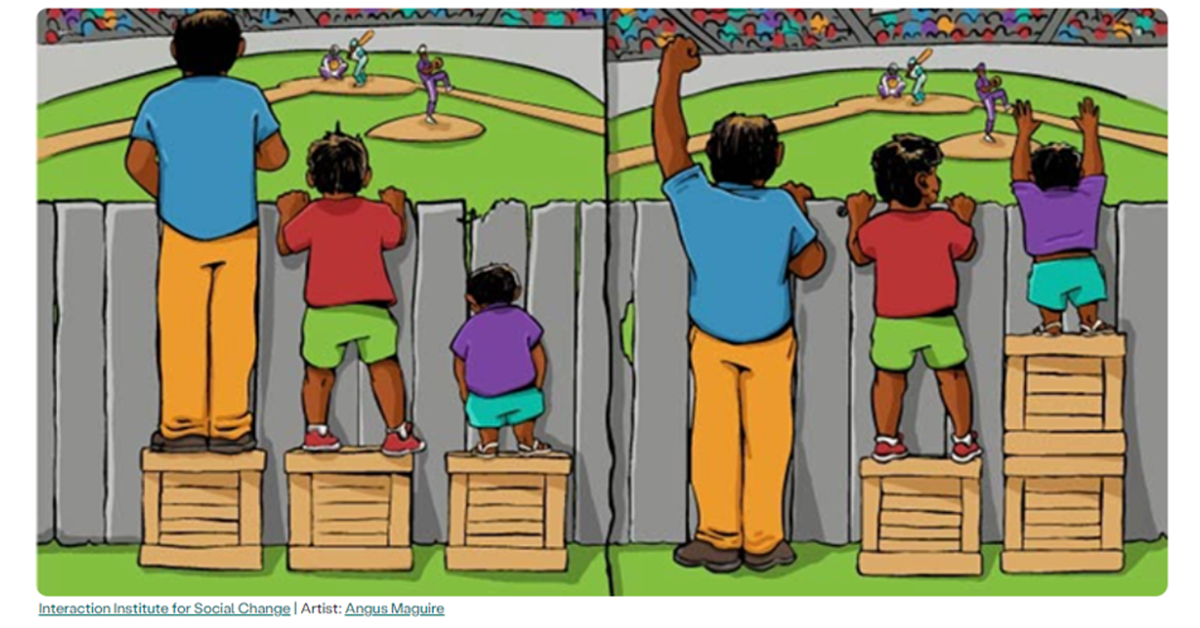
Equity is a necessity if we are serious about reducing the vast economic and social gaps in our society. Here is one definition of equity, as compared to equality, as offered by the Annie E. Casey Foundation:

Well-mean­ing peo­ple often use the terms “equi­ty” and “equal­i­ty” inter­change­ably when dis­cussing mat­ters relat­ed to race and social jus­tice. While both terms have to do with “fair­ness,” there are key dif­fer­ences as the appli­ca­tion of one over the oth­er may lead to dras­ti­cal­ly dif­fer­ent out­comes. Equal­i­ty requires that every­one receives the same resources and oppor­tu­ni­ties, regard­less of cir­cum­stances and despite any inher­ent advan­tages or dis­ad­van­tages that apply to cer­tain groups. Equi­ty, on the oth­er hand, con­sid­ers the spe­cif­ic needs or cir­cum­stances of a per­son or group and pro­vides the types of resources need­ed to be successful.

Equal­i­ty assumes that every­body is oper­at­ing at the same start­ing point and will face the same cir­cum­stances and chal­lenges. Equi­ty rec­og­nizes the short­com­ings of this “one-size-fits-all” approach and under­stands that dif­fer­ent lev­els of sup­port must be pro­vid­ed to achieve fair­ness in outcomes.

A high­ly cir­cu­lat­ed image seeks to pro­vide a visu­al illus­tra­tion of the dif­fer­ences between equal­i­ty and equi­ty. The image depicts three peo­ple stand­ing behind a fence, watch­ing a base­ball game. The three indi­vid­u­als are all dif­fer­ent heights, with the tallest of the three being able to see over the fence with­out any help. The oth­er two are not tall enough to see over. Equal­i­ty pro­vides each of these peo­ple with iden­ti­cal box­es to stand on to peer over the fence. The tallest per­son, who didn’t need the box in the first place, now stands even high­er, con­tin­u­ing to enjoy a per­fect view of the game. The sec­ond per­son can now see over the fence, and the third per­son, even with the help of the box, is still too short to see over.

The image also depicts what equi­ty would look like in this same sce­nario. In the equi­ty ver­sion, the tallest per­son does not receive a box and is still able to enjoy the game. The sec­ond per­son is giv­en one box to stand on, and the third per­son is giv­en two box­es to stand on. Now, all three can enjoy the same view of the game.

Equity vs Equality

The most classic definition of equity in my lifetime was contained in a speech that President Lyndon B. Johnson gave at Howard University in 1965.

He said:

Freedom is not enough. You do not wipe away the scars of centuries by saying: Now you are free to go where you want, and do as you desire, and choose the leaders you please.

You do not take a person who, for years, has been hobbled by chains and liberate him, bring him up to the starting line of a race and then say, “you are free to compete with all the others,” and still justly believe that you have been completely fair.

Thus it is not enough just to open the gates of opportunity. All our citizens must have the ability to walk through those gates.

This is the next and the more profound stage of the battle for civil rights. We seek not just freedom but opportunity. We seek not just legal equity but human ability, not just equality as a right and a theory but equality as a fact and equality as a result.

For the task is to give 20 million Negroes the same chance as every other American to learn and grow, to work and share in society, to develop their abilities–physical, mental and spiritual, and to pursue their individual happiness.

To this end equal opportunity is essential, but not enough, not enough. Men and women of all races are born with the same range of abilities. But ability is not just the product of birth. Ability is stretched or stunted by the family that you live with, and the neighborhood you live in–by the school you go to and the poverty or the richness of your surroundings. It is the product of a hundred unseen forces playing upon the little infant, the child, and finally the man.

The speech was written by LBJ’s White House aide, Daniel Patrick Moynihan. A brilliant Harvard professor, he later was Ambassador to the UN and elected to the US Senate in New York.

As for “inclusion,” it’s a word that means nothing more nor less than all. We commonly speak of equal opportunity for all, not for some. The Pledge of Allegiance refers to “liberty and justice for all,” not for some. All means all. All means inclusion.

Pete Hegseth recently said, “Diversity is not our strength.” What a stupid thing for the Secretary of Defense to say in light of the diversity of our military. Does he want to oust everyone from the military except white nen?

When the U.S. team walks into the Olympic Stadium, it is the most diverse team in the world. I feel proud when I see them.

The fact is, my friends, we are led by a team of idiots. They are simpletons who want to turn the clock back many decades, at least to the 1950s, when the country was run by straight white men. Many barriers have fallen, allowing the rise of people who are not straight white men. (Trump actually has an out gay man in his Cabinet, the Secretary of the Treasury, but he is most certainly an outlier). Trump wants to restore the barriers that kept women and nonwhites out of leadership roles.

We have to push back every day. Don’t let Trump’s seething hatred and bigotry become normalized. Don’t let him wipe out 60 years of civil rights legislation.

At a reader’s suggestion, here is an even better graphic to define “equity.”

Haley Bull of Scripps News reported yesterday that Trump sent out an order to all 50 states warning that the federal government would cut off funding to any school that teaches about “diversity, equity or inclusion.”

She wrote:

The Department of Education is warning state education agencies they may lose federal funding if they do not remove DEI policies and programs to comply with the department’s interpretation of federal law.

A letter from the Department of Education Office for Civil Rights was sent to the departments of education in all 50 states, according to the Department of Government Efficiency.

“Institutions that fail to comply with federal civil rights law may, consistent with applicable law, face potential loss of federal funding,” acting assistant secretary for civil rights Craig Trainor writes in the letter. The message warns that “the department will vigorously enforce the law” to schools and state educational agencies receiving funding and that it will start taking measures “to assess compliance” in no more than 14 days.

The letter argues that a Supreme Court decision in Students for Fair Admissions v. Harvard, which found that affirmative action in the university’s admission process violated the equal protection clause of the Fourteenth Amendment, should apply more broadly. 

“The law is clear: treating students differently on the basis of race to achieve nebulous goals such as diversity, racial balancing, social justice, or equity is illegal under controlling Supreme Court precedent,” the letter states.

This letter fails to mention that since 1970, the U.S. Department of Education has been subject to a law that states clearly that no officer of the federal government may interfere with what schools teaching.

The law states: “No provision of any applicable program shall be construed to authorize any department, agency, officer, employee, of the United States to exercise any direction, supervision, or control over the curriculum, program of instruction, [or] administration…of any educational institution…or over the selection of library resources, textbooks, or other printed or published instructional materials.

The law is P.L. 103-33, General Education Provisions Act, section 432.

These zealots are trying to turn teaching about civil rights, about Black history, and about LGBT people into a criminal act.

They are wrong. Reality exists no matter what they ban and censor.

They are violating the law, and they must be stopped.

They must be sued by the ACLU, the NAACP, and every other legal organization that defends the rule of law.

DOGE swept into the Institute of Education Sciences at the U.S. Department of Education and, following its advice, the Trump administration canceled $900 million in contracts. Bear in mind, this is the team of 20-somethings who knows a lot about software and coding. It’s unlikely that they know anything about education research.

This is the agency that I ran 30 years ago when I was Assistant Secretary of Education in the first Bush administration. At that time it was called the Office of Education Research and Improvement. I could have suggested some cuts, but certainly not $900 million!

What really bothers me is that this group of kiddies could not possibly know enough to judge the quality of the work they were canceling. Not in a day. Impossible. This was just a slash and burn operation.

ProPublica reported:

The Trump administration has terminated more than $900 million in Education Department contracts, taking away a key source of data on the quality and performance of the nation’s schools.

The cuts were made at the behest of Elon Musk’s cost-cutting crew, the Department of Government Efficiency, and were disclosed on X, the social media platform Musk owns, shortly after ProPublica posed questions to U.S. Department of Education staff about the decision to decimate the agency’s research and statistics arm, the Institute of Education Sciences.

A spokesperson for the department, Madi Biedermann, said that the standardized test known as the nation’s report card, the National Assessment of Educational Progress, would not be affected. Neither would the College Scorecard, which allows people to search for and compare information about colleges, she said.

IES is one of the country’s largest funders of education research, and the slashing of contracts could mean a significant loss of public knowledge about schools. The institute maintains a massive database of education statistics and contracts with scientists and education companies to compile and make data public about schools each year, such as information about school crime and safety and high school science course completion.

Its total annual budget is about $815 million, or roughly 1% of the Education Department’s overall budget of $82 billion this fiscal year. The $900 million in contracts the department is canceling includes multiyear agreements.

Trump selected Linda McMahon to be the next Secretary of Education. She is well known for making it rich in the world of wrestling entertainment, in partnership with her husband. Less well known is her role as Chair of the board of the America First Policy Institute (AFPI). Trump is close to AFPI, which promotes school choice and the “parental rights” movement, which promotes censorship of books and curriculum about racism and LGBT topics. They oppose any teaching that might make students “uncomfortable,” like learning about the history of racism, or that might teach students that LGBT exist.

The Nation published an article by Christopher Lewis and Jacob Plaza. The article tells the story of the think tank McMahon leads. It was launched after Trump’s loss in 2020 and its policy agenda defines Trump’s plans. To understand what Trump intends to do, learn more about AFPI.

Lewis and Plaza write:

Amid the incoming Trump administration’s flurry of unqualified, corrupt, and/or vengeance-driven cabinet nominees, it’s been easy to overlook Linda McMahon, Trump’s pick to head the US Department of Education. McMahon is best known for her role in running World Wrestling Entertainment (WWE) with her husband the longtime Trump crony Vince McMahon. Linda McMahon’s background in education is exceedingly thin; she served on the Connecticut Board of Education more than a decade ago, thanks to an appointment from another politically connected friend, then–Connecticut Governor Jodi Rell. McMahon has a teaching certificate but has never actually taught. Indeed, she was forced to resign her spot on the Connecticut board when the Hartford Courant reported that she’d lied on her résumé about having an education degree. Add in the alleged role of the WWE and its parent company in a sexual-abuse scandal involving “ring boys” for the wrestling league, and McMahon’s nomination, in any sanely administered political order, would be dead in the water. (McMahon and her husband both deny the abuse allegations in the pending WWE suit.)

Yet McMahon possesses one key credential for the next Trump administration—in addition, that is, to a proven track record to personal fealty to the president-elect, and a long string of Fox News appearances: She’s the former head of the America First Policy Institute (AFPI), the policy nerve center for MAGA governance. For all the attention focused on the Heritage Foundation and its Project 2025 policy agenda, AFPI has been Trumpworld’s principal policy network, serving as a haven for former Trump appointees during the Biden years. AFPI hands assembled a detailed blueprint for Trump’s return to power, including plans to make the Trump tax cuts permanent and purge the federal workforce of civil service workers deemed insufficiently MAGA. In addition to McMahon, Trump has tapped several senior AFPI figures for cabinet posts, including EPA nominee Lee Zeldin, Agriculture nominee Brooke Rollins (the think tank’s president and CEO), and its Georgia chapter chair, Doug Collins, Trump’s pick to head the Department of Veteran’s Affair

As education secretary, McMahon would be charged with administering a uniquely destructive suite of policies, even by the usual standards of Trump governance. That’s because the Department of Education has been a bête noire of the American right ever since Jimmy Carter founded the agency in 1979. By creating a layer of federal oversight over locally run schools, the DOE has, in the overheated imaginings of right-wing policy mavens, arrogated deep-state sovereignty over the rights of parents to preside over the best educational options and life chances for their children. And as the Education Department has sought to clarify and standardize anti-discrimination policy for LGBTQ+ students, it’s become a pet target for anti-trans culture warriors on the right.

McMahon probably won’t heed the growing chorus of conservative calls to abolish the DOE outright, but she can be counted on to aggressively pursue other key MAGA objectives in education policy. In line with her work at AFPI, McMahon will likely continue to promote the use of privately backed charter schools to defund public education—the most fundamental plank of right-wing education policy. In addition, she’ll probably resume her predecessor Betty DeVos’s campaign to deny basic Title IX protections to LGBTQ+ students. And it’s a safe bet that she’ll also re-up plans to promote Trump’s 1776 commission—MAGA’s agitprop answer to the 1619 Project, promoting a “patriotic” national curriculum to downplay and discourage honest discussion of America’s racial history in the schools.

Following the lead of billionaire right-wing donors, AFPI enthusiastically champions the charter-schools movement, while seeking to undermine the government’s role in providing quality public education. McMahon’s think tank has erected a whole policy infrastructure to promote charter schools, including direct public subsidies to them, the creation of education saving accounts (ESAs) for parents to enroll kids in charters, and proposals to weaken teachers’ unions in conjunction with the rise of open-shop charters. This agenda does more than harness the long-standing animus to government-backed education on the right—it advances the creation of a parallel education system for right-wing partisans. In this regard, as well as in its aggressive model of privatized education funding, the AFPI plan recalls the original role that neoliberal economics played in supporting the new ad hoc network of “segregation academies” launched in the American South after the 1954 Brown v. Board of Education ruling to desegregate the nation’s schools. The same basic dictum holds for today’s American right as it did then: If you can’t segregate with law, segregate with economics.

AFPI claims that charter school students have higher scores on standardized tests. In reality, the findings here follow what holds for better-funded public schools: namely, that well-funded charter schools tend to produce better test scores, while less well-off charters fare a bit worse, with some regional variations. Students in the competitive DC charter school system’s Opportunity Scholarships program, often cited as the gold standard by charter school advocates, actually performed worse on reading tests than those who did not attend the program.

School choice and voucher programs are a drain on the public’s coffers. For hard-right ideologues like the advisers at AFPI, that’s the whole point. Privatized education is part of the broader right-wing campaign to block the public sector’s ability to finance anything, especially if it would further racial equality. The National Education Association notes that voucher programs redirect scarce public funds toward unaccountable private school programs, and found zero evidence that these programs—which increase school segregation—improve students’ performance. In some cases, there are negative impacts.

What’s more, private management naturally leads to a focus on profit, financial self-sustainability, and expansion—mandates that typically lead to steep budget cuts in the schools, even if students suffer. According to the Network for Public Education, for-profit management companies run nearly one in seven charter schools.

AFPI has also endorsed federal legislation to create national education savings accounts. Like charter schools, ESAs seek to redirect public resources to market-driven gimmicks under the broad rubric of consumer choice. When parents open an ESA, they withdraw their children from the school district and receive a deposit of public funds in a savings account authorized by the government. Parents are then allowed to spend from that account on a range of educational expenses, including tutoring, therapy, or school supplies.

ESA plans create an obvious bind by forcing parents to navigate the education industry all on their own. The ESA scheme affords no safeguards for students whose parents made poor spending choices with the funds in their account. A report in Forbes recounted the story of a family using up its entire account before paying for a single English or math class. And like the broader charter model it upholds, the savings-account system reinforces, rather than weakens, the core inequalities of the US education system; it ensures that wealthier parents will be able to afford to send their children to the best schools.

For a bracing illustration of how charter and for-profit education schemes pillage publicly funded schools, consider Chicago’s experience. In 2013, the city closed 48 public schools to cover widening budget shortfalls. And Chicago’s public schools were going broke in no small part due to the rapid expansion of a parallel charter systemcaptained by ardent school privatizers. Since the insurgent charter schools operated outside traditional governance and accountability, they accumulated millions in debt while draining desperately needed funding away from public schools. Ultimately, 17,000 students were displaced, and Chicago was left with a more unequal and racially segmented school system than it had at the outset of the city’s charter-school fiasco.

To finish reading the article, open the link.

This article just appeared on the website of The New York Review of Books.

https://www.nybooks.com/online/2025/01/11/their-kind-of-indoctrination/

It is my review of Trump’s plans for K-12 education.

NYRB is the most distinguished literary-political journal in the nation. It has a huge readership. It reaches a different audience than education journals.

If you subscribe to NYRB, you can open it in full. If you don’t, it costs $10 for 10 issues. Or, if you wait, I will post it in full in a few weeks.