Archives for category: Trump

Heather Cox Richardson points to a sad contradiction: Trump plans to build a monumental arch while tearing down the federal building that symbolizes Social security and the belief that government should serve and protect the American people. Of course, this disregard for history is of a piece with his decision to pave over the Rose Garden, to cover the Oval Office with Walmart gold, and to construct a massive ballroom that will dwarf the White House. All of this makes sense to a man with no respect for history and tradition.

Unknown: Will the triumphal arch have a statue of Trump astride a horse?

Heather Cox Richardson writes:

Last Tuesday, President Donald J. Trump showed to Canadian officials a plan for a triumphal arch that would sit on the banks of the Potomac River opposite the Lincoln Memorial in a traffic rotary at the Virginia end of the Arlington Memorial Bridge below Arlington National Cemetery. The idea, apparently, is to build the arch to commemorate the 250th anniversary of the United States in July 2026.

On Thursday, the White House press pool reported, the plan was laid out on President Donald J. Trump’s desk in the Oval Office. The massive stone arch appears to be the same height as or taller than the Lincoln Memorial. Early in the morning on Saturday, October 11, Trump posted on social media an artist’s rendering of what such an arch might look like, complete with what appears to be a gold winged victory statue at the top of the arch.

Triumphal arches are free-standing structures consisting of one or more arches crowned with a flat top for engravings or statues. They hark back to ancient Rome, where leaders built them to commemorate military victories or significant public events. Those arches inspired others, like the Arc de Triomphe in Paris, France, built to honor those who died in the French Revolutionary and Napoleonic Wars.

Observers immediately noted that the photographed plan showed the Lincoln Memorial facing the wrong way, and compared the Trump Arch both to the Arc de Triomphe and to another arch modeled on it: the German Arch of Triumph proposed by Adolph Hitler to commemorate Germany’s victory in World War II.

That triumphal arch was never built.

Architect Eric Jenkins told Daniel Jonas Roche of The Architect’s Newspaper that the proposed arch would disrupt the symbolic connection between the Lincoln Memorial and Arlington National Cemetery. The two are connected not only by the Arlington Memorial Bridge, but also by the Civil War. During that war, the nation began to bury its hallowed dead on the grounds of the former home of General Robert E. Lee, who led the troops of the Confederacy. Lee’s Arlington House sits directly behind the memorial to Lincoln, who led the United States to stop the Confederates from dismantling the nation.

The proposed construction of a triumphal arch contrasts with the expected sale and probable demolition of the Wilbur J. Cohen Federal Building on Independence Avenue in Washington, D.C. Completed in 1940, the Wilbur J. Cohen Federal Building was built to house the Social Security Board, the precursor to the Social Security Administration.

In August 1935, President Franklin D. Roosevelt signed the Social Security Act. That law established a federal system of old-age benefits; unemployment insurance; aid to homeless, dependent, and neglected children; funds to promote maternal and child welfare; and public health services. It was a sweeping reworking of the relationship between the government and its citizens, using the power of taxation to pool funds to provide a basic social safety net.

The vision of government behind the Social Security Act was very different from that of the Republicans who had run it in the 1920s. While men like President Herbert Hoover had embraced the idea of a “rugged individualism” in which men provided for their families on their own, those behind the Social Security Act recognized that the vision of a hardworking man supporting his wife and children was more myth than reality. They replaced that vision with one in which the government recognized that all Americans were equally valuable.

Their reworking of American government came from the conditions of the United States after the rise of modern industry. Americans had always depended on community, but the harsh conditions of industrialization in the late nineteenth century had made it clear that the government must protect that community. City governments like New York City’s Tammany Hall began to provide a basic system of social welfare for voters, making sure that they had jobs, food, and shelter and that women and children had a support network if a husband or father died.

Then, in the 1930s, the overwhelming unemployment, hunger, and suffering during the Great Depression showed that state governments alone could not adjust the conditions of the modern world to create a safe, supportive community for ordinary people. FDR’s secretary of labor, Frances Perkins, came to believe that, as she said: “The people are what matter to government, and a government should aim to give all the people under its jurisdiction the best possible life.”

And so Perkins pushed for the Social Security Act, the law that became the centerpiece and the symbol of the new relationship between the government and American citizens.

Once FDR signed the law, the next step was to create a building for its administrators. To decorate a building that would be the centerpiece of the government’s new philosophy, administrators announced a competition for the creation of murals to decorate the main corridor of the new building.

Among those who threw their hats into the ring was Lithuanian-born American artist Ben Shahn, one of the most sought-after artists in the United States, a social realist painter who designed murals to illustrate “the meaning of Social Security.” Shahn wrote: “I feel that the whole Social Security idea is one of the real fruits of democracy.” He set out to show that idea in his art.

Shahn depicted the evils of a world of economic insecurity, showing “endless waiting, men standing and waiting, men sitting and waiting, the man and boy going wearily into the long empty perspective of a railroad track.” He showed the “little girl of the mills” and “breaker boys working in a mine. The crippled boy issuing from the mine symbolizes the perils of child labor…a homeless boy is seen sleeping in the street; another child leans from a tenement window.” He showed “the insecurity of dependents—the aged and infirm woman, the helpless mother with her small child.”

Then he illustrated the alleviation of that insecurity through government support. He showed “the building of homes…[and] tremendous public works, furnishing employment and benefitting all of society… youths of a slum area engaged in healthy sport in handball courts…the Harvest—threshing and fruit-gathering, obvious symbols of security, suggesting also security as it applies to the farm family.”

Shahn finished the pieces in 1942, and said: “I think the Social Security mural is the best work I’ve ever done…. I felt I had everything under control—or almost under control—the big masses of color to make it decorative and the little details to make it interesting.”

Shahn’s work stood alongside that of Philip Guston, who depicted the well-being of the family under the Social Security Act; Seymour Fogel, whose portrait of security included children learning and a table piled with food; and sisters Ethel and Jenne Magafan, who were warned their mural in the boardroom should not distract the members, so they painted mountains in snow. Gray Brechin, the founder of the Living New Deal, a nonprofit that tracks the fate of New Deal art, told Timothy Noah of The New Republicthat the Cohen building is “a kind of Sistine Chapel of the New Deal.”

But by the time Shahn and the other artists had completed their work, Noah explains, plans for the building had changed. The Social Security Administration never occupied it. First, the War Production Board, which managed the conversion of U.S. companies to wartime production, commandeered the building, and then in 1954 the Voice of America (VOA) moved in.

Like most federal buildings, the Cohen building is owned by the General Services Administration (GSA), to which the agencies in the building pay rent. With a total budget of $300 million, the VOA’s rent could not keep the building up, and in 2020, under the first Trump administration, the GSA told the VOA that it would have to vacate the building by 2028. During the Biden administration, Noah reports, the GSA proposed renovating the building to make it “a flagship in the federal government portfolio,” but before the report was widely circulated, Senator Joni Ernst (R-IA) inserted into a water resources bill a provision to sell the building.

Now, although the market for commercial buildings is depressed, the Trump administration is proceeding with the sale.

Since taking office in January 2025, officials in the second Trump administration have made war on the vision of government embodied by the Social Security Act, promoting in its place a return to the rugged individualism that is even less true today than it was a century ago.

Now the administration is getting rid of the building built to house the Social Security Administration, along with the murals that champion the government’s role in protecting the equality and security of ordinary people, while Trump contemplates building a triumphal arch, carving MAGA ideology into the nation’s capital in stone.

It’s hard to know which member of Trump’s Cabinet is the most unhinged. Some might say it is Kristi Noem, who has a cruelty streak that she showed when she shot her dog in the head and when she glories in sending ICE to beat up immigrants and citizens and to tear families apart. Or it could be Pete Hegseth, who takes pleasure in firing military officers who rank and service far exceed his. Or it could be the Energy Secretary what’s-his-name who prefers fossil fuels and shares Trump’s antipathy to clean energy, wind or solar.

But I nominate Robert F. Kennedy Jr., who embarrasses himself almost every time he speaks.

There are many reasons to question his judgment, including his hostility to science.

He seems to have a particular contempt for Jews. His latest outrage was to convince Trump that there is a well-established link between circumcision and autism. Even in his telling, it’s not clear whether autism is “caused” by circumcision or by the Tylenol that doctors prescribe for pain.

If he were right, a striking proportion of Jewish males would be afflicted with autism. Virtually all Jewish males are circumcised.

Should Jewish families stop circumcising their male children or stop giving them Tylenol? It’s not clear.

Scientific American says that RFK Jr. and Trump are wrong about the connections among circumcision, Tylenol, and autism. The two studies upon which he relies are fundamentally flawed, they say.

Helen Tager-Flusberg, an autism researcher and a professor emerita at Boston University, calls the methods used in those studies “appalling.” Tager-Flusberg leads the Coalition of Autism Scientists, a group that advocates for high-quality autism research.

Neither study shows a causal link between circumcision—or the pain relief medications that are often prescribed along with the procedure—and higher rates of autism. In the decade-plus since each was published, autism researchers have heavily criticized these studies. And after reviewing both studies, scientists last year found no evidence supporting the claim that circumcision leads to autism or any other adverse psychological effects.

But that’s not all.

In 2022, at an anti-vaccine rally, RFK Jr. said that people forced to take vaccines were worse off than Anne Frank or other victims of the Holocaust. He subsequently apologized for his appalling remarks.

Politico reported:

Anti-vaccine activist Robert F. Kennedy, Jr., apologized Tuesday for suggesting things are worse for people today than they were for Anne Frank, the teenager who died in a Nazi concentration camp after hiding with her family in a secret annex in an Amsterdam house for two years.

Kennedy’s comments, made at a Washington rally on Sunday put on by his anti-vaccine nonprofit group, were widely condemned as offensive, outrageous and historically ignorant. It’s the second time since 2015 that Kennedy has apologized for referencing the Holocaust during his work sowing doubt and distrust about vaccines…

“Even in Hitler’s Germany, you could cross the Alps to Switzerland. You could hide in an attic like Anne Frank did,” he told the crowd.

An investigation by The Associated Press last month found that Kennedy has invoked the specter of Nazis and the Holocaust when talking about public health measures meant to save lives during the pandemic, such as requiring masks or vaccine mandates.

In July 2023, while campaigning for President, RFK Jr. attacked the COVID vaccines and said they were designed to target Caucasians and blacks.

Politico reported:

Democratic presidential candidate Robert F. Kennedy Jr. denied allegations of racism and anti-Semitism Saturday after he reportedly suggested Covid-19 could have been genetically engineered to reduce risks to Ashkenazi Jews and Chinese people.

Kennedy — a longtime vaccine skeptic who is running a longshot primary campaign against President Joe Biden — said during a Tuesday night press event that Covid-19 was “targeted to attack Caucasians and Black people.” He went on to say that “the people who are most immune are Ashkenazi Jews and Chinese.”

Kennedy believed that his comments were not anti-Semitic. But he insisted they were true.

Asked about his comments from July in which he said Covid-19 was “ethnically targeted” to spare Ashkenazi Jews and Chinese people, Kennedy acknowledged that some people could be “disturbed” by the comments. But he said he believed “they certainly weren’t antisemitic.”

“I wish I hadn’t said them, you know. What I said was true,” he said. “The only reason I wouldn’t talk publicly about this … is that I know that there’s people out there who are antisemitic and can misuse any information.”

He never offered any evidence that the COVID vaccine was designed to spare Jews and Chinese. Was it a hunch?

RFK Jr. has a problem with Jews.

The U.S. Department of Education invited 9 eminent universities to join a “compact” in which they would adopt Trump priorities in exchange for assurances of future federal funding. Trump priorities include abolishing any efforts to advance diversity, equity, and inclusion; assuring that rightwing views are accorded equal time; and agreeing that students would be admitted solely by merit (i.e. test scores). This “compact” means intrusion of the federal government into the internal decision-making of the university.

The first institution to respond was the Massachusetts Institute of Technology. Its president Dr. Sally Kornbluth, a cell biologist, wrote this letter to Secretary of Education Linda McMahon, a wrestling entrepreneur:

Regarding the Compact

October 10, 2025

Sally Kornbluth, President

Dear members of the MIT community, 

The U.S. Department of Education recently sent MIT and eight other institutions a proposed “Compact for Academic Excellence in Higher Education,” along with a letter asking that MIT review the document.

From the messages I’ve received, I know this is on the minds of many of you and that you care deeply about the Institute’s mission, its values and each other. I do too. 

After considerable thought and consultation with leaders from across MIT, today I sent the following reply to U.S. Education Secretary Linda McMahon. 

Sincerely,
Sally Kornbluth


Dear Madam Secretary,

I write in response to your letter of October 1, inviting MIT to review a “Compact for Academic Excellence in Higher Education.” I acknowledge the vital importance of these matters.

I appreciated the chance to meet with you earlier this year to discuss the priorities we share for American higher education.

As we discussed, the Institute’s mission of service to the nation directs us to advance knowledge, educate students and bring knowledge to bear on the world’s great challenges. We do that in line with a clear set of values, with excellence above all. Some practical examples:

These values and other MIT practices meet or exceed many standards outlined in the document you sent. We freely choose these values because they’re right, and we live by them because they support our mission – work of immense value to the prosperity, competitiveness, health and security of the United States. And of course, MIT abides by the law.

The document also includes principles with which we disagree, including those that would restrict freedom of expression and our independence as an institution. And fundamentally, the premise of the document is inconsistent with our core belief that scientific funding should be based on scientific merit alone.

In our view, America’s leadership in science and innovation depends on independent thinking and open competition for excellence. In that free marketplace of ideas, the people of MIT gladly compete with the very best, without preferences. Therefore, with respect, we cannot support the proposed approach to addressing the issues facing higher education.

As you know, MIT’s record of service to the nation is long and enduring. Eight decades ago, MIT leaders helped invent a scientific partnership between America’s research universities and the U.S. government that has delivered extraordinary benefits for the American people. We continue to believe in the power of this partnership to serve the nation.

Sincerely,
Sally Kornbluth

cc
Ms. May Mailman
Mr. Vincent Haley

This is an extraordinary video, showing ICE-DHS employees turning away a Catholic priest who wanted to hold communion for ICE detainees. These are people suffering a cruel fate. Why not allow them the comfort of their religion?

https://www.tiktok.com/t/ZP8AamTnq/

Consider that the Supreme Court has been using the freedom of religion guarantee of the First Amendment to tear down the “wall of separation” between church and state and to legalize discrimination against gays.

Why then is is legal or acceptable for ICE to refuse to allow religious freedom to detainees?

The Trump administration used a threat to try to cow leading universities to abandon their independence. The administration called their offer a “Compact,” but in reality it was an offer of protection money. The old way of the Mafia: “Pay us and we will make sure no one breaks your windows or vandalizes your store.”

Vimal Patel of The New York Times reported:

M.I.T. became the first university to reject an agreement that would trade support for the Trump administration’s higher education agenda in exchange for favorable treatment.

The proposal, called the “Compact for Academic Excellence in Higher Education,” was sent to nine universities and would require colleges to cap international student enrollment, freeze tuition for five years, adhere to definitions of gender and prohibit anything that would “belittle” conservative ideas.

In a letter on Friday to the Trump administration, M.I.T.’s president, Sally Kornbluth, wrote that the university has already freely met or exceeded many of the standards outlined in the proposal, but that she disagrees with other requirements it demands, including those that would restrict free expression.

“Fundamentally, the premise of the document is inconsistent with our core belief that scientific funding should be based on scientific merit alone,” Dr. Kornbluth wrote.

A White House spokeswoman, Liz Huston, said in a statement that “any university that refuses this once-in-a-lifetime opportunity to transform higher education isn’t serving its students or their parents — they’re bowing to radical, left-wing bureaucrats.”

“The best science can’t thrive in institutions that have abandoned merit, free inquiry, and the pursuit of truth,” she added. “President Trump encourages universities to join us in restoring academic excellence and common sense policies.”

The White House has said it wants responses from the universities by Oct. 20. The other eight colleges are the University of Arizona, Brown University, Dartmouth College, the University of Pennsylvania, the University of Southern California, the University of Texas, Vanderbilt University and the University of Virginia.

The compacts have been deeply unpopular among faculty members, who view them as yet another political intrusion into the affairs of academia. They argue that the Trump administration is threatening the independence of American higher education by cutting hundreds of millions of dollars in research funding to force top universities to adopt its agenda.

What happens when government data are politicized? What happens when a President fires the professionals who report the data and replace them with his loyalists?

Jack Hassard, a retired professor of science education at Georgia State University, knows what happens. Hassard followed Trump’s behavior in his first term and wrote a book called The Trump Files.

The problem with Trump has accelerated now that he is surrounded by a well-organized cabal of far-right extremists who are turning him into a dictator.

Dear Jack,1

I was eight the last time the numbers were real.

Every Friday, my mother would check the Bureau of Labor Statistics dashboard. She did this the way some families checked the weather. She was quiet and anxious, with a hand on the mouse and a furrow in her brow. The numbers told her how many people had lost work that week. They showed how fast prices were rising. The data revealed whether the rent hikes were outpacing wages again. It was her way of listening for distant thunder. Today, nevertheless, the BLS dashboard is not updating information because of the Republican led government shutdown.

The dashboard went dark the spring Trump returned to power. At first we thought it was just another funding fight, like the ones that had knocked websites offline before. But weeks passed, and the updates never came back. My mother kept refreshing the page for months, like a ritual for a ghost.

By the end of that summer, more pages were vanishing. Climate dashboards froze mid-storm season. Food insecurity surveys were “postponed indefinitely.” Vaccine data disappeared without explanation. By winter, it was as if the country had decided to stop looking at itself in the mirror.

They called it austerity. They said it was about cutting “red tape” and “freeing the agencies from bloated bureaucracy.” But everyone could feel the chill. It wasn’t just numbers that were being cut. It was the nerves that told us where the pain was.


We didn’t realize it at the time. This was how the silence began. It began not with censorship in the usual sense but with a subtraction of knowledge.

When the data stopped, arguments stopped making sense. People clung to whatever numbers their preferred networks fed them, like castaways grabbing driftwood. One station would say unemployment was rising; another insisted we were in a “golden age.” Both cited “official sources,” but the sources were gone, hollowed out or replaced by Trump’s loyalists.

At school, the teachers tried to explain inflation, but the charts they used were months out of date. Some parents started printing memes as evidence. Others stopped trusting the schools entirely.

Looking back, it’s astonishing how quickly civic discourse disintegrated once the shared factual floor cracked. We had thought democracy died in coups or riots. Instead, it died in data voids—quiet gaps that widened into abysses.


My father used to call it “the silence before the storm.” Storms were his touchstone for everything. He said the scariest part wasn’t the wind or the rain. It was the moment the air went unnaturally still. You realized the warning systems had failed.

That silence descended over our public life. When pollution monitoring sites shut down, a chemical spill in Savannah went undetected for weeks. By the time the numbers surfaced through a university backchannel, children were already sick. When the food insecurity survey was cut, hunger surged invisibly. Relief programs couldn’t track where the need was worst.

And when climate data went dark, the storms didn’t stop. They just stopped being predictable. The year the NOAA dashboards froze was the year the Atlantic hurricanes changed course mid-season. Thousands died inland, where no one expected them.

The silence didn’t come from ignorance. It came from a deliberate decision to turn off the lights.


I know you study this era, Jack, so you know the official explanations: budget cuts, “efficiency reforms,” sovereignty rhetoric. But those were just alibis. Trump understood something that too many defenders of democracy underestimated: data is power. Whoever controls the ability to measure reality controls the terms of debate.

His war on data wasn’t chaotic—it was methodical. Fire the agency heads who produce inconvenient statistics. Defund the surveys that expose inequality. Gut the climate monitors that contradict your conspiracies. Let loyal media amplify your alternate “facts.” Over time, the shared reality collapses, and the strongman narrative becomes the only stable frame left.

Our reader Christine Langhoff discovered an excellent analysis of the “compact” that the Trump administration has offered to several universities. A “compact” usually refers to an equitable agreement between two parties. The Trump “compact” is a harsh threat: sign or die.

Christine writes:

Here’s UCLA Law professor Joseph Fishkin on the so-called compact the administration want universities to accept.

Any lawyer—really, any careful reader—who makes it through even the first paragraph of the document can see that this is incorrect. The “compact” is quite explicit: Universities that do not sign on to this thing thereby “elect[] to forego federal benefits.” What benefits? Well, that same first paragraph lists quite a few specific “benefits”: “(i) access to student loans, grant programs, and federal contracts; (ii) funding for research directly or indirectly; (iii) approval of student and other visas in connection with university matriculation and instruction; and (iv) preferential treatment under the tax code,” which means 501(c)(3) status. This compact is a “reward” in exactly the same sense that it is “rewarding” to purchase protection from the Mafia. The compact is an open, explicit threat.

It nonetheless does represent a tactical shift on the part of the Trump Administration. The Trump team’s goal has not changed. They want an unprecedented—and flagrantly unconstitutional—degree of government oversight and control over American universities. So far they are having some trouble obtaining it. Their initial strategy, to roll up the sector from the top, starting with Harvard, through bespoke negotiated dealmaking with individual schools, has turned out to be slower going—and I suspect, simply more labor-intensive—than I am guessing they expected. (I use the rollup metaphor to evoke how a monopolist takes over a sector by buying out one firm after another, gaining more leverage over holdouts as they go. So far it has not worked.) Meanwhile, federal district courts have dealt a series of significant blows to the government’s ability to, for example, arbitrarily withdraw federal scientific research grants. So the administration is pivoting to a new tactic, which seems to be to roll up the higher ed sector from what you might call the upper middle. Instead of starting at the very top with the high-stakes confrontation with Harvard and working their way down, the new tactical approach is to start with whichever prestigious schools seem likeliest—for various reasons—to be amenable to the government’s overtures. It is no accident that many of the schools May Mailman’s team first approached about this “compact” have interim presidents, who are inherently weak, sometimes because a prior president was successfully forced out through political agitation by the right.

https://balkin.blogspot.com/2025/10/the-art-of-replacing-law-with-deal.html

https://www.bostonglobe.com/2025/10/04/business/white-house-university-compact-mit/

The new conditions for federal funding the Trump administration offered to MIT put the school in a no-win situation, people on the Cambridge campus and throughout academia said Friday: Agree to the federal government’s terms and surrender some academic freedom, or refuse and risk further punishment.

The White House’s proposed “Compact for Academic Excellence in Higher Education” — sent to MIT and eight other top-tier universitiesthis week — ties access to federal money to a string of conditions that, if agreed to, would effectuate the most substantial changes MIT has seen to date and fundamentally transform an economic powerhouse of Greater Boston. 

The 10-point document asks the list of schools — which also includes Brown and Dartmouth — to cap international student enrollment, freeze domestic tuition rates for five years, and commit to strict definitions of gender. Some of those requests, such as reducing tuition and the number of international students, are popular with many Americans. But others, including one to limit the speech of university employees, strike at the heart of freedom and independence that universities have long prized.

While MIT declined to comment, on campus and in academia, there doesn’t appear to be much inclination to make a deal with the White House.

The offer amounts to “a loyalty oath to the federal government,” said Catherine D’Ignazio, an MIT professor of urban studies and planning. 

MIT and other schools face new set of demands from White House.

“They’re asking us to sacrifice science. They’re asking us to sacrifice international students. They’re asking us to sacrifice our trans students. They’re asking us to sacrifice our whole idea of shared governance,” D’Ignazio said. “No amount of money is worth that great long list.”

The mandate also says that universities should transform or abolish “institutional units that purposefully punish, belittle, and even spark violence against conservative ideas.” That’s troubling, said Tyler Coward lead counsel for government affairs at the Foundation for Individual Rights and Expression, because it conflates allowing speech with condoning violence.

“This mandate basically forces these institutions to remain silent in order to secure some government benefit,” Coward said. “I think that is a problem, a First Amendment problem.”

MIT is free to decline, the administration wrote in the compact, but doing so would mean the institution “elects to forgo federal benefits” that power much of the school’s vast research operations, spurring innovations and paychecks that ripple across Greater Boston and around the globe.

MIT is the birthplace for countless startup companies, forms the backbone of Kendall Square, and serves as a first landing place for many students — roughly 30 percent of whom come from abroad — who stay and build careers in Massachusetts. 

MIT’s endowment is heavily invested in Kendall Square real estate. Here’s why that could be a problem.

Federal money plays a key role in seeding all that. Last year, MIT collected $648 million in government funding for sponsored activities, including research, which federal agenciescould simply choose to award elsewhere.

The provisions in the compact, said Sandy Baum, a higher education finance expert with the think tank The Urban Institute, amount to “dramatic requests” of MIT from a dollars-and-cents perspective. 

MIT is already bracing for a $300 million reduction in its central budget from the newfound 8 percent tax on its endowment and potential losses of federal science funding that powers much of its massive research arm, university administrators said in a September staff forum. (A recording of the meeting was reviewed by the Globe.) 

In the spring, MIT saved roughly $100 million by freezing hiring and instituting a 5 percent cut to department budgets. It plans to close the remaining $200 million gap by terminating some real estate leases and seeking outside private funding for some academic priorities, including climate change, life sciences, and artificial intelligence, according to details shared at the staff forum. Administrators said that they may also withhold merit raises for employees next year. 

“We do need to treat the $300 million amount as a permanent burden on the central budget that requires a permanent budgetary solution,” Glen Shor, MIT’s executive vice president and treasurer said at the September meeting. “Even if power at some point changes hands in Washington, we can’t count on these policies being reversed.”

Meanwhile, signing onto the compact could impact the number of international students at MIT, who make up around 10 percent of its undergraduate population — less than the limit set in the agreement. (Around 40 percent of MIT graduate students are from abroad.) Many international students pay full price to attend MIT, which can cost nearly $90,000 between tuition, housing, and other expenses. MIT would also pledge to cover the cost of attendance for all students studying hard sciences, such as physics, chemistry, and biology. 

“If [MIT] had to freeze tuition and limit [the] number of international students, that would be a huge hit,” said Baum, the university finance expert. 

Multiple MIT student organizations signed a letter Friday asking MIT to “firmly refuse” to sign the document, claiming that “accepting such a compact would effectively destroy the institutional culture of MIT as we know it.”

Nadia Zaragova, a material sciences PhD student and vice president of the graduate student union, said it would give the federal government “undue oversight over what we do here at the university, including our classrooms, what we study, what we research.”

And Governor Maura Healey, who has proposed $400 million in state funding to help make up for lost federal funds to Massachusetts universities, urged MIT to stand strong, describing the White House offer as “yet another attempt by President Trump to silence speech.”

MIT supporters note the university has already taken up some measures pushed by the Trump administration, including winding down its Institute Community and Equity Office and taking disciplinary actions against students — including a commencement speaker — who participate in pro-Palestinian protests. 

Indeed, MIT was chosen among the schools who received the compact because they are seen as “good actors,” according to May Mailman, senior adviser for special projects at the White House.

“They have a president who is a reformer or a board that has really indicated they are committed to a higher-quality education,” she said to The Wall Street Journal. 

But Ian Hutchinson, an MIT emeritus professor and co-president of its Council of Academic Freedom, said that even those in favor of those moves have sour feelings about the new offer from the administration. 

“Many of us on the council think that the modern academy needs to reform and [is] beginning to do so and that the compact has the risk of alienating a large fraction of the faculty,” he said. 

Others fear that some professors could leave entirely, should the school sign onto the compact. 

A better approach, Hutchinson added, would be if “the government makes clear what it is interested in funding in the way of research and what it is not interested in funding.”

The compact also frames preserving “single-sex spaces” such as bathrooms and locker rooms as necessary for “women’s equality” and stipulates institutions must commit to defining gender “according to reproductive function and biological processes.”

Mila Halgren, an MIT postdoctoral associate, said including such language is an affront to what the values of American higher education should be. 

“In a personal capacity, every moment MIT even considers this compact is a betrayal of every marginalized group on campus,” she said. “That MIT did not immediately reject a proposal which defines trans people out of existence is shameful.”

In the post at 9 a.m. today, two scholars of racism and equity explained that Trump’s scrubbing of museums, national parks, and other federal facilities is an attempt to capture control of the culture and erase the place of Blacks, women, and anyone else who is not a straight white male.

But, as scholar Julian Vasquez Heilig writes here, Trump and his commissariat cannot control the popular culture. In time, we can hope, his mean-spirited efforts to revise history will become a bad joke, a cruel joke, a stupid joke. He and all those who carry out his orders will become a public laughing stock.

Vasquez Heilig writes on his blog Cloaking Inequity:

The Super Bowl has always been more than football. It is a ritual, a spectacle, a national performance. It’s where America tells the world who it thinks it is, and who it wants to be. Which is why the announcement that Bad Bunny will host the halftime show is far more significant than a musical lineup change. It’s a cultural earthquake.

I remember the first time I heard Bad Bunny. It was December 6, 2019, at La Concha Hotel in San Juan. In the downstairs lounge, the beat of reggaetón was shaking the walls, and I pulled out Shazam to figure out what it was. The song was Vete. The room was electric, filled with Puerto Ricans singing every word in Spanish, unapologetically themselves. That night, it hit me: Bad Bunny was not just making music in San Juan, he was celebrating culture. He wasn’t crossing over into the mainstream by adapting; he was dragging the mainstream toward him. He refused to translate, refused to dilute, and now he is everywhere—on playlists, on charts, SNL, in crowded places from San Juan to New York to Madrid.

That’s why his Super Bowl moment matters so much. It is not just a performance, it is the culmination of a global movement that began in places like that basement lounge in Puerto Rico. What felt local then is now universal. Bad Bunny’s rise shows how culture flows upward, from the margins to the center, from overlooked communities to the biggest stage in the world. For millions of us, this is affirmation. For the right wing, it is destabilization. Because when the halftime show belongs to Bad Bunny, it proves that America is no longer just what they imagine it to be. It is bigger, louder, and more diverse than great again nostalgia can contain.

Jay-Z, Kendrick Lamar, and the New Halftime Era

The NFL’s halftime choices haven’t shifted by accident. When the league came under fire for its treatment of Colin Kaepernick and broader criticisms about racial injustice, it needed credibility. Enter Jay-Z and Roc Nation. The NFL tapped him to advise and help curate halftime shows.

The results have been undeniable. Kendrick Lamar’s halftime performance last year was a watershed moment—unapologetically Black, politically charged, and culturally defining. That performance sparked widespread discussion, and even a blog post I wrote about it entitled “TV Off”: What Kendrick Lamar Was Really Saying at the Super Bowl drew more than 100,000 readers in just a few days. Clearly, the hunger to talk about representation and ownership of the halftime stage is real.

Now with Bad Bunny taking the baton, the NFL is making another cultural statement, whether it fully realizes it or not (I think it does). The league’s biggest platform is no longer reserved for the safe, predictable acts of yesterday. It’s becoming a stage where hip hop, reggaeton, and the voices of communities once marginalized are front and center.

Bad Bunny and the Right’s Panic

For decades, the halftime show was dominated by choices that reinforced a narrow image of America: classic rock icons, country stars, or pop acts who wouldn’t ruffle feathers but had wardrobe malfunctions. Bad Bunny shatters that mold. His performance won’t be a side act, it is the show. Spanish won’t be a novelty; it will be central.

This is exactly why the right wing panics. To them, football Sundays and Super Bowls have long been “their” cultural territory. They’ve wrapped the game in patriotic rituals, military flyovers, and moments of silence for conservative heroes. When someone like Bad Bunny steps into the spotlight, it disrupts their monopoly. It forces a new definition of America—one that is multilingual, multicultural, and undeniably Latino. That’s what makes his halftime role so radical: after focusing on the Black experience with Kendrick, this year signals that Latino identity is no longer peripheral. It’s woven into the fabric of America’s biggest stage.

Why ICE Wants to Loom Over the Moment

It might sound absurd that ICE wants to connect itself to the Super Bowl halftime show, but immigration enforcement has always thrived in the shadows of visibility. When Latino joy and success are celebrated so publicly, ICE apparently feels the need to remind America of its terrorizing power.

Bad Bunny performing at the Super Bowl is a triumph of belonging. But ICE’s assaults, raids, arrests, kangaroo courts, and deportations are constant reminders that belonging is conditional on politics. While millions watch a Puerto Rican superstar, ICE agents are throwing mothers and journalists to the ground, spraying pepper liquid into the eyes of Americans who dare to ask questions, arresting elected politicians at the behest of Washington politicians after turning off their body cameras, and authorized by the Supreme Court to detain people simply for looking Latino and poor.

The contradiction is sharp: on the world’s stage, Latino identity is being widely celebrated; on America’s streets, it’s criminalized. ICE doesn’t need to show up at the stadium—it already shows up in our daily life. Its existence ensures that even at moments of cultural triumph, there’s a purposeful shadow of fear and terroristic threats.

Danica Patrick’s Tone-Deaf Criticism

And then, inevitably, a silly critic emerges from the sidelines. This time it’s Danica Patrick, who dismissed Bad Bunny’s hosting role. Her comments were more than unhelpful, they were stupid. 

Patrick should know better. She carved her own career by getting along in a male-dominated sport, where every step forward was a battle for representation. She knows the symbolic weight of breaking barriers. For her to turn around and mock or diminish Bad Bunny’s presence is hypocritical at best, willfully ignorant at worst.

Bad Bunny isn’t there to tick a diversity box, he’s there because he is one of the most influential artists alive— maybe THE most. The incredible success of his shows that he did for his most recent album this past summer ONLY in Puerto Rico is proof that the center of American culture is shifting. Criticizing that isn’t just a matter of taste. It’s a refusal to accept reality.

The Lions, Charlie Kirk, and Who Gets Tribute

The battle over cultural ownership in America doesn’t stop at the Super Bowl. It plays out every Sunday on the NFL field. When conservative commentator Charlie Kirk was assassinated, the league encouraged teams to hold moments of silence in his honor. Most complied. But the Detroit Lions, along with a few other teams, did not.

That decision matters. It was a quiet but deliberate act of boundary-setting, a refusal to let every NFL broadcast become a political ritual sanctifying right-wing political ideology. By declining the tribute, the Lions reminded us that not every form of patriotism must come prepackaged with conservative allegiance. It wasn’t loud or defiant. It was subtle and deeply symbolic. Sometimes resistance isn’t what you do, it’s what you decline to perform and participate.

The Lions’ restraint connects to the same cultural realignment symbolized by Bad Bunny’s Super Bowl performance. Both moments reject the idea that American culture belongs to a single tribe. They push back against the notion that sports, music, or patriotism must orbit one political pole. They insist, instead, that culture belongs to everyone, not just the loudest or the angriest voices claiming to defend it.

The Double Standard of Protest

Of course, this tension between culture, power, and dissent has long been visible in the NFL. When Colin Kaepernick knelt during the national anthem to protest police brutality, he was branded a traitor by many of the same voices now demanding “respect” for Charlie Kirk. His silent, dignified act of conscience was recast as an attack on America itself.

The outrage was never really about the flag. It was about control. It was about who is allowed to define what counts as “patriotic.” Kaepernick’s kneeling was an act of moral courage, but it exposed how fragile America’s cultural gatekeepers truly are when confronted with truth. They could not tolerate a protest that revealed their own comfort with injustice and brutality.

Meanwhile, state violence continues daily without the same moral outrage from the right-wing. ICE officers violently throw mothers and journalists to the ground without cause. They pepper-spray citizens in their eyeballs for daring to ask questions in a conversation. They arrest and detain American citizens in raids not for crimes but for looking poor, brown, or foreign. These acts have not provoked right-wing primetime outrage or public boycotts. Their hypocrisy is staggering.

A man kneeling quietly for justice was vilified. Agents brutalizing families are ignored. The problem has never been the method of protest, it has always been their morality. Silence in the face of injustice is acceptable; silence against injustice is not. The Lions’ quiet refusal and Kaepernick’s quiet protest share something profound: both disrupted the script of cultural obedience. Both reminded us that resistance isn’t always loud. Sometimes it’s the refusal to play along.

The Supreme Court’s Enabling Role

And looming behind all of this is the judiciary. Recent Supreme Court rulings have expanded law enforcement’s power, narrowing protections under the Fourth Amendment and giving politicians more leeway to persecute immigrants using federal data. Justice Brett Kavanaugh has been the lead in the right-wing judicial majorities that have handed law enforcement broad authority to stop, question, and detain anyone with minimal cause. Its new rulings have created the legal cover that now makes racial profiling essentially legal. 

Racial profiling has happen illegally before and the new legal result empowered by the Supreme Court is the same: citizens living under suspicion, families living in fear, communities targeted not for what they’ve done but for how they look. The Supreme Court has enabled ICE brutality in the same way NFL owners enabled the blackballing of dissent, by creating structures that justify exclusion and violence while insisting neutrality.

The Bigger Picture: Who Owns the Stage?

So what do Bad Bunny, Kendrick Lamar, Jay-Z, Danica Patrick, ICE, the Lions, Charlie Kirk, and Brett Kavanaugh all have in common? They are all part of the “fight, fight, fight” (see new Trump $1 coin) over who gets to define American culture.

The right wing has long claimed the NFL as its territory: its rituals, its tributes, its symbols of patriotism. But culture evolves. It cannot be contained. From Detroit to San Juan to Los Angeles, new voices are shaping the narrative. Bad Bunny’s halftime show, Kendrick’s explosive performance, and even the Lions’ silent refusal all tell the same story: football does not belong exclusively to one political ideology. Neither does America.

The real question is whether we are willing to see that America’s identity is bigger than its old rituals. Are we willing to admit that inclusion is not a threat but a fact? Because culture doesn’t wait for permission. It claims the stage. And this year, that stage will belong to Bad Bunny.


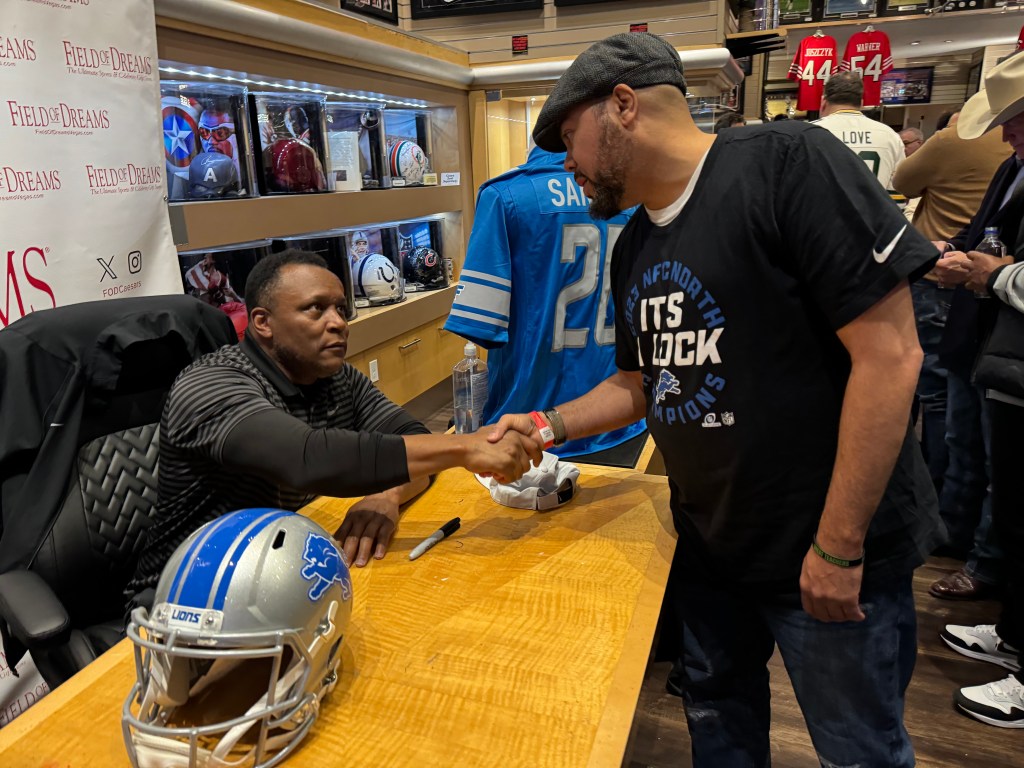
Julian Vasquez Heilig is a professor, writer, and a legit lifelong Detroit Lions fan since 1981. He attended the NFC Championship in San Jose two years ago to support his Cardiac Cats and last year’s playoff loss to the Washington Commanders at Ford Field. He was also at the official Lions partners party during the NFL Draft in Detroit, where he met Robert Porcher and Jason Hanson. Over the years he’s spotted Billy Sims in Times Square, endured the heartbreak of the Lions’ 0–16 season, and treasures his personally autographed Barry Sanders helmet. Beyond education and equity, Julian dabbles in writing about sports, culture, and society.

Two scholars–Kimberlé Crenshaw and Jason Stanley–explain why Trump is censoring exhibits at the Smithsonian. He has also imposed censorship of signage and exhibits at other federal sites, including national parks. He has enlisted the U.S. Department of Educatuon to organize rightwing groups to create a “patriotic” civics course.

  • Kimberlé Crenshaw is an American civil rights advocate and a scholar of critical race theory. She is a professor at the UCLA School of Law and Columbia Law School, where she specializes in race and gender issues
  • Jason Stanley is the Bissell-Heyd Chair in American Studies in the Munk School of Global Affairs & Public Policy at the University of Toronto and the author of Erasing History: How Fascists Rewrite the Past to Control the Future

Trump and his far-right cabal are l trying to revise history and memory. Unless he abolishes or rigs future elections, all this tinhorn fascist censorship will be swept away by his successors. He will rightly be judged, when that day comes, as the closest thing this country has ever seen to having a dictator. He will be portrayed in the Smithsonian and the textbooks as a buffoon and a tyrant.

This article appeared in The Guardian. Please open the link to read the entire article.

Crenshaw and Stanley write:

In a letter sent to Smithsonian secretary, Lonnie G Bunch III, on 12 August, the Trump administration announced its plan to replace all Smithsonian exhibits deemed as “divisive” or “ideological” with descriptions deemed as “historical” and “constructive”. On 21 August, just nine days later, the White House published a list of said offending fixtures – the majority of which include exhibits, programming and artwork that highlight the Black, Latino and LGBTQ+ perspectives on the American project. Included in his bill of particulars was an exhibit that rightly depicts Benjamin Franklin as an enslaver, an art installation that acknowledges race as a social construct and a display that highlights racist voter suppression measures, among others.

The assault on the Smithsonian comes wrapped, as it were, as part of a broader attack on democracy, scenes of which we see playing out every day. The federal occupation of Washington DC, the crackdown on free speech on campus, the targeting of Trump’s political opponents, the gerrymandering of democracy – these are interwoven elements of the same structural assault. So with many fires burning across the nation, concerned citizens who are answering the call to fight the destruction of democracy may regard his attack on history and memory as a mere skirmish, a distraction from the herculean struggle against fascism unfolding in the US. But this is a mistake. Trump’s attack on American museums, education and memory, along with his weaponization of racialized resentment to package his authoritarian sympathies as mere patriotism, is a critical dimension of his fascist aims. The fight for democracy cannot avoid it, nor its racial conditions of possibility.

Fascism always has a central cultural component, because it relies on the construction of a mythic past. The mythic past is central to fascism because it enables and empowers a sense of grievance by a dominant racial or ethnic group whose consent is crucial to the sustainability of the project. In Maga world, the mythic past was pure, innocent and unsullied by women or Black leaders. In this kind of politics, the nation was once great, a byproduct of the great achievements of the men in the dominant racial group. In short, the assault on the Smithsonian and, more broadly, against truthful history and critical reflection is part of the broader fascist attack on democracy.

From this vantage point, racial equality is a threat to the story of the nation’s greatness because only the men of the dominant group can be great. To represent the nation’s founding figures as flawed, as any accurate history would do, is perceived, in this politics, as a kind of treason.

The success of the fascist dismantling of democracy is predicated on the widespread systematic failure to see the larger picture. The anti-woke assault that is a key pillar of Trumpism is part of that failure, partly due to the racial blinders and enduring ambivalence of too many in positions of leadership in the media and elsewhere. Those who sign on to the attack on “wokeness” but regard themselves as opponents of the other elements of the fascist assault are under the mistaken assumption that these projects can be disaggregated. In fact, the dismantling of democracy and of racial justice are symbiotically entangled. To support one is to give cover for the others.

It is no coincidence that this ‘proper’ ideology Trump exposes is constitutive of a more well-known strand of fascism – nazism

It is clear that the Trump administration understands this relationship and fully weaponizes racist appeals as a foundational piece of its fascist agenda. And if this was once the quiet part, it is now pronounced out loud in official government documents. In an executive order issued on 27 March 2025 titled “Restoring Truth and Sanity to American History”, Trump reveals that his mandate to ban “improper ideologies” targets core commitments repudiating a scientific racism that historically naturalized racial hierarchy thereby neutralizing resistance. According to Trump, the problem with the Smithsonian American Art Museum’s exhibit The Shape of Power: Stories of Race and American Sculpture was that it promoted the idea that “race is a human invention”.

The understanding that race is a social construct as opposed to a biological fact is perhaps the most fundamental advance in repudiating enslavement, genocide and segregation. Rejecting the idea that racial inequality is natural or pre-ordained – a claim that grounded enslavement and dispossession in America – forms the cornerstone of the modern commitment to a fully inclusive democracy. Trump’s declaration that this cornerstone is “improper” is an effort to turn the clock back, upending the entire American postwar project. It is no coincidence that this “proper” ideology Trump exposes is constitutive of a more well-known strand of fascism – nazism. How else can we understand why Maya Angelou was purged from the Naval Academy library while Adolf Hitler remains?

The fight against fascism in the US must be as robust in its embrace of racial equality as Trump’s embrace of outdated ideas about race and racism. The defense of memory, of truthful history, of telling the whole American story rather than ascribing agency in history to the deeds of “great men” is vital to the American democratic project. A pro-democratic education fosters the agency of its citizens by teaching about social movements that overturned entrenched hierarchies which blocked democratic equality and imposed racial tyranny. The story of how ordinary Americans lived and struggled and remade America is essential knowledge in developing and sustaining a multiracial democracy. The Smithsonian has been a vital institution in making this knowledge accessible to the masses. The National Museum of the American Latino and the National Museum of the American Indian, for example, provide artifacts and perspectives about the nation’s westward expansion that challenge the myth of unoccupied territory and manifest destiny. The National Museum of African American History and Culture brings forward the global scale of enslavement as well as its infusion across national institutions, culture and politics.